

- Industry Size (2026)
- USD 780 Mn
- Forecast (2036)
- USD 1640 Mn
- CAGR (2026 to 2036)
- 7.7%
Titanium Dioxide-Reduced Opacifying Pigment Systems for Face Products Market Forecast and Outlook 2026 to 2036
The titanium dioxide-reduced opacifying pigment systems for face products market is valued at USD 780 million in 2026 and is projected to reach USD 1,640 million by 2036, with a compound annual growth rate (CAGR) of 7.7%. Regionally, the market’s growth will be influenced by differing regulatory environments and consumer preferences. North America and Europe will likely lead adoption, driven by stringent regulatory frameworks favoring safer, non-toxic ingredients in cosmetics. Meanwhile, adoption in emerging markets may lag due to cost sensitivities and less stringent regulations.
Geographic cost advantages will play a pivotal role, as suppliers in low-cost manufacturing regions may gain a competitive edge, offering reduced prices for raw materials or production. However, these regions may face challenges in meeting the higher performance standards required in more developed markets. As demand accelerates globally, companies will need to tailor their offerings to diverse market conditions, balancing cost, regulatory compliance, and product performance to capture value in both developed and emerging economies.
Quick Stats of the Titanium Dioxide-Reduced Opacifying Pigment Systems for Face Products Market
- Titanium Dioxide-Reduced Opacifying Pigment Systems for Face Products Market Value (2026): USD 780 million
- Titanium Dioxide-Reduced Opacifying Pigment Systems for Face Products Market Forecast Value (2036): USD 1,640 million
- Titanium Dioxide-Reduced Opacifying Pigment Systems for Face Products Market Global Forecast CAGR (2026 to 2036): 7.7%
- Titanium Dioxide-Reduced Opacifying Pigment Systems for Face Products Market Leading Segment: Material Type (Mica-Based Formulations) 42%
- Key Growth Regions in Titanium Dioxide-Reduced Opacifying Pigment Systems for Face Products Market: USA
- Top Players in Titanium Dioxide-Reduced Opacifying Pigment Systems for Face Products Market: Sensient Cosmetic Technologies, Venator Materials PLC, Kobo Products Inc., Sun Chemical Corporation, Schlenk Metallic Pigments GmbH
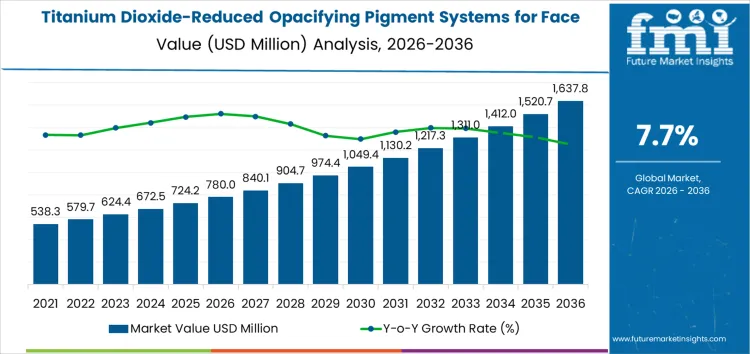
What is the Growth Forecast for the Titanium Dioxide-Reduced Opacifying Pigment Systems for Face Products Market through 2036?
The 10-year growth comparison for the titanium dioxide-reduced opacifying pigment systems for face products market shows a consistent upward trajectory, with steady growth in market value from 2026 to 2036. From an initial value of USD 780 million in 2026, the market will increase to USD 1,640 million by 2036, reflecting a growth of USD 860 million over the 10-year period.
In the early years (2026 to 2031), the market will experience steady growth, rising from USD 780 million to USD 1,137 million by 2031, reflecting an incremental increase of approximately USD 357 million. This growth will be driven by rising consumer awareness about product ingredients, with a shift toward safer and more natural formulations in face products. The market will see a slightly faster growth rate during this period, fueled by regulatory pressures and an increasing focus on ingredient safety in the beauty industry.
From 2031 to 2036, the market will continue to grow at a steady pace, reaching USD 1,640 million by 2036. The increase in value from USD 1,137 million in 2031 to USD 1,640 million in 2036 represents a gradual, stable growth trend. While the rate of growth may slow slightly as the market matures, it will continue to expand due to the ongoing demand for safer, eco-friendly, and effective alternatives to traditional titanium dioxide-based formulations in the cosmetics industry.
Titanium Dioxide-Reduced Opacifying Pigment Systems for Face Products Market Key Takeaways
| Metric | Value |
|---|---|
| Industry Sales Value (2026) | USD 780 million |
| Industry Forecast Value (2036) | USD 1,640 million |
| Industry Forecast CAGR (2026 to 2036) | 7.7% |
What Is Driving the Demand for Titanium Dioxide-Reduced Opacifying Pigment Systems for Face Products Market Globally?
The global demand for titanium dioxide-reduced opacifying pigment systems in face products is being driven by increasing consumer and regulatory scrutiny of traditional mineral opacifiers and the desire for formulations with cleaner, safer ingredient profiles. Titanium dioxide has long been used to provide opacity, coverage, and UV scattering in foundations, concealers, powders, and BB creams. However, concerns about particle size, potential inhalation risks in powder formats, and environmental implications are motivating formulators to explore alternatives that deliver similar coverage with reduced reliance on high levels of titanium dioxide. Consumer interest in skin-friendly and “clean beauty” products, combined with safety guidelines in markets such as Europe and North America, encourages brands to reformulate face products using optimized blends of iron oxides, zinc oxide, silica, and organic pigment systems that achieve opacity while supporting broader performance goals. Makeup developers are also responding to demands for light, breathable textures that do not feel heavy on the skin or settle into lines, reinforcing interest in nuanced pigment systems that balance coverage with wearability.
Future demand for titanium dioxide-reduced opacifying pigment systems for face products is expected to grow as formulation innovation and regulatory expectations continue to evolve. Advances in pigment dispersion technology, particle engineering, and hybrid organic-inorganic systems are improving the ability to achieve uniform coverage, a wide range of shades, and stable color performance without high levels of titanium dioxide. As digital and social media platforms influence beauty trends, consumers increasingly seek makeup that combines aesthetic appeal with perceived safety and sustainability credentials, making reduced titanium dioxide formulations more attractive. Growth in emerging markets and expansion of premium and mass market face makeup categories will further expand the addressable base for alternatives that support diverse skin tones and finishing effects. Regulatory frameworks that emphasize ingredient safety and transparent labeling will reinforce adoption, particularly in regions where cosmetic standards are tightening around particulate exposure and environmental impact. As brands integrate advanced opacifying systems into face products that meet both performance and consumer expectations, the market for titanium dioxide-reduced pigment systems is positioned for steady expansion worldwide.
What are the Leading Segments in the Global Titanium Dioxide-Reduced Opacifying Pigment Systems for Face Products Market?
The global titanium dioxide-reduced opacifying pigment systems for face products market is segmented by material type and end use. Among material types, mica-based formulations lead the market, capturing 42% of the share, followed by iron oxide blends, calcium carbonate systems, and zinc oxide composites. Mica-based formulations are preferred for their ability to provide a natural, subtle opacifying effect, making them ideal for face products. On the end-use side, consumer cosmetics dominate the market, holding 41% of the share, followed by professional makeup artists, luxury beauty brands, and mass market products. Consumer cosmetics are the largest segment, driven by the increasing demand for makeup that provides a smooth finish with reduced opacity from titanium dioxide.
What Drives the Growth of Mica-Based Formulations in the Titanium Dioxide-Reduced Opacifying Pigment Systems for Face Products Market?
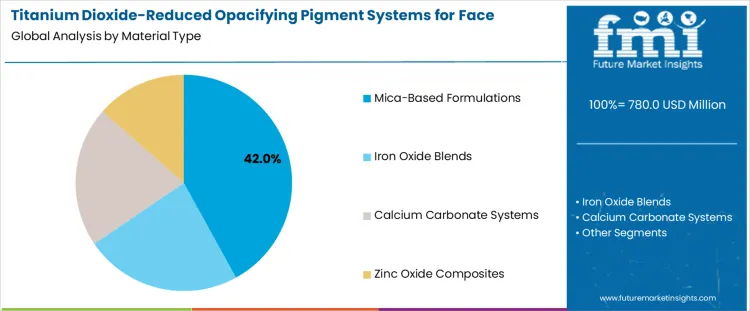
Mica-based formulations are the leading material type in the titanium dioxide-reduced opacifying pigment systems for face products market, holding 42% of the share. Mica is highly valued for its ability to provide a natural, translucent finish in face products while maintaining an opacifying effect without relying heavily on titanium dioxide. It is also lightweight, offers excellent coverage, and enhances the skin’s radiance, making it a preferred ingredient in foundations, powders, and other face makeup products. The growing demand for cosmetics with lighter formulations that deliver a natural appearance, combined with the increasing awareness of the environmental impact of traditional opacifying agents, has led to greater adoption of mica-based pigments. These formulations are particularly sought after in consumer cosmetics, where transparency and light-reflecting properties are key to achieving a flawless, radiant look. As the trend for clean, eco-conscious beauty products continues to rise, mica-based formulations are expected to remain a dominant solution in the market.
What is Driving the Demand for Consumer Cosmetics in the Titanium Dioxide-Reduced Opacifying Pigment Systems for Face Products Market?
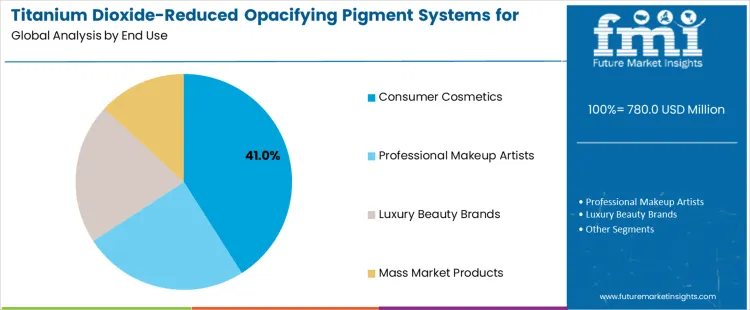
Consumer cosmetics is the leading end-use sector in the titanium dioxide-reduced opacifying pigment systems for face products market, capturing 41% of the share. This demand is primarily driven by the growing interest in makeup products that offer natural, lightweight coverage with enhanced skin benefits. Consumers are increasingly seeking face products that provide a smooth finish without the heavy opacity of traditional pigments, leading to a preference for titanium dioxide-reduced systems that offer better transparency and subtler effects. As awareness of the environmental and health impacts of synthetic chemicals grows, there is a rising demand for cosmetics made with cleaner, more sustainable ingredients, including reduced titanium dioxide formulas. The popularity of natural and breathable makeup, especially in foundations and powders, further fuels the demand for titanium dioxide-reduced opacifying pigment systems in consumer cosmetics. As clean beauty and sustainability continue to be key trends, the demand for these products in the consumer cosmetics segment is expected to keep growing.
What are the Key Dynamics in the Global Titanium Dioxide-Reduced Opacifying Pigment Systems for Face Products Market?
The global titanium dioxide-reduced opacifying pigment systems for face products market is growing as beauty brands reformulate to reduce reliance on high-load mineral filters while maintaining coverage, color payoff and skin feel. These systems use alternative and hybrid pigment blends that deliver opacity, natural finish and broad shade support without heavy titanium dioxide content. Demand is influenced by consumer interest in lightweight, breathable makeup and sunscreen-infused cosmetics. Adoption spans foundations, concealers, BB and CC products where visual performance, skin health and formulation flexibility shape product strategy across mainstream and prestige segments.
What are the Key Drivers for the Titanium Dioxide-Reduced Opacifying Pigment Systems for Face Products Market?
Rising consumer preference for lighter, more skin-friendly face cosmetic products drives use of titanium dioxide-reduced systems that offer opacity without heaviness. Brands responding to demand for multifunctional makeup with skincare benefits seek pigment technologies that complement SPF and antioxidant actives without overloading formulas. Regulatory caution on particulate mineral content and labeling claims motivates innovation in alternative opacifiers and coated pigment blends. Growth in social media engagement and desire for natural finish and camera-ready effect also increases interest. Expansion of digital color matching and personalized beauty services supports adoption of advanced pigment systems that balance coverage with comfort.
What are the Restraints for the Titanium Dioxide-Reduced Opacifying Pigment Systems for Face Products Market?
Challenges include technical complexity in formulating alternatives that provide consistent opacity, shade range and stability across diverse skin tones and product formats. Some reduced titanium dioxide blends may require additional binders or modifiers to match coverage performance, increasing formulation time and testing. Higher cost of specialty pigments and coated systems can influence pricing and margin in value-oriented products. Consumer skepticism about performance compared with traditional systems can slow adoption without clear education and demonstration of benefits. Variations in regulatory definitions for mineral content and labeling complicate global positioning for cosmetics marketers.
What are the Key Trends in the Titanium Dioxide-Reduced Opacifying Pigment Systems for Face Products Market?
A key trend is innovation in hybrid pigment technologies that combine organic and inorganic elements to improve opacity and texture while reducing reliance on titanium dioxide. Ingredient developers are focusing on coated and engineered particles that enhance light diffusion, blendability and shade consistency. Rising interest in clean beauty and formulations with transparent ingredient sourcing supports these alternatives. Brands are expanding color libraries to include subtle and bold finishes that appeal to diverse consumer preferences. Integration with digital tools for virtual try-on and shade selection enhances consumer confidence and encourages trial of products built on reduced titanium dioxide pigment systems.
What is the Country-Wise Analysis of the Titanium Dioxide-Reduced Opacifying Pigment Systems for Face Products Market?
The titanium dioxide-reduced opacifying pigment systems for face products market is experiencing steady growth, driven by the increasing demand for safer, more natural cosmetic ingredients and the growing awareness of the potential health risks associated with titanium dioxide in cosmetics. Titanium dioxide, commonly used as an opacifier and sunscreen agent in cosmetics, has come under scrutiny due to concerns over its potential health risks, particularly in aerosolized or inhaled forms. As a result, there is a rising preference for alternatives that reduce or eliminate the use of titanium dioxide in cosmetic formulations, especially in face products like foundations and sunscreens.
Developed markets such as the USA, Germany, and Japan are seeing strong demand for these alternatives, driven by both consumer awareness of ingredient safety and increasing regulatory pressure to adopt cleaner formulations. Emerging markets like France and the UK are also witnessing steady growth, as consumer demand for cleaner, safer cosmetics continues to rise. This trend is expected to continue, with the demand for titanium dioxide-reduced opacifying pigments growing globally.
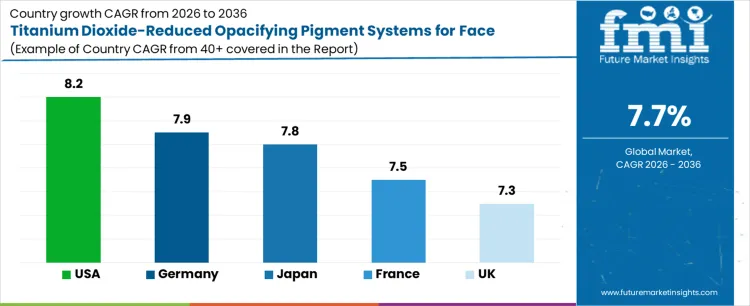
| Country | CAGR (2026-2036) |
|---|---|
| USA | 8.2% |
| Germany | 7.9% |
| Japan | 7.8% |
| France | 7.5% |
| United Kingdom | 7.3% |
What is the Growth Outlook for the Titanium Dioxide-Reduced Opacifying Pigment Systems for Face Products Market in the USA?
The titanium dioxide-reduced opacifying pigment systems for face products market in the USA is projected to grow steadily, with a projected CAGR of 8.2% from 2026 to 2036. The USA market is witnessing a strong shift toward safer, more sustainable ingredients in cosmetics, driven by both consumer demand for non-toxic products and increasing regulatory scrutiny on the use of titanium dioxide in face products. As concerns about the potential risks of titanium dioxide, particularly in its inhalable form, grow, there is increasing demand for alternative opacifying and sunscreen ingredients that are safer for consumers and the environment. The clean beauty movement in the USA is further driving this trend, with both large beauty brands and niche companies focusing on offering safer, cleaner products. The USA Food and Drug Administration (FDA) and other regulatory bodies are also playing a role in shaping the market, encouraging the use of alternatives to titanium dioxide in cosmetic formulations. As consumer preferences for safer cosmetics continue to evolve, the demand for titanium dioxide-reduced opacifying pigments is expected to rise steadily in the USA.
What is the Market Outlook for the Titanium Dioxide-Reduced Opacifying Pigment Systems for Face Products Market in Germany?
Germany is expected to experience steady growth in the titanium dioxide-reduced opacifying pigment systems for face products market, with a projected CAGR of 7.9% from 2026 to 2036. Germany is known for its commitment to sustainability and safety in consumer products, and the demand for cosmetics with safer, non-toxic ingredients is growing. With increasing concerns over the potential health risks of titanium dioxide, particularly in face products like foundations and sunscreens, German consumers are increasingly seeking products with reduced titanium dioxide content. Germany’s cosmetics industry is responding to these demands by incorporating alternative opacifiers and sunscreens into their formulations. Additionally, Germany’s strict environmental regulations and consumer preference for clean, eco-friendly beauty solutions are expected to further drive the adoption of titanium dioxide-reduced opacifying pigments. As the clean beauty movement gains momentum across Europe, Germany remains a key market for innovative, safer cosmetics, contributing to the market’s steady growth.
What is the Growth Forecast for the Titanium Dioxide-Reduced Opacifying Pigment Systems for Face Products Market in Japan?
Japan is projected to experience steady growth in the titanium dioxide-reduced opacifying pigment systems for face products market, with a projected CAGR of 7.8% from 2026 to 2036. Japan’s cosmetics market is highly developed and known for its focus on skin health and safety. As consumer awareness of the potential risks associated with titanium dioxide rises, there is a growing demand for face products that offer effective sun protection and opacity without the use of titanium dioxide. Japanese consumers are becoming more conscious of the ingredients in their beauty products, especially in terms of their safety and environmental impact. In response to this demand, Japanese beauty brands are increasingly adopting alternative ingredients that reduce or eliminate the use of titanium dioxide in their formulations. As the clean beauty trend continues to grow in Japan, the market for titanium dioxide-reduced opacifying pigment systems is expected to expand steadily, driven by both consumer demand and regulatory influences.
What is the Market Outlook for the Titanium Dioxide-Reduced Opacifying Pigment Systems for Face Products Market in France?
The titanium dioxide-reduced opacifying pigment systems for face products market in France is expected to grow steadily, with a projected CAGR of 7.5% from 2026 to 2036. France’s beauty and cosmetics industry is highly innovative and consumer-driven, with a strong emphasis on sustainability and the use of safe, non-toxic ingredients. As concerns about the potential health risks of titanium dioxide grow, particularly in cosmetics used for daily wear, there is increasing demand for safer alternatives in face products like foundations, blushes, and sunscreens. France is also subject to stringent EU regulations that require greater transparency in cosmetic ingredient labeling, pushing brands to adopt safer, more sustainable formulations. As French consumers increasingly prioritize eco-friendly and health-conscious beauty products, the market for titanium dioxide-reduced opacifying pigments is expected to expand, with both local and international brands focusing on safer, more natural alternatives.
What are the Growth Prospects for the Titanium Dioxide-Reduced Opacifying Pigment Systems for Face Products Market in the United Kingdom?
The titanium dioxide-reduced opacifying pigment systems for face products market in the United Kingdom is projected to grow steadily, with a projected CAGR of 7.3% from 2026 to 2036. The UK’s clean beauty movement is gaining momentum, with more consumers demanding safer, natural, and non-toxic beauty products. As concerns about the health risks associated with titanium dioxide, particularly in its aerosolized form, increase, there is a growing demand for alternative opacifiers and sunscreens in cosmetic products. The UK market is responding to this shift, with brands increasingly incorporating plant-based and mineral-based alternatives to titanium dioxide in their formulations. Additionally, UK regulatory frameworks, including those set by the Cosmetic, Toiletry and Perfumery Association (CTPA), are encouraging the development of cleaner beauty products. With heightened consumer awareness of the risks associated with synthetic ingredients and a growing preference for safer, more sustainable cosmetics, the UK market for titanium dioxide-reduced opacifying pigment systems is set to experience steady growth in the coming years.
What is the Competitive Landscape for the Titanium Dioxide-Reduced Opacifying Pigment Systems for Face Products Market?
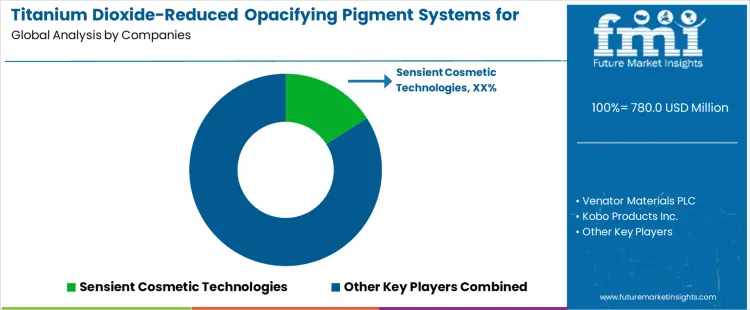
The titanium dioxide-reduced opacifying pigment systems for face products market is experiencing growth as consumers and manufacturers increasingly seek safer, more sustainable alternatives to traditional titanium dioxide-based pigments, particularly in the cosmetics and skincare sectors. Sensient Cosmetic Technologies leads the market with its innovative titanium dioxide-reduced opacifying pigment systems, offering high-performance formulations that maintain the desired opacity and coverage in face products while reducing the reliance on titanium dioxide. Their focus on product quality, innovation, and sustainability has positioned them as a dominant player in the market. Venator Materials PLC, Kobo Products Inc., and Sun Chemical Corporation are significant competitors, each offering specialized opacifying pigments that cater to the growing demand for sustainable cosmetic ingredients. Venator Materials PLC provides high-quality, reduced-titanium dioxide pigments that are designed to meet regulatory standards, while Kobo Products Inc. and Sun Chemical Corporation focus on offering innovative, sustainable pigments that maintain product performance.
Schlenk Metallic Pigments GmbH further contributes to the competitive landscape by offering opacifying pigment systems designed to reduce titanium dioxide usage in cosmetics while ensuring the desired aesthetic qualities of face products. Schlenk Metallic Pigments GmbH specializes in providing high-performance, eco-friendly pigments for a variety of cosmetic applications. These companies compete by focusing on product innovation, sustainability, and the ability to meet the growing demand for safer, effective, and environmentally responsible ingredients in face products. As the cosmetic industry continues to prioritize cleaner, more sustainable formulations, the market for titanium dioxide-reduced opacifying pigment systems is expected to grow, driving further competition and innovation in the sector.
Key Players of the Titanium Dioxide-Reduced Opacifying Pigment Systems for Face Products Market
- Sensient Cosmetic Technologies
- Venator Materials PLC
- Kobo Products Inc.
- Sun Chemical Corporation
- Schlenk Metallic Pigments GmbH
Scope of the Report
| Items | Values |
|---|---|
| Quantitative Units (2026) | USD Million |
| Material Type | Mica-Based Formulations, Iron Oxide Blends, Calcium Carbonate Systems, Zinc Oxide Composites |
| Application Type | Foundation & Concealer, Face Powder Products, Blush & Highlighting, Primer & Setting Products |
| End Use | Consumer Cosmetics, Professional Makeup Artists, Luxury Beauty Brands, Mass Market Products |
| Companies | Sensient Cosmetic Technologies, Venator Materials PLC, Kobo Products Inc., Sun Chemical Corporation, Schlenk Metallic Pigments GmbH |
| Regions Covered | North America, Latin America, Western Europe, Eastern Europe, South Asia and Pacific, East Asia, Middle East & Africa |
| Countries Covered | United States, Canada, Mexico, Brazil, Argentina, Germany, France, United Kingdom, Italy, Spain, Netherlands, China, India, Japan, South Korea, ANZ, GCC Countries, South Africa |
| Additional Attributes | Dollar by sales by material type, application type, end use, and region. Includes market trends in titanium dioxide-reduced opacifying pigment systems adoption for face products, performance in face cosmetic formulations, cost and formulation drivers, regulatory and safety considerations, consumer demand for reduced opacifying pigments, market share and competitive positioning of key companies, innovations in pigment technologies, and evaluation of impact on product appearance, texture, and wear characteristics. |
Titanium Dioxide-Reduced Opacifying Pigment Systems for Face Products Market Segmentation
Material Type
- Mica-Based Formulations
- Iron Oxide Blends
- Calcium Carbonate Systems
- Zinc Oxide Composites
Application Type
- Foundation & Concealer
- Face Powder Products
- Blush & Highlighting
- Primer & Setting Products
End Use
- Consumer Cosmetics
- Professional Makeup Artists
- Luxury Beauty Brands
- Mass Market Products
Region
- Asia Pacific
- China
- Japan
- South Korea
- India
- Australia & New Zealand
- ASEAN
- Rest of Asia Pacific
- Europe
- Germany
- United Kingdom
- France
- Italy
- Spain
- Nordic
- BENELUX
- Rest of Europe
- North America
- United States
- Canada
- Mexico
- Latin America
- Brazil
- Chile
- Rest of Latin America
- Middle East & Africa
- Kingdom of Saudi Arabia
- Other GCC Countries
- Turkey
- South Africa
- Other African Union
- Rest of Middle East & Africa
Frequently Asked Questions
How big is the titanium dioxide-reduced opacifying pigment systems for face products market in 2026?
The global titanium dioxide-reduced opacifying pigment systems for face products market is estimated to be valued at USD 780.0 million in 2026.
What will be the size of titanium dioxide-reduced opacifying pigment systems for face products market in 2036?
The market size for the titanium dioxide-reduced opacifying pigment systems for face products market is projected to reach USD 1,637.8 million by 2036.
How much will be the titanium dioxide-reduced opacifying pigment systems for face products market growth between 2026 and 2036?
The titanium dioxide-reduced opacifying pigment systems for face products market is expected to grow at a 7.7% CAGR between 2026 and 2036.
What are the key product types in the titanium dioxide-reduced opacifying pigment systems for face products market?
The key product types in titanium dioxide-reduced opacifying pigment systems for face products market are mica-based formulations, iron oxide blends, calcium carbonate systems and zinc oxide composites.
Which application type segment to contribute significant share in the titanium dioxide-reduced opacifying pigment systems for face products market in 2026?
In terms of application type, foundation & concealer segment to command 41.0% share in the titanium dioxide-reduced opacifying pigment systems for face products market in 2026.
Preview the report firsthand - request a free sample
Get SampleGet the brochure for pricing and purchase details.
Get PDFTable of Content
- Executive Summary
- Global Market Outlook
- Demand-side Trends
- Supply-side Trends
- Technology Roadmap Analysis
- Analysis and Recommendations
- Market Overview
- Market Coverage / Taxonomy
- Market Definition / Scope / Limitations
- Market Background
- Market Dynamics
- Drivers
- Restraints
- Opportunity
- Trends
- Scenario Forecast
- Demand in Optimistic Scenario
- Demand in Likely Scenario
- Demand in Conservative Scenario
- Opportunity Map Analysis
- Product Life Cycle Analysis
- Supply Chain Analysis
- Investment Feasibility Matrix
- Value Chain Analysis
- PESTLE and Porter’s Analysis
- Regulatory Landscape
- Regional Parent Market Outlook
- Production and Consumption Statistics
- Import and Export Statistics
- Market Dynamics
- Global Market Analysis 2021 to 2025 and Forecast, 2026 to 2036
- Historical Market Size Value (USD Million) Analysis, 2021 to 2025
- Current and Future Market Size Value (USD Million) Projections, 2026 to 2036
- Y-o-Y Growth Trend Analysis
- Absolute $ Opportunity Analysis
- Global Market Pricing Analysis 2021 to 2025 and Forecast 2026 to 2036
- Global Market Analysis 2021 to 2025 and Forecast 2026 to 2036, By Material Type
- Introduction / Key Findings
- Historical Market Size Value (USD Million) Analysis By Material Type , 2021 to 2025
- Current and Future Market Size Value (USD Million) Analysis and Forecast By Material Type , 2026 to 2036
- Mica-Based Formulations
- Iron Oxide Blends
- Calcium Carbonate Systems
- Zinc Oxide Composites
- Mica-Based Formulations
- Y-o-Y Growth Trend Analysis By Material Type , 2021 to 2025
- Absolute $ Opportunity Analysis By Material Type , 2026 to 2036
- Global Market Analysis 2021 to 2025 and Forecast 2026 to 2036, By Application Type
- Introduction / Key Findings
- Historical Market Size Value (USD Million) Analysis By Application Type, 2021 to 2025
- Current and Future Market Size Value (USD Million) Analysis and Forecast By Application Type, 2026 to 2036
- Foundation & Concealer
- Face Powder Products
- Blush & Highlighting
- Primer & Setting Products
- Foundation & Concealer
- Y-o-Y Growth Trend Analysis By Application Type, 2021 to 2025
- Absolute $ Opportunity Analysis By Application Type, 2026 to 2036
- Global Market Analysis 2021 to 2025 and Forecast 2026 to 2036, By End Use
- Introduction / Key Findings
- Historical Market Size Value (USD Million) Analysis By End Use, 2021 to 2025
- Current and Future Market Size Value (USD Million) Analysis and Forecast By End Use, 2026 to 2036
- Consumer Cosmetics
- Professional Makeup Artists
- Luxury Beauty Brands
- Mass Market Products
- Consumer Cosmetics
- Y-o-Y Growth Trend Analysis By End Use, 2021 to 2025
- Absolute $ Opportunity Analysis By End Use, 2026 to 2036
- Global Market Analysis 2021 to 2025 and Forecast 2026 to 2036, By Region
- Introduction
- Historical Market Size Value (USD Million) Analysis By Region, 2021 to 2025
- Current Market Size Value (USD Million) Analysis and Forecast By Region, 2026 to 2036
- North America
- Latin America
- Western Europe
- Eastern Europe
- East Asia
- South Asia and Pacific
- Middle East & Africa
- Market Attractiveness Analysis By Region
- North America Market Analysis 2021 to 2025 and Forecast 2026 to 2036, By Country
- Historical Market Size Value (USD Million) Trend Analysis By Market Taxonomy, 2021 to 2025
- Market Size Value (USD Million) Forecast By Market Taxonomy, 2026 to 2036
- By Country
- USA
- Canada
- Mexico
- By Material Type
- By Application Type
- By End Use
- By Country
- Market Attractiveness Analysis
- By Country
- By Material Type
- By Application Type
- By End Use
- Key Takeaways
- Latin America Market Analysis 2021 to 2025 and Forecast 2026 to 2036, By Country
- Historical Market Size Value (USD Million) Trend Analysis By Market Taxonomy, 2021 to 2025
- Market Size Value (USD Million) Forecast By Market Taxonomy, 2026 to 2036
- By Country
- Brazil
- Chile
- Rest of Latin America
- By Material Type
- By Application Type
- By End Use
- By Country
- Market Attractiveness Analysis
- By Country
- By Material Type
- By Application Type
- By End Use
- Key Takeaways
- Western Europe Market Analysis 2021 to 2025 and Forecast 2026 to 2036, By Country
- Historical Market Size Value (USD Million) Trend Analysis By Market Taxonomy, 2021 to 2025
- Market Size Value (USD Million) Forecast By Market Taxonomy, 2026 to 2036
- By Country
- Germany
- UK
- Italy
- Spain
- France
- Nordic
- BENELUX
- Rest of Western Europe
- By Material Type
- By Application Type
- By End Use
- By Country
- Market Attractiveness Analysis
- By Country
- By Material Type
- By Application Type
- By End Use
- Key Takeaways
- Eastern Europe Market Analysis 2021 to 2025 and Forecast 2026 to 2036, By Country
- Historical Market Size Value (USD Million) Trend Analysis By Market Taxonomy, 2021 to 2025
- Market Size Value (USD Million) Forecast By Market Taxonomy, 2026 to 2036
- By Country
- Russia
- Poland
- Hungary
- Balkan & Baltic
- Rest of Eastern Europe
- By Material Type
- By Application Type
- By End Use
- By Country
- Market Attractiveness Analysis
- By Country
- By Material Type
- By Application Type
- By End Use
- Key Takeaways
- East Asia Market Analysis 2021 to 2025 and Forecast 2026 to 2036, By Country
- Historical Market Size Value (USD Million) Trend Analysis By Market Taxonomy, 2021 to 2025
- Market Size Value (USD Million) Forecast By Market Taxonomy, 2026 to 2036
- By Country
- China
- Japan
- South Korea
- By Material Type
- By Application Type
- By End Use
- By Country
- Market Attractiveness Analysis
- By Country
- By Material Type
- By Application Type
- By End Use
- Key Takeaways
- South Asia and Pacific Market Analysis 2021 to 2025 and Forecast 2026 to 2036, By Country
- Historical Market Size Value (USD Million) Trend Analysis By Market Taxonomy, 2021 to 2025
- Market Size Value (USD Million) Forecast By Market Taxonomy, 2026 to 2036
- By Country
- India
- ASEAN
- Australia & New Zealand
- Rest of South Asia and Pacific
- By Material Type
- By Application Type
- By End Use
- By Country
- Market Attractiveness Analysis
- By Country
- By Material Type
- By Application Type
- By End Use
- Key Takeaways
- Middle East & Africa Market Analysis 2021 to 2025 and Forecast 2026 to 2036, By Country
- Historical Market Size Value (USD Million) Trend Analysis By Market Taxonomy, 2021 to 2025
- Market Size Value (USD Million) Forecast By Market Taxonomy, 2026 to 2036
- By Country
- Kingdom of Saudi Arabia
- Other GCC Countries
- Turkiye
- South Africa
- Other African Union
- Rest of Middle East & Africa
- By Material Type
- By Application Type
- By End Use
- By Country
- Market Attractiveness Analysis
- By Country
- By Material Type
- By Application Type
- By End Use
- Key Takeaways
- Key Countries Market Analysis
- USA
- Pricing Analysis
- Market Share Analysis, 2025
- By Material Type
- By Application Type
- By End Use
- Canada
- Pricing Analysis
- Market Share Analysis, 2025
- By Material Type
- By Application Type
- By End Use
- Mexico
- Pricing Analysis
- Market Share Analysis, 2025
- By Material Type
- By Application Type
- By End Use
- Brazil
- Pricing Analysis
- Market Share Analysis, 2025
- By Material Type
- By Application Type
- By End Use
- Chile
- Pricing Analysis
- Market Share Analysis, 2025
- By Material Type
- By Application Type
- By End Use
- Germany
- Pricing Analysis
- Market Share Analysis, 2025
- By Material Type
- By Application Type
- By End Use
- UK
- Pricing Analysis
- Market Share Analysis, 2025
- By Material Type
- By Application Type
- By End Use
- Italy
- Pricing Analysis
- Market Share Analysis, 2025
- By Material Type
- By Application Type
- By End Use
- Spain
- Pricing Analysis
- Market Share Analysis, 2025
- By Material Type
- By Application Type
- By End Use
- France
- Pricing Analysis
- Market Share Analysis, 2025
- By Material Type
- By Application Type
- By End Use
- India
- Pricing Analysis
- Market Share Analysis, 2025
- By Material Type
- By Application Type
- By End Use
- ASEAN
- Pricing Analysis
- Market Share Analysis, 2025
- By Material Type
- By Application Type
- By End Use
- Australia & New Zealand
- Pricing Analysis
- Market Share Analysis, 2025
- By Material Type
- By Application Type
- By End Use
- China
- Pricing Analysis
- Market Share Analysis, 2025
- By Material Type
- By Application Type
- By End Use
- Japan
- Pricing Analysis
- Market Share Analysis, 2025
- By Material Type
- By Application Type
- By End Use
- South Korea
- Pricing Analysis
- Market Share Analysis, 2025
- By Material Type
- By Application Type
- By End Use
- Russia
- Pricing Analysis
- Market Share Analysis, 2025
- By Material Type
- By Application Type
- By End Use
- Poland
- Pricing Analysis
- Market Share Analysis, 2025
- By Material Type
- By Application Type
- By End Use
- Hungary
- Pricing Analysis
- Market Share Analysis, 2025
- By Material Type
- By Application Type
- By End Use
- Kingdom of Saudi Arabia
- Pricing Analysis
- Market Share Analysis, 2025
- By Material Type
- By Application Type
- By End Use
- Turkiye
- Pricing Analysis
- Market Share Analysis, 2025
- By Material Type
- By Application Type
- By End Use
- South Africa
- Pricing Analysis
- Market Share Analysis, 2025
- By Material Type
- By Application Type
- By End Use
- USA
- Market Structure Analysis
- Competition Dashboard
- Competition Benchmarking
- Market Share Analysis of Top Players
- By Regional
- By Material Type
- By Application Type
- By End Use
- Competition Analysis
- Competition Deep Dive
- Sensient Cosmetic Technologies
- Overview
- Product Portfolio
- Profitability by Market Segments (Product/Age /Sales Channel/Region)
- Sales Footprint
- Strategy Overview
- Marketing Strategy
- Product Strategy
- Channel Strategy
- Venator Materials PLC
- Kobo Products Inc.
- Sun Chemical Corporation
- Schlenk Metallic Pigments GmbH
- Sensient Cosmetic Technologies
- Competition Deep Dive
- Assumptions & Acronyms Used
- Research Methodology


