

- Industry Size (2026)
- USD 1.95 Bn
- Forecast (2036)
- USD 4.42 Bn
- CAGR (2026 to 2036)
- 8.50%
Opacifying Cosmetic Products Market Forecast and Outlook 2026 to 2036
The global opacifying cosmetic products market is valued at USD 1.95 billion in 2026 and is projected to reach USD 4.42 billion by 2036, expanding at an 8.5% CAGR. As per Future Market Insights, growth is being driven by consumer preference for premium aesthetics, where opaque, milky-white formulations signal richness and efficacy compared with transparent alternatives. BASF SE noted in its 2023 Annual Report that its Care Chemicals division continues to see demand for specialty cosmetic ingredients, including opacifiers and pearlescent pigments, as premium formulations increasingly rely on visual differentiation, although opacifier revenues are not reported separately. This aesthetic preference is prompting formulators to use titanium dioxide, zinc oxide, and styrene-acrylate copolymers to enhance product appearance. At the same time, European Union restrictions on titanium dioxide nanoparticles in leave-on cosmetics implemented in 2022 are driving reformulation toward compliant opacity systems.
The shift toward appearance-led premiumization and multifunctional formulation strategies is driving wider adoption of advanced opacifying systems across everyday personal care products. These solutions support premium positioning through enhanced visual richness, texture improvement, and added functionality such as UV support and emulsion stability. Regulatory focus on particle safety and ingredient disclosure is accelerating reformulation toward compliant opacity technologies, strengthening demand for technically validated systems. This direction aligns with BASF SE’s focus on responsible ingredient design. As Dr. Boris Gaspar, Head of Market Development Personal Care EMEA, BASF SE stated, “As society and future generations are expected to live longer, consumers feel an urge to actively impact their footprint and preserve the earth as the foundation for long and healthy living. We support our customers by providing biodegradable alternatives to traditional ingredients, taking into account the consumer desire for responsible beauty routines.” Future Market Insights notes that digital product discovery is amplifying the importance of visual appearance, supporting steady value growth through 2036.
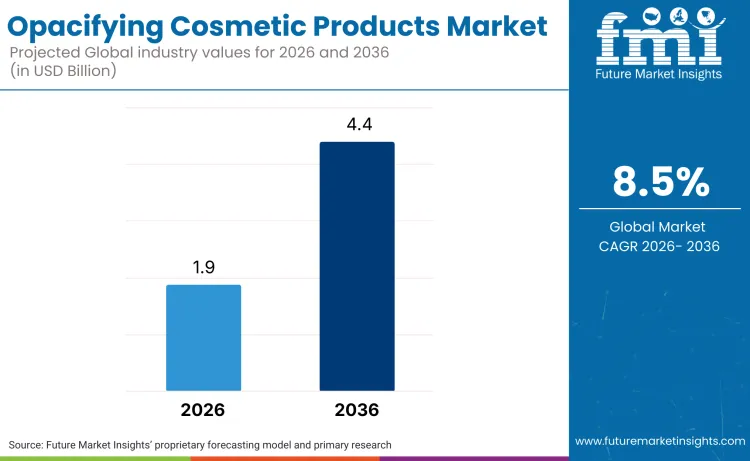
Summary of Opacifying Cosmetic Products Market
What Is Growth Outlook for Opacifying Cosmetic Products Market as per Future Market Insights Projection?
Future Market Insights projects the opacifying cosmetic products market to expand at a CAGR of 8.50% from 2026 to 2036, increasing from USD 1.95 Billion in 2026 to USD 4.42 Billion by 2036.
FMI Research Approach: FMI proprietary forecasting model based on premium personal care category growth trajectories, opacifier ingredient adoption curves across hair care and body wash categories, and clean beauty mineral pigment acceptance rates.
Which Country Holds Largest Share in Global Opacifying Cosmetic Products Market?
China holds a significant share supported by domestic titanium dioxide production capacity and expanding middle-class demand for premium imported personal care products featuring opaque luxury formulations. Cosmetics ingredients market analysis informs opacifier adoption trends across product categories.
FMI Research Approach: FMI country-level revenue modeling by titanium dioxide production capacity, premium personal care penetration rates, and opaque formulation consumer preferences.
What Are Globally Unique Trends Shaping Opacifying Cosmetic Products Market?
Globally unique trends include plant-derived cellulose microparticle opacifiers that satisfy natural cosmetics standards while delivering visual opacity through light scattering, encapsulated opacifier beads that release upon application providing dynamic opacity changes during use, and biomimetic silica particles produced through fermentation replicating natural diatom structures offering sustainable mineral alternatives. Personal care ingredients innovation tracking examines next-generation opacity technologies.
FMI Research Approach: Clean beauty ingredient innovation monitoring and sustainable mineral alternative development analysis examining natural opacifier commercialization pathways.
Opacifying Cosmetic Products Market Key Takeaways
| Metric | Details |
|---|---|
| Industry Size (2026) | USD 1.95 Billion |
| Industry Value (2036) | USD 4.42 Billion |
| CAGR (2026-2036) | 8.50% |
Source: Future Market Insights (FMI) analysis, based on proprietary forecasting model and primary research
Which Factors Propel Adoption of Opacifying Cosmetic Products?
Premium positioning is a key driver behind wider use of opacifiers, as consumer perception studies show that creamy, opaque formulations are associated with higher quality and a more indulgent product experience than clear products, even when functional ingredients remain unchanged. This perception advantage creates strong commercial incentives for brands to use mineral or polymer-based opacifiers that carry relatively low raw material costs but support meaningful retail price uplift through enhanced visual appeal. The effect is especially visible in hair care, where opaque conditioners are commonly linked with intensive repair and nourishment, regardless of whether conditioning performance differs from transparent alternatives.
The multifunctional role of certain opacifiers further supports adoption, as titanium dioxide and zinc oxide can also deliver physical UV protection at appropriate inclusion levels. This enables formulators to combine appearance enhancement and sun protection within a single ingredient system, reducing formulation complexity. At the same time, clean beauty reformulation trends are strengthening demand for mineral opacifiers, as recognizable ingredient names align better with consumer expectations than synthetic polymer systems, creating growth opportunities for mineral-based opacity solutions positioned within natural and clean-label product lines.
How is the Opacifying Cosmetic Products Market Segmented?
The opacifying cosmetic ingredients market is segmented by chemistry, function, physical form, and application, reflecting formulation requirements across personal care categories. By chemistry, titanium dioxide leads adoption due to its broad use as a reliable mineral opacifier in both rinse-off and leave-on products. Zinc oxide and styrene-acrylate copolymers support complementary roles in opacity and texture control, while natural mineral systems are gaining relevance within clean-label formulations. By function, appearance enhancement remains the primary use case, followed by light diffusion and masking, as well as color and texture improvement, reflecting the premiumization of product aesthetics. By physical form, liquid dispersions dominate due to ease of processing and uniform incorporation, while powder concentrates and encapsulated bead formats support specialized formulation needs. By application, shampoos and conditioners account for the largest share of use, followed by body washes and shower gels, lotions and creams, and color cosmetics.
Why Does Titanium Dioxide Hold Dominant Chemistry Share?
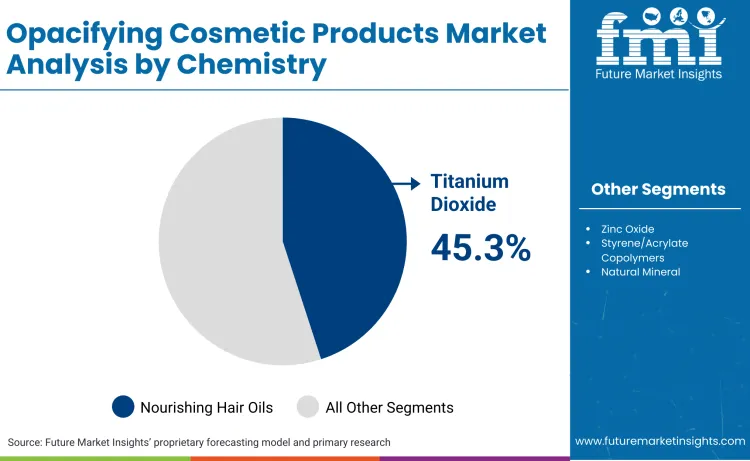
Titanium dioxide maintains 45.30% chemistry share due to unmatched opacity efficiency where 2-5% concentrations achieve visual effects requiring 8-12% loadings of alternative polymer opacifiers, creating cost-effectiveness despite higher per-kilogram pricing. The material's high refractive index of 2.7 enables efficient light scattering that produces opacity through physical rather than chemical mechanisms, providing formulation stability across pH ranges and compatibility with diverse cosmetic ingredients. Regulatory acceptance spanning decades establishes titanium dioxide as GRAS (Generally Recognized As Safe) in numerous jurisdictions, reducing compliance barriers compared to novel opacity systems requiring extensive safety documentation.
Why Does Appearance Enhancement Dominate Functional Segments?
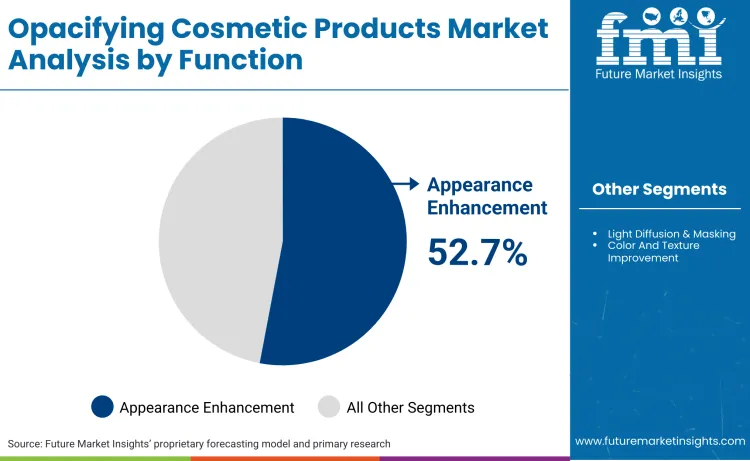
Appearance enhancement captures 52.70% functional share as the primary benefit driving opacifier incorporation, where visual transformation from transparent to opaque formulations creates consumer-perceptible differentiation impossible through internal ingredient optimization. The luxury signaling of opaque products enables premium pricing that funds higher quality base ingredients, creating virtuous cycles where appearance investment supports formulation excellence. This psychological premium is most valuable in competitive categories including body wash and shampoo where functional parity between brands shifts purchasing decisions toward sensory and visual attributes.
Why Do Liquid Dispersions Lead Physical Form Segments?
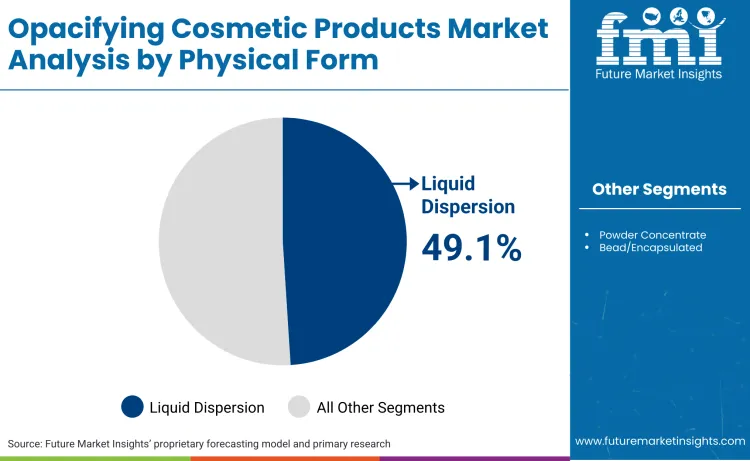
Liquid dispersions hold 49.10% physical form share due to manufacturing convenience where pre-dispersed opacifiers in water or glycol carriers enable simple addition during cosmetic production without specialized dispersion equipment. The liquid format eliminates dusting concerns associated with titanium dioxide powder handling and improves batch-to-batch consistency through homogeneous ingredient distribution. Formulators particularly favor liquid dispersions for cold-process manufacturing where powder dispersion challenges at ambient temperatures would require heating steps that increase energy costs and limit heat-sensitive ingredient compatibility.
Why Do Shampoos and Conditioners Dominate Application Segments?
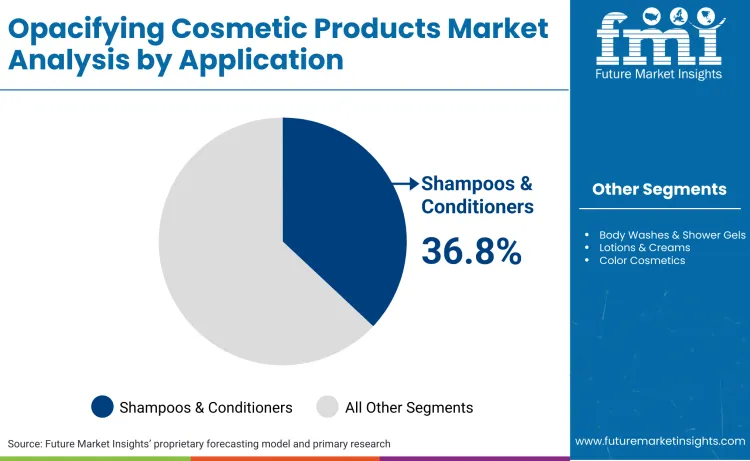
Shampoos and conditioners capture 36.80% application share as categories where opaque aesthetics strongly correlate with consumer efficacy perceptions, particularly for damage repair and intensive conditioning products. The creamy white appearance created by titanium dioxide or styrene-acrylate opacifiers visually communicates moisturization and repair properties, influencing purchase decisions and usage satisfaction independently of actual conditioning agent performance. This psychological association is particularly valuable for mass-market brands differentiating through appearance rather than expensive specialty ingredients, enabling competitive positioning against premium products through visual mimicry at lower formulation costs.
How Are Consumer Preferences Splitting Between Transparent Minimalism and Opaque Premium Aesthetics?
Consumer psychology is shifting toward ingredient minimalism, where transparent products signal purity and the absence of unnecessary additives. This is creating tension with traditional preferences for opaque, milky-white formulations that convey richness and luxury. As a result, the market is increasingly segmented between transparent minimalist formats appealing to ingredient-conscious consumers and opaque premium products targeting aesthetic-led buyers. Brands are responding through dual-launch strategies that offer transparent and opaque versions of similar formulations, allowing consumers to self-select based on personal appearance and sensory preferences without altering functional performance expectations.
Why Is Multifunctional Opacifier Innovation Gaining Strategic Importance for Formulators?
Manufacturers are investing in multifunctional opacifier systems where single ingredients deliver opacity, UV protection, and rheology modification, improving formulation efficiency while reducing total ingredient counts. Innovations in zinc oxide, including advanced surface treatments and dispersion technologies, are enabling improved clarity in leave-on products while maintaining desired opacity in rinse-off applications, expanding versatility across product types. Patent activity around coated titanium dioxide and hybrid polymer-mineral systems highlights industry focus on next-generation opacity technologies that balance regulatory constraints with performance requirements.
How Are Sustainability Pressures Reshaping Opacifier Material Innovation Pathways?
Sustainability pressures are accelerating research into natural opacifier alternatives, including plant-derived cellulose microparticles and fermentation-produced silica that offer renewable options to mineral mining. The broader transformation of specialty chemicals toward bio-based inputs is creating development pathways for opacifying agents produced through more sustainable processes. These innovations aim to preserve optical performance while improving environmental profiles, supporting brand sustainability commitments and regulatory expectations around responsible material sourcing.
How Will Opacifying Cosmetic Products Market Expansion Unfold Across Key Global Regions?
The opacifying cosmetic products market is poised for significant expansion with varying growth rates projected from 2026 to 2036. China leads with 11.475% CAGR driven by domestic titanium dioxide production capacity and expanding premium personal care consumption. India follows at 10.625% benefiting from indigenous mineral resources and growing middle-class beauty consciousness. Germany records 9.775% reflecting European specialty chemical innovation and clean beauty mineral preferences. Brazil anticipates 8.925% growth from personal care market expansion and local cosmetic manufacturing. The United States at 8.075% maintains substantial scale through premium beauty retail maturity. The United Kingdom at 7.225% and Japan at 6.375% show steady growth from prestige positioning and sophisticated formulation aesthetics respectively.
Opacifying Cosmetic Products Market Regional CAGR (2026-2036)
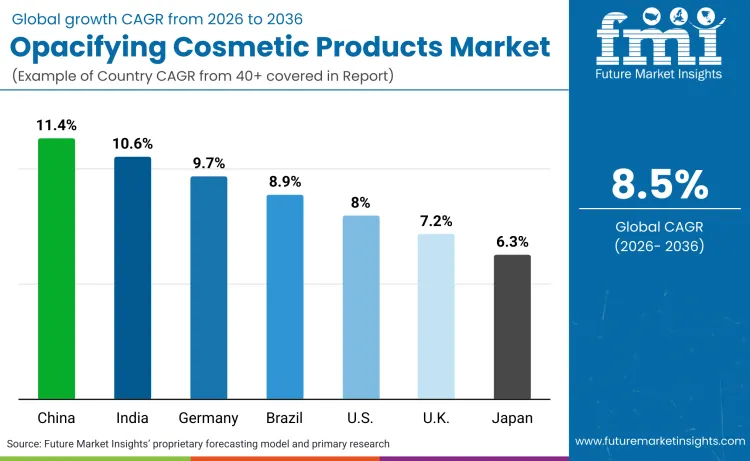
| Country | CAGR (2026 to 2036) |
|---|---|
| China | 11.4% |
| India | 10.6% |
| Germany | 9.7% |
| Brazil | 8.9% |
| United States | 8.0% |
| UK | 7.2% |
| Japan | 6.3% |
Source: FMI historical analysis and forecast data.
How is Domestic Production Capacity Fueling China's Growth?
China's 11.475% expansion shows structural advantages from domestic titanium dioxide production capacity exceeding 3.5 million metric tons annually, positioning the country as the world's largest producer per China Titanium Dioxide Industry Association data. This manufacturing scale creates cost advantages enabling Chinese cosmetic brands to incorporate premium opacifiers at competitive pricing compared to international competitors relying on imported ingredients. Domestic personal care market growth reached RMB 387 billion in 2023 according to National Bureau of Statistics, with premium imported products featuring opaque formulations growing 67% annually. Middle-class consumers demonstrate preference for creamy white body lotions and shampoos over transparent formulations, perceiving opacity as quality indicator. Chinese regulatory approval of titanium dioxide as cosmetic colorant under GB 5296.3-2008 standards provides clear compliance pathways supporting widespread adoption across hair care, body wash, and facial care categories.
Why is Mineral Resource Availability Driving India's Expansion?
India's 10.625% growth benefits from indigenous ilmenite mineral deposits in Tamil Nadu and Kerala coastal regions providing titanium dioxide feedstock, reducing import dependency and supporting domestic specialty chemical manufacturing. The Indian Cosmetic Market Research estimates personal care reached INR 1.8 trillion in 2023, with opaque premium products commanding 28% price premiums over transparent equivalents. Urban millennial consumers increasingly purchase international beauty brands featuring opaque conditioning shampoos and body lotions positioned as luxury alternatives to traditional transparent Ayurvedic formulations. Domestic manufacturers including Pidilite and Clariant India are expanding opacifier production targeting local cosmetic brands requiring cost-effective appearance enhancement ingredients. India's Ministry of Commerce reports cosmetic ingredient exports grew 43% during 2023, with titanium dioxide dispersions representing significant export category to Southeast Asian markets seeking Indian-manufactured opacity systems.
How is Specialty Chemical Innovation Supporting Germany's Growth?
Germany's 9.775% expansion demonstrates European leadership in specialty chemical innovation where companies including BASF, Evonik, and Wacker Chemie develop advanced opacifier formulations featuring surface treatments, hybrid polymer-mineral systems, and sustainable alternatives. German cosmetic ingredient manufacturers invested EUR 340 million in R&D during 2023 per German Chemical Industry Association data, with opacifier technology representing priority area addressing EU titanium dioxide nanoparticle restrictions through larger particle grades and coating technologies. Consumer preference for natural mineral ingredients over synthetic polymers creates favorable conditions for titanium dioxide and zinc oxide positioned as clean beauty approved opacifiers. German pharmacy-channel cosmetics valued at EUR 4.8 billion in 2023 feature high concentrations of opaque premium formulations targeting quality-conscious consumers willing to pay EUR 12-28 for 200ml opaque body lotions versus EUR 6-14 for transparent mass-market equivalents.
What Drives Brazil's Personal Care Market Growth?
Brazil's 8.925% expansion reflects broader personal care market momentum where the Brazilian Association ABIHPEC reported industry reached BRL 152 billion in 2023, with hair care and body wash categories dominated by opaque premium formulations. Domestic brands including Natura and O Boticário utilize titanium dioxide opacifiers in signature creamy white body lotions marketed around Brazilian botanical ingredients, creating national pride positioning. Brazilian consumers demonstrate strong preference for opaque hair conditioners perceived as intensive repair treatments for chemically-treated and heat-damaged hair common in Brazilian styling practices. Distribution through Grupo Boticário's 3,800 stores provides retail infrastructure introducing opaque premium products to middle-class consumers beyond metropolitan São Paulo and Rio de Janeiro concentration. Brazilian regulatory agency ANVISA approval pathways for cosmetic opacifiers align with international standards, facilitating ingredient import and domestic formulation development.
How Does Premium Retail Support USA's Growth?
U.S. maintains 8.075% CAGR through prestige beauty retail where opaque formulations signal luxury positioning across Sephora, Ulta Beauty, and department store channels. The market research firm Circana reported U.S. hair care reached USD 15.4 billion and body care USD 8.7 billion in 2023, with opaque premium products commanding shelf placement advantages through visual differentiation. American consumers associate opaque white lotions with enhanced moisturization and barrier repair, driving preference for titanium dioxide or zinc oxide opacified formulations over transparent alternatives. Clean beauty movement paradoxically supports mineral opacifiers as titanium dioxide and zinc oxide satisfy natural ingredient preferences compared to styrene-acrylate copolymer alternatives. Direct-to-consumer brands utilize opaque formulations as visual brand signatures, with companies including Drunk Elephant and Glossier developing recognizable creamy white products that photograph distinctively for social media marketing.
What Strategic Moves Are Defining Competitive Landscape?
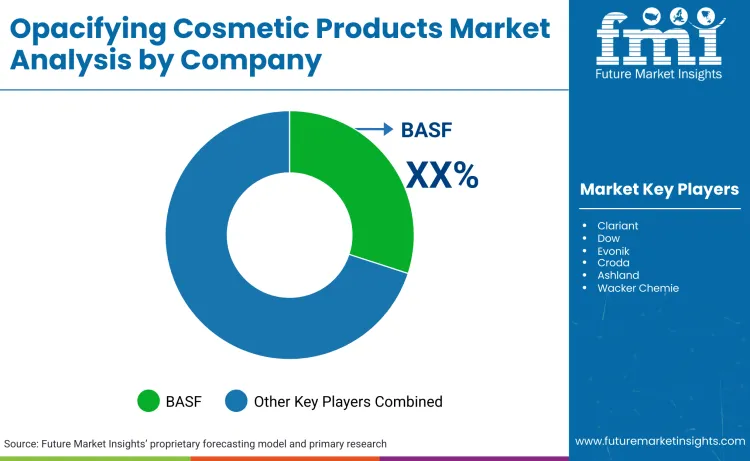
The competitive landscape for opacifying cosmetic ingredients is shaped by specialty chemicals and materials suppliers that are moving beyond commodity pigments toward multifunctional, value-added opacity systems. Players such as BASF, Clariant, Dow, Evonik, Croda, and Ashland benefit from strong formulation science capabilities, regulatory expertise, and long-standing partnerships with global cosmetics manufacturers. BASF holds a leading position with an estimated 29.8% share, reflecting its ability to scale multifunctional titanium dioxide grades with advanced surface treatments that deliver visual opacity alongside UV protection, emulsion stability, and sensory enhancement. Competitive positioning in this market is less about volume leadership in basic pigments and more about supplying differentiated, compliant opacity technologies aligned with evolving regulatory and performance requirements.
Future Market Insights observes that competition is increasingly centered on multifunctional performance, regulatory readiness, and formulation compatibility rather than price-led expansion. Companies such as Evonik, Wacker Chemie, Sensient, Lubrizol, and Kobo Products emphasize coated mineral systems, hybrid polymer-mineral technologies, and technical formulation support to ensure stability and optical consistency across diverse cosmetic bases. At the same time, sustainability initiatives are emerging as a key differentiator, with suppliers investing in closed-loop manufacturing, emissions reduction, and lower water-intensity production for titanium dioxide. FMI notes that long-term advantage will depend on suppliers’ ability to combine regulatory compliance, formulation support, and sustainability credentials while embedding opacifier technologies seamlessly into next-generation cosmetic formulations rather than positioning them as standalone pigment solutions.
Recent Developments:
- In March 2024, BASF launched an advanced titanium dioxide dispersion featuring proprietary surface treatment improving stability in high-surfactant shampoo formulations.
- In June 2024, Clariant introduced a hybrid polymer-mineral opacifier system combining titanium dioxide with biodegradable cellulose microparticles for enhanced sustainability positioning.
- In September 2024, Evonik expanded production capacity for specialty zinc oxide opacifiers targeting clean beauty body care formulations requiring natural mineral ingredients.
Market Definition
The opacifying cosmetic products market represents revenue generated from specialty ingredients including titanium dioxide, zinc oxide, styrene-acrylate copolymers, and natural minerals that provide visual opacity, milky-white appearance, and light-scattering properties to cosmetic formulations. The market measures sales value of opacifier raw materials sold to cosmetic manufacturers for incorporation into shampoos, conditioners, body washes, lotions, creams, and color cosmetics requiring aesthetic appearance enhancement through opacity rather than transparency.
Inclusions cover titanium dioxide grades for cosmetic applications, zinc oxide opacifiers, styrene-acrylate copolymer opacity systems, and natural mineral alternatives including mica and talc. Functions include appearance enhancement through milky aesthetics, light diffusion and masking of formulation imperfections, and color and texture improvement. Physical forms encompass liquid dispersions in water or glycol carriers, powder concentrates requiring formulation-side dispersion, and bead or encapsulated formats providing controlled release. Applications include shampoos and conditioners, body washes and shower gels, lotions and creams, and color cosmetics.
Exclusions include finished cosmetic products containing opacifiers as market focuses on raw ingredient supply. Pearlescent and interference pigments providing iridescent rather than opaque effects fall outside scope. Food-grade titanium dioxide for pharmaceutical and nutraceutical applications is excluded. Colorants and dyes providing chromatic color rather than white opacity are separate categories. Industrial titanium dioxide for paints, plastics, and coatings represents distinct market outside cosmetic applications.
Scope of Report
| Items | Values |
|---|---|
| Quantitative Units (2026) | USD 1.95 Billion |
| By Chemistry | Titanium Dioxide; Zinc Oxide; Styrene/Acrylate Copolymers; Natural Mineral Systems |
| By Function | Appearance Enhancement; Light Diffusion and Masking; Color and Texture Improvement |
| By Physical Form | Liquid Dispersion; Powder Concentrate; Bead/Encapsulated Formats |
| By Application | Shampoos and Conditioners; Body Washes and Shower Gels; Lotions and Creams; Color Cosmetics |
| Regions Covered | North America, Europe, Asia Pacific, Latin America, Middle East & Africa |
| Countries Covered | United States, Germany, United Kingdom, India, China, Brazil, and 40+ countries |
| Key Companies Profiled | BASF; Clariant; Dow; Evonik; Croda; Ashland; Wacker Chemie; Sensient; Lubrizol; Others |
| Additional Attributes | Dollar sales by chemistry, function, physical form, and application; country-wise growth analysis; adoption trends for multifunctional and regulatory-compliant opacifier systems; application patterns across hair care, skin care, and color cosmetics; competitive positioning of specialty chemical suppliers across premium, mass, and clean-label cosmetic formulations |
Opacifying Cosmetic Products Market by Segments
By Chemistry:
- Titanium Dioxide
- Zinc Oxide
- Styrene/Acrylate Copolymers
- Natural Mineral
By Function:
- Appearance Enhancement
- Light Diffusion And Masking
- Color And Texture Improvement
By Physical Form:
- Liquid Dispersion
- Powder Concentrate
- Bead/Encapsulated
By Application:
- Shampoos And Conditioners
- Body Washes And Shower Gels
- Lotions And Creams
- Color Cosmetics
By Region:
- North America (United States, Canada, Mexico)
- Europe (Germany, United Kingdom, France, Italy, Spain)
- East Asia (China, Japan, South Korea)
- South Asia (India, Australia, Southeast Asia)
- Latin America (Brazil, Argentina, Chile)
- Middle East & Africa
Bibliography
- Circana. (2023). USA Hair Care and Body Care Market Report 2023. Circana.
- BASF SE. (2023). Annual Report 2023. BASF SE.
- China Titanium Dioxide Industry Association. (2023). Annual Production Statistics 2023. CTDIA.
- Indian Cosmetic Market Research. (2023). Personal Care Market Report 2023. ICMR.
- German Chemical Industry Association. (2023). Specialty Chemicals R&D Investment Report. VCI.
- Brazilian Association ABIHPEC. (2023). Personal Care Industry Statistics Brazil 2023. ABIHPEC.
Frequently Asked Questions
What is the current global market size for opacifying cosmetic products?
The global market is valued at USD 1.95 Billion in 2026, driven by premium product aesthetic preferences where opaque milky-white formulations signal luxury and efficacy compared to transparent alternatives.
What is the projected Compound Annual Growth Rate (CAGR) for opacifying cosmetic products over the next 10 years?
The market is projected to grow at 8.50% CAGR from 2026 to 2036, reaching USD 4.42 Billion by 2036.
Which regions are experiencing the fastest expansion in opacifying cosmetic products?
China leads with 11.475% growth, followed by India at 10.625% and Germany at 9.775%, driven by domestic titanium dioxide production capacity, indigenous mineral resources, and specialty chemical innovation respectively.
What are the primary drivers for opacifying cosmetic products adoption?
Premium product positioning where opaque aesthetics enable 15-25% retail price premiums and UV protection multifunctionality where titanium dioxide and zinc oxide provide concurrent appearance enhancement and photoprotection are fueling adoption.
Who are the leading companies in the opacifying cosmetic products industry?
BASF SE, Clariant AG, Dow Chemical, Evonik Industries, and Croda International are key players, differentiating through multifunctional titanium dioxide development, hybrid polymer-mineral systems, and sustainability-focused production processes.
Preview the report firsthand - request a free sample
Get SampleGet the brochure for pricing and purchase details.
Get PDFTable of Content
- Executive Summary
- Global Market Overview
- Key Demand Drivers
- Regulatory and Ingredient Shifts
- Strategic Implications
- Market Introduction
- Market Definition
- Market Scope and Coverage
- Market Taxonomy
- Research Methodology
- Report Structure and Chapter Orientation
- FMI Research Framework
- Market Sizing Methodology
- Forecasting Assumptions
- Primary and Secondary Research Inputs
- Data Validation and Triangulation
- Market Background
- Industry Dynamics
- Drivers
- Restraints
- Opportunities
- Trends
- Value Chain Analysis
- Supply Chain and Raw Material Assessment
- Regulatory Landscape
- Pricing and Cost Structure Analysis
- Industry Dynamics
- Global Opacifying Cosmetic Products Market Analysis 2021 to 2025 and Forecast 2026 to 2036
- Market Size Value Analysis (USD Billion)
- Y-o-Y Growth Analysis
- Absolute Dollar Opportunity Analysis
- Global Opacifying Cosmetic Products Market Analysis by Chemistry
- Titanium Dioxide
- Zinc Oxide
- Styrene / Acrylate Copolymers
- Natural Mineral Systems
- Global Opacifying Cosmetic Products Market Analysis by Function
- Appearance Enhancement
- Light Diffusion and Masking
- Color and Texture Improvement
- Global Opacifying Cosmetic Products Market Analysis by Physical Form
- Liquid Dispersion
- Powder Concentrate
- Bead / Encapsulated Formats
- Global Opacifying Cosmetic Products Market Analysis by Application
- Shampoos and Conditioners
- Body Washes and Shower Gels
- Lotions and Creams
- Color Cosmetics
- Global Opacifying Cosmetic Products Market Analysis by Region
- North America
- Europe
- Asia Pacific
- Latin America
- Middle East & Africa
- North America Opacifying Cosmetic Products Market Analysis
- United States
- Canada
- Mexico
- Europe Opacifying Cosmetic Products Market Analysis
- Germany
- United Kingdom
- France
- Italy
- Spain
- Rest of Europe
- Asia Pacific Opacifying Cosmetic Products Market Analysis
- China
- India
- Japan
- South Korea
- Rest of Asia Pacific
- Latin America Opacifying Cosmetic Products Market Analysis
- Brazil
- Argentina
- Chile
- Rest of Latin America
- Middle East & Africa Opacifying Cosmetic Products Market Analysis
- Competitive Landscape
- Market Share Analysis
- Competitive Dashboard
- Strategic Developments
- Company Profiles
- BASF SE
- Clariant AG
- The Dow Chemical Company
- Evonik Industries AG
- Croda International Plc
- Ashland Global Holdings Inc.
- Wacker Chemie AG
- Sensient Technologies Corporation
- The Lubrizol Corporation
- Kobo Products Inc.
- Others
- Assumptions and Acronyms
LOT
- Global Opacifying Cosmetic Products Market Size Value (USD Billion), 2021 to 2025
- Global Opacifying Cosmetic Products Market Forecast (USD Billion), 2026 to 2036
- Global Opacifying Cosmetic Products Market Y-o-Y Growth Analysis (%), 2021 to 2036
- Global Opacifying Cosmetic Products Market Absolute Dollar Opportunity (USD Billion), 2026 to 2036
- Global Opacifying Cosmetic Products Market Size by Chemistry (USD Billion), 2021 to 2025
- Global Opacifying Cosmetic Products Market Forecast by Chemistry (USD Billion), 2026 to 2036
- Y-o-Y Growth Analysis by Chemistry (%), 2021 to 2036
- Absolute Dollar Opportunity by Chemistry (USD Billion), 2026 to 2036
- Global Opacifying Cosmetic Products Market Size by Function (USD Billion), 2021 to 2025
- Global Opacifying Cosmetic Products Market Forecast by Function (USD Billion), 2026 to 2036
- Y-o-Y Growth Analysis by Function (%), 2021 to 2036
- Absolute Dollar Opportunity by Function (USD Billion), 2026 to 2036
- Global Opacifying Cosmetic Products Market Size by Physical Form (USD Billion), 2021 to 2025
- Global Opacifying Cosmetic Products Market Forecast by Physical Form (USD Billion), 2026 to 2036
- Y-o-Y Growth Analysis by Physical Form (%), 2021 to 2036
- Absolute Dollar Opportunity by Physical Form (USD Billion), 2026 to 2036
- Global Opacifying Cosmetic Products Market Size by Application (USD Billion), 2021 to 2025
- Global Opacifying Cosmetic Products Market Forecast by Application (USD Billion), 2026 to 2036
- Y-o-Y Growth Analysis by Application (%), 2021 to 2036
- Absolute Dollar Opportunity by Application (USD Billion), 2026 to 2036
- Global Opacifying Cosmetic Products Market Size by Region (USD Billion), 2021 to 2025
- Global Opacifying Cosmetic Products Market Forecast by Region (USD Billion), 2026 to 2036
- North America Opacifying Cosmetic Products Market Size and Forecast (USD Billion), 2021 to 2036
- Europe Opacifying Cosmetic Products Market Size and Forecast (USD Billion), 2021 to 2036
- Asia Pacific Opacifying Cosmetic Products Market Size and Forecast (USD Billion), 2021 to 2036
- Latin America Opacifying Cosmetic Products Market Size and Forecast (USD Billion), 2021 to 2036
- Middle East & Africa Opacifying Cosmetic Products Market Size and Forecast (USD Billion), 2021 to 2036
- China Opacifying Cosmetic Products Market Size and Forecast (USD Billion), 2021 to 2036
- India Opacifying Cosmetic Products Market Size and Forecast (USD Billion), 2021 to 2036
- United States Opacifying Cosmetic Products Market Size and Forecast (USD Billion), 2021 to 2036
- Germany Opacifying Cosmetic Products Market Size and Forecast (USD Billion), 2021 to 2036
- Brazil Opacifying Cosmetic Products Market Size and Forecast (USD Billion), 2021 to 2036
- Market Share Analysis of Key Players (%), 2026


