

- Industry Size (2026)
- USD 0.6 Bn
- Forecast (2036)
- USD 1.8 Bn
- CAGR (2026 to 2036)
- 11.2%
Pressed Powder Refill Pans Market Forecast and Outlook 2026 to 2036
Pressed powder refill pans are projected to reach USD 0.6 billion in 2026 and expand strongly through 2036 as refillable color cosmetics move from niche launches into core packaging strategies for prestige and masstige brands that want to cut packaging weight while keeping a premium compact experience. Demand is being pulled by setting and finishing powder refills, where consumers repurchase frequently and expect consistent pan fit, clean swap out, and stable press integrity across shades and finishes. Manufacturers are investing in tighter pan tolerances, bonding methods, and compact compatibility systems such as magnetic alignment and repeatable drop in geometry, because the refill experience only works when pans lock securely and powders resist cracking during transport and daily use. Aluminum pans are gaining share because they deliver better dimensional stability, smoother edge finishing, and reliable heat and pressure performance during pressing, which supports higher speed filling lines and fewer rejects for brands running multi SKU refill programs.
Government regulation is also accelerating adoption by raising the compliance and cost pressure around single use packaging. In the EU, Regulation (EU) 2025/40 strengthens packaging prevention and promotes reuse and refill approaches, pushing beauty brands to redesign packs and increase refill readiness across retail channels. In the UK, packaging EPR reporting and fee structures reinforce the business case for reducing packaging placed on the market, which supports refill systems that lower primary pack turnover. At the same time, refill programs must stay aligned with cosmetics safety frameworks such as EU Regulation (EC) 1223/2009, including product safety substantiation and notification requirements via the CPNP, which increases the value of standardized, audit ready refill specifications and cosmetics GMP discipline such as ISO 22716.
Quick Stats for Pressed Powder Refill Pans Market
- Pressed Powder Refill Pans Industry Value (2026): USD 0.6 Billion
- Pressed Powder Refill Pans Industry Forecast Value (2036): USD 1.8 Billion
- Pressed Powder Refill Pans Industry Forecast CAGR: 11.2%
- Pressed Powder Refill Pans Industry Leading Product Type: Setting/Finishing Powder Refills (38.4%)
- Pressed Powder Refill Pans Industry Key Growth Regions: North America, Europe, Asia-Pacific
- Pressed Powder Refill Pans Industry Key Players: Dior, Kjaer Weis, Jane Iredale, Guerlain, Bésame Cosmetics
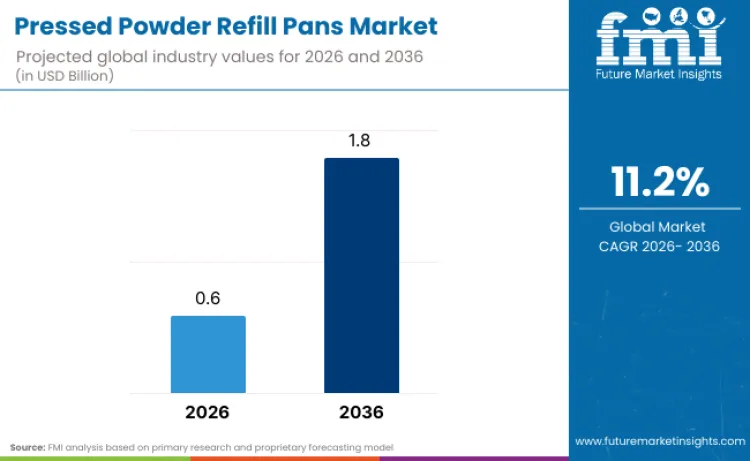
Pressed Powder Refill Pans Market Key Takeaways
| Metric | Value |
|---|---|
| Industry Size (2026) | USD 0.6 Billion |
| Industry Value (2036) | USD 1.8 Billion |
| CAGR (2026 to 2036) | 11.2% |
Source: FMI analysis based on primary research and proprietary forecasting model
What Is Driving Faster Uptake of Refillable Setting Powder Systems?
Momentum behind setting powder refills is being driven by a shift toward lower-waste beauty routines and wider acceptance of refillable packaging as a premium, repeat-purchase format. Improvements in powder pressing are helping refill pans stay more intact in daily use, supporting consistent pickup, texture, and finish over time. Refillable formats are also expanding beyond niche shades as translucent and tone-flexible powders translate well into pan replacements that suit varied skin tones and makeup styles. Education led by beauty advisors is strengthening adoption by linking refills to better value over the life of a compact, not just sustainability messaging. In parallel, prestige brands are scaling the model through signature refill assortments that protect brand equity while encouraging replenishment. Magnetic pan designs are becoming a common hardware standard in higher-end compacts because they simplify swap-in use, reduce handling friction, and maintain a premium look and feel without sacrificing portability.
How Is the Pressed Powder Refill Pans Market Segmented Across Key Categories?
Global marketplace is systematically segmented to address varied requirements of the beauty packaging industry, categorizing sector by product type, pan specification, price tier, and distribution channel. Structural organization enables stakeholders to identify specific market opportunities, such as increasing demand for aluminum pans in luxury formulations or preference for hybrid materials in indie beauty applications. Through examining these segments, manufacturers can customize production strategies to meet distinct requirements of prestige brands versus mass market operators. Segmentation also highlights evolution from basic replacement pans to sophisticated multi-functional refill systems. As technology progresses, granular segmentation becomes vital for understanding consumer adoption patterns and regulatory compliance, ensuring product development aligns with evolving beauty industry standards.
Why Do Setting/Finishing Powder Refills Maintain Dominance?
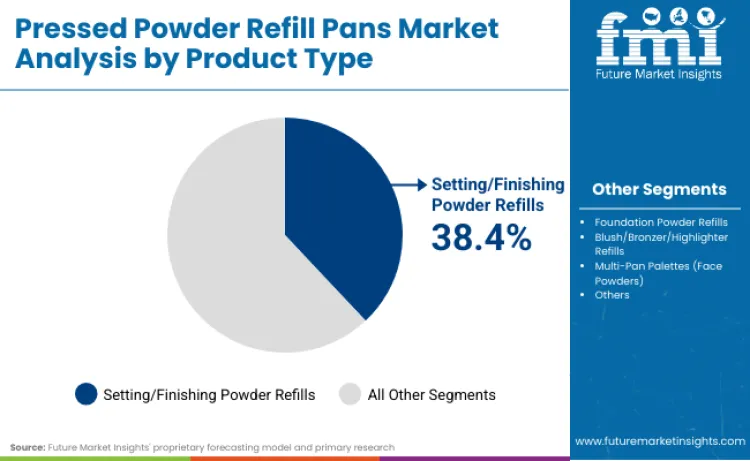
Setting and finishing powder refills command 38.4% of product type share in 2026, driven by universal application across all makeup routines and consistent repurchase patterns. Market leadership stems from established formulation technologies and proven consumer acceptance that beauty brands can leverage effectively. Segment benefits from continuous formula improvements, including oil-absorbing innovations and light-reflecting particles enhancing longevity. Research focused on translucent powder versatility is renewing interest among prestige manufacturers. Critical role in makeup setting protocols further strengthens market position, as these products provide essential final-step coverage. As beauty application guidelines emphasize finishing powder importance, demand for high-quality refillable options is expected to remain substantial.
Why Do Aluminum Pans Lead Specification Preferences?
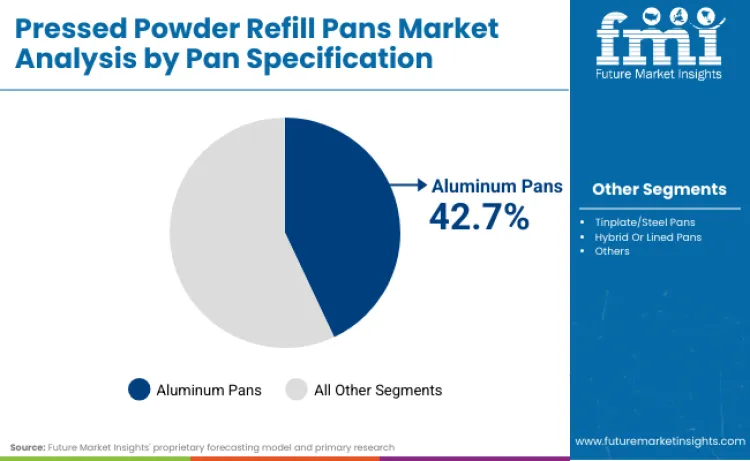
Aluminum pan specifications secure 42.7% of market share in 2026, reflecting superior durability and optimal heat conductivity for powder pressing applications. Leadership position is linked to material compatibility with magnetic closure systems and resistance to impact damage during handling. Manufacturers depend on aluminum's lightweight properties to maintain compact portability while ensuring structural integrity. These specifications are essential for delivering premium powder formulations and extended product lifespan, establishing priority status among luxury beauty brands. Continuous pursuit of corrosion resistance ensures pans designed for repeated use remain the preferred choice. Strong material performance necessitates specialized manufacturing capabilities, supporting sustained revenue streams for packaging suppliers.
Why Do Prestige/Luxury Tiers Dominate Pricing Structure?
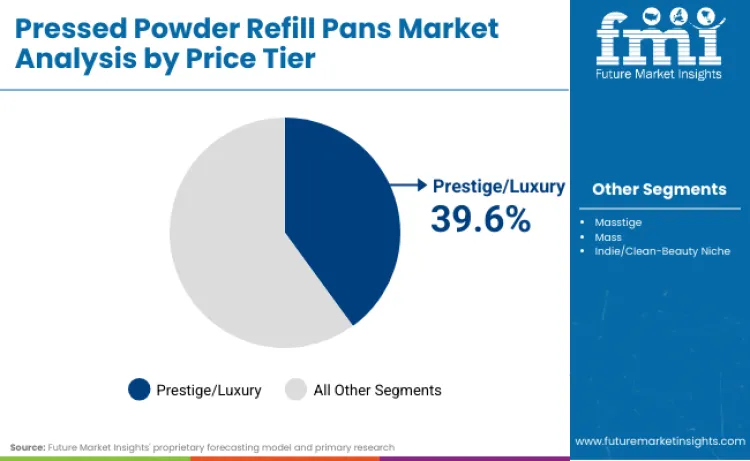
Prestige and luxury price tiers capture 39.6% of market share in 2026, owing to premium brand positioning and sophisticated refill system technology. Dominance originates from high-end consumer willingness to invest in sustainable beauty solutions with superior performance characteristics. Consumers appreciate these products for their exceptional quality and environmental consciousness alignment. Implementation in luxury beauty lines drives continuous adoption growth among affluent demographic segments. Compatibility with exclusive formulation technologies allows for differentiated product experiences across various application methods. Beauty houses focusing on prestige refill offerings for signature powder collections secure substantial customer loyalty among environmentally conscious luxury consumers.
How Are Clean Beauty Rules Reshaping Refill Pan Materials and Manufacturing?
Clean beauty is pushing refill development toward materials and coatings that can withstand higher scrutiny on safety, purity, and end-of-life impact. In the EU, the Packaging and Packaging Waste Regulation has entered into force and is designed to reduce packaging waste while accelerating reuse and circular packaging models, which strengthens the business case for refillable compacts and replacement pans that minimize single-use components. In parallel, EU restrictions on intentionally added microplastics, including glitter, are tightening the acceptable material and particulate profile of cosmetic components and formulations, which increases pressure to avoid coatings or decorative elements that could be treated as microplastic sources. In the United States, MoCRA is raising compliance expectations through requirements like safety substantiation and adverse event reporting, which elevates the importance of packaging compatibility testing and contamination prevention for refill formats that involve repeated consumer handling.
How Will Digital Integration Change the Refill Compact Buying and Replenishment Journey?
Digital integration is turning refill systems into trackable, repeatable replenishment programs rather than occasional repurchases. The EU’s Ecodesign for Sustainable Products Regulation framework introduces a Digital Product Passport concept intended to store product, component, and material information to support circularity and legal compliance, which creates a clear market direction for scannable product data tied to refills, materials, and disposal guidance. For refillable setting powders, this aligns with connected experiences where QR-based product data supports shade continuity, refill compatibility checks, how-to instructions, and simplified reordering, while loyalty apps can link refill cadence to reminders and personalization without relying on store associate intervention. As retailers expand omnichannel refill offerings, digital tools also help reduce friction by enabling click-to-refill, subscription logic for core shades, and clearer proof points for sustainability claims that need to stand up to regulatory scrutiny.
How Are New Powder Textures and Compliance Pressures Changing Pan Performance Requirements?
Formulation innovation is changing what refill pans must tolerate in real use, because newer textures and sensorial finishes often alter press behavior, brittleness, dusting risk, and adhesion. At the same time, the EU microplastics restriction on intentionally added synthetic polymer microparticles is forcing many brands to reassess certain texture and effect ingredients, which can shift binder systems and particle profiles in ways that impact pan hardness, pickup, and break resistance. This pushes pan suppliers toward more consistent surface finishes, coating chemistries that do not interfere with sensitive formulas, and tighter dimensional control so magnetic or snap-in mechanisms seat cleanly without chipping. It also increases the need for durability and contamination controls across transport, retail handling, and repeated consumer swaps, especially as refill programs scale under packaging waste rules that favor reuse models over single-use replacements.
How Will the Pressed Powder Refill Pans Industry Evolve in Major Nations?
Global landscape for refillable beauty packaging is characterized by diverse regulatory environments, influenced by cosmetic safety standards and environmental protection policies. Established markets prioritize sophisticated refill systems and premium material specifications, whereas developing economies focus on accessible refill options and competitive pricing structures. Europe is emerging as regulatory leader due to comprehensive packaging waste legislation and advanced circular economy mandates. Conversely, North American markets emphasize innovation leadership and luxury brand adoption models. As per FMI's projection, government initiatives in developed nations supporting waste reduction targets ensure sustained demand for refillable beauty packaging across all market segments.
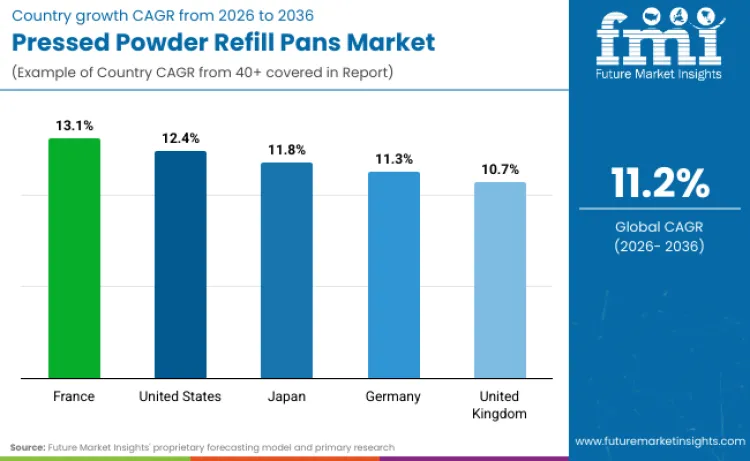
| Country | CAGR (2026 to 2036) |
|---|---|
| France | 13.1% |
| United States | 12.4% |
| Japan | 11.8% |
| Germany | 11.3% |
| United Kingdom | 10.7% |
Source: Future Market Insights analysis, supported by a proprietary forecasting model and primary research
Why is the Pressed Powder Refill Pans Industry in France Growing?
Deployment of pressed powder refill pans in France is positioned to grow at 13.1% CAGR through 2036 because the national circular economy framework is explicitly pushing retail and brands toward reuse, refill, and bulk style selling models that reduce packaging at the point of purchase. France’s official page on the anti waste and circular economy law highlights measures that support reuse systems, including dedicated funding mechanisms within eco organisations to finance reuse, which aligns directly with refillable cosmetics formats where the outer compact is kept and only the pan is replaced. The law also defines bulk sale as selling products without packaging in quantities chosen by the consumer, using reusable or reusable use containers, which reinforces consumer and retailer acceptance of refill and container retention behaviors that refill pan models rely on. Public health authorities also state that everyday consumer products can be sold in bulk with limited exceptions justified for public health reasons, which supports wider category applicability beyond food and strengthens the regulatory comfort around refill retail concepts.
Why is the Pressed Powder Refill Pans Sector in United States Expanding?
Demand for pressed powder refill pans in the United States is projected to advance at 12.4% CAGR through 2036 because state level packaging policy is shifting cost and compliance pressure onto producers, which increases incentives to reduce packaging per use cycle through refillable designs. California’s SB 54 program creates an extended producer responsibility structure for packaging and single use food service ware and is administered by CalRecycle, reinforcing a strong policy signal toward circular packaging outcomes. Implementation text linked to SB 54 also explicitly treats packaging as conventionally disposed after a single use if it is not reusable or refillable under the defined criteria, which supports refill models that can be documented as reuse and refill systems rather than single use packaging. For cosmetics, refill pans fit this direction because they reduce the amount of packaging placed on the market while preserving premium design and brand experience through reusable compacts.
Why is the Pressed Powder Refill Pans Industry in Japan Showing Potential?
Pressed powder refill pans in Japan are set to expand at 11.8% CAGR through 2036 because Japan’s plastics policy is designed around lifecycle circularity, including expectations that product design and business practices support reduce, reuse, and resource circulation. Japan’s Ministry of the Environment describes the Plastic Resource Circulation Act as addressing the full lifecycle of plastics, from design through disposal, and includes measures and guidance that promote circular design and improved resource circulation, which supports refillable cosmetics packaging strategies. Japan’s government public information on the act also frames it as promoting resource circulation across the lifecycle of plastic containing products, reinforcing a policy environment that rewards refill and replacement component models such as refill pans. This creates a market advantage for refill systems that can demonstrate packaging reduction and consistent quality control in compact replacement workflows.
Why is the Pressed Powder Refill Pans Industry in Germany Growing?
Sales of pressed powder refill pans in Germany are set to grow at 11.3% CAGR through 2036 because packaging compliance and recyclability incentives are becoming more prescriptive, nudging brands toward designs that reduce packaging mass and improve end of life outcomes. Germany’s Central Agency Packaging Register explains that meeting packaging recycling targets requires measures across the value chain under the Packaging Act, reinforcing continuous pressure on packaging formats used in consumer goods including cosmetics. The same authority publishes a minimum standard for recycling friendly packaging and states that dual systems must create financial incentives for packaging designs that are more recycling friendly under the Packaging Act framework, which encourages brands to reduce complex packaging components and shift toward refill formats where the primary container is retained and only a smaller component is replaced. Refill pans align well with this direction because they can reduce packaging placed on the market per use cycle while keeping the premium compact as a durable component.
Why is the Pressed Powder Refill Pans Sector in United Kingdom Expanding?
Revenue from pressed powder refill systems in the United Kingdom is positioned to grow at 10.7% CAGR through 2036 because packaging policy is moving toward fee structures and reporting requirements that reward packaging that is easier to recycle, refill, or reuse. UK government guidance on extended producer responsibility for packaging states that affected organisations may need to report packaging data and pay fees based on that data, increasing the commercial value of packaging reduction strategies such as refill systems. DEFRA has also communicated that materials which are easier to recycle, refill, or reuse are liable for lower fees, reinforcing a direct policy incentive for refillable formats in beauty where outer packs can be retained. UK packaging legislation also defines reusable packaging as packaging designed to be used multiple times by being refilled or reused for the same purpose, which supports refill pan systems that keep the compact in use while replacing only the pan.
What is the Competitive Outlook for the Pressed Powder Refill Pans Market?
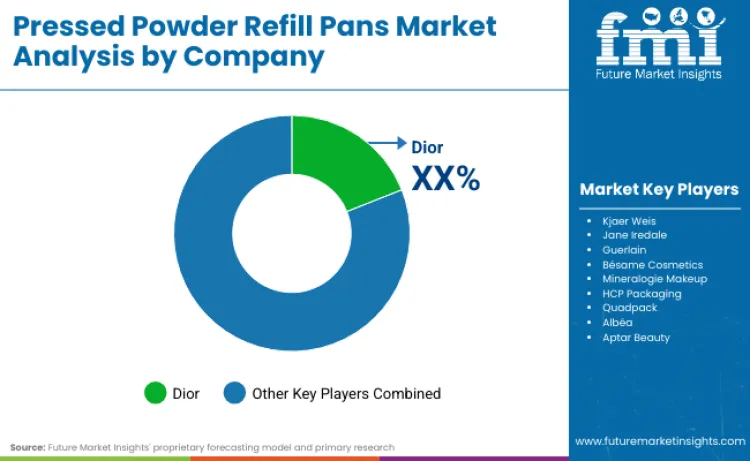
Competition in pressed powder refill pans is being shaped by how convincingly brands can make “refill” feel premium, seamless, and durable, rather than treating the pan as a low-value spare part. Luxury houses are using refillable compacts to protect brand equity and repeat purchase, Dior, for example, sells refill pans designed specifically to be placed into an existing case and not used standalone, reinforcing an ecosystem model (case + refill) rather than a one-off replacement. At the premium-indie end, Kjaer Weis has built its identity around refillability, using long-life compacts with magnetic closure and refill systems designed for repeated swaps, which sets a high bar for fit, finish, and user experience.
On the supply side, the market is becoming more capability-driven: packaging specialists are showcasing rechargeable compact engineering and mono-material redesigns, Texen highlighted a rechargeable compact redesign for Chanel that shifts the compact body from ABS toward PET, reflecting eco-design pressure without sacrificing luxury cues. Consolidation is also reshaping supplier choices: PSB Industries’ move to combine Quadpack and Texen into a single group signals a push toward larger, end-to-end beauty packaging platforms that can deliver refillable compact programs at scale.
Key Players in Pressed Powder Refill Pans Market
- Dior
- Kjaer Weis
- Jane Iredale
- Guerlain
- Bésame Cosmetics
- Mineralogie Makeup
- HCP Packaging
- Quadpack
- Albéa
- Aptar Beauty
Scope of Report
| Items | Values |
|---|---|
| Quantitative Units | USD Billion |
| Product Type Segments | Setting/Finishing Powder Refills; Foundation Powder Refills; Blush/Bronzer/Highlighter Refills; Multi-Pan Palettes (Face Powders); Others |
| Pan Specification Categories | Aluminum Pans; Tinplate/Steel Pans; Hybrid Or Lined Pans; Others |
| Price Tier Types | Prestige/Luxury; Masstige; Mass; Indie/Clean-Beauty Niche |
| Channel Categories | Brand-Owned DTC Refill Sales (Online); Specialty Beauty Retail; Department Stores; B2B Supply; Others |
| Regions Covered | North America, Europe, Asia-Pacific, Latin America, Middle East & Africa |
| Key Countries | France, United States, Japan, Germany, United Kingdom |
| Key Companies Profiled | Dior; Kjaer Weis; Jane Iredale; Guerlain; Bésame Cosmetics; Mineralogie Makeup; HCP Packaging; Quadpack; Albéa; Aptar Beauty |
| Additional Attributes | Dollar sales measured for pressed powder refill pans used in beauty applications and sustainable packaging initiatives, specified by material composition (aluminum, steel, hybrid), product category focus, manufacturing complexity, application target (face powders, color cosmetics), distribution model (direct-to-consumer vs. retail), and compliance alignment with evolving sustainability standards and beauty industry regulations. |
Pressed Powder Refill Pans Market by Segments
Product Type:
- Setting/Finishing Powder Refills
- Foundation Powder Refills
- Blush/Bronzer/Highlighter Refills
- Multi-Pan Palettes (Face Powders)
- Others
Pan Specification:
- Aluminum Pans
- Tinplate/Steel Pans
- Hybrid Or Lined Pans
- Others
Price Tier:
- Prestige/Luxury
- Masstige
- Mass
- Indie/Clean-Beauty Niche
Channel:
- Brand-Owned DTC Refill Sales (Online)
- Specialty Beauty Retail
- Department Stores
- B2B Supply
- Others
Bibliography
- European Union. (2025). Regulation (EU) 2025/40 on packaging and packaging waste (PPWR). Official Journal of the European Union.
- Cosmetics Europe. (2024). Guidelines on cosmetic packaging, safety, and compatibility for refill and reuse formats. Cosmetics Europe - The Personal Care Association.
- USA Food and Drug Administration. (2023). Cosmetics: Good manufacturing practice and packaging considerations. USA Department of Health and Human Services.
- British Beauty Council. (2024). The future of refillable beauty packaging in the UK market. British Beauty Council.
Frequently Asked Questions
How big is the global pressed powder refill pans market?
The global pressed powder refill pans market is valued at USD 0.6 billion in 2026.
What is the growth outlook for the pressed powder refill pans market over the next 10 years?
The market is projected to grow at an 11.2% CAGR from 2026 to 2036, reaching USD 1.8 billion.
Which product segments or formats drive demand in this market?
Demand is driven mainly by setting and finishing powder refills, aluminum pan formats, and prestige refill systems designed for repeated consumer replacement.
How does consumer behavior differ by region?
Europe leads adoption through luxury sustainability and regulatory pressure, North America emphasizes premium refill convenience, while Asia-Pacific favors precision-fit, innovation-led refill cosmetics.
What are the main risks and constraints affecting this market?
Key constraints include tight pan-fit tolerances, powder cracking risk, higher unit manufacturing costs, and the need for seamless compact compatibility across brands.
Preview the report firsthand - request a free sample
Get SampleGet the brochure for pricing and purchase details.
Get PDFTable of Content
- Executive Summary
- Global Market Outlook
- Demand Side Trends
- Supply Side Trends
- Technology Roadmap Analysis
- Analysis and Recommendations
- Market Overview
- Market Coverage / Taxonomy
- Market Definition / Scope / Limitations
- Research Methodology
- Chapter Orientation
- Analytical Lens and Working Hypotheses
- Market Structure, Signals, and Trend Drivers
- Benchmarking and Cross-market Comparability
- Market Sizing, Forecasting, and Opportunity Mapping
- Research Design and Evidence Framework
- Desk Research Programme (Secondary Evidence)
- Company Annual and Sustainability Reports
- Peer-reviewed Journals and Academic Literature
- Corporate Websites, Product Literature, and Technical Notes
- Earnings Decks and Investor Briefings
- Statutory Filings and Regulatory Disclosures
- Technical White Papers and Standards Notes
- Trade Journals, Industry Magazines, and Analyst Briefs
- Conference Proceedings, Webinars, and Seminar Materials
- Government Statistics Portals and Public Data Releases
- Press Releases and Reputable Media Coverage
- Specialist Newsletters and Curated Briefings
- Sector Databases and Reference Repositories
- FMI Internal Knowledge Base and Historical Datasets
- Subscription Datasets and Paid Sources
- Social Channels, Communities, and Digital Listening Inputs
- Additional Desk Sources
- Expert Input and Fieldwork (Primary Evidence)
- Primary Modes
- Qualitative Interviews and Expert Elicitation
- Quantitative Surveys and Structured Data Capture
- Blended Approach
- Why Primary Evidence is Used
- Field Techniques
- Interviews
- Surveys
- Focus Groups
- Observational and In-context Research
- Social and Community Interactions
- Stakeholder Universe Engaged
- C-suite Leaders
- Board Members
- Presidents and Vice Presidents
- R&D and Innovation Heads
- Technical Specialists
- Domain Subject-matter Experts
- Scientists
- Physicians and Other Healthcare Professionals
- Governance, Ethics, and Data Stewardship
- Research Ethics
- Data Integrity and Handling
- Primary Modes
- Tooling, Models, and Reference Databases
- Desk Research Programme (Secondary Evidence)
- Data Engineering and Model Build
- Data Acquisition and Ingestion
- Cleaning, Normalisation, and Verification
- Synthesis, Triangulation, and Analysis
- Quality Assurance and Audit Trail
- Market Background
- Market Dynamics
- Drivers
- Restraints
- Opportunity
- Trends
- Scenario Forecast
- Demand in Optimistic Scenario
- Demand in Likely Scenario
- Demand in Conservative Scenario
- Opportunity Map Analysis
- Product Life Cycle Analysis
- Supply Chain Analysis
- Investment Feasibility Matrix
- Value Chain Analysis
- PESTLE and Porter's Analysis
- Regulatory Landscape
- Regional Parent Market Outlook
- Production and Consumption Statistics
- Import and Export Statistics
- Market Dynamics
- Global Market Analysis 2021 to 2025 and Forecast, 2026 to 2036
- Historical Market Size Value (USD Billion) Analysis, 2021 to 2025
- Current and Future Market Size Value (USD Billion) Projections, 2026 to 2036
- Y-o-Y Growth Trend Analysis
- Absolute $ Opportunity Analysis
- Global Market Pricing Analysis 2021 to 2025 and Forecast 2026 to 2036
- Y-o-Y Growth Trend Analysis 2021 to 2025
- Absolute $ Opportunity Analysis 2026 to 2036
- Global Market Analysis 2021 to 2025 and Forecast 2026 to 2036, By Product Type
- Introduction / Key Findings
- Historical Market Size Value (USD Billion) Analysis By Product Type, 2021 to 2025
- Current and Future Market Size Value (USD Billion) Analysis and Forecast By Product Type, 2026 to 2036
- Setting/Finishing Powder Refills
- Foundation Powder Refills
- Blush/Bronzer/Highlighter Refills
- Multi-Pan Palettes (Face Powders)
- Others
- Y-o-Y Growth Trend Analysis By Product Type, 2021 to 2025
- Absolute $ Opportunity Analysis By Product Type, 2026 to 2036
- Global Market Analysis 2021 to 2025 and Forecast 2026 to 2036, By Pan Specification
- Introduction / Key Findings
- Historical Market Size Value (USD Billion) Analysis By Pan Specification, 2021 to 2025
- Current and Future Market Size Value (USD Billion) Analysis and Forecast By Pan Specification, 2026 to 2036
- Aluminum Pans
- Tinplate/Steel Pans
- Hybrid Or Lined Pans
- Others
- Y-o-Y Growth Trend Analysis By Pan Specification, 2021 to 2025
- Absolute $ Opportunity Analysis By Pan Specification, 2026 to 2036
- Global Market Analysis 2021 to 2025 and Forecast 2026 to 2036, By Price Tier
- Introduction / Key Findings
- Historical Market Size Value (USD Billion) Analysis By Price Tier, 2021 to 2025
- Current and Future Market Size Value (USD Billion) Analysis and Forecast By Price Tier, 2026 to 2036
- Prestige/Luxury
- Masstige
- Mass
- Indie/Clean-Beauty Niche
- Y-o-Y Growth Trend Analysis By Price Tier, 2021 to 2025
- Absolute $ Opportunity Analysis By Price Tier, 2026 to 2036
- Global Market Analysis 2021 to 2025 and Forecast 2026 to 2036, By Channel
- Introduction / Key Findings
- Historical Market Size Value (USD Billion) Analysis By Channel, 2021 to 2025
- Current and Future Market Size Value (USD Billion) Analysis and Forecast By Channel, 2026 to 2036
- Brand-Owned DTC Refill Sales (Online)
- Specialty Beauty Retail
- Department Stores
- B2B Supply
- Others
- Y-o-Y Growth Trend Analysis By Channel, 2021 to 2025
- Absolute $ Opportunity Analysis By Channel, 2026 to 2036
- Global Market Analysis 2021 to 2025 and Forecast 2026 to 2036, By Region
- Introduction
- Historical Market Size Value (USD Billion) Analysis By Region, 2021 to 2025
- Current Market Size Value (USD Billion) Analysis and Forecast By Region, 2026 to 2036
- North America
- Latin America
- Western Europe
- Eastern Europe
- East Asia
- South Asia and Pacific
- Middle East & Africa
- Market Attractiveness Analysis By Region
- North America Market Analysis 2021 to 2025 and Forecast 2026 to 2036, By Country
- Historical Market Size Value (USD Billion) Trend Analysis By Market Taxonomy, 2021 to 2025
- Market Size Value (USD Billion) Forecast By Market Taxonomy, 2026 to 2036
- By Country
- USA
- Canada
- Mexico
- By Product Type
- By Pan Specification
- By Price Tier
- By Channel
- By Country
- Market Attractiveness Analysis
- By Country
- By Product Type
- By Pan Specification
- By Price Tier
- By Channel
- Key Takeaways
- Latin America Market Analysis 2021 to 2025 and Forecast 2026 to 2036, By Country
- Historical Market Size Value (USD Billion) Trend Analysis By Market Taxonomy, 2021 to 2025
- Market Size Value (USD Billion) Forecast By Market Taxonomy, 2026 to 2036
- By Country
- Brazil
- Chile
- Rest of Latin America
- By Product Type
- By Pan Specification
- By Price Tier
- By Channel
- By Country
- Market Attractiveness Analysis
- By Country
- By Product Type
- By Pan Specification
- By Price Tier
- By Channel
- Key Takeaways
- Western Europe Market Analysis 2021 to 2025 and Forecast 2026 to 2036, By Country
- Historical Market Size Value (USD Billion) Trend Analysis By Market Taxonomy, 2021 to 2025
- Market Size Value (USD Billion) Forecast By Market Taxonomy, 2026 to 2036
- By Country
- Germany
- UK
- Italy
- Spain
- France
- Nordic
- BENELUX
- Rest of Western Europe
- By Product Type
- By Pan Specification
- By Price Tier
- By Channel
- By Country
- Market Attractiveness Analysis
- By Country
- By Product Type
- By Pan Specification
- By Price Tier
- By Channel
- Key Takeaways
- Eastern Europe Market Analysis 2021 to 2025 and Forecast 2026 to 2036, By Country
- Historical Market Size Value (USD Billion) Trend Analysis By Market Taxonomy, 2021 to 2025
- Market Size Value (USD Billion) Forecast By Market Taxonomy, 2026 to 2036
- By Country
- Russia
- Poland
- Hungary
- Balkan & Baltic
- Rest of Eastern Europe
- By Product Type
- By Pan Specification
- By Price Tier
- By Channel
- By Country
- Market Attractiveness Analysis
- By Country
- By Product Type
- By Pan Specification
- By Price Tier
- By Channel
- Key Takeaways
- East Asia Market Analysis 2021 to 2025 and Forecast 2026 to 2036, By Country
- Historical Market Size Value (USD Billion) Trend Analysis By Market Taxonomy, 2021 to 2025
- Market Size Value (USD Billion) Forecast By Market Taxonomy, 2026 to 2036
- By Country
- China
- Japan
- South Korea
- By Product Type
- By Pan Specification
- By Price Tier
- By Channel
- By Country
- Market Attractiveness Analysis
- By Country
- By Product Type
- By Pan Specification
- By Price Tier
- By Channel
- Key Takeaways
- South Asia and Pacific Market Analysis 2021 to 2025 and Forecast 2026 to 2036, By Country
- Historical Market Size Value (USD Billion) Trend Analysis By Market Taxonomy, 2021 to 2025
- Market Size Value (USD Billion) Forecast By Market Taxonomy, 2026 to 2036
- By Country
- India
- ASEAN
- Australia & New Zealand
- Rest of South Asia and Pacific
- By Product Type
- By Pan Specification
- By Price Tier
- By Channel
- By Country
- Market Attractiveness Analysis
- By Country
- By Product Type
- By Pan Specification
- By Price Tier
- By Channel
- Key Takeaways
- Middle East & Africa Market Analysis 2021 to 2025 and Forecast 2026 to 2036, By Country
- Historical Market Size Value (USD Billion) Trend Analysis By Market Taxonomy, 2021 to 2025
- Market Size Value (USD Billion) Forecast By Market Taxonomy, 2026 to 2036
- By Country
- Kingdom of Saudi Arabia
- Other GCC Countries
- Turkiye
- South Africa
- Other African Union
- Rest of Middle East & Africa
- By Product Type
- By Pan Specification
- By Price Tier
- By Channel
- By Country
- Market Attractiveness Analysis
- By Country
- By Product Type
- By Pan Specification
- By Price Tier
- By Channel
- Key Takeaways
- Key Countries Market Analysis
- USA
- Pricing Analysis
- Market Share Analysis, 2025
- By Product Type
- By Pan Specification
- By Price Tier
- By Channel
- Canada
- Pricing Analysis
- Market Share Analysis, 2025
- By Product Type
- By Pan Specification
- By Price Tier
- By Channel
- Mexico
- Pricing Analysis
- Market Share Analysis, 2025
- By Product Type
- By Pan Specification
- By Price Tier
- By Channel
- Brazil
- Pricing Analysis
- Market Share Analysis, 2025
- By Product Type
- By Pan Specification
- By Price Tier
- By Channel
- Chile
- Pricing Analysis
- Market Share Analysis, 2025
- By Product Type
- By Pan Specification
- By Price Tier
- By Channel
- Germany
- Pricing Analysis
- Market Share Analysis, 2025
- By Product Type
- By Pan Specification
- By Price Tier
- By Channel
- UK
- Pricing Analysis
- Market Share Analysis, 2025
- By Product Type
- By Pan Specification
- By Price Tier
- By Channel
- Italy
- Pricing Analysis
- Market Share Analysis, 2025
- By Product Type
- By Pan Specification
- By Price Tier
- By Channel
- Spain
- Pricing Analysis
- Market Share Analysis, 2025
- By Product Type
- By Pan Specification
- By Price Tier
- By Channel
- France
- Pricing Analysis
- Market Share Analysis, 2025
- By Product Type
- By Pan Specification
- By Price Tier
- By Channel
- India
- Pricing Analysis
- Market Share Analysis, 2025
- By Product Type
- By Pan Specification
- By Price Tier
- By Channel
- ASEAN
- Pricing Analysis
- Market Share Analysis, 2025
- By Product Type
- By Pan Specification
- By Price Tier
- By Channel
- Australia & New Zealand
- Pricing Analysis
- Market Share Analysis, 2025
- By Product Type
- By Pan Specification
- By Price Tier
- By Channel
- China
- Pricing Analysis
- Market Share Analysis, 2025
- By Product Type
- By Pan Specification
- By Price Tier
- By Channel
- Japan
- Pricing Analysis
- Market Share Analysis, 2025
- By Product Type
- By Pan Specification
- By Price Tier
- By Channel
- South Korea
- Pricing Analysis
- Market Share Analysis, 2025
- By Product Type
- By Pan Specification
- By Price Tier
- By Channel
- Russia
- Pricing Analysis
- Market Share Analysis, 2025
- By Product Type
- By Pan Specification
- By Price Tier
- By Channel
- Poland
- Pricing Analysis
- Market Share Analysis, 2025
- By Product Type
- By Pan Specification
- By Price Tier
- By Channel
- Hungary
- Pricing Analysis
- Market Share Analysis, 2025
- By Product Type
- By Pan Specification
- By Price Tier
- By Channel
- Kingdom of Saudi Arabia
- Pricing Analysis
- Market Share Analysis, 2025
- By Product Type
- By Pan Specification
- By Price Tier
- By Channel
- Turkiye
- Pricing Analysis
- Market Share Analysis, 2025
- By Product Type
- By Pan Specification
- By Price Tier
- By Channel
- South Africa
- Pricing Analysis
- Market Share Analysis, 2025
- By Product Type
- By Pan Specification
- By Price Tier
- By Channel
- USA
- Market Structure Analysis
- Competition Dashboard
- Competition Benchmarking
- Market Share Analysis of Top Players
- By Regional
- By Product Type
- By Pan Specification
- By Price Tier
- By Channel
- Competition Analysis
- Competition Deep Dive
- Dior
- Kjaer Weis
- Jane Iredale
- Guerlain
- Bésame Cosmetics
- Mineralogie Makeup
- HCP Packaging
- Quadpack
- Albéa
- Aptar Beauty
- Competition Deep Dive
- Assumptions & Acronyms Used


