

- Industry Size (2026)
- USD 6.5 Bn
- Forecast (2036)
- USD 21.3 Bn
- CAGR (2026 to 2036)
- 12.60%
Refillable Household Cleaners Market Size, Market Forecast and Outlook By FMI
The refillable household cleaners market crossed a valuation of USD 5.8 billion in 2025. Industry is poised to reach USD 6.5 billion in 2026 at a CAGR of 12.60% during the forecast. Demand outlook carries the market valuation to USD 21.3 billion through 2036 as modular dispenser standards permanently displace single-use rigid plastic bottles in retail supply chains.
The structural transition from disposable spray bottles to durable dispenser ecosystems forces fast-moving consumer goods manufacturers to overhaul their primary filling operations. Formulation chemists facing mandatory virgin plastic reduction targets must stabilize active surfactant ingredients inside ultra-concentrated doses that activate instantly upon consumer dilution. Brand formulation teams delaying this transition face a critical delisting window from major retail shelves, as category buyers prioritize inventory that minimizes volumetric shipping weight. Navigating the integration of durable pump mechanisms with compact aqueous pods fundamentally alters the unit economics of the cleaning aisle.
Summary of Refillable Household Cleaners Market
- Refillable Household Cleaners Market Definition:
- Refillable household cleaners encompass concentrated formulations, including tablets and flexible pouches, engineered for dilution inside reusable dispensing hardware. The sector's boundary is structurally defined by the physical decoupling of active cleaning agents from the water solvent, eliminating redundant single-use plastic container manufacturing.
- Demand Drivers in the Market:
- Regional environmental ministries enforcing extended producer responsibility taxes force chemical manufacturers to drastically reduce the virgin plastic tonnage entering retail channels.
- Retail supply chain directors mandate high-density product formats to optimize pallet configurations and reduce freight fuel expenditures associated with shipping water-weight.
- E-commerce fulfillment managers require leak-proof, compact packaging formats to minimize hazardous liquid spills and damage claims during parcel transit.
- Key Segments Analyzed in the FMI Report:
- Surface Cleaners: 47.0% share in 2026, as household hygiene routines require frequent replenishment of broad-spectrum sanitizing agents.
- Refill Pouches: 38.0% share in 2026, dominating the format landscape through their ability to utilize existing liquid formulation infrastructure.
- Germany: 14.5% compound growth, anchored by strict federal circular economy quotas that penalize non-compliant rigid plastic packaging.
- Analyst Opinion at FMI:
- Ronak Shah, Principal Consultant for Consumer Product, opines, "In my analysis, I have observed that the true bottleneck in refill adoption is not consumer willingness, but the dissolution latency of compacted tablets. Formulation teams attempting to press high-active surfactants without optimizing effervescent dispersal agents face significant reconstitution delays that trigger negative buyer feedback. Chemical engineers who continue relying on legacy binding agents will find themselves unable to meet the immediate-use criteria demanded by mass-market grocery channels during the critical 2026 to 2028 category reset window."
- Strategic Implications / Executive Takeaways:
- Formulation directors must prioritize cold-water solubility testing to guarantee immediate cleaning efficacy upon dilution.
- Retail category managers should redesign shelf architectures to dedicate prominent eye-level positioning for modular starter kits and concentrated refills.
- Brand packaging engineers must secure material supply chains for moisture-resistant barriers that prevent premature activation of effervescent tablets during transit.
- Methodology:
- Primary Research: FMI conducted detailed technical interviews with packaging engineers, surfactant chemists, and grocery sustainability directors across 40 countries to validate format transition timelines.
- Desk Research: Analysts aggregated public standards documentation from packaging associations, corporate plastic reduction disclosures, and national waste management grant programs.
- Market-Sizing and Forecasting: The model applies a bottom-up methodology starting with global installed base metrics for reusable spray bottles and projecting the recurring concentrate purchase rate.
- Data Validation and Update Cycle: Segment forecasts undergo cross-validation against quarterly shipment volumes for high-barrier flexible packaging films.
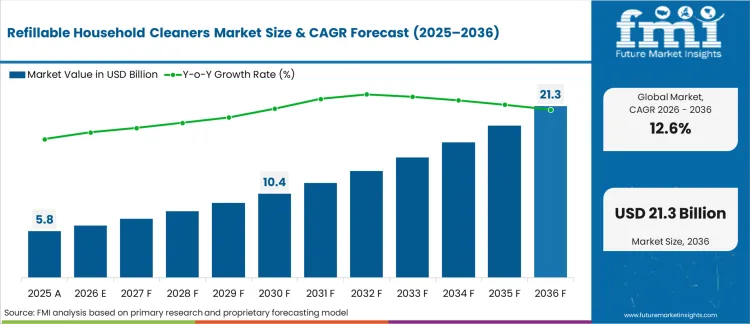
This pivot reaches a decisive inflection point when closed-loop tablet solubility perfectly matches cold-water dispensing kinetics. Chemical engineers must validate active ingredient dispersion rates before national distribution thresholds are triggered. When this solubility standard is met, mass-market adoption accelerates dramatically, establishing compact refills as the default formulation benchmark.
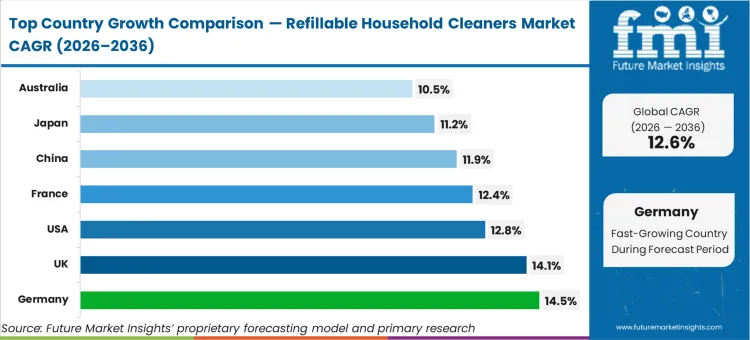
Germany advances at a 14.5% compound rate as federal circular economy legislation penalizes non-recyclable spray triggers. The UK tracks closely at 14.1%, propelled by aggressive supermarket packaging mandates targeting zero-waste aisle conversions. The USA expands at 12.8% as direct-to-consumer shipping economics favor lightweight waterless concentrates over heavy liquid shipments. France grows at 12.4% following strict legislative phase-outs of single-use chemical packaging. China posts an 11.9% trajectory supported by greenfield manufacturing investments in high-speed pouch filling infrastructure. Japan reaches 11.2% through advanced material engineering in water-soluble films. Australia follows at 10.5% as coastal waste mitigation policies eliminate conventional rigid detergent containers.
Refillable Household Cleaners Market Key Takeaways
| Metric | Details |
|---|---|
| Industry Size (2026) | USD 6.5 billion |
| Industry Value (2036) | USD 21.3 billion |
| CAGR (2026-2036) | 12.6% |
Source: Future Market Insights (FMI) analysis, based on proprietary forecasting model and primary research
Refillable Household Cleaners Market Definition
Refillable household cleaners constitute concentrated or dehydrated chemical formulations designed for reconstitution within durable, reusable dispenser hardware. The category fundamentally decouples the active cleaning agents from the primary liquid carrier, requiring the buyer to supply the water solvent at the point of use. This structural decoupling distinguishes the segment from conventional ready-to-use cleaning products by eliminating the transportation of water and the repetitive disposal of complex trigger-spray mechanisms.
Refillable Household Cleaners Market Inclusions
The market scope includes concentrated liquid cartridges, effervescent cleaning tablets, water-soluble pods, and lightweight bulk refill pouches explicitly engineered for residential and commercial hygiene applications. Durable dispensing hardware and specialized components from the packaging supply market fall within these boundaries. The analysis captures product formats utilizing sachet packaging structures and innovations tied to the zero-waste refill packaging market directly associated with surface, glass, and fabric care. Formulations integrating enzymes for laundry detergent advancements for cold-water reconstitution are fully incorporated.
Refillable Household Cleaners Market Exclusions
Conventional ready-to-use cleaning liquids sold in single-use disposable plastic bottles are excluded. Industrial bulk chemical drums lacking a dedicated end-use dispenser ecosystem fall outside the defined parameters. Purely mechanical cleaning tools, disposable wipes, and empty reusable bottles sold without accompanying chemical concentrates are explicitly omitted. Concentrates intended exclusively for heavy industrial manufacturing equipment sanitization without a closed-loop refill format are not calculated within this valuation.
Refillable Household Cleaners Market Research Methodology
- Primary Research: Analysts engaged with formulation chemists, fast-moving consumer goods category directors, and retail procurement leads to map the precise commercial triggers forcing the transition away from ready-to-use formats.
- Desk Research: The data collection phase aggregated compliance roadmaps from regional environmental ministries, retailer sustainability pledges, and formulation patents concerning water-soluble film stability.
- Market-Sizing and Forecasting: The baseline value derives from a bottom-up aggregation of concentrated chemical shipments, applying region-specific shelf-space conversion curves to project the future adoption velocity.
- Data Validation and Update Cycle: Projections are cross-checked against publicly reported packaging reduction metrics from leading global consumer goods conglomerates and container procurement budgets.
Segmental Analysis
Refillable Household Cleaners Market Analysis by Product Type
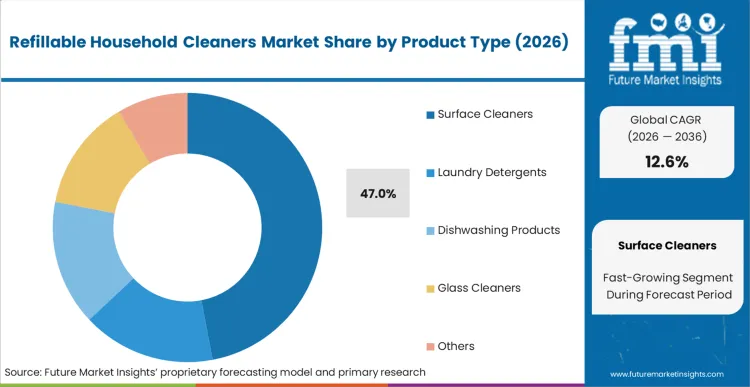
Mass-market penetration requires immediate efficacy parity with legacy chemical sprays. Surface Cleaners secure a 47.0% share in 2026 as broad-spectrum sanitization routines drive the highest recurring consumption frequencies in the household. Formulation chemists reformulate heavy-duty degreasers into compressed formats, stripping inert water without compromising the active surfactant payload. According to FMI's estimates, this precise chemical compaction allows brands to slash volumetric shipping footprints while maintaining exact performance specifications. The integration of advancements from the sustainable packaging directly supports the moisture-sensitive nature of these concentrates. Category procurement directors demanding shelf-space efficiency enforce strict volume constraints that disqualify traditional diluted formats.
- Solubility thresholds: Chemical engineers deploy rapid-effervescent binding agents to guarantee immediate reconstitution in cold tap water. Formulations failing this instant-use requirement face swift retail delisting.
- Surfactant stabilization: Active cleaning agents require specialized micro-encapsulation to prevent premature degradation during extended warehouse storage. Detergent specialists implementing these protective coatings secure longer retail shelf viability.
- Fragrance preservation: Concentrated essential oils demand robust barrier films to prevent aroma leaching before consumer dilution occurs. Packaging technicians specifying high-grade laminates maintain critical brand olfactory signatures.
Refillable Household Cleaners Market Analysis by Refill Format
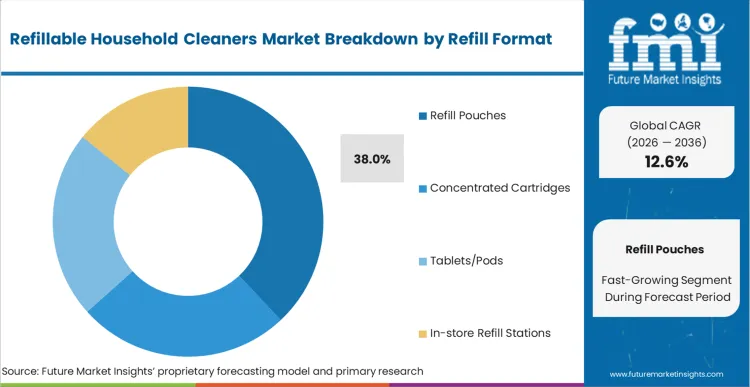
The requirement to utilize existing liquid-filling manufacturing lines dictates early format dominance. Refill Pouches command a 38.0% share in 2026 as legacy fast-moving consumer goods brands transition away from rigid bottles without entirely abandoning liquid formulations. Plant managers retrofit existing form-fill-seal infrastructure to process high-barrier flexible materials, bypassing the complex capital expenditure required for tablet pressing machinery. FMI's research confirms that maintaining a liquid concentrate significantly reduces the consumer behavioral friction associated with waiting for solid tablets to dissolve. Progress tracked within the protective packaging validates the durability of these lightweight spouted films during parcel transit. Converters deploy paper packaging barrier technologies to replace synthetic polymers. Supply chain directors migrating to flexible formats drastically lower reverse logistics costs caused by shipping damage.
- Spout engineering: Precision-molded pour spouts prevent hazardous chemical contact during the consumer transfer process. Engineering teams designing spill-proof interfaces capture higher repeat purchase rates.
- Film downgauging: Converters deploy advanced multi-layer laminates to reduce total polymer weight while maintaining puncture resistance. Material scientists achieving these metrics satisfy strict retail plastic-reduction quotas.
- Viscosity calibration: Liquid concentrates must maintain exact flow characteristics to ensure accurate consumer dosing without excessive residue left in the pouch. Rheology specialists adjusting these parameters prevent active ingredient waste.
Refillable Household Cleaners Market Analysis by Distribution Channel
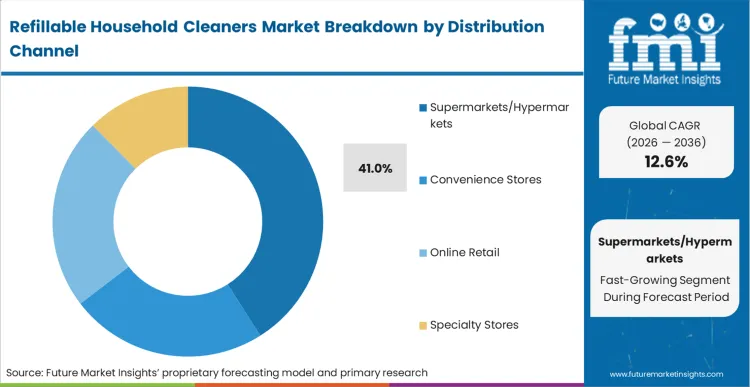
Digital native brands successfully disrupted the cleaning aisle by circumventing traditional retail gatekeepers. Online Retail commands a 41.0% share in 2026 as subscription-based fulfillment models lock in predictable recurring revenue streams. E-commerce fulfillment managers exploit the micro-footprint of concentrated tablets, shipping standard postal mailers rather than executing expensive volumetric parcel routing. In FMI's view, the elimination of water mass fundamentally rewrites the unit economics of shipping cleaning supplies directly to residential addresses. Sourcing innovations from the sustainable plastic packaging ensures mailer durability against moisture ingress. Replacing legacy packaging foam inserts with custom molded pulp further aligns with zero-waste mandates. Logistics directors implementing letterbox-compatible refill packs bypass expensive last-mile delivery surcharges.
- Subscription retention: Automated replenishment algorithms coordinate refill deliveries with precise household consumption patterns. Data analysts optimizing these dispatch frequencies prevent inventory stock-outs.
- Transit survivability: Compact solid formats resist impact damage far better than pressurized trigger sprays during automated warehouse sorting. Packaging engineers validating drop-test metrics minimize expensive product replacement claims.
- Unboxing mechanics: Premium starter kits rely on custom inserts to display durable glass or aluminum dispensing hardware effectively. Industrial designers creating these initial unboxing experiences establish long-term brand equity.
Refillable Household Cleaners Market Analysis by End Use
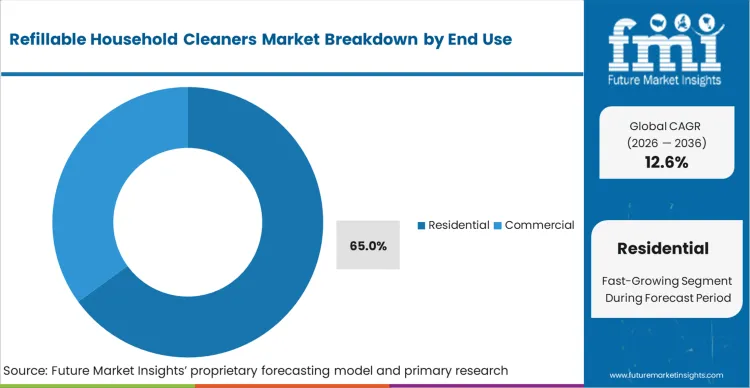
High-frequency domestic cleaning routines generate continuous demand for surface hygiene products. Residential applications account for a 65.0% share in 2026 as household decision-makers actively reject single-use plastics dominating traditional supermarket aisles. Formulation teams engineer user-friendly dilution ratios, ensuring safety and efficacy without requiring specialized commercial mixing equipment. FMI analysts opine that consumer preference for aesthetically pleasing, durable counter-top dispensers heavily influences the initial conversion from legacy brands. Innovations drawn from the biodegradable packaging allow brands to offer fully compostable tablet wrappers, completing the zero-waste proposition. Brand marketing directors emphasizing this aesthetic and environmental upgrade secure permanent placement in domestic environments.
- Hardware aesthetics: Shatter-resistant glass and brushed aluminum dispensers elevate cleaning products from under-sink storage to countertop display. Product designers prioritizing visual appeal capture premium household demographics.
- Safety dosing: Pre-measured pods eliminate the risk of accidental chemical over-concentration during domestic mixing. Regulatory compliance officers mandating these fixed-dose formats mitigate liability regarding household exposure.
- Scent customization: Modular refill systems allow households to alternate fragrances without purchasing entirely new dispensing mechanisms. Brand managers offering diverse seasonal aroma profiles increase overall category purchasing frequency.
Refillable Household Cleaners Market Drivers, Restraints, and Opportunities
Stringent extended producer responsibility frameworks force fast-moving consumer goods conglomerates to drastically cut virgin plastic production. Retail category managers, facing compliance penalties and limited shelf space, mandate the transition to ultra-concentrated formats. This regulatory and spatial pressure compels formulation chemists to engineer dehydrated cleaning agents that maintain exact efficacy profiles upon consumer dilution. Brand directors failing to secure high-density product placements lose critical distribution nodes as supermarkets actively delist bulky, water-heavy inventory.
The complex hygroscopic nature of compacted chemical tablets creates severe moisture-management friction during extended warehouse storage. Material scientists struggle to source plastic-free barrier films that adequately prevent premature effervescent activation in humid climates. Packaging converters cross-apply high-grade laminates developed for the sustainable pharmaceutical packaging that complicate end-of-life recycling streams, partially negating the core environmental proposition. Procurement officers accepting substandard barrier materials face catastrophic inventory loss when entire pallets of concentrated powder prematurely solidify before reaching retail shelves.
Opportunities in the Refillable Household Cleaners Market
- In-Store Dispensing Kiosks: Retail operations directors deploy automated liquid refill stations to eliminate primary packaging entirely. Shoppers bringing their own durable vessels capture significant unit-cost savings while generating dense foot traffic.
- Industrial Concentrate Scaling: Commercial hospitality operators driving sustainable tourism standards eliminate massive chemical drum logistics. Facility management procurement leads transition massive commercial cleaning contracts to hyper-concentrated pod systems, radically reducing occupational handling hazards.
- Smart Dispenser Integration: Hardware engineering teams embed basic sensor arrays into durable spray bottles to track actual chemical usage. Digital product managers utilizing this telemetry data trigger automated replenishment orders directly to the formulation plant.
Regional Analysis
Based on the regional analysis, the Refillable Household Cleaners market is segmented into North America, Latin America, Europe, East Asia, South Asia, Oceania and Middle East & Africa across 40 plus countries.
.webp "Top Country Growth Comparison Refillable Household Cleaners Market Cagr (2026 2036)")
| Country | CAGR (2026 to 2036) |
|---|---|
| Germany | 14.5% |
| UK | 14.1% |
| USA | 12.8% |
| France | 12.4% |
| China | 11.9% |
| Japan | 11.2% |
| Australia | 10.5% |
Source: Future Market Insights (FMI) analysis, based on proprietary forecasting model and primary research
Europe Refillable Household Cleaners Market Analysis
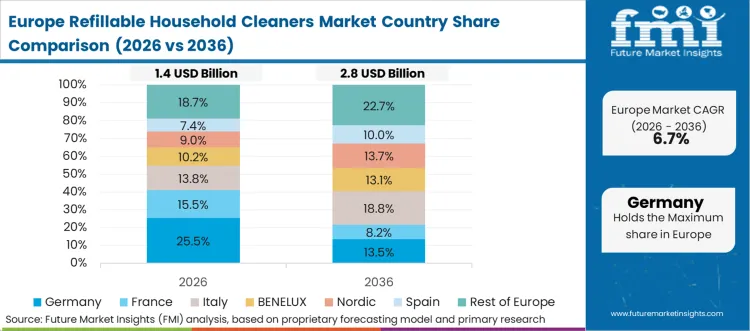
European legislative bodies strictly penalize the persistent deployment of non-recyclable single-use plastics across all fast-moving consumer goods categories. This intense regulatory environment forces legacy chemical manufacturers to execute complete packaging architecture overhauls prior to impending legal deadlines. FMI's research confirms that early material adoption across this region sets the global benchmark for concentrated formulation stability and barrier film performance.
- Germany: Germany's aggressive packaging waste directives force formulation chemists to entirely eliminate virgin plastics from the primary cleaning aisle. Strict municipal compliance frameworks dictate a 14.5% CAGR as major domestic supermarket chains systematically purge heavy liquid bottles. The deployment of insights from the packaging waste recycling optimizes the end-of-life recovery for durable spray hardware. Category procurement leads enforcing these spatial retail mandates swiftly disqualify chemical suppliers lacking viable compressed tablet solutions.
- UK: Extended producer responsibility taxes in the United Kingdom financially penalize brands reliant on outdated liquid shipping models. The rapid expansion of closed-loop delivery ecosystems drives a 14.1% annual growth rate reflecting intense supermarket competition for sustainable credentials. Logistics planners utilize advancements from the liquid packaging board to engineer recyclable refill cartons for bulk dispensing. Supply chain directors migrating to these lightweight formats drastically reduce fleet fuel consumption and associated carbon levies.
- France: National anti-waste legislation defines France's aggressive trajectory away from disposable trigger-spray mechanisms. The absolute prohibition of specific single-use plastics sustains a 12.4% compound rate for advanced water-soluble pod formats. Material scientists collaborate closely with the packaging testing services to validate the moisture-resistance of novel bio-based tablet wrappers. Compliance officers failing to certify these new barrier materials face immediate retail exclusion under federal environmental statutes.
FMI's report includes deep evaluation of the European structural transition toward zero-waste chemical formats. Strict carbon-accounting frameworks across the Nordics and Benelux region compel facility managers to abandon heavy liquid drum distribution entirely.
North America Refillable Household Cleaners Market Analysis
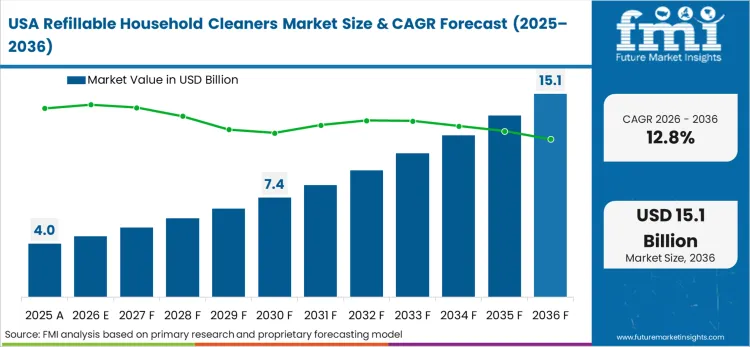
The decentralization of retail fulfillment across North America heavily incentivizes the adoption of lightweight, mailer-compatible product dimensions. Supply chain architects battling extreme parcel freight surcharges aggressively pivot toward dehydrated concentrates to protect eroding profit margins. Based on FMI's assessment, the economic imperative of stripping water from the logistics network far outweighs the premium eco-marketing narrative in this geography.
- USA: E-commerce fulfillment managers in the United States exploit the micro-footprint of concentrated tablets to bypass expensive volumetric shipping penalties. This direct-to-consumer economic advantage anchors the USA's 12.8% compound expansion to 2036. Formulators leverage developments within the packaging tubes to design rigid protective cylinders for fragile effervescent stacks. Digital marketing directors optimizing these letterbox-friendly delivery profiles capture vast swathes of recurring subscription revenue previously held by brick-and-mortar grocery.
FMI's report includes comprehensive analysis of the North American transition mechanics, covering both retail and direct-to-consumer pathways. Cross-border logistics networks into Canada increasingly demand durable starter-kit hardware capable of surviving extended sub-zero transit routes without mechanical failure.
Asia Pacific Refillable Household Cleaners Market Analysis
Rapid urbanization and limited residential storage capacity across Asian mega-cities create intense demand for ultra-compact household goods. Formulation chemists operating in this theater prioritize extreme chemical concentration, delivering maximum cleaning efficacy within minimal physical footprints. As per FMI's projection, the deployment of high-speed flexible manufacturing infrastructure allows regional brands to rapidly undercut imported legacy liquid formats.
- China: China's advanced flexible packaging sector engineers high-barrier spouted pouches that dominate the regional refill ecosystem. This immense manufacturing capability drives an 11.9% CAGR for the market in China. Plant managers heavily integrate solutions from the packaging machinery to accelerate form-fill-seal output for localized liquid concentrates. Procurement directors specifying these cost-effective flexible formats successfully capture the price-sensitive mass-market demographic.
- Japan: Extreme residential space constraints define Japan's requirement for hyper-concentrated household chemical formats. Material engineering dominance sustains a 11.2% compound trajectory to the 2036 horizon. Chemical technologists utilizing the packaging barrier film formulate ultra-thin, rapid-dissolving membranes that eliminate all secondary waste. Brand formulation teams mastering this complex water-soluble chemistry monopolize the premium compact-living retail categories.
- Australia: Strict coastal plastic mitigation mandates isolate Australia's approach to retail chemical distribution. The rapid rollout of in-store bulk dispensing kiosks advances the nation at a 10.5% compound rate. Retail operations directors source hardware linked to the sustainable label to ensure consumer tracking of reusable vessel lifecycles. Store layout managers executing these heavy-footprint kiosk installations lock in exceptional neighborhood customer loyalty.
FMI's report includes extensive modeling of the Asia Pacific chemical compaction trend. E-commerce platforms across South Korea and Southeast Asia penalize bulky liquid shipments, forcing regional brand managers to adopt compact tablet formats to maintain algorithmic visibility.
Competitive Aligners for Market Players
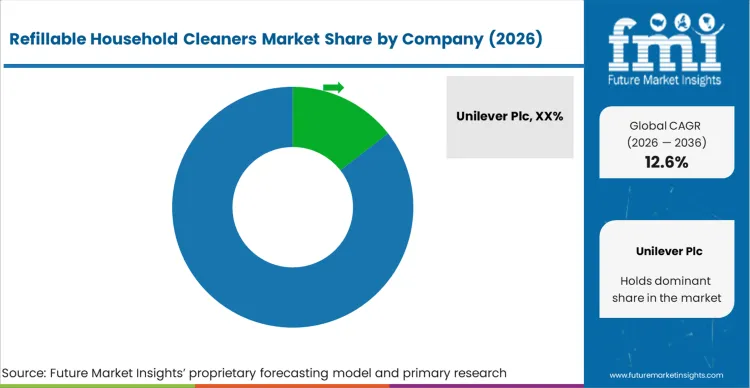
The transition toward decoupled chemical concentrates creates a moderately consolidated competitive environment dominated by agile digital-native challengers and rapidly pivoting legacy conglomerates. This structure exists because mastering moisture-sensitive barrier packaging requires intensive capital investment and specialized chemical engineering expertise. Established manufacturers such as Unilever Plc, Procter & Gamble, and SC Johnson defend their market share by acquiring successful disruptive startups or re-engineering their core flagship formulations into concentrated pods. Retail buyers differentiate qualified suppliers based on a single critical variable: the cold-water dissolution speed of the concentrated tablet or pod.
Digital-native brands maintain distinct structural advantages by operating distribution networks entirely free from legacy liquid-filling infrastructure. Companies like Blueland and Cleancult bypass traditional supermarket gatekeepers by leveraging letterbox-compatible subscription models. Replicating this direct-to-consumer efficiency requires legacy brands to untangle decades of heavy-freight logistics routing. Innovations stemming from the biodegradable food packaging enable these agile competitors to deploy compostable tablet wrappers, offering a pure zero-waste proposition. Supply chain directors attempting to compete must aggressively strip both water mass and synthetic polymers from their packaging portfolios.
Major retail conglomerates heavily leverage their shelf-space authority to force pricing compliance across the concentrated cleaner segment. Supermarket procurement teams frequently launch private-label refill pods that perfectly fit the durable hardware sold by premium brands, destroying proprietary ecosystem lock-in. This aggressive reverse-engineering structurally limits the pricing power of dominant formulation manufacturers. The fundamental tension pits brand directors attempting to protect closed-loop razor-and-blade margins against retail buyers demanding universal interoperability. Ultimately, independent hardware standardization accelerates over the forecast period, forcing suppliers to compete solely on chemical efficacy rather than dispensing mechanics.
Key Players in Refillable Household Cleaners Market
- Unilever Plc
- Procter & Gamble (P&G)
- Henkel AG
- The Clorox Company
- SC Johnson
- Blueland
- Cleancult
Scope of the Report
| Metric | Value |
|---|---|
| Quantitative Units | USD 6.5 billion to USD 21.3 billion, at a CAGR of 12.60% |
| Market Definition | Refillable household cleaners encompass concentrated formulations, including tablets and flexible pouches, engineered for dilution inside reusable dispensing hardware. The sector's boundary is structurally defined by the physical decoupling of active cleaning agents from the water solvent, eliminating redundant single-use plastic container manufacturing. |
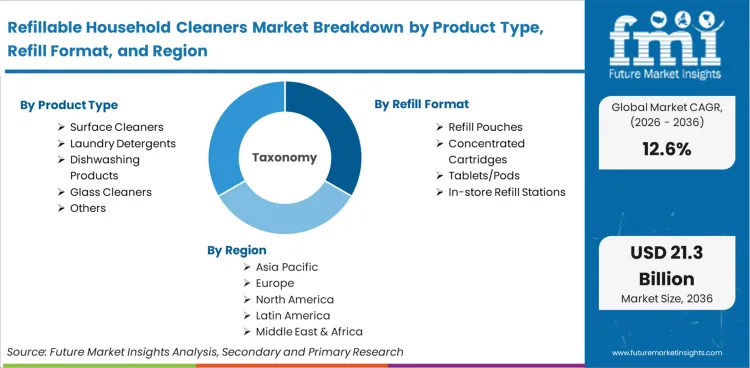
| Product Type Segmentation | Surface Cleaners, Laundry Detergents, Dishwashing Products, Glass Cleaners, Others |
| Refill Format Segmentation | Refill Pouches, Concentrated Cartridges, Tablets/Pods, In-store Refill Stations |
| Distribution Channel Segmentation | Supermarkets/Hypermarkets, Convenience Stores, Online Retail, Specialty Stores |
| End Use Segmentation | Residential, Commercial |
| Regions Covered | North America, Latin America, Europe, East Asia, South Asia, Oceania, Middle East & Africa |
| Countries Covered | Germany, UK, USA, France, China, Japan, Australia, and 40 plus countries |
| Key Companies Profiled | Unilever Plc, Procter & Gamble (P&G), Henkel AG, The Clorox Company, SC Johnson, Blueland, Cleancult |
| Forecast Period | 2026 to 2036 |
| Approach | The baseline value derives from a bottom-up aggregation of concentrated chemical shipments, applying region-specific shelf-space conversion curves to project the future adoption velocity. Projections are rigorously cross-checked against publicly reported packaging reduction metrics from leading global consumer goods conglomerates. |
Refillable Household Cleaners Market Analysis by Segments
Product Type:
- Surface Cleaners
- Laundry Detergents
- Dishwashing Products
- Glass Cleaners
- Others
Refill Format:
- Refill Pouches
- Concentrated Cartridges
- Tablets/Pods
- In-store Refill Stations
Distribution Channel:
- Supermarkets/Hypermarkets
- Convenience Stores
- Online Retail
- Specialty Stores
End Use:
- Residential
- Commercial
Region:
- Asia Pacific
- India
- China
- Japan
- South Korea
- Indonesia
- Australia & New Zealand
- ASEAN
- Rest of Asia Pacific
- Europe
- Germany
- Italy
- France
- United Kingdom
- Spain
- Benelux
- Nordics
- Central & Eastern Europe
- Rest of Europe
- North America
- United States
- Canada
- Mexico
- Latin America
- Brazil
- Argentina
- Chile
- Rest of Latin America
- Middle East & Africa
- Kingdom of Saudi Arabia
- United Arab Emirates
- South Africa
- Turkey
- Rest of Middle East & Africa
Bibliography
- European Union. (2025). Packaging and packaging waste (from 2026). EUR-Lex Summaries.
- European Parliament. (2025). European Parliament legislative resolution of 27 February 2024 on the proposal for a regulation of the European Parliament and of the Council on detergents and surfactants, amending Regulation (EU) 2019/1020 and repealing Regulation (EC) No 648/2004 (COM(2023)0217 – C9-0154/2023 – 2023/0124(COD)). Official Journal of the European Union, C, 2025/1354.
- Council of the European Union. (2025). Position (EU) No 16/2025 of the Council at first reading with a view to the adoption of a Regulation of the European Parliament and of the Council on detergents and surfactants, and repealing Regulation (EC) No 648/2004. Official Journal of the European Union, C, 2025/6774.
- United Nations Environment Programme. (2025, August 8). UNEP/PP/INC.5/CRP.1: Draft text on plastic pollution negotiations.
- European Commission, Joint Research Centre. (2025, March 13). Revision of the EU Ecolabel criteria for detergent and stain remover products: Ad hoc working group document.
This bibliography is provided for reader reference and is not exhaustive. The full report contains the complete reference list and detailed citations.
This Report Addresses
- Market sizing for the organized refillable household cleaners layer.
- Forecast demand for moisture-resistant barrier packaging from 2026 to 2036.
- Product Type analysis across Surface Cleaners, Laundry Detergents, Dishwashing Products, Glass Cleaners, and Others.
- Refill Format demand patterns across Refill Pouches, Concentrated Cartridges, Tablets/Pods, and In-store Refill Stations.
- Regional growth comparisons shaped by specific municipal packaging waste mandates.
- Competitive positioning factors for fast-moving consumer goods formulation chemists.
- Revenue opportunities tied to automated in-store bulk dispensing hardware.
- Strategic implications for retail category supply chain directors.
Frequently Asked Questions
How large is the demand for Refillable Household Cleaners in the global market in 2026?
Demand for Refillable Household Cleaners in the global market is estimated to be valued at USD 6.5 billion in 2026.
What will be the market size of Refillable Household Cleaners in the global market by 2036?
Market size for Refillable Household Cleaners is projected to reach USD 21.3 billion by 2036.
What is the expected demand growth for Refillable Household Cleaners in the global market between 2026 and 2036?
Demand for Refillable Household Cleaners is expected to grow at a CAGR of 12.60% between 2026 and 2036.
Which Product Type is poised to lead global sales by 2026?
Surface Cleaners accounts for 47.0% in 2026 as household hygiene routines require frequent replenishment of broad-spectrum sanitizing agents.
How significant is the role of Refill Pouches in driving Refillable Household Cleaners adoption in 2026?
Refill Pouches represents 38.0% of segment share as legacy fast-moving consumer goods brands transition away from rigid bottles without fully abandoning liquid formulation infrastructure.
What is driving demand in China?
China's advanced flexible packaging sector supports rapid adoption of high-barrier spouted pouches, enabling cost-effective refillable cleaner formats for the mass-market household segment.
What compliance standards or regulations are referenced for Germany?
Germany's market operates under strict federal circular economy legislation and packaging waste directives that penalize non-recyclable rigid plastic cleaning formats.
What is the China growth outlook in this report?
China is projected to grow at a CAGR of 11.9% during 2026 to 2036.
Why is North America described as a priority region in this report?
North America actively drives refillable cleaner adoption because decentralized retail fulfillment models reward lightweight, mailer-compatible formats that reduce freight and last-mile delivery costs.
What type of demand dominates in North America?
Demand heavily focuses on compact, direct-to-consumer refill systems that bypass the shipping penalties associated with bulky ready-to-use liquid cleaners.
What is India's growth outlook in this report?
India is not individually quantified in the regional CAGR table provided in this report.
Does the report cover USA in its regional analysis?
Yes, USA is included within North America under the regional scope of analysis.
What are the sources referred to for analyzing USA?
E-commerce fulfillment economics, direct-to-consumer delivery trends, and cross-border retail logistics form the analytical basis.
What is the main demand theme linked to USA in its region coverage?
Letterbox-compatible concentrates and durable refill systems are gaining traction as brands seek to remove water weight from parcel delivery networks.
Does the report cover Germany in its regional analysis?
Yes, Germany is included within Europe under the regional coverage framework.
What is the main Germany related demand theme in its region coverage?
Aggressive packaging waste directives and strict municipal compliance rules are forcing chemical suppliers to eliminate virgin plastic-heavy spray formats from the cleaning aisle.
Which product formats or configurations are strategically important for Asia Pacific supply chains?
High-barrier spouted refill pouches, rapid-dissolving membranes, and compact tablet or pod systems are strategically important for Asia Pacific supply chains.
What is Refillable Household Cleaners and what is it mainly used for?
Refillable Household Cleaners are concentrated or dehydrated cleaning formulations designed for dilution inside reusable dispensing hardware. They are mainly used for residential and commercial household cleaning applications.
What does Refillable Household Cleaners mean in this report?
The scope encompasses concentrated formulations, tablets, pods, and pouches engineered for repeated use through reusable dispensers rather than single-use ready-to-use bottles.
What is included in the scope of this Refillable Household Cleaners report?
The market covers concentrated liquid cartridges, effervescent cleaning tablets, water-soluble pods, refill pouches, durable dispensing hardware, and related refill systems for household and commercial hygiene applications.
What is excluded from the scope of this report?
Conventional ready-to-use cleaners sold in single-use bottles, industrial bulk drums without closed-loop refill systems, purely mechanical cleaning tools, disposable wipes, and empty reusable bottles sold without concentrates are explicitly excluded.
What does market forecast mean on this page?
The market forecast represents a model-based projection built on defined adoption and shelf-space conversion assumptions for strategic planning purposes.
How does FMI build and validate the Refillable Household Cleaners forecast?
The model applies a bottom-up methodology starting with concentrated chemical shipments and reusable bottle installed base metrics, then cross-validates projections against packaging reduction metrics and procurement budgets.
What does zero reliance on speculative third-party market research mean here?
Primary interviews, verified packaging reduction disclosures, retailer sustainability pledges, and official policy documentation are used exclusively instead of unverified syndicated estimates.
Preview the report firsthand - request a free sample
Get SampleGet the brochure for pricing and purchase details.
Get PDFTable of Content
- Key Takeaways
- Market Size and CAGR
- Top Growth Driver
- Fastest Growing Segment
- Leading Region
- Key Companies
- Emerging Opportunities
- Executive Summary
- Global Market Outlook
- Demand-side Trends
- Supply-side Trends
- Technology Roadmap Analysis
- Analysis and Recommendations
- Analyst Perspective (What is happening? Why now? What should investors know?)
- Key Questions Answered
- How large is the market?
- What is the CAGR?
- What are key trends?
- Which region dominates?
- Who are the leaders?
- Market Overview
- Market Coverage / Taxonomy
- Market Definition / Scope / Limitations
- Research Methodology
- Chapter Orientation
- Analytical Lens and Working Hypotheses
- Market Structure, Signals, and Trend Drivers
- Benchmarking and Cross-market Comparability
- Market Sizing, Forecasting, and Opportunity Mapping
- Research Design and Evidence Framework
- Desk Research Programme (Secondary Evidence)
- Expert Input and Fieldwork (Primary Evidence)
- Tooling, Models, and Reference Databases
- Data Engineering and Model Build
- Quality Assurance and Audit Trail
- Market Background
- Market Dynamics (Drivers, Restraints, Opportunity, Trends)
- Scenario Forecast (Optimistic, Likely, Conservative)
- Impact Analysis
- AI Impact
- Sustainability Impact
- Regulatory Impact
- Technology Impact
- Consumer / Buyer Analysis
- Purchase Drivers
- Adoption Barriers
- Buyer Journey
- Opportunity Map Analysis
- Product Life Cycle Analysis
- Supply Chain Analysis
- Investment Feasibility Matrix
- Value Chain Analysis
- PESTLE and Porter's Analysis
- Regulatory Landscape
- Regional Parent Market Outlook
- Production and Consumption Statistics
- Import and Export Statistics
- Global Market Analysis and Forecast, 2021 to 2036
- Historical Market Size Value (USD Billion) & Volume (Unit) Analysis, 2021 to 2025
- Current and Future Market Size Value (USD Billion) & Volume (Unit) Projections, 2026 to 2036
- Y-o-Y Growth Trend Analysis
- Absolute $ Opportunity Analysis
- Global Market Pricing Analysis, 2021 to 2036
- Global Market Analysis and Forecast, By Product Type, 2021 to 2036
- Introduction / Key Findings
- Historical Market Size Value (USD Billion) & Volume (Unit) Analysis By Product Type, 2021 to 2025
- Current and Future Market Size Value (USD Billion) & Volume (Unit) Analysis and Forecast By Product Type, 2026 to 2036
- Surface Cleaners
- Laundry Detergents
- Dishwashing Products
- Glass Cleaners
- Others
- Surface Cleaners
- Y-o-Y Growth Trend Analysis By Product Type, 2021 to 2025
- Absolute $ Opportunity Analysis By Product Type, 2026 to 2036
- Global Market Analysis and Forecast, By Refill Format, 2021 to 2036
- Introduction / Key Findings
- Historical Market Size Value (USD Billion) & Volume (Unit) Analysis By Refill Format, 2021 to 2025
- Current and Future Market Size Value (USD Billion) & Volume (Unit) Analysis and Forecast By Refill Format, 2026 to 2036
- Refill Pouches
- Concentrated Cartridges
- Tablets/Pods
- In-store Refill Stations
- Refill Pouches
- Y-o-Y Growth Trend Analysis By Refill Format, 2021 to 2025
- Absolute $ Opportunity Analysis By Refill Format, 2026 to 2036
- Global Market Analysis and Forecast, By Distribution Channel, 2021 to 2036
- Introduction / Key Findings
- Historical Market Size Value (USD Billion) & Volume (Unit) Analysis By Distribution Channel, 2021 to 2025
- Current and Future Market Size Value (USD Billion) & Volume (Unit) Analysis and Forecast By Distribution Channel, 2026 to 2036
- Supermarkets/Hypermarkets
- Convenience Stores
- Online Retail
- Specialty Stores
- Supermarkets/Hypermarkets
- Y-o-Y Growth Trend Analysis By Distribution Channel, 2021 to 2025
- Absolute $ Opportunity Analysis By Distribution Channel, 2026 to 2036
- Global Market Analysis and Forecast, By End Use, 2021 to 2036
- Introduction / Key Findings
- Historical Market Size Value (USD Billion) & Volume (Unit) Analysis By End Use, 2021 to 2025
- Current and Future Market Size Value (USD Billion) & Volume (Unit) Analysis and Forecast By End Use, 2026 to 2036
- Residential
- Commercial
- Residential
- Y-o-Y Growth Trend Analysis By End Use, 2021 to 2025
- Absolute $ Opportunity Analysis By End Use, 2026 to 2036
- Global Market Analysis and Forecast, By Region, 2021 to 2036
- Introduction
- Historical Market Size Value (USD Billion) & Volume (Unit) Analysis By Region, 2021 to 2025
- Current Market Size Value (USD Billion) & Volume (Unit) Analysis and Forecast By Region, 2026 to 2036
- North America
- Latin America
- Western Europe
- Eastern Europe
- East Asia
- South Asia and Pacific
- Middle East & Africa
- Market Attractiveness Analysis By Region
- North America Market Analysis and Forecast, By Country, 2021 to 2036
- Historical Market Size Value (USD Billion) & Volume (Unit) Trend Analysis By Market Taxonomy, 2021 to 2025
- Market Size Value (USD Billion) & Volume (Unit) Forecast By Market Taxonomy, 2026 to 2036
- By Country
- USA
- Canada
- Mexico
- By Product Type
- By Refill Format
- By Distribution Channel
- By End Use
- By Country
- Market Attractiveness Analysis
- By Country
- By Product Type
- By Refill Format
- By Distribution Channel
- By End Use
- Key Takeaways
- Latin America Market Analysis and Forecast, By Country
- Historical Market Size Value (USD Billion) & Volume (Unit) Trend Analysis By Market Taxonomy, 2021 to 2025
- Market Size Value (USD Billion) & Volume (Unit) Forecast By Market Taxonomy, 2026 to 2036
- By Country
- Brazil
- Chile
- Rest of Latin America
- By Product Type
- By Refill Format
- By Distribution Channel
- By End Use
- By Country
- Market Attractiveness Analysis
- By Country
- By Product Type
- By Refill Format
- By Distribution Channel
- By End Use
- Key Takeaways
- Western Europe Market Analysis and Forecast, By Country
- Historical Market Size Value (USD Billion) & Volume (Unit) Trend Analysis By Market Taxonomy, 2021 to 2025
- Market Size Value (USD Billion) & Volume (Unit) Forecast By Market Taxonomy, 2026 to 2036
- By Country
- Germany
- UK
- Italy
- Spain
- France
- Nordic
- BENELUX
- Rest of Western Europe
- By Product Type
- By Refill Format
- By Distribution Channel
- By End Use
- By Country
- Market Attractiveness Analysis
- By Country
- By Product Type
- By Refill Format
- By Distribution Channel
- By End Use
- Key Takeaways
- Eastern Europe Market Analysis and Forecast, By Country
- Historical Market Size Value (USD Billion) & Volume (Unit) Trend Analysis By Market Taxonomy, 2021 to 2025
- Market Size Value (USD Billion) & Volume (Unit) Forecast By Market Taxonomy, 2026 to 2036
- By Country
- Russia
- Poland
- Hungary
- Balkan & Baltic
- Rest of Eastern Europe
- By Product Type
- By Refill Format
- By Distribution Channel
- By End Use
- By Country
- Market Attractiveness Analysis
- By Country
- By Product Type
- By Refill Format
- By Distribution Channel
- By End Use
- Key Takeaways
- East Asia Market Analysis and Forecast, By Country
- Historical Market Size Value (USD Billion) & Volume (Unit) Trend Analysis By Market Taxonomy, 2021 to 2025
- Market Size Value (USD Billion) & Volume (Unit) Forecast By Market Taxonomy, 2026 to 2036
- By Country
- China
- Japan
- South Korea
- By Product Type
- By Refill Format
- By Distribution Channel
- By End Use
- By Country
- Market Attractiveness Analysis
- By Country
- By Product Type
- By Refill Format
- By Distribution Channel
- By End Use
- Key Takeaways
- South Asia and Pacific Market Analysis and Forecast, By Country
- Historical Market Size Value (USD Billion) & Volume (Unit) Trend Analysis By Market Taxonomy, 2021 to 2025
- Market Size Value (USD Billion) & Volume (Unit) Forecast By Market Taxonomy, 2026 to 2036
- By Country
- India
- ASEAN
- Australia & New Zealand
- Rest of South Asia and Pacific
- By Product Type
- By Refill Format
- By Distribution Channel
- By End Use
- By Country
- Market Attractiveness Analysis
- By Country
- By Product Type
- By Refill Format
- By Distribution Channel
- By End Use
- Key Takeaways
- Middle East & Africa Market Analysis and Forecast, By Country
- Historical Market Size Value (USD Billion) & Volume (Unit) Trend Analysis By Market Taxonomy, 2021 to 2025
- Market Size Value (USD Billion) & Volume (Unit) Forecast By Market Taxonomy, 2026 to 2036
- By Country
- Kingdom of Saudi Arabia
- Other GCC Countries
- Türkiye
- South Africa
- Other African Union
- Rest of Middle East & Africa
- By Product Type
- By Refill Format
- By Distribution Channel
- By End Use
- By Country
- Market Attractiveness Analysis
- By Country
- By Product Type
- By Refill Format
- By Distribution Channel
- By End Use
- Key Takeaways
- Key Countries Market Analysis
- USA
- Pricing Analysis
- Market Share Analysis, 2025
- By Product Type
- By Refill Format
- By Distribution Channel
- By End Use
- Canada
- Pricing Analysis
- Market Share Analysis, 2025
- By Product Type
- By Refill Format
- By Distribution Channel
- By End Use
- Mexico
- Pricing Analysis
- Market Share Analysis, 2025
- By Product Type
- By Refill Format
- By Distribution Channel
- By End Use
- Brazil
- Pricing Analysis
- Market Share Analysis, 2025
- By Product Type
- By Refill Format
- By Distribution Channel
- By End Use
- Chile
- Pricing Analysis
- Market Share Analysis, 2025
- By Product Type
- By Refill Format
- By Distribution Channel
- By End Use
- Germany
- Pricing Analysis
- Market Share Analysis, 2025
- By Product Type
- By Refill Format
- By Distribution Channel
- By End Use
- UK
- Pricing Analysis
- Market Share Analysis, 2025
- By Product Type
- By Refill Format
- By Distribution Channel
- By End Use
- Italy
- Pricing Analysis
- Market Share Analysis, 2025
- By Product Type
- By Refill Format
- By Distribution Channel
- By End Use
- Spain
- Pricing Analysis
- Market Share Analysis, 2025
- By Product Type
- By Refill Format
- By Distribution Channel
- By End Use
- France
- Pricing Analysis
- Market Share Analysis, 2025
- By Product Type
- By Refill Format
- By Distribution Channel
- By End Use
- India
- Pricing Analysis
- Market Share Analysis, 2025
- By Product Type
- By Refill Format
- By Distribution Channel
- By End Use
- ASEAN
- Pricing Analysis
- Market Share Analysis, 2025
- By Product Type
- By Refill Format
- By Distribution Channel
- By End Use
- Australia & New Zealand
- Pricing Analysis
- Market Share Analysis, 2025
- By Product Type
- By Refill Format
- By Distribution Channel
- By End Use
- China
- Pricing Analysis
- Market Share Analysis, 2025
- By Product Type
- By Refill Format
- By Distribution Channel
- By End Use
- Japan
- Pricing Analysis
- Market Share Analysis, 2025
- By Product Type
- By Refill Format
- By Distribution Channel
- By End Use
- South Korea
- Pricing Analysis
- Market Share Analysis, 2025
- By Product Type
- By Refill Format
- By Distribution Channel
- By End Use
- Russia
- Pricing Analysis
- Market Share Analysis, 2025
- By Product Type
- By Refill Format
- By Distribution Channel
- By End Use
- Poland
- Pricing Analysis
- Market Share Analysis, 2025
- By Product Type
- By Refill Format
- By Distribution Channel
- By End Use
- Hungary
- Pricing Analysis
- Market Share Analysis, 2025
- By Product Type
- By Refill Format
- By Distribution Channel
- By End Use
- Kingdom of Saudi Arabia
- Pricing Analysis
- Market Share Analysis, 2025
- By Product Type
- By Refill Format
- By Distribution Channel
- By End Use
- Türkiye
- Pricing Analysis
- Market Share Analysis, 2025
- By Product Type
- By Refill Format
- By Distribution Channel
- By End Use
- South Africa
- Pricing Analysis
- Market Share Analysis, 2025
- By Product Type
- By Refill Format
- By Distribution Channel
- By End Use
- USA
- Market Structure Analysis
- Competition Dashboard
- Competition Benchmarking
- Market Share Analysis of Top Players
- By Regional
- By Product Type
- By Refill Format
- By Distribution Channel
- By End Use
- Emerging Startups
- Innovation Benchmarking
- Competition Analysis
- Competition Deep Dive
- Unilever Plc
- Overview
- Product Portfolio
- Profitability by Market Segments (Product/Region/Sales Channel)
- Sales Footprint
- Strategy Overview
- Marketing Strategy
- Product Strategy
- Channel Strategy
- Procter & Gamble (P&G)
- Henkel AG
- The Clorox Company
- SC Johnson
- Blueland
- Cleancult
- Unilever Plc
- Case Studies
- Success Stories
- Recent Developments
- Competition Deep Dive
- Assumptions & Acronyms Used


