

- Industry Size (2026)
- USD 3 Bn
- Forecast (2036)
- USD 6.9 Bn
- CAGR (2026 to 2036)
- 8.7%
Powdered Scalp Treatments Market Forecast and Outlook 2026 to 2036
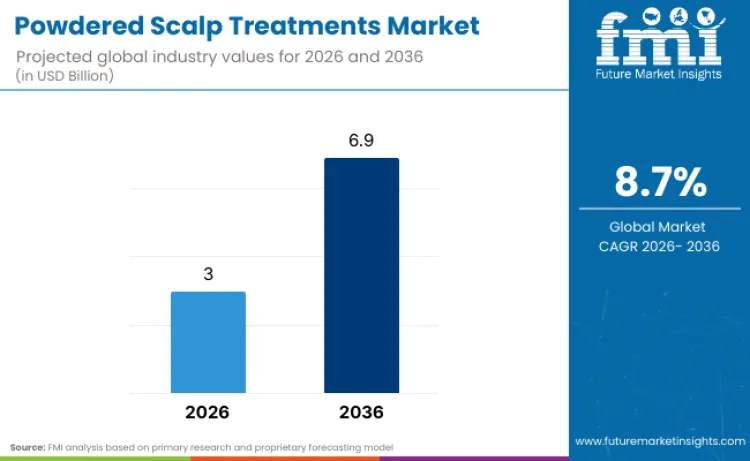
The global Powdered Scalp Treatments Market is projected to reach a valuation of USD 3.0 billion in 2026 and expand to USD 6.9 billion by 2036, registering a steady 8.70% CAGR over the forecast period. Growth in this market is being driven by a structural shift in hair care toward scalp-first routines, where treatment efficacy, ingredient purity, and dermatological logic increasingly outweigh traditional cosmetic conditioning. Powdered formats, in particular, are gaining traction as they enable high active concentration, extended shelf life, and targeted scalp delivery without preservatives or water dilution.
This evolution aligns closely with the broader “skinification of hair” movement, which reframes the scalp as a continuation of facial skin rather than a secondary grooming surface. Nancy Twine, Founder and CEO of Briogeo, articulated this shift clearly, stating: “Healthy hair is rooted in scalp care. When caring for your scalp, think of it as a continuation of your skincare routine for your face.” This perspective is reshaping product development priorities, pushing brands toward powder-based exfoliants, microbiome-balancing treatments, and oil-absorbing therapeutic blends that mirror facial skincare logic.
As consumer awareness around scalp health deepens, manufacturers are responding by prioritizing clinically inspired, clean-ingredient powdered treatments that support follicle health, sebum balance, and barrier function. This transition positions powdered scalp treatments as a core growth pillar within the next decade of performance-led, dermatology-aligned hair care innovation.
Summary of Powdered Scalp Treatments Market
What Is Growth Outlook for Powdered Scalp Treatments Market as per Future Market Insights Projection?
Future Market Insights projects the powdered scalp treatments market to expand at a CAGR of 8.7% from 2026 to 2036, increasing from USD 3.0 Billion in 2026 to USD 6.9 Billion by 2036.
FMI Research Approach: FMI proprietary forecasting model based on scalp-first haircare adoption, anhydrous format penetration, and dermatology-aligned treatment demand.
How Do FMI Analysts Perceive Powdered Scalp Treatments Market to Evolve?
FMI analysts perceive the market evolving toward skinification-led scalp care, where powdered formats enable high active concentration, between-wash maintenance, and preservative-free delivery.
FMI Research Approach: Analysis of skincare-to-haircare convergence, scalp microbiome science, and efficiency-driven haircare routines.
Which Country Holds Largest Share in Global Powdered Scalp Treatments Market?
China holds a significant share of the global powdered scalp treatments market, supported by premium scalp care adoption and strong demand for convenient anhydrous formats.
FMI Research Approach: FMI country-level revenue modeling based on urban grooming trends, e-commerce penetration, and premium scalp treatment uptake.
How Large Will Powdered Scalp Treatments Market Be by 2036?
The global powdered scalp treatments market is projected to reach USD 6.9 Billion by 2036.
FMI Research Approach: FMI long-term revenue forecast derived from scalp-first routine expansion, repeat between-wash usage, and premiumization of haircare treatments.
What Is Definition of Powdered Scalp Treatments Market?
The powdered scalp treatments market comprises dry and anhydrous scalp care products designed to regulate oil, manage dandruff, and support follicle health without water or rinsing.
FMI Research Approach: FMI market taxonomy and inclusion-exclusion framework aligned with scalp-focused, dermatology-inspired haircare formats.
What Are Globally Unique Trends Shaping Powdered Scalp Treatments Market?
Globally unique trends include skinification of hair, between-wash scalp maintenance, and microbiome-friendly powdered formulations.
FMI Research Approach: Dermatology trend analysis, clean-ingredient assessment, and non-aerosol anhydrous format evaluation.
Powdered Scalp Treatments Market Key Takeaways
| Metric | Details |
|---|---|
| Industry Size (2026) | USD 3 Billion |
| Industry Value (2036) | USD 6.9 Billion |
| CAGR (2026 to 2036) | 8.7% |
Source: Future Market Insights (FMI) analysis, based on proprietary forecasting model and primary research
Which Factors Drive Powdered Scalp Treatments Adoption?
Efficiency-driven haircare routines are emerging as a primary adoption catalyst for powdered scalp treatments, particularly among consumers seeking to reduce wash-day frequency without compromising scalp hygiene. Traditional liquid shampoos are structurally limited to in-shower use, whereas powdered formats enable targeted oil absorption and nutrient delivery between washes, allowing users to maintain scalp balance while extending styling longevity. This functional shift is reframing scalp care as an ongoing maintenance practice rather than a rinse-dependent routine.
The transition toward anhydrous, non-aerosol powders is also being reinforced by behavioral and wellness motivations. Dianna Cohen, Founder and CEO of Crown Affair, articulated this change in consumer mindset by stating, “I love the Dry Shampoo [powder] because I don’t have to wash my hair as much. I think that’s been my whole mission with Crown Affair, it’s ultimately about like taking the time to kind of reorient yourself with your hair and then make whatever choice you want.” Her perspective underscores how powdered scalp treatments are positioned not as shortcuts, but as tools that encourage healthier, lower-friction haircare habits.
How is the Powdered Scalp Treatments Market Segmented?
The powdered scalp treatments market is segmented by product, form, active ingredient, distribution channel, and region to reflect the diverse modes of scalp care consumption and treatment intensity. By product, the market includes medicated shampoos and conditioners, leave-in tonics, serums and oils, exfoliating scalp treatments, and dry powder formats that address both therapeutic and maintenance-driven needs. By form, demand spans liquid and shampoo-based formats alongside powder and dry application formats, reflecting a coexistence of rinse-based regimens and between-wash scalp management solutions. By active ingredient, adoption is driven by salicylic acid, antifungal agents, zinc-based compounds, and botanical actives that target dandruff, oil regulation, and scalp sensitivity. By distribution channel, demand is led by pharmacies and drugstores, with e-commerce, mass retail, and professional salon channels emerging as important access points.
FMI analysis suggests that while dry and powdered formats are expanding rapidly, the overall market structure remains anchored in clinically familiar products and ingredients. This segmentation highlights a hybrid market where traditional medicated solutions provide therapeutic depth, while powdered scalp treatments deliver flexibility, efficiency, and routine extension without displacing established scalp care frameworks.
Why do Medicated Shampoos and Conditioners Hold a Dominant Share?
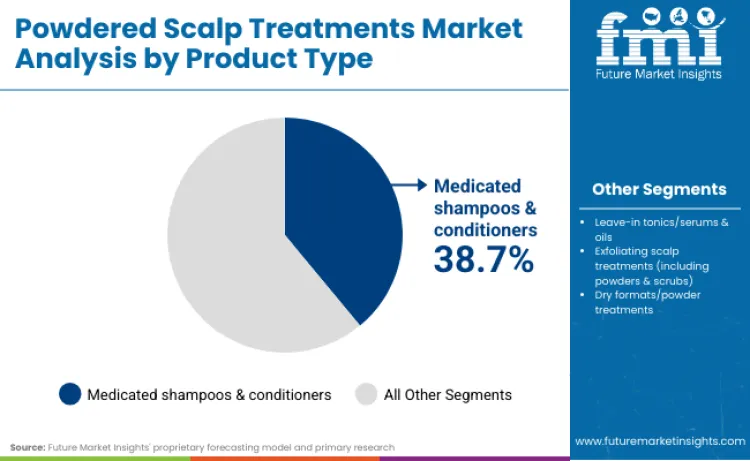
Medicated shampoos and conditioners command a dominant 38.7% share because they remain the most clinically familiar and biologically grounded solution for maintaining scalp health at the follicular level. These products are trusted to deliver consistent active deposition directly to the scalp surface, addressing inflammation, microbial imbalance, and barrier disruption that directly influence hair growth quality. Their dominance is reinforced by dermatologist endorsement and consumer understanding that scalp health functions as the foundation of overall hair outcomes.
Nancy Twine, Founder and CEO of Briogeo, anchors this positioning in scalp biology and ingredient discipline, stating, “Healthy hair is rooted in scalp care which is why a clean-ingredient scalp care routine is a must for keeping your scalp and hair follicles healthy and nourished. When caring for your scalp, think of it as a continuation of your skincare routine for your face. There’s a ‘skinification of hair’ movement going on, which makes a great connection between the ingredients, treatments, and benefits of our skincare routine and how they also relate to hair care.” This philosophy reinforces why medicated shampoos and conditioners continue to lead adoption, as consumers and clinicians alike prioritize rinse-off formats that mirror proven skincare cleansing and treatment logic.
Why does the Liquid/Shampoo Form Dominate the Market?
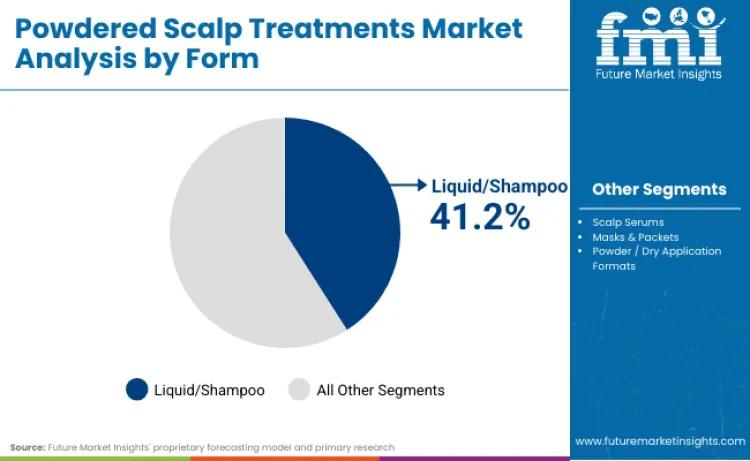
The liquid and shampoo form leads the powdered scalp treatments market with a 41.2% share, supported by deeply ingrained consumer habits, clinical familiarity, and its role as the primary entry point for scalp care routines. Liquid formats enable uniform scalp coverage, effective cleansing, and reliable delivery of active ingredients, making them the default choice for consumers addressing dandruff, oil imbalance, and scalp sensitivity. Their dominance is further reinforced by dermatology-backed protocols and mass accessibility across pharmacies and retail channels.
This leadership position is also aligned with the broader “skinification of hair” movement, where scalp care is increasingly treated as an extension of facial skincare. The founders of The Inkey List captured this shift, stating, “The scalp was the natural next step for us - and our hair and scalp knowledge is even further behind skin, so boy do we have a role to play! Right now there is even more of a spotlight on skin and hair as people have time to invest providing affordable yet premium ingredient treatments whilst supporting customers through their learning journey is the perfect timing.” This perspective explains why liquid and shampoo formats continue to dominate, as they offer a familiar, education-friendly platform for introducing skincare-grade ingredients into scalp routines.
Why Is Skinification Reshaping Scalp Care Routines?
The powdered scalp treatments market is being reshaped by the broader “skinification” movement, where scalp care is no longer positioned as a cosmetic add-on but as a daily health practice aligned with facial skincare principles. Dry and powdered scalp products enable consumers to maintain scalp balance, oil control, and follicular comfort without over-washing, addressing a long-standing tension between hygiene and hair preservation. Anabel Kingsley articulated this mindset shift by noting, “I refresh my scalp in the morning with our One More Day dry shampoo - it has soothing scalp benefits and adds immediate volume to my roots. Daily shampooing also helps to keep your scalp healthy, which is essential to hair growth. You don't wait until you see wrinkles to use an anti-ageing face serum, so why wait with regards to the vibrancy of your hair?” This analogy reinforces how consumers are increasingly treating the scalp as preventative care territory rather than a reactive cleansing zone.
How Are Anhydrous Formats Changing Daily Haircare Behavior?
Anhydrous and powdered scalp treatments are changing daily routines by decoupling scalp health from wash frequency. Unlike traditional liquid shampoos that require water, time, and styling resets, powdered formats allow targeted application of absorbent and soothing actives exactly when imbalance occurs. This enables morning or midday scalp refreshes that align with urban lifestyles, professional schedules, and frequent styling demands. The result is a structural shift toward “micro-maintenance,” where scalp care becomes incremental and habitual, similar to how serums and tonics are used in facial skincare.
What Role Do Large FMCG Players Play in Accelerating This Shift?
Executive validation from large FMCG players is accelerating category legitimacy and scale. Hindustan Unilever Limited (HUL) has explicitly identified scalp-first, skin-inspired care as a future growth lever, stating, “By applying skincare principles to the scalp, focusing on barrier repair, hydration, microbiome balance, and targeted actives, haircare can move from cosmetic improvement to meaningful care... The expectation is no longer just clean hair, but a comfortable, balanced scalp that supports long-term hair health.” This framing signals that powdered and serum-based scalp formats are not niche experiments, but strategic platforms aligned with long-term consumer expectations. As regulatory, ingredient, and education frameworks mature, this convergence of skincare logic and haircare execution is positioning powdered scalp treatments as a durable pillar of modern scalp health ecosystems rather than a transient trend.
What is the Powdered Scalp Treatments Market Regional Outlook?
Growth in the powdered scalp treatments market is being led by emerging economies where urbanization, rising grooming awareness, and accelerated adoption of skinification-led haircare routines are outpacing the global average CAGR of 8.7%. High-growth markets are benefiting from younger consumer demographics, expanding e-commerce penetration, and increasing exposure to dermatologist and influencer-led scalp education. China leads regional expansion with an 11.7% CAGR, driven by premium scalp care adoption in Tier 1 and Tier 2 cities and strong uptake of anhydrous formats aligned with convenience-focused lifestyles. India follows closely at a 10.9% CAGR, supported by rising demand for medicated and botanical scalp solutions that balance affordability with clinical positioning.
Latin America is also emerging as a key growth corridor, with Brazil registering a 9.1% CAGR as consumers increasingly adopt exfoliating and powder-based scalp treatments to manage humidity-driven scalp concerns. In contrast, mature markets such as the United States and Germany are expanding at comparatively moderate rates of 8.3% and 10.1%, respectively, with growth centered on premiumization, salon-led education, and professional scalp care regimens rather than volume expansion. The United Kingdom, at a 7.4% CAGR, reflects a saturated yet innovation-receptive market where adoption is shaped by clean-label positioning and dermatology-backed brands. FMI analysis indicates that future market momentum will be anchored in Asia-led volume growth, while developed regions continue to drive formulation sophistication and category validation.
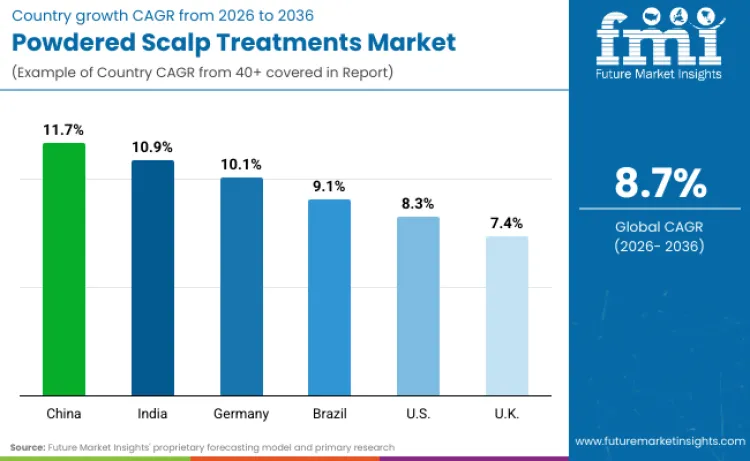
| Country | CAGR (2026 to 2036) |
|---|---|
| China | 11.7% |
| India | 10.9% |
| Germany | 10.1% |
| Brazil | 9.1% |
| United States | 8.3% |
| United Kingdom | 7.4% |
Source: FMI historical analysis and forecast data.
Why is India Bridging Ayurveda and Modern Scalp Science?
India is expanding at a strong 10.9% CAGR, driven by a structural convergence between traditional Ayurvedic wisdom and modern dermatological scalp science. Urban consumers, particularly millennials and Gen Z, are no longer satisfied with generic cleansing solutions and are actively seeking ingredient transparency, clinically credible actives, and routines that feel intentional rather than habitual. Powdered and serum-based scalp treatments align well with India’s climate realities, especially humidity-driven oil imbalance, dandruff, and sensitivity, while also resonating with water-conscious urban lifestyles. Executive insights from Hindustan Unilever Limited (HUL) emphasize that expectations have shifted from simply “clean hair” to maintaining a comfortable, balanced scalp that supports long-term follicle health. This shift is accelerating adoption of skincare-inspired scalp routines, where powders act as targeted, low-residue solutions between washes. FMI analysis suggests that India’s growth is being amplified by education-led brand strategies that frame scalp care as preventive health rather than reactive treatment, positioning powdered formats as a natural evolution within both Ayurvedic and dermatology-aligned regimens.
How is China Driving Premiumization Through Anhydrous Efficiency?
China leads regional growth with an 11.7% CAGR, fueled by rapid premiumization within the masstige scalp care segment and a strong preference for high-performance, convenient formats. Chinese consumers are increasingly seeking dermatologist-grade efficacy delivered through indulgent yet efficient products that fit fast-paced urban routines. Anhydrous powdered scalp treatments are gaining traction as they preserve active ingredient integrity, reduce formulation dilution, and align with on-the-go usage habits. Unilever’s North Asia scalp innovation leadership highlights that consumers now expect holistic scalp care that combines proven dermatological results with sensorial appeal, including refined textures and fragrances. This demand is accelerating the shift away from liquid-heavy maintenance toward concentrated, waterless solutions positioned as premium daily care. FMI analysis indicates that China’s scale, combined with strong digital education and influencer-led validation, is transforming powdered scalp treatments from niche products into mainstream premium essentials, reinforcing the country’s role as the global growth engine for scalp-first innovation.
Why is Germany Advancing Microbiome-Led Scalp Innovation?
Germany is growing at a solid 10.1% CAGR, driven by its deep-rooted strength in scientific research, formulation precision, and microbiome-focused hair and scalp studies. The German market places high value on clinical validation, long-term efficacy, and ingredient functionality, creating favorable conditions for advanced powdered scalp treatments that target follicle-level inflammation and microbial balance. Research communities and industry leaders emphasize that the scalp and hair follicle remain underexplored biological systems, with significant innovation potential when studied below the surface rather than at the fiber level alone. This scientific mindset is accelerating the development of scalp treatments that move beyond cosmetic outcomes toward barrier repair and microbiome harmony. FMI analysis suggests that Germany’s growth is less about rapid consumer turnover and more about translational innovation, where lab-backed insights are systematically converted into premium, dermatologist-aligned scalp solutions. Powdered formats benefit from this environment by enabling precise delivery of actives without unnecessary fillers.
How is Brazil Responding to Climate-Driven Scalp Stress?
Brazil’s 9.1% CAGR reflects a climate-driven transformation in scalp care priorities, where heat, humidity, and sweat exposure have shifted consumer focus from styling aesthetics to barrier integrity and scalp comfort. Brazilian consumers are increasingly adopting skincare-inspired scalp treatments that address irritation, dehydration, and inflammation caused by environmental stressors. Powdered scalp treatments are gaining relevance as they offer oil absorption and microbiome-friendly maintenance without frequent washing, which can exacerbate scalp imbalance in hot climates. Global FMCG insights confirm rising adoption of ingredients such as niacinamide and ceramide precursors to strengthen the scalp barrier and improve hydration. FMI analysis indicates that Brazil’s growth is being shaped by education around scalp biology, with consumers recognizing that healthy hair outcomes depend on managing scalp stress rather than masking symptoms. Powdered formats fit naturally into this shift, serving as functional, climate-adaptive tools within broader scalp wellness routines.
Why is the United States Shifting Toward Proactive Scalp-First Therapy?
The United States is expanding at a steady 8.3% CAGR, characterized by a clear transition from reactive hair problem-solving to proactive, scalp-first care strategies. Premiumization is a central driver, as consumers increasingly invest in high-value products positioned around prevention, maintenance, and long-term scalp health rather than immediate cosmetic fixes. Executive commentary from major FMCG players highlights that premium product mix and pricing are driving growth, signaling strong demand for specialized scalp treatments. Powdered and anhydrous formats are benefiting from this shift by offering daily or between-wash scalp maintenance that mirrors facial skincare routines. FMI analysis suggests that the USA market is maturing around education-led adoption, where consumers understand the link between scalp health, follicle performance, and hair longevity. As a result, powdered scalp treatments are increasingly positioned as essential preventive tools rather than occasional styling aids.
How is the Competition in the Powdered Scalp Treatments Market?
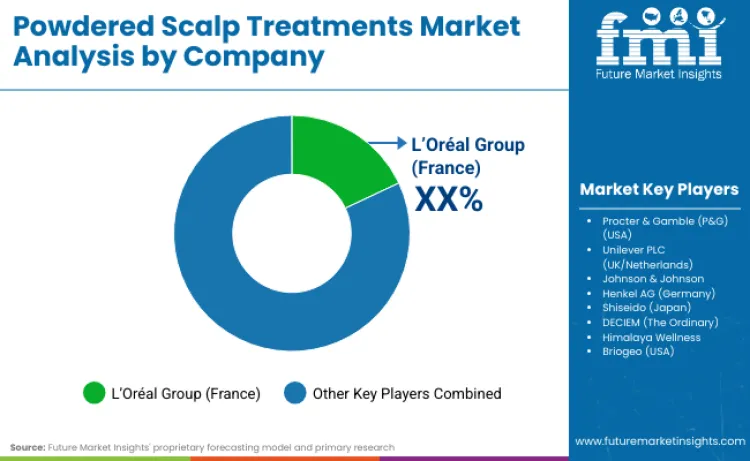
Established leaders such as Aveda protect their market position through deep integration with the professional stylist ecosystem, framing powdered scalp treatments as clinical extensions of salon-led scalp diagnostics rather than mass retail products. By anchoring innovation within professional education and industry forums, including events such as the 2024 World of Texture Virtual Event, these brands reinforce loyalty among stylists who function as the primary gatekeepers of scalp health recommendations. This professional-first strategy limits rapid commoditization and preserves premium positioning by embedding powdered treatments into service-based rituals rather than standalone purchases.
Startups are challenging this dominance by building direct community trust through ritual-based storytelling and education-driven engagement, effectively bypassing traditional advertising and salon gatekeeping. Dianna Cohen, Founder and CEO of Crown Affair, emphasized this shift by stating that community-building is central to the brand’s business model, noting that “your first hundred customers are your people” and highlighting the power of influencer-led guidance over conventional media spend. Strategic competition is increasingly moving toward community ownership, content authority, and ritual creation, reshaping the competitive landscape from distribution-led control to relationship-led differentiation.
Recent Developments:
- In June 2025: L’Oréal Groupe agreed to acquire a majority stake in British skincare brand Medik8. Founded by scientist Elliot Isaacs, Medik8 is known for its Crystal Retinal serum and CSA Philosophy, with strong science-led positioning and growing omnichannel presence across Europe and the USA.
- December 2025: Unilever highlighted the skinification of scalp care, with Dove and Clear launching premium, skincare-inspired scalp and dandruff treatments. Clear’s ScalpCeuticals Pro range broke launch-day sales records on JD.com in China, reflecting strong demand for dermatologist-endorsed, high-efficacy scalp solutions.
Key Players in Powdered Scalp Treatments Market
- L’Oréal Group (France)
- Procter & Gamble (P&G) (USA)
- Unilever PLC (UK/Netherlands)
- Johnson & Johnson
- Henkel AG (Germany)
- Shiseido (Japan)
- DECIEM (The Ordinary)
- Himalaya Wellness
- Briogeo (USA)
Market Definition
The powdered scalp treatments market refers to an emerging category of anhydrous and low-water scalp care solutions formulated in dry or powder formats and applied directly to the scalp to maintain hygiene, balance oil, manage dandruff, and support follicular health without the need for rinsing. These products are positioned as between-wash or daily maintenance solutions and are strongly aligned with the “skinification of hair” trend, where scalp care adopts skincare-grade actives, barrier repair logic, and microbiome-friendly formulations. Powdered scalp treatments prioritize convenience, active integrity, and reduced water dependency, making them suitable for modern lifestyles that favor efficiency, portability, and targeted application. The market spans both cosmetic and functional care use cases, addressing scalp comfort, oil control, and long-term hair vitality rather than immediate styling alone.
Market Inclusion
The market includes powdered and dry-format scalp care products designed to deliver functional benefits such as oil absorption, exfoliation, soothing, dandruff control, and microbiome balance. This includes non-aerosol dry shampoos with scalp health claims, anhydrous exfoliating scalp powders, treatment-oriented dry formats containing dermatologically recognized actives such as salicylic acid, zinc compounds, botanical extracts, clays, and absorbent minerals, and products intended for both consumer and professional use. Distribution channels covered include pharmacies and drugstores, e-commerce platforms, mass retail, salon and professional channels, and specialty beauty outlets. Products positioned for routine scalp maintenance, preventive care, or adjunct therapy alongside liquid shampoos fall within the market scope.
Market Exclusion
The market excludes conventional liquid shampoos, conditioners, and scalp treatments that require water and rinsing as the primary mode of application. Aerosol-based dry shampoos that rely on propellants rather than true powder delivery are not considered part of the powdered scalp treatments category. Also excluded are styling powders intended purely for cosmetic volume or texture enhancement without scalp care functionality, oral hair supplements and nutraceuticals, prescription-only dermatological drugs, and medical devices or diagnostic tools related to hair or scalp health. Hair fibers, concealers, wigs, and cosmetic camouflage products with no therapeutic or scalp maintenance claims are similarly outside the defined market scope.
Scope of Report
| Items | Values |
|---|---|
| Quantitative Units | USD billion |
| Product Categories | Medicated Shampoos & Conditioners; Leave-in Tonics, Serums & Oils; Exfoliating Scalp Treatments (Powders & Scrubs); Dry Powder Scalp Treatments |
| Form Types | Liquid/Shampoo Formats; Scalp Serums; Masks & Treatment Packs; Powder & Dry Application Formats |
| Active Ingredient Systems | Salicylic Acid; Antifungal Agents (Ketoconazole); Zinc-based Compounds; Botanical & Tea Tree Actives; Absorbent Base Materials |
| Core Functional Focus | Oil regulation; dandruff and microbial control; follicle health; scalp exfoliation; microbiome balance; between-wash maintenance |
| Distribution Channels | Pharmacies & Drugstores; E-commerce & Online Retail; Mass Retail & Supermarkets; Salon & Professional Channels |
| Consumer Use Logic | Therapeutic scalp treatment; daily scalp hygiene maintenance; preventive scalp care; skinification-aligned routines |
| Regions Covered | North America; Europe; Asia Pacific; Latin America; Middle East & Africa |
| Countries Covered | China; India; Germany; Brazil; United States; United Kingdom; Japan; South Korea; France; and 35+ additional countries |
| Key Companies Profiled | L’Oréal Group; Procter & Gamble; Unilever PLC; Johnson & Johnson; Henkel AG; Shiseido; DECIEM (The Ordinary); Himalaya Wellness; Briogeo |
| Innovation & Trend Platforms | Skinification of hair; anhydrous scalp care formats; microbiome-focused treatments; clean-ingredient medicated solutions; targeted between-wash therapies |
Powdered Scalp Treatments Market by Segments
By Product:
- Medicated Shampoos & Conditioners
- Leave-in Tonics, Serums & Oils
- Exfoliating Scalp Treatments (Including Powders & Scrubs)
- Dry Format / Powder Treatments
By Form:
- Liquid / ShampoFormats
- Scalp Serums
- Masks & Packets
- Powder & Dry Application Formats
By Active Ingredient:
- Salicylic Acid
- Antifungal Agents (e.g., Ketoconazole)
- Zinc-Based Compounds
- Botanical & Tea Tree Actives
- Absorbent Base Materials
By Distribution Channel:
- Pharmacies & Drugstores
- E-Commerce / Online Retail
- Mass Retail & Supermarkets
- Salon & Professional Channels
By Region:
- North America
- Europe
- Asia Pacific
- Latin America
- Middle East & Africa
Bibliography
- Hindustan Unilever Limited. (2026, January). The rise of scalp-first thinking in haircare. HUL News.
- Kingsley, A. (2024). A day well spent with Anabel Kingsley: Refreshing the scalp with one more day. London Evening Standard.
- Unilever PLC. (2025). The skinification of scalp care: Unilever’s expertise delivers on-demand. Unilever Global News.
Frequently Asked Questions
What is the current global market size for Powdered Scalp Treatments?
The global market is valued at USD 3.0 billion in 2026, driven by the shift toward scalp-first, dermatology-inspired haircare and high-efficacy anhydrous treatment formats.
What is the projected CAGR for the Powdered Scalp Treatments market?
The market is projected to grow at an 8.7% CAGR from 2026 to 2036, reflecting rising adoption of powdered and targeted scalp maintenance routines worldwide.
Which segment currently dominates the industry?
Medicated shampoos and conditioners lead with a 38.7% share, while liquid and shampoo formats dominate overall usage with 41.2%.
What are the primary drivers for adoption in emerging markets?
Rapid urbanization, increasing scalp health awareness, strong e-commerce penetration, and skinification-driven haircare trends in China and India are the main growth drivers.
Who are the leading players in the Powdered Scalp Treatments space?
Key players include L’Oréal Group, Procter & Gamble, Unilever, Johnson & Johnson, Henkel, Shiseido, DECIEM (The Ordinary), Himalaya Wellness, and Briogeo.
Preview the report firsthand - request a free sample
Get SampleGet the brochure for pricing and purchase details.
Get PDFTable of Content
- Executive Summary
- Global Market Outlook
- Demand Side Trends
- Supply Side Trends
- Technology Roadmap Analysis
- Analysis and Recommendations
- Market Overview
- Market Coverage / Taxonomy
- Market Definition / Scope / Limitations
- Research Methodology
- Chapter Orientation
- Analytical Lens and Working Hypotheses
- Market Structure, Signals, and Trend Drivers
- Benchmarking and Cross-market Comparability
- Market Sizing, Forecasting, and Opportunity Mapping
- Research Design and Evidence Framework
- Desk Research Programme (Secondary Evidence)
- Company Annual and Sustainability Reports
- Peer-reviewed Journals and Academic Literature
- Corporate Websites, Product Literature, and Technical Notes
- Earnings Decks and Investor Briefings
- Statutory Filings and Regulatory Disclosures
- Technical White Papers and Standards Notes
- Trade Journals, Industry Magazines, and Analyst Briefs
- Conference Proceedings, Webinars, and Seminar Materials
- Government Statistics Portals and Public Data Releases
- Press Releases and Reputable Media Coverage
- Specialist Newsletters and Curated Briefings
- Sector Databases and Reference Repositories
- FMI Internal Knowledge Base and Historical Datasets
- Subscription Datasets and Paid Sources
- Social Channels, Communities, and Digital Listening Inputs
- Additional Desk Sources
- Expert Input and Fieldwork (Primary Evidence)
- Primary Modes
- Qualitative Interviews and Expert Elicitation
- Quantitative Surveys and Structured Data Capture
- Blended Approach
- Why Primary Evidence is Used
- Field Techniques
- Interviews
- Surveys
- Focus Groups
- Observational and In-context Research
- Social and Community Interactions
- Stakeholder Universe Engaged
- C-suite Leaders
- Board Members
- Presidents and Vice Presidents
- R&D and Innovation Heads
- Technical Specialists
- Domain Subject-matter Experts
- Scientists
- Physicians and Other Healthcare Professionals
- Governance, Ethics, and Data Stewardship
- Research Ethics
- Data Integrity and Handling
- Primary Modes
- Tooling, Models, and Reference Databases
- Desk Research Programme (Secondary Evidence)
- Data Engineering and Model Build
- Data Acquisition and Ingestion
- Cleaning, Normalisation, and Verification
- Synthesis, Triangulation, and Analysis
- Quality Assurance and Audit Trail
- Market Background
- Market Dynamics
- Drivers
- Restraints
- Opportunity
- Trends
- Scenario Forecast
- Demand in Optimistic Scenario
- Demand in Likely Scenario
- Demand in Conservative Scenario
- Opportunity Map Analysis
- Product Life Cycle Analysis
- Supply Chain Analysis
- Investment Feasibility Matrix
- Value Chain Analysis
- PESTLE and Porter's Analysis
- Regulatory Landscape
- Regional Parent Market Outlook
- Production and Consumption Statistics
- Import and Export Statistics
- Market Dynamics
- Global Market Analysis 2021 to 2025 and Forecast, 2026 to 2036
- Historical Market Size Value (USD Billion) Analysis, 2021 to 2025
- Current and Future Market Size Value (USD Billion) Projections, 2026 to 2036
- Y-o-Y Growth Trend Analysis
- Absolute $ Opportunity Analysis
- Global Market Pricing Analysis 2021 to 2025 and Forecast 2026 to 2036
- Y-o-Y Growth Trend Analysis 2021 to 2025
- Absolute $ Opportunity Analysis 2026 to 2036
- Global Market Analysis 2021 to 2025 and Forecast 2026 to 2036, By Product
- Introduction / Key Findings
- Historical Market Size Value (USD Billion) Analysis By Product, 2021 to 2025
- Current and Future Market Size Value (USD Billion) Analysis and Forecast By Product, 2026 to 2036
- Medicated Shampoos & Conditioners
- Leave-in Tonics, Serums & Oils
- Exfoliating Scalp Treatments (Including Powders & Scrubs)
- Dry Format / Powder Treatments
- Y-o-Y Growth Trend Analysis By Product, 2021 to 2025
- Absolute $ Opportunity Analysis By Product, 2026 to 2036
- Global Market Analysis 2021 to 2025 and Forecast 2026 to 2036, By Form
- Introduction / Key Findings
- Historical Market Size Value (USD Billion) Analysis By Form, 2021 to 2025
- Current and Future Market Size Value (USD Billion) Analysis and Forecast By Form, 2026 to 2036
- Liquid / Shampoo Formats
- Scalp Serums
- Masks & Packets
- Powder & Dry Application Formats
- Y-o-Y Growth Trend Analysis By Form, 2021 to 2025
- Absolute $ Opportunity Analysis By Form, 2026 to 2036
- Global Market Analysis 2021 to 2025 and Forecast 2026 to 2036, By Active Ingredient
- Introduction / Key Findings
- Historical Market Size Value (USD Billion) Analysis By Active Ingredient, 2021 to 2025
- Current and Future Market Size Value (USD Billion) Analysis and Forecast By Active Ingredient, 2026 to 2036
- Salicylic Acid
- Antifungal Agents (e.g., Ketoconazole)
- Zinc-Based Compounds
- Botanical & Tea Tree Actives
- Absorbent Base Materials
- Y-o-Y Growth Trend Analysis By Active Ingredient, 2021 to 2025
- Absolute $ Opportunity Analysis By Active Ingredient, 2026 to 2036
- Global Market Analysis 2021 to 2025 and Forecast 2026 to 2036, By Distribution Channel
- Introduction / Key Findings
- Historical Market Size Value (USD Billion) Analysis By Distribution Channel, 2021 to 2025
- Current and Future Market Size Value (USD Billion) Analysis and Forecast By Distribution Channel, 2026 to 2036
- Pharmacies & Drugstores
- E-Commerce / Online Retail
- Mass Retail & Supermarkets
- Salon & Professional Channels
- Y-o-Y Growth Trend Analysis By Distribution Channel, 2021 to 2025
- Absolute $ Opportunity Analysis By Distribution Channel, 2026 to 2036
- Global Market Analysis 2021 to 2025 and Forecast 2026 to 2036, By Region
- Introduction
- Historical Market Size Value (USD Billion) Analysis By Region, 2021 to 2025
- Current Market Size Value (USD Billion) Analysis and Forecast By Region, 2026 to 2036
- North America
- Europe
- Asia Pacific
- Latin America
- Middle East & Africa
- Market Attractiveness Analysis By Region
- North America Market Analysis 2021 to 2025 and Forecast 2026 to 2036, By Country
- Historical Market Size Value (USD Billion) Trend Analysis By Market Taxonomy, 2021 to 2025
- Market Size Value (USD Billion) Forecast By Market Taxonomy, 2026 to 2036
- By Country
- USA
- Canada
- By Product
- By Form
- By Active Ingredient
- By Distribution Channel
- By Country
- Market Attractiveness Analysis
- By Country
- By Product
- By Form
- By Active Ingredient
- By Distribution Channel
- Key Takeaways
- Europe Market Analysis 2021 to 2025 and Forecast 2026 to 2036, By Country
- Historical Market Size Value (USD Billion) Trend Analysis By Market Taxonomy, 2021 to 2025
- Market Size Value (USD Billion) Forecast By Market Taxonomy, 2026 to 2036
- By Country
- Germany
- UK
- France
- Rest of Europe
- By Product
- By Form
- By Active Ingredient
- By Distribution Channel
- By Country
- Market Attractiveness Analysis
- By Country
- By Product
- By Form
- By Active Ingredient
- By Distribution Channel
- Key Takeaways
- Asia Pacific Market Analysis 2021 to 2025 and Forecast 2026 to 2036, By Country
- Historical Market Size Value (USD Billion) Trend Analysis By Market Taxonomy, 2021 to 2025
- Market Size Value (USD Billion) Forecast By Market Taxonomy, 2026 to 2036
- By Country
- China
- India
- Japan
- South Korea
- Rest of Asia Pacific
- By Product
- By Form
- By Active Ingredient
- By Distribution Channel
- By Country
- Market Attractiveness Analysis
- By Country
- By Product
- By Form
- By Active Ingredient
- By Distribution Channel
- Key Takeaways
- Latin America Market Analysis 2021 to 2025 and Forecast 2026 to 2036, By Country
- Historical Market Size Value (USD Billion) Trend Analysis By Market Taxonomy, 2021 to 2025
- Market Size Value (USD Billion) Forecast By Market Taxonomy, 2026 to 2036
- By Country
- Brazil
- Rest of Latin America
- By Product
- By Form
- By Active Ingredient
- By Distribution Channel
- By Country
- Market Attractiveness Analysis
- By Country
- By Product
- By Form
- By Active Ingredient
- By Distribution Channel
- Key Takeaways
- Middle East & Africa Market Analysis 2021 to 2025 and Forecast 2026 to 2036, By Country
- Historical Market Size Value (USD Billion) Trend Analysis By Market Taxonomy, 2021 to 2025
- Market Size Value (USD Billion) Forecast By Market Taxonomy, 2026 to 2036
- By Country
- Kingdom of Saudi Arabia
- South Africa
- Rest of Middle East & Africa
- By Product
- By Form
- By Active Ingredient
- By Distribution Channel
- By Country
- Market Attractiveness Analysis
- By Country
- By Product
- By Form
- By Active Ingredient
- By Distribution Channel
- Key Takeaways
- Key Countries Market Analysis
- USA
- Pricing Analysis
- Market Share Analysis, 2025
- By Product
- By Form
- By Active Ingredient
- By Distribution Channel
- China
- Pricing Analysis
- Market Share Analysis, 2025
- By Product
- By Form
- By Active Ingredient
- By Distribution Channel
- India
- Pricing Analysis
- Market Share Analysis, 2025
- By Product
- By Form
- By Active Ingredient
- By Distribution Channel
- Germany
- Pricing Analysis
- Market Share Analysis, 2025
- By Product
- By Form
- By Active Ingredient
- By Distribution Channel
- Brazil
- Pricing Analysis
- Market Share Analysis, 2025
- By Product
- By Form
- By Active Ingredient
- By Distribution Channel
- UK
- Pricing Analysis
- Market Share Analysis, 2025
- By Product
- By Form
- By Active Ingredient
- By Distribution Channel
- USA
- Market Structure Analysis
- Competition Dashboard
- Competition Benchmarking
- Market Share Analysis of Top Players
- By Regional
- By Product
- By Form
- By Active Ingredient
- By Distribution Channel
- Competition Analysis
- Competition Deep Dive
- L’Oréal Group (France)
- Procter & Gamble (P&G) (USA)
- Unilever PLC (UK/Netherlands)
- Johnson & Johnson
- Henkel AG (Germany)
- Shiseido (Japan)
- DECIEM (The Ordinary)
- Himalaya Wellness
- Briogeo (USA)
- Competition Deep Dive
- Assumptions & Acronyms Used


