

- Market Size (2026)
- USD 2.1 Bn
- Forecast (2036)
- USD 8.7 Bn
- CAGR (2026 to 2036)
- 15.2%
Dry-Format Hair Cleansers Market Forecast and Outlook 2026 to 2036
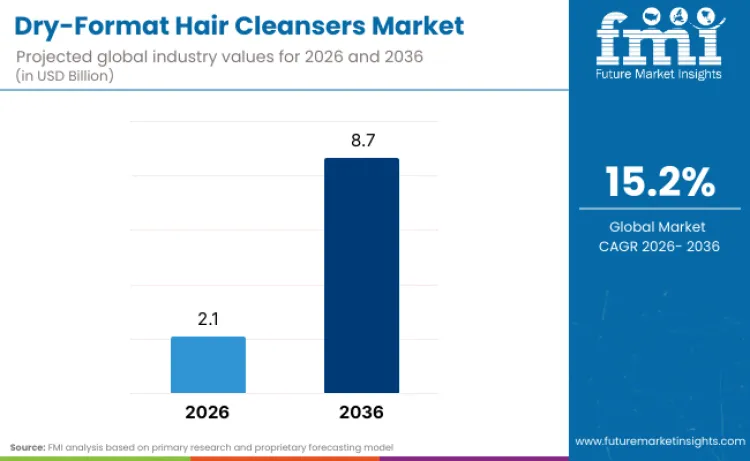
The global dry-format hair cleansers market is projected to reach USD 2.1 billion in 2026 and expand to USD 8.7 billion by 2036, reflecting a CAGR of 15.2% over the forecast period. As per FMI opinion, this growth reflects a structural shift in hair care away from wash centered routines toward maintenance led, convenience first systems that protect styling integrity and scalp comfort. Consumers increasingly adopt routine extension strategies that emphasize oil control, volume refresh, texture retention, and reduced wash frequency. Women represent the largest end user group, accounting for 58.9% share, driven by higher styling frequency, longer hair lengths, and stronger preference for products that preserve salon results between washes.
Product development advances focus on micro particle dispersion, targeted oil absorption systems, and scalp compatible actives that deliver professional grade outcomes without water. Formulations aim to minimize residue, maintain sensory appeal, and support repeated use within daily routines. These technical priorities position dry cleansers as reliable maintenance tools rather than occasional fixes.
Amika was born in the salon and built by a community of stylists and beauty lovers. We’re thrilled to bring our professional-grade products and inclusive haircare philosophy to Ulta Beauty’s diverse and devoted guests across the country. With Ulta’s own in-store salons and talented stylists, this partnership further underscores the amika heritage as a professional brand and reinforces our commitment to delivering salon-level performance and results to all - Chelsea Riggs, CEO of Amika
These actions confirm dry cleansers as deliberate components of structured routines. The category value centers on convenience with performance. Waterless formats support styling longevity, scalp balance, and time efficiency. Dry-format hair cleansers increasingly function as core maintenance tools within modern hair care regimens.
Summary of the Dry-Format Hair Cleansers Market
What Is Growth Outlook for Dry-Format Hair Cleansers Market as per Future Market Insights Projection?
Future Market Insights projects the dry-format hair cleansers industry to expand at a CAGR of 15.2% from 2026 to 2036, increasing from USD 2.1 Billion in 2026 to USD 8.7 Billion by 2036.
FMI Research Approach: FMI proprietary forecasting model based on scalp comfort performance, oil control demand, and waterless formulation innovation across personal care categories.
How Do FMI Analysts Perceive Dry-Format Hair Cleansers Market to Evolve?
FMI analysts perceive the market evolving toward routine-anchored waterless hair hygiene, where dry-format cleansers are adopted not as emergency fixes but as core maintenance tools supporting styling longevity, time efficiency, and scalp refresh.
FMI Research Approach: Category evolution mapped through consumer wash-frequency shifts, residue-reduction formulation benchmarks, and product positioning within professional stylist recommendations.
Which Country Holds Largest Share in Global Dry-Format Hair Cleansers Market?
China holds a significant share of the global dry-format hair cleansers market by value, supported by national mandates on water consumption decoupling and green behavior communication campaigns under the 14th Five-Year Plan.
FMI Research Approach: FMI country-level CAGR modeling based on zero-growth water consumption targets, regulatory enforcement patterns, and urban household hair hygiene behavior data.
How Large Will Dry-Format Hair Cleansers Market Be by 2036?
The global dry-format hair cleansers market is projected to reach USD 8.7 Billion by 2036.
FMI Research Approach: FMI long-term revenue forecast derived from usage-frequency models, consumer education adoption curves, and ingredient compliance frameworks post-aerosol scrutiny.
What Is Definition of Dry-Format Hair Cleansers Market?
The dry-format hair cleansers market comprises non-liquid, rinse-free formulations such as powders, foams, sprays, and solid sticks engineered to refresh hair, absorb oil, and extend wash intervals without water.
FMI Research Approach: FMI market taxonomy and inclusion-exclusion framework based on delivery format, oil absorption function, and routine-based hair hygiene utility.
What Are Globally Unique Trends Shaping Dry-Format Hair Cleansers Market?
Globally unique trends include the benzene-free reformulation movement, the skinification of scalp care, and the transition from aerosol sprays to starch-based micro-powders driven by performance, compliance, and consumer trust.
FMI Research Approach: Global product safety compliance mapping, EU CMR ingredient restriction readiness, and market segmentation aligned with clinical scalp health science and zero-water innovation mandates.
Dry-Format Hair Cleansers Market Key Takeaways
| Metric | Value |
|---|---|
| Market Value (2026) | USD 2.1 billion |
| Market Forecast Value (2036) | USD 8.7 billion |
| Forecast CAGR (2026-2036) | 15.2% |
Source: FMI’s proprietary forecasting model and primary research
Which Factors Drive Dry-Format Hair Cleanser Adoption?
Consumers are increasingly seeking cleansing methods that reduce water dependency while delivering measurable scalp and hair benefits, creating a need for technologies that move beyond oil absorption into physiological odor and barrier management. Clinical style validation of this shift came in March 2024 when K18 Biomimetic Hairscience launched AirWash, a non aerosol dry cleanser that uses patented odorBIND smart release biotechnology with biotech derived Mediterranean microalgae to neutralize odor at a molecular level for up to three days without water.
Unilever reinforced this movement in December 2025 through the skinification of scalp care by incorporating ingredients such as Niacinamide and Zinc into daily use cleansers supported by SebumReg Tech that regulates sebaceous gland activity at the cellular level. This approach ensures that consumer time is directed toward scalp barrier health rather than temporary oil control.
L’Oréal Groupe further accelerated adoption through its pivot toward waterless routines after reporting that a major share of shampoo water and carbon footprint occurs during consumer use. The promotion of no rinse technologies supports its goal to reduce rinse water requirements significantly by 2030.
What are the Various Segments of the Dry-Format Hair Cleansers Market?
The dry-format hair cleansers market is segmented by product format into powder-based cleansers, foam-based cleansers, spray-based cleansers, and solid stick cleansers; by ingredient type into starch-based, clay-based, botanical-based, and charcoal-based; by hair type into oily hair, dry hair, normal hair, and colored & treated hair; by distribution channel into online retail, specialty beauty stores, supermarkets and hypermarkets, and pharmacies & drug stores; by end user into women, men, and unisex; and by region into Asia Pacific (China, Japan, South Korea, India, Australia & New Zealand, ASEAN, rest of Asia Pacific), Europe (Germany, United Kingdom, France, Italy, Spain, Nordic, BENELUX, rest of Europe), North America (USA, Canada, Mexico), Latin America (Brazil, Chile, rest of Latin America), and Middle East & Africa (Kingdom of Saudi Arabia, other GCC countries, Turkey, South Africa, other African Union, rest of Middle East & Africa).
FMI analysis suggests that while innovative formats are gaining visibility, the market structure remains closely tied to familiar cleansing habits. This segmentation highlights a dual-track market where traditional shampoo routines provide continuity while dry-format solutions provide convenience, efficiency, and reduced water dependency.
Which Product Type Leads the Dry-Format Hair Cleansers Market?
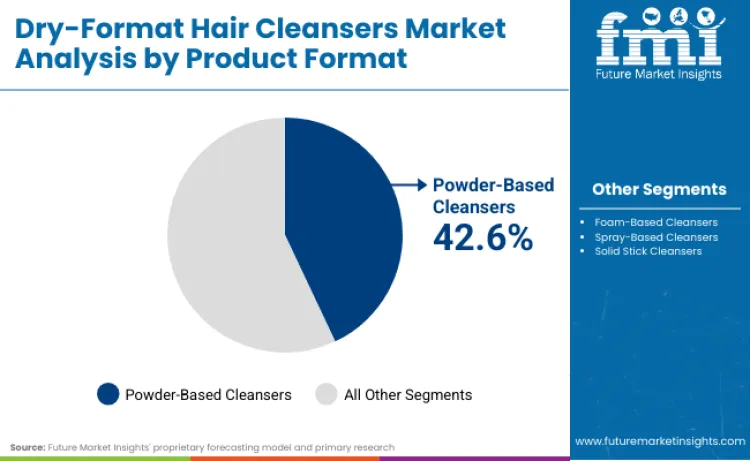
Powder-based dry cleansers hold the largest share at 42.6% because they are a high-efficiency segment that often outperforms aerosol sprays in longevity and ingredient concentration. Batiste, a global leader in the dry shampoo category, recently entered the powder segment by highlighting that “just one bottle of the new Batiste Powder Dry Shampoo is equivalent to four of the brand's standard aerosol bottles.”
Major brands emphasize the value proposition of powder formats over traditional sprays. Prose, a personalized hair care manufacturer, notes the significant difference in product lifespan: “I would go through one can of dry shampoo in a month, while my dry shampoo powder lasts close to six months. So in the end you're spending more money on aerosols if you're regularly using dry shampoo,” says McDonald.
Brands are increasingly leaning into the powder format to meet eco-conscious demands. Batiste positions its new powder line as a response to evolving habits: “This new, non-aerosol format is a first for Batiste, and it aligns with rising non-aerosol dry shampoo usage. Ingredient-conscious consumers will also appreciate that these formulas exclude all bad stuff, namely, parabens, talc, sulfates, phthalates, and silicones.”
Why do Oily Hair Applications hold a Dominant Share?
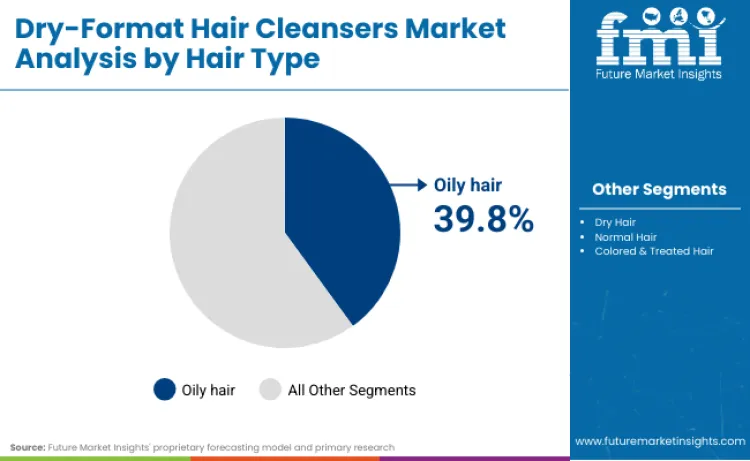
Oily hair accounts for 39.8% of total demand because the dry-format cleanser market is fundamentally engineered to target excess sebum between washes. Batiste, the global market leader in dry shampoo, confirms the efficacy and specialized demand for this segment: “86% of consumers agree Batiste removes grease and oil from hair effectively.”
The market for dry-format cleansers is built on the need to manage oil without water. Leading brands emphasize that their core technology is designed specifically for this hair type. Batiste explains the functional demand: “Batiste Dry Shampoo is designed to refresh the roots of the hair and uses a unique special rice starch to absorb oil.”
Consumer insights from Kérastase under L’Oréal Groupe show that demand is rooted in the skinification of hair care, where managing oil without stripping natural moisture is key. Kérastase states: “Dry shampoo keeps your hair looking fresh and oil-free, allowing you to space out your wash days without worrying about greasy hair or losing the natural oils from your hair.”
Brands now segment products to address combinations such as oily roots with dry ends. Batiste notes: “Dry shampoo is designed to conquer oily roots and absorb oils, giving your hair a revived fresh look between wet shampoos.”
Why Is Dry-Format Formulation Reshaping Hair Hygiene?
Dry-format hair cleansers are fundamentally shifting away from traditional aerosol delivery systems toward starch-based and silicone elastomer powders to eliminate chemical risks. Following intensive studies, inventors found that “an aqueous-based non-aerosol dry shampoo comprising: 0.1 to 30 wt % of silicone elastomer powder; and 5 to 98.3 wt % of water” can solve the disadvantages of conventional products. This evolution is driven by the finding that “propellant is usually alkanes and liquid alkanes which are not only have low toxicity but also insecure and not sustainable.”
How Is Benzene Mitigation Changing Manufacturing Standards?
Market is pivoting aggressively toward benzene-free certification as regulators and consumers react to the discovery of high carcinogen levels in aerosolized products. Independent testing confirmed that “concentrations of benzene increased when the products were sprayed from the aerosol cans, reaching as high as 1,600 ppb,” well above the safety threshold of 2 ppb. This has led to a standard where “drug manufacturers should not release any drug product batch that contains benzene above 2 parts per million ppm.”
What Role Does Scalp Health Science Play in Formulation Innovation?
Modern dry cleansers are being reformulated to prioritize the microenvironment of the scalp to prevent follicular occlusion and inflammatory conditions. Dermatologists warn that “the risk of overusing dry shampoo is that it can build up in your scalp, resulting in occlusion of your hair follicles,” which can lead to “inflammation, acne, or dandruff.” Clinical research indicates that “on the scalp, the hair appears to be impacted prior to emergence, and oxidative stress appears to play a role in premature hair loss.” To counter this, new patents emphasize that “removal of the dry shampoo can be effected simply by brushing or blotting it from the scalp,” reducing the damaging effects of excessive washing in water while maintaining follicle health.
What is the Dry-Format Hair Cleansers Market Regional Outlook?
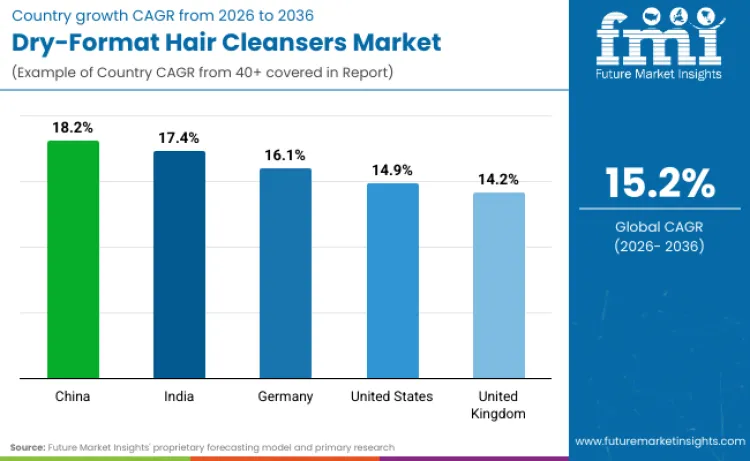
Adoption in high population markets is significantly outpacing the global average as hair care routines shift from daily washing dependency to flexible maintenance systems supported by waterless cleansing formats. While the global market expands steadily, countries are accelerating uptake as formulation advances make dry cleansers competitive on oil control, scalp health, styling benefits, and user satisfaction. China leads this growth with an 18.2% CAGR, followed closely by India at 17.4% and Germany at 16.1%, creating a new axis of demand where routine integration replaces emergency use positioning.
In contrast, mature markets such as the United States at 14.9% and the United Kingdom at 14.2% are driven by professional endorsement and beauty retail integration rather than novelty adoption. Here, salon recommendations and mainstream merchandising reduce specialty positioning and support systematic adoption across diverse hair care needs. FMI analysis indicates that future growth will come from embedding dry-format cleansers into regular hair maintenance routines across both emerging and developed regions.
| Country | CAGR (2026-2036) |
|---|---|
| China | 18.2% |
| India | 17.4% |
| Germany | 16.1% |
| United States | 14.9% |
| United Kingdom | 14.2% |
Source: Future Market Insights' proprietary forecasting model and primary research
Why is China prioritizing Zero Growth Water Consumption?
China is expanding at an 18.2% CAGR, driven by firm national mandates that separate economic progress from increasing water use. By December 2025, authorities confirmed zero growth in total water consumption during the 14th Five Year Plan from 2021 to 2025. The Ministry of Water Resources directed industries to integrate water saving practices across economic and social development as part of a broader green transformation. This policy pressure reaches consumer sectors where water intensive habits are being questioned. Beauty and personal care manufacturers are expected to support conservation goals through formulation changes and production practices.
FMI predicts that this environment will continue to encourage water efficient alternatives that reduce household dependency on rinsing routines. Dry format hair cleansers fit directly into this conservation framework. These products allow consumers to maintain hygiene standards while contributing to national objectives around responsible water use, making waterless cleansing a practical extension of government sustainability priorities.
How is India’s Jan Bhagidari driving the Waterless Transition?
India is growing at a 17.4% CAGR, supported by government programs that promote community participation in water conservation. The Ministry of Jal Shakti initiatives for 2025 to 2026 emphasize conserving every drop through collective responsibility and a whole of society approach. Official data shows that nearly 600 million people experience high to extreme water stress, placing conservation at the center of daily living. Behavior change communication campaigns encourage households to adopt environmentally responsible habits that reduce water consumption.
FMI predicts that this cultural shift will influence personal care routines across both rural and urban populations. Dry format hair cleansers offer a simple method to lower domestic water usage without compromising hygiene. This alignment between hair care practices and national conservation messaging is likely to drive adoption as consumers seek practical ways to participate in water saving efforts.
Why is Germany leading on Cosmetic Ingredient Safety CMR?
Germany is rising at a 16.1% CAGR as it prepares for the EU Omnibus Regulation VIII taking effect in May 2026. The regulation requires strict compliance with updated ingredient safety restrictions across cosmetic products. German consumers already show strong concern about undesirable substances in personal care items, encouraging brands to reformulate away from aerosol and solvent based formats.
FMI predicts that this regulatory environment will accelerate the shift toward dry powder cleansers that rely on simpler, more transparent ingredient lists. These formulations reduce dependency on preservatives and complex stabilizers. Ingredient safety, clarity, and compliance are becoming central purchase criteria. Dry format hair cleansers provide manufacturers with a compliant solution that satisfies both regulatory expectations and consumer demand for safer daily use products.
How is the USA Market maturing through WaterSense Efficiency?
The United States is growing at a 14.9% CAGR, supported by the Environmental Protection Agency expansion of water efficiency labeling through the WaterSense program. This initiative helps consumers identify products that conserve water while maintaining effectiveness. The EPA is extending water efficiency principles into broader product categories, encouraging households to rethink water heavy routines.
FMI predicts that this regulatory focus will gradually shape consumer preferences toward products that reduce water dependency. Dry format hair cleansers offer a convenient option that aligns with water efficiency goals without changing hygiene expectations. As awareness of household water footprints increases, waterless cleansing formats are likely to become more acceptable and integrated into everyday routines.
Why is the UK focusing on Pre Pipe Solutions?
The United Kingdom is expanding at a 14.2% CAGR following the January 2026 Water White Paper that promotes pre pipe solutions and consumer level water reduction. This strategy shifts responsibility from infrastructure alone to household behavior. Planned water efficiency labeling will inform consumers about the water costs of daily activities, encouraging mindful consumption.
FMI predicts that this policy direction will challenge water intensive hygiene habits and support alternatives that reduce reliance on rinsing. Dry format hair cleansers align with the country’s long term resource security goals by allowing effective hair hygiene with minimal water use. This alignment between regulation and routine behavior is expected to support adoption across households.
Which Companies Are Increasing Share in the Dry-Format Hair Cleansers Market?
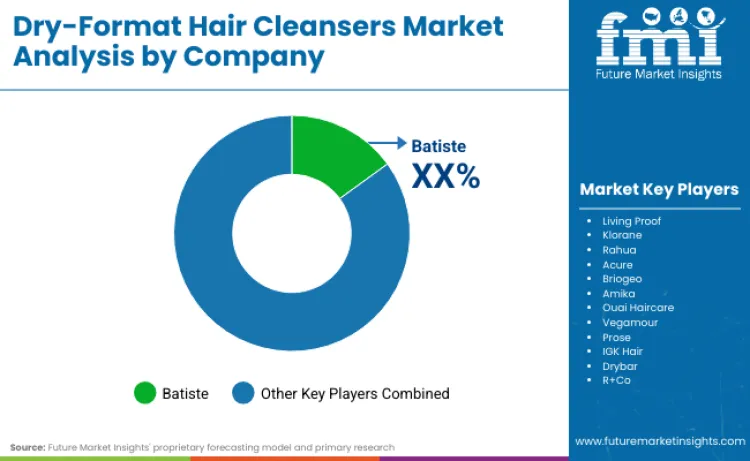
Brands gaining share in dry-format hair cleansers are those that position dry cleansing as a planned maintenance step rather than an emergency styling fix. Leadership comes from long-term consumer training on dosage, placement, and frequency. Batiste is the clearest example. Its strength comes from early scale combined with continuous refinement based on mass consumer usage. The brand normalized dry cleansing across hair types, colors, and lifestyles by pairing wide availability with clear application guidance. This approach made dry formats feel routine safe and repeatable. As the category matures, this education advantage continues to convert into share gains.
Premium growth is led by brands that emphasize scientific validation and professional credibility. Living Proof follows this path by framing dry cleansing around polymer science and oil removal at the molecular level. Salon education and stylist recommendation anchor correct use and reduce misuse. This attracts higher value consumers who treat dry cleansing as part of hair and scalp health management.
Large portfolio owners also consolidate share when scale does not weaken discipline. L’Oréal and Unilever expand dry formats across mass and prestige brands while maintaining usage clarity. amika occupies a hybrid position by leveraging salon heritage to legitimize frequent use while growing through specialty retail. Share concentrates with brands that pair formulation performance with consistent education systems that protect correct, repeatable use.
Recent Developments:
- In October 2025, Kering and L’Oréal formed a strategic alliance including L’Oréal’s acquisition of Creed and 50-year beauty licenses for Gucci, Bottega Veneta, and Balenciaga, plus a joint venture exploring luxury wellness and longevity opportunities. Kering and L'Oréal forge an alliance in beauty and wellness | L'Oréal Finance
- In November 2025, P&G launched Gemz, a water-activated shampoo and conditioner format developed over 14 years. The single-dose tiles dissolve on contact, reduce buildup, enable travel convenience, and support customizable haircare routines. Beyond the Bottle: How Gemz is Redefining Haircare for the Modern Consumer | P&G
- In May 2025, Dove launched its premium Damage Therapy range featuring patented Bio-Protein Care technology. Designed with high-end packaging and social-first marketing, the line targets severe hair damage, reinforcing strands and repositioning Dove as a leader in repair-focused haircare. Dove’s premium range revolutionises hair damage repair | Unilever
Key Players in the Dry-Format Hair Cleansers Market
- Batiste
- Living Proof
- Klorane
- Rahua
- Acure
- Briogeo
- Amika
- Ouai Haircare
- Vegamour
- Prose
- IGK Hair
- Drybar
- R+Co
- Moroccanoil
- Bumble and bumble
- Schwarzkopf
- TRESemmé
- Pantene
- L'Oréal Paris
- Dove
Market Definition
The dry-format hair cleansers market refers to revenues generated from waterless hair care products formulated to absorb excess oil, refresh scalp condition, and extend time between traditional shampooing through powder, foam, spray, and solid delivery systems. These products provide maintenance functions including oil control, volume support, scalp freshness, and style renewal without water or rinse-out steps. Market size is measured in USD billion and evaluated across the 2026 to 2036 period. The category includes dry-format cleansers positioned as systematic hair care tools for regular use rather than emergency fixes. Products are classified by delivery format and functional performance instead of ingredient origin. Included formats comprise powders, aerosols, foams, and pressed solids that demonstrate measurable oil absorption, scalp cleansing action, and cosmetic refresh. The analysis treats dry-format hair cleansers as a distinct hair care category. Traditional shampoos, styling products with minor cleansing effect, and multipurpose beauty items fall outside this definition. Revenue attribution applies only to products explicitly formulated and marketed.
Market Inclusion
Included in the dry-format hair cleansers market scope are finished waterless hair care products sold through online and offline retail, beauty specialty stores, pharmacies, and direct to consumer platforms. The scope covers powder, spray, foam, and solid cleansers intended for repeated use across diverse hair types and maintenance schedules. Products address oil control, scalp refresh, volume support, and cosmetic renewal between washes. The market includes formulations using starch absorbers, clay minerals, botanical extracts, charcoal actives, and specialty chemistry designed for effective oil uptake and scalp comfort. Revenue includes dry cleansers sold as part of defined hair care routines, travel assortments, refill packs, and subscription programs when the cleanser component is distinctly identified and priced. Professional retail assortments that sell consumer ready dry cleansers are included. Geographic coverage spans North America, Europe, Asia Pacific, Latin America, and the Middle East and Africa. Country level analysis applies where lifestyle patterns, climate exposure, water access, or consumer education materially influence adoption rates patterns.
Market Exclusion
Excluded from the dry-format hair cleansers market are traditional liquid shampoos, rinse out conditioners, and styling products lacking defined dry cleansing functionality regardless of convenience claims. Hair powders used primarily for texture or hold without oil absorption performance are excluded. Texture sprays and volumizers without scalp cleansing benefit fall outside scope. The market excludes professional salon treatments, bulk formats not sold in consumer packaging, and experimental products without commercial distribution. Scalp treatments that address sensitivity or treatment needs without hair oil absorption are excluded. Accessories such as brushes, applicators, and tools are not counted. Packaging innovations and delivery devices without product revenue are excluded. Services, consultations, and salon experiences do not contribute to market size. Skincare products applied to the scalp, ingestible supplements, and cosmetic items targeting non hair use are outside the defined boundary. Only products explicitly formulated and sold for waterless hair cleansing and routine maintenance qualify for inclusion. No ancillary categories are counted toward reported revenue totals.
Scope of the Report
| Items | Values |
|---|---|
| Quantitative Units | USD billion |
| Product Format | Powder-Based Cleansers; Foam-Based Cleansers; Spray-Based Cleansers; Solid Stick Cleansers |
| Ingredient Type | Starch-Based; Clay-Based; Botanical-Based; Charcoal-Based |
| Hair Type Application | Oily Hair; Dry Hair; Normal Hair; Colored & Treated Hair |
| Distribution Channel | Online Retail; Specialty Beauty Stores; Supermarkets & Hypermarkets; Pharmacies & Drug Stores |
| End User | Women; Men; Unisex |
| Regions Covered | North America, Europe, Asia Pacific, Latin America, Middle East & Africa |
| Countries Covered | China, India, Germany, United States, United Kingdom, Brazil, Japan, France, and 40+ countries |
| Key Companies Profiled | Batiste; Living Proof; Klorane; Rahua; Acure; Briogeo; Amika; Ouai Haircare; Others |
Dry-Format Hair Cleansers Market by Segment
Product Format:
- Powder-Based Cleansers
- Foam-Based Cleansers
- Spray-Based Cleansers
- Solid Stick Cleansers
Ingredient Type:
- Starch-Based
- Clay-Based
- Botanical-Based
- Charcoal-Based
Hair Type Application:
- Oily Hair
- Dry Hair
- Normal Hair
- Colored & Treated Hair
Distribution Channel:
- Online Retail
- Specialty Beauty Stores
- Supermarkets & Hypermarkets
- Pharmacies & Drug Stores
End User:
- Women
- Men
- Unisex
Region:
- Asia Pacific
- China
- Japan
- South Korea
- India
- Australia & New Zealand
- ASEAN
- Rest of Asia Pacific
- Europe
- Germany
- United Kingdom
- France
- Italy
- Spain
- Nordic
- BENELUX
- Rest of Europe
- North America
- USA
- Canada
- Mexico
- Latin America
- Brazil
- Chile
- Rest of Latin America
- Middle East & Africa
- Kingdom of Saudi Arabia
- Other GCC Countries
- Turkey
- South Africa
- Other African Union
- Rest of Middle East & Africa
Bibliography
- Personal Care Products Council (PCPC). (2024). Guidelines for safety assessment and claims support for waterless and alternative-format personal care products. PCPC Industry Guidance.
- Cosmetics Europe. (2024). Guidance on cosmetic ingredient safety, product claims, and consumer communication for hair care products. The Personal Care Association.
- European Centre for Ecotoxicology and Toxicology of Chemicals (ECETOC). (2024). Environmental considerations and impact assessment for waterless personal care products. ECETOC Technical Report.
Frequently Asked Questions
How big is the global dry-format hair cleansers market?
The global dry-format hair cleansers market is valued at USD 2.1 billion in 2026 and is forecast to reach USD 8.7 billion by 2036.
What is the growth outlook for the dry-format hair cleansers market over the next 10 years?
The category is projected to expand at a 15.2% CAGR from 2026 to 2036, reflecting rapid adoption of convenient hair care solutions driven by lifestyle changes and hair health awareness.
Which product segments drive demand in this market?
Powder-based cleansers lead demand with a 42.6% share, supported by precise application control and customizable absorption levels across different hair types.
How does market behavior differ by region?
Growth is strongest where urbanization and lifestyle demands create systematic convenience needs, with China (18.2% CAGR), India (17.4%), Germany (16.1%), United States (14.9%), and United Kingdom (14.2%) showing strong growth patterns during 2026-2036.
What are the main constraints affecting this market?
Growth is constrained where residue concerns, hair type compatibility limitations, or performance expectations exceed product delivery capabilities, reducing satisfaction compared to traditional washing routines.
Preview the report firsthand - request a free sample
Get SampleGet the brochure for pricing and purchase details.
Get PDFTable of Content
- Executive Summary
- Global Market Outlook
- Demand Side Trends
- Supply Side Trends
- Technology Roadmap Analysis
- Analysis and Recommendations
- Market Overview
- Market Coverage / Taxonomy
- Market Definition / Scope / Limitations
- Research Methodology
- Chapter Orientation
- Analytical Lens and Working Hypotheses
- Market Structure, Signals, and Trend Drivers
- Benchmarking and Cross-market Comparability
- Market Sizing, Forecasting, and Opportunity Mapping
- Research Design and Evidence Framework
- Desk Research Programme (Secondary Evidence)
- Company Annual and Sustainability Reports
- Peer-reviewed Journals and Academic Literature
- Corporate Websites, Product Literature, and Technical Notes
- Earnings Decks and Investor Briefings
- Statutory Filings and Regulatory Disclosures
- Technical White Papers and Standards Notes
- Trade Journals, Industry Magazines, and Analyst Briefs
- Conference Proceedings, Webinars, and Seminar Materials
- Government Statistics Portals and Public Data Releases
- Press Releases and Reputable Media Coverage
- Specialist Newsletters and Curated Briefings
- Sector Databases and Reference Repositories
- FMI Internal Knowledge Base and Historical Datasets
- Subscription Datasets and Paid Sources
- Social Channels, Communities, and Digital Listening Inputs
- Additional Desk Sources
- Expert Input and Fieldwork (Primary Evidence)
- Primary Modes
- Qualitative Interviews and Expert Elicitation
- Quantitative Surveys and Structured Data Capture
- Blended Approach
- Why Primary Evidence is Used
- Field Techniques
- Interviews
- Surveys
- Focus Groups
- Observational and In-context Research
- Social and Community Interactions
- Stakeholder Universe Engaged
- C-suite Leaders
- Board Members
- Presidents and Vice Presidents
- R&D and Innovation Heads
- Technical Specialists
- Domain Subject-matter Experts
- Scientists
- Physicians and Other Healthcare Professionals
- Governance, Ethics, and Data Stewardship
- Research Ethics
- Data Integrity and Handling
- Primary Modes
- Tooling, Models, and Reference Databases
- Desk Research Programme (Secondary Evidence)
- Data Engineering and Model Build
- Data Acquisition and Ingestion
- Cleaning, Normalisation, and Verification
- Synthesis, Triangulation, and Analysis
- Quality Assurance and Audit Trail
- Market Background
- Market Dynamics
- Drivers
- Restraints
- Opportunity
- Trends
- Scenario Forecast
- Demand in Optimistic Scenario
- Demand in Likely Scenario
- Demand in Conservative Scenario
- Opportunity Map Analysis
- Product Life Cycle Analysis
- Supply Chain Analysis
- Investment Feasibility Matrix
- Value Chain Analysis
- PESTLE and Porter's Analysis
- Regulatory Landscape
- Regional Parent Market Outlook
- Production and Consumption Statistics
- Import and Export Statistics
- Market Dynamics
- Global Market Analysis 2021 to 2025 and Forecast, 2026 to 2036
- Historical Market Size Value (USD Billion) Analysis, 2021 to 2025
- Current and Future Market Size Value (USD Billion) Projections, 2026 to 2036
- Y-o-Y Growth Trend Analysis
- Absolute $ Opportunity Analysis
- Global Market Pricing Analysis 2021 to 2025 and Forecast 2026 to 2036
- Y-o-Y Growth Trend Analysis 2021 to 2025
- Absolute $ Opportunity Analysis 2026 to 2036
- Global Market Analysis 2021 to 2025 and Forecast 2026 to 2036, By Product Format
- Introduction / Key Findings
- Historical Market Size Value (USD Billion) Analysis By Product Format, 2021 to 2025
- Current and Future Market Size Value (USD Billion) Analysis and Forecast By Product Format, 2026 to 2036
- Powder-Based Cleansers
- Foam-Based Cleansers
- Spray-Based Cleansers
- Solid Stick Cleansers
- Y-o-Y Growth Trend Analysis By Product Format, 2021 to 2025
- Absolute $ Opportunity Analysis By Product Format, 2026 to 2036
- Global Market Analysis 2021 to 2025 and Forecast 2026 to 2036, By Ingredient Type
- Introduction / Key Findings
- Historical Market Size Value (USD Billion) Analysis By Ingredient Type, 2021 to 2025
- Current and Future Market Size Value (USD Billion) Analysis and Forecast By Ingredient Type, 2026 to 2036
- Starch-Based
- Clay-Based
- Botanical-Based
- Charcoal-Based
- Y-o-Y Growth Trend Analysis By Ingredient Type, 2021 to 2025
- Absolute $ Opportunity Analysis By Ingredient Type, 2026 to 2036
- Global Market Analysis 2021 to 2025 and Forecast 2026 to 2036, By Hair Type Application
- Introduction / Key Findings
- Historical Market Size Value (USD Billion) Analysis By Hair Type Application, 2021 to 2025
- Current and Future Market Size Value (USD Billion) Analysis and Forecast By Hair Type Application, 2026 to 2036
- Oily Hair
- Dry Hair
- Normal Hair
- Colored & Treated Hair
- Y-o-Y Growth Trend Analysis By Hair Type Application, 2021 to 2025
- Absolute $ Opportunity Analysis By Hair Type Application, 2026 to 2036
- Global Market Analysis 2021 to 2025 and Forecast 2026 to 2036, By Distribution Channel
- Introduction / Key Findings
- Historical Market Size Value (USD Billion) Analysis By Distribution Channel, 2021 to 2025
- Current and Future Market Size Value (USD Billion) Analysis and Forecast By Distribution Channel, 2026 to 2036
- Online Retail
- Specialty Beauty Stores
- Supermarkets & Hypermarkets
- Pharmacies & Drug Stores
- Y-o-Y Growth Trend Analysis By Distribution Channel, 2021 to 2025
- Absolute $ Opportunity Analysis By Distribution Channel, 2026 to 2036
- Global Market Analysis 2021 to 2025 and Forecast 2026 to 2036, By End User
- Introduction / Key Findings
- Historical Market Size Value (USD Billion) Analysis By End User, 2021 to 2025
- Current and Future Market Size Value (USD Billion) Analysis and Forecast By End User, 2026 to 2036
- Women
- Men
- Unisex
- Y-o-Y Growth Trend Analysis By End User, 2021 to 2025
- Absolute $ Opportunity Analysis By End User, 2026 to 2036
- Global Market Analysis 2021 to 2025 and Forecast 2026 to 2036, By Region
- Introduction
- Historical Market Size Value (USD Billion) Analysis By Region, 2021 to 2025
- Current Market Size Value (USD Billion) Analysis and Forecast By Region, 2026 to 2036
- North America
- Latin America
- Western Europe
- Eastern Europe
- East Asia
- South Asia and Pacific
- Middle East & Africa
- Market Attractiveness Analysis By Region
- North America Market Analysis 2021 to 2025 and Forecast 2026 to 2036, By Country
- Historical Market Size Value (USD Billion) Trend Analysis By Market Taxonomy, 2021 to 2025
- Market Size Value (USD Billion) Forecast By Market Taxonomy, 2026 to 2036
- By Country
- USA
- Canada
- Mexico
- By Product Format
- By Ingredient Type
- By Hair Type Application
- By Distribution Channel
- By End User
- By Country
- Market Attractiveness Analysis
- By Country
- By Product Format
- By Ingredient Type
- By Hair Type Application
- By Distribution Channel
- By End User
- Key Takeaways
- Latin America Market Analysis 2021 to 2025 and Forecast 2026 to 2036, By Country
- Historical Market Size Value (USD Billion) Trend Analysis By Market Taxonomy, 2021 to 2025
- Market Size Value (USD Billion) Forecast By Market Taxonomy, 2026 to 2036
- By Country
- Brazil
- Chile
- Rest of Latin America
- By Product Format
- By Ingredient Type
- By Hair Type Application
- By Distribution Channel
- By End User
- By Country
- Market Attractiveness Analysis
- By Country
- By Product Format
- By Ingredient Type
- By Hair Type Application
- By Distribution Channel
- By End User
- Key Takeaways
- Western Europe Market Analysis 2021 to 2025 and Forecast 2026 to 2036, By Country
- Historical Market Size Value (USD Billion) Trend Analysis By Market Taxonomy, 2021 to 2025
- Market Size Value (USD Billion) Forecast By Market Taxonomy, 2026 to 2036
- By Country
- Germany
- UK
- Italy
- Spain
- France
- Nordic
- BENELUX
- Rest of Western Europe
- By Product Format
- By Ingredient Type
- By Hair Type Application
- By Distribution Channel
- By End User
- By Country
- Market Attractiveness Analysis
- By Country
- By Product Format
- By Ingredient Type
- By Hair Type Application
- By Distribution Channel
- By End User
- Key Takeaways
- Eastern Europe Market Analysis 2021 to 2025 and Forecast 2026 to 2036, By Country
- Historical Market Size Value (USD Billion) Trend Analysis By Market Taxonomy, 2021 to 2025
- Market Size Value (USD Billion) Forecast By Market Taxonomy, 2026 to 2036
- By Country
- Russia
- Poland
- Hungary
- Balkan & Baltic
- Rest of Eastern Europe
- By Product Format
- By Ingredient Type
- By Hair Type Application
- By Distribution Channel
- By End User
- By Country
- Market Attractiveness Analysis
- By Country
- By Product Format
- By Ingredient Type
- By Hair Type Application
- By Distribution Channel
- By End User
- Key Takeaways
- East Asia Market Analysis 2021 to 2025 and Forecast 2026 to 2036, By Country
- Historical Market Size Value (USD Billion) Trend Analysis By Market Taxonomy, 2021 to 2025
- Market Size Value (USD Billion) Forecast By Market Taxonomy, 2026 to 2036
- By Country
- China
- Japan
- South Korea
- By Product Format
- By Ingredient Type
- By Hair Type Application
- By Distribution Channel
- By End User
- By Country
- Market Attractiveness Analysis
- By Country
- By Product Format
- By Ingredient Type
- By Hair Type Application
- By Distribution Channel
- By End User
- Key Takeaways
- South Asia and Pacific Market Analysis 2021 to 2025 and Forecast 2026 to 2036, By Country
- Historical Market Size Value (USD Billion) Trend Analysis By Market Taxonomy, 2021 to 2025
- Market Size Value (USD Billion) Forecast By Market Taxonomy, 2026 to 2036
- By Country
- India
- ASEAN
- Australia & New Zealand
- Rest of South Asia and Pacific
- By Product Format
- By Ingredient Type
- By Hair Type Application
- By Distribution Channel
- By End User
- By Country
- Market Attractiveness Analysis
- By Country
- By Product Format
- By Ingredient Type
- By Hair Type Application
- By Distribution Channel
- By End User
- Key Takeaways
- Middle East & Africa Market Analysis 2021 to 2025 and Forecast 2026 to 2036, By Country
- Historical Market Size Value (USD Billion) Trend Analysis By Market Taxonomy, 2021 to 2025
- Market Size Value (USD Billion) Forecast By Market Taxonomy, 2026 to 2036
- By Country
- Kingdom of Saudi Arabia
- Other GCC Countries
- Turkiye
- South Africa
- Other African Union
- Rest of Middle East & Africa
- By Product Format
- By Ingredient Type
- By Hair Type Application
- By Distribution Channel
- By End User
- By Country
- Market Attractiveness Analysis
- By Country
- By Product Format
- By Ingredient Type
- By Hair Type Application
- By Distribution Channel
- By End User
- Key Takeaways
- Key Countries Market Analysis
- USA
- Pricing Analysis
- Market Share Analysis, 2025
- By Product Format
- By Ingredient Type
- By Hair Type Application
- By Distribution Channel
- By End User
- Canada
- Pricing Analysis
- Market Share Analysis, 2025
- By Product Format
- By Ingredient Type
- By Hair Type Application
- By Distribution Channel
- By End User
- Mexico
- Pricing Analysis
- Market Share Analysis, 2025
- By Product Format
- By Ingredient Type
- By Hair Type Application
- By Distribution Channel
- By End User
- Brazil
- Pricing Analysis
- Market Share Analysis, 2025
- By Product Format
- By Ingredient Type
- By Hair Type Application
- By Distribution Channel
- By End User
- Chile
- Pricing Analysis
- Market Share Analysis, 2025
- By Product Format
- By Ingredient Type
- By Hair Type Application
- By Distribution Channel
- By End User
- Germany
- Pricing Analysis
- Market Share Analysis, 2025
- By Product Format
- By Ingredient Type
- By Hair Type Application
- By Distribution Channel
- By End User
- UK
- Pricing Analysis
- Market Share Analysis, 2025
- By Product Format
- By Ingredient Type
- By Hair Type Application
- By Distribution Channel
- By End User
- Italy
- Pricing Analysis
- Market Share Analysis, 2025
- By Product Format
- By Ingredient Type
- By Hair Type Application
- By Distribution Channel
- By End User
- Spain
- Pricing Analysis
- Market Share Analysis, 2025
- By Product Format
- By Ingredient Type
- By Hair Type Application
- By Distribution Channel
- By End User
- France
- Pricing Analysis
- Market Share Analysis, 2025
- By Product Format
- By Ingredient Type
- By Hair Type Application
- By Distribution Channel
- By End User
- India
- Pricing Analysis
- Market Share Analysis, 2025
- By Product Format
- By Ingredient Type
- By Hair Type Application
- By Distribution Channel
- By End User
- ASEAN
- Pricing Analysis
- Market Share Analysis, 2025
- By Product Format
- By Ingredient Type
- By Hair Type Application
- By Distribution Channel
- By End User
- Australia & New Zealand
- Pricing Analysis
- Market Share Analysis, 2025
- By Product Format
- By Ingredient Type
- By Hair Type Application
- By Distribution Channel
- By End User
- China
- Pricing Analysis
- Market Share Analysis, 2025
- By Product Format
- By Ingredient Type
- By Hair Type Application
- By Distribution Channel
- By End User
- Japan
- Pricing Analysis
- Market Share Analysis, 2025
- By Product Format
- By Ingredient Type
- By Hair Type Application
- By Distribution Channel
- By End User
- South Korea
- Pricing Analysis
- Market Share Analysis, 2025
- By Product Format
- By Ingredient Type
- By Hair Type Application
- By Distribution Channel
- By End User
- Russia
- Pricing Analysis
- Market Share Analysis, 2025
- By Product Format
- By Ingredient Type
- By Hair Type Application
- By Distribution Channel
- By End User
- Poland
- Pricing Analysis
- Market Share Analysis, 2025
- By Product Format
- By Ingredient Type
- By Hair Type Application
- By Distribution Channel
- By End User
- Hungary
- Pricing Analysis
- Market Share Analysis, 2025
- By Product Format
- By Ingredient Type
- By Hair Type Application
- By Distribution Channel
- By End User
- Kingdom of Saudi Arabia
- Pricing Analysis
- Market Share Analysis, 2025
- By Product Format
- By Ingredient Type
- By Hair Type Application
- By Distribution Channel
- By End User
- Turkiye
- Pricing Analysis
- Market Share Analysis, 2025
- By Product Format
- By Ingredient Type
- By Hair Type Application
- By Distribution Channel
- By End User
- South Africa
- Pricing Analysis
- Market Share Analysis, 2025
- By Product Format
- By Ingredient Type
- By Hair Type Application
- By Distribution Channel
- By End User
- USA
- Market Structure Analysis
- Competition Dashboard
- Competition Benchmarking
- Market Share Analysis of Top Players
- By Regional
- By Product Format
- By Ingredient Type
- By Hair Type Application
- By Distribution Channel
- By End User
- Competition Analysis
- Competition Deep Dive
- Batiste
- Living Proof
- Klorane
- Rahua
- Acure
- Briogeo
- Amika
- Ouai Haircare
- Vegamour
- Prose
- Competition Deep Dive
- Assumptions & Acronyms Used


