

- Industry Size (2026)
- USD 819.3 Mn
- Forecast (2036)
- USD 1537.9 Mn
- CAGR (2026 to 2036)
- 6.5%
Liquid Nitrogen Biological Containers Market Forecast and Outlook 2026 to 2036
Cold chain custody for reproductive medicine, biobanking, and cell therapy programs puts the liquid nitrogen biological containers market at USD 819.3 million in 2026 and extends it to USD 1,715.3 million by 2036 at a 6.5% CAGR. The real buying trigger is not storage volume but transfer risk. Clinics and repositories choose vessels based on hold time during transport, evaporation behavior, and recovery margins during power or logistics disruptions. Once a facility standardizes on a container family, staff procedures, racks, and transport fixtures adapt around it. Replacement cycles follow certification reviews and audit findings rather than wear alone.
Money in this segment moves with samples, not with equipment counts. A single failure event carries reputational and legal cost that exceeds years of container spend. That reality shifts attention toward handling ergonomics, neck design, and lid reliability. Fleet managers track loss rates, refill intervals, and route schedules to plan capacity. Service providers value refurbishment programs and requalification speed. Manufacturing priorities sit in insulation consistency and vacuum integrity more than in cosmetic design. Distribution networks keep exchange pools near fertility clinics and research hubs. Profit follows uptime, revalidation throughput, and field support discipline rather than shipment volume alone.
Quick Stats for Liquid Nitrogen Biological Containers Market
- Liquid Nitrogen Biological Containers Market Value (2026): USD 819.3 million
- Liquid Nitrogen Biological Containers Market Forecast Value (2036): USD 1,537.9 million
- Liquid Nitrogen Biological Containers Market Forecast CAGR (2026-2036): 6.5%
- Leading Product Type in Liquid Nitrogen Biological Containers Market: Cryogenic storage tanks
- Leading Application in Liquid Nitrogen Biological Containers Market: Biobanking
- Leading End User Channel in Liquid Nitrogen Biological Containers Market: Direct OEM sales and distributor-led institutional supply
- Key Growth Regions in Liquid Nitrogen Biological Containers Market: Asia Pacific, North America, Europe
- Top Players in Liquid Nitrogen Biological Containers Market: Chart Industries, Thermo Fisher Scientific, Worthington Industries, Taylor-Wharton, MVE Biological

What Is the Growth Forecast for the Liquid Nitrogen Biological Containers Market through 2036?
Sample management policy and long term storage strategy shape purchasing behavior in the liquid nitrogen biological containers market more than short term research funding cycles. In 2026, at about USD 819.3 million, demand is concentrated in biobanks, fertility clinics, cell therapy producers, and research institutes where preservation protocols require stable ultra-low temperature conditions over many years. Container selection is tied to capacity planning, monitoring systems, and facility layout, which fixes equipment choice across long operating periods. Utilization rises as more organizations expand sample collections and consolidate storage into centralized facilities. The upward path reflects steady growth in stored biological material and wider institutional adoption rather than rapid replacement of existing containers.
Reliability standards and service infrastructure define the later phase of the liquid nitrogen biological containers market. As value approaches roughly USD 1,715.3 million by 2036, buyers focus on hold time performance, evaporation rates, alarm integration, and ease of handling. Manufacturers invest in insulation performance, monitoring compatibility, and logistics support. The move from just over eight hundred million into the low one point seven billion reflects accumulated additions across many storage programs rather than a single expansion wave. Suppliers that combine dependable thermal performance, robust construction, and responsive service networks tend to secure long term positions in critical storage operations.
Liquid Nitrogen Biological Containers Market Key Takeaways
| Metric | Value |
|---|---|
| Market Value (2026) | USD 819.3 million |
| Forecast Value (2036) | USD 1,537.9 million |
| Forecast CAGR (2026-2036) | 6.5% |
How Is the Liquid Nitrogen Biological Containers Market Supporting Long Term Sample Preservation?
Liquid nitrogen biological containers are used to store cells, tissues, embryos, and other sensitive materials at cryogenic temperatures. Laboratories, biobanks, fertility clinics, and research centers rely on them to maintain viability over long storage periods. Earlier storage systems faced losses from temperature fluctuation, high evaporation rates, and limited inventory control. Modern containers use improved insulation, controlled neck designs, and stable rack systems to reduce nitrogen loss and handling risk. Buyers specify them by static hold time, working capacity, footprint, and compatibility with inventory systems. Use spans clinical and research environments where sample integrity carries legal and scientific consequences. Installation planning considers room ventilation, refill logistics, and access control because the containers become permanent fixtures in controlled storage areas.
Procurement is led by laboratory management, quality, and safety teams because storage equipment affects accreditation and chain of custody requirements. Earlier purchasing allowed mixed container types, which complicated training and spares planning. Current programs aim to standardize sizes and accessories across sites. Manufacturers compete on insulation performance, neck durability, and consistent manufacturing quality rather than shell thickness alone. Users assess total cost through nitrogen consumption, sample loss risk, and maintenance effort, not purchase price. Distributors add value through delivery, installation, and service support. Over time, demand follows growth in biobanking, cell therapies, and fertility services, where long retention periods and audit expectations make reliable cryogenic storage a core part of daily operations and regulatory compliance planning across organizations.
What Factors Are Shaping the Demand for Liquid Nitrogen Biological Containers Market in 2026 by Product Type and Application?
Specification in Liquid Nitrogen Biological Containers Market is determined by sample integrity requirements, custody control procedures, and regulatory or accreditation obligations rather than by routine equipment replacement. Once a storage and handling concept is approved, container type becomes part of the validated cold chain logistics and is fixed within operating protocols. This links demand to capacity expansion in biorepositories, clinic network growth, and research infrastructure investment. Segment structure reflects differences in storage duration, access frequency, and transport exposure. Buyers prioritize thermal stability, monitoring reliability, and documented performance because sample loss carries scientific, clinical, and legal consequences. Volume development therefore follows program scale up and institutional investment cycles rather than short term fluctuations in sample intake.
How Does Product Type Selection Influence Storage Risk Management and Operating Discipline in the Liquid Nitrogen Biological Containers Market?

Cryogenic storage tanks represent about 51% of demand in the Liquid Nitrogen Biological Containers Market because large repositories require high capacity, long term storage with stable thermal profiles. These systems support centralized inventory management and reduce handling frequency, which lowers exposure risk. Portable dewars serve transport and short term holding needs, where mobility and controlled evaporation rates are prioritized. Monitoring and accessories are specified to provide continuous oversight of temperature, fill level, and alarm conditions, increasing control depth but also adding maintenance obligations. Each category establishes different inspection routines, refill logistics, and contingency planning requirements.
From a governance and cost perspective, product type choice defines the control framework. Fixed tanks require facility integration, backup supply arrangements, and periodic integrity checks. Portable dewars introduce logistics management and higher handling frequency, which increases procedural control requirements. Monitoring systems shift cost toward sensors, calibration, and alarm management, yet reduce loss risk. Once a storage system is validated within an institution, changes are avoided because requalification affects accreditation and audit status. Demand by product type therefore follows repository design standards and scale planning rather than short term procurement preferences.
Why Does Application Mix Determine Capacity Concentration and Compliance Intensity in the Liquid Nitrogen Biological Containers Market?

Biobanking accounts for about 47% of demand in the Liquid Nitrogen Biological Containers Market because large collections of cells, tissues, and genetic material require long term, high density storage under controlled conditions. This environment favors centralized tank systems with comprehensive monitoring. IVF and fertility clinics manage smaller inventories but impose strict chain of custody and rapid access requirements, which increases emphasis on reliability and documentation. Research laboratories operate mixed storage models with variable project lifecycles, producing more fragmented demand. These differences explain why volume concentrates in institutional repositories while smaller facilities focus on flexibility and access control.
Application mix also shapes procurement and qualification practice. Biobanks invest through long term capacity programs with formal validation and redundancy planning. IVF clinics align purchases with clinic expansion and regulatory inspection cycles. Research laboratories acquire equipment through project or grant funding, resulting in irregular purchasing patterns. The resulting demand structure concentrates high capacity systems in biobanking while other segments contribute smaller, specification driven orders. Segment shares therefore move with research funding trends, clinical network expansion, and long term sample preservation policies rather than with short term laboratory activity levels.
How Is the Liquid Nitrogen Biological Containers Market Being Defined by Sample Integrity and Chain of Custody Control?
The Liquid Nitrogen Biological Containers Market is shaped by how laboratories, biobanks, and clinical centers protect valuable biological samples over long storage periods. These containers hold irreplaceable materials such as cells, tissues, and reproductive samples, where temperature stability and secure handling are critical. Buyers focus on thermal performance, evaporation rates, safety features, and traceability during storage and transport. Selection decisions involve laboratory managers, quality teams, and logistics coordinators. This positions liquid nitrogen biological containers as part of sample governance and risk management systems rather than as simple storage vessels.
How Is Biobank Standardization Changing Equipment Expectations in The Liquid Nitrogen Biological Containers Market?
Organizations managing large sample collections increasingly standardize storage formats and handling procedures across sites. This is changing expectations in the Liquid Nitrogen Biological Containers Market toward containers with consistent dimensions, predictable performance, and compatible racking systems. Standardization simplifies training, inventory management, and audit processes. Buyers prefer containers that fit into predefined storage layouts and support uniform operating procedures. As a result, suppliers are evaluated on product family consistency, documentation quality, and long-term availability rather than on custom or one-off container designs.
Where Is Long-Term Procurement Volume Being Built in The Liquid Nitrogen Biological Containers Market?
Long-term procurement volume is being built in fertility clinics, cell therapy systems, research institutions, and centralized biobanks that expand storage capacity over time. Each new collection program or facility expansion creates demand for additional containers. The Liquid Nitrogen Biological Containers Market also benefits from replacement cycles, as older containers are retired to maintain safety and performance standards. There is opportunity for suppliers that become part of standard equipment lists used by hospital groups and research networks, creating repeat orders tied to program growth and capacity planning rather than to single purchases.
Why Do Handling Risk and Capital Cost Limit Faster Fleet Expansion in The Liquid Nitrogen Biological Containers Market?
Liquid nitrogen containers involve safety considerations related to cryogenic systems handling, oxygen displacement, and transport risk. This makes organizations cautious about rapid expansion without proper training and infrastructure. The Liquid Nitrogen Biological Containers Market also faces budget constraints because these containers represent significant capital purchases, especially when deployed in large numbers. Some organizations extend the service life of existing units to control spending. In addition, space constraints and facility layout limitations can slow deployment. These factors keep purchasing decisions tied closely to program growth milestones and infrastructure readiness rather than to aggressive upfront expansion.
What is the Demand for Liquid Nitrogen Biological Containers by Country?

| Country | CAGR |
|---|---|
| USA | 8.8% |
| Brazil | 9.3% |
| China | 9.8% |
| India | 10.0% |
| Germany | 7.0% |
Demand for liquid nitrogen biological containers is increasing as biobanks, IVF centers, hospitals, and research laboratories expand long term storage of cells, tissues, vaccines, and genetic material. India leads with a 10.0% CAGR, supported by growth in fertility clinics, vaccine storage programs, and expanding biobanking infrastructure in research and healthcare institutions. China follows at 9.8%, driven by large scale biomedical research, clinical trial activity, and expansion of cell therapy programs. Brazil records 9.3%, reflecting rising use in IVF and diagnostic laboratories. The USA grows at 8.8%, shaped by stable demand from research institutes and life sciences companies. Germany, at 7.0%, reflects a mature but steady replacement and capacity expansion cycle in regulated laboratory environments.
How Are Biobanking and Clinical Logistics Shaping Demand in the Liquid Nitrogen Biological Containers Market in the United States?
Biobanking expansion and clinical sample logistics keep Liquid Nitrogen Biological Containers Market demand in United States on an 8.8% CAGR path. Procurement authority sits with laboratory networks, fertility clinics, and research centers. Adoption focuses on cryogenic storage for cells, tissues, and vaccines. Equipment choice emphasizes temperature stability, hold time, and safe handling workflows. Once a platform is approved, deployment spreads across multiple sites inside the same group. Service coverage and refill logistics influence vendor positioning. Import systems serve high capacity repositories. Local suppliers support routine laboratory needs. Spending follows facility expansion and program launches. Training and safety procedures affect utilization rates. Replacement cycles remain long. Commercial success depends on inclusion in storage programs and framework agreements rather than isolated purchases.
How Are Private Healthcare Networks Influencing Demand in the Liquid Nitrogen Biological Containers Market in Brazil?
Private biobanks and fertility programs keep Liquid Nitrogen Biological Containers Market demand in Brazil on a 9.3% CAGR path. Purchasing authority concentrates inside large hospital groups and assisted reproduction networks. Use cases include sample archiving, cell therapy manufacturing, and vaccine storage. Equipment choice emphasizes hold time, footprint, and safe transfer procedures. Import systems dominate higher capacity installations. Local distributors manage delivery, refilling, and compliance training. Once a supplier is accepted, rollout extends across affiliated sites. Spending follows clinic openings and program expansion. Service response affects uptime planning. Public sector adoption progresses through targeted pilots. Audit schedules influence inspection frequency and documentation. Replacement cycles remain long. Commercial success depends on inclusion in storage programs and framework agreements rather than isolated purchases.
What Are National Biobanking Programs Driving in the Liquid Nitrogen Biological Containers Market in China?
National biobanking expansion and vaccine logistics keep Liquid Nitrogen Biological Containers Market demand in China on a 9.8% CAGR path. Large hospital systems and research institutes control most purchasing decisions. Deployment targets cell therapy, genomics, and clinical trial storage. Domestic manufacturers supply standard vessels at scale. International brands retain roles in high capacity repositories. Procurement follows tender lists and multiyear plans. Data logging and traceability influence selection. Once a platform is approved, replication across sites proceeds quickly. Service networks and refill logistics affect uptime. Training programs support safe handling. Provincial programs align schedules and budgets for storage upgrades and audits. Replacement cycles remain long. Commercial success depends on inclusion in storage programs and framework agreements rather than isolated purchases.
Why Are Research and Fertility Programs Driving Growth in the Liquid Nitrogen Biological Containers Market in India?
Expansion of clinical research and fertility services keeps Liquid Nitrogen Biological Containers Market demand in India on a 10% CAGR path. Purchasing authority sits with hospital chains, biobanks, and research parks. Use cases include sample archiving, vaccine programs, and cell therapy pilots. Import systems serve high capacity hubs. Domestic suppliers cover routine laboratory needs. Equipment choice emphasizes hold time, footprint, and safe transfer steps. Once approved, rollout follows network expansion. Service reach affects uptime planning. Training programs support safe handling. Budget release follows facility commissioning. Cold chain constraints influence site selection and scheduling across multi-site networks during rollouts each year. Replacement cycles remain long. Commercial success depends on inclusion in storage programs and framework agreements rather than isolated purchases.
How Are Guideline and Reimbursement Systems Shaping Demand in the Liquid Nitrogen Biological Containers Market in Germany?
Guideline driven procurement and reimbursement discipline keep Liquid Nitrogen Biological Containers Market demand in Germany on a 7% CAGR path. University hospitals and public laboratories control most purchasing decisions. Use cases include biobanking, transplant programs, and clinical trial storage. Device evaluation emphasizes temperature stability, documentation, and safety procedures. Procurement follows health technology assessment and budget cycles. Import suppliers dominate higher specification installations. Once a platform is approved, deployment extends across departments. Service contracts and refill logistics affect uptime. Training supports safe handling. Spending aligns with modernization programs. Standardization across networks simplifies procurement and training. Audit schedules influence inspection frequency and documentation. Replacement cycles remain long. Commercial success depends on inclusion in storage programs and framework agreements rather than isolated purchases.
How Do Equipment Suppliers Compete for Standardization in the Liquid Nitrogen Biological Containers Market?
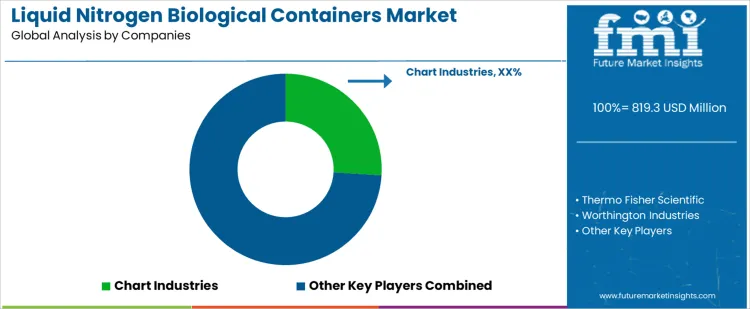
Liquid nitrogen biological container selection starts with storage protocol design and sample risk classification rather than catalog comparison. Biobanks, fertility centers, and research labs define capacity bands, access frequency, evaporation tolerance, and monitoring approach before naming equipment. Chart Industries, Thermo Fisher Scientific, Worthington Industries, Taylor Wharton, MVE compete inside those planning exercises. Once a vessel family enters operating procedures, alarm settings, handling tools, and refill routines align around it. Chart Industries and MVE focus on large capacity storage systems with integrated racks. Thermo Fisher Scientific links containers with monitoring and inventory workflows. Worthington Industries and Taylor Wharton supply a broad range of transport and storage dewars. Change introduces revalidation and retraining, which keeps installed bases stable across many years.
Competitive outcomes follow safety record, thermal performance, and service reach rather than headline capacity figures. Laboratory managers review static loss rates, neck tube design, lid insulation, and handling ergonomics during evaluation. Logistics teams value consistent dimensions and accessory compatibility across fleets. Long term programs favor suppliers that support refurbishment and spare parts over long lifecycles. Chart Industries benefits from scale manufacturing and cryogenic engineering depth. MVE holds positions where high density storage systems dominate. Thermo Fisher Scientific secures accounts through integrated laboratory equipment supply relationships. Worthington Industries and Taylor Wharton compete in transport and mid volume storage segments. Market positions vary by application type, regulatory oversight, and institutional risk policies.
Key Players in the Liquid Nitrogen Biological Containers Market
- Chart Industries
- Thermo Fisher Scientific
- Worthington Industries
- Taylor-Wharton
- MVE Biological
- Others
Scope of the Report
| Items | Values |
|---|---|
| Quantitative Units (2026) | USD Million |
| Product Type | Cryogenic storage tanks; Portable dewars; Monitoring & accessories |
| Application | Biobanking; IVF & fertility; Research labs |
| End User | Direct OEM sales; Distributors; Service contracts |
| Region | Asia Pacific; Europe; North America; Latin America; Middle East & Africa |
| Countries Covered | United States, Canada, Mexico, Germany, United Kingdom, France, Italy, Spain, Nordic, BENELUX, China, Japan, South Korea, India, Australia & New Zealand, ASEAN, Brazil, Chile, Saudi Arabia, Turkey, South Africa, Rest of regions |
| Key Companies Profiled | Chart Industries; Thermo Fisher Scientific; Worthington Industries; Taylor Wharton; MVE Biological |
| Additional Attributes | Dollar by sales by product and application, installed base by facility type, nitrogen consumption rates, refurbishment and requalification cycles, transport versus static storage mix, alarm and monitoring penetration, audit and compliance driven replacement, service and uptime metrics, logistics and refill network coverage |
Liquid Nitrogen Biological Containers Market Segmentation
Product Type:
- Cryogenic storage tanks
- Portable dewars
- Monitoring & accessories
Application:
- Biobanking
- IVF & fertility
- Research labs
End User:
- Direct OEM sales
- Distributors
- Service contracts
Region:
- Asia Pacific
- China
- Japan
- South Korea
- India
- Australia & New Zealand
- ASEAN
- Rest of Asia Pacific
- Europe
- Germany
- United Kingdom
- France
- Italy
- Spain
- Nordic
- BENELUX
- Rest of Europe
- North America
- United States
- Canada
- Mexico
- Latin America
- Brazil
- Chile
- Rest of Latin America
- Middle East & Africa
- Kingdom of Saudi Arabia
- Other GCC Countries
- Turkey
- South Africa
- Other African Union
- Rest of Middle East & Africa
Bibliography
- World Health Organization. (2024). WHO laboratory biosafety manual (4th ed., updated online edition). World Health Organization.
- European Medicines Agency. (2024). Guideline on human cell‑based medicinal products (current version). European Medicines Agency.
- International Air Transport Association. (2024). Dangerous Goods Regulations: Packing instructions for refrigerated liquid nitrogen and biological substances (66th ed.). IATA.
Frequently Asked Questions
How big is the liquid nitrogen biological containers market in 2026?
The global liquid nitrogen biological containers market is estimated to be valued at USD 819.3 million in 2026.
What will be the size of liquid nitrogen biological containers market in 2036?
The market size for the liquid nitrogen biological containers market is projected to reach USD 1,537.9 million by 2036.
How much will be the liquid nitrogen biological containers market growth between 2026 and 2036?
The liquid nitrogen biological containers market is expected to grow at a 6.5% CAGR between 2026 and 2036.
What are the key product types in the liquid nitrogen biological containers market?
The key product types in liquid nitrogen biological containers market are cryogenic storage tanks, portable dewars and monitoring & accessories.
Which application segment to contribute significant share in the liquid nitrogen biological containers market in 2026?
In terms of application, biobanking segment to command 47.0% share in the liquid nitrogen biological containers market in 2026.
Preview the report firsthand - request a free sample
Get SampleGet the brochure for pricing and purchase details.
Get PDFTable of Content
- Executive Summary
- Global Market Outlook
- Demand-side Trends
- Supply-side Trends
- Technology Roadmap Analysis
- Analysis and Recommendations
- Market Overview
- Market Coverage / Taxonomy
- Market Definition / Scope / Limitations
- Market Background
- Market Dynamics
- Drivers
- Restraints
- Opportunity
- Trends
- Scenario Forecast
- Demand in Optimistic Scenario
- Demand in Likely Scenario
- Demand in Conservative Scenario
- Opportunity Map Analysis
- Product Life Cycle Analysis
- Supply Chain Analysis
- Investment Feasibility Matrix
- Value Chain Analysis
- PESTLE and Porter’s Analysis
- Regulatory Landscape
- Regional Parent Market Outlook
- Production and Consumption Statistics
- Import and Export Statistics
- Market Dynamics
- Global Market Analysis 2021 to 2025 and Forecast, 2026 to 2036
- Historical Market Size Value (USD Million) Analysis, 2021 to 2025
- Current and Future Market Size Value (USD Million) Projections, 2026 to 2036
- Y-o-Y Growth Trend Analysis
- Absolute $ Opportunity Analysis
- Global Market Pricing Analysis 2021 to 2025 and Forecast 2026 to 2036
- Global Market Analysis 2021 to 2025 and Forecast 2026 to 2036, By Product Type
- Introduction / Key Findings
- Historical Market Size Value (USD Million) Analysis By Product Type , 2021 to 2025
- Current and Future Market Size Value (USD Million) Analysis and Forecast By Product Type , 2026 to 2036
- Cryogenic storage tanks
- Portable dewars
- Monitoring & accessories
- Cryogenic storage tanks
- Y-o-Y Growth Trend Analysis By Product Type , 2021 to 2025
- Absolute $ Opportunity Analysis By Product Type , 2026 to 2036
- Global Market Analysis 2021 to 2025 and Forecast 2026 to 2036, By Application
- Introduction / Key Findings
- Historical Market Size Value (USD Million) Analysis By Application, 2021 to 2025
- Current and Future Market Size Value (USD Million) Analysis and Forecast By Application, 2026 to 2036
- Biobanking
- IVF & fertility
- Research labs
- Biobanking
- Y-o-Y Growth Trend Analysis By Application, 2021 to 2025
- Absolute $ Opportunity Analysis By Application, 2026 to 2036
- Global Market Analysis 2021 to 2025 and Forecast 2026 to 2036, By End User
- Introduction / Key Findings
- Historical Market Size Value (USD Million) Analysis By End User, 2021 to 2025
- Current and Future Market Size Value (USD Million) Analysis and Forecast By End User, 2026 to 2036
- Direct OEM sales
- Distributors
- Service contracts
- Direct OEM sales
- Y-o-Y Growth Trend Analysis By End User, 2021 to 2025
- Absolute $ Opportunity Analysis By End User, 2026 to 2036
- Global Market Analysis 2021 to 2025 and Forecast 2026 to 2036, By Region
- Introduction
- Historical Market Size Value (USD Million) Analysis By Region, 2021 to 2025
- Current Market Size Value (USD Million) Analysis and Forecast By Region, 2026 to 2036
- North America
- Latin America
- Western Europe
- Eastern Europe
- East Asia
- South Asia and Pacific
- Middle East & Africa
- Market Attractiveness Analysis By Region
- North America Market Analysis 2021 to 2025 and Forecast 2026 to 2036, By Country
- Historical Market Size Value (USD Million) Trend Analysis By Market Taxonomy, 2021 to 2025
- Market Size Value (USD Million) Forecast By Market Taxonomy, 2026 to 2036
- By Country
- USA
- Canada
- Mexico
- By Product Type
- By Application
- By End User
- By Country
- Market Attractiveness Analysis
- By Country
- By Product Type
- By Application
- By End User
- Key Takeaways
- Latin America Market Analysis 2021 to 2025 and Forecast 2026 to 2036, By Country
- Historical Market Size Value (USD Million) Trend Analysis By Market Taxonomy, 2021 to 2025
- Market Size Value (USD Million) Forecast By Market Taxonomy, 2026 to 2036
- By Country
- Brazil
- Chile
- Rest of Latin America
- By Product Type
- By Application
- By End User
- By Country
- Market Attractiveness Analysis
- By Country
- By Product Type
- By Application
- By End User
- Key Takeaways
- Western Europe Market Analysis 2021 to 2025 and Forecast 2026 to 2036, By Country
- Historical Market Size Value (USD Million) Trend Analysis By Market Taxonomy, 2021 to 2025
- Market Size Value (USD Million) Forecast By Market Taxonomy, 2026 to 2036
- By Country
- Germany
- UK
- Italy
- Spain
- France
- Nordic
- BENELUX
- Rest of Western Europe
- By Product Type
- By Application
- By End User
- By Country
- Market Attractiveness Analysis
- By Country
- By Product Type
- By Application
- By End User
- Key Takeaways
- Eastern Europe Market Analysis 2021 to 2025 and Forecast 2026 to 2036, By Country
- Historical Market Size Value (USD Million) Trend Analysis By Market Taxonomy, 2021 to 2025
- Market Size Value (USD Million) Forecast By Market Taxonomy, 2026 to 2036
- By Country
- Russia
- Poland
- Hungary
- Balkan & Baltic
- Rest of Eastern Europe
- By Product Type
- By Application
- By End User
- By Country
- Market Attractiveness Analysis
- By Country
- By Product Type
- By Application
- By End User
- Key Takeaways
- East Asia Market Analysis 2021 to 2025 and Forecast 2026 to 2036, By Country
- Historical Market Size Value (USD Million) Trend Analysis By Market Taxonomy, 2021 to 2025
- Market Size Value (USD Million) Forecast By Market Taxonomy, 2026 to 2036
- By Country
- China
- Japan
- South Korea
- By Product Type
- By Application
- By End User
- By Country
- Market Attractiveness Analysis
- By Country
- By Product Type
- By Application
- By End User
- Key Takeaways
- South Asia and Pacific Market Analysis 2021 to 2025 and Forecast 2026 to 2036, By Country
- Historical Market Size Value (USD Million) Trend Analysis By Market Taxonomy, 2021 to 2025
- Market Size Value (USD Million) Forecast By Market Taxonomy, 2026 to 2036
- By Country
- India
- ASEAN
- Australia & New Zealand
- Rest of South Asia and Pacific
- By Product Type
- By Application
- By End User
- By Country
- Market Attractiveness Analysis
- By Country
- By Product Type
- By Application
- By End User
- Key Takeaways
- Middle East & Africa Market Analysis 2021 to 2025 and Forecast 2026 to 2036, By Country
- Historical Market Size Value (USD Million) Trend Analysis By Market Taxonomy, 2021 to 2025
- Market Size Value (USD Million) Forecast By Market Taxonomy, 2026 to 2036
- By Country
- Kingdom of Saudi Arabia
- Other GCC Countries
- Turkiye
- South Africa
- Other African Union
- Rest of Middle East & Africa
- By Product Type
- By Application
- By End User
- By Country
- Market Attractiveness Analysis
- By Country
- By Product Type
- By Application
- By End User
- Key Takeaways
- Key Countries Market Analysis
- USA
- Pricing Analysis
- Market Share Analysis, 2025
- By Product Type
- By Application
- By End User
- Canada
- Pricing Analysis
- Market Share Analysis, 2025
- By Product Type
- By Application
- By End User
- Mexico
- Pricing Analysis
- Market Share Analysis, 2025
- By Product Type
- By Application
- By End User
- Brazil
- Pricing Analysis
- Market Share Analysis, 2025
- By Product Type
- By Application
- By End User
- Chile
- Pricing Analysis
- Market Share Analysis, 2025
- By Product Type
- By Application
- By End User
- Germany
- Pricing Analysis
- Market Share Analysis, 2025
- By Product Type
- By Application
- By End User
- UK
- Pricing Analysis
- Market Share Analysis, 2025
- By Product Type
- By Application
- By End User
- Italy
- Pricing Analysis
- Market Share Analysis, 2025
- By Product Type
- By Application
- By End User
- Spain
- Pricing Analysis
- Market Share Analysis, 2025
- By Product Type
- By Application
- By End User
- France
- Pricing Analysis
- Market Share Analysis, 2025
- By Product Type
- By Application
- By End User
- India
- Pricing Analysis
- Market Share Analysis, 2025
- By Product Type
- By Application
- By End User
- ASEAN
- Pricing Analysis
- Market Share Analysis, 2025
- By Product Type
- By Application
- By End User
- Australia & New Zealand
- Pricing Analysis
- Market Share Analysis, 2025
- By Product Type
- By Application
- By End User
- China
- Pricing Analysis
- Market Share Analysis, 2025
- By Product Type
- By Application
- By End User
- Japan
- Pricing Analysis
- Market Share Analysis, 2025
- By Product Type
- By Application
- By End User
- South Korea
- Pricing Analysis
- Market Share Analysis, 2025
- By Product Type
- By Application
- By End User
- Russia
- Pricing Analysis
- Market Share Analysis, 2025
- By Product Type
- By Application
- By End User
- Poland
- Pricing Analysis
- Market Share Analysis, 2025
- By Product Type
- By Application
- By End User
- Hungary
- Pricing Analysis
- Market Share Analysis, 2025
- By Product Type
- By Application
- By End User
- Kingdom of Saudi Arabia
- Pricing Analysis
- Market Share Analysis, 2025
- By Product Type
- By Application
- By End User
- Turkiye
- Pricing Analysis
- Market Share Analysis, 2025
- By Product Type
- By Application
- By End User
- South Africa
- Pricing Analysis
- Market Share Analysis, 2025
- By Product Type
- By Application
- By End User
- USA
- Market Structure Analysis
- Competition Dashboard
- Competition Benchmarking
- Market Share Analysis of Top Players
- By Regional
- By Product Type
- By Application
- By End User
- Competition Analysis
- Competition Deep Dive
- Chart Industries
- Overview
- Product Portfolio
- Profitability by Market Segments (Product/Age /Sales Channel/Region)
- Sales Footprint
- Strategy Overview
- Marketing Strategy
- Product Strategy
- Channel Strategy
- Thermo Fisher Scientific
- Worthington Industries
- Taylor-Wharton
- MVE Biological
- Others
- Chart Industries
- Competition Deep Dive
- Assumptions & Acronyms Used
- Research Methodology


