

- Market Size (2026)
- USD 208.4 Mn
- Forecast (2036)
- USD 467 Mn
- CAGR (2026 to 2036)
- 8.4%
High-Throughput Food Allergen Screening Test Instruments Market Size, Market Forecast and Outlook By FMI
High-throughput food allergen screening test instruments market was valued at USD 192.3 million in 2025. Industry valuation is estimated to reach USD 208.4 million in 2026 at a CAGR of 8.4% during the forecast period. Cumulative category buildup takes total valuation to USD 467 million by 2036 as food manufacturers and contract laboratories treat allergen screening as a routine release, sanitation, and label-verification task rather than an occasional bench check.
Summary of High-Throughput Food Allergen Screening Test Instruments Market
- The market is forecast to reach USD 467 million by 2036.
- The market is expected to grow at a CAGR of 8% from 2026 to 2036.
- The market was estimated at USD 192.3 million in 2025.
- The forecast period represents an incremental opportunity of USD 258.6 million.
- High-throughput allergen screening instruments are used for routine workflows such as release testing, sanitation checks, and label verification.
- PCR-based systems dominate due to strong compatibility with high-volume, plate-based laboratory workflows.
- 96-well throughput formats remain the most widely used due to their balance between efficiency and validation familiarity.
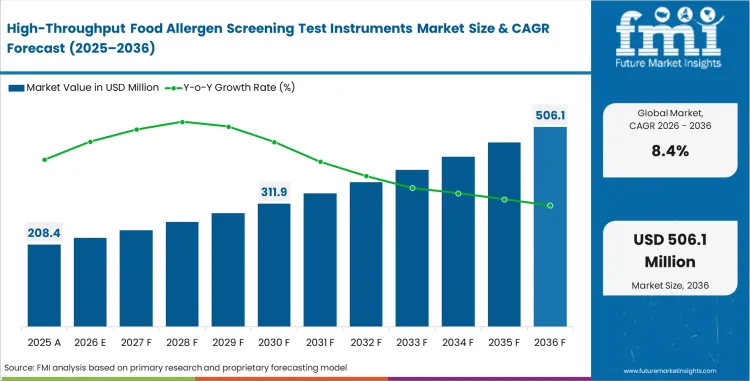
Key Takeaways, Market Size, and Forecast
- High-Throughput Food Allergen Screening Test Instruments Market is projected to grow from USD 208.4 million in 2026 to USD 467 million by 2036, at a CAGR of 8.0%.
- The high-throughput food allergen screening test instruments market was valued at USD 192.3 million in 2025.
- By 2036, the High-Throughput Food Allergen Screening Test Instruments Market is expected to be worth USD 467 million.
- From 2026 to 2036, the market is anticipated to expand at a CAGR of 8.0%.
- The market is predicted to create an incremental opportunity of USD 258.6 million between 2026 and 2036.
- In 2026, PCR is expected to account for 34.0% of the technology segment.
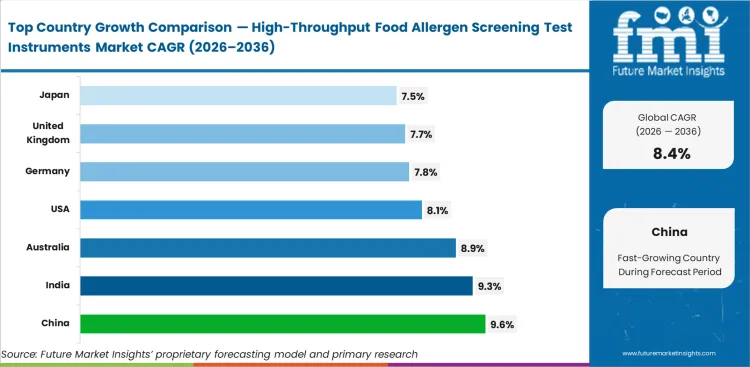
- China (9.6%) and India (9.3%) are projected to be two of the fastest growing markets.
High-Throughput Food Allergen Screening Test Instruments Market Key Takeaways
| Metric | Value |
|---|---|
| Market Size (2025) | USD 192.3 million |
| Market Size (2026) | USD 208.4 million |
| Market Size (2036) | USD 467 million |
| CAGR (2026-2036) | 8% |
| Incremental Opportunity | USD 258.6 million |
| Leading Technology | PCR (34%) |
| Leading Instrument Type | PCR Systems (32%) |
| Leading Throughput Format | 96-Well (58%) |
| Leading Sample Matrix | Processed Foods (39%) |
| Leading Application | Finished Foods (34%) |
| Leading End User | Food Manufacturers (43%) |
| Leading Automation Level | Semi-Automated (46%) |
Source: Future Market Insights (FMI) analysis and primary research
Quality teams in food plants are no longer choosing benches one method at a time. Day-to-day selection now centers on whether a setup can handle extraction, plate work, result review, and follow-up confirmation without slowing batch release or creating another manual checkpoint, and that is pulling this category closer to food allergen testing as a workflow decision instead of a single-device purchase. Faster run speed does not decide the purchase on its own. Laboratories first want repeatable prep, cleaner handoffs between shifts, and a result trail that can stand up during internal review.
Wider bench adoption becomes easier once a laboratory standardizes extraction, plate handling, and result interpretation across sites. Quality teams trigger that condition when allergen checks start sitting beside broader food diagnostics routines instead of staying in a separate corner of the lab. After that point, adding another instrument or another assay places less strain on training, scheduling, and result review.
China is expected to record 9.6% CAGR through 2036 as larger packaged-food plants formalize in-house allergen screening. India follows at 9.3%, helped by wider bench adoption in branded food production. Australia is likely to post 8.9% CAGR, while the United States reaches 8.1% as mature laboratories keep refining release workflows. Germany stands at 7.8%, the United Kingdom at 7.7%, and Japan at 7.5%. Countries with closer alignment between routine testing and laboratory information systems usually add capacity with less disruption to daily lab timing.
Segmental Analysis
Key Facts About Segments
- Routine allergen screening workflows keep PCR at the forefront, with 34% share projected in 2026. Its compatibility with high-volume, plate-based testing supports consistent laboratory use.
- Established laboratory workflows position PCR Systems as the leading instrument type, capturing 32% share in 2026. Their ability to handle repeat screening without adding bench complexity reinforces adoption.
- Balanced throughput and operational familiarity sustain 96-Well formats as the dominant choice, accounting for 58% share in 2026. They align well with existing validation and handling practices.
- Complex food formulations drive Processed Foods as the leading sample matrix, with 39% share expected in 2026. Higher analytical difficulty and label risk increase testing frequency.
- Final product verification keeps Finished Foods as the top application, holding 34% share in 2026. Proximity to shipment and labeling risk strengthens its importance.
- Continuous in-house testing demand positions Food Manufacturers as the leading end user, with 43% share projected in 2026. Daily production cycles generate consistent sample volumes.
- Operational flexibility maintains Semi-Automated systems as the preferred automation level, capturing 46% share in 2026. They improve efficiency while preserving operator control.
High-Throughput Food Allergen Screening Test Instruments Market Analysis by Technology
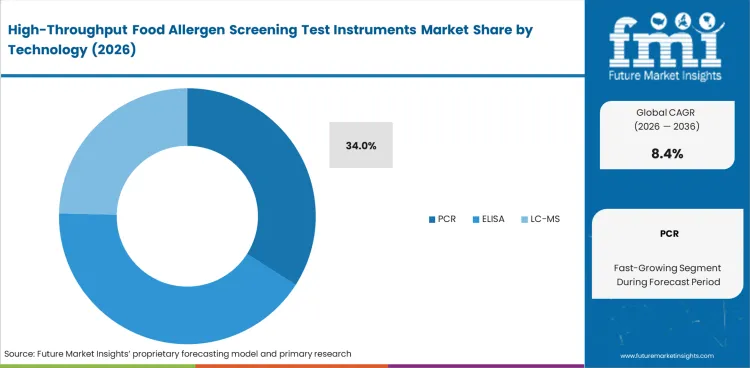
PCR is expected to account for 34% share in 2026 because it fits routine allergen screening across mixed food matrices with less bench disruption than many alternatives. Laboratories working with processed foods need a method that can handle repeated runs, stay manageable during result review, and align with the plate-based logic already familiar from real-time pcr systems. ELISA keeps a firm place in established screening programs, while LC-MS becomes more relevant when deeper follow-up work is required. Digital PCR adds technical precision, yet routine food testing still leans toward methods that match existing extraction, plate handling, and interpretation habits. Laboratories that move toward a technically richer platform without considering daily bench practicality often create more review burden than their teams can comfortably manage.
- Matrix fit: PCR works across raw materials, processed foods, and environmental checks with less disruption to day-to-day laboratory routines.
- Run discipline: Plate-based cycling and software-led interpretation help teams manage review time more effectively when sample loads rise.
- Expansion logic: Adding new allergen targets becomes easier when the chosen method already fits familiar extraction and reporting workflows.
High-Throughput Food Allergen Screening Test Instruments Market Analysis by Instrument Type
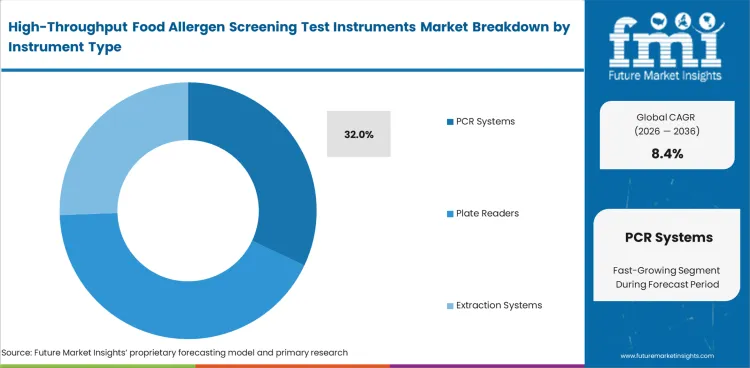
PCR Systems lead this segment because many laboratories build their routine allergen workflow around instruments that can handle repeat screening without adding another layer of bench complexity. By 2026, PCR Systems are projected to contribute 32% of total market share. Position at that level reflects their central role in day-to-day screening, especially in laboratories already comfortable with the workflow logic used in qpcr instruments. Plate Readers remain important where ELISA routines are well established, while Extraction Systems gain attention when prep consistency creates more pressure than detection itself. Mass Spectrometers matter most where broader confirmatory work becomes part of normal laboratory planning. A platform with weak assay compatibility may look workable at first, yet it usually adds slower validation work and more complicated review later.
- Qualification ease: PCR Systems make method transfer easier for laboratories already trained on cycle-based and plate-based workflows.
- Bench capacity: Instrument value rises when recurring sample volumes can be handled without creating another manual checkpoint.
- Method reach: Wider assay compatibility helps suppliers stay relevant as laboratories increase the number of allergens under review.
High-Throughput Food Allergen Screening Test Instruments Market Analysis by Throughput Format
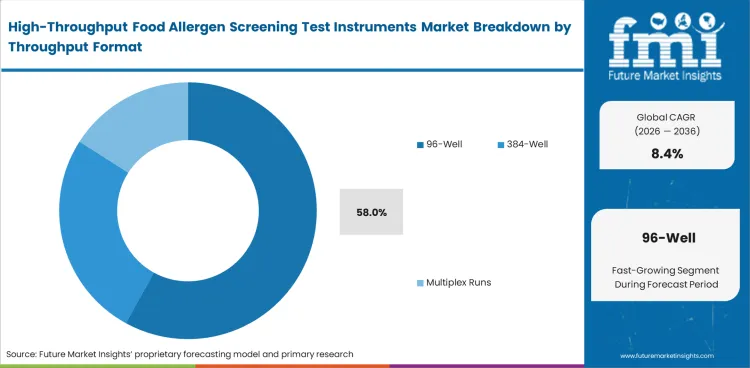
Routine allergen screening depends on more than raw sample volume. Laboratories also need a format that can keep pace with extraction timing, plate setup, result review, and release scheduling through an ordinary working day, which is why 96-Well remains the preferred choice for many sites. It is projected to represent 58% of the market in 2026 because it gives laboratories a workable balance between throughput, validation familiarity, and bench handling control, especially in settings already moving closer to broader lab automation routines. 384-Well options suit larger operations with tighter workflow discipline, while Multiplex Runs appeal where broader analyte coverage matters more than bench familiarity. Batch Benchtop formats still serve smaller operations and lower-volume laboratories. Moving too early toward denser formats often replaces practical bench efficiency with theoretical output that everyday staffing cannot fully capture.
- Handling rhythm: 96-Well benches match common loading and review habits, reducing avoidable pauses during repeated runs.
- Validation comfort: Food laboratories prefer formats that fit existing SOPs and reduce the need for broad retraining.
- Scale control: Higher-density formats work best after staffing, sample prep, and review discipline are already in place.
High-Throughput Food Allergen Screening Test Instruments Market Analysis by Sample Matrix
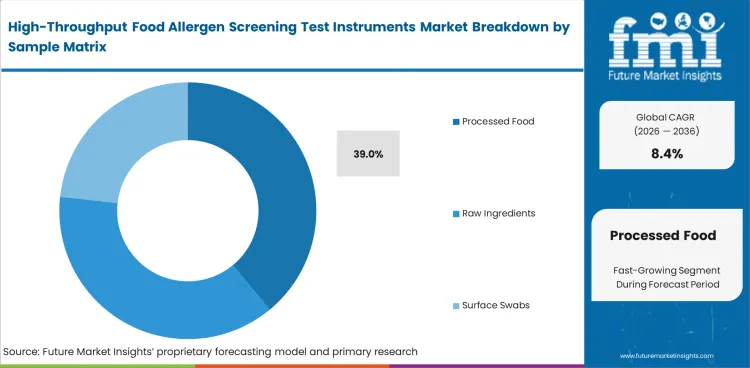
Processed foods keep laboratories under the greatest analytical pressure because ingredients, heat treatment, texture variation, and cross-contact exposure make screening more difficult than it is for a cleaner raw-material sample. Raw Ingredients remain important for supplier control, while Surface Swabs and Rinse Water support sanitation and changeover verification. Processed Foods are expected to make up 39% of the market in 2026, reflecting how often finished formulations create the hardest bench work and the highest label exposure, particularly in settings that also rely on a service laboratory for overflow or confirmation. Sample complexity matters more here than sample count alone. Laboratories that underestimate matrix difficulty often end up with extra prep steps, repeat runs, or outside confirmation they could have avoided with a better bench setup.
- Matrix burden: Processed foods require benches that can handle inhibitor-heavy and formulation-rich samples without unstable interpretation.
- Release exposure: Final packaged products carry the clearest label risk, so laboratories give them more regular bench time.
- Recheck pressure: Poor matrix handling increases repeat testing and adds extra strain to contract laboratories serving branded food producers.
High-Throughput Food Allergen Screening Test Instruments Market Analysis by Application
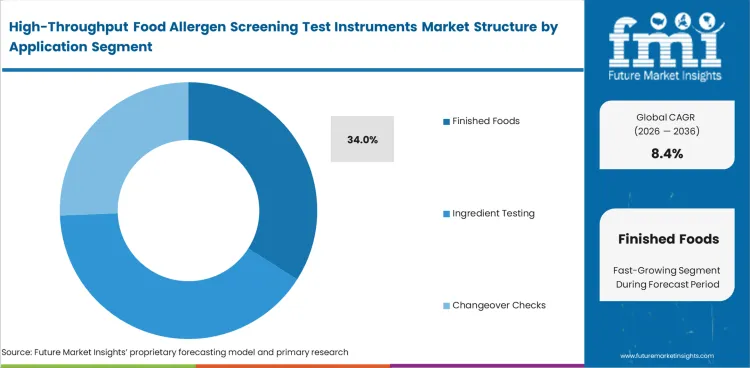
Release decisions carry more commercial weight than most other allergen checks, which keeps Finished Foods at the center of instrument use. Ingredient Testing and Changeover Checks remain necessary, yet final product screening sits closest to the point where a labeling error becomes a shipment hold, rework event, or recall exposure. Label Claims also stay relevant, especially where clean allergen communication supports premium positioning and where analytical laboratory service support is used for overflow or secondary review. Finished Foods are anticipated to represent 34% of the market in 2026. Priority at that level reflects the importance of final-release confidence rather than a simple preference for end-product sampling. Leaving final-release screening too late in the production cycle can turn a small analytical delay into a broader warehouse and scheduling problem.
- Release timing: Finished-food screening sits closest to shipment approval, so result delays carry a wider operating cost.
- Label exposure: Final packs carry the clearest legal and brand consequence when allergen declarations do not match product content.
- Workflow order: Application value rises when testing is timed early enough to support release decisions without creating storage backlogs.
High-Throughput Food Allergen Screening Test Instruments Market Analysis by End User
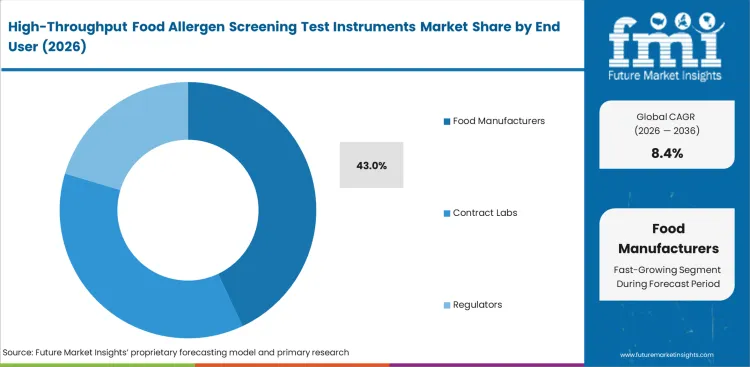
Food Manufacturers are forecast to account for 43% share in 2026 because routine sample ownership remains concentrated inside plant-linked laboratories. In-house teams handle recurring checks tied to supplier control, line clearance, final release, and internal verification, which gives manufacturers a steadier need for dedicated screening capacity than most other user groups. Contract Laboratories still play an important role where smaller processors outsource work or need extra confirmation capacity, while Regulators and Research Labs contribute more selectively. Many manufacturer-linked laboratories also look at adjacent benchtop automation options when trying to reduce manual handling without rebuilding the whole room. Test frequency and workflow immediacy explain why manufacturers stay ahead. User groups without direct exposure to production timing can tolerate longer turnarounds. Plant-linked laboratories usually cannot.
- Sample ownership: Food manufacturers generate recurring sample flow from daily operations rather than occasional project work.
- Turnaround pressure: Plant-linked laboratories place more value on benches that support same-cycle review and release decisions.
- Capacity choice: Contract laboratories win when they can absorb overflow or specialized confirmation without slowing standard turnaround.
High-Throughput Food Allergen Screening Test Instruments Market Analysis by Automation Level
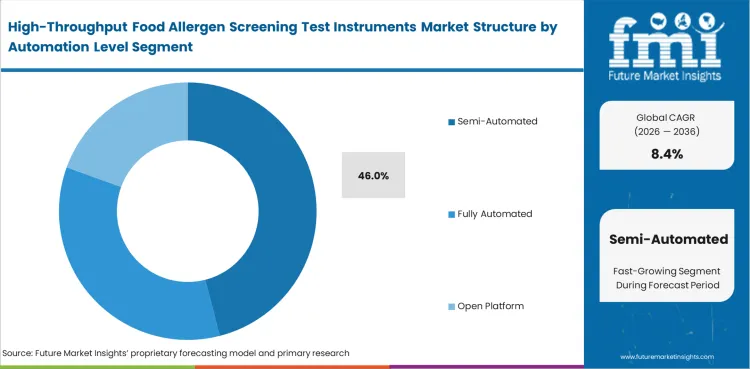
Bench automation creates the most value when it removes repetitive handling without forcing the laboratory into a working model it cannot maintain. Many food laboratories want faster extraction, cleaner result capture, and steadier run timing, yet they still want direct operator control over loading, review, and exception handling. Semi-Automated systems lead because they answer that need better than either a fully manual or fully integrated setup, and they also sit comfortably beside related molecular diagnostics workflows where targeted automation is already familiar. Market estimates place Semi-Automated systems at 46% share in 2026. Fully Automated options remain attractive for larger and more standardized environments, while Open Platform and Standalone setups hold value where method flexibility or budget discipline outweighs full workflow integration. A laboratory can usually absorb targeted automation faster than a full-room redesign, especially where staffing patterns and validation routines are already set.
- Operator control: Semi-Automated benches remove repetitive steps while still leaving room for sample judgment and review.
- Budget discipline: Many laboratories prefer targeted automation that improves throughput without requiring a full room rebuild.
- Validation ease: Partial automation usually fits existing SOPs with fewer changes to daily bench practice.
Regional Analysis
Key Facts of Country
- China is witnessing a steady expansion among the countries highlighted, with high-throughput food allergen screening test instruments expected to expand at a CAGR of 9.6% through 2036.
- Wider bench adoption in branded food production keeps India close behind, and the market there is estimated to rise at 9.3% CAGR during the forecast period.
- Strong compliance standards and demand for reliable testing workflows support Australia, where growth is projected to reach 8.9% CAGR over the study period.
- Mature laboratories in the United States continue refining release workflows, placing the market on an anticipated 8.1% CAGR path by 2036.
- Disciplined laboratory practice keeps Germany at a likely 7.8% CAGR during the assessment period.
- Labeling compliance and reporting efficiency support the United Kingdom, where demand is forecast to advance at 7.7% CAGR through 2036.
- Japan records the most moderate pace among the countries highlighted, with the market expected to grow at 7.5% CAGR over the forecast period.
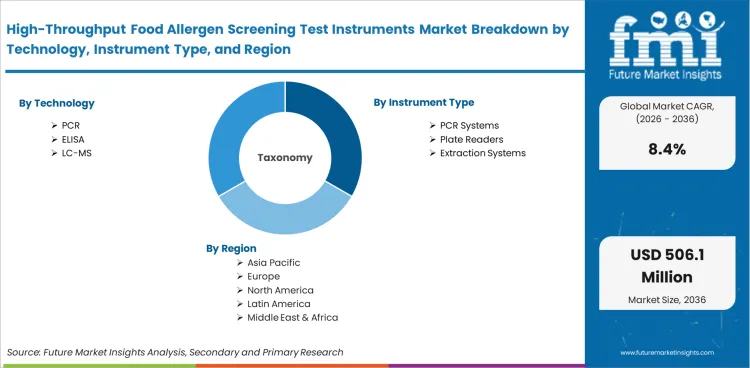
Based on the regional analysis, the High-Throughput Food Allergen Screening Test Instruments Market is segmented into North America, Latin America, Europe, East Asia, South Asia and Pacific, and Middle East and Africa across 40 plus countries.
.webp "Top Country Growth Comparison High Throughput Food Allergen Screening Test Instruments Market Cagr (2026 2036)")
| Country | CAGR (2026 to 2036) |
|---|---|
| China | 9.6% |
| India | 9.3% |
| Australia | 8.9% |
| United States | 8.1% |
| Germany | 7.8% |
| United Kingdom | 7.7% |
| Japan | 7.5% |
Source: Future Market Insights (FMI) analysis and primary research
North America High-Throughput Food Allergen Screening Test Instruments Market Analysis
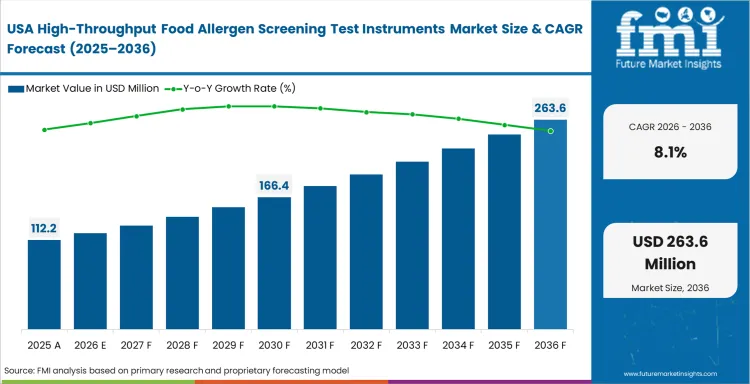
North America remains the reference point for routine allergen bench discipline because release timing, internal documentation, and contract-laboratory expectations are already tied closely to food quality practice. Laboratories here rarely need to be convinced that allergen screening belongs inside daily operations. Buying discussions usually center on how far automation can go without adding review burden or creating a bench format that site teams cannot support consistently. Method familiarity, software clarity, service response, and fit with existing result-control routines carry more weight than headline technical claims alone. Closer alignment with digital quality handling also makes this region more receptive to setups that borrow logic from molecular assay environments, provided bench use remains practical for ordinary food testing conditions.
- United States: Packaged-food plants in the United States operate under constant label exposure, and that keeps allergen screening close to routine release decisions rather than occasional exception testing. Larger laboratories already have an installed base, so selection often centers on replacement quality, method compatibility, and software ease more than first-time installation. Industry outlook in the United States points to 8.1% CAGR through 2036. Mature bench use does not weaken category relevance here. It makes the country more selective, with preference moving toward systems that cut repeat work, tighten review control, and fit established validation habits.
FMI's report includes Canada and Mexico. Food laboratories across those countries add weight to North America through export-linked testing, wider private-label participation, and a stronger preference for methods that can move between internal and outsourced bench environments without lengthy retraining.
Europe High-Throughput Food Allergen Screening Test Instruments Market Analysis
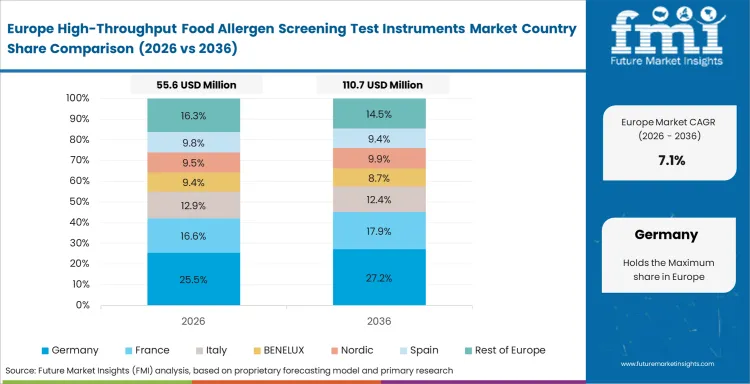
Europe keeps category expansion steady because food labeling discipline, audit culture, and cross-border supply exposure leave little room for weak result handling. Laboratories across the region usually want bench setups that produce dependable records, stay manageable under mixed sample loads, and support repeatable interpretation across shifts. Speed matters, but it does not settle the decision on its own. Review quality, method comfort, and operator consistency carry equal weight in most laboratory settings. Categories such as molecular spectroscopy remain relevant here when laboratories consider how far to widen analytical capability without making routine bench work harder to run.
- Germany: Germany is likely to post 7.8% CAGR in this sector through 2036. Food manufacturing depth keeps German laboratories close to recurring allergen checks across ingredients, finished goods, and sanitation-related samples. Bench selection here usually favors platforms that fit disciplined method control and reduce avoidable reruns across mixed product categories. Pace stays measured because many larger laboratories already have core testing capacity in place, yet replacement demand and workflow refinement remain active where plants want cleaner release timing and steadier documentation.
- United Kingdom: Label clarity and food business compliance keep allergen testing close to daily operating practice in the United Kingdom. Laboratories serving branded packaged foods need methods that stay reliable across varying sample loads and do not create extra interpretation burden for already busy teams. Market outlook in the United Kingdom is expected to register 7.7% CAGR through 2036. Category progress here reflects a practical pattern: bench upgrades move ahead when they tighten reporting discipline and shorten the gap between sample receipt and final review.
FMI's report includes France, Italy, Spain, Benelux, and Nordic countries. Food processing and contract-laboratory activity across those areas keep Europe commercially important, especially where mixed product portfolios make method reliability more valuable than headline throughput alone.
Asia Pacific High-Throughput Food Allergen Screening Test Instruments Market Analysis
Asia Pacific carries the strongest upside because bench formalization is widening across large branded-food operations, export-oriented processing, and independent contract laboratories handling more complex sample volumes. Installed-base maturity still varies sharply from one country to another, which creates very different buying conversations inside the same region. Some laboratories are selecting their first high-throughput setup, while others are refining extraction consistency, bench flow, and result handling after earlier adoption. Adjacent analytical categories such as process spectroscopy matter here less as direct substitutes and more as signs that laboratories are becoming more comfortable with instrument-led food analysis.
- China: China is forecast to register 9.6% CAGR in this category through 2036. Packaged-food scale and wider formalization of in-house testing give China the fastest pace among the countries covered in this study. Large plants are bringing more screening inside the site, which lifts interest in benches that can handle routine sample volume without making review discipline harder to manage. Breadth of adoption stands out as much as pace, because a wider range of food operations now treats higher-throughput allergen screening as part of ordinary quality work.
- India: Branded food production in India is widening the need for dependable allergen checks across ingredients, finished goods, and sanitation-linked verification. Laboratories often prefer systems that improve bench throughput without forcing a full redesign of staffing, training, and result review. A CAGR of 9.3% is expected for the India category through 2036. Room for adoption remains meaningful because many laboratories are still moving from narrower testing routines toward more formal and repeatable bench practice.
- Japan: Japan is expected to record 7.5% CAGR in the category during the forecast period. Method discipline and careful validation culture shape instrument selection in Japan. Laboratories here place strong weight on consistency, bench fit, and controlled implementation, which keeps adoption measured even when the technical case for upgrade is clear. Slower pace does not point to weak interest. Preference simply stays with low-disruption integration and stable result handling over quick bench turnover.
- Australia: Label-control discipline and mature food compliance practice keep allergen testing visible in Australian food operations. Laboratories usually want instruments that produce clean documentation and fit everyday lab timing rather than benches chosen only for maximum run speed. Australia is on a positive trend at 8.9% CAGR through 2036. Faster category expansion comes from a mix of established quality habits and continued need for reliable verification across packaged and branded food lines.
FMI's report includes South Korea, ASEAN countries, and New Zealand. Wider adoption across those countries depends less on one single trigger and more on how quickly laboratories can add capacity without stretching staffing, validation effort, or service support beyond what local operations can comfortably carry.
Competitive Aligners for Market Players
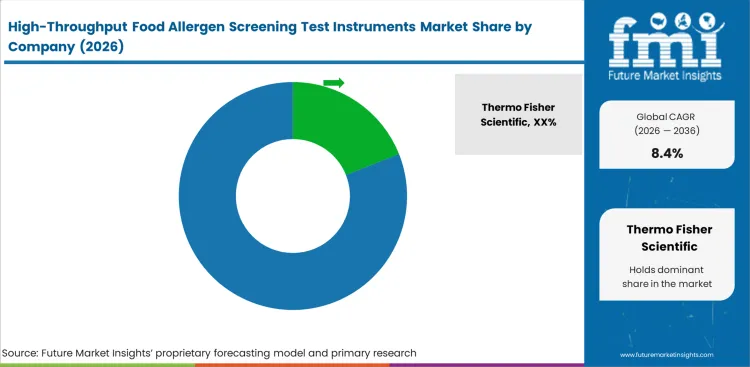
Competition in this category sits in the middle ground between concentration and fragmentation. Thermo Fisher Scientific, Hygiena, Bio-Rad Laboratories, QIAGEN, Bruker Corporation, Revvity, and Waters Corporation all have room to compete, yet laboratories do not choose among them on brand visibility alone. Bench fit, assay compatibility, reporting comfort, service response, and ease of validation decide more deals than headline technical claims. Food laboratories want instruments that reduce repeat work and review burden while still fitting existing SOPs. That is why adjacent categories such as automated molecular diagnostics matter more as workflow reference points than as direct substitutes.
Incumbents hold an edge when they can support both screening and follow-up work without forcing the laboratory to piece together too many disconnected steps. Thermo Fisher Scientific, QIAGEN, and Bio-Rad Laboratories benefit from broad method familiarity, while Hygiena is well placed where routine food safety bench practice matters more than wider laboratory portfolio breadth. Bruker Corporation and Waters Corporation gain attention when confirmation depth becomes part of the selection discussion, and Revvity remains relevant where microplate-based routines stay central. Challengers can still win, especially when they improve service coverage, shorten implementation time, or give laboratories a cleaner path between daily screening and adjacent biosensors or analytical workflows.
Laboratory buying power will keep suppliers from locking in easy advantage through 2036. Larger food producers and multi-site contract laboratories want method portability, manageable validation effort, and vendor support that does not weaken after installation. Preference like that limits how far any supplier can push a closed bench logic if it creates extra retraining or slow review habits. Category direction points toward more connected screening setups, broader follow-up capability, and steadier software-led result control. Suppliers that improve bench usability without overcomplicating daily work are better placed than those trying to sell technical breadth that the laboratory cannot absorb.
Key Players in High-Throughput Food Allergen Screening Test Instruments Market
- Thermo Fisher Scientific
- Hygiena
- Bio-Rad Laboratories
- QIAGEN
- Bruker Corporation
- Revvity
- Waters Corporation
Scope of the Report
| Metric | Value |
|---|---|
| Quantitative Units | USD 208.4 million to USD 467 million, at a CAGR of 8.4% |
| Market Definition | High-throughput food allergen screening test instruments include bench systems used to detect allergen presence across ingredients, finished foods, swabs, and rinse-related samples inside food testing operations. Scope covers instrument-led screening and follow-up confirmation workflows rather than outsourced testing service fees or clinical diagnostics. |
| Technology Segmentation | PCR, ELISA, LC-MS, Digital PCR |
| Instrument Type Segmentation | PCR Systems, Plate Readers, Extraction Systems, Mass Spectrometers |
| Throughput Format Segmentation | 96-Well, 384-Well, Multiplex Runs, Batch Benchtop |
| Sample Matrix Segmentation | Processed Foods, Raw Ingredients, Surface Swabs, Rinse Water |
| Application Segmentation | Finished Foods, Ingredient Testing, Changeover Checks, Label Claims |
| End User Segmentation | Food Manufacturers, Contract Labs, Regulators, Research Labs |
| Automation Level Segmentation | Semi-Automated, Fully Automated, Open Platform, Standalone |
| Regions Covered | North America, Latin America, Europe, East Asia, South Asia and Pacific, Middle East and Africa |
| Countries Covered | United States, China, India, Germany, United Kingdom, Japan, Australia, and 40 plus countries |
| Key Companies Profiled | Thermo Fisher Scientific, Hygiena, Bio-Rad Laboratories, QIAGEN, Bruker Corporation, Revvity, Waters Corporation |
| Forecast Period | 2026 to 2036 |
| Approach | FMI combined interviews with quality assurance heads, laboratory managers, and food safety leads. Baseline sizing anchored to installed benches, replacement timing, and workflow fit across PCR, ELISA, extraction, and LC-MS setups. Forecasts were checked against vendor participation, laboratory format mix, and adoption patterns across food manufacturers, contract laboratories, and public testing settings. |
Source: Future Market Insights (FMI) analysis and primary research
High-Throughput Food Allergen Screening Test Instruments Market Analysis by Segments
Technology:
- PCR
- ELISA
- LC-MS
- Digital PCR
Instrument Type:
- PCR Systems
- Plate Readers
- Extraction Systems
- Mass Spectrometers
Throughput Format:
- 96-Well
- 384-Well
- Multiplex Runs
- Batch Benchtop
Sample Matrix:
- Processed Foods
- Raw Ingredients
- Surface Swabs
- Rinse Water
Application:
- Finished Foods
- Ingredient Testing
- Changeover Checks
- Label Claims
End User:
- Food Manufacturers
- Contract Labs
- Regulators
- Research Labs
Automation Level:
- Semi-Automated
- Fully Automated
- Open Platform
- Standalone
Region:
- North America
- United States
- Europe
- Germany
- United Kingdom
- Asia Pacific
- China
- India
- Japan
- Australia
- Latin America
- Middle East and Africa
Bibliography
- USA Food and Drug Administration. (2025, March). Food Allergens/Gluten-Free Guidance Documents & Regulatory Information. USA Food and Drug Administration.
- USA Food and Drug Administration. (2025, March 26). Frequently Asked Questions: Food Allergen Labeling Guidance for Industry. USA Food and Drug Administrati
- USA Food and Drug Administration. (2026, March 11). Food Allergies. USA Food and Drug Administration.
- AOAC INTERNATIONAL. (2024, July 03). New Food Allergen Method Validation Guidelines Published. AOAC INTERNATIONAL.
- Food Standards Agency. (2025, March 14). Allergen Guidance for Food Businesses. Food Standards Agency.
This bibliography is provided for reader reference. The full FMI report contains the complete reference list with primary source documentation.
This Report Addresses
- Market intelligence to support strategic decision making across PCR systems, ELISA readers, extraction platforms, LC-MS benches, and semi-automated screening setups
- Market size estimation and 10-year revenue forecasts from 2026 to 2036, supported by installed-base modeling, replacement-cycle review, and workflow-fit analysis
- Growth opportunity mapping across Technology, Instrument Type, Throughput Format, Sample Matrix, Application, End User, and Automation Level, with emphasis on bench standardization and result-control discipline
- Segment and regional revenue forecasts covering PCR, 96-Well, Processed Foods, Finished Foods, Food Manufacturers, and Semi-Automated setups across food labeling and internal verification conditions
- Competition assessment including assay compatibility, software clarity, service response, validation comfort, and bench fit across routine food testing environments
- Product and capability tracking including real-time PCR systems, qPCR instruments, lab automation, next-generation mass spectrometer benches, and molecular diagnostics workflows
- Market access analysis covering allergen-labeling guidance, food business compliance needs, contract-laboratory participation, and in-house quality bench adoption
Market report delivery in PDF, Excel, PPT, and interactive dashboard formats for executive planning, quality planning, and operational benchmarking use
Frequently Asked Questions
How large is the High-Throughput Food Allergen Screening Test Instruments Market in 2026?
The market is expected to reach USD 208.4 million in 2026. This covers instruments used to test food for allergen traces at higher sample volumes in food plants and laboratories.
What will the High-Throughput Food Allergen Screening Test Instruments Market be worth by 2036?
The market is projected to reach USD 467 million by 2036. This points to wider use of allergen testing instruments in routine food quality checks over the forecast period.
What CAGR is projected for the market from 2026 to 2036?
FMI projects a CAGR of 8.4% for 2026 to 2036. This suggests steady expansion rather than a short burst of buying.
Which Technology segment leads the market?
PCR leads the Technology segment. PCR is expected to account for 34.0% share in 2026 because many laboratories use it for repeatable, high-volume allergen screening across different food types.
Which Instrument Type segment leads the market?
PCR Systems lead Instrument Type. They are widely used because they fit routine allergen testing workflows in food laboratories.
Which Throughput Format segment leads the market?
96-Well leads Throughput Format. FMI expects it to account for 58.0% share in 2026 because it offers a practical balance between sample volume, lab handling, and workflow control.
What is driving the market forward?
Food companies are checking allergens more often during routine production, final product release, and sanitation review. Laboratories need benches that can process more samples without slowing down daily work.
What is the main restraint in this market?
Validation and qualification take time. Laboratories cannot replace a core testing bench quickly because new systems must match existing methods, staff routines, and result records.
Which country is expected to grow the fastest?
China is expected to post the fastest pace, with a CAGR of 9.6% through 2036. Wider in-house testing across packaged food production supports that outlook.
What does this market include?
This market includes high-throughput instruments used to detect food allergens in ingredients, finished foods, swabs, and rinse samples. It mainly covers PCR systems, ELISA readers and washers, extraction platforms, and LC-MS benches used in food testing laboratories.
What is not included in this market?
This market does not include lateral-flow strips, consumables sold on their own, outsourced testing service fees, or clinical allergy diagnostics. Those belong to different product groups and follow different buying patterns.
Why is sample preparation so important in allergen testing?
Fast instruments are useful only when sample prep is consistent. Poor prep can lead to repeat runs, slower review, and less confidence in the final result.
Why do Semi-Automated systems still lead Automation Level?
Semi-Automated systems improve bench speed without forcing a laboratory to rebuild the whole workflow. Many laboratories prefer that step because it is easier to manage and validate.
Why does PCR lead the Technology segment?
PCR works well across many food matrices and fits repeatable plate-based routines. Laboratories also value it because it supports higher sample volumes with clear result interpretation.
Why does 96-Well lead Throughput Format?
96-Well formats are familiar to many laboratories and are easier to fit into daily bench work than denser formats. They support higher output without making routine handling too difficult.
Why do Processed Foods lead the Sample Matrix segment?
Processed foods are harder to test because ingredients, heat treatment, and cross-contact can make allergen screening more complex. That keeps them at the center of instrument use.
Why do Finished Foods lead the Application segment?
Finished foods sit closest to label claims and shipment release. A testing error at that stage can create a hold, rework, or recall risk.
Why do Food Manufacturers lead the End User segment?
Food manufacturers run frequent allergen checks inside their own quality programs. They need regular testing for supplier control, line clearance, sanitation checks, and final release.
Why is China ahead of the other countries in the study?
China has a large packaged food base and more plants are building in-house testing capability. That combination supports faster adoption of high-throughput allergen screening instruments.
Why is India also growing at a strong pace?
India is seeing wider branded food production and more formal laboratory routines. Many facilities are still moving from narrower testing practice toward more regular allergen screening.
Why is Australia growing faster than the United States?
Australia still has room to add more bench capacity, while many larger laboratories in the United States already have an installed base. United States demand remains important, but more of it comes from replacement and workflow refinement.
Why is the United States still a key market?
United States laboratories already run mature food testing programs, which makes it a strong replacement and upgrade market. Suppliers that fit existing methods and reduce review burden are well placed there.
What role does Germany play in this market?
Germany remains important because food manufacturing depth keeps allergen testing close to day-to-day production support. Laboratories there often place high value on method control and steady bench performance.
Why is Japan growing more slowly than some other countries?
Japan usually adopts new laboratory systems in a careful and measured way. Buyers there often want low-disruption integration and dependable result handling before moving ahead.
Preview the report firsthand - request a free sample
Get SampleGet the brochure for pricing and purchase details.
Get PDFTable of Content
- Executive Summary
- Global Market Outlook
- Demand-side Trends
- Supply-side Trends
- Technology Roadmap Analysis
- Analysis and Recommendations
- Market Overview
- Market Coverage / Taxonomy
- Market Definition / Scope / Limitations
- Research Methodology
- Chapter Orientation
- Analytical Framework
- Market Structure, Signals, and Trend Drivers
- Benchmarking and Cross-market Comparability
- Market Sizing, Forecasting, and Opportunity Mapping
- Research Design and Evidence Framework
- Desk Research Programme (Secondary Evidence)
- Company Annual and Sustainability Reports
- Peer-reviewed Journals and Academic Literature
- Corporate Websites, Product Literature, and Technical Notes
- Earnings Decks and Investor Briefings
- Statutory Filings and Regulatory Disclosures
- Technical White Papers and Standards Notes
- Trade Journals, Industry Magazines, and Analyst Briefs
- Conference Proceedings, Webinars, and Seminar Materials
- Government Statistics Portals and Public Data Releases
- Press Releases and Reputable Media Coverage
- Specialist Newsletters and Curated Briefings
- Sector Databases and Reference Repositories
- FMI Proprietary Databases and Historical Market Data
- Subscription Datasets and Paid Sources
- Social Channels, Communities, and Digital Listening Inputs
- Additional Desk Sources
- Expert Input and Fieldwork (Primary Evidence)
- Primary Modes
- Qualitative Interviews and Expert Elicitation
- Quantitative Surveys and Structured Data Capture
- Blended Approach
- Why Primary Evidence is Used
- Field Techniques
- Interviews
- Surveys
- Focus Groups
- Observational and In-context Research
- Social and Community Interactions
- Stakeholder Universe Engaged
- C-suite Leaders
- Board Members
- Presidents and Vice Presidents
- R&D and Innovation Heads
- Technical Specialists
- Domain Subject-matter Experts
- Scientists
- Physicians and Other Healthcare Professionals
- Governance, Ethics, and Data Stewardship
- Research Ethics
- Data Integrity and Handling
- Primary Modes
- Research Methods and Reference Sources
- Desk Research Programme (Secondary Evidence)
- Market Data Analysis and Forecast Development
- Data Collection
- Data Review and Validation
- Synthesis, Triangulation, and Analysis
- Research Quality and Validation
- Market Background
- Market Dynamics
- Drivers
- Restraints
- Opportunity
- Trends
- Scenario Forecast
- Demand in Optimistic Scenario
- Demand in Likely Scenario
- Demand in Conservative Scenario
- Opportunity Map Analysis
- Product Life Cycle Analysis
- Supply Chain Analysis
- Investment Feasibility Matrix
- Value Chain Analysis
- PESTLE and Porter’s Analysis
- Regulatory Landscape
- Regional Parent Market Outlook
- Production and Consumption Statistics
- Import and Export Statistics
- Market Dynamics
- Global Market Analysis 2021 to 2025 and Forecast, 2026 to 2036
- Historical Market Size Value (USD Million) Analysis, 2021 to 2025
- Current and Future Market Size Value (USD Million) Projections, 2026 to 2036
- Y-o-Y Growth Trend Analysis
- Absolute $ Opportunity Analysis
- Global Market Pricing Analysis 2021 to 2025 and Forecast 2026 to 2036
- Global Market Analysis 2021 to 2025 and Forecast 2026 to 2036, By Technology
- Introduction / Key Findings
- Historical Market Size Value (USD Million) Analysis By Technology , 2021 to 2025
- Current and Future Market Size Value (USD Million) Analysis and Forecast By Technology , 2026 to 2036
- PCR
- ELISA
- LC-MS
- PCR
- Y-o-Y Growth Trend Analysis By Technology , 2021 to 2025
- Absolute $ Opportunity Analysis By Technology , 2026 to 2036
- Global Market Analysis 2021 to 2025 and Forecast 2026 to 2036, By Instrument Type
- Introduction / Key Findings
- Historical Market Size Value (USD Million) Analysis By Instrument Type, 2021 to 2025
- Current and Future Market Size Value (USD Million) Analysis and Forecast By Instrument Type, 2026 to 2036
- PCR Systems
- Plate Readers
- Extraction Systems
- PCR Systems
- Y-o-Y Growth Trend Analysis By Instrument Type, 2021 to 2025
- Absolute $ Opportunity Analysis By Instrument Type, 2026 to 2036
- Global Market Analysis 2021 to 2025 and Forecast 2026 to 2036, By Throughput Format
- Introduction / Key Findings
- Historical Market Size Value (USD Million) Analysis By Throughput Format, 2021 to 2025
- Current and Future Market Size Value (USD Million) Analysis and Forecast By Throughput Format, 2026 to 2036
- 96-Well
- 384-Well
- Multiplex Runs
- 96-Well
- Y-o-Y Growth Trend Analysis By Throughput Format, 2021 to 2025
- Absolute $ Opportunity Analysis By Throughput Format, 2026 to 2036
- Global Market Analysis 2021 to 2025 and Forecast 2026 to 2036, By Sample Matrix
- Introduction / Key Findings
- Historical Market Size Value (USD Million) Analysis By Sample Matrix, 2021 to 2025
- Current and Future Market Size Value (USD Million) Analysis and Forecast By Sample Matrix, 2026 to 2036
- Processed Food
- Raw Ingredients
- Surface Swabs
- Processed Food
- Y-o-Y Growth Trend Analysis By Sample Matrix, 2021 to 2025
- Absolute $ Opportunity Analysis By Sample Matrix, 2026 to 2036
- Global Market Analysis 2021 to 2025 and Forecast 2026 to 2036, By Application
- Introduction / Key Findings
- Historical Market Size Value (USD Million) Analysis By Application, 2021 to 2025
- Current and Future Market Size Value (USD Million) Analysis and Forecast By Application, 2026 to 2036
- Finished Foods
- Ingredient Testing
- Changeover Checks
- Finished Foods
- Y-o-Y Growth Trend Analysis By Application, 2021 to 2025
- Absolute $ Opportunity Analysis By Application, 2026 to 2036
- Global Market Analysis 2021 to 2025 and Forecast 2026 to 2036, By End User
- Introduction / Key Findings
- Historical Market Size Value (USD Million) Analysis By End User, 2021 to 2025
- Current and Future Market Size Value (USD Million) Analysis and Forecast By End User, 2026 to 2036
- Food Manufacturers
- Contract Labs
- Regulators
- Food Manufacturers
- Y-o-Y Growth Trend Analysis By End User, 2021 to 2025
- Absolute $ Opportunity Analysis By End User, 2026 to 2036
- Global Market Analysis 2021 to 2025 and Forecast 2026 to 2036, By Automation Level
- Introduction / Key Findings
- Historical Market Size Value (USD Million) Analysis By Automation Level, 2021 to 2025
- Current and Future Market Size Value (USD Million) Analysis and Forecast By Automation Level, 2026 to 2036
- Semi-Automated
- Fully Automated
- Open Platform
- Semi-Automated
- Y-o-Y Growth Trend Analysis By Automation Level, 2021 to 2025
- Absolute $ Opportunity Analysis By Automation Level, 2026 to 2036
- Global Market Analysis 2021 to 2025 and Forecast 2026 to 2036, By Region
- Introduction
- Historical Market Size Value (USD Million) Analysis By Region, 2021 to 2025
- Current Market Size Value (USD Million) Analysis and Forecast By Region, 2026 to 2036
- North America
- Latin America
- Western Europe
- Eastern Europe
- East Asia
- South Asia and Pacific
- Middle East & Africa
- Market Attractiveness Analysis By Region
- North America Market Analysis 2021 to 2025 and Forecast 2026 to 2036, By Country
- Historical Market Size Value (USD Million) Trend Analysis By Market Taxonomy, 2021 to 2025
- Market Size Value (USD Million) Forecast By Market Taxonomy, 2026 to 2036
- By Country
- USA
- Canada
- Mexico
- By Technology
- By Instrument Type
- By Throughput Format
- By Sample Matrix
- By Application
- By End User
- By Automation Level
- By Country
- Market Attractiveness Analysis
- By Country
- By Technology
- By Instrument Type
- By Throughput Format
- By Sample Matrix
- By Application
- By End User
- By Automation Level
- Key Takeaways
- Latin America Market Analysis 2021 to 2025 and Forecast 2026 to 2036, By Country
- Historical Market Size Value (USD Million) Trend Analysis By Market Taxonomy, 2021 to 2025
- Market Size Value (USD Million) Forecast By Market Taxonomy, 2026 to 2036
- By Country
- Brazil
- Chile
- Rest of Latin America
- By Technology
- By Instrument Type
- By Throughput Format
- By Sample Matrix
- By Application
- By End User
- By Automation Level
- By Country
- Market Attractiveness Analysis
- By Country
- By Technology
- By Instrument Type
- By Throughput Format
- By Sample Matrix
- By Application
- By End User
- By Automation Level
- Key Takeaways
- Western Europe Market Analysis 2021 to 2025 and Forecast 2026 to 2036, By Country
- Historical Market Size Value (USD Million) Trend Analysis By Market Taxonomy, 2021 to 2025
- Market Size Value (USD Million) Forecast By Market Taxonomy, 2026 to 2036
- By Country
- Germany
- UK
- Italy
- Spain
- France
- Nordic
- BENELUX
- Rest of Western Europe
- By Technology
- By Instrument Type
- By Throughput Format
- By Sample Matrix
- By Application
- By End User
- By Automation Level
- By Country
- Market Attractiveness Analysis
- By Country
- By Technology
- By Instrument Type
- By Throughput Format
- By Sample Matrix
- By Application
- By End User
- By Automation Level
- Key Takeaways
- Eastern Europe Market Analysis 2021 to 2025 and Forecast 2026 to 2036, By Country
- Historical Market Size Value (USD Million) Trend Analysis By Market Taxonomy, 2021 to 2025
- Market Size Value (USD Million) Forecast By Market Taxonomy, 2026 to 2036
- By Country
- Russia
- Poland
- Hungary
- Balkan & Baltic
- Rest of Eastern Europe
- By Technology
- By Instrument Type
- By Throughput Format
- By Sample Matrix
- By Application
- By End User
- By Automation Level
- By Country
- Market Attractiveness Analysis
- By Country
- By Technology
- By Instrument Type
- By Throughput Format
- By Sample Matrix
- By Application
- By End User
- By Automation Level
- Key Takeaways
- East Asia Market Analysis 2021 to 2025 and Forecast 2026 to 2036, By Country
- Historical Market Size Value (USD Million) Trend Analysis By Market Taxonomy, 2021 to 2025
- Market Size Value (USD Million) Forecast By Market Taxonomy, 2026 to 2036
- By Country
- China
- Japan
- South Korea
- By Technology
- By Instrument Type
- By Throughput Format
- By Sample Matrix
- By Application
- By End User
- By Automation Level
- By Country
- Market Attractiveness Analysis
- By Country
- By Technology
- By Instrument Type
- By Throughput Format
- By Sample Matrix
- By Application
- By End User
- By Automation Level
- Key Takeaways
- South Asia and Pacific Market Analysis 2021 to 2025 and Forecast 2026 to 2036, By Country
- Historical Market Size Value (USD Million) Trend Analysis By Market Taxonomy, 2021 to 2025
- Market Size Value (USD Million) Forecast By Market Taxonomy, 2026 to 2036
- By Country
- India
- ASEAN
- Australia & New Zealand
- Rest of South Asia and Pacific
- By Technology
- By Instrument Type
- By Throughput Format
- By Sample Matrix
- By Application
- By End User
- By Automation Level
- By Country
- Market Attractiveness Analysis
- By Country
- By Technology
- By Instrument Type
- By Throughput Format
- By Sample Matrix
- By Application
- By End User
- By Automation Level
- Key Takeaways
- Middle East & Africa Market Analysis 2021 to 2025 and Forecast 2026 to 2036, By Country
- Historical Market Size Value (USD Million) Trend Analysis By Market Taxonomy, 2021 to 2025
- Market Size Value (USD Million) Forecast By Market Taxonomy, 2026 to 2036
- By Country
- Kingdom of Saudi Arabia
- Other GCC Countries
- Turkiye
- South Africa
- Other African Union
- Rest of Middle East & Africa
- By Technology
- By Instrument Type
- By Throughput Format
- By Sample Matrix
- By Application
- By End User
- By Automation Level
- By Country
- Market Attractiveness Analysis
- By Country
- By Technology
- By Instrument Type
- By Throughput Format
- By Sample Matrix
- By Application
- By End User
- By Automation Level
- Key Takeaways
- Key Countries Market Analysis
- USA
- Pricing Analysis
- Market Share Analysis, 2025
- By Technology
- By Instrument Type
- By Throughput Format
- By Sample Matrix
- By Application
- By End User
- By Automation Level
- Canada
- Pricing Analysis
- Market Share Analysis, 2025
- By Technology
- By Instrument Type
- By Throughput Format
- By Sample Matrix
- By Application
- By End User
- By Automation Level
- Mexico
- Pricing Analysis
- Market Share Analysis, 2025
- By Technology
- By Instrument Type
- By Throughput Format
- By Sample Matrix
- By Application
- By End User
- By Automation Level
- Brazil
- Pricing Analysis
- Market Share Analysis, 2025
- By Technology
- By Instrument Type
- By Throughput Format
- By Sample Matrix
- By Application
- By End User
- By Automation Level
- Chile
- Pricing Analysis
- Market Share Analysis, 2025
- By Technology
- By Instrument Type
- By Throughput Format
- By Sample Matrix
- By Application
- By End User
- By Automation Level
- Germany
- Pricing Analysis
- Market Share Analysis, 2025
- By Technology
- By Instrument Type
- By Throughput Format
- By Sample Matrix
- By Application
- By End User
- By Automation Level
- UK
- Pricing Analysis
- Market Share Analysis, 2025
- By Technology
- By Instrument Type
- By Throughput Format
- By Sample Matrix
- By Application
- By End User
- By Automation Level
- Italy
- Pricing Analysis
- Market Share Analysis, 2025
- By Technology
- By Instrument Type
- By Throughput Format
- By Sample Matrix
- By Application
- By End User
- By Automation Level
- Spain
- Pricing Analysis
- Market Share Analysis, 2025
- By Technology
- By Instrument Type
- By Throughput Format
- By Sample Matrix
- By Application
- By End User
- By Automation Level
- France
- Pricing Analysis
- Market Share Analysis, 2025
- By Technology
- By Instrument Type
- By Throughput Format
- By Sample Matrix
- By Application
- By End User
- By Automation Level
- India
- Pricing Analysis
- Market Share Analysis, 2025
- By Technology
- By Instrument Type
- By Throughput Format
- By Sample Matrix
- By Application
- By End User
- By Automation Level
- ASEAN
- Pricing Analysis
- Market Share Analysis, 2025
- By Technology
- By Instrument Type
- By Throughput Format
- By Sample Matrix
- By Application
- By End User
- By Automation Level
- Australia & New Zealand
- Pricing Analysis
- Market Share Analysis, 2025
- By Technology
- By Instrument Type
- By Throughput Format
- By Sample Matrix
- By Application
- By End User
- By Automation Level
- China
- Pricing Analysis
- Market Share Analysis, 2025
- By Technology
- By Instrument Type
- By Throughput Format
- By Sample Matrix
- By Application
- By End User
- By Automation Level
- Japan
- Pricing Analysis
- Market Share Analysis, 2025
- By Technology
- By Instrument Type
- By Throughput Format
- By Sample Matrix
- By Application
- By End User
- By Automation Level
- South Korea
- Pricing Analysis
- Market Share Analysis, 2025
- By Technology
- By Instrument Type
- By Throughput Format
- By Sample Matrix
- By Application
- By End User
- By Automation Level
- Russia
- Pricing Analysis
- Market Share Analysis, 2025
- By Technology
- By Instrument Type
- By Throughput Format
- By Sample Matrix
- By Application
- By End User
- By Automation Level
- Poland
- Pricing Analysis
- Market Share Analysis, 2025
- By Technology
- By Instrument Type
- By Throughput Format
- By Sample Matrix
- By Application
- By End User
- By Automation Level
- Hungary
- Pricing Analysis
- Market Share Analysis, 2025
- By Technology
- By Instrument Type
- By Throughput Format
- By Sample Matrix
- By Application
- By End User
- By Automation Level
- Kingdom of Saudi Arabia
- Pricing Analysis
- Market Share Analysis, 2025
- By Technology
- By Instrument Type
- By Throughput Format
- By Sample Matrix
- By Application
- By End User
- By Automation Level
- Turkiye
- Pricing Analysis
- Market Share Analysis, 2025
- By Technology
- By Instrument Type
- By Throughput Format
- By Sample Matrix
- By Application
- By End User
- By Automation Level
- South Africa
- Pricing Analysis
- Market Share Analysis, 2025
- By Technology
- By Instrument Type
- By Throughput Format
- By Sample Matrix
- By Application
- By End User
- By Automation Level
- USA
- Market Structure Analysis
- Competition Dashboard
- Competition Benchmarking
- Market Share Analysis of Top Players
- By Regional
- By Technology
- By Instrument Type
- By Throughput Format
- By Sample Matrix
- By Application
- By End User
- By Automation Level
- Competition Analysis
- Competition Deep Dive
- Thermo Fisher Scientific
- Overview
- Product Portfolio
- Profitability by Market Segments (Product/Age /Sales Channel/Region)
- Sales Footprint
- Strategy Overview
- Marketing Strategy
- Product Strategy
- Channel Strategy
- Hygiena
- Bio-Rad Laboratories
- QIAGEN
- Bruker Corporation
- Revvity
- Waters Corporation
- Thermo Fisher Scientific
- Competition Deep Dive
- Assumptions & Acronyms Used


