

- Industry Size (2026)
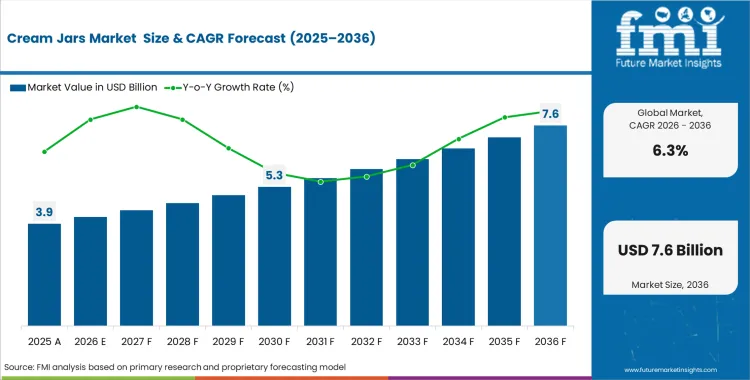
- USD 3.9 Bn
- Forecast (2036)
- USD 7.2 Bn
- CAGR (2026 to 2036)
- 6.3%
Cream Jars Market Size, Market Forecast and Outlook By FMI
The cream jars market was valued at USD 3.6 billion in 2025. The market is projected to reach USD 3.9 billion in 2026 and USD 7.2 billion by 2036, expanding at a CAGR of 6.3% during the forecast period. Glass jars are expected to lead material demand with a 38.7% share in 2026. Skincare is projected to remain the leading end-use category with a 52.4% share in 2026. North America, Western Europe, and East Asia are expected to represent the dominant regional markets through 2036.
Summary of Cream Jars Market
- Key Drivers
- Skincare category expansion: The global skincare market continues to expand across demographics and price tiers, generating broad volume growth in cream jar demand across moisturizers, serums, anti-aging treatments, barrier creams, and specialized dermocosmetics.
- Premiumization in beauty packaging: Brand owners across prestige and masstige tiers are trading up from standard polymer to glass and aluminum cream jars to communicate product quality, ingredient purity, and superior shelf presence in a competitive beauty retail environment.
- Refillable and sustainable packaging demand: Consumer and regulatory pressure for reduced packaging waste is creating a new jar design category where durable, premium-quality containers are sold once and replenished through pouch, cartridge, or refill sachet systems.
- Key Segments Analyzed in the Report
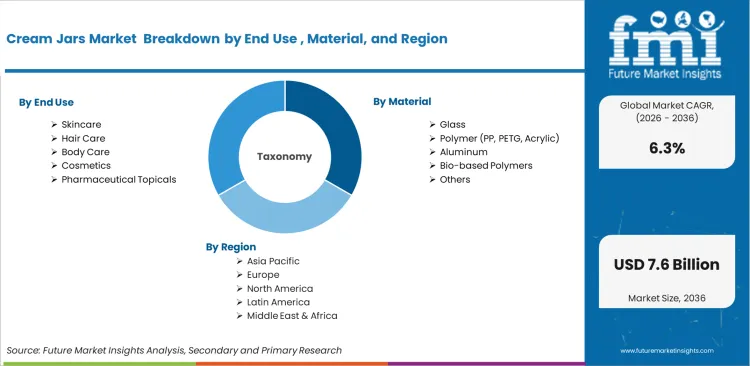
- Material: glass, polymer (PP, PETG, acrylic), aluminum, bio-based polymers, and others
- Capacity: travel size (under 30ml), standard (30 to 100ml), professional (100 to 250ml), salon and bulk (above 250ml)
- End use industry: skincare, hair care, body care, cosmetics, and pharmaceutical topicals
- Region: North America, Latin America, Western Europe, Eastern Europe, East Asia, South Asia and Pacific, and Middle East and Africa
- Analyst Opinion
- Ismail Sutaria, Sr. Consultant at FMI says, "Cream jars sit at the intersection of beauty aspiration and packaging functionality. The category is bifurcating: a premium glass and aluminum tier is being driven by skincare premiumization, while a high-volume polymer tier is being sustained by mass market body and hair care. Winners will be producers who build refillable infrastructure and recycled content programs before these become regulatory requirements rather than brand differentiators."
Cream Jars Market Definition
The cream jars market includes wide-mouth primary packaging containers used to contain and dispense cream, gel, paste, and solid-format personal care and cosmetic formulations. The market covers glass, polymer, aluminum, and bio-based polymer jars in travel, standard, professional, and bulk capacities used in skincare, hair care, body care, decorative cosmetics, and pharmaceutical topical applications. These formats are chosen where formulation viscosity, dispensing by spatula or finger, and packaging aesthetics aligned with brand positioning are primary packaging design requirements.
Cream Jars Market Inclusions
- Sales of wide-mouth primary packaging jars in glass, polymer, aluminum, and bio-based formats for skincare, hair care, body care, cosmetics, and pharmaceutical topical applications.
- Revenue from standard, travel, professional, and bulk cream jar formats including airless jar systems, refillable jar designs, and decorated or customized jar presentations.
- All commercial demand across global packaging supply chains for cream jars sold to personal care brands, pharmaceutical companies, and private label formulators.
Cream Jars Market Exclusions
- Narrow-mouth bottles, tubes, pump dispensers, and squeeze formats that are not classified as wide-mouth jars for cream or paste formulations.
- Secondary packaging including outer boxes, cartons, and display packaging that contains cream jars but is not the primary cream container.
- Industrial and laboratory jars used for chemical, food ingredient, or non-personal care storage applications.
Cream Jars Market Research Methodology
This study evaluates the cream jars market by material, capacity, and end use industry using 2025 as the base year and 2026 to 2036 as the forecast period in value terms. Evidence inputs include beauty and personal care market data, packaging trade association guidance, annual reports from glass and polymer packaging companies, sustainability reports from major beauty brands, and first-party product documentation from leading jar manufacturers. Market estimates are built through triangulation of skincare and cosmetics market growth rates, premium packaging substitution in beauty categories, refillable packaging adoption data, and the expansion of post-consumer recycled content requirements in packaging procurement.
Key Drivers, Restraints, and Trends in Cream Jars market
Drivers
Cream jar demand is growing because the skincare market is expanding broadly while simultaneously upgrading its packaging aesthetics and material ambition. The category benefits from the growing consumer belief that premium packaging communicates ingredient quality, which is pushing mainstream brands toward glass and aluminum jars previously associated only with prestige tiers. Refillable jar systems are creating an additional growth driver as brands seek to satisfy retailer sustainability requirements and consumer demand for waste reduction without abandoning the primary jar format. These combined forces are expanding the addressable market beyond core skincare into hair care, body care, and specialized dermocosmetics categories.
Restraints
Wide-mouth cream jars invite repeated finger-dipping that contaminates formulations and shortens shelf life, prompting some premium skincare brands to migrate toward airless pump and tube formats that offer better hygiene and dosage control. Glass jars, despite their premiumization appeal, add weight and fragility challenges to e-commerce fulfillment that increase protective packaging requirements and drive up shipping costs, creating a total landed cost disadvantage relative to polymer formats in online retail channels. Acrylic and PETG polymer resin prices are also subject to petrochemical feedstock price swings that compress converter margins on fixed-price brand contracts in the mid-range jar segment.
Trends
Airless jar systems are gaining adoption in premium skincare because they protect oxidation-sensitive formulations from contamination while improving dosage efficiency and extending product shelf life. Brands and retailers are specifying post-consumer recycled content minimums in polymer jar procurement, pushing converters to validate recycled resin performance in jar walls and closures for food-contact-adjacent personal care applications. Minimalist and clinical packaging aesthetics are trending across premium skincare, favoring clean geometric jar forms with matte or frosted finishes, simple labeling, and subdued color palettes that communicate scientific efficacy rather than decorative appeal.
Segmental Analysis
Cream Jars Market Analysis by Product Type
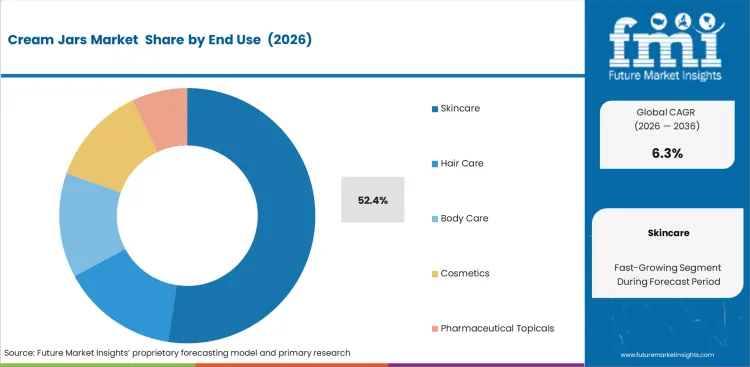
Skincare accounts for 52.4% of cream jar demand in 2026. The category encompasses moisturizers, eye creams, night treatments, face masks, and barrier formulations that are inherently suited to wide-mouth jar presentation and dispensing. Skincare purchase frequency is high, and the premium positioning prevalent in this segment supports investment in glass and high-quality polymer jar formats that drive average selling price well above body care or hair care equivalents. The segment also benefits from the growing consumer expectation that skincare packaging should be refillable or made from sustainable materials.
Cream Jars Market Analysis by End Use Industry
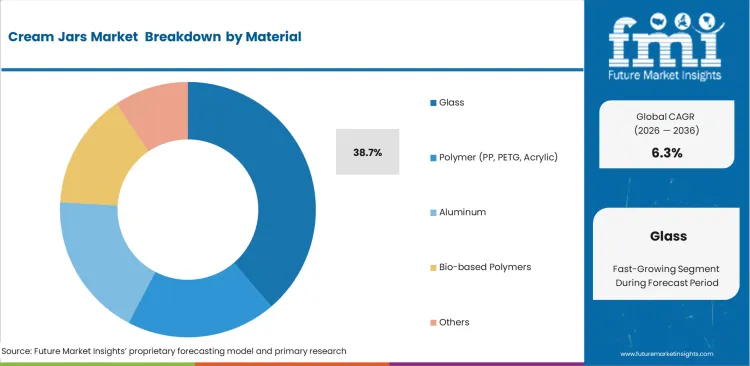
Glass jars lead material demand with a 38.7% share in 2026. Luxury and prestige skincare brands anchor this segment, using glass for its weight, optical clarity, and shelf presence. Glass also aligns with clean beauty and ingredient transparency positioning because it is chemically inert, carries no leaching risk, and communicates a sense of quality that consumers associate with premium formulation standards. As refillable jar programs expand, glass is increasingly preferred as the durable primary container because its weight and quality communicate the long-term product investment that refillable systems require from consumers.
Competitive Aligners for Market Players
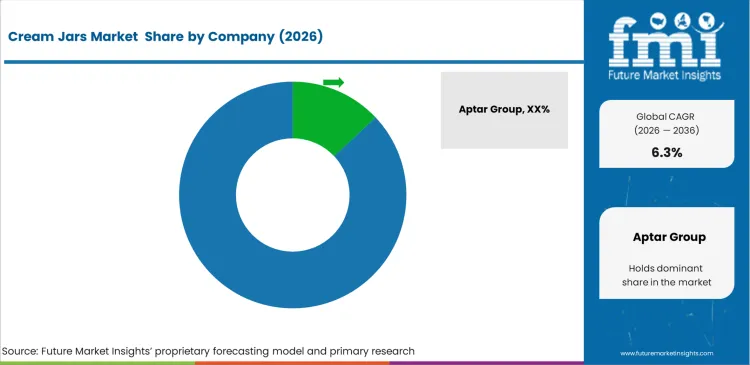
Competitive advantage in cream jars is being built around material versatility, decoration capability, refillable system engineering, and the sustainability documentation that beauty brands need for retailer compliance. Buyers want jar partners who can support glass, polymer, and aluminum formats from a single supply relationship while also delivering custom decoration, recycled content validation, and refillable design engineering. Producers who invest in lightweighting glass without sacrificing tactile premium, and in qualifying post-consumer recycled polymer grades for personal care use, will hold the strongest position as sustainability requirements tighten in major beauty retail channels.
Key Players in Cream Jars market
- Aptar Group
- APackaging Group
- Albea Group
- Berry Global
- Verescence
- Gerresheimer AG
- Pochet Group
- Zhejiang Jinsheng New Materials
- RPC Group
- Stoelzle Glass Group
Strategic Outlook by FMI on Cream Jars market
FMI views the cream jars market as a durable, mid-growth category anchored by the expanding global skincare industry and driven by premiumization in glass and aluminum formats alongside sustained volume in polymer formats for mass market personal care. The next phase of growth will be shaped by refillable system adoption, post-consumer recycled content integration, and the ability to meet e-commerce logistics requirements without sacrificing premium aesthetics. Producers who invest in lightweight glass engineering, recycled polymer qualification, and refillable system development will capture the highest value as the category evolves.
Scope of the Report
| Market Value | USD 3.6 billion in 2025 to USD 7.2 billion by 2036 |
|---|---|
| CAGR | 6.3% from 2026 to 2036 |
| Base Year | 2025 |
| Forecast Period | 2026 to 2036 |
| Material Segmentation | Glass, Polymer (PP, PETG, Acrylic), Aluminum, Bio-based Polymers, Others |
| Capacity Segmentation | Travel Size (under 30ml), Standard (30 to 100ml), Professional (100 to 250ml), Salon and Bulk (above 250ml) |
| End Use Industry Segmentation | Skincare, Hair Care, Body Care, Cosmetics, Pharmaceutical Topicals |
| Regions Covered | North America, Latin America, Western Europe, Eastern Europe, East Asia, South Asia and Pacific, Middle East and Africa |
Bibliography
- European Union. Regulation (EU) 2025/40 on packaging and packaging waste.
- Aptar. 2024 Annual Report or a specific 2025 results release.
- Cosmetics Europe. Packaging and Packaging Waste Regulation (PPWR) page.
- Glass Packaging Institute. Glass Recycling Facts & Benefits or A Circular Future of Glass.
Frequently Asked Questions
What is the size and growth outlook for the cream jars market through 2036?
The market was valued at USD 3.6 billion in 2025 and is projected to reach USD 7.2 billion by 2036, growing at a CAGR of 6.3%, driven by skincare category expansion and premiumization in glass and aluminum jar formats.
Why is glass gaining share over polymer in premium cream jars?
Glass communicates product quality, provides chemical inertness that supports clean beauty and ingredient transparency claims, and delivers the tactile weight and optical clarity that polymer alternatives cannot match in prestige skincare and cosmetics.
What is an airless cream jar and why is it growing in adoption?
An airless cream jar uses a piston or internal bladder mechanism to dispense cream without air entering the container. It protects oxidation-sensitive formulations from contamination and oxidation while improving dosage control and extending shelf life after opening.
How is sustainability pressure affecting cream jar design and procurement?
Brands are specifying recycled content thresholds, designing jars for disassembly to improve recyclability, and introducing refillable jar systems that reduce primary packaging waste per use. Retailer sustainability scorecards are making these features procurement requirements rather than optional differentiators.
Which end-use segment offers the highest value opportunity for cream jar suppliers?
Prestige skincare represents the highest value per unit, driven by heavy-gauge glass, complex closure systems, and custom decoration investment. Mainstream skincare and body care offer the highest volume opportunity for polymer jar converters serving mass market personal care brands.
Preview the report firsthand - request a free sample
Get SampleGet the brochure for pricing and purchase details.
Get PDFTable of Content
- Executive Summary
- Global Market Outlook
- Demand-side Trends
- Supply-side Trends
- Technology Roadmap Analysis
- Analysis and Recommendations
- Market Overview
- Market Coverage / Taxonomy
- Market Definition / Scope / Limitations
- Research Methodology
- Chapter Orientation
- Analytical Lens and Working Hypotheses
- Market Structure, Signals, and Trend Drivers
- Benchmarking and Cross-market Comparability
- Market Sizing, Forecasting, and Opportunity Mapping
- Research Design and Evidence Framework
- Desk Research Programme (Secondary Evidence)
- Company Annual and Sustainability Reports
- Peer-reviewed Journals and Academic Literature
- Corporate Websites, Product Literature, and Technical Notes
- Earnings Decks and Investor Briefings
- Statutory Filings and Regulatory Disclosures
- Technical White Papers and Standards Notes
- Trade Journals, Industry Magazines, and Analyst Briefs
- Conference Proceedings, Webinars, and Seminar Materials
- Government Statistics Portals and Public Data Releases
- Press Releases and Reputable Media Coverage
- Specialist Newsletters and Curated Briefings
- Sector Databases and Reference Repositories
- FMI Internal Proprietary Databases and Historical Market Datasets
- Subscription Datasets and Paid Sources
- Social Channels, Communities, and Digital Listening Inputs
- Additional Desk Sources
- Expert Input and Fieldwork (Primary Evidence)
- Primary Modes
- Qualitative Interviews and Expert Elicitation
- Quantitative Surveys and Structured Data Capture
- Blended Approach
- Why Primary Evidence is Used
- Field Techniques
- Interviews
- Surveys
- Focus Groups
- Observational and In-context Research
- Social and Community Interactions
- Stakeholder Universe Engaged
- C-suite Leaders
- Board Members
- Presidents and Vice Presidents
- R&D and Innovation Heads
- Technical Specialists
- Domain Subject-matter Experts
- Scientists
- Physicians and Other Healthcare Professionals
- Governance, Ethics, and Data Stewardship
- Research Ethics
- Data Integrity and Handling
- Primary Modes
- Tooling, Models, and Reference Databases
- Desk Research Programme (Secondary Evidence)
- Data Engineering and Model Build
- Data Acquisition and Ingestion
- Cleaning, Normalisation, and Verification
- Synthesis, Triangulation, and Analysis
- Quality Assurance and Audit Trail
- Market Background
- Market Dynamics
- Drivers
- Restraints
- Opportunity
- Trends
- Scenario Forecast
- Demand in Optimistic Scenario
- Demand in Likely Scenario
- Demand in Conservative Scenario
- Opportunity Map Analysis
- Product Life Cycle Analysis
- Supply Chain Analysis
- Investment Feasibility Matrix
- Value Chain Analysis
- PESTLE and Porter’s Analysis
- Regulatory Landscape
- Regional Parent Market Outlook
- Production and Consumption Statistics
- Import and Export Statistics
- Market Dynamics
- Global Market Analysis 2021 to 2025 and Forecast, 2026 to 2036
- Historical Market Size Value (USD Million) Analysis, 2021 to 2025
- Current and Future Market Size Value (USD Million) Projections, 2026 to 2036
- Y-o-Y Growth Trend Analysis
- Absolute $ Opportunity Analysis
- Global Market Pricing Analysis 2021 to 2025 and Forecast 2026 to 2036
- Global Market Analysis 2021 to 2025 and Forecast 2026 to 2036, By End Use
- Introduction / Key Findings
- Historical Market Size Value (USD Million) Analysis By End Use , 2021 to 2025
- Current and Future Market Size Value (USD Million) Analysis and Forecast By End Use , 2026 to 2036
- Skincare
- Hair Care
- Body Care
- Cosmetics
- Pharmaceutical Topicals
- Skincare
- Y-o-Y Growth Trend Analysis By End Use , 2021 to 2025
- Absolute $ Opportunity Analysis By End Use , 2026 to 2036
- Global Market Analysis 2021 to 2025 and Forecast 2026 to 2036, By Material
- Introduction / Key Findings
- Historical Market Size Value (USD Million) Analysis By Material, 2021 to 2025
- Current and Future Market Size Value (USD Million) Analysis and Forecast By Material, 2026 to 2036
- Glass
- Polymer (PP, PETG, Acrylic)
- Aluminum
- Bio-based Polymers
- Others
- Glass
- Y-o-Y Growth Trend Analysis By Material, 2021 to 2025
- Absolute $ Opportunity Analysis By Material, 2026 to 2036
- Global Market Analysis 2021 to 2025 and Forecast 2026 to 2036, By Region
- Introduction
- Historical Market Size Value (USD Million) Analysis By Region, 2021 to 2025
- Current Market Size Value (USD Million) Analysis and Forecast By Region, 2026 to 2036
- North America
- Latin America
- Western Europe
- Eastern Europe
- East Asia
- South Asia and Pacific
- Middle East & Africa
- Market Attractiveness Analysis By Region
- North America Market Analysis 2021 to 2025 and Forecast 2026 to 2036, By Country
- Historical Market Size Value (USD Million) Trend Analysis By Market Taxonomy, 2021 to 2025
- Market Size Value (USD Million) Forecast By Market Taxonomy, 2026 to 2036
- By Country
- USA
- Canada
- Mexico
- By End Use
- By Material
- By Country
- Market Attractiveness Analysis
- By Country
- By End Use
- By Material
- Key Takeaways
- Latin America Market Analysis 2021 to 2025 and Forecast 2026 to 2036, By Country
- Historical Market Size Value (USD Million) Trend Analysis By Market Taxonomy, 2021 to 2025
- Market Size Value (USD Million) Forecast By Market Taxonomy, 2026 to 2036
- By Country
- Brazil
- Chile
- Rest of Latin America
- By End Use
- By Material
- By Country
- Market Attractiveness Analysis
- By Country
- By End Use
- By Material
- Key Takeaways
- Western Europe Market Analysis 2021 to 2025 and Forecast 2026 to 2036, By Country
- Historical Market Size Value (USD Million) Trend Analysis By Market Taxonomy, 2021 to 2025
- Market Size Value (USD Million) Forecast By Market Taxonomy, 2026 to 2036
- By Country
- Germany
- UK
- Italy
- Spain
- France
- Nordic
- BENELUX
- Rest of Western Europe
- By End Use
- By Material
- By Country
- Market Attractiveness Analysis
- By Country
- By End Use
- By Material
- Key Takeaways
- Eastern Europe Market Analysis 2021 to 2025 and Forecast 2026 to 2036, By Country
- Historical Market Size Value (USD Million) Trend Analysis By Market Taxonomy, 2021 to 2025
- Market Size Value (USD Million) Forecast By Market Taxonomy, 2026 to 2036
- By Country
- Russia
- Poland
- Hungary
- Balkan & Baltic
- Rest of Eastern Europe
- By End Use
- By Material
- By Country
- Market Attractiveness Analysis
- By Country
- By End Use
- By Material
- Key Takeaways
- East Asia Market Analysis 2021 to 2025 and Forecast 2026 to 2036, By Country
- Historical Market Size Value (USD Million) Trend Analysis By Market Taxonomy, 2021 to 2025
- Market Size Value (USD Million) Forecast By Market Taxonomy, 2026 to 2036
- By Country
- China
- Japan
- South Korea
- By End Use
- By Material
- By Country
- Market Attractiveness Analysis
- By Country
- By End Use
- By Material
- Key Takeaways
- South Asia and Pacific Market Analysis 2021 to 2025 and Forecast 2026 to 2036, By Country
- Historical Market Size Value (USD Million) Trend Analysis By Market Taxonomy, 2021 to 2025
- Market Size Value (USD Million) Forecast By Market Taxonomy, 2026 to 2036
- By Country
- India
- ASEAN
- Australia & New Zealand
- Rest of South Asia and Pacific
- By End Use
- By Material
- By Country
- Market Attractiveness Analysis
- By Country
- By End Use
- By Material
- Key Takeaways
- Middle East & Africa Market Analysis 2021 to 2025 and Forecast 2026 to 2036, By Country
- Historical Market Size Value (USD Million) Trend Analysis By Market Taxonomy, 2021 to 2025
- Market Size Value (USD Million) Forecast By Market Taxonomy, 2026 to 2036
- By Country
- Kingdom of Saudi Arabia
- Other GCC Countries
- Turkiye
- South Africa
- Other African Union
- Rest of Middle East & Africa
- By End Use
- By Material
- By Country
- Market Attractiveness Analysis
- By Country
- By End Use
- By Material
- Key Takeaways
- Key Countries Market Analysis
- USA
- Pricing Analysis
- Market Share Analysis, 2025
- By End Use
- By Material
- Canada
- Pricing Analysis
- Market Share Analysis, 2025
- By End Use
- By Material
- Mexico
- Pricing Analysis
- Market Share Analysis, 2025
- By End Use
- By Material
- Brazil
- Pricing Analysis
- Market Share Analysis, 2025
- By End Use
- By Material
- Chile
- Pricing Analysis
- Market Share Analysis, 2025
- By End Use
- By Material
- Germany
- Pricing Analysis
- Market Share Analysis, 2025
- By End Use
- By Material
- UK
- Pricing Analysis
- Market Share Analysis, 2025
- By End Use
- By Material
- Italy
- Pricing Analysis
- Market Share Analysis, 2025
- By End Use
- By Material
- Spain
- Pricing Analysis
- Market Share Analysis, 2025
- By End Use
- By Material
- France
- Pricing Analysis
- Market Share Analysis, 2025
- By End Use
- By Material
- India
- Pricing Analysis
- Market Share Analysis, 2025
- By End Use
- By Material
- ASEAN
- Pricing Analysis
- Market Share Analysis, 2025
- By End Use
- By Material
- Australia & New Zealand
- Pricing Analysis
- Market Share Analysis, 2025
- By End Use
- By Material
- China
- Pricing Analysis
- Market Share Analysis, 2025
- By End Use
- By Material
- Japan
- Pricing Analysis
- Market Share Analysis, 2025
- By End Use
- By Material
- South Korea
- Pricing Analysis
- Market Share Analysis, 2025
- By End Use
- By Material
- Russia
- Pricing Analysis
- Market Share Analysis, 2025
- By End Use
- By Material
- Poland
- Pricing Analysis
- Market Share Analysis, 2025
- By End Use
- By Material
- Hungary
- Pricing Analysis
- Market Share Analysis, 2025
- By End Use
- By Material
- Kingdom of Saudi Arabia
- Pricing Analysis
- Market Share Analysis, 2025
- By End Use
- By Material
- Turkiye
- Pricing Analysis
- Market Share Analysis, 2025
- By End Use
- By Material
- South Africa
- Pricing Analysis
- Market Share Analysis, 2025
- By End Use
- By Material
- USA
- Market Structure Analysis
- Competition Dashboard
- Competition Benchmarking
- Market Share Analysis of Top Players
- By Regional
- By End Use
- By Material
- Competition Analysis
- Competition Deep Dive
- Aptar Group
- Overview
- Product Portfolio
- Profitability by Market Segments (Product/Age /Sales Channel/Region)
- Sales Footprint
- Strategy Overview
- Marketing Strategy
- Product Strategy
- Channel Strategy
- APackaging Group
- Albea Group
- Berry Global
- Verescence
- Gerresheimer AG
- Pochet Group
- Zhejiang Jinsheng New Materials
- RPC Group
- Stoelzle Glass Group
- Aptar Group
- Competition Deep Dive
- Assumptions & Acronyms Used


