

- Industry Size (2026)
- USD 153 Mn
- Forecast (2036)
- USD 475.2 Mn
- CAGR (2026 to 2036)
- 12.0%
Night-Apply Nitrogen Stabilization Program Market Forecast and Outlook 2026 to 2036
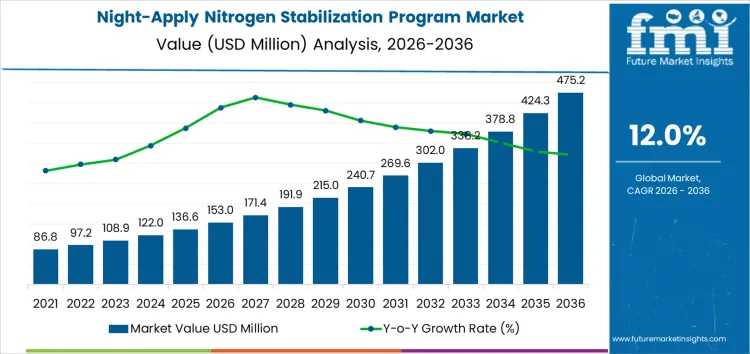
The night-apply nitrogen stabilization program market is valued at USD 153 million in 2026 and is projected to reach USD 475.2 million by 2036, reflecting a CAGR of 12.0%. Adoption during this period is shaped by volatilization control, application timing flexibility, and alignment with narrow field operation windows. Cost structures are influenced by stabilizer chemistry, application logistics, and coordination with night-time equipment use. Programs are evaluated on their ability to preserve nitrogen availability under lower temperatures and reduced wind conditions. Preference is given to solutions demonstrating predictable performance across soil types. Procurement decisions emphasize risk reduction during application rather than incremental input savings.
Between 2026 and 2036, outcomes are influenced by grower risk aversion and operational discipline. Night application requires coordination between labor availability, equipment readiness, and stabilizer effectiveness. Once incorporated into nutrient management plans, switching remains limited due to scheduling complexity and yield exposure. Sales channels offering agronomic guidance and timing support strengthen repeat adoption. Entry barriers persist through field validation requirements and program execution reliability. Strategic trade offs arise between operational convenience and consistency of nitrogen protection. Competitive positioning favors providers integrated into seasonal planning frameworks rather than transactional product supply models.
Quick Stats for Night Apply Nitrogen Stabilization Program Market
- Night Apply Nitrogen Stabilization Program Market Value (2026): USD 153 million
- Night Apply Nitrogen Stabilization Program Market Forecast Value (2036): USD 475.2 million
- Night Apply Nitrogen Stabilization Program Market Forecast CAGR (2026-2036): 12.0%
- Leading Application Type in Night Apply Nitrogen Stabilization Program Market: Standard programs
- Key Growth Countries in Night Apply Nitrogen Stabilization Program Market: India, Brazil, United States, China
- Top Players in Night Apply Nitrogen Stabilization Program Market: Koch Agronomic Services, BASF, Nutrien, Yara International, CF Industries, Corteva
What Is the Growth Forecast for Night Apply Nitrogen Stabilization Program Market through 2036?
Application timing efficiency and nitrogen loss mitigation define the early growth phase of the night apply nitrogen stabilization program market between 2026 and 2031. During this period, the market expands from USD 153 million to USD 238 million, adding USD 85 million in value. Annual progression from USD 88 million to USD 153 million reflects increasing adoption of night time fertilizer application to reduce volatilization and improve nitrogen retention. Historical growth was constrained by operational complexity and limited awareness of timing based nutrient strategies. Forward expansion in this phase is supported by wider use of stabilized nitrogen products, improved applicator scheduling, and growing acceptance among row crop producers seeking consistent nutrient availability under variable daytime temperature conditions.
Operational scale up and program standardization drive growth from 2031 to 2036. Over this period, the market increased from USD 238 million to USD 475.2 million, adding USD 267 million and representing the stronger expansion window. Annual values rise from USD 264 million to USD 475.2 million, indicating accelerating year-over-year momentum. Earlier demand focused on progressive growers and custom applicators, while future growth reflects broader integration into commercial nitrogen management programs. Expanded use across large acreage farms, improved coordination with precision application services, and consistent yield response outcomes support sustained expansion as night apply nitrogen stabilization programs become established practices in modern crop nutrient management.
Night Apply Nitrogen Stabilization Program Market Key Takeaways
| Metric | Value |
|---|---|
| Market Value (2026) | USD 153 million |
| Forecast Value (2036) | USD 475.2 million |
| Forecast CAGR (2026-2036) | 12.0% |
Why Is Application Timing Becoming a Management Lever in Nitrogen Programs?
Night apply nitrogen stabilization programs emerged as growers began managing nitrogen loss as a timing problem rather than a formulation problem. Field monitoring showed that daytime applications often coincided with wind, higher evaporation rates, and surface drying, reducing retention even before incorporation or irrigation. Applying nitrogen at night offered calmer conditions, higher surface moisture, and slower biochemical activity. Stabilization programs were developed to complement this window by extending nitrogen availability until plant demand increased. Early adoption followed operational observations from large scale growers who saw more predictable uptake when timing and chemistry were coordinated rather than adjusted independently.
Future growth reflects alignment with operational discipline and compliance oversight. Farms increasingly operate under nutrient management plans that track timing, weather conditions, and application outcomes. Night apply programs fit these frameworks by reducing variability linked to daytime conditions. As advisory services and regulators emphasize documented loss reduction strategies, coordinated timing and stabilization approaches gain preference. Demand will expand where nitrogen performance is evaluated on consistency and compliance rather than total applied volume.
What Factors Are Affecting the Demand for Night Apply Nitrogen Stabilization Program Market in Terms of Application and Form?
The night apply nitrogen stabilization program market is shaped by efforts to reduce nitrogen loss, improve fertilizer efficiency, and comply with emerging emission and runoff controls. Demand focuses on programs that align application timing with reduced volatilization risk while fitting existing farm operations. Adoption depends on program complexity, ease of execution, and compatibility with common fertilizer forms. Market leadership reflects operational practicality and measurable nitrogen retention rather than novelty of stabilization chemistry.
What Is Driving Leadership by Application in the Night Apply Nitrogen Stabilization Program Market?
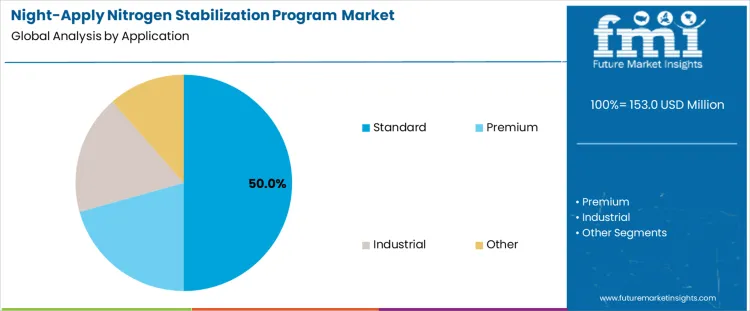
Standard programs account for about 50% of demand because they provide a practical balance between nitrogen protection and operational simplicity. These programs typically involve basic timing adjustments combined with widely available stabilizers, allowing growers to reduce volatilization without significant changes to equipment or labor planning. Night application lowers temperature and wind exposure, slowing urea hydrolysis and ammonia loss. Standard programs are favored by row crop producers who prioritize predictable outcomes and minimal disruption during peak application periods. Their repeatability across seasons supports confidence in agronomic performance and cost recovery. Extension guidance and agronomy service providers often promote standardized night application protocols, reinforcing adoption. The scalability of standard programs across large acreage further supports dominance, especially in corn and cereal systems where nitrogen rates are high.
Premium programs offer enhanced stabilization through advanced inhibitors or monitoring but require higher input costs and management intensity. Industrial and other specialized programs serve niche use cases such as contract application or controlled environments. Application leadership therefore reflects ease of implementation, broad agronomic fit, and proven loss reduction rather than maximum stabilization duration or technical sophistication.
What Is Driving Leadership by Form in the Night Apply Nitrogen Stabilization Program Market?
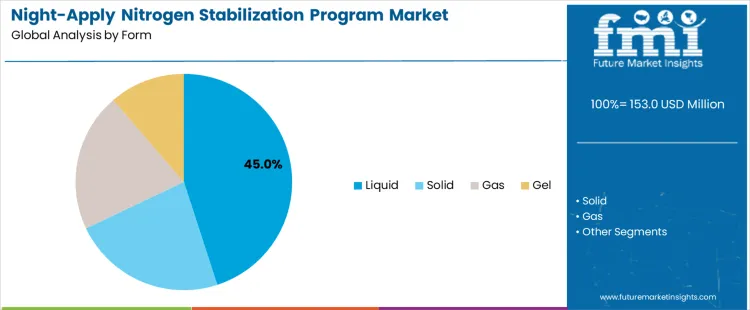
Liquid formulations account for about 45% of demand because they integrate seamlessly with night application practices and stabilization additives. Liquids enable uniform blending of nitrogen sources with inhibitors, ensuring consistent coverage during application. Their flow properties support precise rate control and compatibility with modern sprayers and applicators used during nighttime operations. Liquids also reduce handling complexity compared with solids, which require additional spreading equipment and calibration. Rapid uptake into soil under cooler night conditions further enhances effectiveness.
Solid formulations remain important for dry fertilizer programs but offer less flexibility in stabilizer integration. Gas forms require specialized equipment and face safety constraints at night. Gel formulations provide niche benefits but lack widespread adoption. Form leadership therefore reflects application precision, blending flexibility, and operational reliability rather than nutrient concentration or storage stability alone.
How Is the Night-Apply Nitrogen Stabilization Program Being Applied Across Crop Farming?
Use appears in row crops, cereals, and high-value horticulture where timing and efficiency of nitrogen application are critical. Farmers adopt night-apply programs combining stabilized nitrogen fertilizers with inhibitors to reduce volatilization losses during cooler, low-wind nighttime conditions. Operators integrate these programs with irrigation, fertigation, or field spreading to optimize nitrogen availability for early plant uptake. These applications reflect operational and environmental priorities rather than purely cost objectives, with adoption driven by improved nitrogen use efficiency, crop yield, and reduced environmental impact.
What Operational and Material Conditions Support Adoption of Night-Apply Nitrogen Stabilization Programs?
Selection aligns with nitrogen fertilizers compatible with urease or nitrification inhibitors for application under nighttime conditions. Formulations are optimized for stability, solubility, and uniform distribution to prevent losses and maintain agronomic effectiveness. Farmers monitor soil moisture, temperature, and application equipment calibration to ensure precise delivery. Quality control evaluates nitrogen content, inhibitor activity, and field efficacy to comply with agronomic and environmental standards. These conditions emerge from operational efficiency, nutrient performance, and sustainability priorities in structured fertilization workflows.
Which Practical Considerations Limit Wider Use of Night-Apply Nitrogen Stabilization Programs?
Higher input costs and specialized timing requirements may limit adoption in small-scale or low-margin farms. Equipment must be suitable for nighttime application with accurate calibration and monitoring. Soil type, moisture, and weather conditions influence nitrogen availability and program effectiveness. Regulatory approvals for stabilized nitrogen products differ by region. These factors lead to selective deployment where nitrogen efficiency, crop yield optimization, and environmental compliance justify incremental cost and careful operational planning.
What is the Demand for Night Apply Nitrogen Stabilization Programs by Country?
| Country | CAGR (%) |
|---|---|
| USA | 13.6% |
| Brazil | 14.1% |
| China | 13.4% |
| India | 14.8% |
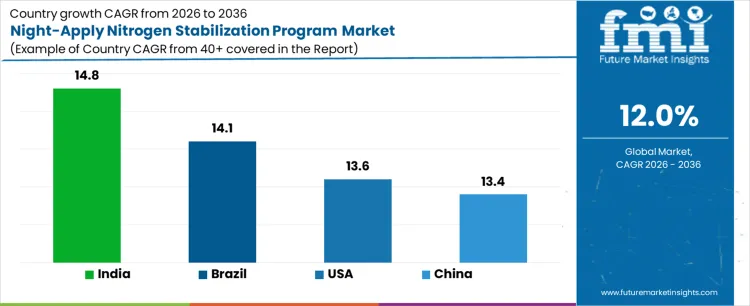
The demand for night apply nitrogen stabilization programs is expanding across major agricultural economies, driven by nitrogen loss mitigation, regulatory pressure on emissions, and adoption of precision nutrient management. India leads with a 14.8% CAGR, supported by high urea usage, increasing awareness of volatilization losses, and promotion of stabilized nitrogen practices in irrigated and intensive cropping systems. Brazil follows at 14.1%, reflecting large scale field operations, warm climate conditions that increase nitrogen loss risk, and growing adoption of timing based fertilizer strategies. The USA grows at 13.6%, driven by precision agriculture adoption, compliance with nutrient management guidelines, and focus on improving nitrogen use efficiency in row crops. China records 13.4%, shaped by policy measures to curb fertilizer overuse, expansion of mechanized night application, and emphasis on reducing environmental nitrogen losses.
How are night-apply nitrogen stabilization programs expanding adoption in the United States?
In the United States, the night-apply nitrogen stabilization program market is growing at a CAGR of 13.6% through 2036, driven by the need to reduce nitrogen losses, improve nutrient-use efficiency, and comply with environmental regulations. Farmers are applying nitrogen stabilization treatments at night to minimize volatilization, enhance crop uptake, and increase yields. Demand is concentrated in high-value row crop regions, irrigated agricultural zones, and industrial farming hubs. Compared to China, adoption emphasizes precision application, regulatory compliance, and optimization of nutrient timing rather than large-scale volume. Domestic suppliers provide high-performance, chemically stable products suitable for recurring seasonal applications.
- Row crop regions, irrigated zones, and industrial farming hubs drive adoption
- Treatments reduce nitrogen losses and improve nutrient-use efficiency
- Domestic suppliers provide high-performance, chemically stable solutions
- Recurring seasonal applications sustain adoption
How are precision nutrient management and environmental sustainability driving adoption in Brazil?
In Brazil, revenue is growing at a CAGR of 14.1% through 2036, supported by adoption of precision agriculture, high-intensity crop production, and demand for reduced nitrogen emissions. Farmers are integrating night-apply stabilization programs to increase nitrogen retention, improve early crop growth, and comply with environmental regulations. Demand is concentrated in industrial grain regions, irrigated crop zones, and mechanized farming hubs. Compared to the USA, adoption emphasizes large-scale deployment and integration with high-volume mechanized planting operations. Domestic suppliers provide cost-effective, high-nutrient stabilization solutions suitable for recurring crop cycles.
- Industrial grain regions, irrigated crop zones, and mechanized hubs drive adoption
- Treatments enhance nitrogen retention and early crop growth
- Domestic suppliers provide cost-effective, high-nutrient solutions
- Recurring crop cycles sustain adoption
How are mechanized farming and nutrient efficiency driving growth in China?
In China, the market is expanding at a CAGR of 13.4% through 2036, fueled by widespread adoption of high-speed planters, nitrogen management programs, and government incentives for precision fertilization. Farmers are using night-apply stabilization programs to optimize nitrogen use, reduce volatilization, and increase yield potential in cereal and vegetable crops. Demand is concentrated in high-intensity crop regions, irrigated fields, and industrial agricultural zones. Compared to India, adoption emphasizes integration with large-scale mechanized operations and high-volume production. Domestic suppliers provide high-performance, precision nitrogen stabilization products suitable for recurring seasonal applications.
- High-intensity crop regions, irrigated fields, and industrial agricultural zones drive adoption
- Treatments optimize nitrogen use and reduce volatilization
- Domestic suppliers provide high-performance, precision solutions
- Recurring seasonal applications sustain adoption
How are precision agriculture and high-value crop production driving adoption in India?
In India, the market is growing at a CAGR of 14.8% through 2036, supported by widespread adoption of night-apply nitrogen stabilization programs in irrigated horticulture, high-value crops, and grain production. Farmers are integrating these treatments to enhance nitrogen-use efficiency, reduce emissions, and improve early crop development. Demand is concentrated in irrigated horticultural regions, industrial crop zones, and high-intensity agricultural hubs. Compared to China, adoption emphasizes rapid large-scale deployment for diverse crop types. Domestic suppliers provide high-performance, environmentally friendly nitrogen stabilization solutions suitable for recurring seasonal applications.
- Irrigated horticultural regions, industrial crop zones, and high-intensity hubs drive adoption
- Treatments improve nitrogen-use efficiency and early crop development
- Domestic suppliers provide high-performance, environmentally friendly solutions
- Recurring seasonal applications sustain adoption
Which Strategic Factors Shape Competition in the Night Apply Nitrogen Stabilization Program Market under Timing Sensitivity and Loss Control Requirements?
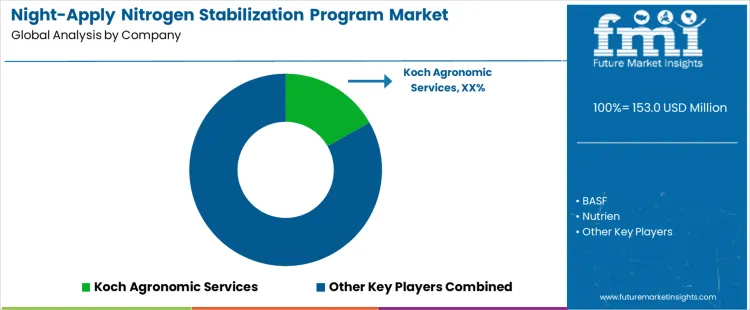
Competition in night apply nitrogen stabilization programs is shaped by how effectively suppliers align chemistry performance with narrow application windows and reduced volatilization risk. Koch Agronomic Services positions its programs around urease and nitrification control that remains effective under cooler nighttime temperatures, focusing on predictable nitrogen retention until crop uptake begins. BASF emphasizes formulation stability and consistency when applied under low light, high humidity conditions, where handling errors and uneven coverage can increase loss risk. Nutrien integrates stabilization products with application guidance, reinforcing correct timing, rate, and placement rather than relying solely on chemical inhibition. Adoption is influenced by confidence that nighttime application does not compromise nutrient efficiency or operational safety.
Supply integration and agronomic credibility further influence competitive positioning. Yara International aligns nitrogen stabilization with broader nutrient management programs, supporting growers who use night application to manage labor and equipment utilization. CF Industries focuses on compatibility between stabilized products and large scale nitrogen supply chains, ensuring performance is preserved through storage and transport before application. Corteva competes through agronomy led programs that combine stabilization with decision tools and field protocols. Across the market, competitive advantage depends on reliability under real night field conditions, clarity of use recommendations, and repeatable outcomes across seasons rather than on inhibitor strength claims alone.
Key Players in the Night Apply Nitrogen Stabilization Program Market
- Koch Agronomic Services
- BASF
- Nutrien
- Yara International
- CF Industries
- Corteva
Scope of the Report
| Items | Values |
|---|---|
| Quantitative Units | USD million |
| Type | Urease inhibitor based stabilization programs, nitrification inhibitor based programs, combined stabilization programs |
| Application | Night-time nitrogen application programs, volatilization loss control during fertilizer application, timing-based nitrogen management |
| End User | Large-scale row crop growers, commercial cereal producers, precision agriculture farms, custom fertilizer applicators |
| Regions Covered | Asia Pacific, Europe, North America, Latin America, Middle East & Africa |
| Countries Covered | India, Brazil, United States, China, and other major agricultural economies |
| Key Companies Profiled | Koch Agronomic Services, BASF, Nutrien, Yara International, CF Industries, Corteva |
| Additional Attributes | Dollar sales by program type and formulation form, adoption trends linked to night-time application windows and nitrogen loss mitigation, competitive landscape focused on timing coordination and stabilizer effectiveness, operational execution requirements for night application, integration with seasonal nutrient management and compliance frameworks |
Night Apply Nitrogen Stabilization Program Market Segmentation
Application
- Standard
- Premium
- Industrial
- Other
Form
- Liquid
- Solid
- Gas
- Gel
Channel
- Direct
- Retail
- Online
- Distributor
Region
- Asia Pacific
- China
- Japan
- South Korea
- India
- Australia & New Zealand
- ASEAN
- Rest of Asia Pacific
- Europe
- Germany
- United Kingdom
- France
- Italy
- Spain
- Nordic
- BENELUX
- Rest of Europe
- North America
- United States
- Canada
- Mexico
- Latin America
- Brazil
- Chile
- Rest of Latin America
- Middle East & Africa
- Kingdom of Saudi Arabia
- Other GCC Countries
- Turkey
- South Africa
- Other African Union
- Rest of Middle East & Africa
Frequently Asked Questions
How big is the night-apply nitrogen stabilization program market in 2026?
The global night-apply nitrogen stabilization program market is estimated to be valued at USD 153.0 million in 2026.
What will be the size of night-apply nitrogen stabilization program market in 2036?
The market size for the night-apply nitrogen stabilization program market is projected to reach USD 475.2 million by 2036.
How much will be the night-apply nitrogen stabilization program market growth between 2026 and 2036?
The night-apply nitrogen stabilization program market is expected to grow at a 12.0% CAGR between 2026 and 2036.
What are the key product types in the night-apply nitrogen stabilization program market?
The key product types in night-apply nitrogen stabilization program market are standard, premium, industrial and other.
Which form segment to contribute significant share in the night-apply nitrogen stabilization program market in 2026?
In terms of form, liquid segment to command 45.0% share in the night-apply nitrogen stabilization program market in 2026.
Preview the report firsthand - request a free sample
Get SampleGet the brochure for pricing and purchase details.
Get PDFTable of Content
- Executive Summary
- Global Market Outlook
- Demand-side Trends
- Supply-side Trends
- Technology Roadmap Analysis
- Analysis and Recommendations
- Market Overview
- Market Coverage / Taxonomy
- Market Definition / Scope / Limitations
- Market Background
- Market Dynamics
- Drivers
- Restraints
- Opportunity
- Trends
- Scenario Forecast
- Demand in Optimistic Scenario
- Demand in Likely Scenario
- Demand in Conservative Scenario
- Opportunity Map Analysis
- Product Life Cycle Analysis
- Supply Chain Analysis
- Investment Feasibility Matrix
- Value Chain Analysis
- PESTLE and Porter’s Analysis
- Regulatory Landscape
- Regional Parent Market Outlook
- Production and Consumption Statistics
- Import and Export Statistics
- Market Dynamics
- Global Market Analysis 2021 to 2025 and Forecast, 2026 to 2036
- Historical Market Size Value (USD Million) Analysis, 2021 to 2025
- Current and Future Market Size Value (USD Million) Projections, 2026 to 2036
- Y-o-Y Growth Trend Analysis
- Absolute $ Opportunity Analysis
- Global Market Pricing Analysis 2021 to 2025 and Forecast 2026 to 2036
- Global Market Analysis 2021 to 2025 and Forecast 2026 to 2036, By Application
- Introduction / Key Findings
- Historical Market Size Value (USD Million) Analysis By Application , 2021 to 2025
- Current and Future Market Size Value (USD Million) Analysis and Forecast By Application , 2026 to 2036
- Standard
- Premium
- Industrial
- Other
- Standard
- Y-o-Y Growth Trend Analysis By Application , 2021 to 2025
- Absolute $ Opportunity Analysis By Application , 2026 to 2036
- Global Market Analysis 2021 to 2025 and Forecast 2026 to 2036, By Form
- Introduction / Key Findings
- Historical Market Size Value (USD Million) Analysis By Form, 2021 to 2025
- Current and Future Market Size Value (USD Million) Analysis and Forecast By Form, 2026 to 2036
- Liquid
- Solid
- Gas
- Gel
- Liquid
- Y-o-Y Growth Trend Analysis By Form, 2021 to 2025
- Absolute $ Opportunity Analysis By Form, 2026 to 2036
- Global Market Analysis 2021 to 2025 and Forecast 2026 to 2036, By Channel
- Introduction / Key Findings
- Historical Market Size Value (USD Million) Analysis By Channel, 2021 to 2025
- Current and Future Market Size Value (USD Million) Analysis and Forecast By Channel, 2026 to 2036
- Direct
- Retail
- Online
- Distributor
- Direct
- Y-o-Y Growth Trend Analysis By Channel, 2021 to 2025
- Absolute $ Opportunity Analysis By Channel, 2026 to 2036
- Global Market Analysis 2021 to 2025 and Forecast 2026 to 2036, By Region
- Introduction
- Historical Market Size Value (USD Million) Analysis By Region, 2021 to 2025
- Current Market Size Value (USD Million) Analysis and Forecast By Region, 2026 to 2036
- North America
- Latin America
- Western Europe
- Eastern Europe
- East Asia
- South Asia and Pacific
- Middle East & Africa
- Market Attractiveness Analysis By Region
- North America Market Analysis 2021 to 2025 and Forecast 2026 to 2036, By Country
- Historical Market Size Value (USD Million) Trend Analysis By Market Taxonomy, 2021 to 2025
- Market Size Value (USD Million) Forecast By Market Taxonomy, 2026 to 2036
- By Country
- USA
- Canada
- Mexico
- By Application
- By Form
- By Channel
- By Country
- Market Attractiveness Analysis
- By Country
- By Application
- By Form
- By Channel
- Key Takeaways
- Latin America Market Analysis 2021 to 2025 and Forecast 2026 to 2036, By Country
- Historical Market Size Value (USD Million) Trend Analysis By Market Taxonomy, 2021 to 2025
- Market Size Value (USD Million) Forecast By Market Taxonomy, 2026 to 2036
- By Country
- Brazil
- Chile
- Rest of Latin America
- By Application
- By Form
- By Channel
- By Country
- Market Attractiveness Analysis
- By Country
- By Application
- By Form
- By Channel
- Key Takeaways
- Western Europe Market Analysis 2021 to 2025 and Forecast 2026 to 2036, By Country
- Historical Market Size Value (USD Million) Trend Analysis By Market Taxonomy, 2021 to 2025
- Market Size Value (USD Million) Forecast By Market Taxonomy, 2026 to 2036
- By Country
- Germany
- UK
- Italy
- Spain
- France
- Nordic
- BENELUX
- Rest of Western Europe
- By Application
- By Form
- By Channel
- By Country
- Market Attractiveness Analysis
- By Country
- By Application
- By Form
- By Channel
- Key Takeaways
- Eastern Europe Market Analysis 2021 to 2025 and Forecast 2026 to 2036, By Country
- Historical Market Size Value (USD Million) Trend Analysis By Market Taxonomy, 2021 to 2025
- Market Size Value (USD Million) Forecast By Market Taxonomy, 2026 to 2036
- By Country
- Russia
- Poland
- Hungary
- Balkan & Baltic
- Rest of Eastern Europe
- By Application
- By Form
- By Channel
- By Country
- Market Attractiveness Analysis
- By Country
- By Application
- By Form
- By Channel
- Key Takeaways
- East Asia Market Analysis 2021 to 2025 and Forecast 2026 to 2036, By Country
- Historical Market Size Value (USD Million) Trend Analysis By Market Taxonomy, 2021 to 2025
- Market Size Value (USD Million) Forecast By Market Taxonomy, 2026 to 2036
- By Country
- China
- Japan
- South Korea
- By Application
- By Form
- By Channel
- By Country
- Market Attractiveness Analysis
- By Country
- By Application
- By Form
- By Channel
- Key Takeaways
- South Asia and Pacific Market Analysis 2021 to 2025 and Forecast 2026 to 2036, By Country
- Historical Market Size Value (USD Million) Trend Analysis By Market Taxonomy, 2021 to 2025
- Market Size Value (USD Million) Forecast By Market Taxonomy, 2026 to 2036
- By Country
- India
- ASEAN
- Australia & New Zealand
- Rest of South Asia and Pacific
- By Application
- By Form
- By Channel
- By Country
- Market Attractiveness Analysis
- By Country
- By Application
- By Form
- By Channel
- Key Takeaways
- Middle East & Africa Market Analysis 2021 to 2025 and Forecast 2026 to 2036, By Country
- Historical Market Size Value (USD Million) Trend Analysis By Market Taxonomy, 2021 to 2025
- Market Size Value (USD Million) Forecast By Market Taxonomy, 2026 to 2036
- By Country
- Kingdom of Saudi Arabia
- Other GCC Countries
- Turkiye
- South Africa
- Other African Union
- Rest of Middle East & Africa
- By Application
- By Form
- By Channel
- By Country
- Market Attractiveness Analysis
- By Country
- By Application
- By Form
- By Channel
- Key Takeaways
- Key Countries Market Analysis
- USA
- Pricing Analysis
- Market Share Analysis, 2025
- By Application
- By Form
- By Channel
- Canada
- Pricing Analysis
- Market Share Analysis, 2025
- By Application
- By Form
- By Channel
- Mexico
- Pricing Analysis
- Market Share Analysis, 2025
- By Application
- By Form
- By Channel
- Brazil
- Pricing Analysis
- Market Share Analysis, 2025
- By Application
- By Form
- By Channel
- Chile
- Pricing Analysis
- Market Share Analysis, 2025
- By Application
- By Form
- By Channel
- Germany
- Pricing Analysis
- Market Share Analysis, 2025
- By Application
- By Form
- By Channel
- UK
- Pricing Analysis
- Market Share Analysis, 2025
- By Application
- By Form
- By Channel
- Italy
- Pricing Analysis
- Market Share Analysis, 2025
- By Application
- By Form
- By Channel
- Spain
- Pricing Analysis
- Market Share Analysis, 2025
- By Application
- By Form
- By Channel
- France
- Pricing Analysis
- Market Share Analysis, 2025
- By Application
- By Form
- By Channel
- India
- Pricing Analysis
- Market Share Analysis, 2025
- By Application
- By Form
- By Channel
- ASEAN
- Pricing Analysis
- Market Share Analysis, 2025
- By Application
- By Form
- By Channel
- Australia & New Zealand
- Pricing Analysis
- Market Share Analysis, 2025
- By Application
- By Form
- By Channel
- China
- Pricing Analysis
- Market Share Analysis, 2025
- By Application
- By Form
- By Channel
- Japan
- Pricing Analysis
- Market Share Analysis, 2025
- By Application
- By Form
- By Channel
- South Korea
- Pricing Analysis
- Market Share Analysis, 2025
- By Application
- By Form
- By Channel
- Russia
- Pricing Analysis
- Market Share Analysis, 2025
- By Application
- By Form
- By Channel
- Poland
- Pricing Analysis
- Market Share Analysis, 2025
- By Application
- By Form
- By Channel
- Hungary
- Pricing Analysis
- Market Share Analysis, 2025
- By Application
- By Form
- By Channel
- Kingdom of Saudi Arabia
- Pricing Analysis
- Market Share Analysis, 2025
- By Application
- By Form
- By Channel
- Turkiye
- Pricing Analysis
- Market Share Analysis, 2025
- By Application
- By Form
- By Channel
- South Africa
- Pricing Analysis
- Market Share Analysis, 2025
- By Application
- By Form
- By Channel
- USA
- Market Structure Analysis
- Competition Dashboard
- Competition Benchmarking
- Market Share Analysis of Top Players
- By Regional
- By Application
- By Form
- By Channel
- Competition Analysis
- Competition Deep Dive
- Koch Agronomic Services
- Overview
- Product Portfolio
- Profitability by Market Segments (Product/Age /Sales Channel/Region)
- Sales Footprint
- Strategy Overview
- Marketing Strategy
- Product Strategy
- Channel Strategy
- BASF
- Nutrien
- Yara International
- CF Industries
- Corteva
- Koch Agronomic Services
- Competition Deep Dive
- Assumptions & Acronyms Used
- Research Methodology


