

- Market Size (2026)
- USD 1.2 Bn
- Forecast (2036)
- USD 2.1 Bn
- CAGR (2026 to 2036)
- 5.8%
Nitrogen Gas Springs Market Size, Market Forecast and Outlook By FMI
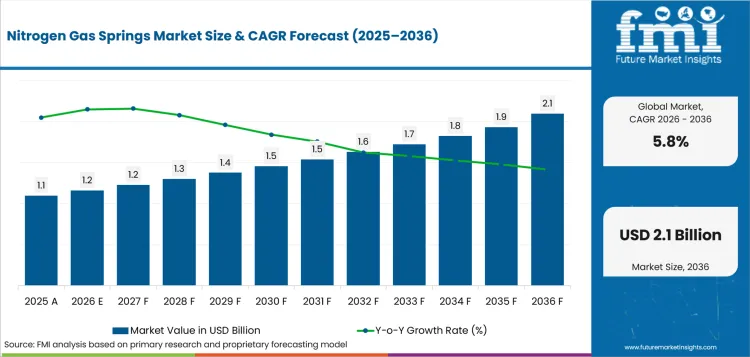
The nitrogen gas springs market is projected to advance from USD 1.1 billion in 2025 to USD 2.1 billion by 2036 at a 5.8% CAGR, driven by compact force delivery needs in press dies and high-cycle stamping tools, with push type springs holding 72.0% share and press tooling contributing 36.5% share as manufacturers focus on safer die motion and faster service access
Key Takeaways, Market Size, and Forecast
| Metric | Value |
|---|---|
| Market Size (2026) | USD 1.2 Billion |
| Market Size (2036) | USD 2.1 Billion |
| Forecast CAGR | 5.8% from 2026 to 2036 |
| Leading Product Type | Push Type Springs |
| Push Type Springs Share In 2026 | 72.0% |
| Leading Application | Press Tooling |
| Press Tooling Share In 2026 | 36.5% |
| Fastest-Growing Country | China |
| China CAGR | 8.6% through 2036 |
Summary of the Nitrogen Gas Springs Market
- Demand and Growth Drivers
- Press tool builders use nitrogen gas springs as compact force units in dies needing stable lift action.
- Automotive stamping plants create repeat demand as body panel dies need controlled stripping and return force.
- Manifold systems gain use in larger dies as several cylinders need one pressure control point.
- Product and Segment View
- Push type springs are expected to stay the leading product type segment, driven by broad use in press die return and stripping functions.
- Press tooling is likely to lead application demand, due to nitrogen gas spring use across die lifting and controlled force operations.
- Standalone spring formats are expected to retain value importance as simple replacement needs and easier service access guide buyer selection.
- Geography and Competitive Outlook
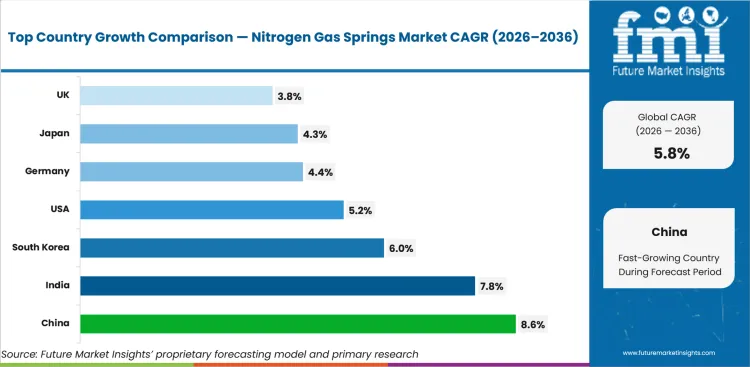
- China is expected to record a CAGR of 8.6% through 2036, driven by local stamping and automation investment.
- India is projected to expand at 7.8% CAGR by 2036, as domestic vehicle production and tooling capacity expand.
- DADCO and Special Springs focus on catalog range and safety design.
- Suppliers combining force range breadth with fast replacement access are strengthening positions during the forecast period.
- Analyst Opinion
- Nikhil Kaitwade, Principal Consultant for Industrial Automation at FMI says, “Nitrogen gas springs support die force control as stamping lines replace coil springs. Press shop engineers prioritize force rating and stroke length. They also check safety venting and fitment guidance. Changeover plants need repairable cylinders and clear charging labels. They also need cross-reference support to limit stoppages.”
- Nitrogen Gas Springs Market Value Analysis
- Nitrogen gas springs are moving beyond simple spring replacement and becoming planned force-control parts in press tool design.
- Stamping die programs are increasing use as compact cylinders deliver controlled return force across repeated press operations.
- Industrial machinery use is expanding as equipment makers need adjustable force performance within tight installation spaces.
- Safety venting and planned replacement cycles are strengthening demand across high-cycle manufacturing plants.
Press tool makers use nitrogen gas springs to deliver controlled force during repeated die cycles. ISO 11901-1:2025 was published in March 2025 and defines nitrogen gas springs for press tools from type 900 to type 100,000. The standard lists nominal initial force from 900 N ±5% to 100,600 N ±5%. These specifications help OEMs and die builders compare catalog products more consistently. DADCO’s July 2024 safety bulletin states that its EU catalog gas springs include over-speed, over-pressure, and overstroke protection. The same bulletin recommends at least 10% stroke reserve to prevent over-travelling and improve performance. DADCO’s March 2024 WKP electronic pressure switch sheet lists a 0 to 400 bar measuring range with ±4 bar accuracy. The switch supports easier pressure checks during press tool operation.
Nitrogen Gas Springs Market Definition
Nitrogen gas springs are sealed cylinders filled with compressed nitrogen for controlled force delivery in press tools. Products covered include push type springs, pull type springs, manifold-ready cylinders, and hose-connected systems. Main uses include press tooling, automotive stamping, aerospace tooling, furniture systems, and industrial machinery. Scope excludes vehicle tailgate gas struts, chair lift cylinders, coil springs, and nitrogen generators.
Nitrogen Gas Springs Market Inclusions
Market scope covers commercially traded nitrogen gas springs categorized by product type, force output, application, installation format, and sales channel. Product scope includes push type springs and pull type springs for press tooling applications, with adjacent review of demand for metal forming fluids used to assess metal forming activity. Revenue scope covers 2026 to 2036 across direct sales, distributor supply, and online replacement channels. Key participants include nitrogen gas spring manufacturers, die makers, stamping plants, industrial machinery builders, tooling service providers, regional distributors, and maintenance teams. Forecast assessment considers die casting services industry analysis as casting and forming supply chains influence tooling component demand.
Nitrogen Gas Springs Market Exclusions
Scope excludes automotive lift struts, furniture lift cylinders, ordinary coil springs, hydraulic cylinders, nitrogen generators, and charging stations sold as separate equipment.
Nitrogen Gas Springs Market Research Methodology
- Primary Research: FMI analysts reviewed inputs from die makers, stamping suppliers, industrial spring distributors, and machinery service providers in key markets.
- Desk Research: Research combined supplier catalogs, ISO gas spring specifications, metalworking indicators, and public automotive production data.
- Market sizing and forecasting: Forecasting added cylinder use rates across tooling applications and checked country demand against automotive output.
- Data validation: Estimates were cross-checked every quarter using supplier portfolio breadth, press tooling demand, and replacement ordering patterns.
Why is the Nitrogen Gas Springs Market Growing?
- Stamping die builders use nitrogen gas springs to obtain high force inside restricted die spaces.
- Automotive body panel programs need repeatable lift and strip action across long production cycles.
- Manifold systems help large tools maintain even force across several spring positions.
- Repairable cylinder designs reduce replacement frequency for press shops using high cycle tooling.
Press tool designers are choosing nitrogen gas springs for compact force delivery across modern dies. ISO guidance positions nitrogen gas springs as standardized force parts for press tool design. This helps tool designers select cylinders based on die load needs without relying on bulky coil spring layouts. Compression gas spring industry analysis reflects buyer interest in compact force systems across adjacent uses. Suppliers with broad cylinder ranges and clear fitment data can capture repeat orders during die rebuild cycles.
Factory automation raises the need for stable force control in press cells. The International Federation of Robotics reported 542,076 industrial robot installations for 2024 in its World Robotics 2025 executive summary. Automated cells need predictable tool action and safe maintenance access inside crowded work areas. Nitrogen gas springs fit these cells through compact bodies and adjustable charge pressure. Demand for suppliers with cylinders and service guidance improves as press shops reduce manual setup time.
Market Segmentation Analysis
- Push type springs are projected to represent 72.0% of product type share in 2026 as press dies rely on upward return force during stripping work.
- Across force output, the 5,000 N to 20,000 N range is expected to hold 41.0% share in 2026 as medium stamping tools need balanced lift and cylinder size.
- Press tooling is forecast to capture 36.5% application share in 2026 as die builders use nitrogen gas springs for lifting and controlled part release.
- Standalone springs are estimated to hold 58.5% of installation format share in 2026 as standard tools favor simple placement and easier service access.
- Direct sales are projected to contribute 61.0% of channel share in 2026 as tool shops seek force matching and fitment guidance before ordering.
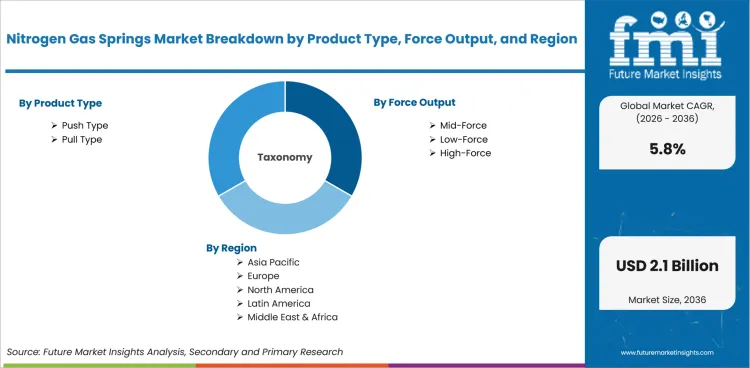
The market for nitrogen gas springs is divided into groups based on product type, force output, application, installation format, sales channel, and region. Product type includes push type springs and pull type springs. By force output, the market includes below 5,000 N, 5,000 N to 20,000 N, and above 20,000 N. By application, the market covers press tooling, automotive stamping, aerospace tooling, industrial machinery, and furniture systems. Based on installation format, it includes standalone springs, manifold systems, and hose systems. By sales channel, the market includes direct sales, distributors, and online sales. Regional assessment covers North America, Latin America, Europe, East Asia, South Asia and Pacific, Middle East and Africa. Demand patterns are assessed with adjacent references such as press machine market outlook and industrial robotics industry analysis, as tooling automation and press equipment use shape product selection.
Insights into Nitrogen Gas Springs Market by Product Type
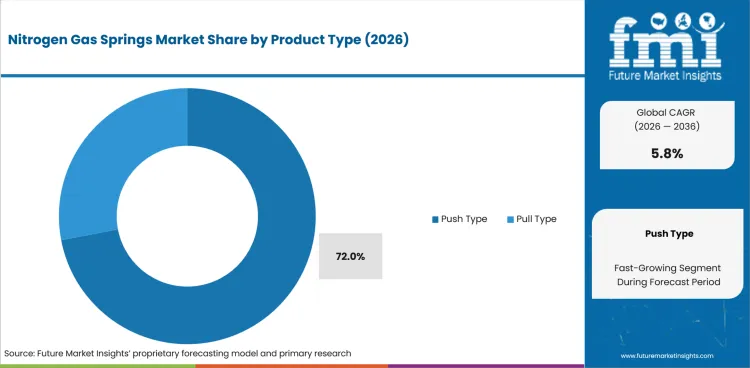
- In 2026, push type springs are expected to make up 72.0% of the product type segment. Push designs suit press dies needing upward force return across stripping and lifting operations.
- Pull type springs serve selected machine layouts needing controlled tension force. Their use improves in compact assemblies requiring reverse-motion force inside limited tool space.
Insights into Nitrogen Gas Springs Market by Force Output
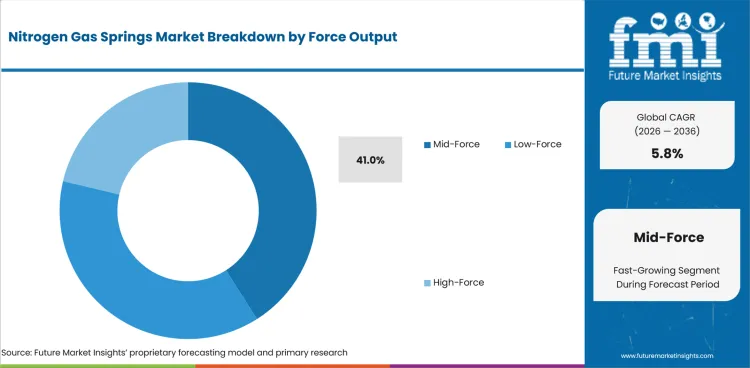
- Mid-force springs are projected to account for 41.0% of the force output segment in 2026. Medium-duty tools need balanced cylinder sizing across common stamping and forming applications.
- Low-force products serve light fixtures and small press tools. High-force products address deep-draw dies and heavy tooling needing stronger mounting discipline.
Insights into Nitrogen Gas Springs Market by Application
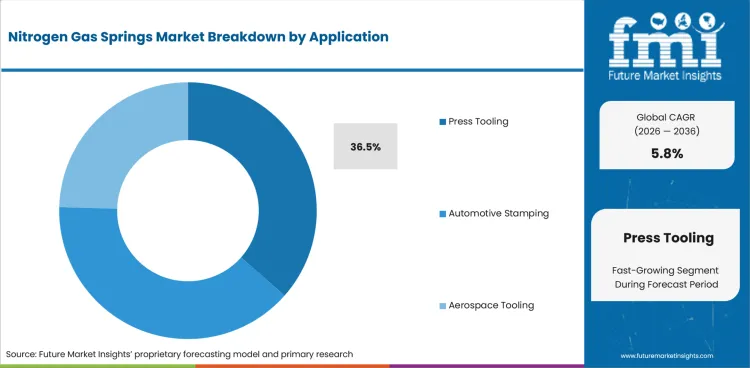
- Press tooling is expected to account for 36.5% of the application segment in 2026. Die makers use nitrogen gas springs for controlled lift and reliable strip action.
- Automotive stamping and industrial machinery applications create recurring replacement demand. Their use improves as tool rooms seek compact force systems for repeat operations.
Insights into Nitrogen Gas Springs Market by Installation Format
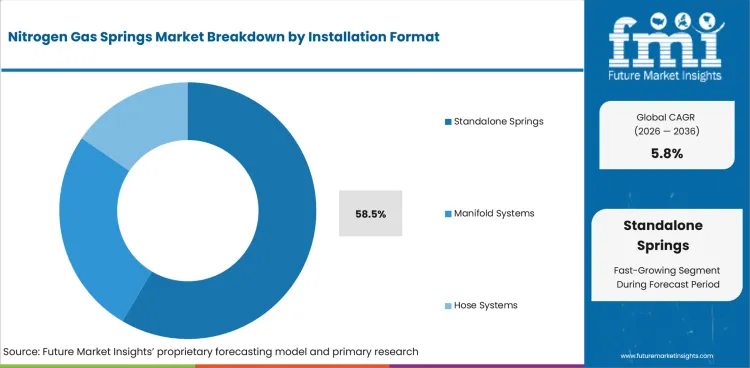
- Standalone springs are estimated to account for 58.5% of the installation format segment in 2026. Standard dies use these units for simple replacement and easier maintenance access.
- Manifold and hose systems address larger dies requiring shared pressure control. Their value improves in tools needing balanced force across several cylinder positions.
Insights into Nitrogen Gas Springs Market by Sales Channel
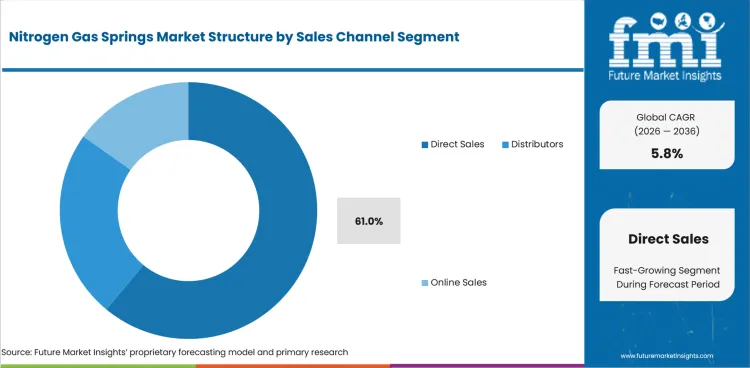
- Direct sales are projected to hold 61.0% of the sales channel segment in 2026. Large buyers prefer direct sourcing for force matching and application-specific guidance.
- Distributor sales serve smaller replacement orders requiring faster local access. Online sales address standard sizes used by maintenance teams and tool repair shops.
Nitrogen Gas Springs Market Drivers, Restraints and Opportunities
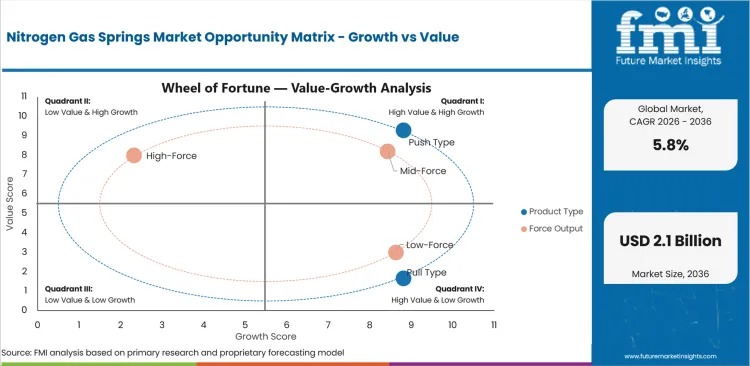
- Driver: Press tool continuity keeps nitrogen gas spring replacement orders active as die shops cannot afford unstable force return during production cycles.
- Restraint: Steel scrap and energy cost volatility can keep spring hardware and charging service prices firm during maintenance planning.
- Opportunity: Safer charging service and pressure monitoring create supplier differentiation for stamping plants seeking lower die downtime.
Nitrogen gas spring demand is linked to press tools requiring repeatable force and safe part release. United States Geological Survey reported in February 2026, No. 1 heavy melting steel scrap averaged US$319.00 per ton in 2025, up from US$314.85 per ton in 2024. Steel-intensive cylinders and mounting parts make this cost signal important for gas spring pricing. Buyers now compare replacement price with service life and fitment reliability. Suppliers with controlled steel sourcing and short delivery systems can protect share during maintenance cycles.
Steel Scrap Volatility and Spring Hardware Pricing
Spring hardware pricing is most exposed when machined steel parts carry tight tolerance needs. United States Geological Survey reported in February 2026, monthly No. 1 heavy melting steel scrap prices ranged from US$366.26 per ton in March 2025 to US$303.46 per ton in November 2025. This spread affects cylinder bodies and mounting hardware used in nitrogen gas spring assemblies. Tool shops may delay non-urgent replacements during price uncertainty. Suppliers must manage steel purchasing and quote validity before setting replacement package prices.
Energy Nitrogen Charging and Service Analysis
Charging service economics add a second pricing pressure for nitrogen gas spring suppliers. United States Energy Information Administration reported in February 2026, Henry Hub natural gas spot prices averaged US$3.52 per MMBtu in 2025, up 56.0% from 2024. Nitrogen production and distribution rely on energy cost conditions. High-pressure charging is often bundled with inspection and seal replacement. Service providers can protect margins through defined recharge terms and narrower quote windows.
Competitive Landscape and Strategic Positioning
Nitrogen Gas Springs Market Analysis By Company
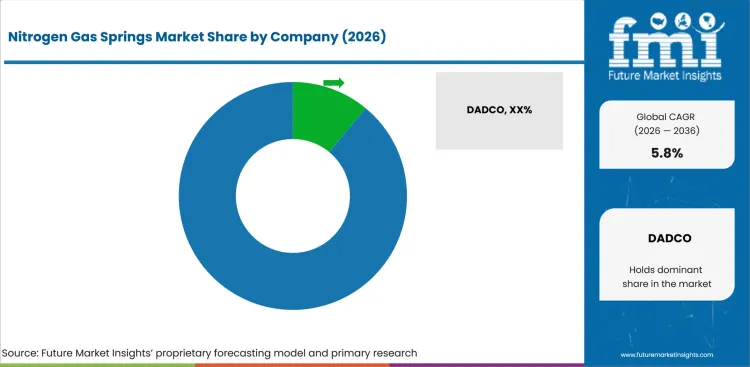
Nitrogen gas springs competition is shaped by force range coverage and press tooling safety requirements. Global suppliers compete on catalog depth and documented safety performance for die builders across stamping programs.
- DADCO leads through broad force range coverage and strong safety design for press tooling applications.
- KALLER and HYSON compete on premium gas spring systems and die application expertise for press tool buyers.
- FIBRO and Special Springs serve standard parts buyers through catalog range and European tooling access.
- AZOLGAS and Bordignon provide standard parts buyers with access to catalog ranges and European tooling.
DADCO holds a visible position through safety features and broad catalog availability across tool and die applications. KALLER builds its position through nitrogen gas springs and gas hydraulic suspension expertise for press tool buyers. HYSON adds USA service strength and product visibility across stamping operations. FIBRO and Special Springs build demand through standard parts catalogs and ISO-compatible product lines.
High component cost and precise fitment requirements create barriers across existing die pockets. Competitive priorities center on force range breadth and fast replacement access across tooling clusters. Buyers prefer suppliers with mechanical safety features and clear service instructions. Suppliers with stronger stock visibility near tooling clusters are positioned to reduce downtime risk and win repeat orders.
Key Companies in the Nitrogen Gas Springs Market
Key global companies active in the nitrogen gas springs market include:
- DADCO, KALLER, and HYSON have strong gas spring portfolios for press tooling and automotive stamping.
- FIBRO, Special Springs, and AZOLGAS compete over standard parts catalogs and European tooling access.
- Bordignon serves buyers through nitrogen gas springs and related accessories for press tool applications.
Competitive Benchmarking: Nitrogen Gas Springs Market
| Company | Force Range Breadth | Die Safety Features | Service Access |
|---|---|---|---|
| DADCO | High | High | Strong |
| KALLER | High | High | Strong |
| HYSON | High | High | Strong |
| FIBRO | Medium | High | Strong |
| Special Springs | High | High | Moderate |
| AZOLGAS | Medium | High | Moderate |
| Bordignon | Medium | Medium | Moderate |
Source: Future Market Insights, 2026.
Key Developments in Nitrogen Gas Springs Market
- In November 2025, DADCO’s Bulletin No. B25100 introduced the DGB.160 Nitrogen Gas Booster System. The compact booster is designed to raise low-pressure nitrogen supply tanks to suitable gas spring filling pressure. The bulletin identifies it as a nitrogen gas spring accessory and states it can support maintenance and charging operations for press-tool gas spring users.
- In September 2025, Hyson announced its “Back to Black” transition for Hyson Gas Springs. The company stated that the black finish uses a refined surface treatment process. Hyson also stated that part numbers, dimensions and specifications remain unchanged.
Key Players in the Nitrogen Gas Springs Market
Major Global Players
- DADCO
- KALLER
- HYSON
- FIBRO
- Special Springs
- AZOLGAS
- Bordignon
Specialist Players
- Nitrogas
- MDL Europe
- Quiri
- Barnes Group
- Misumi
Analysis of Nitrogen Gas Springs Market By Key Countries
.webp "Top Country Growth Comparison Nitrogen Gas Springs Market Cagr (2026 2036)")
| Country | CAGR |
|---|---|
| China | 8.6% |
| India | 7.8% |
| South Korea | 6.0% |
| USA | 5.2% |
| Germany | 4.4% |
| Japan | 4.3% |
| UK | 3.8% |
Source: Future Market Insights, 2026.
Demand Outlook for Nitrogen Gas Springs Market in China
Fastest-growing country market · 2026 to 2036
Country Market Snapshot Table
| Parameter | Value |
|---|---|
| Market Size in 2025 (Value) | USD 0.25 billion |
| Market Forecast in 2036 (Value) | USD 0.62 billion |
| CAGR (2026-2036) | 8.6% |
| Years Considered | 2021-2036 |
| Base Year | 2025 |
| Forecast Period | 2026-2036 |
| Units Considered | Value (USD Bn) |
| Leading Sub-Region | Guangdong |
Demand Outlook for Nitrogen Gas Springs Industry in China
The significance of the Nitrogen Gas Springs Industry in China starts with its vehicle and machinery production base across Guangdong and Jiangsu. Domestic die makers use gas springs in press tools serving automotive panels and electronics housings. Local buyers compare China nitrogen gas spring market outlook with stamping capacity plans before placing replacement orders.
China’s automation base increases the need for stable die action and safe service routines. Robotized press lines in Guangdong and Zhejiang need force parts with predictable stroke behavior. Local distributors gain from stocking standard push-type cylinders near stamping clusters and tool repair shops.
Key Growth Drivers
- OICA’s 2024 production table listed China at 31,281,592 vehicles. This supports cylinder replacement volume across Guangdong stamping clusters.
- The International Federation of Robotics reported that China accounted for 54% of global industrial robot installations in 2024. This supports manifold-ready demand in Jiangsu press automation.
- Zhejiang electronics tooling uses small press dies needing accurate spring force across short production runs.
- Shanghai automotive programs favor direct supplier advice as replacement cylinders must match existing die pockets.
Key Restraints
- The National Bureau of Statistics of China reported the May 2026 new export order index at 48.6. This indicates weaker export-facing order conditions for spare part planning.
- Inland tool shops in Henan often prioritize lower-cost coil springs for simple dies with low duty cycles.
- Smaller distributors in Sichuan face service gaps as charging tools and seal kits are less available.
What makes China unique
China combines the largest vehicle output base with the leading robot installation share among major manufacturing countries.
Key Companies
- KALLER China
- DADCO China
- HYSON Asia distributors
- FIBRO Shanghai
- Special Springs China
Sales & Marketing Channels
- Direct technical sales to Guangdong die makers
- Distributor supply through Shanghai toolmaking clusters
- Online catalog inquiry for standard replacement cylinders
Country Segment Breakdown Table
| Segment | Sub-Segments |
|---|---|
| By Product Type | Push Type · Pull Type |
| By Force Output | Below 5,000 N · 5,000 N to 20,000 N · Above 20,000 N |
| By Application | Press Tooling · Automotive Stamping · Aerospace Tooling · Industrial Machinery · Furniture Systems |
| By Installation Format | Standalone Springs · Manifold Systems · Hose Systems |
| By Sales Channel | Direct Sales · Distributors · Online Sales |
| Key Sub-Regions Covered, Provinces / Municipalities | Guangdong, Jiangsu, Zhejiang, Shanghai, Shandong, Chongqing, Hubei, Tianjin |
Frequently Asked Questions
How fast is China's nitrogen gas springs market growing?
China’s nitrogen gas springs market is projected to expand at 8.6% CAGR from 2026 to 2036.
Who leads the China nitrogen gas springs market?
KALLER, DADCO, FIBRO, and Special Springs hold strong positions through catalog access and local distributor networks.
What is driving industry outlook in China?
Vehicle output, robotized press cells, and die repair demand across Guangdong and Jiangsu drive cylinder use.
Sales Analysis of Nitrogen Gas Springs Industry in India
Fast-expanding tooling base · 2026 to 2036
Country Market Snapshot Table
| Parameter | Value |
|---|---|
| Market Size in 2025 (Value) | USD 0.06 billion |
| Market Forecast in 2036 (Value) | USD 0.14 billion |
| CAGR (2026-2036) | 7.8% |
| Years Considered | 2021-2036 |
| Base Year | 2025 |
| Forecast Period | 2026-2036 |
| Units Considered | Value (USD Bn) |
| Leading Sub-Region | Maharashtra |
Sales Analysis of Nitrogen Gas Springs Industry in India
India’s demand base is centered on automotive and industrial tooling clusters in Maharashtra and Tamil Nadu. It is supported by similar tooling clusters in the Gujarat region. Domestic tool rooms are moving toward compact die systems for higher precision stamping. Growing demand for metal stampings improves replacement prospects for nitrogen gas springs.
India’s tooling buyers often balance price with service access. Local distributors near Pune and Chennai gain advantage through fast replacement and installation guidance. Direct imports serve premium press tools. Domestic stocking is important for downtime-sensitive plants.
Key Growth Drivers
- OICA’s 2024 production table listed India at 6,014,691 vehicles. This supports toolroom demand across Pune and Chennai vehicle clusters.
- The Society of Indian Automobile Manufacturers reported 0.77 million passenger vehicle exports in FY 2024 to 2025. Export programs therefore support higher press tool quality requirements.
- Gujarat machinery plants use mid-force cylinders as tool shops add compact press tooling for parts production.
- Bengaluru aerospace suppliers favor certified gas springs as tool reliability affects precision component output.
Key Restraints
- OICA’s 2024 production table showed India vehicle output rose 3% year over year. Smaller Faridabad tool shops may still delay gas spring conversion.
- Price-sensitive buyers in Rajkot often select coil springs for low-cycle fixtures and simpler sheet metal tools.
- Service training gaps across tier-two clusters limit safe charging and rebuild activity for gas springs.
What makes India unique
India combines fast vehicle output expansion with toolroom localization across Pune, Chennai, and Gujarat.
Key Companies
- DADCO India distributors
- FIBRO India
- KALLER India representatives
- Special Springs India
- HYSON channel partners
Sales & Marketing Channels
- Direct sales to Pune and Chennai toolrooms
- Distributor supply through Gujarat machinery clusters
- Catalog-based replacement sales through industrial component dealers
Country Segment Breakdown Table
| Segment | Sub-Segments |
|---|---|
| By Product Type | Push Type · Pull Type |
| By Force Output | Below 5,000 N · 5,000 N to 20,000 N · Above 20,000 N |
| By Application | Press Tooling · Automotive Stamping · Aerospace Tooling · Industrial Machinery · Furniture Systems |
| By Installation Format | Standalone Springs · Manifold Systems · Hose Systems |
| By Sales Channel | Direct Sales · Distributors · Online Sales |
| Key Sub-Regions Covered, States / Industrial Zones | Maharashtra, Tamil Nadu, Gujarat, Karnataka, Haryana, Uttar Pradesh, Telangana, Rajasthan |
Frequently Asked Questions
How fast is India's nitrogen gas springs market growing?
India’s nitrogen gas springs market is projected to expand at 7.8% CAGR between 2026 and 2036.
Who leads the India nitrogen gas springs market?
FIBRO India, DADCO distributors, KALLER representatives, and Special Springs India serve premium and replacement demand.
What is driving industry outlook in India?
Vehicle production, export tooling needs, and local die repair capacity drive nitrogen gas springs demand.
Demand Analysis of Nitrogen Gas Springs Industry in South Korea
High-automation manufacturing market · 2026 to 2036
Country Market Snapshot Table
| Parameter | Value |
|---|---|
| Market Size in 2025 (Value) | USD 0.05 billion |
| Market Forecast in 2036 (Value) | USD 0.09 billion |
| CAGR (2026-2036) | 6.0% |
| Years Considered | 2021-2036 |
| Base Year | 2025 |
| Forecast Period | 2026-2036 |
| Units Considered | Value (USD Bn) |
| Leading Sub-Region | Ulsan |
Demand Analysis of Nitrogen Gas Springs Industry in South Korea
South Korea’s industry is shaped by automated vehicle plants and precision electronics tooling. Ulsan and Gyeonggi host buyers needing reliable gas springs for high-cycle press tools. Strong automation density makes service quality and safety documentation important purchasing factors.
Korean buyers value compact components with stable stroke behavior across fast production lines. Connected factories increase demand for predictable tool components. Suppliers offering manifold systems and fast local replacement gain preference.
Key Growth Drivers
- OICA’s 2024 production table listed South Korea at 4,127,252 vehicles. This supports replacement demand for high-cycle dies in Ulsan automotive plants.
- The International Federation of Robotics reported that South Korea held about 6% of global industrial robot installations in 2024. This supports automation fitment in Gyeonggi electronics tooling.
- Busan machinery suppliers use direct technical sales as tool designers need force rating guidance before ordering.
- Incheon distributors gain replacement orders as local plants need standard sizes during maintenance windows.
Key Restraints
- OICA’s 2024 production table showed South Korea vehicle output declined 3% year over year. The decrease can limit near-term die-build orders.
- Smaller Daegu tool shops face higher imported component costs across premium gas spring purchases.
- High automation raises failure cost, which makes unverified low-cost cylinders less acceptable in major plants.
What makes South Korea unique
South Korea links compact gas spring demand with automated vehicle and electronics tooling at high production intensity.
Key Companies
- KALLER Korea
- DADCO Korea partners
- HYSON distributors
- Special Springs Korea agents
- FIBRO Asia channel partners
Sales & Marketing Channels
- Direct supply to Ulsan automotive tool programs
- Distributor service through Gyeonggi industrial clusters
- Catalog replacement through Seoul-area tool suppliers
Country Segment Breakdown Table
| Segment | Sub-Segments |
|---|---|
| By Product Type | Push Type · Pull Type |
| By Force Output | Below 5,000 N · 5,000 N to 20,000 N · Above 20,000 N |
| By Application | Press Tooling · Automotive Stamping · Aerospace Tooling · Industrial Machinery · Furniture Systems |
| By Installation Format | Standalone Springs · Manifold Systems · Hose Systems |
| By Sales Channel | Direct Sales · Distributors · Online Sales |
| Key Sub-Regions Covered, Provinces / Municipalities | Ulsan, Gyeonggi, Busan, Incheon, Daegu, Gwangju, Changwon, Daejeon |
Frequently Asked Questions
How fast is South Korea's nitrogen gas springs industry growing?
South Korea’s nitrogen gas springs industry is projected to expand at 6.0% CAGR from 2026 to 2036.
Who leads the South Korea nitrogen gas springs industry?
KALLER, DADCO, HYSON, Special Springs, and FIBRO channel partners serve high-cycle tooling buyers.
What is driving industry outlook in South Korea?
Automated vehicle plants and electronics tooling clusters drive demand for compact and safe force systems.
Opportunity Analysis of Nitrogen Gas Springs Industry in the USA
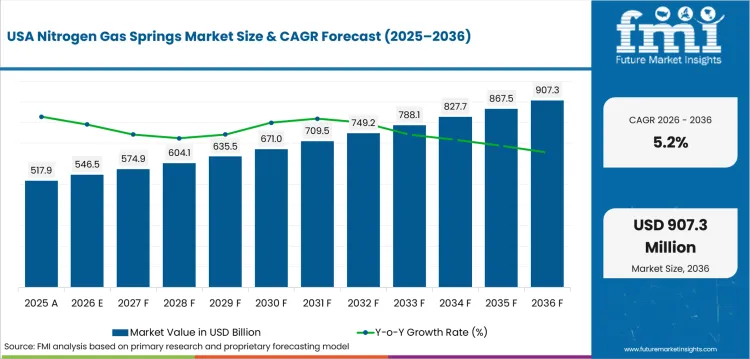
Large replacement market · 2026 to 2036
Country Market Snapshot Table
| Parameter | Value |
|---|---|
| Market Size in 2025 (Value) | USD 0.24 billion |
| Market Forecast in 2036 (Value) | USD 0.41 billion |
| CAGR (2026-2036) | 5.2% |
| Years Considered | 2021-2036 |
| Base Year | 2025 |
| Forecast Period | 2026-2036 |
| Units Considered | Value (USD Bn) |
| Leading Sub-Region | Michigan |
Opportunity Analysis of Nitrogen Gas Springs Industry in the USA
USA demand is concentrated in Midwest stamping and machinery plants using established die maintenance systems. Michigan and Ohio buyers need fast replacement access for nitrogen gas springs used in automotive panels. Premium suppliers benefit from direct service and safety training across major press shop accounts.
Replacement demand carries much of the USA opportunity as many plants rebuild tools instead of replacing entire dies. Machine safety industry analysis aligns with buyer focus on safer press shop operation. Service capability holds importance as failure in a production die can halt downstream assembly.
Key Growth Drivers
- OICA’s 2024 production table listed USA vehicle output at 10,562,188 units. This supports spring replacement demand across Michigan stamping plants.
- The International Federation of Robotics reported that the United States accounted for 6% of global industrial robot installations in 2024. This supports force-control needs in automated USA press operations.
- Ohio machinery builders use mid-force springs across metalworking tools and compact industrial fixtures.
- Tennessee vehicle plants favor direct supply as replacement matching reduces downtime during scheduled maintenance.
Key Restraints
- The Federal Reserve Bank of St. Louis listed the metalworking machinery manufacturing PPI at 165.367 for April 2026. That cost signal can constrain conversion plans.
- Small job shops in Indiana often select coil springs for low-volume dies and basic fixtures.
- Imported premium cylinders can face lead time risk across urgent replacement orders.
What makes the USA unique
USA demand is driven by a large die replacement base and strong premium supplier presence near automotive plants.
Key Companies
- DADCO
- HYSON
- KALLER USA
- FIBRO USA
- Special Springs North America
Sales & Marketing Channels
- Direct field sales to Michigan stamping plants
- Distributor inventory through Ohio tooling suppliers
- Repair and rebuild service via Midwest industrial channels
Country Segment Breakdown Table
| Segment | Sub-Segments |
|---|---|
| By Product Type | Push Type · Pull Type |
| By Force Output | Below 5,000 N · 5,000 N to 20,000 N · Above 20,000 N |
| By Application | Press Tooling · Automotive Stamping · Aerospace Tooling · Industrial Machinery · Furniture Systems |
| By Installation Format | Standalone Springs · Manifold Systems · Hose Systems |
| By Sales Channel | Direct Sales · Distributors · Online Sales |
| Key Sub-Regions Covered, States / Industrial Zones | Michigan, Ohio, Indiana, Tennessee, Kentucky, Texas, South Carolina, Alabama |
Frequently Asked Questions
How fast is the USA nitrogen gas springs market growing?
USA nitrogen gas springs market is projected to expand at 5.2% CAGR from 2026 to 2036.
Who leads the USA nitrogen gas springs market?
DADCO, HYSON, KALLER USA, FIBRO USA, and Special Springs North America lead through service access.
What is driving industry outlook in the USA?
Midwest die rebuild activity and automotive stamping demand drive replacement orders for nitrogen gas springs.
Future Outlook for Nitrogen Gas Springs Industry in Germany
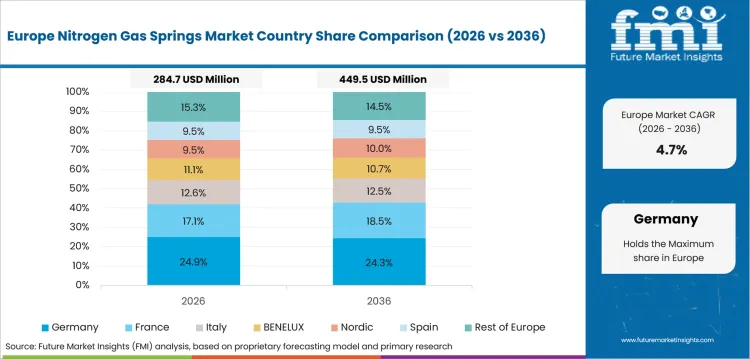
Premium tooling market · 2026 to 2036
Country Market Snapshot Table
| Parameter | Value |
|---|---|
| Market Size in 2025 (Value) | USD 0.11 billion |
| Market Forecast in 2036 (Value) | USD 0.18 billion |
| CAGR (2026-2036) | 4.4% |
| Years Considered | 2021-2036 |
| Base Year | 2025 |
| Forecast Period | 2026-2036 |
| Units Considered | Value (USD Bn) |
| Leading Sub-Region | Baden-Württemberg |
Future Outlook for Nitrogen Gas Springs Industry in Germany
Germany’s industry is centered on premium tooling and automotive production in Baden-Württemberg and Bavaria. Buyers expect gas springs with certified safety design and precise catalog documentation. Composite tooling revenue analysis helps frame precision tooling demand across advanced manufacturing.
German buyers place value on lifecycle service and safe press shop operation. Direct access to European suppliers improves fitment speed for standard and manifold systems. Mature vehicle output makes replacement cycles more important compared with new die demand.
Key Growth Drivers
- OICA’s 2024 production table listed Germany passenger car output at 4,069,222 units. This supports tooling demand for Baden-Württemberg tool builders.
- The International Federation of Robotics reported that Germany held about 5% of global industrial robot installations in 2024. This supports high-spec gas spring selection in automated German plants.
- Bavaria machinery producers use manifold systems for larger industrial forming tools requiring balanced force.
- North Rhine-Westphalia distributors benefit from spare part orders across mature metalworking plants.
Key Restraints
- OICA’s 2024 production table showed Germany vehicle output declined 1% year over year. This can constrain new die orders.
- High labor cost in Baden-Württemberg raises service cost for spring rebuild and installation work.
- Strict safety expectations limit low-cost entrants lacking documentation for press tool use.
What makes Germany unique
Germany combines precision die standards with strong European supplier access for premium gas spring systems.
Key Companies
- FIBRO
- KALLER Germany
- DADCO Europe
- Special Springs Germany
- Bordignon distributors
Sales & Marketing Channels
- Direct sales to Baden-Württemberg tool builders
- Distributor service through North Rhine-Westphalia
- Technical catalog supply through Bavaria machinery networks
Country Segment Breakdown Table
| Segment | Sub-Segments |
|---|---|
| By Product Type | Push Type · Pull Type |
| By Force Output | Below 5,000 N · 5,000 N to 20,000 N · Above 20,000 N |
| By Application | Press Tooling · Automotive Stamping · Aerospace Tooling · Industrial Machinery · Furniture Systems |
| By Installation Format | Standalone Springs · Manifold Systems · Hose Systems |
| By Sales Channel | Direct Sales · Distributors · Online Sales |
| Key Sub-Regions Covered, States / Industrial Zones | Baden-Württemberg, Bavaria, North Rhine-Westphalia, Lower Saxony, Saxony, Hesse, Saarland, Bremen |
Frequently Asked Questions
How fast is Germany's nitrogen gas springs industry growing?
Germany’s nitrogen gas springs industry is projected to expand at 4.4% CAGR from 2026 to 2036.
Who leads the Germany nitrogen gas springs industry?
FIBRO, KALLER, DADCO Europe, and Special Springs serve premium tooling and replacement demand.
What is driving industry outlook in Germany?
Precision tooling, safety expectations, and mature metalworking plants drive demand across German industrial regions.
Demand Outlook for Nitrogen Gas Springs Market in Japan
Precision manufacturing industry · 2026 to 2036
Country Market Snapshot Table
| Parameter | Value |
|---|---|
| Market Size in 2025 (Value) | USD 0.08 billion |
| Market Forecast in 2036 (Value) | USD 0.13 billion |
| CAGR (2026-2036) | 4.3% |
| Years Considered | 2021-2036 |
| Base Year | 2025 |
| Forecast Period | 2026-2036 |
| Units Considered | Value (USD Bn) |
| Leading Sub-Region | Aichi |
Demand Outlook for Nitrogen Gas Springs Industry in Japan
The demand for nitrogen gas springs in Japan is shaped by precision vehicle tooling and industrial machinery in Aichi and Shizuoka. Buyers focus on stable stroke behavior and long service life in compact press dies. Demand connects with press brakes as sheet metal forming equipment uses precise force control.
Japan’s mature manufacturing base favors premium replacement parts with proven safety features. Tool shops in Osaka and Kanagawa use direct supplier advice for exact force matching. Conservative replacement behavior keeps growth measured, and high-value plants continue to buy certified gas springs.
Key Growth Drivers
- OICA’s 2024 production table listed Japan at 8,234,681 vehicles. This supports replacement orders for reliable die force in Aichi automotive tooling.
- The International Federation of Robotics reported that Japan held about 8% of global industrial robot installations in 2024. This supports compact cylinder use in press tool upgrades.
- Shizuoka machinery makers use mid-force gas springs in precision fixtures and forming tools.
- Osaka distributors serve standard replacement sizes for tool repair shops needing short delivery cycles.
Key Restraints
- OICA’s 2024 production table showed Japan vehicle output declined by about 8.5% year over year. Lower output can constrain new die activity.
- Conservative buying in Kanagawa limits switching from proven coil spring layouts in low-duty fixtures.
- Premium imported cylinders face approval delays in plants with strict supplier qualification rules.
What makes Japan unique
Japan’s gas spring demand centers on precision tooling with high reliability expectations and cautious supplier qualification.
Key Companies
- KALLER Japan
- DADCO Japan distributors
- FIBRO Japan
- HYSON Asia partners
- Special Springs agents
Sales & Marketing Channels
- Direct service to Aichi automotive toolrooms
- Distributor supply through Osaka machinery channels
- Catalog replacement ordering through Kanagawa industrial suppliers
Country Segment Breakdown Table
| Segment | Sub-Segments |
|---|---|
| By Product Type | Push Type · Pull Type |
| By Force Output | Below 5,000 N · 5,000 N to 20,000 N · Above 20,000 N |
| By Application | Press Tooling · Automotive Stamping · Aerospace Tooling · Industrial Machinery · Furniture Systems |
| By Installation Format | Standalone Springs · Manifold Systems · Hose Systems |
| By Sales Channel | Direct Sales · Distributors · Online Sales |
| Key Sub-Regions Covered, Prefectures / Industrial Zones | Aichi, Shizuoka, Osaka, Kanagawa, Saitama, Hiroshima, Fukuoka, Tochig |
Frequently Asked Questions
How fast is Japan's nitrogen gas springs industry growing?
Japan’s nitrogen gas springs industry is projected to expand at 4.3% CAGR from 2026 to 2036.
Who leads the Japan nitrogen gas springs industry?
KALLER, DADCO, FIBRO, HYSON partners, and Special Springs agents serve Japan’s tooling base.
What is driving industry outlook in Japan?
Precision vehicle tooling and high automation needs drive replacement demand in Aichi and nearby industrial zones.
In-depth Analysis of Nitrogen Gas Springs Industry in the UK
Specialized manufacturing market · 2026 to 2036
Country Market Snapshot Table
| Parameter | Value |
|---|---|
| Market Size in 2025 (Value) | USD 0.04 billion |
| Market Forecast in 2036 (Value) | USD 0.06 billion |
| CAGR (2026-2036) | 3.8% |
| Years Considered | 2021-2036 |
| Base Year | 2025 |
| Forecast Period | 2026-2036 |
| Units Considered | Value (USD Bn) |
| Leading Sub-Region | West Midlands |
In-depth Analysis of Nitrogen Gas Springs Industry in the UK
UK demand is concentrated around West Midlands automotive tooling and aerospace supply chains. Buyers need safe replacement access and documentation for press tools used in lower-volume production.
UK manufacturing plants often use gas springs in replacement cycles instead of new high-volume die builds. Aerospace and motorsport tooling near Midlands clusters raises demand for precise force control. Lower vehicle output keeps market expansion controlled, with service quality driving supplier choice.
Key Growth Drivers
- SMMT’s January 2025 production update listed UK vehicle production at 905,233 units for 2024. This supports replacement demand for West Midlands toolrooms.
- SMMT’s January 2025 production update showed UK commercial vehicle output increased 4.0% in 2024. This offers some support for tool service demand.
- Midlands aerospace suppliers use certified cylinders for fixtures needing compact force and careful documentation.
- Sunderland and Oxford vehicle programs need quick replacement channels during press tool maintenance.
Key Restraints
- SMMT’s January 2025 production update showed total UK vehicle production fell 11.8% in 2024. Lower output can constrain cylinder volume.
- Smaller Midlands tool shops face higher imported component cost for premium gas spring replacements.
- Brexit-related customs steps can slow urgent replacement orders for non-stocked European spring models.
What makes the UK unique
UK demand is specialized around replacement service, aerospace tooling, and smaller automotive production programs.
Key Companies
- KALLER UK
- DADCO UK distributors
- FIBRO UK partners
- Special Springs UK agents
- HYSON channel partners
Sales & Marketing Channels
- Direct supply to West Midlands toolrooms
- Distributor service through Sunderland and Oxford clusters
- Technical catalog sales through aerospace tooling channels
Country Segment Breakdown Table
| Segment | Sub-Segments |
|---|---|
| By Product Type | Push Type · Pull Type |
| By Force Output | Below 5,000 N · 5,000 N to 20,000 N · Above 20,000 N |
| By Application | Press Tooling · Automotive Stamping · Aerospace Tooling · Industrial Machinery · Furniture Systems |
| By Installation Format | Standalone Springs · Manifold Systems · Hose Systems |
| By Sales Channel | Direct Sales · Distributors · Online Sales |
| Key Sub-Regions Covered, Nations / Industrial Zones | West Midlands, East Midlands, North East England, South East England, Wales, Scotland, Yorkshire, Greater Manchester |
Frequently Asked Questions
How fast is the UK nitrogen gas springs industry growing?
UK nitrogen gas springs industry is projected to expand at 3.8% CAGR from 2026 to 2036.
Who leads the UK nitrogen gas springs industry?
KALLER UK, DADCO distributors, FIBRO partners, and Special Springs agents serve specialist tooling demand.
What is driving industry outlook in the UK?
Replacement demand, aerospace tooling, and Midlands automotive clusters drive controlled uptake of nitrogen gas springs.
Report Scope and Coverage
| Parameter | Details |
|---|---|
| Market size by 2036 | USD 2.1 billion |
| Growth rate | 5.8% CAGR (2026-2036) |
| Forecast period | 2026 to 2036 |
| Base year value (2026) | USD 1.2 billion |
| By product type | Push Type Nitrogen Gas Springs, Pull Type Nitrogen Gas Springs |
| By force output | Below 5,000 N, 5,000 N to 20,000 N, Above 20,000 N |
| By application | Press Tooling, Automotive Stamping, Aerospace Tooling, Industrial Machinery, Furniture Systems |
| By installation format | Standalone Springs, Manifold Systems, Hose Systems |
| By sales channel | Direct Sales, Distributors, Online Sales |
| Regions covered | North America, Latin America, Europe, East Asia, South Asia and Pacific, Middle East and Africa |
| Countries covered | China, India, South Korea, USA, Germany, Japan, UK, and 30 plus countries |
| Key companies profiled | DADCO, KALLER, HYSON, FIBRO, Special Springs, AZOLGAS, Bordignon, Nitrogas, MDL Europe, Quiri |
| Approach | Hybrid bottom-up and top-down methodology starting with verified tooling demand, press application use rates, supplier portfolios, and replacement patterns across regions. |
Nitrogen Gas Springs Market Breakdown By Product Type, Force Output, Application, Installation Format, Sales Channel, And Region
Nitrogen Gas Springs Market Segmented by Product Type
- Push Type
- Pull Type
Nitrogen Gas Springs Market Segmented by Force Output
- Below 5,000 N
- 5,000 N to 20,000 N
- Above 20,000 N
Nitrogen Gas Springs Market Segmented by Application
- Press Tooling
- Automotive Stamping
- Aerospace Tooling
- Industrial Machinery
- Furniture Systems
Nitrogen Gas Springs Market Segmented by Installation Format
- Standalone Springs
- Manifold Systems
- Hose Systems
Nitrogen Gas Springs Market Segmented by Sales Channel
- Direct Sales
- Distributors
- Online Sales
Nitrogen Gas Springs Market by Region:
- North America
- USA
- Canada
- Mexico
- Latin America
- Brazil
- Chile
- Rest of Latin America
- Europe
- Germany
- UK
- Italy
- Spain
- France
- Rest of Europe
- East Asia
- China
- Japan
- South Korea
- South Asia and Pacific
- India
- ASEAN
- Australia and New Zealand
- Rest of South Asia and Pacific
- Middle East and Africa
- Saudi Arabia
- Other GCC Countries
- South Africa
- Rest of Middle East and Africa
Research Sources and Bibliography
- International Organization of Motor Vehicle Manufacturers. (2025, October). World motor vehicle production by country, region, and type. OICA.
- International Federation of Robotics. (2025, September). World Robotics 2025 report: Industrial robots executive summary. IFR.
- International Organization for Standardization. (2025, February). ISO 11901-1:2025: Tools for pressing, gas springs, Part 1: General specifications. ISO.
- USA Bureau of Labor Statistics. (2026, May 13). Producer Price Index by Industry: Metalworking Machinery Manufacturing [PCU3335133351]. Federal Reserve Bank of St. Louis.
- Society of Motor Manufacturers and Traders. (2025, January 30). Vehicle production dips amid EV transformation and intense market pressure. SMMT.
- Society of Indian Automobile Manufacturers. (2025, April 15). Auto industry sales performance of March 2025, Q4 2025, and April 2024 to March 2025. SIAM.
- Japan Automobile Manufacturers Association. (2025, September). The Motor Industry of Japan 2025. JAMA.
- HYSON. (2025, September 5). Press release - Back to Black. HYSON.
- HYSON. (2025, June 18). Product announcement: HYSON transitions surface finish from silver to black. HYSON.
- DADCO. (2024). Safe Design Features [Bulletin No. B22116A]. DADCO.
- DADCO. (2024). Electronic Pressure Switch - WKP [Bulletin No. B23110]. DADCO.
- National Bureau of Statistics of China. (2026, June 1). Purchasing Managers' Index for May 2026. NBS.
- USA Energy Information Administration. (2026, February 2). USA wholesale day-ahead electricity prices rose in 2025 with higher natural gas prices. EIA.
- USA Geological Survey. (2026, February). Iron and steel scrap: Mineral Commodity Summaries 2026. USGS.
- DADCO. (2025, November). Nitrogen Gas Booster System DGB.160 [Bulletin No. B25100]. DADCO.
This Report Answers
- What is the current and future size of the nitrogen gas springs market?
- How fast is the nitrogen gas springs market expected to expand between 2026 and 2036?
- Which product type is expected to lead the market by 2026?
- Which application segment is expected to account for the leading demand by 2026?
- What factors are driving demand for nitrogen gas springs globally?
- How are press tool design and stamping operations influencing adoption?
- Why are push type springs the main product base for buyers?
- How are manifold systems creating demand across larger die applications?
- Which countries are projected to record faster expansion through 2036?
- What is driving market expansion in China and India?
- Who are the key companies active in the nitrogen gas springs market?
- How does FMI estimate and validate the market forecast?
Frequently Asked Questions
What is the global market demand for Nitrogen Gas Springs in 2026?
In 2026, the global market for nitrogen gas springs is expected to be worth USD 1.2 billion.
How big will the market for Nitrogen Gas Springs be in 2036?
By 2036, the market for nitrogen gas springs is expected to be worth USD 2.1 billion.
How much is demand for Nitrogen Gas Springs expected to expand between 2026 and 2036?
Between 2026 and 2036, demand for nitrogen gas springs is expected to expand at a CAGR of 5.8%.
Which product type segment is likely to be the leading seller globally by 2026?
Push type springs will make up 72.0% of the product type segment in 2026.
What is causing demand to rise in China?
China nitrogen gas springs market is projected to record 8.6% CAGR through 2036, backed by vehicle output and factory automation.
What is causing demand to rise in India?
India nitrogen gas springs market is projected to expand at 7.8% CAGR through 2036, backed by local vehicle production and toolroom capacity.
What does this report mean by Nitrogen Gas Springs Market definition?
Nitrogen gas springs market includes sealed nitrogen-filled force cylinders used in press tools and industrial machinery.
How does FMI make the Nitrogen Gas Springs forecast and check it?
Forecasting models use a hybrid bottom-up and top-down approach, starting with tooling demand and checking it against application use patterns.
Preview the report firsthand - request a free sample
Get SampleGet the brochure for pricing and purchase details.
Get PDFTable of Content
- Key Takeaways
- Market Size and CAGR
- Top Growth Driver
- Fastest Growing Segment
- Leading Region
- Key Companies
- Emerging Opportunities
- Executive Summary
- Global Market Outlook
- Demand-side Trends
- Supply-side Trends
- Technology Roadmap Analysis
- Analysis and Recommendations
- Analyst Perspective (What is happening? Why now? What should investors know?)
- Key Questions Answered
- How large is the market?
- What is the CAGR?
- What are key trends?
- Which region dominates?
- Who are the leaders?
- Market Overview
- Market Coverage / Taxonomy
- Market Definition / Scope / Limitations
- Research Methodology
- Chapter Orientation
- Analytical Lens and Working Hypotheses
- Market Structure, Signals, and Trend Drivers
- Benchmarking and Cross-market Comparability
- Market Sizing, Forecasting, and Opportunity Mapping
- Research Design and Evidence Framework
- Desk Research Programme (Secondary Evidence)
- Expert Input and Fieldwork (Primary Evidence)
- Tooling, Models, and Reference Databases
- Data Engineering and Model Build
- Quality Assurance and Audit Trail
- Market Background
- Market Dynamics (Drivers, Restraints, Opportunity, Trends)
- Scenario Forecast (Optimistic, Likely, Conservative)
- Impact Analysis
- AI Impact
- Sustainability Impact
- Regulatory Impact
- Technology Impact
- Consumer / Buyer Analysis
- Purchase Drivers
- Adoption Barriers
- Buyer Journey
- Opportunity Map Analysis
- Product Life Cycle Analysis
- Supply Chain Analysis
- Investment Feasibility Matrix
- Value Chain Analysis
- PESTLE and Porter's Analysis
- Regulatory Landscape
- Regional Parent Market Outlook
- Production and Consumption Statistics
- Import and Export Statistics
- Global Market Analysis and Forecast, 2021 to 2036
- Historical Market Size Value (USD Billion) Analysis, 2021 to 2025
- Current and Future Market Size Value (USD Billion) Projections, 2026 to 2036
- Y-o-Y Growth Trend Analysis
- Absolute $ Opportunity Analysis
- Global Market Pricing Analysis, 2021 to 2036
- Global Market Analysis and Forecast, By Product Type, 2021 to 2036
- Introduction / Key Findings
- Historical Market Size Value (USD Billion) Analysis By Product Type, 2021 to 2025
- Current and Future Market Size Value (USD Billion) Analysis and Forecast By Product Type, 2026 to 2036
- Push Type
- Pull Type
- Push Type
- Y-o-Y Growth Trend Analysis By Product Type, 2021 to 2025
- Absolute $ Opportunity Analysis By Product Type, 2026 to 2036
- Global Market Analysis and Forecast, By Force Output, 2021 to 2036
- Introduction / Key Findings
- Historical Market Size Value (USD Billion) Analysis By Force Output, 2021 to 2025
- Current and Future Market Size Value (USD Billion) Analysis and Forecast By Force Output, 2026 to 2036
- 5,000 N to 20,000 N
- Below 5,000 N
- Above 20,000 N
- 5,000 N to 20,000 N
- Y-o-Y Growth Trend Analysis By Force Output, 2021 to 2025
- Absolute $ Opportunity Analysis By Force Output, 2026 to 2036
- Global Market Analysis and Forecast, By Application, 2021 to 2036
- Introduction / Key Findings
- Historical Market Size Value (USD Billion) Analysis By Application, 2021 to 2025
- Current and Future Market Size Value (USD Billion) Analysis and Forecast By Application, 2026 to 2036
- Press Tooling
- Automotive Stamping
- Aerospace Tooling
- Industrial Machinery
- Furniture Systems
- Press Tooling
- Y-o-Y Growth Trend Analysis By Application, 2021 to 2025
- Absolute $ Opportunity Analysis By Application, 2026 to 2036
- Global Market Analysis and Forecast, By Installation Format, 2021 to 2036
- Introduction / Key Findings
- Historical Market Size Value (USD Billion) Analysis By Installation Format, 2021 to 2025
- Current and Future Market Size Value (USD Billion) Analysis and Forecast By Installation Format, 2026 to 2036
- Standalone Springs
- Manifold Systems
- Hose Systems
- Standalone Springs
- Y-o-Y Growth Trend Analysis By Installation Format, 2021 to 2025
- Absolute $ Opportunity Analysis By Installation Format, 2026 to 2036
- Global Market Analysis and Forecast, By Sales Channel, 2021 to 2036
- Introduction / Key Findings
- Historical Market Size Value (USD Billion) Analysis By Sales Channel, 2021 to 2025
- Current and Future Market Size Value (USD Billion) Analysis and Forecast By Sales Channel, 2026 to 2036
- Direct Sales
- Distributors
- Online Sales
- Direct Sales
- Y-o-Y Growth Trend Analysis By Sales Channel, 2021 to 2025
- Absolute $ Opportunity Analysis By Sales Channel, 2026 to 2036
- Global Market Analysis and Forecast, By Region, 2021 to 2036
- Introduction
- Historical Market Size Value (USD Billion) Analysis By Region, 2021 to 2025
- Current Market Size Value (USD Billion) Analysis and Forecast By Region, 2026 to 2036
- North America
- Latin America
- Western Europe
- Eastern Europe
- East Asia
- South Asia and Pacific
- Middle East & Africa
- Market Attractiveness Analysis By Region
- North America Market Analysis and Forecast, By Country, 2021 to 2036
- Historical Market Size Value (USD Billion) Trend Analysis By Market Taxonomy, 2021 to 2025
- Market Size Value (USD Billion) Forecast By Market Taxonomy, 2026 to 2036
- By Country
- USA
- Canada
- By Product Type
- By Force Output
- By Application
- By Installation Format
- By Sales Channel
- By Country
- Market Attractiveness Analysis
- By Country
- By Product Type
- By Force Output
- By Application
- By Installation Format
- By Sales Channel
- Key Takeaways
- Latin America Market Analysis and Forecast, By Country
- Historical Market Size Value (USD Billion) Trend Analysis By Market Taxonomy, 2021 to 2025
- Market Size Value (USD Billion) Forecast By Market Taxonomy, 2026 to 2036
- By Country
- Brazil
- Mexico
- Chile
- Rest of Latin America
- By Product Type
- By Force Output
- By Application
- By Installation Format
- By Sales Channel
- By Country
- Market Attractiveness Analysis
- By Country
- By Product Type
- By Force Output
- By Application
- By Installation Format
- By Sales Channel
- Key Takeaways
- Western Europe Market Analysis and Forecast, By Country
- Historical Market Size Value (USD Billion) Trend Analysis By Market Taxonomy, 2021 to 2025
- Market Size Value (USD Billion) Forecast By Market Taxonomy, 2026 to 2036
- By Country
- Germany
- UK
- Italy
- Spain
- France
- Nordic
- BENELUX
- Rest of Western Europe
- By Product Type
- By Force Output
- By Application
- By Installation Format
- By Sales Channel
- By Country
- Market Attractiveness Analysis
- By Country
- By Product Type
- By Force Output
- By Application
- By Installation Format
- By Sales Channel
- Key Takeaways
- Eastern Europe Market Analysis and Forecast, By Country
- Historical Market Size Value (USD Billion) Trend Analysis By Market Taxonomy, 2021 to 2025
- Market Size Value (USD Billion) Forecast By Market Taxonomy, 2026 to 2036
- By Country
- Russia
- Poland
- Hungary
- Balkan & Baltic
- Rest of Eastern Europe
- By Product Type
- By Force Output
- By Application
- By Installation Format
- By Sales Channel
- By Country
- Market Attractiveness Analysis
- By Country
- By Product Type
- By Force Output
- By Application
- By Installation Format
- By Sales Channel
- Key Takeaways
- East Asia Market Analysis and Forecast, By Country
- Historical Market Size Value (USD Billion) Trend Analysis By Market Taxonomy, 2021 to 2025
- Market Size Value (USD Billion) Forecast By Market Taxonomy, 2026 to 2036
- By Country
- China
- Japan
- South Korea
- By Product Type
- By Force Output
- By Application
- By Installation Format
- By Sales Channel
- By Country
- Market Attractiveness Analysis
- By Country
- By Product Type
- By Force Output
- By Application
- By Installation Format
- By Sales Channel
- Key Takeaways
- South Asia and Pacific Market Analysis and Forecast, By Country
- Historical Market Size Value (USD Billion) Trend Analysis By Market Taxonomy, 2021 to 2025
- Market Size Value (USD Billion) Forecast By Market Taxonomy, 2026 to 2036
- By Country
- India
- ASEAN
- Australia & New Zealand
- Rest of South Asia and Pacific
- By Product Type
- By Force Output
- By Application
- By Installation Format
- By Sales Channel
- By Country
- Market Attractiveness Analysis
- By Country
- By Product Type
- By Force Output
- By Application
- By Installation Format
- By Sales Channel
- Key Takeaways
- Middle East & Africa Market Analysis and Forecast, By Country
- Historical Market Size Value (USD Billion) Trend Analysis By Market Taxonomy, 2021 to 2025
- Market Size Value (USD Billion) Forecast By Market Taxonomy, 2026 to 2036
- By Country
- Kingdom of Saudi Arabia
- Other GCC Countries
- Türkiye
- South Africa
- Other African Union
- Rest of Middle East & Africa
- By Product Type
- By Force Output
- By Application
- By Installation Format
- By Sales Channel
- By Country
- Market Attractiveness Analysis
- By Country
- By Product Type
- By Force Output
- By Application
- By Installation Format
- By Sales Channel
- Key Takeaways
- Key Countries Market Analysis
- USA
- Pricing Analysis
- Market Share Analysis, 2025
- By Product Type
- By Force Output
- By Application
- By Installation Format
- By Sales Channel
- Canada
- Pricing Analysis
- Market Share Analysis, 2025
- By Product Type
- By Force Output
- By Application
- By Installation Format
- By Sales Channel
- Mexico
- Pricing Analysis
- Market Share Analysis, 2025
- By Product Type
- By Force Output
- By Application
- By Installation Format
- By Sales Channel
- Brazil
- Pricing Analysis
- Market Share Analysis, 2025
- By Product Type
- By Force Output
- By Application
- By Installation Format
- By Sales Channel
- Chile
- Pricing Analysis
- Market Share Analysis, 2025
- By Product Type
- By Force Output
- By Application
- By Installation Format
- By Sales Channel
- Germany
- Pricing Analysis
- Market Share Analysis, 2025
- By Product Type
- By Force Output
- By Application
- By Installation Format
- By Sales Channel
- UK
- Pricing Analysis
- Market Share Analysis, 2025
- By Product Type
- By Force Output
- By Application
- By Installation Format
- By Sales Channel
- Italy
- Pricing Analysis
- Market Share Analysis, 2025
- By Product Type
- By Force Output
- By Application
- By Installation Format
- By Sales Channel
- Spain
- Pricing Analysis
- Market Share Analysis, 2025
- By Product Type
- By Force Output
- By Application
- By Installation Format
- By Sales Channel
- France
- Pricing Analysis
- Market Share Analysis, 2025
- By Product Type
- By Force Output
- By Application
- By Installation Format
- By Sales Channel
- India
- Pricing Analysis
- Market Share Analysis, 2025
- By Product Type
- By Force Output
- By Application
- By Installation Format
- By Sales Channel
- ASEAN
- Pricing Analysis
- Market Share Analysis, 2025
- By Product Type
- By Force Output
- By Application
- By Installation Format
- By Sales Channel
- Australia & New Zealand
- Pricing Analysis
- Market Share Analysis, 2025
- By Product Type
- By Force Output
- By Application
- By Installation Format
- By Sales Channel
- China
- Pricing Analysis
- Market Share Analysis, 2025
- By Product Type
- By Force Output
- By Application
- By Installation Format
- By Sales Channel
- Japan
- Pricing Analysis
- Market Share Analysis, 2025
- By Product Type
- By Force Output
- By Application
- By Installation Format
- By Sales Channel
- South Korea
- Pricing Analysis
- Market Share Analysis, 2025
- By Product Type
- By Force Output
- By Application
- By Installation Format
- By Sales Channel
- Russia
- Pricing Analysis
- Market Share Analysis, 2025
- By Product Type
- By Force Output
- By Application
- By Installation Format
- By Sales Channel
- Poland
- Pricing Analysis
- Market Share Analysis, 2025
- By Product Type
- By Force Output
- By Application
- By Installation Format
- By Sales Channel
- Hungary
- Pricing Analysis
- Market Share Analysis, 2025
- By Product Type
- By Force Output
- By Application
- By Installation Format
- By Sales Channel
- Kingdom of Saudi Arabia
- Pricing Analysis
- Market Share Analysis, 2025
- By Product Type
- By Force Output
- By Application
- By Installation Format
- By Sales Channel
- Türkiye
- Pricing Analysis
- Market Share Analysis, 2025
- By Product Type
- By Force Output
- By Application
- By Installation Format
- By Sales Channel
- South Africa
- Pricing Analysis
- Market Share Analysis, 2025
- By Product Type
- By Force Output
- By Application
- By Installation Format
- By Sales Channel
- USA
- Market Structure Analysis
- Competition Dashboard
- Competition Benchmarking
- Market Share Analysis of Top Players
- By Regional
- By Product Type
- By Force Output
- By Application
- By Installation Format
- By Sales Channel
- Emerging Startups
- Innovation Benchmarking
- Competition Analysis
- Competition Deep Dive
- DADCO
- Overview
- Product Portfolio
- Profitability by Market Segments
- Sales Footprint
- Strategy Overview
- Marketing Strategy
- Product Strategy
- Channel Strategy
- KALLER
- HYSON
- FIBRO
- Special Springs
- AZOLGAS
- Bordignon
- Nitrogas
- MDL Europe
- Quiri
- Barnes Group
- Misumi
- DADCO
- Case Studies
- Success Stories
- Recent Developments
- Competition Deep Dive
- Assumptions & Acronyms Used


