

- Industry Size (2025)
- USD 1.4 Bn
- Forecast (2035)
- USD 2.2 Bn
- CAGR (2025 to 2035)
- 4.7%
Demand for Automotive Gas Charged Shock Absorbers in the USA Forecast Outlook 2025 to 2035
The demand for automotive gas charged shock absorbers in the USA is projected to grow from USD 1.4 billion in 2025 to USD 2.2 billion by 2035, reflecting a compound annual growth rate (CAGR) of 4.7%. Gas charged shock absorbers are integral components in modern vehicles, ensuring ride comfort and stability by controlling the motion of the vehicle's suspension system. Their ability to adapt to varying road conditions and driving styles has made them popular across a wide range of vehicle types, from passenger cars to SUVs and light trucks.
Key drivers for the growth of automotive gas-charged shock absorbers include the increasing consumer demand for improved ride quality and vehicle performance, especially in premium and luxury vehicle segments. The shift towards SUVs, off-road vehicles, and electric vehicles (EVs) also contributes, as these vehicles require advanced suspension systems to manage their weight and ensure smooth driving experiences. Advancements in suspension technology, such as adaptive and electronically controlled shock absorbers, are enhancing vehicle stability, further driving adoption. Stringent safety and comfort regulations in the automotive industry also play a crucial role in the demand for these shock absorbers.
Quick Stats of the Demand for Automotive Gas Charged Shock Absorber in USA
- Demand for Automotive Gas Charged Shock Absorber in USA Value (2025): USD 1.4 billion
- Demand for Automotive Gas Charged Shock Absorber in USA Forecast Value (2035): USD 2.2 billion
- Demand for Automotive Gas Charged Shock Absorber in USA Forecast CAGR (2025-2035): 4.7%
- Demand for Automotive Gas Charged Shock Absorber in USA Leading Design Type: Twin
- Demand for Automotive Gas Charged Shock Absorber in USA Key Growth Regions: West USA, South USA, Northeast USA, Midwest USA
- Demand for Automotive Gas Charged Shock Absorber in USA Top Players: ZF Friedrichshafen AG, Tenneco Inc., KYB Corporation, Gabriel India Ltd., Hitachi Astemo, Ltd.
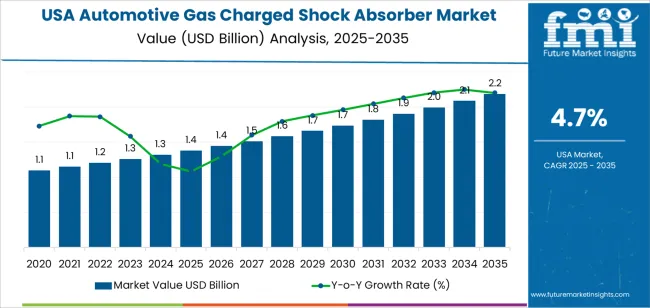
What is the Growth Forecast for the Demand for Automotive Gas Charged Shock Absorber in USA through 2035?
Between 2025 and 2030, the demand for gas-charged shock absorbers is expected to grow gradually, from USD 1.4 billion to USD 1.7 billion. This steady increase will be driven by the ongoing adoption of advanced suspension systems by automakers seeking to improve vehicle performance and comfort. As consumer demand for high-performance vehicles and enhanced driving experiences continues to rise, manufacturers are expected to invest in more durable and efficient shock absorbers. This phase of growth will also be influenced by the increasing popularity of electric vehicles (EVs), which require more advanced suspension technologies to handle additional weight and provide smooth rides.
From 2030 to 2035, the market will experience a sharper rise, with demand expected to increase from USD 1.7 billion to USD 2.2 billion. This acceleration will be driven by the growing popularity of SUVs, off-road vehicles, and the ongoing trend of improving ride quality in consumer vehicles. The expanding use of gas-charged shock absorbers in premium and performance vehicles will further boost demand. The transition to EVs, with their emphasis on smooth and quiet rides, will continue to drive technological advancements in shock absorber designs, leading to significant growth during this period.
Demand for Automotive Gas Charged Shock Absorber in USA Key Takeaways
| Metric | Value |
|---|---|
| Demand for Automotive Gas Charged Shock Absorber in USA Value (2025) | USD 1.4 billion |
| Demand for Automotive Gas Charged Shock Absorber in USA Forecast Value (2035) | USD 2.2 billion |
| Demand for Automotive Gas Charged Shock Absorber in USA Forecast CAGR (2025-2035) | 4.7% |
Why is the Demand for Automotive Gas Charged Shock Absorber in USA Growing?
The demand for automotive gas charged shock absorbers in the USA is increasing due to the rising focus on vehicle performance, safety, and ride comfort. Gas charged shock absorbers, which use compressed gas to reduce aeration and improve damping efficiency, are known for providing better control, enhanced stability, and a smoother ride compared to conventional shock absorbers. As consumers continue to demand vehicles that offer a balance of comfort, handling, and safety, the need for advanced shock absorber solutions like gas charged types is growing.
A major driver of this growth is the increasing adoption of high-performance vehicles, including SUVs, trucks, and sedans, where superior ride comfort and handling are essential. Gas charged shock absorbers are becoming a preferred choice for automakers because they provide improved handling, especially in vehicles designed for off-roading or towing. As the automotive industry in the USA continues to evolve, with consumers prioritizing both performance and comfort, the demand for gas charged shock absorbers is expected to rise.
The growing awareness of vehicle safety and stability is also contributing to the adoption of gas charged shock absorbers. These shock absorbers offer better performance during high-speed driving, abrupt turns, and rough terrains, improving overall vehicle stability and reducing the risk of accidents. With advancements in automotive suspension technology, including innovations in material science and gas charging systems, the demand for automotive gas charged shock absorbers in the USA is expected to grow steadily through 2035.
What is the Segment-Wise Analysis of Demand for Automotive Gas Charged Shock Absorbers in the USA?
Demand for automotive gas-charged shock absorbers in the USA is segmented by design type, sales channel, vehicle type, and region. By design type, demand is divided into twin and mono shock absorbers, with twin shock absorbers holding the largest share at 63%. In terms of sales channel, OEMs lead the demand at 68%, reflecting the need for new vehicle components. Regarding vehicle type, demand is driven primarily by passenger cars, followed by two-wheelers, LCVs (Light Commercial Vehicles), and HCVs (Heavy Commercial Vehicles). Regionally, demand is spread across the West, South, Northeast, and Midwest USA, indicating broad adoption across the country.
Why Do Twin Design Shock Absorbers Lead the Demand for Automotive Gas Charged Shock Absorbers?
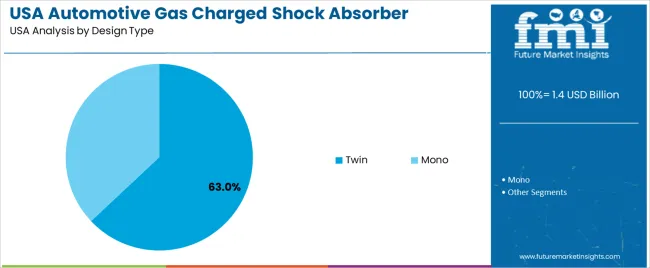
Twin design shock absorbers account for 63% of the demand for automotive gas-charged shock absorbers in the USA. They are widely preferred due to their ability to provide superior handling and stability in diverse driving conditions. The dual-tube design offers a more robust system for absorbing road shocks, making them ideal for passenger cars and light commercial vehicles (LCVs). Twin shock absorbers are known for their durability, offering consistent performance even in harsh conditions.
Their cost-effectiveness and ability to withstand extreme temperatures and road vibrations make them a reliable choice for both high-performance and everyday driving. This design ensures enhanced comfort and control, critical factors for consumers prioritizing smooth rides and safety. As vehicle performance expectations continue to rise, the demand for twin design shock absorbers will remain strong in the automotive sector, reinforcing their dominance in the industry.
Why Do OEMs Lead the Sales Channel Demand for Automotive Gas Charged Shock Absorbers?
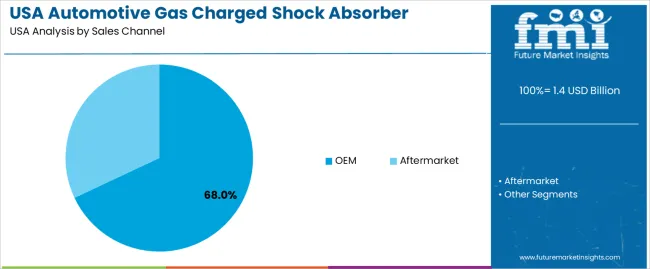
OEMs account for 68% of the demand for automotive gas-charged shock absorbers in the USA. OEMs (Original Equipment Manufacturers) are the primary suppliers of shock absorbers to vehicle manufacturers, ensuring that new vehicles are equipped with high-quality, factory-tested components. The preference for OEM shock absorbers stems from their perfect compatibility, durability, and consistent performance, as they are designed to meet the exact specifications of each vehicle model.
These shock absorbers are vital for ensuring optimal safety, comfort, and vehicle handling, all of which are crucial for consumer satisfaction. As the automotive industry focuses on advanced suspension systems for better performance, safety, and efficiency, OEMs remain the dominant sales channel for automotive gas-charged shock absorbers. This dominance is driven by the constant demand for new vehicles and a growing focus on high-quality, factory-installed components to enhance driving experiences.
What are the Key Trends, Drivers, and Restraints in Demand for Gas Charged Shock Absorbers in USA?
Demand for gas‑charged shock absorbers in USA is increasing as automakers and consumers demand better ride comfort, safety, and handling performance, especially with the rise of SUVs, crossovers, trucks and heavy‑use vehicles. Gas‑charged absorbers deliver more consistent damping, improved heat dissipation, and better stability under load compared with conventional hydraulic shocks. As vehicles become heavier (EVs, hybrids, trucks) or carry more payloads, robust suspension components become essential boosting uptake. On the restraint side, these shock absorbers tend to cost more than traditional systems, and variability in raw‑material prices (steel, rubber, seals) can affect cost and margins for producers and replacement‑part suppliers.
Why is Demand for Gas Charged Shock Absorbers Growing in USA?
In USA, demand is rising because vehicle owners and manufacturers prioritize ride quality, comfort, and control especially on rough roads, long‑distance travel, or when vehicles carry passengers or cargo. With SUVs, pickups, and crossovers remaining popular, the need for suspension systems that deliver stability, reduced body roll, and reliable damping under varying loads drives the adoption of gas‑charged shock absorbers.
The growing industry for electric and hybrid vehicles, often heavier due to batteries, puts extra stress on suspension systems, making advanced shock absorbers a preferred choice to maintain performance and comfort. As vehicle weight increases and consumer demand for improved ride experience grows, gas‑charged shock absorbers become a critical component for maintaining both safety and driving comfort.
How are Technological Innovations Driving Growth of Gas Charged Shock Absorbers in USA?
Technological innovations are boosting the adoption of gas‑charged shock absorbers. Advances in piston and seal design, use of higher‑quality materials, and improved gas‑charging methods increase durability, damping consistency, and fade resistance over time. Some manufacturers integrate these absorbers with adaptive or electronically controlled suspension systems, enabling real‑time adjustment for comfort or performance based on road conditions.
These innovations make gas‑charged absorbers more versatile and efficient, making them suitable for a broader range of vehicle types, including standard passenger cars, heavy trucks, and electric vehicles. As vehicles continue to evolve, incorporating features like increased weight from batteries, these advanced shock absorbers are becoming essential to support ride quality, control, and comfort.
What are the Key Challenges Limiting Wider Adoption of Gas‑Charged Shock Absorbers in USA?
Despite their benefits, several factors limit the widespread adoption of gas‑charged shock absorbers. The higher cost of manufacturing, including materials, precision components, and gas‑charging processes, can deter budget‑focused automakers or owners from choosing these shock absorbers. For aftermarket or replacement parts, these higher costs may lead to increased retail prices, limiting their appeal to price‑sensitive consumers or those with older vehicles.
Supply‑chain risks, such as fluctuations in raw material costs or shortages of specialized components, can also disrupt prices and availability. Some consumers may not perceive a noticeable benefit from gas‑charged shock absorbers, particularly for city driving or lighter vehicles, making the adoption slower outside of SUVs, trucks, or performance vehicles.
What is the Regional Demand Outlook for Automotive Gas Charged Shock Absorber in USA?
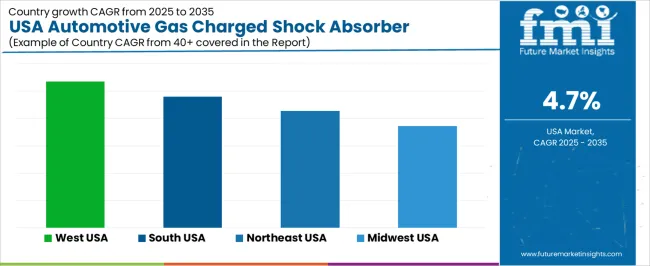
| Region | CAGR (%) |
|---|---|
| West USA | 5.4% |
| South USA | 4.8% |
| Northeast USA | 4.3% |
| Midwest USA | 3.7% |
Demand for automotive gas charged shock absorbers in the USA is growing steadily, with West USA leading at a 5.4% CAGR, driven by a high number of off-road vehicles, SUVs, and trucks, where improved suspension systems are essential for performance and safety. South USA follows at a 4.8% CAGR, supported by the region’s large vehicle base, particularly for work and off-road vehicles that require enhanced ride comfort and stability. Northeast USA shows a 4.3% CAGR, with demand driven by the popularity of SUVs and the need for better handling in varied weather conditions. Midwest USA experiences a 3.7% CAGR, with steady demand from agricultural, industrial, and utility vehicles that benefit from durable suspension systems.
How is Demand for Automotive Gas Charged Shock Absorbers Growing in West USA?
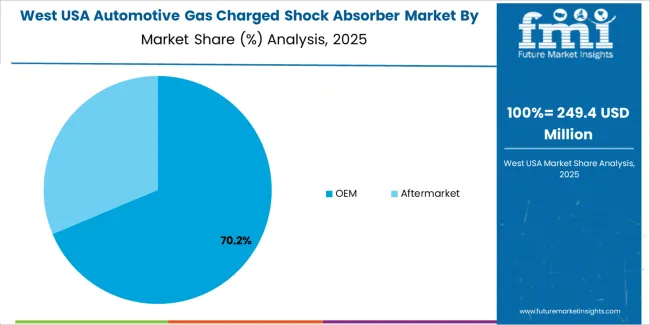
West USA is leading the demand for automotive gas-charged shock absorbers, growing at a 5.4% CAGR. The region’s diverse vehicle USAge, particularly off-road vehicles, SUVs, trucks, and recreational vehicles, is a key driver of this growth. West USA’s terrain ranging from mountainous regions to deserts makes gas-charged shock absorbers an essential component for improved ride comfort, stability, and handling. These shock absorbers are particularly popular in off-road vehicles, which are common in areas like California and Arizona.
West USA’s strong automotive aftermarket industry, driven by consumer demand for vehicle performance enhancements, supports the steady growth of gas-charged shock absorbers. With growing interest in vehicle suspension systems for better safety, comfort, and durability, West USA remains the primary industry for automotive gas-charged shock absorbers.
Why is Demand for Automotive Gas Charged Shock Absorbers Rising in South USA?
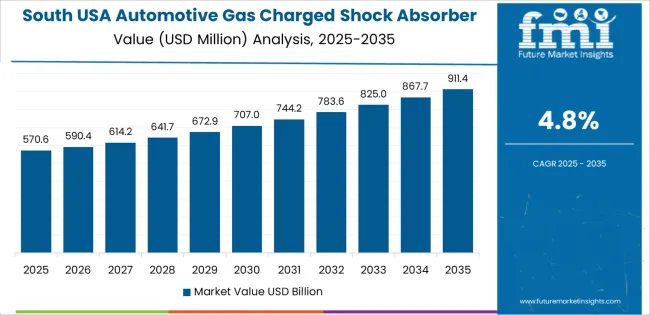
South USA is experiencing steady demand for automotive gas-charged shock absorbers, with a 4.8% CAGR. The region’s large number of trucks, SUVs, and utility vehicles, often used for work, off-road activities, and transport, is a major factor contributing to this demand. Gas-charged shock absorbers are valued for their ability to improve vehicle stability, handling, and ride comfort, especially for vehicles operating in rough terrains or carrying heavy loads.
The expanding automotive aftermarket in South USA also plays a key role in driving demand, as vehicle owners seek to upgrade their suspension systems for enhanced performance and safety. The region’s focus on commercial vehicle fleets and construction vehicles, which benefit from durable suspension systems, further fuels demand for gas-charged shock absorbers. As vehicle customization and performance enhancement continue to grow in popularity, demand in South USA is expected to remain strong.
How is Demand for Automotive Gas Charged Shock Absorbers Expanding in Northeast USA?
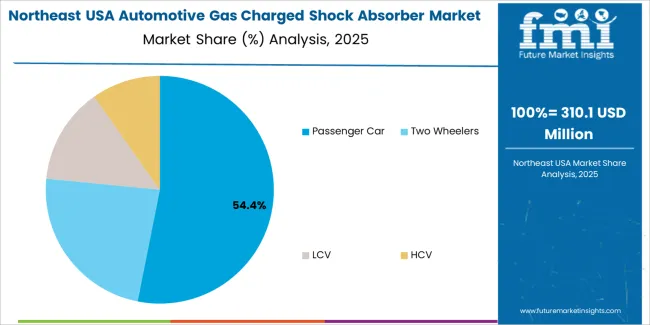
Northeast USA is seeing moderate growth in demand for automotive gas charged shock absorbers, with a 4.3% CAGR. The region’s demand is largely driven by the high number of passenger vehicles and the growing number of SUVs, which benefit from improved suspension systems. Gas-charged shock absorbers are essential in providing enhanced comfort and ride quality, especially in regions that experience diverse weather conditions, such as snow, rain, and ice.
The need for better vehicle performance and safety, particularly for vehicles used in urban and suburban areas, contributes to the demand for these shock absorbers. The increasing popularity of vehicle customization in the Northeast, where consumers seek high-performance parts, supports the growing demand for gas-charged shock absorbers. As consumers continue to focus on vehicle longevity, handling, and ride quality, the demand for these shock absorbers will continue to rise in the region.
Why is Demand for Automotive Gas Charged Shock Absorbers Growing in Midwest USA?
Midwest USA is experiencing steady growth in the demand for automotive gas charged shock absorbers, with a 3.7% CAGR. The region’s automotive industry, particularly in agricultural and commercial vehicles, drives the demand for shock absorbers that offer durability, stability, and comfort in harsh conditions. Midwest vehicles, especially trucks and off-road vehicles, require gas-charged shock absorbers to ensure better handling when navigating rough terrains or carrying heavy loads.
As the region is heavily reliant on industries like agriculture, logistics, and construction, vehicles in these sectors benefit from improved suspension systems for safety and comfort. While demand growth in Midwest USA is slower compared to more automotive-centric regions, the steady use of trucks, fleet vehicles, and off-road vehicles ensures a consistent industry for automotive gas-charged shock absorbers.
What is the Competitive Landscape of Automotive Gas Charged Shock Absorber Demand in USA?
The demand for automotive gas charged shock absorbers in the USA is growing as vehicle manufacturers and consumers seek enhanced ride quality, improved safety, and better handling performance. Gas charged shock absorbers, which use nitrogen gas to increase damping efficiency and provide consistent performance, are crucial in modern vehicles, especially for trucks, SUVs, and performance cars. These shock absorbers help improve stability and comfort by reducing vibrations and handling better on rough terrains. As consumers demand smoother rides and improved vehicle dynamics, gas charged shock absorbers are becoming increasingly popular.
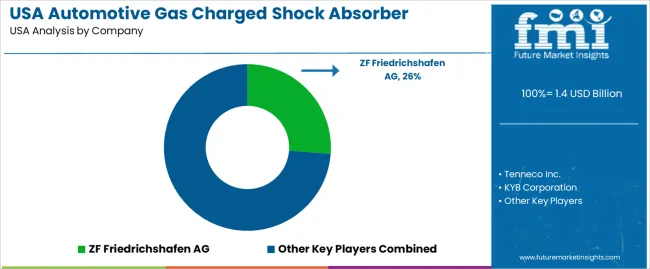
Leading companies in the automotive gas charged shock absorber industry in the USA include ZF Friedrichshafen AG, Tenneco Inc., KYB Corporation, Gabriel India Ltd., and Hitachi Astemo, Ltd. ZF Friedrichshafen AG leads the industry with a share of 26.2%, providing high-performance gas charged shock absorbers that are widely used in passenger cars, commercial vehicles, and motorsport applications. Tenneco Inc. is another major player, offering a wide range of shock absorbers for both OEM and aftermarket applications. KYB Corporation provides gas charged shock absorbers known for their quality and performance across a variety of vehicle types. Gabriel India Ltd. and Hitachi Astemo, Ltd. are also key suppliers in the industry, known for providing durable and cost-effective shock absorbers.
Competition in the automotive gas charged shock absorber industry is driven by factors such as performance, durability, and cost-efficiency. Companies compete by offering advanced shock absorber technologies that enhance vehicle ride quality, handling, and safety. As consumers seek improved driving comfort and manufacturers focus on vehicle performance, the demand for high-quality shock absorbers is rising. Providers that can offer innovative designs, superior performance in various road conditions, and reliable durability will continue to hold a competitive edge in this industry.
Key Players in USA Automotive Gas Charged Shock Absorber Demand
- ZF Friedrichshafen AG
- Tenneco Inc.
- KYB Corporation
- Gabriel India Ltd.
- Hitachi Astemo, Ltd.
Scope of Report
| Items | Values |
|---|---|
| Quantitative Units (2025) | USD billion |
| Sales Channel | OEM, Aftermarket |
| Vehicle Type | Passenger Car, Two Wheelers, LCV, HCV |
| Design Type | Twin, Mono |
| Region | West USA, South USA, Northeast USA, Midwest USA |
| Countries Covered | USA |
| Key Companies Profiled | ZF Friedrichshafen AG, Tenneco Inc., KYB Corporation, Gabriel India Ltd., Hitachi Astemo, Ltd. |
| Additional Attributes | Dollar sales by sales channel, vehicle type, and design type; regional CAGR and adoption trends; demand trends in automotive gas charged shock absorbers; growth in passenger cars, two wheelers, and commercial vehicles; technology adoption for twin and mono shock absorber designs; vendor offerings including OEM and aftermarket solutions; regulatory influences and industry standards |
USA Automotive Gas Charged Shock Absorber Demand by Key Segments
Sales Channel
- OEM
- Aftermarket
Vehicle Type
- Passenger Car
- Two Wheelers
- LCV
- HCV
Design Type
- Twin
- Mono
Region
- West USA
- South USA
- Northeast USA
- Midwest USA
Bibliography
- SAE International. (2023). Passenger car and light truck suspension system terminology and performance standards, including shock absorber design parameters. SAE Standards and Technical Papers.
- National Highway Traffic Safety Administration. (2023). Vehicle safety and component compliance guidelines impacting suspension and shock absorber requirements. NHTSA Regulatory Publications.
- Automotive Parts Manufacturers Association. (2023). Shock absorber design, quality, and performance considerations for gas charged units. APMA Technical and Industry Publications.
- USA Consumer Product Safety Commission. (2023). Safety and compliance guidance for automotive replacement parts including gas charged shock absorbers. CPSC Regulatory and Guidance Publications.
Frequently Asked Questions
How big is the demand for automotive gas charged shock absorber in USA in 2025?
The demand for automotive gas charged shock absorber in USA is estimated to be valued at USD 1.4 billion in 2025.
What will be the size of automotive gas charged shock absorber in USA in 2035?
The market size for the automotive gas charged shock absorber in USA is projected to reach USD 2.2 billion by 2035.
How much will be the demand for automotive gas charged shock absorber in USA growth between 2025 and 2035?
The demand for automotive gas charged shock absorber in USA is expected to grow at a 4.7% CAGR between 2025 and 2035.
What are the key product types in the automotive gas charged shock absorber in USA?
The key product types in automotive gas charged shock absorber in USA are oem and aftermarket.
Which vehicle type segment is expected to contribute significant share in the automotive gas charged shock absorber in USA in 2025?
In terms of vehicle type, passenger car segment is expected to command 52.0% share in the automotive gas charged shock absorber in USA in 2025.
Preview the report firsthand - request a free sample
Get SampleGet the brochure for pricing and purchase details.
Get PDFTable of Content
- Executive Summary
- USA Market Outlook
- Demand-side Trends
- Supply-side Trends
- Technology Roadmap Analysis
- Analysis and Recommendations
- Market Overview
- Market Coverage / Taxonomy
- Market Definition / Scope / Limitations
- Market Background
- Market Dynamics
- Drivers
- Restraints
- Opportunity
- Trends
- Scenario Forecast
- Demand in Optimistic Scenario
- Demand in Likely Scenario
- Demand in Conservative Scenario
- Opportunity Map Analysis
- Product Life Cycle Analysis
- Supply Chain Analysis
- Investment Feasibility Matrix
- Value Chain Analysis
- PESTLE and Porter’s Analysis
- Regulatory Landscape
- Regional Parent Market Outlook
- Production and Consumption Statistics
- Import and Export Statistics
- Market Dynamics
- USA Market Analysis 2020 to 2024 and Forecast, 2025 to 2035
- Historical Market Size Value (USD Million) Analysis, 2020 to 2024
- Current and Future Market Size Value (USD Million) Projections, 2025 to 2035
- Y-o-Y Growth Trend Analysis
- Absolute $ Opportunity Analysis
- USA Market Pricing Analysis 2020 to 2024 and Forecast 2025 to 2035
- USA Market Analysis 2020 to 2024 and Forecast 2025 to 2035, By Sales Channel
- Introduction / Key Findings
- Historical Market Size Value (USD Million) Analysis By Sales Channel , 2020 to 2024
- Current and Future Market Size Value (USD Million) Analysis and Forecast By Sales Channel , 2025 to 2035
- OEM
- Aftermarket
- Y-o-Y Growth Trend Analysis By Sales Channel , 2020 to 2024
- Absolute $ Opportunity Analysis By Sales Channel , 2025 to 2035
- USA Market Analysis 2020 to 2024 and Forecast 2025 to 2035, By Vehicle Type
- Introduction / Key Findings
- Historical Market Size Value (USD Million) Analysis By Vehicle Type, 2020 to 2024
- Current and Future Market Size Value (USD Million) Analysis and Forecast By Vehicle Type, 2025 to 2035
- Passenger Car
- Two Wheelers
- LCV
- HCV
- Y-o-Y Growth Trend Analysis By Vehicle Type, 2020 to 2024
- Absolute $ Opportunity Analysis By Vehicle Type, 2025 to 2035
- USA Market Analysis 2020 to 2024 and Forecast 2025 to 2035, By Design Type
- Introduction / Key Findings
- Historical Market Size Value (USD Million) Analysis By Design Type, 2020 to 2024
- Current and Future Market Size Value (USD Million) Analysis and Forecast By Design Type, 2025 to 2035
- Twin
- Mono
- Y-o-Y Growth Trend Analysis By Design Type, 2020 to 2024
- Absolute $ Opportunity Analysis By Design Type, 2025 to 2035
- Market Structure Analysis
- Competition Dashboard
- Competition Benchmarking
- Market Share Analysis of Top Players
- By Regional
- By Sales Channel
- By Vehicle Type
- By Design Type
- Competition Analysis
- Competition Deep Dive
- ZF Friedrichshafen AG
- Overview
- Product Portfolio
- Profitability by Market Segments (Product/Age /Sales Channel/Region)
- Sales Footprint
- Strategy Overview
- Marketing Strategy
- Product Strategy
- Channel Strategy
- Tenneco Inc.
- KYB Corporation
- Gabriel India Ltd.
- Hitachi Astemo, Ltd.
- ZF Friedrichshafen AG
- Competition Deep Dive
- Assumptions & Acronyms Used
- Research Methodology


