

- Industry Size (2025)
- USD 370.5 Mn
- Forecast (2035)
- USD 662.5 Mn
- CAGR (2025 to 2035)
- 6.0%
Lauryl Glucoside Market Forecast and Outlook 2025 to 2035
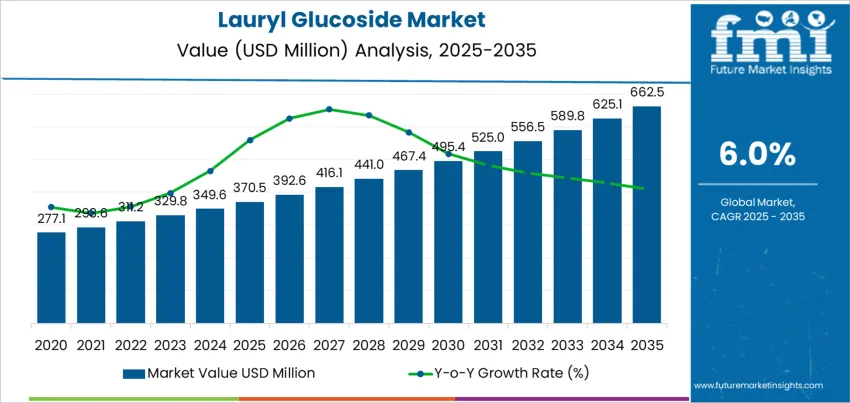
Growth of the lauryl glucoside market begins at USD 370.5 million in 2025 to reach USD 662.5 million by 2035, representing a CAGR of 6.0%. The revenue accretion rate in the early phase is supported by stable offtake from personal care manufacturers producing sulfate-free shampoos, facial cleansers, body washes, and baby care products.
Lauryl glucoside retains its preference for higher foaming performance compared with shorter-chain glucosides, supporting consistent formulation demand. Through 2030, revenue addition remains evenly distributed year to year as unit volumes rise in tandem with broad-based production of mild surfactant systems across mass retail and professional cosmetic brands.
Quick Stats of the Lauryl Glucoside Market
- Lauryl Glucoside Market Value (2025): USD 370.5 million
- Lauryl Glucoside Market Forecast Value (2035): USD 662.5 million
- Lauryl Glucoside Market Forecast CAGR (2025 to 2035): 6.0%
- Leading Product Form in Lauryl Glucoside Market: Powder (15.6%)
- Key Growth Regions in Lauryl Glucoside Market: Asia Pacific, Europe
- Top Players in Lauryl Glucoside Market: BASF SE, Croda International, Evonik Industries, Symrise (incl. IFF/Givaudan actives), Dow / Dow Inc., Ashland, Clariant, Seppic / Others
What is the Growth Forecast for the Lauryl Glucoside Market through 2035?
After 2030, the revenue accretion rate is sustained more by value density than by abrupt volume expansion. Market size rises from about USD 495.4 million in 2030 toward USD 662.5 million by 2035 as higher purity grades and blended surfactant systems command improved price realization. Hybrid formulations that combine lauryl glucoside with amphoteric surfactants support premium cleansing performance and contribute to steady ticket size growth per formulation.
Industrial demand remains limited but stable in household and institutional cleaning products. Producers focus on fatty alcohol sourcing efficiency, glucose conversion yield, and reaction selectivity to protect margin as volume expands. Long-term revenue buildup remains anchored to repeat ordering behavior, formulation lock-in, and sustained regulatory preference for mild, plant-derived surfactant systems.
The global lauryl glucoside market expands from USD 370.5 million in 2025 to USD 467.4 million by 2030, delivering an absolute gain of USD 96.9 million in the first half of the forecast period. The demand steps up in this phase is moderate but clearly structured, with annual increments rising from about USD 21.1 million between 2025 and 2026 to nearly USD 26.4 million by 2029 to 2030. This step up reflects its elevation from a niche mild surfactant into a core cleansing base for sulfate free shampoos, facial cleansers, baby washes, and sensitive-skin products. The shift is driven by large brand portfolio reformulations that convert entire product families at once, creating stepwise demand escalation rather than linear drift.
From 2030 to 2035, the market advances from USD 467.4 million to USD 662.5 million, adding a larger USD 195.1 million in the second half of the decade. The demand step up becomes materially steeper as annual value additions climb from roughly USD 28.0 million to more than USD 37.4 million by the final years. This sharper step reflects lauryl glucoside becoming a default primary surfactant across mass personal care, institutional hygiene, and dermatology-linked cleansing systems. As multi-brand conversions, refill-format expansion, and export-oriented personal care manufacturing intensify, lauryl glucoside shifts into a structurally higher demand tier, sustaining a pronounced upward step pattern through 2035.
Lauryl Glucoside Industry Key Takeaways
| Metric | Value |
|---|---|
| Industry Value (2025) | USD 370.5 million |
| Forecast Value (2035) | USD 662.5 million |
| Forecast CAGR (2025 to 2035) | 6.0% |
How Is the Lauryl Glucoside Market Developing Across Cleansing, Hair Care, and Mild Detergent Formulations?
The lauryl glucoside market developed from the broader transition toward plant derived surfactants that balance cleansing power with reduced skin irritation. Compared with shorter chain glucosides, lauryl glucoside offers stronger oil removal and denser foam, which made it attractive for products that require more active cleansing such as shampoos, body washes, and facial cleansers for oily skin. Early adoption was concentrated in natural and organics certified brands that needed sulfate free systems without sacrificing lather performance. Over time, mainstream personal care brands incorporated lauryl glucoside into reformulated product lines as consumer sensitivity to harsh surfactants increased. Its compatibility with amphoteric and nonionic surfactants supported broad use across mixed surfactant systems.
Future growth of the lauryl glucoside market will be shaped by sustained demand for sulfate free products, biodegradable cleaning agents, and transparent ingredient labeling. Expansion is expected in hair cleansing for textured and chemically treated hair, men grooming products, and light household cleaners that require effective grease removal without aggressive chemistry. Barriers include higher cost compared with traditional anionic surfactants, supply dependence on palm and coconut derived fatty alcohols, and formulation challenges in achieving viscosity without added thickeners. Competition from other alkyl polyglucosides and amino acid surfactants will also influence long term positioning. Growth will depend on how well lauryl glucoside continues to balance cleansing strength, skin tolerance, and cost efficiency in mass market formulations.
How Are End Use Application and Product Form Structuring the Demand for Lauryl Glucoside?
The demand for lauryl glucoside is structured by end use application and product form. Skin care represents 9.4% of total demand, followed by body care, hair care, sun care, color cosmetics, men grooming, baby and kids care, and dermocosmetic and professional care. By product form, powder accounts for 15.6% of total consumption, followed by granules and agglomerates, flakes, pellets and prills, liquid solutions, high active concentrates, dispersions and suspensions, emulsions, pastes, gels, wax or solid block formats, and oils. Demand behavior is shaped by primary cleansing strength, foam density control, viscosity response in blends, eye comfort performance, and compatibility with sulfate-free and silicone-free formulation systems.
Why Does Skin Care Lead the Lauryl Glucoside End Use Demand?
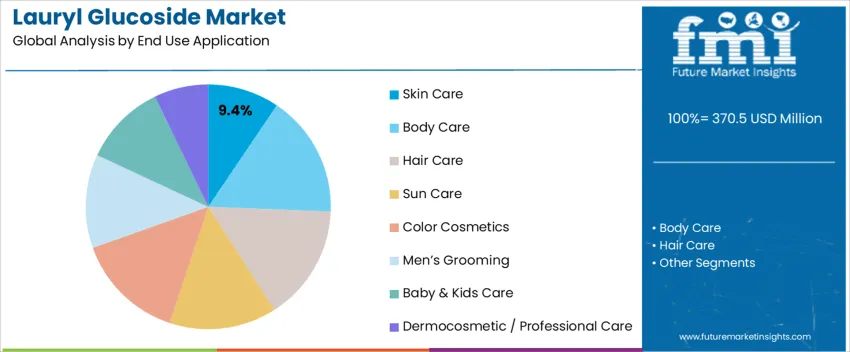
Skin care accounts for 9.4% of total lauryl glucoside demand due to its stronger cleansing power compared with shorter-chain glucosides while retaining a low irritation profile. Lauryl glucoside is widely used in facial cleansers, acne-control washes, gel-based exfoliators, and daily body cleansers where removal of excess sebum, sunscreen residues, and environmental debris is required. Its ability to generate dense, creamy foam improves sensory perception during cleansing without aggressive lipid stripping.
Skin care formulators value lauryl glucoside for its stable performance across a wide pH range and its compatibility with botanical extracts, salicylic acid, and soothing agents. It contributes to viscosity build in clear gel systems, reducing the need for additional thickeners. Its favorable eye tolerance also supports use in facial and periocular cleansing formats. These cleansing efficiency, foam aesthetics, and formulation stability characteristics sustain skin care as the leading end use segment within lauryl glucoside demand.
Why Does Powder Lead the Lauryl Glucoside Product Form Demand?
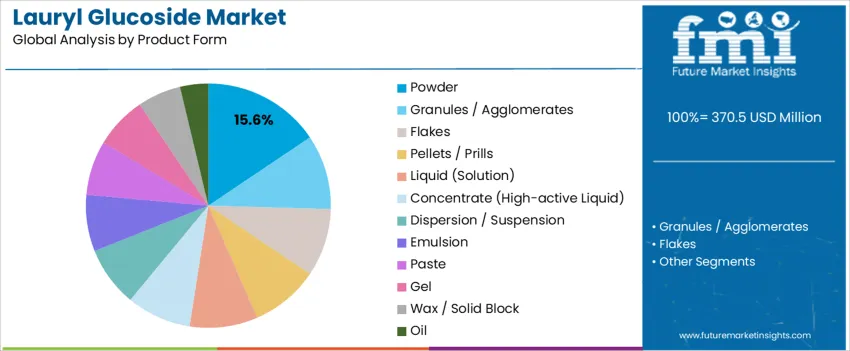
Powder accounts for 15.6% of total lauryl glucoside demand due to its superior storage stability, reduced freight cost, and flexibility in batch-specific activation. Powdered lauryl glucoside allows formulators to control surfactant concentration precisely at the hydration stage, which is critical for tuning foam height, viscosity, and skin feel across different product grades. Low moisture exposure limits hydrolytic degradation and prevents microbial growth during storage.
Powder form also integrates well into pre-blended surfactant systems used for mass production of cleansers, shampoos, and baby washes. It dissolves uniformly under controlled mixing without leaving insoluble residues that can affect clarity. Packaging in moisture-barrier containers preserves free-flowing behavior during transport and handling. These logistics advantages, dosing accuracy, and processing predictability benefits position powder as the leading product form within the lauryl glucoside demand structure.
Why Is Lauryl Glucoside Chosen When Cleansing Must Feel Strong Without Crossing into Harshness?
Lauryl glucoside sits in a narrow functional space where visible cleansing power is required without the sensory penalties of sulfates. Its longer lauryl chain gives it stronger oil-lifting ability than shorter-chain glucosides, yet its sugar-based head group moderate’s irritation. This combination makes it suitable for shampoos, body washes, and facial cleansers that must remove sebum, styling residues, and environmental soil in one pass. Demand grows where brands aim to signal "effective clean" while still avoiding the dryness, sting, and rebound oiliness linked to aggressive anionic surfactants.
How Does Chain Length Control Foam Perception and Grease Removal Behavior?
The lauryl chain length directly governs how lauryl glucoside behaves at the oil-water interface. It produces larger, faster-rising foam with stronger degreasing than decyl-based systems, which shifts user perception toward power rather than softness. This makes it valuable in scalp cleansers, men’s grooming, and sport-oriented hygiene where visible foam is equated with performance. At the same time, the sugar head slows protein denaturation at the skin surface. Demand reflects this balance between visual strength and biological tolerance created by its specific carbon chain length.
What Formulation Instability and Viscosity Control Issues Limit Its Standalone Use?
Lauryl glucoside introduces stability challenges in clear systems and electrolyte-thickened formulas. At higher levels, it can cause clouding, phase separation, or unpredictable viscosity swings, especially in sulfate-free blends. It also shows reduced flash foam in very cold water and can leave drag in high-pH systems. These behaviors prevent it from functioning as a universal single-surfactant solution. Instead, it is typically paired with betaines, amphoacetates, or milder glucosides to stabilize feel, clarity, and rinse performance across temperature and usage conditions.
Where Is Demand Shifting as Scalp Care, Men’s Grooming, And Multi-Benefit Washes Expand?
Demand for lauryl glucoside is quietly consolidating in scalp-focused systems, beard washes, and hybrid shampoo-cleanser products that must remove oil, styling polymers, and sweat in fewer steps. Men’s grooming favors it for quicker visible foam and clean feel without tightness. Scalp exfoliating cleansers rely on its stronger oil release to clear follicular buildup before active delivery. As wash products are asked to do more in less time, lauryl glucoside grows as the surfactant that supports speed, strength, and skin tolerance in a single cleansing cycle.
What Is the Global Growth Outlook for the Lauryl Glucoside Industry by Country?
| Country | CAGR (%) |
|---|---|
| India | 8.1 |
| China | 7.5 |
| Japan | 6.9 |
| UK | 6.3 |
| Germany | 5.7 |
| USA | 5.1 |
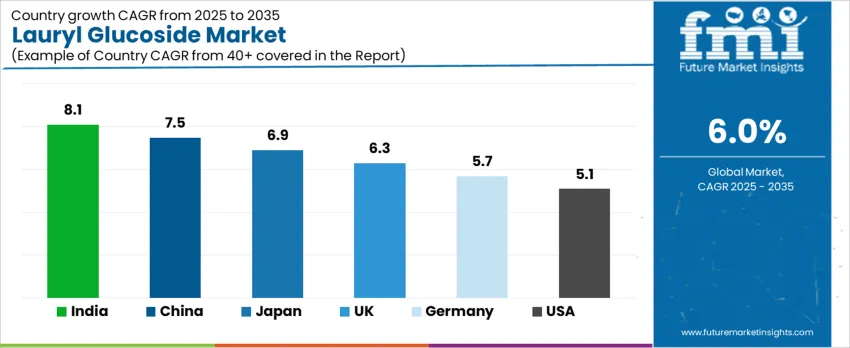
The lauryl glucoside industry is expanding steadily across global personal care and home care formulation markets, with India leading at an 8.1% CAGR. Growth in India is supported by rising demand for mild, plant derived surfactants in baby care, facial cleansers, and sulfate free shampoos, alongside increasing domestic production of green cosmetic ingredients. China follows at 7.5%, driven by large scale natural surfactant manufacturing, export oriented cosmetic production, and growing demand from household cleaning formulations.
Japan at 6.9% reflects stable adoption in sensitive skin products, dermatology focused cleansers, and premium hygiene formulations. The UK and Germany record 6.3% and 5.7% growth, supported by preference for biodegradable, nonionic surfactants in clean label products. The USA at 5.1% reflects a mature but steadily advancing market driven by natural beauty brands and ecofriendly household care formulations.
What Is Driving Lauryl Glucoside Adoption in India Personal Care Manufacturing?
Growth momentum in India is forming at a CAGR of 8.1% through 2035 for lauryl glucoside demand, supported by rising production of sulfate free shampoos, herbal face washes, and baby hygiene products. Domestic personal care brands favor lauryl glucoside for its mild cleansing profile and plant derived positioning. Ayurvedic and sensitive skin product lines add further volume. Imports remain the primary supply source due to limited domestic alkyl polyglucoside processing. Demand remains formulation led and retail aligned, shaped by growing preference for gentle surfactants, steady baby care product expansion, and strong online personal care sales growth.
- Sulfate free shampoos drive primary formulation demand
- Baby hygiene products support repeat mild surfactant usage
- Herbal skincare expands plant based cleanser adoption
- Import based sourcing dominates ingredient availability
How Is China Expanding Large Scale Use of Lauryl Glucoside in Hygiene Products?
Industrial expansion in China is advancing at a CAGR of 7.5% through 2035 for lauryl glucoside utilization, supported by mass production of clean label cosmetics, family hygiene products, and private label personal care brands. Lauryl glucoside appears in facial cleansers, hand soaps, shower gels, and foam based baby washes. Domestic surfactant manufacturing ensures stable high volume output and cost efficiency. Export oriented personal care producers maintain steady offtake for overseas markets. Demand remains production driven and volume oriented, aligned with hygiene product consumption growth and continued transition from sulfate surfactants to milder alternatives.
- Hand wash and shower gels sustain bulk consumption
- Baby washes support repeat product turnover
- Domestic surfactant plants stabilize large batch supply
- Export finished goods strengthen continuous demand
Why Does Japan Maintain Stable Demand for Lauryl Glucoside in Sensitive Skin Products?
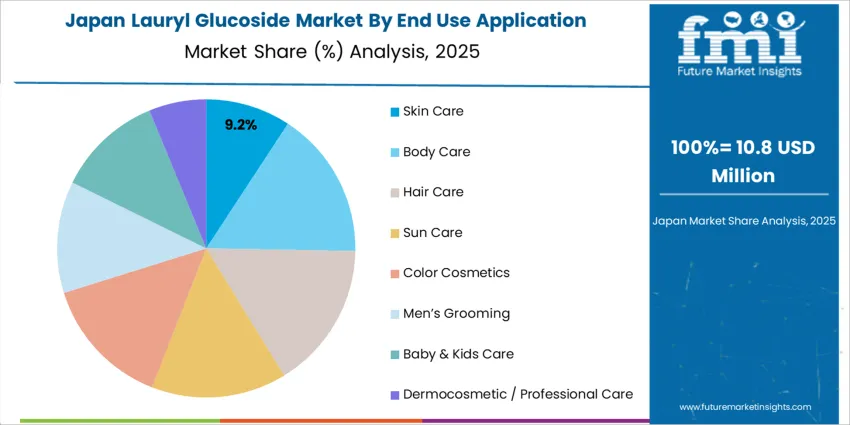
Usage patterns in Japan indicate a CAGR of 6.9% through 2035 for lauryl glucoside demand, supported by premium facial cleansers, dermatology aligned hygiene products, and fragrance free skincare formulations. Lauryl glucoside is applied in foam face washes, post treatment cleansers, and low irritation body cleansers. Domestic formulators emphasize controlled foaming performance and low allergen risk. Pharmacy distributed personal care brands favor mild surfactant systems for daily use. Demand stays quality driven and skin safety focused, shaped by aging population skincare needs, steady dermatology product development, and consumer confidence in gentle cleansing technologies.
- Foam facial cleansers anchor daily usage
- Post treatment skincare supports regulated applications
- Domestic formulation stabilizes irritation control
- Pharmacy distribution ensures steady retail flow
What Is Supporting Lauryl Glucoside Market Expansion in the United Kingdom?
Market development in the UK is advancing at a CAGR of 6.3% through 2035 for lauryl glucoside demand, supported by vegan beauty products, sulfate free haircare adoption, and expanding clean label hygiene ranges. Lauryl glucoside appears in face washes, micellar cleansers, baby shampoos, and body washes. Independent clean beauty brands and contract formulators support steady product launches. Imports dominate ingredient sourcing due to limited domestic alkyl polyglucoside capacity. Demand remains retail driven and ingredient focused, shaped by ethical beauty preferences, steady baby care demand, and strong online personal care distribution.
- Vegan skincare supports ongoing surfactant substitution
- Baby shampoos sustain repeat retail demand
- Contract formulation activity supports product diversity
- Imported sourcing dominates national supply structure
How Is Germany Integrating Lauryl Glucoside into Regulated Dermatology Grade Cleansers?
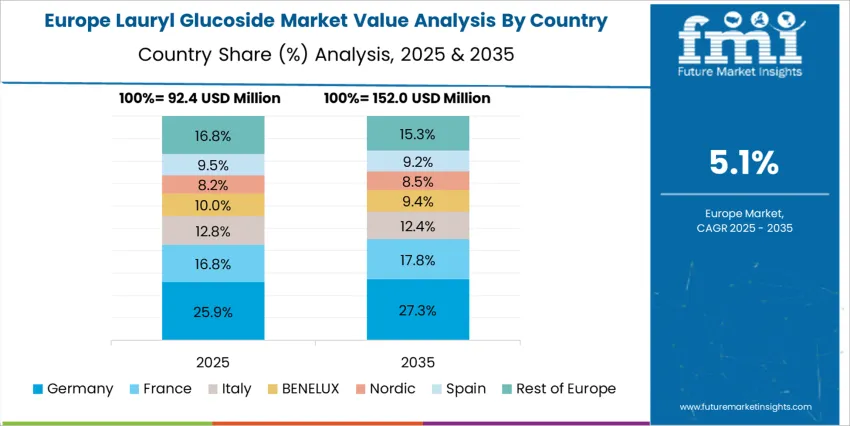
Adoption in Germany is rising at a CAGR of 5.7% through 2035 for lauryl glucoside consumption, driven by pharmacy grade cleansers, certified natural cosmetics, and regulated sensitive skin hygiene products. Lauryl glucoside is used in eczema friendly body washes, fragrance free shampoos, and medical grade foam cleansers. Strict ingredient testing, documentation, and eco certification standards guide formulation and supplier approval. Imports remain the main supply route for consistent cosmetic quality grades. Demand stays quality focused and regulation aligned, supported by preventive dermatology practices and steady expansion of certified natural personal care retail.
- Dermatology cleansers anchor regulated product usage
- Certified natural cosmetics support eco compliant demand
- Testing standards shape ingredient qualification
- Pharmacy retail stabilizes long term sales consistency
What Is Driving Measured Lauryl Glucoside Growth in the United States?
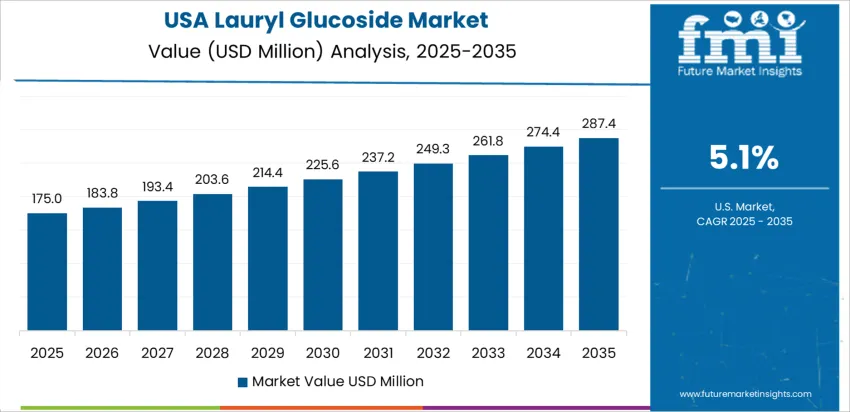
Expansion in the United States is progressing at a CAGR of 5.1% through 2035 for lauryl glucoside demand, supported by clean beauty brand development, sulfate free shampoo adoption, and rising use in family hygiene products. Lauryl glucoside appears in face washes, scalp cleansers, baby body washes, and gentle hand soaps. Professional salon brands and mass retail labels both contribute to volume consumption. Imports supply most cosmetic grade material. Demand remains application driven and formulation diverse, shaped by steady personal care sales, continued sulfate replacement trends, and growing preference for gentler daily cleansing systems.
- Sulfate free shampoos support steady surfactant demand
- Baby body washes sustain repeat household usage
- Salon brands support professional product turnover
- Import dependence dominates cosmetic grade sourcing
How Intense Is the Rivalry in the Global Lauryl Glucoside Market?
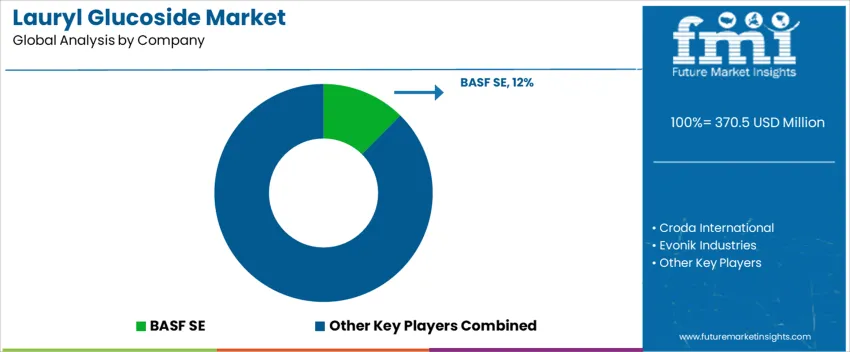
Rivalry in the global Lauryl Glucoside market remains intense because several manufacturers supply similar surfactant grades for personal care, home care and industrial cleaning. Companies such as BASF, Croda, Evonik, Dow and Clariant produce bulk volumes of Lauryl Glucoside with largely interchangeable specifications. When buyers switch between suppliers, the transaction involves minimal conversion effort. This weakens supplier lock in and increases competition on price and supply reliability.
Market growth only partially offsets additions to production capacity. Newer entrants such as Symrise and Seppic must resort to aggressive pricing or tailored service offers to win orders. The result is persistent price pressure on commodity batches. For firms operating at the lower end of the market, maintaining large volume output at low cost becomes critical for survival in a margin constrained environment.
Firms with integrated procurement and large scale operations enjoy stronger competitive standing. BASF and Dow benefit from backward integration and global feed stock contracts that cushion the impact of raw material price swings. Evonik and Croda secure contracts by guaranteeing consistent quality and regulatory compliance. Smaller specialist producers such as Seppic, along with niche ingredient houses, rely on differentiation.
They offer high purity or eco certified Lauryl Glucoside grades, catering to premium, baby care or organic personal care segments that value certification and formulation support over price. These niche suppliers avoid direct price competition and instead compete on service and regulatory credentials. Their positioning allows modest margins despite limited volume. As a result, the market structure splits between bulk commodity suppliers and premium niche providers, and competitive intensity remains high across both segments.
Key Players in the Lauryl Glucoside Market
- BASF SE
- Croda International
- Evonik Industries
- Symrise (incl. IFF/Givaudan actives)
- Dow / Dow Inc.
- Ashland
- Clariant
- Seppic
- Others
Scope of the report
| Items | Values |
|---|---|
| Quantitative Units (2025) | USD million |
| End-Use Applications | Skin Care, Body Care, Hair Care, Sun Care, Color Cosmetics, Men’s Grooming, Baby & Kids Care, Dermocosmetic / Professional Care |
| Product Forms | Powder, Granules/Agglomerates, Flakes, Pellets/Prills, Liquid (Solution), Concentrate (High-active Liquid), Dispersion/Suspension, Emulsion, Paste, Gel, Wax / Solid Block, Oil |
| Regions Covered | Asia Pacific, Europe, North America, Latin America, Middle East & Africa |
| Countries Covered | China, Japan, South Korea, India, Australia & New Zealand, ASEAN, Germany, United Kingdom, France, Italy, Spain, Nordic, BENELUX, USA, Canada, Mexico, Brazil, Chile, Saudi Arabia, Turkey, South Africa, plus 40+ additional countries globally |
| Key Companies Profiled | BASF SE, Croda International, Evonik Industries, Symrise (incl. IFF/Givaudan actives), Dow Inc., Ashland, Clariant, Seppic, Lubrizol, Lonza, Inolex |
| Additional Attributes | Dollar by sales breakdown by region, country, end-use, and product form; global growth projections; multi-sector adoption (cosmetic, nutraceutical, functional food); extract bioactivity profiling; iodine and polyphenol standardization; contract harvesting; vertical integration; supply chain stability; regulatory compliance; sensory and bioavailability performance |
Lauryl Glucoside Market Segmentation
End Use Application:
- Skin Care
- Body Care
- Hair Care
- Sun Care
- Color Cosmetics
- Men’s Grooming
- Baby & Kids Care
- Dermocosmetic / Professional Care
Product Form:
- Powder
- Granules / Agglomerates
- Flakes
- Pellets / Prills
- Liquid (Solution)
- Concentrate (High-active Liquid)
- Dispersion / Suspension
- Emulsion
- Paste
- Gel
- Wax / Solid Block
- Oil
Region
-
Asia Pacific
- China
- Japan
- South Korea
- India
- Australia & New Zealand
- ASEAN
- Rest of Asia Pacific
- Europe
- Germany
- United Kingdom
- France
- Italy
- Spain
- Nordic
- BENELUX
- Rest of Europe
-
North America
- United States
- Canada
- Mexico
-
Latin America
- Brazil
- Chile
- Rest of Latin America
-
Middle East & Africa
- Kingdom of Saudi Arabia
- Other GCC Countries
- Turkey
- South Africa
- Other African Union
- Rest of Middle East & Africa
Frequently Asked Questions
How big is the lauryl glucoside market in 2025?
The global lauryl glucoside market is estimated to be valued at USD 370.5 million in 2025.
What will be the size of lauryl glucoside market in 2035?
The market size for the lauryl glucoside market is projected to reach USD 662.5 million by 2035.
How much will be the lauryl glucoside market growth between 2025 and 2035?
The lauryl glucoside market is expected to grow at a 6.0% CAGR between 2025 and 2035.
What are the key product types in the lauryl glucoside market?
The key product types in lauryl glucoside market are skin care, body care, hair care, sun care, color cosmetics, men’s grooming, baby & kids care and dermocosmetic / professional care.
Which product form segment to contribute significant share in the lauryl glucoside market in 2025?
In terms of product form , powder segment to command 15.6% share in the lauryl glucoside market in 2025.
Preview the report firsthand - request a free sample
Get SampleGet the brochure for pricing and purchase details.
Get PDFTable of Content
- Executive Summary
- Global Market Outlook
- Demand-side Trends
- Supply-side Trends
- Technology Roadmap Analysis
- Analysis and Recommendations
- Market Overview
- Market Coverage / Taxonomy
- Market Definition / Scope / Limitations
- Market Background
- Market Dynamics
- Drivers
- Restraints
- Opportunity
- Trends
- Scenario Forecast
- Demand in Optimistic Scenario
- Demand in Likely Scenario
- Demand in Conservative Scenario
- Opportunity Map Analysis
- Product Life Cycle Analysis
- Supply Chain Analysis
- Investment Feasibility Matrix
- Value Chain Analysis
- PESTLE and Porter’s Analysis
- Regulatory Landscape
- Regional Parent Market Outlook
- Production and Consumption Statistics
- Import and Export Statistics
- Market Dynamics
- Global Market Analysis 2020 to 2024 and Forecast, 2025 to 2035
- Historical Market Size Value (USD Million) Analysis, 2020 to 2024
- Current and Future Market Size Value (USD Million) Projections, 2025 to 2035
- Y-o-Y Growth Trend Analysis
- Absolute $ Opportunity Analysis
- Global Market Pricing Analysis 2020 to 2024 and Forecast 2025 to 2035
- Global Market Analysis 2020 to 2024 and Forecast 2025 to 2035, By End Use Application
- Introduction / Key Findings
- Historical Market Size Value (USD Million) Analysis By End Use Application , 2020 to 2024
- Current and Future Market Size Value (USD Million) Analysis and Forecast By End Use Application , 2025 to 2035
- Skin Care
- Body Care
- Hair Care
- Sun Care
- Color Cosmetics
- Men’s Grooming
- Baby & Kids Care
- Dermocosmetic / Professional Care
- Y-o-Y Growth Trend Analysis By End Use Application , 2020 to 2024
- Absolute $ Opportunity Analysis By End Use Application , 2025 to 2035
- Global Market Analysis 2020 to 2024 and Forecast 2025 to 2035, By Product Form
- Introduction / Key Findings
- Historical Market Size Value (USD Million) Analysis By Product Form, 2020 to 2024
- Current and Future Market Size Value (USD Million) Analysis and Forecast By Product Form, 2025 to 2035
- Powder
- Granules / Agglomerates
- Flakes
- Pellets / Prills
- Liquid (Solution)
- Concentrate (High-active Liquid)
- Dispersion / Suspension
- Emulsion
- Paste
- Gel
- Wax / Solid Block
- Y-o-Y Growth Trend Analysis By Product Form, 2020 to 2024
- Absolute $ Opportunity Analysis By Product Form, 2025 to 2035
- Global Market Analysis 2020 to 2024 and Forecast 2025 to 2035, By Region
- Introduction
- Historical Market Size Value (USD Million) Analysis By Region, 2020 to 2024
- Current Market Size Value (USD Million) Analysis and Forecast By Region, 2025 to 2035
- North America
- Latin America
- Western Europe
- Eastern Europe
- East Asia
- South Asia and Pacific
- Middle East & Africa
- Market Attractiveness Analysis By Region
- North America Market Analysis 2020 to 2024 and Forecast 2025 to 2035, By Country
- Historical Market Size Value (USD Million) Trend Analysis By Market Taxonomy, 2020 to 2024
- Market Size Value (USD Million) Forecast By Market Taxonomy, 2025 to 2035
- By Country
- USA
- Canada
- Mexico
- By End Use Application
- By Product Form
- By Country
- Market Attractiveness Analysis
- By Country
- By End Use Application
- By Product Form
- Key Takeaways
- Latin America Market Analysis 2020 to 2024 and Forecast 2025 to 2035, By Country
- Historical Market Size Value (USD Million) Trend Analysis By Market Taxonomy, 2020 to 2024
- Market Size Value (USD Million) Forecast By Market Taxonomy, 2025 to 2035
- By Country
- Brazil
- Chile
- Rest of Latin America
- By End Use Application
- By Product Form
- By Country
- Market Attractiveness Analysis
- By Country
- By End Use Application
- By Product Form
- Key Takeaways
- Western Europe Market Analysis 2020 to 2024 and Forecast 2025 to 2035, By Country
- Historical Market Size Value (USD Million) Trend Analysis By Market Taxonomy, 2020 to 2024
- Market Size Value (USD Million) Forecast By Market Taxonomy, 2025 to 2035
- By Country
- Germany
- UK
- Italy
- Spain
- France
- Nordic
- BENELUX
- Rest of Western Europe
- By End Use Application
- By Product Form
- By Country
- Market Attractiveness Analysis
- By Country
- By End Use Application
- By Product Form
- Key Takeaways
- Eastern Europe Market Analysis 2020 to 2024 and Forecast 2025 to 2035, By Country
- Historical Market Size Value (USD Million) Trend Analysis By Market Taxonomy, 2020 to 2024
- Market Size Value (USD Million) Forecast By Market Taxonomy, 2025 to 2035
- By Country
- Russia
- Poland
- Hungary
- Balkan & Baltic
- Rest of Eastern Europe
- By End Use Application
- By Product Form
- By Country
- Market Attractiveness Analysis
- By Country
- By End Use Application
- By Product Form
- Key Takeaways
- East Asia Market Analysis 2020 to 2024 and Forecast 2025 to 2035, By Country
- Historical Market Size Value (USD Million) Trend Analysis By Market Taxonomy, 2020 to 2024
- Market Size Value (USD Million) Forecast By Market Taxonomy, 2025 to 2035
- By Country
- China
- Japan
- South Korea
- By End Use Application
- By Product Form
- By Country
- Market Attractiveness Analysis
- By Country
- By End Use Application
- By Product Form
- Key Takeaways
- South Asia and Pacific Market Analysis 2020 to 2024 and Forecast 2025 to 2035, By Country
- Historical Market Size Value (USD Million) Trend Analysis By Market Taxonomy, 2020 to 2024
- Market Size Value (USD Million) Forecast By Market Taxonomy, 2025 to 2035
- By Country
- India
- ASEAN
- Australia & New Zealand
- Rest of South Asia and Pacific
- By End Use Application
- By Product Form
- By Country
- Market Attractiveness Analysis
- By Country
- By End Use Application
- By Product Form
- Key Takeaways
- Middle East & Africa Market Analysis 2020 to 2024 and Forecast 2025 to 2035, By Country
- Historical Market Size Value (USD Million) Trend Analysis By Market Taxonomy, 2020 to 2024
- Market Size Value (USD Million) Forecast By Market Taxonomy, 2025 to 2035
- By Country
- Kingdom of Saudi Arabia
- Other GCC Countries
- Turkiye
- South Africa
- Other African Union
- Rest of Middle East & Africa
- By End Use Application
- By Product Form
- By Country
- Market Attractiveness Analysis
- By Country
- By End Use Application
- By Product Form
- Key Takeaways
- Key Countries Market Analysis
- USA
- Pricing Analysis
- Market Share Analysis, 2024
- By End Use Application
- By Product Form
- Canada
- Pricing Analysis
- Market Share Analysis, 2024
- By End Use Application
- By Product Form
- Mexico
- Pricing Analysis
- Market Share Analysis, 2024
- By End Use Application
- By Product Form
- Brazil
- Pricing Analysis
- Market Share Analysis, 2024
- By End Use Application
- By Product Form
- Chile
- Pricing Analysis
- Market Share Analysis, 2024
- By End Use Application
- By Product Form
- Germany
- Pricing Analysis
- Market Share Analysis, 2024
- By End Use Application
- By Product Form
- UK
- Pricing Analysis
- Market Share Analysis, 2024
- By End Use Application
- By Product Form
- Italy
- Pricing Analysis
- Market Share Analysis, 2024
- By End Use Application
- By Product Form
- Spain
- Pricing Analysis
- Market Share Analysis, 2024
- By End Use Application
- By Product Form
- France
- Pricing Analysis
- Market Share Analysis, 2024
- By End Use Application
- By Product Form
- India
- Pricing Analysis
- Market Share Analysis, 2024
- By End Use Application
- By Product Form
- ASEAN
- Pricing Analysis
- Market Share Analysis, 2024
- By End Use Application
- By Product Form
- Australia & New Zealand
- Pricing Analysis
- Market Share Analysis, 2024
- By End Use Application
- By Product Form
- China
- Pricing Analysis
- Market Share Analysis, 2024
- By End Use Application
- By Product Form
- Japan
- Pricing Analysis
- Market Share Analysis, 2024
- By End Use Application
- By Product Form
- South Korea
- Pricing Analysis
- Market Share Analysis, 2024
- By End Use Application
- By Product Form
- Russia
- Pricing Analysis
- Market Share Analysis, 2024
- By End Use Application
- By Product Form
- Poland
- Pricing Analysis
- Market Share Analysis, 2024
- By End Use Application
- By Product Form
- Hungary
- Pricing Analysis
- Market Share Analysis, 2024
- By End Use Application
- By Product Form
- Kingdom of Saudi Arabia
- Pricing Analysis
- Market Share Analysis, 2024
- By End Use Application
- By Product Form
- Turkiye
- Pricing Analysis
- Market Share Analysis, 2024
- By End Use Application
- By Product Form
- South Africa
- Pricing Analysis
- Market Share Analysis, 2024
- By End Use Application
- By Product Form
- USA
- Market Structure Analysis
- Competition Dashboard
- Competition Benchmarking
- Market Share Analysis of Top Players
- By Regional
- By End Use Application
- By Product Form
- Competition Analysis
- Competition Deep Dive
- BASF SE
- Overview
- Product Portfolio
- Profitability by Market Segments (Product/Age /Sales Channel/Region)
- Sales Footprint
- Strategy Overview
- Marketing Strategy
- Product Strategy
- Channel Strategy
- Croda International
- Evonik Industries
- Symrise (incl. IFF/Givaudan actives)
- Dow / Dow Inc.
- Ashland
- Clariant
- Seppic
- Others
- BASF SE
- Competition Deep Dive
- Assumptions & Acronyms Used
- Research Methodology


