

- Industry Size (2026)
- USD 12.4 Bn
- Forecast (2036)
- USD 40.3 Bn
- CAGR (2026 to 2036)
- 12.5%
No-water Hair Conditioners Market Forecast and Outlook 2026 to 2036
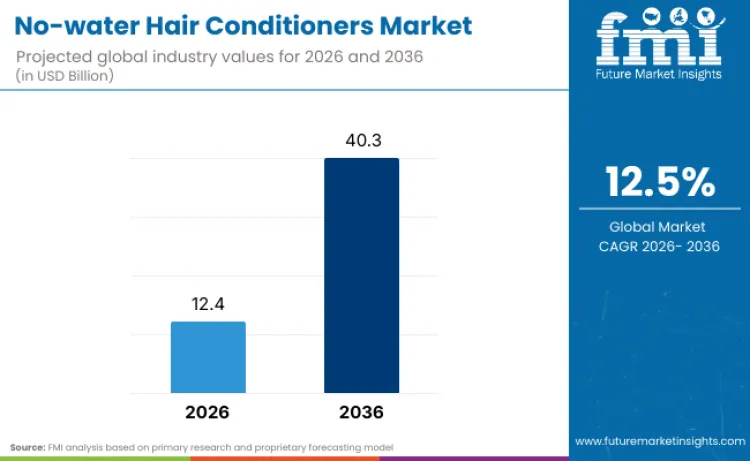
The global no-water hair conditioners market is projected to reach a valuation of USD 12.4 Billion in 2026 and expand to USD 40.3 Billion by 2036, registering a strong 12.50% CAGR. Demand for no-water hair conditioners, as per Future Market Insights, is being driven by mounting pressure on water resources, rising urban convenience needs, and the inefficiency of conventional rinse-off formulations that depend heavily on water usage during both production and consumption. The category is evolving from niche emergency hygiene solutions into mainstream personal care formats positioned around sustainability, portability, and rapid application.
Technology-led founders and science-driven startups are playing a pivotal role in legitimizing waterless conditioning as a scalable alternative to traditional hair care. Puneet Gupta, CEO and Founder of Clensta, highlighted the innovation logic behind this shift, stating: "I partnered with IIT Delhi and developed the world’s first waterless technology to create a range of complete personal hygiene solutions that addressed this problem." This collaboration underscores how academic-industry partnerships are enabling breakthrough formulation platforms that eliminate water without compromising conditioning performance.
Manufacturers are increasingly responding by investing in spray, foam, and leave-on solid formats that deliver detangling, smoothing, and scalp comfort without rinse dependency. As adoption accelerates across travel, medical care, and water-stressed regions, the no-water hair conditioners market is transitioning from functional necessity to a core pillar of next-generation sustainable hair care through 2036.
Summary of No-water Hair Conditioners Market
What Is Growth Outlook for No-water Hair Conditioners Market as per Future Market Insights Projection?
Future Market Insights projects the no-water hair conditioners market to expand at a CAGR of 12.5% from 2026 to 2036, increasing from USD 12.4 Billion in 2026 to USD 40.3 Billion by 2036.
FMI Research Approach: FMI proprietary forecasting model based on water-stress impact analysis, anhydrous haircare adoption rates, and logistics efficiency gains.
How Do FMI Analysts Perceive No-water Hair Conditioners Market to Evolve?
FMI analysts perceive the market evolving from emergency hygiene solutions into mainstream sustainable haircare formats centered on portability, concentration, and rinse-free performance.
FMI Research Approach: Evaluation of waterless formulation scalability, convenience-driven consumption, and sustainability-led product innovation.
Which Country Holds Largest Share in Global No-water Hair Conditioners Market?
China holds a significant share of the global no-water hair conditioners market, supported by strong e-commerce penetration and rapid adoption of compact, science-led haircare formats.
FMI Research Approach: FMI country-level revenue modeling based on digital retail growth, solid-format uptake, and premium haircare demand.
How Large Will No-water Hair Conditioners Market Be by 2036?
The global no-water hair conditioners market is projected to reach USD 40.3 Billion by 2036.
FMI Research Approach: FMI long-term revenue forecast derived from solid conditioner penetration, repeat usage patterns, and emerging market scale-up.
What Is Definition of No-water Hair Conditioners Market?
The no-water hair conditioners market comprises anhydrous hair conditioning products formulated without added water to deliver detangling, smoothing, and repair benefits.
FMI Research Approach: FMI market taxonomy and inclusion-exclusion framework aligned with waterless haircare and concentrated formulation standards.
What Are Globally Unique Trends Shaping No-water Hair Conditioners Market?
Globally unique trends include solid conditioner bars, water-activated formats, and biotech-enabled concentrated haircare systems.
FMI Research Approach: Sustainability policy tracking, corporate water-reduction mandates, and innovation-led haircare technology assessment.
No-water Hair Conditioners Market Key Takeaways
| Metric | Details |
|---|---|
| Industry Size (2026) | USD 12.4 Billion |
| Industry Value (2036) | USD 40.3 Billion |
| CAGR (2026-2036) | 12.5% |
Source: Future Market Insights (FMI) analysis, based on proprietary forecasting model and primary research
Which Factors Drive Waterless Hair Conditioner Adoption?
The No-water Hair Conditioners Market is being driven by a structural breakdown in the economics and sustainability of traditional rinse-off hair care. Conventional conditioners are heavily water-diluted, increasing shipping weight, plastic dependency, and preservative load, while delivering limited functional value per use. This has created an urgent operational need for anhydrous formulations that can reduce logistics costs, eliminate synthetic preservatives, and deliver concentrated performance without compromising hair health or manageability. Waterless conditioners directly address these inefficiencies by concentrating actives into lighter, modular formats that are easier to transport, store, and customize.
Lorena Ferreyros, Senior Brand Director of Hair Care North America at Procter & Gamble, captured this transition in October 2025, describing waterless innovations such as Gemz as a "science-enabled response to modern consumer needs," allowing consumers to "mix and match different shampoos and conditioners based on their hair’s changing needs, without sacrificing performance." This shift is forcing a fundamental move away from fixed, one-size-fits-all liquid routines toward adaptive, concentrated hair conditioning systems that align with modern sustainability and convenience expectations.
How Is the No-water Hair Conditioners Market Segmented?
The no-water hair conditioners market is segmented by product type, ingredient type, consumer orientation, sales channel, and region to reflect how anhydrous hair care is being adopted across formulation platforms and usage behaviors. By product type, the market includes solid bars or solid conditioner bars, dry mists and condition-in-mist formats, powder or activated conditioners, and concentrated paste or gel formats that deliver conditioning benefits without rinse dependency. By ingredient type, demand is led by natural and plant-derived formulations, followed by organic or clean label formulas and functional additives designed to enhance detangling, smoothing, and scalp comfort.
By consumer orientation, women account for the largest share of adoption, while men and unisex products represent expanding use cases as waterless grooming routines gain acceptance. By sales channel, online retail including direct-to-consumer and e-commerce platforms leads distribution, supported by specialty beauty stores, supermarkets and hypermarkets, and professional salon networks.
FMI analysis suggests that while format innovation is accelerating, the market structure remains anchored in trusted ingredient systems and digital-first sales models. This segmentation highlights a dual-track market where solid bars provide scale and familiarity, while mist, powder, and paste formats expand functional flexibility and personalization.
Why do Solid Bars (Solid Conditioner Bars) hold a Dominant Share?
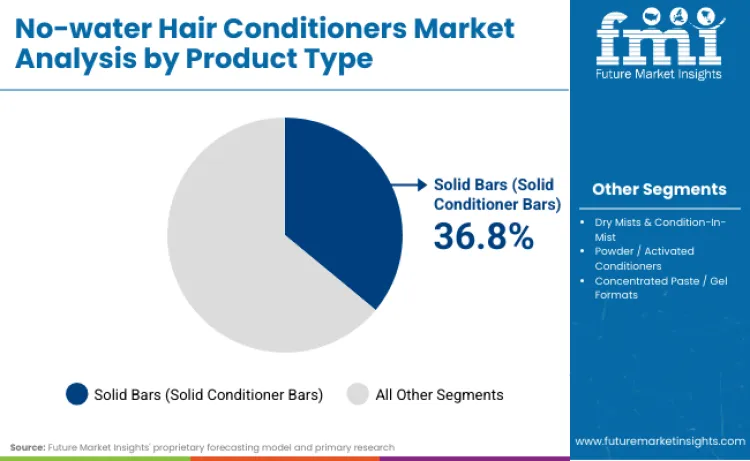
Solid conditioner bars command a dominant 36.80% share in the no-water hair conditioners market because they directly resolve the core inefficiencies of traditional liquid hair care while preserving conditioning performance. Conventional conditioners are heavily water-diluted, increasing shipping weight, plastic usage, and preservative dependency. Solid bars eliminate these constraints by concentrating conditioning actives into compact, self-preserving formats that reduce logistics costs and environmental impact without compromising hair health. Their familiar bar format also lowers the adoption barrier for consumers transitioning from rinse-off products to anhydrous routines.
Robert Reiss, Brand Vice President, North America Hair and Disruptive Innovation at Procter & Gamble, validated this shift in November 2025, stating: "Consumers are loving the Gemz experience because it’s fun and flexible - adapting to their unique needs without sacrificing cleaning or conditioning performance." This performance parity, combined with flexibility and sustainability benefits, protects solid conditioner bars from displacement by emerging mist or powder formats, positioning them as the anchor product type in the no-water hair conditioners market.
Why do Concentrated Solids hold a Dominant Share?
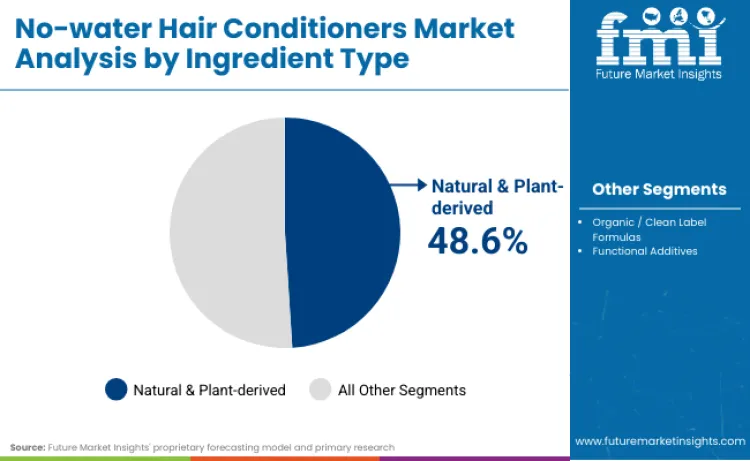
Concentrated solid formats lead the no-water hair conditioners market with natural and plant-derived ingredients accounting for a dominant 48.60% share, as these formats directly eliminate the structural inefficiency of "shipping water" that inflates carbon footprints and logistics costs in liquid hair care. By removing water, solid bars and tiles reduce packaging needs, lower transport emissions, and avoid synthetic preservatives while delivering high active concentration. Their dominance is reinforced by the requirement that solid formats must match or exceed luxury bottled performance to secure repeat adoption. Kate Assaraf, Founder of Dip Sustainable Hair Care, highlighted this rigor, stating: "I took over a thousand showers and A/B tested my products against different luxury bottled brands and obsessed on making the bars work for all hair types." This performance-first validation ensures concentrated solids are not perceived as compromises, positioning them as the cornerstone of sustained market expansion.
Why Is R&D-Driven Format Innovation Reshaping the Market?
Research-led format innovation is fundamentally reshaping the No-water Hair Conditioners Market by replacing conventional liquid formulas with engineered solid and semi-solid delivery systems that maximize active efficiency. A clear inflection point emerged in July 2025 with the launch of Gemz by Procter & Gamble, which introduced porous, water-activated solids capable of delivering salon-grade conditioning without bulk packaging. John Scarchilli, Director of Hair Care Scientific Communications at P&G, explained that each unit is built from intricately spun threads forming a high-surface-area matrix that dissolves rapidly on contact with water. This approach allows consumers to control concentration at the point of use, relieving sustainability and logistics bottlenecks created by heavy, water-filled bottles while enabling modular, performance-driven hair routines.
How Is Biotech-Based Formula Concentration Changing Consumer Habits?
The market is pivoting aggressively toward ultra-concentrated, biotech-enabled formulations that replicate or exceed the sensory performance of traditional conditioners. Brands are integrating smart-release systems, bio-fermented actives, and microalgae-based complexes to deliver slip, moisture retention, and scalp comfort in water-free formats. This transition is changing consumer habits by decoupling conditioning efficacy from rinse-off volume, allowing users to adopt lighter, more precise routines. Industry commentary in early 2026 emphasized that while sustainability is now expected, performance and affordability remain non-negotiable, forcing waterless formats to compete head-to-head with premium liquid products. As a result, no-water conditioners are increasingly perceived as advanced, skin-care-grade solutions for hair rather than eco-compromises, accelerating everyday adoption and repeat usage.
What Role Does Corporate Sustainability Mandates Play in Lab Innovation?
Corporate sustainability mandates are stabilizing the investment environment for waterless haircare innovation by removing internal resistance to non-traditional formats. Large manufacturers are setting fixed targets for water and plastic reduction that structurally require anhydrous R&D pathways. L’Oréal, for example, committed that by 2025 all plastic packaging would be recyclable or refillable, with at least half derived from recycled materials. These mandates lower the barrier for internal labs to commercialize solid bars, tiles, and "gems" without relying on conventional packaging economics. The result is a faster path to market for niche, planet-positive conditioner formats and greater freedom for R&D teams to develop concentrated nutrient systems aligned with a waterless future.
What Is the No-water Hair Conditioners Market Regional Outlook?
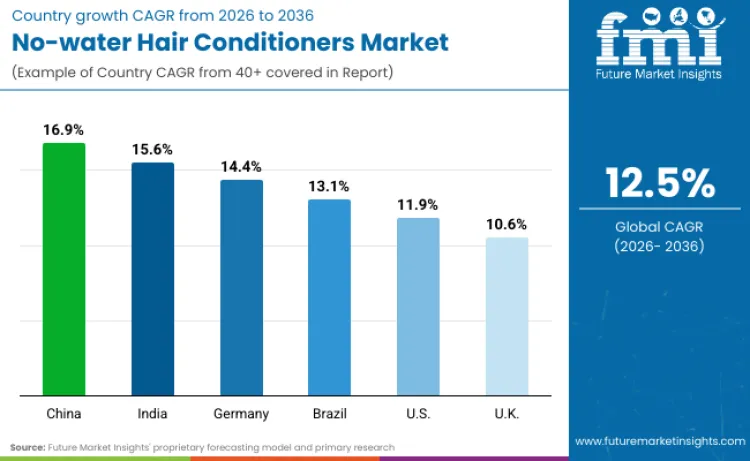
Sales of no-water hair conditioners are expanding faster than the global average in emerging and water-stressed markets, where sustainability pressures, digital commerce, and portability needs are accelerating adoption. While the global market grows at a 12.50% CAGR, Asia is clearly outperforming as consumers and manufacturers move away from water-intensive rinse-off routines. China leads the regional outlook with a 16.9% CAGR, driven by strong e-commerce penetration, science-led solid formats, and rising demand for premium, compact haircare solutions. India follows closely at 15.6%, supported by rapid urbanization, travel-friendly hygiene adoption, and growing acceptance of solid conditioner bars among younger consumers.
In contrast, developed markets are expanding at more moderate but structurally stable rates. Germany records a 14.4% CAGR, anchored in clean-label and specialty beauty retail, while Brazil grows at 13.1%, supported by powder and activated conditioner formats suited to climate and lifestyle conditions. The United States and the United Kingdom trail at 11.9% and 10.6%, where growth is driven by premium innovation, professional channels, and ingredient transparency rather than rapid volume expansion. FMI analysis indicates that future growth will be led by emerging markets scaling digital access, while mature regions act as performance-validation and margin anchors.
| Country | CAGR (2026 to 2036) |
|---|---|
| China | 16.9% |
| India | 15.6% |
| Germany | 14.4% |
| Brazil | 13.1% |
| United States | 11.9% |
| United Kingdom | 10.6% |
Source: FMI historical analysis and forecast data.
Why Is the Indian Government Standardizing Waterless Personal Care?
India’s no-water hair conditioners market is growing at a strong 15.6% CAGR, and much of this momentum is coming from policy rather than marketing alone. The government’s Mission LiFE (Lifestyle for Environment) has shifted sustainability from a voluntary ideal to a structured national objective. This became more concrete with the expansion of the National Circular Economy Framework (NCEF) 2024-2025, which widened its scope to cover plastics and other high-impact materials used in personal care. For hair care brands, this effectively raises the cost of continuing with water-heavy, plastic-intensive formats.
In response, manufacturers are increasingly aligning product design with these policy signals. Waterless conditioners reduce packaging, lower transport emissions, and fit cleanly into the government’s "waste-to-worth" narrative. Rather than banning liquid products outright, India is creating a compliance environment that makes anhydrous formats the more practical long-term choice. As a result, waterless conditioners are becoming part of the formalized, policy-aligned personal care ecosystem rather than a niche sustainability experiment.
How Is China Deploying Sustainable Beauty Infrastructure?
China leads the no-water hair conditioners market with a 16.9% CAGR, driven by regulatory speed and innovation support rather than consumer activism alone. In November 2025, the National Medical Products Administration introduced reforms that significantly streamlined cosmetics approvals, including faster review timelines and relaxed requirements for imported products with new efficacy claims. These changes make it much easier for waterless and solid haircare formats to reach shelves quickly.
What makes China distinctive is that sustainability is being paired with performance and industrial policy. Subsidies for new raw materials, wider acceptance of alternative testing methods, and support for high-quality manufacturing all favor concentrated, anhydrous formats. Waterless conditioners benefit from this environment because they combine innovation, efficiency, and regulatory alignment. FMI analysis suggests China is not just adopting sustainable beauty products, but actively building the infrastructure that allows these formats to scale rapidly and compete with traditional liquids on both performance and availability.
Why Is Brazil Focusing on Circularity?
Brazil’s no-water hair conditioners market is expanding at a 13.1% CAGR, shaped by a growing focus on circularity across the full product lifecycle. Industry data shows that a large share of haircare’s environmental footprint comes during the rinse-off phase, when water and energy use peak. This has shifted attention away from packaging alone and toward how products are actually used by consumers.
In this context, waterless conditioners stand out because they reduce or eliminate rinse-off impact altogether. Brands operating in Brazil are increasingly adopting scoring systems that rate products on water use, transparency, and circular performance, making sustainability visible and comparable. FMI analysis indicates that Brazil is becoming a proving ground for lifecycle-based sustainability rather than surface-level green claims. Waterless hair conditioners fit naturally into this model, helping brands demonstrate measurable reductions in environmental impact while still meeting consumer expectations for performance and care.
How Is the US Market Maturing Around Performance Standards?
The United States is growing at a steady 11.9% CAGR, but its adoption of waterless hair conditioners is being shaped by performance expectations rather than regulation alone. Programs such as the EPA’s WaterSense label reinforce a clear principle: products that save water must perform as well as, or better than, conventional alternatives. This mindset has carried over into personal care.
As a result, USA consumers are less forgiving of sustainability products that compromise results. Waterless conditioners gaining traction are those that can match liquid formulas in conditioning, detangling, and hair feel. FMI analysis suggests this has filtered the market, favoring science-driven, high-efficacy formats over novelty solutions. The USA is therefore maturing into a validation market where waterless conditioners succeed only when they prove functional superiority, helping establish global benchmarks for performance-led sustainability in hair care.
Why Is the UK Standardizing Green Claims for Personal Care?
The UK no-water hair conditioners market is growing at 10.6% CAGR, supported by tighter rules around sustainability claims. The government’s move toward UK Sustainability Reporting Standards (UK SRS S1 and S2) signals a shift toward consistent, auditable environmental disclosures across consumer goods. This is aimed squarely at reducing vague or misleading green claims.
For hair care brands, this means that environmental benefits must be measurable and defensible. Waterless conditioners are structurally advantaged here because their reductions in water use, packaging, and transport emissions are easier to quantify than incremental improvements in liquid products. FMI analysis indicates that the UK market is becoming less about storytelling and more about proof. As reporting standards tighten, anhydrous formats are increasingly seen as safer, more credible choices for brands looking to withstand regulatory and investor scrutiny.
How Is Germany Reshaping Product Safety and Water Preservation?
Germany is expanding at a 14.4% CAGR, driven by a strong national focus on resource security, climate resilience, and water protection. In recent policy statements, secure drinking water supply has been framed as a strategic priority, not just an environmental issue. This perspective is gradually influencing consumer goods regulation and corporate responsibility expectations.
In hair care, this translates into growing scrutiny of water-intensive rinse-off products. Waterless conditioners align well with Germany’s efficiency-first approach, reducing water use across both manufacturing and consumer phases. FMI analysis suggests German adoption is pragmatic rather than trend-driven: anhydrous conditioners are seen as logical, risk-reducing alternatives rather than premium novelties. This makes Germany a market where waterless formats gain credibility through safety, efficiency, and long-term resource planning, reinforcing steady and policy-aligned growth.
How is the Competition in the No-water Hair Conditioners Market?
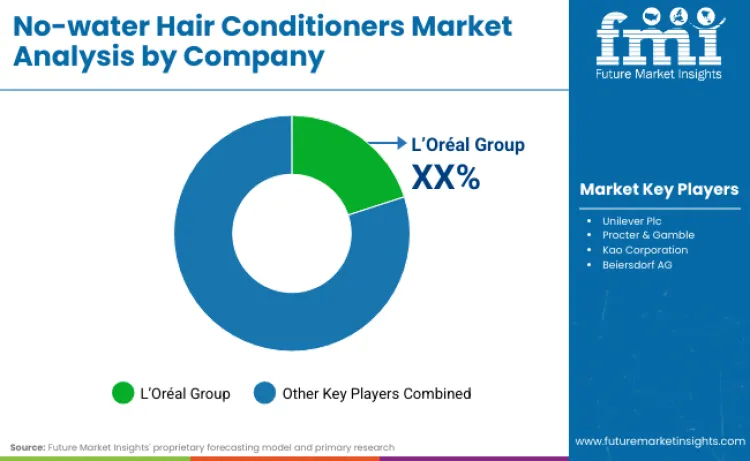
Established leaders such as Procter & Gamble protect their market position through deep scientific integration and long-horizon R&D investment that smaller entrants struggle to replicate. The launch of Gemz, positioned as a first-of-its-kind water-activated hair care format, reflects more than product innovation; it signals a strategic bet on modular, zero-waste routines for fast-evolving consumer needs. P&G leverages more than a decade of formulation science and consumer testing to maintain loyalty among users seeking flexibility without sacrificing conditioning performance. Robert Reiss, Brand Vice President for Hair and Disruptive Innovation at P&G, validated this competitive edge by noting that consumers value formats that adapt to changing needs while maintaining efficacy.
Strategic transformation is further reshaping competition as global groups embed water stewardship directly into operations. L’Oréal has moved beyond packaging innovation toward systemic efficiency, committing to closed-loop industrial water use and measurable reductions in rinse-off water consumption by 2030. This shifts competition from shelf-level differentiation to operational excellence, where leadership is defined by who can deliver high-performance waterless conditioning at scale while meeting increasingly strict sustainability benchmarks.
Recent Developments:
- In July 2025, P&G launched Gemz, a first-of-its-kind haircare brand using single-dose, water-activated, dissolvable "gems" instead of bottles. Developed over 14 years, the waterless tiles deliver concentrated cleansing without fillers or waxes, leaving hair light, smooth, and residue-free.
- In October 2025, DC Advisory released its Beauty M&A outlook, noting resilience across beauty categories despite post-pandemic moderation. Renewed strategic activity by major players, ongoing global deals, and selective acquisitions point to a healthy, growth-oriented M&A landscape for 2025-2026 amid geopolitical and policy shifts.
Key Players in No-water Hair Conditioners Market
- L’Oréal Group
- Unilever Plc
- Procter & Gamble
- Kao Corporation
- Beiersdorf AG
Market Definition
The No-water Hair Conditioners Market refers to hair conditioning products formulated without added water, designed to deliver conditioning, detangling, smoothing, or repair benefits through concentrated or anhydrous formats. These products rely on solid, powder, paste, gel, or mist-based delivery systems that activate upon application or contact with minimal water during use. The market is driven by sustainability goals, portability, reduced packaging, and improved ingredient efficiency, positioning no-water conditioners as alternatives to traditional rinse-off liquid conditioners. This market includes both consumer and professional-use products across mass, premium, and salon-grade segments, and is shaped by innovation in solid matrices, biotech actives, and water-efficient beauty routines.
Market Inclusion
The market includes solid conditioner bars, conditioner tiles, powder or activated conditioners, concentrated pastes or gels, and dry or condition-in-mist formats that contain no added water at the point of manufacture. Products formulated with natural, plant-derived, organic, or biotech-based conditioning agents are included, as are items sold through online direct-to-consumer platforms, specialty beauty stores, supermarkets, and professional salon channels. Both individual consumer products and professional-use formats are covered. The scope includes products marketed for daily care, travel use, sustainability-focused routines, and water-saving applications across global regions.
Market Exclusion
The market excludes traditional liquid or cream conditioners that contain significant water content, even if marketed as eco-friendly or low-waste. Rinse-off conditioners packaged in bottles, refill pouches, or concentrates requiring dilution before use are not included. The scope also excludes shampoos, cleansing bars without conditioning functionality, leave-in sprays that are water-based, and hair masks or treatments primarily designed for intensive repair rather than routine conditioning. Products focused solely on scalp cleansing, styling, or cosmetic fragrance without conditioning benefits are excluded from this market definition.
Scope of the Report
| Items | Values |
|---|---|
| Quantitative Units | USD billion |
| Product Type | Skin-Nourishing & Moisturizing Bars; Standard Massage Bars; Aromatherapy-Infused Bars; Specialized Solid Therapy Bars |
| Core Functional Focus | Anhydrous solid formulations; natural self-preserving systems; high-active concentration delivery; preservative-free body care; zero-water cosmetic platforms |
| Application | Personal Care & Daily Use; Professional Spa & Wellness Use; Therapeutic & Sports Massage |
| End User | Individual Consumers; Commercial Clients (Spas, Wellness Centers, Therapy Clinics) |
| Distribution Channel | Online Retail & E-commerce; Specialty Stores & Wellness Boutiques; Supermarkets & Hypermarkets |
| Sustainability & Innovation Platform | Waterless beauty systems; naked/unpackaged formats; ethical manufacturing models; plastic-free logistics; concentrated active formulation science |
| Regions Covered | North America; Europe; Asia Pacific; Latin America; Middle East & Africa |
| Countries Covered | China; India; Germany; Brazil; United States; United Kingdom; Japan; South Korea; France; and 35+ additional countries |
| Key Companies Profiled | The Body Shop; Bon Vital (Performance Health); Raven Moonlight Botanicals; Fabulous Frannie; Lush Cosmetics; Organic & Specialty Wellness Brands |
| Additional Attributes | Solid format penetration rates; packaging-free adoption trends; professional spa channel expansion; e-commerce growth intensity; sustainability-driven purchasing behavior |
No-water Hair Conditioners Market by Segments
By Product Type:
- Solid Conditioner Bars
- Dry Mists & Condition-in-Mist Formats
- Powder / Activated Conditioners
- Concentrated Paste & Gel Formats
By Ingredient Type:
- Natural & Plant-Derived Formulations
- Organic / Clean Label Formulas
- Functional Additives
By Consumer Orientation:
- Women
- Men
- Unisex
By Sales Channel:
- Online Retail (Direct-to-Consumer & E-Commerce)
- Specialty Beauty Stores
- Supermarkets & Hypermarkets
- Professional Salon Distribution
By Region:
- North America
- Europe
- Asia Pacific
- Latin America
- Middle East & Africa
Bibliography
- CII-ITC Centre of Excellence for Sustainable Development. (2024). National circular economy framework (NCEF) edition 2. Confederation of Indian Industry.
- State Council of the People’s Republic of China. (2025, November 17). China unveils guidelines to boost cosmetics industry regulation, innovation. National Medical Products Administration.
- USA Environmental Protection Agency. (2025). WaterSense product specifications.
Frequently Asked Questions
What is the current global market size for No-water Hair Conditioners?
The global market is valued at USD 12.4 billion in 2026, driven by rising adoption of concentrated, waterless haircare formats focused on sustainability and convenience.
What is the projected CAGR for the No-water Hair Conditioners market?
The market is projected to grow at a 12.5% CAGR from 2026 to 2036, reflecting rapid expansion of solid, mist, and activated conditioner innovations worldwide.
Which segment currently dominates the industry?
Solid conditioner bars lead with a 36.8% share, while natural and plant-derived ingredients dominate formulations with 48.6% adoption.
What are the primary drivers for adoption in emerging markets?
Severe water stress, fast-growing e-commerce access, portability needs, and rising acceptance of sustainable grooming formats in China and India are the main growth drivers.
Who are the leading players in the No-water Hair Conditioners space?
Key companies include L’Oréal Group, Unilever, Procter & Gamble, Kao Corporation, and Beiersdorf AG.
Preview the report firsthand - request a free sample
Get SampleGet the brochure for pricing and purchase details.
Get PDFTable of Content
- Executive Summary
- Global Market Outlook
- Demand Side Trends
- Supply Side Trends
- Technology Roadmap Analysis
- Analysis and Recommendations
- Market Overview
- Market Coverage / Taxonomy
- Market Definition / Scope / Limitations
- Research Methodology
- Chapter Orientation
- Analytical Lens and Working Hypotheses
- Market Structure, Signals, and Trend Drivers
- Benchmarking and Cross-market Comparability
- Market Sizing, Forecasting, and Opportunity Mapping
- Research Design and Evidence Framework
- Desk Research Programme (Secondary Evidence)
- Company Annual and Sustainability Reports
- Peer-reviewed Journals and Academic Literature
- Corporate Websites, Product Literature, and Technical Notes
- Earnings Decks and Investor Briefings
- Statutory Filings and Regulatory Disclosures
- Technical White Papers and Standards Notes
- Trade Journals, Industry Magazines, and Analyst Briefs
- Conference Proceedings, Webinars, and Seminar Materials
- Government Statistics Portals and Public Data Releases
- Press Releases and Reputable Media Coverage
- Specialist Newsletters and Curated Briefings
- Sector Databases and Reference Repositories
- FMI Internal Knowledge Base and Historical Datasets
- Subscription Datasets and Paid Sources
- Social Channels, Communities, and Digital Listening Inputs
- Additional Desk Sources
- Expert Input and Fieldwork (Primary Evidence)
- Primary Modes
- Qualitative Interviews and Expert Elicitation
- Quantitative Surveys and Structured Data Capture
- Blended Approach
- Why Primary Evidence is Used
- Field Techniques
- Interviews
- Surveys
- Focus Groups
- Observational and In-context Research
- Social and Community Interactions
- Stakeholder Universe Engaged
- C-suite Leaders
- Board Members
- Presidents and Vice Presidents
- R&D and Innovation Heads
- Technical Specialists
- Domain Subject-matter Experts
- Scientists
- Physicians and Other Healthcare Professionals
- Governance, Ethics, and Data Stewardship
- Research Ethics
- Data Integrity and Handling
- Primary Modes
- Tooling, Models, and Reference Databases
- Desk Research Programme (Secondary Evidence)
- Data Engineering and Model Build
- Data Acquisition and Ingestion
- Cleaning, Normalisation, and Verification
- Synthesis, Triangulation, and Analysis
- Quality Assurance and Audit Trail
- Market Background
- Market Dynamics
- Drivers
- Restraints
- Opportunity
- Trends
- Scenario Forecast
- Demand in Optimistic Scenario
- Demand in Likely Scenario
- Demand in Conservative Scenario
- Opportunity Map Analysis
- Product Life Cycle Analysis
- Supply Chain Analysis
- Investment Feasibility Matrix
- Value Chain Analysis
- PESTLE and Porter's Analysis
- Regulatory Landscape
- Regional Parent Market Outlook
- Production and Consumption Statistics
- Import and Export Statistics
- Market Dynamics
- Global Market Analysis 2021 to 2025 and Forecast, 2026 to 2036
- Historical Market Size Value (USD Billion) Analysis, 2021 to 2025
- Current and Future Market Size Value (USD Billion) Projections, 2026 to 2036
- Y-o-Y Growth Trend Analysis
- Absolute $ Opportunity Analysis
- Global Market Pricing Analysis 2021 to 2025 and Forecast 2026 to 2036
- Y-o-Y Growth Trend Analysis 2021 to 2025
- Absolute $ Opportunity Analysis 2026 to 2036
- Global Market Analysis 2021 to 2025 and Forecast 2026 to 2036, By Product Type
- Introduction / Key Findings
- Historical Market Size Value (USD Billion) Analysis By Product Type, 2021 to 2025
- Current and Future Market Size Value (USD Billion) Analysis and Forecast By Product Type, 2026 to 2036
- Solid Conditioner Bars
- Dry Mists & Condition-in-Mist Formats
- Powder / Activated Conditioners
- Concentrated Paste & Gel Formats
- Y-o-Y Growth Trend Analysis By Product Type, 2021 to 2025
- Absolute $ Opportunity Analysis By Product Type, 2026 to 2036
- Global Market Analysis 2021 to 2025 and Forecast 2026 to 2036, By Ingredient Type
- Introduction / Key Findings
- Historical Market Size Value (USD Billion) Analysis By Ingredient Type, 2021 to 2025
- Current and Future Market Size Value (USD Billion) Analysis and Forecast By Ingredient Type, 2026 to 2036
- Natural & Plant-Derived Formulations
- Organic / Clean Label Formulas
- Functional Additives
- Y-o-Y Growth Trend Analysis By Ingredient Type, 2021 to 2025
- Absolute $ Opportunity Analysis By Ingredient Type, 2026 to 2036
- Global Market Analysis 2021 to 2025 and Forecast 2026 to 2036, By Consumer Orientation
- Introduction / Key Findings
- Historical Market Size Value (USD Billion) Analysis By Consumer Orientation, 2021 to 2025
- Current and Future Market Size Value (USD Billion) Analysis and Forecast By Consumer Orientation, 2026 to 2036
- Women
- Men
- Unisex
- Y-o-Y Growth Trend Analysis By Consumer Orientation, 2021 to 2025
- Absolute $ Opportunity Analysis By Consumer Orientation, 2026 to 2036
- Global Market Analysis 2021 to 2025 and Forecast 2026 to 2036, By Sales Channel
- Introduction / Key Findings
- Historical Market Size Value (USD Billion) Analysis By Sales Channel, 2021 to 2025
- Current and Future Market Size Value (USD Billion) Analysis and Forecast By Sales Channel, 2026 to 2036
- Online Retail (Direct-to-Consumer & E-Commerce)
- Specialty Beauty Stores
- Supermarkets & Hypermarkets
- Professional Salon Distribution
- Y-o-Y Growth Trend Analysis By Sales Channel, 2021 to 2025
- Absolute $ Opportunity Analysis By Sales Channel, 2026 to 2036
- Global Market Analysis 2021 to 2025 and Forecast 2026 to 2036, By Region
- Introduction
- Historical Market Size Value (USD Billion) Analysis By Region, 2021 to 2025
- Current Market Size Value (USD Billion) Analysis and Forecast By Region, 2026 to 2036
- North America
- Europe
- Asia Pacific
- Latin America
- Middle East & Africa
- Market Attractiveness Analysis By Region
- North America Market Analysis 2021 to 2025 and Forecast 2026 to 2036, By Country
- Historical Market Size Value (USD Billion) Trend Analysis By Market Taxonomy, 2021 to 2025
- Market Size Value (USD Billion) Forecast By Market Taxonomy, 2026 to 2036
- By Country
- USA
- Canada
- By Product Type
- By Ingredient Type
- By Consumer Orientation
- By Sales Channel
- By Country
- Market Attractiveness Analysis
- By Country
- By Product Type
- By Ingredient Type
- By Consumer Orientation
- By Sales Channel
- Key Takeaways
- Europe Market Analysis 2021 to 2025 and Forecast 2026 to 2036, By Country
- Historical Market Size Value (USD Billion) Trend Analysis By Market Taxonomy, 2021 to 2025
- Market Size Value (USD Billion) Forecast By Market Taxonomy, 2026 to 2036
- By Country
- Germany
- UK
- France
- Rest of Europe
- By Product Type
- By Ingredient Type
- By Consumer Orientation
- By Sales Channel
- By Country
- Market Attractiveness Analysis
- By Country
- By Product Type
- By Ingredient Type
- By Consumer Orientation
- By Sales Channel
- Key Takeaways
- Asia Pacific Market Analysis 2021 to 2025 and Forecast 2026 to 2036, By Country
- Historical Market Size Value (USD Billion) Trend Analysis By Market Taxonomy, 2021 to 2025
- Market Size Value (USD Billion) Forecast By Market Taxonomy, 2026 to 2036
- By Country
- China
- India
- Japan
- South Korea
- Rest of Asia Pacific
- By Product Type
- By Ingredient Type
- By Consumer Orientation
- By Sales Channel
- By Country
- Market Attractiveness Analysis
- By Country
- By Product Type
- By Ingredient Type
- By Consumer Orientation
- By Sales Channel
- Key Takeaways
- Latin America Market Analysis 2021 to 2025 and Forecast 2026 to 2036, By Country
- Historical Market Size Value (USD Billion) Trend Analysis By Market Taxonomy, 2021 to 2025
- Market Size Value (USD Billion) Forecast By Market Taxonomy, 2026 to 2036
- By Country
- Brazil
- Rest of Latin America
- By Product Type
- By Ingredient Type
- By Consumer Orientation
- By Sales Channel
- By Country
- Market Attractiveness Analysis
- By Country
- By Product Type
- By Ingredient Type
- By Consumer Orientation
- By Sales Channel
- Key Takeaways
- Middle East & Africa Market Analysis 2021 to 2025 and Forecast 2026 to 2036, By Country
- Historical Market Size Value (USD Billion) Trend Analysis By Market Taxonomy, 2021 to 2025
- Market Size Value (USD Billion) Forecast By Market Taxonomy, 2026 to 2036
- By Country
- Kingdom of Saudi Arabia
- South Africa
- Rest of Middle East & Africa
- By Product Type
- By Ingredient Type
- By Consumer Orientation
- By Sales Channel
- By Country
- Market Attractiveness Analysis
- By Country
- By Product Type
- By Ingredient Type
- By Consumer Orientation
- By Sales Channel
- Key Takeaways
- Key Countries Market Analysis
- USA
- Pricing Analysis
- Market Share Analysis, 2025
- By Product Type
- By Ingredient Type
- By Consumer Orientation
- By Sales Channel
- China
- Pricing Analysis
- Market Share Analysis, 2025
- By Product Type
- By Ingredient Type
- By Consumer Orientation
- By Sales Channel
- India
- Pricing Analysis
- Market Share Analysis, 2025
- By Product Type
- By Ingredient Type
- By Consumer Orientation
- By Sales Channel
- Germany
- Pricing Analysis
- Market Share Analysis, 2025
- By Product Type
- By Ingredient Type
- By Consumer Orientation
- By Sales Channel
- Brazil
- Pricing Analysis
- Market Share Analysis, 2025
- By Product Type
- By Ingredient Type
- By Consumer Orientation
- By Sales Channel
- UK
- Pricing Analysis
- Market Share Analysis, 2025
- By Product Type
- By Ingredient Type
- By Consumer Orientation
- By Sales Channel
- USA
- Market Structure Analysis
- Competition Dashboard
- Competition Benchmarking
- Market Share Analysis of Top Players
- By Regional
- By Product Type
- By Ingredient Type
- By Consumer Orientation
- By Sales Channel
- Competition Analysis
- Competition Deep Dive
- L’Oréal Group
- Unilever Plc
- Procter & Gamble
- Kao Corporation
- Beiersdorf AG
- Competition Deep Dive
- Assumptions & Acronyms Used


