

- Industry Size (2026)
- USD 17.9 Bn
- Forecast (2036)
- USD 23.6 Bn
- CAGR (2026 to 2036)
- 2.80%
Plasticizing Hair Styling Products Market Forecast and Outlook 2026 to 2036
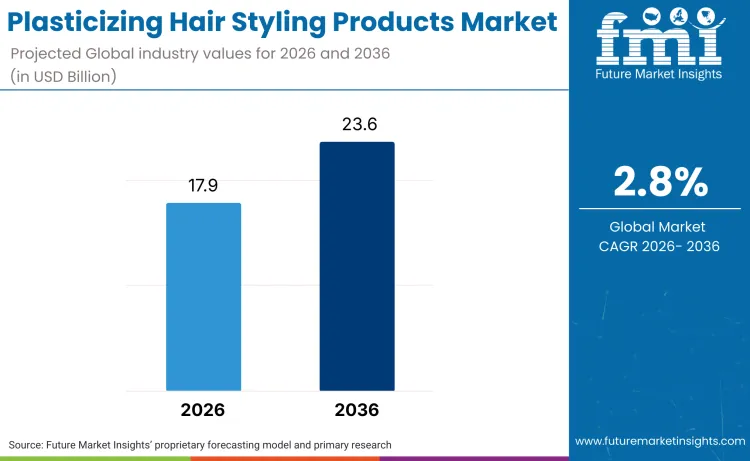
The plasticizing hair styling products market is valued at USD 17.9 billion in 2026 and is projected to reach USD 23.6 billion by 2036, expanding at a 2.80% CAGR. As per Future Market Insights, market expansion is being driven by sustained demand for long hold styling products that deliver shape retention, humidity resistance, and flexible control across daily grooming routines. Plasticizing agents are enabling styling formulations to achieve smoother film formation, improved spreadability, and consistent performance across gels, creams, pomades, and styling waxes. Product activity between 2025 and 2026 reflects a shift toward lightweight plasticizers and hybrid polymer systems that reduce stiffness, residue, and flaking during prolonged wear. Brands are reformulating styling portfolios to improve comfort during extended use while maintaining hold strength across diverse hair textures, with professional salon brands strengthening high performance styling lines and mass market players upgrading polymer systems to protect category relevance.
Rising frequency of at home styling routines, growing adoption of textured and structured hair looks, and climate related humidity exposure are supporting steady usage across routine hair care practices. Styling performance claims around flexible hold and long lasting definition are shaping new product positioning strategies across premium and professional ranges. This emphasis on performance aligned with professional expectations is echoed by salon focused brands. Michaeline DeJoria, CEO of John Paul Mitchell Systems, stated, "It’s an honor to be recognized by Kline for our professional hair styling products. My father co-founded this company 43 year ago and since then we have always strived to put the needs of the salon industry first. Our success wouldn’t have been possible without the unwavering support of professional stylists, and for that, I am incredibly grateful. As we continue to grow and expand our product line, we will always appreciate and implement the feedback and needs of our global professional community." Future Market Insights notes that digital retail and social commerce remain central to category visibility, as visual results drive trial and repeat purchase, supporting stable value growth and broader brand participation through 2036.
Summary of the Plasticizing Hair Styling Products Market
What Is Growth Outlook for the Plasticizing Hair Styling Products Market as per Future Market Insights Projection?
Future Market Insights projects the plasticizing hair styling products market to grow at a 2.80% CAGR from 2026 to 2036, expanding from USD 17.9 billion in 2026 to USD 23.6 billion by 2036.
FMI Research Approach: FMI proprietary forecasting model based on bottom up revenue estimation, tracking penetration of plasticizing polymers across styling formats such as gels, creams, pomades, waxes, and edge control products, and demand modeling linked to daily grooming frequency, humidity exposure, and structured styling adoption across consumer segments.
How Do FMI Analysts Perceive Plasticizing Hair Styling Products Market to Evolve?
FMI analysts perceive the market shifting from basic hold focused styling toward performance balanced formulations that combine flexible control, comfort during extended wear, and reduced flaking or residue. Plasticizing hair styling products are increasingly positioned as daily grooming essentials that support long wear styling without stiffness across diverse hair textures.
FMI Research Approach: Assessment of product positioning centered on flexible hold, humidity resistance, and texture definition, evaluation of polymer and plasticizer system upgrades across mass and professional portfolios, and analysis of consumer acceptance of long wear styling products for routine grooming use.
Which Country Holds Largest Share in the Global Plasticizing Hair Styling Products Market?
China holds the largest share of the global plasticizing hair styling products market by value, supported by high frequency of daily styling routines, strong urban grooming culture, and wide penetration of styling gels and creams across mass and premium channels.
FMI Research Approach: FMI country level demand assessment across urban consumers, evaluation of daily hair styling frequency, and tracking of domestic and international brand expansion within Chinese hair care and styling retail.
How Large Will the Plasticizing Hair Styling Products Market Be by 2036?
The global plasticizing hair styling products market is projected to reach USD 23.6 billion by 2036.
FMI Research Approach: FMI long term forecast by country, styling format, hair texture category, and distribution channel, incorporating scaling assumptions for daily styling product usage and cross checking against broader hair care and grooming product growth trends.
What Is Definition of Plasticizing Hair Styling Products Market?
The plasticizing hair styling products market comprises hair styling formulations that incorporate plasticizing agents to enhance film formation, flexibility, spreadability, and hold performance, enabling long lasting styling across gels, creams, pomades, waxes, and related formats.
FMI Research Approach: FMI market taxonomy and inclusion exclusion framework covering styling products formulated with plasticizers for hold and texture control, while excluding non styling shampoos, conditioners, hair oils, and treatment serums.
What Are Globally Unique Trends Shaping Plasticizing Hair Styling Products Market?
Globally unique trends include rising demand for flexible hold styling solutions, increased influence of textured and structured hair looks, and growth of digital retail and social commerce as primary discovery channels for styling products.
FMI Research Approach: Analysis of styling performance claim adoption, distribution channel contribution trends, country wise growth differentials, and expansion of plasticizing styling products across routine daily grooming and professional use environments.
Plasticizing Hair Styling Products Market Key Takeaways
| Metric | Details |
|---|---|
| Industry Size (2026) | USD 17.9 Billion |
| Industry Value (2036) | USD 23.6 Billion |
| CAGR (2026-2036) | 2.80% |
Source: Future Market Insights (FMI) analysis, based on proprietary forecasting model and primary research.
Why Is the Demand for Plasticizing Hair Styling Products Growing?
Expectations around hair styling performance are changing as plasticizing hair styling products move beyond occasional, event based use into routine daily grooming practices. According to Future Market Insights, consumers are placing increasing value on long lasting hold, humidity resistance, and flexible control that maintains natural hair movement across extended wear. Earlier styling products were often perceived as stiff hold solutions suited mainly for special occasions or professional salon use, which limited everyday adoption. That perception is shifting as plasticizing formulations gain wider acceptance within regular hair care and styling routines.
Brand portfolio strategies illustrate this shift toward mainstream positioning. L’Oréal Groupe has expanded its styling ranges under L’Oréal Paris and Garnier Fructis with polymer based gels and creams positioned alongside shampoos and conditioners as part of complete daily grooming systems. Unilever has strengthened performance styling propositions across brands such as TRESemmé by promoting long wear control and humidity resistant styling benefits designed for routine use across diverse hair textures. These products are formulated to deliver consistent hold with reduced residue and improved comfort during extended wear, aligning with established grooming habits rather than changing usage behavior. Future Market Insights notes that brands integrating plasticizing styling products into core hair care portfolios, with everyday use positioning and reliable performance claims, are better placed to drive repeat purchase as the category expands beyond limited use styling occasions.
How Is the Plasticizing Hair Styling Products Market Segmented?
The plasticizing hair styling products market is segmented by product type, ingredient type, sales channel, and end user or gender, reflecting routine grooming and daily styling usage patterns. By product type, the market includes hair gels, hair sprays, hair mousse, hair wax, hair pomades, hair creams, and other styling formats, with hair gels holding the largest share at 34.7% due to their widespread use for structured styling, shape retention, and daily grooming across both mass and professional segments. By ingredient type, chemical based formulations dominate with a 56.3% share, supported by their formulation stability, predictable performance, and scalability across large volume manufacturing. By sales channel, supermarkets and hypermarkets account for 42.5% of total sales, driven by high footfall, routine replenishment behavior, and strong shelf visibility for mainstream styling products. By end user or gender, women represent the largest share at 47.8%, reflecting higher frequency of daily styling routines, broader styling needs across hair lengths and textures, and greater adoption of multi format styling products.
Why Do Hair Gels Hold a Dominant Share?
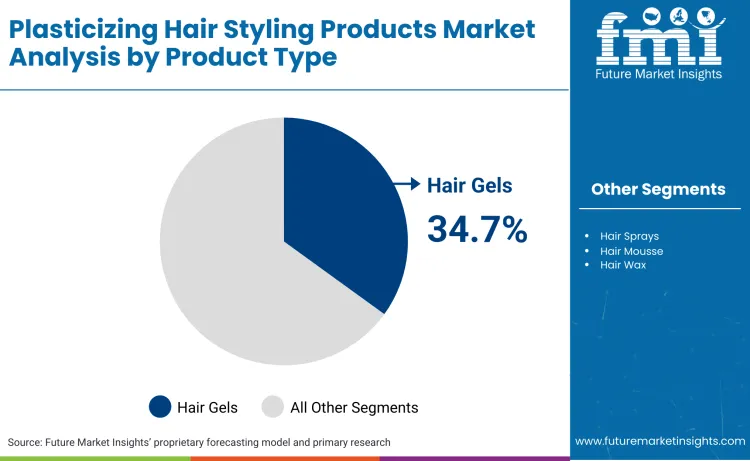
Hair gels account for 34.7% of the plasticizing hair styling products market due to their relevance to everyday styling and their ability to deliver reliable hold across a wide range of hair types. These products support shape retention and humidity resistance through plasticizing polymer systems that form flexible films on the hair surface. Consumers associate hair gels with consistent styling outcomes, longer wear cycles, and ease of use across work, social, and outdoor environments. Their compatibility with routine grooming habits lowers resistance to repeat purchase, especially in urban markets where daily styling is common. FMI observes that hair gels are positioned as essential grooming products rather than occasional styling aids, allowing them to anchor both volume and value demand within the broader styling category.
Why Do Chemical Based Ingredient Systems Dominate?
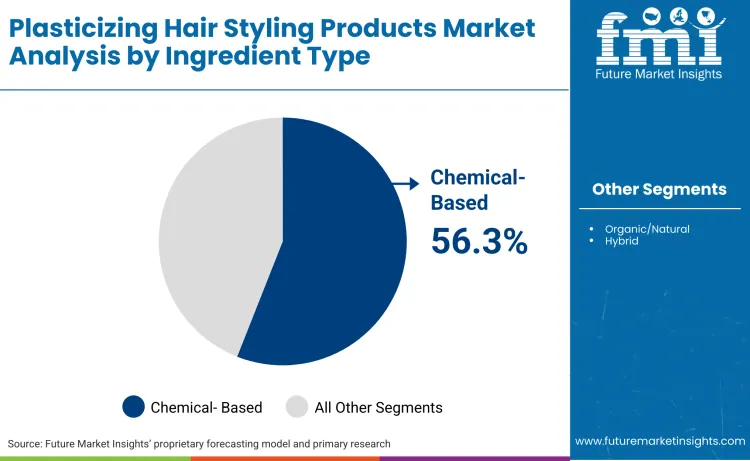
Chemical based formulations represent 56.3% of ingredient usage due to their proven performance reliability, cost efficiency, and formulation predictability. These plasticizing agents provide stable film formation, uniform hold strength, and resistance to humidity related breakdown across extended wear periods. Manufacturers rely on these ingredient systems to ensure batch to batch consistency and to maintain performance standards across diverse climate conditions. While natural and hybrid ingredient systems are gaining traction, chemical based plasticizers continue to underpin mainstream styling performance and price accessibility. FMI notes that their scalability and compatibility with existing polymer technologies allow brands to protect margins while meeting performance expectations across mass and professional styling portfolios.
Why Do Supermarkets and Hypermarkets Lead the Sales Channel?
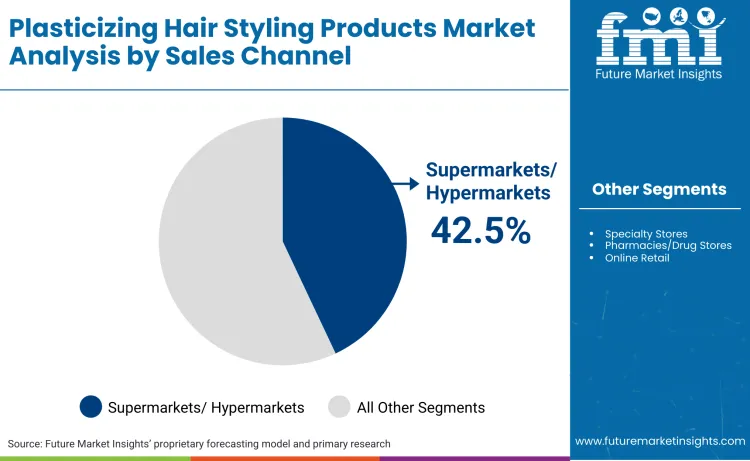
Supermarkets and hypermarkets account for 42.5% of plasticizing hair styling product sales, reflecting their role as primary points of routine grooming product purchase. Styling products are commonly purchased alongside shampoos, conditioners, and personal care essentials, supporting frequent replenishment and impulse buying. These retail formats offer strong brand visibility, competitive pricing, and accessibility across urban and semi urban consumer segments. Their scale enables brands to achieve broad distribution coverage and consistent shelf presence. FMI notes that large format retail continues to anchor volume movement for mainstream styling products, even as online channels gain share through discovery led purchasing and creator driven recommendations.
Why Do Women Represent the Largest End User Segment?
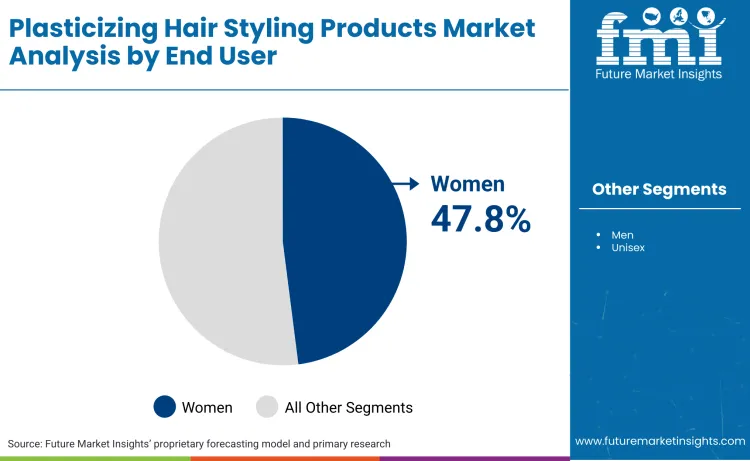
Women account for 47.8% of end user demand due to higher frequency of daily styling routines and wider variation in styling needs across hair lengths and textures. Styling products are used for shaping, smoothing, volume control, and finish across everyday grooming and professional appearance requirements. This segment also shows higher experimentation with multiple product types such as gels, creams, sprays, and mousse, which increases average basket size. FMI observes that product launches, styling education, and influencer led tutorials are more heavily targeted toward female consumers, reinforcing higher engagement and repeat usage. As textured styling and inclusive grooming trends expand, men and unisex segments continue to grow, though women remain the primary volume driver within the current market structure.
Which Trends Are Driving Structural Change in Plasticizing Hair Styling Products?
Plasticizing hair styling products are gaining momentum as brands respond to rising demand for long wear control, humidity tolerance, and flexible styling performance across daily grooming routines. Plasticizing polymer systems enable controlled film formation on hair fibers, supporting shape retention while maintaining natural movement and touch. These formulations reduce stiffness and visible residue compared with earlier high hold styling systems. Brands such as Moroccanoil are reinforcing this shift by offering styling creams and gels designed to balance hold performance with conditioning benefits, positioning performance styling within routine grooming rather than occasional use scenarios. As per Future Market Insights, plasticizing styling products are increasingly framed for everyday styling needs rather than limited salon or special event usage. Their adaptability across hair textures and climate conditions is expanding acceptance within mainstream grooming habits.
In What Ways Is Portfolio Expansion Strengthening Hair Styling Ecosystems?
Portfolio expansion is strengthening competitive positioning by allowing companies to embed plasticizing styling products within broader hair care systems alongside shampoos, conditioners, and treatment products. Large personal care brands are broadening styling portfolios to cover multiple hold strengths, texture control requirements, and finish preferences, focusing on functional coverage and usage flexibility rather than replacing existing grooming routines. Henkel’s Schwarzkopf Professional continues to extend styling ranges across gels, sprays, and creams that emphasize durable performance and salon grade control within retail accessible portfolios. This approach improves formulation alignment, distribution coverage, and consumer familiarity across channels. According to FMI, embedding plasticizing styling products into established hair care platforms accelerates adoption by leveraging brand trust and retail presence, enabling these products to scale across mass and premium channels without disrupting existing styling behavior.
What Factors Are Pushing Formulation-Level Innovation in Plasticizing Styling Products?
Cost sensitivity and rising performance expectations are pushing manufacturers to refine plasticizing styling formulations while maintaining scalp comfort, washability, and wear consistency. Plasticizing systems require careful balancing of polymers, solvents, and conditioning agents to ensure smooth application, even distribution, and stable hold throughout the day. Minor formulation changes can influence flaking behavior, tactile feel, and humidity tolerance during repeated use. FMI notes that intensifying competition is increasing emphasis on formulation discipline, supporting consistent performance across varied climates and hair textures. Kao Corporation, through its professional and consumer styling brands, continues to invest in polymer science and texture control technologies to improve wear comfort and performance stability. This formulation focus supports scalable manufacturing and positions plasticizing hair styling products as dependable, everyday grooming solutions rather than niche styling aids.
What Is the Country-wise Outlook for the Plasticizing Hair Styling Products Market?
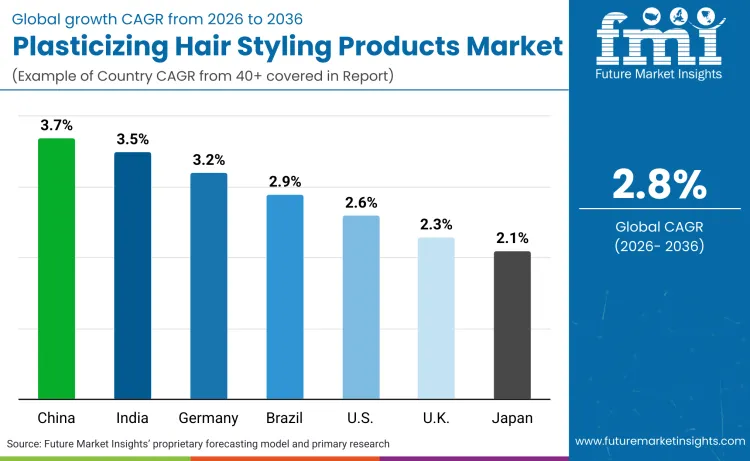
Country-level growth for plasticizing hair styling products shows clear variation, influenced by grooming habits, hair texture diversity, climate exposure, and acceptance of long-hold styling formats. China leads with a 3.78% CAGR, supported by high frequency of daily styling routines across urban consumers and strong demand for humidity resistant styling solutions suited for dense city environments. India follows at 3.5%, driven by expanding grooming awareness among younger populations and rising usage of styling gels and creams for structure and shape control in warm conditions. Germany records 3.22% growth, reflecting disciplined grooming routines and preference for performance consistent styling products. Brazil grows at 2.94%, supported by frequent styling needs in humid climates where hold durability is valued. The United States posts 2.66%, indicating steady uptake in a mature styling market dominated by established brands. The United Kingdom reaches 2.38%, while Japan trails at 2.1%, shaped by conservative product switching and continued reliance on lightweight styling formats.
| Country | CAGR (2026 to 2036) |
|---|---|
| China | 3.78% |
| India | 3.5% |
| Germany | 3.22% |
| Brazil | 2.94% |
| United States | 2.66% |
| UK | 2.38% |
| Japan | 2.1% |
Source: FMI historical analysis and forecast data.
Why Is China Leading Growth in Plasticizing Hair Styling Products?
China’s 3.78% CAGR is driven by high frequency of daily grooming routines among urban consumers and strong demand for long hold styling products that perform reliably under humid conditions. Styling gels and creams formulated with plasticizing agents align well with fast paced urban lifestyles where appearance maintenance is part of daily routines. These products are widely used for structured looks and controlled finishes rather than occasional styling. Strong digital retail penetration further supports growth, as styling products are easy to compare and replenish online. Adoption is shaped more by increased usage frequency and portfolio upgrades toward higher performance formulations than by population growth, positioning plasticizing styling products as routine grooming essentials.
What Is Supporting Growth in India’s Plasticizing Hair Styling Products Market?
India’s 3.5% CAGR reflects expanding grooming awareness among younger consumers and rising acceptance of structured styling routines across urban centers. Plasticizing styling products appeal due to their ability to deliver hold and shape control in warm and humid climates where hairstyle durability is often challenged. Gels and creams are frequently used for daily grooming, supporting repeat purchase cycles. Improved access through online platforms is enabling trial across tier two and tier three cities, while broader availability across price tiers supports gradual mainstream adoption. Growth is reinforced by evolving grooming habits and increasing engagement with appearance focused routines without major shifts in existing hair care practices.
Why Is Germany Showing Steady Expansion in Plasticizing Hair Styling Products?
Germany records a 3.22% CAGR, supported by structured grooming routines and preference for consistent, performance reliable styling products. Consumers value controlled application, predictable hold behavior, and low residue performance, which aligns with plasticizing formulations designed for disciplined daily use. Adoption is deliberate, driven by functional assessment rather than trend driven experimentation. Styling products are integrated into established grooming routines for shape control and finish definition rather than replacing existing care products. Growth is supported by steady retail availability and consumer emphasis on product reliability and performance consistency, keeping Germany aligned with moderate but stable expansion.
What Is Driving Growth in Brazil’s Plasticizing Hair Styling Products Market?
Brazil’s 2.94% CAGR is shaped by climate driven grooming needs and rising middle income consumption. Warm temperatures and high humidity increase the need for styling products that provide durable hold throughout the day. Plasticizing gels, creams, and sprays support structured looks that withstand moisture exposure during work, commuting, and outdoor activities. Improved availability across modern retail and online platforms is expanding awareness and encouraging repeat usage. Adoption remains gradual, with styling products often used alongside basic grooming items, supporting balanced growth across major urban population centers.
Why Is Growth More Moderate in the United States?
The United States posts a 2.66% CAGR, reflecting selective adoption within a mature hair styling market dominated by established product formats and strong brand loyalty. Plasticizing styling products are commonly used alongside existing grooming staples rather than replacing them, which limits rapid volume expansion. Growth is concentrated among consumers seeking stronger hold performance, humidity resistance, and structured styling outcomes. Digital retail supports discovery and replenishment, yet entrenched preferences for familiar formats slow rapid switching. As awareness of advanced plasticizing formulations increases, adoption continues at a steady pace without disrupting established grooming routines.
What Is the Competitive Outlook for the Plasticizing Hair Styling Products Market?
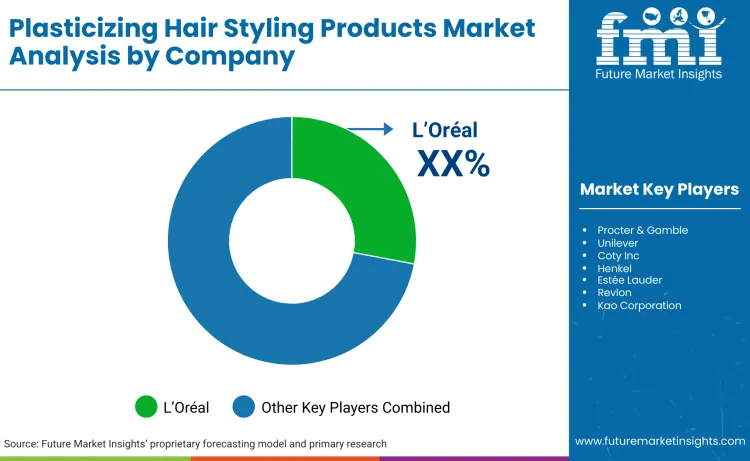
The competitive landscape for plasticizing hair styling products is led by large personal care and professional haircare companies that continue to strengthen styling portfolios to maintain performance relevance and format breadth across gels, sprays, creams, waxes, and pomades. Players such as L’Oréal, Procter & Gamble, Unilever, Coty Inc., and Henkel benefit from broad global distribution, strong brand equity, and established haircare franchises that allow rapid rollout of upgraded styling formulations using advanced plasticizing polymer systems. L’Oréal holds an estimated 27.8% share, reflecting its scale advantage across mass, premium, and professional styling brands, as well as its ability to refresh polymer technologies across multiple price tiers and hair texture segments. Competitive positioning in this market is less about aggressive volume capture and more about ensuring that high performance styling formats remain embedded within everyday grooming routines.
Future Market Insights observes that competition is increasingly centered on formulation reliability, humidity tolerance, and comfort during extended wear rather than rapid category expansion. Companies such as Estée Lauder and Kao Corporation emphasize performance styling combined with hair health positioning through premium and professional channels, while Revlon and Amika Products focus on differentiated styling claims tied to texture definition, shine, and residue control within salon influenced portfolios. At the same time, brands including Avon Products, Coty Inc., and Henkel support broader adoption through mass accessibility and lifestyle oriented styling lines distributed across supermarkets, specialty retail, and digital platforms. FMI notes that long term competitive advantage will depend on how effectively plasticizing styling products are integrated into complete hair care systems rather than being positioned as standalone styling aids.
Recent Developments:
- In October 2025, Kao Corporation expanded its professional styling portfolio in Japan with the launch of a humidity-resistant hair gel formulated using updated polymer and plasticizer systems designed to improve flexible hold and reduce flaking during prolonged wear. The product targets urban consumers exposed to high humidity and daily grooming routines, highlighting continued investment in performance-led plasticizing formulations within mature styling markets.
- In December 2025, Revlon introduced a reformulated long-hold styling cream under its mass styling portfolio in North America, incorporating lightweight plasticizing agents to improve spreadability and reduce residue across repeated daily use. The update reflects brand efforts to modernize legacy styling formats while maintaining accessibility across mainstream retail channels.
- In February 2026, Amika Products expanded its salon-influenced styling range with a texture-enhancing styling wax positioned for flexible hold and natural finish, using revised plasticizing polymer blends to support shape retention without stiffness. This launch demonstrates growing focus on comfort-driven plasticizing systems within premium and professional adjacent styling segments.
Key Players in Plasticizing Hair Styling Products Market
- L’Oréal
- Procter & Gamble
- Unilever
- Coty Inc.
- Henkel
- Estée Lauder
- Revlon
- Kao Corporation
- Amika Products
- Avon Products
Market Definition
The plasticizing hair styling products market captures revenue from hair styling formulations that incorporate plasticizing agents to deliver flexible hold, shape retention, humidity resistance, and improved film formation on hair fibers. In this assessment, the market covers commercially available styling products positioned for everyday grooming, long wear styling, texture definition, and controlled finish. Market sizing reflects the value of finished consumer products sold through physical retail and online platforms, analyzed by product type, ingredient type, sales channel, end user or gender, and region, and reported in USD billion.
The scope includes plasticizing styling products developed across gels, sprays, mousses, waxes, pomades, creams, and related styling formats formulated for structured hold, volume control, texture definition, and finish management. Products intended for routine use across short, medium, and long hair lengths, as well as diverse hair textures, are included when marketed specifically as hair styling products with hold and shape control functions. Sales through e-commerce platforms, supermarkets and hypermarkets, specialty beauty retailers, and pharmacies are counted. Geographic coverage spans North America, Europe, Asia Pacific, Latin America, and the Middle East and Africa.
The market excludes shampoos, conditioners, hair oils, serums, masks, and leave in treatments that do not provide styling hold or shape retention. Products positioned solely as hair growth treatments, scalp therapies, medicated formulations, or professional only salon products without retail availability are excluded. Revenues from bulk plasticizing agents, raw material supply, private label contract manufacturing, packaging components, and logistics services are outside the defined market scope.
Scope of Report
| Items | Values |
|---|---|
| Quantitative Units (2026) | USD 17.9 Billion |
| Product Type | Hair gels; Hair sprays; Hair mousse; Hair wax; Hair pomades; Hair creams; Others |
| Ingredient Type | Chemical based; Organic or natural; Hybrid |
| Sales Channel | Supermarkets and hypermarkets; Specialty stores; Pharmacies and drug stores; Online retail; Others |
| End User or Gender | Women; Men; Unisex |
| Regions Covered | North America, Europe, Asia Pacific, Latin America, Middle East & Africa |
| Countries Covered | United States, Germany, United Kingdom, India, China, Brazil, and 40+ countries |
| Key Companies Profiled | L’Oréal; Procter and Gamble; Unilever; Coty Inc.; Henkel; Estée Lauder; Revlon; Kao Corporation; Amika Products; Avon Products |
| Additional Attributes | Dollar sales by product type, ingredient type, sales channel, and end user; country wise growth analysis for plasticizing styling products; adoption trends for long hold and humidity resistant styling formats; usage patterns across gels, sprays, creams, waxes, and pomades; competitive positioning across mass, premium, and professional styling channels |
Source: FMI historical analysis and forecast data
Plasticizing Hair Styling Products Market by Segments
By Product Type:
- Hair gels (34.7% share)
- Hair sprays
- Hair mousse
- Hair wax
- Hair pomades
- Hair creams
- Others
By Ingredient Type:
- Chemical based (56.3% share)
- Organic or natural
- Hybrid
By Sales Channel:
- Supermarkets and hypermarkets (42.5% share)
- Specialty stores
- Pharmacies and drug stores
- Online retail
- Others
By End User or Gender:
- Women (47.8% share)
- Men
- Unisex
By Region:
- North America
- Europe
- Asia Pacific
- Latin America
- Middle East and Africa
Bibliography
- Dobos, K. (2023). Balancing hold, flexibility, and comfort in long-wear hair styling formulations. Cosmetics & Toiletries Magazine, 138(10), 16-26.
- Personal Care Products Council. (2024). Safety and functional use of plasticizing agents in cosmetic formulations. PCPC Technical Guidance Document.
- L’Oréal Groupe. (2025). Advanced polymer and plasticizer technologies in hair styling product development. L’Oréal Research & Innovation Report.
- Procter & Gamble Company. (2024). Hair styling product performance systems and polymer science innovation. Procter & Gamble Annual Report.
- Henkel AG & Co. KGaA. (2024). Professional and consumer hair styling formulations: Hold performance and comfort optimization. Henkel Annual Report.
- Kao Corporation. (2025). Polymer engineering and texture control technologies in hair styling products. Kao Integrated Report.
Frequently Asked Questions
What is the current global market size for Plasticizing Hair Styling Products?
The global plasticizing hair styling products market is valued at USD 17.9 billion in 2026, supported by steady demand for long hold styling solutions, humidity resistant performance, and flexible control across daily grooming routines.
What is the projected CAGR for the Plasticizing Hair Styling Products market?
Market revenues are projected to grow at a 2.80% CAGR from 2026 to 2036, reaching USD 23.6 billion by the end of the forecast period.
Which segment currently dominates the industry?
Hair gels dominate the market with a 34.7% share, driven by frequent use for structured styling, shape retention, and everyday grooming needs across mass and professional consumer segments.
What are the primary risks or barriers to adoption?
Key barriers include strong consumer loyalty to established styling formats, rising sensitivity toward chemical based ingredients, and limited willingness to switch from familiar grooming routines in mature markets.
Who are the leading players in the Plasticizing Hair Styling Products space?
Leading companies include L’Oréal, Procter & Gamble, Unilever, Coty Inc., Henkel, Estée Lauder, Revlon, Kao Corporation, Amika Products, and Avon Products, leveraging broad haircare portfolios and extensive retail distribution.
Preview the report firsthand - request a free sample
Get SampleGet the brochure for pricing and purchase details.
Get PDFTable of Content
- Executive Summary
- Global Market Outlook
- Demand Side Trends
- Supply Side Trends
- Formulation and Polymer Technology Roadmap
- Analysis and Strategic Recommendations
- Market Overview
- Market Coverage and Taxonomy
- Market Definition, Scope, and Limitations
- Research Methodology
- Chapter Orientation
- Analytical Lens and Working Hypotheses
- Market Structure, Signals, and Demand Drivers
- Benchmarking and Cross-Market Comparability
- Market Sizing, Forecasting, and Opportunity Mapping
- Research Design and Evidence Framework
- Desk Research Programme (Secondary Evidence)
- Company Annual and Sustainability Reports
- Peer-reviewed Journals and Technical Literature
- Corporate Websites, Product Literature, and Formulation Notes
- Earnings Decks and Investor Briefings
- Regulatory Filings and Industry Standards
- Trade Journals and Industry Publications
- FMI Internal Databases and Historical Datasets
- Primary Research Programme
- Expert Interviews and Industry Consultations
- Salon Professionals and Product Formulators
- Distribution and Retail Stakeholders
- Data Validation, Triangulation, and Quality Control
- Desk Research Programme (Secondary Evidence)
- Market Background
- Market Dynamics
- Drivers
- Restraints
- Opportunities
- Trends
- Product Life Cycle Analysis
- Value Chain and Supply Chain Analysis
- Regulatory and Safety Landscape for Styling Formulations
- Market Dynamics
- Global Plasticizing Hair Styling Products Market Analysis 2021-2025 and Forecast 2026-2036
- Historical Market Size Value (USD Billion), 2021-2025
- Current and Future Market Size Value (USD Billion), 2026-2036
- Y-o-Y Growth Trend Analysis
- Absolute Dollar Opportunity Analysis
- Global Market Pricing Analysis 2021-2025 and Forecast 2026-2036
- Global Market Analysis by Product Type
- Hair Gels
- Hair Sprays
- Hair Mousse
- Hair Wax
- Hair Pomades
- Hair Creams
- Other Styling Formats
- Global Market Analysis by Ingredient Type
- Chemical-based Plasticizers
- Organic or Natural Systems
- Hybrid Plasticizing Systems
- Global Market Analysis by Sales Channel
- Supermarkets and Hypermarkets
- Specialty Beauty Stores
- Pharmacies and Drug Stores
- Online Retail
- Other Channels
- Global Market Analysis by End User or Gender
- Women
- Men
- Unisex
- Global Market Analysis by Region
- North America
- Europe
- Asia Pacific
- Latin America
- Middle East and Africa
- North America Market Analysis and Forecast 2026-2036
- United States
- Canada
- Mexico
- Europe Market Analysis and Forecast 2026-2036
- Germany
- United Kingdom
- France
- Italy
- Spain
- Rest of Europe
- Asia Pacific Market Analysis and Forecast 2026-2036
- China
- India
- Japan
- ASEAN
- Rest of Asia Pacific
- Latin America Market Analysis and Forecast 2026-2036
- Brazil
- Rest of Latin America
- Middle East and Africa Market Analysis and Forecast 2026-2036
- Competitive Landscape
- Market Structure and Competition Dashboard
- Market Share Analysis of Key Players
- Strategic Developments and Portfolio Positioning
- Company Profiles
- L’Oréal
- Procter & Gamble
- Unilever
- Coty Inc.
- Henkel
- Estée Lauder
- Revlon
- Kao Corporation
- Amika Products
- Avon Products
- Assumptions and Acronyms Used


