

- Industry Size (2026)
- USD 460 Mn
- Forecast (2036)
- USD 1570 Mn
- CAGR (2026 to 2036)
- 13%
QR-Coded Reuse Cup and Container Tracking Systems Market Forecast and Outlook 2026 to 2036
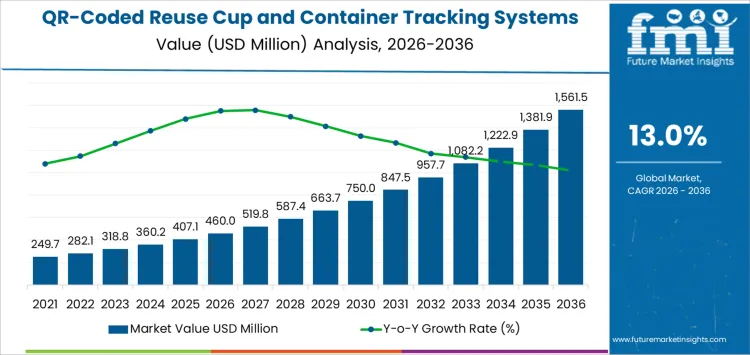
The QR-coded reuse cup and container tracking systems market is expected to grow from USD 460 million in 2026 to USD 1,570 million by 2036, reflecting a compound annual growth rate (CAGR) of 13%. This growth is driven by the growing focus on sustainability and the need for more efficient tracking systems to support reusable packaging initiatives across industries such as foodservice, retail, and logistics. QR-coded tracking systems enable businesses to monitor the return and reuse of cups and containers, providing an efficient way to reduce waste and ensure compliance with circular economy principles.
As more companies adopt sustainability practices, QR-coded systems help streamline the management of reusable cups and containers, reducing reliance on single-use packaging. The market will continue to benefit from the growing demand for eco-friendly packaging, the rising use of mobile apps for tracking returns, and the desire for businesses to improve their sustainability profiles. Additionally, regulatory pressures and consumer demand for greener options will continue to accelerate the adoption of reusable cup and container tracking systems.
Quick Stats for QR-Coded Reuse Cup and Container Tracking Systems Market
- QR-Coded Reuse Cup and Container Tracking Systems Market Value (2026): USD 460 million
- QR-Coded Reuse Cup and Container Tracking Systems Market Forecast Value (2036): USD 1,570 million
- QR-Coded Reuse Cup and Container Tracking Systems Market Global Forecast CAGR (2026 to 2036): 13%
- Top End User by Share in QR-Coded Reuse Cup and Container Tracking Systems Market: Coffee Chains & Quick Service Restaurants (46%)
- Key Growth Regions in QR-Coded Reuse Cup and Container Tracking Systems Market: India, China, USA, Germany, UK
- Top Players in QR-Coded Reuse Cup and Container Tracking Systems Market: CupClub, Releev, Returnity Solutions, Loop (Terracycle)
What is the Growth Forecast for the QR-Coded Reuse Cup and Container Tracking Systems Market through 2036?
The market growth curve for QR-coded reuse cup and container tracking systems shows a steady and consistent increase, with acceleration in the latter years. Starting at USD 460 million in 2026, the market gradually increases to USD 520.3 million in 2027 and USD 589.7 million in 2028. This early-phase growth reflects the initial adoption of tracking systems as companies begin implementing reusable container programs and gaining confidence in their ability to manage these systems effectively.
From 2028 to 2030, the market experiences moderate acceleration, reaching USD 669.7 million in 2029 and USD 762.1 million in 2030. This period reflects a growing recognition of the importance of tracking systems for ensuring the sustainability of reuse programs, as well as the expansion of mobile app capabilities and consumer adoption of the systems. By 2035, the market is projected to reach USD 1,471.7 million, with the growth rate continuing to accelerate in the final years, driven by increasing adoption of QR-coded systems across multiple sectors. The market is expected to mature and reach USD 1,570 million by 2036, reflecting the widespread adoption of QR-coded tracking systems for reusable cups and containers, with strong momentum in the last phase of the forecast period.
QR-Coded Reuse Cup and Container Tracking Systems Market Key Takeaways
| Metric | Value |
|---|---|
| Industry Sales Value (2026) | USD 460 million |
| Industry Forecast Value (2036) | USD 1,570 million |
| Industry Forecast CAGR (2026 to 2036) | 13% |
What Is Driving the Demand for vQR Coded Reuse Cup and Container Tracking Systems Globally?
Demand for vQR coded reuse cup and container tracking systems is driven by the rapid rise in reuse based packaging models and increased focus on reducing single use waste. Cafes, quick service restaurants, event venues and food delivery services are adopting reusable cups and containers to align with sustainability commitments and regulatory pressure on disposable plastics. vQR codes provide a simple digital method to track reuse assets, manage returns, monitor cleaning cycles, and link physical containers to user accounts without expensive hardware. As consumers become more environmentally conscious and governments introduce policies to reduce waste, businesses seek scalable tracking solutions that enable circular reuse loops, improve inventory visibility, and enhance customer engagement. vQR coded systems use visible codes scanned by smartphones or point of sale devices to record container movement and status, allowing operators to charge deposits, monitor lifespan, and analyse reuse behaviour. The low entry cost and compatibility with existing mobile ecosystems make vQR tracking attractive for reuse initiatives in regions such as Europe, North America, and parts of Asia where reuse schemes are expanding in retail and foodservice.
Future demand for vQR coded reuse cup and container tracking systems is expected to grow as reuse packaging models scale and operators seek efficient, data driven management tools. Growth will be supported by integration of tracking systems with order, payment and loyalty platforms, improving convenience for users and operational efficiency for businesses. Advances in cloud based platforms and analytics will enable real time monitoring of container fleets, helping reduce loss rates, optimise cleaning and logistics, and measure environmental impact. Regulatory frameworks that encourage or mandate reuse systems could further accelerate adoption, especially where deposit and return schemes are implemented. The pace of market growth will depend on how well tracking solutions deliver measurable cost savings, customer participation rates, and ecosystem partnerships among foodservice, logistics, and technology providers. As global emphasis on circular packaging strengthens, vQR coded tracking systems are expected to play a central role in managing reusable assets at scale.
What Are the Key Segments in QR-Coded Reuse Cup and Container Tracking Systems Market?
The QR-coded reuse cup and container tracking systems market is segmented by system type and end user. QR code scanning & mobile app solutions lead the system type segment with 42% of the market share, providing an efficient way to track reusable containers. Coffee chains & quick service restaurants dominate the end-user segment with 46%, driven by the need for sustainable and traceable packaging solutions. The market is expanding as the focus on sustainability and reducing single-use plastic grows in the foodservice and retail industries.
Which System Type Drives QR-Coded Reuse Cup and Container Tracking Systems Market Demand Globally?

QR code scanning & mobile app solutions account for 42% of the market share. These systems use QR codes to track reusable cups and containers, allowing consumers to easily return them for cleaning and reuse, often via a mobile app. The convenience of QR code scanning combined with the widespread use of smartphones makes this technology highly effective in tracking and managing reusable packaging in real time. This system allows businesses to incentivize customers with deposit refunds or loyalty points, thus encouraging participation in reuse programs.
The growing demand for sustainable packaging solutions, alongside stricter environmental regulations, is driving the adoption of QR code scanning and mobile app solutions. The ease of integration with existing customer loyalty programs and point-of-sale (POS) systems further boosts the appeal of these solutions for businesses in the foodservice, retail, and events industries. As sustainability initiatives gain momentum, QR code-based tracking is becoming a vital component in circular economy strategies for managing reusable containers.
Which End User Drives QR-Coded Reuse Cup and Container Tracking Systems Market Demand Globally?
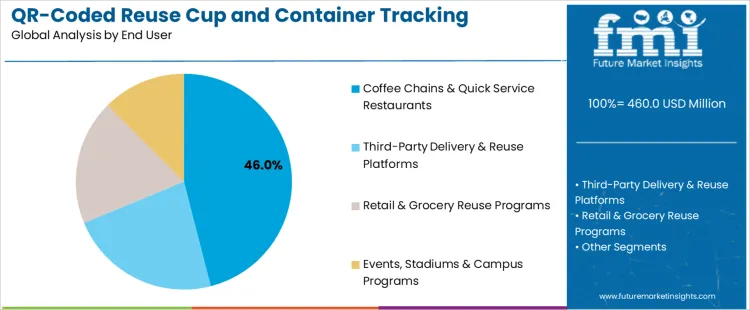
Coffee chains & quick service restaurants lead the end-user segment with 46% of the market share. These establishments are major users of reusable cup and container tracking systems, driven by the growing demand for eco-friendly solutions in the foodservice industry. Coffee chains and quick-service restaurants often serve beverages and meals in single-use containers, contributing significantly to plastic waste. Implementing QR-coded tracking systems enables these businesses to reduce waste, track the return of containers, and offer incentives to customers, such as discounts or loyalty rewards, for participating in reuse programs.
These systems align with the industry’s shift toward sustainability and waste reduction. Additionally, coffee chains and quick-service restaurants can improve operational efficiency by streamlining container tracking and reducing the need for disposable packaging. While other sectors, such as third-party delivery & reuse platforms, retail & grocery reuse programs, and events, stadiums & campus programs, also contribute to market growth, the foodservice industry remains the dominant segment due to its high volume of container usage and growing consumer demand for sustainable practices.
What are the Key Dynamics of the Global QR Coded Reuse Cup and Container Tracking Systems Market?
Global QR coded reuse cup and container tracking systems market is growing as foodservice, retail and hospitality sectors expand reuse and circular packaging programs. QR coded systems enable traceability of reusable cups and containers, facilitating returns, cleaning cycles, and consumer engagement. Digital tracking supports efficient asset management, reduces loss and improves hygiene monitoring. Adoption is driven by environmental goals and interest in reducing single use waste. Deployment spans cafes, quick service restaurants, events and shared reuse networks. Growth reflects rising investment in technology platforms that connect physical reuse assets to digital return systems worldwide.
What are the Key Drivers for the Global QR Coded Reuse Cup and Container Tracking Systems Market?
A key driver is rising pressure to reduce single use packaging waste and meet sustainability commitments set by brands, governments and consumers. QR coded tracking systems allow stakeholders to monitor reuse flow, collect data on return rates and optimise container availability. Consumer preference for transparent, tech enabled reuse experiences supports adoption. Advances in mobile technology and widespread smartphone use make QR scanning practical at point of use. Partnerships between foodservice chains, reuse platform providers and logistics operators strengthen infrastructure for interoperable tracking. Growth of reuse programmes and regulatory emphasis on circular materials accelerate deployment of QR coded tracking systems.
What are the Restraints for the Global QR Coded Reuse Cup and Container Tracking Systems Market?
One restraint is the cost and complexity of implementing digital tracking infrastructure that integrates with point of sale, cleaning facilities and logistics systems. Smaller businesses may lack resources to adopt or maintain these systems, slowing expansion in some regions. Consumer return behaviour and participation affect system efficiency, especially where incentives or convenient return points are limited. Data privacy concerns may arise around tracking interactions, requiring careful management and compliance with local regulations. Standardisation of tracking protocols across reuse networks is uneven, which can complicate interoperability and broader scaling of QR coded reuse systems globally.
What is the Key Trends in the Global QR Coded Reuse Cup and Container Tracking Systems Market?
A key trend is integration of QR coded tracking with digital wallets, loyalty programmes and refund incentives that enhance user participation and streamline reuse flows. Platforms increasingly provide analytics dashboards that help operators monitor return rates, asset utilisation and environmental impact metrics. There is growth in shared reuse networks across multiple brands and locations, supported by interoperable QR tracking standards. Use of contactless scanning supports hygiene priorities, while data integration with logistics and cleaning partners improves turnaround efficiency. Collaboration among technology providers, reuse programme designers and sustainability initiatives is shaping future system capabilities and adoption pathways.
What is the Country-Wise Outlook for QR-Coded Reuse Cup and Container Tracking Systems?
The QR-Coded Reuse Cup and Container Tracking Systems market is witnessing significant growth, driven by the increasing demand for sustainable and efficient waste management solutions in the foodservice industry. Countries such as India, China, and the USA are leading this growth, propelled by a rising focus on circular economy practices and reducing single-use plastic waste. QR-coded systems help track reusable cups and containers, ensuring that they are returned, cleaned, and reused, contributing to reduced waste and enhanced operational efficiency. As sustainability becomes a priority across industries, the demand for these tracking systems is expected to expand steadily across these regions.
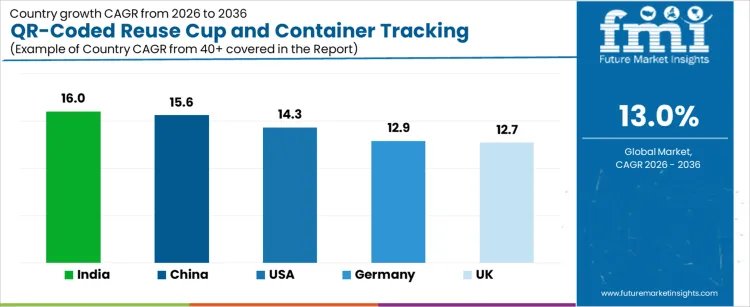
| Country | CAGR (2026–2036) |
|---|---|
| India | 16% |
| China | 15.6% |
| USA | 14.3% |
| Germany | 12.9% |
| UK | 12.7% |
What is Driving the Growth of QR-Coded Reuse Cup and Container Tracking Systems in India?
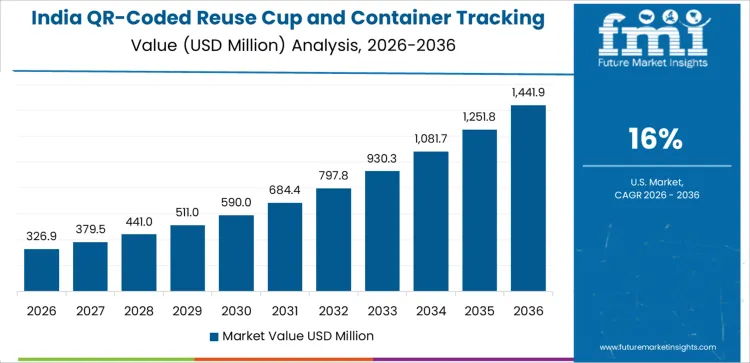
India’s QR-Coded Reuse Cup and Container Tracking Systems market is projected to grow at a CAGR of 16%. This growth is largely driven by the rapidly expanding foodservice and delivery sectors, which are increasingly adopting sustainable practices. QR-coded systems provide a cost-effective solution for tracking reusable cups and containers, ensuring they are properly returned, cleaned, and reused. The Indian government’s focus on reducing plastic waste and promoting sustainable packaging solutions is further pushing the demand for these systems. With an increasing awareness of environmental sustainability and a growing adoption of circular economy principles, India is well-positioned for continued growth in this market.
What is Contributing to the Growth of QR-Coded Reuse Cup and Container Tracking Systems in China?
China’s QR-Coded Reuse Cup and Container Tracking Systems market is expected to grow at a CAGR of 15.6%. The rapid expansion of China’s e-commerce, food delivery, and retail sectors is fueling the demand for more efficient, sustainable packaging solutions. QR-coded systems are an effective way to manage the collection, return, and reuse of cups and containers, ensuring that they are tracked and returned for cleaning and reuse. With growing concerns about plastic waste and the increasing adoption of green initiatives by businesses and consumers, China’s market for reuse tracking systems is expected to experience steady growth, driven by both regulatory pressures and rising sustainability awareness.
What is Driving the QR-Coded Reuse Cup and Container Tracking Systems Market Growth in the USA?
The USA’s QR-Coded Reuse Cup and Container Tracking Systems market is projected to grow at a CAGR of 14.3%. The growing demand for sustainable practices in the foodservice and beverage sectors, especially within the context of rising concerns over plastic waste, is driving the adoption of reusable packaging solutions. QR-coded tracking systems offer an effective and scalable solution to manage the reuse of cups and containers, ensuring that they are efficiently returned, cleaned, and reused. The increasing implementation of regulatory measures aimed at reducing single-use plastics, along with consumer demand for environmentally friendly solutions, further supports the growth of this market in the USA.
What is Influencing the Growth of QR-Coded Reuse Cup and Container Tracking Systems in Germany?
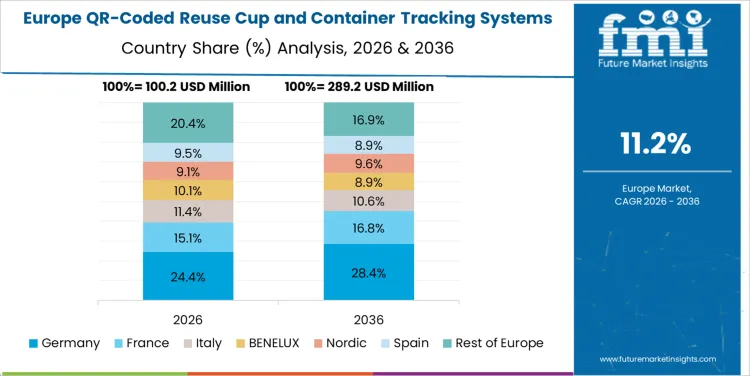
Germany’s QR-Coded Reuse Cup and Container Tracking Systems market is expected to grow at a CAGR of 12.9%. Germany, known for its strong commitment to sustainability and environmental responsibility, is increasingly adopting circular economy practices in various industries, including foodservice. QR-coded systems for tracking reusable cups and containers are gaining traction as they help streamline operations and reduce waste. With the German government’s focus on sustainability and regulations aimed at reducing single-use plastic packaging, the demand for these tracking systems is expected to grow. Germany’s advanced infrastructure and high level of environmental awareness contribute to the strong adoption of these systems in the market.
What is Contributing to the Growth of QR-Coded Reuse Cup and Container Tracking Systems in the UK?
The UK’s QR-Coded Reuse Cup and Container Tracking Systems market is projected to grow at a CAGR of 12.7%. The UK’s increasing focus on sustainability, particularly in response to growing concerns about plastic pollution and waste, is driving the demand for reusable packaging solutions. QR-coded systems, which facilitate the efficient return, cleaning, and reuse of cups and containers, are becoming an essential part of the foodservice sector’s efforts to reduce waste. The government’s push for reducing plastic waste, along with a growing consumer preference for environmentally friendly solutions, supports the growth of this market in the UK. As the market embraces circular economy practices, QR-coded reuse systems will continue to expand in the coming years.
What is the Competitive Landscape for the QR Coded Reuse Cup and Container Tracking Systems Market?
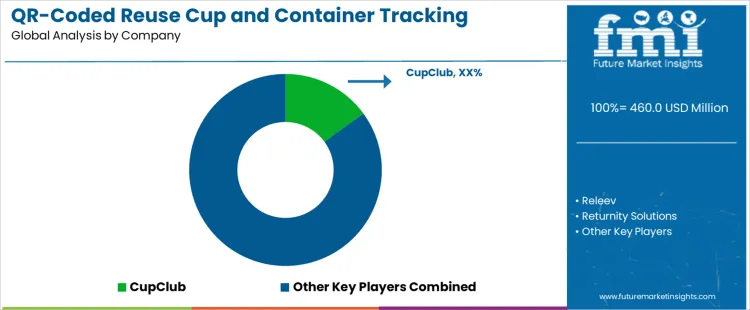
Global demand for QR coded reuse cup and container tracking systems is accelerating as food service operators, cafes and beverage brands push toward reusable packaging to cut waste and meet sustainability goals. QR coded tracking enhances returnability and reuse by linking each cup or container to an individual identifier that consumers scan to return items at designated points. This boosts convenience, supports incentive based return programmes, and helps operators monitor container flows, cleaning cycles and lifecycle usage. Growth in takeaway and delivery services, rising consumer eco awareness, and regulatory pressure on single use plastics all support adoption of digital reuse systems. Markets in Europe, North America and parts of Asia Pacific are particularly active, driven by strong circular economy commitments from cities, retailers and hospitality chains seeking practical, technology enabled reuse solutions.
On the supply side, a small group of specialised platforms competes to provide QR coded tracking systems and support reuse programmes. CupClub is recognised as a leading player with a technology driven platform that connects reusable cups and containers with digital tracking and return logistics. Other competitors include Releev, Returnity Solutions and Loop (Terracycle), each offering systems that integrate QR codes, user engagement tools and operational support for return and reuse schemes. Competition among these providers centres on ease of implementation, user experience, integration with point of sale and return networks, data analytics capabilities, and ability to scale across retail and food service partners. Platforms that combine reliable QR tracking, seamless app integration, robust logistics support and clear sustainability metrics are best positioned to capture growth as businesses and consumers increasingly adopt reusable cup and container systems globally.
Key Players of the QR-Coded Reuse Cup and Container Tracking Systems Market
- CupClub
- Releev
- Returnity Solutions
- Loop (Terracycle)
Scope of the Report
| Items | Values |
|---|---|
| Quantitative Units (2026) | USD Million |
| System Type | QR Code Scanning & Mobile App Solutions, Integrated POS & Loyalty Tracking Systems, IoT-Enhanced QR Platforms with Sensor Data, Analytics & Backend Platform Services |
| End User | Coffee Chains & Quick Service Restaurants, Third-Party Delivery & Reuse Platforms, Retail & Grocery Reuse Programs, Events, Stadiums & Campus Programs |
| Companies | CupClub, Releev, Returnity Solutions, Loop (Terracycle) |
| Regions Covered | North America, Latin America, Western Europe, Eastern Europe, South Asia and Pacific, East Asia, Middle East & Africa |
| Countries Covered | United States, Canada, Mexico, Brazil, Argentina, Germany, France, United Kingdom, Italy, Spain, Netherlands, China, India, Japan, South Korea, ANZ, GCC Countries, South Africa |
| Additional Attributes | Dollar by sales by system type, end-user, and region. Includes market trends in QR-coded reuse cup and container tracking, performance in various applications (coffee chains, retail, events, delivery platforms), cost-effectiveness, sustainability practices, regulatory compliance, market share and competitive positioning of key companies, and the role of QR code and IoT-enabled tracking systems in enhancing reuse program efficiency, waste reduction, and circular economy practices. |
Key Segments in the QR-Coded Reuse Cup and Container Tracking Systems Market
By System Type:
- QR Code Scanning & Mobile App Solutions
- Integrated POS & Loyalty Tracking Systems
- IoT Enhanced QR Platforms with Sensor Data
- Analytics & Backend Platform Services
By End User:
- Coffee Chains & Quick Service Restaurants
- Third Party Delivery & Reuse Platforms
- Retail & Grocery Reuse Programs
- Events, Stadiums & Campus Programs
By Region:
- Asia Pacific
- China
- India
- Japan
- South Korea
- ASEAN
- Rest of Asia Pacific
- Europe
- Germany
- United Kingdom
- France
- Italy
- Spain
- Nordic
- BENELUX
- Rest of Europe
- North America
- United States
- Canada
- Mexico
- Latin America
- Brazil
- Chile
- Rest of Latin America
- Middle East & Africa
- Kingdom of Saudi Arabia
- Other GCC Countries
- Turkey
- South Africa
- Other African Union
- Rest of Middle East & Africa
Frequently Asked Questions
How big is the QR-coded reuse cup and container tracking systems market in 2026?
The global QR-coded reuse cup and container tracking systems market is estimated to be valued at USD 460.0 million in 2026.
What will be the size of QR-coded reuse cup and container tracking systems market in 2036?
The market size for the QR-coded reuse cup and container tracking systems market is projected to reach USD 1,561.5 million by 2036.
How much will be the QR-coded reuse cup and container tracking systems market growth between 2026 and 2036?
The QR-coded reuse cup and container tracking systems market is expected to grow at a 13.0% CAGR between 2026 and 2036.
What are the key product types in the QR-coded reuse cup and container tracking systems market?
The key product types in QR-coded reuse cup and container tracking systems market are qr code scanning & mobile app solutions, integrated pos & loyalty tracking systems, iot‑enhanced qr platforms with sensor data and analytics & backend platform services.
Which end user segment to contribute significant share in the QR-coded reuse cup and container tracking systems market in 2026?
In terms of end user, coffee chains & quick service restaurants segment to command 46.0% share in the QR-coded reuse cup and container tracking systems market in 2026.
Preview the report firsthand - request a free sample
Get SampleGet the brochure for pricing and purchase details.
Get PDFTable of Content
- Executive Summary
- Global Market Outlook
- Demand-side Trends
- Supply-side Trends
- Technology Roadmap Analysis
- Analysis and Recommendations
- Market Overview
- Market Coverage / Taxonomy
- Market Definition / Scope / Limitations
- Market Background
- Market Dynamics
- Drivers
- Restraints
- Opportunity
- Trends
- Scenario Forecast
- Demand in Optimistic Scenario
- Demand in Likely Scenario
- Demand in Conservative Scenario
- Opportunity Map Analysis
- Product Life Cycle Analysis
- Supply Chain Analysis
- Investment Feasibility Matrix
- Value Chain Analysis
- PESTLE and Porter’s Analysis
- Regulatory Landscape
- Regional Parent Market Outlook
- Production and Consumption Statistics
- Import and Export Statistics
- Market Dynamics
- Global Market Analysis 2021 to 2025 and Forecast, 2026 to 2036
- Historical Market Size Value (USD Million) Analysis, 2021 to 2025
- Current and Future Market Size Value (USD Million) Projections, 2026 to 2036
- Y-o-Y Growth Trend Analysis
- Absolute $ Opportunity Analysis
- Global Market Pricing Analysis 2021 to 2025 and Forecast 2026 to 2036
- Global Market Analysis 2021 to 2025 and Forecast 2026 to 2036, By System Type
- Introduction / Key Findings
- Historical Market Size Value (USD Million) Analysis By System Type , 2021 to 2025
- Current and Future Market Size Value (USD Million) Analysis and Forecast By System Type , 2026 to 2036
- QR Code Scanning & Mobile App Solutions
- Integrated POS & Loyalty Tracking Systems
- IoT‑Enhanced QR Platforms with Sensor Data
- Analytics & Backend Platform Services
- Y-o-Y Growth Trend Analysis By System Type , 2021 to 2025
- Absolute $ Opportunity Analysis By System Type , 2026 to 2036
- Global Market Analysis 2021 to 2025 and Forecast 2026 to 2036, By End User
- Introduction / Key Findings
- Historical Market Size Value (USD Million) Analysis By End User, 2021 to 2025
- Current and Future Market Size Value (USD Million) Analysis and Forecast By End User, 2026 to 2036
- Coffee Chains & Quick Service Restaurants
- Third‑Party Delivery & Reuse Platforms
- Retail & Grocery Reuse Programs
- Events, Stadiums & Campus Programs
- Y-o-Y Growth Trend Analysis By End User, 2021 to 2025
- Absolute $ Opportunity Analysis By End User, 2026 to 2036
- Global Market Analysis 2021 to 2025 and Forecast 2026 to 2036, By Region
- Introduction
- Historical Market Size Value (USD Million) Analysis By Region, 2021 to 2025
- Current Market Size Value (USD Million) Analysis and Forecast By Region, 2026 to 2036
- North America
- Latin America
- Western Europe
- Eastern Europe
- East Asia
- South Asia and Pacific
- Middle East & Africa
- Market Attractiveness Analysis By Region
- North America Market Analysis 2021 to 2025 and Forecast 2026 to 2036, By Country
- Historical Market Size Value (USD Million) Trend Analysis By Market Taxonomy, 2021 to 2025
- Market Size Value (USD Million) Forecast By Market Taxonomy, 2026 to 2036
- By Country
- USA
- Canada
- Mexico
- By System Type
- By End User
- By Country
- Market Attractiveness Analysis
- By Country
- By System Type
- By End User
- Key Takeaways
- Latin America Market Analysis 2021 to 2025 and Forecast 2026 to 2036, By Country
- Historical Market Size Value (USD Million) Trend Analysis By Market Taxonomy, 2021 to 2025
- Market Size Value (USD Million) Forecast By Market Taxonomy, 2026 to 2036
- By Country
- Brazil
- Chile
- Rest of Latin America
- By System Type
- By End User
- By Country
- Market Attractiveness Analysis
- By Country
- By System Type
- By End User
- Key Takeaways
- Western Europe Market Analysis 2021 to 2025 and Forecast 2026 to 2036, By Country
- Historical Market Size Value (USD Million) Trend Analysis By Market Taxonomy, 2021 to 2025
- Market Size Value (USD Million) Forecast By Market Taxonomy, 2026 to 2036
- By Country
- Germany
- UK
- Italy
- Spain
- France
- Nordic
- BENELUX
- Rest of Western Europe
- By System Type
- By End User
- By Country
- Market Attractiveness Analysis
- By Country
- By System Type
- By End User
- Key Takeaways
- Eastern Europe Market Analysis 2021 to 2025 and Forecast 2026 to 2036, By Country
- Historical Market Size Value (USD Million) Trend Analysis By Market Taxonomy, 2021 to 2025
- Market Size Value (USD Million) Forecast By Market Taxonomy, 2026 to 2036
- By Country
- Russia
- Poland
- Hungary
- Balkan & Baltic
- Rest of Eastern Europe
- By System Type
- By End User
- By Country
- Market Attractiveness Analysis
- By Country
- By System Type
- By End User
- Key Takeaways
- East Asia Market Analysis 2021 to 2025 and Forecast 2026 to 2036, By Country
- Historical Market Size Value (USD Million) Trend Analysis By Market Taxonomy, 2021 to 2025
- Market Size Value (USD Million) Forecast By Market Taxonomy, 2026 to 2036
- By Country
- China
- Japan
- South Korea
- By System Type
- By End User
- By Country
- Market Attractiveness Analysis
- By Country
- By System Type
- By End User
- Key Takeaways
- South Asia and Pacific Market Analysis 2021 to 2025 and Forecast 2026 to 2036, By Country
- Historical Market Size Value (USD Million) Trend Analysis By Market Taxonomy, 2021 to 2025
- Market Size Value (USD Million) Forecast By Market Taxonomy, 2026 to 2036
- By Country
- India
- ASEAN
- Australia & New Zealand
- Rest of South Asia and Pacific
- By System Type
- By End User
- By Country
- Market Attractiveness Analysis
- By Country
- By System Type
- By End User
- Key Takeaways
- Middle East & Africa Market Analysis 2021 to 2025 and Forecast 2026 to 2036, By Country
- Historical Market Size Value (USD Million) Trend Analysis By Market Taxonomy, 2021 to 2025
- Market Size Value (USD Million) Forecast By Market Taxonomy, 2026 to 2036
- By Country
- Kingdom of Saudi Arabia
- Other GCC Countries
- Turkiye
- South Africa
- Other African Union
- Rest of Middle East & Africa
- By System Type
- By End User
- By Country
- Market Attractiveness Analysis
- By Country
- By System Type
- By End User
- Key Takeaways
- Key Countries Market Analysis
- USA
- Pricing Analysis
- Market Share Analysis, 2025
- By System Type
- By End User
- Canada
- Pricing Analysis
- Market Share Analysis, 2025
- By System Type
- By End User
- Mexico
- Pricing Analysis
- Market Share Analysis, 2025
- By System Type
- By End User
- Brazil
- Pricing Analysis
- Market Share Analysis, 2025
- By System Type
- By End User
- Chile
- Pricing Analysis
- Market Share Analysis, 2025
- By System Type
- By End User
- Germany
- Pricing Analysis
- Market Share Analysis, 2025
- By System Type
- By End User
- UK
- Pricing Analysis
- Market Share Analysis, 2025
- By System Type
- By End User
- Italy
- Pricing Analysis
- Market Share Analysis, 2025
- By System Type
- By End User
- Spain
- Pricing Analysis
- Market Share Analysis, 2025
- By System Type
- By End User
- France
- Pricing Analysis
- Market Share Analysis, 2025
- By System Type
- By End User
- India
- Pricing Analysis
- Market Share Analysis, 2025
- By System Type
- By End User
- ASEAN
- Pricing Analysis
- Market Share Analysis, 2025
- By System Type
- By End User
- Australia & New Zealand
- Pricing Analysis
- Market Share Analysis, 2025
- By System Type
- By End User
- China
- Pricing Analysis
- Market Share Analysis, 2025
- By System Type
- By End User
- Japan
- Pricing Analysis
- Market Share Analysis, 2025
- By System Type
- By End User
- South Korea
- Pricing Analysis
- Market Share Analysis, 2025
- By System Type
- By End User
- Russia
- Pricing Analysis
- Market Share Analysis, 2025
- By System Type
- By End User
- Poland
- Pricing Analysis
- Market Share Analysis, 2025
- By System Type
- By End User
- Hungary
- Pricing Analysis
- Market Share Analysis, 2025
- By System Type
- By End User
- Kingdom of Saudi Arabia
- Pricing Analysis
- Market Share Analysis, 2025
- By System Type
- By End User
- Turkiye
- Pricing Analysis
- Market Share Analysis, 2025
- By System Type
- By End User
- South Africa
- Pricing Analysis
- Market Share Analysis, 2025
- By System Type
- By End User
- USA
- Market Structure Analysis
- Competition Dashboard
- Competition Benchmarking
- Market Share Analysis of Top Players
- By Regional
- By System Type
- By End User
- Competition Analysis
- Competition Deep Dive
- CupClub
- Overview
- Product Portfolio
- Profitability by Market Segments (Product/Age /Sales Channel/Region)
- Sales Footprint
- Strategy Overview
- Marketing Strategy
- Product Strategy
- Channel Strategy
- Releev
- Returnity Solutions
- Loop (Terracycle)
- CupClub
- Competition Deep Dive
- Assumptions & Acronyms Used
- Research Methodology


