

- Industry Size (2025)
- USD 6.8 Bn
- Forecast (2035)
- USD 11.3 Bn
- CAGR (2025 to 2035)
- 5.2%
Circular Saw Blade Market Size and Share Forecast Outlook 2025 to 2035
The Circular Saw Blade Market is estimated to be valued at USD 6.8 billion in 2025 and is projected to reach USD 11.3 billion by 2035, registering a compound annual growth rate (CAGR) of 5.2% over the forecast period.
The Circular Saw Blade market is witnessing steady growth driven by rising demand in construction, woodworking, and metalworking industries. The future outlook for this market is shaped by ongoing technological advancements in blade design and materials, which enhance cutting efficiency, durability, and precision. Increasing investments in infrastructure development and industrial projects across both developed and emerging regions are fueling the adoption of high-performance circular saw blades.
The market is further supported by the growing need for faster and more accurate cutting solutions to improve operational productivity and reduce material wastage. Rising awareness regarding workplace safety and the adoption of automated cutting equipment also contribute to market expansion.
Moreover, the continuous evolution of blade materials, including carbide-tipped and advanced alloy blades, is enabling longer service life and superior cutting performance As industries focus on efficiency, precision, and cost-effectiveness in their operations, the Circular Saw Blade market is anticipated to sustain its growth trajectory in the coming years.
Quick Stats for Circular Saw Blade Market
- Circular Saw Blade Market Industry Value (2025): USD 6.8 billion
- Circular Saw Blade Market Forecast Value (2035): USD 11.3 billion
- Circular Saw Blade Market Forecast CAGR: 5.2%
- Leading Segment in Circular Saw Blade Market in 2025: Ripping Blades (32.8%)
- Key Growth Region in Circular Saw Blade Market: North America, Asia-Pacific, Europe
- Top Key Players in Circular Saw Blade Market: Kyocera Corporation, Bosch, Makita Corp, Techtronic Industries Company, Hilti Corporation, Hangzhou Wagen Precision Tooling Co.,Ltd (Ferrotech), Milwaukee Tool, Stanley Black & Decker, Metabo HPT, Amana Tool, JK Files & Engineering Limited, Freud Tools, Electrex India Ltd, Kulkarni Power Tools Ltd., Hangzhou FUWEISI Saw Industry Co.

| Metric | Value |
|---|---|
| Circular Saw Blade Market Estimated Value in (2025 E) | USD 6.8 billion |
| Circular Saw Blade Market Forecast Value in (2035 F) | USD 11.3 billion |
| Forecast CAGR (2025 to 2035) | 5.2% |
Segmental Analysis
The market is segmented by Blade Type, Diameter, Material Type, Sales Channel, and Application and region. By Blade Type, the market is divided into Ripping Blades, Combination Blades, Crosscut Blades, and Specialty Blades. In terms of Diameter, the market is classified into 7 To 12 Inches, Up To 6 Inches, and Above 12 Inches. Based on Material Type, the market is segmented into Carbide-Tipped, High-Speed Steel (HSS), and Others. By Sales Channel, the market is divided into Direct Sales and Indirect Sales. By Application, the market is segmented into Woodworking, Metalworking, Masonry, and Others. Regionally, the market is classified into North America, Latin America, Western Europe, Eastern Europe, Balkan & Baltic Countries, Russia & Belarus, Central Asia, East Asia, South Asia & Pacific, and the Middle East & Africa.
Insights into the Blade Type Segment
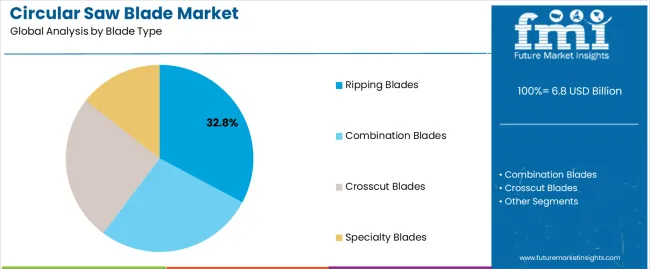
The ripping blade segment is projected to hold 32.8% of the Circular Saw Blade market revenue share in 2025, making it the leading blade type. This segment has been driven by its capability to deliver efficient and precise cuts along the grain of wood and other materials, which is critical for both industrial and commercial applications.
The demand for ripping blades has been supported by the increasing adoption of automated and high-speed cutting machinery that requires durable and specialized blades. The segment’s growth is further enhanced by the versatility of ripping blades in handling different materials, ensuring consistent performance and reduced downtime.
Additionally, their reliability, longevity, and compatibility with a range of saw machines have reinforced their preference among manufacturers and end users Growing emphasis on productivity, operational efficiency, and precise cutting quality continues to support the dominance of ripping blades in the market.
Insights into the Diameter Segment
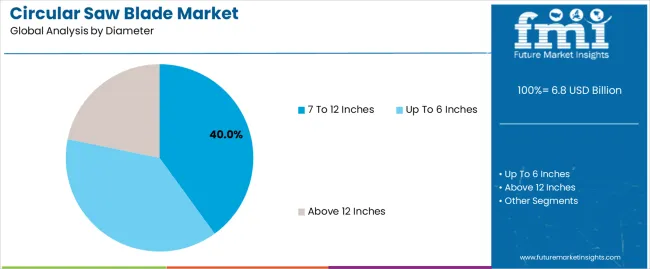
Blades with a diameter of 7 to 12 inches are expected to capture 40.0% of the Circular Saw Blade market revenue share in 2025, establishing this as the leading size range. The preference for this diameter is influenced by its adaptability to a variety of saw machines used in woodworking, construction, and metalworking applications.
This size range offers an optimal balance between cutting capacity, precision, and maneuverability, which is essential for professional and industrial use. Demand is further driven by the increasing adoption of portable and stationary saw machines that support this diameter, providing efficient and accurate cutting across different materials.
The segment benefits from versatility, operational efficiency, and compatibility with multiple applications, making it a preferred choice among commercial and industrial users.
Insights into the Material Type Segment
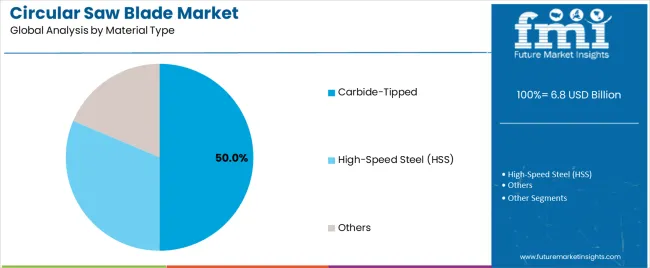
The carbide-tipped segment is anticipated to account for 50.0% of the Circular Saw Blade market revenue in 2025, making it the dominant material type. The growth of this segment is attributed to the superior hardness, durability, and wear resistance offered by carbide-tipped blades, which enable longer service life and consistent cutting performance.
Their ability to maintain sharpness even under high-speed and heavy-duty operations has made them highly sought after in industrial and professional applications. The segment’s adoption is further enhanced by the increasing demand for precision cutting and reduced maintenance downtime.
Carbide-tipped blades are widely used across multiple industries due to their reliability and ability to cut through a variety of materials with minimal degradation The emphasis on efficiency, productivity, and operational cost reduction continues to propel the growth of this segment.
Semi-annual Market Update
The table below presents a comparative assessment of the variation in the anticipated CAGR for the circular saw blade industry over the semi-annual periods spanning from the base year (2025) to the current year (2025). The examination of the compound annual growth rate showcases the shifts in the performance and divulges its revenue realization patterns.
The examination also helps businesses gain a better understanding of the industry and its growth trajectory over the period. The first half of the year, or H1, spans from January to June. The second half, H2, includes the months from July to December.
Figures provided in the table showcase the projected CAGR over the semi-annual period starting from 2025 to 2035. In the first half (H1) of 2025 to 2035, growth is estimated to surge at a CAGR of 5% followed by a noticeable spike during the second half (H2), taking the CAGR to 5.6%.
| Particular | Value CAGR |
|---|---|
| H1 | 5% (2025 to 2035) |
| H2 | 5.6% (2025 to 2035) |
| H1 | 5.2% (2025 to 2035) |
| H2 | 5.8% (2025 to 2035) |
Progressing in the following period, from H1 2025 to H2 2035, the CAGR is anticipated to fall to 5.2% in the first half (H1) and then rise considerably to 5.8% in the second half (H2). In the first half (H1), it is projected to experience an increase of 20 BPS while in the second half (H2), it is estimated to witness a slight surge of 20 BPS.
Key Industry Highlights
Rising Construction of Residential and Commercial Structures Boosts Demand
Rapid industrialization across the globe, especially in countries like India and China, presents immense growth potential for the circular saw blade market. The increasing population is raising the need for residential and commercial structures. Manufacturers in the industry are therefore launching novel and advanced circular saws.
Popular Mechanics, in an article, testified Bosch's GKS18V-25GC circular saw and termed it as one of the most premium saw blades with nimble precision and accuracy statistics. It boasts a factory-standard 24-tooth blade, which is likely to emerge as a popular choice in the construction and furniture industry.
High Popularity of DIY Projects is Propelling Expansion Globally
The growing popularity of do-it-yourself (DIY) projects and home repair activities is a prominent driver of the saw blade industry. As people undertake home renovations and personal projects, the demand for user-friendly and inexpensive saw blades is expected to rise. This trend is aided by the abundance of home improvement content and tools available online, which allow people to take on their projects individually.
Ryobi, among a few key players, focuses on the DIY segment by offering a range of circular saw blades that are affordable and easy to use. The company’s products are designed for non-professional users who seek reliable and cost-effective solutions for home improvement projects.
Another key player, Craftsman's Blades caters to the DIY segment with an emphasis on user-friendly designs and value for money. Its marketing strategies target homeowners and hobbyists engaged in DIY projects.
Slow Adoption of Unique Cutting Technologies Paving the Path for Expansion
The slow adoption of new cutting technology is a significant challenge for circular saw blade manufacturers. Traditional methodologies continue to dominate because of industry inertia and the perceived complexity of modern technologies. This hesitancy, however, creates an opportunity for expansion through instructional efforts.
Manufacturers and industry stakeholders are focusing on educating consumers about the benefits and ease of using contemporary cutting technologies. They are conducting workshops, seminars, and online resources that teach about the efficiency, precision, and cost-effectiveness of current cutting methods. By simplifying these technologies, stakeholders can improve consumer interest and confidence, resulting in their increased adoption.
Slow acceptance encourages producers to constantly enhance and refine cutting technologies. This iterative approach promotes innovation and expansion as consumers eventually adopt the efficiency benefits and competitive advantages provided by upgraded saw blades.
Launch of Carbide-tipped and Diamond Blades to Create Novel Opportunities
Technological developments, expanding applications, and geographical expansion are helping to drive growth in the circular saw blade market. Innovations in blade materials and designs, such as carbide-tipped and diamond blades, improve cutting performance and longevity, fulfilling the demands of a wide range of industrial and DIY applications.
The growing construction and infrastructure industries across the globe provide significant opportunities owing to the rising demand for precise and efficient cutting equipment in woodworking, metals, and masonry. The rise of DIY culture and home renovation projects is propelling expansion, as customers seek high-quality, user-friendly tools for their projects.
In 2025, Freud launched the new Premier Fusion series of circular saw blades that are designed for smooth and rapid cuts in a variety of materials. These blades use Freud's proprietary TiCo Hi-Density carbide for long life and have a unique anti-kickback design for added safety.
Rising Popularity of Diamond-coated Tools to Hinder Growth Potential
Diamond-coated tools, in recent times, have gained significant popularity over carbide-coated ones as these offer higher abrasion resistance and longer tool life. This is projected to adversely affect the demand for saw blades over the forecast year.
The high cost of diamond-coated tools, however, is a huge hurdle that manufacturers haven’t figured out how to tackle. This is a relief for carbide-coated tool manufacturers. Presently, diamond-coated tools have a minimal impact on the growth of saw blades but this may change in the coming years as prices of diamond-coated tools get competitive.
2020 to 2025 Global Circular Saw Blade Sales Analysis Compared to Demand Forecast for 2025 to 2035
The global circular saw blade market recorded a CAGR of 2.5% during the historical period ranging from 2020 to 2025. It attained a size of USD 6,117.7 million in 2020.
The COVID-19 pandemic caused a slowdown in production and supply chain activities due to lockdowns and transport restrictions worldwide. This crisis significantly impacted the global economy, including the circular saw blade industry as it experienced a notable drop in demand in 2024.
The supply chain was adversely affected due to the pandemic. Supply capabilities, however, surged steadily from 2025 onward as lockdown restrictions eased and transport regulations relaxed.
The circular saw blade market is likely to reach a value of USD 6,409.9 million in 2025. It is projected to surge at a CAGR of 5.5% throughout the assessment period to reach a size of USD 10,936.1 million by 2035.
The demand for circular saw blades is projected to rise significantly in the coming decade. It is prominently pushed by factors such as the expansion of end-use industries, infrastructure development, and an emphasis on efficient cutting solutions. Advances in blade materials and coatings are driving up the global demand for saw blades.
The industry experienced a slight dip in demand owing to project delays and disruptions in industrial activities during the COVID-19 lockdowns. The industry, however, is expected to experience increased use of circular saw blades in critical construction and repair projects in the forecast period.
Market Concentration
Tier 1 comprises industry leaders with annual revenue exceeding USD 500 million. These companies capture a significant share ranging from 25% to 30% globally. These frontrunners are often characterized by high production capacity and a wide product portfolio.
They are distinguished by their expertise in manufacturing and a broad geographical reach that is underpinned by a robust consumer base. These firms provide a wide range of products and utilize the latest technology to meet regulatory standards. Prominent companies within Tier 1 include Kyocera Corporation, Bosch, Makita Corp, Techtronic Industries Company, Hilti Corporation, and Hangzhou Wagen Precision Tooling Co., Ltd (Ferrotech).
Tier 2 consists of small-scale companies operating in specific locations. These enterprises are renowned in the international industries. They have a big impact on the local economy and boast a wealth of business expertise.
Tier 3 consists of medium-to small-sized companies with regional headquarters. They serve niche circular saw blade vendors with low revenue. These companies are notably oriented toward fulfilling local demands.
They have a limited geographical reach. Tier 3, within this context, is recognized as an unorganized segment, denoting a sector characterized by a lack of extensive structure and formalization compared to organized competitors.
Country-wise Insights
The section provides businesses with an overview of the industry on a country-by-country basis. It contains a detailed examination of the potential trends and opportunities. This country-specific analysis of the dynamics is likely to provide organizations with an in-depth understanding of the complex nature.
The examination comprises key factors, potential challenges, and forecasts impacting the demand, production, and consumption of the product within each country. The section aims to assist companies in making informed decisions and developing effective strategies customized to individual countries.
India is expected to emerge as a dominating country during the forecast period with an estimated CAGR of 6.4%. Japan, China, and the United States are anticipated to follow behind India to become the prominent countries with projected CAGRs of 6.1%, 5.3%, and 5%, respectively.
| Countries | CAGR 2025 to 2035 |
|---|---|
| India | 6.4% |
| Japan | 6.1% |
| China | 5.3% |
| United States | 5% |
| Germany | 4.1% |
Rising Demand for Modular Furniture across Households Spurs Sales in India
India is projected to account for 49.9% of the value share in South Asia in 2035. The booming construction industry in the country is likely to spur demand for these saw blades. These blades are set to be used to cut wood, metal, and other materials in building and infrastructure projects.
Rising disposable income and changing consumer preferences are boosting India's furniture business. The country’s population has witnessed an increasing demand for modular furniture for their homes.
Customized and modular furniture requires high-quality, accurate cutting tools. Circular saw blades, particularly ripping saw blades, have a high demand for wood cutting and engineered wood products in the country.
The furniture industry in the country is projected to reach USD 6.8 billion by the end of 2025. Revenue is estimated to surge at a CAGR of 8.6% in the estimated period. It is further projected to reach a size of USD 11.3 billion by 2035.
United States-based Manufacturers like Snap-on Inc. Focus on New Launches to Attract Customers
The United States is projected to account for a value share of 60.4% in North America in 2035. The country is set to experience significant growth during the forecast period owing to the increasing demand for circular saw blades in residential and commercial applications. Leading manufacturers are focusing on providing a diverse product range for various applications.
For instance, Bosch USA is a specialist manufacturer of saw blades with excellent cutting performance. The company’s products are made of highly strong carbide grains for maximum endurance, as well as robust Microtech teeth with an ATB (Alternate Top Bevel) tooth geometry. The protective layer helps in avoiding corrosion and friction. The anti-vibration slots allow for smooth cutting with minimal noise and vibration, contributing to the product's ease of use.
Snap-on Inc., headquartered in Kenosha, Wisconsin, United States, manufactures, designs, and markets high-end tools and equipment for professional use in industries such as automotive, heavy-duty, and others. The company manufactures a variety of metal-cutting equipment under the legendary European Bahco brand. Its product line comprises high-performance bi-metal and carbide bandsaw blades for general purpose and other production-cutting applications.
Increasing Reconstruction and Renovation Activities in Germany to Push Growth
Germany is projected to experience a CAGR of 4.1% during the forecast period. The country’s market is anticipated to experience substantial growth owing to rising reconstruction and renovation activities in Germany.
The government of Germany is rebuilding and renovating the country’s old and high-rise buildings. This activity is expected to surge sales of circular saw blades in the country.
For instance, AKE Knebel GmBH, headquartered in Germany, manufactures saw blades for all types of materials like wood and wood-based, plastic, metal, and composite materials. They are designed for suitable tools for each application and usage.
Category-wise Insights
The section below offers companies with insightful data and an examination of the two leading segments. Segmentation of these categories assists businesses in gaining a better understanding of the dynamics and investing in the beneficial zones.
Analysis of the growth helps organizations attain a better understanding of the trends, opportunities, and challenges. This examination is likely to assist organizations to navigate the complex business environment and make informed decisions.
In terms of blade type, ripping saw blades are projected to lead the industry with a value share of 32.8% in 2025. Woodworking is anticipated to dominate the application segment with a value share of 56.3% in the same year.
Ripping Saw Blades with Laser-cut Stabilizers to Gain Traction by 2035
| Segment | Ripping Saw Blade (Blade Type) |
|---|---|
| Value Share (2025) | 32.8% |
Based on product type, the ripping saw blades segment is estimated to dominate, accounting for a value share of 32.8% in 2025. Innovations in the material and design of saw blades, including carbide-tipped blades and laser-cut stabilizers have improved the performance and longevity of ripping saw blades. These developments play a crucial role in making these blades extra appealing to DIY enthusiasts, thereby increasing their demand.
The rise of DIY culture and home renovation projects, spurred partly by the COVID-19 pandemic, has increased sales of power tools and accessories, including ripping saw blades. Homeowners taking up woodworking projects desire high-quality blades that deliver clean and efficient cuts.
Woodworking is becoming popular as a hobby and a professional craft. Woodworkers require dependable and precise tools. Ripping saw blades, are, therefore, an essential component in their toolboxes.
Increasing Demand for Wooden Furniture Boosts Sales in Woodworking Application
| Segment | Woodworking (Application) |
|---|---|
| Value Share (2025) | 56.3% |
By application, the woodworking segment is projected to dominate the circular saw blade industry in the forecast period. Sales accelerated at a CAGR of 1.9% between 2020 and 2025. It is further projected to register a CAGR of 4.5% during the forecast period spanning from 2025 to 2035.
Woodworking is one of the leading uses of saw blades. The segment is projected to continue dominating the global market. This expansion is highly spurred by the growing demand for saw blades in wooden furniture and construction materials. Innovations in technology have resulted in the development of specialized saw blades for cutting several varieties of wood, thereby driving the expansion of the global circular saw blade market.
Competition Outlook

Key players in the industry include Kyocera Corporation, Bosch, Makita Corp, Techtronic Industries Company, and Hilti Corporation. They are witnessing robust growth with the increasing demand from woodworking, metalworking, and construction industries. The industry is also witnessing opportunities from the renovation and remodeling sector.
Established players have a fairly good position in the industry. Despite this, it remains highly fragmented with the presence of regional and local manufacturers. Businesses are focusing on portfolio expansion, especially in fast-growing product types to maintain their competitive edge.
The industry is dominated by several manufacturers, ranging from multinational organizations to small regional businesses. This fragmentation increases competition as enterprises vouch for market share based on product quality, performance, and pricing.
The expansion of e-commerce platforms has enhanced the accessibility of circular saw blades. Consumers can choose from a wide range of products, compare their prices and features, and make informed purchasing decisions, all from the convenience of their homes.
The rise of DIY projects has LED to manufacturers introducing easy-to-use, efficient, and versatile saw blades for non-professionals taking up their home renovation. Brands are also leveraging the power of social media to showcase the use of their saw blades through tutorials.
Manufacturers are further integrating automation in the woodworking and furniture manufacturing industry to bolster growth. Integration of these technologies leads to substantial enhancement in production efficiency. Continuous optimization of saw blades is contributing to the sustained expansion of the market.
Industry Updates
- In August 2025, Bosch, headquartered in Gerlingen, launched three new Biturbo innovations for professionals, including a cordless hand-held circular saw, table saw, and impact wrenches. These innovations have set new standards for power and features while offering enhanced connectivity.
- In May 2025, Makita USA Inc., headquartered in California, launched new cutting options for pro users of corded and cordless band saws with new bi-metal band saw blades. Available in a 3-pack, these band saw blades are available in multiple Teeth Per Inch (TPI) offerings for a wide range of cutting applications.
- In January 20253, SCM, headquartered in Italy, launched Blade Off, a predictive safety system for circular saws that was honored with an award at Xylexpo. This innovation was introduced alongside the Startech CN K machining center, a compact three-axis machine designed for joinery, enhancing safety and productivity.
Leading Circular Saw Blade Brands
- Kyocera Corporation
- Bosch
- Makita Corp
- Techtronic Industries Company
- Hilti Corporation
- Hangzhou Wagen Precision Tooling Co., Ltd. (Ferrotech)
- Milwaukee Tool
- Stanley Black & Decker
- Metabo HPT
- Amana Tool
- JK Files & Engineering Limited
- Freud Tools
- Electrex India Ltd
- Kulkarni Power Tools Ltd.
- Hangzhou FUWEISI Saw Industry Co
Key Segments of Market Report
By Blade Type:
Based on blade type, the industry is divided into ripping, combination, crosscut, and specialty blades.
By Diameter:
By diameter, the industry is segregated into up to 6 inches, 7 to 12 inches, and above 12 inches.
By Material Type:
Based on material type, the industry is segmented into high-speed steel (HSS), carbide-tipped, and others.
By Sales Channel:
By sales channel, the industry is segmented into direct and indirect sales.
By Application:
The product has applications in woodworking, metalworking, masonry, and others.
By Region:
The industry is spread across North America, Latin America, East Asia, South Asia, Western Europe, Eastern Europe, and the Middle East and Africa.
Frequently Asked Questions
How big is the circular saw blade market in 2025?
The global circular saw blade market is estimated to be valued at USD 6.8 billion in 2025.
What will be the size of circular saw blade market in 2035?
The market size for the circular saw blade market is projected to reach USD 11.3 billion by 2035.
How much will be the circular saw blade market growth between 2025 and 2035?
The circular saw blade market is expected to grow at a 5.2% CAGR between 2025 and 2035.
What are the key product types in the circular saw blade market?
The key product types in circular saw blade market are ripping blades, combination blades, crosscut blades and specialty blades.
Which diameter segment to contribute significant share in the circular saw blade market in 2025?
In terms of diameter, 7 to 12 inches segment to command 40.0% share in the circular saw blade market in 2025.
Preview the report firsthand - request a free sample
Get SampleGet the brochure for pricing and purchase details.
Get PDFTable of Content
- Executive Summary
- Global Market Outlook
- Demand-side Trends
- Supply-side Trends
- Technology Roadmap Analysis
- Analysis and Recommendations
- Market Overview
- Market Coverage / Taxonomy
- Market Definition / Scope / Limitations
- Market Background
- Market Dynamics
- Drivers
- Restraints
- Opportunity
- Trends
- Scenario Forecast
- Demand in Optimistic Scenario
- Demand in Likely Scenario
- Demand in Conservative Scenario
- Opportunity Map Analysis
- Product Life Cycle Analysis
- Supply Chain Analysis
- Investment Feasibility Matrix
- Value Chain Analysis
- PESTLE and Porter’s Analysis
- Regulatory Landscape
- Regional Parent Market Outlook
- Production and Consumption Statistics
- Import and Export Statistics
- Market Dynamics
- Global Market Analysis 2020 to 2024 and Forecast, 2025 to 2035
- Historical Market Size Value (USD Million) Analysis, 2020 to 2024
- Current and Future Market Size Value (USD Million) Projections, 2025 to 2035
- Y-o-Y Growth Trend Analysis
- Absolute $ Opportunity Analysis
- Global Market Pricing Analysis 2020 to 2024 and Forecast 2025 to 2035
- Global Market Analysis 2020 to 2024 and Forecast 2025 to 2035, By Blade Type
- Introduction / Key Findings
- Historical Market Size Value (USD Million) Analysis By Blade Type , 2020 to 2024
- Current and Future Market Size Value (USD Million) Analysis and Forecast By Blade Type , 2025 to 2035
- Ripping Blades
- Combination Blades
- Crosscut Blades
- Specialty Blades
- Y-o-Y Growth Trend Analysis By Blade Type , 2020 to 2024
- Absolute $ Opportunity Analysis By Blade Type , 2025 to 2035
- Global Market Analysis 2020 to 2024 and Forecast 2025 to 2035, By Diameter
- Introduction / Key Findings
- Historical Market Size Value (USD Million) Analysis By Diameter, 2020 to 2024
- Current and Future Market Size Value (USD Million) Analysis and Forecast By Diameter, 2025 to 2035
- 7 To 12 Inches
- Up To 6 Inches
- Above 12 Inches
- Y-o-Y Growth Trend Analysis By Diameter, 2020 to 2024
- Absolute $ Opportunity Analysis By Diameter, 2025 to 2035
- Global Market Analysis 2020 to 2024 and Forecast 2025 to 2035, By Material Type
- Introduction / Key Findings
- Historical Market Size Value (USD Million) Analysis By Material Type, 2020 to 2024
- Current and Future Market Size Value (USD Million) Analysis and Forecast By Material Type, 2025 to 2035
- Carbide-Tipped
- High-Speed Steel (HSS)
- Others
- Y-o-Y Growth Trend Analysis By Material Type, 2020 to 2024
- Absolute $ Opportunity Analysis By Material Type, 2025 to 2035
- Global Market Analysis 2020 to 2024 and Forecast 2025 to 2035, By Sales Channel
- Introduction / Key Findings
- Historical Market Size Value (USD Million) Analysis By Sales Channel, 2020 to 2024
- Current and Future Market Size Value (USD Million) Analysis and Forecast By Sales Channel, 2025 to 2035
- Direct Sales
- Indirect Sales
- Y-o-Y Growth Trend Analysis By Sales Channel, 2020 to 2024
- Absolute $ Opportunity Analysis By Sales Channel, 2025 to 2035
- Global Market Analysis 2020 to 2024 and Forecast 2025 to 2035, By Application
- Introduction / Key Findings
- Historical Market Size Value (USD Million) Analysis By Application, 2020 to 2024
- Current and Future Market Size Value (USD Million) Analysis and Forecast By Application, 2025 to 2035
- Woodworking
- Metalworking
- Masonry
- Others
- Y-o-Y Growth Trend Analysis By Application, 2020 to 2024
- Absolute $ Opportunity Analysis By Application, 2025 to 2035
- Global Market Analysis 2020 to 2024 and Forecast 2025 to 2035, By Region
- Introduction
- Historical Market Size Value (USD Million) Analysis By Region, 2020 to 2024
- Current Market Size Value (USD Million) Analysis and Forecast By Region, 2025 to 2035
- North America
- Latin America
- Western Europe
- Eastern Europe
- East Asia
- South Asia and Pacific
- Middle East & Africa
- Market Attractiveness Analysis By Region
- North America Market Analysis 2020 to 2024 and Forecast 2025 to 2035, By Country
- Historical Market Size Value (USD Million) Trend Analysis By Market Taxonomy, 2020 to 2024
- Market Size Value (USD Million) Forecast By Market Taxonomy, 2025 to 2035
- By Country
- USA
- Canada
- Mexico
- By Blade Type
- By Diameter
- By Material Type
- By Sales Channel
- By Application
- By Country
- Market Attractiveness Analysis
- By Country
- By Blade Type
- By Diameter
- By Material Type
- By Sales Channel
- By Application
- Key Takeaways
- Latin America Market Analysis 2020 to 2024 and Forecast 2025 to 2035, By Country
- Historical Market Size Value (USD Million) Trend Analysis By Market Taxonomy, 2020 to 2024
- Market Size Value (USD Million) Forecast By Market Taxonomy, 2025 to 2035
- By Country
- Brazil
- Chile
- Rest of Latin America
- By Blade Type
- By Diameter
- By Material Type
- By Sales Channel
- By Application
- By Country
- Market Attractiveness Analysis
- By Country
- By Blade Type
- By Diameter
- By Material Type
- By Sales Channel
- By Application
- Key Takeaways
- Western Europe Market Analysis 2020 to 2024 and Forecast 2025 to 2035, By Country
- Historical Market Size Value (USD Million) Trend Analysis By Market Taxonomy, 2020 to 2024
- Market Size Value (USD Million) Forecast By Market Taxonomy, 2025 to 2035
- By Country
- Germany
- UK
- Italy
- Spain
- France
- Nordic
- BENELUX
- Rest of Western Europe
- By Blade Type
- By Diameter
- By Material Type
- By Sales Channel
- By Application
- By Country
- Market Attractiveness Analysis
- By Country
- By Blade Type
- By Diameter
- By Material Type
- By Sales Channel
- By Application
- Key Takeaways
- Eastern Europe Market Analysis 2020 to 2024 and Forecast 2025 to 2035, By Country
- Historical Market Size Value (USD Million) Trend Analysis By Market Taxonomy, 2020 to 2024
- Market Size Value (USD Million) Forecast By Market Taxonomy, 2025 to 2035
- By Country
- Russia
- Poland
- Hungary
- Balkan & Baltic
- Rest of Eastern Europe
- By Blade Type
- By Diameter
- By Material Type
- By Sales Channel
- By Application
- By Country
- Market Attractiveness Analysis
- By Country
- By Blade Type
- By Diameter
- By Material Type
- By Sales Channel
- By Application
- Key Takeaways
- East Asia Market Analysis 2020 to 2024 and Forecast 2025 to 2035, By Country
- Historical Market Size Value (USD Million) Trend Analysis By Market Taxonomy, 2020 to 2024
- Market Size Value (USD Million) Forecast By Market Taxonomy, 2025 to 2035
- By Country
- China
- Japan
- South Korea
- By Blade Type
- By Diameter
- By Material Type
- By Sales Channel
- By Application
- By Country
- Market Attractiveness Analysis
- By Country
- By Blade Type
- By Diameter
- By Material Type
- By Sales Channel
- By Application
- Key Takeaways
- South Asia and Pacific Market Analysis 2020 to 2024 and Forecast 2025 to 2035, By Country
- Historical Market Size Value (USD Million) Trend Analysis By Market Taxonomy, 2020 to 2024
- Market Size Value (USD Million) Forecast By Market Taxonomy, 2025 to 2035
- By Country
- India
- ASEAN
- Australia & New Zealand
- Rest of South Asia and Pacific
- By Blade Type
- By Diameter
- By Material Type
- By Sales Channel
- By Application
- By Country
- Market Attractiveness Analysis
- By Country
- By Blade Type
- By Diameter
- By Material Type
- By Sales Channel
- By Application
- Key Takeaways
- Middle East & Africa Market Analysis 2020 to 2024 and Forecast 2025 to 2035, By Country
- Historical Market Size Value (USD Million) Trend Analysis By Market Taxonomy, 2020 to 2024
- Market Size Value (USD Million) Forecast By Market Taxonomy, 2025 to 2035
- By Country
- Kingdom of Saudi Arabia
- Other GCC Countries
- Turkiye
- South Africa
- Other African Union
- Rest of Middle East & Africa
- By Blade Type
- By Diameter
- By Material Type
- By Sales Channel
- By Application
- By Country
- Market Attractiveness Analysis
- By Country
- By Blade Type
- By Diameter
- By Material Type
- By Sales Channel
- By Application
- Key Takeaways
- Key Countries Market Analysis
- USA
- Pricing Analysis
- Market Share Analysis, 2024
- By Blade Type
- By Diameter
- By Material Type
- By Sales Channel
- By Application
- Canada
- Pricing Analysis
- Market Share Analysis, 2024
- By Blade Type
- By Diameter
- By Material Type
- By Sales Channel
- By Application
- Mexico
- Pricing Analysis
- Market Share Analysis, 2024
- By Blade Type
- By Diameter
- By Material Type
- By Sales Channel
- By Application
- Brazil
- Pricing Analysis
- Market Share Analysis, 2024
- By Blade Type
- By Diameter
- By Material Type
- By Sales Channel
- By Application
- Chile
- Pricing Analysis
- Market Share Analysis, 2024
- By Blade Type
- By Diameter
- By Material Type
- By Sales Channel
- By Application
- Germany
- Pricing Analysis
- Market Share Analysis, 2024
- By Blade Type
- By Diameter
- By Material Type
- By Sales Channel
- By Application
- UK
- Pricing Analysis
- Market Share Analysis, 2024
- By Blade Type
- By Diameter
- By Material Type
- By Sales Channel
- By Application
- Italy
- Pricing Analysis
- Market Share Analysis, 2024
- By Blade Type
- By Diameter
- By Material Type
- By Sales Channel
- By Application
- Spain
- Pricing Analysis
- Market Share Analysis, 2024
- By Blade Type
- By Diameter
- By Material Type
- By Sales Channel
- By Application
- France
- Pricing Analysis
- Market Share Analysis, 2024
- By Blade Type
- By Diameter
- By Material Type
- By Sales Channel
- By Application
- India
- Pricing Analysis
- Market Share Analysis, 2024
- By Blade Type
- By Diameter
- By Material Type
- By Sales Channel
- By Application
- ASEAN
- Pricing Analysis
- Market Share Analysis, 2024
- By Blade Type
- By Diameter
- By Material Type
- By Sales Channel
- By Application
- Australia & New Zealand
- Pricing Analysis
- Market Share Analysis, 2024
- By Blade Type
- By Diameter
- By Material Type
- By Sales Channel
- By Application
- China
- Pricing Analysis
- Market Share Analysis, 2024
- By Blade Type
- By Diameter
- By Material Type
- By Sales Channel
- By Application
- Japan
- Pricing Analysis
- Market Share Analysis, 2024
- By Blade Type
- By Diameter
- By Material Type
- By Sales Channel
- By Application
- South Korea
- Pricing Analysis
- Market Share Analysis, 2024
- By Blade Type
- By Diameter
- By Material Type
- By Sales Channel
- By Application
- Russia
- Pricing Analysis
- Market Share Analysis, 2024
- By Blade Type
- By Diameter
- By Material Type
- By Sales Channel
- By Application
- Poland
- Pricing Analysis
- Market Share Analysis, 2024
- By Blade Type
- By Diameter
- By Material Type
- By Sales Channel
- By Application
- Hungary
- Pricing Analysis
- Market Share Analysis, 2024
- By Blade Type
- By Diameter
- By Material Type
- By Sales Channel
- By Application
- Kingdom of Saudi Arabia
- Pricing Analysis
- Market Share Analysis, 2024
- By Blade Type
- By Diameter
- By Material Type
- By Sales Channel
- By Application
- Turkiye
- Pricing Analysis
- Market Share Analysis, 2024
- By Blade Type
- By Diameter
- By Material Type
- By Sales Channel
- By Application
- South Africa
- Pricing Analysis
- Market Share Analysis, 2024
- By Blade Type
- By Diameter
- By Material Type
- By Sales Channel
- By Application
- USA
- Market Structure Analysis
- Competition Dashboard
- Competition Benchmarking
- Market Share Analysis of Top Players
- By Regional
- By Blade Type
- By Diameter
- By Material Type
- By Sales Channel
- By Application
- Competition Analysis
- Competition Deep Dive
- Kyocera Corporation
- Overview
- Product Portfolio
- Profitability by Market Segments (Product/Age /Sales Channel/Region)
- Sales Footprint
- Strategy Overview
- Marketing Strategy
- Product Strategy
- Channel Strategy
- Bosch
- Makita Corp
- Techtronic Industries Company
- Hilti Corporation
- Hangzhou Wagen Precision Tooling Co.,Ltd (Ferrotech)
- Milwaukee Tool
- Stanley Black & Decker
- Metabo HPT
- Amana Tool
- JK Files & Engineering Limited
- Freud Tools
- Electrex India Ltd
- Kulkarni Power Tools Ltd.
- Hangzhou FUWEISI Saw Industry Co.
- Kyocera Corporation
- Competition Deep Dive
- Assumptions & Acronyms Used
- Research Methodology


