

- Industry Size (2026)
- USD 6.5 Bn
- Forecast (2036)
- USD 21.0 Bn
- CAGR (2026 to 2036)
- 12.44%
Fashion Resale Authentication Market Size, Market Forecast and Outlook By FMI
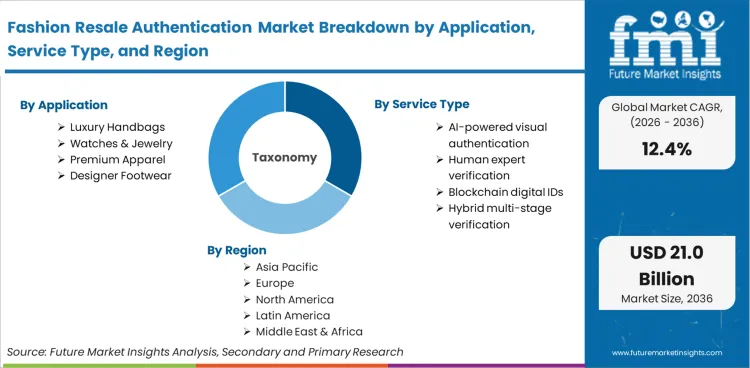
The fashion resale authentication market crossed a valuation of USD 5.8 billion in 2025. The industry is expected to reach USD 6.5 billion in 2026 at a CAGR of 12.44% during the forecast period. Demand outlook carries the market valuation to USD 21.0 billion by 2036 as digital resale platforms integrate AI-driven authentication systems and blockchain-backed product passports to eliminate counterfeit risks in high-value fashion transactions.
The transition from manual consignment to technology-first verification defines the current architectural pivot in the industry. Quality assurance directors at global marketplaces now reject unverified peer-to-peer uploads that introduce significant legal and reputational risks. This structural change forces hardware and software vendors to integrate microscopic imaging and cryptographic anchoring into every intake workflow.
Summary of Fashion Resale Authentication Market
- Fashion Resale Authentication Market Definition
- Fashion Resale Authentication encompasses specialized software, expert services, and hardware built on proprietary brand databases to guarantee zero counterfeit penetration for industrial-scale re-commerce traffic.
- Demand Drivers in the Market
- Global proliferation of super-fakes forces platform operators to specify verification hardware capable of microscopic material analysis.
- Strict digital product passport regulations in Europe compel fashion architects to replace manual logs with cryptographically secure authentication links.
- The shift toward brand-led resale programs requires third-party verification providers to demonstrate sub-99% accuracy rates for luxury goods.
- Key Segments Analyzed in the FMI Report
- AI-powered visual authentication: 45.0% share in 2026, reflecting the massive shift toward automated intake for high-volume peer-to-peer marketplaces.
- Luxury Handbags: 40.0% share in 2026, as high-value assets mandate the most rigorous multi-stage verification protocols to protect investor value.
- China: 16.5% compound growth, driven by massive digital resale ecosystems deploying unified authentication backbones.
- Analyst Opinion at FMI
- Ronak Shah, Principal Consultant for Consumer Product, opines, "In my analysis, I have observed that the true bottleneck in scaling fashion re-commerce is not the lack of supply, but the trust deficit created by increasingly sophisticated counterfeit operations. Platforms attempting to scale high-value luxury categories without integrated AI-driven verification face unavoidable liability risks that trigger buyer attrition. Market architects who continue relying on human-only inspection will find themselves unable to meet the deterministic response times required for the next generation of instant-buy resale integration."
- Strategic Implications / Executive Takeaways
- Platform integrity leads must secure third-party interoperability certification to qualify for impending brand-led resale partnership contracts.
- Capital project directors should phase out manual-only inspection and mandate native digital passport support in all new intake specifications.
- Service integrators must develop specialized microscopic imaging competencies to prove legitimacy guarantees during the item on-boarding phase.
- Methodology
- Primary Research: FMI conducted detailed technical interviews with principal platform architects, luxury authentication leads, and re-commerce directors across 40 countries to validate technology adoption timelines.
- Desk Research: Analysts aggregated public standards documentation from global fashion federations, blockchain compliance registries, and national circular economy grant programs.
- Market-Sizing and Forecasting: The model applies a bottom-up methodology starting with global resale transaction volumes and projecting the conversion rate to professional authentication standards.
- Data Validation and Update Cycle: Segment forecasts undergo cross-validation against quarterly investment reports from leading re-commerce technology venture funds.
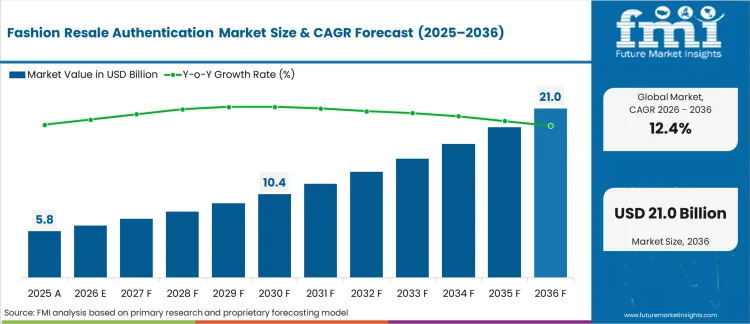
Fashion Resale Authentication Market Key Takeaways
| Metric | Details |
|---|---|
| Industry Size (2026) | USD 6.5 billion |
| Industry Value (2036) | USD 21.0 billion |
| CAGR (2026-2036) | 12.44% |
FMI analysts opine that the true inflection point occurs when the marginal cost of authentication drops below the overhead of manual item cataloging. This specific condition allows for the mass-market application of verification protocols to low-margin apparel segments that previously lacked structural protection. Professional authenticators who continue relying solely on sensory inspection will find themselves unable to process the sheer volume of single-SKU inventory required for profitable scale in global re-commerce hubs.
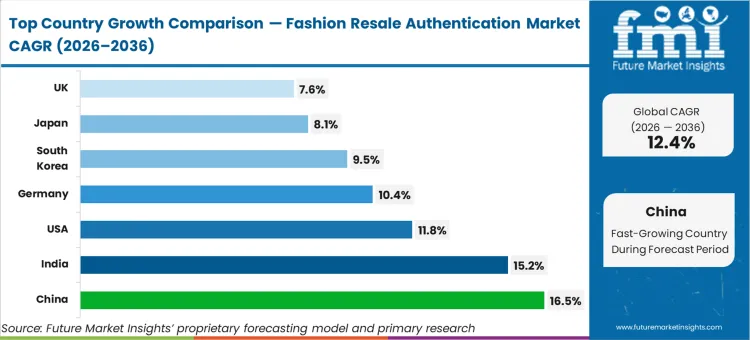
As regional fashion centers navigate this transition, China sets the pace with a 16.5% CAGR, followed closely by India at 15.2% as both nations leverage digital-first retail landscapes to bypass legacy thrift models. The United States advances at an 11.8% rate, supported by stringent intellectual property enforcement mandates. Germany records a 10.4% expansion while South Korea tracks at 9.5%, both driven by high-end luxury consumption and electronic tag integration. Japan expands at an 8.1% trajectory anchored by its established vintage luxury retail standards. The UK maintains a steady 7.6% pace as regional platforms implement synchronized anti-counterfeit topologies.
Fashion Resale Authentication Market Definition
Fashion Resale Authentication represents the technical and analytical infrastructure designed specifically to guarantee the legitimacy and condition of pre-owned fashion assets. The ecosystem includes specialized imaging hardware, deep-learning algorithms, and expert verification services compliant with brand-specific provenance standards. A core inclusion is the deployment of microscopic surface-area analysis to identify counterfeit deviations in fabric weave and hardware engraving.
Fashion Resale Authentication Market Inclusions
The market scope includes automated AI-driven verification tools, blockchain-anchored digital product passports, and professional consignment inspection services. Protocol-specific software stacks for image recognition and associated physical layer testing equipment for luxury materials fall within the boundaries. Products utilizing sustainable fashion mechanisms for circularity tracking and brand-led buy-back programs are fully incorporated into the valuation.
Fashion Resale Authentication Market Exclusions
Standard commercial e-commerce listing tools lacking specialized counterfeit detection algorithms are excluded. Pure logistics software, standalone shipping services, and non-verified general classified ads fall outside the defined parameters. Legacy donation-based sorting processes without formal legitimacy certification are explicitly omitted from the valuation to ensure an accurate mapping of the organized service layer.
Fashion Resale Authentication Market Research Methodology
- Primary Research: Analysts engaged with platform integrity directors, lead luxury authenticators, and circular economy policy advisors to map the specific decision gates triggering service adoption.
- Desk Research: The data collection phase aggregated compliance roadmaps from global fashion councils, brand-led resale registries, and major marketplace operational filings.
- Market-Sizing and Forecasting: The baseline value derives from a bottom-up aggregation of verification transaction volumes, applying region-specific adoption curves to project future service velocity.
- Data Validation and Update Cycle: Projections are rigorously tested against publicly reported capital expenditure guidance from leading luxury conglomerates and independent verification technology firms.
Segmental Analysis
Fashion Resale Authentication Market Analysis by Service Type
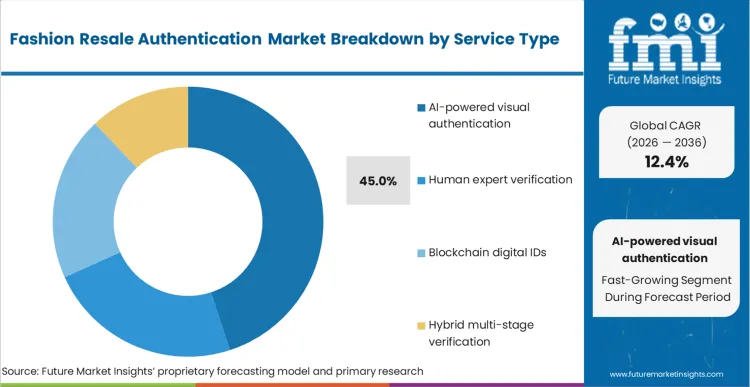
With legacy manual inspection proving inadequate for the volume of sub-minute digital listings, capital project directors at major marketplaces execute full-scale hardware replacement programs. AI-powered visual authentication commands a dominant 45.0% share in 2026, reflecting the absolute requirement for physical network upgrades before advanced logical orchestration can occur. Platforms deploying deep-learning algorithms directly into the intake mobile apps establish the foundation for trust-led environments. According to FMI's estimates, this integration eliminates the need for expensive external shipping to central hubs. Network architects specifying these endpoints streamline their deployment topologies and significantly reduce overall processing time. Hardware vendors unable to supply certified luxury handbags verification components risk immediate exclusion from the next wave of greenfield marketplace RFPs.
- Deep learning integration: Algorithmic models demand rigorous training against proprietary brand datasets to guarantee accurate identification of high-precision counterfeit deviations.
- Automated intake: Embedded software capabilities natively handle microscopic image capture, shifting the verification burden away from the manual sorter.
- Processing velocity: Eliminating intermediate shipping to authentication centers shrinks the time-to-market for high-demand secondary inventory in competitive retail environments.
Fashion Resale Authentication Market Analysis by Application
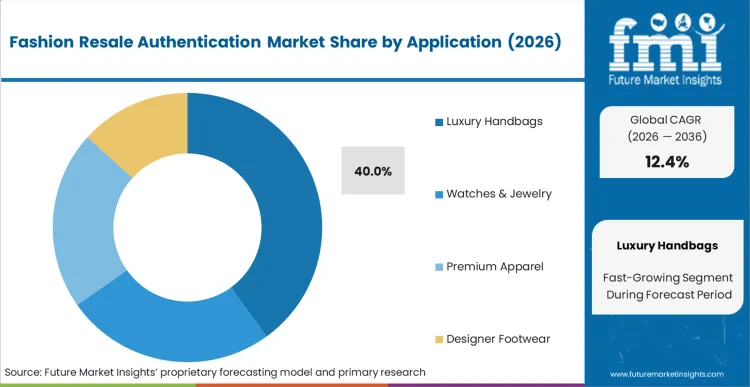
Luxury Handbags emerge as the dominant application area, expected to represent 40.0% of total market share in 2026. Modern high-value resale environments are increasingly built around unified verification networks, removing the delays and inefficiencies caused by traditional mailing to human experts. FMI analysts opine that flattening the authentication architecture directly enables real-time liquidity for asset owners on the platform floor. Platform automation leads must validate deterministic performance metrics during site acceptance testing to authorize final project sign-off. The integration of industrial communication standards across isolated machine cells forces systems integrators to rethink traditional hierarchical topologies.
- Asset liquidity: Critical verification data receives guaranteed transmission windows while standard diagnostic data flows utilize remaining bandwidth without causing interference.
- Risk mitigation: Connecting field devices directly to the main production backbone accelerates the extraction of telemetry data for predictive fraud platforms.
- Verification precision: Standardized configuration models reduce the engineering hours previously required to map proprietary data structures between disparate control domains.
Fashion Resale Authentication Market Drivers, Restraints, and Opportunities
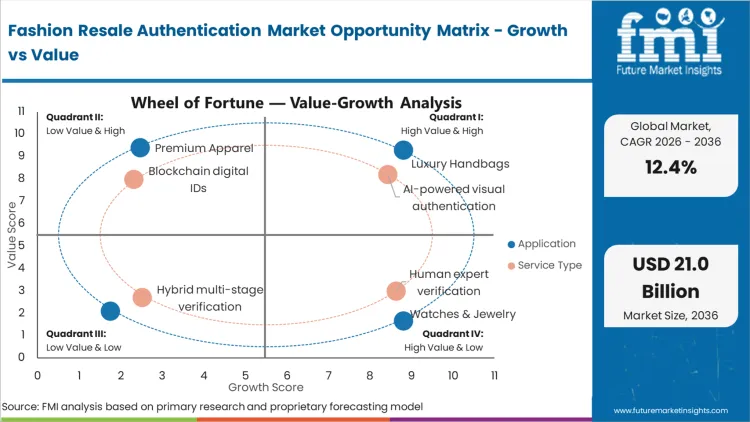
The convergence of global re-commerce volume and the sophistication of counterfeit manufacturing forces platform integrity leads to extract actionable data directly from the textile weave. This architectural requirement renders fragmented, manual inspection processes obsolete. Asset owners upgrading brownfield marketplaces face a strict binary choice between deploying complex translation gateways or overhauling the base infrastructure. Transitioning to a unified deterministic backbone simplifies network topology and enables direct cloud connectivity for advanced anti-fraud analytics. Facilities that fail to modernize their core communication layers risk operational blind spots and reduced overall equipment effectiveness.
The intricate configuration parameters required to optimize high-resolution image flows create steep learning curves for traditional retail engineers. Designing conflict-free transmission schedules across multi-vendor hardware demands specialized network calculus expertise that most fashion facilities lack internally. Based on FMI's assessment, capital projects directors increasingly rely on advanced software configuration tools that automate the scheduling process and validate network designs before physical deployment.
Opportunities in the Fashion Resale Authentication Market
- Digital Product Passport Integration: Next-generation authentication endpoints enable brand architects to run virtualized ownership logic directly on the network switch.
- High-Bandwidth Microscopic Vision: Upgraded deterministic bandwidth permits quality assurance teams to deploy inline 3D optical inspection without impacting critical control traffic.
- Retailer-Led Circularity Ecosystems: Utility network planners integrating distributed renewable energy resources require precise phase measurement data to balance volatile power generation inputs.
Regional Analysis
Based on the regional analysis, the Fashion Resale Authentication market is segmented into North America, Latin America, Europe, East Asia, South Asia, Oceania and Middle East & Africa across 40 plus countries.
.webp "Top Country Growth Comparison Fashion Resale Authentication Market Cagr (2026 2036)")
| Country | CAGR (2026 to 2036) |
|---|---|
| China | 16.5% |
| India | 15.2% |
| USA | 11.8% |
| Germany | 10.4% |
| South Korea | 9.5% |
| Japan | 8.1% |
| UK | 7.6% |
Source: Future Market Insights (FMI) analysis, based on proprietary forecasting model and primary research
Asia Pacific Fashion Resale Authentication Market Analysis
Digital commerce expansion across the Asia Pacific region accelerates the shift away from informal trust-based resale transactions. Platform operators building new luxury resale ecosystems specify authentication infrastructure in their initial operating models to reduce fraud exposure and strengthen buyer confidence. FMI analysts opine that this clean-slate approach eliminates the costly reputational damage associated with counterfeit disputes that burden loosely governed secondary fashion channels. By embedding verification frameworks into the foundation, regional market participants establish highly scalable resale environments capable of supporting rapid transaction growth. This aggressive platform formalization strategy directly fuels the demand for advanced fashion resale authentication services. The integration of trusted verification architecture forms the critical prerequisite for scaling premium resale activity across online and offline channels. The specific luxury consumption patterns of individual nations dictate the precise implementation pathway for these authentication systems.
- China: China’s premium fashion resale sector operates through highly digital, fast-moving commerce ecosystems that require trusted authentication to support large transaction volumes. Marketplace operators expanding luxury resale activity must deploy robust verification systems capable of distinguishing genuine branded items from increasingly sophisticated counterfeit goods. The rapid growth of affluent urban consumers and social commerce-driven secondhand fashion platforms creates a large installed base for authentication services across key metropolitan clusters. This accelerated market formalization drives a 16.5% CAGR for fashion resale authentication demand in China through 2036. Service providers unable to demonstrate strong brand-level verification capability risk exclusion from the most lucrative premium resale partnerships in the country.
- India: India’s organized resale landscape is evolving alongside rising aspirational fashion spending and greater consumer exposure to branded accessories and apparel. Authentication providers must support platforms and retailers with systems that reduce counterfeit risk while building confidence among first-time luxury resale buyers. The growing influence of digital marketplaces and structured recommerce models is triggering a wave of authentication-led resale expansion across major urban centers. This structural transition anchors India’s 15.2% compound expansion in fashion resale authentication demand to 2036. Vendors failing to provide credible verification support and scalable authentication workflows risk disqualification from major resale ecosystem partnerships.
- South Korea: South Korea’s luxury fashion resale environment is shaped by digitally mature consumers, high brand awareness, and strong demand for authenticated premium goods. Resale operators must deploy highly consistent verification mechanisms to preserve trust in cross-border and domestic secondhand luxury transactions. The concentration of fashion-conscious urban buyers and premium lifestyle marketplaces sustains continuous investment in reliable authentication systems that can support rapid inventory turnover. South Korea’s fashion resale authentication demand is rising at a CAGR of 9.5% through 2036 as trust assurance becomes a baseline requirement across curated resale channels. Authentication specialists targeting the next phase of premium resale growth must prove consistent verification accuracy before entering preferred platform networks.
- Japan: Japan’s secondhand luxury goods market operates within a highly quality-conscious retail culture where condition grading and authenticity validation directly influence resale value. Authentication providers serving this market must support rigorous verification workflows that align with consumer expectations for precision and trust. The domestic resale ecosystem benefits from established appreciation for branded fashion and disciplined purchasing behavior, which drives recurring demand for reliable authentication support. This continuous trust-led market structure sustains an 8.1% CAGR for fashion resale authentication demand in Japan through 2036. Providers lacking dependable verification credibility and consistent brand expertise risk losing access to leading premium resale channels.
FMI's report includes extensive coverage of the Asia Pacific fashion resale authentication landscape. It incorporates detailed analysis of Australia, Indonesia, Thailand, and the broader ASEAN region. A primary trend shaping these nations is the rapid institutionalization of online resale channels, forcing market participants to deploy trusted authentication systems that can support cross-border premium fashion trade and rising consumer scrutiny.
North America Fashion Resale Authentication Market Analysis
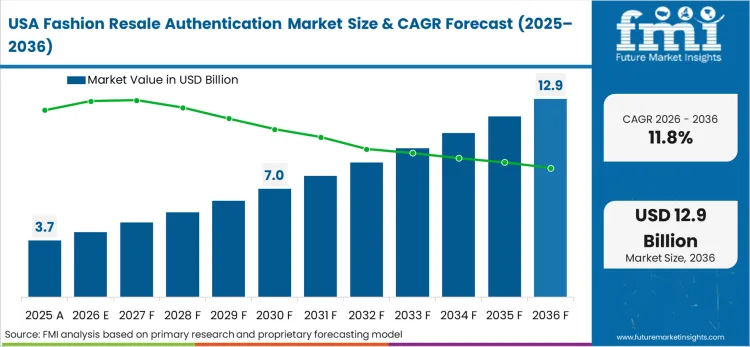
Premium resale expansion across North America is driving the formalization of authentication practices across digital and store-linked recommerce channels. Marketplace operators, resale specialists, and brand-adjacent partners must integrate trusted verification capabilities to limit counterfeit penetration and protect platform credibility. According to FMI’s estimates, the United States market actively drives this transition as luxury resale moves further into mainstream consumer purchasing behavior. Implementing structured authentication systems enables platforms to scale branded fashion resale while maintaining buyer assurance and transaction integrity. This strategic shift requires sustained investment in authentication workflows capable of supporting high-value product turnover across handbags, footwear, apparel, and accessories. The success of these resale modernization initiatives depends heavily on the availability of credible and repeatable verification standards. Consumer trust expectations and brand protection priorities define the exact requirements for authentication deployment across the region.
- USA: The United States premium resale sector enforces strong trust expectations across platform-based and omnichannel secondhand fashion ecosystems. Authentication providers supporting this market must deploy systems capable of verifying high volumes of branded goods while preserving buyer confidence across increasingly competitive resale channels. Strong consumer interest in sustainable fashion, premium accessories, and recommerce-led value purchasing continues to accelerate platform investment in verification infrastructure. This structural shift drives an 11.8% compound rate for fashion resale authentication demand in the United States through 2036. Providers lacking visible credibility, repeatable verification accuracy, and strong luxury brand expertise risk exclusion from major resale platform partnerships.
FMI's report includes comprehensive evaluation of the North American fashion resale authentication sector. It features specific analysis of the Canadian and Mexican markets. A defining regional dynamic involves the expansion of cross-border online luxury resale, which requires dependable authentication systems to support trust, minimize disputes, and preserve transaction value across multiple consumer markets.
Europe Fashion Resale Authentication Market Analysis
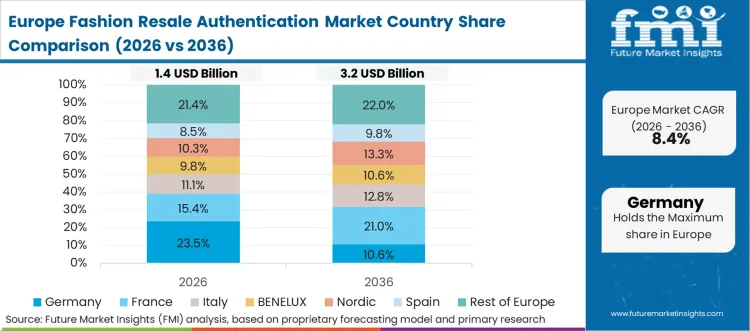
European circular fashion growth is accelerating the need for formal authentication systems across premium secondhand channels. Resale platforms, boutique operators, and luxury-focused digital marketplaces must embed trusted verification processes to support consumer confidence and reduce counterfeit-related risk. This requirement is driving a structural shift away from loosely screened peer-to-peer resale activity toward more controlled and professionally authenticated commerce environments. The transition requires consistent investment in verification expertise, item-level inspection frameworks, and scalable authentication workflows capable of supporting premium fashion turnover. Upgrading trust architecture across the resale value chain gives operators the ability to expand inventory breadth while preserving brand-sensitive transaction integrity. Market participants recognize that weak authentication standards directly undermine resale profitability in highly quality-conscious European luxury markets. Regional consumer expectations and circular economy behavior strongly influence the implementation pathway for these authentication systems.
- Germany: Germany’s resale environment is shaped by disciplined consumer purchasing patterns, rising circular fashion participation, and strong demand for authenticated branded goods. Authentication providers targeting this market must demonstrate reliable inspection standards capable of supporting premium resale transactions across digital and specialist retail channels. The country’s emphasis on product quality, traceability, and structured recommerce models creates a recurring trust requirement that accelerates investment in professional verification services. This systemic quality-driven pressure drives a 10.4% annual expansion rate for fashion resale authentication demand in Germany through 2036. Service providers unable to guarantee consistent verification performance risk losing qualification for leading premium resale partnerships.
- UK: The United Kingdom’s fashion resale ecosystem is increasingly influenced by sustainability-conscious consumers and growing acceptance of authenticated pre-owned premium goods. Resale operators must strengthen verification frameworks to support higher transaction volumes while reducing buyer hesitation linked to counterfeit exposure. The expansion of luxury recommerce platforms and curated secondhand retail models is pushing the market toward more formalized authentication standards across product categories. This transition anchors the UK’s 7.6% compound trajectory to 2036 as authenticated resale becomes a more established component of fashion purchasing behavior. Providers unable to demonstrate dependable brand-level authentication capability risk forfeiting access to major curated resale networks.
FMI's report includes thorough investigation of the broader European fashion resale authentication framework. The analysis encompasses France, Italy, Spain, the Nordics, and the Benelux region. A prevailing structural condition across these markets is the growing overlap between sustainability-led fashion consumption and premium brand protection, forcing resale operators to adopt authentication systems that can reliably support trust, valuation, and long-term platform credibility.
Competitive Aligners for Market Players
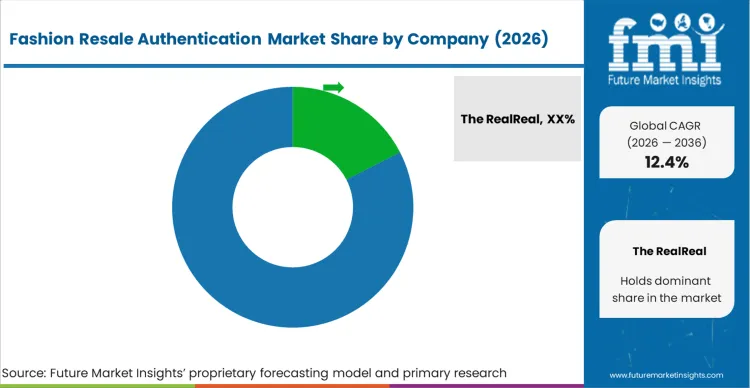
The introduction of standardized testing profiles under the global circular fashion initiative is reshaping how industrial buyers evaluate re-commerce networking hardware. Instead of accepting proprietary timing mechanisms, procurement teams now demand certified, interoperable switching silicon in all new tenders. This shift has raised the performance bar across the industry, meaning vendors that continue to rely on closed, single-vendor ecosystems risk being excluded from major modernization programs. Industry leaders have already begun adapting, as companies like The RealReal and Vestiaire Collective have aligned portions of their portfolios with open, deterministic networking standards, setting a new competitive baseline for others to follow.
Vendors embedding precision timing and synchronization protocols directly into edge devices gain a significant architectural advantage. In FMI's view, companies like Entrupy and Authentique, which increasingly incorporate deterministic silicon at the device level, help reduce engineering overhead during commissioning and shrink the physical control-cabinet footprint. This silicon-first approach accelerates brownfield migration projects, allowing network architects and project leads to prioritize platforms that avoid the complexity associated with external timing gateways. In contrast, component manufacturers slow to adopt native deterministic designs risk losing position during early-stage vendor shortlisting.
Growth of cross-vendor interoperability ecosystems is disrupting long-established market strongholds. With more authentication layers becoming standardized and interoperable, system integrators designing converged IT/OT architectures can now choose endpoints from multiple suppliers without worrying about timing drift or synchronization failures. This expanded flexibility empowers facility owners to optimize networks for performance and reliability instead of being constrained by vendor lock-in. The ability to integrate secondhand apparel verification seamlessly into existing logistics backbones has become the primary differentiator for top-tier service providers.
Key Players in Fashion Resale Authentication Market
- The RealReal
- Vestiaire Collective
- Entrupy
- eBay Inc.
- Poshmark
- ThredUp Inc.
- StockX
- Authentique
- Legit Check By Ch
- Certilogo
- Aura Blockchain Consortium
- Luxclusif
Scope of the Report
| Metric | Value |
|---|---|
| Quantitative Units | USD 6.5 billion to USD 21.0 billion, at a CAGR of 12.44% |
| Market Definition | Fashion Resale Authentication encompasses specialized software, expert services, and hardware built on proprietary brand databases to guarantee zero counterfeit penetration for industrial-scale re-commerce traffic. |
| Service Type Segmentation | AI-powered visual authentication, Human expert verification, Blockchain digital IDs, Hybrid multi-stage verification |
| Application Segmentation | Luxury Handbags, Watches & Jewelry, Premium Apparel, Designer Footwear |
| Platform Segmentation | Online Marketplaces, Retailer-Operated Programs, Peer-to-Peer Platforms |
| Service Level Segmentation | Basic automated check, Professional consignment inspection, Full forensic certification |
| Regions Covered | North America, Latin America, Europe, East Asia, South Asia, Oceania, Middle East & Africa |
| Countries Covered | China, India, USA, Germany, South Korea, Japan, UK, and 40 plus countries |
| Key Companies Profiled | The RealReal, Vestiaire Collective, Entrupy, eBay Inc., Poshmark, ThredUp Inc., StockX, Authentique, Legit Check By Ch, Certilogo, Aura Blockchain Consortium, and Luxclusif |
| Forecast Period | 2026 to 2036 |
| Approach | The baseline value derives from a bottom-up aggregation of verification transaction volumes, applying region-specific adoption curves to project future service velocity. |
Fashion Resale Authentication Market Analysis by Segments
Service Type:
- AI-powered visual authentication
- Human expert verification
- Blockchain digital IDs
- Hybrid multi-stage verification
Application:
- Luxury Handbags
- Watches & Jewelry
- Premium Apparel
- Designer Footwear
Platform:
- Online Marketplaces
- Retailer-Operated Programs
- Peer-to-Peer Platforms
Service Level:
- Basic automated check
- Professional consignment inspection
- Full forensic certification
Region:
- Asia Pacific
- India
- China
- Japan
- South Korea
- Indonesia
- Australia & New Zealand
- ASEAN
- Rest of Asia Pacific
- Europe
- Germany
- Italy
- France
- United Kingdom
- Spain
- Benelux
- Nordics
- Central & Eastern Europe
- Rest of Europe
- North America
- United States
- Canada
- Mexico
- Latin America
- Brazil
- Argentina
- Chile
- Rest of Latin America
- Middle East & Africa
- Kingdom of Saudi Arabia
- United Arab Emirates
- South Africa
- Turkey
- Rest of Middle East & Africa
Bibliography
- European Union Intellectual Property Office. (2025, June 13). International IP Enforcement Summit 2025: Draft agenda.
- European Commission, Joint Research Centre. (2025, May 5). Preparatory study on textiles for product policy instruments.
- Organization for Economic Co-operation and Development. (2025, May 7). Global trade in fake goods reached USD 467 billion, posing risks to consumer safety and compromising intellectual property.
- European Union Intellectual Property Office. (2025, September). Recent European case-law on the infringement and enforcement of intellectual property rights.
- eBay Inc. (2025). eBay launches Authenticity Guarantee for apparel.
This Report Addresses
- Market sizing for the organized fashion resale authentication layer.
- Forecast demand for automated verification from 2026 to 2036.
- Service Type analysis across AI, expert, and blockchain segments.
- Application demand patterns across luxury and premium categories.
- Regional growth comparisons shaped by national IP enforcement policies.
- Competitive positioning factors for technology-led authentication providers.
- Revenue opportunities tied to brand-led circularity value streams.
- Strategic implications for platform integrity leads and retail architects.
Frequently Asked Questions
How large is the Fashion Resale Authentication in 2026?
The market is estimated to be valued at USD 6.5 billion in 2026. This value reflects the rapid integration of trust frameworks into the global circular fashion supply chain.
What will the Fashion Resale Authentication be valued at by 2036?
The market is projected to reach USD 21.0 billion by 2036. Sustained demand is driven by the mandatory adoption of digital product passports and microscopic imaging standards.
What CAGR is projected for Fashion Resale Authentication from 2026 to 2036?
Compound expansion is projected at 12.44% across the forecast decade. This rate is maintained by the shift from manual consignment to automated technology-first verification.
Which Service Type is poised to lead the market by 2026?
AI-powered visual authentication accounts for 45.0% share in 2026 as marketplaces automate intake. This dominance reflects the need for sub-minute processing of high-volume digital listings.
What is the leading application segment in 2026?
Luxury Handbags represent 40.0% of the market share as high-value assets mandate rigorous verification. Investors and collectors require multi-stage forensic certification to protect secondary market values.
What structural transformation is driving the market?
The industry is pivoting from manual "caveat emptor" models to platform-guaranteed trust ecosystems. This shift requires the total elimination of isolated, unverified peer-to-peer transaction domains.
What is driving demand in China?
China's massive digital resale ecosystems require software-defined production lines for item intake. This aggressive greenfield expansion strategy drives a 16.5% CAGR for authentication infrastructure.
What are the primary regulatory drivers in Europe?
Mandatory circular economy directives for digital product passports force the adoption of unified tracking. Facility directors must integrate authentication to remain competitive in highly regulated markets.
What is the growth outlook for India?
India is projected to expand at a CAGR of 15.2% during 2026 to 2036. This growth is anchored by the push toward active retail self-sufficiency and digital-first marketplaces.
How does FMI define the inflection point for this market?
Growth becomes self-sustaining when the marginal cost of AI-verification drops below the overhead of manual sorting. This allows for the protection of mass-market apparel categories previously left unverified.
What is the main demand theme in the USA?
Strict federal cybersecurity and data visibility mandates across multi-tier retail supply chains force adoption. Converged network architectures are now required to support both real-time precision and secure telemetry.
Does the report cover South Korea in its regional analysis?
Yes, South Korea is included within the East Asia regional scope of analysis. It operates at a 9.5% CAGR driven by zero-tolerance positioning task standards.
What prevents competitors from replicating leader advantages?
Leading players possess proprietary brand datasets and deep-learning cycles that are difficult to build. Certification depth and installed base integration form significant barriers to entry for new niche entrants.
What is the UK's compound growth trajectory to 2036?
The UK maintains a 7.6% CAGR as utility-focused sustainability programs influence retail planning. Grid-like synchronization of anti-counterfeit data is now a national procurement baseline.
What role does blockchain play in this market?
Blockchain provides the cryptographic anchoring necessary for immutable digital product passports. It enables absolute provenance tracking for luxury items as they change owners across borders.
What is excluded from the scope of this report?
Standard commercial e-commerce listing tools and legacy donation-based sorting are explicitly omitted. These processes lack the formal legitimacy certification required for the organized service layer.
How does FMI validate the market forecast?
The model applies a bottom-up methodology starting with global resale transaction volumes. Projections are cross-validated against semiconductor shipment volumes for specialized imaging silicon.
What is the primary competitive variable for suppliers?
Interoperability certification is the key variable used to distinguish qualified from unqualified vendors. Buyers now demand certified switching silicon that can integrate with multiple platform backbones.
Why is North America described as a priority region?
The region's aerospace and defense manufacturing sectors drive the consolidation of secure supply chain flows. This creates a recurring compliance cycle that accelerates the replacement of legacy hardware.
What is the main driver for high-bandwidth vision systems?
Quality assurance teams require 3D optical inspection to detect microscopic deviations in hardware engravings. This prevents defective or counterfeit components from entering the assembly sequence.
What are the strategic implications for capital project directors?
Directors must phase out manual-only inspection and mandate native digital passport support. Suppliers failing to demonstrate this capability lose priority status in critical infrastructure upgrade cycles.
How many Q&A pairs are included in this section?
Exactly 22 questions are provided to cover quantitative, segmental, and regional growth dynamics. This ensures a comprehensive overview of the market's structural evolution.
Preview the report firsthand - request a free sample
Get SampleGet the brochure for pricing and purchase details.
Get PDFTable of Content
- Key Takeaways
- Market Size and CAGR
- Top Growth Driver
- Fastest Growing Segment
- Leading Region
- Key Companies
- Emerging Opportunities
- Executive Summary
- Global Market Outlook
- Demand-side Trends
- Supply-side Trends
- Technology Roadmap Analysis
- Analysis and Recommendations
- Analyst Perspective (What is happening? Why now? What should investors know?)
- Key Questions Answered
- How large is the market?
- What is the CAGR?
- What are key trends?
- Which region dominates?
- Who are the leaders?
- Market Overview
- Market Coverage / Taxonomy
- Market Definition / Scope / Limitations
- Research Methodology
- Chapter Orientation
- Analytical Lens and Working Hypotheses
- Market Structure, Signals, and Trend Drivers
- Benchmarking and Cross-market Comparability
- Market Sizing, Forecasting, and Opportunity Mapping
- Research Design and Evidence Framework
- Desk Research Programme (Secondary Evidence)
- Expert Input and Fieldwork (Primary Evidence)
- Tooling, Models, and Reference Databases
- Data Engineering and Model Build
- Quality Assurance and Audit Trail
- Market Background
- Market Dynamics (Drivers, Restraints, Opportunity, Trends)
- Scenario Forecast (Optimistic, Likely, Conservative)
- Impact Analysis
- AI Impact
- Sustainability Impact
- Regulatory Impact
- Technology Impact
- Consumer / Buyer Analysis
- Purchase Drivers
- Adoption Barriers
- Buyer Journey
- Opportunity Map Analysis
- Product Life Cycle Analysis
- Supply Chain Analysis
- Investment Feasibility Matrix
- Value Chain Analysis
- PESTLE and Porter's Analysis
- Regulatory Landscape
- Regional Parent Market Outlook
- Production and Consumption Statistics
- Import and Export Statistics
- Global Market Analysis and Forecast, 2021 to 2036
- Historical Market Size Value (USD Billion) & Volume (Unit) Analysis, 2021 to 2025
- Current and Future Market Size Value (USD Billion) & Volume (Unit) Projections, 2026 to 2036
- Y-o-Y Growth Trend Analysis
- Absolute $ Opportunity Analysis
- Global Market Pricing Analysis, 2021 to 2036
- Global Market Analysis and Forecast, By Service Type, 2021 to 2036
- Introduction / Key Findings
- Historical Market Size Value (USD Billion) & Volume (Unit) Analysis By Service Type, 2021 to 2025
- Current and Future Market Size Value (USD Billion) & Volume (Unit) Analysis and Forecast By Service Type, 2026 to 2036
- AI-powered visual authentication
- Human expert verification
- Blockchain digital IDs
- Hybrid multi-stage verification
- AI-powered visual authentication
- Y-o-Y Growth Trend Analysis By Service Type, 2021 to 2025
- Absolute $ Opportunity Analysis By Service Type, 2026 to 2036
- Global Market Analysis and Forecast, By Application, 2021 to 2036
- Introduction / Key Findings
- Historical Market Size Value (USD Billion) & Volume (Unit) Analysis By Application, 2021 to 2025
- Current and Future Market Size Value (USD Billion) & Volume (Unit) Analysis and Forecast By Application, 2026 to 2036
- Luxury Handbags
- Watches & Jewelry
- Premium Apparel
- Designer Footwear
- Luxury Handbags
- Y-o-Y Growth Trend Analysis By Application, 2021 to 2025
- Absolute $ Opportunity Analysis By Application, 2026 to 2036
- Global Market Analysis and Forecast, By Platform, 2021 to 2036
- Introduction / Key Findings
- Historical Market Size Value (USD Billion) & Volume (Unit) Analysis By Platform, 2021 to 2025
- Current and Future Market Size Value (USD Billion) & Volume (Unit) Analysis and Forecast By Platform, 2026 to 2036
- Online Marketplaces
- Retailer-Operated Programs
- Peer-to-Peer Platforms
- Online Marketplaces
- Y-o-Y Growth Trend Analysis By Platform, 2021 to 2025
- Absolute $ Opportunity Analysis By Platform, 2026 to 2036
- Global Market Analysis and Forecast, By Service Level, 2021 to 2036
- Introduction / Key Findings
- Historical Market Size Value (USD Billion) & Volume (Unit) Analysis By Service Level, 2021 to 2025
- Current and Future Market Size Value (USD Billion) & Volume (Unit) Analysis and Forecast By Service Level, 2026 to 2036
- Basic automated check
- Professional consignment inspection
- Full forensic certification
- Basic automated check
- Y-o-Y Growth Trend Analysis By Service Level, 2021 to 2025
- Absolute $ Opportunity Analysis By Service Level, 2026 to 2036
- Global Market Analysis and Forecast, By Region, 2021 to 2036
- Introduction
- Historical Market Size Value (USD Billion) & Volume (Unit) Analysis By Region, 2021 to 2025
- Current Market Size Value (USD Billion) & Volume (Unit) Analysis and Forecast By Region, 2026 to 2036
- North America
- Latin America
- Western Europe
- Eastern Europe
- East Asia
- South Asia and Pacific
- Middle East & Africa
- Market Attractiveness Analysis By Region
- North America Market Analysis and Forecast, By Country, 2021 to 2036
- Historical Market Size Value (USD Billion) & Volume (Unit) Trend Analysis By Market Taxonomy, 2021 to 2025
- Market Size Value (USD Billion) & Volume (Unit) Forecast By Market Taxonomy, 2026 to 2036
- By Country
- USA
- Canada
- Mexico
- By Service Type
- By Application
- By Platform
- By Service Level
- By Country
- Market Attractiveness Analysis
- By Country
- By Service Type
- By Application
- By Platform
- By Service Level
- Key Takeaways
- Latin America Market Analysis and Forecast, By Country
- Historical Market Size Value (USD Billion) & Volume (Unit) Trend Analysis By Market Taxonomy, 2021 to 2025
- Market Size Value (USD Billion) & Volume (Unit) Forecast By Market Taxonomy, 2026 to 2036
- By Country
- Brazil
- Chile
- Rest of Latin America
- By Service Type
- By Application
- By Platform
- By Service Level
- By Country
- Market Attractiveness Analysis
- By Country
- By Service Type
- By Application
- By Platform
- By Service Level
- Key Takeaways
- Western Europe Market Analysis and Forecast, By Country
- Historical Market Size Value (USD Billion) & Volume (Unit) Trend Analysis By Market Taxonomy, 2021 to 2025
- Market Size Value (USD Billion) & Volume (Unit) Forecast By Market Taxonomy, 2026 to 2036
- By Country
- Germany
- UK
- Italy
- Spain
- France
- Nordic
- BENELUX
- Rest of Western Europe
- By Service Type
- By Application
- By Platform
- By Service Level
- By Country
- Market Attractiveness Analysis
- By Country
- By Service Type
- By Application
- By Platform
- By Service Level
- Key Takeaways
- Eastern Europe Market Analysis and Forecast, By Country
- Historical Market Size Value (USD Billion) & Volume (Unit) Trend Analysis By Market Taxonomy, 2021 to 2025
- Market Size Value (USD Billion) & Volume (Unit) Forecast By Market Taxonomy, 2026 to 2036
- By Country
- Russia
- Poland
- Hungary
- Balkan & Baltic
- Rest of Eastern Europe
- By Service Type
- By Application
- By Platform
- By Service Level
- By Country
- Market Attractiveness Analysis
- By Country
- By Service Type
- By Application
- By Platform
- By Service Level
- Key Takeaways
- East Asia Market Analysis and Forecast, By Country
- Historical Market Size Value (USD Billion) & Volume (Unit) Trend Analysis By Market Taxonomy, 2021 to 2025
- Market Size Value (USD Billion) & Volume (Unit) Forecast By Market Taxonomy, 2026 to 2036
- By Country
- China
- Japan
- South Korea
- By Service Type
- By Application
- By Platform
- By Service Level
- By Country
- Market Attractiveness Analysis
- By Country
- By Service Type
- By Application
- By Platform
- By Service Level
- Key Takeaways
- South Asia and Pacific Market Analysis and Forecast, By Country
- Historical Market Size Value (USD Billion) & Volume (Unit) Trend Analysis By Market Taxonomy, 2021 to 2025
- Market Size Value (USD Billion) & Volume (Unit) Forecast By Market Taxonomy, 2026 to 2036
- By Country
- India
- ASEAN
- Australia & New Zealand
- Rest of South Asia and Pacific
- By Service Type
- By Application
- By Platform
- By Service Level
- By Country
- Market Attractiveness Analysis
- By Country
- By Service Type
- By Application
- By Platform
- By Service Level
- Key Takeaways
- Middle East & Africa Market Analysis and Forecast, By Country
- Historical Market Size Value (USD Billion) & Volume (Unit) Trend Analysis By Market Taxonomy, 2021 to 2025
- Market Size Value (USD Billion) & Volume (Unit) Forecast By Market Taxonomy, 2026 to 2036
- By Country
- Kingdom of Saudi Arabia
- Other GCC Countries
- Türkiye
- South Africa
- Other African Union
- Rest of Middle East & Africa
- By Service Type
- By Application
- By Platform
- By Service Level
- By Country
- Market Attractiveness Analysis
- By Country
- By Service Type
- By Application
- By Platform
- By Service Level
- Key Takeaways
- Key Countries Market Analysis
- USA
- Pricing Analysis
- Market Share Analysis, 2025
- By Service Type
- By Application
- By Platform
- By Service Level
- Canada
- Pricing Analysis
- Market Share Analysis, 2025
- By Service Type
- By Application
- By Platform
- By Service Level
- Mexico
- Pricing Analysis
- Market Share Analysis, 2025
- By Service Type
- By Application
- By Platform
- By Service Level
- Brazil
- Pricing Analysis
- Market Share Analysis, 2025
- By Service Type
- By Application
- By Platform
- By Service Level
- Chile
- Pricing Analysis
- Market Share Analysis, 2025
- By Service Type
- By Application
- By Platform
- By Service Level
- Germany
- Pricing Analysis
- Market Share Analysis, 2025
- By Service Type
- By Application
- By Platform
- By Service Level
- UK
- Pricing Analysis
- Market Share Analysis, 2025
- By Service Type
- By Application
- By Platform
- By Service Level
- Italy
- Pricing Analysis
- Market Share Analysis, 2025
- By Service Type
- By Application
- By Platform
- By Service Level
- Spain
- Pricing Analysis
- Market Share Analysis, 2025
- By Service Type
- By Application
- By Platform
- By Service Level
- France
- Pricing Analysis
- Market Share Analysis, 2025
- By Service Type
- By Application
- By Platform
- By Service Level
- India
- Pricing Analysis
- Market Share Analysis, 2025
- By Service Type
- By Application
- By Platform
- By Service Level
- ASEAN
- Pricing Analysis
- Market Share Analysis, 2025
- By Service Type
- By Application
- By Platform
- By Service Level
- Australia & New Zealand
- Pricing Analysis
- Market Share Analysis, 2025
- By Service Type
- By Application
- By Platform
- By Service Level
- China
- Pricing Analysis
- Market Share Analysis, 2025
- By Service Type
- By Application
- By Platform
- By Service Level
- Japan
- Pricing Analysis
- Market Share Analysis, 2025
- By Service Type
- By Application
- By Platform
- By Service Level
- South Korea
- Pricing Analysis
- Market Share Analysis, 2025
- By Service Type
- By Application
- By Platform
- By Service Level
- Russia
- Pricing Analysis
- Market Share Analysis, 2025
- By Service Type
- By Application
- By Platform
- By Service Level
- Poland
- Pricing Analysis
- Market Share Analysis, 2025
- By Service Type
- By Application
- By Platform
- By Service Level
- Hungary
- Pricing Analysis
- Market Share Analysis, 2025
- By Service Type
- By Application
- By Platform
- By Service Level
- Kingdom of Saudi Arabia
- Pricing Analysis
- Market Share Analysis, 2025
- By Service Type
- By Application
- By Platform
- By Service Level
- Türkiye
- Pricing Analysis
- Market Share Analysis, 2025
- By Service Type
- By Application
- By Platform
- By Service Level
- South Africa
- Pricing Analysis
- Market Share Analysis, 2025
- By Service Type
- By Application
- By Platform
- By Service Level
- USA
- Market Structure Analysis
- Competition Dashboard
- Competition Benchmarking
- Market Share Analysis of Top Players
- By Regional
- By Service Type
- By Application
- By Platform
- By Service Level
- Emerging Startups
- Innovation Benchmarking
- Competition Analysis
- Competition Deep Dive
- The RealReal
- Overview
- Product Portfolio
- Profitability by Market Segments (Product/Region/Sales Channel)
- Sales Footprint
- Strategy Overview
- Marketing Strategy
- Product Strategy
- Channel Strategy
- Vestiaire Collective
- Entrupy
- eBay Inc.
- Poshmark
- ThredUp Inc.
- StockX
- Authentique
- Legit Check Ch
- Certilogo
- Aura Blockchain Consortium
- Luxclusif
- The RealReal
- Case Studies
- Success Stories
- Recent Developments
- Competition Deep Dive
- Assumptions & Acronyms Used


