

- Industry Size (2026)
- USD 5.40 Bn
- Forecast (2036)
- USD 14.1 Bn
- CAGR (2026 to 2036)
- 10.1%
Asset Recovery and Secondary Market Logistics Platforms Market Size, Market Forecast and Outlook By FMI
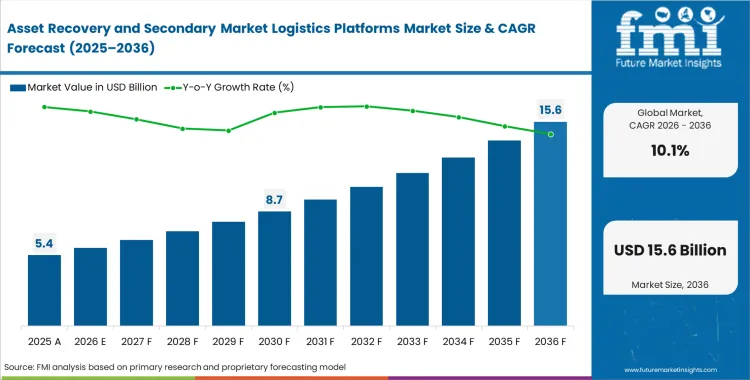
The asset recovery logistics platforms sector was valued at USD 4.90 billion in 2025 and is expected to surpass USD 5.40 billion in 2026, expanding at a CAGR of 10.1% over the forecast period. The market is projected to reach USD 14.1 billion by 2036 as enterprise liquidation teams move away from fragmented broker-led models toward integrated digital orchestration platforms that streamline valuation, routing, and resale execution.
Summary of Asset Recovery and Secondary Market Logistics Platforms Market
- Market Snapshot
- The Asset Recovery and Secondary Market Logistics Platforms Market is projected to expand from USD 4.9 billion in 2025 to USD 14.1 billion by 2036, reflecting a shift toward structured and centralized recovery ecosystem.
- Growth is expected at 10.1% CAGR through 2036, creating an incremental opportunity of approximately USD 8.7 billion as enterprises scale platform-led liquidation and resale models.
- Positioned between reverse logistics, liquidation, ITAD, and recommerce, the category functions as a control layer managing intake, routing, resale execution, recovery analytics, and governance across secondary market channels.
- Demand and Growth Drivers
- Demand is rising because enterprises are under pressure to recover more value from returned, obsolete, or surplus assets instead of writing them off or relying on fragmented manual liquidation channels.
- Liquidity Services reported annual GMV above USD 1.5 billion in fiscal 2025, which shows strong transaction activity in organized surplus-asset platforms.
- B-Stock’s official positioning around returned, excess, and trade-in inventory from major retailers confirms that secondary-market movement is increasingly platformized rather than broker-led.
- Device-recovery channels are strengthening too. Assurant said USA mobile trade-in programs returned USD 6.4 billion to consumers in 2025, while GSMA projects the broader circular devices and services market will exceed USD 150 billion by 2027.
- Circularity pressure is intensifying because global e-waste reached 62 million tonnes in 2022, and Apple says it participates in take-back and recycling collection programs in significant countries where it sells products.
- Product and Segment View
- Surplus and overstock recovery is expected to account for 29.0% share in the Program Type segment in 2026, as retailers and enterprises prioritize faster liquidation of idle inventory to unlock working capital.
- The core value of these platforms lies in connecting recovered assets with the most suitable buyer channels, positioning marketplace and resale routing at 32.0% share in the Platform Function segment in 2026.
- Consumer electronics continue to dominate due to strong resale demand and active trade-in and recommerce ecosystems, with the segment projected to reach 34.0% share in 2026.
- Bulk B2B recovery remains the primary collection model, as enterprises move inventory in large lots rather than individual units, driving the segment to 37.0% share in 2026.
- Retail and e-commerce are set to account for 31.0% share in the End Use segment in 2026, supported by high return volumes, excess stock clearance, and ongoing channel optimization needs.
- Geography and Competitive Outlook
- India and China continue to show the fastest growth, while the United States remains the largest demand center due to its established base across liquidation, ITAD, and trade-in infrastructure, supported by mature platform operators and stronger circular-device activity.
- Competitive positioning is shaped by the depth of buyer networks, strength of chain-of-custody controls, governance across resale channels, real-time pricing intelligence, and the ability to route assets into compliant recovery pathways.
- Liquidity Services is estimated to hold 14.0% share, leading a market that remains moderately fragmented as recommerce, ITAD, trade-in, and surplus inventory specialists continue to overlap across the value chain.
Rising inventory aging is forcing supply chain teams to act earlier in the recovery cycle, as holding costs and depreciation quickly erode asset value. Procurement teams face growing exposure when returned or off-lease inventory sits in warehouses without defined resale pathways. This is accelerating adoption of asset recovery platforms that connect intake, valuation, and buyer routing within a single system. Fragmented liquidation models are increasingly difficult to manage, particularly when different asset classes require distinct pricing and channel strategies. Operations teams are shifting toward centralized orchestration platforms that improve control over global recovery flows. Delayed upgrades often lead to warehouse congestion during seasonal resets, where unsold inventory accumulates and loses value.
Early-stage routing decisions at the point of receipt improve capital recovery timelines. Direct matching with pre-qualified buyers and structured staging reduces inventory cycles significantly, improving turnover and limiting write-down risk. As these platforms mature, liquidation teams benefit from stronger pricing alignment and reduced dependence on low-value disposal channels.
India records the fastest expansion at 11.9% CAGR, supported by retail growth and rising surplus volumes, while China follows at 11.1% due to industrial asset turnover. Growth in the United States reaches 10.3% as liquidation networks consolidate, with Germany at 9.7% and the United Kingdom at 9.5% shaped by compliance requirements. France grows at 9.2%, and Japan at 8.8%, reflecting steady optimization of asset recovery across enterprise IT and industrial equipment.
Segmental Analysis
Asset Recovery and Secondary Market Logistics Platforms Market Analysis by Program Type
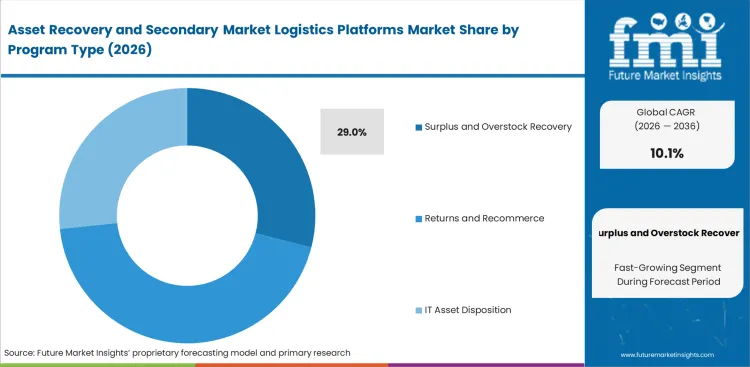
Enterprises handling surplus and overstock inventory require faster pathways to convert idle goods into cash before depreciation reduces recovery value. The surplus and overstock recovery segment is expected to account for 29.0% share in 2026, reflecting continued reliance on structured liquidation programs. Traditional broker-led models lack the speed and pricing consistency needed at scale, driving adoption of platform-based systems that connect inventory directly with qualified buyers. Digital platforms standardize pricing, improve visibility, and reduce dependency on fragmented regional intermediaries. Integration with inventory and warehouse systems allows assets to be routed toward resale channels immediately after intake. Data quality remains a key constraint, as inaccurate inventory records can lead to misrouting or undervaluation of recoverable assets.
- Automated buyer matching: Platforms connect surplus inventory with pre-qualified buyers based on category, condition, and demand signals, improving speed of liquidation.
- Dynamic pricing alignment: Systems adjust reserve prices and floor values based on real-time secondary market demand, reducing underpricing risk.
- Inventory data validation: Structured intake processes improve accuracy in product classification, preventing misrouting and recovery losses.
Asset Recovery and Secondary Market Logistics Platforms Market Analysis by Platform Function
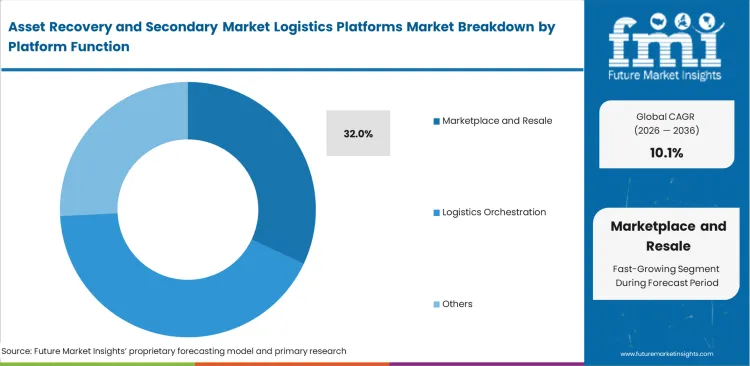
Marketplace and Resale Routing is set to garner 32.0% share in 2026. Based on FMI's analysis, platforms identify the highest bidding liquidation channels automatically based upon specific product condition codes. Remarketing managers utilizing an IT asset recovery platform secure maximum asset value liquidating inventory rapidly leveraging dedicated supply chain analytics effectively. Proximity positioning prevents costly value degradation for merchandise designated critical upon initial triage. Advanced routing algorithms integrate directly with specific buyer networks guiding facility associates physically through the fulfillment checklist. Distribution planners consistently miscalculate how inaccurate local staff grading destroys anticipated resale margin savings entirely. Routing optimization failures cause prime wholesale buyers waiting hours for components stalled behind minor processing disputes.
- Multi-channel routing logic: Platforms evaluate auctions, direct buyers, and secondary distributors simultaneously to determine optimal resale paths.
- Real-time demand sensing: Systems monitor buyer activity and price signals to guide routing decisions dynamically.
- Exception handling workflows: Alerts and overrides address discrepancies in grading or pricing before assets are routed incorrectly.
Asset Payment and Secondary Market Logistics Platforms Market Analysis by Asset Type
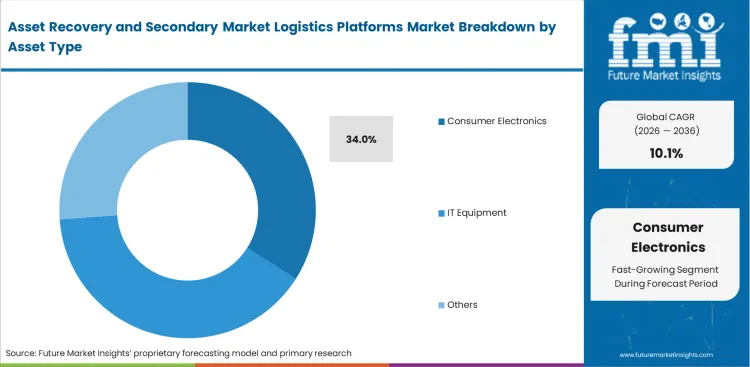
Consumer electronics continue to dominate secondary market activity due to strong resale demand and established refurbishment ecosystems. The segment is projected to capture 34.0% share in 2026, supported by high turnover and active participation across recommerce and ITAD channels. Managing these assets requires coordination across collection, grading, and resale processes, along with strict compliance in areas such as data security and component handling. Integration with enterprise systems improves tracking and reduces the risk of loss or unauthorized handling during processing.
- Device identification tracking: Unique identifiers such as serial numbers and IMEI codes ensure traceability and prevent unauthorized resale.
- Data security compliance: Platforms enforce certified data wiping processes before resale to meet regulatory and enterprise requirements.
- Component recovery optimization: Systems identify reusable parts and route them into refurbishment channels to maximize value extraction.
Asset Recovery and Secondary Market Logistics Platforms Market Analysis by Collection Channel
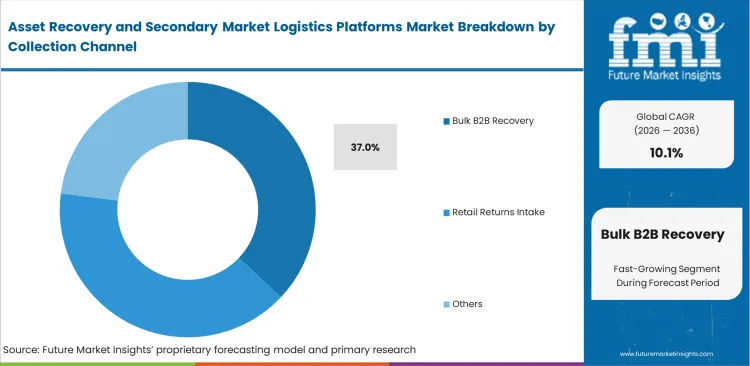
Enterprise asset rotation generates significant localized inbound freight flows. Bulk B2B Recovery is likely to represent 37.0% share in 2026. As per FMI's projection, consolidation logic inside a B2B recommerce platform bundles single corporate office cleanouts into profitable truckload shipments before moving inventory toward centralized grading locations. Centralized tracking prevents unauthorized sorting facilities processing highly sensitive corporate assets independently. Executing this large-scale aggregation requires tight integration against existing warehouse management systems evaluating current dock processing capacity. Integrating agile on demand logistics networks solves unpredictable regional volume spikes securely during major corporate facility relocations. Ignoring local carrier workflow realities blinds central planners completely, causing severe invoice reconciliation failures when managing third-party freight providers.
- Consolidated shipment planning: Platforms group enterprise inventory into optimized transport loads, improving cost efficiency.
- Warehouse capacity alignment: Systems schedule inbound flows based on available processing capacity across facilities.
- Chain-of-custody tracking: End-to-end visibility ensures sensitive corporate assets are handled securely throughout the recovery process.
Asset Recovery and Secondary Market Logistics Platforms Market Analysis by End Use
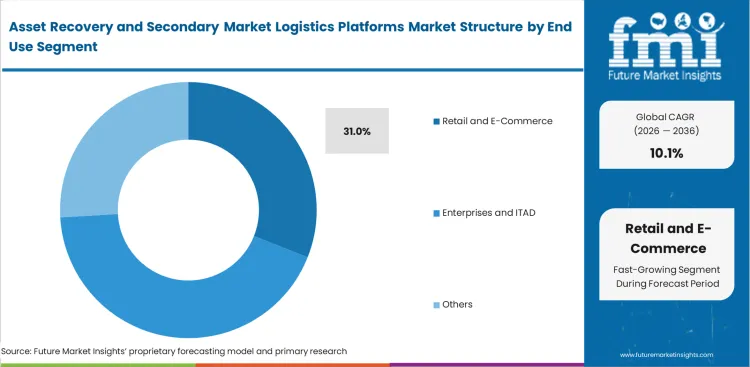
Retail and e-commerce remain the primary drivers of surplus and return volumes, with the segment expected to hold 31.0% share in 2026. Seasonal inventory cycles and high return rates create continuous demand for structured recovery and resale solutions. Fast-moving categories require rapid sorting and routing to preserve value, particularly where resale windows are short. Platforms that connect inventory directly with resale channels help reduce holding time and minimize markdown risk. Delays in processing or weak coordination across facilities can result in inventory buildup and reduced recovery margins.
- Rapid intake sorting: Systems classify returned goods immediately upon arrival, improving downstream processing speed.
- Channel-specific routing: Platforms direct inventory toward the most suitable resale channel based on product lifecycle stage.
- Inventory aging controls: Analytics track holding time and trigger accelerated liquidation before value erosion occurs.
Asset Recovery and Secondary Market Logistics Platforms Market Drivers, Restraints, and Opportunities
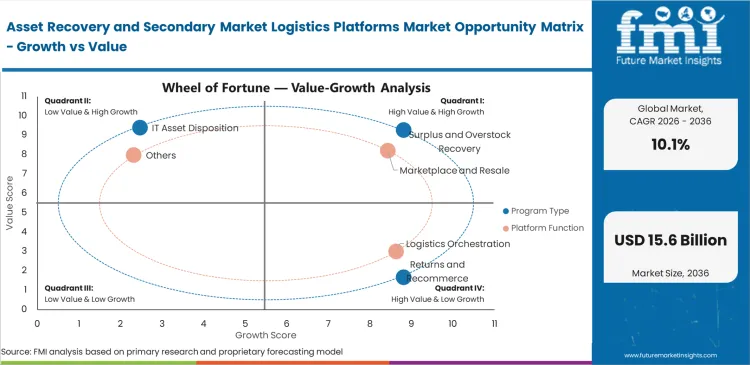
Margin preservation targets force retail operations directors implementing an ITAD remarketing platform immediately. Sourcing critical replacement hardware manually costs excessive processing hours while simultaneously delaying secondary wholesale operations. Delaying system modernization leaves prime grading lines choked waiting for distant central warehouse shipments. Financial controllers realize legacy distribution systems completely fail tracking device-level depreciation costs without dedicated reverse tracking software.
Third-party courier adoption friction slows full aftermarket fulfillment services timelines severely. Independent driver networks resent navigating clunky web interfaces disrupting normal physical material handling rhythms. Software architects building these dispatch portals rarely consult actual field technicians regarding practical location data entry constraints. Until developers design mobile-first barcode scanning interfaces replacing keyboard data entry, local compliance remains frustratingly low.
Opportunities in the Asset Recovery and Secondary Market Logistics Platforms Market
- Predictive pricing artificial intelligence: Matching secondary hardware telemetry against historical wholesale patterns automatically routes critical surplus directly toward high-demand geographic regions utilizing a returned inventory resale platform.
- Enterprise fleet integration: Partnering with corporate IT departments capturing initial diagnostic fault codes securely deploys regional couriers proactively supporting comprehensive device recovery safely.
- Kiosk network expansion: Equipping independent retail spaces managing automated intake volumes accurately expands geographic collection coverage without substantial capital warehouse expenditure.
Regional Analysis
Based on regional analysis, Asset Recovery and Secondary Market Logistics Platforms Market is segmented into North America, Europe, and Asia Pacific across 40 plus countries.
.webp "Top Country Growth Comparison Asset Recovery And Secondary Market Logistics Platforms Market Cagr (2026 2036)")
| Country | CAGR (2026 to 2036) |
|---|---|
| India | 11.9% |
| China | 11.1% |
| United States | 10.3% |
| Germany | 9.7% |
| United Kingdom | 9.5% |
| France | 9.2% |
| Japan | 8.8% |
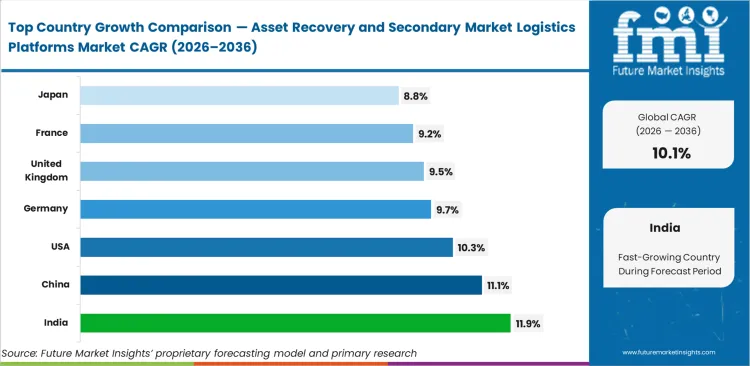
Source: Future Market Insights (FMI) analysis, based on proprietary forecasting model and primary research
Asia Pacific Asset Recovery and Secondary Market Logistics Platforms Market Analysis
Local manufacturing expansion mandates create significant new regional fulfillment liabilities. Based on FMI's assessment, massive electronics assembly hubs transition toward managing full lifecycle service locally. Regional supply chain directors are accelerating the implementation of digital tracking matching original production volume scale. Untracked component failures within complex Asian distribution networks create severe financial exposure. Local policy shifts demanding higher domestic recycling targets force immediate investment regarding advanced tracking algorithms.
- India: Demand for asset recovery and secondary market logistics platforms in India is anticipated to rise at a CAGR of 11.9% through 2036. Domestic manufacturing initiatives are driving integration between production data and recovery networks, enabling accurate tracking of returned assets. Companies are building centralized grading systems to evaluate condition and maximize resale value. Logistics frameworks are being strengthened to connect collection points, refurbishment centers, and secondary markets efficiently.
- China: China is projected to witness 11.1% CAGR during 2026 to 2036. Industrial automation and large-scale electronics consumption are increasing the volume of recoverable assets. Companies are deploying platforms to manage grading, resale, and recycling processes within domestic systems. Secondary markets, including liquidation channels, play a key role in absorbing recovered inventory. Regulatory focus on recycling targets is pushing manufacturers to formalize recovery operations and improve material tracking.
- Japan: Optimizing legacy industrial equipment recovery workflows drives regional adoption. Facility directors digitize decades-old paper routing manuals directly into modern sorting interfaces by applying advanced logistics visibility software frameworks. Japan is likely to post a CAGR of 8.8% by 2036. Heavy utilization regarding corporate IT asset disposition services protects critical capabilities against severe demographic workforce retirements.
Europe Asset Recovery and Secondary Market Logistics Platforms Market Analysis
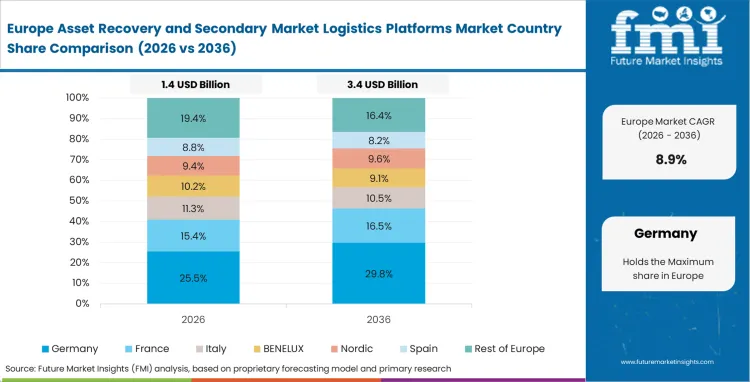
Regulatory frameworks across Europe require transparency in asset recovery, reuse, and recycling. Circular economy policies mandate traceability across product lifecycles, increasing reliance on platforms that manage grading, resale, and compliance reporting. Cross-border operations remain complex due to varying national regulations, requiring centralized coordination across regional facilities. Demand for secondary materials and refurbished products supports stable downstream integration.
- Germany: Strict industrial service level agreements force exact component tracking operations. Critical inventory logistics managers implement workflows separating critical replacements from standard inbound freight streams flawlessly. Germany is poised to expand at a CAGR of 9.7% through 2036. Regional network operators formalize rigorous device intake rubrics ensuring exact valuation matching strict federal environmental reporting mandates accurately within the broader pcr based circular supply chain platform ecosystem.
- United Kingdom: The asset recovery and secondary market logistics platforms market in the United Kingdom is expected to grow at a CAGR of 9.5% through 2036. Independent service providers require standardized interfaces to integrate with enterprise recovery systems. Companies are investing in platforms that support coordination across collection, grading, and resale operations. Demand is also influenced by enterprise requirements for structured asset recovery processes and improved inventory visibility.
- France: France is anticipated to register a CAGR of 9.2% through 2036. Regulatory focus on repairability and lifecycle extension is pushing companies to strengthen take-back and recovery systems. Platforms are used to track asset flows and ensure alignment with environmental compliance standards. Integration of closed-loop recycling processes supports consistency between reported and actual recovery outcomes.
North America Asset Recovery and Secondary Market Logistics Platforms Market Analysis
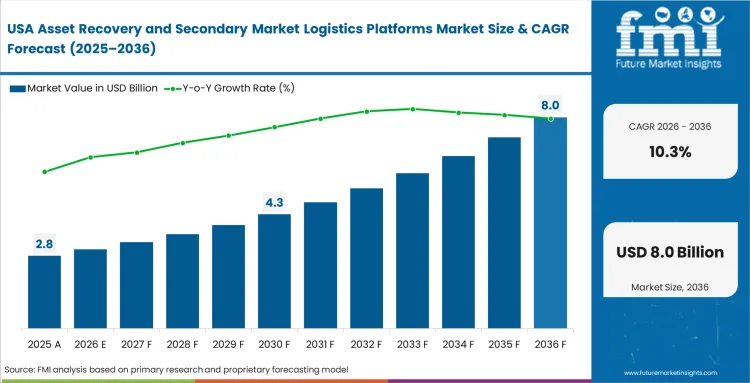
Massive retail consolidation drives unified return center investments continentally. In FMI's view, sprawling geography requires algorithmic routing predicting optimal processing locations. Transportation directors minimize cross-country freight expenses utilizing smart dispositioning rules instantly upon customer initiation. Unchecked failure volumes during peak holiday seasons overwhelm manual warehouse inspection teams completely. Leading retail brands demand systems capable of communicating directly across competing third-party logistics provider networks.
- United States: Tier-one automotive and telecommunication manufacturers consolidate regional dealer networks driving immediate software upgrades. Supply chain planners implement unified dashboards matching inbound component demands against real-time secondary inventory availability securely via end to end multimodal shipment visibility platforms architecture. The United States sector is expected to register a CAGR of 10.3% through 2036. Executing strategic deployments unlocks millions hidden within depreciating seasonal inventory rapidly.
FMI's report includes Canada, Mexico, Brazil, South Korea, Australia, South Africa, and United Arab Emirates. Expanding analysis covers complex municipal regulatory environments dictating specific electronic waste tracking capabilities locally.
Competitive Aligners for Market Players
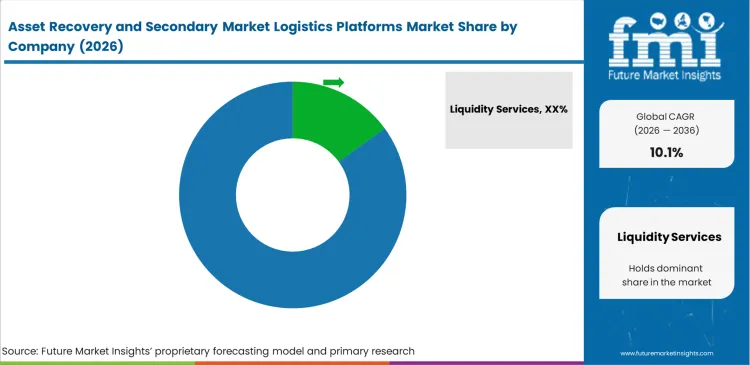
Legacy enterprise resource planning vendors struggle defending territory against nimble specialized fulfillment platforms. FMI observes that massive enterprise logistics providers rely upon deep existing financial integrations securing service contract renewals. Companies like Assurant and B-Stock leverage core procurement modules expanding into critical component tracking organically. Operations directors evaluate these massive suite capabilities prioritizing existing financial ledger integrations bridging global inventory networks within broader supply chain management frameworks. Niche logistics startups bypass corporate IT departments selling directly toward frustrated field service directors promising immediate warehouse dispatch improvements. Teams evaluating the best surplus asset marketplaces frequently seek Liquidity Services alternatives offering agile API connections.
Long-established providers retain an advantage through deeply embedded data models that define complex component hierarchies and lifecycle relationships across asset categories, making replication difficult for newer platforms scaling across diverse recovery workflows. Companies such as Iron Mountain and Ingram Micro Lifecycle operate with mature ITAD and remarketing structures, so evaluating alternatives often comes down to how well emerging cloud platforms align with these existing workflows rather than replacing them entirely. Independent developers must demonstrate clear superiority in routing precision, valuation accuracy, and execution speed to displace bundled enterprise capabilities tied to long-term contracts. Platform evolution is also moving upstream, with stronger integration into post-production collection and lifecycle tracking to maintain continuity from manufacturing through resale. Purpose-built asset disposition systems consistently outperform adapted transportation software in these environments, as they are designed to manage multi-stage routing, compliance requirements, and resale coordination without the limitations of generic logistics frameworks.
Global procurement directors resist vendor lock-in demanding open architectures universally. Ingram Micro asset recovery divisions carve profitable territory managing highly specific operational loops within strict secondary sectors demanding absolute precision. Procurement teams split contracts intentionally separating consumer portals from physical warehouse routing engines. Large brands force vendors collaborating within single corporate environments deploying cloud logistics architecture securely. This continuous integration pressure keeps interface standardization extremely high while preventing any single provider dictating absolute recovery network terms unconditionally.
Key Players in Asset Recovery and Secondary Market Logistics Platforms Market
- Liquidity Services
- B-Stock
- Iron Mountain
- Ingram Micro Lifecycle
- Assurant
- Flex FreeFlow
- Foxway
Scope of the Report
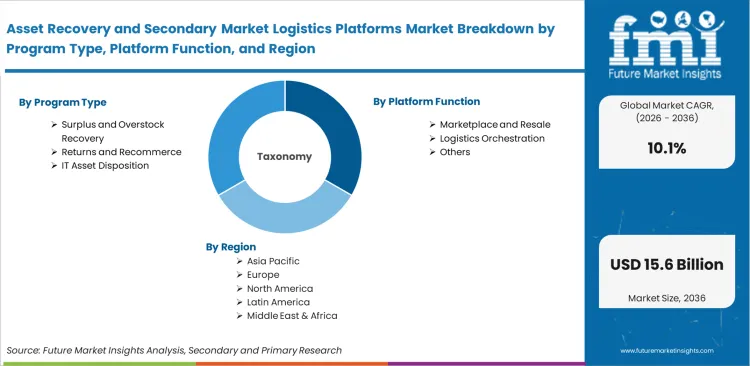
| Metric | Value |
|---|---|
| Quantitative Units | USD 5.4 billion to USD 14.1 billion, at a CAGR of 10.1% |
| Market Definition | Digital orchestration systems specifically designed for coordinating surplus inventory collection, condition grading, and final secondary market redistribution into unified financial workflows. Providers synchronize regional warehouse sorting, compliance tracking, and dynamic pricing algorithms globally. |
| Segmentation | Program Type, Platform Function, Asset Type, Collection Channel, End Use, Region |
| Regions Covered | North America, Latin America, Europe, Asia Pacific, Middle East and Africa |
| Countries Covered | United States, Canada, Brazil, Mexico, Germany, United Kingdom, France, Italy, Spain, China, Japan, India, South Korea, Australia, South Africa, United Arab Emirates |
| Key Companies Profiled | Liquidity Services, B-Stock, Iron Mountain, Ingram Micro Lifecycle, Assurant, Flex FreeFlow, Foxway |
| Forecast Period | 2026 to 2036 |
| Approach | Annual transportation and software spending allocations for surplus recovery among global enterprises anchored baseline valuations. |
Source: Future Market Insights (FMI) analysis, based on proprietary forecasting model and primary research
Asset Recovery and Secondary Market Logistics Platforms Market Analysis by Segments
Program Type
- Surplus and Overstock Recovery
- Returns and Recommerce
- IT Asset Disposition
- Lease Return Recovery
- Trade-In Recovery
Platform Function
- Marketplace and Resale Routing
- Logistics Orchestration
- Grading and Value Recovery
- Compliance and Chain of Custody
- Settlement and Reporting
Asset Type
- Consumer Electronics
- IT Equipment
- General Merchandise
- Industrial Assets
- Telecom Devices
Collection Channel
- Bulk B2B Recovery
- Retail Returns Intake
- Mail-In Recovery
- Store and Depot Collection
- Enterprise Pickup
End Use
- Retail and E-commerce
- Enterprises and ITAD
- Telecom and Mobile
- Manufacturing and Industrial
- Government and Public Sector
Region
- North America
- United States
- Canada
- Latin America
- Brazil
- Mexico
- Europe
- Germany
- United Kingdom
- France
- Italy
- Spain
- Asia Pacific
- China
- Japan
- India
- South Korea
- Australia
- Middle East and Africa
- South Africa
- United Arab Emirates
Bibliography
- Assurant. (2026, March). Assurant reports record $6.4 billion returned to consumers through device innovation and trade-in programs in 2025. Assurant.com
- Apple. (2025). Environmental progress report 2025. Apple
- B-Stock. (2026). Wholesale liquidators: Liquidation auctions for inventory resale. B-Stock Solutions
- Flex. (2025). FreeFlow, a Flex marketplace for inventory management. Flex
- GSMA. (2025, February). 70% of consumers are willing to pay a premium for environmentally friendly phones, finds new GSMA report. GSMA
Frequently Asked Questions
What is an asset recovery logistics platform?
Digital orchestration systems specifically designed coordinating surplus inventory collection, condition grading, and final secondary market redistribution into unified financial workflows form this sector. Providers synchronize regional warehouse sorting, compliance tracking, and dynamic pricing algorithms globally.
How do secondary market platforms work?
Engines determine optimal disposition pathways instantly upon warehouse receipt. Accelerated value matching combined with pre-qualified wholesale buyer networks routes aging inventory toward the highest bidding liquidation channels automatically based upon specific product condition codes.
Why are asset recovery platforms growing?
Supply chain directors face mounting pressure offloading massive volumes of aging inventory before depreciation destroys book value entirely. Decentralized supply networks compel retail directors to trace specific surplus merchandise accurately across scattered distribution centers avoiding expensive landfill disposal entirely.
How do retailers liquidate excess inventory?
E-commerce fulfillment directors push returned items through diagnostic sorting within twenty-four hours utilizing specialized algorithmic matching. Operations directors require processing engines connecting stranded goods directly with specialized buyers instantly upon intake confirmation.
What happens to recovered IT assets?
Facilities execute military-grade storage wiping procedures issuing cryptographic certificates for every processed handset. Consolidated logic bundles single corporate office cleanouts into profitable truckload shipments before moving inventory toward centralized grading locations for resale.
What is the asset recovery platform market size 2036?
Sales hits USD 14.13 billion by 2036. Sustained commercial pressures mandating strict electronic circular economy compliance drive permanent operational shifts toward decentralized hardware recovery logistics tracking systems globally.
What is total valuation in 2026?
Revenue reaches USD 5.40 billion during 2026. This metric signals structural confidence among global telecom operators and enterprise fleets decentralizing fragmented collection pipelines under unified third-party tracking dashboards preventing device depreciation.
What is projected CAGR?
Demand expands at 10.1% CAGR. Consistent double-digit volume increases across secondary electronics channels force brands adopting automated pricing tools preventing warehouse triage bottlenecks securely.
How does trade-in logistics programs management integrate with asset recovery?
Trade-in logistics forms a critical pillar within the broader asset recovery market. Specialized algorithms route consumer-surrendered devices directly into the same grading and valuation networks used for corporate ITAD, maximizing wholesale resale value rapidly.
Why does Surplus and Overstock Recovery lead the Program Type segment?
Business-to-business wholesale liquidators require immediate capital extraction from aging merchandise. Operations directors deploy algorithmic matching connecting stranded goods directly with specialized secondary buyers instantly upon intake confirmation avoiding financial losses.
Why does Marketplace and Resale Routing dominate Platform Functions?
Determining exact secondary wholesale worth dictates overall program profitability. Pricing directors push critical updates through dedicated cloud networks within twenty-four hours maximizing geographical coverage areas automatically based on condition codes.
Why do Consumer Electronics drive asset volume?
Massive global circulation drives unprecedented decentralized component recovery demand. Coordinating millions of independent device exchanges requires sophisticated fulfillment layers predicting specific regional part congestion accurately preventing theft.
Why does Bulk B2B Recovery lead the Collection Channel?
Enterprise asset rotation generates massive localized inbound freight flows. Consolidation logic bundles single corporate office cleanouts into profitable truckload shipments before moving inventory toward centralized grading bays effectively.
Which region presents fastest tracking growth?
India leads at 11.9% CAGR driven by aggressive domestic manufacturing mandates creating massive new regional asset liquidation tracking liabilities. Supply chain directors scramble implementing digital systems locally.
How does China approach recovery tracking?
Massive consumer electronics recycling targets dictate strict tracking requirements. Integrating modern sorting tools secures preferential municipal recycling subsidies rapidly deploying precise tracking software locally.
How do European sustainability laws impact software demand?
Mandatory tracking indices force brands providing standardized salvage access globally. Strict industrial service level agreements force exact component tracking operations avoiding massive compliance penalties.
What friction slows universal warehouse adoption?
Independent driver networks resent navigating clunky web interfaces disrupting normal physical material handling rhythms. Developers design poor keyboard entry interfaces rather than mobile-first barcode scanning systems causing low compliance.
Why does secondary liquidation fail often?
Subjective human evaluation drives massive profit leakage during visual grading. Disjointed reporting environments hide poor inventory utilization behind confusing dealer-specific spreadsheet formats destroying potential resale value.
What limits retail seasonal value recovery?
Sluggish processing cycles leave distribution centers holding aging surplus inventory facing steep financial markdowns regarding missed resale windows. Disconnected staging synchronization creates severe customer fulfillment issues.
How do predictive routing algorithms function?
Systems automatically compile failure probability metrics shifting inventory toward high-risk locations proactively. Software identifies nearest available certified drivers matching specific weight capacity requirements automatically reducing transit durations significantly.
Why do procurement directors separate software contracts?
Global procurement directors resist vendor lock-in demanding open architectures universally. Large brands force competing software vendors collaborating within single corporate environments preventing any single provider dictating absolute terms unconditionally.
What hidden costs impact carrier aggregation?
Rigidly forcing small independent sorting facilities into complex enterprise visibility portals increases package loss rates. Ignoring local service station workflow realities blinds central planners causing severe invoice reconciliation failures eventually.
How does access integration improve partner security?
Service providers grant certified couriers secure entry into unmanned forward stocking locations constantly. Facility managers guarantee component availability regardless regarding traditional business operating hours securely.
What prevents pure visibility platform success?
Companies deploying pure parcel delivery fail repeatedly because routing teams ignore complex installation constraints during peak failure surges. Genuine efficiency demands dispatch designs matching fast-paced industrial repair realities physically.
Why does manual condition grading fail?
Platforms convert subjective inspector observations into standardized digital codes resolving human inconsistency. Manual return tracking slows refurbishment cycles causing massive spare parts shortages globally.
Preview the report firsthand - request a free sample
Get SampleGet the brochure for pricing and purchase details.
Get PDFTable of Content
- Executive Summary
- Global Market Outlook
- Demand-side Trends
- Supply-side Trends
- Technology Roadmap Analysis
- Analysis and Recommendations
- Market Overview
- Market Coverage / Taxonomy
- Market Definition / Scope / Limitations
- Research Methodology
- Chapter Orientation
- Analytical Lens and Working Hypotheses
- Market Structure, Signals, and Trend Drivers
- Benchmarking and Cross-market Comparability
- Market Sizing, Forecasting, and Opportunity Mapping
- Research Design and Evidence Framework
- Desk Research Programme (Secondary Evidence)
- Company Annual and Sustainability Reports
- Peer-reviewed Journals and Academic Literature
- Corporate Websites, Product Literature, and Technical Notes
- Earnings Decks and Investor Briefings
- Statutory Filings and Regulatory Disclosures
- Technical White Papers and Standards Notes
- Trade Journals, Industry Magazines, and Analyst Briefs
- Conference Proceedings, Webinars, and Seminar Materials
- Government Statistics Portals and Public Data Releases
- Press Releases and Reputable Media Coverage
- Specialist Newsletters and Curated Briefings
- Sector Databases and Reference Repositories
- FMI Internal Proprietary Databases and Historical Market Datasets
- Subscription Datasets and Paid Sources
- Social Channels, Communities, and Digital Listening Inputs
- Additional Desk Sources
- Expert Input and Fieldwork (Primary Evidence)
- Primary Modes
- Qualitative Interviews and Expert Elicitation
- Quantitative Surveys and Structured Data Capture
- Blended Approach
- Why Primary Evidence is Used
- Field Techniques
- Interviews
- Surveys
- Focus Groups
- Observational and In-context Research
- Social and Community Interactions
- Stakeholder Universe Engaged
- C-suite Leaders
- Board Members
- Presidents and Vice Presidents
- R&D and Innovation Heads
- Technical Specialists
- Domain Subject-matter Experts
- Scientists
- Physicians and Other Healthcare Professionals
- Governance, Ethics, and Data Stewardship
- Research Ethics
- Data Integrity and Handling
- Primary Modes
- Tooling, Models, and Reference Databases
- Desk Research Programme (Secondary Evidence)
- Data Engineering and Model Build
- Data Acquisition and Ingestion
- Cleaning, Normalisation, and Verification
- Synthesis, Triangulation, and Analysis
- Quality Assurance and Audit Trail
- Market Background
- Market Dynamics
- Drivers
- Restraints
- Opportunity
- Trends
- Scenario Forecast
- Demand in Optimistic Scenario
- Demand in Likely Scenario
- Demand in Conservative Scenario
- Opportunity Map Analysis
- Product Life Cycle Analysis
- Supply Chain Analysis
- Investment Feasibility Matrix
- Value Chain Analysis
- PESTLE and Porter’s Analysis
- Regulatory Landscape
- Regional Parent Market Outlook
- Production and Consumption Statistics
- Import and Export Statistics
- Market Dynamics
- Global Market Analysis 2021 to 2025 and Forecast, 2026 to 2036
- Historical Market Size Value (USD Million) Analysis, 2021 to 2025
- Current and Future Market Size Value (USD Million) Projections, 2026 to 2036
- Y-o-Y Growth Trend Analysis
- Absolute $ Opportunity Analysis
- Global Market Pricing Analysis 2021 to 2025 and Forecast 2026 to 2036
- Global Market Analysis 2021 to 2025 and Forecast 2026 to 2036, By Program Type
- Introduction / Key Findings
- Historical Market Size Value (USD Million) Analysis By Program Type , 2021 to 2025
- Current and Future Market Size Value (USD Million) Analysis and Forecast By Program Type , 2026 to 2036
- Surplus and Overstock Recovery
- Returns and Recommerce
- IT Asset Disposition
- Surplus and Overstock Recovery
- Y-o-Y Growth Trend Analysis By Program Type , 2021 to 2025
- Absolute $ Opportunity Analysis By Program Type , 2026 to 2036
- Global Market Analysis 2021 to 2025 and Forecast 2026 to 2036, By Platform Function
- Introduction / Key Findings
- Historical Market Size Value (USD Million) Analysis By Platform Function, 2021 to 2025
- Current and Future Market Size Value (USD Million) Analysis and Forecast By Platform Function, 2026 to 2036
- Marketplace and Resale
- Logistics Orchestration
- Others
- Marketplace and Resale
- Y-o-Y Growth Trend Analysis By Platform Function, 2021 to 2025
- Absolute $ Opportunity Analysis By Platform Function, 2026 to 2036
- Global Market Analysis 2021 to 2025 and Forecast 2026 to 2036, By Asset Type
- Introduction / Key Findings
- Historical Market Size Value (USD Million) Analysis By Asset Type, 2021 to 2025
- Current and Future Market Size Value (USD Million) Analysis and Forecast By Asset Type, 2026 to 2036
- Consumer Electronics
- IT Equipment
- Others
- Consumer Electronics
- Y-o-Y Growth Trend Analysis By Asset Type, 2021 to 2025
- Absolute $ Opportunity Analysis By Asset Type, 2026 to 2036
- Global Market Analysis 2021 to 2025 and Forecast 2026 to 2036, By Collection Channel
- Introduction / Key Findings
- Historical Market Size Value (USD Million) Analysis By Collection Channel, 2021 to 2025
- Current and Future Market Size Value (USD Million) Analysis and Forecast By Collection Channel, 2026 to 2036
- Bulk B2B Recovery
- Retail Returns Intake
- Others
- Bulk B2B Recovery
- Y-o-Y Growth Trend Analysis By Collection Channel, 2021 to 2025
- Absolute $ Opportunity Analysis By Collection Channel, 2026 to 2036
- Global Market Analysis 2021 to 2025 and Forecast 2026 to 2036, By End Use
- Introduction / Key Findings
- Historical Market Size Value (USD Million) Analysis By End Use, 2021 to 2025
- Current and Future Market Size Value (USD Million) Analysis and Forecast By End Use, 2026 to 2036
- Retail and E-Commerce
- Enterprises and ITAD
- Others
- Retail and E-Commerce
- Y-o-Y Growth Trend Analysis By End Use, 2021 to 2025
- Absolute $ Opportunity Analysis By End Use, 2026 to 2036
- Global Market Analysis 2021 to 2025 and Forecast 2026 to 2036, By Region
- Introduction
- Historical Market Size Value (USD Million) Analysis By Region, 2021 to 2025
- Current Market Size Value (USD Million) Analysis and Forecast By Region, 2026 to 2036
- North America
- Latin America
- Western Europe
- Eastern Europe
- East Asia
- South Asia and Pacific
- Middle East & Africa
- Market Attractiveness Analysis By Region
- North America Market Analysis 2021 to 2025 and Forecast 2026 to 2036, By Country
- Historical Market Size Value (USD Million) Trend Analysis By Market Taxonomy, 2021 to 2025
- Market Size Value (USD Million) Forecast By Market Taxonomy, 2026 to 2036
- By Country
- USA
- Canada
- Mexico
- By Program Type
- By Platform Function
- By Asset Type
- By Collection Channel
- By End Use
- By Country
- Market Attractiveness Analysis
- By Country
- By Program Type
- By Platform Function
- By Asset Type
- By Collection Channel
- By End Use
- Key Takeaways
- Latin America Market Analysis 2021 to 2025 and Forecast 2026 to 2036, By Country
- Historical Market Size Value (USD Million) Trend Analysis By Market Taxonomy, 2021 to 2025
- Market Size Value (USD Million) Forecast By Market Taxonomy, 2026 to 2036
- By Country
- Brazil
- Chile
- Rest of Latin America
- By Program Type
- By Platform Function
- By Asset Type
- By Collection Channel
- By End Use
- By Country
- Market Attractiveness Analysis
- By Country
- By Program Type
- By Platform Function
- By Asset Type
- By Collection Channel
- By End Use
- Key Takeaways
- Western Europe Market Analysis 2021 to 2025 and Forecast 2026 to 2036, By Country
- Historical Market Size Value (USD Million) Trend Analysis By Market Taxonomy, 2021 to 2025
- Market Size Value (USD Million) Forecast By Market Taxonomy, 2026 to 2036
- By Country
- Germany
- UK
- Italy
- Spain
- France
- Nordic
- BENELUX
- Rest of Western Europe
- By Program Type
- By Platform Function
- By Asset Type
- By Collection Channel
- By End Use
- By Country
- Market Attractiveness Analysis
- By Country
- By Program Type
- By Platform Function
- By Asset Type
- By Collection Channel
- By End Use
- Key Takeaways
- Eastern Europe Market Analysis 2021 to 2025 and Forecast 2026 to 2036, By Country
- Historical Market Size Value (USD Million) Trend Analysis By Market Taxonomy, 2021 to 2025
- Market Size Value (USD Million) Forecast By Market Taxonomy, 2026 to 2036
- By Country
- Russia
- Poland
- Hungary
- Balkan & Baltic
- Rest of Eastern Europe
- By Program Type
- By Platform Function
- By Asset Type
- By Collection Channel
- By End Use
- By Country
- Market Attractiveness Analysis
- By Country
- By Program Type
- By Platform Function
- By Asset Type
- By Collection Channel
- By End Use
- Key Takeaways
- East Asia Market Analysis 2021 to 2025 and Forecast 2026 to 2036, By Country
- Historical Market Size Value (USD Million) Trend Analysis By Market Taxonomy, 2021 to 2025
- Market Size Value (USD Million) Forecast By Market Taxonomy, 2026 to 2036
- By Country
- China
- Japan
- South Korea
- By Program Type
- By Platform Function
- By Asset Type
- By Collection Channel
- By End Use
- By Country
- Market Attractiveness Analysis
- By Country
- By Program Type
- By Platform Function
- By Asset Type
- By Collection Channel
- By End Use
- Key Takeaways
- South Asia and Pacific Market Analysis 2021 to 2025 and Forecast 2026 to 2036, By Country
- Historical Market Size Value (USD Million) Trend Analysis By Market Taxonomy, 2021 to 2025
- Market Size Value (USD Million) Forecast By Market Taxonomy, 2026 to 2036
- By Country
- India
- ASEAN
- Australia & New Zealand
- Rest of South Asia and Pacific
- By Program Type
- By Platform Function
- By Asset Type
- By Collection Channel
- By End Use
- By Country
- Market Attractiveness Analysis
- By Country
- By Program Type
- By Platform Function
- By Asset Type
- By Collection Channel
- By End Use
- Key Takeaways
- Middle East & Africa Market Analysis 2021 to 2025 and Forecast 2026 to 2036, By Country
- Historical Market Size Value (USD Million) Trend Analysis By Market Taxonomy, 2021 to 2025
- Market Size Value (USD Million) Forecast By Market Taxonomy, 2026 to 2036
- By Country
- Kingdom of Saudi Arabia
- Other GCC Countries
- Turkiye
- South Africa
- Other African Union
- Rest of Middle East & Africa
- By Program Type
- By Platform Function
- By Asset Type
- By Collection Channel
- By End Use
- By Country
- Market Attractiveness Analysis
- By Country
- By Program Type
- By Platform Function
- By Asset Type
- By Collection Channel
- By End Use
- Key Takeaways
- Key Countries Market Analysis
- USA
- Pricing Analysis
- Market Share Analysis, 2025
- By Program Type
- By Platform Function
- By Asset Type
- By Collection Channel
- By End Use
- Canada
- Pricing Analysis
- Market Share Analysis, 2025
- By Program Type
- By Platform Function
- By Asset Type
- By Collection Channel
- By End Use
- Mexico
- Pricing Analysis
- Market Share Analysis, 2025
- By Program Type
- By Platform Function
- By Asset Type
- By Collection Channel
- By End Use
- Brazil
- Pricing Analysis
- Market Share Analysis, 2025
- By Program Type
- By Platform Function
- By Asset Type
- By Collection Channel
- By End Use
- Chile
- Pricing Analysis
- Market Share Analysis, 2025
- By Program Type
- By Platform Function
- By Asset Type
- By Collection Channel
- By End Use
- Germany
- Pricing Analysis
- Market Share Analysis, 2025
- By Program Type
- By Platform Function
- By Asset Type
- By Collection Channel
- By End Use
- UK
- Pricing Analysis
- Market Share Analysis, 2025
- By Program Type
- By Platform Function
- By Asset Type
- By Collection Channel
- By End Use
- Italy
- Pricing Analysis
- Market Share Analysis, 2025
- By Program Type
- By Platform Function
- By Asset Type
- By Collection Channel
- By End Use
- Spain
- Pricing Analysis
- Market Share Analysis, 2025
- By Program Type
- By Platform Function
- By Asset Type
- By Collection Channel
- By End Use
- France
- Pricing Analysis
- Market Share Analysis, 2025
- By Program Type
- By Platform Function
- By Asset Type
- By Collection Channel
- By End Use
- India
- Pricing Analysis
- Market Share Analysis, 2025
- By Program Type
- By Platform Function
- By Asset Type
- By Collection Channel
- By End Use
- ASEAN
- Pricing Analysis
- Market Share Analysis, 2025
- By Program Type
- By Platform Function
- By Asset Type
- By Collection Channel
- By End Use
- Australia & New Zealand
- Pricing Analysis
- Market Share Analysis, 2025
- By Program Type
- By Platform Function
- By Asset Type
- By Collection Channel
- By End Use
- China
- Pricing Analysis
- Market Share Analysis, 2025
- By Program Type
- By Platform Function
- By Asset Type
- By Collection Channel
- By End Use
- Japan
- Pricing Analysis
- Market Share Analysis, 2025
- By Program Type
- By Platform Function
- By Asset Type
- By Collection Channel
- By End Use
- South Korea
- Pricing Analysis
- Market Share Analysis, 2025
- By Program Type
- By Platform Function
- By Asset Type
- By Collection Channel
- By End Use
- Russia
- Pricing Analysis
- Market Share Analysis, 2025
- By Program Type
- By Platform Function
- By Asset Type
- By Collection Channel
- By End Use
- Poland
- Pricing Analysis
- Market Share Analysis, 2025
- By Program Type
- By Platform Function
- By Asset Type
- By Collection Channel
- By End Use
- Hungary
- Pricing Analysis
- Market Share Analysis, 2025
- By Program Type
- By Platform Function
- By Asset Type
- By Collection Channel
- By End Use
- Kingdom of Saudi Arabia
- Pricing Analysis
- Market Share Analysis, 2025
- By Program Type
- By Platform Function
- By Asset Type
- By Collection Channel
- By End Use
- Turkiye
- Pricing Analysis
- Market Share Analysis, 2025
- By Program Type
- By Platform Function
- By Asset Type
- By Collection Channel
- By End Use
- South Africa
- Pricing Analysis
- Market Share Analysis, 2025
- By Program Type
- By Platform Function
- By Asset Type
- By Collection Channel
- By End Use
- USA
- Market Structure Analysis
- Competition Dashboard
- Competition Benchmarking
- Market Share Analysis of Top Players
- By Regional
- By Program Type
- By Platform Function
- By Asset Type
- By Collection Channel
- By End Use
- Competition Analysis
- Competition Deep Dive
- Liquidity Services
- Overview
- Product Portfolio
- Profitability by Market Segments (Product/Age /Sales Channel/Region)
- Sales Footprint
- Strategy Overview
- Marketing Strategy
- Product Strategy
- Channel Strategy
- B-Stock
- Iron Mountain
- Ingram Micro Lifecycle
- Assurant
- Flex FreeFlow
- Foxway
- Liquidity Services
- Competition Deep Dive
- Assumptions & Acronyms Used


