

- Industry Size (2026)
- USD 950.0 Mn
- Forecast (2036)
- USD 2290.0 Mn
- CAGR (2026 to 2036)
- 9.2%
Refurbishment and Repair Logistics Orchestration Platforms Market Size, Market Forecast and Outlook By FMI
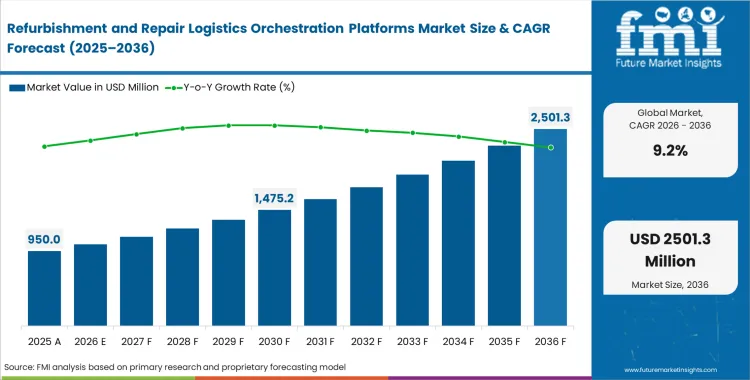
The refurbishment and repair logistics orchestration platforms market was valued at USD 870.0 million in 2025. Valuation is poised to surpass USD 950.0 million in 2026 at a CAGR of 9.2% during forecasting periods. Total market opportunity is projected to reach USD 2,290.0 million through 2036 as OEM service arms prioritize centralizing fragmented third-party repair networks into unified visibility systems using advanced repair orchestration software.
Summary of Refurbishment and Repair Logistics Orchestration Platforms Market
- Market Snapshot
- The refurbishment and repair logistics orchestration platforms market was valued at USD 870 million in 2025 and is projected to reach USD 2,290.0 million by 2036.
- The industry is expected to grow at a 9.2% CAGR from 2026 to 2036, creating a stable incremental opportunity.
- This market covers software platforms that coordinate returns routing, repair RMAs, depot repair, parts visibility, refurbishment disposition, and multi-party logistics across OEMs, retailers, 3PLs, and service depots.
- The category is shaped by rising returns complexity, tighter repair-policy frameworks, and higher pressure to recover asset value instead of writing returned units off.
- Demand and Growth Drivers
- Demand is increasing as retail and e-commerce operators handle larger return volumes, placing sustained pressure on returns processing, repair coordination, and reverse logistics systems.
- Repair orchestration tools are seeing higher budget allocation following the EU’s repair directive adopted on June 13, 2024, with member states required to implement national rules from July 31, 2026, driving more structured repair workflows and standardized repair-information handling.
- Refurbishment-linked workflows are gaining importance as global e-waste generation continues to outpace documented recycling, increasing the need to extend product lifecycles through reuse and refurbishment, as highlighted in the Global E-waste Monitor 2024.
- India is projected to lead with an 11.4% CAGR, followed by China at 10.3%, the United Kingdom at 9.1%, Germany at 8.9%, the United States at 8.5%, France at 8.3%, and Japan at 7.6%, reflecting region-specific regulatory and operational drivers.
- Growth remains constrained by long enterprise sales cycles, integration complexity across ERP, WMS, service, and carrier systems, and continued reliance on disconnected legacy tools for returns and repair processes.
- Product and Segment View
- The market covers orchestration software deployed primarily through cloud or hybrid models that connect RMAs, depot repair operations, parts planning, claims handling, and disposition decisions across reverse logistics networks.
- These platforms are applied across consumer electronics, appliances, industrial equipment, medical devices, and telecom hardware where returned assets require repair, refurbishment, replacement, or controlled resale.
- Cloud SaaS is expected to account for 68.0% share in the Deployment segment in 2026, supported by faster implementation cycles, API-led integrations, and improved visibility across distributed repair networks.
- The returns routing workflow is projected to hold 31.0% share in 2026, as disposition speed directly determines whether units are repaired, restocked, replaced, or scrapped. This step remains central to cost control and turnaround efficiency.
- Electronics is anticipated to capture 39.0% share in the Asset Type segment in 2026, driven by high return frequency, recurring warranty events, and strong refurbishment potential. This creates sustained demand for orchestration.
- Large enterprises are expected to represent 46.0% share in the Buyer Type segment in 2026, reflecting their complex carrier, service center, and ERP integration environments. Their scale increases the need for centralized control layers.
- Consumer electronics is set to account for 34.0% share in the End Use segment in 2026 due to dense return volumes, active secondary channels, and stronger residual value recovery. This segment continues to anchor platform adoption.
- The scope includes returns orchestration, repair RMAs, depot repair control, refurbishment routing, parts and status visibility, and vendor coordination, while excluding pure parcel delivery, stand-alone repair labor without a platform layer, and generic warehouse systems that lack reverse and repair workflow capabilities.
- Geography and Competitive Outlook
- India and China are expected to record the fastest growth, while the United States continues to represent the largest near-term demand base due to high return volumes and established enterprise software spending.
- Competition is shaped by large supply chain and service software providers expanding into returns and repair capabilities, while specialized vendors compete through faster deployment, stronger returns analytics, and refurbishment-focused workflows.
- Oracle, SAP, ServiceNow, Blue Yonder, ReverseLogix, Global Blue, and Infor remain key participants, with Oracle estimated to hold the strongest share as its service logistics stack already integrates depot repair, service requests, and return execution within a unified environment.
- The market remains moderately fragmented, with the leading vendor projected to account for 14.0% share, as buyers continue to choose between suite providers offering deeper integration and specialists focused on faster reverse process transformation.
Network managers responsible for aftersales operations face rising pressure to maintain traceability of serialized components once they move beyond authorized facilities, while procurement teams risk losing visibility over parts sent for repair as soon as they exit primary warehouse control. FMI’s assessment indicates a clear shift toward integrated reverse logistics orchestration software that connects legacy systems with field technicians to maintain continuity across fragmented service workflows. Operations leaders must evaluate whether to invest in custom integrations, which add cost, time, and maintenance burden, or adopt specialized service lifecycle platforms that enable faster standardization. Delayed implementation tends to surface as reconciliation challenges, particularly during end-of-quarter warranty audits where data gaps become difficult to resolve. Many organizations assume returns and repair management software closes visibility gaps, yet centralized data alone is insufficient without consistent and standardized technician updates at the depot level to ensure accuracy across the service chain.
Warranty administrators who initiate repair RMA automation at the point of first failure ticket creation can significantly improve SLA adherence by eliminating early-stage delays, while a dedicated reverse logistics disposition engine removes the need for manual triage and keeps workflows moving without interruption. Faster technician dispatch, supported by pre-positioned spare boards, compresses repair cycles from weeks to a matter of days, improving service turnaround and asset availability. Return logistics managers begin to see measurable margin improvement once multi-party repair logistics platforms stabilize, as coordination inefficiencies reduce and process consistency improves across stakeholders.
India is set to record the fastest expansion, with demand rising at a CAGR of 11.4% as local manufacturing mandates push companies toward tighter, centralized component tracking systems. China follows with a 10.3% CAGR, supported by large-scale consumer electronics recycling targets that require structured refurbishment and recovery processes. The United Kingdom is projected to grow at 9.1%, while Germany advances at 8.9%, both shaped by strict compliance frameworks that increase reliance on specialized right-to-repair software. The United States is expected to expand at 8.5% as tier-one retailers consolidate regional return centers to improve operational control and turnaround times. France is likely to see 8.3% CAGR, supported by repairability index regulations that formalize product lifecycle transparency. Japan registers comparatively steady growth at 7.6%, with demand anchored in optimizing maintenance workflows for legacy industrial equipment. These regional differences reflect how electronic waste regulations and policy frameworks directly influence investment priorities in refurbishment and repair workflow automation.
Segmental Analysis
Refurbishment and Repair Logistics Orchestration Platforms Market Analysis by Deployment
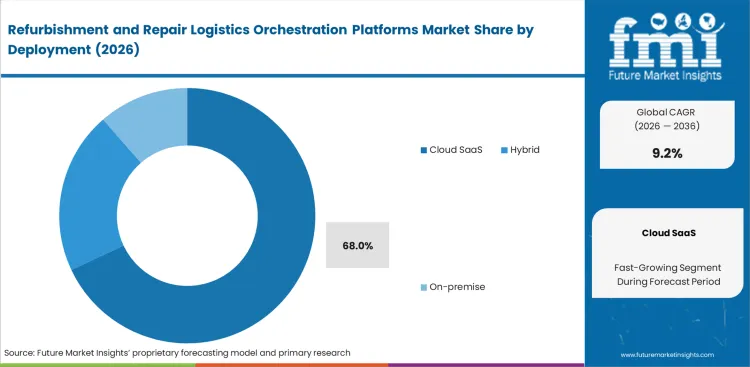
Cloud SaaS is expected to hold 68.0% share in 2026, as external API calls process significantly faster outside rigid corporate firewalls. IT security directors demand isolated environments when granting inventory access to independent technicians using modern depot repair software. Centralized platforms allow immediate disposition policy updates globally without requiring manual server patches. Hardware procurement managers evaluate refurbished laptop channels prioritizing solutions minimizing upfront server capital expenditures. What software implementation teams rarely mention is how public cloud architectures expose localized internet connectivity vulnerabilities during rural technician field visits.
- API bridge capability: Cloud environments process real-time status updates from fragmented diagnostic machines instantly. IT security directors avoid opening internal firewalls directly. Isolation allows safe collaboration across unauthorized shops.
- Policy deployment speed: Centralized administration pushes new return triage logic globally overnight. Warranty managers update diagnostic flowcharts instantly without requiring local IT intervention. Delaying policy updates causes massive misrouting during sudden product recall events.
- Authentication layer integration: Modern platforms sync directly with external identity providers managing temporary technician credentials. Compliance officers monitor exact file access logs easily. Weak authentication frameworks expose sensitive customer diagnostic data during prolonged teardown procedures.
Refurbishment and Repair Logistics Orchestration Platforms Market Analysis by Workflow
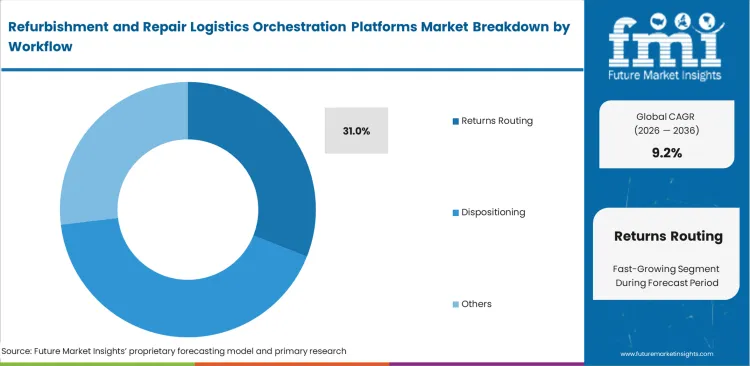
Speeding customer refunds often conflicts with the need for proper failure analysis, creating a trade-off between customer experience and operational control. Automated returns routing addresses this by evaluating product value against estimated repair costs at the point of return initiation, allowing faster and more accurate disposition decisions. Logistics teams rules that divert low-value electronics toward local recycling streams instead of routing them through high-cost centralized repair facilities. Returns routing is set to garner 31.0% share in 2026, reflecting its central role in controlling cost, speed, and asset recovery outcomes. Smart routing also limits unnecessary cross-country shipping by filtering out items identified as unrepairable during the initial customer interaction. Shipping coordinators often underestimate how small dimensional weight errors in return portals can erode freight margin assumptions, especially at scale. Weak routing logic and poor data accuracy lead to warehouses filling with low-value, unsalvageable hardware that adds handling cost without recovery upside.
- Algorithmic triage gates: Smart portals evaluate customer symptoms before generating return labels. Customer service directors deflect unnecessary shipping costs offering immediate remote troubleshooting. Failed deflection attempts trigger specific diagnostic codes routing hardware toward specialized benches.
- Proximity matching logic: Software identifies nearest certified technicians matching specific product skill requirements automatically. Field service managers minimize travel durations significantly. Sending unqualified personnel increases customer escalation rates while reducing efficiency.
- Carrier integration layers: Platforms query multiple freight providers comparing dynamic return shipping rates continuously. Transportation directors select optimal transit modes balancing speed against salvage value. Relying upon single carrier contracts increases operational costs.
Refurbishment and Repair Logistics Orchestration Platforms Market Analysis by Asset Type
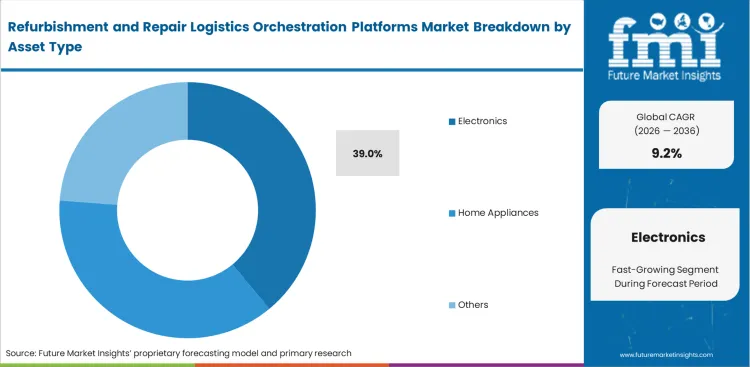
Component salvage operations require precise serialized tracking workflows. Electronics is projected to capture 39.0% share in 2026. High-margin internal components justify complex reverse supply chain investments. Operations managers prioritize extracting valuable microprocessors before recycling entire laptop chassis. Detailed teardown instructions delivered directly to technician tablets prevent accidental component destruction during disassembly. Facility directors measure software ROI entirely upon successful salvage rates rather than processing speed. What electronic recycling managers ignore during initial deployment is severe database latency when updating thousands of individual serial numbers simultaneously. Failing to capture exact component revisions renders extracted parts totally unsellable across secondary markets.
- Micro-component extraction: Consumer electronics repair logistics software mandates specific barcode scanning sequences during hardware disassembly. Inventory clerks guarantee exact component origin documentation. Missing traceability links force complete batch rejection during secondary buyer audits.
- Value depreciation tracking: Valuation algorithms downgrade asset worth daily based upon secondary pricing feeds. Remarketing directors adjust salvage strategies dynamically avoiding stagnant warehouse inventory. Ignoring real-time depreciation converts valuable assets into worthless e-waste within months.
- Compliance documentation limits: Systems automatically generate disposal certificates matching local regulatory requirements. Compliance officers satisfy random government audits immediately. Missing disposal records trigger massive municipal fines across regulated territories.
Refurbishment and Repair Logistics Orchestration Platforms Market Analysis by Buyer Type
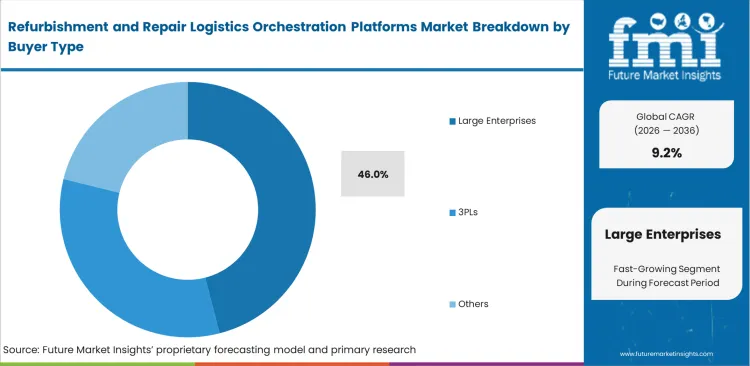
Significant warranty volumes require industrial-grade capabilities, particularly for original equipment manufacturers managing hundreds of independent regional repair centers. Vendor management teams address this by implementing unified portals that enforce standardized diagnostic checklists across geographies, improving consistency and accountability. Centralized depot repair oversight helps prevent unauthorized billing practices and limits cost leakage from non-compliant service partners. Financial controllers benefit from automated cost-per-repair tracking, which improves budgeting accuracy and vendor performance evaluation. Enterprise procurement teams often overlook the operational impact of forcing smaller local repair shops into rigid portal, which can increase technician attrition and reduce service capacity. Misalignment with local workflow realities continues to strain relationships with skilled independent contractors. Large enterprises are likely to represent 46.0% share in 2026, reflecting their scale and need for structured orchestration systems.
- Volume consolidation power: Enterprise systems aggregate repair data predicting regional component failure rates accurately. Supply chain planners pre-position spare parts near emerging failure clusters. Ignoring predictive analytics causes severe local part shortages driving massive SLA penalties.
- Multi-vendor standardization: Dashboards force competing providers following identical protocols. Service quality directors compare vendor performance metrics apples-to-apples. Disjointed reporting environments hide poor yields behind confusing vendor-specific spreadsheet formats.
- Financial reconciliation automation: Software matches invoices directly against verified diagnostic logs. Accounts payable managers process vendor payments without manual line-item reviews. Unverified invoice processing creates significant revenue leakage through unchecked claims.
Refurbishment and Repair Logistics Orchestration Platforms Market Analysis by End Use
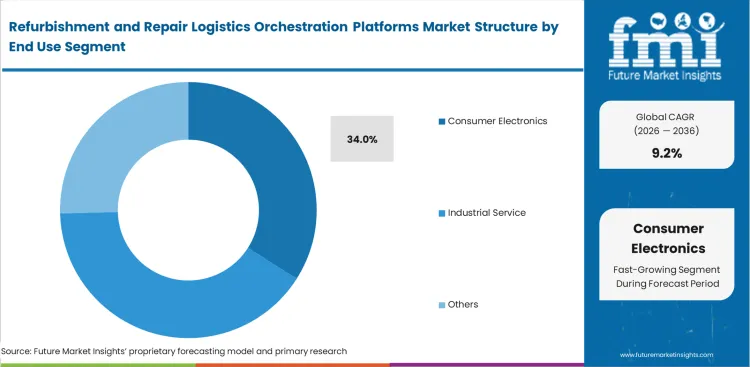
Consumer electronics is poised to account for 34.0% share in 2026. Rapid product cycles in consumer electronics compress refurbishment windows, limiting the time available to recover value from returned devices. Refurbished retail teams prioritize pushing smartphones through diagnostic testing within tight timelines to preserve resale potential, while automated testing replaces manual inspection to improve throughput and consistency. E-commerce fulfillment teams depend on real-time inventory updates once devices clear final quality checks, enabling faster resale and stock rotation. Brand protection teams remain cautious about risks such as unauthorized software flashing during third-party servicing, which can quietly impact product integrity and customer trust. Delays in processing leave warehouses holding aging inventory that quickly loses value and requires markdowns.
- Rapid triage requirement: Retail reverse logistics software guides initial warehouse receiving clerks through binary condition checklists instantly. Receiving supervisors separate pristine returns from damaged units immediately. Commingling mixed-condition inventory degrades downstream routing efficiency.
- Automated diagnostic wiping: Systems interface directly with specialized hardware securely wiping previous user data automatically. Privacy compliance officers guarantee zero data leakage incidents. Manual wiping protocols increase exposure to consumer privacy liabilities.
- Secondary channel routing: Software posts refurbished inventory directly onto diverse online marketplaces simultaneously. Remarketing directors maximize channel exposure without risking double-selling single units. Disconnected sales channels create severe customer satisfaction issues when synchronizations fail.
Refurbishment and Repair Logistics Orchestration Platforms Market Drivers, Restraints, and Opportunities
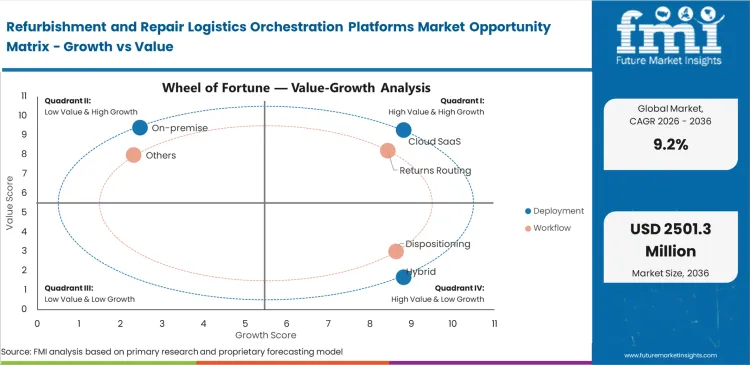
Margin preservation targets are pushing e-commerce return leaders to implement automated triage at the earliest stage of the return cycle, as manual processing drives up labor costs and delays resale opportunities. Unsorted inventory accumulates quickly when modernization is delayed, reducing recovery value as products depreciate on warehouse shelves. Financial controllers recognize that legacy systems do not provide component-level visibility into salvage economics, limiting their ability to track true repair and recovery profitability without dedicated reverse logistics and repair platforms.
Adoption challenges remain at the execution level, where technician-facing portals slow implementation due to poor usability. Independent repair shops often resist navigating complex web interfaces that disrupt hands-on workflows at the workbench. Software design decisions frequently overlook real-world technician constraints, particularly around data entry in fast-paced repair environments. Compliance improves only when systems shift toward mobile-first interfaces with barcode scanning and minimal manual input, aligning better with how technicians actually operate.
Opportunities in the Refurbishment and Repair Logistics Orchestration Platforms Market
- Direct consumer part ordering: Integrating self-service diagnostic tools empowering end-users directly. Customer experience directors lower support call volumes significantly. Providing incorrect parts frustrates consumers driving negative brand perception.
- Predictive failure routing: Artificial intelligence matching product telemetry against historical data. Operations managers route failing units toward specialized facilities before critical breakdowns occur. Ignoring predictive signals guarantees expensive emergency field deployments.
- Right to repair service networks expansion: Certifying independent shops capturing massive out-of-warranty revenue. Network development directors expand geographic coverage without capital expenditure. Poorly vetted partners damage OEM brand equity through substandard quality.
Regional Analysis
Based on regional analysis, Refurbishment and Repair Logistics Orchestration Platforms Market is segmented into North America, Europe, and Asia Pacific across 40 plus countries.
.webp "Top Country Growth Comparison Refurbishment And Repair Logistics Orchestration Platforms Market Cagr (2026 2036)")
| Country | CAGR (2026 to 2036) |
|---|---|
| India | 11.4% |
| China | 10.3% |
| United Kingdom | 9.1% |
| Germany | 8.9% |
| United States | 8.5% |
| France | 8.3% |
| Japan | 7.6% |
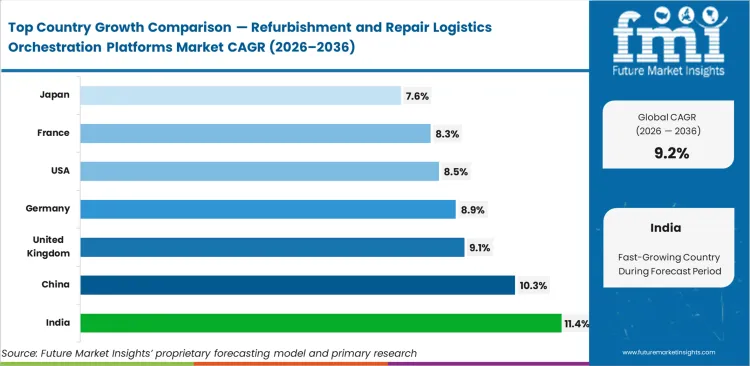
Source: Future Market Insights (FMI) analysis, based on proprietary forecasting model and primary research
Asia Pacific Refurbishment and Repair Logistics Orchestration Platforms Market Analysis
Manufacturing scale across Asia Pacific is shifting responsibility for warranty, repair, and recycling within domestic borders. Electronics production hubs are integrating post-sale service tracking into core supply chain systems to reduce financial exposure from untracked failures. Policy enforcement on recycling and material recovery is increasing, requiring precise tracking of components across fragmented service networks. Infrastructure gaps across rural and urban regions require centralized orchestration platforms to connect OEMs, service providers, and recyclers within a unified system.
- India: Demand in India is anticipated to rise at a CAGR of 11.4% during 2026 to 2036 in the refurbishment and repair logistics orchestration platforms market. Government-led manufacturing initiatives require full lifecycle traceability across domestically produced goods. Warranty tracking is being integrated with field service systems to align with public procurement requirements. Companies lacking visibility across repair cycles face exclusion from large contracts, making platform adoption essential for compliance and operational continuity.
- China: Significant consumer electronics recycling targets dictate strict tracking. Sustainability compliance officers deploy platforms verifying precise material salvage rates accurately. China is projected to witness 10.3% CAGR in this sector through 2036. Companies achieving early compliance secure preferential municipal recycling subsidies rapidly.
- Japan: Legacy infrastructure continues to shape adoption patterns in Japan. The refurbishment and repair logistics orchestration platforms market is moving at a CAGR of 7.6% through 2036, supported by efforts to digitize long-standing repair workflows. Companies are converting manual service knowledge into structured digital systems to maintain continuity amid workforce aging. Platform deployment focuses on improving technician efficiency and preserving institutional expertise across distributed service networks.
Europe Refurbishment and Repair Logistics Orchestration Platforms Market Analysis
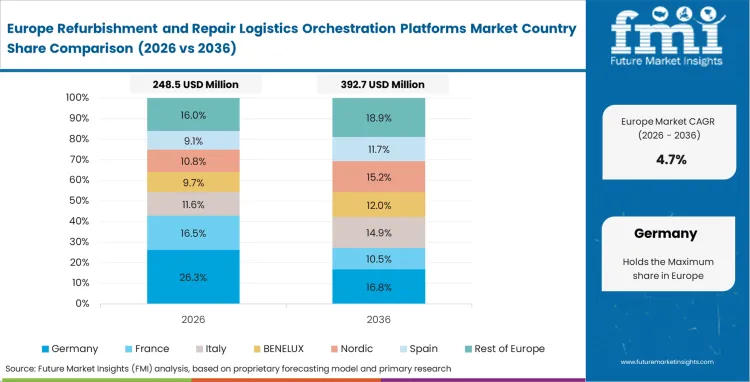
Europe operates under strict regulatory frameworks governing reparability, traceability, and material recovery. Platforms are required to manage compliance across multiple jurisdictions with differing national rules. Cross-border logistics are constrained by regulatory checks, making localized coordination critical. Industrial demand for recovered components supports stable downstream integration, particularly where secondary material usage is mandated.
- United Kingdom: Independent service provider networks demand standardized API access. IT security directors build secure gateways sharing diagnostic codes without exposing proprietary firmware. United Kingdom is forecast to record steady expansion at a CAGR of 9.1% through 2036. Early standardization captures massive out-of-warranty market share rapidly.
- Germany: Germany’s regulatory anchors platform deployment, where an 8.9% CAGR during 2026 to 2036 reflects integration with industrial reverse logistics systems. Material tracking requirements enforce precise separation between reusable and hazardous components. Platforms are embedded within existing manufacturing and recycling infrastructure, enabling consistent compliance and reducing environmental cost exposure across supply chains.
- France: France is anticipated to register a CAGR of 8.3% through 2036. Repairability scoring systems require alignment between advertised service standards and actual repair timelines. Platforms synchronize operations across service centers to ensure compliance with consumer protection regulations. Companies failing to maintain consistency face direct regulatory scrutiny, making system-wide visibility a core operational requirement.
North America Refurbishment and Repair Logistics Orchestration Platforms Market Analysis
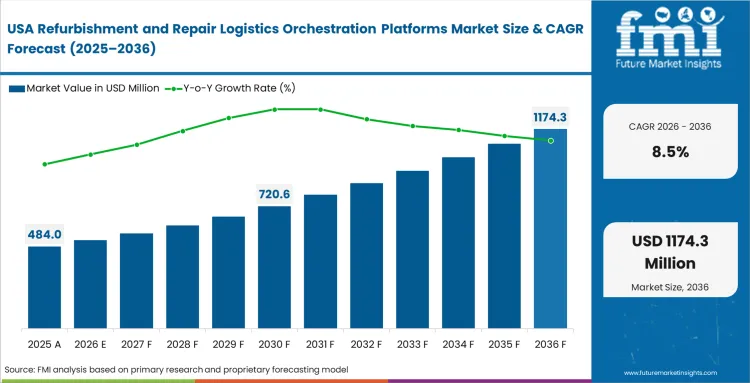
Retail-driven return volumes define platform adoption across North America. Large-scale distribution networks require centralized orchestration to manage inspection, refurbishment, and resale decisions. Geographic spread increases transport complexity, making algorithm-based routing essential. Platforms connect retailers, logistics providers, and secondary sales channels to reduce handling time and recover value from returned inventory.
- United States: Tier-one retailers consolidate regional return centers driving software upgrades. Supply chain planners implement unified dashboards matching inbound returns against real-time secondary demand. The United States sector is expected to register a CAGR of 8.5% through 2036. Achieving accurate channel synchronization unlocks millions hidden within depreciating seasonal inventory.
FMI's report includes Canada, Mexico, Brazil, South Korea, Australia, South Africa, and United Arab Emirates. Expanding analysis covers complex municipal regulatory environments dictating specific electronic waste tracking capabilities locally.
Competitive Aligners for Market Players
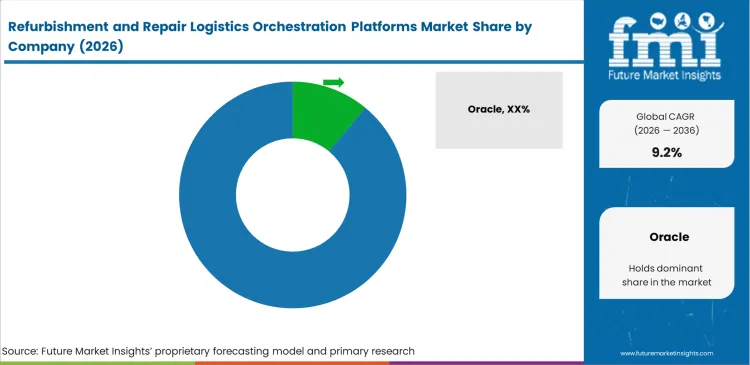
Pressure on legacy ERP vendors is increasing as specialized platforms focus on improving reverse logistics execution rather than offering broad system coverage. Enterprise providers maintain their position through deep integration with financial and service systems, while niche vendors compete on speed, usability, and warehouse-level performance. Concerns around data security and system reliability continue to influence platform selection.
Long-developed data architectures remain a key strength for established platforms, particularly in managing complex bill-of-material relationships and repair logic. These models are not easily replicated across multiple industries, limiting how quickly new entrants can scale. Large inventory management software providers bundle reverse logistics modules heavily discounting initial licensing fees..
Global sourcing teams are restructuring vendor engagement by enforcing interoperability and avoiding dependency on a single system. Contract often separate system components and require competing vendors to operate within shared environments. This approach supports flexibility, maintains high interface standards, and prevents any single provider from controlling the full service network.
Key Players in Refurbishment and Repair Logistics Orchestration Platforms Market
- Oracle
- SAP
- ServiceNow
- Blue Yonder
- ReverseLogix
- Global Blue
- Infor
Scope of the Report
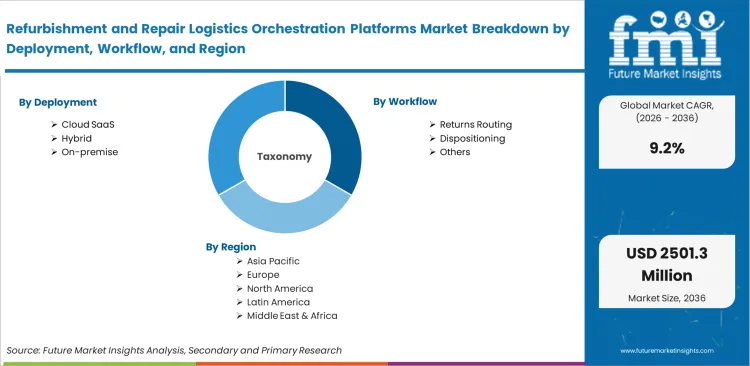
| Metric | Value |
|---|---|
| Quantitative Units | USD 950.0 million to USD 2,290.0 million, at a CAGR of 9.2% |
| Market Definition | Digital systems specifically designed bridging warranty administration, reverse supply chains, and technical repair operations into unified workflows form this sector. Software synchronizes failed asset ingestion, technician routing, spare parts allocation, and final dispositioning decisions globally. |
| Segmentation | Deployment, Workflow, Asset Type, Buyer Type, End Use, Region |
| Regions Covered | North America, Latin America, Europe, Asia Pacific, Middle East and Africa |
| Countries Covered | United States, Canada, Brazil, Mexico, Germany, United Kingdom, France, Italy, Spain, China, Japan, India, South Korea, Australia, South Africa, United Arab Emirates |
| Key Companies Profiled | Oracle, SAP, ServiceNow, Blue Yonder, ReverseLogix, Global Blue, Infor |
| Forecast Period | 2026 to 2036 |
| Approach | Annual IT spending allocations for post-sale service management among global manufacturers anchored baseline valuations. |
Source: Future Market Insights (FMI) analysis, based on proprietary forecasting model and primary research
Refurbishment and Repair Logistics Orchestration Platforms Market Analysis by Segments
Deployment
- Cloud SaaS
- Hybrid
- On-premise
Workflow
- Returns routing
- Depot repair
- Warranty claims
- Parts planning
- Dispositioning
Asset Type
- Electronics
- Home appliances
- Industrial equipment
- Medical devices
- Telecom hardware
Buyer Type
- Large enterprises
- Mid-market
- 3PLs
- OEM service arms
End Use
- Consumer electronics
- Retail and e-commerce
- Industrial service
- Healthcare devices
- Automotive aftermarket
Region
- North America
- United States
- Canada
- Latin America
- Brazil
- Mexico
- Europe
- Germany
- United Kingdom
- France
- Italy
- Spain
- Asia Pacific
- China
- Japan
- India
- South Korea
- Australia
- Middle East and Africa
- South Africa
- United Arab Emirates
Bibliography
- European Commission. (2024). Directive on repair of goods.
- Infor. (2024, March). Infor Distribution FACTS Service and Repair User Guide.
- International Telecommunication Union. (2024, January). The Global E-waste Monitor 2024.
- National Retail Federation. (2025, October). Consumers expected to return nearly $850 billion in merchandise in 2025.
- Oracle Corporation. (2025, June). Oracle announces fiscal 2025 fourth quarter and fiscal full year financial results.
This bibliography is provided for reader reference. The full FMI report contains the complete reference list with primary source documentation.
This Report Addresses
- Component level salvage tracking profitability metrics spanning electronics recycling facilities.
- API integration challenges connecting legacy ERP systems against independent repair shop portals.
- Automated triage algorithms deciding product dispositioning routing instantly during customer return initiation.
- Right to repair legislative impacts forcing transparent diagnostic data access across European territories.
- Refurbishment workflow software pricing considerations for mid-market enterprise deployments.
- Mobile interface design constraints determining physical workbench data entry compliance rates locally.
- Predictive failure analytics routing struggling equipment toward specialized maintenance depots proactively.
- Geographic investment disparities highlighting localized electronic waste tracking capabilities across diverse municipal regulations.
Frequently Asked Questions
What is a refurbishment and repair logistics orchestration platform?
Digital systems specifically designed to bridge warranty administration, reverse supply chains, and technical repair operations into unified workflows form this sector. Software synchronizes failed asset ingestion, technician routing, spare parts allocation, and final dispositioning decisions globally.
Give me the market size for refurbishment and repair logistics orchestration platforms?
Sales are expected to reach USD 2,290.0 million by 2036. Sustained legislative pressures mandating consumer right-to-repair access drive permanent operational shifts toward formalized service networks globally. Companies investing early mitigate future compliance risks.
What is the total valuation in 2026?
Revenue is projected to reach USD 950.0 million during 2026. This metric signals structural confidence among global manufacturers centralizing fragmented reverse logistics pipelines under unified digital dashboards. Centralization remains critical for limiting inventory leakage.
What is the projected CAGR?
Demand is anticipated to expand at a 9.2% CAGR. Consistent volume increases across electronic waste channels push brands to adopt automated triage tools to prevent warehouse congestion. Manual sorting operations cannot scale cost-effectively.
Who are the top vendors in repair logistics orchestration software?
Key providers include Oracle, SAP, ServiceNow, Blue Yonder, ReverseLogix, Global Blue, and Infor. Established enterprise software providers leverage deep existing financial integrations to secure service contract renewals, while specialized vendors focus on innovative triage features.
How does repair logistics orchestration software work?
Platforms evaluate customer symptoms before generating return labels automatically. Failed deflection attempts trigger specific diagnostic codes routing hardware toward specialized repair benches matching technician skill sets against actual component failure telemetry.
What is the difference between returns software and repair software?
Returns management focuses primarily on reverse transportation and immediate warehouse restocking. Repair orchestration actively manages physical technician dispatch, serialized component salvage workflows, and the detailed diagnostic teardown procedures required for complex hardware.
Compare Oracle, SAP, and ServiceNow for repair return orchestration?
Oracle and SAP employ substantial existing ERP and financial reconciliation footprints to bridge inventory ledgers directly. ServiceNow excels in connecting front-end customer service ticketing workflows directly against field technician dispatch systems.
Why does Cloud SaaS lead deployment?
Cloud architecture processes external API calls efficiently outside rigid corporate firewalls. IT security directors require isolated environments when granting inventory access to independent technicians. On-premise installations face challenges in securely bridging external networks.
Why does Returns routing dominate workflow?
Speeding customer refunds directly conflicts with proper failure analysis requirements. Automated destination algorithms resolve this tension by evaluating product value against estimated repair costs. Proper routing limits unnecessary cross-country shipping of unrepairable units.
Why do Large enterprises hold the buyer majority?
Original equipment manufacturers navigate complexity when managing hundreds of independent regional repair centers. Vendor management directors implement unified portals enforcing strict diagnostic checklists globally, standardizing service fees across depots.
Which countries will grow fastest in repair orchestration software?
India is anticipated to lead with an 11.4% CAGR, driven by local manufacturing expansion mandates that create new regional warranty liabilities. Supply chain directors are implementing digital tracking to align with original production volumes locally.
How do right to repair rules affect refurbishment logistics software demand?
Mandatory repairability indices require brands to provide standardized diagnostic access. Compliance directors face market exclusion risks without verifiable reverse supply chain tracking. Regulatory frameworks penalize companies lacking transparent consumer repair pathways.
What friction slows universal portal adoption?
Independent repair shops often resist navigating web interfaces that disrupt normal physical workbench workflows. Software architects building portals sometimes overlook practical data entry constraints faced by hardware technicians locally.
Why does component salvage tracking fail often?
Electronic recycling managers occasionally underestimate database latency when updating thousands of individual serial numbers simultaneously. Failing to capture exact component revisions renders extracted parts unsellable across secondary markets.
What limits refurbished retail velocity?
Unauthorized software flashing during third-party repair damages brand reputation silently. Sluggish repair cycles leave warehouses holding outdated models facing steep markdowns. Rapid model obsolescence restricts profitable refurbishment windows.
How do predictive routing algorithms work?
Artificial intelligence matches product telemetry against historical repair data to identify failure patterns. Operations managers route failing units toward specialized depots before critical breakdowns occur, minimizing expensive emergency field deployments.
Why do procurement directors split vendor contracts?
Global procurement directors resist vendor lock-in by demanding open API architectures universally. Procurement teams separate front-end consumer return portals from back-end physical depot routing engines to maintain competitive pricing flexibility.
What hidden costs impact carrier integration?
Minor dimensional weight errors within return portals erode anticipated freight margin savings. Routing optimization failures cause warehouses to accumulate unsalvageable hardware shipped inefficiently across regions.
How does authentication integration improve security?
Modern platforms sync directly with external identity providers managing temporary technician credentials. Compliance officers monitor exact file access logs to easily identify suspicious data export patterns.
What prevents predictive analytics success?
Disjointed reporting environments hide poor repair yields behind confusing vendor-specific spreadsheet formats. Enterprise systems must aggregate repair data to predict regional component failure rates accurately, preventing local part shortages.
Why does manual diagnostic wiping fail?
Manual wiping protocols increase exposure to consumer privacy lawsuits due to human error. Systems must interface directly with specialized hardware to securely wipe previous user data automatically, minimizing leakage risks.
How do direct consumer parts change service?
Integrating self-service diagnostic tools empowers end-users directly, lowering support call volumes significantly. Providing incorrect parts frustrates consumers, negatively impacting brand perception and requiring exact diagnostic matching beforehand.
What challenges face third-party logistics providers?
Dashboards requiring competing providers to follow identical repair protocols can disrupt localized workflow efficiencies. Service quality directors compare vendor performance metrics uniformly, demanding standardized reporting regardless of provider preferences.
How does valuation track preserve margins?
Valuation algorithms downgrade asset worth daily based on secondary market pricing feeds. Remarketing directors adjust salvage strategies dynamically to avoid stagnant warehouse inventory and the conversion of valuable assets into e-waste.
What impacts Japanese adoption trajectories?
Optimizing legacy industrial equipment maintenance workflows drives regional adoption. Field service directors digitize paper repair manuals directly into modern technician interfaces, protecting institutional knowledge against workforce retirements.
Preview the report firsthand - request a free sample
Get SampleGet the brochure for pricing and purchase details.
Get PDFTable of Content
- Executive Summary
- Global Market Outlook
- Demand-side Trends
- Supply-side Trends
- Technology Roadmap Analysis
- Analysis and Recommendations
- Market Overview
- Market Coverage / Taxonomy
- Market Definition / Scope / Limitations
- Research Methodology
- Chapter Orientation
- Analytical Lens and Working Hypotheses
- Market Structure, Signals, and Trend Drivers
- Benchmarking and Cross-market Comparability
- Market Sizing, Forecasting, and Opportunity Mapping
- Research Design and Evidence Framework
- Desk Research Programme (Secondary Evidence)
- Company Annual and Sustainability Reports
- Peer-reviewed Journals and Academic Literature
- Corporate Websites, Product Literature, and Technical Notes
- Earnings Decks and Investor Briefings
- Statutory Filings and Regulatory Disclosures
- Technical White Papers and Standards Notes
- Trade Journals, Industry Magazines, and Analyst Briefs
- Conference Proceedings, Webinars, and Seminar Materials
- Government Statistics Portals and Public Data Releases
- Press Releases and Reputable Media Coverage
- Specialist Newsletters and Curated Briefings
- Sector Databases and Reference Repositories
- FMI Internal Proprietary Databases and Historical Market Datasets
- Subscription Datasets and Paid Sources
- Social Channels, Communities, and Digital Listening Inputs
- Additional Desk Sources
- Expert Input and Fieldwork (Primary Evidence)
- Primary Modes
- Qualitative Interviews and Expert Elicitation
- Quantitative Surveys and Structured Data Capture
- Blended Approach
- Why Primary Evidence is Used
- Field Techniques
- Interviews
- Surveys
- Focus Groups
- Observational and In-context Research
- Social and Community Interactions
- Stakeholder Universe Engaged
- C-suite Leaders
- Board Members
- Presidents and Vice Presidents
- R&D and Innovation Heads
- Technical Specialists
- Domain Subject-matter Experts
- Scientists
- Physicians and Other Healthcare Professionals
- Governance, Ethics, and Data Stewardship
- Research Ethics
- Data Integrity and Handling
- Primary Modes
- Tooling, Models, and Reference Databases
- Desk Research Programme (Secondary Evidence)
- Data Engineering and Model Build
- Data Acquisition and Ingestion
- Cleaning, Normalisation, and Verification
- Synthesis, Triangulation, and Analysis
- Quality Assurance and Audit Trail
- Market Background
- Market Dynamics
- Drivers
- Restraints
- Opportunity
- Trends
- Scenario Forecast
- Demand in Optimistic Scenario
- Demand in Likely Scenario
- Demand in Conservative Scenario
- Opportunity Map Analysis
- Product Life Cycle Analysis
- Supply Chain Analysis
- Investment Feasibility Matrix
- Value Chain Analysis
- PESTLE and Porter’s Analysis
- Regulatory Landscape
- Regional Parent Market Outlook
- Production and Consumption Statistics
- Import and Export Statistics
- Market Dynamics
- Global Market Analysis 2021 to 2025 and Forecast, 2026 to 2036
- Historical Market Size Value (USD Million) Analysis, 2021 to 2025
- Current and Future Market Size Value (USD Million) Projections, 2026 to 2036
- Y-o-Y Growth Trend Analysis
- Absolute $ Opportunity Analysis
- Global Market Pricing Analysis 2021 to 2025 and Forecast 2026 to 2036
- Global Market Analysis 2021 to 2025 and Forecast 2026 to 2036, By Deployment
- Introduction / Key Findings
- Historical Market Size Value (USD Million) Analysis By Deployment , 2021 to 2025
- Current and Future Market Size Value (USD Million) Analysis and Forecast By Deployment , 2026 to 2036
- Cloud SaaS
- Hybrid
- On-premise
- Cloud SaaS
- Y-o-Y Growth Trend Analysis By Deployment , 2021 to 2025
- Absolute $ Opportunity Analysis By Deployment , 2026 to 2036
- Global Market Analysis 2021 to 2025 and Forecast 2026 to 2036, By Workflow
- Introduction / Key Findings
- Historical Market Size Value (USD Million) Analysis By Workflow, 2021 to 2025
- Current and Future Market Size Value (USD Million) Analysis and Forecast By Workflow, 2026 to 2036
- Returns Routing
- Dispositioning
- Others
- Returns Routing
- Y-o-Y Growth Trend Analysis By Workflow, 2021 to 2025
- Absolute $ Opportunity Analysis By Workflow, 2026 to 2036
- Global Market Analysis 2021 to 2025 and Forecast 2026 to 2036, By Asset Type
- Introduction / Key Findings
- Historical Market Size Value (USD Million) Analysis By Asset Type, 2021 to 2025
- Current and Future Market Size Value (USD Million) Analysis and Forecast By Asset Type, 2026 to 2036
- Electronics
- Home Appliances
- Others
- Electronics
- Y-o-Y Growth Trend Analysis By Asset Type, 2021 to 2025
- Absolute $ Opportunity Analysis By Asset Type, 2026 to 2036
- Global Market Analysis 2021 to 2025 and Forecast 2026 to 2036, By Buyer Type
- Introduction / Key Findings
- Historical Market Size Value (USD Million) Analysis By Buyer Type, 2021 to 2025
- Current and Future Market Size Value (USD Million) Analysis and Forecast By Buyer Type, 2026 to 2036
- Large Enterprises
- 3PLs
- Others
- Large Enterprises
- Y-o-Y Growth Trend Analysis By Buyer Type, 2021 to 2025
- Absolute $ Opportunity Analysis By Buyer Type, 2026 to 2036
- Global Market Analysis 2021 to 2025 and Forecast 2026 to 2036, By End Use
- Introduction / Key Findings
- Historical Market Size Value (USD Million) Analysis By End Use, 2021 to 2025
- Current and Future Market Size Value (USD Million) Analysis and Forecast By End Use, 2026 to 2036
- Consumer Electronics
- Industrial Service
- Others
- Consumer Electronics
- Y-o-Y Growth Trend Analysis By End Use, 2021 to 2025
- Absolute $ Opportunity Analysis By End Use, 2026 to 2036
- Global Market Analysis 2021 to 2025 and Forecast 2026 to 2036, By Region
- Introduction
- Historical Market Size Value (USD Million) Analysis By Region, 2021 to 2025
- Current Market Size Value (USD Million) Analysis and Forecast By Region, 2026 to 2036
- North America
- Latin America
- Western Europe
- Eastern Europe
- East Asia
- South Asia and Pacific
- Middle East & Africa
- Market Attractiveness Analysis By Region
- North America Market Analysis 2021 to 2025 and Forecast 2026 to 2036, By Country
- Historical Market Size Value (USD Million) Trend Analysis By Market Taxonomy, 2021 to 2025
- Market Size Value (USD Million) Forecast By Market Taxonomy, 2026 to 2036
- By Country
- USA
- Canada
- Mexico
- By Deployment
- By Workflow
- By Asset Type
- By Buyer Type
- By End Use
- By Country
- Market Attractiveness Analysis
- By Country
- By Deployment
- By Workflow
- By Asset Type
- By Buyer Type
- By End Use
- Key Takeaways
- Latin America Market Analysis 2021 to 2025 and Forecast 2026 to 2036, By Country
- Historical Market Size Value (USD Million) Trend Analysis By Market Taxonomy, 2021 to 2025
- Market Size Value (USD Million) Forecast By Market Taxonomy, 2026 to 2036
- By Country
- Brazil
- Chile
- Rest of Latin America
- By Deployment
- By Workflow
- By Asset Type
- By Buyer Type
- By End Use
- By Country
- Market Attractiveness Analysis
- By Country
- By Deployment
- By Workflow
- By Asset Type
- By Buyer Type
- By End Use
- Key Takeaways
- Western Europe Market Analysis 2021 to 2025 and Forecast 2026 to 2036, By Country
- Historical Market Size Value (USD Million) Trend Analysis By Market Taxonomy, 2021 to 2025
- Market Size Value (USD Million) Forecast By Market Taxonomy, 2026 to 2036
- By Country
- Germany
- UK
- Italy
- Spain
- France
- Nordic
- BENELUX
- Rest of Western Europe
- By Deployment
- By Workflow
- By Asset Type
- By Buyer Type
- By End Use
- By Country
- Market Attractiveness Analysis
- By Country
- By Deployment
- By Workflow
- By Asset Type
- By Buyer Type
- By End Use
- Key Takeaways
- Eastern Europe Market Analysis 2021 to 2025 and Forecast 2026 to 2036, By Country
- Historical Market Size Value (USD Million) Trend Analysis By Market Taxonomy, 2021 to 2025
- Market Size Value (USD Million) Forecast By Market Taxonomy, 2026 to 2036
- By Country
- Russia
- Poland
- Hungary
- Balkan & Baltic
- Rest of Eastern Europe
- By Deployment
- By Workflow
- By Asset Type
- By Buyer Type
- By End Use
- By Country
- Market Attractiveness Analysis
- By Country
- By Deployment
- By Workflow
- By Asset Type
- By Buyer Type
- By End Use
- Key Takeaways
- East Asia Market Analysis 2021 to 2025 and Forecast 2026 to 2036, By Country
- Historical Market Size Value (USD Million) Trend Analysis By Market Taxonomy, 2021 to 2025
- Market Size Value (USD Million) Forecast By Market Taxonomy, 2026 to 2036
- By Country
- China
- Japan
- South Korea
- By Deployment
- By Workflow
- By Asset Type
- By Buyer Type
- By End Use
- By Country
- Market Attractiveness Analysis
- By Country
- By Deployment
- By Workflow
- By Asset Type
- By Buyer Type
- By End Use
- Key Takeaways
- South Asia and Pacific Market Analysis 2021 to 2025 and Forecast 2026 to 2036, By Country
- Historical Market Size Value (USD Million) Trend Analysis By Market Taxonomy, 2021 to 2025
- Market Size Value (USD Million) Forecast By Market Taxonomy, 2026 to 2036
- By Country
- India
- ASEAN
- Australia & New Zealand
- Rest of South Asia and Pacific
- By Deployment
- By Workflow
- By Asset Type
- By Buyer Type
- By End Use
- By Country
- Market Attractiveness Analysis
- By Country
- By Deployment
- By Workflow
- By Asset Type
- By Buyer Type
- By End Use
- Key Takeaways
- Middle East & Africa Market Analysis 2021 to 2025 and Forecast 2026 to 2036, By Country
- Historical Market Size Value (USD Million) Trend Analysis By Market Taxonomy, 2021 to 2025
- Market Size Value (USD Million) Forecast By Market Taxonomy, 2026 to 2036
- By Country
- Kingdom of Saudi Arabia
- Other GCC Countries
- Turkiye
- South Africa
- Other African Union
- Rest of Middle East & Africa
- By Deployment
- By Workflow
- By Asset Type
- By Buyer Type
- By End Use
- By Country
- Market Attractiveness Analysis
- By Country
- By Deployment
- By Workflow
- By Asset Type
- By Buyer Type
- By End Use
- Key Takeaways
- Key Countries Market Analysis
- USA
- Pricing Analysis
- Market Share Analysis, 2025
- By Deployment
- By Workflow
- By Asset Type
- By Buyer Type
- By End Use
- Canada
- Pricing Analysis
- Market Share Analysis, 2025
- By Deployment
- By Workflow
- By Asset Type
- By Buyer Type
- By End Use
- Mexico
- Pricing Analysis
- Market Share Analysis, 2025
- By Deployment
- By Workflow
- By Asset Type
- By Buyer Type
- By End Use
- Brazil
- Pricing Analysis
- Market Share Analysis, 2025
- By Deployment
- By Workflow
- By Asset Type
- By Buyer Type
- By End Use
- Chile
- Pricing Analysis
- Market Share Analysis, 2025
- By Deployment
- By Workflow
- By Asset Type
- By Buyer Type
- By End Use
- Germany
- Pricing Analysis
- Market Share Analysis, 2025
- By Deployment
- By Workflow
- By Asset Type
- By Buyer Type
- By End Use
- UK
- Pricing Analysis
- Market Share Analysis, 2025
- By Deployment
- By Workflow
- By Asset Type
- By Buyer Type
- By End Use
- Italy
- Pricing Analysis
- Market Share Analysis, 2025
- By Deployment
- By Workflow
- By Asset Type
- By Buyer Type
- By End Use
- Spain
- Pricing Analysis
- Market Share Analysis, 2025
- By Deployment
- By Workflow
- By Asset Type
- By Buyer Type
- By End Use
- France
- Pricing Analysis
- Market Share Analysis, 2025
- By Deployment
- By Workflow
- By Asset Type
- By Buyer Type
- By End Use
- India
- Pricing Analysis
- Market Share Analysis, 2025
- By Deployment
- By Workflow
- By Asset Type
- By Buyer Type
- By End Use
- ASEAN
- Pricing Analysis
- Market Share Analysis, 2025
- By Deployment
- By Workflow
- By Asset Type
- By Buyer Type
- By End Use
- Australia & New Zealand
- Pricing Analysis
- Market Share Analysis, 2025
- By Deployment
- By Workflow
- By Asset Type
- By Buyer Type
- By End Use
- China
- Pricing Analysis
- Market Share Analysis, 2025
- By Deployment
- By Workflow
- By Asset Type
- By Buyer Type
- By End Use
- Japan
- Pricing Analysis
- Market Share Analysis, 2025
- By Deployment
- By Workflow
- By Asset Type
- By Buyer Type
- By End Use
- South Korea
- Pricing Analysis
- Market Share Analysis, 2025
- By Deployment
- By Workflow
- By Asset Type
- By Buyer Type
- By End Use
- Russia
- Pricing Analysis
- Market Share Analysis, 2025
- By Deployment
- By Workflow
- By Asset Type
- By Buyer Type
- By End Use
- Poland
- Pricing Analysis
- Market Share Analysis, 2025
- By Deployment
- By Workflow
- By Asset Type
- By Buyer Type
- By End Use
- Hungary
- Pricing Analysis
- Market Share Analysis, 2025
- By Deployment
- By Workflow
- By Asset Type
- By Buyer Type
- By End Use
- Kingdom of Saudi Arabia
- Pricing Analysis
- Market Share Analysis, 2025
- By Deployment
- By Workflow
- By Asset Type
- By Buyer Type
- By End Use
- Turkiye
- Pricing Analysis
- Market Share Analysis, 2025
- By Deployment
- By Workflow
- By Asset Type
- By Buyer Type
- By End Use
- South Africa
- Pricing Analysis
- Market Share Analysis, 2025
- By Deployment
- By Workflow
- By Asset Type
- By Buyer Type
- By End Use
- USA
- Market Structure Analysis
- Competition Dashboard
- Competition Benchmarking
- Market Share Analysis of Top Players
- By Regional
- By Deployment
- By Workflow
- By Asset Type
- By Buyer Type
- By End Use
- Competition Analysis
- Competition Deep Dive
- Oracle
- Overview
- Product Portfolio
- Profitability by Market Segments (Product/Age /Sales Channel/Region)
- Sales Footprint
- Strategy Overview
- Marketing Strategy
- Product Strategy
- Channel Strategy
- SAP
- ServiceNow
- Blue Yonder
- ReverseLogix
- Global Blue
- Oracle
- Competition Deep Dive
- Assumptions & Acronyms Used


