

- Industry Size (2026)
- USD 1.5 Bn
- Forecast (2036)
- USD 2.5 Bn
- CAGR (2026 to 2036)
- 5.2%
Repair Mortar Polymer Additives Market Forecast and Outlook 2026 to 2036
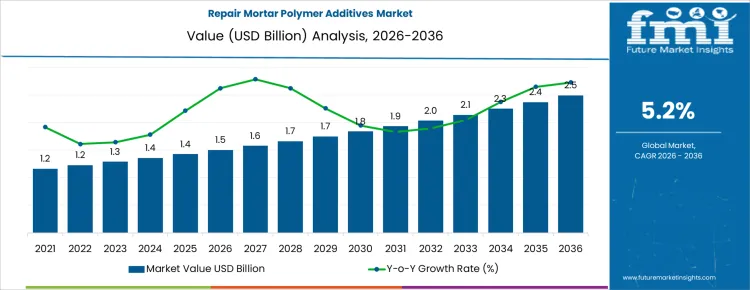
The repair mortar polymer additives market is estimated at USD 1.5 billion in 2026 and is projected to reach USD 2.5 billion by 2036, growing at a CAGR of 5.2%. Redispersible polymer powders account for the largest share, used extensively in structural repair mortars. Growth is supported by rising repair and refurbishment activities in urban and industrial infrastructure. Acrylic latex and SBR latex contribute to non-structural patching and overlays, offering improved adhesion and durability. End users include construction contractors, ready-mix producers, and precast manufacturers, emphasizing quality and longevity in repair solutions.
From 2031 onward, the market shows faster uptake of EVA and other copolymers, particularly in waterproofing and specialized grouting applications. The period between 2033 and 2036 sees significant adoption in both residential and industrial construction projects, driven by regulatory encouragement and performance demands. Companies focusing on diversified polymer types, blending powders and liquid formulations, are expected to consolidate their positions, while regional adoption patterns reflect infrastructure growth and refurbishment cycles in emerging and developed markets.
Quick Stats of the Repair Mortar Polymer Additives Market
- Repair Mortar Polymer Additives Market Value (2026): USD 1.5 billion
- Repair Mortar Polymer Additives Market Forecast Value (2036): USD 2.5 billion
- Repair Mortar Polymer Additives Market Forecast CAGR (2026 to 2036): 5.2%
- Leading Polymer Type in the Market: Redispersible Polymer Powder (RDP) (38%)
- Key Growth Regions in the Market: China, Brazil, USA, Germany, UK
- Top Players in the Market: Sika, Master Builders Solutions, Mapei, Dow, Wacker Chemie, Celanese, Synthomer, Arkema (Bostik), Evonik, Ashland
What is the Growth Forecast for the Repair Mortar Polymer Additives Market through 2036?
From 2026 to 2031, the repair mortar polymer additives market grows from USD 1.5 billion to around USD 2.0 billion, with annual absolute gains increasing from USD 0.1 billion in 2026 to USD 0.2 billion in 2031. This period is characterized by selective adoption across bridge rehabilitation (30% of demand), residential concrete repair (25%), and commercial retrofitting projects (20%), with the remainder spread across industrial flooring and infrastructure maintenance. Growth is influenced by the rising need for enhanced mortar adhesion, crack resistance, and flexibility in both new and repair applications. Early uptake is concentrated in North America and Europe, accounting for roughly 60% of market value, while Asia Pacific begins scaling pilot deployments.
Between 2031 and 2036, the market accelerates from approximately USD 2.0 billion to USD 2.5 billion, reflecting broader portfolio adoption and higher specification penetration. Annual increments increase consistently, reaching USD 0.3 billion by 2036, driven by multi-site infrastructure retrofitting, accelerated urban development, and higher adoption in industrial maintenance programs. Polymer additives become standard in high-performance repair mortars, with demand weighted toward high-durability formulations for bridges and highways (35%) and commercial/industrial facilities (30%). The late-stage expansion is reinforced by repeat procurement cycles, regional infrastructure spending growth, and regulatory encouragement for polymer-modified repair mortars, particularly in Europe and Asia Pacific.
Repair Mortar Polymer Additives Market Key Takeaways
| Metric | Value |
|---|---|
| Market Value (2026) | USD 1.5 billion |
| Forecast Value (2036) | USD 2.5 billion |
| Forecast CAGR (2026 to 2036) | 5.2% |
What Is Driving the Demand for Polymer Additives in Repair Mortars?
Demand for polymer additives in repair mortars first emerged from persistent performance gaps in traditional cementitious repair materials. Conventional mortars often suffered from limited adhesion to older substrates, shrinkage cracking, and reduced durability under cyclic loads and moisture variations. Contractors and material suppliers began incorporating polymeric modifiers such as latexes and copolymers to improve bond strength, flexibility, and resistance to environmental stress. Early adoption occurred where structural repairs faced frequent failure or liability, including bridges, industrial floors, and water retaining structures. Historical uptake reflected project-level problem solving, with performance improvements evaluated case by case rather than standardized across repair specifications.
Future demand for polymer additives in repair mortars will be shaped by evolving durability expectations, regulatory quality standards, and lifecycle cost frameworks rather than solely by discrete performance repairs. Infrastructure agencies and building codes increasingly recognize the need for longer service life in maintenance interventions. Polymer-modified mortars that resist freeze-thaw cycles, chemical attack, and fatigue loading are being specified in standards and technical clauses. Advances in polymer chemistry are producing additive systems that enhance workability, reduce permeability, and deliver consistent mechanical properties across varied substrates. Unlike historical use driven by isolated project performance issues, future adoption will be tied to formal durability criteria, asset management standards, and procurement policies that value extended service life outcomes.
What Factors Are Affecting the Demand for Repair Mortar Polymer Additives Market in Terms of Polymer Type and Form?
Demand for repair mortar polymer additives is segmented by polymer type and form across construction repair and rehabilitation activities. Redispersible polymer powder accounts for about 38% of total demand, making it the leading polymer type. Acrylic latex, SBR latex, and EVA or other copolymers represent additional polymer categories without disclosed share splits. These polymers differ in adhesion improvement, flexibility contribution, and water resistance behavior. Form based segmentation reflects handling and application preferences on site. Powder form RDP accounts for about 44% of demand, followed by liquid latex and waterborne dispersions. Together, these segments explain demand formation shaped by application convenience, storage stability, and performance requirements in repair mortars rather than new construction activity alone.
What Drives Demand by Polymer Type in the Repair Mortar Polymer Additives Market?
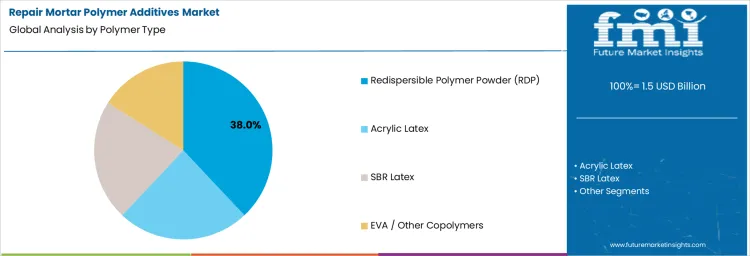
Redispersible polymer powder leads demand with a 38% share due to compatibility with dry mix repair mortars and predictable performance after rehydration. RDP improves adhesion, flexural strength, and crack resistance in cementitious repair systems. Acrylic latex is used where enhanced durability and UV resistance are required. SBR latex is applied to improve bonding strength and water resistance in structural repairs. EVA and other copolymers support specific flexibility and setting profiles. Polymer type selection reflects performance reliability across varied substrates and exposure conditions. Demand therefore aligns with specification driven repair requirements rather than polymer cost differentiation.
Polymer driven demand remains stable because repair mortar formulations are standardized for certification and field performance. RDP is embedded in factory blended dry mixes. Latex systems are specified where site mixing is preferred. EVA copolymers are applied selectively for tailored performance. These patterns limit rapid substitution. Polymer type segmentation highlights reliance on proven reinforcement mechanisms. Demand therefore follows repair material standards and contractor practice rather than short term shifts in raw material pricing.
How Does Form Shape Demand for Repair Mortar Polymer Additives Market?
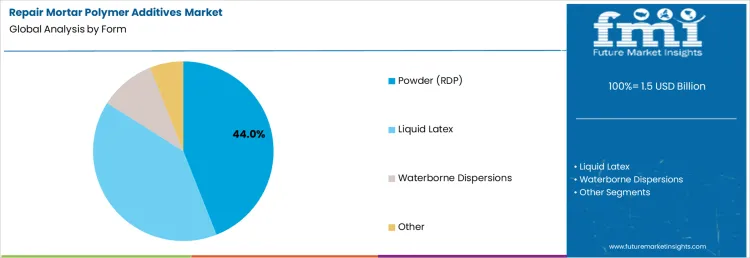
Powder form RDP accounts for about 44% of total demand, making it the leading additive form. This dominance reflects ease of transport, long shelf life, and compatibility with pre blended dry mortars. Liquid latex additives are used where on site formulation flexibility is required. Waterborne dispersions support applications needing controlled polymer distribution. Other forms address niche repair scenarios. Form selection depends on logistics, dosing accuracy, and mixing practices. Demand follows construction workflow efficiency rather than intrinsic polymer performance differences.
Powder additives maintain leadership due to standardized dry mix production. Liquid forms remain relevant in site specific repairs. Waterborne systems persist where dispersion control is critical. Contractors avoid frequent form changes due to retraining and quality risks. This stabilizes form demand distribution. Form segmentation therefore reinforces reliance on dry mix compatible polymer additives within repair mortar systems.
How Are Repair Mortar Polymer Additives Being Applied Across Construction and Infrastructure Projects?
Use appears in repair and renovation operations where concrete or masonry restoration requires enhanced adhesion, flexibility, and durability. Contractors incorporate polymer additives into repair mortars to improve bond strength to existing substrates and reduce cracking during curing. Bridge, road, and building maintenance projects adopt them to extend service life and maintain structural integrity. Industrial flooring and concrete patching applications rely on polymer-modified mortars for high wear resistance and shrinkage control. These applications reflect operational and performance priorities rather than decorative considerations, with adoption driven by durability, workability, and long-term maintenance reduction.
What Operational and Material Conditions Support Adoption of Repair Mortar Polymer Additives?
Selection aligns with formulations that need controlled rheology, setting time, and mechanical performance. Concrete technologists optimize polymer type and dosage to balance flexibility, adhesion, and compressive strength. Contractors value additives compatible with existing substrates, ambient curing conditions, and finishing equipment. Infrastructure project managers specify polymer-modified repair mortars to meet performance standards for durability, freeze-thaw resistance, and chemical exposure. These conditions arise from operational efficiency, material reliability, and long-term performance priorities in structured repair workflows.
Which Practical Considerations Limit Wider Use of Repair Mortar Polymer Additives?
Cost per unit is higher than traditional cementitious repair mortars, influencing adoption in small-scale or low-margin projects. Compatibility with diverse substrate types and environmental conditions requires careful testing. Storage, handling, and mixing protocols must be followed to prevent polymer segregation or performance loss. Cure time adjustments may affect project scheduling. Regulatory compliance for specific building codes may restrict certain polymer chemistries. These factors lead to selective deployment where enhanced adhesion, durability, and maintenance reduction justify additional material and operational investment.
What is the Demand for Repair Mortar Polymer Additives by Country?
| Country | CAGR (%) |
|---|---|
| USA | 5.0% |
| Germany | 4.6% |
| China | 6.3% |
| UK | 4.7% |
| Brazil | 6.0% |
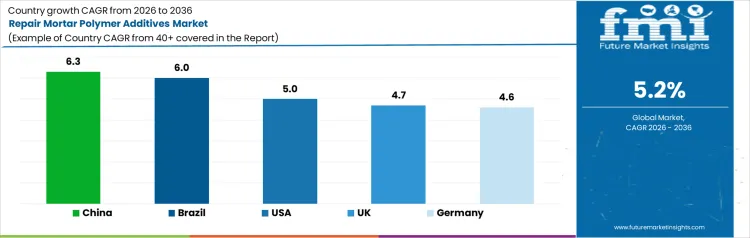
The demand for repair mortar polymer additives varies across countries, driven by infrastructure maintenance, construction activity, and adoption of polymer modified mortars. China leads with a 6.3% CAGR, supported by large scale infrastructure projects and growing use of polymer enhanced repair materials. Brazil follows at 6.0%, driven by urban development and renovation of aging buildings. The USA grows at 5.0%, reflecting steady demand in construction and civil engineering repair applications. Germany records 4.6%, shaped by mature construction markets and regulated building standards. The UK posts 4.7%, supported by maintenance of historical structures and adoption of polymer modified repair mortars for durable performance.
How Is Polymer-Enhanced Repair Mortar Driving Growth in the United States?
In the United States, revenue from the Repair Mortar Polymer Additives Market is expanding at a CAGR of 5.0% through 2035, driven by adoption of polymer additives to improve adhesion, flexibility, and durability in cementitious repair mortars. Manufacturers are integrating polymer-modified mortars in concrete repair, structural restoration, and surface finishing applications across commercial, infrastructure, and industrial projects. Demand is concentrated in construction, civil engineering, and maintenance operations. Domestic suppliers provide high-performance polymer additives compatible with cementitious systems and standard mixing processes. Regulatory compliance, durability requirements, and recurring repair projects are sustaining predictable procurement nationwide.
- Commercial, civil engineering, and industrial projects adopt polymer-enhanced repair mortars
- Additives improve adhesion, flexibility, and durability
- Domestic suppliers provide high-performance polymer additives compatible with cementitious systems
- Recurring repair projects sustain predictable procurement
How Are Construction Standards Supporting Growth in Germany?
Germany continues to record steady growth in the Repair Mortar Polymer Additives Market at a CAGR of 4.6% through 2035, supported by stringent construction quality and durability standards. Manufacturers are integrating polymer additives into repair mortars for concrete restoration, structural repair, and finishing works. Demand is concentrated in infrastructure, commercial buildings, and industrial facilities. Domestic suppliers provide additives designed for consistent performance, compatibility with cement-based systems, and improved mechanical properties. Compliance-driven procurement and stable repair project volumes are sustaining measured adoption nationwide.
- Construction and durability standards drive polymer additive adoption
- Concrete restoration, structural repair, and finishing works anchor demand
- Domestic suppliers provide consistent and cement-compatible polymer additives
- Recurring repair project volumes sustain steady procurement
How Is Infrastructure and Construction Expansion Accelerating Adoption in China?
In China, revenue from the Repair Mortar Polymer Additives Market is growing at a CAGR of 6.3% through 2035, driven by rapid expansion of commercial and infrastructure construction. Manufacturers are adopting polymer additives to enhance adhesion, reduce shrinkage, and improve flexibility of repair mortars for bridges, roads, and high-rise buildings. Demand is strong across civil engineering, industrial construction, and municipal maintenance projects. Domestic suppliers are scaling production of high-performance polymer additives compatible with cementitious systems. High construction volumes and structured procurement practices are sustaining rapid adoption nationwide.
- Bridges, roads, and high-rise buildings drive polymer additive adoption
- Additives improve adhesion, flexibility, and reduce shrinkage
- Domestic suppliers scale high-performance polymer additive production
- High construction volumes sustain consistent adoption
How Is Building Maintenance Supporting Growth in the United Kingdom?
In the United Kingdom, revenue from the Repair Mortar Polymer Additives Market is expanding at a CAGR of 4.7% through 2035, supported by demand for durable concrete repair and maintenance solutions. Manufacturers are integrating polymer additives in repair mortars for structural restoration, façade repair, and surface finishing. Demand is concentrated in commercial, civil engineering, and industrial maintenance projects. Domestic suppliers provide polymer additives designed for compatibility with cementitious mortars and improved mechanical properties. Recurring infrastructure maintenance, regulatory compliance, and durability requirements are sustaining predictable procurement nationwide.
- Structural restoration, façade repair, and surface finishing drive polymer additive adoption
- Additives improve durability, adhesion, and mechanical performance
- Domestic suppliers provide cement-compatible polymer additives
- Recurring infrastructure maintenance sustains predictable procurement
How Is Civil and Industrial Construction Supporting Adoption in Brazil?
Brazil is seeing strong growth in the Repair Mortar Polymer Additives Market at a CAGR of 6.0% through 2035, supported by increasing infrastructure projects, commercial construction, and industrial maintenance. Manufacturers are adopting polymer additives to enhance adhesion, flexibility, and durability of repair mortars used in bridges, roads, and buildings. Demand is concentrated in civil engineering, industrial facilities, and infrastructure maintenance. Domestic suppliers are expanding production of high-performance polymer additives compatible with cement-based mortars. Growth in construction projects and recurring maintenance activities are sustaining robust procurement nationwide.
- Bridges, roads, and building repairs drive polymer additive adoption
- Additives improve adhesion, flexibility, and durability
- Domestic suppliers expand high-performance polymer additive production
- Recurring construction and maintenance activities sustain procurement
Which Companies Are Shaping Competition in The Repair Mortar Polymer Additives Market Through Formulation and On Site Performance Requirements?
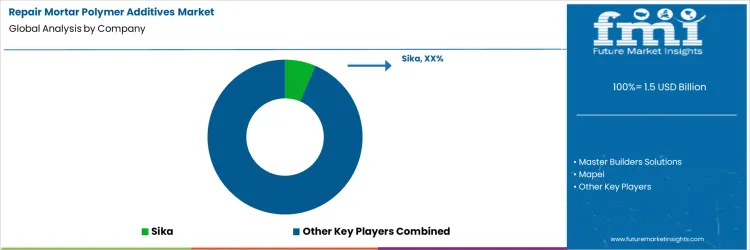
Demand in the Repair Mortar Polymer Additives Market is shaped primarily by how repair mortars behave during placement, curing, and long term exposure. Polymer additives are selected less for brand identity and more for predictable bonding, crack resistance, and compatibility with varied substrates. Suppliers such as Dow, Celanese, and Wacker Chemie are embedded upstream, providing redispersible powders and binders that formulators rely on for baseline performance control. Evonik and Ashland influence formulation behavior through rheology modifiers and functional additives that affect water retention and workability. Purchasing decisions are often driven by contractor feedback and site performance records rather than laboratory metrics alone, reinforcing the importance of consistency across batches and conditions.
System providers shape competition by linking polymer additives to finished repair solutions specified in infrastructure maintenance. Sika, Master Builders Solutions, and Mapei influence additive selection indirectly through approved formulation systems used by applicators and engineers. Synthomer and Arkema, via Bostik, supply latexes and specialty polymers adapted to localized repair needs, including rapid setting and overhead applications. Local formulators adjust polymer loading to suit climate, aggregate quality, and curing practices, which limits standardization across regions. Competitive positioning reflects technical service depth, responsiveness to field issues, and alignment with repair standards rather than innovation cycles. Market entry remains constrained by qualification timelines, contractor trust, and repeat performance under real repair conditions.
Key Players in the Repair Mortar Polymer Additives Market
- Sika
- Master Builders Solutions
- Mapei
- Dow
- Wacker Chemie
- Celanese
- Synthomer
- Arkema (Bostik)
- Evonik
- Ashland
Scope of the Report
| Items | Values |
|---|---|
| Quantitative Units (2026) | USD billion |
| Polymer Type | Redispersible Polymer Powder (RDP); Acrylic Latex; SBR Latex; EVA / Other Copolymers |
| Form | Powder (RDP); Liquid Latex; Waterborne Dispersions; Other forms |
| Application | Structural Repair Mortars; Non-Structural Patching; Overlays / Skim Coats; Waterproofing / Grouts |
| End User | Construction Contractors; Ready-Mix / Precast Producers; Infrastructure Owners; DIY / Retail |
| Region | Asia Pacific; Europe; North America; Latin America; Middle East & Africa |
| Countries Covered | China; Japan; South Korea; India; Australia & New Zealand; ASEAN; Germany; United Kingdom; France; Italy; Spain; Nordic; BENELUX; United States; Canada; Mexico; Brazil; Chile; Kingdom of Saudi Arabia; Other GCC Countries; Turkey; South Africa; Other African Union; Rest of Asia Pacific; Rest of Europe; Rest of Latin America; Rest of Middle East & Africa |
| Key Companies Profiled | Sika; Master Builders Solutions; Mapei; Dow; Wacker Chemie; Celanese; Synthomer; Arkema (Bostik); Evonik; Ashland |
| Additional Attributes | Dollar by sales across polymer type, form, and application; Redispersible polymer powder leads demand due to dry mix compatibility and predictable performance; Powder form dominates due to storage stability and site application convenience; Adoption concentrated in structural repair, bridge rehabilitation, and industrial maintenance; Early-stage growth led by North America and Europe, later expansion driven by Asia Pacific urban infrastructure; Recurring repair cycles, regulatory encouragement, and performance standards sustain adoption; Portfolio-wide uptake across multi-site repair projects reinforces demand; Suppliers focus on technical service, formulation support, and contractor feedback to maintain competitive positioning; Growth influenced by infrastructure expansion, refurbishment programs, and lifecycle cost considerations. |
Repair Mortar Polymer Additives Market Report Scope
Polymer Type:
- Redispersible Polymer Powder (RDP)
- Acrylic Latex
- SBR Latex
- EVA / Other Copolymers
Form:
- Powder (RDP)
- Liquid Latex
- Waterborne Dispersions
- Other
Application:
- Structural Repair Mortars
- Non-Structural Patching
- Overlays / Skim Coats
- Waterproofing / Grouts
End User:
- Construction Contractors
- Ready-Mix / Precast Producers
- Infrastructure Owners
- DIY / Retail
Region
-
Asia Pacific
- China
- Japan
- South Korea
- India
- Australia & New Zealand
- ASEAN
- Rest of Asia Pacific
-
Europe
- Germany
- United Kingdom
- France
- Italy
- Spain
- Nordic
- BENELUX
- Rest of Europe
-
North America
- United States
- Canada
- Mexico
-
Latin America
- Brazil
- Chile
- Rest of Latin America
-
Middle East & Africa
- Kingdom of Saudi Arabia
- Other GCC Countries
- Turkey
- South Africa
- Other African Union
- Rest of Middle East & Africa
Frequently Asked Questions
How big is the repair mortar polymer additives market in 2026?
The global repair mortar polymer additives market is estimated to be valued at USD 1.5 billion in 2026.
What will be the size of repair mortar polymer additives market in 2036?
The market size for the repair mortar polymer additives market is projected to reach USD 2.5 billion by 2036.
How much will be the repair mortar polymer additives market growth between 2026 and 2036?
The repair mortar polymer additives market is expected to grow at a 5.2% CAGR between 2026 and 2036.
What are the key product types in the repair mortar polymer additives market?
The key product types in repair mortar polymer additives market are redispersible polymer powder (rdp), acrylic latex, sbr latex and eva / other copolymers.
Which form segment to contribute significant share in the repair mortar polymer additives market in 2026?
In terms of form, powder (rdp) segment to command 44.0% share in the repair mortar polymer additives market in 2026.
Preview the report firsthand - request a free sample
Get SampleGet the brochure for pricing and purchase details.
Get PDFTable of Content
- Executive Summary
- Global Market Outlook
- Demand-side Trends
- Supply-side Trends
- Technology Roadmap Analysis
- Analysis and Recommendations
- Market Overview
- Market Coverage / Taxonomy
- Market Definition / Scope / Limitations
- Market Background
- Market Dynamics
- Drivers
- Restraints
- Opportunity
- Trends
- Scenario Forecast
- Demand in Optimistic Scenario
- Demand in Likely Scenario
- Demand in Conservative Scenario
- Opportunity Map Analysis
- Product Life Cycle Analysis
- Supply Chain Analysis
- Investment Feasibility Matrix
- Value Chain Analysis
- PESTLE and Porter’s Analysis
- Regulatory Landscape
- Regional Parent Market Outlook
- Production and Consumption Statistics
- Import and Export Statistics
- Market Dynamics
- Global Market Analysis 2021 to 2025 and Forecast, 2026 to 2036
- Historical Market Size Value (USD Million) Analysis, 2021 to 2025
- Current and Future Market Size Value (USD Million) Projections, 2026 to 2036
- Y-o-Y Growth Trend Analysis
- Absolute $ Opportunity Analysis
- Global Market Pricing Analysis 2021 to 2025 and Forecast 2026 to 2036
- Global Market Analysis 2021 to 2025 and Forecast 2026 to 2036, By Polymer Type
- Introduction / Key Findings
- Historical Market Size Value (USD Million) Analysis By Polymer Type , 2021 to 2025
- Current and Future Market Size Value (USD Million) Analysis and Forecast By Polymer Type , 2026 to 2036
- Redispersible Polymer Powder (RDP)
- Acrylic Latex
- SBR Latex
- EVA / Other Copolymers
- Y-o-Y Growth Trend Analysis By Polymer Type , 2021 to 2025
- Absolute $ Opportunity Analysis By Polymer Type , 2026 to 2036
- Global Market Analysis 2021 to 2025 and Forecast 2026 to 2036, By Form
- Introduction / Key Findings
- Historical Market Size Value (USD Million) Analysis By Form, 2021 to 2025
- Current and Future Market Size Value (USD Million) Analysis and Forecast By Form, 2026 to 2036
- Powder (RDP)
- Liquid Latex
- Waterborne Dispersions
- Other
- Y-o-Y Growth Trend Analysis By Form, 2021 to 2025
- Absolute $ Opportunity Analysis By Form, 2026 to 2036
- Global Market Analysis 2021 to 2025 and Forecast 2026 to 2036, By Application
- Introduction / Key Findings
- Historical Market Size Value (USD Million) Analysis By Application, 2021 to 2025
- Current and Future Market Size Value (USD Million) Analysis and Forecast By Application, 2026 to 2036
- Structural Repair Mortars
- Non-Structural Patching
- Overlays / Skim Coats
- Waterproofing / Grouts
- Y-o-Y Growth Trend Analysis By Application, 2021 to 2025
- Absolute $ Opportunity Analysis By Application, 2026 to 2036
- Global Market Analysis 2021 to 2025 and Forecast 2026 to 2036, By End User
- Introduction / Key Findings
- Historical Market Size Value (USD Million) Analysis By End User, 2021 to 2025
- Current and Future Market Size Value (USD Million) Analysis and Forecast By End User, 2026 to 2036
- Construction Contractors
- Ready-Mix / Precast Producers
- Infrastructure Owners
- DIY / Retail
- Y-o-Y Growth Trend Analysis By End User, 2021 to 2025
- Absolute $ Opportunity Analysis By End User, 2026 to 2036
- Global Market Analysis 2021 to 2025 and Forecast 2026 to 2036, By Region
- Introduction
- Historical Market Size Value (USD Million) Analysis By Region, 2021 to 2025
- Current Market Size Value (USD Million) Analysis and Forecast By Region, 2026 to 2036
- North America
- Latin America
- Western Europe
- Eastern Europe
- East Asia
- South Asia and Pacific
- Middle East & Africa
- Market Attractiveness Analysis By Region
- North America Market Analysis 2021 to 2025 and Forecast 2026 to 2036, By Country
- Historical Market Size Value (USD Million) Trend Analysis By Market Taxonomy, 2021 to 2025
- Market Size Value (USD Million) Forecast By Market Taxonomy, 2026 to 2036
- By Country
- USA
- Canada
- Mexico
- By Polymer Type
- By Form
- By Application
- By End User
- By Country
- Market Attractiveness Analysis
- By Country
- By Polymer Type
- By Form
- By Application
- By End User
- Key Takeaways
- Latin America Market Analysis 2021 to 2025 and Forecast 2026 to 2036, By Country
- Historical Market Size Value (USD Million) Trend Analysis By Market Taxonomy, 2021 to 2025
- Market Size Value (USD Million) Forecast By Market Taxonomy, 2026 to 2036
- By Country
- Brazil
- Chile
- Rest of Latin America
- By Polymer Type
- By Form
- By Application
- By End User
- By Country
- Market Attractiveness Analysis
- By Country
- By Polymer Type
- By Form
- By Application
- By End User
- Key Takeaways
- Western Europe Market Analysis 2021 to 2025 and Forecast 2026 to 2036, By Country
- Historical Market Size Value (USD Million) Trend Analysis By Market Taxonomy, 2021 to 2025
- Market Size Value (USD Million) Forecast By Market Taxonomy, 2026 to 2036
- By Country
- Germany
- UK
- Italy
- Spain
- France
- Nordic
- BENELUX
- Rest of Western Europe
- By Polymer Type
- By Form
- By Application
- By End User
- By Country
- Market Attractiveness Analysis
- By Country
- By Polymer Type
- By Form
- By Application
- By End User
- Key Takeaways
- Eastern Europe Market Analysis 2021 to 2025 and Forecast 2026 to 2036, By Country
- Historical Market Size Value (USD Million) Trend Analysis By Market Taxonomy, 2021 to 2025
- Market Size Value (USD Million) Forecast By Market Taxonomy, 2026 to 2036
- By Country
- Russia
- Poland
- Hungary
- Balkan & Baltic
- Rest of Eastern Europe
- By Polymer Type
- By Form
- By Application
- By End User
- By Country
- Market Attractiveness Analysis
- By Country
- By Polymer Type
- By Form
- By Application
- By End User
- Key Takeaways
- East Asia Market Analysis 2021 to 2025 and Forecast 2026 to 2036, By Country
- Historical Market Size Value (USD Million) Trend Analysis By Market Taxonomy, 2021 to 2025
- Market Size Value (USD Million) Forecast By Market Taxonomy, 2026 to 2036
- By Country
- China
- Japan
- South Korea
- By Polymer Type
- By Form
- By Application
- By End User
- By Country
- Market Attractiveness Analysis
- By Country
- By Polymer Type
- By Form
- By Application
- By End User
- Key Takeaways
- South Asia and Pacific Market Analysis 2021 to 2025 and Forecast 2026 to 2036, By Country
- Historical Market Size Value (USD Million) Trend Analysis By Market Taxonomy, 2021 to 2025
- Market Size Value (USD Million) Forecast By Market Taxonomy, 2026 to 2036
- By Country
- India
- ASEAN
- Australia & New Zealand
- Rest of South Asia and Pacific
- By Polymer Type
- By Form
- By Application
- By End User
- By Country
- Market Attractiveness Analysis
- By Country
- By Polymer Type
- By Form
- By Application
- By End User
- Key Takeaways
- Middle East & Africa Market Analysis 2021 to 2025 and Forecast 2026 to 2036, By Country
- Historical Market Size Value (USD Million) Trend Analysis By Market Taxonomy, 2021 to 2025
- Market Size Value (USD Million) Forecast By Market Taxonomy, 2026 to 2036
- By Country
- Kingdom of Saudi Arabia
- Other GCC Countries
- Turkiye
- South Africa
- Other African Union
- Rest of Middle East & Africa
- By Polymer Type
- By Form
- By Application
- By End User
- By Country
- Market Attractiveness Analysis
- By Country
- By Polymer Type
- By Form
- By Application
- By End User
- Key Takeaways
- Key Countries Market Analysis
- USA
- Pricing Analysis
- Market Share Analysis, 2025
- By Polymer Type
- By Form
- By Application
- By End User
- Canada
- Pricing Analysis
- Market Share Analysis, 2025
- By Polymer Type
- By Form
- By Application
- By End User
- Mexico
- Pricing Analysis
- Market Share Analysis, 2025
- By Polymer Type
- By Form
- By Application
- By End User
- Brazil
- Pricing Analysis
- Market Share Analysis, 2025
- By Polymer Type
- By Form
- By Application
- By End User
- Chile
- Pricing Analysis
- Market Share Analysis, 2025
- By Polymer Type
- By Form
- By Application
- By End User
- Germany
- Pricing Analysis
- Market Share Analysis, 2025
- By Polymer Type
- By Form
- By Application
- By End User
- UK
- Pricing Analysis
- Market Share Analysis, 2025
- By Polymer Type
- By Form
- By Application
- By End User
- Italy
- Pricing Analysis
- Market Share Analysis, 2025
- By Polymer Type
- By Form
- By Application
- By End User
- Spain
- Pricing Analysis
- Market Share Analysis, 2025
- By Polymer Type
- By Form
- By Application
- By End User
- France
- Pricing Analysis
- Market Share Analysis, 2025
- By Polymer Type
- By Form
- By Application
- By End User
- India
- Pricing Analysis
- Market Share Analysis, 2025
- By Polymer Type
- By Form
- By Application
- By End User
- ASEAN
- Pricing Analysis
- Market Share Analysis, 2025
- By Polymer Type
- By Form
- By Application
- By End User
- Australia & New Zealand
- Pricing Analysis
- Market Share Analysis, 2025
- By Polymer Type
- By Form
- By Application
- By End User
- China
- Pricing Analysis
- Market Share Analysis, 2025
- By Polymer Type
- By Form
- By Application
- By End User
- Japan
- Pricing Analysis
- Market Share Analysis, 2025
- By Polymer Type
- By Form
- By Application
- By End User
- South Korea
- Pricing Analysis
- Market Share Analysis, 2025
- By Polymer Type
- By Form
- By Application
- By End User
- Russia
- Pricing Analysis
- Market Share Analysis, 2025
- By Polymer Type
- By Form
- By Application
- By End User
- Poland
- Pricing Analysis
- Market Share Analysis, 2025
- By Polymer Type
- By Form
- By Application
- By End User
- Hungary
- Pricing Analysis
- Market Share Analysis, 2025
- By Polymer Type
- By Form
- By Application
- By End User
- Kingdom of Saudi Arabia
- Pricing Analysis
- Market Share Analysis, 2025
- By Polymer Type
- By Form
- By Application
- By End User
- Turkiye
- Pricing Analysis
- Market Share Analysis, 2025
- By Polymer Type
- By Form
- By Application
- By End User
- South Africa
- Pricing Analysis
- Market Share Analysis, 2025
- By Polymer Type
- By Form
- By Application
- By End User
- USA
- Market Structure Analysis
- Competition Dashboard
- Competition Benchmarking
- Market Share Analysis of Top Players
- By Regional
- By Polymer Type
- By Form
- By Application
- By End User
- Competition Analysis
- Competition Deep Dive
- Sika
- Overview
- Product Portfolio
- Profitability by Market Segments (Product/Age /Sales Channel/Region)
- Sales Footprint
- Strategy Overview
- Marketing Strategy
- Product Strategy
- Channel Strategy
- Master Builders Solutions
- Mapei
- Dow
- Wacker Chemie
- Celanese
- Synthomer
- Arkema (Bostik)
- Evonik
- Ashland
- Sika
- Competition Deep Dive
- Assumptions & Acronyms Used
- Research Methodology


