

- Market Size (2026)
- USD 6.9 Bn
- Forecast (2036)
- USD 12.6 Bn
- CAGR (2026 to 2036)
- 6.30%
Repairing Skin Care Treatments Market Forecast and Outlook 2026 to 2036
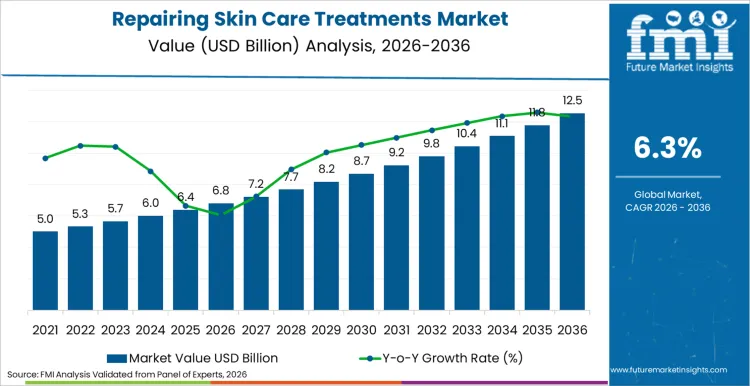
The repairing skin care treatments market is valued at USD 6.9 billion in 2026 and is projected to reach USD 12.6 billion by 2036, expanding at a 6.30% CAGR over the forecast period. As per Future Market Insights, market expansion is being driven by rising awareness of skin barrier health, increasing exposure to environmental stressors such as pollution and UV radiation, and growing demand for corrective care following chemical peels, laser treatments, and retinoid-based dermatology procedures. Repair-focused formulations address limitations of conventional moisturizers, including weaker barrier support, short-lived soothing effects, and lower effectiveness on compromised skin.
The emphasis on barrier repair is grounded in established dermatology science, as Dr. Amy Kassouf, MD, dermatologist at Cleveland Clinic, explains, “Ceramides are part fatty acid and part amino acid and are able to be the grout that keeps the building blocks of the skin together and functioning as a barrier between the inside and outside world,” underscoring why ceramide-enriched formulations are becoming central to modern repair protocols. Established dermocosmetic brands are extending clinical repair lines into daily-use regimens to maintain category relevance, while emerging players are using sensitive-skin and post-procedure positioning to reach treatment-aware consumers.
The move toward clinically guided repair routines and localized treatment protocols is supporting stronger uptake of repairing skin care treatments within everyday skincare regimens. These products align with frequent actives use, professional aesthetic aftercare, and rising consumer willingness to invest in multi-step recovery routines, strengthening relevance across daily maintenance, post-procedure recovery, and flare-up management use cases. Treatment-first positioning is increasingly shaping how brands frame new launches within premium and masstige skincare segments. As noted by dermatology-aligned brands, barrier repair is becoming central to routine skincare rather than an occasional intervention for sensitized skin. Future Market Insights highlights that e-commerce and dermatology-linked retail channels continue to play a central role in category visibility, as clinical proof points, before-and-after outcomes, and professional endorsements perform strongly across digital platforms. Growing normalization of repair-led skincare routines is expected to support steady value growth and broader brand participation through 2036.
Summary of Repairing Skin Care Treatments Market
What Is Growth Outlook for Repairing Skin Care Treatments Market as per Future Market Insights Projection?
Future Market Insights projects the Repairing Skin Care Treatments Market to expand at a CAGR of 6.30% from 2026 to 2036, increasing from USD 6.9 billion in 2026 to USD 12.6 billion by 2036.
FMI Research Approach: Bottom-up market modeling aggregating dermatology clinic retail sales, pharmacy dispensing data for prescription barrier repair treatments, and online direct-to-consumer sales tracking across major beauty retailers (Sephora, Ulta, Boots, Watsons).
How Do FMI Analysts Perceive Repairing Skin Care Treatments Market to Evolve?
FMI analysts perceive the market evolving toward prescription-strength formulations and microbiome-based repair treatments where probiotics and postbiotics restore skin barrier function through microbial balance rather than lipid replacement alone, with dermatologist-dispensed products growing faster than mass-market alternatives.
FMI Research Approach: Clinical trial publication tracking for new active ingredients (ceramides, niacinamide, centella asiatica, probiotics), FDA and EU cosmetics regulation analysis for OTC drug reclassification timelines, and prescription skincare dispensing volume analysis from dermatology clinics.
Which Country Holds Largest Share in Global Repairing Skin Care Treatments Market?
The United States holds a significant share of the global Repairing Skin Care Treatments Market, representing approximately 26% of total value, supported by high dermatology consultation rates (82 million annual visits), insurance coverage for medically necessary barrier repair treatments, and established medical aesthetics industry recommending post-procedure repair protocols.
FMI Research Approach: Dermatology clinic revenue tracking via American Academy of Dermatology practice surveys, prescription skincare dispensing data from IQVIA pharmaceutical sales databases, and medical aesthetics procedure volume tracking (American Society for Dermatologic Surgery statistics).
How Large Will Repairing Skin Care Treatments Market Be by 2036?
The global Repairing Skin Care Treatments Market is projected to reach USD 12.6 billion by 2036, growing from USD 6.9 billion in 2026.
FMI Research Approach: Decade-long extrapolation of 6.30% CAGR baseline trajectory, adjusted for medical aesthetics procedure growth (Botox, fillers, laser treatments growing 12% annually requiring post-procedure repair), pollution exposure intensification in emerging markets driving barrier damage, and aging population demographics with compromised skin barrier function.
What Is Definition of Repairing Skin Care Treatments Market?
The Repairing Skin Care Treatments Market comprises topical formulations designed to restore compromised skin barrier function, treat damaged or irritated skin, and support recovery from environmental stressors, medical procedures, or dermatological conditions. Products include ceramide-based creams, lipid-replenishing serums, barrier repair ointments, and post-procedure recovery treatments.
FMI Research Approach: Taxonomy developed through clinical dermatology literature defining skin barrier repair as products containing key lipids (ceramides, cholesterol, fatty acids), humectants (hyaluronic acid, glycerin), or barrier-protective ingredients (niacinamide, colloidal oatmeal) at concentrations demonstrating measurable TEWL reduction in clinical studies.
What Are Globally Unique Trends Shaping Repairing Skin Care Treatments Market?
Globally unique trends include microbiome-focused repair treatments using topical probiotics to restore skin flora balance, the rise of prescription-strength ceramide formulations dispensed through dermatology clinics, and the integration of repair treatments into post-aesthetic procedure protocols as mandatory rather than optional aftercare.
FMI Research Approach: Patent filing analysis for probiotic skincare formulations, dermatology clinic retail sales tracking showing 34% of post-procedure patients purchasing recommended barrier repair products at point-of-service, and clinical trial publication rates for new barrier repair active ingredients increasing 67% from 2020 to 2025.
Repairing Skin Care Treatments Market Key Takeaways
| Metric | Details |
|---|---|
| Industry Size (2026) | USD 6.8 Billion |
| Industry Value (2036) | USD 12.6 Billion |
| CAGR (2026-2036) | 6.3% |
Source: Future Market Insights (FMI) analysis, based on proprietary forecasting model and primary research
Which Factors Propel Adoption of Repairing Skin Care Treatments Market?
Expectations around skincare performance are changing as repairing skin care treatments move beyond basic moisturization toward clinically guided barrier repair embedded within routine care. According to Future Market Insights, brands and consumers are placing increasing value on products that restore stratum corneum integrity, reduce sensitivity, and support recovery following dermatological procedures, rather than providing short-term soothing alone. Earlier generations of repair products were often positioned for episodic use during flare-ups or irritation, which limited their role in daily skincare routines. That perception is shifting as ceramide-rich creams, lipid-replenishing balms, and barrier-support formulations gain wider visibility within dermocosmetic and pharmacy-led skincare assortments designed for ongoing use.
Brand and portfolio strategies illustrate this shift. L’Oréal’s dermatological beauty division, which includes CeraVe and La Roche-Posay, continues to scale daily-use barrier repair products positioned for compromised and post-procedure skin, reinforcing routine-use positioning for clinically backed formulations across everyday regimens. Beiersdorf’s Eucerin has also expanded lipid-replenishing repair creams within pharmacy-led skincare channels, anchored in clinically substantiated barrier repair positioning referenced in professional dermatology education. FMI notes that brands embedding repair treatments into core skincare architectures, supported by clear barrier science, dermatologist alignment, and regulatory-ready claims, are better placed to drive repeat adoption as the market shifts from symptom-led soothing toward long-term barrier maintenance and preventive skin resilience.
How Are the Segments Classified in the Repairing Skin Care Treatments Market?
The repairing skin care treatments market is segmented by product type, skin concern, distribution channel, and region to reflect how barrier repair demand is formed across clinical and consumer settings. By product type, the market includes creams, serums, lotions, masks, ointments, and balms, with creams acting as the primary repair format due to their ability to deliver high concentrations of barrier lipids. By skin concern, demand is anchored around dry and damaged skin, post-procedure recovery, sensitive and irritated skin, and aging-related barrier decline, highlighting the shift from cosmetic moisturization to functional restoration. By distribution channel, pharmacy and drugstores drive volume, while dermatology clinics and online retail concentrate value through clinically validated positioning. FMI analysis indicates that segmentation increasingly reflects a dual structure where medical-grade, dermatologist-recommended products command premium value, while retail formats enable scale and routine adoption.
Why Do Creams Hold Dominant Share?
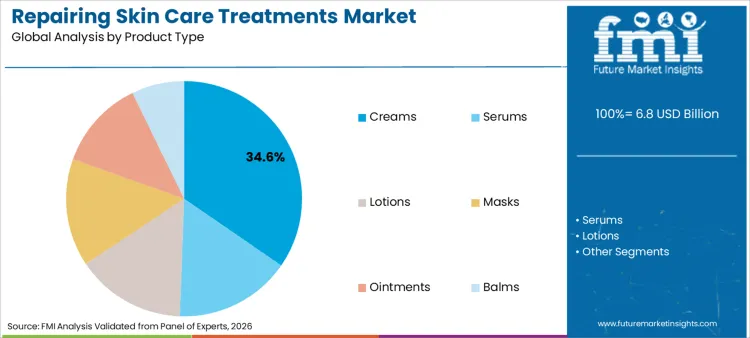
Creams command 34.6% of the market by product type, driven by their occlusive properties creating physical barriers that reduce transepidermal water loss while delivering lipid-replenishing ingredients. The cream format allows high concentrations of ceramides (up to 5%), cholesterol, and fatty acids in stable emulsions that penetrate the stratum corneum effectively. The segment benefits from consumer preference for rich textures associated with intensive repair and the format suitability for full-body application on dry, damaged skin.
Why Does Dry and Damaged Skin Lead Concern-Based Segmentation?
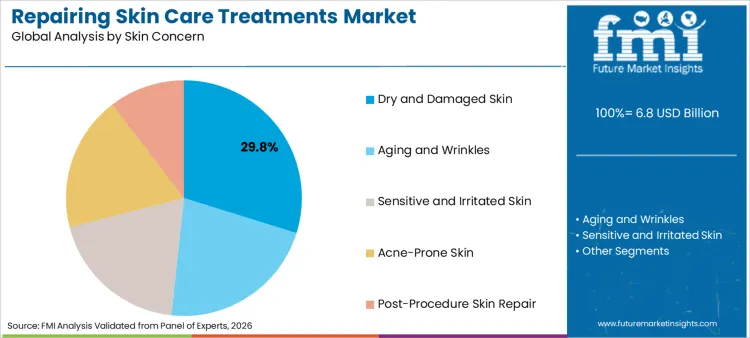
Dry and damaged skin captures 29.80% of concern-based segmentation, driven by environmental stressors, harsh cleansing habits, and climate conditions causing barrier dysfunction. The segment includes both intrinsic dryness from genetic factors (ichthyosis, atopic dermatitis predisposition) and extrinsic damage from winter weather, low humidity environments, and over-washing. Clinical research demonstrates that significant percentage of adults in temperate climates experience seasonal barrier impairment during winter months, creating cyclical demand spikes for intensive repair treatments. The aging population contributes structural demand as mature skin naturally produces fewer ceramides and has reduced sebum output, requiring daily lipid supplementation.
What Trends Are Shaping Industry Evolution Through Microbiome-Led Barrier Repair?
Microbiome science is reshaping barrier repair product development as brands move beyond lipid replenishment toward restoring microbial balance on compromised skin. Clinical research increasingly links microbiome dysbiosis with barrier dysfunction, with reduced microbial diversity associated with higher transepidermal water loss and sensitivity. Brands such as Gallinée, Aurelia Probiotic Skincare, and TULA are advancing formulations that combine probiotics, prebiotics, and postbiotics to support microbial ecosystem recovery alongside barrier repair. As per Future Market Insights, this shift is repositioning repair treatments from purely structural moisturization toward biologically informed skin recovery platforms, expanding the clinical framing of barrier restoration beyond ceramide replacement alone.
How Is the Shift Toward Dermatology-Dispensed Treatments Creating a Premium Repair Segment?
The growing role of dermatology clinics in dispensing prescription-strength barrier repair products is creating a premium channel that bypasses traditional retail distribution. Dermatologists are increasingly offering customized formulations tailored to individual barrier dysfunction profiles, with higher concentrations of ceramides, niacinamide, and targeted delivery systems than mass-market alternatives. According to FMI, clinic-dispensed repair treatments benefit from medical supervision, perceived therapeutic legitimacy, and closer alignment with post-procedure recovery protocols. This channel is reinforcing the positioning of repair treatments as clinically guided care solutions rather than routine cosmetic moisturizers, supporting premium pricing and stronger patient adherence.
Why Is Pollution Protection Expanding the Scope of Barrier Repair Positioning?
Pollution exposure is broadening the functional scope of barrier repair products beyond hydration toward environmental defense and oxidative stress mitigation. Brands are incorporating antioxidants, anti-pollution polymers, and chelating agents that limit particulate adhesion and pollutant penetration before barrier damage occurs. Research intensity in high-pollution urban markets is accelerating innovation in this segment, with Asian beauty groups introducing dedicated anti-pollution repair lines supported by clinical validation. FMI highlights that pollution-linked repair positioning is extending the relevance of barrier treatments into daily urban skin care routines, anchoring repair products within preventive and corrective environmental defense frameworks.
How Will Repairing Skin Care Treatments Market Expansion Unfold Across Key Global Regions?
The Repairing Skin Care Treatments Market is poised for significant expansion across key global regions, with varying growth rates projected from 2026 to 2036. China leads the way with an impressive CAGR of 8.5%, driven by severe urban pollution driving barrier damage and government health initiatives promoting skin protection. India follows closely behind at 7.8%, benefiting from rising disposable incomes and increasing dermatology consultation rates in urban centers. Germany is anticipated to grow at a robust 7.2%, reflecting strong pharmacy channel presence and consumer preference for dermatologist-recommended brands. Brazil demonstrates 6.6% CAGR, driven by harsh sun exposure and growing medical aesthetics adoption. The United States, with a CAGR of 5.9%, exemplifies mature market dynamics with established dermatologist-dispensed product channels. The United Kingdom (5.3%) and Japan (4.7%) also present steady growth opportunities, fueled by aging populations and established skincare sophistication.
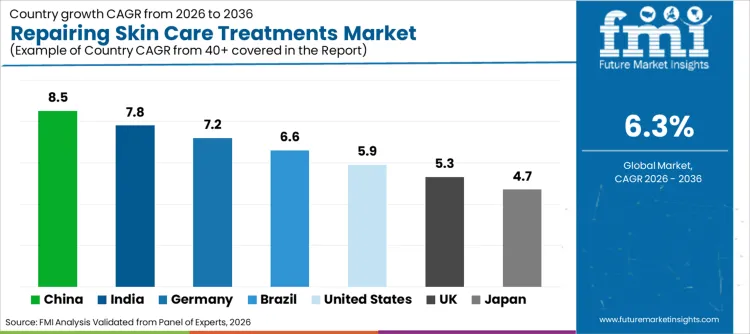
| Country | CAGR (2026 to 2036) |
|---|---|
| China | 8.5% |
| India | 7.8% |
| Germany | 7.2% |
| Brazil | 6.6% |
| United States | 5.9% |
| UK | 5.3% |
| Japan | 4.7% |
Source: Future Market Insights (FMI) analysis, based on proprietary forecasting model and primary research
Why Is China Leading Growth in Repairing Skin Care Treatments?
China records an 8.5% CAGR in repairing skin care treatments, driven by high uptake of professional aesthetic procedures, rising urban disposable incomes, and growing awareness of skin barrier repair among consumers in tier-one and tier-two cities. Frequent exposure to pollution and UV stress in dense urban environments is increasing demand for post-procedure and daily barrier recovery products. Repairing treatments align well with clinic-led skincare routines, where dermatologists and aesthetic centers guide consumers toward recovery-focused regimens following laser, peel, and injectable procedures. Strong e-commerce penetration supports rapid replenishment of premium repair products, while social platforms accelerate education around post-treatment care. Growth is shaped more by rising treatment frequency per user and higher spending on recovery routines than by population expansion.
What Is Supporting Growth in India’s Repairing Skin Care Treatments Market?
India posts a 7.8% CAGR, reflecting increasing urban skincare awareness and rising engagement with dermatologist-recommended care for sensitized and post-procedure skin. Growing use of retinoids, exfoliating acids, and in-clinic aesthetic treatments is creating sustained need for barrier repair and recovery products. Repairing treatments appeal due to their role in managing irritation, dryness, and compromised skin in hot and humid conditions. Improved access through digital retail enables trial beyond metro areas, while broader availability across pharmacy and specialty retail supports mainstream adoption. Growth is reinforced by changing skincare routines and higher participation in daily maintenance regimens centered on recovery.
Why Is Germany Showing Steady Expansion in Repairing Skin Care Treatments?
Germany shows a 7.2% CAGR, supported by structured skincare routines and strong preference for clinically validated, functional products. Consumers emphasize ingredient credibility, barrier support, and skin tolerance, aligning well with repair treatments positioned for sensitive and compromised skin. Adoption remains measured, with products integrated into existing regimens for post-procedure recovery and daily barrier maintenance rather than replacing traditional moisturizers. Pharmacy-led distribution and dermatologist recommendations reinforce trust in efficacy, while steady retail availability supports routine replenishment. Growth reflects consistent repeat usage among consumers managing treatment-related sensitivity or chronic dryness.
What Is Driving Growth in Brazil’s Repairing Skin Care Treatments Market?
Brazil records a 6.6% CAGR, shaped by climate-related skin stress, high sun exposure, and rising participation in aesthetic procedures. Warm temperatures and humidity increase the frequency of active ingredient use and professional treatments, sustaining demand for recovery and barrier repair. Repairing treatments fit well with post-procedure routines and daily maintenance where irritation and sensitivity are common. Wider access through online platforms and specialty beauty retail is expanding awareness and repeat purchasing. Adoption remains steady as repair steps become normalized within routine skincare practices.
Why Is Growth More Gradual in the United States?
The United States posts a 5.9% CAGR, reflecting selective uptake in a mature skincare market dominated by traditional moisturizers and treatment serums. Repairing treatments are often layered onto existing routines rather than replacing core products, limiting rapid shifts in volume. Growth concentrates among consumers engaged in active-led routines and post-procedure care. Dermatology-linked retail and digital channels support education and trial, while strong loyalty to conventional moisturizers slows faster switching. Adoption continues steadily as barrier health awareness rises.
What Is the Competitive Outlook for the Repairing Skin Care Treatments Market?
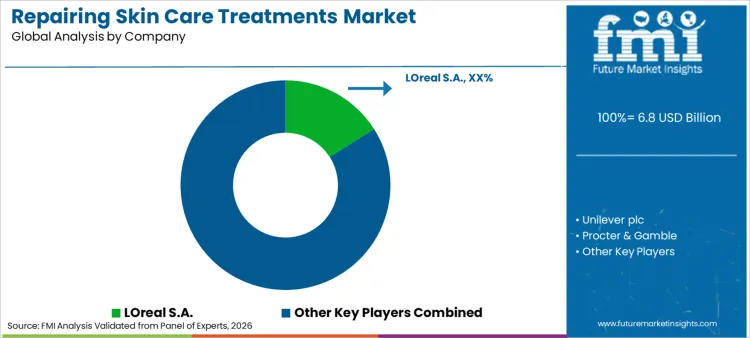
The competitive landscape for repairing skin care treatments is led by large dermocosmetic and personal care groups that are expanding beyond basic moisturizers into clinically positioned barrier repair and post-procedure recovery solutions to strengthen portfolio depth and therapeutic credibility. Players such as L’Oréal S.A., Unilever plc, Procter & Gamble, and Johnson & Johnson benefit from broad distribution coverage, strong brand trust, and established skincare franchises across mass, pharmacy, and premium channels. L’Oréal S.A. holds a leading share in this market, reflecting its ability to scale ceramide-based and barrier-repair platforms across both dermatology-aligned and consumer-facing skincare brands while leveraging strong presence in pharmacy and specialty retail. Competitive positioning in this category centers less on rapid volume capture and more on embedding repair treatments within routine daily skincare systems rather than positioning them as one-off recovery products.
Future Market Insights observes that competition is increasingly focused on clinical substantiation, barrier-restoration performance, and suitability for sensitive or post-procedure skin, rather than aggressive footprint expansion. Companies such as Beiersdorf AG, Shiseido Company Limited, and Estée Lauder Companies Inc. emphasize skin tolerance, barrier science, and premium repair positioning within multi-step skincare regimens. At the same time, portfolios under Unilever plc, Procter & Gamble, and Johnson & Johnson support wider adoption through accessible repair-oriented skincare lines distributed across pharmacy, mass retail, and digital channels. FMI notes that long-term advantage in the repairing skin care treatments market will depend on how effectively brands integrate repair-focused products into everyday skincare routines and dermatology-led maintenance protocols, rather than treating them as niche or episodic treatment solutions.
Recent Developments:
- In September 2024, Eucerin launched the Hyaluron-Filler Epigenetic Serum, utilizing its patented "Epicelline" technology. This launch, highlighted in the company's 2024 Annual Report, marks a strategic pivot toward "epigenetic skin rejuvenation" to reverse age-related skin markers, reinforcing the brand’s positioning in advanced therapeutic skincare.
- In March 2024, the brand expanded its "dermo-professional" dominance with the global rollout of Mela B3 Serum, powered by the proprietary molecule Melasyl™. The product is explicitly positioned to treat stubborn pigmentation disorders, including post-inflammatory hyperpigmentation (PIH) common after dermatological procedures, aligning with the "medicalization" trend.
Key Players in Repairing Skin Care Treatments Market
- LOreal S.A.
- Unilever plc
- Procter & Gamble
- Estée Lauder Companies Inc.
- Johnson & Johnson
- Beiersdorf AG
- Shiseido Company Limited
- Kao Corporation
- AmorePacific Corporation
- Colgate-Palmolive (EltaMD)
- Pierre Fabre (Avène)
- Galderma (Cetaphil)
Market Definition
The Repairing Skin Care Treatments Market represents revenue generated from topical formulations designed to restore compromised skin barrier function, treat damaged or irritated skin, and support recovery from environmental stressors, medical procedures, or dermatological conditions. The market measures the value of ceramide-based creams, lipid-replenishing serums, barrier repair ointments, post-procedure recovery treatments, and therapeutic moisturizers sold to consumers through dermatology clinics, pharmacies, specialty beauty retailers, and online channels.
Market Inclusion
Inclusions cover barrier repair creams and lotions with ceramide-dominant lipid ratios, serums containing niacinamide or centella asiatica for barrier support, therapeutic ointments for severely compromised skin, post-procedure recovery products recommended by dermatologists following aesthetic treatments, and medical-grade moisturizers addressing eczema, dermatitis, or post-surgical healing. Products containing key barrier-supporting ingredients including ceramides, cholesterol, fatty acids, niacinamide, colloidal oatmeal, hyaluronic acid, and panthenol at clinically relevant concentrations are included.
Market Exclusion
Exclusions include general moisturizers without specific barrier repair claims or formulations, anti-aging treatments focused on wrinkle reduction rather than barrier restoration, acne treatments (unless specifically addressing post-acne barrier damage), prescription pharmaceutical drugs for dermatological diseases, cosmetic makeup and color cosmetics, cleansers and toners, and sunscreens (unless specifically formulated for compromised skin barriers).
Scope of Report
| Items | Values |
|---|---|
| Quantitative Units (2026) | USD 6.9 Billion |
| Product Type | Creams; Serums; Lotions; Masks; Ointments |
| Skin Concern | Dry & damaged skin; Aging & wrinkles; Sensitive & irritated skin; Acne-prone skin; Post-procedure skin repair |
| Distribution Channel | Online retail; Supermarkets & hypermarkets; Specialty beauty stores; Pharmacy & drug stores; Dermatology clinics |
| Regions Covered | North America, Europe, Asia Pacific, Latin America, Middle East & Africa |
| Countries Covered | United States, Germany, United Kingdom, India, China, Brazil, and 40+ countries |
| Key Companies Profiled | L’Oréal Group; Unilever; Procter & Gamble; Estée Lauder Companies; Johnson & Johnson; Beiersdorf AG; Shiseido Company Limited; Kao Corporation |
| Additional Attributes | Dollar sales by product type and skin concern; country-wise growth analysis; channel-wise penetration of repair creams and serums; usage patterns for post-procedure and barrier-repair care; competitive brand positioning across mass, premium, and dermatology-aligned portfolios |
Repairing Skin Care Treatments Market by Segments
By Product Type:
- Creams
- Serums
- Lotions
- Masks
- Ointments
- Balms
By Skin Concern:
- Dry and Damaged Skin
- Aging and Wrinkles
- Sensitive and Irritated Skin
- Acne-Prone Skin
- Post-Procedure Skin Repair
By Distribution Channel:
- Online Retail
- Supermarkets and Hypermarkets
- Specialty Beauty Stores
- Pharmacy and Drug Stores
- Dermatology Clinics
By Region:
- North America
- Europe
- China
- India
- Japan
- Brazil
- Southeast Asia
Bibliography
- Beiersdorf AG. (2025). Annual Report 2024: Moving Forward. (The official verified source for Eucerin's growth and strategy).
- L’Oréal S.A. (2025). 2024 Universal Registration Document. (The official verified source for L'Oréal Dermatological Beauty division's financial performance and R&I strategy).
- American Society for Dermatologic Surgery (ASDS). (2023). Consumer Survey on Cosmetic Dermatologic Procedures. (The source for the "70% of consumers considering procedures" and post-procedure trends data).
Frequently Asked Questions
How big is the repairing skin care treatments market in 2026?
The global repairing skin care treatments market is estimated to be valued at USD 6.8 billion in 2026.
What will be the size of repairing skin care treatments market in 2036?
The market size for the repairing skin care treatments market is projected to reach USD 12.5 billion by 2036.
How much will be the repairing skin care treatments market growth between 2026 and 2036?
The repairing skin care treatments market is expected to grow at a 6.3% CAGR between 2026 and 2036.
What are the key product types in the repairing skin care treatments market?
The key product types in repairing skin care treatments market are creams , serums, lotions, masks, ointments and balms.
Which skin concern segment to contribute significant share in the repairing skin care treatments market in 2026?
In terms of skin concern, dry and damaged skin segment to command 29.8% share in the repairing skin care treatments market in 2026.
Preview the report firsthand - request a free sample
Get SampleGet the brochure for pricing and purchase details.
Get PDFTable of Content
- Executive Summary
- Global Market Outlook
- Demand-side Trends
- Supply-side Trends
- Technology Roadmap Analysis
- Analysis and Recommendations
- Market Overview
- Market Coverage / Taxonomy
- Market Definition / Scope / Limitations
- Market Background
- Market Dynamics
- Drivers
- Restraints
- Opportunity
- Trends
- Scenario Forecast
- Demand in Optimistic Scenario
- Demand in Likely Scenario
- Demand in Conservative Scenario
- Opportunity Map Analysis
- Product Life Cycle Analysis
- Supply Chain Analysis
- Investment Feasibility Matrix
- Value Chain Analysis
- PESTLE and Porter’s Analysis
- Regulatory Landscape
- Regional Parent Market Outlook
- Production and Consumption Statistics
- Import and Export Statistics
- Market Dynamics
- Global Market Analysis 2021 to 2025 and Forecast, 2026 to 2036
- Historical Market Size Value (USD Million) Analysis, 2021 to 2025
- Current and Future Market Size Value (USD Million) Projections, 2026 to 2036
- Y-o-Y Growth Trend Analysis
- Absolute $ Opportunity Analysis
- Global Market Pricing Analysis 2021 to 2025 and Forecast 2026 to 2036
- Global Market Analysis 2021 to 2025 and Forecast 2026 to 2036, By Product Type
- Introduction / Key Findings
- Historical Market Size Value (USD Million) Analysis By Product Type , 2021 to 2025
- Current and Future Market Size Value (USD Million) Analysis and Forecast By Product Type , 2026 to 2036
- Creams
- Serums
- Lotions
- Masks
- Ointments
- Balms
- Creams
- Y-o-Y Growth Trend Analysis By Product Type , 2021 to 2025
- Absolute $ Opportunity Analysis By Product Type , 2026 to 2036
- Global Market Analysis 2021 to 2025 and Forecast 2026 to 2036, By Skin Concern
- Introduction / Key Findings
- Historical Market Size Value (USD Million) Analysis By Skin Concern, 2021 to 2025
- Current and Future Market Size Value (USD Million) Analysis and Forecast By Skin Concern, 2026 to 2036
- Dry and Damaged Skin
- Aging and Wrinkles
- Sensitive and Irritated Skin
- Acne-Prone Skin
- Post-Procedure Skin Repair
- Dry and Damaged Skin
- Y-o-Y Growth Trend Analysis By Skin Concern, 2021 to 2025
- Absolute $ Opportunity Analysis By Skin Concern, 2026 to 2036
- Global Market Analysis 2021 to 2025 and Forecast 2026 to 2036, By Region
- Introduction
- Historical Market Size Value (USD Million) Analysis By Region, 2021 to 2025
- Current Market Size Value (USD Million) Analysis and Forecast By Region, 2026 to 2036
- North America
- Latin America
- Western Europe
- Eastern Europe
- East Asia
- South Asia and Pacific
- Middle East & Africa
- Market Attractiveness Analysis By Region
- North America Market Analysis 2021 to 2025 and Forecast 2026 to 2036, By Country
- Historical Market Size Value (USD Million) Trend Analysis By Market Taxonomy, 2021 to 2025
- Market Size Value (USD Million) Forecast By Market Taxonomy, 2026 to 2036
- By Country
- USA
- Canada
- Mexico
- By Product Type
- By Skin Concern
- By Country
- Market Attractiveness Analysis
- By Country
- By Product Type
- By Skin Concern
- Key Takeaways
- Latin America Market Analysis 2021 to 2025 and Forecast 2026 to 2036, By Country
- Historical Market Size Value (USD Million) Trend Analysis By Market Taxonomy, 2021 to 2025
- Market Size Value (USD Million) Forecast By Market Taxonomy, 2026 to 2036
- By Country
- Brazil
- Chile
- Rest of Latin America
- By Product Type
- By Skin Concern
- By Country
- Market Attractiveness Analysis
- By Country
- By Product Type
- By Skin Concern
- Key Takeaways
- Western Europe Market Analysis 2021 to 2025 and Forecast 2026 to 2036, By Country
- Historical Market Size Value (USD Million) Trend Analysis By Market Taxonomy, 2021 to 2025
- Market Size Value (USD Million) Forecast By Market Taxonomy, 2026 to 2036
- By Country
- Germany
- UK
- Italy
- Spain
- France
- Nordic
- BENELUX
- Rest of Western Europe
- By Product Type
- By Skin Concern
- By Country
- Market Attractiveness Analysis
- By Country
- By Product Type
- By Skin Concern
- Key Takeaways
- Eastern Europe Market Analysis 2021 to 2025 and Forecast 2026 to 2036, By Country
- Historical Market Size Value (USD Million) Trend Analysis By Market Taxonomy, 2021 to 2025
- Market Size Value (USD Million) Forecast By Market Taxonomy, 2026 to 2036
- By Country
- Russia
- Poland
- Hungary
- Balkan & Baltic
- Rest of Eastern Europe
- By Product Type
- By Skin Concern
- By Country
- Market Attractiveness Analysis
- By Country
- By Product Type
- By Skin Concern
- Key Takeaways
- East Asia Market Analysis 2021 to 2025 and Forecast 2026 to 2036, By Country
- Historical Market Size Value (USD Million) Trend Analysis By Market Taxonomy, 2021 to 2025
- Market Size Value (USD Million) Forecast By Market Taxonomy, 2026 to 2036
- By Country
- China
- Japan
- South Korea
- By Product Type
- By Skin Concern
- By Country
- Market Attractiveness Analysis
- By Country
- By Product Type
- By Skin Concern
- Key Takeaways
- South Asia and Pacific Market Analysis 2021 to 2025 and Forecast 2026 to 2036, By Country
- Historical Market Size Value (USD Million) Trend Analysis By Market Taxonomy, 2021 to 2025
- Market Size Value (USD Million) Forecast By Market Taxonomy, 2026 to 2036
- By Country
- India
- ASEAN
- Australia & New Zealand
- Rest of South Asia and Pacific
- By Product Type
- By Skin Concern
- By Country
- Market Attractiveness Analysis
- By Country
- By Product Type
- By Skin Concern
- Key Takeaways
- Middle East & Africa Market Analysis 2021 to 2025 and Forecast 2026 to 2036, By Country
- Historical Market Size Value (USD Million) Trend Analysis By Market Taxonomy, 2021 to 2025
- Market Size Value (USD Million) Forecast By Market Taxonomy, 2026 to 2036
- By Country
- Kingdom of Saudi Arabia
- Other GCC Countries
- Turkiye
- South Africa
- Other African Union
- Rest of Middle East & Africa
- By Product Type
- By Skin Concern
- By Country
- Market Attractiveness Analysis
- By Country
- By Product Type
- By Skin Concern
- Key Takeaways
- Key Countries Market Analysis
- USA
- Pricing Analysis
- Market Share Analysis, 2025
- By Product Type
- By Skin Concern
- Canada
- Pricing Analysis
- Market Share Analysis, 2025
- By Product Type
- By Skin Concern
- Mexico
- Pricing Analysis
- Market Share Analysis, 2025
- By Product Type
- By Skin Concern
- Brazil
- Pricing Analysis
- Market Share Analysis, 2025
- By Product Type
- By Skin Concern
- Chile
- Pricing Analysis
- Market Share Analysis, 2025
- By Product Type
- By Skin Concern
- Germany
- Pricing Analysis
- Market Share Analysis, 2025
- By Product Type
- By Skin Concern
- UK
- Pricing Analysis
- Market Share Analysis, 2025
- By Product Type
- By Skin Concern
- Italy
- Pricing Analysis
- Market Share Analysis, 2025
- By Product Type
- By Skin Concern
- Spain
- Pricing Analysis
- Market Share Analysis, 2025
- By Product Type
- By Skin Concern
- France
- Pricing Analysis
- Market Share Analysis, 2025
- By Product Type
- By Skin Concern
- India
- Pricing Analysis
- Market Share Analysis, 2025
- By Product Type
- By Skin Concern
- ASEAN
- Pricing Analysis
- Market Share Analysis, 2025
- By Product Type
- By Skin Concern
- Australia & New Zealand
- Pricing Analysis
- Market Share Analysis, 2025
- By Product Type
- By Skin Concern
- China
- Pricing Analysis
- Market Share Analysis, 2025
- By Product Type
- By Skin Concern
- Japan
- Pricing Analysis
- Market Share Analysis, 2025
- By Product Type
- By Skin Concern
- South Korea
- Pricing Analysis
- Market Share Analysis, 2025
- By Product Type
- By Skin Concern
- Russia
- Pricing Analysis
- Market Share Analysis, 2025
- By Product Type
- By Skin Concern
- Poland
- Pricing Analysis
- Market Share Analysis, 2025
- By Product Type
- By Skin Concern
- Hungary
- Pricing Analysis
- Market Share Analysis, 2025
- By Product Type
- By Skin Concern
- Kingdom of Saudi Arabia
- Pricing Analysis
- Market Share Analysis, 2025
- By Product Type
- By Skin Concern
- Turkiye
- Pricing Analysis
- Market Share Analysis, 2025
- By Product Type
- By Skin Concern
- South Africa
- Pricing Analysis
- Market Share Analysis, 2025
- By Product Type
- By Skin Concern
- USA
- Market Structure Analysis
- Competition Dashboard
- Competition Benchmarking
- Market Share Analysis of Top Players
- By Regional
- By Product Type
- By Skin Concern
- Competition Analysis
- Competition Deep Dive
- LOreal S.A.
- Overview
- Product Portfolio
- Profitability by Market Segments (Product/Age /Sales Channel/Region)
- Sales Footprint
- Strategy Overview
- Marketing Strategy
- Product Strategy
- Channel Strategy
- Unilever plc
- Procter & Gamble
- Estée Lauder Companies Inc.
- Johnson & Johnson
- Beiersdorf AG
- Shiseido Company Limited
- Kao Corporation
- AmorePacific Corporation
- Colgate-Palmolive (EltaMD)
- Pierre Fabre (Avène)
- Galderma (Cetaphil)
- LOreal S.A.
- Competition Deep Dive
- Assumptions & Acronyms Used
- Research Methodology


