

- Market Size (2026)
- USD 7.8 Bn
- Forecast (2036)
- USD 12.9 Bn
- CAGR (2026 to 2036)
- 5.2%
Engine Module-Level Repair and Refurbishment Services Market Size, Market Forecast and Outlook By FMI
Summary of the Engine Module-Level Repair and Refurbishment Services Market
- Demand and Growth Drivers
- Aircraft delivery delays are extending engine service programs as airlines keep mature fleets available for scheduled operations.
- Engine part pricing is increasing buyer interest in approved repair work and used serviceable material planning.
- Shop visit pressure is raising demand for module repair as operators try to avoid full engine teardown.
- Product and Segment View
- Module repair is expected to lead the service type segment with 41.0% share in 2026, reflecting targeted scope control during shop visits.
- High-pressure turbine modules are projected to lead engine module demand with 32.0% share in 2026, reflecting hot-section repair cost exposure.
- Turbofan engines are anticipated to hold high-value service demand as narrowbody fleets create repeat module removal cycles.
- Geography and Competitive Outlook
- India is estimated to record a CAGR of 7.4% through 2036 as fleet expansion raises local engine service needs.
- China is projected to expand at 6.6% CAGR through 2036, as domestic aviation scale increases module repair volumes.
- Companies combining repair approval depth with test-cell access are strengthening their market position during the forecast period.
- Analyst Opinion
- Nikhil Kaitwade, Associate Vice President at FMI says, “Engine module repair shapes aircraft availability as airlines delayed deliveries. Operators need turbine module records within one service plan. Approved repair data can lower teardown cost. Provider selection should check pooling rights and warranty exposure before long term agreements.”
- Engine Module-Level Repair and Refurbishment Services Market Value Analysis
- The engine module-level repair and refurbishment services market is moving from broad engine overhaul into targeted module work.
- Service planning needs for turbofan fleets and aging narrowbody aircraft are encouraging broader use of module-level repair programs.
- The market is benefiting from deeper use of air transport MRO across airline engine programs.
- Repair records meeting release and warranty requirements are becoming a key demand factor for service providers.
- Cost pressure is strongest in turbine work as high-value parts affect final shop visit quotes.
Key Takeaways, Market Size, and Forecast
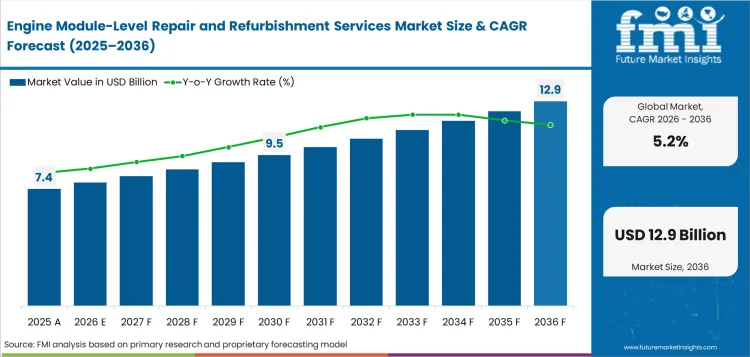
- The engine module-level repair and refurbishment services market was valued at USD 7.4 billion in 2025.
- By 2036, the Engine Module-Level Repair and Refurbishment Services Market is expected to be worth USD 12.9 billion.
- From 2026 to 2036, demand is projected to expand at a CAGR of 5.2%.
- The market is projected to create an incremental opportunity of USD 5.1 billion between 2026 and 2036.
- In 2026, turbofan engines are expected to account for 64.0% of engine type demand.
- India at 7.4% and China at 6.6% are two of the faster expanding country markets.
Module-level repair is becoming a capacity issue as narrow-body engine fleets face inspection pressure and longer service queues. GE Aerospace stated in February 2026 that its Seletar expansion will support CFM LEAP-1A/1B High-Pressure Turbine module repairs. The US$300 million Singapore MRO investment gives operators in Asia Pacific and the Middle East a closer repair route. Safran stated in December 2024 that its Brussels “Module Factory” will cover more than 11,000 square meters. Planned capacity of 1,200 module shop visits per year by 2028 turns module maintenance into a scaled production activity. AAR stated in March 2025 that FTAI’s Module Factory™ focuses on CFM56-7B and CFM56-5B modular repair and refurbishment. The connected pool of over 450 engines strengthens used-serviceable-material access. RTX stated in April 2025 that Pratt & Whitney’s additive repair reduces process time by more than 60%. That helps MRO providers reduce replacement-part pressure.
Engine Module-Level Repair and Refurbishment Services Market Definition
The engine module-level repair and refurbishment services market includes off-wing repair services performed on defined aircraft engine modules. These services cover inspection, teardown, repair, refurbishment, exchange planning, and release testing for engine sections. Scope includes turbofan, turboprop, and turboshaft engine modules used in civil and defense aviation. Full airframe MRO, new engine manufacturing, and standalone spare part trading are outside the scope.
Engine Module-Level Repair and Refurbishment Services Market Inclusions
Market scope covers all commercially traded engine module-level repair and refurbishment services categorized by service type, including module repair, module refurbishment, module exchange, inspection testing, and workscope planning, engine module, including high-pressure turbine, high-pressure compressor, fan module, low-pressure turbine, and accessory gearbox, engine type, including turbofan, turboprop, and turboshaft engines, provider type, including OEM networks, independent MRO providers, and airline shops, and end users, including commercial airlines, cargo operators, leasing companies, defense fleets, and business aviation operators. Revenue scope covers 2026 to 2036. The key stakeholders include aircraft engine OEMs, engine MRO providers, airline maintenance teams, leasing companies, component repair specialists, test-cell operators, parts suppliers, defense aviation agencies, aviation regulators, and service network partners.
Engine Module-Level Repair and Refurbishment Services Market Exclusions
Scope does not include full aircraft heavy checks, new engine assembly, propeller-only servicing, piston engine repair, or routine line maintenance.
Engine Module-Level Repair and Refurbishment Services Market Research Methodology
- Primary Research: FMI analysts talked to airline maintenance planners, engine MRO providers, leasing firms, and component repair specialists in important aviation markets.
- Desk Research: Combined data from aviation authority records, official traffic statistics, engine service portfolios, and aircraft maintenance requirements.
- Market sizing and forecasting: Added shop-visit demand across service types, engine modules, provider groups, and end-user groups from the bottom up.
- Data validation: Cross-checked every three months against aircraft utilization trends, shop capacity signals, and company service coverage.
Why is the Engine Module-Level Repair and Refurbishment Services Market Growing?
- Airlines are using module-level repair to manage shop visit cost before full engine overhaul becomes unavoidable.
- Engine access pressure is increasing as aircraft delivery delays keep older aircraft flying for longer periods.
- Leasing firms are asking for better module records to protect asset value during engine handback events.
Aircraft delivery pressure is keeping older engines inside airline service plans for longer periods. IATA reported in October 2025 aircraft deliveries fell to 1,254 in 2024 as backlog reached 17,000 jets. This backlog increases demand for module repair as airlines need serviceable engines before new aircraft arrive. Repair shops with approved data can reduce teardown exposure and protect return-to-service timing.
Passenger use is adding flight-hour pressure across fleets already exposed to supply chain limits. IATA reported in January 2026 full-year 2025 revenue passenger kilometers increased 5.3% over 2024. Higher aircraft use increases wear on hot-section modules and raises demand for timely repair planning. Service providers with turbine repair depth can convert operating pressure into repeat engine work.
Market Segmentation Analysis
- Module Repair is estimated to account for 41.0% of service type demand in 2026 with high use across targeted shop visits.
- High-Pressure Turbine is expected to account for 32.0% of engine module demand in 2026 with deeper cost exposure across hot-section work.
- Turbofan is expected to account for 64.0% of engine type demand in 2026 with higher use across narrowbody aircraft fleets.
- OEM Networks are estimated to account for 46.0% of provider type demand in 2026 with strong access to approved service instructions.
- Commercial Airlines are estimated to account for 59.0% of end-user demand in 2026 with frequent engine removal planning needs.
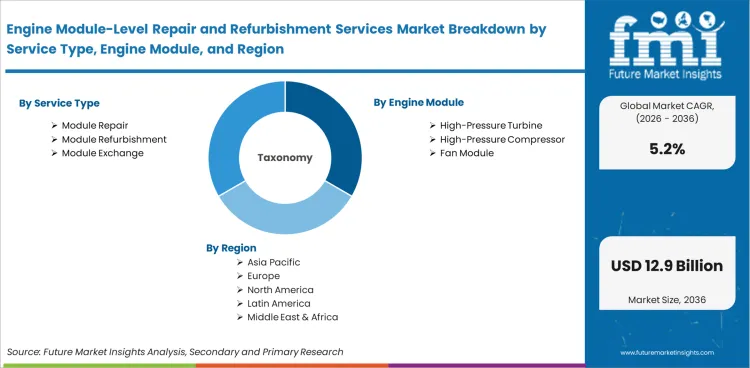
The market for engine module-level repair and refurbishment services is divided into five primary segment groups based on service type, engine module, engine type, provider type, and end user. Service type includes Module Repair, Module Refurbishment, Module Exchange, Inspection Testing, and Workscope Planning. Engine module includes High-Pressure Turbine, High-Pressure Compressor, Fan Module, Low-Pressure Turbine, and Accessory Gearbox. Engine type includes Turbofan, Turboprop, and Turboshaft. Provider type includes OEM Networks, Independent MRO, and Airline Shops. End user includes Commercial Airlines, Cargo Operators, Leasing Companies, Defense Fleets, and Business Aviation.
Insights into the Module Repair Service Type Segment
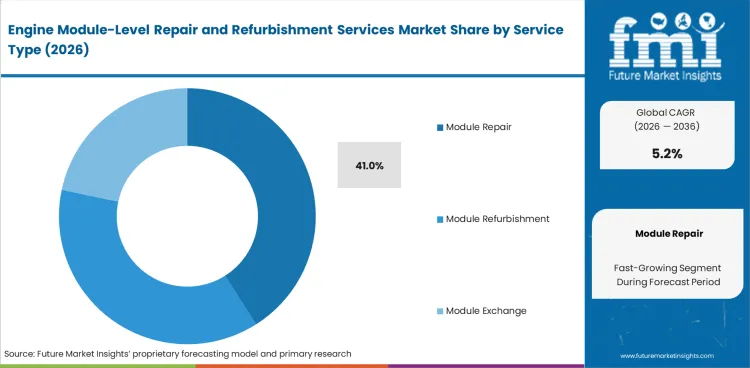
- In 2026, module repair is estimated to make up 41.0% of the service type segment. Operators use targeted module repair to control shop visit scope before full engine teardown becomes necessary.
- Module refurbishment and exchange services address engines needing deeper restoration after repeated operating cycles create section-level wear. Inspection testing adds value during release decisions requiring verified evidence for service approval.
Insights into the High-Pressure Turbine Engine Module Segment
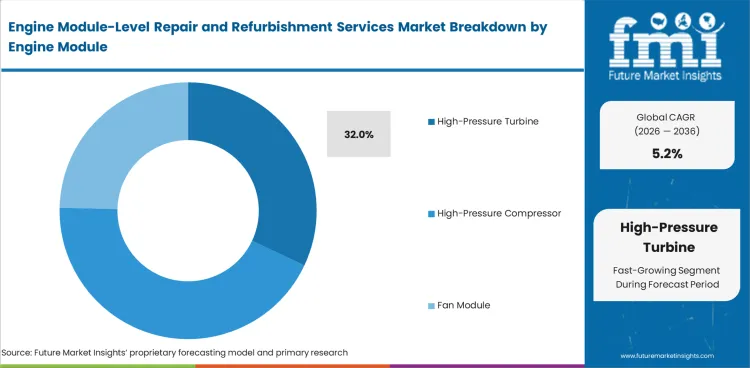
- High-pressure turbine modules are expected to hold 32.0% of the engine module segment in 2026. Hot-section exposure makes this module group more inspection-heavy during repair planning.
- Fan modules and compressor sections serve different repair needs across airflow and compression performance. Their service value improves as operators need focused restoration without wider engine disassembly.
Insights into the Turbofan Engine Type Segment
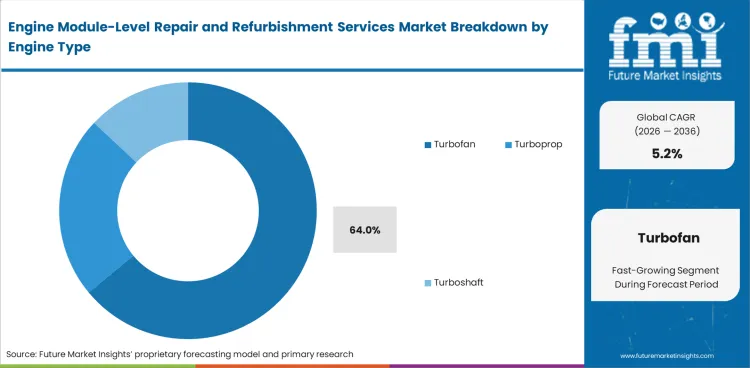
- In 2026, turbofan engines are projected to contribute 64.0% share of the engine type segment. Narrowbody fleet scale keeps this engine group central to repeat module repair planning.
- Turboprop and turboshaft engines serve regional aircraft and rotorcraft repair needs. Their demand pattern is steadier and often linked to smaller fleet service schedules.
Insights into the OEM Networks Provider Type Segment
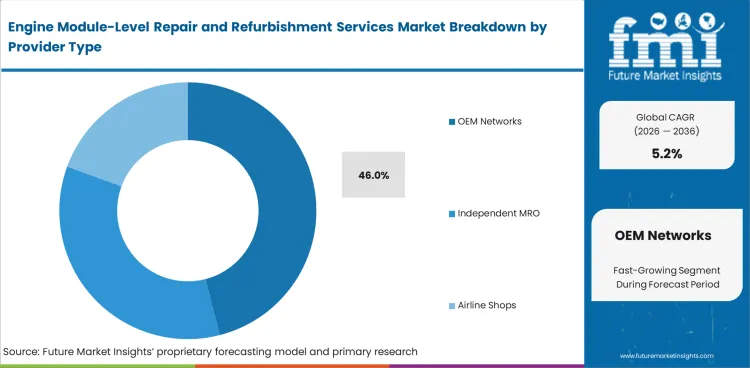
- In 2026, OEM networks are forecast to hold 46.0% of the provider type segment. Approved repair instructions and parts access make them important for high-value module work.
- Independent MRO providers focus on faster intake and flexible handling of varied workscope requirements during maintenance operations. Airline shops handle selected module tasks if internal capability and required release authority are available.
Insights into the Commercial Airlines End User Segment
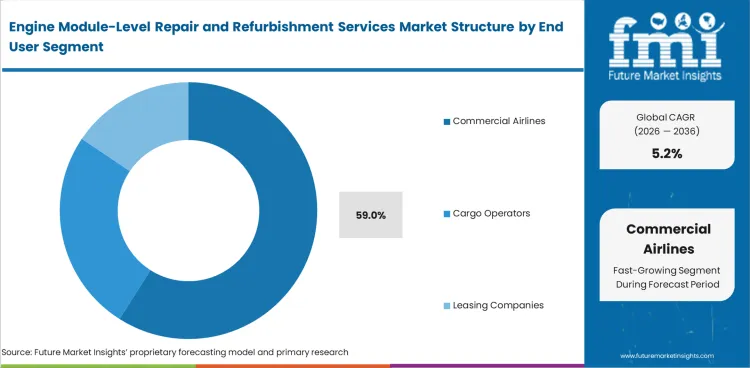
- In 2026, commercial airlines are projected to account for 59.0% of the end-user segment. Frequent aircraft use makes airline fleets the largest source of module repair demand.
- Cargo operators and leasing companies create different service needs across asset use and redelivery events. Reliable release timing helps both groups manage aircraft availability and engine value.
Engine Module-Level Repair and Refurbishment Services Market Drivers, Restraints, and Opportunities
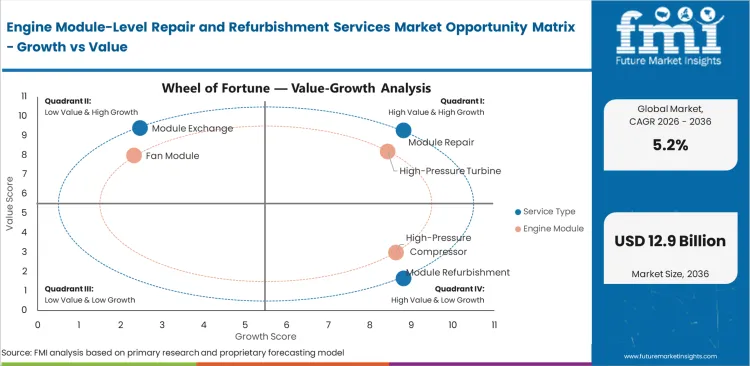
- Delivery delays are creating structured demand for module-level repair across mature aircraft fleets.
- High engine part prices improve margin pressure for operators and smaller service providers.
- Digital inspection creates service opportunity through faster defect review and better repair records.
Engine module-level repair and refurbishment services for aircraft engines keep expanding because airlines need controlled shop visit scope and reliable module release records. Cost pressure and limited test-cell access can slow faster service turnaround. Growth continues through turbofan fleet demand and approved repair programs.
Engine Scarcity Is Lifting Repair Quotes
Engine module-level repair and refurbishment pricing is being pulled upward by the cost of delay instead of labor alone. In April 2026, IATA said PW1100G engine lease rates had doubled since 2019, while LEAP-1A and LEAP-1B lease rates had risen over 50%, it has put added engine-leasing cost from longer maintenance ground time at USD 2.6 billion in 2025. Airlines are less likely to award contracts based only on bench rate discounts, as delays in a fan or compressor module can trigger expensive substitute lift requirements. Delays in combustor or turbine modules can also lead to costly substitute lift needs across airline operations. Providers with exchange stock and validated turnaround slots can price availability instead of focusing only on workmanship. Repair development capability further supports pricing strategies that emphasize availability and operational readiness.
Higher Utilization Is Tightening Shop Capacity
Module-level repair prices are firming as operators extract more flying hours from existing aircraft fleets. This usage pattern brings life-limited parts and hot-section deterioration into earlier shop visit planning decisions. Accessory repairs move forward as older engines carry more work between planned replacement service cycles. In March 2025, ARSA’s Oliver Wyman executive summary reported average flight hours per aircraft increased almost 15% to 2,800 hours in 2024 from just over 2,400 in 2022, while global utilization exceeded 78 million flight hours. Engine module shops gain fuller induction pipelines as airlines keep more work inside active repair schedules. This reduces willingness to offer discounted capacity during periods with tighter teardown and test-cell availability. Buyers should expect price adders for expedited teardown and parts pre-kitting across labor-heavy refurbishment work. Non-routine findings can raise final quotes further as shops assign more inspection time and repair labor. Contracting earlier against forecast removals is becoming a cost-control tool.
Analysis of Engine Module-Level Repair and Refurbishment Services Market By Key Countries
.webp "Top Country Growth Comparison Engine Module Level Repair And Refurbishment Services Market Cagr (2026 2036)")
| Country | CAGR |
|---|---|
| India | 7.4% |
| China | 6.6% |
| Singapore | 5.9% |
| USA | 5.7% |
| Canada | 4.8% |
| Germany | 4.1% |
| UK | 3.6% |
Source: Future Market Insights, 2026.
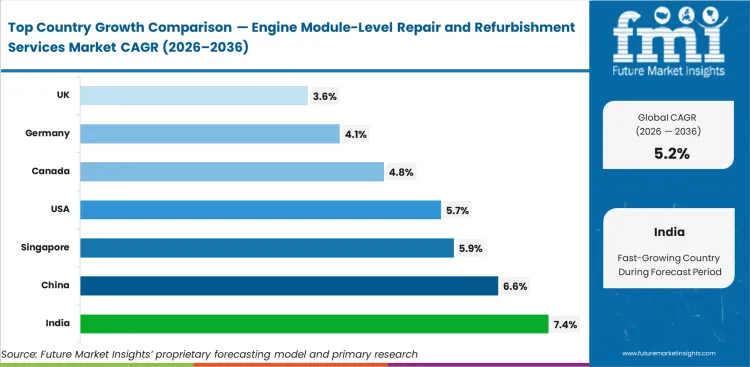
Engine Module-Level Repair and Refurbishment Services Market CAGR Analysis By Country
- India is expected to lead with a 7.4% CAGR through 2036 as fleet expansion and MRO localization increase service demand.
- China is projected at 6.6% CAGR as dense domestic flying raises demand for local engine module repair.
- Singapore’s predicted 5.9% CAGR is supported by hub maintenance capacity and regional airline traffic feeding engine shop programs.
- USA demand is forecast at 5.7% CAGR, with deep engine shop networks serving large airline fleets.
- Canada’s estimated 4.8% CAGR follows steady airline activity and demand for repair access across North American service networks.
- Germany is expected to record 4.1% CAGR as mature service capacity keeps fleet repair demand measured.
- UK demand is projected at 3.6% CAGR by 2036 with airport activity sustaining routine engine service work.
Demand for engine module-level repair and refurbishment services is forecast to rise at 5.2% CAGR from 2026 to 2036. Country-level analysis covers the major markets contributing to this forecast, with the key markets listed below.
Demand Outlook for Engine Module-Level Repair and Refurbishment Services Market in India
India’s engine module-level repair and refurbishment services industry is projected to record a CAGR of 7.4% through 2036. Indian airports handled 412 million passengers in FY25 and are projected to handle 665 million by FY31, according to a January 2026 PIB release. Passenger volume in India increases the need for local engine service access as airlines expand fleets and limit ferry expenses. Local module shops can gain from carriers seeking faster turnarounds and better cost control.
- Local fleet growth favors demand for turbofan module repair and engine release testing.
- MRO localization improves service access for airlines operating dense domestic networks.
- Indian carriers need module partners who can reduce aircraft downtime and repair cost exposure.
Sales Analysis of Engine Module-Level Repair and Refurbishment Services Market in China
China’s engine module-level repair and refurbishment services sector is expected to expand at a CAGR of 6.6% during the assessment period. Passenger traffic reached 770 million in 2025 and increased 5.5% from the prior year, according to CAAC data released in January 2026. This traffic scale boosts demand for China engine module-level repair and refurbishment services. Providers benefit from local operators seeking faster repair planning and domestic shop availability.
- Large domestic traffic volume amplifies demand for high-pressure turbine and compressor module work.
- Local airlines need repair access to reduce ferry movements and engine lease cost exposure.
- Domestic MRO capacity can strengthen repair depth as engine fleets become more varied.
Demand Outlook for Engine Module-Level Repair and Refurbishment Services Market in Singapore
Singapore’s engine module-level repair and refurbishment services industry is forecast to grow at a CAGR of 5.9% by 2036. Changi Airport recorded 17.6 million passenger movements during the first quarter of 2026, according to its traffic statistics page. The hub activity enhances demand for Singapore engine module-level repair and refurbishment services. Engine shops can serve regional fleets which use Singapore for heavy maintenance planning.
- Hub traffic increases demand for module repair linked to regional aircraft utilization.
- Strong cargo and passenger flows help preserve steady engine shop scheduling needs.
- Service providers with aviation test equipment capability can improve release timing for regional airline customers.
Opportunity Analysis of Engine Module-Level Repair and Refurbishment Services Market in the USA
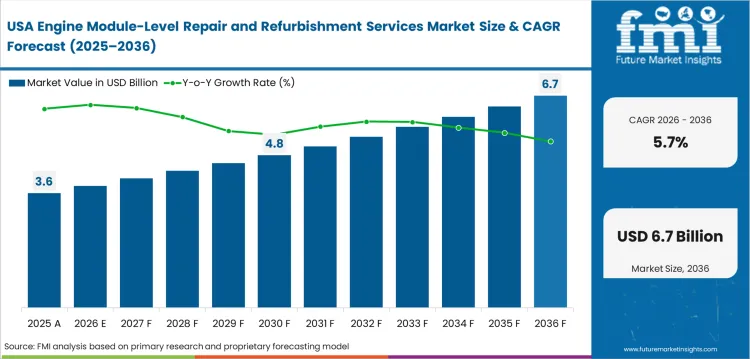
The USA engine module-level repair and refurbishment services segment is expected to advance at 5.7% CAGR over the forecast years. BTS data released in April 2026 said USA carriers carried 69.5 million scheduled service passengers in January 2026. This operating base favors demand for USA engine module-level repair and refurbishment services. Engine MRO providers with test-cell depth can serve large fleets and high-frequency domestic networks.
- Large airline fleets enhance demand for module repair and release testing services.
- Mature engine shop networks improve access for commercial carriers and leasing customers.
- Workscope control helps operators manage cost pressure from engine parts and accessories.
Future Outlook for Engine Module-Level Repair and Refurbishment Services Market in Canada
Canada’s engine module-level repair and refurbishment services industry is expected to post 4.8% CAGR through 2036. Statistics Canada reported 4.7 million passengers passed through pre-board screening at the eight largest airports in March 2026. Scheduled flying across long domestic networks strengthens demand for Canada engine module-level repair and refurbishment services. Service providers with regional access can reduce ferry time for engine work.
- Domestic network length favors demand for dependable engine module planning.
- Cross-border airline operations create demand for North American repair access and release records.
- Regional operators need repair partners who can manage turboprop and turbofan service needs.
Demand Outlook for Engine Module-Level Repair and Refurbishment Services Market in Germany
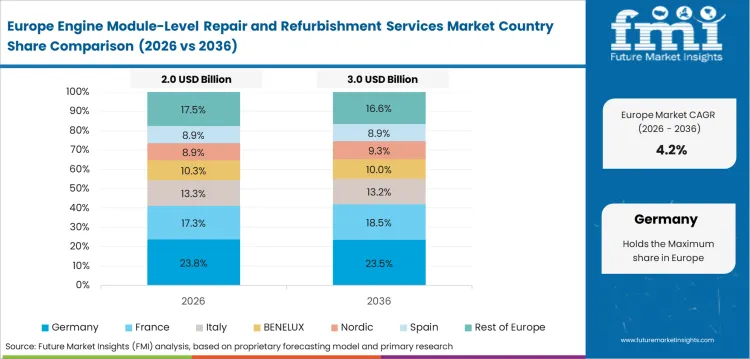
Germany’s engine module-level repair and refurbishment services industry is projected to record 4.1% CAGR through 2036. Destatis reported 97,324,895 boarding passengers at German airports in 2025. Mature aviation base raises the demand for Germany engine module-level repair and refurbishment services. Local repair networks gain from airlines seeking disciplined shop planning and high documentation standards.
- Mature airline operations enhance demand for turbine module inspection and repair records.
- Technical labor depth improves Germany’s role in complex engine service programs.
- Aircraft engine blade repair needs influence turbine module planning across hot-section work.
In-depth Analysis of Engine Module-Level Repair and Refurbishment Services Market in the United Kingdom
The UK engine module-level repair and refurbishment services sector is forecast at 3.6% CAGR through 2036. UK CAA reported 302 million passenger journeys through UK airports in 2025, setting a record level. This supports demand for UK engine module-level repair and refurbishment services as airport activity is high. Service providers can benefit from operators needing reliable turnarounds and release documentation.
- High airport activity raises steady demand for module inspection and repair planning.
- Mature airline fleets lift the demand for cost-controlled workscope decisions during shop visits.
- Service providers with commercial aircraft MRO depth can serve airlines seeking fewer coordination gaps.
Competitive Landscape and Strategic Positioning
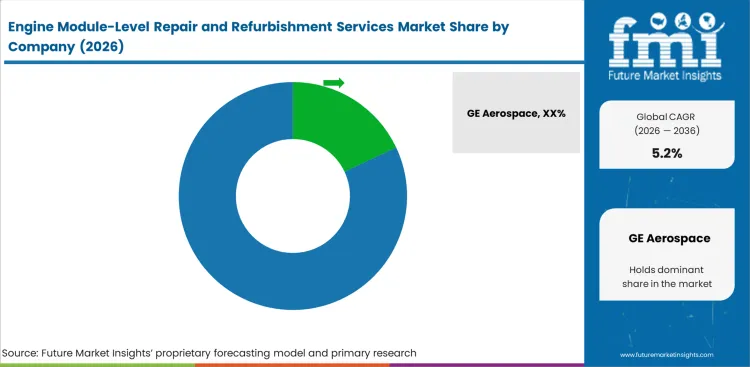
- GE Aerospace is a leading provider through broad engine program depth and repair approval coverage.
- Safran Aircraft Engines and Pratt & Whitney focus on engine family access and large-scale service network capabilities across global aviation markets.
- Independent providers focus on module turnaround and test-cell coordination for airline customers.
GE Aerospace has strong positioning through engine program access and approved repair depth. Safran Aircraft Engines offers LEAP service scale through its global network and India capacity expansion. Pratt & Whitney supports GTF fleets through repair methods and network capacity. Lufthansa Technik and MTU Maintenance focus on broad airline service reach and advanced capabilities in handling complex engine shop work.
Barriers include high tooling cost and strict release documentation across engine module work. Strategic priorities include hot-section repair capability and faster testing across long shop visit cycles. Operators favor providers offering approved repair records and module release control. Suppliers with broader engine families can reduce coordination burden for airline customers.
Key Companies in the Engine Module-Level Repair and Refurbishment Services Market
Key global companies leading the engine module-level repair and refurbishment services market include:
- GE Aerospace, Safran Aircraft Engines, and Pratt & Whitney have strong engine program access for module repair and refurbishment services.
- Rolls-Royce, Lufthansa Technik, and MTU Maintenance serve operators through engine shop depth and airline maintenance coverage.
- StandardAero holds a specialist position across independent engine repair and component service programs.
Competitive Benchmarking: Engine Module-Level Repair and Refurbishment Services Market
| Company | Module Repair Depth | Hot-Section Capability | Test-Cell Access | Geographic Footprint |
|---|---|---|---|---|
| GE Aerospace | High | High | Strong | North America, Europe, and Asia Pacific through overhaul and component locations |
| Safran Aircraft Engines | High | High | Strong | Europe, North America, China, and India through engine service and industrial sites |
| Pratt & Whitney | High | High | Strong | Global GTF MRO network across North America, Europe, Asia, and the Middle East |
| Rolls-Royce | High | High | Strong | Europe, North America, China, and wider global customer support network |
| Lufthansa Technik | High | Medium | Strong | Europe, Asia Pacific, and the Americas through operating subsidiaries and affiliates |
| MTU Maintenance | High | High | Strong | Europe, North America, and Asia through Hannover, Canada, Zhuhai, and partner sites |
| StandardAero | Medium | Medium | Strong | North America, Europe, Australia, Brazil, and Asia through engine MRO facilities |
Source: Future Market Insights, 2026.
Key Developments in Engine Module-Level Repair and Refurbishment Services Market
- February 2026, Willis Lease Finance launched Willis Module Shop and completed its first CFM56-7B core engine module restoration.
- March 2026, StandardAero signed a general terms agreement with AviLease for LEAP and CFM56-7B MRO services.
Key Players in the Engine Module-Level Repair and Refurbishment Services Market
Major Global Players:
- GE Aerospace
- Safran Aircraft Engines
- Pratt & Whitney
- Rolls-Royce
Specialist Players:
- Lufthansa Technik
- MTU Maintenance
- StandardAero
Report Scope and Coverage
| Parameter | Details |
|---|---|
| Quantitative Units | USD 7.8 billion to USD 12.9 billion, at a CAGR of 5.2% |
| Market Definition | The engine module-level repair and refurbishment services market covers off-wing repair and restoration of defined aircraft engine modules. |
| Regions Covered | North America, Latin America, Europe, East Asia, South Asia and Pacific, Middle East and Africa |
| Countries Covered | USA, UK, Germany, China, India, Singapore, Canada, and 30 plus countries |
| Key Companies Profiled | GE Aerospace, Safran Aircraft Engines, Pratt & Whitney, Rolls-Royce, Lufthansa Technik, MTU Maintenance, StandardAero |
| Forecast Period | 2026 to 2036 |
| Approach | Hybrid bottom-up and top-down methodology starting with shop-visit demand and verified service use patterns. |
Engine Module-Level Repair and Refurbishment Services Market by Segments
Engine Module-Level Repair and Refurbishment Services Market Segmented by Service Type:
- Module Repair
- Module Refurbishment
- Module Exchange
- Inspection Testing
- Workscope Planning
Engine Module-Level Repair and Refurbishment Services Market Segmented by Engine Module:
- High-Pressure Turbine
- High-Pressure Compressor
- Fan Module
- Low-Pressure Turbine
- Accessory Gearbox
Engine Module-Level Repair and Refurbishment Services Market Segmented by Engine Type:
- Turbofan
- Turboprop
- Turboshaft
Engine Module-Level Repair and Refurbishment Services Market Segmented by Provider Type:
- OEM Networks
- Independent MRO
- Airline Shops
Engine Module-Level Repair and Refurbishment Services Market Segmented by End User:
- Commercial Airlines
- Cargo Operators
- Leasing Companies
- Defense Fleets
- Business Aviation
Engine Module-Level Repair and Refurbishment Services Market by Region:
- North America
- USA
- Canada
- Mexico
- Latin America
- Brazil
- Chile
- Rest of Latin America
- Europe
- Germany
- UK
- Italy
- Spain
- France
- Rest of Europe
- East Asia
- China
- Japan
- South Korea
- South Asia and Pacific
- India
- ASEAN
- Australia & New Zealand
- Rest of South Asia and Pacific
- Middle East and Africa
- Saudi Arabia
- Other GCC Countries
- South Africa
- Rest of Middle East and Africa
Research Sources and Bibliography
- International Air Transport Association. (2026, April 19). Optimizing decisions amid aviation supply chain turmoil. IATA.
- Oliver Wyman. (2025, March 16). 25 years of the global fleet and MRO market forecast. Aeronautical Repair Station Association.
- International Air Transport Association. (2026, January 29). Strong 2025 passenger demand masks ongoing capacity constraints.
- International Air Transport Association. (2025, October). Aviation supply chain.
- Federal Reserve Bank of St. Louis. (2026, April 14). Producer Price Index by Industry: Aircraft Engine and Engine Parts Manufacturing.
- Press Information Bureau. (2026, January 29). Government of India civil aviation sector update.
- Civil Aviation Administration of China. (2026, January 6). China’s civil aviation sector achieves steady growth in 2025.
- Changi Airport Group. (2026, April). Traffic statistics and data.
- Bureau of Transportation Statistics. (2026, April 10). January 2026 USA airline traffic data down 1.8% from the same month last year.
- Statistics Canada. (2026, May 1). Screened passenger traffic at Canadian airports, March 2026.
- Federal Statistical Office of Germany. (2026). Boarding air passengers at German airports.
- Civil Aviation Authority. (2026, February 24). UK aviation officially breaks records with over 300m passenger journeys in 2025.
- Willis Lease Finance Corporation. (2026, February 12). Willis Lease Finance Corporation launches in-house engine module restoration capability.
- StandardAero. (2026, March). StandardAero signs general terms agreement with AviLease for LEAP and CFM56-7B MRO services.
- Lufthansa Technik. (2025, February). Agreement with WestJet for world-class aircraft engine maintenance services.
- Lufthansa Technik. (2025, June). Groundbreaking for new engine maintenance facility in Calgary.
- RTX. (2025, April). Pratt & Whitney and MTU Aero Engines strengthen GTF MRO network collaboration.
- RTX. (2025, April). Pratt & Whitney inks agreement for Delta TechOps to increase GTF MRO capacity.
- RTX. (2025, April). Pratt & Whitney launches additive GTF repair solution to improve turnaround time.
- Safran. (2025, November). Safran steps up expansion in India for civil and military aviation.
This Report Addresses
- What is the expected value of the engine module-level repair and refurbishment services market in 2026?
- What is the forecast value of the engine module-level repair and refurbishment services market by 2036?
- Which service type is expected to account for the highest share in 2026?
- Which engine module is expected to account for the highest share in 2026?
- Which countries are expected to record faster demand expansion through 2036?
- Which companies are active in engine module-level repair and refurbishment services?
- How does FMI estimate and validate the market forecast?
Frequently Asked Questions
What is the global market demand for Engine Module-Level Repair and Refurbishment Services in 2026?
In 2026, the global market for engine module-level repair and refurbishment services is expected to be worth USD 7.8 billion.
How big will the market for Engine Module-Level Repair and Refurbishment Services be in 2036?
By 2036, the market for engine module-level repair and refurbishment services is expected to be worth USD 12.9 billion.
How much is demand for Engine Module-Level Repair and Refurbishment Services expected to expand between 2026 and 2036?
Between 2026 and 2036, demand for engine module-level repair and refurbishment services is expected to expand at a CAGR of 5.2%.
Which service type segment is likely to be the best seller globally by 2026?
Module Repair is expected to make up 41.0% of the service type segment in 2026.
What is causing demand to rise in India?
The India engine module-level repair and refurbishment services market is projected to record 7.4% CAGR through 2036, backed by fleet expansion and MRO localization.
What is causing demand to rise in China?
The China engine module-level repair and refurbishment services market is projected to expand at 6.6% CAGR through 2036, backed by aviation scale and domestic service needs.
What does this report mean by Engine Module-Level Repair and Refurbishment Services Market definition?
The engine module-level repair and refurbishment services market includes off-wing repair and restoration of defined aircraft engine modules.
How does FMI make the Engine Module-Level Repair and Refurbishment Services forecast and check it?
Forecasting models use a hybrid bottom-up and top-down approach, starting with shop-visit demand and checking it against aircraft utilization patterns.
Preview the report firsthand - request a free sample
Get SampleGet the brochure for pricing and purchase details.
Get PDFTable of Content
- Executive Summary
- Global Market Outlook
- Demand-side Trends
- Supply-side Trends
- Technology Roadmap Analysis
- Analysis and Recommendations
- Market Overview
- Market Coverage / Taxonomy
- Market Definition / Scope / Limitations
- Research Methodology
- Chapter Orientation
- Analytical Lens and Working Hypotheses
- Market Structure, Signals, and Trend Drivers
- Benchmarking and Cross-market Comparability
- Market Sizing, Forecasting, and Opportunity Mapping
- Research Design and Evidence Framework
- Desk Research Programme (Secondary Evidence)
- Company Annual and Sustainability Reports
- Peer-reviewed Journals and Academic Literature
- Corporate Websites, Product Literature, and Technical Notes
- Earnings Decks and Investor Briefings
- Statutory Filings and Regulatory Disclosures
- Technical White Papers and Standards Notes
- Trade Journals, Industry Magazines, and Analyst Briefs
- Conference Proceedings, Webinars, and Seminar Materials
- Government Statistics Portals and Public Data Releases
- Press Releases and Reputable Media Coverage
- Specialist Newsletters and Curated Briefings
- Sector Databases and Reference Repositories
- FMI Internal Proprietary Databases and Historical Market Datasets
- Subscription Datasets and Paid Sources
- Social Channels, Communities, and Digital Listening Inputs
- Additional Desk Sources
- Expert Input and Fieldwork (Primary Evidence)
- Primary Modes
- Qualitative Interviews and Expert Elicitation
- Quantitative Surveys and Structured Data Capture
- Blended Approach
- Why Primary Evidence is Used
- Field Techniques
- Interviews
- Surveys
- Focus Groups
- Observational and In-context Research
- Social and Community Interactions
- Stakeholder Universe Engaged
- C-suite Leaders
- Board Members
- Presidents and Vice Presidents
- R&D and Innovation Heads
- Technical Specialists
- Domain Subject-matter Experts
- Scientists
- Physicians and Other Healthcare Professionals
- Governance, Ethics, and Data Stewardship
- Research Ethics
- Data Integrity and Handling
- Primary Modes
- Tooling, Models, and Reference Databases
- Desk Research Programme (Secondary Evidence)
- Data Engineering and Model Build
- Data Acquisition and Ingestion
- Cleaning, Normalisation, and Verification
- Synthesis, Triangulation, and Analysis
- Quality Assurance and Audit Trail
- Market Background
- Market Dynamics
- Drivers
- Restraints
- Opportunity
- Trends
- Scenario Forecast
- Demand in Optimistic Scenario
- Demand in Likely Scenario
- Demand in Conservative Scenario
- Opportunity Map Analysis
- Product Life Cycle Analysis
- Supply Chain Analysis
- Investment Feasibility Matrix
- Value Chain Analysis
- PESTLE and Porter’s Analysis
- Regulatory Landscape
- Regional Parent Market Outlook
- Production and Consumption Statistics
- Import and Export Statistics
- Market Dynamics
- Global Market Analysis 2021 to 2025 and Forecast, 2026 to 2036
- Historical Market Size Value (USD Million) Analysis, 2021 to 2025
- Current and Future Market Size Value (USD Million) Projections, 2026 to 2036
- Y-o-Y Growth Trend Analysis
- Absolute $ Opportunity Analysis
- Global Market Pricing Analysis 2021 to 2025 and Forecast 2026 to 2036
- Global Market Analysis 2021 to 2025 and Forecast 2026 to 2036, By Service Type
- Introduction / Key Findings
- Historical Market Size Value (USD Million) Analysis By Service Type , 2021 to 2025
- Current and Future Market Size Value (USD Million) Analysis and Forecast By Service Type , 2026 to 2036
- Module Repair
- Module Refurbishment
- Module Exchange
- Module Repair
- Y-o-Y Growth Trend Analysis By Service Type , 2021 to 2025
- Absolute $ Opportunity Analysis By Service Type , 2026 to 2036
- Global Market Analysis 2021 to 2025 and Forecast 2026 to 2036, By Engine Module
- Introduction / Key Findings
- Historical Market Size Value (USD Million) Analysis By Engine Module, 2021 to 2025
- Current and Future Market Size Value (USD Million) Analysis and Forecast By Engine Module, 2026 to 2036
- High-Pressure Turbine
- High-Pressure Compressor
- Fan Module
- High-Pressure Turbine
- Y-o-Y Growth Trend Analysis By Engine Module, 2021 to 2025
- Absolute $ Opportunity Analysis By Engine Module, 2026 to 2036
- Global Market Analysis 2021 to 2025 and Forecast 2026 to 2036, By Engine Type
- Introduction / Key Findings
- Historical Market Size Value (USD Million) Analysis By Engine Type, 2021 to 2025
- Current and Future Market Size Value (USD Million) Analysis and Forecast By Engine Type, 2026 to 2036
- Turbofan
- Turboprop
- Turboshaft
- Turbofan
- Y-o-Y Growth Trend Analysis By Engine Type, 2021 to 2025
- Absolute $ Opportunity Analysis By Engine Type, 2026 to 2036
- Global Market Analysis 2021 to 2025 and Forecast 2026 to 2036, By Provider Type
- Introduction / Key Findings
- Historical Market Size Value (USD Million) Analysis By Provider Type, 2021 to 2025
- Current and Future Market Size Value (USD Million) Analysis and Forecast By Provider Type, 2026 to 2036
- OEM Networks
- Independent MRO
- Airline Shops
- OEM Networks
- Y-o-Y Growth Trend Analysis By Provider Type, 2021 to 2025
- Absolute $ Opportunity Analysis By Provider Type, 2026 to 2036
- Global Market Analysis 2021 to 2025 and Forecast 2026 to 2036, By End User
- Introduction / Key Findings
- Historical Market Size Value (USD Million) Analysis By End User, 2021 to 2025
- Current and Future Market Size Value (USD Million) Analysis and Forecast By End User, 2026 to 2036
- Commercial Airlines
- Cargo Operators
- Leasing Companies
- Commercial Airlines
- Y-o-Y Growth Trend Analysis By End User, 2021 to 2025
- Absolute $ Opportunity Analysis By End User, 2026 to 2036
- Global Market Analysis 2021 to 2025 and Forecast 2026 to 2036, By Region
- Introduction
- Historical Market Size Value (USD Million) Analysis By Region, 2021 to 2025
- Current Market Size Value (USD Million) Analysis and Forecast By Region, 2026 to 2036
- North America
- Latin America
- Western Europe
- Eastern Europe
- East Asia
- South Asia and Pacific
- Middle East & Africa
- Market Attractiveness Analysis By Region
- North America Market Analysis 2021 to 2025 and Forecast 2026 to 2036, By Country
- Historical Market Size Value (USD Million) Trend Analysis By Market Taxonomy, 2021 to 2025
- Market Size Value (USD Million) Forecast By Market Taxonomy, 2026 to 2036
- By Country
- USA
- Canada
- Mexico
- By Service Type
- By Engine Module
- By Engine Type
- By Provider Type
- By End User
- By Country
- Market Attractiveness Analysis
- By Country
- By Service Type
- By Engine Module
- By Engine Type
- By Provider Type
- By End User
- Key Takeaways
- Latin America Market Analysis 2021 to 2025 and Forecast 2026 to 2036, By Country
- Historical Market Size Value (USD Million) Trend Analysis By Market Taxonomy, 2021 to 2025
- Market Size Value (USD Million) Forecast By Market Taxonomy, 2026 to 2036
- By Country
- Brazil
- Chile
- Rest of Latin America
- By Service Type
- By Engine Module
- By Engine Type
- By Provider Type
- By End User
- By Country
- Market Attractiveness Analysis
- By Country
- By Service Type
- By Engine Module
- By Engine Type
- By Provider Type
- By End User
- Key Takeaways
- Western Europe Market Analysis 2021 to 2025 and Forecast 2026 to 2036, By Country
- Historical Market Size Value (USD Million) Trend Analysis By Market Taxonomy, 2021 to 2025
- Market Size Value (USD Million) Forecast By Market Taxonomy, 2026 to 2036
- By Country
- Germany
- UK
- Italy
- Spain
- France
- Nordic
- BENELUX
- Rest of Western Europe
- By Service Type
- By Engine Module
- By Engine Type
- By Provider Type
- By End User
- By Country
- Market Attractiveness Analysis
- By Country
- By Service Type
- By Engine Module
- By Engine Type
- By Provider Type
- By End User
- Key Takeaways
- Eastern Europe Market Analysis 2021 to 2025 and Forecast 2026 to 2036, By Country
- Historical Market Size Value (USD Million) Trend Analysis By Market Taxonomy, 2021 to 2025
- Market Size Value (USD Million) Forecast By Market Taxonomy, 2026 to 2036
- By Country
- Russia
- Poland
- Hungary
- Balkan & Baltic
- Rest of Eastern Europe
- By Service Type
- By Engine Module
- By Engine Type
- By Provider Type
- By End User
- By Country
- Market Attractiveness Analysis
- By Country
- By Service Type
- By Engine Module
- By Engine Type
- By Provider Type
- By End User
- Key Takeaways
- East Asia Market Analysis 2021 to 2025 and Forecast 2026 to 2036, By Country
- Historical Market Size Value (USD Million) Trend Analysis By Market Taxonomy, 2021 to 2025
- Market Size Value (USD Million) Forecast By Market Taxonomy, 2026 to 2036
- By Country
- China
- Japan
- South Korea
- By Service Type
- By Engine Module
- By Engine Type
- By Provider Type
- By End User
- By Country
- Market Attractiveness Analysis
- By Country
- By Service Type
- By Engine Module
- By Engine Type
- By Provider Type
- By End User
- Key Takeaways
- South Asia and Pacific Market Analysis 2021 to 2025 and Forecast 2026 to 2036, By Country
- Historical Market Size Value (USD Million) Trend Analysis By Market Taxonomy, 2021 to 2025
- Market Size Value (USD Million) Forecast By Market Taxonomy, 2026 to 2036
- By Country
- India
- ASEAN
- Australia & New Zealand
- Rest of South Asia and Pacific
- By Service Type
- By Engine Module
- By Engine Type
- By Provider Type
- By End User
- By Country
- Market Attractiveness Analysis
- By Country
- By Service Type
- By Engine Module
- By Engine Type
- By Provider Type
- By End User
- Key Takeaways
- Middle East & Africa Market Analysis 2021 to 2025 and Forecast 2026 to 2036, By Country
- Historical Market Size Value (USD Million) Trend Analysis By Market Taxonomy, 2021 to 2025
- Market Size Value (USD Million) Forecast By Market Taxonomy, 2026 to 2036
- By Country
- Kingdom of Saudi Arabia
- Other GCC Countries
- Turkiye
- South Africa
- Other African Union
- Rest of Middle East & Africa
- By Service Type
- By Engine Module
- By Engine Type
- By Provider Type
- By End User
- By Country
- Market Attractiveness Analysis
- By Country
- By Service Type
- By Engine Module
- By Engine Type
- By Provider Type
- By End User
- Key Takeaways
- Key Countries Market Analysis
- USA
- Pricing Analysis
- Market Share Analysis, 2025
- By Service Type
- By Engine Module
- By Engine Type
- By Provider Type
- By End User
- Canada
- Pricing Analysis
- Market Share Analysis, 2025
- By Service Type
- By Engine Module
- By Engine Type
- By Provider Type
- By End User
- Mexico
- Pricing Analysis
- Market Share Analysis, 2025
- By Service Type
- By Engine Module
- By Engine Type
- By Provider Type
- By End User
- Brazil
- Pricing Analysis
- Market Share Analysis, 2025
- By Service Type
- By Engine Module
- By Engine Type
- By Provider Type
- By End User
- Chile
- Pricing Analysis
- Market Share Analysis, 2025
- By Service Type
- By Engine Module
- By Engine Type
- By Provider Type
- By End User
- Germany
- Pricing Analysis
- Market Share Analysis, 2025
- By Service Type
- By Engine Module
- By Engine Type
- By Provider Type
- By End User
- UK
- Pricing Analysis
- Market Share Analysis, 2025
- By Service Type
- By Engine Module
- By Engine Type
- By Provider Type
- By End User
- Italy
- Pricing Analysis
- Market Share Analysis, 2025
- By Service Type
- By Engine Module
- By Engine Type
- By Provider Type
- By End User
- Spain
- Pricing Analysis
- Market Share Analysis, 2025
- By Service Type
- By Engine Module
- By Engine Type
- By Provider Type
- By End User
- France
- Pricing Analysis
- Market Share Analysis, 2025
- By Service Type
- By Engine Module
- By Engine Type
- By Provider Type
- By End User
- India
- Pricing Analysis
- Market Share Analysis, 2025
- By Service Type
- By Engine Module
- By Engine Type
- By Provider Type
- By End User
- ASEAN
- Pricing Analysis
- Market Share Analysis, 2025
- By Service Type
- By Engine Module
- By Engine Type
- By Provider Type
- By End User
- Australia & New Zealand
- Pricing Analysis
- Market Share Analysis, 2025
- By Service Type
- By Engine Module
- By Engine Type
- By Provider Type
- By End User
- China
- Pricing Analysis
- Market Share Analysis, 2025
- By Service Type
- By Engine Module
- By Engine Type
- By Provider Type
- By End User
- Japan
- Pricing Analysis
- Market Share Analysis, 2025
- By Service Type
- By Engine Module
- By Engine Type
- By Provider Type
- By End User
- South Korea
- Pricing Analysis
- Market Share Analysis, 2025
- By Service Type
- By Engine Module
- By Engine Type
- By Provider Type
- By End User
- Russia
- Pricing Analysis
- Market Share Analysis, 2025
- By Service Type
- By Engine Module
- By Engine Type
- By Provider Type
- By End User
- Poland
- Pricing Analysis
- Market Share Analysis, 2025
- By Service Type
- By Engine Module
- By Engine Type
- By Provider Type
- By End User
- Hungary
- Pricing Analysis
- Market Share Analysis, 2025
- By Service Type
- By Engine Module
- By Engine Type
- By Provider Type
- By End User
- Kingdom of Saudi Arabia
- Pricing Analysis
- Market Share Analysis, 2025
- By Service Type
- By Engine Module
- By Engine Type
- By Provider Type
- By End User
- Turkiye
- Pricing Analysis
- Market Share Analysis, 2025
- By Service Type
- By Engine Module
- By Engine Type
- By Provider Type
- By End User
- South Africa
- Pricing Analysis
- Market Share Analysis, 2025
- By Service Type
- By Engine Module
- By Engine Type
- By Provider Type
- By End User
- USA
- Market Structure Analysis
- Competition Dashboard
- Competition Benchmarking
- Market Share Analysis of Top Players
- By Regional
- By Service Type
- By Engine Module
- By Engine Type
- By Provider Type
- By End User
- Competition Analysis
- Competition Deep Dive
- GE Aerospace
- Overview
- Product Portfolio
- Profitability by Market Segments (Product/Age /Sales Channel/Region)
- Sales Footprint
- Strategy Overview
- Marketing Strategy
- Product Strategy
- Channel Strategy
- Safran Aircraft Engines
- Pratt & Whitney
- Rolls-Royce
- Lufthansa Technik
- MTU Maintenance
- StandardAero
- GE Aerospace
- Competition Deep Dive
- Assumptions & Acronyms Used


