

- Industry Size (2026)
- USD 156.6 Bn
- Forecast (2036)
- USD 272.1 Bn
- CAGR (2026 to 2036)
- 5.7%
Repairable Small Appliances Market Size, Market Forecast and Outlook By FMI
The repairable small appliances market was valued at USD 148.4 billion in 2025. Industry is expected to reach USD 156.6 billion in 2026 at a CAGR of 5.7% during the forecast. Demand outlook carries the market size to USD 272.1 billion through 2036 as circular economy mandates reach mid-market consumer electronics tiers that previously relied on disposable product cycles.
Standardized repairability foundations have crossed from aspirational environmental goals to contractually mandated specifications. Product design engineers executing new household appliances expansions now reject integrated assemblies that fragment maintenance feasibility. This architectural pivot forces incumbent hardware vendors to integrate modular components into every new small cooking appliance and floor care product line. Manufacturers entering 2027 retail cycles without certified 10-year spare part availability face a brand disqualification window they cannot close after consumer shortlisting begins.
Summary of Repairable Small Appliances Market
- Repairable Small Appliances Market Definition:
- Repairable Small Appliances encompasses specialized consumer electronics built with modularity and standardized parts to guarantee extended product lifespans and reduced waste.
- Demand Drivers in the Market:
- Legislative mandates for "Right to Repair" force brands to provide parts for up to a decade.
- High replacement costs for advanced wet and dry vacuum cleaners drive consumers to seek cost-effective component fixes.
- Growing environmental awareness regarding e-waste compels market leaders to adopt circular design philosophies.
- Key Segments Analyzed in the FMI Report:
- Cooking & Kitchen Appliances: 42.0% share in 2026, reflecting the high technical complexity and capital value of coffee brewers and stand mixers.
- Online/E-commerce: 48.5% share in 2026, as digital platforms provide the logistics required for distributing niche components.
- China: 7.1% compound growth driven by a massive consumer base shifting toward high-quality, long-lasting electronic brands.
- Analyst Opinion at FMI:
- Ronak Shah, Principal Consultant for Consumer Products at FMI, suggests, “In my analysis, I have observed that the true bottleneck in the on-demand repair sector is no longer consumer interest, but the availability of standardized components. Facilities attempting to service high-end household devices often face proprietary hurdles that drive repair costs above the price of a new unit. Product architects who continue utilizing adhesive-heavy assemblies will find themselves unable to meet the repairability scores required for entry into the increasingly regulated European and North American markets.”
- Strategic Implications / Executive Takeaways:
- Appliance manufacturers must secure electronics repair services partnerships to ensure local availability of technicians.
- Sustainability directors should phase out glued components and mandate standardized fastener support in all new household kitchen appliances blueprints.
- Retailers must develop specialized e-commerce sections for genuine spare parts to capture the growing DIY repair market.
- Methodology:
- Primary Research: FMI conducted detailed technical interviews with principal design engineers and retail leads across 40+ countries to validate part availability timelines.
- Desk Research: Analysts aggregated public standards documentation from environmental agencies, certifications, and manufacturer part-catalog launch sheets.
- Market-Sizing and Forecasting: The model applies a bottom-up methodology starting with global shipment volumes and projecting the conversion rate to repairable standards.
- Data Validation and Update Cycle: Segment forecasts undergo cross-validation against reported electronic waste volumes and sustainability trends.
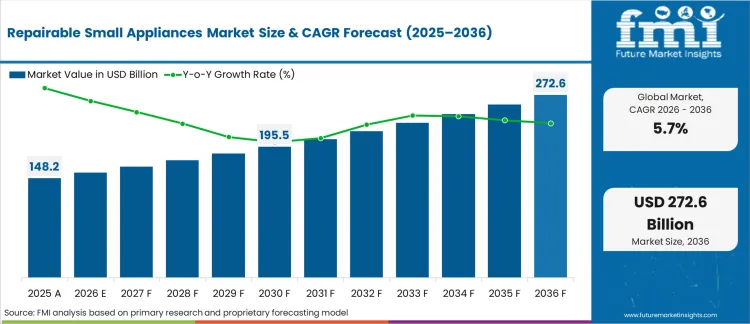
FMI analysts observe that the projected compound expansion relies entirely on a structural shift from "planned obsolescence" architectures to standardized, repairable ecosystems. This transition forces appliance brands to abandon sealed-unit designs and commit significant capital to spare parts logistics for component recovery. The underlying mechanism sustaining the 5.7% growth trajectory is the absolute necessity of modularity for sustainable consumer electronics, a capability legacy garment care devices physically cannot support under new eco-design laws. The geographic distribution of this architectural migration reveals distinct adoption velocities tied directly to regional "Right to Repair" legislation.
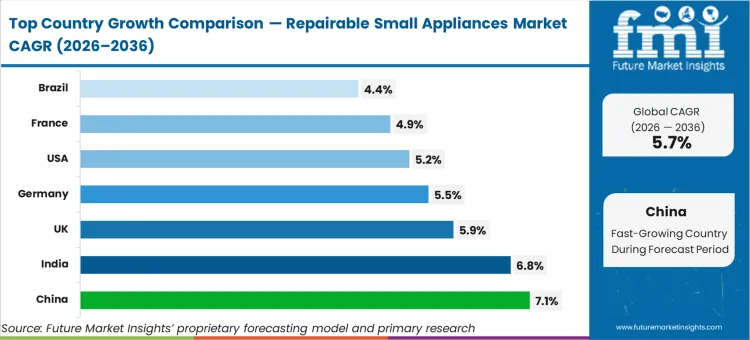
As regional consumer hubs navigate this transition, China sets the pace with a 7.1% CAGR, followed closely by India at 6.8% as both nations leverage rising middle-class demand for high-quality electronics with long-term durability. The United Kingdom advances at a 5.9% rate, supported by strict post-Brexit environmental standards. Germany registers a 5.5% expansion while the United States tracks at 5.2%, both driven by state-level repair mandates and smart kitchen appliances complexity. France expands at a 4.9% trajectory anchored by its national Repairability Index. Brazil maintains a steady 4.4% pace as compact kitchen devices gain traction in urban dwellings.
Repairable Small Appliances Market Key Takeaways
| Metric | Details |
|---|---|
| Industry Size (2026) | USD 156.6 billion |
| Industry Value (2036) | USD 272.1 billion |
| CAGR (2026-2036) | 5.70% |
Source: Future Market Insights (FMI) analysis, based on proprietary forecasting model and primary research.
Repairable Small Appliances Market Definition
Repairable Small Appliances represent the consumer electronics and mechanical household goods designed specifically to allow for non-destructive disassembly and part replacement. The ecosystem includes specialized hardware (modular motors, standardized screws), genuine spare parts, and electronics repair services manuals compliant with international standards. A core inclusion is hardware supporting user-replaceable batteries and heating elements. Regulatory frameworks mandate the operational parameters defining these accessible product profiles.
Repairable Small Appliances Market Inclusions
The market scope includes cooking appliances, vacuum cleaners, hair dryers, and irons featuring native repairable capabilities. Component-specific spare parts, official repair kits, and diagnostic tools for under-sink water purifiers or robotic maintenance fall within the boundaries. Products utilizing modular design mechanisms for personal care appliances are fully incorporated.
Repairable Small Appliances Market Exclusions
Single-use or ultra-low-cost "disposable" electronics lacking any internal access are excluded. Industrial-grade food processing machinery, large white goods such as residential dishwashers, and air treatment devices without accessible motor assemblies fall outside the defined parameters. Legacy analog appliances without available digital replacement parts are explicitly omitted from the valuation.
Repairable Small Appliances Market Research Methodology
- Primary Research: Analysts engaged with product design leads, sustainability directors, and service network managers to map the specific consumer triggers for choosing repair over replacement.
- Desk Research: The data collection phase aggregated compliance roadmaps from global environmental agencies, spare part availability registries, and major consumerware manufacturer sustainability reports.
- Market-Sizing and Forecasting: The baseline value derives from a bottom-up aggregation of shipment data, applying region-specific regulatory curves to project the future adoption velocity of repairable designs.
- Data Validation and Update Cycle: Projections are rigorously tested against publicly reported inventory data for spare parts and consumer sentiment surveys regarding household product durability.
Segmental Analysis
Repairable Small Appliances Market Analysis by Product Type
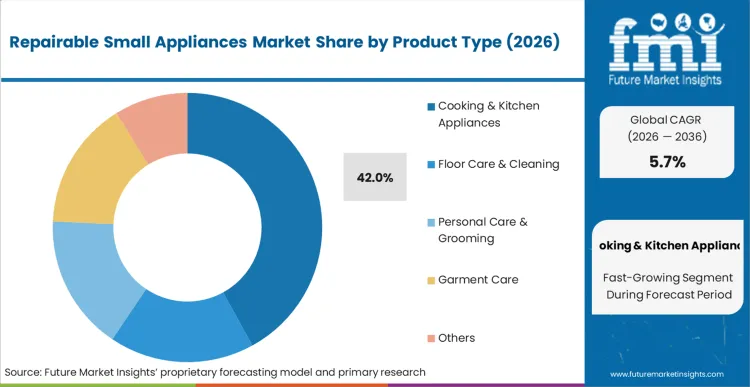
With the cost of premium electronics rising, the small kitchen appliances segment leads the hardware replacement cycle. Cooking & Kitchen Appliances command a dominant 42.0% share in 2026, reflecting the requirement for accessible internal heating and motor elements. Manufacturers deploying modular designs into these devices establish the foundation for long-term brand loyalty. This modularity eliminates the need for consumers to discard an expensive device over a faulty gasket or sensor. Design leads specifying these accessible architectures streamline their global service footprints and significantly reduce reverse logistics costs.
- Ease of Disassembly: Product integration protocols demand non-destructive access to internal motors, shifting the burden away from proprietary service tools.
- Component Modularity: Standardized heating elements handle wear-and-tear locally, reducing the need for aftermarket packaging for bulky unit returns.
- Durability Perception: Eliminating integrated batteries in rechargeable devices extends the physical lifespan of the product housing significantly.
Repairable Small Appliances Market Analysis by Repairability Level
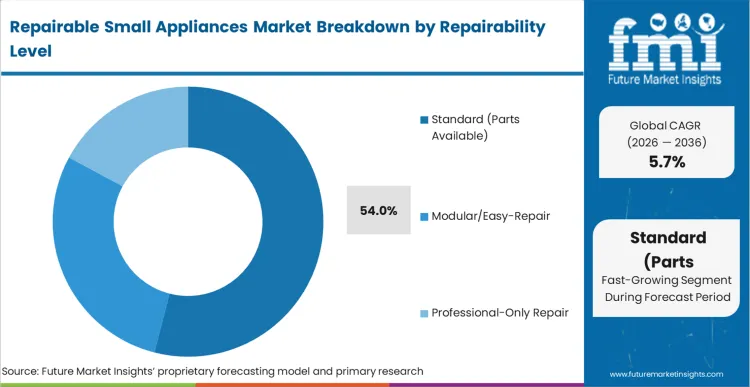
Standard repairability emerges as the dominant tier, expected to represent 54% of total market share in 2026. Modern household environments are increasingly built around premium items, where manufacturers provide the necessary schematics and parts through authorized centers. FMI analysts opine that this level of access directly enables the growth of the professional repair economy. Product safety leads must validate repairability scores during the design phase to authorize regional market entry. The integration of plastic recovery standards across personal care devices forces engineers to rethink traditional ultrasonic welding methods.
- Accessibility indices: Critical components receive high repairability ratings when they can be swapped using standard household kitchen tools.
- Manual Transparency: Providing public access to repair diagrams accelerates the troubleshooting phase for independent technicians.
- Part Interoperability: Standardized component sizes reduce the inventory hours previously required to stock proprietary parts.
Repairable Small Appliances Market Analysis by Distribution Channel
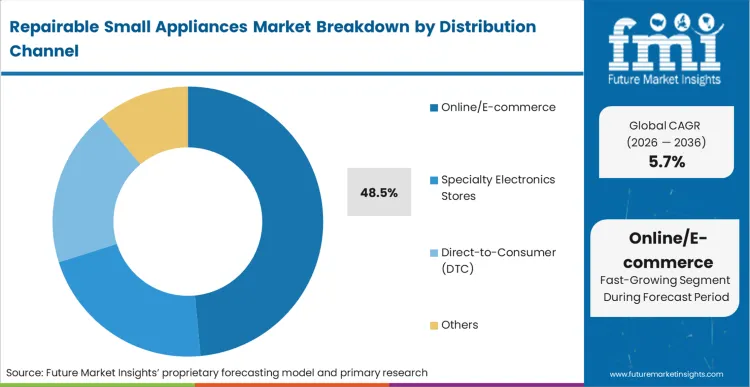
Every product lead bidding on retail contracts now faces strict adherence criteria for part availability. Online/E-commerce accounts for a leading 48.5% segment share in 2026. Digital consumers operating in urban environments reject items that lack a clear digital path for spare part ordering. Incorporating certified portals guarantees that replacement parts for air purifiers or other small devices arrive within 48 hours.
- Digital Spare Catalogs: Real-time inventory tracking ensures consumers can find parts for models up to 15 years old.
- DIY Video Integration: Dedicated video tutorials permit home users to fix their own water purifiers without professional intervention.
- Subscription Maintenance: Service-based models empower facility owners to source air humidifiers with guaranteed maintenance intervals.
Repairable Small Appliances Market Drivers, Restraints, and Opportunities
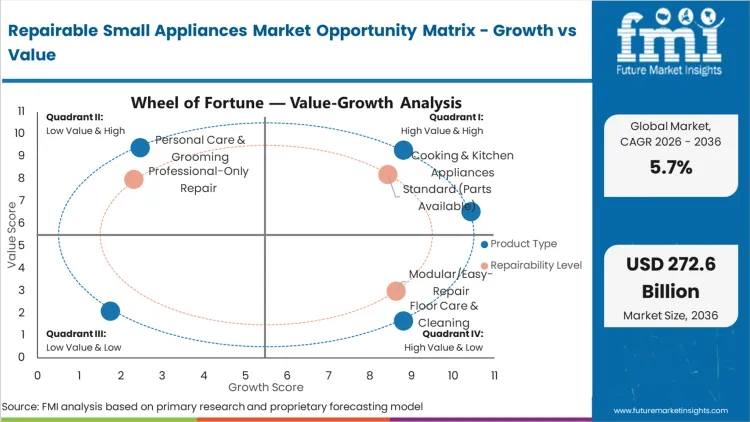
The convergence of environmental legislation and consumer economic pressure forces consumer electronics leads to extract more value from existing devices. This architectural requirement renders non-repairable "sealed" designs obsolete. Asset owners upgrading compact kitchen devices face a strict choice between low-cost disposable units or overhauling their kitchen with repairable infrastructure. Transitioning to a unified repairable backbone simplifies the product lifecycle and enables direct consumer engagement.
The intricate logistics required to manage a 10-year spare part inventory create steep learning curves for manufacturers. Designing conflict-free supply chains across multi-vendor parts demands specialized expertise. To mitigate this skill gap, brands increasingly rely on digital platforms that automate the part-matching process and validate component compatibility.
Opportunities in the Repairable Small Appliances Market
- Refurbishment as a Service: Next-generation repairable models enable brands to run certified pre-owned programs. This consolidation eliminates waste and simplifies sustainable entry.
- 3D-Printed Spare Parts: Upgraded digital files permit repair teams to print non-critical plastic housings on-site. This capability prevents older personal care devices from being retired due to minor cosmetic breakage.
- Modular Smart Hubs: Utility planners integrating smart kitchen appliances require precise control over waste. Repairable design provides the accuracy necessary to balance volatile disposal inputs.
Regional Analysis
Based on the regional analysis, the Repairable Small Appliances market is segmented into North America, Latin America, Europe, East Asia, South Asia, Oceania and Middle East & Africa across 40+ countries.
.webp "Top Country Growth Comparison Repairable Small Appliances Market Cagr (2026 2036)")
| Country | CAGR (2026 to 2036) |
|---|---|
| China | 7.1% |
| India | 6.8% |
| USA | 5.2% |
| Germany | 5.5% |
| United Kingdom | 5.9% |
| France | 4.9% |
| Brazil | 4.4% |
Source: Future Market Insights (FMI) analysis, based on proprietary forecasting model and primary research.
Asia Pacific Repairable Small Appliances Market Analysis
Greenfield development of organized repair networks across the Asia Pacific region accelerates the bypass of legacy waste constraints. Capital projects directors constructing new facilities specify repairability in their initial site blueprints. FMI analysts opine that this approach entirely eliminates the costly waste management phase that plagues older markets. By building native synchronization into the foundation, regional asset owners establish highly flexible service environments.
- China: China's sector deploys highly automated, repairable production lines requiring seamless data exchange between retailers and service providers. Greenfield facility architects specify native repairable endpoints for all new procurement contracts. This aggressive modernization strategy drives a 7.1% CAGR through 2036.
- India: India's consumer sector operates under emerging waste management frameworks requiring immutable electronic records for product disposal. Brands must deploy personal care appliances networks capable of guaranteeing spare part delivery to rural areas. This pressure anchors India's 6.8% expansion to 2036.
North America Repairable Small Appliances Market Analysis
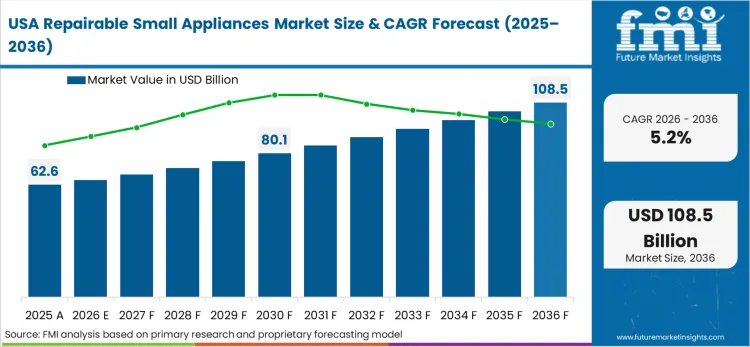
Modernization mandates across North America target the systematic eradication of "throwaway" household kitchen appliances. Engineers leading market overhauls face strict directives to unify disparate repair domains under a single manageable architecture. According to FMI's estimates, the US West Coast actively drives this consolidation to secure sustainable flows.
- USA: The United States sector enforces strict data visibility mandates across its service ecosystem. Specification leads replacing aging equipment must deploy converged architectures capable of supporting both repair and secure telemetry extraction. The United States advances at a 5.2% compound rate.
Europe Repairable Small Appliances Market Analysis
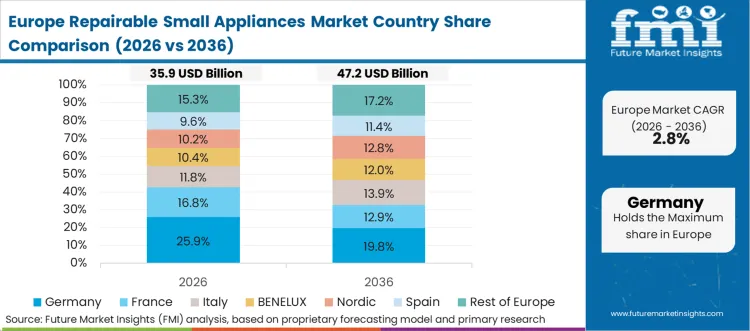
European industrial policy actively penalizes the operation of technologically isolated facilities. Architects redesigning legacy lines must integrate repairability data alongside critical energy monitoring signals. This dual-purpose requirement forces the rapid adoption of traffic-shaping protocols.
- Germany: Germany's premium supply chain dictates stringent validation criteria for repairable traffic on assembly lines. Engineers must demonstrate flawless execution of repair flows before receiving authorization for market entry. This pressure drives a 5.5% annual expansion rate.
- UK: The United Kingdom's programs require precise measurement data to balance volatile generation. Utility planners mandate architectures capable of sub-millisecond data delivery. This transition anchors the UK's 5.9% compound trajectory to 2036.
- France: The French sector is uniquely characterized by the national Repairability Index, which mandates visible scoring on all retail packaging. This law, part of the Anti-Waste for a Circular Economy (AGEC) initiative, forces manufacturers to disclose spare part availability and pricing at the point of sale. FMI observes that these transparency mandates are creating a refurbished-appliance boom, sustaining a 4.9% CAGR as consumers prioritize high-scoring sustainable brands.
Latin America Repairable Small Appliances Market Analysis
The Latin American market is transitioning toward durability as a hedge against currency volatility and rising import costs. Local manufacturing hubs are adapting to produce modular units that allow for localized servicing.
- Brazil: Rapid urbanization in metropolitan cores like São Paulo is driving a shift toward compact, space-efficient, and durable designs. The unique parcelamento (installment payment) culture in Brazil allows the middle class to invest in premium repairable household appliances that offer long-term value over cheaper disposable alternatives. This economic shift, combined with stricter e-waste take-back obligations, supports a 4.4% CAGR through 2036.
Competitive Aligners for Market Players
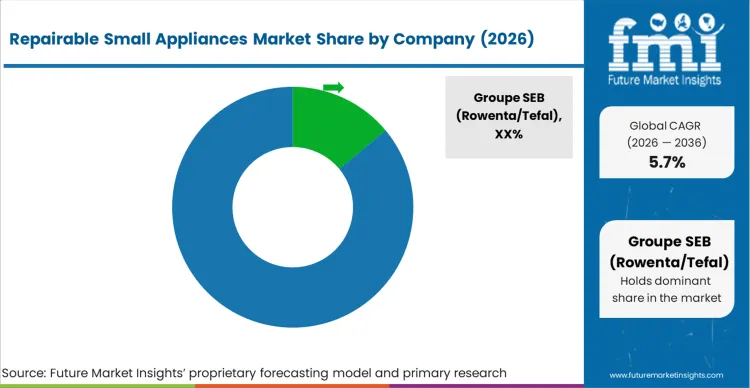
The introduction of standardized testing profiles under regional indices is reshaping how premium buyers evaluate hardware. Instead of accepting proprietary designs, procurement teams now demand certified, repairable small kitchen appliances in all new tenders. This shift has raised the performance bar across the industry, meaning vendors that continue to rely on closed ecosystems risk being excluded from major sustainability programs.
Industry leaders have already begun adapting. For example, manufacturers such as Groupe SEB, Bosch, and Midea have aligned their portfolios with open, repairable standards. As a result, personal care suppliers are now pushed to integrate native durability capabilities directly into their hardware instead of using add-on service programs.
Vendors embedding precision repair protocols directly into rechargeable devices gain a significant advantage. Companies like Philips and Dyson, which increasingly incorporate modular designs at the device level, help reduce engineering overhead. This approach accelerates the migration, allowing project leads to prioritize platforms that avoid the complexity of external gateways.
Key Players in Repairable Small Appliances Market
- Groupe SEB (Rowenta/Tefal)
- Robert Bosch GmbH
- Dyson Ltd.
- Philips NV
- Midea Group
- Whirlpool Corporation
- Breville Group
- SharkNinja
Scope of the Report
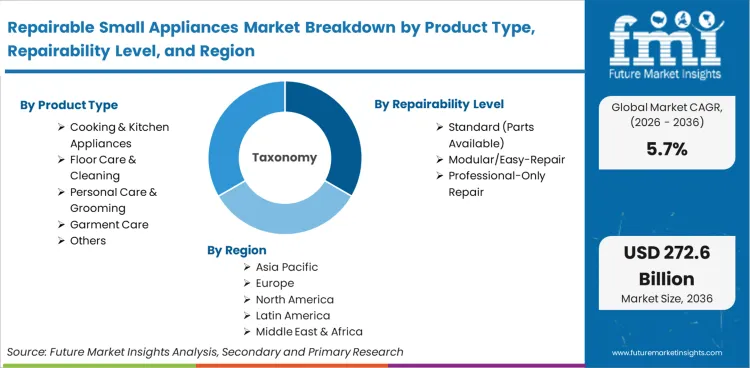
| Metric | Value |
|---|---|
| Quantitative Units | USD 156.6 billion to USD 272.1 billion, at a CAGR of 5.70% |
| Market Definition | Specialized consumer electronics built with modularity and standardized parts to guarantee extended product lifespans and reduced waste. |
| Product Type Segmentation | Cooking & Kitchen Appliances, Floor Care & Cleaning, Personal Care & Grooming, Garment Care, Others |
| Repairability Level Segmentation | Modular/Easy-Repair, Standard (Parts Available), Professional-Only Repair |
| Distribution Channel Segmentation | Online/E-commerce, Specialty Electronics Stores, Direct-to-Consumer (DTC), Others |
| Regions Covered | North America, Latin America, Europe, East Asia, South Asia, Oceania, Middle East & Africa |
| Countries Covered | China, India, UK, Germany, USA, France, Brazil, and 40 plus countries |
| Key Companies Profiled | Groupe SEB, Bosch, Dyson, Philips, Midea, Whirlpool, Breville, SharkNinja |
| Forecast Period | 2026 to 2036 |
| Approach | Primary interviews with design leads, desk research of compliance roadmaps, and bottom-up market sizing from shipment data. |
Repairable Small Appliances Market Analysis by Segments
Product Type:
- Cooking & Kitchen Appliances
- Floor Care & Cleaning
- Personal Care & Grooming
- Garment Care
- Others
Repairability Level:
- Modular/Easy-Repair
- Standard (Parts Available)
- Professional-Only Repair
Distribution Channel:
- Online/E-commerce
- Specialty Electronics Stores
- Direct-to-Consumer (DTC)
- Others
Region:
- Asia Pacific
- China
- India
- Japan
- South Korea
- Indonesia
- Australia & New Zealand
- ASEAN
- Rest of Asia Pacific
- Europe
- United Kingdom
- Germany
- Italy
- France
- Spain
- Benelux
- Nordics
- Central & Eastern Europe
- Rest of Europe
- North America
- United States
- Canada
- Mexico
- Latin America
- Brazil
- Argentina
- Chile
- Rest of Latin America
- Middle East & Africa
- Kingdom of Saudi Arabia
- United Arab Emirates
- South Africa
- Turkey
- Rest of Middle East
- Africa
Bibliography
- European Union. (2024, June 13). Regulation (EU) 2024/1781 of the European Parliament and of the Council establishing a framework for the setting of ecodesign requirements for sustainable products.
- Ministère de la Transition écologique, de la Biodiversité, de la Forêt, de la Mer et de la Pêche. (2024, April 9). Indice de durabilité.
- Bureau of Household Goods and Services, California Department of Consumer Affairs. (2024, June 15). Industry advisory: The Right to Repair Act effective July 1, 2024
- Press Information Bureau, Ministry of Consumer Affairs, Food & Public Distribution, Government of India. (2024, September 24). Centre constitutes committee for formulating framework on Repairability Index in Mobile and Electronics Sector.
- Competition Bureau Canada. (2024, September 26). Submission to ISED: Right to Repair public consultation.
This bibliography is provided for reader reference and is not exhaustive. The full report contains the complete reference list and detailed citations.
This Report Addresses
- Market intelligence to support strategic decision‑making across organized and emerging repairable small appliance categories, including kitchen, floor care, garment care, and personal grooming segments
- Market size estimation and 10‑year revenue forecasts from 2026 to 2036, supported by validated shipment data, spare‑part inventory tracking, and structured primary interviews with design and service leads
- Growth opportunity mapping across product types, repairability tiers, and distribution ecosystems with emphasis on modular engineering, service lifecycle efficiency, and compliance‑led design transformation
- Segment and regional revenue forecasts covering modular/easy‑repair, standard (parts‑available), and professional‑only repair formats across online, specialty retail, and direct‑to‑consumer channels
- Competitive strategy assessment including component standardization, repair‑score optimization, modular platform development, and after‑sales network strengthening across global markets
- Product development tracking including modular heating elements, user‑replaceable batteries, standardized fasteners, open‑architecture motor assemblies, and next‑generation diagnostic and repair‑support tools
- Market access analysis covering e‑commerce spare‑part ecosystems, authorized repair networks, reverse‑logistics programs, and integration with refurbishment, recycling, and circular‑economy value chains
- Market report delivery in PDF, Excel, PPT, and interactive dashboard formats for executive strategy, category planning, sustainability benchmarking, and operational decision support
Frequently Asked Questions
How large is the Repairable Small Appliances Market in 2026?
The repairable small appliances market is projected to reach USD 156.6 billion in 2026, supported by rising demand for durable, modular, and serviceable products.
What will the Repairable Small Appliances Market be valued at by 2036?
The market is expected to attain USD 272.1 billion by 2036, as repair-friendly design standards and spare-parts ecosystems become commercially important worldwide.
What CAGR is projected for the Repairable Small Appliances Market between 2026 and 2036?
The market is projected to expand at a 5.70% CAGR, supported by circular economy rules, growing repair awareness, and premium appliance replacement economics.
Which product type segment leads the Repairable Small Appliances Market?
Cooking and kitchen appliances lead the product type segment with 42.0% share in 2026, driven by higher product value and frequent component replacement demand.
Which distribution channel leads the Repairable Small Appliances Market?
Online and e-commerce lead distribution in 2026, as digital platforms simplify spare-parts discovery, ordering, instructional access, and direct consumer repair engagement.
Which repairability level holds the leading share in the market?
Standard repairability, where parts remain available through authorized channels, leads the market with 54.0% share in 2026 due to balanced accessibility.
What is driving growth in the Repairable Small Appliances Market?
Growth is being driven by right-to-repair mandates, rising appliance replacement costs, e-waste reduction goals, and stronger consumer preference for long-life products.
What is the primary restraint affecting market expansion?
The main restraint is the complexity of managing long-term spare-parts inventories, which raises logistics costs and challenges multi-vendor service coordination.
Which country is projected to grow the fastest in this market?
China is projected to grow fastest, at 7.1% CAGR, supported by rising middle-class demand, expanding quality-conscious consumption, and scalable repairable appliance manufacturing.
Why is India emerging as a strong growth market for repairable small appliances?
India is advancing at 6.8% CAGR because waste management frameworks, rural service expansion, and affordability pressures are increasing interest in repairable appliances.
How is France influencing the repairable small appliances industry?
France influences the industry through its national Repairability Index, which increases retail transparency, highlights spare-parts availability, and encourages consumers to prefer serviceable devices.
What is included within the Repairable Small Appliances Market scope?
The market includes kitchen appliances, vacuum cleaners, hair dryers, irons, official repair kits, modular parts, and diagnostic tools supporting native repairability.
What is excluded from the Repairable Small Appliances Market scope?
Excluded categories include disposable electronics, industrial food-processing equipment, large white goods, and air-treatment devices lacking accessible internal motor assemblies.
Why do cooking and kitchen appliances dominate this market?
Cooking and kitchen appliances dominate because consumers replace heating elements, gaskets, and sensors more often, making modular repairability economically attractive.
How does e-commerce strengthen adoption of repairable small appliances?
E-commerce strengthens adoption by providing access to genuine components, repair manuals, availability tracking, and fast delivery that supports do-it-yourself maintenance.
What opportunity does refurbishment create for appliance brands?
Refurbishment programs let brands recapture used products, extend lifecycle value, reduce waste, and open lower-cost resale channels for repairable appliance portfolios.
How can 3D-printed spare parts support market expansion?
3D-printed spare parts support growth by enabling localized replacement of non-critical housings and accessories, helping older appliances remain serviceable longer.
Why is Germany an important country in this market?
Germany remains important because premium appliance engineering, validation standards, and structured service expectations support a 5.5% CAGR through the forecast period.
Who are the key companies operating in the Repairable Small Appliances Market?
Key participants include Groupe SEB, Robert Bosch, Dyson, Philips, Midea, Whirlpool, Breville, and SharkNinja, each active across durable appliance categories.
How is FMI building the forecast for this market?
FMI builds the forecast through primary interviews, desk research on compliance roadmaps, bottom-up shipment analysis, and validation against spare-parts availability data.
Preview the report firsthand - request a free sample
Get SampleGet the brochure for pricing and purchase details.
Get PDFTable of Content
- Executive Summary
- Global Market Outlook
- Demand-side Trends
- Supply-side Trends
- Technology Roadmap Analysis
- Analysis and Recommendations
- Market Overview
- Market Coverage / Taxonomy
- Market Definition / Scope / Limitations
- Research Methodology
- Chapter Orientation
- Analytical Lens and Working Hypotheses
- Market Structure, Signals, and Trend Drivers
- Benchmarking and Cross-market Comparability
- Market Sizing, Forecasting, and Opportunity Mapping
- Research Design and Evidence Framework
- Desk Research Programme (Secondary Evidence)
- Company Annual and Sustainability Reports
- Peer-reviewed Journals and Academic Literature
- Corporate Websites, Product Literature, and Technical Notes
- Earnings Decks and Investor Briefings
- Statutory Filings and Regulatory Disclosures
- Technical White Papers and Standards Notes
- Trade Journals, Industry Magazines, and Analyst Briefs
- Conference Proceedings, Webinars, and Seminar Materials
- Government Statistics Portals and Public Data Releases
- Press Releases and Reputable Media Coverage
- Specialist Newsletters and Curated Briefings
- Sector Databases and Reference Repositories
- FMI Internal Proprietary Databases and Historical Market Datasets
- Subscription Datasets and Paid Sources
- Social Channels, Communities, and Digital Listening Inputs
- Additional Desk Sources
- Expert Input and Fieldwork (Primary Evidence)
- Primary Modes
- Qualitative Interviews and Expert Elicitation
- Quantitative Surveys and Structured Data Capture
- Blended Approach
- Why Primary Evidence is Used
- Field Techniques
- Interviews
- Surveys
- Focus Groups
- Observational and In-context Research
- Social and Community Interactions
- Stakeholder Universe Engaged
- C-suite Leaders
- Board Members
- Presidents and Vice Presidents
- R&D and Innovation Heads
- Technical Specialists
- Domain Subject-matter Experts
- Scientists
- Physicians and Other Healthcare Professionals
- Governance, Ethics, and Data Stewardship
- Research Ethics
- Data Integrity and Handling
- Primary Modes
- Tooling, Models, and Reference Databases
- Desk Research Programme (Secondary Evidence)
- Data Engineering and Model Build
- Data Acquisition and Ingestion
- Cleaning, Normalisation, and Verification
- Synthesis, Triangulation, and Analysis
- Quality Assurance and Audit Trail
- Market Background
- Market Dynamics
- Drivers
- Restraints
- Opportunity
- Trends
- Scenario Forecast
- Demand in Optimistic Scenario
- Demand in Likely Scenario
- Demand in Conservative Scenario
- Opportunity Map Analysis
- Product Life Cycle Analysis
- Supply Chain Analysis
- Investment Feasibility Matrix
- Value Chain Analysis
- PESTLE and Porter’s Analysis
- Regulatory Landscape
- Regional Parent Market Outlook
- Production and Consumption Statistics
- Import and Export Statistics
- Market Dynamics
- Global Market Analysis 2021 to 2025 and Forecast, 2026 to 2036
- Historical Market Size Value (USD Million) Analysis, 2021 to 2025
- Current and Future Market Size Value (USD Million) Projections, 2026 to 2036
- Y-o-Y Growth Trend Analysis
- Absolute $ Opportunity Analysis
- Global Market Pricing Analysis 2021 to 2025 and Forecast 2026 to 2036
- Global Market Analysis 2021 to 2025 and Forecast 2026 to 2036, By Product Type
- Introduction / Key Findings
- Historical Market Size Value (USD Million) Analysis By Product Type , 2021 to 2025
- Current and Future Market Size Value (USD Million) Analysis and Forecast By Product Type , 2026 to 2036
- Cooking & Kitchen Appliances
- Floor Care & Cleaning
- Personal Care & Grooming
- Garment Care
- Others
- Cooking & Kitchen Appliances
- Y-o-Y Growth Trend Analysis By Product Type , 2021 to 2025
- Absolute $ Opportunity Analysis By Product Type , 2026 to 2036
- Global Market Analysis 2021 to 2025 and Forecast 2026 to 2036, By Repairability Level
- Introduction / Key Findings
- Historical Market Size Value (USD Million) Analysis By Repairability Level, 2021 to 2025
- Current and Future Market Size Value (USD Million) Analysis and Forecast By Repairability Level, 2026 to 2036
- Standard (Parts Available)
- Modular/Easy-Repair
- Professional-Only Repair
- Standard (Parts Available)
- Y-o-Y Growth Trend Analysis By Repairability Level, 2021 to 2025
- Absolute $ Opportunity Analysis By Repairability Level, 2026 to 2036
- Global Market Analysis 2021 to 2025 and Forecast 2026 to 2036, By Distribution Channel
- Introduction / Key Findings
- Historical Market Size Value (USD Million) Analysis By Distribution Channel, 2021 to 2025
- Current and Future Market Size Value (USD Million) Analysis and Forecast By Distribution Channel, 2026 to 2036
- Online/E-commerce
- Specialty Electronics Stores
- Direct-to-Consumer (DTC)
- Others
- Online/E-commerce
- Y-o-Y Growth Trend Analysis By Distribution Channel, 2021 to 2025
- Absolute $ Opportunity Analysis By Distribution Channel, 2026 to 2036
- Global Market Analysis 2021 to 2025 and Forecast 2026 to 2036, By Region
- Introduction
- Historical Market Size Value (USD Million) Analysis By Region, 2021 to 2025
- Current Market Size Value (USD Million) Analysis and Forecast By Region, 2026 to 2036
- North America
- Latin America
- Western Europe
- Eastern Europe
- East Asia
- South Asia and Pacific
- Middle East & Africa
- Market Attractiveness Analysis By Region
- North America Market Analysis 2021 to 2025 and Forecast 2026 to 2036, By Country
- Historical Market Size Value (USD Million) Trend Analysis By Market Taxonomy, 2021 to 2025
- Market Size Value (USD Million) Forecast By Market Taxonomy, 2026 to 2036
- By Country
- USA
- Canada
- Mexico
- By Product Type
- By Repairability Level
- By Distribution Channel
- By Country
- Market Attractiveness Analysis
- By Country
- By Product Type
- By Repairability Level
- By Distribution Channel
- Key Takeaways
- Latin America Market Analysis 2021 to 2025 and Forecast 2026 to 2036, By Country
- Historical Market Size Value (USD Million) Trend Analysis By Market Taxonomy, 2021 to 2025
- Market Size Value (USD Million) Forecast By Market Taxonomy, 2026 to 2036
- By Country
- Brazil
- Chile
- Rest of Latin America
- By Product Type
- By Repairability Level
- By Distribution Channel
- By Country
- Market Attractiveness Analysis
- By Country
- By Product Type
- By Repairability Level
- By Distribution Channel
- Key Takeaways
- Western Europe Market Analysis 2021 to 2025 and Forecast 2026 to 2036, By Country
- Historical Market Size Value (USD Million) Trend Analysis By Market Taxonomy, 2021 to 2025
- Market Size Value (USD Million) Forecast By Market Taxonomy, 2026 to 2036
- By Country
- Germany
- UK
- Italy
- Spain
- France
- Nordic
- BENELUX
- Rest of Western Europe
- By Product Type
- By Repairability Level
- By Distribution Channel
- By Country
- Market Attractiveness Analysis
- By Country
- By Product Type
- By Repairability Level
- By Distribution Channel
- Key Takeaways
- Eastern Europe Market Analysis 2021 to 2025 and Forecast 2026 to 2036, By Country
- Historical Market Size Value (USD Million) Trend Analysis By Market Taxonomy, 2021 to 2025
- Market Size Value (USD Million) Forecast By Market Taxonomy, 2026 to 2036
- By Country
- Russia
- Poland
- Hungary
- Balkan & Baltic
- Rest of Eastern Europe
- By Product Type
- By Repairability Level
- By Distribution Channel
- By Country
- Market Attractiveness Analysis
- By Country
- By Product Type
- By Repairability Level
- By Distribution Channel
- Key Takeaways
- East Asia Market Analysis 2021 to 2025 and Forecast 2026 to 2036, By Country
- Historical Market Size Value (USD Million) Trend Analysis By Market Taxonomy, 2021 to 2025
- Market Size Value (USD Million) Forecast By Market Taxonomy, 2026 to 2036
- By Country
- China
- Japan
- South Korea
- By Product Type
- By Repairability Level
- By Distribution Channel
- By Country
- Market Attractiveness Analysis
- By Country
- By Product Type
- By Repairability Level
- By Distribution Channel
- Key Takeaways
- South Asia and Pacific Market Analysis 2021 to 2025 and Forecast 2026 to 2036, By Country
- Historical Market Size Value (USD Million) Trend Analysis By Market Taxonomy, 2021 to 2025
- Market Size Value (USD Million) Forecast By Market Taxonomy, 2026 to 2036
- By Country
- India
- ASEAN
- Australia & New Zealand
- Rest of South Asia and Pacific
- By Product Type
- By Repairability Level
- By Distribution Channel
- By Country
- Market Attractiveness Analysis
- By Country
- By Product Type
- By Repairability Level
- By Distribution Channel
- Key Takeaways
- Middle East & Africa Market Analysis 2021 to 2025 and Forecast 2026 to 2036, By Country
- Historical Market Size Value (USD Million) Trend Analysis By Market Taxonomy, 2021 to 2025
- Market Size Value (USD Million) Forecast By Market Taxonomy, 2026 to 2036
- By Country
- Kingdom of Saudi Arabia
- Other GCC Countries
- Turkiye
- South Africa
- Other African Union
- Rest of Middle East & Africa
- By Product Type
- By Repairability Level
- By Distribution Channel
- By Country
- Market Attractiveness Analysis
- By Country
- By Product Type
- By Repairability Level
- By Distribution Channel
- Key Takeaways
- Key Countries Market Analysis
- USA
- Pricing Analysis
- Market Share Analysis, 2025
- By Product Type
- By Repairability Level
- By Distribution Channel
- Canada
- Pricing Analysis
- Market Share Analysis, 2025
- By Product Type
- By Repairability Level
- By Distribution Channel
- Mexico
- Pricing Analysis
- Market Share Analysis, 2025
- By Product Type
- By Repairability Level
- By Distribution Channel
- Brazil
- Pricing Analysis
- Market Share Analysis, 2025
- By Product Type
- By Repairability Level
- By Distribution Channel
- Chile
- Pricing Analysis
- Market Share Analysis, 2025
- By Product Type
- By Repairability Level
- By Distribution Channel
- Germany
- Pricing Analysis
- Market Share Analysis, 2025
- By Product Type
- By Repairability Level
- By Distribution Channel
- UK
- Pricing Analysis
- Market Share Analysis, 2025
- By Product Type
- By Repairability Level
- By Distribution Channel
- Italy
- Pricing Analysis
- Market Share Analysis, 2025
- By Product Type
- By Repairability Level
- By Distribution Channel
- Spain
- Pricing Analysis
- Market Share Analysis, 2025
- By Product Type
- By Repairability Level
- By Distribution Channel
- France
- Pricing Analysis
- Market Share Analysis, 2025
- By Product Type
- By Repairability Level
- By Distribution Channel
- India
- Pricing Analysis
- Market Share Analysis, 2025
- By Product Type
- By Repairability Level
- By Distribution Channel
- ASEAN
- Pricing Analysis
- Market Share Analysis, 2025
- By Product Type
- By Repairability Level
- By Distribution Channel
- Australia & New Zealand
- Pricing Analysis
- Market Share Analysis, 2025
- By Product Type
- By Repairability Level
- By Distribution Channel
- China
- Pricing Analysis
- Market Share Analysis, 2025
- By Product Type
- By Repairability Level
- By Distribution Channel
- Japan
- Pricing Analysis
- Market Share Analysis, 2025
- By Product Type
- By Repairability Level
- By Distribution Channel
- South Korea
- Pricing Analysis
- Market Share Analysis, 2025
- By Product Type
- By Repairability Level
- By Distribution Channel
- Russia
- Pricing Analysis
- Market Share Analysis, 2025
- By Product Type
- By Repairability Level
- By Distribution Channel
- Poland
- Pricing Analysis
- Market Share Analysis, 2025
- By Product Type
- By Repairability Level
- By Distribution Channel
- Hungary
- Pricing Analysis
- Market Share Analysis, 2025
- By Product Type
- By Repairability Level
- By Distribution Channel
- Kingdom of Saudi Arabia
- Pricing Analysis
- Market Share Analysis, 2025
- By Product Type
- By Repairability Level
- By Distribution Channel
- Turkiye
- Pricing Analysis
- Market Share Analysis, 2025
- By Product Type
- By Repairability Level
- By Distribution Channel
- South Africa
- Pricing Analysis
- Market Share Analysis, 2025
- By Product Type
- By Repairability Level
- By Distribution Channel
- USA
- Market Structure Analysis
- Competition Dashboard
- Competition Benchmarking
- Market Share Analysis of Top Players
- By Regional
- By Product Type
- By Repairability Level
- By Distribution Channel
- Competition Analysis
- Competition Deep Dive
- Groupe SEB (Rowenta/Tefal)
- Overview
- Product Portfolio
- Profitability by Market Segments (Product/Age /Sales Channel/Region)
- Sales Footprint
- Strategy Overview
- Marketing Strategy
- Product Strategy
- Channel Strategy
- Robert Bosch GmbH
- Dyson Ltd.
- Philips NV
- Midea Group
- Whirlpool Corporation
- Breville Group
- SharkNinja
- Groupe SEB (Rowenta/Tefal)
- Competition Deep Dive
- Assumptions & Acronyms Used


