

- Industry Size (2026)
- USD 1.7 Bn
- Forecast (2036)
- USD 3.0 Bn
- CAGR (2026 to 2036)
- 5.90%
2-in-1 Wet and Dry Vacuum Cleaners Market Forecast and Outlook 2026 to 2036
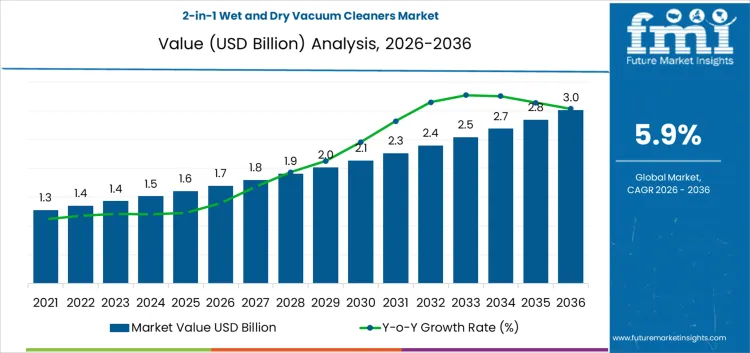
The 2-in-1 wet and dry vacuum cleaners market is projected to reach USD 1.7 billion in 2026 and USD 3.0 billion by 2036, registering a CAGR of 5.9% over the forecast period. Procurement outcomes in this market are influenced by buyer emphasis on reliability, long-term operating efficiency, and service assurance rather than unit pricing alone. Senior buyers tend to prioritize products with consistent performance across wet and dry applications, as operational disruptions increase perceived risk. Vendor selection is often shaped by warranty depth, service network reach, and availability of consumables such as filters and batteries.
Lock-in effects emerge through proprietary battery platforms, accessory fittings, and maintenance ecosystems that discourage frequent switching. Switching costs increase once users standardize cleaning routines and inventory around a specific brand platform. Risk aversion is more pronounced among commercial and institutional buyers, where equipment failure impacts daily operations. Suppliers that reduce buyer uncertainty through predictable performance and dependable support capture a greater share of value than those competing primarily on price.
Quick Stats for 2-in-1 Wet and Dry Vacuum Cleaners Market
- 2-in-1 Wet and Dry Vacuum Cleaners Market Value (2026): USD 1.7 Billion
- 2-in-1 Wet and Dry Vacuum Cleaners Market Forecast Value (2036): USD 3.0 Billion
- 2-in-1 Wet and Dry Vacuum Cleaners Market Forecast CAGR 2026 to 2036: 5.90%
- Leading Product Type in 2-in-1 Wet and Dry Vacuum Cleaners Market: Cordless Wet & Dry Vacuums
- Leading Application in 2-in-1 Wet and Dry Vacuum Cleaners Market: Residential Cleaning
- Key Growth Regions in 2-in-1 Wet and Dry Vacuum Cleaners Market: Asia Pacific, North America, Latin America, Middle East & Africa
- Top Key Players in 2-in-1 Wet and Dry Vacuum Cleaners Market: Alfred Kärcher SE & Co. KG; Nilfisk A/S; Tennant Company; Techtronic Industries Company Limited; SharkNinja, Inc.; Beijing Roborock Technology Co., Ltd.
2-in-1 Wet and Dry Vacuum Cleaners Market Key Takeaways
| Metric | Value |
|---|---|
| 2-in-1 Wet and Dry Vacuum Cleaners Market Value (2026) | USD 1.7 Billion |
| 2-in-1 Wet and Dry Vacuum Cleaners Market Forecast Value (2036) | USD 3.0 Billion |
| 2-in-1 Wet and Dry Vacuum Cleaners Market Forecast CAGR 2026 to 2036 | 5.90% |
Why Is the 2-in-1 Wet and Dry Vacuum Cleaners Market Witnessing Consistent Growth?
The 2-in-1 wet and dry vacuum cleaners market is growing as consumers increasingly prefer multifunctional home cleaning appliances that reduce the need for multiple devices. Urban households, especially in apartments and compact living spaces, are prioritizing versatility and convenience. The ability to handle both liquid spills and dry debris using a single unit is improving product appeal across residential and light commercial environments, including offices, retail spaces, and hospitality facilities.
Product innovation is further strengthening demand within the 2-in-1 wet and dry vacuum cleaners market. Manufacturers are introducing models with improved suction efficiency, advanced filtration systems, and lightweight ergonomic designs. Cordless variants, enhanced battery life, and noise reduction features are making these appliances more user-friendly. Smart features such as washable filters, quick-release tanks, and modular accessories are improving usability while extending product lifespan, which supports higher replacement and upgrade rates.
Changing lifestyles and rising hygiene awareness are also influencing growth in the 2-in-1 wet and dry vacuum cleaners market. Busy work schedules and increased focus on indoor cleanliness are encouraging adoption of efficient cleaning solutions that save time and effort. Commercial users value these systems for their ability to manage mixed waste in a single cleaning cycle. Together, rising urbanization, product upgrades, and shifting consumer preferences are sustaining steady market expansion over the forecast period.
What does the segment overview indicate about the 2-in-1 wet and dry vacuum cleaners market?
The 2-in-1 wet and dry vacuum cleaners market shows strong alignment with convenience-driven cleaning needs. Cordless models lead with 34% share, reflecting demand for flexibility and ease of use. Corded, robotic, and upright systems cater to specific cleaning environments. Residential cleaning dominates with around 55% share, supported by daily household cleaning requirements. Commercial, industrial, and hospitality applications contribute stable secondary demand, creating balanced growth across both domestic and professional use segments.
Why do cordless wet & dry vacuums hold the leading type share in the 2-in-1 wet and dry vacuum cleaners market?
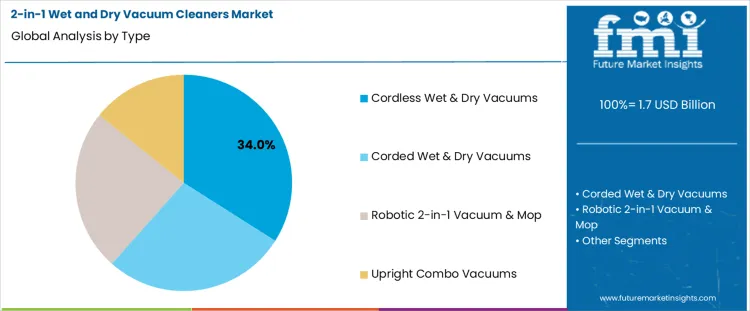
Cordless wet & dry vacuums hold the leading 34% share in the 2-in-1 wet and dry vacuum cleaners market because they align strongly with user preferences for mobility, speed, and ease of handling. The absence of power cords allows uninterrupted movement across rooms, stairs, and tight spaces, making these units highly suitable for modern apartments and compact homes. Battery-powered designs support quick response to liquid spills, pet messes, and routine dust cleaning without setup delays. Lightweight construction and foldable or compact storage formats further enhance convenience. Segment variation is evident, as premium households prefer high-capacity batteries and stronger suction for extended cleaning sessions, while mid-range models cater to everyday household tasks. Continuous improvements in battery efficiency, charging speed, and suction stability reinforce the segment’s leadership.
How does residential cleaning drive application demand in the 2-in-1 wet and dry vacuum cleaners market?
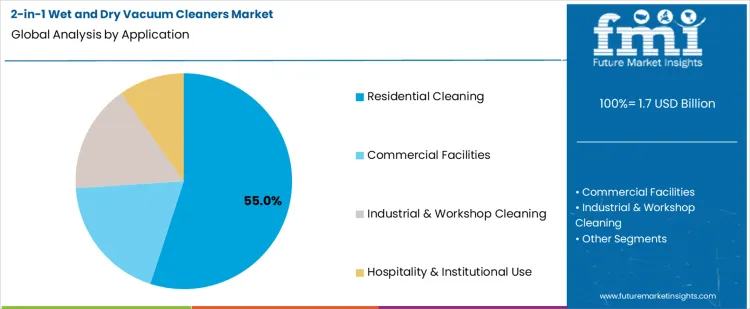
Residential cleaning drives application demand in the 2-in-1 wet and dry vacuum cleaners market, accounting for around 55% share, as households increasingly prefer multifunctional appliances that reduce cleaning time and effort. Daily exposure to dust, food spills, and liquid messes in kitchens and living areas creates consistent demand for combined vacuuming and mopping solutions. Compact home layouts and rising apartment living support adoption of space-saving, all-in-one cleaning devices. Users value the ability to switch quickly between dry and wet cleaning without changing equipment. Demand variation exists across regions, with urban households showing higher replacement rates and suburban homes favoring durable models. Seasonal deep-cleaning routines and rising awareness of hygiene standards further strengthen residential dominance across the application landscape.
What’s Shaping Growth in the 2-in-1 Wet and Dry Vacuum Cleaners Market?
The 2-in-1 wet and dry vacuum cleaners market is expanding as households and commercial users seek versatile cleaning solutions that handle liquid spills and dry debris with a single device. Rising urban living, smaller homes, and time-efficient cleaning preferences are increasing demand for multi-functional appliances. Growth is supported by higher adoption in hospitality, retail, and healthcare facilities where mixed-surface cleaning is frequent. Cordless designs, improved suction efficiency, and compact storage footprints are strengthening product appeal. E-commerce penetration and wider availability across price tiers are improving accessibility. Demand is also influenced by replacement cycles, convenience-driven purchasing behavior, and increased awareness of hygienic indoor environments.
What Is Limiting Wider Adoption of 2-in-1 Wet and Dry Vacuum Cleaners?
Price sensitivity remains a key restraint in the 2-in-1 wet and dry vacuum cleaners market, especially in cost-conscious residential segments. Multi-function units are often priced higher than basic dry vacuum cleaners, slowing adoption in emerging regions. Product weight, noise levels, and storage size can also discourage frequent use in smaller homes. Some users perceive compromises in suction power or liquid handling compared with specialized machines. Maintenance requirements, including filter cleaning and tank drying, add to ownership effort. Limited after-sales service availability in certain regions further affects buyer confidence, particularly for premium and cordless product variants.
How Are Product and Technology Trends Changing the 2-in-1 Wet and Dry Vacuum Cleaners Market?
Product development in the 2-in-1 wet and dry vacuum cleaners market is focused on improving usability, efficiency, and design flexibility. Manufacturers are introducing cordless models with longer battery life, faster charging, and consistent suction performance. Compact and lightweight designs are gaining traction to suit urban homes and storage-constrained users. Enhanced filtration systems and sealed airflow designs are improving dust containment and hygiene performance. Smart indicators for tank capacity, filter status, and battery levels are becoming more common. Growth in online retail is influencing product bundling, accessories, and pricing strategies, while branding increasingly emphasizes convenience and multi-surface cleaning capability.
What is the country-wise growth outlook for the 2-in-1 wet and dry vacuum cleaners market?
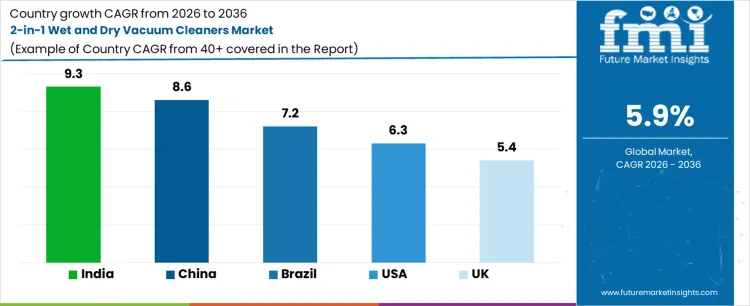
The 2-in-1 wet and dry vacuum cleaners market shows differentiated growth across emerging and mature consumer appliance economies, shaped by household income trends, urban housing formats, and adoption of multi-functional cleaning appliances. India leads the outlook with a CAGR of 9.3%, supported by rising urban households and demand for versatile cleaning solutions. China follows at an 8.6% CAGR as consumers upgrade from basic vacuum models to multifunctional units. Brazil records a 7.2% CAGR driven by improving appliance penetration in urban homes. The USA grows at a 6.3% CAGR, reflecting replacement demand and premium product adoption. The UK posts a 5.4% CAGR, supported by compact living spaces and demand for efficient home cleaning equipment.
| Country | CAGR |
|---|---|
| India | 9.3% |
| China | 8.6% |
| Brazil | 7.2% |
| USA | 6.3% |
| UK | 5.4% |
Why is India emerging as a high-growth market for 2-in-1 wet and dry vacuum cleaners?
Demand for the 2-in-1 wet and dry vacuum cleaners in India is expanding at a CAGR of 9.3%, driven by rising urban households and growing preference for multifunctional home cleaning appliances. Indian consumers increasingly look for single devices that manage dry dust, food crumbs, and wet spills, reducing dependence on traditional cleaning methods. Sales growth is supported by compact apartments, tiled flooring, and higher awareness of time-saving cleaning solutions. E-commerce platforms and organized retail chains improve product availability, pricing transparency, and access to multiple brands. Manufacturers focus on affordable price points, lightweight designs, and low-maintenance features to attract first-time buyers. Penetration is increasing across Tier II and Tier III cities as disposable incomes rise and appliance ownership expands. Promotional offers, easy financing options, and extended warranties further influence purchasing decisions. These factors together strengthen India’s position as the fastest-growing country market for 2-in-1 wet and dry vacuum cleaners during the forecast period.
What factors are supporting China’s growth trajectory in the 2-in-1 wet and dry vacuum cleaners market?
Sales for the 2-in-1 wet and dry vacuum cleaners in China are rising at a CAGR of 8.6%, supported by consumer upgrades from conventional vacuum cleaners to multifunctional models. High urban housing density and increasing expectations around household hygiene drive demand for efficient cleaning appliances. Chinese consumers value the ability to manage mixed cleaning needs such as fine dust, pet hair, and liquid spills using a single device. Domestic manufacturers play a strong role by offering competitively priced models with improved suction power and filtration systems. Online marketplaces and brand-led promotional campaigns accelerate replacement demand. Compact designs suitable for apartment living and easy storage influence purchasing behavior. Continuous product innovation, feature upgrades, and frequent model launches support repeat purchases. These dynamics help sustain steady sales momentum for 2-in-1 wet and dry vacuum cleaners across urban and semi-urban regions in China.
How is Brazil contributing to growth in the 2-in-1 wet and dry vacuum cleaners market?
Demand for the 2-in-1 wet and dry vacuum cleaners in Brazil is growing at a CAGR of 7.2%, as household appliance penetration improves across urban centers. Brazilian consumers increasingly prefer versatile cleaning tools that reduce physical effort and cleaning time. Mixed flooring types, combined with exposure to dust and moisture, increase the relevance of wet and dry functionality. Sales are supported by expanding middle-income households and wider access to consumer credit and installment-based purchasing. Retail promotions and bundled appliance offers improve product visibility and affordability. Buyers show preference for durable designs and easy maintenance due to cost sensitivity. Growing awareness of hygiene and convenience in home cleaning supports gradual replacement of traditional cleaning practices. These factors collectively contribute to steady adoption of 2-in-1 wet and dry vacuum cleaners across residential segments in Brazil.
Why does the USA remain a stable demand center for 2-in-1 wet and dry vacuum cleaners?
Sales for the 2-in-1 wet and dry vacuum cleaners in the USA are increasing at a CAGR of 6.3%, driven primarily by replacement demand and preference for premium home cleaning appliances. Larger home sizes and high pet ownership create consistent need for powerful, multi-surface cleaning solutions. Consumers prioritize strong suction performance, advanced filtration, and ease of use. Online retail platforms and specialty appliance stores support product differentiation and brand visibility. Cordless, compact, and smart-enabled models gain traction for convenience and storage efficiency. Brand reputation, warranty coverage, and after-sales service strongly influence purchasing decisions. Although household appliance penetration is already high, steady upgrades and premiumization trends continue to support ongoing sales growth in the USA.
What is shaping moderate growth in the UK’s 2-in-1 wet and dry vacuum cleaners market?
Demand for the 2-in-1 wet and dry vacuum cleaners in the UK is advancing at a CAGR of 5.4%, supported by compact living spaces and efficiency-focused consumer preferences. UK households increasingly favor space-saving appliances capable of handling both dry debris and liquid spills. Sales are influenced by smaller home layouts and rising interest in multifunctional devices that reduce storage requirements. Energy efficiency, noise control, and lightweight construction play important roles in purchasing decisions. Retailers emphasize compact designs suitable for apartments and terraced homes. Replacement demand and gradual upgrades from basic vacuum cleaners support consistent sales volumes. These factors result in steady, value-driven growth for 2-in-1 wet and dry vacuum cleaners across residential households in the UK.
How are leading players competing and positioning themselves in the 2-in-1 wet and dry vacuum cleaners market?
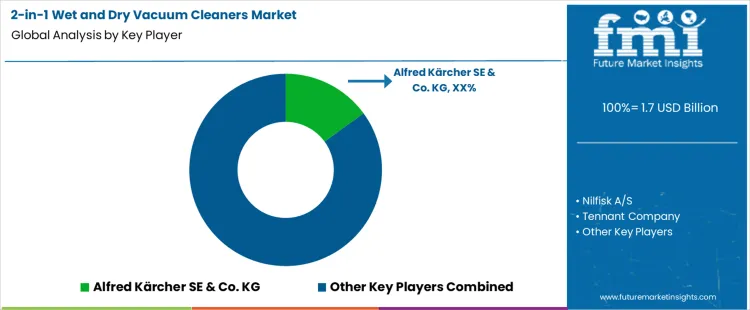
Competition is being driven by how effectively wet pickup, dry debris removal, and floor care automation are combined into a single platform. Alfred Kärcher SE & Co. KG is being positioned around professional-grade reliability adapted for consumer and light commercial use. Product brochures emphasize suction stability, separate clean and dirty water tanks, and durable brush systems designed for repeated wet-dry cycles. Nilfisk A/S is being differentiated through industrial heritage, with messaging focused on powerful airflow, hygienic waste separation, and long operating life. Performance consistency and cleaning precision are being presented as the key buying factors.
Commercial and institutional demand is being shaped by Tennant Company. Its wet and dry solutions are being promoted for commercial spaces, retail floors, and hospitality environments where downtime must be minimized. Compact scrubber-vac hybrids and easy-maintenance designs are being highlighted in brochures. Techtronic Industries Company Limited is competing through aggressive innovation and scale. Brands under its portfolio are being positioned on cordless convenience, high-speed digital motors, and rapid moisture extraction. Battery efficiency and lightweight construction are being framed as productivity enablers for modern households.
A different competitive tone is being set by SharkNinja, Inc. User-focused design is being emphasized, with messaging centered on intuitive controls, self-cleaning brush rolls, and odor management. Product literature highlights simplicity and everyday usability rather than technical depth. Beijing Roborock Technology Co., Ltd. is pushing automation and smart cleaning integration. Wet and dry vacuum-mop hybrids are being positioned as intelligent floor care systems, supported by sensors, app connectivity, and adaptive water control. Precision cleaning with minimal manual effort is being marketed as the primary advantage.
Key Players in 2-in-1 Wet and Dry Vacuum Cleaners Market
- Key Player
- Alfred Kärcher SE & Co. KG
- Nilfisk A/S
- Tennant Company
- Techtronic Industries Company Limited
- SharkNinja, Inc.
- Beijing Roborock Technology Co., Ltd.
Scope of Report
| Attributes | Description |
|---|---|
| Quantitative Unit | USD Billion |
| Base Year | 2026 |
| Forecast Period | 2026-2036 |
| Type | Cordless Wet & Dry Vacuums, Corded Wet & Dry Vacuums, Robotic 2-in-1 Vacuum & Mop, Upright Combo Vacuums |
| Application | Residential Cleaning, Commercial Facilities, Industrial & Workshop Cleaning, Hospitality & Institutional Use |
| Regions Covered | Asia Pacific, Europe, North America, Latin America, Middle East & Africa |
| Countries Covered | China, Japan, South Korea, India, Australia & New Zealand, ASEAN, Rest of Asia Pacific, Germany, United Kingdom, France, Italy, Spain, Nordic, BENELUX, Rest of Europe, United States, Canada, Mexico, Brazil, Chile, Rest of Latin America, Kingdom of Saudi Arabia, Other GCC Countries, Turkey, South Africa, Other African Union, Rest of Middle East & Africa |
| Key Companies Profiled | Alfred Kärcher SE & Co. KG, Nilfisk A/S, Tennant Company, Techtronic Industries Company Limited, SharkNinja, Inc., Beijing Roborock Technology Co., Ltd. |
| Additional Attributes | Dollar sales by type and application; regional market sizing with 2026-2036 forecast analysis; assessment of cordless and robotic adoption trends; evaluation of cleaning efficiency requirements across residential, commercial, and industrial environments; analysis of distribution and procurement patterns across consumer retail and institutional buyers. |
2-in-1 Wet and Dry Vacuum Cleaners Market by Key Segments
Type
- Cordless Wet & Dry Vacuums
- Corded Wet & Dry Vacuums
- Robotic 2-in-1 Vacuum & Mop
- Upright Combo Vacuums
Application
- Residential Cleaning
- Commercial Facilities
- Industrial & Workshop Cleaning
- Hospitality & Institutional Use
Region:
- Asia Pacific
- China
- Japan
- South Korea
- India
- Australia & New Zealand
- ASEAN
- Rest of Asia Pacific
- Europe
- Germany
- United Kingdom
- France
- Italy
- Spain
- Nordic
- BENELUX
- Rest of Europe
- North America
- United States
- Canada
- Mexico
- Latin America
- Brazil
- Chile
- Rest of Latin America
- Middle East & Africa
- Kingdom of Saudi Arabia
- Other GCC Countries
- Turkey
- South Africa
- Other African Union
- Rest of Middle East & Africa
Bibliography
- International Electrotechnical Commission. (2023). Household and similar electrical appliances—Safety and performance requirements for vacuum cleaners (IEC 60335-2-2:2023). IEC.
- Bureau of Indian Standards. (2025). IS 302 (Part 1):2024 household and similar electrical appliances—General requirements (Safety Quality Control Order for vacuum cleaners and water suction appliances). Government of India.
- European Committee for Electrotechnical Standardization. (2024). EN 60335-2-2:2024 household and similar electrical appliances—Safety—Part 2-2: Particular requirements for vacuum cleaners and water suction cleaning appliances. CENELEC.
Frequently Asked Questions
How big is the 2-in-1 wet and dry vacuum cleaners market in 2026?
The global 2-in-1 wet and dry vacuum cleaners market is estimated to be valued at USD 1.7 billion in 2026.
What will be the size of 2-in-1 wet and dry vacuum cleaners market in 2036?
The market size for the 2-in-1 wet and dry vacuum cleaners market is projected to reach USD 3.0 billion by 2036.
How much will be the 2-in-1 wet and dry vacuum cleaners market growth between 2026 and 2036?
The 2-in-1 wet and dry vacuum cleaners market is expected to grow at a 5.9% CAGR between 2026 and 2036.
What are the key product types in the 2-in-1 wet and dry vacuum cleaners market?
The key product types in 2-in-1 wet and dry vacuum cleaners market are cordless wet & dry vacuums, corded wet & dry vacuums, robotic 2-in-1 vacuum & mop and upright combo vacuums.
Which application segment to contribute significant share in the 2-in-1 wet and dry vacuum cleaners market in 2026?
In terms of application, residential cleaning segment to command 55.0% share in the 2-in-1 wet and dry vacuum cleaners market in 2026.
Preview the report firsthand - request a free sample
Get SampleGet the brochure for pricing and purchase details.
Get PDFTable of Content
- Executive Summary
- Global Market Outlook
- Demand-side Trends
- Supply-side Trends
- Technology Roadmap Analysis
- Analysis and Recommendations
- Market Overview
- Market Coverage / Taxonomy
- Market Definition / Scope / Limitations
- Market Background
- Market Dynamics
- Drivers
- Restraints
- Opportunity
- Trends
- Scenario Forecast
- Demand in Optimistic Scenario
- Demand in Likely Scenario
- Demand in Conservative Scenario
- Opportunity Map Analysis
- Product Life Cycle Analysis
- Supply Chain Analysis
- Investment Feasibility Matrix
- Value Chain Analysis
- PESTLE and Porter’s Analysis
- Regulatory Landscape
- Regional Parent Market Outlook
- Production and Consumption Statistics
- Import and Export Statistics
- Market Dynamics
- Global Market Analysis 2021 to 2025 and Forecast, 2026 to 2036
- Historical Market Size Value (USD Million) Analysis, 2021 to 2025
- Current and Future Market Size Value (USD Million) Projections, 2026 to 2036
- Y-o-Y Growth Trend Analysis
- Absolute $ Opportunity Analysis
- Global Market Pricing Analysis 2021 to 2025 and Forecast 2026 to 2036
- Global Market Analysis 2021 to 2025 and Forecast 2026 to 2036, By Type
- Introduction / Key Findings
- Historical Market Size Value (USD Million) Analysis By Type , 2021 to 2025
- Current and Future Market Size Value (USD Million) Analysis and Forecast By Type , 2026 to 2036
- Cordless Wet & Dry Vacuums
- Corded Wet & Dry Vacuums
- Robotic 2-in-1 Vacuum & Mop
- Upright Combo Vacuums
- Cordless Wet & Dry Vacuums
- Y-o-Y Growth Trend Analysis By Type , 2021 to 2025
- Absolute $ Opportunity Analysis By Type , 2026 to 2036
- Global Market Analysis 2021 to 2025 and Forecast 2026 to 2036, By Application
- Introduction / Key Findings
- Historical Market Size Value (USD Million) Analysis By Application, 2021 to 2025
- Current and Future Market Size Value (USD Million) Analysis and Forecast By Application, 2026 to 2036
- Residential Cleaning
- Commercial Facilities
- Industrial & Workshop Cleaning
- Hospitality & Institutional Use
- Residential Cleaning
- Y-o-Y Growth Trend Analysis By Application, 2021 to 2025
- Absolute $ Opportunity Analysis By Application, 2026 to 2036
- Global Market Analysis 2021 to 2025 and Forecast 2026 to 2036, By Region
- Introduction
- Historical Market Size Value (USD Million) Analysis By Region, 2021 to 2025
- Current Market Size Value (USD Million) Analysis and Forecast By Region, 2026 to 2036
- North America
- Latin America
- Western Europe
- Eastern Europe
- East Asia
- South Asia and Pacific
- Middle East & Africa
- Market Attractiveness Analysis By Region
- North America Market Analysis 2021 to 2025 and Forecast 2026 to 2036, By Country
- Historical Market Size Value (USD Million) Trend Analysis By Market Taxonomy, 2021 to 2025
- Market Size Value (USD Million) Forecast By Market Taxonomy, 2026 to 2036
- By Country
- USA
- Canada
- Mexico
- By Type
- By Application
- By Country
- Market Attractiveness Analysis
- By Country
- By Type
- By Application
- Key Takeaways
- Latin America Market Analysis 2021 to 2025 and Forecast 2026 to 2036, By Country
- Historical Market Size Value (USD Million) Trend Analysis By Market Taxonomy, 2021 to 2025
- Market Size Value (USD Million) Forecast By Market Taxonomy, 2026 to 2036
- By Country
- Brazil
- Chile
- Rest of Latin America
- By Type
- By Application
- By Country
- Market Attractiveness Analysis
- By Country
- By Type
- By Application
- Key Takeaways
- Western Europe Market Analysis 2021 to 2025 and Forecast 2026 to 2036, By Country
- Historical Market Size Value (USD Million) Trend Analysis By Market Taxonomy, 2021 to 2025
- Market Size Value (USD Million) Forecast By Market Taxonomy, 2026 to 2036
- By Country
- Germany
- UK
- Italy
- Spain
- France
- Nordic
- BENELUX
- Rest of Western Europe
- By Type
- By Application
- By Country
- Market Attractiveness Analysis
- By Country
- By Type
- By Application
- Key Takeaways
- Eastern Europe Market Analysis 2021 to 2025 and Forecast 2026 to 2036, By Country
- Historical Market Size Value (USD Million) Trend Analysis By Market Taxonomy, 2021 to 2025
- Market Size Value (USD Million) Forecast By Market Taxonomy, 2026 to 2036
- By Country
- Russia
- Poland
- Hungary
- Balkan & Baltic
- Rest of Eastern Europe
- By Type
- By Application
- By Country
- Market Attractiveness Analysis
- By Country
- By Type
- By Application
- Key Takeaways
- East Asia Market Analysis 2021 to 2025 and Forecast 2026 to 2036, By Country
- Historical Market Size Value (USD Million) Trend Analysis By Market Taxonomy, 2021 to 2025
- Market Size Value (USD Million) Forecast By Market Taxonomy, 2026 to 2036
- By Country
- China
- Japan
- South Korea
- By Type
- By Application
- By Country
- Market Attractiveness Analysis
- By Country
- By Type
- By Application
- Key Takeaways
- South Asia and Pacific Market Analysis 2021 to 2025 and Forecast 2026 to 2036, By Country
- Historical Market Size Value (USD Million) Trend Analysis By Market Taxonomy, 2021 to 2025
- Market Size Value (USD Million) Forecast By Market Taxonomy, 2026 to 2036
- By Country
- India
- ASEAN
- Australia & New Zealand
- Rest of South Asia and Pacific
- By Type
- By Application
- By Country
- Market Attractiveness Analysis
- By Country
- By Type
- By Application
- Key Takeaways
- Middle East & Africa Market Analysis 2021 to 2025 and Forecast 2026 to 2036, By Country
- Historical Market Size Value (USD Million) Trend Analysis By Market Taxonomy, 2021 to 2025
- Market Size Value (USD Million) Forecast By Market Taxonomy, 2026 to 2036
- By Country
- Kingdom of Saudi Arabia
- Other GCC Countries
- Turkiye
- South Africa
- Other African Union
- Rest of Middle East & Africa
- By Type
- By Application
- By Country
- Market Attractiveness Analysis
- By Country
- By Type
- By Application
- Key Takeaways
- Key Countries Market Analysis
- USA
- Pricing Analysis
- Market Share Analysis, 2025
- By Type
- By Application
- Canada
- Pricing Analysis
- Market Share Analysis, 2025
- By Type
- By Application
- Mexico
- Pricing Analysis
- Market Share Analysis, 2025
- By Type
- By Application
- Brazil
- Pricing Analysis
- Market Share Analysis, 2025
- By Type
- By Application
- Chile
- Pricing Analysis
- Market Share Analysis, 2025
- By Type
- By Application
- Germany
- Pricing Analysis
- Market Share Analysis, 2025
- By Type
- By Application
- UK
- Pricing Analysis
- Market Share Analysis, 2025
- By Type
- By Application
- Italy
- Pricing Analysis
- Market Share Analysis, 2025
- By Type
- By Application
- Spain
- Pricing Analysis
- Market Share Analysis, 2025
- By Type
- By Application
- France
- Pricing Analysis
- Market Share Analysis, 2025
- By Type
- By Application
- India
- Pricing Analysis
- Market Share Analysis, 2025
- By Type
- By Application
- ASEAN
- Pricing Analysis
- Market Share Analysis, 2025
- By Type
- By Application
- Australia & New Zealand
- Pricing Analysis
- Market Share Analysis, 2025
- By Type
- By Application
- China
- Pricing Analysis
- Market Share Analysis, 2025
- By Type
- By Application
- Japan
- Pricing Analysis
- Market Share Analysis, 2025
- By Type
- By Application
- South Korea
- Pricing Analysis
- Market Share Analysis, 2025
- By Type
- By Application
- Russia
- Pricing Analysis
- Market Share Analysis, 2025
- By Type
- By Application
- Poland
- Pricing Analysis
- Market Share Analysis, 2025
- By Type
- By Application
- Hungary
- Pricing Analysis
- Market Share Analysis, 2025
- By Type
- By Application
- Kingdom of Saudi Arabia
- Pricing Analysis
- Market Share Analysis, 2025
- By Type
- By Application
- Turkiye
- Pricing Analysis
- Market Share Analysis, 2025
- By Type
- By Application
- South Africa
- Pricing Analysis
- Market Share Analysis, 2025
- By Type
- By Application
- USA
- Market Structure Analysis
- Competition Dashboard
- Competition Benchmarking
- Market Share Analysis of Top Players
- By Regional
- By Type
- By Application
- Competition Analysis
- Competition Deep Dive
- Alfred Kärcher SE & Co. KG
- Overview
- Product Portfolio
- Profitability by Market Segments (Product/Age /Sales Channel/Region)
- Sales Footprint
- Strategy Overview
- Marketing Strategy
- Product Strategy
- Channel Strategy
- Nilfisk A/S
- Tennant Company
- Techtronic Industries Company Limited
- SharkNinja, Inc.
- Beijing Roborock Technology Co., Ltd.
- Alfred Kärcher SE & Co. KG
- Competition Deep Dive
- Assumptions & Acronyms Used
- Research Methodology


