

- Industry Size (2026)
- USD 3.4 Bn
- Forecast (2036)
- USD 5.4 Bn
- CAGR (2026 to 2036)
- 4.8%
Wet-Molded Fibre Market Size, Market Forecast and Outlook By FMI
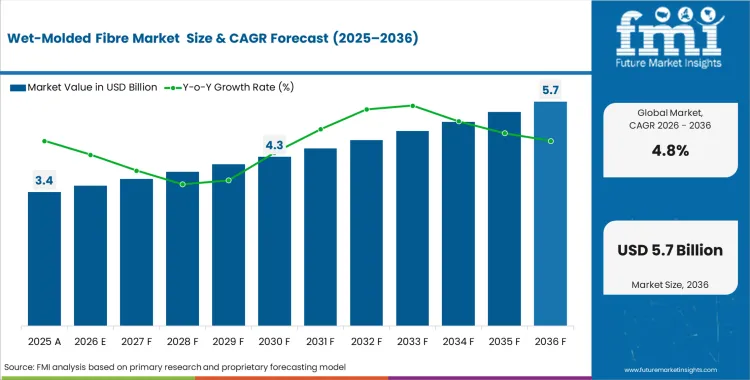
The wet-molded fibre market was valued at USD 3.2 billion in 2025. The market is projected to reach USD 3.4 billion in 2026 and USD 5.4 billion by 2036, expanding at a CAGR of 4.8% during the forecast period. Recycled pulp are expected to lead fiber source or material demand with a 63.5% share in 2026. Egg cartons are projected to remain the leading product type with a 31.7% share in 2026. Egg packaging are expected to lead end-use demand with a 34.9% share in 2026.
Summary of Wet-Molded Fibre Market
- Key Drivers
- Installed process base: Wet-molded fibre benefits from decades of installed tooling, machine know-how, and converter familiarity.
- Recovered-fiber economics: The category aligns naturally with recycled paper feedstocks and circular packaging procurement goals.
- Agrifood packaging demand: Egg and produce distribution continue to anchor recurring demand for molded-fibre trays and cartons.
- Key Segments Analyzed in the Report
- Fiber source: recycled pulp, virgin wood pulp, bagasse, bamboo, and others
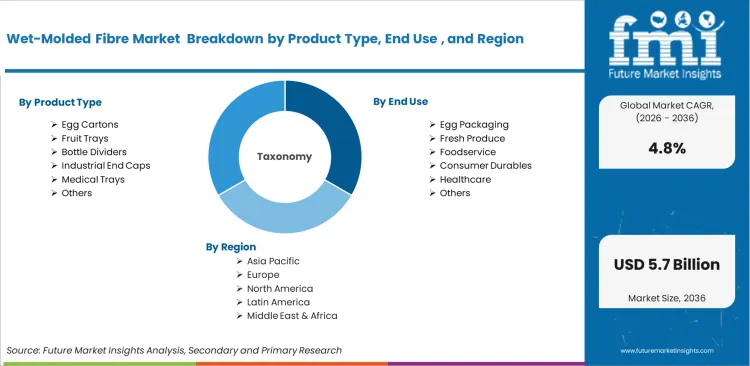
- Product type: egg cartons, fruit trays, bottle dividers, industrial end caps, medical trays, and others
- End use industry: egg packaging, fresh produce, foodservice, consumer durables, healthcare, and others
- Region: North America, Latin America, Western Europe, Eastern Europe, East Asia, South Asia and Pacific, and Middle East and Africa
- Analyst Opinion
- Ismail Sutaria, Senior Research Analyst at FMI says, "Wet-molded fibre remains the volume engine of the molded-fibre economy. Its advantage is not novelty. It is the ability to deliver durable, low-cost protective geometry at industrial scale using recycled raw materials and proven equipment."
Wet-Molded Fibre Market Definition
The wet-molded fibre market covers slurry-based molded cellulose packaging produced through wet-form and transfer-mold processes for protective and food-distribution applications. It includes egg cartons, fruit trays, bottle dividers, industrial end caps, cup carriers, and selected healthcare or service trays made from recycled pulp, virgin pulp, and non-wood fibers. These products are used where shock absorption, nestability, stack strength, and low-cost renewable packaging are more important than premium surface finish.
Wet-Molded Fibre market Inclusions
- Sales of wet-form and transfer-molded fiber packaging used in food distribution, industrial protection, beverage shipment, and selected healthcare applications.
- Revenue from cartons, trays, dividers, end caps, carriers, and similar molded-fibre articles produced through slurry-based forming routes.
- Commercial demand across all major regions including domestic distribution, export transit, and retail pack applications.
Wet-Molded Fibre market Exclusions
- Dry-molded fibre products formed through low-moisture proprietary routes.
- Premium thermoformed fiber tableware and thin-wall formed-fiber packs with heat-pressed finishing, except where conventional wet routes still dominate production value.
- Paperboard cartons, corrugated boxes, and plastic protective inserts outside molded-fibre manufacturing.
Wet-Molded Fibre market Research Methodology
This study evaluates wet-molded fibre demand by fiber source, product type, and end use industry with 2025 as the base year and 2026 to 2036 as the forecast period in value terms. Inputs include USA materials and recycling datasets, European packaging rules, trade association guidance, annual reports from leading molded-fibre producers, and technical literature on molded pulp materials and process categories. Market estimates are formed through triangulation of installed production capacity, recycled-fiber use patterns, agrifood pack demand, export fruit and egg packaging intensity, and ongoing substitution of plastic protective parts in selected transport applications.
Key Drivers, Restraints, and Trends in Wet-Molded Fibre market
Drivers
Wet-molded fibre continues to grow because it matches recurring packaging demand in eggs, fruit, bottle shipment, and general protective transit with a mature and familiar production base. The category benefits from recycled feedstock logic, which improves procurement acceptance where circular packaging targets matter. It also works well in applications that need cushioning geometry and nestable stack performance without premium cosmetic finish. Producers with legacy plant networks can supply very large unit volumes at competitive cost. That keeps the format resilient even as newer molded-fibre technologies attract attention.
Restraints
The category is constrained by water and energy intensity relative to newer dry-form routes. Surface finish is also less refined, which limits premium consumer-facing applications unless secondary processing is added. Machinery footprints and drying needs can raise capital cost in new plants. Regional availability of clean recovered fiber can affect consistency and cost. In some foodservice and retail packs, conventional wet-molded fibre loses share where buyers want thinner walls, sharper branding detail, or better sealing interfaces.
Trends
Wet-molded fibre is staying strong in agrifood while extending selectively into industrial protection and bottle shipment. Producers are improving automation, drying efficiency, and tooling accuracy to defend the category on cost and quality. Non-wood fibers such as bagasse are appearing more often in regional markets where agricultural residues are commercially accessible. Buyers also increasingly want simple pack systems with fewer mixed materials, which helps molded fibre replace plastic trays and separators in familiar geometries. The market is becoming more segmented between high-volume utility packs and more refined premium formats.
Segmental Analysis
Wet-Molded Fibre market Analysis by Product Type
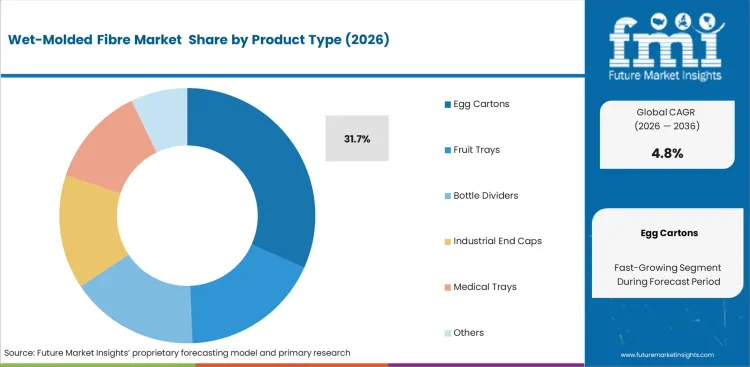
Egg cartons are expected to represent 31.7% of market value in 2026 because they combine recurring unit demand, well-established distribution economics, and a product geometry that molded fibre handles exceptionally well. The format protects fragile goods, nests efficiently, and supports automated denesting and filling in large packing operations. It also aligns with the material recovery story that retailers and egg producers increasingly prefer. Hartmann’s annual reporting continues to describe the company as the world’s leading manufacturer of moulded-fibre egg packaging, which validates how central egg cartons remain to the commercial structure of the market.
Wet-Molded Fibre market Analysis by End Use Industry
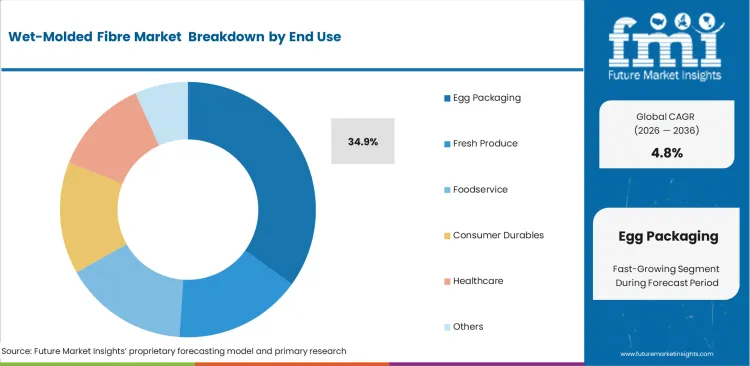
Egg packaging is projected to account for 34.9% of demand in 2026 because eggs move in very large repetitive volumes and require low-cost shock absorption with reliable stacking and ventilation. This end use values molded geometry and logistics efficiency more than premium finish. Huhtamaki’s 2025 annual report notes continued demand improvement in fiber packaging driven by egg and fruit packaging, reinforcing the category’s role as the anchor demand pool for wet-molded fibre.
Competitive Aligners for Market Players
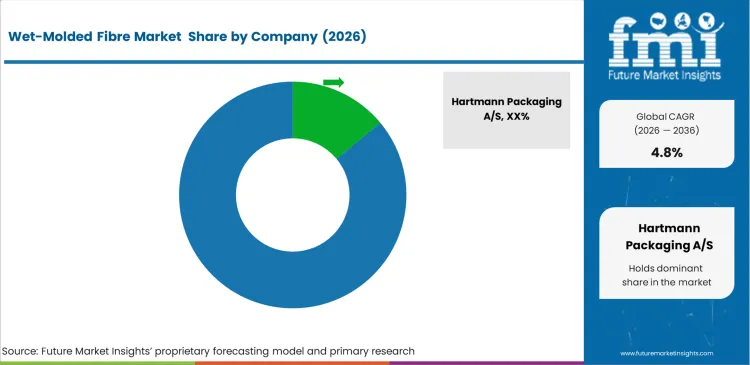
Competitive advantage in wet-molded fibre comes from plant density, machine uptime, recycled-fiber handling, and application know-how rather than from novelty claims. Buyers need dependable supply, food-contact compliance where relevant, and tooling that keeps breakage and pack variance low. Hartmann pairs packaging manufacturing with production technology expertise, which strengthens its control over cost and operational performance. Huhtamaki brings broad fiber-packaging scale and category reach in eggs, fruit, and selected food applications. Market leadership will remain concentrated with players that combine high-volume manufacturing discipline with feedstock resilience and customer-specific tooling support.
Key Players in Wet-Molded Fibre Market
- Hartmann Packaging A/S
- Huhtamaki Oyj
- CKF Inc.
- Omni-Pac Group
- EnviroPAK Corporation
- Pactiv Evergreen
- Henry Molded Products, Inc.
- Brødrene Hartmann A/S
- UFP Technologies, Inc.
- Brodrene Hartmann India Pvt. Ltd.
Strategic Outlook by FMI on Wet-Molded Fibre Market
FMI expects wet-molded fibre to remain the foundational volume segment of the broader molded-fibre industry. Its growth path will be steadier than that of newer formed-fiber technologies, but the installed base, agrifood demand, and recycled-material logic keep the category commercially durable. Producers that improve drying efficiency, tool precision, and regional feedstock access will hold the strongest margin position.
Scope of the Report
| Metric | Value |
|---|---|
| Market Value | USD 3.2 billion in 2025 to USD 5.4 billion by 2036 |
| CAGR | 4.8% from 2026 to 2036 |
| Base Year | 2025 |
| Forecast Period | 2026 to 2036 |
| Fiber Source Segmentation | Recycled Pulp, Virgin Wood Pulp, Bagasse, Bamboo, Others |
| Product Type Segmentation | Egg Cartons, Fruit Trays, Bottle Dividers, Industrial End Caps, Medical Trays, Others |
| End Use Industry Segmentation | Egg Packaging, Fresh Produce, Foodservice, Consumer Durables, Healthcare, Others |
| Regions Covered | North America, Latin America, Western Europe, Eastern Europe, East Asia, South Asia and Pacific, Middle East and Africa |
Bibliography
- European Commission. 2025. Packaging and Packaging Waste Regulation.
- USA Environmental Protection Agency. 2025. Paper and Paperboard: Material-Specific Data.
- International Molded Fiber Association. 2025. Molded Fiber Masterclass.
- Hartmann Packaging A/S. 2024. Annual Report 2024.
- Hartmann Packaging A/S. 2025. Social Responsibility Policy.
- Huhtamaki Oyj. 2025. Annual Report 2025.
- Semple, K. E. et al. 2022. Moulded Pulp Fibers for Disposable Food Packaging.
Frequently Asked Questions
What is the wet-molded fibre market size and growth rate?
USD 3.2 Billion in 2025, reaching USD 5.4 Billion by 2036 at a 4.8% CAGR.
Which fiber source dominates wet-molded fibre demand?
Recycled pulp leads overwhelmingly with a 63.5% share in 2026.
Which product type holds the largest wet-molded fibre market share?
Egg cartons at 31.7%, combining recurring volume, fragile-goods geometry, and recycled-material alignment.
Which end-use industry drives the most wet-molded fibre demand?
Egg packaging at 34.9%, anchored by massive repetitive volumes needing low-cost shock absorption and reliable stacking.
Who are the key players in the wet-molded fibre market?
Hartmann and Huhtamaki lead through manufacturing scale, recycled-fiber handling discipline, and deep agrifood application know-how.
Preview the report firsthand - request a free sample
Get SampleGet the brochure for pricing and purchase details.
Get PDFTable of Content
- Executive Summary
- Global Market Outlook
- Demand-side Trends
- Supply-side Trends
- Technology Roadmap Analysis
- Analysis and Recommendations
- Market Overview
- Market Coverage / Taxonomy
- Market Definition / Scope / Limitations
- Research Methodology
- Chapter Orientation
- Analytical Lens and Working Hypotheses
- Market Structure, Signals, and Trend Drivers
- Benchmarking and Cross-market Comparability
- Market Sizing, Forecasting, and Opportunity Mapping
- Research Design and Evidence Framework
- Desk Research Programme (Secondary Evidence)
- Company Annual and Sustainability Reports
- Peer-reviewed Journals and Academic Literature
- Corporate Websites, Product Literature, and Technical Notes
- Earnings Decks and Investor Briefings
- Statutory Filings and Regulatory Disclosures
- Technical White Papers and Standards Notes
- Trade Journals, Industry Magazines, and Analyst Briefs
- Conference Proceedings, Webinars, and Seminar Materials
- Government Statistics Portals and Public Data Releases
- Press Releases and Reputable Media Coverage
- Specialist Newsletters and Curated Briefings
- Sector Databases and Reference Repositories
- FMI Internal Proprietary Databases and Historical Market Datasets
- Subscription Datasets and Paid Sources
- Social Channels, Communities, and Digital Listening Inputs
- Additional Desk Sources
- Expert Input and Fieldwork (Primary Evidence)
- Primary Modes
- Qualitative Interviews and Expert Elicitation
- Quantitative Surveys and Structured Data Capture
- Blended Approach
- Why Primary Evidence is Used
- Field Techniques
- Interviews
- Surveys
- Focus Groups
- Observational and In-context Research
- Social and Community Interactions
- Stakeholder Universe Engaged
- C-suite Leaders
- Board Members
- Presidents and Vice Presidents
- R&D and Innovation Heads
- Technical Specialists
- Domain Subject-matter Experts
- Scientists
- Physicians and Other Healthcare Professionals
- Governance, Ethics, and Data Stewardship
- Research Ethics
- Data Integrity and Handling
- Primary Modes
- Tooling, Models, and Reference Databases
- Desk Research Programme (Secondary Evidence)
- Data Engineering and Model Build
- Data Acquisition and Ingestion
- Cleaning, Normalisation, and Verification
- Synthesis, Triangulation, and Analysis
- Quality Assurance and Audit Trail
- Market Background
- Market Dynamics
- Drivers
- Restraints
- Opportunity
- Trends
- Scenario Forecast
- Demand in Optimistic Scenario
- Demand in Likely Scenario
- Demand in Conservative Scenario
- Opportunity Map Analysis
- Product Life Cycle Analysis
- Supply Chain Analysis
- Investment Feasibility Matrix
- Value Chain Analysis
- PESTLE and Porter’s Analysis
- Regulatory Landscape
- Regional Parent Market Outlook
- Production and Consumption Statistics
- Import and Export Statistics
- Market Dynamics
- Global Market Analysis 2021 to 2025 and Forecast, 2026 to 2036
- Historical Market Size Value (USD Million) Analysis, 2021 to 2025
- Current and Future Market Size Value (USD Million) Projections, 2026 to 2036
- Y-o-Y Growth Trend Analysis
- Absolute $ Opportunity Analysis
- Global Market Pricing Analysis 2021 to 2025 and Forecast 2026 to 2036
- Global Market Analysis 2021 to 2025 and Forecast 2026 to 2036, By Product Type
- Introduction / Key Findings
- Historical Market Size Value (USD Million) Analysis By Product Type , 2021 to 2025
- Current and Future Market Size Value (USD Million) Analysis and Forecast By Product Type , 2026 to 2036
- Egg Cartons
- Fruit Trays
- Bottle Dividers
- Industrial End Caps
- Medical Trays
- Others
- Egg Cartons
- Y-o-Y Growth Trend Analysis By Product Type , 2021 to 2025
- Absolute $ Opportunity Analysis By Product Type , 2026 to 2036
- Global Market Analysis 2021 to 2025 and Forecast 2026 to 2036, By End Use
- Introduction / Key Findings
- Historical Market Size Value (USD Million) Analysis By End Use, 2021 to 2025
- Current and Future Market Size Value (USD Million) Analysis and Forecast By End Use, 2026 to 2036
- Egg Packaging
- Fresh Produce
- Foodservice
- Consumer Durables
- Healthcare
- Others
- Egg Packaging
- Y-o-Y Growth Trend Analysis By End Use, 2021 to 2025
- Absolute $ Opportunity Analysis By End Use, 2026 to 2036
- Global Market Analysis 2021 to 2025 and Forecast 2026 to 2036, By Region
- Introduction
- Historical Market Size Value (USD Million) Analysis By Region, 2021 to 2025
- Current Market Size Value (USD Million) Analysis and Forecast By Region, 2026 to 2036
- North America
- Latin America
- Western Europe
- Eastern Europe
- East Asia
- South Asia and Pacific
- Middle East & Africa
- Market Attractiveness Analysis By Region
- North America Market Analysis 2021 to 2025 and Forecast 2026 to 2036, By Country
- Historical Market Size Value (USD Million) Trend Analysis By Market Taxonomy, 2021 to 2025
- Market Size Value (USD Million) Forecast By Market Taxonomy, 2026 to 2036
- By Country
- USA
- Canada
- Mexico
- By Product Type
- By End Use
- By Country
- Market Attractiveness Analysis
- By Country
- By Product Type
- By End Use
- Key Takeaways
- Latin America Market Analysis 2021 to 2025 and Forecast 2026 to 2036, By Country
- Historical Market Size Value (USD Million) Trend Analysis By Market Taxonomy, 2021 to 2025
- Market Size Value (USD Million) Forecast By Market Taxonomy, 2026 to 2036
- By Country
- Brazil
- Chile
- Rest of Latin America
- By Product Type
- By End Use
- By Country
- Market Attractiveness Analysis
- By Country
- By Product Type
- By End Use
- Key Takeaways
- Western Europe Market Analysis 2021 to 2025 and Forecast 2026 to 2036, By Country
- Historical Market Size Value (USD Million) Trend Analysis By Market Taxonomy, 2021 to 2025
- Market Size Value (USD Million) Forecast By Market Taxonomy, 2026 to 2036
- By Country
- Germany
- UK
- Italy
- Spain
- France
- Nordic
- BENELUX
- Rest of Western Europe
- By Product Type
- By End Use
- By Country
- Market Attractiveness Analysis
- By Country
- By Product Type
- By End Use
- Key Takeaways
- Eastern Europe Market Analysis 2021 to 2025 and Forecast 2026 to 2036, By Country
- Historical Market Size Value (USD Million) Trend Analysis By Market Taxonomy, 2021 to 2025
- Market Size Value (USD Million) Forecast By Market Taxonomy, 2026 to 2036
- By Country
- Russia
- Poland
- Hungary
- Balkan & Baltic
- Rest of Eastern Europe
- By Product Type
- By End Use
- By Country
- Market Attractiveness Analysis
- By Country
- By Product Type
- By End Use
- Key Takeaways
- East Asia Market Analysis 2021 to 2025 and Forecast 2026 to 2036, By Country
- Historical Market Size Value (USD Million) Trend Analysis By Market Taxonomy, 2021 to 2025
- Market Size Value (USD Million) Forecast By Market Taxonomy, 2026 to 2036
- By Country
- China
- Japan
- South Korea
- By Product Type
- By End Use
- By Country
- Market Attractiveness Analysis
- By Country
- By Product Type
- By End Use
- Key Takeaways
- South Asia and Pacific Market Analysis 2021 to 2025 and Forecast 2026 to 2036, By Country
- Historical Market Size Value (USD Million) Trend Analysis By Market Taxonomy, 2021 to 2025
- Market Size Value (USD Million) Forecast By Market Taxonomy, 2026 to 2036
- By Country
- India
- ASEAN
- Australia & New Zealand
- Rest of South Asia and Pacific
- By Product Type
- By End Use
- By Country
- Market Attractiveness Analysis
- By Country
- By Product Type
- By End Use
- Key Takeaways
- Middle East & Africa Market Analysis 2021 to 2025 and Forecast 2026 to 2036, By Country
- Historical Market Size Value (USD Million) Trend Analysis By Market Taxonomy, 2021 to 2025
- Market Size Value (USD Million) Forecast By Market Taxonomy, 2026 to 2036
- By Country
- Kingdom of Saudi Arabia
- Other GCC Countries
- Turkiye
- South Africa
- Other African Union
- Rest of Middle East & Africa
- By Product Type
- By End Use
- By Country
- Market Attractiveness Analysis
- By Country
- By Product Type
- By End Use
- Key Takeaways
- Key Countries Market Analysis
- USA
- Pricing Analysis
- Market Share Analysis, 2025
- By Product Type
- By End Use
- Canada
- Pricing Analysis
- Market Share Analysis, 2025
- By Product Type
- By End Use
- Mexico
- Pricing Analysis
- Market Share Analysis, 2025
- By Product Type
- By End Use
- Brazil
- Pricing Analysis
- Market Share Analysis, 2025
- By Product Type
- By End Use
- Chile
- Pricing Analysis
- Market Share Analysis, 2025
- By Product Type
- By End Use
- Germany
- Pricing Analysis
- Market Share Analysis, 2025
- By Product Type
- By End Use
- UK
- Pricing Analysis
- Market Share Analysis, 2025
- By Product Type
- By End Use
- Italy
- Pricing Analysis
- Market Share Analysis, 2025
- By Product Type
- By End Use
- Spain
- Pricing Analysis
- Market Share Analysis, 2025
- By Product Type
- By End Use
- France
- Pricing Analysis
- Market Share Analysis, 2025
- By Product Type
- By End Use
- India
- Pricing Analysis
- Market Share Analysis, 2025
- By Product Type
- By End Use
- ASEAN
- Pricing Analysis
- Market Share Analysis, 2025
- By Product Type
- By End Use
- Australia & New Zealand
- Pricing Analysis
- Market Share Analysis, 2025
- By Product Type
- By End Use
- China
- Pricing Analysis
- Market Share Analysis, 2025
- By Product Type
- By End Use
- Japan
- Pricing Analysis
- Market Share Analysis, 2025
- By Product Type
- By End Use
- South Korea
- Pricing Analysis
- Market Share Analysis, 2025
- By Product Type
- By End Use
- Russia
- Pricing Analysis
- Market Share Analysis, 2025
- By Product Type
- By End Use
- Poland
- Pricing Analysis
- Market Share Analysis, 2025
- By Product Type
- By End Use
- Hungary
- Pricing Analysis
- Market Share Analysis, 2025
- By Product Type
- By End Use
- Kingdom of Saudi Arabia
- Pricing Analysis
- Market Share Analysis, 2025
- By Product Type
- By End Use
- Turkiye
- Pricing Analysis
- Market Share Analysis, 2025
- By Product Type
- By End Use
- South Africa
- Pricing Analysis
- Market Share Analysis, 2025
- By Product Type
- By End Use
- USA
- Market Structure Analysis
- Competition Dashboard
- Competition Benchmarking
- Market Share Analysis of Top Players
- By Region
- By Product Type
- By End Use
- Competition Analysis
- Competition Deep Dive
- Hartmann Packaging A/S
- Overview
- Product Portfolio
- Profitability by Market Segments (Product/Age /Sales Channel/Region)
- Sales Footprint
- Strategy Overview
- Marketing Strategy
- Product Strategy
- Channel Strategy
- Huhtamaki Oyj
- CKF Inc.
- Omni-Pac Group
- EnviroPAK Corporation
- Pactiv Evergreen
- Henry Molded Products, Inc.
- Brødrene Hartmann A/S
- UFP Technologies, Inc.
- Brodrene Hartmann India Pvt. Ltd.
- Hartmann Packaging A/S
- Competition Deep Dive
- Assumptions & Acronyms Used


