

- Industry Size (2026)
- USD 2.8 Bn
- Forecast (2036)
- USD 5.5 Bn
- CAGR (2026 to 2036)
- 7.0%
Thermoformed Fibre Market Size, Market Forecast and Outlook By FMI
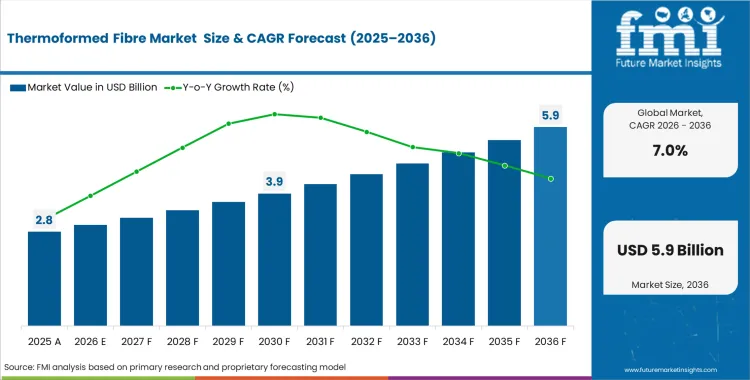
The thermoformed fibre market was valued at USD 2.6 billion in 2025. The market is projected to reach USD 2.8 billion in 2026 and USD 5.5 billion by 2036, expanding at a CAGR of 7.0% during the forecast period. Virgin wood pulp are expected to lead fiber source or material demand with a 46.1% share in 2026. Plates and bowls are projected to remain the leading product type with a 24.7% share in 2026. Foodservice are expected to lead end-use demand with a 39.2% share in 2026.
Summary of Thermoformed Fibre Market
- Key Drivers
- Premium fiber conversion: Thermoforming gives molded fiber smoother surfaces and tighter tolerances, opening higher-value food and consumer applications.
- Tableware substitution: Compostable and recyclable tableware programs continue to pull demand for plates, bowls, trays, and clamshells.
- Regulatory alignment: Fiber formats benefit from packaging rules that reward recyclability and lower dependence on fossil-based disposables.
- Key Segments Analyzed in the Report
- Fiber source: virgin wood pulp, recycled pulp, bagasse, bamboo, and others
- Product type: plates and bowls, clamshells, meal trays, lids, industrial trays, and others
- End use industry: foodservice, ready meals, fresh produce, consumer electronics, healthcare, and others
- Region: North America, Latin America, Western Europe, Eastern Europe, East Asia, South Asia and Pacific, and Middle East and Africa
- Analyst Opinion
- Ismail Sutaria, Senior Consultant at FMI says, "Thermoformed fiber sits where aesthetics and sustainability finally meet. The market is earning share because it delivers a cleaner shelf appearance and better tactile quality than traditional molded pulp without abandoning the fiber recovery story."
Thermoformed Fibre Market Definition
The thermoformed fibre market includes thin-wall and heat-pressed molded-fibre products manufactured to achieve smoother surfaces, sharper definition, and more consistent dimensions than traditional wet-molded formats. It includes plates, bowls, clamshells, lids, meal trays, industrial trays, and selected premium inserts made from wood and non-wood fibers. These products serve foodservice, chilled and ready-meal packaging, produce packaging, and selected non-food applications that require stronger visual presentation and higher dimensional control.
Thermoformed Fibre Market Inclusions
- Sales of thermoformed or thin-wall heat-pressed fiber packaging used in foodservice, meal packaging, produce presentation, and selected protective applications.
- Revenue from plates, bowls, lids, trays, clamshells, and comparable premium formed-fiber components.
- Commercial demand across global regions for both branded consumer-facing and operational packaging programs.
Thermoformed Fibre Market Exclusions
- Conventional thick-wall and transfer-molded fiber products sold mainly as utility protective packs.
- Plastic and bioplastic thermoformed tableware and trays not based on cellulose fiber structures.
- Paperboard cartons and flexible paper wraps that are not formed into rigid thermoformed shapes.
Thermoformed Fibre Market Research Methodology
This study analyzes thermoformed fibre demand by fiber source, product type, and end use industry with 2025 as the base year and 2026 to 2036 as the forecast period in value terms. Inputs include European packaging rules, official trade guidance, USA trade documentation on thermoformed molded fiber products, annual reports and product disclosures from leading packaging companies, and peer-reviewed literature on thermoformed and molded pulp performance. Market estimates are developed through triangulation of foodservice replacement rates, formed-fiber capacity additions, packaging qualification cycles, and the migration of consumer-facing applications toward smoother fiber formats.
Key Drivers, Restraints, and Trends in Thermoformed Fibre Market
Drivers
Thermoformed fibre is growing quickly because it addresses the main weakness of traditional molded pulp, namely finish quality and visual precision. Foodservice operators and packaged-food brands want fiber solutions that look cleaner, feel more premium, and still fit circular-packaging targets. The category also benefits from repeated-use occasions such as takeaway meals, airline catering, convenience foods, and event tableware where unit volumes are large. Heat-pressed molding improves stacking behavior and dimensional consistency, which helps operations as well as brand presentation. Those combined advantages are expanding thermoformed fibre from a niche sustainable tableware format into a broader premium packaging platform.
Restraints
Barrier requirements remain a restraint in wet or greasy food applications. Some packs still need coatings or hybrid structures, which can complicate recycling claims and procurement decisions. Capacity is growing, but regional supply is not yet as deep as it is in standard molded pulp or board conversion. Higher-quality fiber inputs and more exacting process control can also lift cost. In industrial applications, the value proposition weakens when appearance matters less than rugged low-cost cushioning.
Trends
The market is moving toward consumer-facing applications where fiber has to do more than signal sustainability. Buyers increasingly expect formed-fiber packs to carry brand quality, stack efficiently, and support better lid fit and product presentation. Strategic partnerships between material innovators and converters are becoming more important because commercialization depends on both fiber formulation and production scale. The category is also broadening from plates and bowls into trays, produce packs, and selected retail inserts. Competitive differentiation is shifting toward finish quality, forming speed, and application-specific design support.
Segmental Analysis
Thermoformed Fibre market Analysis by Product Type
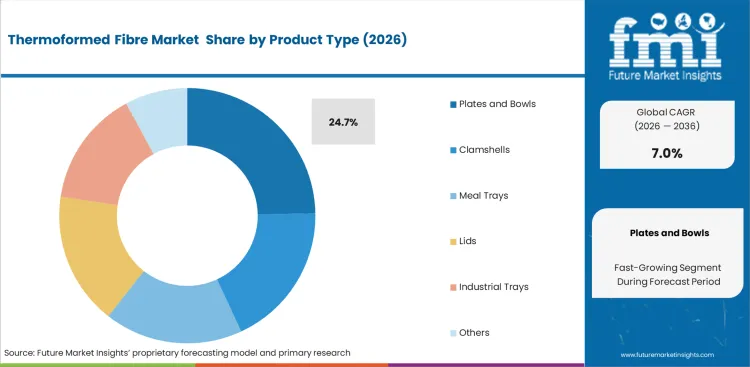
Plates and bowls are expected to account for 24.7% of market value in 2026 because they combine very large foodservice volumes with a visible need for a smoother, stronger alternative to plastic and foamed formats. They are easy for operators and consumers to understand, which shortens adoption cycles. The segment also benefits from standard sizes and recurring reorder patterns. The USA International Trade Commission described thermoformed molded fiber products as including plates, bowls, clamshells, and trays manufactured using multiple heated molds, which directly supports the central role of plates and bowls in the market structure.
Thermoformed Fibre market Analysis by End Use Industry
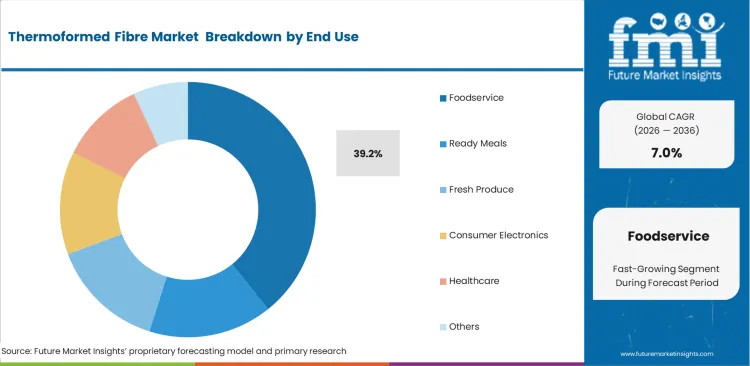
Foodservice is projected to hold 39.2% of demand in 2026 because on-the-go meals, dine-away formats, and event consumption create immense volume for clamshells, bowls, lids, and trays. These uses reward dimensional consistency, nestability, and consumer-friendly presentation. Stora Enso has continued to expand formed-fiber capacity and product partnerships around food applications, which underlines how foodservice remains the primary commercial proving ground for thermoformed fibre.
Competitive Aligners for Market Players
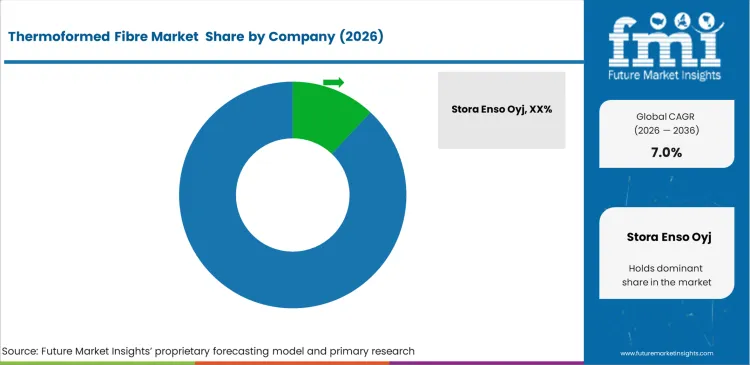
The market is being shaped by finish quality and scalable conversion, not by raw fiber availability alone. Buyers want molded-fiber parts that seal better, stack better, and still preserve a strong fiber sustainability narrative. Stora Enso invested to expand formed-fiber capacity in Europe and later partnered with Matrix Pack to accelerate formed-fiber packaging innovation, showing that material science must connect with industrial reach. Huhtamaki and other large packaging suppliers bring commercialization discipline and foodservice customer access. The strongest players will be the ones that can turn thermoformed fibre into a reliable operating format rather than a one-off sustainability showcase.
Key Players in Thermoformed Fibre Market
- Stora Enso Oyj
- Huhtamaki Oyj
- Hartmann Packaging A/S
- Footprint
- Matrix Pack Group
- PulPac AB
- Omni-Pac Group
- CKF Inc.
- Pactiv Evergreen
- Valmet Oyj
Strategic Outlook by FMI on Thermoformed Fibre Market
FMI views thermoformed fibre as the premium-growth layer of the molded-fibre landscape. The next stage of expansion will come from applications where appearance, stackability, and consumer handling are part of the purchasing decision. Companies that solve finish quality, food-contact performance, and large-scale throughput together will shape the category’s profit pool through 2036.
Scope of the Report
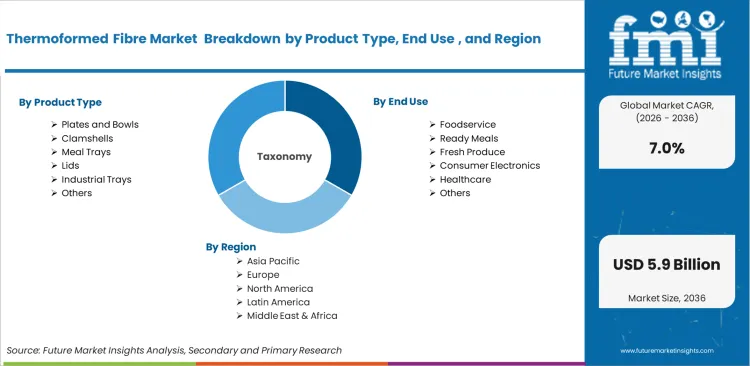
| Metric | Value |
|---|---|
| Market Value | USD 2.6 billion in 2025 to USD 5.5 billion by 2036 |
| CAGR | 7.0% from 2026 to 2036 |
| Base Year | 2025 |
| Forecast Period | 2026 to 2036 |
| Fiber Source Segmentation | Virgin Wood Pulp, Recycled Pulp, Bagasse, Bamboo, Others |
| Product Type Segmentation | Plates and Bowls, Clamshells, Meal Trays, Lids, Industrial Trays, Others |
| End Use Industry Segmentation | Foodservice, Ready Meals, Fresh Produce, Consumer Electronics, Healthcare, Others |
| Regions Covered | North America, Latin America, Western Europe, Eastern Europe, East Asia, South Asia and Pacific, Middle East and Africa |
Bibliography
- European Commission. 2025. Packaging and Packaging Waste Regulation.
- USA International Trade Commission. 2024. Thermoformed Molded Fiber Products from China and Vietnam: Institution of Antidumping and Countervailing Duty Investigations.
- USA International Trade Commission. 2026. Thermoformed Molded Fiber Products from China and Vietnam: Final Determinations, Investigation Nos. 701-TA-739-740 and 731-TA-1716-1717.
- Stora Enso. 2022. Stora Enso Accelerates Growth in Formed Fiber by Expanding Its Production Capacity in Europe.
- Stora Enso. 2026. Financial Statements Release 2025.
- Huhtamaki Oyj. 2026. Annual Report 2025.
- Skinner, C. et al. 2024. Life Cycle Assessment of Pulp-Moulded and Thermoformed Oil Palm Fibre-Based Food Tray. Discover Applied Sciences.
Frequently Asked Questions
How big is the thermoformed fibre market and how fast is the thermoformed fibre market growing?
The thermoformed fibre market was valued at USD 2.6 billion in 2025 and is projected to reach USD 5.5 billion by 2036, expanding at a CAGR of 7.0% during the forecast period.
Which fiber source leads demand in the thermoformed fibre market?
Virgin wood pulp is expected to lead the thermoformed fibre market by fiber source, accounting for a 46.1% share in 2026.
Which product type holds the largest share in the thermoformed fibre market?
Plates and bowls are projected to remain the leading product type in the thermoformed fibre market, holding a 24.7% share in 2026.
Which end-use industry drives the most demand in the thermoformed fibre market?
Foodservice is expected to lead the thermoformed fibre market by end use, accounting for a 39.2% share in 2026 due to strong demand from takeaway meals, ready meals, and event tableware.
What is driving growth in the thermoformed fibre market?
Growth in the thermoformed fibre market is being driven by rising demand for premium fiber-based packaging, substitution of plastic tableware, and regulatory support for recyclable and lower-fossil packaging formats.
Who are the key players in the thermoformed fibre market?
Key players in the thermoformed fibre market include Stora Enso Oyj, Huhtamaki Oyj, Hartmann Packaging A/S, Footprint, Matrix Pack Group, PulPac AB, Omni-Pac Group, CKF Inc., Pactiv Evergreen, and Valmet Oyj.
Preview the report firsthand - request a free sample
Get SampleGet the brochure for pricing and purchase details.
Get PDFTable of Content
- Executive Summary
- Global Market Outlook
- Demand-side Trends
- Supply-side Trends
- Technology Roadmap Analysis
- Analysis and Recommendations
- Market Overview
- Market Coverage / Taxonomy
- Market Definition / Scope / Limitations
- Research Methodology
- Chapter Orientation
- Analytical Lens and Working Hypotheses
- Market Structure, Signals, and Trend Drivers
- Benchmarking and Cross-market Comparability
- Market Sizing, Forecasting, and Opportunity Mapping
- Research Design and Evidence Framework
- Desk Research Programme (Secondary Evidence)
- Company Annual and Sustainability Reports
- Peer-reviewed Journals and Academic Literature
- Corporate Websites, Product Literature, and Technical Notes
- Earnings Decks and Investor Briefings
- Statutory Filings and Regulatory Disclosures
- Technical White Papers and Standards Notes
- Trade Journals, Industry Magazines, and Analyst Briefs
- Conference Proceedings, Webinars, and Seminar Materials
- Government Statistics Portals and Public Data Releases
- Press Releases and Reputable Media Coverage
- Specialist Newsletters and Curated Briefings
- Sector Databases and Reference Repositories
- FMI Internal Proprietary Databases and Historical Market Datasets
- Subscription Datasets and Paid Sources
- Social Channels, Communities, and Digital Listening Inputs
- Additional Desk Sources
- Expert Input and Fieldwork (Primary Evidence)
- Primary Modes
- Qualitative Interviews and Expert Elicitation
- Quantitative Surveys and Structured Data Capture
- Blended Approach
- Why Primary Evidence is Used
- Field Techniques
- Interviews
- Surveys
- Focus Groups
- Observational and In-context Research
- Social and Community Interactions
- Stakeholder Universe Engaged
- C-suite Leaders
- Board Members
- Presidents and Vice Presidents
- R&D and Innovation Heads
- Technical Specialists
- Domain Subject-matter Experts
- Scientists
- Physicians and Other Healthcare Professionals
- Governance, Ethics, and Data Stewardship
- Research Ethics
- Data Integrity and Handling
- Primary Modes
- Tooling, Models, and Reference Databases
- Desk Research Programme (Secondary Evidence)
- Data Engineering and Model Build
- Data Acquisition and Ingestion
- Cleaning, Normalisation, and Verification
- Synthesis, Triangulation, and Analysis
- Quality Assurance and Audit Trail
- Market Background
- Market Dynamics
- Drivers
- Restraints
- Opportunity
- Trends
- Scenario Forecast
- Demand in Optimistic Scenario
- Demand in Likely Scenario
- Demand in Conservative Scenario
- Opportunity Map Analysis
- Product Life Cycle Analysis
- Supply Chain Analysis
- Investment Feasibility Matrix
- Value Chain Analysis
- PESTLE and Porter’s Analysis
- Regulatory Landscape
- Regional Parent Market Outlook
- Production and Consumption Statistics
- Import and Export Statistics
- Market Dynamics
- Global Market Analysis 2021 to 2025 and Forecast, 2026 to 2036
- Historical Market Size Value (USD Million) Analysis, 2021 to 2025
- Current and Future Market Size Value (USD Million) Projections, 2026 to 2036
- Y-o-Y Growth Trend Analysis
- Absolute $ Opportunity Analysis
- Global Market Pricing Analysis 2021 to 2025 and Forecast 2026 to 2036
- Global Market Analysis 2021 to 2025 and Forecast 2026 to 2036, By Product Type
- Introduction / Key Findings
- Historical Market Size Value (USD Million) Analysis By Product Type , 2021 to 2025
- Current and Future Market Size Value (USD Million) Analysis and Forecast By Product Type , 2026 to 2036
- Plates and Bowls
- Clamshells
- Meal Trays
- Lids
- Industrial Trays
- Others
- Plates and Bowls
- Y-o-Y Growth Trend Analysis By Product Type , 2021 to 2025
- Absolute $ Opportunity Analysis By Product Type , 2026 to 2036
- Global Market Analysis 2021 to 2025 and Forecast 2026 to 2036, By End Use
- Introduction / Key Findings
- Historical Market Size Value (USD Million) Analysis By End Use, 2021 to 2025
- Current and Future Market Size Value (USD Million) Analysis and Forecast By End Use, 2026 to 2036
- Foodservice
- Ready Meals
- Fresh Produce
- Consumer Electronics
- Healthcare
- Others
- Foodservice
- Y-o-Y Growth Trend Analysis By End Use, 2021 to 2025
- Absolute $ Opportunity Analysis By End Use, 2026 to 2036
- Global Market Analysis 2021 to 2025 and Forecast 2026 to 2036, By Region
- Introduction
- Historical Market Size Value (USD Million) Analysis By Region, 2021 to 2025
- Current Market Size Value (USD Million) Analysis and Forecast By Region, 2026 to 2036
- North America
- Latin America
- Western Europe
- Eastern Europe
- East Asia
- South Asia and Pacific
- Middle East & Africa
- Market Attractiveness Analysis By Region
- North America Market Analysis 2021 to 2025 and Forecast 2026 to 2036, By Country
- Historical Market Size Value (USD Million) Trend Analysis By Market Taxonomy, 2021 to 2025
- Market Size Value (USD Million) Forecast By Market Taxonomy, 2026 to 2036
- By Country
- USA
- Canada
- Mexico
- By Product Type
- By End Use
- By Country
- Market Attractiveness Analysis
- By Country
- By Product Type
- By End Use
- Key Takeaways
- Latin America Market Analysis 2021 to 2025 and Forecast 2026 to 2036, By Country
- Historical Market Size Value (USD Million) Trend Analysis By Market Taxonomy, 2021 to 2025
- Market Size Value (USD Million) Forecast By Market Taxonomy, 2026 to 2036
- By Country
- Brazil
- Chile
- Rest of Latin America
- By Product Type
- By End Use
- By Country
- Market Attractiveness Analysis
- By Country
- By Product Type
- By End Use
- Key Takeaways
- Western Europe Market Analysis 2021 to 2025 and Forecast 2026 to 2036, By Country
- Historical Market Size Value (USD Million) Trend Analysis By Market Taxonomy, 2021 to 2025
- Market Size Value (USD Million) Forecast By Market Taxonomy, 2026 to 2036
- By Country
- Germany
- UK
- Italy
- Spain
- France
- Nordic
- BENELUX
- Rest of Western Europe
- By Product Type
- By End Use
- By Country
- Market Attractiveness Analysis
- By Country
- By Product Type
- By End Use
- Key Takeaways
- Eastern Europe Market Analysis 2021 to 2025 and Forecast 2026 to 2036, By Country
- Historical Market Size Value (USD Million) Trend Analysis By Market Taxonomy, 2021 to 2025
- Market Size Value (USD Million) Forecast By Market Taxonomy, 2026 to 2036
- By Country
- Russia
- Poland
- Hungary
- Balkan & Baltic
- Rest of Eastern Europe
- By Product Type
- By End Use
- By Country
- Market Attractiveness Analysis
- By Country
- By Product Type
- By End Use
- Key Takeaways
- East Asia Market Analysis 2021 to 2025 and Forecast 2026 to 2036, By Country
- Historical Market Size Value (USD Million) Trend Analysis By Market Taxonomy, 2021 to 2025
- Market Size Value (USD Million) Forecast By Market Taxonomy, 2026 to 2036
- By Country
- China
- Japan
- South Korea
- By Product Type
- By End Use
- By Country
- Market Attractiveness Analysis
- By Country
- By Product Type
- By End Use
- Key Takeaways
- South Asia and Pacific Market Analysis 2021 to 2025 and Forecast 2026 to 2036, By Country
- Historical Market Size Value (USD Million) Trend Analysis By Market Taxonomy, 2021 to 2025
- Market Size Value (USD Million) Forecast By Market Taxonomy, 2026 to 2036
- By Country
- India
- ASEAN
- Australia & New Zealand
- Rest of South Asia and Pacific
- By Product Type
- By End Use
- By Country
- Market Attractiveness Analysis
- By Country
- By Product Type
- By End Use
- Key Takeaways
- Middle East & Africa Market Analysis 2021 to 2025 and Forecast 2026 to 2036, By Country
- Historical Market Size Value (USD Million) Trend Analysis By Market Taxonomy, 2021 to 2025
- Market Size Value (USD Million) Forecast By Market Taxonomy, 2026 to 2036
- By Country
- Kingdom of Saudi Arabia
- Other GCC Countries
- Turkiye
- South Africa
- Other African Union
- Rest of Middle East & Africa
- By Product Type
- By End Use
- By Country
- Market Attractiveness Analysis
- By Country
- By Product Type
- By End Use
- Key Takeaways
- Key Countries Market Analysis
- USA
- Pricing Analysis
- Market Share Analysis, 2025
- By Product Type
- By End Use
- Canada
- Pricing Analysis
- Market Share Analysis, 2025
- By Product Type
- By End Use
- Mexico
- Pricing Analysis
- Market Share Analysis, 2025
- By Product Type
- By End Use
- Brazil
- Pricing Analysis
- Market Share Analysis, 2025
- By Product Type
- By End Use
- Chile
- Pricing Analysis
- Market Share Analysis, 2025
- By Product Type
- By End Use
- Germany
- Pricing Analysis
- Market Share Analysis, 2025
- By Product Type
- By End Use
- UK
- Pricing Analysis
- Market Share Analysis, 2025
- By Product Type
- By End Use
- Italy
- Pricing Analysis
- Market Share Analysis, 2025
- By Product Type
- By End Use
- Spain
- Pricing Analysis
- Market Share Analysis, 2025
- By Product Type
- By End Use
- France
- Pricing Analysis
- Market Share Analysis, 2025
- By Product Type
- By End Use
- India
- Pricing Analysis
- Market Share Analysis, 2025
- By Product Type
- By End Use
- ASEAN
- Pricing Analysis
- Market Share Analysis, 2025
- By Product Type
- By End Use
- Australia & New Zealand
- Pricing Analysis
- Market Share Analysis, 2025
- By Product Type
- By End Use
- China
- Pricing Analysis
- Market Share Analysis, 2025
- By Product Type
- By End Use
- Japan
- Pricing Analysis
- Market Share Analysis, 2025
- By Product Type
- By End Use
- South Korea
- Pricing Analysis
- Market Share Analysis, 2025
- By Product Type
- By End Use
- Russia
- Pricing Analysis
- Market Share Analysis, 2025
- By Product Type
- By End Use
- Poland
- Pricing Analysis
- Market Share Analysis, 2025
- By Product Type
- By End Use
- Hungary
- Pricing Analysis
- Market Share Analysis, 2025
- By Product Type
- By End Use
- Kingdom of Saudi Arabia
- Pricing Analysis
- Market Share Analysis, 2025
- By Product Type
- By End Use
- Turkiye
- Pricing Analysis
- Market Share Analysis, 2025
- By Product Type
- By End Use
- South Africa
- Pricing Analysis
- Market Share Analysis, 2025
- By Product Type
- By End Use
- USA
- Market Structure Analysis
- Competition Dashboard
- Competition Benchmarking
- Market Share Analysis of Top Players
- By Regional
- By Product Type
- By End Use
- Competition Analysis
- Competition Deep Dive
- Stora Enso Oyj
- Overview
- Product Portfolio
- Profitability by Market Segments (Product/Age /Sales Channel/Region)
- Sales Footprint
- Strategy Overview
- Marketing Strategy
- Product Strategy
- Channel Strategy
- Huhtamaki Oyj
- Hartmann Packaging A/S
- Footprint
- Matrix Pack Group
- PulPac AB
- Omni-Pac Group
- CKF Inc.
- Pactiv Evergreen
- Valmet Oyj
- Stora Enso Oyj
- Competition Deep Dive
- Assumptions & Acronyms Used


