

- Industry Size (2026)
- USD 1.0 Bn
- Forecast (2036)
- USD 2.4 Bn
- CAGR (2026 to 2036)
- 9.1%
Dry-Molded Fibre Market Size, Market Forecast and Outlook By FMI
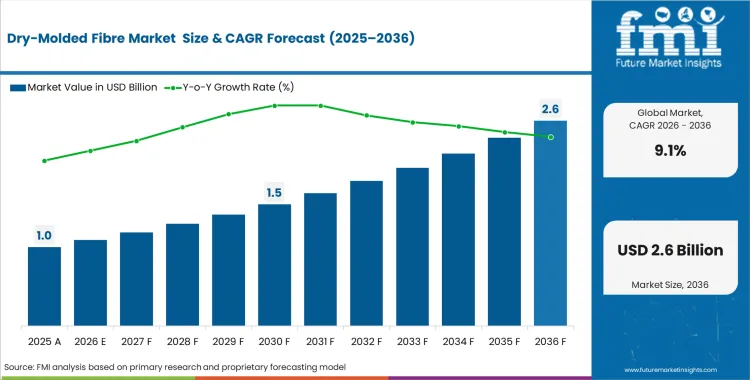
The dry-molded fibre market was valued at USD 0.9 billion in 2025. The market is projected to reach USD 1.0 billion in 2026 and USD 2.4 billion by 2036, expanding at a CAGR of 9.1% during the forecast period. Virgin wood pulp are expected to lead fiber source or material demand with a 41.2% share in 2026. Lids and closures are projected to remain the leading product type with a 26.4% share in 2026. Foodservice are expected to lead end-use demand with a 36.8% share in 2026.
Summary of Dry-Molded Fibre market
- Key Drivers
- High-speed forming: Dry-molded fibre gains traction where brand owners need fiber packs that can run closer to industrial packaging speeds.
- Plastic replacement urgency: Single-use plastic restrictions are pushing pilots into scaled programs for lids, inserts, trays, and accessory packaging.
- Resource efficiency: The process uses less water than conventional wet-form routes, which improves the business case in capacity-constrained regions.
- Key Segments Analyzed in the Report
- Fiber source: virgin wood pulp, recycled pulp, bagasse, bamboo, and others
- Product type: lids and closures, trays, inserts, clamshells, cup carriers, and others
- End use industry: foodservice, consumer packaged goods, personal care, electronics, healthcare, and others
- Region: North America, Latin America, Western Europe, Eastern Europe, East Asia, South Asia and Pacific, and Middle East and Africa
- Analyst Opinion
- Ismail Sutaria, Sr. Consultant at FMI says, "Dry-molded fibre will win where converters can pair fiber credentials with industrial productivity. The category is moving beyond sustainability pilots and into programs where line speed, surface quality, and unit economics determine adoption."
Dry-Molded Fibre market Definition
The dry-molded fibre market includes fiber packaging formed through low-moisture processes that shape cellulose into rigid three-dimensional products with reduced water intensity versus conventional wet molding. The market includes lids, closures, trays, cup carriers, clamshells, retail inserts, and selected precision protective components made from virgin or recycled pulp and non-wood fibers. These products are used in foodservice, retail packaging, personal care, electronics, and healthcare applications that need renewable rigid packaging with better process efficiency.
Dry-Molded Fibre market Inclusions
- Sales of dry-formed or dry-molded fiber packaging products and licensed production output derived from commercial dry-molded fibre technology platforms.
- Revenue from standard and custom parts used in foodservice, protective packaging, and branded consumer packaging applications.
- All commercial demand captured across global production and converting networks for dry-molded fibre packaging.
Dry-Molded Fibre market Exclusions
- Conventional wet-molded and transfer-molded fiber products that rely on slurry-dominant forming routes.
- Paperboard cartons, corrugated packs, and flexible paper formats that are not molded into rigid three-dimensional parts.
- Plastic lids, thermoformed plastic trays, and bioresin articles sold outside dry-molded fibre systems.
Dry-Molded Fibre market Research Methodology
This study evaluates the dry-molded fibre market by fiber source, product type, and end use industry using 2025 as the base year and 2026 to 2036 as the forecast period in value terms. Evidence inputs include European packaging regulation, trade association guidance on fiber-based packaging, first-party technology disclosures, company annual reports, and technical literature on molded pulp performance and process efficiency. Market estimates are built through triangulation of commercial installations, licensing reach, application substitution potential, line-speed economics, and the expansion of fiber-based replacements in foodservice and retail packaging.
Key Drivers, Restraints, and Trends in Dry-Molded Fibre market
Drivers
Dry-molded fibre demand is accelerating as converters and brands pursue rigid fiber packaging that scales without the water and drying burden typical of wet-form systems. The strongest pull is coming from foodservice lids, cup accessories, and retail inserts where plastic replacement goals have moved from concept work into purchasing mandates. Productivity and resource efficiency are now part of the procurement conversation, which was rarely true five years ago. As converters license dedicated dry-molded technology and toolsets, brands gain a route to more consistent geometry and cleaner surfaces. That combination is widening the addressable market well beyond niche sustainability launches.
Restraints
The market still faces capacity concentration and technology access constraints. A limited number of validated platforms and toolmaking ecosystems means buyers cannot switch suppliers as easily as they can in mature board converting markets. Fiber quality requirements can also narrow feedstock flexibility in high-precision parts. Some applications still require barrier performance or sealing behavior that fiber alone does not deliver without added treatments. Commercial adoption can slow when unit economics look attractive but specification risk stays unresolved.
Trends
Dry-molded fibre is moving first into parts where speed, stackability, and tactile quality matter. Lids, cup accessories, branded inserts, and small-format protective packaging are becoming the proving ground. Technology owners are increasingly using licensing models, which shifts the market from a single-manufacturer story to an ecosystem story. Tooling, embossing, and surface-finish improvements are also pushing the category toward premium consumer-packaged-goods applications. Buyers increasingly judge the format on throughput and repeatability, rather than on sustainability language alone.
Segmental Analysis
Dry-Molded Fibre market Analysis by Product Type
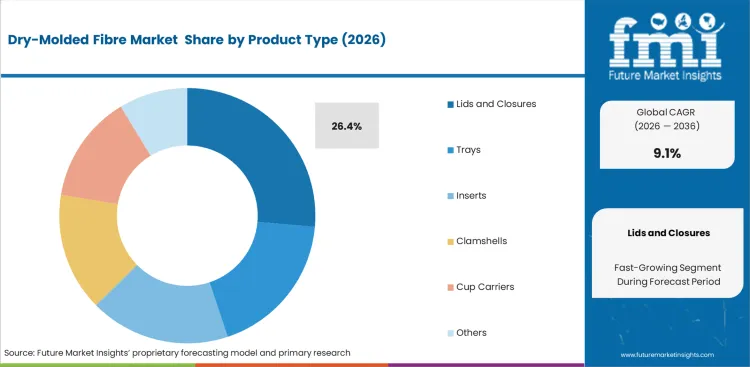
Lids and closures are projected to hold 26.4% of market value in 2026. They sit in a high-volume use case where the shift away from plastic is visible, repetitive, and operationally measurable. Simple geometries, strong brand visibility, and clear substitution logic in foodservice and takeaway packaging all work in their favor. Once a lid format is qualified, recurring demand is large and replacement cycles are rapid. PulPac describes Dry Molded Fiber as a cost-effective, high-speed, and resource-efficient production route for packaging, which helps explain why lid and closure applications are emerging as the first scaled commercial pool.
Dry-Molded Fibre market Analysis by End Use Industry
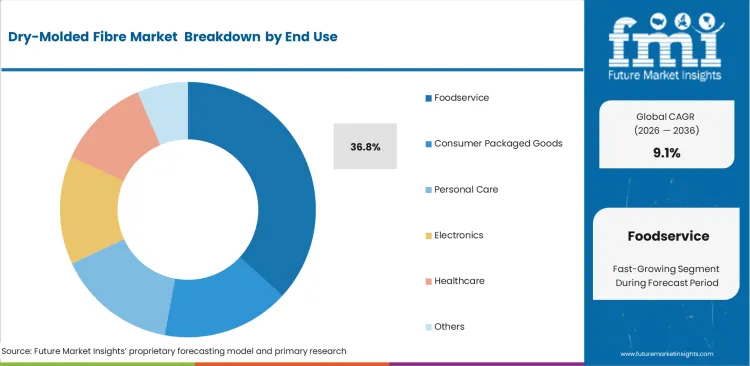
Foodservice is expected to account for 36.8% of demand in 2026 because beverage and takeaway formats create enormous annual unit volumes and face constant pressure to eliminate unnecessary plastic. Operators also favor stackable components that travel well, store densely, and support brand communication at the point of use. Huhtamaki's 2025 annual report continues to position fiber packaging around foodservice and molded fiber categories, reinforcing how commercial demand is anchored in serving-format applications rather than isolated pilot projects.
Competitive Aligners for Market Players
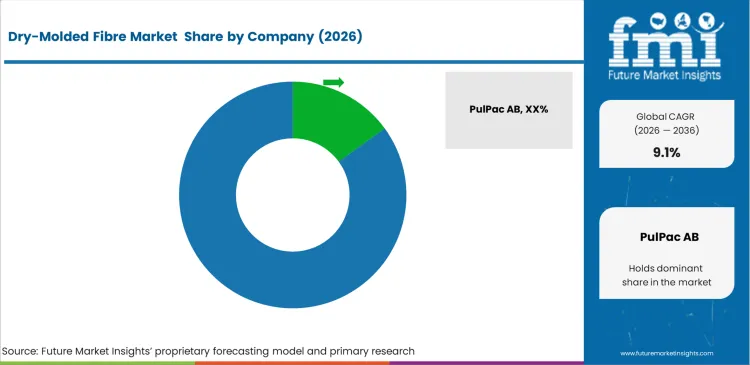
Competitive advantage is being built around licensing access, tooling know-how, and converter execution. Broad sustainability messaging alone is not moving buyers anymore. What they actually need is geometry precision, repeatable forming quality, and a credible scale-up path across regions. Food-contact confidence matters too. PulPac has built its model around licensing dry-molded fibre technology to packaging manufacturers, which shows how ecosystem control is becoming central to market structure. Huhtamaki and other large converters bring procurement, operations, and customer qualification strength that young technology platforms need. Leadership will concentrate with firms that can pair proprietary process capability with industrial customer delivery.
Key Players in Dry-Molded Fibre market
- PulPac AB
- Huhtamaki Oyj
- Footprint
- PA Consulting
- Hartmann Packaging A/S
- Omni-Pac Group
- CKF Inc.
- EnviroPAK Corporation
- Matrix Pack Group
- Valmet Oyj
Strategic Outlook by FMI on Dry-Molded Fibre market
FMI sees dry-molded fibre as one of the few packaging categories where sustainability and manufacturing economics are beginning to align. Growth through 2036 will depend on converter adoption, tooling maturity, and the expansion of qualified foodservice and retail programs. Winners will be the platforms and manufacturers that can deliver repeatable industrial output while keeping the fiber value proposition clean and easy for brand owners to scale.
Scope of the Report
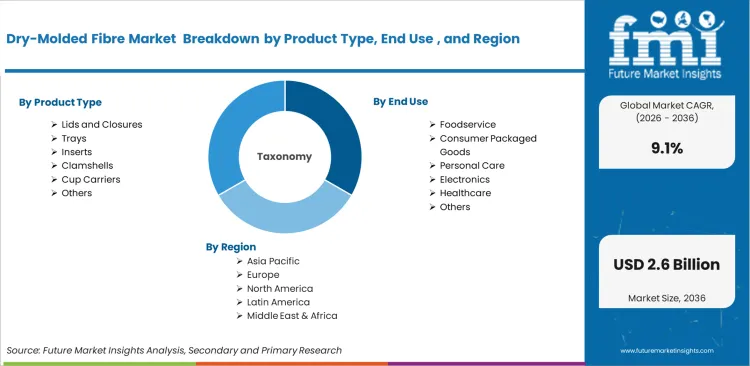
| Metric | Value |
|---|---|
| Market Value | USD 0.9 billion in 2025 to USD 2.4 billion by 2036 |
| CAGR | 9.1% from 2026 to 2036 |
| Base Year | 2025 |
| Forecast Period | 2026 to 2036 |
| Fiber Source Segmentation | Virgin Wood Pulp, Recycled Pulp, Bagasse, Bamboo, Others |
| Product Type Segmentation | Lids and Closures, Trays, Inserts, Clamshells, Cup Carriers, Others |
| End Use Industry Segmentation | Foodservice, Consumer Packaged Goods, Personal Care, Electronics, Healthcare, Others |
| Regions Covered | North America, Latin America, Western Europe, Eastern Europe, East Asia, South Asia and Pacific, Middle East and Africa |
Bibliography
- European Commission. 2025. Packaging and Packaging Waste Regulation.
- International Molded Fiber Association. 2025. Molded Fiber 101.
- International Molded Fiber Association. 2025. Molded Fiber Masterclass.
- PulPac AB. 2024. Dry Molded Fiber.
- European Investment Bank. 2024. PulPac Dry Molded Fiber Packaging Project.
- Huhtamaki Oyj. 2025. Annual Report 2025.
- Semple, K. E. et al. 2022. Moulded Pulp Fibers for Disposable Food Packaging.
Frequently Asked Questions
How large is the dry-molded fibre market and what is its growth trajectory through 2036?
The market was valued at USD 0.9 billion in 2025 and is projected to reach USD 2.4 billion by 2036, growing at a CAGR of 9.1%. Plastic replacement mandates and process efficiency gains over wet-form systems are the primary growth engines.
Which fiber source dominates dry-molded fibre production today?
Virgin wood pulp leads with a 41.2% share of fiber source demand in 2026, preferred for applications requiring consistent surface quality and tight dimensional tolerances.
What is driving dry-molded fibre lid and closure demand in foodservice packaging?
Lids and closures hold 26.4% of total market value in 2026, largely because they combine high annual volumes with simple geometries and clear plastic substitution logic. Once a format clears qualification, reorder volumes are large and predictable.
Why does foodservice account for the largest share of dry-molded fibre end-use demand?
Foodservice represents 36.8% of demand in 2026 driven by the sheer volume of beverage and takeaway formats facing regulatory pressure to eliminate single-use plastic.
How does PulPac's licensing model shape competition in the dry-molded fibre market?
By licensing its technology rather than converting directly, PulPac has turned the market into an ecosystem play where advantage concentrates around tooling know-how and converter execution, not just process access.
What are the key restraints slowing dry-molded fibre market adoption?
A limited number of validated technology platforms restricts supplier options, and certain applications still need barrier or sealing performance that fiber alone cannot meet without additional treatment.
Which regions present the strongest growth opportunity for dry-molded fibre packaging?
Western Europe leads given the European Commission's Packaging and Packaging Waste Regulation. Water-scarce regions across South Asia and Middle East and Africa also have a direct operational incentive since the dry-molded process uses significantly less water than wet-form alternatives.
Preview the report firsthand - request a free sample
Get SampleGet the brochure for pricing and purchase details.
Get PDFTable of Content
- Executive Summary
- Global Market Outlook
- Demand-side Trends
- Supply-side Trends
- Technology Roadmap Analysis
- Analysis and Recommendations
- Market Overview
- Market Coverage / Taxonomy
- Market Definition / Scope / Limitations
- Research Methodology
- Chapter Orientation
- Analytical Lens and Working Hypotheses
- Market Structure, Signals, and Trend Drivers
- Benchmarking and Cross-market Comparability
- Market Sizing, Forecasting, and Opportunity Mapping
- Research Design and Evidence Framework
- Desk Research Programme (Secondary Evidence)
- Company Annual and Sustainability Reports
- Peer-reviewed Journals and Academic Literature
- Corporate Websites, Product Literature, and Technical Notes
- Earnings Decks and Investor Briefings
- Statutory Filings and Regulatory Disclosures
- Technical White Papers and Standards Notes
- Trade Journals, Industry Magazines, and Analyst Briefs
- Conference Proceedings, Webinars, and Seminar Materials
- Government Statistics Portals and Public Data Releases
- Press Releases and Reputable Media Coverage
- Specialist Newsletters and Curated Briefings
- Sector Databases and Reference Repositories
- FMI Internal Proprietary Databases and Historical Market Datasets
- Subscription Datasets and Paid Sources
- Social Channels, Communities, and Digital Listening Inputs
- Additional Desk Sources
- Expert Input and Fieldwork (Primary Evidence)
- Primary Modes
- Qualitative Interviews and Expert Elicitation
- Quantitative Surveys and Structured Data Capture
- Blended Approach
- Why Primary Evidence is Used
- Field Techniques
- Interviews
- Surveys
- Focus Groups
- Observational and In-context Research
- Social and Community Interactions
- Stakeholder Universe Engaged
- C-suite Leaders
- Board Members
- Presidents and Vice Presidents
- R&D and Innovation Heads
- Technical Specialists
- Domain Subject-matter Experts
- Scientists
- Physicians and Other Healthcare Professionals
- Governance, Ethics, and Data Stewardship
- Research Ethics
- Data Integrity and Handling
- Primary Modes
- Tooling, Models, and Reference Databases
- Desk Research Programme (Secondary Evidence)
- Data Engineering and Model Build
- Data Acquisition and Ingestion
- Cleaning, Normalisation, and Verification
- Synthesis, Triangulation, and Analysis
- Quality Assurance and Audit Trail
- Market Background
- Market Dynamics
- Drivers
- Restraints
- Opportunity
- Trends
- Scenario Forecast
- Demand in Optimistic Scenario
- Demand in Likely Scenario
- Demand in Conservative Scenario
- Opportunity Map Analysis
- Product Life Cycle Analysis
- Supply Chain Analysis
- Investment Feasibility Matrix
- Value Chain Analysis
- PESTLE and Porter’s Analysis
- Regulatory Landscape
- Regional Parent Market Outlook
- Production and Consumption Statistics
- Import and Export Statistics
- Market Dynamics
- Global Market Analysis 2021 to 2025 and Forecast, 2026 to 2036
- Historical Market Size Value (USD Million) Analysis, 2021 to 2025
- Current and Future Market Size Value (USD Million) Projections, 2026 to 2036
- Y-o-Y Growth Trend Analysis
- Absolute $ Opportunity Analysis
- Global Market Pricing Analysis 2021 to 2025 and Forecast 2026 to 2036
- Global Market Analysis 2021 to 2025 and Forecast 2026 to 2036, By Product Type
- Introduction / Key Findings
- Historical Market Size Value (USD Million) Analysis By Product Type , 2021 to 2025
- Current and Future Market Size Value (USD Million) Analysis and Forecast By Product Type , 2026 to 2036
- Lids and Closures
- Trays
- Inserts
- Clamshells
- Cup Carriers
- Others
- Lids and Closures
- Y-o-Y Growth Trend Analysis By Product Type , 2021 to 2025
- Absolute $ Opportunity Analysis By Product Type , 2026 to 2036
- Global Market Analysis 2021 to 2025 and Forecast 2026 to 2036, By End Use
- Introduction / Key Findings
- Historical Market Size Value (USD Million) Analysis By End Use, 2021 to 2025
- Current and Future Market Size Value (USD Million) Analysis and Forecast By End Use, 2026 to 2036
- Foodservice
- Consumer Packaged Goods
- Personal Care
- Electronics
- Healthcare
- Others
- Foodservice
- Y-o-Y Growth Trend Analysis By End Use, 2021 to 2025
- Absolute $ Opportunity Analysis By End Use, 2026 to 2036
- Global Market Analysis 2021 to 2025 and Forecast 2026 to 2036, By Region
- Introduction
- Historical Market Size Value (USD Million) Analysis By Region, 2021 to 2025
- Current Market Size Value (USD Million) Analysis and Forecast By Region, 2026 to 2036
- North America
- Latin America
- Western Europe
- Eastern Europe
- East Asia
- South Asia and Pacific
- Middle East & Africa
- Market Attractiveness Analysis By Region
- North America Market Analysis 2021 to 2025 and Forecast 2026 to 2036, By Country
- Historical Market Size Value (USD Million) Trend Analysis By Market Taxonomy, 2021 to 2025
- Market Size Value (USD Million) Forecast By Market Taxonomy, 2026 to 2036
- By Country
- USA
- Canada
- Mexico
- By Product Type
- By End Use
- By Country
- Market Attractiveness Analysis
- By Country
- By Product Type
- By End Use
- Key Takeaways
- Latin America Market Analysis 2021 to 2025 and Forecast 2026 to 2036, By Country
- Historical Market Size Value (USD Million) Trend Analysis By Market Taxonomy, 2021 to 2025
- Market Size Value (USD Million) Forecast By Market Taxonomy, 2026 to 2036
- By Country
- Brazil
- Chile
- Rest of Latin America
- By Product Type
- By End Use
- By Country
- Market Attractiveness Analysis
- By Country
- By Product Type
- By End Use
- Key Takeaways
- Western Europe Market Analysis 2021 to 2025 and Forecast 2026 to 2036, By Country
- Historical Market Size Value (USD Million) Trend Analysis By Market Taxonomy, 2021 to 2025
- Market Size Value (USD Million) Forecast By Market Taxonomy, 2026 to 2036
- By Country
- Germany
- UK
- Italy
- Spain
- France
- Nordic
- BENELUX
- Rest of Western Europe
- By Product Type
- By End Use
- By Country
- Market Attractiveness Analysis
- By Country
- By Product Type
- By End Use
- Key Takeaways
- Eastern Europe Market Analysis 2021 to 2025 and Forecast 2026 to 2036, By Country
- Historical Market Size Value (USD Million) Trend Analysis By Market Taxonomy, 2021 to 2025
- Market Size Value (USD Million) Forecast By Market Taxonomy, 2026 to 2036
- By Country
- Russia
- Poland
- Hungary
- Balkan & Baltic
- Rest of Eastern Europe
- By Product Type
- By End Use
- By Country
- Market Attractiveness Analysis
- By Country
- By Product Type
- By End Use
- Key Takeaways
- East Asia Market Analysis 2021 to 2025 and Forecast 2026 to 2036, By Country
- Historical Market Size Value (USD Million) Trend Analysis By Market Taxonomy, 2021 to 2025
- Market Size Value (USD Million) Forecast By Market Taxonomy, 2026 to 2036
- By Country
- China
- Japan
- South Korea
- By Product Type
- By End Use
- By Country
- Market Attractiveness Analysis
- By Country
- By Product Type
- By End Use
- Key Takeaways
- South Asia and Pacific Market Analysis 2021 to 2025 and Forecast 2026 to 2036, By Country
- Historical Market Size Value (USD Million) Trend Analysis By Market Taxonomy, 2021 to 2025
- Market Size Value (USD Million) Forecast By Market Taxonomy, 2026 to 2036
- By Country
- India
- ASEAN
- Australia & New Zealand
- Rest of South Asia and Pacific
- By Product Type
- By End Use
- By Country
- Market Attractiveness Analysis
- By Country
- By Product Type
- By End Use
- Key Takeaways
- Middle East & Africa Market Analysis 2021 to 2025 and Forecast 2026 to 2036, By Country
- Historical Market Size Value (USD Million) Trend Analysis By Market Taxonomy, 2021 to 2025
- Market Size Value (USD Million) Forecast By Market Taxonomy, 2026 to 2036
- By Country
- Kingdom of Saudi Arabia
- Other GCC Countries
- Turkiye
- South Africa
- Other African Union
- Rest of Middle East & Africa
- By Product Type
- By End Use
- By Country
- Market Attractiveness Analysis
- By Country
- By Product Type
- By End Use
- Key Takeaways
- Key Countries Market Analysis
- USA
- Pricing Analysis
- Market Share Analysis, 2025
- By Product Type
- By End Use
- Canada
- Pricing Analysis
- Market Share Analysis, 2025
- By Product Type
- By End Use
- Mexico
- Pricing Analysis
- Market Share Analysis, 2025
- By Product Type
- By End Use
- Brazil
- Pricing Analysis
- Market Share Analysis, 2025
- By Product Type
- By End Use
- Chile
- Pricing Analysis
- Market Share Analysis, 2025
- By Product Type
- By End Use
- Germany
- Pricing Analysis
- Market Share Analysis, 2025
- By Product Type
- By End Use
- UK
- Pricing Analysis
- Market Share Analysis, 2025
- By Product Type
- By End Use
- Italy
- Pricing Analysis
- Market Share Analysis, 2025
- By Product Type
- By End Use
- Spain
- Pricing Analysis
- Market Share Analysis, 2025
- By Product Type
- By End Use
- France
- Pricing Analysis
- Market Share Analysis, 2025
- By Product Type
- By End Use
- India
- Pricing Analysis
- Market Share Analysis, 2025
- By Product Type
- By End Use
- ASEAN
- Pricing Analysis
- Market Share Analysis, 2025
- By Product Type
- By End Use
- Australia & New Zealand
- Pricing Analysis
- Market Share Analysis, 2025
- By Product Type
- By End Use
- China
- Pricing Analysis
- Market Share Analysis, 2025
- By Product Type
- By End Use
- Japan
- Pricing Analysis
- Market Share Analysis, 2025
- By Product Type
- By End Use
- South Korea
- Pricing Analysis
- Market Share Analysis, 2025
- By Product Type
- By End Use
- Russia
- Pricing Analysis
- Market Share Analysis, 2025
- By Product Type
- By End Use
- Poland
- Pricing Analysis
- Market Share Analysis, 2025
- By Product Type
- By End Use
- Hungary
- Pricing Analysis
- Market Share Analysis, 2025
- By Product Type
- By End Use
- Kingdom of Saudi Arabia
- Pricing Analysis
- Market Share Analysis, 2025
- By Product Type
- By End Use
- Turkiye
- Pricing Analysis
- Market Share Analysis, 2025
- By Product Type
- By End Use
- South Africa
- Pricing Analysis
- Market Share Analysis, 2025
- By Product Type
- By End Use
- USA
- Market Structure Analysis
- Competition Dashboard
- Competition Benchmarking
- Market Share Analysis of Top Players
- By Regional
- By Product Type
- By End Use
- Competition Analysis
- Competition Deep Dive
- PulPac AB
- Overview
- Product Portfolio
- Profitability by Market Segments (Product/Age /Sales Channel/Region)
- Sales Footprint
- Strategy Overview
- Marketing Strategy
- Product Strategy
- Channel Strategy
- Huhtamaki Oyj
- Footprint
- PA Consulting
- Hartmann Packaging A/S
- Omni-Pac Group
- CKF Inc.
- EnviroPAK Corporation
- Matrix Pack Group
- Valmet Oyj
- PulPac AB
- Competition Deep Dive
- Assumptions & Acronyms Used


