

- Industry Size (2026)
- USD 104 Mn
- Forecast (2036)
- USD 286 Mn
- CAGR (2026 to 2036)
- 10.6%
Integrated Microfibre Filter Assemblies for Household Washing Machines Market Forecast and Outlook 2026 to 2036
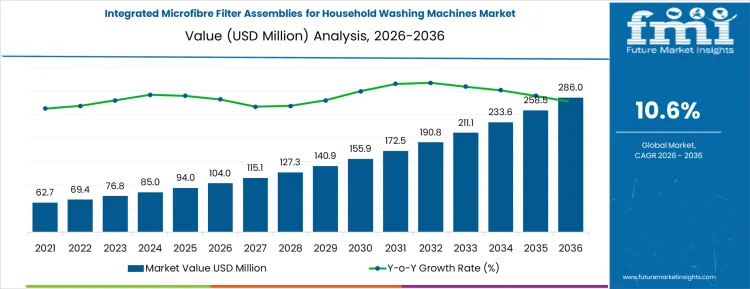
The integrated microfibre filter assemblies market for household washing machines is valued at USD 104 million in 2026 and is projected to reach USD 286 million by 2036, reflecting a CAGR of 10.6%. Early cumulative value growth, rising from roughly USD 64 million in 2020 to USD 167 million by 2031, is driven by adoption among residential consumers seeking improved lint and microfibre capture. Advanced filtration assemblies integrated into washing machines enhance performance, water efficiency, and compliance with environmental regulations, supporting repeat purchases and early uptake.
From 2031 to 2036, cumulative value accelerates from approximately USD 184 million to USD 286 million. Growth is reinforced by increased penetration across mid-range and premium household appliances, expansion in appliance replacement cycles, and enhanced consumer awareness of microfibre pollution reduction. Operational efficiencies in manufacturing, product standardization, and partnerships with appliance brands contribute to sustained accumulation. The long-term value curve demonstrates structural growth, with compounding benefits from wider adoption and regulatory alignment driving market resilience throughout the forecast period.
Quick Stats of the Integrated Microfibre Filter Assemblies for Household Washing Machines Market
- Integrated Microfibre Filter Assemblies for Household Washing Machines Market Value (2026): USD 104 million
- Integrated Microfibre Filter Assemblies for Household Washing Machines Market Forecast Value (2036): USD 286 million
- Integrated Microfibre Filter Assemblies for Household Washing Machines Market Forecast CAGR (2026-2036): 10.6%
- Leading Product Format in Integrated Microfibre Filter Assemblies Market: Inline Filter Assemblies (45%)
- Key Growth Regions in Integrated Microfibre Filter Assemblies Market: North America, Europe, and Asia Pacific
- Top Players in Integrated Microfibre Filter Assemblies Market: Bosch, Miele, Whirlpool, Haier, Xeros Technology, LG India, IFB, Toppan
What is the Growth Forecast for the Integrated Microfibre Filter Assemblies for Household Washing Machines Market through 2036?
From 2026 to 2031, the integrated microfibre filter assemblies market grows from USD 104 million to approximately USD 167 million, representing the early adoption curve. Growth in this phase is driven by initial deployment in premium and mid-range household washing machines, focusing on microfibre capture, water efficiency, and appliance longevity. Uptake remains selective as manufacturers validate filtration efficiency, maintenance requirements, and integration compatibility. Year-on-year value additions rise steadily as production processes stabilize, installation protocols are standardized, and consumer awareness of microfibre reduction benefits begins to drive repeat adoption.
Between 2031 and 2036, the market expands from roughly USD 167 million to USD 286 million, illustrating the late adoption curve characterized by broader commercialization. Growth accelerates as filter assemblies become standard in mass-market washing machines, supported by regulatory encouragement and sustainability-driven product differentiation. Annual additions increase as higher penetration across appliance SKUs, repeat procurement, and multi-region adoption reinforce market expansion. Early growth relied on selective integration, whereas later expansion is driven by portfolio-wide deployment, standardized design adoption, and consistent consumer demand for household microfibre filtration solutions.
Integrated Microfibre Filter Assemblies for Household Washing Machines Market Key Takeaways
| Metric | Value |
|---|---|
| Market Value (2026) | USD 104 million |
| Forecast Value (2036) | USD 286 million |
| Forecast CAGR (2026-2036) | 10.6% |
What Is Driving the Demand for Integrated Microfibre Filter Assemblies for Household Washing Machines?
Historical demand for integrated microfibre filter assemblies for household washing machines developed from growing awareness of microplastic shedding during laundry cycles. Traditional washing machines lacked effective mechanisms to capture fine fibres released from synthetic textiles, leading to increased microfibre discharge into wastewater systems. Early interest in filters emerged from environmental research and advocacy highlighting the contribution of laundry effluent to aquatic pollution. Manufacturers in regions with advanced wastewater treatment infrastructure began offering retrofit filter solutions to meet early voluntary standards and consumer interest in reducing environmental impact. Uptake was limited by additional maintenance requirements and inconsistent regulatory expectations, concentrating demand among environmentally conscious households and niche appliance brands willing to invest in enhanced capture systems.
Future demand for integrated microfibre filter assemblies is expected to differ from earlier interest by reflecting regulatory compliance and standardisation in appliance design rather than voluntary enhancements alone. Policy proposals in several jurisdictions are moving toward mandatory microfibre capture requirements for new washing machines, requiring built-in filters that meet specified retention thresholds. Appliance manufacturers will integrate capture systems into new models to comply with future performance criteria and avoid non-compliance penalties. Advances in filter media, flow management, and ease of cleaning will improve user experience, reducing barriers that historically limited broader adoption. Connectivity features that monitor filter status and maintenance cycles will support effective operation across diverse households. Unlike past demand driven by environmental advocacy and early adopter behaviour, future growth will be anchored in compliance obligations, product performance standards, and wastewater quality objectives set by regulators. Adoption is likely to expand significantly as microfibre retention becomes a baseline expectation in household appliance specifications.
What Factors Are Affecting the Demand for Integrated Microfibre Filter Assemblies for Household Washing Machines Market in Terms of End Use Application and Product Format?
Demand for integrated microfibre filter assemblies for household washing machines is segmented by end use application and product format across residential and appliance manufacturing channels. Residential washing appliances account for about 40% of total demand, making this the leading end use segment. Appliance OEM integrations, OEM aftermarket channels, and value segment appliances represent additional applications without disclosed share splits. These segments differ in installation point, replacement cycles, and price sensitivity. Regulatory pressure on fibre capture and appliance compliance influences adoption across categories. Product format determines filtration efficiency, maintenance burden, and compatibility with machine architecture. Together, these segments explain demand formation shaped by appliance penetration, regulatory readiness, and system integration constraints rather than consumer driven accessory uptake.
What Drives Demand by End Use Application in the Integrated Microfibre Filter Assemblies for Household Washing Machines Market?
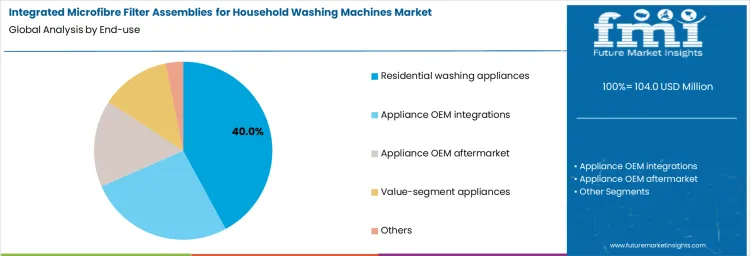
Residential washing appliances lead demand with a 40% share due to installed base size and direct exposure to fibre release controls. Appliance OEM integrations adopt filters to meet design stage compliance requirements and performance validation standards. OEM aftermarket channels support replacement demand where filters are modular and serviceable. Value segment appliances adopt simplified solutions to manage cost constraints while addressing minimum compliance thresholds. Adoption intensity varies with appliance price tier and regional regulation. End use demand therefore reflects appliance manufacturing strategy and lifecycle servicing rather than discretionary consumer retrofitting behavior across households.
Application driven demand remains stable because washing machine replacement and servicing cycles are predictable. OEMs integrate filtration where long term compliance planning is required. Aftermarket demand persists through maintenance and replacement intervals. Value segment adoption remains selective due to price sensitivity. These patterns limit short term volatility. End use segmentation highlights structural dependence on appliance design decisions. Demand therefore aligns with manufacturing standards and installed base servicing rather than rapid shifts in household purchasing behavior.
How Does Product Format Shape Demand for Integrated Microfibre Filter Assemblies for Household Washing Machines Market?
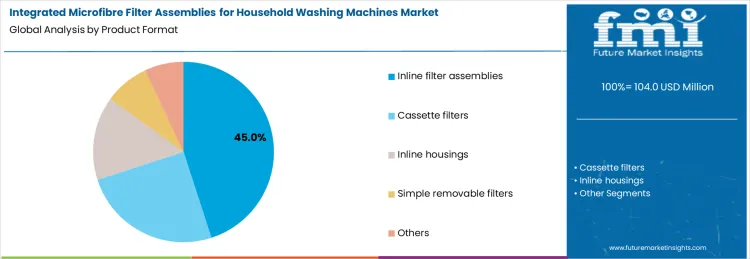
Inline filter assemblies account for about 45% of total demand, making them the leading product format. Their dominance reflects compatibility with internal plumbing and continuous filtration during wash cycles. Cassette filters are used where modular replacement is prioritized by OEMs. Inline housings support aftermarket installations and service access. Simple removable filters serve value segment appliances with basic filtration needs. Other formats address niche appliance designs. Product format selection depends on installation complexity, maintenance frequency, and space constraints. Demand follows appliance architecture rather than filtration performance differentiation alone.
Inline assemblies maintain leadership due to seamless integration and minimal user interaction. Cassette formats support predictable servicing models. Inline housings enable retrofitting without redesign. Removable filters lower cost but require user maintenance. OEMs favor formats aligned with existing platforms to avoid redesign costs. This constrains rapid format diversification. Product format therefore stabilizes demand by reinforcing widely compatible filtration solutions across appliance categories.
How Are Integrated Microfibre Filter Assemblies Being Applied in Household Washing Machines?
Use appears in appliances where enhanced lint, fibre, and microplastic capture improves effluent quality and protects internal components. Washing machine manufacturers integrate filter assemblies to reduce lint accumulation in pumps and hoses, improving machine longevity. Eco-conscious brands adopt microfibre filters to minimize microplastic discharge into wastewater systems. Retrofit and replacement markets provide assemblies for older machines lacking integrated filtration. These applications reflect operational and environmental priorities rather than performance marketing alone, with adoption driven by compliance with wastewater standards, appliance protection, and consumer sustainability awareness.
What Operational and Consumer Conditions Support Adoption of Integrated Microfibre Filter Assemblies?
Selection aligns with appliances requiring routine maintenance that is simple and effective. Filters are designed to be accessible for easy cleaning by consumers without interrupting wash cycles. Manufacturers optimize pore size and mesh density to capture fine fibres without reducing water flow or efficiency. Regulatory incentives in regions targeting microplastic reduction encourage inclusion of filters in new models. Consumer awareness of environmental impact drives demand for machines with built-in filtration. These conditions emerge from operational reliability, regulatory alignment, and user convenience priorities.
Which Practical Considerations Limit Wider Use of Integrated Microfibre Filter Assemblies?
Installation requires compatibility with existing machine designs, limiting retrofitting options. Regular cleaning is necessary to maintain performance, which may reduce adoption among users seeking low-maintenance appliances. Cost per machine increases due to additional components. Disposal of collected fibres and filter materials requires consumer education and infrastructure. Filter efficiency may vary depending on fabric types and load sizes. These factors lead to selective deployment where appliance protection, environmental benefit, and regulatory compliance justify incremental cost and maintenance expectations.
What is the Demand for Integrated Microfibre Filter Assemblies for Household Washing Machines by Country?
| Country | CAGR (%) |
|---|---|
| USA | 9.0% |
| Germany | 7.5% |
| China | 11.2% |
| India | 12.0% |
| Brazil | 7.5% |
| Japan | 4.8% |
The demand for integrated microfibre filter assemblies for household washing machines varies across countries, driven by environmental regulations, water filtration standards, and household appliance adoption. India leads with a 12.0% CAGR, supported by rising washing machine penetration, awareness of microfibre pollution, and regulatory encouragement for filtration technologies. China follows at 11.2%, driven by large appliance manufacturing and increasing household adoption of smart and eco-friendly washing systems. The USA grows at 9.0%, reflecting consumer preference for advanced filtration and water saving appliances. Germany and Brazil record 7.5%, shaped by established appliance markets and environmental compliance. Japan posts 4.8%, reflecting mature markets and steady replacement demand for microfibre filters.
How Is Advanced Filtration Driving Growth in the United States?
In the United States, revenue from the integrated microfibre filter assemblies market is expanding at a CAGR of 9% through 2036, driven by adoption of microfibre filtration systems to reduce microplastic release and enhance washing machine performance. Manufacturers are integrating filter assemblies into front-load and top-load machines for household laundry applications. Demand is concentrated in residential appliances and retail distribution channels. Domestic suppliers provide high-efficiency microfibre filters compatible with diverse machine models and cleaning cycles. Increasing environmental awareness, regulatory guidance, and recurring replacement requirements are sustaining predictable procurement across appliance manufacturers and distributors nationwide.
- Residential washing machine producers adopt microfibre filter assemblies to reduce microplastic release
- Filters enhance performance and ensure compatibility with multiple machine models
- Domestic suppliers provide high-efficiency, durable microfibre filters
- Replacement cycles and environmental regulations sustain predictable procurement
How Are Environmental Regulations Supporting Growth in Germany?
Germany continues to record steady growth in the integrated microfibre filter assemblies market at a CAGR of 7.5% through 2036, supported by strict environmental regulations targeting microplastic reduction in household wastewater. Manufacturers are integrating microfibre filter assemblies into domestic washing machines to improve filtration efficiency and comply with regulatory requirements. Demand is concentrated in residential appliance production and retail channels. Domestic suppliers provide standardized filter assemblies designed for durability, cleaning compatibility, and effective microplastic capture. Compliance-driven procurement and stable appliance sales are sustaining measured adoption nationwide.
- Environmental regulations encourage adoption of microfibre filter assemblies
- Household washing machines anchor demand
- Domestic suppliers provide durable, standardized filter assemblies
- Compliance-driven procurement sustains steady adoption levels
How Is Appliance Manufacturing Expansion Accelerating Adoption in China?
In China, revenue from the integrated microfibre filter assemblies market is growing at a CAGR of 11.2% through 2036, driven by rapid growth of residential appliance manufacturing and urban household adoption. Manufacturers are integrating microfibre filter assemblies into washing machines to improve filtration performance and meet consumer environmental expectations. Demand is strong across major appliance brands, modern retail, and e-commerce channels. Domestic suppliers are scaling production of high-efficiency filters compatible with diverse machine models. High appliance production volumes and structured replacement programs are sustaining rapid adoption nationwide.
- Residential appliance production drives adoption of microfibre filter assemblies
- Front-load and top-load washing machines anchor demand
- Domestic suppliers scale production of high-efficiency filter assemblies
- Structured replacement programs sustain consistent adoption
How Is Organized Appliance Manufacturing Supporting Growth in India?
India is witnessing strong expansion in the integrated microfibre filter assemblies market at a CAGR of 12% through 2036, supported by growth in organized washing machine manufacturing and urban household adoption. Manufacturers are integrating microfibre filter assemblies to reduce microplastic emissions, improve water filtration, and comply with emerging environmental guidelines. Demand is rising across retail, e-commerce, and institutional appliance channels. Domestic suppliers are providing cost-aligned, durable filter assemblies suitable for high-volume production. Expanding urban appliance penetration and organized manufacturing networks are sustaining robust procurement nationwide.
- Organized washing machine manufacturing increases demand for microfibre filter assemblies
- Front-load and top-load machines drive high-volume adoption
- Domestic suppliers provide cost-aligned, durable filter assemblies
- Urban appliance penetration and structured distribution sustain procurement growth
How Are Consumer Appliance Shipments Supporting Adoption in Brazil?
Brazil is seeing steady growth in the integrated microfibre filter assemblies market at a CAGR of 7.5% through 2036, supported by rising sales of household washing machines and environmental awareness. Manufacturers are integrating microfibre filter assemblies to improve filtration, reduce microplastic release, and extend appliance lifecycle. Demand is concentrated in retail and regional distribution hubs. Domestic suppliers are expanding production of standardized, high-efficiency filter assemblies. Growth in residential appliance shipments and retail networks is sustaining recurring procurement across appliance manufacturers and distributors nationwide.
- Household washing machine sales drive adoption of microfibre filter assemblies
- Filters reduce microplastic emissions and improve appliance lifecycle
- Domestic suppliers expand production of high-efficiency, standardized filters
- Retail and appliance distribution growth sustain recurring procurement
How Does Mature Household Appliance Demand Influence Stability in Japan?
Japan is maintaining measured growth in the integrated microfibre filter assemblies market at a CAGR of 4.8% through 2036, supported by mature residential appliance markets and selective adoption of filtration solutions. Manufacturers apply microfibre filter assemblies for front-load and top-load washing machines. Demand remains focused on filtration efficiency, durability, and compatibility with multiple appliance models. Domestic suppliers emphasize precise filter design and consistent material quality. Stable household appliance consumption and replacement-driven filter programs are sustaining predictable procurement across established appliance manufacturers nationwide.
- Mature appliance markets favor selective adoption of microfibre filter assemblies
- Front-load and top-load machines anchor baseline demand
- Domestic suppliers ensure precise design and consistent filter quality
- Replacement-driven programs sustain procurement continuity
Which Companies Are Shaping Competition in The Integrated Microfibre Filter Assemblies for Household Washing Machines Market Across Appliance Platforms?
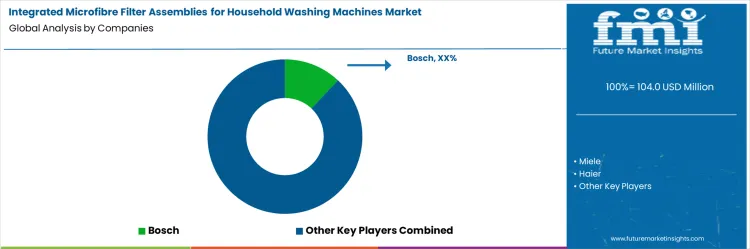
The integrated microfibre filter assemblies for household washing machines market is driven by appliance manufacturers integrating filtration components at the machine design stage. Bosch and Miele influence adoption through premium washing machines incorporating fine particle capture aligned with regulatory and performance expectations. Whirlpool participates through platform level integration across mass market appliance ranges. Haier contributes through vertically integrated appliance manufacturing, enabling in house alignment between washing systems and filtration components. Xeros Technology operates as a specialist technology provider, supplying microfibre filtration solutions integrated into selected appliance models or pilot programs. Competitive positioning reflects ease of integration, durability under repeated wash cycles, and minimal impact on machine performance or maintenance requirements.
Regional manufacturers and component suppliers shape market execution at the local level. LG India and IFB participate through appliances adapted to regional usage patterns, water conditions, and regulatory developments. Local appliance part makers supply housings, meshes, and filter frames used within integrated assemblies rather than standalone products. Toppan contributes through precision component manufacturing and material engineering supporting filter durability and consistency. These participants compete on manufacturability, cost control, and alignment with appliance assembly processes. Competitive differentiation centers on filtration efficiency stability, cleaning and replacement simplicity, and compatibility with existing washing machine architectures. Market entry depends on appliance maker validation, long testing cycles, and alignment with national appliance standards rather than rapid technology substitution.
Key Players in the Integrated Microfibre Filter Assemblies for Household Washing Machines Market
- Bosch
- Whirlpool
- Xeros Technology
- Miele
- Haier
- IFB, LG India
- Local appliance part makers
- Toppan
Scope of the Report
| Items | Values |
|---|---|
| Quantitative Units (2026) | USD million |
| End-use / Application | Residential washing appliances; Appliance OEM integrations; Appliance OEM aftermarket; Value-segment appliances; Others |
| Product Format | Inline filter assemblies; Cassette filters; Inline housings; Simple removable filters; Others |
| Material | Microfibre polymer media; Synthetic fibres; Microfibre blends; Polyester media; Others |
| Technology | Multi-stage filtration; Self-clean cycles; Cartridge + mesh tech; Replaceable cartridges; Others |
| Region | Asia Pacific; Europe; North America; Latin America; Middle East & Africa |
| Countries Covered | China; Japan; South Korea; India; Australia & New Zealand; ASEAN; Germany; United Kingdom; France; Italy; Spain; Nordic; BENELUX; United States; Canada; Mexico; Brazil; Chile; Kingdom of Saudi Arabia; Other GCC Countries; Turkey; South Africa; Other African Union; Rest of Asia Pacific; Rest of Europe; Rest of Latin America; Rest of Middle East & Africa |
| Key Companies Profiled | Bosch; Miele; Whirlpool; Haier; Xeros Technology; LG India; IFB; Toppan; Local appliance part makers |
| Additional Attributes | Dollar by sales across end-use applications, product formats, materials, and technologies; Inline filter assemblies lead due to seamless integration and continuous filtration during wash cycles; Cassette and inline housing formats support modularity, retrofitting, and maintenance; Material selection prioritizes microfibre retention, durability, and water flow compatibility; Multi-stage filtration, self-clean cycles, and replaceable cartridges enhance performance and user convenience; Adoption driven by residential appliance penetration, regulatory compliance, and consumer environmental awareness; OEM integrations dominate early adoption, while value-segment appliances drive selective uptake. |
Integrated Microfibre Filter Assemblies for Household Washing Machines Market Segmentation
End-use / Application:
- Residential washing appliances
- Appliance OEM integrations
- Appliance OEM aftermarket
- Value-segment appliances
- Others
Product Format:
- Inline filter assemblies
- Cassette filters
- Inline housings
- Simple removable filters
- Others
Material:
- Microfibre polymer media
- Synthetic fibres
- Microfibre blends
- Polyester media
- Others
Technology:
- Multi-stage filtration
- Self-clean cycles
- Cartridge + mesh tech
- Replaceable cartridges
- Others
Region:
- Asia Pacific
- China
- Japan
- South Korea
- India
- Australia & New Zealand
- ASEAN
- Rest of Asia Pacific
- Europe
- Germany
- United Kingdom
- France
- Italy
- Spain
- Nordic
- BENELUX
- Rest of Europe
- North America
- United States
- Canada
- Mexico
- Latin America
- Brazil
- Chile
- Rest of Latin America
- Middle East & Africa
- Kingdom of Saudi Arabia
- Other GCC Countries
- Turkey
- South Africa
- Other African Union
- Rest of Middle East & Africa
Frequently Asked Questions
How big is the integrated microfibre filter assemblies for household washing machines market in 2026?
The global integrated microfibre filter assemblies for household washing machines market is estimated to be valued at USD 104.0 million in 2026.
What will be the size of integrated microfibre filter assemblies for household washing machines market in 2036?
The market size for the integrated microfibre filter assemblies for household washing machines market is projected to reach USD 286.0 million by 2036.
How much will be the integrated microfibre filter assemblies for household washing machines market growth between 2026 and 2036?
The integrated microfibre filter assemblies for household washing machines market is expected to grow at a 10.6% CAGR between 2026 and 2036.
What are the key product types in the integrated microfibre filter assemblies for household washing machines market?
The key product types in integrated microfibre filter assemblies for household washing machines market are residential washing appliances, appliance oem integrations, appliance oem aftermarket, value-segment appliances and others.
Which product format segment to contribute significant share in the integrated microfibre filter assemblies for household washing machines market in 2026?
In terms of product format, inline filter assemblies segment to command 45.0% share in the integrated microfibre filter assemblies for household washing machines market in 2026.
Preview the report firsthand - request a free sample
Get SampleGet the brochure for pricing and purchase details.
Get PDFTable of Content
- Executive Summary
- Global Market Outlook
- Demand-side Trends
- Supply-side Trends
- Technology Roadmap Analysis
- Analysis and Recommendations
- Market Overview
- Market Coverage / Taxonomy
- Market Definition / Scope / Limitations
- Market Background
- Market Dynamics
- Drivers
- Restraints
- Opportunity
- Trends
- Scenario Forecast
- Demand in Optimistic Scenario
- Demand in Likely Scenario
- Demand in Conservative Scenario
- Opportunity Map Analysis
- Product Life Cycle Analysis
- Supply Chain Analysis
- Investment Feasibility Matrix
- Value Chain Analysis
- PESTLE and Porter’s Analysis
- Regulatory Landscape
- Regional Parent Market Outlook
- Production and Consumption Statistics
- Import and Export Statistics
- Market Dynamics
- Global Market Analysis 2021 to 2025 and Forecast, 2026 to 2036
- Historical Market Size Value (USD Million) Analysis, 2021 to 2025
- Current and Future Market Size Value (USD Million) Projections, 2026 to 2036
- Y-o-Y Growth Trend Analysis
- Absolute $ Opportunity Analysis
- Global Market Pricing Analysis 2021 to 2025 and Forecast 2026 to 2036
- Global Market Analysis 2021 to 2025 and Forecast 2026 to 2036, By End-use
- Introduction / Key Findings
- Historical Market Size Value (USD Million) Analysis By End-use , 2021 to 2025
- Current and Future Market Size Value (USD Million) Analysis and Forecast By End-use , 2026 to 2036
- Residential washing appliances
- Appliance OEM integrations
- Appliance OEM aftermarket
- Value-segment appliances
- Others
- Y-o-Y Growth Trend Analysis By End-use , 2021 to 2025
- Absolute $ Opportunity Analysis By End-use , 2026 to 2036
- Global Market Analysis 2021 to 2025 and Forecast 2026 to 2036, By Product Format
- Introduction / Key Findings
- Historical Market Size Value (USD Million) Analysis By Product Format, 2021 to 2025
- Current and Future Market Size Value (USD Million) Analysis and Forecast By Product Format, 2026 to 2036
- Inline filter assemblies
- Cassette filters
- Inline housings
- Simple removable filters
- Others
- Y-o-Y Growth Trend Analysis By Product Format, 2021 to 2025
- Absolute $ Opportunity Analysis By Product Format, 2026 to 2036
- Global Market Analysis 2021 to 2025 and Forecast 2026 to 2036, By Material
- Introduction / Key Findings
- Historical Market Size Value (USD Million) Analysis By Material, 2021 to 2025
- Current and Future Market Size Value (USD Million) Analysis and Forecast By Material, 2026 to 2036
- Microfibre polymer media
- Synthetic fibres
- Microfibre blends
- Polyester media
- Others
- Y-o-Y Growth Trend Analysis By Material, 2021 to 2025
- Absolute $ Opportunity Analysis By Material, 2026 to 2036
- Global Market Analysis 2021 to 2025 and Forecast 2026 to 2036, By Technology
- Introduction / Key Findings
- Historical Market Size Value (USD Million) Analysis By Technology, 2021 to 2025
- Current and Future Market Size Value (USD Million) Analysis and Forecast By Technology, 2026 to 2036
- Multi-stage filtration
- Self-clean cycles
- Cartridge + mesh tech
- Replaceable cartridges
- Others
- Y-o-Y Growth Trend Analysis By Technology, 2021 to 2025
- Absolute $ Opportunity Analysis By Technology, 2026 to 2036
- Global Market Analysis 2021 to 2025 and Forecast 2026 to 2036, By Region
- Introduction
- Historical Market Size Value (USD Million) Analysis By Region, 2021 to 2025
- Current Market Size Value (USD Million) Analysis and Forecast By Region, 2026 to 2036
- North America
- Latin America
- Western Europe
- Eastern Europe
- East Asia
- South Asia and Pacific
- Middle East & Africa
- Market Attractiveness Analysis By Region
- North America Market Analysis 2021 to 2025 and Forecast 2026 to 2036, By Country
- Historical Market Size Value (USD Million) Trend Analysis By Market Taxonomy, 2021 to 2025
- Market Size Value (USD Million) Forecast By Market Taxonomy, 2026 to 2036
- By Country
- USA
- Canada
- Mexico
- By End-use
- By Product Format
- By Material
- By Technology
- By Country
- Market Attractiveness Analysis
- By Country
- By End-use
- By Product Format
- By Material
- By Technology
- Key Takeaways
- Latin America Market Analysis 2021 to 2025 and Forecast 2026 to 2036, By Country
- Historical Market Size Value (USD Million) Trend Analysis By Market Taxonomy, 2021 to 2025
- Market Size Value (USD Million) Forecast By Market Taxonomy, 2026 to 2036
- By Country
- Brazil
- Chile
- Rest of Latin America
- By End-use
- By Product Format
- By Material
- By Technology
- By Country
- Market Attractiveness Analysis
- By Country
- By End-use
- By Product Format
- By Material
- By Technology
- Key Takeaways
- Western Europe Market Analysis 2021 to 2025 and Forecast 2026 to 2036, By Country
- Historical Market Size Value (USD Million) Trend Analysis By Market Taxonomy, 2021 to 2025
- Market Size Value (USD Million) Forecast By Market Taxonomy, 2026 to 2036
- By Country
- Germany
- UK
- Italy
- Spain
- France
- Nordic
- BENELUX
- Rest of Western Europe
- By End-use
- By Product Format
- By Material
- By Technology
- By Country
- Market Attractiveness Analysis
- By Country
- By End-use
- By Product Format
- By Material
- By Technology
- Key Takeaways
- Eastern Europe Market Analysis 2021 to 2025 and Forecast 2026 to 2036, By Country
- Historical Market Size Value (USD Million) Trend Analysis By Market Taxonomy, 2021 to 2025
- Market Size Value (USD Million) Forecast By Market Taxonomy, 2026 to 2036
- By Country
- Russia
- Poland
- Hungary
- Balkan & Baltic
- Rest of Eastern Europe
- By End-use
- By Product Format
- By Material
- By Technology
- By Country
- Market Attractiveness Analysis
- By Country
- By End-use
- By Product Format
- By Material
- By Technology
- Key Takeaways
- East Asia Market Analysis 2021 to 2025 and Forecast 2026 to 2036, By Country
- Historical Market Size Value (USD Million) Trend Analysis By Market Taxonomy, 2021 to 2025
- Market Size Value (USD Million) Forecast By Market Taxonomy, 2026 to 2036
- By Country
- China
- Japan
- South Korea
- By End-use
- By Product Format
- By Material
- By Technology
- By Country
- Market Attractiveness Analysis
- By Country
- By End-use
- By Product Format
- By Material
- By Technology
- Key Takeaways
- South Asia and Pacific Market Analysis 2021 to 2025 and Forecast 2026 to 2036, By Country
- Historical Market Size Value (USD Million) Trend Analysis By Market Taxonomy, 2021 to 2025
- Market Size Value (USD Million) Forecast By Market Taxonomy, 2026 to 2036
- By Country
- India
- ASEAN
- Australia & New Zealand
- Rest of South Asia and Pacific
- By End-use
- By Product Format
- By Material
- By Technology
- By Country
- Market Attractiveness Analysis
- By Country
- By End-use
- By Product Format
- By Material
- By Technology
- Key Takeaways
- Middle East & Africa Market Analysis 2021 to 2025 and Forecast 2026 to 2036, By Country
- Historical Market Size Value (USD Million) Trend Analysis By Market Taxonomy, 2021 to 2025
- Market Size Value (USD Million) Forecast By Market Taxonomy, 2026 to 2036
- By Country
- Kingdom of Saudi Arabia
- Other GCC Countries
- Turkiye
- South Africa
- Other African Union
- Rest of Middle East & Africa
- By End-use
- By Product Format
- By Material
- By Technology
- By Country
- Market Attractiveness Analysis
- By Country
- By End-use
- By Product Format
- By Material
- By Technology
- Key Takeaways
- Key Countries Market Analysis
- USA
- Pricing Analysis
- Market Share Analysis, 2025
- By End-use
- By Product Format
- By Material
- By Technology
- Canada
- Pricing Analysis
- Market Share Analysis, 2025
- By End-use
- By Product Format
- By Material
- By Technology
- Mexico
- Pricing Analysis
- Market Share Analysis, 2025
- By End-use
- By Product Format
- By Material
- By Technology
- Brazil
- Pricing Analysis
- Market Share Analysis, 2025
- By End-use
- By Product Format
- By Material
- By Technology
- Chile
- Pricing Analysis
- Market Share Analysis, 2025
- By End-use
- By Product Format
- By Material
- By Technology
- Germany
- Pricing Analysis
- Market Share Analysis, 2025
- By End-use
- By Product Format
- By Material
- By Technology
- UK
- Pricing Analysis
- Market Share Analysis, 2025
- By End-use
- By Product Format
- By Material
- By Technology
- Italy
- Pricing Analysis
- Market Share Analysis, 2025
- By End-use
- By Product Format
- By Material
- By Technology
- Spain
- Pricing Analysis
- Market Share Analysis, 2025
- By End-use
- By Product Format
- By Material
- By Technology
- France
- Pricing Analysis
- Market Share Analysis, 2025
- By End-use
- By Product Format
- By Material
- By Technology
- India
- Pricing Analysis
- Market Share Analysis, 2025
- By End-use
- By Product Format
- By Material
- By Technology
- ASEAN
- Pricing Analysis
- Market Share Analysis, 2025
- By End-use
- By Product Format
- By Material
- By Technology
- Australia & New Zealand
- Pricing Analysis
- Market Share Analysis, 2025
- By End-use
- By Product Format
- By Material
- By Technology
- China
- Pricing Analysis
- Market Share Analysis, 2025
- By End-use
- By Product Format
- By Material
- By Technology
- Japan
- Pricing Analysis
- Market Share Analysis, 2025
- By End-use
- By Product Format
- By Material
- By Technology
- South Korea
- Pricing Analysis
- Market Share Analysis, 2025
- By End-use
- By Product Format
- By Material
- By Technology
- Russia
- Pricing Analysis
- Market Share Analysis, 2025
- By End-use
- By Product Format
- By Material
- By Technology
- Poland
- Pricing Analysis
- Market Share Analysis, 2025
- By End-use
- By Product Format
- By Material
- By Technology
- Hungary
- Pricing Analysis
- Market Share Analysis, 2025
- By End-use
- By Product Format
- By Material
- By Technology
- Kingdom of Saudi Arabia
- Pricing Analysis
- Market Share Analysis, 2025
- By End-use
- By Product Format
- By Material
- By Technology
- Turkiye
- Pricing Analysis
- Market Share Analysis, 2025
- By End-use
- By Product Format
- By Material
- By Technology
- South Africa
- Pricing Analysis
- Market Share Analysis, 2025
- By End-use
- By Product Format
- By Material
- By Technology
- USA
- Market Structure Analysis
- Competition Dashboard
- Competition Benchmarking
- Market Share Analysis of Top Players
- By Regional
- By End-use
- By Product Format
- By Material
- By Technology
- Competition Analysis
- Competition Deep Dive
- Bosch
- Overview
- Product Portfolio
- Profitability by Market Segments (Product/Age /Sales Channel/Region)
- Sales Footprint
- Strategy Overview
- Marketing Strategy
- Product Strategy
- Channel Strategy
- Miele
- Haier
- IFB
- Local appliance part makers
- Toppan
- Whirlpool
- Xeros Technology
- LG India
- Bosch
- Competition Deep Dive
- Assumptions & Acronyms Used
- Research Methodology


