

- Industry Size (2026)
- USD 5.8 Bn
- Forecast (2036)
- USD 11.0 Bn
- CAGR (2026 to 2036)
- 6.6%
Air Humidifier Market Forecast and Outlook 2026 to 2036
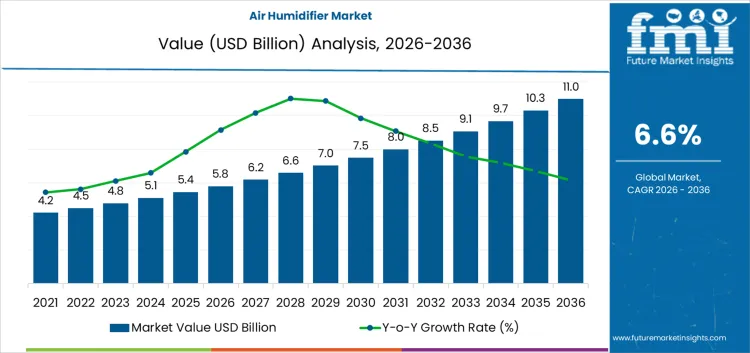
The air humidifier market expands from USD 5.8 billion in 2026 to USD 11.0 billion by 2036, representing a CAGR of 6.60%. Cost structures differ materially across product categories and manufacturing models, and these differences exert a stronger influence on profitability than shipment volumes alone. Margin formation depends on the degree of control over component sourcing, tooling, and electronics integration. Manufacturers that internalize critical processes and maintain stable supplier arrangements retain greater pricing authority. By contrast, assembler’s dependent on spot procurement face structurally weaker margins and greater exposure to input cost fluctuations.
Over the period, competitive performance diverges according to the ability of firms to maintain pricing discipline across fragmented distribution channels. Markets characterized by frequent discounting compress margins despite volume growth, while regions with more controlled channel structures preserve unit profitability. Logistics expense, warranty obligations, and return rates materially affect realized margins beyond factory gate pricing. Product differentiation linked to control systems and build quality supports more stable returns in higher value segments. The market expands in absolute size; though economic returns remain concentrated among a limited group of manufacturers.
Quick Stats of the Air Humidifier Market
- Air Humidifier Market Value (2026): USD 5.8 billion
- Air Humidifier Forecast Value (2036): USD 11.0 billion
- Air Humidifier Forecast CAGR 2026 to 2036: 6.6%
- Leading Type in Air Humidifier Market: Ultrasonic Humidifiers (38 % share)
- Leading Sales Channel in Air Humidifier Market: Online Platforms (35 % share)
- Key Growth Regions in Air Humidifier Market: India, China, Brazil, USA, UK
- Top Players in Air Humidifier Market: Philips, Honeywell International, Dyson, Sharp Corporation, De’Longhi Group, Vornado Air, Beurer GmbH
What is the Growth Forecast for Air Humidifier Market through 2036?
Between 2026 and 2031, the air humidifier market is projected to expand from USD 5.8 billion along a trajectory consistent with a 6.6% CAGR, shaped by changes in indoor environment expectations rather than by appliance replacement cycles alone. In this phase, demand is pulled by health-related use cases such as respiratory comfort, skin care, and protection of wooden furnishings and musical instruments, alongside broader adoption in offices, clinics, and commercial spaces. Growth is supported by wider distribution through online and specialty retail channels and by rising awareness of indoor air quality management in both cold and dry-climate regions. Purchasing behavior is driven more by usage frequency and room coverage needs than by feature novelty, keeping volumes steady across mass and mid-range product segments.
From 2031 to 2036, the market is expected to reach USD 11.0 billion, with expansion increasingly linked to integration of humidity control into broader indoor air quality and climate management strategies. Humidifiers are less often bought as seasonal gadgets and more frequently specified as part of year-round comfort systems in homes, offices, and healthcare facilities. Commercial and institutional use grows as building operators seek to manage occupant comfort, equipment protection, and material preservation. Value growth comes from wider installation density and higher average unit value in larger spaces rather than from rapid unit price increases. Competitive dynamics favor brands that combine reliability, quiet operation, and low-maintenance designs with strong distribution reach.
Air Humidifier Market Key Takeaways
| Metric | Value |
|---|---|
| Market Value (2026) | USD 5.8 billion |
| Forecast Value (2036) | USD 11.0 billion |
| Forecast CAGR 2026 to 2036 | 6.6% |
How Is the Air Humidifier Market Enhancing Indoor Air Quality and Comfort?
The air humidifier market is increasingly adopted to maintain optimal indoor humidity, improve air quality, and enhance occupant comfort across residential, commercial, and healthcare environments. Historically, indoor humidity control relied on passive methods or basic devices, which provided limited consistency and often led to dry air, discomfort, or respiratory irritation. Modern humidifiers integrate ultrasonic, evaporative, or steam-based technologies with smart sensors, automated control, and air purification features to ensure consistent humidity levels, energy efficiency, and user convenience. Homeowners, office facility managers, and healthcare providers prioritize precision control, reliability, and ease of maintenance. Early adoption focused on premium households and medical facilities, while current demand spans residential, commercial, and institutional settings, driven by health awareness, allergy and respiratory concerns, and smart home integration. Output control, noise levels, and energy efficiency influence adoption and supplier selection.
Rising awareness of indoor air quality, growing adoption of smart home devices, and health-focused building standards are shaping market growth. Compared with conventional devices, modern air humidifiers emphasize precise humidity regulation, energy efficiency, and integration with automated environmental controls HVAC air quality monitoring. Cost structures depend on technology type, sensor integration, and maintenance design, concentrating margins among suppliers capable of delivering reliable, high-performance products. Consumers and facility operators adopt these devices to maintain comfort, reduce respiratory issues, and optimize indoor environmental conditions. By 2036, air humidifiers are expected to become standard in residential, commercial, and healthcare environments, supporting indoor comfort, air quality, and occupant well-being.
What Factors Are Shaping the Demand for Air Humidifiers by Operating Principle and Sales Channel in 2026?
The air humidifier market in 2026 is segmented by product type and by distribution channel. By operating principle, demand is divided into ultrasonic, evaporative, steam vaporizer, and impeller humidifiers, each offering different balances of energy use, noise, and maintenance needs. By sales channel, demand is organized around online platforms, specialty stores, supermarkets or hypermarkets, and home appliance retail outlets, which differ in product assortment, price transparency, and after sales support. These segments reflect how consumers evaluate convenience, health concerns, and purchase experience while selecting devices intended for regular household or small office use.
Why Do Ultrasonic Humidifiers Lead Product Type Demand?
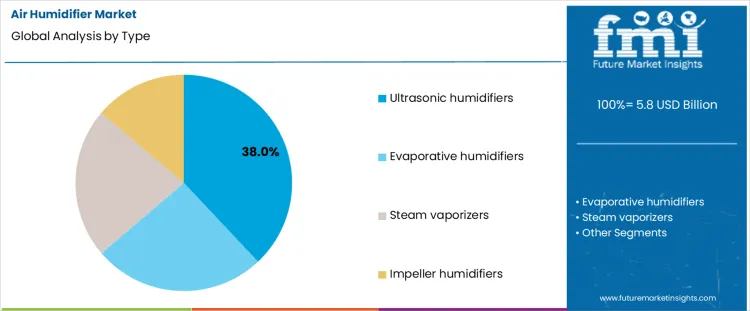
Ultrasonic humidifiers account for about 38% of demand in 2026, reflecting their quiet operation and low power consumption. These units use high frequency vibration to create fine mist without heating water, which suits bedrooms and living spaces where noise and energy use matter. Their compact size and modern designs fit well with contemporary home interiors, which supports strong retail acceptance. Maintenance requirements are moderate, and many models include basic filters or cartridges to manage mineral buildup. Price points cover a wide range, which makes them accessible to many households. This mix of comfort, efficiency, and broad availability keeps ultrasonic models as the most widely chosen humidifier type.
Evaporative, steam, and impeller models address different user priorities. Evaporative units regulate output naturally through airflow and are less prone to over humidification, yet they rely on replaceable wicks and larger fans. Steam vaporizers provide hygienic output through boiling, though they consume more power and pose burn risk, which limits use in some homes. Impeller models are simple and robust but can be noisier and less refined. Each type holds a place based on specific preferences, yet none matches the overall appeal and balance of features that ultrasonic designs offer to mainstream consumers.
Why Do Online Channels Represent the Largest Share of Sales?
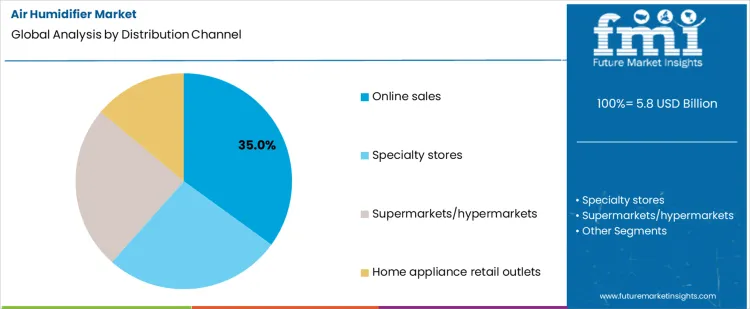
Online sales represent about 35% of demand in 2026 because consumers increasingly prefer to compare features, prices, and reviews before purchasing small appliances. Humidifiers are relatively low risk purchases that do not require physical inspection, which suits e commerce. Delivery is simple because units are compact and light. Online platforms also offer wider model selection and frequent promotions, which attracts price sensitive buyers. Seasonal demand spikes during dry or cold periods further favor online purchasing, where stock availability can be managed centrally. This convenience and transparency explain why digital channels capture the largest share of unit sales.
Specialty stores, mass retailers, and appliance outlets serve different shopping habits. Specialty stores offer advice and curated selections, which appeals to buyers seeking guidance. Supermarkets and hypermarkets focus on impulse or seasonal purchases with limited model ranges. Appliance stores cater to customers who want to see products in person or bundle purchases with other devices. These channels remain important, yet their reach and assortment are more constrained. As a result, while offline retail continues to contribute substantial volume, it does not surpass the scale and flexibility achieved through online distribution for this product category.
Why Are Indoor Air Quality Management and Building Use Patterns Driving the Air Humidifier Market through 2036?
Demand is linked to how buildings are operated rather than to weather alone. Tightly sealed offices, hospitals, data centers, and homes with mechanical ventilation often experience overly dry air, especially in winter or in air conditioned climates. Low humidity affects occupant comfort, respiratory health, static discharge, and in some settings the preservation of materials and equipment. Employers and facility managers increasingly monitor indoor conditions as part of workplace standards. In residences, awareness of comfort and health effects supports adoption. Once humidification is integrated into HVAC or room systems, it becomes a routine part of environmental control rather than a seasonal accessory.
What Maintenance Burden, Hygiene Risk, and Energy Use Are Limiting Broader Deployment?
Constraints arise from ownership experience. Poorly maintained humidifiers can harbor bacteria and mineral buildup indoor air purification systems, which turns a comfort device into a hygiene concern. Central systems require water treatment, periodic cleaning, and monitoring, adding to facility workload. Portable units are often neglected or misused, reducing perceived benefit. Energy use is also an issue, especially for steam based systems that consume significant power. In commercial buildings, designers sometimes avoid humidification to reduce complexity and liability. These factors make buyers cautious and lead many projects to accept lower humidity levels rather than commit to systems that require continuous attention and disciplined upkeep.
How Are Building Automation and Health Oriented Standards Changing Product Roles?
The role of humidification is becoming more systematic. New buildings increasingly specify humidity control as part of broader indoor environment standards rather than as an add on. Integration with building management systems allows monitoring of humidity alongside temperature and air quality, enabling tighter control and fault detection. In healthcare, museums, and data centers, specifications are becoming more explicit and audited. Some users favor localized units to avoid large water systems, while others centralize control for consistency. The category is shifting from discretionary comfort equipment toward a managed parameter within building performance and compliance frameworks.
What is the Demand for Air Humidifiers by Country?
| Country | CAGR (%) |
|---|---|
| USA | 6.0% |
| UK | 5.8% |
| China | 7.2% |
| India | 7.5% |
| Brazil | 6.5% |
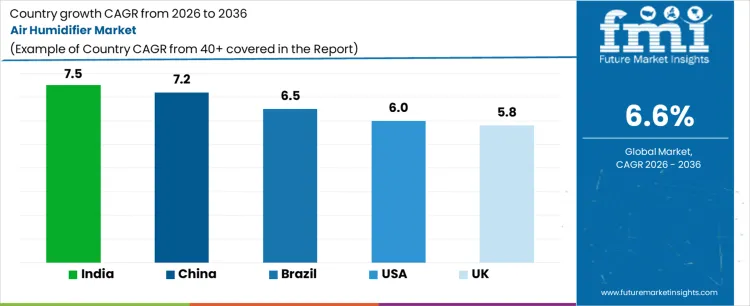
Demand for air humidifiers is rising as consumers, healthcare facilities, and commercial spaces seek to maintain optimal indoor air quality, comfort, and health. India leads with a 7.5% CAGR, driven by rising urbanization, growing awareness of indoor air quality, and increasing adoption of home and office humidification systems. China follows at 7.2%, supported by large urban populations, cold-dry climates in northern regions, and expanding household appliance markets. Brazil records 6.5% growth, shaped by increasing residential and commercial installations. The USA grows at 6.0%, influenced by mature markets and rising adoption in healthcare and hospitality sectors. The UK shows 5.8% CAGR, reflecting steady consumer demand and commercial application of air humidifiers.
How is the United States experiencing growth in the air humidifier market?
United States is experiencing growth at a CAGR of 6%, driven by rising consumer focus on indoor air quality, allergy management, and home comfort. Air humidifiers are optimized for efficient moisture distribution, quiet operation, and energy efficiency, suitable for residential and small office environments. Demand is concentrated in metropolitan areas such as New York, Los Angeles, and Chicago, where seasonal variations create high demand for humidification. Investments focus on device reliability, user safety, and compliance with EPA and UL standards. Growth reflects increasing awareness of health benefits, smart home adoption, and expansion of home appliance retail channels.
- Indoor air quality drives adoption.
- Devices optimize moisture distribution and energy efficiency.
- Urban residential hubs concentrate demand.
- Reliability and regulatory compliance guide investment.
How is the United Kingdom witnessing growth in the air humidifier market?
United Kingdom is witnessing growth at a CAGR of 5.8%, supported by rising demand for health-conscious home appliances and allergy prevention solutions. Air humidifiers are optimized for compact design, low noise, and energy-efficient operation. Demand is concentrated in London, Birmingham, and Manchester, where high-density urban housing increases need for indoor climate control. Investments prioritize product durability, performance, and compliance with UK electrical and safety standards. Growth reflects consumer adoption of wellness-focused appliances, increased e-commerce penetration, and awareness of the benefits of controlled indoor humidity.
- Home wellness and allergy prevention drive adoption.
- Devices enhance low-noise operation and efficiency.
- Urban housing areas concentrate demand.
- Product performance and regulatory compliance guide investment.
How is China experiencing growth in the air humidifier market?
China is experiencing growth at a CAGR of 7.2%, fueled by rising urbanization, air pollution awareness, and increasing adoption of smart home appliances in cities such as Beijing, Shanghai, and Guangzhou. Air humidifiers are optimized for high-efficiency moisture delivery, smart connectivity, and energy savings. Demand is concentrated in urban apartments, offices, and tech-integrated homes. Investments focus on product reliability, connectivity features, and compliance with national electrical and safety standards. Growth reflects rising health consciousness, integration with smart home ecosystems, and growing middle-class consumer demand for comfort appliances.
- Urbanization and pollution awareness drive adoption.
- Devices optimize moisture efficiency and smart integration.
- Apartments and offices concentrate demand.
- Product reliability and standards compliance guide investment.
How is India witnessing growth in the air humidifier market?
India is witnessing growth at a CAGR of 7.5%, driven by increasing awareness of indoor air quality, seasonal dry climates in northern regions, and rising disposable incomes in metropolitan cities. Air humidifiers are optimized for energy efficiency, quiet operation, and compatibility with smart home setups. Demand is concentrated in Mumbai, Delhi, and Bengaluru, where urban housing density and seasonal air dryness increase product necessity. Investments focus on performance reliability, user-friendly operation, and compliance with national electrical standards. Growth reflects rising health consciousness, adoption of smart appliances, and expansion of home appliance retail networks.
- Indoor air quality in dry climates drives adoption.
- Devices enhance energy efficiency and quiet operation.
- Metropolitan residential areas concentrate demand.
- Performance reliability and regulatory compliance guide investment.
How is Brazil experiencing growth in the air humidifier market?
Brazil is experiencing growth at a CAGR of 6.5%, supported by increasing urbanization, focus on wellness and air quality, and adoption of home comfort appliances in cities like São Paulo, Rio de Janeiro, and Brasília. Air humidifiers are optimized for tropical and seasonal climate variations, energy efficiency, and user-friendly operation. Demand is concentrated in urban residential complexes and commercial offices. Investments prioritize device durability, ease of use, and compliance with national safety and electrical standards. Growth reflects rising consumer interest in indoor comfort, wellness trends, and expansion of modern retail and e-commerce channels.
- Urban wellness trends drive adoption.
- Devices optimize climate adaptability and energy efficiency.
- Residential and commercial hubs concentrate demand.
- Durability and standards compliance guide investment.
Who Are the Key Competitors in the Air Humidifier Market and How Do They Differ?
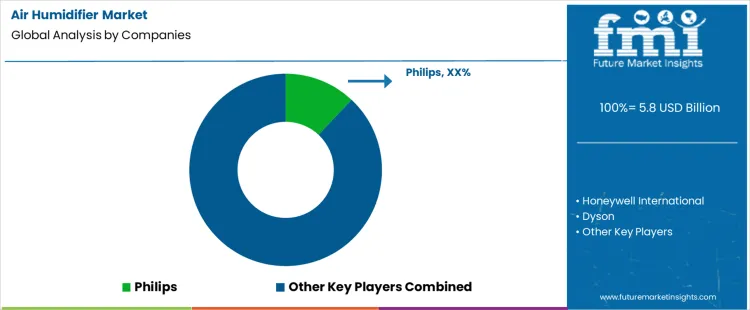
Competition in the air humidifier market is defined by product type, humidity control precision, energy use, and suitability for different indoor environments. Philips supplies humidifiers designed for consistent moisture delivery with user adjustable settings and filter integration for air quality. Honeywell International offers a range of evaporative and ultrasonic humidifiers with humidistats for automatic humidity control in residential and light commercial spaces. Dyson provides models that combine humidification with air purification and heating features, using sealed systems to limit bacterial spread. Sharp Corporation markets humidifiers with built in plasma cluster technology intended to reduce airborne microbes and particulates while maintaining set humidity levels. De’Longhi Group delivers compact and mid size humidifiers focused on ease of use, tank capacity, and quiet operation.
Vornado Air offers units that emphasize directed airflow and whole room moisture distribution with adjustable controls. Beurer GmbH supplies humidifiers with simple interface designs and integrated hygiene features such as antimicrobial surfaces. Other regional and specialty manufacturers provide basic ultrasonic or warm mist humidifiers tailored to budget sensitive consumers or specific climate conditions. Differentiation across suppliers arises from technologies used (evaporative, ultrasonic, steam), control precision, ease of maintenance, noise levels, and energy efficiency. Market relevance also depends on service networks, replacement filter availability, and compliance with indoor air quality guidelines. Adoption reflects consumer preferences for smart controls, integrated air quality features, and reliable moisture management in homes, offices, and healthcare settings.
Key Players in the Air Humidifier Market
- Philips
- Honeywell International
- Dyson
- Sharp Corporation
- De’Longhi Group
- Vornado Air
- Beurer GmbH
Scope of the Report
| Items | Values |
|---|---|
| Quantitative Units (2026) | USD billion |
| Type | Ultrasonic Humidifiers, Evaporative Humidifiers, Steam Vaporizers, Impeller Humidifiers |
| Distribution Channel | Online Sales, Specialty Stores, Supermarkets and Hypermarkets, Home Appliance Retail Outlets |
| Regions Covered | Asia Pacific, Europe, North America, Latin America, Middle East & Africa |
| Countries Covered | China, Japan, South Korea, India, Australia & New Zealand, ASEAN, Germany, United Kingdom, France, Italy, Spain, Nordic, BENELUX, United States, Canada, Mexico, Brazil, Chile, Saudi Arabia, Turkey, South Africa, and other regional markets |
| Key Companies Profiled | Philips, Honeywell International, Dyson, Sharp Corporation, De’Longhi Group, Vornado Air, Beurer GmbH |
| Additional Attributes | Dollar sales by type and distribution channel, ultrasonic humidifiers forming the largest product segment due to quiet operation and low power use, online channels representing the largest sales share due to price comparison and convenience, demand driven by indoor air quality management in residential, commercial, and healthcare settings, margins influenced by control over component sourcing, electronics integration, logistics cost, warranty and return rates, growth tied to wider installation density and integration into building climate management rather than seasonal use, increasing role of smart controls, low-noise operation, and low-maintenance designs, and competitive positioning based on reliability, hygiene management, energy efficiency, and distribution reach. |
Air Humidifier Market Segmentation
Type:
- Ultrasonic humidifiers
- Evaporative humidifiers
- Steam vaporizers
- Impeller humidifiers
Distribution Channel:
- Online sales
- Specialty stores
- Supermarkets/hypermarkets
- Home appliance retail outlets
Region
- Asia Pacific
- China
- Japan
- South Korea
- India
- Australia & New Zealand
- ASEAN
- Rest of Asia Pacific
- Europe
- Germany
- United Kingdom
- France
- Italy
- Spain
- Nordic
- BENELUX
- Rest of Europe
- North America
- United States
- Canada
- Mexico
- Latin America
- Brazil
- Chile
- Rest of Latin America
- Middle East & Africa
- Kingdom of Saudi Arabia
- Other GCC Countries
- Turkey
- South Africa
- Other African Union
- Rest of Middle East & Africa
Bibliography
- International Electrotechnical Commission. (2023). IEC 60335-2-98:2023: Household and similar electrical appliances—Safety—Part 2-98: Particular requirements for humidifiers. IEC.
- International Energy Agency. (2024). Energy efficiency 2024. International Energy Agency.
- U.S. Environmental Protection Agency. (2025). Indoor air quality. U.S. Environmental Protection Agency.
Frequently Asked Questions
How big is the air humidifier market in 2026?
The global air humidifier market is estimated to be valued at USD 5.8 billion in 2026.
What will be the size of air humidifier market in 2036?
The market size for the air humidifier market is projected to reach USD 11.0 billion by 2036.
How much will be the air humidifier market growth between 2026 and 2036?
The air humidifier market is expected to grow at a 6.6% CAGR between 2026 and 2036.
What are the key product types in the air humidifier market?
The key product types in air humidifier market are ultrasonic humidifiers, evaporative humidifiers, steam vaporizers and impeller humidifiers.
Which distribution channel segment to contribute significant share in the air humidifier market in 2026?
In terms of distribution channel, online sales segment to command 35.0% share in the air humidifier market in 2026.
Preview the report firsthand - request a free sample
Get SampleGet the brochure for pricing and purchase details.
Get PDFTable of Content
- Executive Summary
- Global Market Outlook
- Demand-side Trends
- Supply-side Trends
- Technology Roadmap Analysis
- Analysis and Recommendations
- Market Overview
- Market Coverage / Taxonomy
- Market Definition / Scope / Limitations
- Market Background
- Market Dynamics
- Drivers
- Restraints
- Opportunity
- Trends
- Scenario Forecast
- Demand in Optimistic Scenario
- Demand in Likely Scenario
- Demand in Conservative Scenario
- Opportunity Map Analysis
- Product Life Cycle Analysis
- Supply Chain Analysis
- Investment Feasibility Matrix
- Value Chain Analysis
- PESTLE and Porter’s Analysis
- Regulatory Landscape
- Regional Parent Market Outlook
- Production and Consumption Statistics
- Import and Export Statistics
- Market Dynamics
- Global Market Analysis 2021 to 2025 and Forecast, 2026 to 2036
- Historical Market Size Value (USD Million) Analysis, 2021 to 2025
- Current and Future Market Size Value (USD Million) Projections, 2026 to 2036
- Y-o-Y Growth Trend Analysis
- Absolute $ Opportunity Analysis
- Global Market Pricing Analysis 2021 to 2025 and Forecast 2026 to 2036
- Global Market Analysis 2021 to 2025 and Forecast 2026 to 2036, By Type
- Introduction / Key Findings
- Historical Market Size Value (USD Million) Analysis By Type, 2021 to 2025
- Current and Future Market Size Value (USD Million) Analysis and Forecast By Type, 2026 to 2036
- Ultrasonic humidifiers
- Evaporative humidifiers
- Steam vaporizers
- Impeller humidifiers
- Ultrasonic humidifiers
- Y-o-Y Growth Trend Analysis By Type, 2021 to 2025
- Absolute $ Opportunity Analysis By Type, 2026 to 2036
- Global Market Analysis 2021 to 2025 and Forecast 2026 to 2036, By Distribution Channel
- Introduction / Key Findings
- Historical Market Size Value (USD Million) Analysis By Distribution Channel, 2021 to 2025
- Current and Future Market Size Value (USD Million) Analysis and Forecast By Distribution Channel, 2026 to 2036
- Online sales
- Specialty stores
- Supermarkets/hypermarkets
- Home appliance retail outlets
- Online sales
- Y-o-Y Growth Trend Analysis By Distribution Channel, 2021 to 2025
- Absolute $ Opportunity Analysis By Distribution Channel, 2026 to 2036
- Global Market Analysis 2021 to 2025 and Forecast 2026 to 2036, By Region
- Introduction
- Historical Market Size Value (USD Million) Analysis By Region, 2021 to 2025
- Current Market Size Value (USD Million) Analysis and Forecast By Region, 2026 to 2036
- North America
- Latin America
- Western Europe
- Eastern Europe
- East Asia
- South Asia and Pacific
- Middle East & Africa
- Market Attractiveness Analysis By Region
- North America Market Analysis 2021 to 2025 and Forecast 2026 to 2036, By Country
- Historical Market Size Value (USD Million) Trend Analysis By Market Taxonomy, 2021 to 2025
- Market Size Value (USD Million) Forecast By Market Taxonomy, 2026 to 2036
- By Country
- USA
- Canada
- Mexico
- By Type
- By Distribution Channel
- By Country
- Market Attractiveness Analysis
- By Country
- By Type
- By Distribution Channel
- Key Takeaways
- Latin America Market Analysis 2021 to 2025 and Forecast 2026 to 2036, By Country
- Historical Market Size Value (USD Million) Trend Analysis By Market Taxonomy, 2021 to 2025
- Market Size Value (USD Million) Forecast By Market Taxonomy, 2026 to 2036
- By Country
- Brazil
- Chile
- Rest of Latin America
- By Type
- By Distribution Channel
- By Country
- Market Attractiveness Analysis
- By Country
- By Type
- By Distribution Channel
- Key Takeaways
- Western Europe Market Analysis 2021 to 2025 and Forecast 2026 to 2036, By Country
- Historical Market Size Value (USD Million) Trend Analysis By Market Taxonomy, 2021 to 2025
- Market Size Value (USD Million) Forecast By Market Taxonomy, 2026 to 2036
- By Country
- Germany
- UK
- Italy
- Spain
- France
- Nordic
- BENELUX
- Rest of Western Europe
- By Type
- By Distribution Channel
- By Country
- Market Attractiveness Analysis
- By Country
- By Type
- By Distribution Channel
- Key Takeaways
- Eastern Europe Market Analysis 2021 to 2025 and Forecast 2026 to 2036, By Country
- Historical Market Size Value (USD Million) Trend Analysis By Market Taxonomy, 2021 to 2025
- Market Size Value (USD Million) Forecast By Market Taxonomy, 2026 to 2036
- By Country
- Russia
- Poland
- Hungary
- Balkan & Baltic
- Rest of Eastern Europe
- By Type
- By Distribution Channel
- By Country
- Market Attractiveness Analysis
- By Country
- By Type
- By Distribution Channel
- Key Takeaways
- East Asia Market Analysis 2021 to 2025 and Forecast 2026 to 2036, By Country
- Historical Market Size Value (USD Million) Trend Analysis By Market Taxonomy, 2021 to 2025
- Market Size Value (USD Million) Forecast By Market Taxonomy, 2026 to 2036
- By Country
- China
- Japan
- South Korea
- By Type
- By Distribution Channel
- By Country
- Market Attractiveness Analysis
- By Country
- By Type
- By Distribution Channel
- Key Takeaways
- South Asia and Pacific Market Analysis 2021 to 2025 and Forecast 2026 to 2036, By Country
- Historical Market Size Value (USD Million) Trend Analysis By Market Taxonomy, 2021 to 2025
- Market Size Value (USD Million) Forecast By Market Taxonomy, 2026 to 2036
- By Country
- India
- ASEAN
- Australia & New Zealand
- Rest of South Asia and Pacific
- By Type
- By Distribution Channel
- By Country
- Market Attractiveness Analysis
- By Country
- By Type
- By Distribution Channel
- Key Takeaways
- Middle East & Africa Market Analysis 2021 to 2025 and Forecast 2026 to 2036, By Country
- Historical Market Size Value (USD Million) Trend Analysis By Market Taxonomy, 2021 to 2025
- Market Size Value (USD Million) Forecast By Market Taxonomy, 2026 to 2036
- By Country
- Kingdom of Saudi Arabia
- Other GCC Countries
- Turkiye
- South Africa
- Other African Union
- Rest of Middle East & Africa
- By Type
- By Distribution Channel
- By Country
- Market Attractiveness Analysis
- By Country
- By Type
- By Distribution Channel
- Key Takeaways
- Key Countries Market Analysis
- USA
- Pricing Analysis
- Market Share Analysis, 2025
- By Type
- By Distribution Channel
- Canada
- Pricing Analysis
- Market Share Analysis, 2025
- By Type
- By Distribution Channel
- Mexico
- Pricing Analysis
- Market Share Analysis, 2025
- By Type
- By Distribution Channel
- Brazil
- Pricing Analysis
- Market Share Analysis, 2025
- By Type
- By Distribution Channel
- Chile
- Pricing Analysis
- Market Share Analysis, 2025
- By Type
- By Distribution Channel
- Germany
- Pricing Analysis
- Market Share Analysis, 2025
- By Type
- By Distribution Channel
- UK
- Pricing Analysis
- Market Share Analysis, 2025
- By Type
- By Distribution Channel
- Italy
- Pricing Analysis
- Market Share Analysis, 2025
- By Type
- By Distribution Channel
- Spain
- Pricing Analysis
- Market Share Analysis, 2025
- By Type
- By Distribution Channel
- France
- Pricing Analysis
- Market Share Analysis, 2025
- By Type
- By Distribution Channel
- India
- Pricing Analysis
- Market Share Analysis, 2025
- By Type
- By Distribution Channel
- ASEAN
- Pricing Analysis
- Market Share Analysis, 2025
- By Type
- By Distribution Channel
- Australia & New Zealand
- Pricing Analysis
- Market Share Analysis, 2025
- By Type
- By Distribution Channel
- China
- Pricing Analysis
- Market Share Analysis, 2025
- By Type
- By Distribution Channel
- Japan
- Pricing Analysis
- Market Share Analysis, 2025
- By Type
- By Distribution Channel
- South Korea
- Pricing Analysis
- Market Share Analysis, 2025
- By Type
- By Distribution Channel
- Russia
- Pricing Analysis
- Market Share Analysis, 2025
- By Type
- By Distribution Channel
- Poland
- Pricing Analysis
- Market Share Analysis, 2025
- By Type
- By Distribution Channel
- Hungary
- Pricing Analysis
- Market Share Analysis, 2025
- By Type
- By Distribution Channel
- Kingdom of Saudi Arabia
- Pricing Analysis
- Market Share Analysis, 2025
- By Type
- By Distribution Channel
- Turkiye
- Pricing Analysis
- Market Share Analysis, 2025
- By Type
- By Distribution Channel
- South Africa
- Pricing Analysis
- Market Share Analysis, 2025
- By Type
- By Distribution Channel
- USA
- Market Structure Analysis
- Competition Dashboard
- Competition Benchmarking
- Market Share Analysis of Top Players
- By Regional
- By Type
- By Distribution Channel
- Competition Analysis
- Competition Deep Dive
- Philips
- Overview
- Product Portfolio
- Profitability by Market Segments (Product/Age /Sales Channel/Region)
- Sales Footprint
- Strategy Overview
- Marketing Strategy
- Product Strategy
- Channel Strategy
- Honeywell International
- Dyson
- Sharp Corporation
- De’Longhi Group
- Vornado Air
- Beurer GmbH
- Philips
- Competition Deep Dive
- Assumptions & Acronyms Used
- Research Methodology


