

- Industry Size (2026)
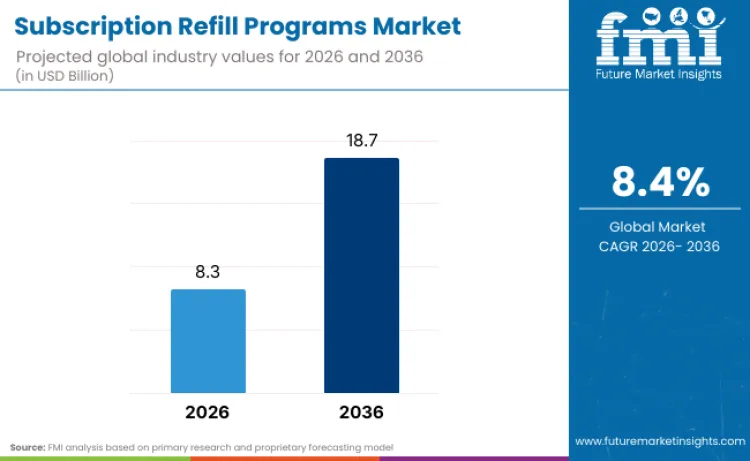
- USD 8.3 Bn
- Forecast (2036)
- USD 18.7 Bn
- CAGR (2026 to 2036)
- 8.4%
Subscription Refill Programs Market Forecast and Outlook 2026 to 2036
Subscription refill programs are projected to reach USD 8.3 billion in 2026 and expand steadily through 2036 as brands and service providers scale recurring replenishment models that reduce cart abandonment, smooth demand, and protect retention across consumables. Growth is being driven by the shift from basic “repeat order” setups to predictive refill engines that use household consumption signals, shipping lead times, and stock visibility to trigger replenishment before a customer runs out. Platform investment is concentrating on software that can unify subscription billing, inventory allocation, last mile routing, and exception handling in one workflow, because the economics of refill programs depend on lowering failed deliveries, reducing customer service tickets, and improving on time fulfillment.
Government regulation is becoming a primary design constraint for these programs. In consumer subscriptions, auto renewal and negative option rules increasingly require clear consent, upfront price disclosure, renewal reminders where applicable, and simple cancellation mechanisms, which forces platforms to hard code compliant checkout, confirmation flows, and audit trails. Data privacy regulation also shapes how prediction models are built, since refill scheduling relies on behavioral data and must follow rules on collection, retention, and user rights.
Quick Stats for Subscription Refill Programs Market
- Subscription Refill Programs Industry Value (2026): USD 8.3 Billion
- Subscription Refill Programs Industry Forecast Value (2036): USD 18.7 Billion
- Subscription Refill Programs Industry Forecast CAGR: 8.4%
- Subscription Refill Programs Industry Leading Component: Software (42.7%)
- Subscription Refill Programs Industry Key Growth Regions: India, China, Brazil
- Subscription Refill Programs Industry Key Players: Amazon, Philips, Procter & Gamble (P&G), Nestlé, Unilever
In payments, stronger authentication and fraud controls influence checkout friction and retry logic. In healthcare refill programs, regulation adds another layer because subscription convenience must still align with prescription validity, refill limits, pharmacist oversight, and controlled substance restrictions, while protecting patient data under healthcare privacy requirements. Providers that combine compliant consent management, privacy by design analytics, and regulated product workflow controls are better positioned to scale refill subscriptions without increasing legal risk or operational friction.
Subscription Refill Programs Market Key Takeaways
| Metric | Value |
|---|---|
| Industry Size (2026) | USD 8.3 Billion |
| Industry Value (2036) | USD 18.7 Billion |
| CAGR (2026-2036) | 8.4% |
Source: Future Market Insights - analysis driven by proprietary forecasting models and primary research
Which Consumer Product KPIs Best Explain Accelerating Adoption of Subscription Software Components?
Subscription software component adoption is accelerating when companies can turn automated billing, analytics, and API-led integrations into measurable improvements across the full customer lifecycle. Acquisition should track CAC and conversion rate, because unified checkout, flexible plans, and fewer payment frictions directly improve sign-up efficiency and reduce wasted spend. Engagement is captured through DAU/MAU, session duration, and feature adoption, especially where self-serve plan changes, in-app upgrades, usage dashboards, and proactive notifications increase product reliance and reduce support dependency. Retention hinges on churn rate, retention rate, and stickiness, since automation wins when it prevents failed renewals, reduces involuntary churn through smarter dunning, and identifies downgrade risk early enough for intervention. Revenue is validated through LTV, ARPU, and MRR/ARR, reflecting improved expansion motions, pricing experimentation, and tighter renewal control across multi-product portfolios. Customer satisfaction should follow NPS and CSAT, as clearer invoices, fewer billing disputes, and smoother subscription experiences improve trust. Usage patterns like bounce rate and task completion rate show whether onboarding, plan selection, and payment flows are intuitive enough to keep users progressing instead of abandoning mid-journey.
How Is the Subscription Refill Programs Market Segmented Across Key Categories?
Global landscape is intricately segmented to address diverse requirements of the automated commerce industry, categorizing sector by component, application, deployment mode, enterprise size, end-user, and company type. Structural division allows stakeholders to identify specific operational targets, such as rising demand for cloud-based formats in scalable enterprise solutions or preference for on-premises deployment in data-sensitive applications. By analyzing these segments, technology providers can tailor development cycles to meet distinct needs of large enterprise platforms versus small business subscription models. Segmentation also highlights shift from generic recurring billing approaches to targeted customer lifecycle interventions. As industry matures, granular segmentation becomes essential for understanding technology pathways and compliance requirements, ensuring platform development aligns with evolving commercial guidelines.
Why Do Software Components Maintain Dominance?
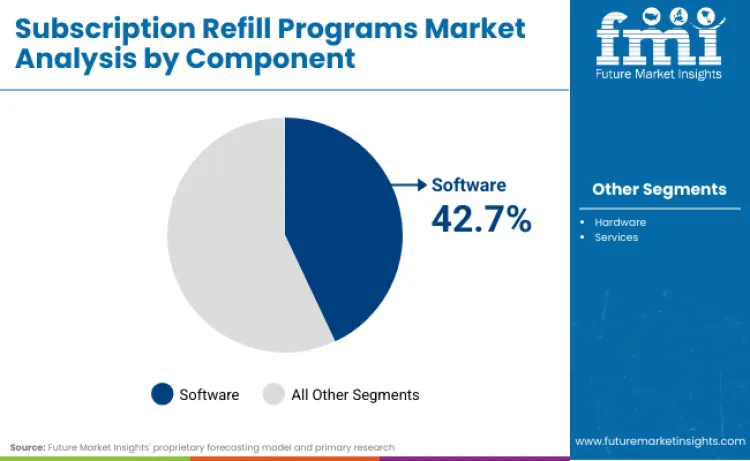
Software components account for 42.7% of component share in 2026, driven by extensive integration capabilities supporting subscription automation requirements. Leadership position is underpinned by API compatibility from technology platforms recognizing subscription management functionality claims. Segment benefits from continuous development improvements, such as microservices architecture removing integration bottlenecks. Research focused on cloud-native subscription stability is renewing interest among enterprise technology manufacturers. Critical role in managing automated billing formulations further solidifies standing, as these platforms reduce manual processing overhead. As commercial guidelines prioritize subscription automation, demand for enterprise-grade software solutions is expected to remain robust.
Why Is Healthcare the Leading Application?
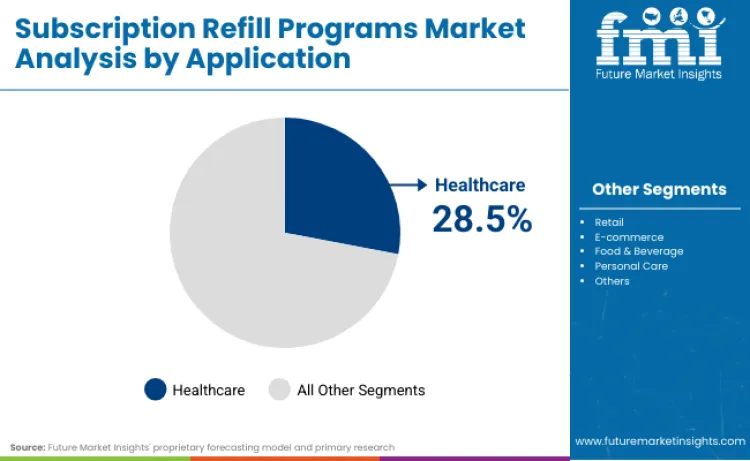
Healthcare applications command 28.5% share of sector in 2026, reflecting industry preference for reliable recurring supply delivery systems. Dominance is linked to superior inventory management of critical medical supplies and pharmaceutical products compared to traditional ordering methods. Healthcare providers rely on specialized automated replenishment technology to ensure precise timing and regulatory compliance. These applications are essential for delivering consistent pharmaceutical refills and medical device supplies, driving priority status among healthcare subscription brands. Relentless pursuit of patient safety compliance ensures products designed for medical supply chains remain primary choice. High provider acceptance necessitates dynamic fulfillment capacity, bolstering sustained revenue streams for healthcare technology suppliers.
Why Does Cloud Deployment Lead Infrastructure?
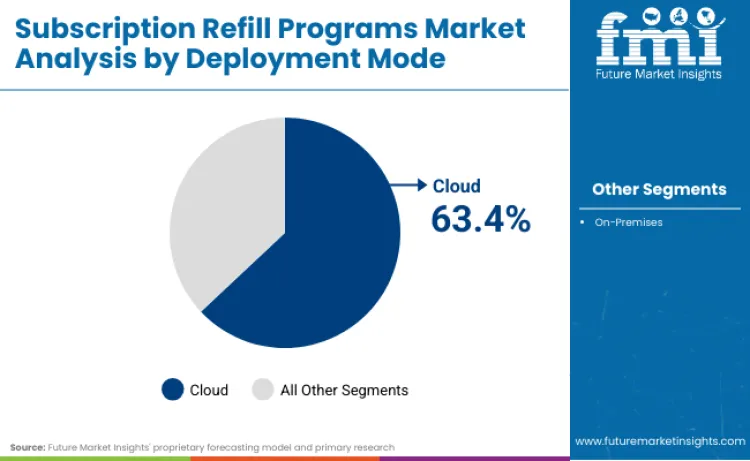
Cloud deployment captures 63.4% of deployment mode share in 2026, owing to widespread scalability requirements demanding flexible infrastructure solutions. Dominance stems from operational guidelines recommending cloud-based subscription management alongside traditional commerce platforms for optimal system integration. Businesses prefer these solutions for their accessibility benefits and minimal infrastructure overhead. Usage in supporting multi-tenant subscription architectures drives continuous capacity growth among enterprise technology populations. Compatibility with various subscription platform matrices allows for integration strategies across different deployment categories. Technology providers focusing on serverless subscription and containerized application formulations for these high-scalability conditions secure significant adoption among technology practices.
How Will Enterprise Digital Transformation Influence Adoption of Subscription Management Platforms?
Enterprise digital transformation is pushing subscription management from a billing tool into a core system that must plug into finance, order management, customer data, and entitlement control without breaking governance. As cloud-first adoption expands, large organizations increasingly require enterprise-grade capabilities such as role-based controls, audit trails, configurable approval workflows, and support for complex hierarchies across regions, business units, and product lines. Omnichannel growth amplifies this need because subscriptions now span web, app, partner marketplaces, and offline-assisted sales, forcing platforms to unify pricing, proration logic, invoicing rules, and customer identity across touchpoints. Vendors that cannot demonstrate ERP compatibility, scalable integration patterns, and reliable entitlement enforcement tend to lose ground to platforms positioned as “system-of-record” ready rather than lightweight checkout add-ons.
How Will AI Integration Transform Subscription Operations?
AI is changing subscription operations by shifting focus from reactive reporting to proactive intervention across renewal, expansion, and service delivery. Platforms are embedding predictive signals that identify churn risk, downgrade propensity, and payment failure likelihood early enough to trigger targeted actions such as personalized offers, plan right-sizing, or automated dunning workflows. On the operations side, usage forecasting supports better capacity planning for digital services and smoother inventory allocation for hybrid or physical components tied to subscriptions. AI-driven experimentation also accelerates optimization by enabling faster testing of bundles, price fences, and messaging variants while keeping governance in place through automated guardrails and performance monitoring.
How Will Data Privacy Regulations Shape Platform Development?
Privacy regulation is increasingly shaping platform architecture because subscription businesses rely on behavioral data for personalization, retention, and revenue optimization. Compliance requirements are pushing vendors toward privacy-by-design patterns, including stronger consent management, minimization of stored identifiers, configurable retention policies, and clearer separation between analytics and operational data. Security investment becomes a competitive requirement as enterprises demand encryption, access control, logging, and incident response maturity before integrating subscription platforms with customer data stores and payment systems. Regulations can also act as an advantage for platforms that can operationalize compliance across regions through configurable controls, making cross-border scaling easier for global brands that want one subscription backbone without fragmented tooling.
How Will the Subscription Refill Programs Industry Evolve in Major Nations?
Global landscape for subscription commerce platforms is characterized by diverse regulatory frameworks, influenced by digital commerce systems and data protection standards. Established technology markets prioritize security-focused formulations and enterprise-grade development, whereas emerging digital economies focus on accessible pricing and basic subscription automation. Asia-Pacific is emerging as rapid growth hub due to increasing mobile commerce adoption and expanding digital payment infrastructure. Conversely, North American sectors pivot towards artificial intelligence integration and personalized automation protocols. Government initiatives in developing nations supporting digital commerce development ensure sustained demand for subscription platforms across all business demographics.
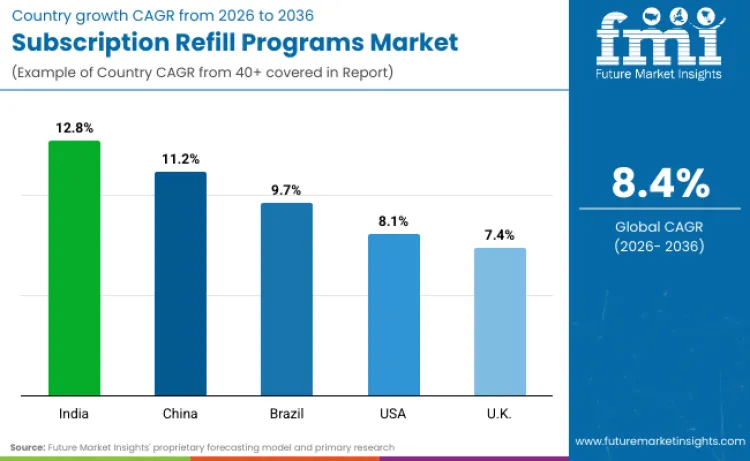
| Country | CAGR (2026 to 2036) |
|---|---|
| India | 12.8% |
| China | 11.2% |
| Brazil | 9.7% |
| USA | 8.1% |
| UK | 7.4% |
Source: Future Market Insights (FMI) analysis, based on proprietary forecasting model and primary research
Why is the Subscription Refill Programs Industry in India Growing?
Revenue from subscription refill programs in India is set to grow at 12.8% CAGR through 2036 because recurring, consent based payments are becoming easier to set up and collect through UPI mandate rails. NPCI’s UPI AutoPay enables e mandates for recurring use cases such as bills, EMIs, insurance, and subscriptions, which directly lowers friction for refill automation models that need predictable repeat billing. This is reinforced by ongoing government focus on deepening digital transactions across public services and commerce, which expands the addressable base for subscription like ordering and automated replenishment across channels.
Why is the Subscription Refill Programs Sector in China Expanding?
Demand in China is projected to rise at 11.2% CAGR through 2036 because subscription automation scales best in markets with strong digital commerce foundations and regulated payment infrastructure. The State Council has explicitly framed digital economy development as a national priority under the current planning period, which supports platform based commerce models that rely on automated ordering and payment flows. On the payments side, official reporting shows continued institutional expansion of the digital yuan ecosystem and its management framework, signalling sustained investment in modern retail payment rails that can support automated collections and controlled authorization.
Why is the Subscription Refill Programs Industry in Brazil Showing Potential?
Brazil is poised to expand at 9.7% CAGR through 2036 because the central bank is extending Pix beyond one time transfers into true recurring payment capability. Banco Central do Brasil’s Pix Automático is designed specifically to allow recurring payments with a single authorization by the payer, which fits subscription refill models for utilities, memberships, and services and reduces dependence on card based billing. This creates a clearer route for merchants to automate replenishment billing directly from bank accounts using a widely adopted national payment scheme.
Why is the Subscription Refill Programs Industry in USA Growing?
Revenue in the United States is set to grow at 8.1% CAGR through 2036 because subscription automation is increasingly defined by compliance grade consent, cancellation, and recurring payment controls. Regulation E sets consumer protections for electronic fund transfers, including rules around preauthorized transfers, which pushes subscription platforms to build strong authorization capture, notices, and stop payment handling into their billing operations. In parallel, the FTC’s work on negative option marketing and the related click to cancel rulemaking, even with litigation outcomes, has increased enforcement attention on subscription sign up and cancellation practices, which drives demand for platforms that can prove compliant customer journeys and reduce charge disputes.
Why is the Subscription Refill Programs Sector in the UK Expanding?
Revenue in the UK is set to grow at 7.4% CAGR through 2036 because the country has mature recurring payment rails and is actively extending them with open banking based recurring payment capability. The Direct Debit Guarantee underpins trust in bank account recurring collections for many household and service subscriptions. On top of this, variable recurring payments are being rolled out in open banking, and the FCA has highlighted VRPs as a growing share of open banking activity, supporting more automated, consent controlled payment flows that map well to refill subscriptions.
What is the Competitive Outlook for the Subscription Refill Programs Market?
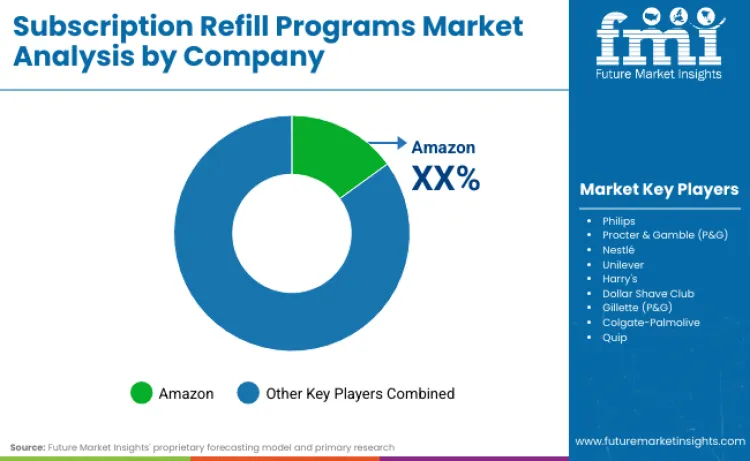
Competition is shifting toward who can run replenishment with the least customer friction, accurate timing, easy skips/edits, and tight integration into the places people already buy. Amazon’s advantage is its ability to pair subscriptions with AI-driven personalization across the shopping journey, which improves how replenishment items are surfaced and re-ordered. In connected replenishment, the playbook is becoming more “device-linked”: Amazon’s original Dash replenishment program has been replaced by Amazon Smart Reorders, which pushes auto-replenishment setup through Alexa/app workflows and partner device skills. Philips reflects how brands plug into that ecosystem, its Sonicare brush head program supports scheduled replenishment and its app-based reordering flow can redirect users to their Amazon account to manage reorder settings.
For non-Amazon players, the fight is about owning the subscription layer on brand/retailer sites through subscription engines and commerce integrations (e.g., Ordergroove expanding retailer subscription capabilities). Overall, the winners will be those with strong first-party data, dependable fulfillment, and integrations that turn refills into a “set-and-forget” habit rather than a monthly decision.
Key Players in Subscription Refill Programs Market
- Amazon
- Philips
- Procter & Gamble (P&G)
- Nestlé
- Unilever
- Harry's
- Dollar Shave Club
- Gillette (P&G)
- Colgate-Palmolive
- Quip
- BarkBox
- Blue Apron
- HelloFresh
- Chewy
- Petco
- Walmart
- Target
- Scentbird
- Loot Crate
- Stitch Fix
Scope of Report
| Items | Values |
|---|---|
| Quantitative Units | USD Billion |
| Component Segments | Software; Hardware; Services |
| Application Categories | Healthcare; Retail; E-commerce; Food & Beverage; Personal Care; Others |
| Deployment Mode Types | Cloud; On-Premises |
| Enterprise Size Categories | Small and Medium Enterprises; Large Enterprises |
| End-User Types | Direct-to-Consumer Brands; Pharmacies; Retailers |
| Company Coverage | Amazon; Philips; Procter & Gamble; Nestlé; Unilever; Harry's; Dollar Shave Club; Quip; BarkBox; HelloFresh |
| Regions Covered | North America, Europe, East Asia, South Asia, Latin America, Middle East & Africa |
| Key Countries | India, China, Brazil, USA, UK |
| Additional Attributes | Dollar revenue measured for subscription refill programs used in automated commerce and recurring billing applications, specified by deployment model (cloud vs. on-premises), component type (software, hardware, services), enterprise scale preference, application focus (healthcare, retail, personal care), business model (B2C vs. B2B), and compliance alignment with evolving data protection standards and commercial automation regulations. |
Subscription Refill Programs Market by Segments
Component
- Software
- Hardware
- Services
Application
- Healthcare
- Retail
- E-commerce
- Food & Beverage
- Personal Care
- Others
Deployment Mode
- Cloud
- On-Premises
Enterprise Size
- Small and Medium Enterprises
- Large Enterprises
End-User
- Direct-to-Consumer Brands
- Pharmacies
- Retailers
Company
- Amazon
- Philips
- Procter & Gamble (P&G)
- Nestlé
- Unilever
- Harry's
- Dollar Shave Club
- Gillette (P&G)
- Colgate-Palmolive
- Quip
- BarkBox
- Blue Apron
- HelloFresh
- Chewy
- Petco
- Walmart
- Target
- Scentbird
- Loot Crate
- Stitch Fix
Bibliography
- Payment Card Industry Security Standards Council. (2024). Payment Card Industry Data Security Standard (PCI DSS) Version 4.0. PCI SSC.
- International Organization for Standardization / International Electrotechnical Commission. (2023). ISO/IEC 27001: Information security, cybersecurity and privacy protection - Information security management systems - Requirements. ISO/IEC.
- Organisation for Economic Co‑operation and Development. (2024). Consumer protection and digital platforms: Policy guidance for subscription services. OECD Publishing.
Frequently Asked Questions
How big is the global subscription refill programs market?
The global subscription refill programs market is valued at USD 8.3 billion in 2026.
What is the growth outlook for the subscription refill programs market over the next 10 years?
The market is projected to grow at an 8.4% CAGR between 2026 and 2036, reaching USD 18.7 billion.
Which product segments or formats drive demand in this market?
Demand is primarily driven by software-led subscription platforms, especially those supporting predictive replenishment, automated billing, and inventory synchronization.
How does consumer behavior differ by region?
Emerging digital economies such as India, China, and Brazil show faster adoption driven by mobile commerce growth, while mature markets prioritize compliance, personalization, and operational efficiency.
What are the main risks and constraints affecting this market?
Key constraints include regulatory compliance complexity, data privacy requirements, payment authentication friction, and operational risk from failed deliveries or involuntary churn.
Preview the report firsthand - request a free sample
Get SampleGet the brochure for pricing and purchase details.
Get PDFTable of Content
- Executive Summary
- Global Market Outlook
- Demand Side Trends
- Supply Side Trends
- Technology Roadmap Analysis
- Analysis and Recommendations
- Market Overview
- Market Coverage / Taxonomy
- Market Definition / Scope / Limitations
- Research Methodology
- Chapter Orientation
- Analytical Lens and Working Hypotheses
- Market Structure, Signals, and Trend Drivers
- Benchmarking and Cross-market Comparability
- Market Sizing, Forecasting, and Opportunity Mapping
- Research Design and Evidence Framework
- Desk Research Programme (Secondary Evidence)
- Company Annual and Sustainability Reports
- Peer-reviewed Journals and Academic Literature
- Corporate Websites, Product Literature, and Technical Notes
- Earnings Decks and Investor Briefings
- Statutory Filings and Regulatory Disclosures
- Technical White Papers and Standards Notes
- Trade Journals, Industry Magazines, and Analyst Briefs
- Conference Proceedings, Webinars, and Seminar Materials
- Government Statistics Portals and Public Data Releases
- Press Releases and Reputable Media Coverage
- Specialist Newsletters and Curated Briefings
- Sector Databases and Reference Repositories
- FMI Internal Knowledge Base and Historical Datasets
- Subscription Datasets and Paid Sources
- Social Channels, Communities, and Digital Listening Inputs
- Additional Desk Sources
- Expert Input and Fieldwork (Primary Evidence)
- Primary Modes
- Qualitative Interviews and Expert Elicitation
- Quantitative Surveys and Structured Data Capture
- Blended Approach
- Why Primary Evidence is Used
- Field Techniques
- Interviews
- Surveys
- Focus Groups
- Observational and In-context Research
- Social and Community Interactions
- Stakeholder Universe Engaged
- C-suite Leaders
- Board Members
- Presidents and Vice Presidents
- R&D and Innovation Heads
- Technical Specialists
- Domain Subject-matter Experts
- Scientists
- Physicians and Other Healthcare Professionals
- Governance, Ethics, and Data Stewardship
- Research Ethics
- Data Integrity and Handling
- Primary Modes
- Tooling, Models, and Reference Databases
- Desk Research Programme (Secondary Evidence)
- Data Engineering and Model Build
- Data Acquisition and Ingestion
- Cleaning, Normalisation, and Verification
- Synthesis, Triangulation, and Analysis
- Quality Assurance and Audit Trail
- Market Background
- Market Dynamics
- Drivers
- Restraints
- Opportunity
- Trends
- Scenario Forecast
- Demand in Optimistic Scenario
- Demand in Likely Scenario
- Demand in Conservative Scenario
- Opportunity Map Analysis
- Product Life Cycle Analysis
- Supply Chain Analysis
- Investment Feasibility Matrix
- Value Chain Analysis
- PESTLE and Porter's Analysis
- Regulatory Landscape
- Regional Parent Market Outlook
- Production and Consumption Statistics
- Import and Export Statistics
- Market Dynamics
- Global Market Analysis 2021 to 2025 and Forecast, 2026 to 2036
- Historical Market Size Value (USD Billion) Analysis, 2021 to 2025
- Current and Future Market Size Value (USD Billion) Projections, 2026 to 2036
- Y-o-Y Growth Trend Analysis
- Absolute $ Opportunity Analysis
- Global Market Pricing Analysis 2021 to 2025 and Forecast 2026 to 2036
- Y-o-Y Growth Trend Analysis 2021 to 2025
- Absolute $ Opportunity Analysis 2026 to 2036
- Global Market Analysis 2021 to 2025 and Forecast 2026 to 2036, By Component
- Introduction / Key Findings
- Historical Market Size Value (USD Billion) Analysis By Component, 2021 to 2025
- Current and Future Market Size Value (USD Billion) Analysis and Forecast By Component, 2026 to 2036
- Software
- Hardware
- Services
- Y-o-Y Growth Trend Analysis By Component, 2021 to 2025
- Absolute $ Opportunity Analysis By Component, 2026 to 2036
- Global Market Analysis 2021 to 2025 and Forecast 2026 to 2036, By Application
- Introduction / Key Findings
- Historical Market Size Value (USD Billion) Analysis By Application, 2021 to 2025
- Current and Future Market Size Value (USD Billion) Analysis and Forecast By Application, 2026 to 2036
- Healthcare
- Retail
- E-commerce
- Food & Beverage
- Personal Care
- Others
- Y-o-Y Growth Trend Analysis By Application, 2021 to 2025
- Absolute $ Opportunity Analysis By Application, 2026 to 2036
- Global Market Analysis 2021 to 2025 and Forecast 2026 to 2036, By Deployment Mode
- Introduction / Key Findings
- Historical Market Size Value (USD Billion) Analysis By Deployment Mode, 2021 to 2025
- Current and Future Market Size Value (USD Billion) Analysis and Forecast By Deployment Mode, 2026 to 2036
- Cloud
- On-Premises
- Y-o-Y Growth Trend Analysis By Deployment Mode, 2021 to 2025
- Absolute $ Opportunity Analysis By Deployment Mode, 2026 to 2036
- Global Market Analysis 2021 to 2025 and Forecast 2026 to 2036, By Enterprise Size
- Introduction / Key Findings
- Historical Market Size Value (USD Billion) Analysis By Enterprise Size, 2021 to 2025
- Current and Future Market Size Value (USD Billion) Analysis and Forecast By Enterprise Size, 2026 to 2036
- Small and Medium Enterprises
- Large Enterprises
- Y-o-Y Growth Trend Analysis By Enterprise Size, 2021 to 2025
- Absolute $ Opportunity Analysis By Enterprise Size, 2026 to 2036
- Global Market Analysis 2021 to 2025 and Forecast 2026 to 2036, By End-User
- Introduction / Key Findings
- Historical Market Size Value (USD Billion) Analysis By End-User, 2021 to 2025
- Current and Future Market Size Value (USD Billion) Analysis and Forecast By End-User, 2026 to 2036
- Direct-to-Consumer Brands
- Pharmacies
- Retailers
- Y-o-Y Growth Trend Analysis By End-User, 2021 to 2025
- Absolute $ Opportunity Analysis By End-User, 2026 to 2036
- Global Market Analysis 2021 to 2025 and Forecast 2026 to 2036, By Region
- Introduction
- Historical Market Size Value (USD Billion) Analysis By Region, 2021 to 2025
- Current Market Size Value (USD Billion) Analysis and Forecast By Region, 2026 to 2036
- North America
- Latin America
- Western Europe
- Eastern Europe
- East Asia
- South Asia and Pacific
- Middle East & Africa
- Market Attractiveness Analysis By Region
- North America Market Analysis 2021 to 2025 and Forecast 2026 to 2036, By Country
- Historical Market Size Value (USD Billion) Trend Analysis By Market Taxonomy, 2021 to 2025
- Market Size Value (USD Billion) Forecast By Market Taxonomy, 2026 to 2036
- By Country
- USA
- Canada
- Mexico
- By Component
- By Application
- By Deployment Mode
- By Enterprise Size
- By End-User
- By Country
- Market Attractiveness Analysis
- By Country
- By Component
- By Application
- By Deployment Mode
- By Enterprise Size
- By End-User
- Key Takeaways
- Latin America Market Analysis 2021 to 2025 and Forecast 2026 to 2036, By Country
- Historical Market Size Value (USD Billion) Trend Analysis By Market Taxonomy, 2021 to 2025
- Market Size Value (USD Billion) Forecast By Market Taxonomy, 2026 to 2036
- By Country
- Brazil
- Chile
- Rest of Latin America
- By Component
- By Application
- By Deployment Mode
- By Enterprise Size
- By End-User
- By Country
- Market Attractiveness Analysis
- By Country
- By Component
- By Application
- By Deployment Mode
- By Enterprise Size
- By End-User
- Key Takeaways
- Western Europe Market Analysis 2021 to 2025 and Forecast 2026 to 2036, By Country
- Historical Market Size Value (USD Billion) Trend Analysis By Market Taxonomy, 2021 to 2025
- Market Size Value (USD Billion) Forecast By Market Taxonomy, 2026 to 2036
- By Country
- Germany
- UK
- Italy
- Spain
- France
- Nordic
- BENELUX
- Rest of Western Europe
- By Component
- By Application
- By Deployment Mode
- By Enterprise Size
- By End-User
- By Country
- Market Attractiveness Analysis
- By Country
- By Component
- By Application
- By Deployment Mode
- By Enterprise Size
- By End-User
- Key Takeaways
- Eastern Europe Market Analysis 2021 to 2025 and Forecast 2026 to 2036, By Country
- Historical Market Size Value (USD Billion) Trend Analysis By Market Taxonomy, 2021 to 2025
- Market Size Value (USD Billion) Forecast By Market Taxonomy, 2026 to 2036
- By Country
- Russia
- Poland
- Hungary
- Balkan & Baltic
- Rest of Eastern Europe
- By Component
- By Application
- By Deployment Mode
- By Enterprise Size
- By End-User
- By Country
- Market Attractiveness Analysis
- By Country
- By Component
- By Application
- By Deployment Mode
- By Enterprise Size
- By End-User
- Key Takeaways
- East Asia Market Analysis 2021 to 2025 and Forecast 2026 to 2036, By Country
- Historical Market Size Value (USD Billion) Trend Analysis By Market Taxonomy, 2021 to 2025
- Market Size Value (USD Billion) Forecast By Market Taxonomy, 2026 to 2036
- By Country
- China
- Japan
- South Korea
- By Component
- By Application
- By Deployment Mode
- By Enterprise Size
- By End-User
- By Country
- Market Attractiveness Analysis
- By Country
- By Component
- By Application
- By Deployment Mode
- By Enterprise Size
- By End-User
- Key Takeaways
- South Asia and Pacific Market Analysis 2021 to 2025 and Forecast 2026 to 2036, By Country
- Historical Market Size Value (USD Billion) Trend Analysis By Market Taxonomy, 2021 to 2025
- Market Size Value (USD Billion) Forecast By Market Taxonomy, 2026 to 2036
- By Country
- India
- ASEAN
- Australia & New Zealand
- Rest of South Asia and Pacific
- By Component
- By Application
- By Deployment Mode
- By Enterprise Size
- By End-User
- By Country
- Market Attractiveness Analysis
- By Country
- By Component
- By Application
- By Deployment Mode
- By Enterprise Size
- By End-User
- Key Takeaways
- Middle East & Africa Market Analysis 2021 to 2025 and Forecast 2026 to 2036, By Country
- Historical Market Size Value (USD Billion) Trend Analysis By Market Taxonomy, 2021 to 2025
- Market Size Value (USD Billion) Forecast By Market Taxonomy, 2026 to 2036
- By Country
- Kingdom of Saudi Arabia
- Other GCC Countries
- Turkiye
- South Africa
- Other African Union
- Rest of Middle East & Africa
- By Component
- By Application
- By Deployment Mode
- By Enterprise Size
- By End-User
- By Country
- Market Attractiveness Analysis
- By Country
- By Component
- By Application
- By Deployment Mode
- By Enterprise Size
- By End-User
- Key Takeaways
- Key Countries Market Analysis
- USA
- Pricing Analysis
- Market Share Analysis, 2025
- By Component
- By Application
- By Deployment Mode
- By Enterprise Size
- By End-User
- Canada
- Pricing Analysis
- Market Share Analysis, 2025
- By Component
- By Application
- By Deployment Mode
- By Enterprise Size
- By End-User
- Mexico
- Pricing Analysis
- Market Share Analysis, 2025
- By Component
- By Application
- By Deployment Mode
- By Enterprise Size
- By End-User
- Brazil
- Pricing Analysis
- Market Share Analysis, 2025
- By Component
- By Application
- By Deployment Mode
- By Enterprise Size
- By End-User
- Chile
- Pricing Analysis
- Market Share Analysis, 2025
- By Component
- By Application
- By Deployment Mode
- By Enterprise Size
- By End-User
- Germany
- Pricing Analysis
- Market Share Analysis, 2025
- By Component
- By Application
- By Deployment Mode
- By Enterprise Size
- By End-User
- UK
- Pricing Analysis
- Market Share Analysis, 2025
- By Component
- By Application
- By Deployment Mode
- By Enterprise Size
- By End-User
- Italy
- Pricing Analysis
- Market Share Analysis, 2025
- By Component
- By Application
- By Deployment Mode
- By Enterprise Size
- By End-User
- Spain
- Pricing Analysis
- Market Share Analysis, 2025
- By Component
- By Application
- By Deployment Mode
- By Enterprise Size
- By End-User
- France
- Pricing Analysis
- Market Share Analysis, 2025
- By Component
- By Application
- By Deployment Mode
- By Enterprise Size
- By End-User
- India
- Pricing Analysis
- Market Share Analysis, 2025
- By Component
- By Application
- By Deployment Mode
- By Enterprise Size
- By End-User
- ASEAN
- Pricing Analysis
- Market Share Analysis, 2025
- By Component
- By Application
- By Deployment Mode
- By Enterprise Size
- By End-User
- Australia & New Zealand
- Pricing Analysis
- Market Share Analysis, 2025
- By Component
- By Application
- By Deployment Mode
- By Enterprise Size
- By End-User
- China
- Pricing Analysis
- Market Share Analysis, 2025
- By Component
- By Application
- By Deployment Mode
- By Enterprise Size
- By End-User
- Japan
- Pricing Analysis
- Market Share Analysis, 2025
- By Component
- By Application
- By Deployment Mode
- By Enterprise Size
- By End-User
- South Korea
- Pricing Analysis
- Market Share Analysis, 2025
- By Component
- By Application
- By Deployment Mode
- By Enterprise Size
- By End-User
- Russia
- Pricing Analysis
- Market Share Analysis, 2025
- By Component
- By Application
- By Deployment Mode
- By Enterprise Size
- By End-User
- Poland
- Pricing Analysis
- Market Share Analysis, 2025
- By Component
- By Application
- By Deployment Mode
- By Enterprise Size
- By End-User
- Hungary
- Pricing Analysis
- Market Share Analysis, 2025
- By Component
- By Application
- By Deployment Mode
- By Enterprise Size
- By End-User
- Kingdom of Saudi Arabia
- Pricing Analysis
- Market Share Analysis, 2025
- By Component
- By Application
- By Deployment Mode
- By Enterprise Size
- By End-User
- Turkiye
- Pricing Analysis
- Market Share Analysis, 2025
- By Component
- By Application
- By Deployment Mode
- By Enterprise Size
- By End-User
- South Africa
- Pricing Analysis
- Market Share Analysis, 2025
- By Component
- By Application
- By Deployment Mode
- By Enterprise Size
- By End-User
- USA
- Market Structure Analysis
- Competition Dashboard
- Competition Benchmarking
- Market Share Analysis of Top Players
- By Regional
- By Component
- By Application
- By Deployment Mode
- By Enterprise Size
- By End-User
- Competition Analysis
- Competition Deep Dive
- Amazon
- Philips
- Procter & Gamble (P&G)
- Nestlé
- Unilever
- Harry's
- Dollar Shave Club
- Gillette (P&G)
- Colgate-Palmolive
- Quip
- BarkBox
- Blue Apron
- HelloFresh
- Chewy
- Petco
- Walmart
- Target
- Scentbird
- Loot Crate
- Stitch Fix
- Competition Deep Dive
- Assumptions & Acronyms Used


