

- Industry Size (2026)
- USD 0.6 Bn
- Forecast (2036)
- USD 1.9 Bn
- CAGR (2026 to 2036)
- 12.2%
Carbon-Aware Slot Booking and Delivery Windows Platforms Market Size, Market Forecast and Outlook By FMI
The carbon-aware slot booking and delivery windows platforms market was valued at USD 0.5 billion in 2025. Industry size is set to reach USD 0.6 billion in 2026 at a CAGR of 12.2% during the forecast period. The cumulative valuation is expected to reach USD 1.9 billion through 2036 as fleet operators pass Scope 3 emissions reporting pressure directly to retail partners, forcing the integration of carbon calculations into the exact moment of consumer checkout using advanced sustainable delivery scheduling software.
The operational imperatives that are now dictating the role of modern e-commerce fulfillment directors are ever more closely defined by the severe constraints that are now inherent within urban logistics, whereby a lack of achieving a precise balance between route density and the need to dispatch quickly results in immediate financial penalty, often in the form of urban congestion charges. This is now compounded by the growing need to achieve sustainability. A critical mistake within this environment is that of failing to integrate scheduling with green delivery services, whereby this results in a critical reduction within the profit margin achieved on a per-package basis. Consumer behavior provides a surprising degree of flexibility, whereby studies have shown that consumers are relatively flexible with regards to extended delivery windows, as long as transparent environmental data is available at time of purchase.
Summary of Carbon-Aware Slot Booking and Delivery Windows Platforms Market
- Carbon-Aware Slot Booking and Delivery Windows Platforms Market Definition
- This category defines the software layer orchestrating dispatch timing based on real-time environmental impact calculations, actively restricting or pricing slot availability according to predicted carbon output rather than purely operational efficiency.
- Demand Drivers in the Carbon-Aware Slot Booking and Delivery Windows Platforms Market
- Scope 3 emissions reporting mandates compel supply chain IT directors to capture granular data at the exact point of dispatch via delivery emissions tracking.
- Urban congestion pricing forces fleet operations managers to maximize drop density per dispatched vehicle.
- Retail sustainability key performance indicators push e-commerce fulfillment heads to nudge consumers toward consolidated delivery windows.
- Key Segments Analyzed in the FMI Report
- Route optimization platforms: This segment is expected to hold 41.3% share in 2026, driven by the absolute necessity of balancing vehicle capacity against traffic-linked carbon indices via carbon-aware routing software.
- Cloud platforms: Cloud platforms is set to lead deployment models, fueled by continuous multi-carrier emissions data feeds requiring off-premise processing power.
- Retailers: Retailers is anticipated to dominate end-user adoption due to their control over the critical checkout interface for final timing decisions.
- Last-mile delivery: Segment is projected to capture maximum application spend, driven by its disproportionate contribution to total network emissions.
- AI optimization: This segment is likely to lead technology layers, fueled by enabling predictive restrictions on delivery windows without alerting the consumer.
- India: The country shows 15.6% compound growth, fueled by extreme urban density forcing rapid adoption of dispatch consolidation algorithms.
- Analyst Opinion at FMI
- Rahul Pandita, Principal Analyst, Technology, at FMI, points out, "Purchasing managers assume the primary barrier to adoption is integrating these algorithms with legacy transport management systems. In reality, the true friction occurs at the checkout page. The operational gap exists between algorithmic optimization and actual retail interface presentation. Software providers prioritizing logistics efficiency over conversion-rate protection consistently fail to secure enterprise renewals."
- Strategic Implications / Executive Takeaways
- E-commerce fulfillment directors face margin erosion failing to link slot availability directly to dynamic urban congestion pricing models.
- Supply chain IT leads must secure API access to tier-one carrier emissions data or risk losing visibility across subcontracted networks.
- Urban fleet managers gain significant bidding advantages for municipal contracts by demonstrating verifiable per-parcel carbon reductions.
- Methodology
- Primary Research: Direct interviews with logistics IT buyers reveals actual checkout-integration friction.
- Desk Research: Regulatory reporting standards provide the compliance baseline driving mandatory software upgrades.
- Market-Sizing and Forecasting: IT logistics expenditure defines the addressable software penetration ceiling.
- Data Validation and Update Cycle: SaaS provider revenue disclosures verify actual corporate spending against modeled projections.
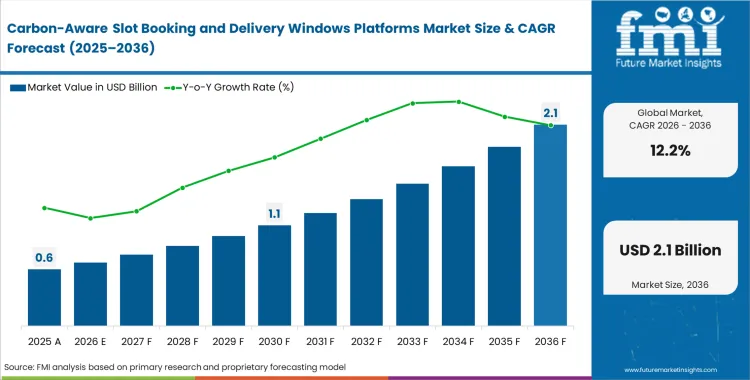
Carbon-Aware Slot Booking and Delivery Windows Platforms Market Key Takeaways
| Metric | Details |
|---|---|
| Industry Size (2026) | USD 0.6 Billion |
| Industry Value (2036) | USD 1.9 Billion |
| CAGR (2026 to 2036) | 12.2% |
Source: Future Market Insights (FMI) analysis, based on proprietary forecasting model and primary research
This sustainability push is rapidly changing from an aspirational sustainability objective to a basic operational requirement. This trend is largely being driven by the top-tier carriers, who are now requiring API-level visibility of the sub-contracted fleet’s emissions. This stringent need for transparency within the entire sub-contractor network is exerting significant pressure on secondary logistics providers. To maintain their coveted status as a preferred carrier, these sub-contractors are being forced to utilize allocation engines that have sophisticated delivery optimization algorithms. These algorithms are expected to extend beyond basic route distances to real-time variables such as vehicle type, fuel type, and even traffic conditions to accurately determine verifiable carbon footprints.
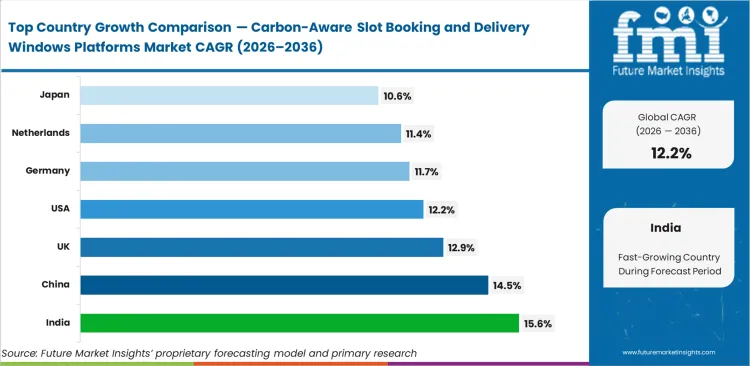
India leads at 15.6% as rapid e-commerce expansion collides with emerging urban delivery density mandates, while China tracks closely at 14.5% driven by central directives on transport electrification. The United Kingdom advances at 12.9%, followed by the United States at 12.2%, Germany at 11.7%, and the Netherlands at 11.4%. Japan trails at 10.6% due to its highly mature existing logistics infrastructure requiring less incremental digital intervention. A clear split separates early ESG compliance adopters relying on logistics ESG compliance software from nations driven purely by sheer transaction volume.
Carbon-Aware Slot Booking and Delivery Windows Platforms Market Definition
The carbon-aware slot booking and delivery windows platforms market represents the specific software layer orchestrating dispatch timing based on real-time environmental impact calculations. Algorithmic scheduling engines utilizing carbon-aware delivery analytics calculate emissions variables prior to presenting delivery options to end consumers. Functional boundaries restrict this category to applications actively restricting or pricing slot availability according to predicted carbon output rather than purely operational efficiency.
Carbon-Aware Slot Booking and Delivery Windows Platforms Market Inclusions
Scope encompasses dynamic checkout integration APIs, emissions-based routing engines, fleet-specific carbon calculation modules, and consumer-facing sustainability dashboards acting as delivery sustainability tools. Capabilities linking directly to green logistics frameworks fall within this assessment. Modules providing predictive modeling for electric vehicle battery depletion against scheduled delivery windows form a core component of analyzed software suites.
Carbon-Aware Slot Booking and Delivery Windows Platforms Market Exclusions
General-purpose warehouse management systems without dispatch timing algorithms remain outside this classification. Hardware sensors tracking vehicle emissions physically fail to meet software-layer criteria. Carbon offset purchasing portals lacking direct integration with specific smart delivery scheduling systems are intentionally excluded to maintain analytical focus on active logistics orchestration.
Carbon-Aware Slot Booking and Delivery Windows Platforms Market Research Methodology
- Primary Research: Supply chain IT directors, e-commerce fulfillment heads, and urban fleet managers within major retail networks.
- Desk Research: European Environment Agency emissions reporting mandates, national transport statistics, and major carrier sustainability disclosures.
- Market-Sizing and Forecasting: Global last-mile delivery logistics IT spend provides the baseline anchor for penetration modeling.
- Data Validation and Update Cycle: Revenue triangulation against major logistics software-as-a-service provider filings cross-validates adoption curves.
Segmental Analysis
Carbon-Aware Slot Booking and Delivery Windows Platforms Market Analysis by Platform Type
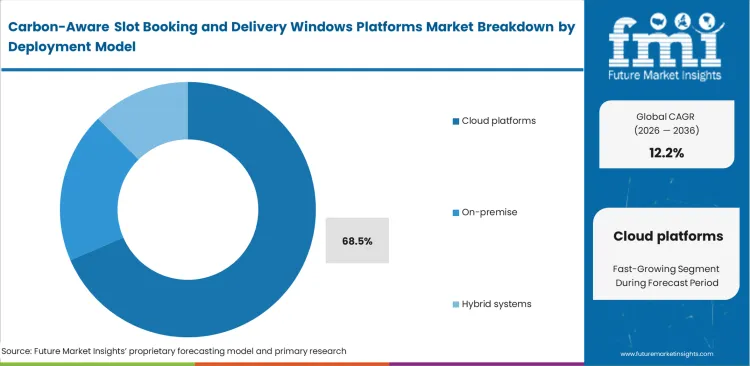
The commoditization of basic mapping software leaves value creation with real-time load balancing against traffic-linked carbon indices. Route optimization software segment is set to hold a commanding share of 41.3% in 2026, driven by real-time load balancing against traffic-linked carbon indices, according to FMI’s assessment, which indicates this category drives overarching software investment decisions for urban fleet managers. Delaying the integration of on-demand logistics orchestration exposes the organization to the prospect of municipal-level emission penalties. Integration of dynamic routing algorithms fundamentally changes the manner in which dispatchers traditionally manage daily loads, shifting the emphasis from driver comfort with the route to algorithm-driven density constraints.
- Route synchronization: Dispatchers will synchronize locked delivery areas based on predictive carbon models. Urban fleet managers will not dispatch multiple vehicles to restricted emission areas on the same day through the use of decarbonized logistics platforms.
- Density enforcement: Algorithmically, certain delivery windows will be removed from customer view, which will enforce geographical consolidation. E-commerce fulfillment directors will capture margin improvements through the prevention of isolated single parcel dispatches.
- Compliance tracking: The system architecture will track actual driver behavior compared with calculated emissions, which will be used for compliance purposes. IT supply chain managers will ensure compliance without the need for manual data input from drivers.
Carbon-Aware Slot Booking and Delivery Windows Platforms Market Analysis by Deployment Model
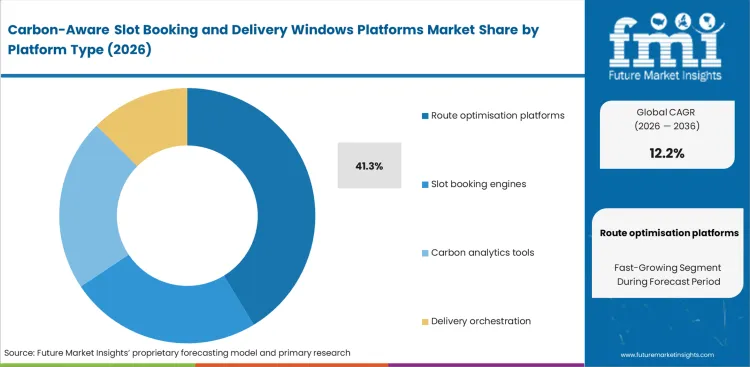
Infrastructure decisions are largely governed by continuous data feeds from numerous external carriers, rather than IT policies. Logistics operations managers require off-premise processing power to simultaneously ingest continuous live traffic updates, weather factors, and partner emissions management metrics. The move towards cloud-native architectures requires internal teams to let go of highly customized legacy workflows in favor of standardized API protocols, which are supported by scalable carbon-friendly SaaS logistics. The cloud platforms segment is expected to dominate, accounting for 68.5% share in 2026, owing to continuous data feeds from numerous external carriers, dictating off-premise infrastructure decisions. Analysts at FMI have noted that while cloud platforms are expected to dominate this segment, there is a growing risk to data sovereignty, with Europe operators becoming increasingly hesitant to pass their local carbon metrics through foreign servers. The risk of being left behind by tier-one carriers demanding real-time bidirectional visibility is a guarantee if cloud migration is delayed.
- Multi-tenant pooling: Processing power scales automatically during holiday peak dispatch hours. Supply chain IT directors prevent system crashes during periods of order volume forcing exponential routing calculations.
- Carrier integration: Standardized endpoints allow instant connection with secondary fleet partners. Logistics procurement heads avoid costly custom middleware development for each new subcontractor.
- Update persistence: Regulatory calculation models receive automatic updates following changes in municipal reporting standards. Compliance officers eliminate the risk of submitting outdated carbon metrics to authorities.
Carbon-Aware Slot Booking and Delivery Windows Platforms Market Analysis by End User
The ability to dictate the point at which consumer selection occurs dictates which entity benefits from the highest value in software. Retailers drive adoption with a 36.2% share in 2026 due to front-end interface ownership outpacing backend fleet management in this software type. According to FMI calculations, last-mile delivery software integrations involve consumer promise and store inventory communication. E-commerce fulfillment directors must make an active selection in whether to promote the fastest option to a consumer or encourage the consumer to select the most sustainable consolidated option via sustainable e-commerce delivery software. Presenting environmental impact data to a consumer significantly influences conversion rates, causing merchandising teams to align with fulfillment planners. The percentage does not account for the fact that many mid-tier retailers technically own these software platforms but are hesitant to utilize restrictive slot offerings due to cart abandonment fears. Retailers seeking to develop in-house software solutions tend to underestimate the computational demands of carbon cost calculations in real-time.
- Checkout friction: Presenting a green delivery choice requires instant background validation of fleet capacity. E-commerce fulfillment heads must ensure carbon calculations do not add milliseconds to page load times.
- Behavioral nudging: Interface designs highlight specific delivery days to encourage geographic consolidation. Merchandising directors monitor conversion drops carefully alongside standard shipping labeled as high-emission.
- Incentive alignment: Customers receive loyalty points for selecting the optimized delivery window. Marketing officers offset the perceived inconvenience of delayed shipping with gamified rewards.
Carbon-Aware Slot Booking and Delivery Windows Platforms Market Analysis by Application
The extreme variances in parcel densities make final-stage distribution the main focus for algorithmic intervention. The last-mile delivery segment captures a 52.4% share in 2026 due to the quest for immediate solutions to mitigate escalating localized congestion pricing for urban fleet managers. According to FMI research, investment in this segment provides the fastest return on investment through direct reductions in fuel consumption and penalty fees. To redesign the last-mile delivery process is to initiate painful negotiations with contracted drivers who previously optimized their routes through experience. The reliance on algorithms takes away decision-making power from experienced drivers, resulting in short-term retention problems within the fleet. The prevalence of this application segment conceals a critical vulnerability: optimization algorithms often break down under extreme weather events that cause historic carbon algorithms to conflict with real-world street accessibility. Organizations that ignore final-stage optimization lose money on every single isolated suburban delivery.
- Zone restriction: Software automatically blocks specific zip codes during peak congestion charge days. Transport data analysts balance penalty avoidance against strict customer service level agreements.
- Driver allocation: Engine assigns electric vehicles exclusively to low-emission zones while routing combustion engines to outskirts. Fleet operations directors maximize asset utilization without violating localized municipal bans.
- Predictive charging: Algorithms factor battery depletion rates into the routing schedule. Logistics coordinators ensure electric vans reach charging depots before stranded-asset protocols trigger.
Carbon-Aware Slot Booking and Delivery Windows Platforms Market Analysis by Technology Layer
Predictive capabilities are what distinguish modern orchestration engines from legacy mapping tools. Transport data analysts use machine learning to limit delivery windows proactively, thereby preventing geographic density without alerting the end consumer through advanced delivery optimization algorithms. Using ai optimized AI-optimized middle-mile linehaul planning platforms within existing dispatch operations removes human hesitation within routing decisions. Relying on neural networks to inform operational constraints forces a cultural change within traditional dispatch operations that have historically allowed human intervention.
AI optimisation segment holds a 44.7% market share in 2026, owing to predictive capabilities that distinguish modern orchestration engines from legacy mapping tools. According to FMI's analysis, AI penetration rates are overstated because they are based on actual deployments that are using basic rules-based logic that has been rebranded as artificial intelligence to market to potential customers. Customers who do not conduct adequate analysis on actual machine learning capabilities within vendors are forced to pay premium subscription rates for standard routing logic.
- Pattern recognition: Systems identify neighborhoods consistently tolerating delayed shipping for environmental reasons. Data science directors train models to offer aggressive consolidation discounts only to receptive demographics.
- Dynamic pricing: AI calculates the exact financial incentive required to compel a consumer to choose a sustainable slot. E-commerce fulfillment directors avoid over-subsidizing deliveries naturally geared for consolidation.
- Exception handling: Neural networks instantly recalculate network emissions following a vehicle breakdown. Dispatch supervisors maintain compliance reporting accuracy despite unexpected daily operational failures.
Carbon-Aware Slot Booking and Delivery Windows Platforms Market Drivers, Restraints, and Opportunities
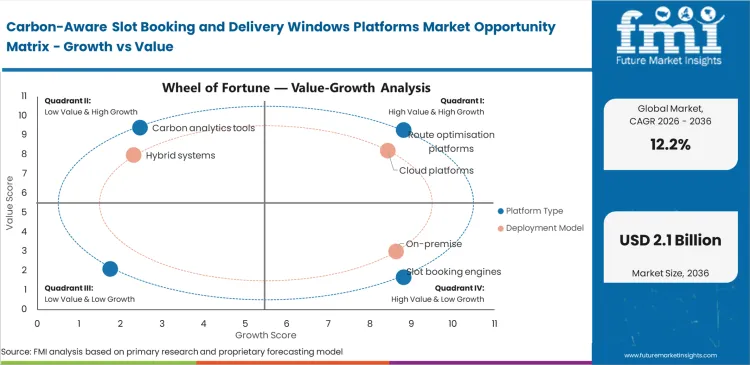
Margin erosion is a direct consequence faced by e-commerce fulfillment directors who do not connect slot availability with dynamic urban congestion pricing strategies enabled by urban delivery emissions reduction strategies. Scope 3 emission reporting requirements now force supply chain IT directors to collect detailed data at the exact point of dispatch. This shifts the focus of carbon tracking from an annual exercise to a daily imperative. Supply chain IT directors who rely on outdated transport management system frameworks cannot calculate the true cost of an isolated delivery run before the consumer completes their purchase. Immediate implementation guarantees municipal logistics contracts with stringent environmental prerequisites. The outdated checkout system creates significant friction in adoption. E-commerce fulfillment heads now realize integrating complex routing algorithms into green supply chain software causes unacceptable milliseconds in page loading times, which directly impacts conversion rates. This is structurally caused by the milliseconds it takes to calculate carbon in real time, which necessitates simultaneous data queries between the storefront system, the warehouse system, and the external networks. Edge computing partially resolves the problem; standardizing API calls to fragmented secondary networks is mathematically complex.
Opportunities in the Carbon-Aware Slot Booking and Delivery Windows Platforms Market
- Municipal data sharing: Integrating predictive routing models with city traffic control systems unlocks exclusive access to restricted delivery zones. Urban fleet managers secure competitive advantages operating in locations rivals face strict embargoes.
- Consumer gamification: Linking carbon offset platform metrics to loyalty programs encourages organic behavioral shifts. Marketing directors reduce overall logistics costs by rewarding buyers willingly selecting consolidated delivery days.
- Subcontractor certification: Providing tiered routing software to smaller fleet partners standardizes network-wide reporting. Supply chain IT leads transform fragmented logistics networks into cohesive, compliance-ready environmental assets using logistics carbon optimization platforms.
Regional Analysis
Based on regional analysis, the carbon-aware slot booking and delivery windows platforms market is segmented into North America, Europe, Asia Pacific, Latin America, and Middle East & Africa across 40 plus countries.
.webp "Top Country Growth Comparison Carbon Aware Slot Booking And Delivery Windows Platforms Market Cagr (2026 2036)")
| Country | CAGR (2026 to 2036) |
|---|---|
| India | 15.6% |
| China | 14.5% |
| United Kingdom | 12.9% |
| United States | 12.2% |
| Germany | 11.7% |
| Netherlands | 11.4% |
| Japan | 10.6% |
Source: Future Market Insights (FMI) analysis, based on proprietary forecasting model and primary research
Asia Pacific Carbon-Aware Slot Booking and Delivery Windows Platforms Market Analysis
The high levels of urban density, as well as directives from central authorities regarding the electrification of transport systems, result in the forced adoption of dispatch consolidation algorithms across major metropolitan areas. The logistics operations manager must now rely on algorithmic means of navigating infrastructure bottlenecks, as manual scheduling of dispatches has become mathematically impossible. The adoption of freight management software integrations has become a strict necessity, governing the dispatch sequencing of daily dispatch waves for local delivery hubs. In the opinion of FMI, a complete reliance on local expertise will inevitably lead to unmanageable fuel costs as well as missed delivery windows in areas of high congestion. The adoption of algorithmic means of dispatching has removed the need for experienced dispatch personnel, enabling rapid scaling during peak festival seasons.
Supply chain IT directors focus their efforts on systems that can accurately predict exact energy consumption, especially with changing topography. Incomplete dispatch window planning with respect to available charging infrastructure makes them extremely susceptible to stranded asset scenarios during peak delivery periods. A change of focus from speed to efficiency significantly impacts regional carrier competitiveness.
- India: Fragmented local delivery systems need to be centrally orchestrated with digital technology to safely manage extreme growth in e-commerce. India is expected to witness a CAGR of 15.6%, driven by extreme growth in e-commerce that needs to be safely managed with centralized digital orchestration. Urban fleet operations need to ensure that smartphone technology is mandatorily adopted for all subcontracted delivery staff to ensure system-wide visibility in carbon tracking logistics.
- China: China is expected to rise at a CAGR of 14.5% through 2036, driven by very strict top-down mandates regarding urban air quality. Top-down mandates are very strict in this region regarding urban air quality. As a result, immediate integration with emissions tracking needs to be done in all commercial dispatch operations. E-commerce dispatch operations directors need to ensure access to restricted CBDs with the help of algorithms to ensure access to these areas with delivery emissions optimization tools.
- Japan: The country has a highly mature existing logistics infrastructure, which requires substantially less incremental digital intervention compared to its rapidly developing neighbors. The expansion in Japan is expected to be propelled at a rate of 10.6%, driven by a highly mature existing logistics infrastructure. The focus of logistics procurement heads is entirely on efficiency gains rather than overhauling the entire software system.
Europe Carbon-Aware Slot Booking and Delivery Windows Platforms Market Analysis
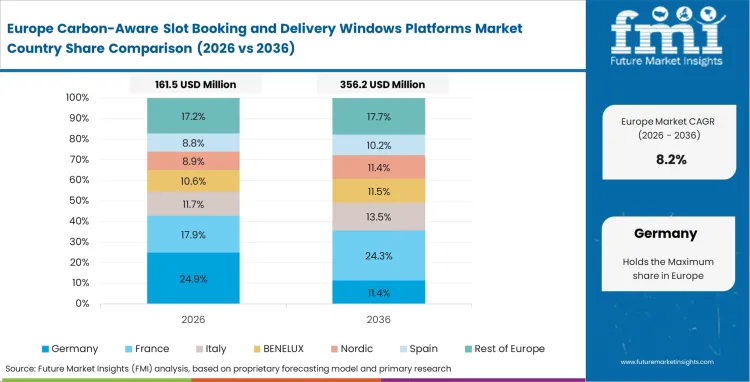
Severe urban congestion pricing schemes drive the adoption curve in historic city centers. Transport data analysts use predictive algorithms to specifically avoid crossing geofenced zones when entering peak penalty hours. FMI analysts assert that static routing algorithms guarantee margin destruction when using dynamic low emission zones in capital cities. Integration of these systems requires warehouse dispatchers to strategically hold packages in anticipation of density-based localized entry fees. Failure to adopt density-based dispatch systems leaves carriers relegated to unprofitable routes in the suburbs.
- United Kingdom: Severe urban emission charging schemes require immediate adoption of carbon-aware scheduling tools in all major retail fleets seeking green logistics software. Industry in the country is set to rise at a CAGR of 12.9%, driven by severe urban emission charging schemes. Urban fleet managers require instant verification of compliance status via application programming interfaces.
- Germany: Germany has very strict national reporting standards, which require operators to keep detailed logs of calculated versus actual route emissions. Supply chain IT leads have to implement driver compliance protocols to mandate the adherence to algorithmic routing suggestions. The market revenue is expected to grow by 11.7%, with the country having very strict national reporting standards, which require operators to keep detailed logs of calculated versus actual route emissions.
- Netherlands: Netherlands sector is set to garner a CAGR of 11.4%, with the country having dense cycling infrastructure, which creates unique challenges to commercial delivery vehicles, which require hyper-localized dispatch timing. The country has dense cycling infrastructure, which creates unique challenges to commercial delivery vehicles, which require hyper-localized dispatch timing. The operations director has to balance algorithmic car routing with municipal pushes to substitute micro-mobility cargo bikes.
North America Carbon-Aware Slot Booking and Delivery Windows Platforms Market Analysis
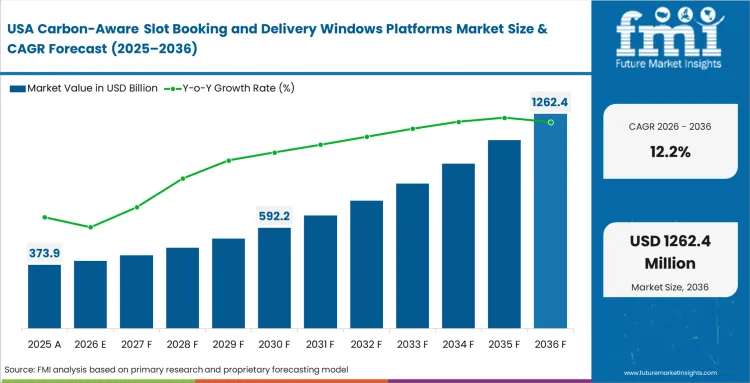
Corporate ESG commitments drive tier-one retailers' need to demand emissions visibility across their entire contracted delivery network. E-commerce fulfillment heads leverage software tools to highlight green delivery options during the checkout process, a critical step in the buying process. From an analysis done by FMI, failure to account for this type of consumer-facing green delivery options translates directly into lost business as major retailers drive a hard line on non-compliant logistics providers. Implementing green delivery options through interactive carbon dashboards requires integration across fragmented regional carrier infrastructures. Organizations able to demonstrate verifiable green delivery options command a higher price from environmentally focused consumer segments.
- United States: The huge suburban sprawl necessitates the use of sophisticated algorithms to balance long-distance linehaul efficiency with local drop density. Transport data analysts are entirely focused on determining specific delivery corridors by making use of delayed shipping to create massive fuel savings, making use of AI route optimization logistics. The demand in USA is expected to grow by 12.2 percent, mainly due to the huge suburban sprawl necessitating sophisticated algorithms to balance long-distance linehaul efficiency with local drop density.
FMI's report offers in-depth analysis on emerging smart logistics models in Latin America and the Middle East & Africa regions. Extreme climate changes in these regions require algorithms to prioritize temperature efficiency over distance.
Competitive Aligners for Market Players
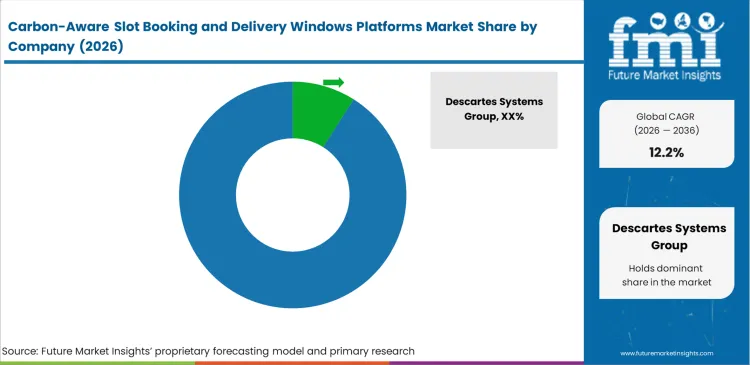
Competition heavily relies on obtaining exclusive data sharing agreements with municipal traffic authorities. Top carbon-aware logistics solution providers like Project44 and Descartes Systems Group control certain corridors in cities by embedding their routing engines into municipal congestion management systems. Data analysts for transportation compete among themselves based on their ability to access municipal data feeds in real-time rather than algorithmic innovation. Solutions without direct access to municipal infrastructure are always in reaction to traffic conditions rather than able to forecast localized carbon restrictions in advance.
Companies hold a distinct advantage through their established libraries of contactless delivery services driver behavior profiles. Blue Yonder and Oracle Corporation have access to historical data on how long it takes to complete specific drops by specific drivers under different conditions. This data is imperative in creating successful carbon-aware transportation software. Anyone looking to get into this space must develop their own artificial intelligence model without the foundational data to make successful micro-level predictions. E-commerce fulfillment directors have no time to consider new software companies offering theoretical routing suggestions that cannot be completed by human drivers.
Major retail buyers are actively fighting against vendor lock-in by demanding software with modular design, which is able to separate the routing engine from the consumer-facing checkout interface, thus fueling the need for flexible carbon-aware fleet management. Bringg and FarEye address this by providing headless API designs, which enable retailers to have ownership over the consumer-facing layer while having access to backend algorithmic processing. changes require software vendors to move from selling closed ecosystems to selling microservices. Over-reliance on proprietary formats creates a rift with massive logistics networks seeking to normalize emissions reporting across thousands of individual subcontractors.
Key Players in Carbon-Aware Slot Booking and Delivery Windows Platforms Market
- Descartes Systems Group
- Project44
- Bringg
- FarEye
- Blue Yonder
- Oracle Corporation
Scope of the Report
| Metric | Value |
|---|---|
| Quantitative Units | USD 0.6 Billion to USD 1.9 Billion, at a CAGR of 12.2% |
| Market Definition | Software orchestrating dispatch timing based on real-time environmental impact calculations to actively restrict or price slot availability. |
| Segmentation | Platform Type, Deployment Model, End User, Application, Technology Layer, Region |
| Regions Covered | North America, Europe, Asia Pacific, Latin America, Middle East & Africa |
| Countries Covered | United States, United Kingdom, Germany, Netherlands, China, India, Japan |
| Key Companies Profiled | Descartes Systems Group, Project44, Bringg, FarEye, One Network Enterprises, Blue Yonder, Oracle Corporation |
| Forecast Period | 2026 to 2036 |
| Approach | Top-down penetration approach anchored on global last-mile delivery logistics IT spend |
Source: Future Market Insights (FMI) analysis, based on proprietary forecasting model and primary research
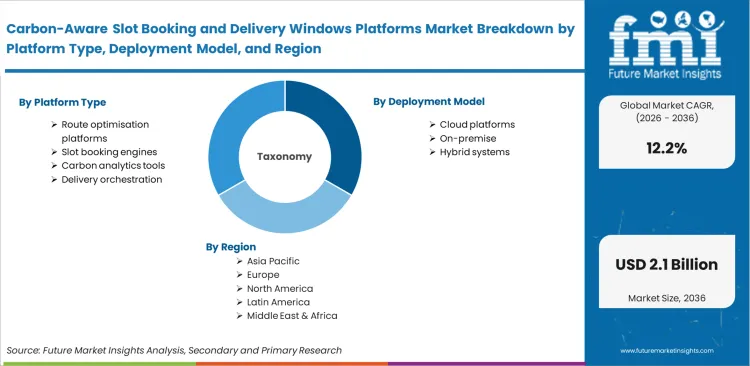
Carbon-Aware Slot Booking and Delivery Windows Platforms Market Analysis by Segments
Platform Type
- Route optimisation platforms
- Slot booking engines
- Carbon analytics tools
- Delivery orchestration
Deployment Model
- Cloud platforms
- On-premise
- Hybrid systems
End User
- Retailers
- Logistics providers
- E-commerce firms
- 3PL operators
Application
- Last-mile delivery
- Click-and-collect
- Fleet management
- Urban logistics
Technology Layer
- AI optimisation
- API integration
- Carbon tracking
- Digital twins
Region:
- North America
- United States
- Canada
- Europe
- Germany
- United Kingdom
- France
- Italy
- Spain
- Asia Pacific
- China
- Japan
- South Korea
- Taiwan
- Singapore
- Latin America
- Brazil
- Mexico
- Argentina
- Middle East & Africa
- GCC Countries
- South Africa
- Israel
- Rest of Middle East & Africa
Bibliography
- Ytreberg, N. S., & Jordbakke, G. N. (2026, May). Love thy neighbor - reducing driving through green slot labels in e-commerce. Transportation Research Part D: Transport and Environment, 105, 105252.
- Tudisco, V., Perotti, S., Yetkin Ekren, B., & Aktas, E. (2025, March). Sustainable e-grocery home delivery: An optimization model considering on-demand vehicles. Computers & Industrial Engineering, 201, 110874.
- Rizzitello, E., Lo Nigro, G., Mancini, S., & Gansterer, M. (2026, January). Nudging the last mile: Combining behavioral insights and monetary incentives for sustainable delivery choices. International Journal of Production Economics.
- Transporeon. (2024). Green Freight Report 2024.
- Zou, Y., Gao, Q., Wu, H., & Liu, N. (2024, November). Carbon-efficient scheduling in fresh food supply chains with time-window-constrained deep reinforcement learning.&
This bibliography is provided for reader reference. The full FMI report contains the complete reference list with primary source documentation.
This Report Addresses
- Dynamic slot pricing strategies triggered by tier-one carriers mandating API-level emissions visibility.
- Software layer configurations orchestrating dispatch timing based on real-time environmental impact calculations.
- Integration friction between predictive routing algorithms and legacy transport management systems.
- Margin implications for e-commerce fulfillment directors navigating escalating municipal congestion charging schemes.
- Disproportionate algorithmic intervention focus within final-stage distribution and localized parcel delivery.
- Cloud infrastructure requirements for processing continuous multi-carrier emissions data feeds.
- Headless API architecture enabling retailers to control consumer-facing sustainability checkout experiences.
- Machine learning applications designed specifically to restrict delivery windows proactively for geographical density.
Frequently Asked Questions
What was the valuation of Carbon-Aware Slot Booking and Delivery Windows Platforms in 2026?
Revenue reached USD 0.6 billion in 2026, signaling rapid adoption of emissions tracking tools across urban fleet operations facing stringent regulatory compliance mandates.
What is the projected value of this category by 2036?
Cumulative investment carries total valuation to USD 1.9 billion through 2036, driven by retail mandates forcing subcontracted carriers to provide verifiable per-parcel carbon calculations.
What is the anticipated compound annual growth rate?
The category expands at a CAGR of 12.2% as legacy logistics operators replace outdated manual dispatch protocols with dynamic density-enforcement algorithms.
Why do route optimisation platforms lead the platform type segment?
Standalone mapping loses utility against municipal congestion pricing. Operators demand systems capable of balancing vehicle capacity directly against localized traffic-linked carbon indices simultaneously.
Why do cloud platforms dominate the deployment model dimension?
Continuous data ingestion from multiple external carriers and traffic authorities requires immense off-premise processing power that isolated local servers mathematically cannot sustain during peak volume.
Why do retailers hold the largest end-user share?
Control over the consumer interface determines software value. Retailers execute the critical final integration where buyers physically select consolidated delivery days over immediate dispatch.
Why does last-mile delivery capture maximum application spending?
Extreme variance in residential parcel density makes final-stage distribution the most carbon-intensive segment, offering operators the fastest return on capital regarding fuel reduction.
Why does AI optimisation lead the technology layer?
Neural networks proactively restrict available delivery slots to enforce geographic density without relying on dispatchers to manually override standard consumer shipping expectations.
How does India compare to China structurally?
India expands at 15.6% fueled by fragmented local couriers requiring centralized digital orchestration. China grows at 14.5% driven almost entirely by central directives enforcing total transport electrification.
What barrier slows rapid adoption globally?
Integrating complex routing algorithms introduces critical latency during the checkout process. E-commerce fulfillment directors hesitate to implement features that potentially degrade conversion rates through delayed page loading.
How do tier-one carriers force secondary adoption?
Major logistics providers mandate API-level visibility from all subcontractors. Smaller fleets must purchase compatible scheduling engines or risk permanent exclusion from lucrative enterprise contracts.
What role does municipal data sharing play?
Connecting predictive routing models directly to city traffic systems allows compliant fleets to secure exclusive access to restricted delivery zones, generating massive competitive advantages.
How do vendors prevent cart abandonment during green selection?
Headless architecture decouples the complex background calculation from the front-end user experience. Marketing officers pair sustainable slot options with gamified loyalty incentives.
Why are hardware sensors excluded from this specific category?
This assessment isolates the specific software layer orchestrating dispatch timing. Physical telemetry components track output but do not actively manage or restrict consumer-facing slot availability.
How does predictive charging alter daily dispatch?
Algorithms factor specific electric vehicle battery depletion rates into the routing schedule, ensuring vans reach charging depots before municipal stranded-asset protocols trigger.
What causes algorithmic failure during extreme weather?
Historical carbon models frequently conflict with real-time street accessibility. Dispatch centers accustomed to full automation struggle to resume manual routing when flooded zones require human intervention.
How do incumbents leverage historical driver data?
Established software providers possess massive libraries detailing specific driver execution times under variable conditions, making their predictive routing suggestions vastly more accurate than new entrants.
Why is vendor lock-in a significant concern for retailers?
Relying heavily on proprietary calculation formats prevents large retail networks from harmonizing their total emissions reporting across thousands of distinct independent subcontractors.
How do urban congestion charges impact margins directly?
Sending partially empty vehicles into penalized zones destroys profitability. Organizations use density-enforcing software to hold parcels strategically until sufficient volume justifies the entry tariff.
What makes consumer tolerance for delayed shipping elastic?
Transparent communication alters expectations. Presenting verified environmental metrics during checkout successfully nudges buyers toward consolidated routes without causing significant brand resentment.
How does the UK approach differ from the USA?
The United Kingdom relies heavily on severe localized emission charging schemes to force compliance, while the United States focuses on long-distance linehaul efficiency to improve overall network profitability.
What operational vulnerability do Europe operators face?
Data sovereignty concerns make localized fleets hesitant to route their specific daily carbon metrics through foreign-hosted cloud servers, complicating continent-wide enterprise deployments.
Preview the report firsthand - request a free sample
Get SampleGet the brochure for pricing and purchase details.
Get PDFTable of Content
- Executive Summary
- Global Market Outlook
- Demand-side Trends
- Supply-side Trends
- Technology Roadmap Analysis
- Analysis and Recommendations
- Market Overview
- Market Coverage / Taxonomy
- Market Definition / Scope / Limitations
- Research Methodology
- Chapter Orientation
- Analytical Lens and Working Hypotheses
- Market Structure, Signals, and Trend Drivers
- Benchmarking and Cross-market Comparability
- Market Sizing, Forecasting, and Opportunity Mapping
- Research Design and Evidence Framework
- Desk Research Programme (Secondary Evidence)
- Company Annual and Sustainability Reports
- Peer-reviewed Journals and Academic Literature
- Corporate Websites, Product Literature, and Technical Notes
- Earnings Decks and Investor Briefings
- Statutory Filings and Regulatory Disclosures
- Technical White Papers and Standards Notes
- Additional Desk Sources
- Expert Input and Fieldwork (Primary Evidence)
- Primary Modes
- Qualitative Interviews and Expert Elicitation
- Quantitative Surveys and Structured Data Capture
- Blended Approach
- Why Primary Evidence is Used
- Field Techniques
- Interviews
- Surveys
- Focus Groups
- Observational and In-context Research
- Social and Community Interactions
- Stakeholder Universe Engaged
- C-suite Leaders
- Board Members
- Presidents and Vice Presidents
- R&D and Innovation Heads
- Technical Specialists
- Domain Subject-matter Experts
- Scientists
- Physicians and Other Healthcare Professionals
- Governance, Ethics, and Data Stewardship
- Research Ethics
- Data Integrity and Handling
- Primary Modes
- Tooling, Models, and Reference Databases
- Desk Research Programme (Secondary Evidence)
- Data Engineering and Model Build
- Data Acquisition and Ingestion
- Cleaning, Normalisation, and Verification
- Synthesis, Triangulation, and Analysis
- Quality Assurance and Audit Trail
- Market Background
- Market Dynamics
- Drivers
- Restraints
- Opportunity
- Trends
- Scenario Forecast
- Demand in Optimistic Scenario
- Demand in Likely Scenario
- Demand in Conservative Scenario
- Opportunity Map Analysis
- Product Life Cycle Analysis
- Supply Chain Analysis
- Investment Feasibility Matrix
- Value Chain Analysis
- PESTLE and Porter’s Analysis
- Regulatory Landscape
- Regional Parent Market Outlook
- Production and Consumption Statistics
- Import and Export Statistics
- Market Dynamics
- Global Market Analysis 2021 to 2025 and Forecast, 2026 to 2036
- Historical Market Size Value (USD Million) Analysis, 2021 to 2025
- Current and Future Market Size Value (USD Million) Projections, 2026 to 2036
- Y-o-Y Growth Trend Analysis
- Absolute $ Opportunity Analysis
- Global Market Pricing Analysis 2021 to 2025 and Forecast 2026 to 2036
- Global Market Analysis 2021 to 2025 and Forecast 2026 to 2036, By Platform Type
- Introduction / Key Findings
- Historical Market Size Value (USD Million) Analysis By Platform Type , 2021 to 2025
- Current and Future Market Size Value (USD Million) Analysis and Forecast By Platform Type , 2026 to 2036
- Route optimisation platforms
- Slot booking engines
- Carbon analytics tools
- Delivery orchestration
- Route optimisation platforms
- Y-o-Y Growth Trend Analysis By Platform Type , 2021 to 2025
- Absolute $ Opportunity Analysis By Platform Type , 2026 to 2036
- Global Market Analysis 2021 to 2025 and Forecast 2026 to 2036, By Deployment Model
- Introduction / Key Findings
- Historical Market Size Value (USD Million) Analysis By Deployment Model, 2021 to 2025
- Current and Future Market Size Value (USD Million) Analysis and Forecast By Deployment Model, 2026 to 2036
- Cloud platforms
- On-premise
- Hybrid systems
- Cloud platforms
- Y-o-Y Growth Trend Analysis By Deployment Model, 2021 to 2025
- Absolute $ Opportunity Analysis By Deployment Model, 2026 to 2036
- Global Market Analysis 2021 to 2025 and Forecast 2026 to 2036, By Region
- Introduction
- Historical Market Size Value (USD Million) Analysis By Region, 2021 to 2025
- Current Market Size Value (USD Million) Analysis and Forecast By Region, 2026 to 2036
- North America
- Latin America
- Western Europe
- Eastern Europe
- East Asia
- South Asia and Pacific
- Middle East & Africa
- Market Attractiveness Analysis By Region
- North America Market Analysis 2021 to 2025 and Forecast 2026 to 2036, By Country
- Historical Market Size Value (USD Million) Trend Analysis By Market Taxonomy, 2021 to 2025
- Market Size Value (USD Million) Forecast By Market Taxonomy, 2026 to 2036
- By Country
- USA
- Canada
- Mexico
- By Platform Type
- By Deployment Model
- By Country
- Market Attractiveness Analysis
- By Country
- By Platform Type
- By Deployment Model
- Key Takeaways
- Latin America Market Analysis 2021 to 2025 and Forecast 2026 to 2036, By Country
- Historical Market Size Value (USD Million) Trend Analysis By Market Taxonomy, 2021 to 2025
- Market Size Value (USD Million) Forecast By Market Taxonomy, 2026 to 2036
- By Country
- Brazil
- Chile
- Rest of Latin America
- By Platform Type
- By Deployment Model
- By Country
- Market Attractiveness Analysis
- By Country
- By Platform Type
- By Deployment Model
- Key Takeaways
- Western Europe Market Analysis 2021 to 2025 and Forecast 2026 to 2036, By Country
- Historical Market Size Value (USD Million) Trend Analysis By Market Taxonomy, 2021 to 2025
- Market Size Value (USD Million) Forecast By Market Taxonomy, 2026 to 2036
- By Country
- Germany
- UK
- Italy
- Spain
- France
- Nordic
- BENELUX
- Rest of Western Europe
- By Platform Type
- By Deployment Model
- By Country
- Market Attractiveness Analysis
- By Country
- By Platform Type
- By Deployment Model
- Key Takeaways
- Eastern Europe Market Analysis 2021 to 2025 and Forecast 2026 to 2036, By Country
- Historical Market Size Value (USD Million) Trend Analysis By Market Taxonomy, 2021 to 2025
- Market Size Value (USD Million) Forecast By Market Taxonomy, 2026 to 2036
- By Country
- Russia
- Poland
- Hungary
- Balkan & Baltic
- Rest of Eastern Europe
- By Platform Type
- By Deployment Model
- By Country
- Market Attractiveness Analysis
- By Country
- By Platform Type
- By Deployment Model
- Key Takeaways
- East Asia Market Analysis 2021 to 2025 and Forecast 2026 to 2036, By Country
- Historical Market Size Value (USD Million) Trend Analysis By Market Taxonomy, 2021 to 2025
- Market Size Value (USD Million) Forecast By Market Taxonomy, 2026 to 2036
- By Country
- China
- Japan
- South Korea
- By Platform Type
- By Deployment Model
- By Country
- Market Attractiveness Analysis
- By Country
- By Platform Type
- By Deployment Model
- Key Takeaways
- South Asia and Pacific Market Analysis 2021 to 2025 and Forecast 2026 to 2036, By Country
- Historical Market Size Value (USD Million) Trend Analysis By Market Taxonomy, 2021 to 2025
- Market Size Value (USD Million) Forecast By Market Taxonomy, 2026 to 2036
- By Country
- India
- ASEAN
- Australia & New Zealand
- Rest of South Asia and Pacific
- By Platform Type
- By Deployment Model
- By Country
- Market Attractiveness Analysis
- By Country
- By Platform Type
- By Deployment Model
- Key Takeaways
- Middle East & Africa Market Analysis 2021 to 2025 and Forecast 2026 to 2036, By Country
- Historical Market Size Value (USD Million) Trend Analysis By Market Taxonomy, 2021 to 2025
- Market Size Value (USD Million) Forecast By Market Taxonomy, 2026 to 2036
- By Country
- Kingdom of Saudi Arabia
- Other GCC Countries
- Turkiye
- South Africa
- Other African Union
- Rest of Middle East & Africa
- By Platform Type
- By Deployment Model
- By Country
- Market Attractiveness Analysis
- By Country
- By Platform Type
- By Deployment Model
- Key Takeaways
- Key Countries Market Analysis
- USA
- Pricing Analysis
- Market Share Analysis, 2025
- By Platform Type
- By Deployment Model
- Canada
- Pricing Analysis
- Market Share Analysis, 2025
- By Platform Type
- By Deployment Model
- Mexico
- Pricing Analysis
- Market Share Analysis, 2025
- By Platform Type
- By Deployment Model
- Brazil
- Pricing Analysis
- Market Share Analysis, 2025
- By Platform Type
- By Deployment Model
- Chile
- Pricing Analysis
- Market Share Analysis, 2025
- By Platform Type
- By Deployment Model
- Germany
- Pricing Analysis
- Market Share Analysis, 2025
- By Platform Type
- By Deployment Model
- UK
- Pricing Analysis
- Market Share Analysis, 2025
- By Platform Type
- By Deployment Model
- Italy
- Pricing Analysis
- Market Share Analysis, 2025
- By Platform Type
- By Deployment Model
- Spain
- Pricing Analysis
- Market Share Analysis, 2025
- By Platform Type
- By Deployment Model
- France
- Pricing Analysis
- Market Share Analysis, 2025
- By Platform Type
- By Deployment Model
- India
- Pricing Analysis
- Market Share Analysis, 2025
- By Platform Type
- By Deployment Model
- ASEAN
- Pricing Analysis
- Market Share Analysis, 2025
- By Platform Type
- By Deployment Model
- Australia & New Zealand
- Pricing Analysis
- Market Share Analysis, 2025
- By Platform Type
- By Deployment Model
- China
- Pricing Analysis
- Market Share Analysis, 2025
- By Platform Type
- By Deployment Model
- Japan
- Pricing Analysis
- Market Share Analysis, 2025
- By Platform Type
- By Deployment Model
- South Korea
- Pricing Analysis
- Market Share Analysis, 2025
- By Platform Type
- By Deployment Model
- Russia
- Pricing Analysis
- Market Share Analysis, 2025
- By Platform Type
- By Deployment Model
- Poland
- Pricing Analysis
- Market Share Analysis, 2025
- By Platform Type
- By Deployment Model
- Hungary
- Pricing Analysis
- Market Share Analysis, 2025
- By Platform Type
- By Deployment Model
- Kingdom of Saudi Arabia
- Pricing Analysis
- Market Share Analysis, 2025
- By Platform Type
- By Deployment Model
- Turkiye
- Pricing Analysis
- Market Share Analysis, 2025
- By Platform Type
- By Deployment Model
- South Africa
- Pricing Analysis
- Market Share Analysis, 2025
- By Platform Type
- By Deployment Model
- USA
- Market Structure Analysis
- Competition Dashboard
- Competition Benchmarking
- Market Share Analysis of Top Players
- By Regional
- By Platform Type
- By Deployment Model
- Competition Analysis
- Competition Deep Dive
- Descartes Systems Group
- Overview
- Product Portfolio
- Profitability by Market Segments (Product/Age /Sales Channel/Region)
- Sales Footprint
- Strategy Overview
- Marketing Strategy
- Product Strategy
- Channel Strategy
- Project44
- Bringg
- FarEye
- Blue Yonder
- Oracle Corporation
- Descartes Systems Group
- Competition Deep Dive
- Assumptions & Acronyms Used


