

- Industry Size (2025)
- USD 4.2 Bn
- Forecast (2035)
- USD 20.7 Bn
- CAGR (2025 to 2035)
- 17.6%
Instant Grocery Delivery Route Optimization Platforms Market Forecast and Outlook 2026 to 2036
The instant grocery delivery route optimization platforms market is valued at USD 4.2 billion in 2026 and is projected to reach USD 20.7 billion by 2036, reflecting a CAGR of 17.6%. China, India, USA, and Japan represent key growth regions supported by strong quick-commerce penetration and maturing digital logistics ecosystems. Bringg, Onfleet, Wise Systems, Routific, and Tookan (Jungleworks) drive competitive innovation with scalable dispatch platforms, AI-enabled routing engines, and real-time visibility tools that streamline operations for retailers offering instant and near-instant grocery delivery services.
Demand grows as rapid-commerce operators and grocery retailers pursue faster fulfillment cycles, tighter delivery windows, and reduced operating costs in dense urban zones. High-frequency ordering patterns and volatile peak loads strengthen reliance on algorithm-driven routing engines. Real-time dynamic route planning leads optimization functions because continuous recalculation of delivery paths improves fleet utilization, shortens drop-off times, and adapts to traffic, weather, and order changes. Platforms integrate predictive analytics, rider availability data, and batching logic to raise delivery density and limit idle time. Automation of assignments and sequencing enhances reliability across high-velocity grocery networks.
Quick Stats for Instant Grocery Delivery Route Optimization Platforms
- Industry Value (2026): USD 4.2 billion
- Industry Forecast Value (2036): USD 20.7 billion
- Forecast CAGR (2026 to 2036): 17.6%
- Leading Optimization Function in Global Demand: Real-time dynamic route planning
- Key Growth Regions in Global Demand: China, India, USA, Japan
- Top Players in Global Demand: Bringg, Onfleet, Wise Systems, Routific, Tookan (Jungleworks)
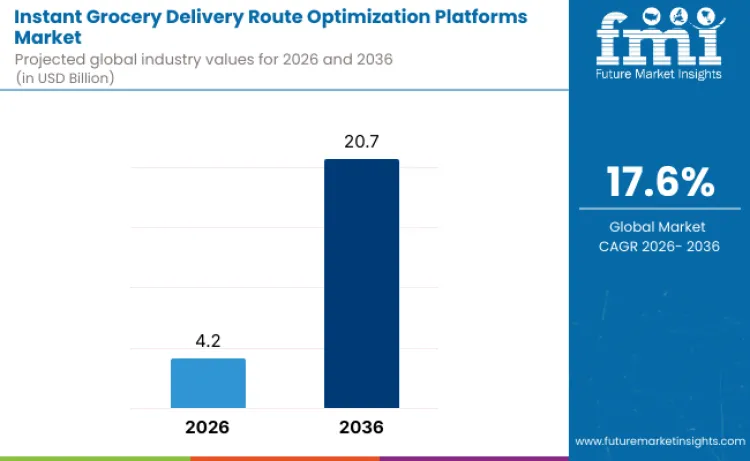
Instant Grocery Delivery Route Optimization Platforms Market Key Takeaways
| Metric | Value |
|---|---|
| Market Value (2026) | USD 4.2 billion |
| Market Forecast Value (2036) | USD 20.7 billion |
| Forecast CAGR (2026-2036) | 17.6% |
How Are the Segments Classified in the Instant Grocery Delivery Route Optimization Platforms Market?
Demand for instant grocery delivery route-optimization platforms is shaped by rapid-fulfillment expectations, dense delivery volumes, and the need for real-time routing precision across hyperlocal zones. Buyers evaluate platform responsiveness, multi-stop optimization capability, and integration with forecasting tools that adjust routing to fluctuating order loads. Adoption patterns reflect growth in quick-commerce, expansion of dark-store networks, and operational requirements for automated driver assignment in high-velocity delivery environments.
Which Optimization Function Accounts for the Largest Share of Global Demand?
Real-time dynamic route planning holds 45.3%, making it the leading optimization-function segment globally. This function supports continuous recalculation of routes based on traffic conditions, order inflow, driver availability, and delivery windows. Multi-stop batch optimization supports consolidation for cost-efficient routing across clustered orders. Dispatch and driver-assignment optimization manages resource allocation and prioritizes high-urgency orders. Demand-forecasting-integrated routing anticipates order surges and pre-positions driver resources. Function distribution reflects priority placed on speed, route adaptability, and urban delivery density.
Key Points:
- Real-time planning supports dynamic adjustments across dense zones.
- Batch optimization improves efficiency for clustered orders.
- Driver-assignment tools strengthen fleet coordination.
- Forecast-integrated routing supports surge-readiness.
Which Platform Type Represents the Largest Share of Global Demand?
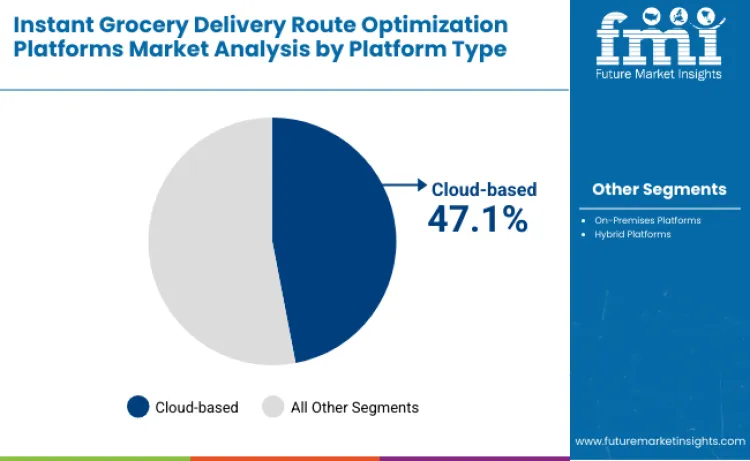
Cloud-based optimization platforms hold 47.1%, making them the leading platform-type segment globally. Cloud deployment supports real-time analytics, rapid scalability, and integration with dark stores, quick-commerce apps, and fleet-management systems. On-premises platforms serve operators requiring controlled data environments and internal hosting. Hybrid platforms combine cloud-based routing intelligence with localized processing for environments that require latency reduction or partial on-site data control. Platform distribution reflects scalability, integration needs, and the time-sensitive nature of quick-commerce operations.
Key Points:
- Cloud platforms support real-time analytics and rapid scaling.
- On-premises deployment fits controlled data environments.
- Hybrid platforms balance cloud intelligence with local processing.
- Platform choice aligns with integration and latency requirements.
Which Application Accounts for the Largest Share of Global Demand?
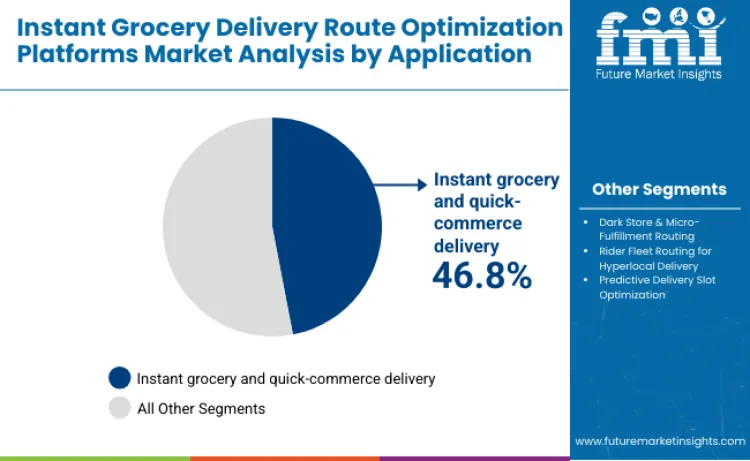
Instant grocery and quick-commerce delivery holds 46.8%, making it the largest application segment globally. High-frequency ordering, narrow delivery windows, and geographically dense fulfillment zones drive strong adoption. Dark store and micro-fulfillment routing requires optimized batch picks and coordinated delivery departure. Rider-fleet routing supports hyperlocal operators managing short-distance, multi-order dispatch. Predictive delivery slot optimization supports time-window scheduling that anticipates demand peaks. Application distribution reflects urgency, order density, and fulfillment network structure.
Key Points:
- Instant grocery delivery drives highest routing demand.
- Dark-store routing supports high-throughput fulfillment networks.
- Fleet routing assists hyperlocal multi-order operations.
- Predictive slot optimization improves delivery-time accuracy.
What are the Key Dynamics in the Instant Grocery Delivery Route Optimization Platforms Market?
Global demand rises as rapid grocery services expand operations requiring precise routing, high order density management, and short delivery windows. Platforms coordinate courier assignment, batch creation, and navigation across compact delivery zones. Retailers rely on optimization engines to stabilize fulfilment speed during peak demand. Micro fulfillment centres and dark stores use route tools to align inventory readiness with real time dispatch, supporting efficient last mile workflows across dense urban districts.
How are rapid fulfilment models and high frequency delivery patterns shaping platform adoption?
Instant delivery operators manage large volumes of short distance orders requiring precise route sequencing and minimal idle time. Platforms generate dynamic routes that respond to fluctuating order inflow, traffic patterns, and courier availability. Grocery networks adopt batching engines that group compatible orders to reduce travel fragmentation. Micro fulfillment sites rely on route visibility to match packing speed with courier arrival. Couriers use app based navigation that adjusts for live conditions. Operators require tools that reduce late deliveries in neighborhoods with irregular street grids. Data insights support identification of zones where rider supply and order density shift throughout operating hours.
How do cost pressures, integration needs, and operational constraints influence scalability?
Rapid delivery operators face thin margins, creating sensitivity to software licensing, courier incentives, and fleet management costs. Integration with inventory systems, POS platforms, and dark store management tools requires ongoing technical investment. Weather, traffic restrictions, and variable courier supply influence delivery reliability across peak periods. Smaller operators experience difficulty maintaining consistent routing performance without dedicated data teams. High churn in courier networks complicates adoption of workflow features requiring training. Infrastructure limits in dense districts reduce availability of staging areas near dispatch points. Variability in municipal regulations concerning rapid commerce operations affects long term route planning.
How is Demand for Instant Grocery Delivery Route Optimization Platforms Market Evolving Across Key Countries?
Demand for the instant grocery delivery route optimization platforms market is rising due to rapid expansion of quick-commerce models, increasing delivery-density complexity, and strong need for real-time routing intelligence. China records a CAGR of 19.0% supported by dense urban fulfilment networks and high order frequency. India shows an 18.3% CAGR driven by rapid hyperlocal delivery growth. USA posts a 17.1% CAGR supported by strong same-day delivery adoption. Japan holds a 16.0% CAGR linked with structured logistics optimization. UK records a 15.2% CAGR supported by urban convenience retail and route-efficiency requirements.
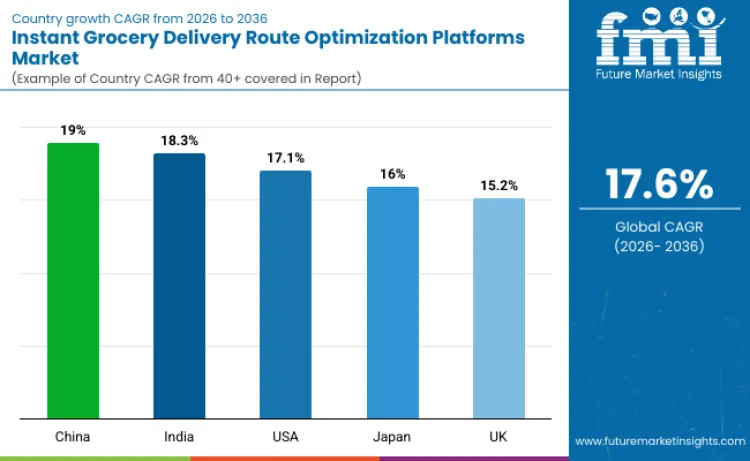
| Country | CAGR (%) |
|---|---|
| China | 19.0% |
| India | 18.3% |
| USA | 17.1% |
| Japan | 16.0% |
| UK | 15.2% |
How is China driving demand for Instant Grocery Delivery Route Optimization Platforms?
China drives demand due to dense quick-commerce ecosystems, high delivery intensity, and widespread digital adoption across fulfilment networks. The country’s CAGR of 19.0% reflects strong reliance on route-optimization platforms that coordinate rider assignments, minimize travel times, and manage fluctuating order volumes. Micro-fulfilment centers use advanced routing tools to maintain sub-hour delivery commitments. Delivery platforms integrate real-time traffic and demand-forecasting data to increase accuracy. Urban density reinforces the need for optimized routing to navigate congested corridors and high-rise delivery environments. Scaled e-commerce ecosystems further support rapid implementation of algorithm-driven route systems.
- Dense quick-commerce and e-commerce ecosystems
- High delivery volumes requiring dynamic routing
- Real-time traffic and demand forecasting integration
- Strong adoption of micro-fulfilment optimization tools
How is India driving demand for Instant Grocery Delivery Route Optimization Platforms?
India supports rising demand due to strong hyperlocal delivery growth, high urban traffic density, and rapid expansion of instant grocery services. The country’s CAGR of 18.3% reflects frequent use of route-optimization platforms to manage rider allocation, reduce delays, and support short delivery windows. Quick-commerce providers rely on predictive routing to handle order spikes. Retailers integrate intelligent routing with inventory visibility to improve promise accuracy. Congested metropolitan conditions increase the need for efficient path planning. Digital mobility ecosystems enable rapid scaling of routing platforms across major cities.
- Strong hyperlocal and instant-delivery adoption
- Need for routing efficiency in congested metro areas
- Integration of inventory-aware routing systems
- Predictive algorithms supporting high-frequency order cycles
How is the USA driving demand for Instant Grocery Delivery Route Optimization Platforms?
The USA drives demand through high same-day and near-instant delivery expectations, broad use of convenience retail, and strong logistics-software adoption. The country’s CAGR of 17.1% reflects steady integration of route-optimization tools supporting multi-point delivery, real-time substitution, and dynamic scheduling. Retailers deploy advanced routing systems to manage expanding micro-fulfilment networks. Delivery platforms use real-time analytics to reduce travel time and improve driver productivity. Urban-suburban delivery corridors require optimized routing to maintain service reliability. Growth in convenience-driven shopping reinforces continued platform adoption.
- Strong same-day and rapid-delivery expectations
- Broad deployment of micro-fulfilment routing systems
- Use of real-time analytics to optimize delivery performance
- Retail and logistics reliance on multi-point routing tools
How is Japan driving demand for Instant Grocery Delivery Route Optimization Platforms?
Japan drives demand due to compact city layouts, high delivery precision requirements, and emphasis on structured logistics efficiency. The country’s CAGR of 16.0% reflects consistent adoption of route-optimization platforms enabling accurate delivery timing, optimized sequencing, and reduced street-level congestion. Retailers integrate routing systems to support predictable fulfilment in dense commercial and residential districts. Traffic- and weather-aware routing improves operational reliability. Logistics providers rely on platform-generated schedules to enhance short-distance delivery performance. Urban mobility policies encourage the use of digital tools for delivery coordination.
- Compact urban environments supporting optimized routing
- Precision-driven delivery operations
- Weather- and traffic-integrated routing systems
- Retail and logistics reliance on structured delivery sequencing
How is the UK driving demand for Instant Grocery Delivery Route Optimization Platforms?
The UK supports demand through dense urban retail activity, strong convenience-store networks, and emphasis on reducing delivery inefficiencies. The country’s CAGR of 15.2% reflects adoption of route-optimization platforms enabling time-window accuracy, efficient vehicle allocation, and congestion-aware routing. Retailers integrate advanced routing tools to improve rapid fulfilment consistency. Delivery providers use optimization engines to manage fluctuating order volumes in dense city centers. National urban freight strategies encourage digital route planning to minimize emissions and roadway impact. Growth in rapid grocery services strengthens platform dependence.
- Dense convenience-retail and quick-commerce operations
- Time-window accuracy supported by digital routing
- Congestion-aware path planning for urban delivery
- Growing rapid-grocery adoption increasing platform usage
What is the competitive landscape of demand for instant grocery delivery route optimization platforms globally?
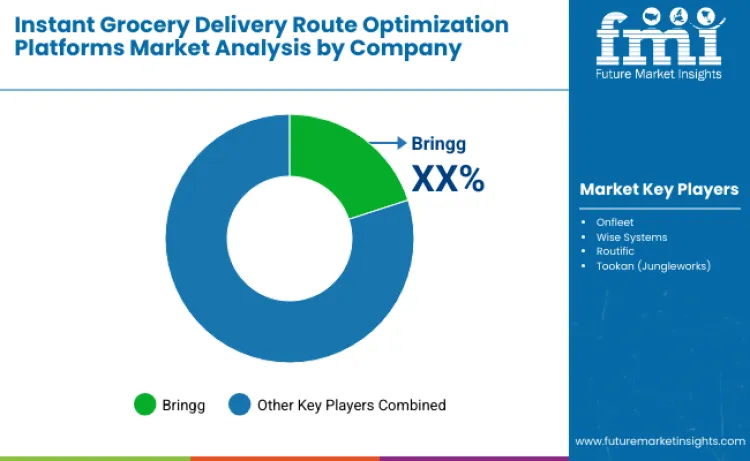
Demand for instant grocery delivery route optimization platforms grows as quick-commerce operators, supermarkets, and dark-store networks manage dense order volumes and sub-hour fulfillment windows. Onfleet participates with last-mile routing software used by grocery, meal, and pharmacy operators requiring real-time driver management. Wise Systems maintains visibility with autonomous dispatch and dynamic routing platforms used across structured delivery operations. Routific contributes route optimization tools favored by small and mid-sized delivery teams managing dense urban routes. Tookan (Jungleworks) supports demand with configurable last-mile management systems used by regional quick-commerce and convenience delivery operators.
Competitive positioning globally reflects algorithmic performance, integration depth, platform scalability, and operational analytics supporting high-velocity grocery delivery environments. Requirements center on real-time routing, batch optimization, courier assignment, and integration with inventory, picking, and dispatch workflows. Buyers evaluate API flexibility, latency performance, predictive analytics, and fleet coordination across mixed delivery modes. Procurement teams emphasize platform reliability, geospatial accuracy, and scalability supporting thousands of concurrent deliveries. Trend in the global market reflects expansion of rapid-fulfillment services, increased automation of delivery allocation, and broader use of AI-driven routing engines.
Key Players in the Instant Grocery Delivery Route Optimization Platforms Market
- Bringg
- Onfleet
- Wise Systems
- Routific
- Tookan (Jungleworks)
Scope of the Report
| Items | Values |
|---|---|
| Quantitative Units | USD billion |
| Optimization Function | Real-Time Dynamic Route Planning, Multi-Stop Batch Optimization, Dispatch & Driver Assignment Optimization, Demand Forecasting-Integrated Routing |
| Platform Type | Cloud-Based Optimization Platforms, On-Premises Platforms, Hybrid Platforms |
| Application | Instant Grocery & Quick-Commerce Delivery, Dark Store & Micro-Fulfillment Routing, Rider Fleet Routing for Hyperlocal Delivery, Predictive Delivery Slot Optimization |
| End-User | Quick-Commerce Companies, Grocery Retail Chains, Third-Party Delivery Platforms, Independent Fleet Operators |
| Regions Covered | Asia Pacific, Europe, North America, Latin America, Middle East & Africa |
| Countries Covered | India, China, USA, Germany, South Korea, Japan, Italy, and 40+ countries |
| Key Companies Profiled | Bringg, Onfleet, Wise Systems, Routific, Tookan (Jungleworks) |
| Additional Attributes | Dollar sales by optimization function, platform type, and application; regional adoption trends driven by urban last-mile demand, quick-commerce network density, and fleet utilization improvements; integration with AI-based predictive routing, ETA accuracy enhancement, and demand-forecasting engines; competitive landscape of fleet orchestration and dispatch automation vendors; expansion of API-enabled routing solutions for micro-fulfillment centers, dark stores, and hyperlocal grocery networks; influence of city regulations, delivery time compliance policies, and sustainability requirements. |
Instant Grocery Delivery Route Optimization Platforms Market by Segment
By Optimization Function:
- Real-Time Dynamic Route Planning
- Multi-Stop Batch Optimization
- Dispatch & Driver Assignment Optimization
- Demand Forecasting–Integrated Routing
By Platform Type:
- Cloud-Based Optimization Platforms
- On-Premises Platforms
- Hybrid Platforms
By Application:
- Instant Grocery & Quick-Commerce Delivery
- Dark Store & Micro-Fulfillment Routing
- Rider Fleet Routing for Hyperlocal Delivery
- Predictive Delivery Slot Optimization
By End-User:
- Quick-Commerce Companies
- Grocery Retail Chains
- Third-Party Delivery Platforms
- Independent Fleet Operators
Region:
- Asia Pacific
- China
- Japan
- South Korea
- India
- Australia & New Zealand
- ASEAN
- Rest of Asia Pacific
- Europe
- Germany
- United Kingdom
- France
- Italy
- Spain
- Nordic
- BENELUX
- Rest of Europe
- North America
- United States
- Canada
- Mexico
- Latin America
- Brazil
- Chile
- Rest of Latin America
- Middle East & Africa
- Kingdom of Saudi Arabia
- Other GCC Countries
- Turkey
- South Africa
- Other African Union
- Rest of Middle East & Africa
Frequently Asked Questions
What is the size of the instant grocery delivery route optimization platforms market in 2026?
The market is valued at USD 4.2 billion in 2026, driven by increasing order density and reliance on routing systems that reduce delivery times.
What will be the industry size by 2036?
Industry value will reach USD 20.7 billion by 2036 as quick-commerce operators scale real-time optimization tools across multi-node delivery grids.
What is the CAGR for 2026 to 2036?
The instant grocery delivery route optimization platforms market expands at a 17.6% CAGR during the forecast period.
Which optimization-function segment leads in 2026?
Real-time dynamic route planning holds 45.3% share due to its ability to adjust delivery paths based on live demand and traffic conditions.
Which platform-type segment holds the highest share?
Cloud-based optimization platforms lead with 47.1% share, supported by scalable deployment, rapid updates, and centralized data processing.
Preview the report firsthand - request a free sample
Get SampleGet the brochure for pricing and purchase details.
Get PDFTable of Content
- Executive Summary
- Market Overview
- Global Market Value, 2020-2026
- Global Market Forecast, 2026-2036
- Market Dynamics
- Drivers
- Restraints
- Opportunities
- Regulatory & Standards Landscape
- Technology & Material Innovation Outlook
- Market Segmentation Analysis
- By Optimization Function
- Real-Time Dynamic Route Planning
- Multi-Stop Batch Optimization
- Dispatch & Driver Assignment Optimization
- Demand Forecasting-Integrated Routing
- By Platform Type
- Cloud-Based Optimization Platforms
- On-Premises Platforms
- Hybrid Platforms
- By Application
- Instant Grocery & Quick-Commerce Delivery
- Dark Store & Micro-Fulfillment Routing
- Rider Fleet Routing for Hyperlocal Delivery
- Predictive Delivery Slot Optimization
- By End-User
- Quick-Commerce Companies
- Grocery Retail Chains
- Third-Party Delivery Platforms
- Independent Fleet Operators
- By Optimization Function
- Regional Outlook
- Asia Pacific
- Europe
- North America
- Latin America
- Middle East & Africa
- Country-Level Outlook
- China
- India
- USA
- Japan
- United Kingdom
- Germany
- South Korea
- Italy
- Australia & New Zealand
- ASEAN
- Brazil
- Chile
- Turkey
- South Africa
- Other GCC Countries
- Rest of Europe
- Rest of Latin America
- Rest of Middle East & Africa
- Competitive Landscape
- Market Structure Overview
- Company Positioning
- Strategic Initiatives
- Key Player Profiles
- Scope of the Report
- Research Methodology
- Assumptions & Acronyms


