

- Industry Size (2026)
- USD 33.5 Bn
- Forecast (2036)
- USD 55.6 Bn
- CAGR (2026 to 2036)
- 5.2%
Instant Cereals Market Size, Market Forecast and Outlook By FMI
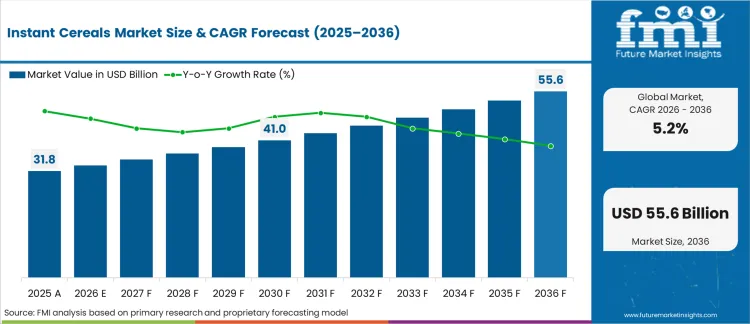
In 2025, the instant cereals market was valued at USD 31.8 billion. Based on Future Market Insights' analysis, demand for instant cereals is estimated to grow to USD 33.5 billion in 2026 and USD 55.6 billion by 2036. FMI projects a CAGR of 5.2% during the forecast period.
Absolute dollar growth of USD 22.1 billion over the decade reflects sustained structural demand tied to urbanization, rising dual-income households, and the global breakfast category's shift toward fortified, on-the-go options. Mars, Inc. completed its USD 36 billion acquisition of Kellanova in December 2025, consolidating brands including Special K and Rice Krispies within its snacking portfolio, signaling large-scale corporate conviction in the ready-to-eat and instant cereal segment's long-term volume trajectory. [1]
Summary of Instant Cereals Market
- Instant Cereals Market Definition
- The market covers globally traded pre-cooked and processed grain-based breakfast products requiring minimal preparation, spanning oats, millets, multigrain blends, and fortified cereal formats across retail and food service channels.
- Demand Drivers in the Market
- Rising urbanization and dual-income household growth in APAC driving demand for convenient, nutritionally complete breakfast solutions across India and China's expanding middle class.
- Protein fortification trend expanding the total addressable market, with General Mills targeting a 25% increase in new product sales for fiscal 2026 through innovation in protein-enriched cereal formats. [3]
- Government millet promotion programs and national dietary guideline updates reinforcing whole grain and alternative grain cereal consumption across multiple developing markets.
- Key Segments Analyzed in the FMI Report
- Type: Oats hold 34.6% share in 2026, benefiting from established global supply chains, clinical evidence on beta-glucan fiber benefits, and broad retail distribution.
- Distribution Channel: Vitamins and protein-enriched variants represent 29.8% of channel value, reflecting the structural shift toward functional fortified cereal as the primary growth vector.
- Geography: India leads growth at 10.2% CAGR; the United States at USD 11.6 billion represents the largest absolute value in 2026.
- Analyst Opinion at FMI
- Nandini Roy Choudhury, Principal Consultant for Food & Beverage Industry at Future Market Insights, opines, "In the updated version of the Instant Cereals Market Report for 2026 to 2036, CXOs will find that the market's mid-single-digit growth masks a sharp bifurcation between stagnating conventional cereal volumes in mature markets and rapidly expanding functional and protein-enriched formats in both APAC and Western markets. My findings indicate that the consolidation wave, exemplified by the Mars-Kellanova USD 36 billion deal and Post Holdings' acquisition activity, is compressing shelf space access for smaller brands and raising the innovation and compliance bar for new entrants seeking distribution in organized retail."
- Strategic Implications / Executive Takeaways
- Prioritize protein fortification and functional ingredient integration to access the premium segment that is driving volume growth above category average rates.
- Develop APAC-specific formulations incorporating regional grains such as millets and rice variants to capture the India and China growth corridors at 10.2% and 8.4% CAGR respectively.
- Evaluate supply chain exposure following the Mars-Kellanova consolidation, as integrated grain sourcing and distribution leverage by major players increases input cost pressure for smaller processors.
- Methodology
- Validated through primary interviews with cereal product manufacturers and retail category managers across North America, Europe, and APAC.
- Supported by UN Comtrade grain trade data, national grain association production statistics, and manufacturer revenue disclosures.
- Zero reliance on speculative third-party market research reports; all forecasts grounded in verifiable production, consumption, and channel data.
As Philipp Navratil, CEO of Nestle, noted during the 2025 full-year results, 'We are upgrading our marketing and innovation and increasing investment behind high-potential growth platforms, which now have an expanded scope and represent 30% of sales.' [2]
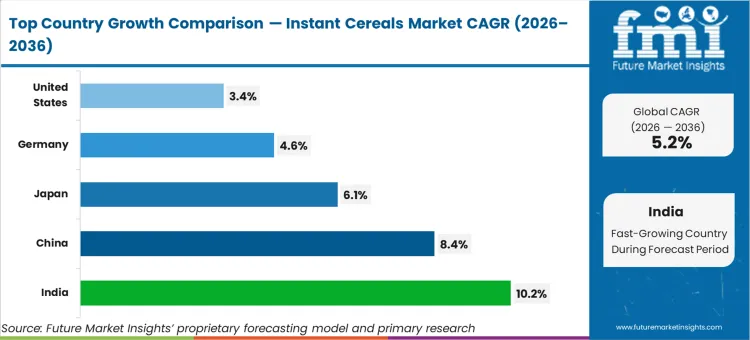
India leads with a 10.2% CAGR through 2036, supported by millet promotion policies under the International Year of Millets legacy programs and expanding modern retail penetration in Tier 2 and 3 cities. China follows at 8.4%, driven by rising health consciousness and convenience-oriented urban breakfast consumption. Japan registers 6.1%, underpinned by aging population dietary requirements and functional cereal demand. Germany grows at 4.6%, supported by organic certification uptake and whole grain mandatory labeling. The United States, the largest absolute market at USD 11.6 billion in 2026, expands at 3.4% as the market matures and innovation shifts toward protein-enriched and specialty grain variants.
Instant Cereals Market Definition
The instant cereals market encompasses the global production and trade of pre-cooked, heat-treated, or processed grain-based breakfast products designed for rapid preparation with water or milk, including oat porridges, multigrain flakes, millet-based porriges, and fortified cereal blends. The market covers both traditional grain formats and value-added functional variants incorporating protein concentrates, vitamins, minerals, and fiber fortification. Products span retail consumer formats and food service supply formats across hot and cold preparation methods.
Instant Cereals Market Inclusions
The report includes comprehensive global and regional market sizing by volume and value with a 10-year forecast from 2026 to 2036. Segmental analysis covers grain type (Oats, Legumes, Buckwheat, Semolina, Barley, Rye, Rice) and distribution channel. Country-level CAGR analysis includes the United States, Germany, Japan, China, and India. Functional ingredient overlays including protein, fiber, and vitamin fortification trajectories are incorporated alongside retail channel shift analysis from traditional trade to organized and online formats.
Instant Cereals Market Exclusions
The scope excludes cold ready-to-eat dry cereal formats that do not require any preparation step, granola bars, cereal-based snack products, baby cereal formulations under infant nutrition classifications, and non-grain-based breakfast alternatives. Foodservice operator recipes and restaurant chain procurement are outside scope unless the channel data directly reports packaged instant cereal usage. Agricultural commodity grain pricing is excluded from market sizing.
Instant Cereals Market Research Methodology
- Primary Research: Interviews were conducted with cereal product manufacturers, grain processors, food ingredient suppliers, retail category managers, and registered dietitians advising on fortification standards across North America, Europe, and APAC markets.
- Desk Research: Production data from national grain industry associations, trade statistics from UN Comtrade grain and prepared food codes, retail scanner data from publicly available market briefings, and government nutritional policy documents supported volume benchmarking.
- Market-Sizing and Forecasting: A hybrid top-down and bottom-up model integrated consumer household penetration data, per capita breakfast consumption rates, grain processing output, and distribution channel shift trends to reconstruct demand by geography and grain type, validated against manufacturer revenue disclosures.
- Data Validation and Update Cycle: Outputs underwent cross-validation against retail audit data, anomaly screening for outlier country trajectories, and structured review by food industry analysts prior to finalization.
Key Industry Highlights
Fast-paced lifestyles demand quick and easy meal options, making instant cereals ideal for breakfast.
Consumer interest in convenience foods; demand for fast-westernized foods. Instant cereals have therefore become popular at breakfast time because they do not take a lot of preparation time before they are ready to be eaten. These are some of the conveniences that make it suitable for working persons, students, and families who may not have time to prepare the normal breakfast. Another Feature of instant cereals is that they can be prepared by simple addition of hot water or milk; therefore, it is convenient for people who eat while on the move.
Instant cereals are used in a number of ways including as a breakfast cereal as oatmeal, as a topping trencher, or as a snack. This customization suits individual tastes and schedules, which only adds to the product’s charm. Single-serve packaging also plays to this advantage because a consumer can simply take the portion without having to measure or prepare it in any way.
A wide variety of instant cereals, including gluten-free and organic options, cater to different dietary preferences and needs.
A wide range of food items will suit different dietary requirements and constraints. This diversity is a critical factor for the growth of the market since consumers demand different products that meet their preferences in terms of their health and preferred lifestyle.
To cater to the consumers’ desire for instant cereals, manufacturers are bringing into the market various instant cereals such as bilateral gluten-free & organic instant cereals, as well as instant cereals that are GMO-free.
This is because products labeled gluten-free are particularly favored by individuals with gluten sensitivity while those labeled as organic target those who prefer compounds that are organically produced. Also, the inclusion of ‘superfoods’ such as chia seeds, quinoa, and acai berry to the instant forms of cereal has become fashionable in light of the shift towards, ‘functional consumption.
Instant cereal is already predefined in terms of flavor and texture. Flavors are simple and may range from cinnamon and maple syrup to what is considered complex and contemporary, chocolate almond, and berry mix. Consumers get the chance to taste several products and get what suits them hence making the overall breakfast experience better.
2021 to 2025 Global Instant Cereals Sales Analysis Compared to Demand Forecasts for 2026 to 2036
Global Instant Cereals increased at a CAGR of 4.8% from 2021 to 2025. For the next ten years (2026 to 2036), projections are that expenditure on Instant Cereals will rise at 5.2% CAGR
From the year 2021 to 2025, the Instant Cereals market increased notably, and the presence of an e-business platform makes it possible to obtain instant food products. Companies are pouring the specialized dietary needed items and the brand here also has added even more organic, keto diet, and gluten-free food items.
For the years 2026 to 2036, the projected increase comes from busy lives consumers now prefer ready-to-eat items with healthy products like instant cereal. The population awareness of health-beneficial products over the coming decade is attractive at a 5.2% CAGR.
Market Concentration
Several big players in the instant cereals market are Quaker, NutreMill, Gold Kili, Kellogs, Nestle, and many more. These business leaders form a very large value share.
These brands have sound manufacturing standards and gain a competitive advantage over the rivals over a strong distribution channel and market and also introduce new products. Their products are found all over the world. It has a diversified product range associated with fashionable packaging types. They focus more on achieving the set legal requirements to gain more customer confidence and strengthen their brand equity.
Local key enterprises, for example, Unison, Marico, Slurrp Farm, Num-Num, and Others. The first strength is that it targets its local consumers and attends to their needs and preferences.
In terms of research and development, for instance, the regional players are slightly disadvantaged when they are pitted against the national brands but what is very likely to surprise many observers is the fact that the regional players are very much in touch with their target consumers and their market as a whole. Regional brands quickly respond to new conditions and needs of consumers because they are small and located close to the regional market.
Country-wise Insights
The following table shows the estimated growth rates of the top three industries. China and India are set to exhibit Instant cereal consumption, recording CAGRs of 8.4% and 10.2%, respectively, through 2036.
.webp "Top Country Growth Comparison Instant Cereals Market Cagr (2026 2036)")
| Countries | CAGR 2026 to 2036 |
|---|---|
| United States | 3.4% |
| Germany | 4.6% |
| Japan | 6.1% |
| China | 8.4% |
| India | 10.2% |
Increased Focus on Breakfast as a Key Meal in United States Culture
The sale of Instant Cereals in the United States is projected to exhibit a CAGR of 3.4% during the assessment period by 2036, and revenue from these sales is expected to reach USD 9,546.0 Million.
In the United States, breakfast is considered to be the king of meals, regarding which through many commercials and dietary guidelines. This emphasis on breakfast has created a great market for breakfast foods and since instant cereals are a good source of these foods, the American consumer has readily embraced them.
Due to a hectic schedule, most of the American population requires easy-to-prepare foods that may not necessitate a lot of preparation time. Instant cereals suit this purpose very well, as they only take a few minutes to prepare, and also can be prepared in several different ways.
Characterization used in ads pretty much by all cereal brands is to associate their products with breakfast as an important meal necessary to sustain alertness throughout the day. Commercials often show families having their breakfast, preaching the importance of a meal in the day. This cultural aspect has brought about change in product differentiation where besides new exciting tastes, brands have had to develop organic as well as fortified cereals for the new health-conscious cereal consumer.
On-the-Go Consumption Patterns in Germany
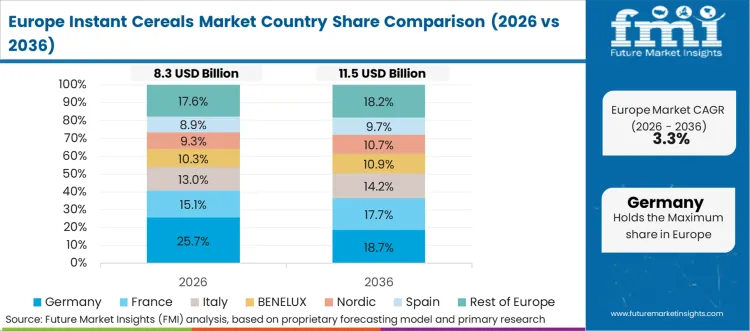
Instant Cereal demand in Germany is expected to rise at a value CAGR of 4.6% during the forecast period 2026 to 2036. By 2035, Germany is expected value share to account for 14.8% of Instant Cereals sales in Europe.
In Germany, the mobility trend has caught up, especially in large cities where the fast pace of life is evident. Since a large number of customers are working, raising families, and have many social obligations to fulfill, the need for easy access to meals has surged. Instant cereals have gained a wide acceptance at the breakfast table personality more so they are convenient enough to be eaten while on the move or during short breaks at work or school.
Single-serve packaging and portable formats for instant cereals and foods are similar to the convenience found in the German market. This convenience is very special for young workers, students, and families who prefer to be mobile most of the time. To meet this need, brands have introduced different instant cereal products that are easy to prepare, but are also healthy so the consumer does not have to compromise on health in their bid to embrace convenient breakfast solutions.
Convenience and Time Efficiency in Indian Households
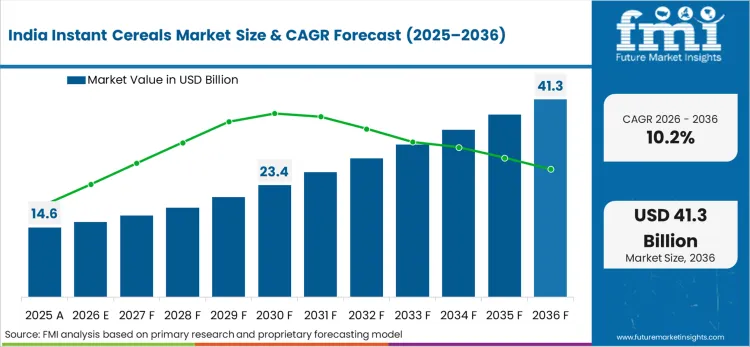
Consumption of Instant Cereals in India is expected to increase at a value CAGR of 10.2% over the next ten years. By 2035, the sale size is forecasted to reach USD 3,389.0 Million, with India expected to account for a market share of 22.5% in South Asia.
Organizational buyers in India's Eating habits of organizational buyers have also been determined to be influenced by the fast-growing urban lifestyle consciousness, leading to a rise in convenience foods. Sustained cereals as a convenience breakfast have increased in appeal due to the fast-paced lives encountered by business people, learners, and families.
In traditional Indian culture breakfast usually involves elaborate preparations which can at times be very time-consuming, especially for those with full schedules. Instant cereals are the more convenient solution which enables the consumer to have a healthy meal within a few minutes.
The advantage of convenience is that offer instant cereal products to suit the Indian market. Most cereal producers have their brands that reflect the local taste, and some of the ingredients and spices are suitable for Indian consumers. The growth of single-serve packaging have also made it convenient for the consumer to take a quick meal in a home, office, car and anywhere.
Category-Wise Insights
Legumes as a product type remain the dominant Sale for Instant Cereals
| Segment | Legumes (Type) |
|---|---|
| Value Share (2026) | 31.5% |
Sales of Legumes Instant Cereals are projected to register a CAGR of 5.2% from 2026 to 2036
The increasing concern with the nutritional values linked to curse also has played a signification in the instant cereals market. Studies suggest that legumes can reduce cholesterol levels while improving blood glucose control and gut function because they are high in fiber.
As consumers are more aware of the nutrient value of a product and the role being played by these pulses in food consumption, they are looking for foods containing such products. Companies targeting customers focused on the nutritional value of legume-based instant cereals would hence market their products accordingly by galvanizing their consumer base in this segment.
Since legume-based cereals have a broad savory spectrum, an extensive variety of products ranging from savory to sweet can be produced. It empowers manufacturers to design and develop new products that can fulfill taste buds and meet various cooking cultures. For example, instant cereals prepared from chickpea can be spiced to suit consumers who prefer to have a savory breakfast while instant cereals prepared from lentils can be sweetened naturally to suit consumers who prefer sweet foods.
The Supermarkets/ Hypermarkets Distribution Channel is more popular among all Nutrition Types
| Segment | Supermarkets/ Hypermarkets (Distribution Channel) |
|---|---|
| Value Share (2026) | 44.5% |
The rapidly growing popularity of the Supermarkets/ Hypermarkets type segment is anticipated to advance at 5.2% CAGR during the projection period.
Supermarkets and hypermarkets are currently the largest and the most rapidly developing channels for instant cereals, which play today’s key role in forming the instant cereals market. These formats offered a broad variety of conditioning activities and through integration, they have become easily accessible to consumers.
The options of the instant cereal brands, the types of instant cereal available, and flavors available in supermarkets and Hypermarkets mean that consumers are in a position to do cross-checks, and cross comparisons. This factor suits consumers who would wish to buy all their staples from one channel hence the improved sales achieved by this channel.
High frequency and penetration of eyepoint promotions involving temporary promotions, coupons, and promos on specifically eyepoint shelves in supermarkets and hypermarkets imply that they have significant consumer influence. These promotions get customers but are more importantly capable of convincing customers to go for products or brands that they would not have gone for in their normal buying habits.
Along with the two, the instant cereals when properly placed in clean and well-lit shelf spaces, with attractive packaging, and impressive adverts encourage the creation of brand awareness and call for an immediate purchase. Consequently, given that these are promotional chances, brands that can optimize such are likely to have higher market share and corresponding visibility levels in this high-street sub-sector of instant cereals.
Competition Outlook
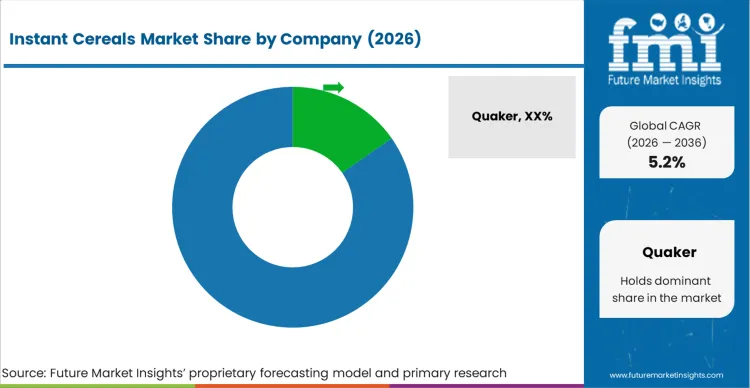
The instant cereals market is moderately concentrated at the brand level with Quaker (PepsiCo), Kellogg, Nestle, General Mills, and Post Holdings commanding significant shelf space in organized retail globally, while regional players dominate in unorganized and traditional trade channels particularly across South and Southeast Asia. The Mars-Kellanova acquisition completed December 2025 at USD 36 billion reshapes competitive dynamics by combining Mars' distribution infrastructure with Kellanova's cereal brand equity, creating an integrated snacking and breakfast platform with unmatched retail leverage. [1]
Nestle's strategic pivot announced in February 2026 to expand investment behind 30% of sales attributable to high-potential growth platforms directly encompasses its cereal and instant breakfast portfolio, increasing the marketing spend differential between top-tier players and challenger brands. [2] General Mills' reaffirmed innovation commitment targeting 25% growth in new product sales for fiscal 2026 signals that the category's competitive intensity in functional and protein formats is accelerating. [3]
WK Kellogg Co's USD 200 million supply chain modernization commitment in 2025, part of a USD 500 million multi-year initiative targeting EBITDA margins of 14% by end of 2026, reflects the operational efficiency imperative for processors facing input cost volatility and retailer margin pressure. [5] This scale of investment in manufacturing infrastructure creates a structural cost advantage that smaller regional producers will find difficult to replicate.
Recent Developments
- February 2026: General Mills partnered with lifestyle sports nutrition brand GHOST to launch a new line of protein-packed cereals, reimagining classic General Mills flavors including Cinnamon Toast Crunch and Lucky Charms with 17 grams of protein per serving. This launch targets the growing prosumer segment seeking functional, high-protein breakfast options that maintain traditional cereal taste profiles. [3]
- January 2026: Post Consumer Brands officially launched Honey Bunches of Oats Protein, a new extension of its flagship brand designed to provide 9 grams of protein per serving in Cinnamon and Honey & Almond varieties. This development is part of a broader 2026 strategic rollout including Cinnamon PEBBLES and Premier Protein Granola at 17 grams protein, specifically designed for on-the-go nutrition. [4]
- March 2025: WK Kellogg Co announced it would earmark USD 200 million for supply chain updates in 2025 as part of a larger USD 500 million multi-year modernization initiative. The investment focuses on upgrading infrastructure and implementing new production technology at facilities in Michigan, Pennsylvania, and Ontario, targeting EBITDA margins of 14% by the end of 2026. [5]
Key Players in Instant Cereals Market
- Quaker
- NutreMill
- Gold Kili
- Kellogg's
- Nestle
- General Mills
- Post
- Unison
- Marico
- Slurrp Farm
- Num-Num
Scope of the Report
| Metric | Value |
|---|---|
| Quantitative Units | USD 33.5 billion (2026) to USD 55.6 billion (2036), at a CAGR of 5.2% |
| Market Definition | The instant cereals market encompasses global production and trade of pre-cooked, heat-treated, or processed grain-based breakfast products designed for rapid preparation, including oat porridges, multigrain flakes, millet blends, and fortified cereal formats. |
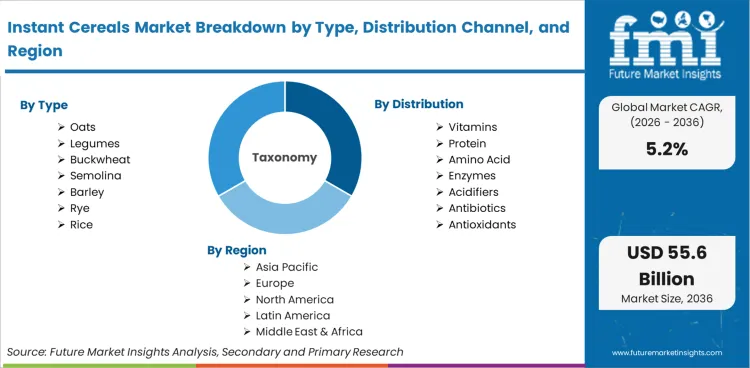
| Type Segmentation | Oats, Legumes, Buckwheat, Semolina, Barley, Rye, Rice |
| Distribution Channel Segmentation | Vitamins, Protein, Amino Acid, Enzymes, Acidifiers, Antibiotics, Antioxidants |
| Regions Covered | North America, Latin America, Europe, East Asia, South Asia, Oceania, Middle East and Africa |
| Countries Covered | United States, Germany, Japan, China, India, Canada, Mexico, Brazil, United Kingdom, France, South Korea, Australia and 40 plus countries |
| Key Companies Profiled | Quaker, NutreMill, Gold Kili, Kellogg's, Nestle, General Mills, Post, Unison, Marico, Slurrp Farm, Num-Num |
| Forecast Period | 2026 to 2036 |
| Approach | Hybrid top-down and bottom-up market modeling validated through primary interviews with cereal manufacturers and retail category managers, supported by UN Comtrade grain trade data and national grain association production statistics |
Instant Cereals Market Analysis by Segments
Type:
- Oats (34.6% share, 2026)
- Legumes
- Buckwheat
- Semolina
- Barley
- Rye
- Rice
Distribution Channel:
- Vitamins (29.8% share, 2026)
- Protein
- Amino Acid
- Enzymes
- Acidifiers
- Antibiotics
- Antioxidants
Region:
- North America: United States (USD 11.6B, 2026), Canada, Mexico
- Latin America: Brazil, Argentina, Chile, Rest of Latin America
- Europe: Germany, France, United Kingdom, Italy, Spain, Benelux, Nordics, Rest of Europe
- East Asia: China, Japan (USD 24.7B, 2036), South Korea
- South Asia: India, Indonesia, Malaysia, Thailand, Rest of South Asia
- Oceania: Australia, New Zealand
- Middle East & Africa: Saudi Arabia, UAE, South Africa, Rest of Middle East & Africa
Bibliography
- [1] Mars, Inc. / Kellanova. (2025). Mars Completes Acquisition of Kellanova. Corporate Press Release, December 2025.
- [2] Nestle S.A. (2026). Full-Year Results Press Release 2025. Investor Relations, February 2026.
- [3] General Mills. (2026). General Mills Reports Fiscal 2026 Second Quarter Results and Reaffirms Full-Year Outlook. Corporate Press Release, December 2025.
- [4] Post Consumer Brands. (2026). New Grocery Products January 2026. Corporate News, January 2026.
- [5] Supply Chain Dive. (2025). WK Kellogg USD 200M Supply Chain Modernization Initiative 2025.
This Report Addresses
- Market intelligence to enable portfolio and innovation strategy decisions across grain type, fortification level, and channel format segments
- Market size estimation and 10-year revenue forecasts from 2026 to 2036, supported by grain trade data benchmarks and manufacturer revenue validation
- Growth opportunity mapping across oat, millet, multigrain, and protein-enriched formats with emphasis on functional nutrition transitions
- Segment and regional revenue forecasts covering North America, Europe, and high-growth APAC markets with country-level CAGR breakdown
- Competition strategy assessment including consolidation impact analysis, shelf space dynamics, and innovation pipeline benchmarking
- Supply chain analysis covering grain sourcing vulnerabilities, processing capacity constraints, and impact of major acquisitions on raw material pricing
- Regulatory impact analysis covering whole grain labeling mandates, fortification standards, and millet promotion policy frameworks
- Market report delivery in PDF, Excel, PPT, and interactive dashboard formats for executive and operational use
Frequently Asked Questions
How large is the demand for Instant Cereals in the global market in 2026?
Demand for Instant Cereals in the global market is estimated to be valued at USD 33.5 billion in 2026.
What will be the market size of Instant Cereals by 2036?
Market size for Instant Cereals is projected to reach USD 55.6 billion by 2036.
What is the expected CAGR for the Instant Cereals market between 2026 and 2036?
Demand for Instant Cereals is expected to grow at a CAGR of 5.2% between 2026 and 2036.
Which grain type leads global Instant Cereals consumption in 2026?
Oats is the leading type segment, estimated at 34.6% share in 2026, supported by established beta-glucan fiber clinical evidence, global supply chain depth, and broad retail distribution.
Which distribution channel segment holds the largest share?
Vitamins-enriched and fortified cereals hold 29.8% of channel value, reflecting the structural shift toward functional and fortified formats as the primary value growth driver.
Which country is projected to grow fastest in the Instant Cereals market?
India is projected to grow at a 10.2% CAGR through 2036, driven by millet promotion policies, expanding modern retail, and rising urban consumer demand for convenient nutritional breakfast options.
What is driving Instant Cereals demand in the United States?
The United States represents USD 11.6 billion in 2026, with 3.4% CAGR driven by protein-enriched innovation, category consolidation post Mars-Kellanova merger, and the on-the-go breakfast consumption trend.
What is Germany's growth outlook in this report?
Germany is projected to expand at a CAGR of 4.6% during 2026 to 2036, supported by organic certification uptake, whole grain labeling compliance, and consumer preference for clean-label fortified cereals.
What does this Instant Cereals report cover in its scope?
Scope covers instant cereals by grain type and distribution channel with regional and country forecasts, competitive landscape, functional fortification trends, and channel shift analysis from traditional to organized and online retail.
How does FMI build and validate the Instant Cereals forecast?
Forecast is developed using hybrid top-down and bottom-up modeling validated through primary interviews, UN Comtrade grain trade data, national grain industry association statistics, and manufacturer revenue cross-checks.
Preview the report firsthand - request a free sample
Get SampleGet the brochure for pricing and purchase details.
Get PDFTable of Content
- Executive Summary
- Global Market Outlook
- Demand-side Trends
- Supply-side Trends
- Technology Roadmap Analysis
- Analysis and Recommendations
- Market Overview
- Market Coverage / Taxonomy
- Market Definition / Scope / Limitations
- Research Methodology
- Chapter Orientation
- Analytical Lens and Working Hypotheses
- Market Structure, Signals, and Trend Drivers
- Company Annual and Sustainability Reports
- Peer-reviewed Journals and Academic Literature
- Corporate Websites, Product Literature, and Technical Notes
- Earnings Decks and Investor Briefings
- Statutory Filings and Regulatory Disclosures
- Technical White Papers and Standards Notes
- Trade Journals, Industry Magazines, and Analyst Briefs
- Conference Proceedings, Webinars, and Seminar Materials
- Government Statistics Portals and Public Data Releases
- Press Releases and Reputable Media Coverage
- Specialist Newsletters and Curated Briefings
- Sector Databases and Reference Repositories
- FMI Internal Proprietary Databases and Historical Market Datasets
- Subscription Datasets and Paid Sources
- Social Channels, Communities, and Digital Listening Inputs
- Additional Desk Sources
- Expert Input and Fieldwork (Primary Evidence)
- Primary Modes
- Qualitative Interviews and Expert Elicitation
- Quantitative Surveys and Structured Data Capture
- Blended Approach
- Why Primary Evidence is Used
- Field Techniques
- Interviews
- Surveys
- Focus Groups
- Observational and In-context Research
- Social and Community Interactions
- Stakeholder Universe Engaged
- C-suite Leaders
- Board Members
- Presidents and Vice Presidents
- R&D and Innovation Heads
- Technical Specialists
- Domain Subject-matter Experts
- Scientists
- Physicians and Other Healthcare Professionals
- Governance, Ethics, and Data Stewardship
- Research Ethics
- Data Integrity and Handling
- Primary Modes
- Tooling, Models, and Reference Databases
- Data Engineering and Model Build
- Data Acquisition and Ingestion
- Cleaning, Normalisation, and Verification
- Synthesis, Triangulation, and Analysis
- Quality Assurance and Audit Trail
- Market Background
- Market Dynamics
- Drivers
- Restraints
- Opportunity
- Trends
- Scenario Forecast
- Demand in Optimistic Scenario
- Demand in Likely Scenario
- Demand in Conservative Scenario
- Opportunity Map Analysis
- Product Life Cycle Analysis
- Supply Chain Analysis
- Investment Feasibility Matrix
- Value Chain Analysis
- PESTLE and Porter’s Analysis
- Regulatory Landscape
- Regional Parent Market Outlook
- Production and Consumption Statistics
- Import and Export Statistics
- Market Dynamics
- Global Market Analysis 2021 to 2025 and Forecast, 2026 to 2036
- Historical Market Size Value (USD Billion) Analysis, 2021 to 2025
- Current and Future Market Size Value (USD Billion) Projections, 2026 to 2036
- Y-o-Y Growth Trend Analysis
- Absolute $ Opportunity Analysis
- Global Market Pricing Analysis 2021 to 2025 and Forecast 2026 to 2036
- Global Market Analysis 2021 to 2025 and Forecast 2026 to 2036, By Type
- Introduction / Key Findings
- Historical Market Size Value (USD Billion) Analysis By Type , 2021 to 2025
- Current and Future Market Size Value (USD Billion) Analysis and Forecast By Type , 2026 to 2036
- Oats
- Legumes
- Buckwheat
- Semolina
- Barley
- Rye
- Rice
- Oats
- Y-o-Y Growth Trend Analysis By Type , 2021 to 2025
- Absolute $ Opportunity Analysis By Type , 2026 to 2036
- Global Market Analysis 2021 to 2025 and Forecast 2026 to 2036, By Distribution Channel
- Introduction / Key Findings
- Historical Market Size Value (USD Billion) Analysis By Distribution Channel, 2021 to 2025
- Current and Future Market Size Value (USD Billion) Analysis and Forecast By Distribution Channel, 2026 to 2036
- Vitamins
- Protein
- Amino Acid
- Enzymes
- Acidifiers
- Antibiotics
- Antioxidants
- Vitamins
- Y-o-Y Growth Trend Analysis By Distribution Channel, 2021 to 2025
- Absolute $ Opportunity Analysis By Distribution Channel, 2026 to 2036
- Global Market Analysis 2021 to 2025 and Forecast 2026 to 2036, By Region
- Introduction
- Historical Market Size Value (USD Billion) Analysis By Region, 2021 to 2025
- Current Market Size Value (USD Billion) Analysis and Forecast By Region, 2026 to 2036
- North America
- Latin America
- Western Europe
- Eastern Europe
- East Asia
- South Asia and Pacific
- Middle East & Africa
- Market Attractiveness Analysis By Region
- North America Market Analysis 2021 to 2025 and Forecast 2026 to 2036, By Country
- Historical Market Size Value (USD Billion) Trend Analysis By Market Taxonomy, 2021 to 2025
- Market Size Value (USD Billion) Forecast By Market Taxonomy, 2026 to 2036
- By Country
- USA
- Canada
- Mexico
- By Type
- By Distribution Channel
- By Country
- Market Attractiveness Analysis
- By Country
- By Type
- By Distribution Channel
- Key Takeaways
- Latin America Market Analysis 2021 to 2025 and Forecast 2026 to 2036, By Country
- Historical Market Size Value (USD Billion) Trend Analysis By Market Taxonomy, 2021 to 2025
- Market Size Value (USD Billion) Forecast By Market Taxonomy, 2026 to 2036
- By Country
- Brazil
- Chile
- Rest of Latin America
- By Type
- By Distribution Channel
- By Country
- Market Attractiveness Analysis
- By Country
- By Type
- By Distribution Channel
- Key Takeaways
- Western Europe Market Analysis 2021 to 2025 and Forecast 2026 to 2036, By Country
- Historical Market Size Value (USD Billion) Trend Analysis By Market Taxonomy, 2021 to 2025
- Market Size Value (USD Billion) Forecast By Market Taxonomy, 2026 to 2036
- By Country
- Germany
- UK
- Italy
- Spain
- France
- Nordic
- BENELUX
- Rest of Western Europe
- By Type
- By Distribution Channel
- By Country
- Market Attractiveness Analysis
- By Country
- By Type
- By Distribution Channel
- Key Takeaways
- Eastern Europe Market Analysis 2021 to 2025 and Forecast 2026 to 2036, By Country
- Historical Market Size Value (USD Billion) Trend Analysis By Market Taxonomy, 2021 to 2025
- Market Size Value (USD Billion) Forecast By Market Taxonomy, 2026 to 2036
- By Country
- Russia
- Poland
- Hungary
- Balkan & Baltic
- Rest of Eastern Europe
- By Type
- By Distribution Channel
- By Country
- Market Attractiveness Analysis
- By Country
- By Type
- By Distribution Channel
- Key Takeaways
- East Asia Market Analysis 2021 to 2025 and Forecast 2026 to 2036, By Country
- Historical Market Size Value (USD Billion) Trend Analysis By Market Taxonomy, 2021 to 2025
- Market Size Value (USD Billion) Forecast By Market Taxonomy, 2026 to 2036
- By Country
- China
- Japan
- South Korea
- By Type
- By Distribution Channel
- By Country
- Market Attractiveness Analysis
- By Country
- By Type
- By Distribution Channel
- Key Takeaways
- South Asia and Pacific Market Analysis 2021 to 2025 and Forecast 2026 to 2036, By Country
- Historical Market Size Value (USD Billion) Trend Analysis By Market Taxonomy, 2021 to 2025
- Market Size Value (USD Billion) Forecast By Market Taxonomy, 2026 to 2036
- By Country
- India
- ASEAN
- Australia & New Zealand
- Rest of South Asia and Pacific
- By Type
- By Distribution Channel
- By Country
- Market Attractiveness Analysis
- By Country
- By Type
- By Distribution Channel
- Key Takeaways
- Middle East & Africa Market Analysis 2021 to 2025 and Forecast 2026 to 2036, By Country
- Historical Market Size Value (USD Billion) Trend Analysis By Market Taxonomy, 2021 to 2025
- Market Size Value (USD Billion) Forecast By Market Taxonomy, 2026 to 2036
- By Country
- Kingdom of Saudi Arabia
- Other GCC Countries
- Turkiye
- South Africa
- Other African Union
- Rest of Middle East & Africa
- By Type
- By Distribution Channel
- By Country
- Market Attractiveness Analysis
- By Country
- By Type
- By Distribution Channel
- Key Takeaways
- Key Countries Market Analysis
- USA
- Pricing Analysis
- Market Share Analysis, 2025
- By Type
- By Distribution Channel
- Canada
- Pricing Analysis
- Market Share Analysis, 2025
- By Type
- By Distribution Channel
- Mexico
- Pricing Analysis
- Market Share Analysis, 2025
- By Type
- By Distribution Channel
- Brazil
- Pricing Analysis
- Market Share Analysis, 2025
- By Type
- By Distribution Channel
- Chile
- Pricing Analysis
- Market Share Analysis, 2025
- By Type
- By Distribution Channel
- Germany
- Pricing Analysis
- Market Share Analysis, 2025
- By Type
- By Distribution Channel
- UK
- Pricing Analysis
- Market Share Analysis, 2025
- By Type
- By Distribution Channel
- Italy
- Pricing Analysis
- Market Share Analysis, 2025
- By Type
- By Distribution Channel
- Spain
- Pricing Analysis
- Market Share Analysis, 2025
- By Type
- By Distribution Channel
- France
- Pricing Analysis
- Market Share Analysis, 2025
- By Type
- By Distribution Channel
- India
- Pricing Analysis
- Market Share Analysis, 2025
- By Type
- By Distribution Channel
- ASEAN
- Pricing Analysis
- Market Share Analysis, 2025
- By Type
- By Distribution Channel
- Australia & New Zealand
- Pricing Analysis
- Market Share Analysis, 2025
- By Type
- By Distribution Channel
- China
- Pricing Analysis
- Market Share Analysis, 2025
- By Type
- By Distribution Channel
- Japan
- Pricing Analysis
- Market Share Analysis, 2025
- By Type
- By Distribution Channel
- South Korea
- Pricing Analysis
- Market Share Analysis, 2025
- By Type
- By Distribution Channel
- Russia
- Pricing Analysis
- Market Share Analysis, 2025
- By Type
- By Distribution Channel
- Poland
- Pricing Analysis
- Market Share Analysis, 2025
- By Type
- By Distribution Channel
- Hungary
- Pricing Analysis
- Market Share Analysis, 2025
- By Type
- By Distribution Channel
- Kingdom of Saudi Arabia
- Pricing Analysis
- Market Share Analysis, 2025
- By Type
- By Distribution Channel
- Turkiye
- Pricing Analysis
- Market Share Analysis, 2025
- By Type
- By Distribution Channel
- South Africa
- Pricing Analysis
- Market Share Analysis, 2025
- By Type
- By Distribution Channel
- USA
- Market Structure Analysis
- Competition Dashboard
- Competition Benchmarking
- Market Share Analysis of Top Players
- By Regional
- By Type
- By Distribution Channel
- Competition Analysis
- Competition Deep Dive
- Quaker
- Overview
- Product Portfolio
- Profitability by Market Segments (Product/Age /Sales Channel/Region)
- Sales Footprint
- Strategy Overview
- Marketing Strategy
- Product Strategy
- Channel Strategy
- NutreMill
- Gold Kili
- Kellogs
- Nestle
- General mills
- Post
- Unison
- Marico
- Slurrp Farm
- Num-Num
- Quaker
- Competition Deep Dive
- Assumptions & Acronyms Used


