

- Industry Size (2026)
- USD 6.7 Bn
- Forecast (2036)
- USD 13.2 Bn
- CAGR (2026 to 2036)
- 7.0%
Gluten-free Food Market Size, Market Forecast and Outlook By FMI
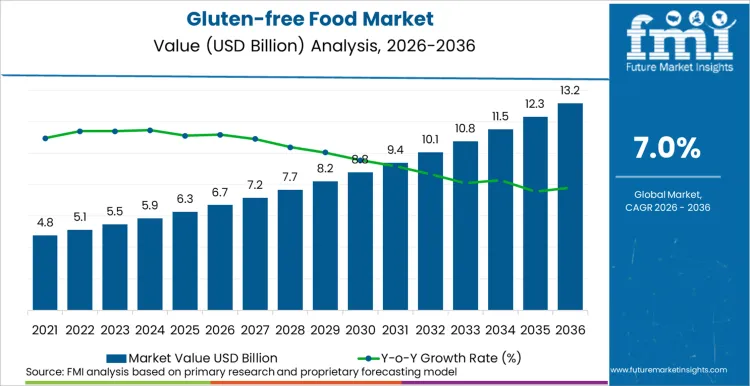
The gluten-free food market is expected to expand from USD 6.7 billion in 2026 to USD 13.2 billion by 2036. The market is anticipated to register a 7.0% CAGR during the forecast period. Bakery products are likely to lead product type with a 31.4% share, while solid form is projected to account for 58.7% share of form revenue in 2026.
Summary of the Gluten-free Food Market
- Demand and Growth Drivers
- Rising celiac disease awareness is expected to support gluten-free food adoption across mainstream retail channels.
- Clean-label preferences are likely to move gluten-free products beyond medically necessary consumption.
- Better texture and taste are anticipated to increase repeat buying across bakery and ready meal categories.
- Product and Segment View
- Bakery products are expected to lead the product type segment due to frequent consumption of bread and snacks.
- Solid form is likely to remain the leading format because packaged bakery and snack products dominate usage.
- Plant-based sources are anticipated to gain wider use as brands reformulate with grains, seeds, and legumes.
- Geography and Competitive Outlook
- India is expected to lead country-level growth as health awareness and organized retail access improve.
- China is likely to record strong expansion as urban consumers adopt allergen-aware and wellness-led foods.
- Companies with stronger formulation science are anticipated to gain advantage in texture-sensitive categories.
- Analyst Opinion
- Nandini Roy Choudhury, Principal Consultant for Food and Beverage at FMI, suggests, “The gluten-free food market is shifting from basic allergen avoidance toward better-tasting and nutritionally balanced everyday foods. Manufacturers that improve texture, clean-label positioning, and shelf stability are likely to gain stronger traction with both medical and lifestyle consumers.”
- Gluten-free Food Market Value Analysis
- The gluten-free food market is moving from a specialty dietary category into a mainstream packaged food segment.
- Demand is likely to rise as consumers seek safer alternatives for digestive wellness and allergen-aware diets.
- Product adoption is expected to improve as bakery, pasta, and ready meal brands close the taste gap with standard products.
- Spending is anticipated to be supported by retail expansion and premium formulations with stronger nutritional positioning.
Key Takeaways, Market Size, and Forecast
- The gluten-free food market is expected to reach USD 6.7 billion in 2026.
- By 2036, the gluten-free food market is projected to reach USD 13.2 billion.
- From 2026 to 2036, the market is anticipated to expand at a 7.0% CAGR.
- Bakery products are likely to account for 31.4% share of the product type segment in 2026.
- Solid form is expected to hold 58.7% share of the form segment in 2026.
- India is projected to record the fastest country-level expansion at 8.4% CAGR by 2036.
This performance reflects accelerating demand for high-quality, great-tasting gluten-free options across North America, Europe, and Asia-Pacific, driven by rising celiac disease diagnoses, gluten sensitivity awareness, and lifestyle-based dietary choices.North America leads global expansion, supported by high consumer awareness and established distribution networks. Asia-Pacific (8.4% CAGR in India) follows, driven by rapid urbanization, rising disposable incomes, and increasing health consciousness. Europe (6.6% CAGR in Germany) grows on the back of stringent food labeling regulations and a strong retail infrastructure for specialty foods.
Mature markets such as the United States (5.2% CAGR) generate comparatively slower expansion, where demand is shaped more by product diversification and replacement cycles than new consumer adoption, with intense competition acting as a structural constraint on pricing.
Gluten-free Food Market Definition
The gluten-free food market covers the global production and supply of food products formulated without gluten-containing grains such as wheat, barley, and rye. These products are designed for individuals with celiac disease, gluten sensitivity, or those choosing a gluten-free diet for perceived health benefits. They are widely used across bakery, dairy, ready meals, infant formula, and pasta categories where safe, palatable, and nutritious alternatives are required.
Market Inclusions
The report includes global and regional market size estimates in value terms, with a forecast period from 2026 to 2036. It provides segmentation by Product Type, Form, Source, and Region. The analysis incorporates manufacturing technology trends, ingredient innovation developments, regulatory alignment strategies, and performance benchmarking across gluten-free formats. Regional demand dynamics, country-level growth rates, and competitive positioning are also evaluated as per FMI methodology.
Market Exclusions
The scope excludes products that may be naturally gluten-free but are not positioned, labeled, or marketed as part of the gluten-free food category. It also excludes revenues from non-food gluten-free products and focuses strictly on the food manufacturing layer. Custom low-volume artisanal products and non-commercial kitchen prototypes are not considered due to negligible market contribution.
Research Methodology
- Primary Research: Interviews were conducted with food manufacturers, ingredient suppliers, retail buyers, celiac disease foundation representatives, and regulatory compliance advisors.
- Desk Research: Public company filings, food production statistics, trade data under relevant HS codes, food industry association publications, and regulatory documentation were reviewed.
- Market-Sizing and Forecasting: A hybrid top-down and bottom-up model was constructed, reconstructing demand from packaged food output volumes and consumption patterns across end-use segments.
- Data Validation and Update Cycle: Outputs were subjected to variance testing against production capacity data, trade flow benchmarking, and structured internal review prior to publication.
Segmental Analysis
Gluten-free Food Market Analysis by Product Type
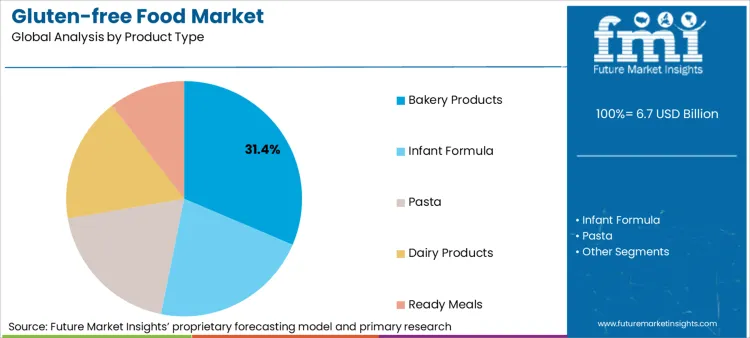
Based on FMI's gluten-free food market report, demand for bakery products is estimated to remain the leading product type, capturing 31.4% of the market share. Its dominance is supported by continuous innovation in baking ingredients and the integration of alternative flours such as rice, almond, and millet. Manufacturers are investing in improving texture and shelf life to match conventional bakery standards while maintaining clean-label credentials.
Growing retail availability and the inclusion of gluten-free options in mainstream product lines have enhanced accessibility and consumer trust. Increased consumption among individuals seeking digestive wellness and lifestyle-based dietary shifts has further sustained growth. Expanding café chains and artisanal bakeries are also contributing to volume gains, ensuring the segment remains the cornerstone of gluten-free product expansion globally [6].
Gluten-free Food Market Analysis by Form
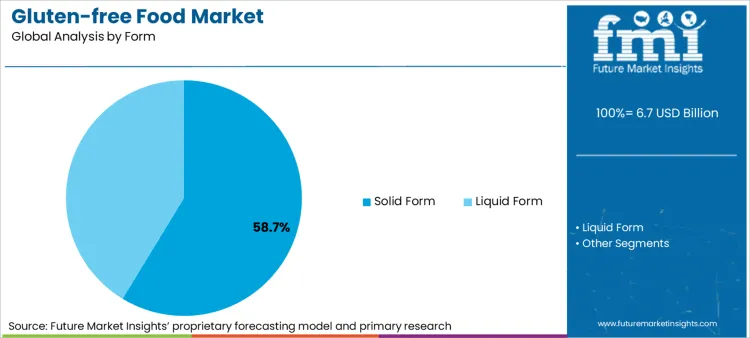
The solid form segment, accounting for 58.7% of the form category, dominates the market owing to its wide applicability across packaged foods, snacks, and bakery items. Its strong performance is attributed to product stability, ease of storage, and longer shelf life compared to liquid counterparts. Manufacturers have been focusing on enhancing texture and sensory appeal through advanced blending techniques and ingredient optimization.
Consumer inclination toward ready-to-eat and convenient solid food products has reinforced demand across both retail and foodservice channels. Innovation in packaging and extended distribution reach has improved product accessibility in developed and emerging markets. The solid form segment is expected to maintain its leadership position as product diversification and nutritional improvements continue to align with evolving consumer preferences [7].
Gluten-free Food Market Analysis by Source
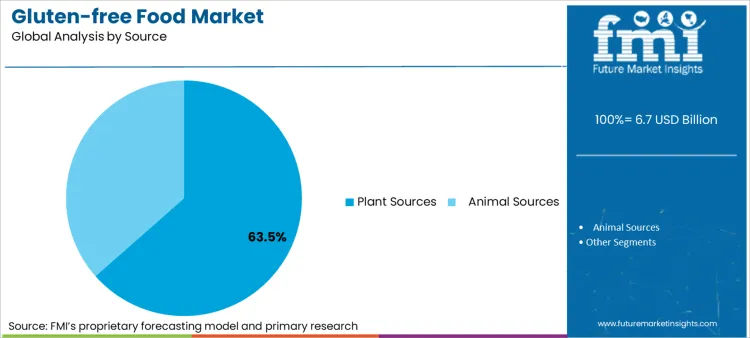
The plant sources segment, representing 63.5% of the source category, has emerged as the leading contributor due to the extensive use of grains, seeds, and legumes in gluten-free formulations. Its dominance is driven by sustainability advantages, broad ingredient availability, and compatibility with vegan and allergen-free product positioning. Consumers are increasingly preferring plant-based ingredients for their nutritional benefits, including higher fiber and protein content.
Manufacturers are leveraging plant sources to innovate across multiple product categories such as snacks, cereals, and bakery items. Supply chain efficiency and scalability of plant-based raw materials have also strengthened cost-effectiveness and production consistency. Continuous research into novel plant-derived flours and proteins is expected to expand application potential, ensuring that the segment sustains its leadership and supports long-term market growth [8].
Gluten-free Food Market Drivers, Restraints, and Opportunities
Future Market Insights analysis indicates the market has historically existed as a specialty food category tied to medical necessity. Its baseline scale is anchored in the rising diagnosed prevalence of celiac disease and gluten sensitivity. As per FMI, the market's valuation is increasingly linked to lifestyle-driven dietary shifts, where gluten-free consumption becomes part of a broader wellness trend, accelerating demand beyond the clinically affected population.
FMI analysts observe a clear tension between legacy gluten-free products optimized for safety but often criticized for poor texture and taste, and newer formulations that invest heavily in sensory quality and nutritional fortification. Standard products face pressure where brands push for mainstream acceptance, while growth is concentrated in premium segments that justify higher prices through superior eating experience and clean-label ingredients. This shift nets out as higher value growth even as price competition intensifies in basic categories.
- Rising Celiac Disease and Gluten Sensitivity: The increasing global incidence of celiac disease and non-celiac gluten sensitivity is a primary demand driver. According to the Celiac Disease Foundation, updated statistics indicate that approximately 1 in 100 people worldwide are affected by celiac disease, with many more experiencing non-celiac gluten sensitivity, creating a substantial consumer base requiring gluten-free products [1].
- Shift Toward Healthier Lifestyles: Growing consumer awareness of the link between diet and health, coupled with rising obesity rates in developed countries, is driving adoption of gluten-free diets as a perceived healthier choice, expanding the market beyond medically necessary consumers [2].
- Product Innovation and Improved Formulations: Manufacturers are adopting novel technologies like microencapsulation to achieve appropriate shelf life and improve the taste and texture of gluten-free products. This addresses historical product shortcomings and attracts a broader consumer base seeking quality and convenience [3].
- Expanding Distribution Networks: The convenience with which gluten-free products can be purchased across various retail formats convenience stores, drugstores, specialty stores, pharmacies, and rapidly growing e-commerce platforms is playing a key role in expanding market accessibility and size [4].
- Premiumization and Diversification: Growth is increasingly concentrated in premium ready meals, snacks, and bakery items that offer enhanced nutritional profiles, including higher fiber and protein content from plant-based ingredients like almond, millet, and legume flours [5].
Regional Analysis
The gluten-free food market is segmented geographically across North America, Latin America, Western Europe, Eastern Europe, East Asia, South Asia & Pacific, and the Middle East & Africa. Growth dynamics differ based on celiac disease prevalence, health awareness, disposable income levels, and retail infrastructure.
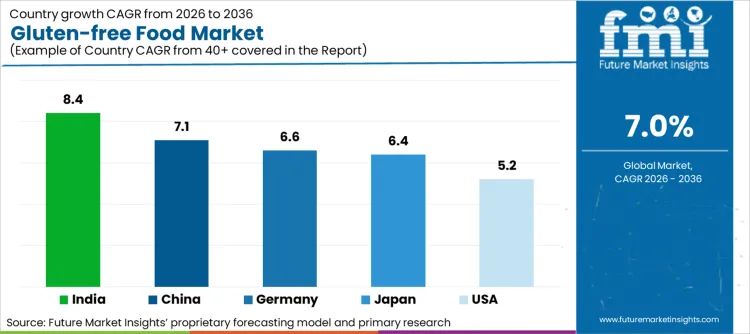
| Country | CAGR (2026-2036) |
|---|---|
| India | 8.4% |
| China | 7.1% |
| Germany | 6.6% |
| Japan | 6.4% |
| United States | 5.2% |
Source: Future Market Insights (FMI) analysis, based on proprietary forecasting model and primary research
North America Market Analysis
North America functions as the awareness-driven maturity zone of the gluten-free food sector. Major players include The Kraft Heinz Company, General Mills, and The Hain Celestial Group Inc., all operating large-scale gluten-free product lines serving diverse consumer needs.
- United States: Demand for gluten-free food in the United States is forecasted to advance at 5.2% CAGR through 2036. The higher prevalence of children and adults affected by obesity and the increasing need for leading a healthy lifestyle are key drivers. According to the Celiac Disease Foundation, approximately 1 in 133 Americans have celiac disease, and an estimated 6% of the population suffers from non-celiac gluten sensitivity, creating a substantial and sustained consumer base [1]. Unlike emerging markets where growth is volume-led, U.S. growth is driven by product mix upgrades, with consumers seeking premium, great-tasting, and nutritionally fortified options [2].
FMI's analysis of the gluten-free food market in North America consists of country-wise assessment that includes the United States and Canada. Readers can find consumer trend mapping, retail channel analysis, and product innovation tracking.
Europe Market Analysis
Europe acts as the regulatory-intensive innovation hub of the gluten-free food sector. Regional players such as Hero AG and Barilla G.E.R Fratelli S.P.A maintain strong positions, aligning closely with EU food safety and labeling frameworks.
- Germany: Demand for gluten-free food in Germany is projected to rise at 6.6% CAGR through 2036. Growth is influenced by the surge in lifestyle diseases, the increasing demand for non-allergic food products, and the higher spending capacity of German citizens. Due to the increase in celiac disease and other digestive health conditions, people in Europe consume gluten-free products like bakeries on large scales. Germany's strong food retail sector and consumer acceptance of specialty foods further support market expansion. Growth in this market is therefore health-driven and quality-aligned [5].
FMI's analysis of the gluten-free food market in Europe consists of country-wise assessment that includes Germany, United Kingdom, France, Italy, and Spain. Readers can find regulatory impact assessment, consumer behavior analysis, and distribution channel insights.
Asia-Pacific Market Analysis
Asia-Pacific remains the high-growth potential engine of the global gluten-free food market. The region benefits from rapid urbanization, rising disposable incomes, growing health awareness, and expanding modern retail. Key players include both multinational corporations and emerging local manufacturers.
- India: Gluten-free food sales in India are projected to rise at 8.4% CAGR through 2036. Growth is supported by raising awareness about the health benefits of gluten-free diets, along with increased disposable income. Increasing government efforts to strengthen the food processing sector and MSME sector are favoring the emergence of gluten-free production industries. Unlike China's broader health and wellness trend, India's growth is significantly driven by rising health awareness and the expansion of the organized retail sector [4].
FMI's analysis of the gluten-free food market in Asia-Pacific consists of country-wise assessment that includes India, China, Japan, and South Korea. Readers can find domestic manufacturing trends, regulatory compliance implications, and end-use sector demand evolution insights.
- China: Demand for gluten-free food in China is anticipated to thrive with a CAGR of 7.1% through 2036. The growing shift towards healthy food products, particularly among millennials, has increased the consumption of gluten-free foods. Rising demand for gluten-free infant formulas, bakeries, and dairy products is expected to boost gluten-free food sales in the country. Its massive population, increasing health consciousness, and the growing influence of Western dietary trends [2] fuel China’s growth.
- Japan: Demand for gluten-free food products in Japan is poised to increase at a lucrative rate of 6.4% CAGR till 2036. A shift in consumer demography and a rapid expansion of the allergen-friendly food market in the country are key drivers. The strong presence of top gluten-free manufacturers in the country that are competing at the global level further supports market growth. Japan's mature food market and high consumer standards create demand for premium, high-quality gluten-free options [8].
Competitive Landscape for Market Players
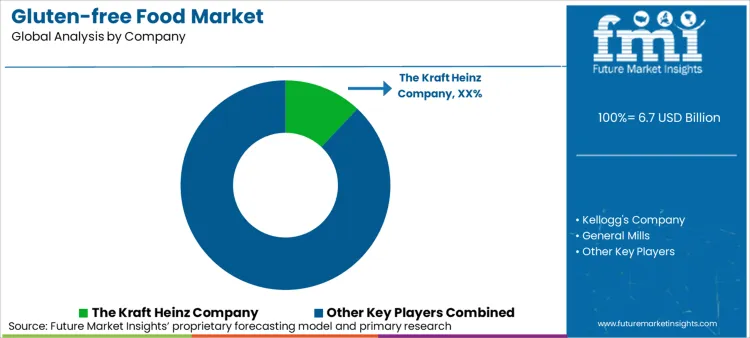
The gluten-free food market is highly fragmented owing to the presence of multiple international players and regional players, especially in developing countries. As per FMI estimates, top global players collectively control a significant share of market value, particularly in developed regions, while regional players compete aggressively on price and local taste preferences in emerging markets. The primary competitive variable is increasingly not just raw ingredient sourcing but formulation expertise in achieving taste and texture parity with conventional foods [5].
Large integrated players such as The Kraft Heinz Company, Kellogg's Company, and General Mills benefit from scale advantages in R&D, ingredient procurement, manufacturing, and global distribution networks. Companies with diversified food portfolios can cross-sell gluten-free products into mainstream categories, reducing customer acquisition costs. Structural advantage also comes from investment in novel technologies like microencapsulation to improve product shelf life and sensory appeal, differentiating offerings in a crowded marketplace [3].
Buyer behavior in this market reflects a dual track: medically necessary consumers prioritize safety and trust in established brands, while lifestyle consumers are more experimental, seeking variety, taste, and premium attributes. Gluten-free food manufacturers use a variety of organic and inorganic business strategies to grow their market share, boost profitability, and stay competitive. The top player in the gluten-free food market has mainly focused on introducing new items to their existing portfolio to remain relevant in the market [6].
Recent Developments
- Annie's Inc. - Product Launch (2024): Annie's Inc., a General Mills-owned organic and natural food company, expanded their gluten-free snack portfolio with new cracker variants targeting health-conscious families and children [6].
- GOODLES - Product Launch (February 2025): GOODLES introduced its first gluten-free products, GLUTEN-FREE VEGAN BE HEROES and GLUTEN-FREE CHEDDY MAC. These nutrient-dense foods include protein, fiber, prebiotics, and 21 nutrients derived from plants, just like other GOODLES mac and cheese. The company created the ideal gluten-free Mac that tastes just like conventional mac and cheese [9].
- Barilla - Line Extension (2024): Barilla G.E.R Fratelli S.P.A expanded its gluten-free pasta range with new formats made from a blend of corn, rice, and legume flours to improve protein content and texture [5].
Key Players in the Gluten-free Food Market
- The Kraft Heinz Company
- Kellogg's Company
- General Mills
- The Hain Celestial Group Inc.
- ConAgra Brands Inc.
- Hero AG
- Barilla G.E.R Fratelli S.P.A
- Freedom Foods Group Limited
- Raisio PLC
- Enjoy Life Foods
Scope of Report
| Metric | Value |
|---|---|
| Quantitative Units | USD 6.7 billion (2026) to USD 13.2 billion (2036), at a CAGR of 7.0% |
| Market Definition | The gluten-free food market comprises the global production and supply of food products formulated without gluten-containing ingredients, designed for safe consumption by individuals with celiac disease, gluten sensitivity, or those following gluten-free dietary patterns. |
| Product Type Segmentation | Bakery Products, Infant Formula, Pasta, Dairy Products, Ready Meals, Other Product Types |
| Form Segmentation | Solid Form, Liquid Form |
| Source Segmentation | Plant Sources, Animal Sources |
| Region Segmentation | North America, Latin America, Western Europe, Eastern Europe, East Asia, South Asia & Pacific, Middle East & Africa |
| Key Countries Covered | United States, Canada, Germany, United Kingdom, France, Italy, Spain, China, India, Japan, South Korea, and 40+ countries |
| Key Companies Profiled | The Kraft Heinz Company, Kellogg's Company, General Mills, The Hain Celestial Group Inc, ConAgra Brands Inc, Hero AG, Barilla G.E.R Fratelli S.P.A, Freedom Foods Group Limited, Raisio PLC, Enjoy Life Foods |
| Forecast Period | 2026 to 2036 |
| Approach | Hybrid top-down and bottom-up market modeling validated through primary interviews with food manufacturers, ingredient suppliers, and retail buyers, supported by trade benchmarking and production capacity analysis |
Gluten-free Food Market Analysis by Segments
Product Type
- Bakery Products
- Infant Formula
- Pasta
- Dairy Products
- Ready Meals
- Other Product Types
Form
- Solid Form
- Liquid Form
Source
- Plant Sources
- Animal Sources
Region
- North America
- Latin America
- Western Europe
- Eastern Europe
- East Asia
- South Asia & Pacific
- Middle East & Africa
Bibliography
- Celiac Disease Foundation. (2025). Celiac Disease Facts and Statistics. Celiac Disease Foundation.
- Food Navigator. (2025, March 12). Beyond medical necessity: How lifestyle consumers are reshaping the gluten-free market.
- Prepared Foods. (2024, November 5). Microencapsulation techniques enhance gluten-free product quality.
- Retail Gazette. (2025, January 20). The rise of free-from aisles: How supermarkets are expanding allergen-friendly ranges.
- Just Food. (2024, September 18). Barilla and Hero lead gluten-free innovation in Europe.
- General Mills. (2024). Annual Report 2024: Expanding our free-from portfolio. General Mills, Inc.
- International Food Information Council. (2025). 2025 Food & Health Survey.
- Nikkei Asia. (2024, October 22). Japan's aging population drives demand for allergen-free foods.
- Business Wire. (2025, February 12). GOODLES Enters Gluten-Free Category with New Mac and Cheese Products.
This Report Addresses
- Market intelligence to enable structured strategic decision making across mature and emerging gluten-free food consumption economies
- Market size estimation and 10 year revenue forecasts from 2026 to 2036, supported by validated retail sales tracking, ingredient consumption benchmarks, and trade data analysis
- Growth opportunity mapping across bakery products, ready meals, infant formula, and pasta categories with emphasis on texture optimization, nutritional fortification, and clean-label transitions
- Segment and regional revenue forecasts covering solid and liquid forms, plant- and animal-based sources, and key country markets including the United States, Germany, China, India, and Japan
- Competition strategy assessment including portfolio diversification models, premiumization positioning, private label penetration, and formulation capability benchmarking
- Product innovation and labeling compliance tracking aligned with gluten-free certification standards, allergen-free mandates, and regional food safety regulations
- Regulatory impact analysis covering gluten labeling thresholds, food safety compliance frameworks, and retail specification upgrades across North America, Europe, and Asia-Pacific
- Market report delivery in PDF, Excel, PPT, and interactive dashboard formats for executive and operational use
Frequently Asked Questions
How large is the demand for gluten-free food in the global market in 2026?
Demand for gluten-free food is estimated to be valued at USD 6.7 billion in 2026.
What will be the market size of gluten-free food in the global market by 2036?
Market size for gluten-free food is projected to reach USD 12.4 billion by 2036.
What is the expected demand growth for gluten-free food between 2026 and 2036?
Demand for gluten-free food is expected to grow at a 7.0% CAGR between 2026 and 2036.
Which product type segment is poised to lead global sales?
Bakery Products is expected to remain the leading product type, anchored by high consumer demand for bread, cakes, cookies, and snacks, and it held 31.4% share in 2025.
How significant is the role of the solid form segment in driving the gluten-free food market?
The solid form segment is dominant because of its wide applicability across packaged foods, snacks, and bakery items, offering product stability and longer shelf life. It held 58.7% share in 2025.
What is driving demand in the United States?
The higher prevalence of obesity, the increasing need for healthy lifestyles, and a large population with celiac disease or gluten sensitivity are supporting demand growth in the United States.
What is the United States growth outlook in this report?
The United States is projected to expand at a 5.2% CAGR during 2026 to 2036.
Why is Germany described as a key market in Europe?
Germany's market growth is driven by the surge in lifestyle diseases, high demand for non-allergic food products, and the higher spending capacity of its citizens.
What is the Germany growth outlook in this report?
Germany is projected to expand at a 6.6% CAGR during 2026 to 2036.
Does the report cover China in its regional analysis?
Yes, China is included within Asia-Pacific and is a high-growth country market covered in the report.
What is the China growth outlook in this report?
China is projected to expand at a 7.1% CAGR during 2026 to 2036.
Does the report cover India in its regional analysis?
Yes, India is included within Asia-Pacific and is covered in the country-wise assessment.
What is the India growth outlook in this report?
India is projected to expand at a robust 8.4% CAGR during 2026 to 2036.
Does the report cover Japan in its regional analysis?
Yes, Japan is included within Asia-Pacific under the regional scope of analysis.
What is the Japan growth outlook in this report?
Japan is projected to expand at a 6.4% CAGR during 2026 to 2036.
What defines a product as part of the gluten-free food market?
A product is included if it is specially formulated without gluten-containing ingredients (wheat, barley, rye) and is positioned, labeled, and marketed as gluten-free for individuals with celiac disease, gluten sensitivity, or those choosing such a diet.
What is included in the scope of this gluten-free food market report?
Scope includes market sizing and forecasting for 2026 to 2036, segmentation by product type, form, source, and region, along with competitive assessment and country-wise outlook.
What is excluded from the scope of this report?
The scope excludes products that are naturally gluten-free but not marketed as such, non-food gluten-free products, and focuses strictly on the food manufacturing and supply layer.
Preview the report firsthand - request a free sample
Get SampleGet the brochure for pricing and purchase details.
Get PDFTable of Content
- Executive Summary
- Global Market Outlook
- Demand-side Trends
- Supply-side Trends
- Technology Roadmap Analysis
- Analysis and Recommendations
- Market Overview
- Market Coverage / Taxonomy
- Market Definition / Scope / Limitations
- Research Methodology
- Chapter Orientation
- Analytical Lens and Working Hypotheses
- Market Structure, Signals, and Trend Drivers
- Benchmarking and Cross-market Comparability
- Market Sizing, Forecasting, and Opportunity Mapping
- Research Design and Evidence Framework
- Desk Research Programme (Secondary Evidence)
- Company Annual and Sustainability Reports
- Peer-reviewed Journals and Academic Literature
- Corporate Websites, Product Literature, and Technical Notes
- Earnings Decks and Investor Briefings
- Statutory Filings and Regulatory Disclosures
- Technical White Papers and Standards Notes
- Trade Journals, Industry Magazines, and Analyst Briefs
- Conference Proceedings, Webinars, and Seminar Materials
- Government Statistics Portals and Public Data Releases
- Press Releases and Reputable Media Coverage
- Specialist Newsletters and Curated Briefings
- Sector Databases and Reference Repositories
- FMI Internal Proprietary Databases and Historical Market Datasets
- Subscription Datasets and Paid Sources
- Social Channels, Communities, and Digital Listening Inputs
- Additional Desk Sources
- Expert Input and Fieldwork (Primary Evidence)
- Primary Modes
- Qualitative Interviews and Expert Elicitation
- Quantitative Surveys and Structured Data Capture
- Blended Approach
- Why Primary Evidence is Used
- Field Techniques
- Interviews
- Surveys
- Focus Groups
- Observational and In-context Research
- Social and Community Interactions
- Stakeholder Universe Engaged
- C-suite Leaders
- Board Members
- Presidents and Vice Presidents
- R&D and Innovation Heads
- Technical Specialists
- Domain Subject-matter Experts
- Scientists
- Physicians and Other Healthcare Professionals
- Governance, Ethics, and Data Stewardship
- Research Ethics
- Data Integrity and Handling
- Primary Modes
- Tooling, Models, and Reference Databases
- Desk Research Programme (Secondary Evidence)
- Data Engineering and Model Build
- Data Acquisition and Ingestion
- Cleaning, Normalisation, and Verification
- Synthesis, Triangulation, and Analysis
- Quality Assurance and Audit Trail
- Market Background
- Market Dynamics
- Drivers
- Restraints
- Opportunity
- Trends
- Scenario Forecast
- Demand in Optimistic Scenario
- Demand in Likely Scenario
- Demand in Conservative Scenario
- Opportunity Map Analysis
- Product Life Cycle Analysis
- Supply Chain Analysis
- Investment Feasibility Matrix
- Value Chain Analysis
- PESTLE and Porter’s Analysis
- Regulatory Landscape
- Regional Parent Market Outlook
- Production and Consumption Statistics
- Import and Export Statistics
- Market Dynamics
- Global Market Analysis 2021 to 2025 and Forecast, 2026 to 2036
- Historical Market Size Value (USD Billion) Analysis, 2021 to 2025
- Current and Future Market Size Value (USD Billion) Projections, 2026 to 2036
- Y-o-Y Growth Trend Analysis
- Absolute $ Opportunity Analysis
- Global Market Pricing Analysis 2021 to 2025 and Forecast 2026 to 2036
- Global Market Analysis 2021 to 2025 and Forecast 2026 to 2036, By Product Type
- Introduction / Key Findings
- Historical Market Size Value (USD Billion) Analysis By Product Type , 2021 to 2025
- Current and Future Market Size Value (USD Billion) Analysis and Forecast By Product Type , 2026 to 2036
- Bakery Products
- Infant Formula
- Pasta
- Dairy Products
- Ready Meals
- Bakery Products
- Y-o-Y Growth Trend Analysis By Product Type , 2021 to 2025
- Absolute $ Opportunity Analysis By Product Type , 2026 to 2036
- Global Market Analysis 2021 to 2025 and Forecast 2026 to 2036, By Form
- Introduction / Key Findings
- Historical Market Size Value (USD Billion) Analysis By Form, 2021 to 2025
- Current and Future Market Size Value (USD Billion) Analysis and Forecast By Form, 2026 to 2036
- Solid Form
- Liquid Form
- Solid Form
- Y-o-Y Growth Trend Analysis By Form, 2021 to 2025
- Absolute $ Opportunity Analysis By Form, 2026 to 2036
- Global Market Analysis 2021 to 2025 and Forecast 2026 to 2036, By Source
- Introduction / Key Findings
- Historical Market Size Value (USD Billion) Analysis By Source, 2021 to 2025
- Current and Future Market Size Value (USD Billion) Analysis and Forecast By Source, 2026 to 2036
- Plant Sources
- Animal Sources
- Plant Sources
- Y-o-Y Growth Trend Analysis By Source, 2021 to 2025
- Absolute $ Opportunity Analysis By Source, 2026 to 2036
- Global Market Analysis 2021 to 2025 and Forecast 2026 to 2036, By Region
- Introduction
- Historical Market Size Value (USD Billion) Analysis By Region, 2021 to 2025
- Current Market Size Value (USD Billion) Analysis and Forecast By Region, 2026 to 2036
- North America
- Latin America
- Western Europe
- Eastern Europe
- East Asia
- South Asia and Pacific
- Middle East & Africa
- Market Attractiveness Analysis By Region
- North America Market Analysis 2021 to 2025 and Forecast 2026 to 2036, By Country
- Historical Market Size Value (USD Billion) Trend Analysis By Market Taxonomy, 2021 to 2025
- Market Size Value (USD Billion) Forecast By Market Taxonomy, 2026 to 2036
- By Country
- USA
- Canada
- Mexico
- By Product Type
- By Form
- By Source
- By Country
- Market Attractiveness Analysis
- By Country
- By Product Type
- By Form
- By Source
- Key Takeaways
- Latin America Market Analysis 2021 to 2025 and Forecast 2026 to 2036, By Country
- Historical Market Size Value (USD Billion) Trend Analysis By Market Taxonomy, 2021 to 2025
- Market Size Value (USD Billion) Forecast By Market Taxonomy, 2026 to 2036
- By Country
- Brazil
- Chile
- Rest of Latin America
- By Product Type
- By Form
- By Source
- By Country
- Market Attractiveness Analysis
- By Country
- By Product Type
- By Form
- By Source
- Key Takeaways
- Western Europe Market Analysis 2021 to 2025 and Forecast 2026 to 2036, By Country
- Historical Market Size Value (USD Billion) Trend Analysis By Market Taxonomy, 2021 to 2025
- Market Size Value (USD Billion) Forecast By Market Taxonomy, 2026 to 2036
- By Country
- Germany
- UK
- Italy
- Spain
- France
- Nordic
- BENELUX
- Rest of Western Europe
- By Product Type
- By Form
- By Source
- By Country
- Market Attractiveness Analysis
- By Country
- By Product Type
- By Form
- By Source
- Key Takeaways
- Eastern Europe Market Analysis 2021 to 2025 and Forecast 2026 to 2036, By Country
- Historical Market Size Value (USD Billion) Trend Analysis By Market Taxonomy, 2021 to 2025
- Market Size Value (USD Billion) Forecast By Market Taxonomy, 2026 to 2036
- By Country
- Russia
- Poland
- Hungary
- Balkan & Baltic
- Rest of Eastern Europe
- By Product Type
- By Form
- By Source
- By Country
- Market Attractiveness Analysis
- By Country
- By Product Type
- By Form
- By Source
- Key Takeaways
- East Asia Market Analysis 2021 to 2025 and Forecast 2026 to 2036, By Country
- Historical Market Size Value (USD Billion) Trend Analysis By Market Taxonomy, 2021 to 2025
- Market Size Value (USD Billion) Forecast By Market Taxonomy, 2026 to 2036
- By Country
- China
- Japan
- South Korea
- By Product Type
- By Form
- By Source
- By Country
- Market Attractiveness Analysis
- By Country
- By Product Type
- By Form
- By Source
- Key Takeaways
- South Asia and Pacific Market Analysis 2021 to 2025 and Forecast 2026 to 2036, By Country
- Historical Market Size Value (USD Billion) Trend Analysis By Market Taxonomy, 2021 to 2025
- Market Size Value (USD Billion) Forecast By Market Taxonomy, 2026 to 2036
- By Country
- India
- ASEAN
- Australia & New Zealand
- Rest of South Asia and Pacific
- By Product Type
- By Form
- By Source
- By Country
- Market Attractiveness Analysis
- By Country
- By Product Type
- By Form
- By Source
- Key Takeaways
- Middle East & Africa Market Analysis 2021 to 2025 and Forecast 2026 to 2036, By Country
- Historical Market Size Value (USD Billion) Trend Analysis By Market Taxonomy, 2021 to 2025
- Market Size Value (USD Billion) Forecast By Market Taxonomy, 2026 to 2036
- By Country
- Kingdom of Saudi Arabia
- Other GCC Countries
- Turkiye
- South Africa
- Other African Union
- Rest of Middle East & Africa
- By Product Type
- By Form
- By Source
- By Country
- Market Attractiveness Analysis
- By Country
- By Product Type
- By Form
- By Source
- Key Takeaways
- Key Countries Market Analysis
- USA
- Pricing Analysis
- Market Share Analysis, 2025
- By Product Type
- By Form
- By Source
- Canada
- Pricing Analysis
- Market Share Analysis, 2025
- By Product Type
- By Form
- By Source
- Mexico
- Pricing Analysis
- Market Share Analysis, 2025
- By Product Type
- By Form
- By Source
- Brazil
- Pricing Analysis
- Market Share Analysis, 2025
- By Product Type
- By Form
- By Source
- Chile
- Pricing Analysis
- Market Share Analysis, 2025
- By Product Type
- By Form
- By Source
- Germany
- Pricing Analysis
- Market Share Analysis, 2025
- By Product Type
- By Form
- By Source
- UK
- Pricing Analysis
- Market Share Analysis, 2025
- By Product Type
- By Form
- By Source
- Italy
- Pricing Analysis
- Market Share Analysis, 2025
- By Product Type
- By Form
- By Source
- Spain
- Pricing Analysis
- Market Share Analysis, 2025
- By Product Type
- By Form
- By Source
- France
- Pricing Analysis
- Market Share Analysis, 2025
- By Product Type
- By Form
- By Source
- India
- Pricing Analysis
- Market Share Analysis, 2025
- By Product Type
- By Form
- By Source
- ASEAN
- Pricing Analysis
- Market Share Analysis, 2025
- By Product Type
- By Form
- By Source
- Australia & New Zealand
- Pricing Analysis
- Market Share Analysis, 2025
- By Product Type
- By Form
- By Source
- China
- Pricing Analysis
- Market Share Analysis, 2025
- By Product Type
- By Form
- By Source
- Japan
- Pricing Analysis
- Market Share Analysis, 2025
- By Product Type
- By Form
- By Source
- South Korea
- Pricing Analysis
- Market Share Analysis, 2025
- By Product Type
- By Form
- By Source
- Russia
- Pricing Analysis
- Market Share Analysis, 2025
- By Product Type
- By Form
- By Source
- Poland
- Pricing Analysis
- Market Share Analysis, 2025
- By Product Type
- By Form
- By Source
- Hungary
- Pricing Analysis
- Market Share Analysis, 2025
- By Product Type
- By Form
- By Source
- Kingdom of Saudi Arabia
- Pricing Analysis
- Market Share Analysis, 2025
- By Product Type
- By Form
- By Source
- Turkiye
- Pricing Analysis
- Market Share Analysis, 2025
- By Product Type
- By Form
- By Source
- South Africa
- Pricing Analysis
- Market Share Analysis, 2025
- By Product Type
- By Form
- By Source
- USA
- Market Structure Analysis
- Competition Dashboard
- Competition Benchmarking
- Market Share Analysis of Top Players
- By Regional
- By Product Type
- By Form
- By Source
- Competition Analysis
- Competition Deep Dive
- The Kraft Heinz Company
- Overview
- Product Portfolio
- Profitability by Market Segments (Product/Age /Sales Channel/Region)
- Sales Footprint
- Strategy Overview
- Marketing Strategy
- Product Strategy
- Channel Strategy
- Kellogg's Company
- General Mills
- The Hain Celestial Group Inc.
- ConAgra Brands Inc.
- Hero AG
- Barilla G.E.R Fratelli S.P.A
- The Kraft Heinz Company
- Competition Deep Dive
- Assumptions & Acronyms Used


