

- Industry Size (2026)
- USD 793.5 Mn
- Forecast (2036)
- USD 1268.2 Mn
- CAGR (2026 to 2036)
- 4.8%
Instant Dry Yeast Market Size, Market Forecast and Outlook By FMI
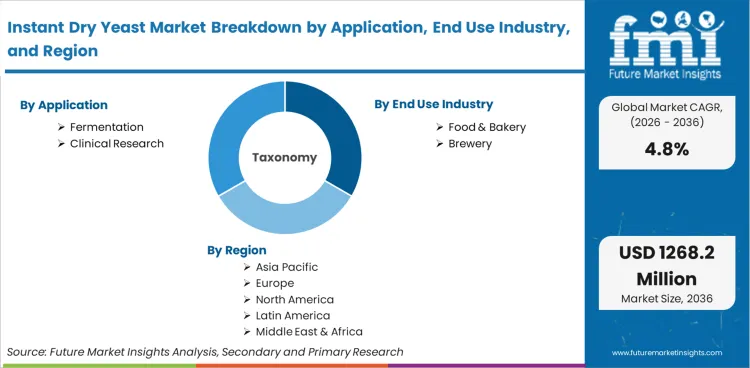
In 2025, the instant dry yeast market was valued at USD 756.7 million. Based on Future Market Insights' analysis, demand for instant dry yeast is estimated to grow to USD 793.5 million in 2026 and USD 1,268.2 million by 2036. FMI projects a CAGR of 4.8% during the forecast period.
Absolute dollar growth of USD 474.7 million over the decade reflects steady volume compounding driven by industrial bakery expansion in APAC and the rising craft brewing segment's shift toward specialized dry yeast formats. Angel Yeast commenced trial production at its new specialty yeast facility in Yichang in February 2026, utilizing ten-thousand-level microbiological controls that significantly surpass traditional baking yeast standards, demonstrating the technical upgrade trajectory underway in the sector. [2]
Summary of Instant Dry Yeast Market
- Instant Dry Yeast Market Definition
- The market covers globally traded active Saccharomyces cerevisiae in granular or powder instant form, serving industrial bakery, craft brewery, and fermentation applications across B2B and B2C sales channels.
- Demand Drivers in the Market
- Industrial bakery expansion across China and India, where organized food processing formalization is standardizing on instant dry yeast formats for consistent leavening performance and extended shelf life versus fresh yeast.
- Craft brewing and specialty fermentation sector growth driving demand for osmotolerant and strain-specific instant dry yeast products commanding 20-40% premiums over standard baking grades.
- Lallemand's acquisition of AIT Ingredients from Moulins Soufflet in June 2025 and the Ohly Hutchinson facility in July 2025 expanding combined enzyme and yeast portfolio capabilities for technical bakery and fermentation markets. [3]
- Key Segments Analyzed in the FMI Report
- Application: Fermentation holds 72.4% of total application share in 2026, covering industrial bread, brewery, and bioethanol fermentation uses.
- End Use Industry: Food & Bakery holds 84.6% of end use volume in 2026, reflecting the dominant role of industrial baking in global yeast consumption.
- Sales Channel: B2B accounts for 63.2% of total channel value, consistent with the institutional procurement structure of industrial bakery and brewery customers.
- Analyst Opinion at FMI
- Nandini Roy Choudhury, Principal Consultant for Food & Beverage Industry at Future Market Insights, opines, "In the updated version of the Instant Dry Yeast Market Report for 2026 to 2036, CXOs will find that the market's steady 4.8% CAGR conceals two structural pressures that boards need to address now. First, the pace of acquisition activity by Lallemand, AB Mauri, and Angel Yeast is concentrating market share among fewer, more vertically integrated producers at a rate that will structurally disadvantage underfunded independent processors within three to five years. Second, the transition of fermentation technology toward ten-thousand-level microbiological control standards, as demonstrated by Angel Yeast's new Yichang facility, is raising the minimum viable technical specification for industrial contracts, creating a qualification barrier that many legacy plants cannot meet without substantial capital investment."
- Strategic Implications / Executive Takeaways
- Evaluate partnership or licensing arrangements with specialty strain developers in the craft brewing and bioethanol segments, where volume growth exceeds standard baking grade trajectories by 200-300 basis points.
- Invest in microbiological control infrastructure upgrades to meet evolving industrial contract specifications, as the technical bar set by Angel Yeast's ten-thousand-level facility is expected to become the industry standard by 2028.
- Assess exposure to supply consolidation risks as Lallemand's two acquisitions in 2025 effectively reduce the number of independent European production sites available for spot and short-term procurement.
- Methodology
- Validated through primary interviews with yeast plant managers, industrial bakery procurement specialists, and brewery technical directors across major markets.
- Supported by producer annual report capacity data, UN Comtrade fermentation ingredient trade statistics, and industry association publications.
- Zero reliance on speculative third-party market research reports; all forecasts anchored in verifiable production capacity and confirmed commercial developments.
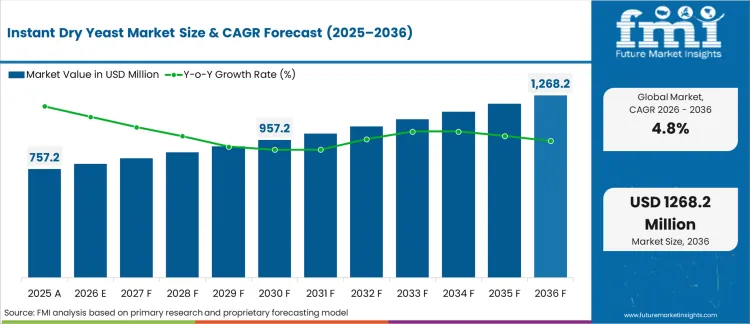
As Li Ku, General Manager of Angel Yeast's Protein Center, noted regarding the sector's evolution, 'As global priorities continue to shift toward health, nutrition, and sustainability, we see unprecedented market potential for yeast protein.' [2]
China leads growth at 3.7% CAGR, driven by expanding industrial bakery capacity and the government's push for domestic fermentation ingredient self-sufficiency. India grows at 2.8%, supported by expanding organized bakery retail and food processing sector formalization. The United States, representing USD 282.6 million in 2026, grows at 2.3% as the market matures, with incremental volume from craft brewing and specialty fermentation applications. Fermentation applications hold 72.4% of total usage, while Food & Bakery end use accounts for 84.6% of volume, confirming the segment's dominant role in industrial bread and baked goods manufacturing globally.
Instant Dry Yeast Market Definition
The instant dry yeast market comprises the global production, trade, and industrial supply of active Saccharomyces cerevisiae strains processed into granular or powder form with moisture content below 8%, designed for direct incorporation into bakery formulations without prior rehydration. The market covers both standard instant dry yeast strains for bread, roll, and bun manufacturing, and specialty osmotolerant, frozen-dough, and high-sugar-tolerant strains for industrial and artisanal baking applications. Fermentation-grade instant dry yeast for brewery, bioethanol, and fermentation research applications is included within scope.
Instant Dry Yeast Market Inclusions
The report includes comprehensive global and regional market sizing by volume and value with a 10-year forecast from 2026 to 2036. Coverage includes segmental analysis by application (Fermentation, Clinical Research), end use industry (Food & Bakery, Brewery), and sales channel (B2B, B2C). Country-level CAGR analysis includes the United States, China, and India, with regional breakdowns across North America, Europe, and APAC. Pricing dynamics, strain type differentiation, and packaging format shifts are incorporated alongside channel analysis.
Instant Dry Yeast Market Exclusions
The scope excludes fresh compressed yeast and active dry yeast formats requiring rehydration prior to use unless commercially positioned as direct substitutes. Liquid yeast cultures for laboratory and pharmaceutical fermentation, yeast extracts and autolysates for flavoring applications, and nutritional yeast products for consumer health markets are outside scope. Downstream finished bakery goods and brewed beverages are excluded from market sizing.
Instant Dry Yeast Market Research Methodology
- Primary Research: Structured interviews were conducted with yeast production plant managers, industrial bakery procurement specialists, brewery technical directors, food ingredient distributors, and fermentation scientists across North America, Europe, and Asia-Pacific, with emphasis on strain specification requirements and B2B supply contract structures.
- Desk Research: Production capacity data from yeast manufacturers' annual reports and plant investment disclosures, UN Comtrade trade data under relevant HS codes, and industry association publications from the International Federation of Bakers and national bread industry bodies supported volume benchmarking.
- Market-Sizing and Forecasting: A hybrid bottom-up and top-down model reconstructed demand from industrial bakery output data, per capita bread consumption rates by region, craft brewing volume trajectories, and fermentation industry growth projections, validated against plant-level production capacity and known major contract structures.
- Data Validation and Update Cycle: Outputs underwent cross-validation through variance analysis against reported revenue by major producers, anomaly screening for outlier regional trajectories, and structured review by food science and fermentation industry advisors prior to publication.
Key Industry Highlights
Rising adoption of instant dry yeast enhancing bakery efficiency and product quality
The instant dry yeast sector is experiencing dynamic growth, which results from various key factors and tendencies. This has made it a favorite for local bakeries around the world because of its practicality.
The use of this type of yeast helps to reduce the fermentation period in bakeries and improves their product quality as well as standardization of the production process. This makes proofing unnecessary thus reducing labor costs and making it possible for the bakery to respond to orders promptly.
Instant Dry Yeast also improves volume, texture, and smell in bakery products thereby resulting in a final desirable outcome that satisfies consumers’ preferences for freshness and taste. Its longer shelf life compared to fresh yeast reduces wastage and operational costs and, therefore, is cost-effective among smaller bakeries. In addition, using this kind of yeast not only allows local bakeries to broaden their range of products but also increases their efficiency making them able to provide customers with convenient baked goods, which are demanded nowadays.
The shift towards instant dry yeast enhances efficiency and quality in baking
Modern baking practices are showing a preference for products over active dry yeast due to a variety of advantages. One good aspect is that unlike active dry yeast, which needs proofing in warm water, instant dry yeast can be added directly to the other ingredients, saving time and making baking easier. This not only makes it cheap but also enables quick response by bakeries to production demands.
In addition, its shelf life is longer, and it handles temperature variations better than other types of yeasts hence more consistent results and less wastage. Bread, pastries, and pizza are some baked products whose volume and texture can be improved using instant yeast. By having fast fermentation abilities its rising times might be shortened enabling quicker production cycles without affecting the flavor or quality.
Therefore it suits both large-scale bakeries as well as home bakers who need better consistency with their end products while at the same time avoiding any poor results. It sets itself apart as a safety option compared to traditional active dry yeast due to efficiency’s place in the baking industry coupled with quality improvements among other things that have made many consider shifting from their use to this kind of product.
Customization in bakery ingredients meeting diverse demands with precision
The focus by manufacturers is increasingly on coming up with customizable bakery ingredients to suit the diverse demands across different formulations. This way, bakeries can have their baked products meet specific criteria without having to compromise quality and efficiency. When formulating, companies also consider how easy it is for the dough to be handled, fermentation time, and other stages of production including the final texture of a product or flavor profile.
These include various specialized types of yeast meant to improve performance under varied conditions such as found in specialty breads and pastries with high sugar levels or low salt levels. The customization process involves extensive research and development aimed at optimizing ingredient blends, which should cater to the unique needs of different bakery products while still guaranteeing uniformity and dependability in manufacturing lines.
In light of healthier lifestyle trends among consumers who are more discerning now, the possibility to tailor bakery ingredients including instant dry yeast becomes crucial in fostering innovations as well as reaching out to market requirements easily.
2021 to 2025 Global Instant Dry Yeast Sales Analysis Compared to Demand Forecasts for 2026 to 2036
Global instant dry yeast sales increased at a CAGR of 4.7% from 2021 to 2026. For the next ten years (2026 to 2036), projections are that the value will rise at 5.1% CAGR.
According to the new data the instant dry yeast industry is anticipated to show prosperous growth in the next ten years, due to the rising trend of making of flavourful bakery products at home.
As more consumers are actively looking for quality ingredients this will encourage the manufacturers to enhance their production and help the end user industries to fortify their products with quality ingredients.
Moreover, innovations and the increasing use of yeast in breweries to make better compositions have significantly impacted the global business landscape in the recent few years. Strong fermentation applications of products are creating a demand in the production of breweries like wine and beer, which are consumed in high amounts across the globe.
Market Concentration
The industry is characterized by a two-tier structure, which includes both organized and unorganized players. Leading companies such as AB Mauri Food Inc., Lesaffre, Fleischmann's Yeast, Angel Yeast Co, LALLEMAND Inc., and some other players dominate the organized segment that accounts for 47% of sales in the industry.
Multinational corporations (MNCs) that have target segment revenue greater than 5 million USD belong to these groupings and they maintain their arena presence in this way because they have large volumes of production capacities, high-tech infrastructure, and various products.
These well-regulated players have strict distribution networks and can be found in every corner of the world thereby; resulting in huge penetration globally. Their modernized research labs, on the other hand, enhance innovations enabling them to introduce a range of products about changing trends among health-aware consumers who are conscious about their diet.
On the contrary, local participants with target segment revenue below 5 million USD from the unorganized part contribute up to 53% of total sales within this category. These smaller companies may lack global coverage but are vital for specific areas.
Working in a niche community allows them to offer particular goods fitted for diverse domestic preferences or specialized dietary needs. In many cases, these entities adjust quickly according to fads in consumer tastes which results in a unique product mix.
This makes sure that there is dynamism as well as competitiveness within the industry due to the existence of both big and small firms. This variety brings on board multiple developments along with a wide range of options being made available satisfying different customers across all regions worldwide. This means that the industry has good prospects given its innovative nature coupled with the growing trend towards healthier alternatives.
Country wise Insights
The following table shows the estimated growth rates of the top three countries. China and the USA are set to exhibit high consumption, and CAGRs of 2.3% and 3.7%, respectively, through 2036.
.webp "Top Country Growth Comparison Instant Dry Yeast Market Cagr (2026 2036)")
| Countries | CAGR 2026 to 2036 |
|---|---|
| United States | 2.3% |
| China | 3.7% |
| India | 2.8% |
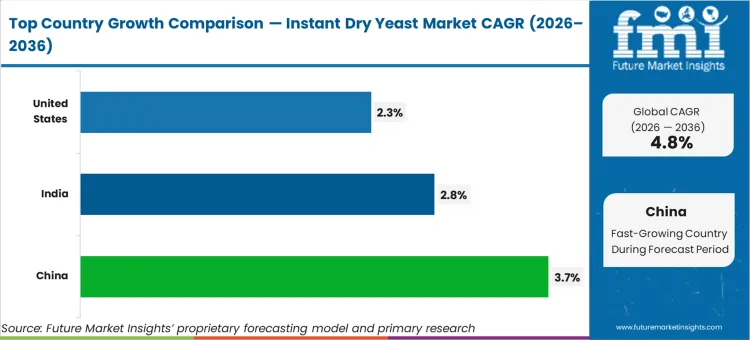
Several Key factors fuelling the market in the USA
Extensive research laboratories, diversified connectivity for the distribution of the products, continuous innovation in product development, a large consumer base of confectionary products like cake, pizza, and bread, and modern technology for advanced production are key factors that directly influence the business landscape across the United States.
Key players in the country are striving to increase their brand share. Consumers are willing to pay for quality premium products including bakery ingredients like yeast due to the high disposable income, to enjoy the mouth-feeling experience of a product along with its nutritional value.
A diversified network of the confectionary industry and high per capita consumption of flavorful and fortified confectionary products encourage the manufacturers to bring diversity and innovation. Several marketing strategies and product claims like “GMO-free” are attracting the attention of consumers in the USA.
Supply and demand combination helping the sales across Germany
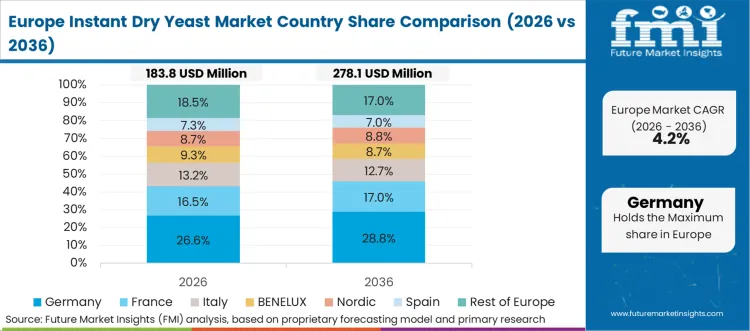
Demand for target products in Germany is expected to rise at a value CAGR of 4.2% during the forecast period (2026 to 2036). By 2036, Germany is calculated to account for 28.3% of sales in Europe.
The thriving bakery industry and potential baking and fermentation baking results of yeast are leveraging the instant dry yeast sector in Germany. Consumers want their artisanal baking experience to be better and better with the addition of quality components to their food.
Varieties that are coming with the latest product claims like gluten-free and organic dry yeast are gaining significant traction among consumers. A diversified logistics network and reachable regulations are helping the manufacturers boost their sales across the country. Furthermore, emerging brands come with clean-label alternatives to increase their market share across the country.
Category-wise Insights
Exploring the potential of yeast during the fermentation
| Segment | Fermentation (Application) |
|---|---|
| Value Share (2026) | 82.8% |
Instant dry yeast is known for its ability to have a low fermentation time as compared to the others and strong fermentation endurance. Small particle size and fast disolvation in dough, ready to use straightly while making bakery products are the several factors of product that help the overall process of fermentation. These factors are also leveraging the bakery product manufacturers to smoothen their production process and increase production capacity. Moreover, it also creates puffiness in bread, helps to enhance and maintain the stability of a dough increases the fermentation efficiency.
Global network of bakeries: driving the demand of instant dry yeast
| Segment | Food & Bakery (End User Industry) |
|---|---|
| Value Share (2026) | 73.4% |
Bakeries are utilizing consumer education and clever merchandising to increase the sales of products. They emphasize the ease of use and dependability of yeast products for home bakers by putting them on display next to baking necessities. To encourage experimentation and repeat purchases, several supermarkets provide recipe cards and online tutorials that highlight the versatility of yeast in a variety of baked foods.
To earn their customers' trust, bakeries also frequently suggest particular yeast brands that are renowned for their reliable quality and performance. Sales are further boosted by promotional discounts and bundle offerings throughout the busiest baking seasons and holidays. All things considered, bakeries take advantage of the fact that it is a basic component and use clever marketing techniques to raise consumer happiness and engagement.
Competition Outlook
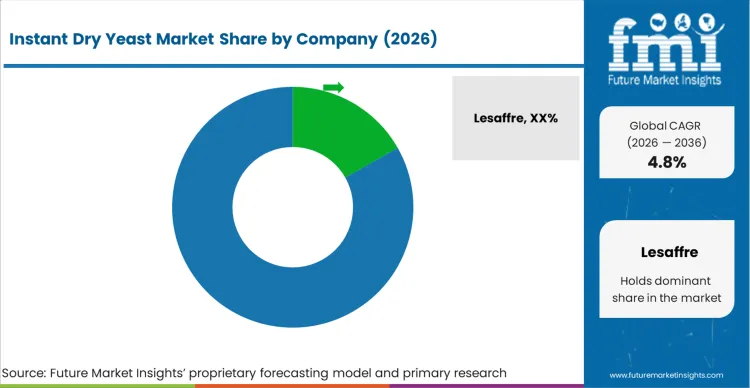
The instant dry yeast market is moderately concentrated, with Lesaffre holding an estimated 16.8% share in 2026, followed by AB Mauri, Lallemand, and Angel Yeast as the primary global competitors capable of serving large-scale industrial bakery contracts with consistent specification compliance. The market is undergoing rapid consolidation: Lallemand completed two material acquisitions in 2025 within a 42-day window, the AIT Ingredients transaction from Groupe InVivo in June and the Ohly Hutchinson yeast production facility in July, substantially expanding its enzyme-yeast integrated portfolio and geographic reach in Europe and Africa. [3] [4]
Lesaffre inaugurated a new yeast production plant in Indonesia in December 2025 and simultaneously opened an Industrial Baking Center in Shanghai, reinforcing its Asia-Pacific manufacturing and technical support infrastructure as the region's industrial bakery sector grows at above-global-average rates. [1] Angel Yeast's February 2026 commencement of trial production at its 8,500-ton specialty yeast facility in Yichang, combined with its November 2025 launch of an 11,000-ton yeast protein production line in Hubei, demonstrates a deliberate dual-track strategy of expanding both standard and high-value specialty yeast capacity simultaneously.
Buyer leverage remains moderate in the B2B segment given the technical specification requirements for industrial-grade strains and the logistical advantages of regional production proximity. Large bakery groups multi-source to manage supply dependency, but the geographic footprint required for just-in-time delivery restricts meaningful competition to the three or four producers with proximate manufacturing in each major consuming region.
Recent Developments
- September 2025: AB Mauri Lanka launched its new Prime Instant Dry Yeast in a 500g format, specifically designed for professional and home bakers in the Sri Lankan market. As part of the launch strategy, the company strengthened its distribution network by partnering with David Stores to ensure consistent availability of high-performance leavening agents across the region. [1]
- February 2026: Angel Yeast announced the commencement of trial production at its new specialty yeast facility in Yichang, China. The facility utilizes a high-precision manufacturing process with ten-thousand-level microbiological controls, significantly surpassing traditional baking yeast standards, allowing for the production of specialized dry yeast strains with higher value-added potential for diverse applications including craft brewing and fuel ethanol. [2]
- June 2025: Lallemand completed the acquisition of AIT Ingredients from Moulins Soufflet, a subsidiary of Groupe InVivo. This acquisition integrated AIT's expertise in enzymes and specialty ingredients with Lallemand's yeast production capabilities, expanding geographical reach in Europe and Africa while enhancing the portfolio of technical bakery solutions. [3]
Key Players in Instant Dry Yeast Market
- Lesaffre
- AB Mauri Food Inc.
- Fleischmann's Yeast
- Chr. Hansen Holding A/S
- Angel Yeast Co.
- ACH Foods
- LALLEMAND Inc.
- Imperial Yeast
- DCL Yeast Ltd.
- Agrano GmbH & Co. KG
- Leiber GmbH
Scope of the Report
| Metric | Value |
|---|---|
| Quantitative Units | USD 793.5 million (2026) to USD 1,268.2 million (2036), at a CAGR of 4.8% |
| Market Definition | The instant dry yeast market covers global production and trade of active Saccharomyces cerevisiae in granular or powder instant form, serving industrial bakery, craft brewery, and fermentation applications across B2B and B2C sales channels. |
| Application Segmentation | Fermentation, Clinical Research |
| End Use Industry Segmentation | Food & Bakery, Brewery |
| Sales Channel Segmentation | B2B, B2C |
| Regions Covered | North America, Latin America, Europe, East Asia, South Asia, Oceania, Middle East and Africa |
| Countries Covered | United States, China, India, Germany, France, United Kingdom, Japan, South Korea, Indonesia, Australia and 40 plus countries |
| Key Companies Profiled | Lesaffre, AB Mauri Food Inc., Fleischmann's Yeast, Chr. Hansen Holding A/S, Angel Yeast Co., ACH Foods, LALLEMAND Inc., Imperial Yeast, DCL Yeast Ltd., Agrano GmbH & Co. KG, Leiber GmbH |
| Forecast Period | 2026 to 2036 |
| Approach | Hybrid bottom-up and top-down market modeling validated through primary interviews with yeast plant managers and industrial bakery procurement specialists, supported by UN Comtrade fermentation ingredient trade data and producer capacity disclosures |
Instant Dry Yeast Market Analysis by Segments
Application:
- Fermentation (72.4% share, 2026)
- Clinical Research
End Use Industry:
- Food & Bakery (84.6% share, 2026)
- Brewery
Sales Channel:
- B2B (63.2% share, 2026)
- B2C
Region:
- North America: United States (USD 282.6M, 2026), Canada, Mexico
- Latin America: Brazil, Argentina, Chile, Rest of Latin America
- Europe: Germany, France, United Kingdom, Italy, Spain, Benelux, Nordics, Rest of Europe
- East Asia: China, Japan (USD 599.0M projected, 2036), South Korea
- South Asia: India, Indonesia, Malaysia, Thailand, Rest of South Asia
- Oceania: Australia, New Zealand
- Middle East & Africa: Saudi Arabia, UAE, South Africa, Rest of Middle East & Africa
Bibliography
- 1] AB Mauri Lanka / Lanka Talks. (2025). AB Mauri Lanka Recognises Longstanding Partnership with David Stores at Prime Yeast Launch. Industry Report, September 2025.
- [2] Angel Yeast Co., Ltd. (2026). Angel Yeast Launches 8,500-Ton Specialty Yeast Facility. Corporate Press Release, February 2026.
- [3] Lallemand Inc. (2025). Lallemand Successfully Acquires AIT Ingredients. Corporate Press Release, June 2025.
- [4] Lallemand Inc. / Ohly GmbH. (2025). Ohly and Lallemand Enter Strategic Partnership for Hutchinson Yeast Production Site. Corporate Press Release, July 2025.
- [5] Nutrition Insight. (2025). Angel Yeast Fermentation Protein: Baiyang Hubei Facility Launch. Industry News, November 2025.
This bibliography is provided for reader reference and is not exhaustive. The full report contains the complete reference list and detailed citations.
This Report Addresses
- Market intelligence to enable supply strategy and contract positioning decisions across industrial bakery, brewery, and fermentation application segments
- Market size estimation and 10-year revenue forecasts from 2026 to 2036, supported by producer capacity benchmarks and UN Comtrade fermentation trade data
- Growth opportunity mapping across standard baking, specialty osmotolerant, and fermentation-grade yeast formats with emphasis on high-value strain transitions
- Segment and regional revenue forecasts covering application, end use industry, and sales channel dimensions with country-level CAGR analysis
- Competition strategy assessment including consolidation impact analysis, acquisition activity tracking, and capacity footprint benchmarking by major producers
- Supply chain analysis covering production concentration risks, geographic proximity requirements, and impact of Lallemand and Angel Yeast expansion on regional pricing
- Regulatory impact analysis covering food-grade yeast standards, microbiological control requirements, and import classification across key markets
- Market report delivery in PDF, Excel, PPT, and interactive dashboard formats for executive and operational use
Frequently Asked Questions
How large is the demand for Instant Dry Yeast in the global market in 2026?
Demand for Instant Dry Yeast in the global market is estimated to be valued at USD 793.5 million in 2026.
What will be the market size of Instant Dry Yeast by 2036?
Market size for Instant Dry Yeast is projected to reach USD 1,268.2 million by 2036.
What is the expected CAGR for the Instant Dry Yeast market between 2026 and 2036?
Demand for Instant Dry Yeast is expected to grow at a CAGR of 4.8% between 2026 and 2036.
Which application leads the Instant Dry Yeast market in 2026?
Fermentation holds 72.4% of application share in 2026, encompassing industrial bread baking, brewery fermentation, and bioethanol production as the primary volume drivers.
Which end use industry dominates Instant Dry Yeast consumption?
Food & Bakery accounts for 84.6% of end use volume in 2026, reflecting the industrial bread and baked goods sector's dominant role in global yeast consumption.
Which sales channel holds the largest share?
B2B accounts for 63.2% of total channel value, consistent with the institutional procurement structure of industrial bakery groups and brewery operators.
What is driving Instant Dry Yeast demand in China?
China is projected to grow at a 3.7% CAGR, driven by expanding industrial bakery capacity, government fermentation ingredient self-sufficiency initiatives, and Angel Yeast's new specialty and protein yeast facilities in Hubei and Yichang.
What is the United States growth outlook in this report?
The United States represents USD 282.6 million in 2026 and is projected to grow at a 2.3% CAGR through 2036, with incremental volume from craft brewing specialty yeast and fermentation applications offsetting mature bread sector saturation.
What is the significance of recent acquisitions in the Instant Dry Yeast market?
Lallemand's two acquisitions in 2025 and AB Mauri's Omega Yeast Labs acquisition are concentrating production and technical capabilities among fewer, larger players, raising the minimum scale required to compete for major industrial bakery and brewery contracts.
How does FMI validate its Instant Dry Yeast forecast?
Forecast is developed using hybrid bottom-up and top-down modeling validated through primary interviews with yeast plant managers, UN Comtrade fermentation trade data, and producer annual report capacity disclosures.
Preview the report firsthand - request a free sample
Get SampleGet the brochure for pricing and purchase details.
Get PDFTable of Content
- Executive Summary
- Global Market Outlook
- Demand-side Trends
- Supply-side Trends
- Technology Roadmap Analysis
- Analysis and Recommendations
- Market Overview
- Market Coverage / Taxonomy
- Market Definition / Scope / Limitations
- Research Methodology
- Chapter Orientation
- Analytical Lens and Working Hypotheses
- Market Structure, Signals, and Trend Drivers
- Benchmarking and Cross-market Comparability
- Market Sizing, Forecasting, and Opportunity Mapping
- Research Design and Evidence Framework
- Desk Research Programme (Secondary Evidence)
- Company Annual and Sustainability Reports
- Peer-reviewed Journals and Academic Literature
- Corporate Websites, Product Literature, and Technical Notes
- Earnings Decks and Investor Briefings
- Statutory Filings and Regulatory Disclosures
- Technical White Papers and Standards Notes
- Trade Journals, Industry Magazines, and Analyst Briefs
- Conference Proceedings, Webinars, and Seminar Materials
- Government Statistics Portals and Public Data Releases
- Press Releases and Reputable Media Coverage
- Specialist Newsletters and Curated Briefings
- Sector Databases and Reference Repositories
- FMI Internal Proprietary Databases and Historical Market Datasets
- Subscription Datasets and Paid Sources
- Social Channels, Communities, and Digital Listening Inputs
- Additional Desk Sources
- Expert Input and Fieldwork (Primary Evidence)
- Primary Modes
- Qualitative Interviews and Expert Elicitation
- Quantitative Surveys and Structured Data Capture
- Blended Approach
- Why Primary Evidence is Used
- Field Techniques
- Interviews
- Surveys
- Focus Groups
- Observational and In-context Research
- Social and Community Interactions
- Stakeholder Universe Engaged
- C-suite Leaders
- Board Members
- Presidents and Vice Presidents
- R&D and Innovation Heads
- Technical Specialists
- Domain Subject-matter Experts
- Scientists
- Physicians and Other Healthcare Professionals
- Governance, Ethics, and Data Stewardship
- Research Ethics
- Data Integrity and Handling
- Primary Modes
- Tooling, Models, and Reference Databases
- Desk Research Programme (Secondary Evidence)
- Data Engineering and Model Build
- Data Acquisition and Ingestion
- Cleaning, Normalisation, and Verification
- Synthesis, Triangulation, and Analysis
- Quality Assurance and Audit Trail
- Market Background
- Market Dynamics
- Drivers
- Restraints
- Opportunity
- Trends
- Scenario Forecast
- Demand in Optimistic Scenario
- Demand in Likely Scenario
- Demand in Conservative Scenario
- Opportunity Map Analysis
- Product Life Cycle Analysis
- Supply Chain Analysis
- Investment Feasibility Matrix
- Value Chain Analysis
- PESTLE and Porter’s Analysis
- Regulatory Landscape
- Regional Parent Market Outlook
- Production and Consumption Statistics
- Import and Export Statistics
- Market Dynamics
- Global Market Analysis 2021 to 2025 and Forecast, 2026 to 2036
- Historical Market Size Value (USD Million) Analysis, 2021 to 2025
- Current and Future Market Size Value (USD Million) Projections, 2026 to 2036
- Y-o-Y Growth Trend Analysis
- Absolute $ Opportunity Analysis
- Global Market Pricing Analysis 2021 to 2025 and Forecast 2026 to 2036
- Global Market Analysis 2021 to 2025 and Forecast 2026 to 2036, By Application
- Introduction / Key Findings
- Historical Market Size Value (USD Million) Analysis By Application , 2021 to 2025
- Current and Future Market Size Value (USD Million) Analysis and Forecast By Application , 2026 to 2036
- Fermentation
- Clinical Research
- Fermentation
- Y-o-Y Growth Trend Analysis By Application , 2021 to 2025
- Absolute $ Opportunity Analysis By Application , 2026 to 2036
- Global Market Analysis 2021 to 2025 and Forecast 2026 to 2036, By End Use Industry
- Introduction / Key Findings
- Historical Market Size Value (USD Million) Analysis By End Use Industry, 2021 to 2025
- Current and Future Market Size Value (USD Million) Analysis and Forecast By End Use Industry, 2026 to 2036
- Food & Bakery
- Brewery
- Food & Bakery
- Y-o-Y Growth Trend Analysis By End Use Industry, 2021 to 2025
- Absolute $ Opportunity Analysis By End Use Industry, 2026 to 2036
- Global Market Analysis 2021 to 2025 and Forecast 2026 to 2036, By Sales Channel
- Introduction / Key Findings
- Historical Market Size Value (USD Million) Analysis By Sales Channel, 2021 to 2025
- Current and Future Market Size Value (USD Million) Analysis and Forecast By Sales Channel, 2026 to 2036
- B2B
- B2C
- B2B
- Y-o-Y Growth Trend Analysis By Sales Channel, 2021 to 2025
- Absolute $ Opportunity Analysis By Sales Channel, 2026 to 2036
- Global Market Analysis 2021 to 2025 and Forecast 2026 to 2036, By Region
- Introduction
- Historical Market Size Value (USD Million) Analysis By Region, 2021 to 2025
- Current Market Size Value (USD Million) Analysis and Forecast By Region, 2026 to 2036
- North America
- Latin America
- Western Europe
- Eastern Europe
- East Asia
- South Asia and Pacific
- Middle East & Africa
- Market Attractiveness Analysis By Region
- North America Market Analysis 2021 to 2025 and Forecast 2026 to 2036, By Country
- Historical Market Size Value (USD Million) Trend Analysis By Market Taxonomy, 2021 to 2025
- Market Size Value (USD Million) Forecast By Market Taxonomy, 2026 to 2036
- By Country
- USA
- Canada
- Mexico
- By Application
- By End Use Industry
- By Sales Channel
- By Country
- Market Attractiveness Analysis
- By Country
- By Application
- By End Use Industry
- By Sales Channel
- Key Takeaways
- Latin America Market Analysis 2021 to 2025 and Forecast 2026 to 2036, By Country
- Historical Market Size Value (USD Million) Trend Analysis By Market Taxonomy, 2021 to 2025
- Market Size Value (USD Million) Forecast By Market Taxonomy, 2026 to 2036
- By Country
- Brazil
- Chile
- Rest of Latin America
- By Application
- By End Use Industry
- By Sales Channel
- By Country
- Market Attractiveness Analysis
- By Country
- By Application
- By End Use Industry
- By Sales Channel
- Key Takeaways
- Western Europe Market Analysis 2021 to 2025 and Forecast 2026 to 2036, By Country
- Historical Market Size Value (USD Million) Trend Analysis By Market Taxonomy, 2021 to 2025
- Market Size Value (USD Million) Forecast By Market Taxonomy, 2026 to 2036
- By Country
- Germany
- UK
- Italy
- Spain
- France
- Nordic
- BENELUX
- Rest of Western Europe
- By Application
- By End Use Industry
- By Sales Channel
- By Country
- Market Attractiveness Analysis
- By Country
- By Application
- By End Use Industry
- By Sales Channel
- Key Takeaways
- Eastern Europe Market Analysis 2021 to 2025 and Forecast 2026 to 2036, By Country
- Historical Market Size Value (USD Million) Trend Analysis By Market Taxonomy, 2021 to 2025
- Market Size Value (USD Million) Forecast By Market Taxonomy, 2026 to 2036
- By Country
- Russia
- Poland
- Hungary
- Balkan & Baltic
- Rest of Eastern Europe
- By Application
- By End Use Industry
- By Sales Channel
- By Country
- Market Attractiveness Analysis
- By Country
- By Application
- By End Use Industry
- By Sales Channel
- Key Takeaways
- East Asia Market Analysis 2021 to 2025 and Forecast 2026 to 2036, By Country
- Historical Market Size Value (USD Million) Trend Analysis By Market Taxonomy, 2021 to 2025
- Market Size Value (USD Million) Forecast By Market Taxonomy, 2026 to 2036
- By Country
- China
- Japan
- South Korea
- By Application
- By End Use Industry
- By Sales Channel
- By Country
- Market Attractiveness Analysis
- By Country
- By Application
- By End Use Industry
- By Sales Channel
- Key Takeaways
- South Asia and Pacific Market Analysis 2021 to 2025 and Forecast 2026 to 2036, By Country
- Historical Market Size Value (USD Million) Trend Analysis By Market Taxonomy, 2021 to 2025
- Market Size Value (USD Million) Forecast By Market Taxonomy, 2026 to 2036
- By Country
- India
- ASEAN
- Australia & New Zealand
- Rest of South Asia and Pacific
- By Application
- By End Use Industry
- By Sales Channel
- By Country
- Market Attractiveness Analysis
- By Country
- By Application
- By End Use Industry
- By Sales Channel
- Key Takeaways
- Middle East & Africa Market Analysis 2021 to 2025 and Forecast 2026 to 2036, By Country
- Historical Market Size Value (USD Million) Trend Analysis By Market Taxonomy, 2021 to 2025
- Market Size Value (USD Million) Forecast By Market Taxonomy, 2026 to 2036
- By Country
- Kingdom of Saudi Arabia
- Other GCC Countries
- Turkiye
- South Africa
- Other African Union
- Rest of Middle East & Africa
- By Application
- By End Use Industry
- By Sales Channel
- By Country
- Market Attractiveness Analysis
- By Country
- By Application
- By End Use Industry
- By Sales Channel
- Key Takeaways
- Key Countries Market Analysis
- USA
- Pricing Analysis
- Market Share Analysis, 2025
- By Application
- By End Use Industry
- By Sales Channel
- Canada
- Pricing Analysis
- Market Share Analysis, 2025
- By Application
- By End Use Industry
- By Sales Channel
- Mexico
- Pricing Analysis
- Market Share Analysis, 2025
- By Application
- By End Use Industry
- By Sales Channel
- Brazil
- Pricing Analysis
- Market Share Analysis, 2025
- By Application
- By End Use Industry
- By Sales Channel
- Chile
- Pricing Analysis
- Market Share Analysis, 2025
- By Application
- By End Use Industry
- By Sales Channel
- Germany
- Pricing Analysis
- Market Share Analysis, 2025
- By Application
- By End Use Industry
- By Sales Channel
- UK
- Pricing Analysis
- Market Share Analysis, 2025
- By Application
- By End Use Industry
- By Sales Channel
- Italy
- Pricing Analysis
- Market Share Analysis, 2025
- By Application
- By End Use Industry
- By Sales Channel
- Spain
- Pricing Analysis
- Market Share Analysis, 2025
- By Application
- By End Use Industry
- By Sales Channel
- France
- Pricing Analysis
- Market Share Analysis, 2025
- By Application
- By End Use Industry
- By Sales Channel
- India
- Pricing Analysis
- Market Share Analysis, 2025
- By Application
- By End Use Industry
- By Sales Channel
- ASEAN
- Pricing Analysis
- Market Share Analysis, 2025
- By Application
- By End Use Industry
- By Sales Channel
- Australia & New Zealand
- Pricing Analysis
- Market Share Analysis, 2025
- By Application
- By End Use Industry
- By Sales Channel
- China
- Pricing Analysis
- Market Share Analysis, 2025
- By Application
- By End Use Industry
- By Sales Channel
- Japan
- Pricing Analysis
- Market Share Analysis, 2025
- By Application
- By End Use Industry
- By Sales Channel
- South Korea
- Pricing Analysis
- Market Share Analysis, 2025
- By Application
- By End Use Industry
- By Sales Channel
- Russia
- Pricing Analysis
- Market Share Analysis, 2025
- By Application
- By End Use Industry
- By Sales Channel
- Poland
- Pricing Analysis
- Market Share Analysis, 2025
- By Application
- By End Use Industry
- By Sales Channel
- Hungary
- Pricing Analysis
- Market Share Analysis, 2025
- By Application
- By End Use Industry
- By Sales Channel
- Kingdom of Saudi Arabia
- Pricing Analysis
- Market Share Analysis, 2025
- By Application
- By End Use Industry
- By Sales Channel
- Turkiye
- Pricing Analysis
- Market Share Analysis, 2025
- By Application
- By End Use Industry
- By Sales Channel
- South Africa
- Pricing Analysis
- Market Share Analysis, 2025
- By Application
- By End Use Industry
- By Sales Channel
- USA
- Market Structure Analysis
- Competition Dashboard
- Competition Benchmarking
- Market Share Analysis of Top Players
- By Regional
- By Application
- By End Use Industry
- By Sales Channel
- Competition Analysis
- Competition Deep Dive
- Lesaffre
- Overview
- Product Portfolio
- Profitability by Market Segments (Product/Age /Sales Channel/Region)
- Sales Footprint
- Strategy Overview
- Marketing Strategy
- Product Strategy
- Channel Strategy
- AB Mauri Food Inc.
- Fleischmann's Yeast
- Chr. Hansen Holding A/S
- Angel Yeast Co.
- ACH Foods
- LALLEMAND Inc.
- Imperial Yeast
- DCL Yeast Ltd.
- Agrano GmbH & Co. KG
- Leiber GmbH
- Lesaffre
- Competition Deep Dive
- Assumptions & Acronyms Used


