

- Industry Size (2026)
- USD 23.89 Bn
- Forecast (2036)
- USD 82.5 Bn
- CAGR (2026 to 2036)
- 13.2%
Pharmacy Dark Store Market Size, Market Forecast and Outlook By FMI
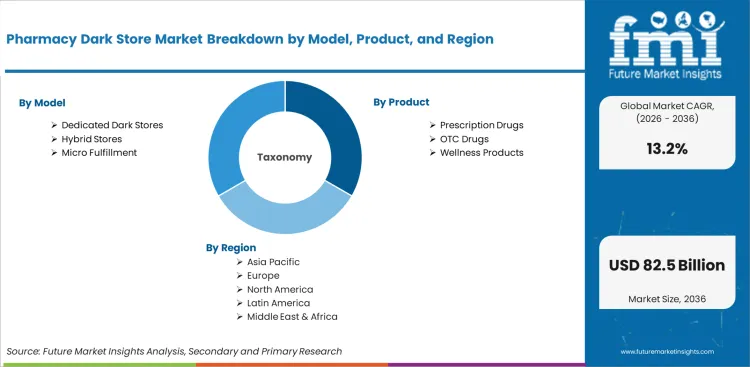
The pharmacy dark store market was valued at USD 21.1 billion in 2025. Demand is set to hit USD 23.89 billion in 2026 at a CAGR of 13.2% during forecast period. Industry valuation is expected to reach USD 82.5 billion through 2036 as inventory positioning physically shifts from centralized distribution hubs to hyper-local urban nodes requiring sub-hour fulfillment capabilities.
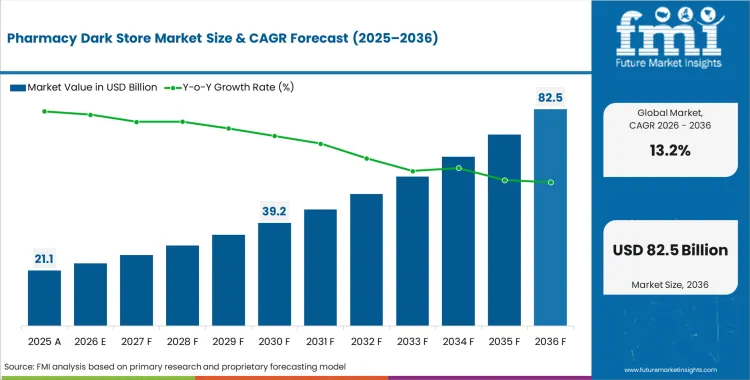
Summary of Pharmacy Dark Store Market
- Pharmacy Dark Store Market Definition
- Hyper-local healthcare delivery networks combining licensed pharmaceutical dispensing with decentralized inventory nodes. Infrastructure specifically supports sub-hour transit requirements.
- Demand Drivers in the Market
- Chronic illness demographic shifts force clinic operations managers to establish reliable home-delivery protocols.
- Urban traffic congestion compels regional health systems to bypass patient travel entirely.
- Patient expectations dictate retail pharmacy directors match delivery speeds established by grocery competitors.
- Key Segments Analyzed in the FMI Report
- Dedicated Dark Stores: This segment is projected to hold 62.0% share in 2026, leveraging minimal real estate costs per square foot compared to retail frontage.
- Prescription Drugs: This segment is anticipated to account for 54.0% share in 2026, driven by chronic medication recurring revenue streams.
- On-demand Delivery: This segment is estimated to capture 58.0% share in 2026, satisfying immediate acute care requirements.
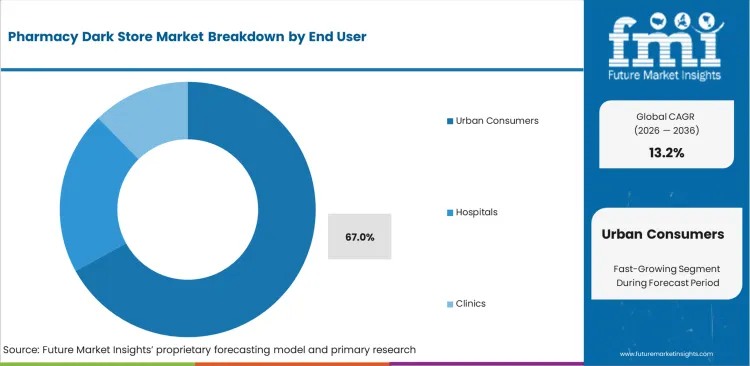
- Urban Consumers: This segment is set to record 67.0% share in 2026, reflecting high residential density necessary for route profitability.
- Inventory Systems: This segment is expected to garner 49.0% share in 2026, forming foundational infrastructure for multi-node stock balancing.
- China: China exhibits 14.2% compound growth, reflecting rapid middle-class adoption of digital healthcare platforms.
- Analyst Opinion at FMI
- Anurag Sharma, Principal Analyst, Healthcare, at FMI, points out, "Healthcare executives assume rapid delivery merely adds convenience to standard pharmacy operations. Actually, sub-hour fulfillment fundamentally alters patient adherence patterns. A patient leaving a telehealth appointment receiving a thirty-minute delivery window guarantees prescription capture before intent fades. Procurement directors measuring only logistics costs completely miss the impact of speed on script abandonment rates. The real metric isn't delivery expense; the metric involves captured revenue previously evaporating between the clinic and the physical retail counter."
- Strategic Implications / Executive Takeaways
- Chief pharmacy officers must transition real estate strategies from high-visibility corners to high-accessibility industrial spaces.
- Clinical trial coordinators require cold-chain validated rapid transit maintaining decentralized study protocols.
- Health plan administrators benefit from increased medication adherence eliminating transit friction for elderly members.
- Methodology
- FMI maps physical footprint data against prescription density establishing baseline capacity metrics.
- Regional courier dispatch rates cross-reference claimed platform growth figures.
- Pharmaceutical board licensing data tracks legitimate conversion of retail space into dark store infrastructure.
- Cold-chain packaging procurement volumes validate high-value biological fulfillment claims.
Pharmacy Dark Store Market Key Takeaways
| Metric | Details |
|---|---|
| Industry Size (2026) | USD 23.89 billion |
| Industry Value (2036) | USD 82.5 Billion |
| CAGR (2026-2036) | 13.2% |
Source: Future Market Insights (FMI) analysis, based on proprietary forecasting model and primary research
Pharmacy operations are currently under intense pressure concerning the delivery timelines for chronic medications. The traditional expectation of next-day shipping for maintenance drugs is now unacceptable to patients, as they are accustomed to receiving everyday retail purchases within as little as thirty minutes. A failure to invest in the necessary infrastructure immediately poses a significant risk of losing high-lifetime-value patients to competitors who have already adopted a digital-first operating model. A crucial, yet often overlooked, challenge lies in cold-chain validation. Successfully maintaining strict temperature compliance throughout a thirty-minute transit period demands vastly different packaging solutions compared to the requirements for overnight shipping. This fundamental change forces procurement teams to engage with entirely new vendor ecosystems, such as specialized dark store operators who are equipped to handle these rapid, temperature-controlled logistics.
By directly integrating dispensing software with local gig-fleet APIs, regional pharmacy chains are achieving exponential scaling of localized fulfillment. This strategic integration is key, converting the formerly variable nature of courier availability into a highly predictable logistics capacity. Advanced dispatch algorithms precisely synchronize compounding time with courier arrival, completely eliminating costly wait times. This efficiency dramatically improves unit economics and customer satisfaction, establishing a robust, on-demand delivery model crucial for modern healthcare logistics.
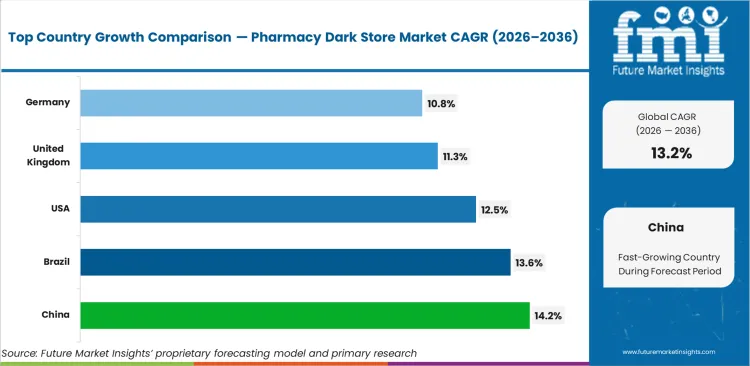
Developed nations are experiencing growth through market consolidation, while emerging regions are seeing expansion driven by pure-play digital startups. China expands at 14.2% CAGR driven by deep digital health ecosystem integration. Brazil shows 13.6% CAGR amid shifting consumer demographics. United States records 12.5% CAGR as incumbent retail giants retrofit physical footprints. United Kingdom hits 11.3% CAGR alongside Germany growing at 10.8% CAGR. Structural divergence separates emerging regions relying on pure-play digital startups from developed nations transitioning through consolidation.
Pharmacy Dark Store Market Definition
The pharmacy dark store market constitutes hyper-local healthcare delivery infrastructure built for sub-hour fulfillment of medicinal products. Functional boundaries require pharmaceutical dispensing licenses combined with decentralized micro-warehousing specifically organized for rapid courier dispatch rather than walk-in retail. Pure courier services delivering from traditional pharmacies fall outside this boundary.
Pharmacy Dark Store Market Inclusions
Scope captures licensed digital pharmacies operating localized fulfillment centers, specialized pharmacy delivery software, and integrated temperature-controlled dispatch systems. Operations utilizing automated fulfillment platforms and dedicated transit fleets for medical goods represent core inclusive categories.
Pharmacy Dark Store Market Exclusions
Standard overnight mail-order pharmacies fall outside scope due to incompatibility with sub-hour fulfillment requirements. Third-party restaurant delivery applications executing occasional pharmacy pickups without native HIPAA compliance or cold-chain validation systems are similarly excluded.
Pharmacy Dark Store Market Research Methodology
- Primary Research: Pharmacy fulfillment directors, clinical operations managers, and cold-chain logistics procurement officers.
- Desk Research: National pharmacy board licensing registries, commercial real estate transaction records for urban warehousing, and pharmaceutical temperature compliance filings.
- Market-Sizing and Forecasting: Dark store square footage mapped against regional prescription volume density.
- Data Validation and Update Cycle: Independent gig-economy courier healthcare transit data cross-validates regional fulfillment volume forecasts.
Segmental Analysis
Pharmacy Dark Store Market Analysis by Model
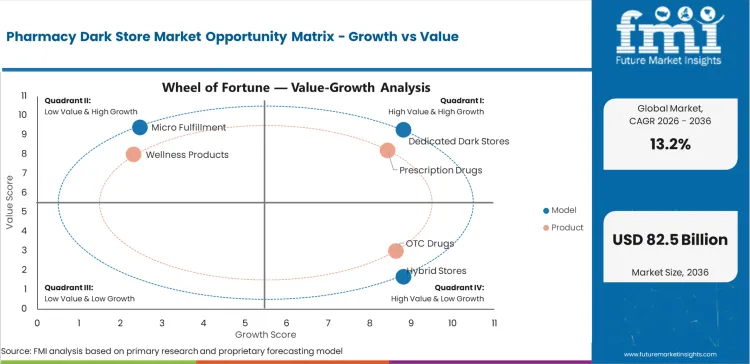
Real estate economics dictate the spatial layout of urban centers. Dedicated dark stores segment is projected to hold a 62.0% market share in 2026, driven by high retail frontage costs making consumer walk-in sales less profitable. According to FMI, facility managers are completely removing merchandising displays, which cuts the required footprint in half and triples pick-path efficiency. Operations directors adopting this model are achieving higher order volumes per labor hour. While casual observers might see dark stores as merely hidden inventory, industry professionals recognize them as localized assembly lines demanding fundamentally different labor models. Brands that attempt hybrid models often fail because splitting staff attention between online orders and physical customers simultaneously compromises both experiences. Furthermore, sub-segment analysis suggests that micro fulfillment centers necessitate entirely distinct automation strategies.
- Pick-path optimization: Stripping retail elements allows industrial engineers to route pickers dynamically. Facility managers achieve triple-digit hourly fulfillment rates.
- Zoning regulations: Commercial property classifications restrict heavy fulfillment activities in residential zones. Expansion directors face lengthy variance hearings.
- Lease arbitrage: Securing secondary industrial space slashes fixed overhead. Real estate officers gain leverage over prime retail competitors.
Pharmacy Dark Store Market Analysis by Product
pharmacy-dark-store-market-opportunity-matrix-growth-vs-value
The digital health sector relies on chronic conditions to drive recurring revenue models. Compliance directors are under significant regulatory scrutiny concerning digital identity verification. Utilizing biometric handoffs addresses controlled substance regulations while preserving transit efficiency. The prescription drugs segment, contributing 54.0% of the market share in 2026, achieved stable, long-term cash flow through these consistent medication revenue streams. FMI notes that high-margin biologicals necessitate that procurement teams commit to specialized advanced cold-chain vendors. Simple unit-cost comparisons overlook the fact that specialized courier training, not inventory capacity, is the actual limiting factor for platform scalability. Competitors who postpone integrating pharmacy automation are experiencing escalating error rates during periods of high demand.
- Biological cold-chain: Temperature-sensitive medications require active cooling during transit. Procurement managers must secure specialized packaging contracts.
- Identity verification: Controlled substances mandate strict chain of custody. Compliance officers deploy digital signature protocols preventing diversion.
- Adherence tracking: Digital fulfillment systems log exact delivery times. Clinical coordinators utilize timestamps measuring patient compliance accurately.
Pharmacy Dark Store Market Analysis by Delivery Type
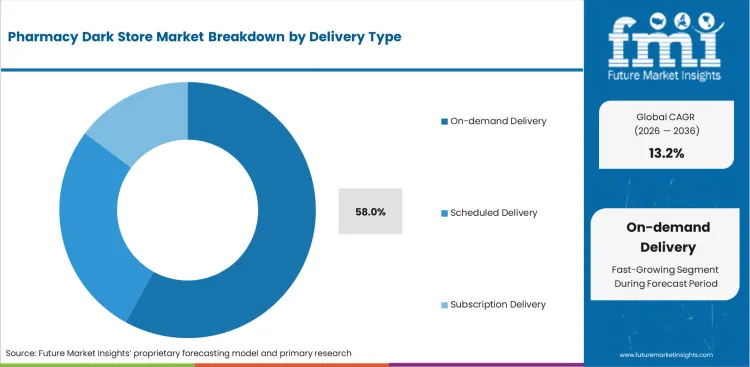
Urgent medical needs necessitate immediate action, bypassing standard transit times. Fleet managers must continuously strike a balance between ensuring courier availability and minimizing costs associated with idle time. Unit profitability is ultimately determined by route density; falling below critical levels can instantly eliminate profit margins. FMI research shows that platforms heavily subsidize initial on-demand routes. While external observers assume consumers pay a premium for speed, industry insiders understand that platforms entirely absorb transit costs to acquire high-lifetime-value patients. The on-demand delivery segment holds 58.0% market share in 2026, primarily driven by immediate acute care requirements. Operators who delay investing in route optimization risk draining venture capital rapidly during periods of geographic expansion. Successful last mile delivery relies on advanced algorithmic dispatching.
- Algorithm dispatch: Dynamic routing assigns orders based on current courier trajectory. Fleet managers reduce deadhead miles significantly.
- Idle-time management: Maintaining guaranteed sub-hour speeds requires baseline courier availability. Finance directors balance wait-time compensation against service guarantees.
- Density threshold: Profitability materializes only alongside multiple orders aligning geographically. Expansion strategists carefully pace neighborhood launches.
Pharmacy Dark Store Market Analysis by End User
Population density is the fundamental requirement for viable fulfillment within a sub-hour timeframe. Marketing directors are concentrating on multi-family residential complexes, establishing clustered drop-off points. Consolidating deliveries at single concierge desks fundamentally alters the economics of transit. Urban consumers segment account for 67.0% of the market share in 2026, attributable to high residential density essential for profitable delivery routes. According to FMI's projections, suburban expansion remains structurally unviable without the implementation of autonomous transit. Platforms advertising extensive accessibility achieve actual gross margins solely within a two-mile radius of urban distribution centers. Attempting to maintain identical service levels in geographically dispersed residential areas leads to operator insolvency without a substantial retail presence. Strategic pharmacy franchises meticulously assess population density before committing to lease agreements.
- Concierge consolidation: High-rise residential buildings allow multiple deliveries per stop. Route managers capture massive efficiency gains.
- Density mapping: Algorithmic tools evaluate neighborhood profitability before launch. Expansion officers avoid structurally unprofitable zones entirely.
- Suburban friction: Distance between addresses destroys sub-hour guarantees. Operations directors restrict service boundaries aggressively.
Pharmacy Dark Store Market Analysis by Technology
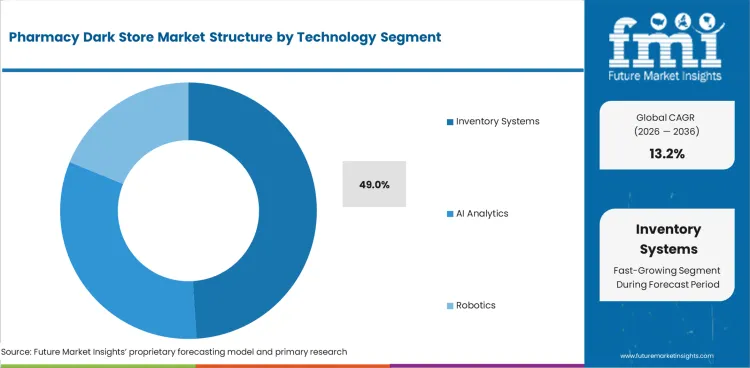
Stockouts instantly erode digital trust, making complete visibility essential. Supply chain directors must ensure perfect synchronization between physical inventory and digital storefronts. A latency exceeding three seconds frequently results in overselling during peak demand periods. FMI analysts observe that platforms often feature advanced consumer interfaces supported by outdated, spreadsheet-era stock databases. Inventory systems segment is set to secure a 49.0% market share in 2026, driven by the critical need for multi-node stock balancing infrastructure. The operational reality indicates that multi-node inventory balancing can be more costly than the physical fulfillment process itself. Operators who depend on batch updates inevitably dispatch couriers for items that are completely unavailable on shelves. Reliable prescription delivery systems necessitate real-time database synchronization.
- Multi-node balancing: Algorithms shift stock locations based on predictive demand models. Inventory directors prevent regional stockouts effectively.
- Latency reduction: Real-time synchronization eliminates double-sold items. Technology officers invest heavily in edge computing infrastructure.
- Predictive stocking: Machine learning anticipates seasonal illness patterns locally. Procurement managers order flu therapeutics proactively.
Pharmacy Dark Store Market Drivers, Restraints, and Opportunities
The advent of widespread telehealth has fundamentally disrupted traditional pharmacy operating models, specifically by forcing an immediate integration of fulfillment directly into the virtual care pipeline. This integration is non-negotiable, compelling pharmacy operators to adopt ultra-rapid, sub-hour delivery modes. The primary driver for this shift is the critically high patient abandonment rate observed when patients are expected to manage the physical transit required to retrieve medication after a successful virtual consultation. This friction point, the post-consultation gap, severely compromises the value proposition of digital health.
Directors of digital health platforms are now realizing that achieving true market dominance and optimizing patient outcomes necessitates capturing the entire end-to-end patient journey. This requires implementing a "closed-loop fulfillment" system, where the prescription is routed, filled, and delivered seamlessly and instantaneously following the virtual appointment. Any delay in establishing these integrated fulfillment partnerships represents a significant financial loss, as prescription revenue is immediately diverted to competing digital platforms that offer an immediate, frictionless transit solution.
Standard for patient expectation has shifted from convenience to immediacy. Beyond the logistical challenges of rapid delivery, the digital pharmacy landscape is structurally hindered by profound regulatory fragmentation. Compliance officers operating national digital pharmacy services face a daunting compliance matrix, grappling with the specific, often contradictory, regulations set forth by all fifty different state boards of pharmacy. This jurisdictional complexity means that building a truly national, unified pharmacy network is exceptionally capital-intensive and slow. It demands a unique, localized software architecture for dispensing, record-keeping, and communication across each jurisdiction.
Opportunities in the Pharmacy Dark Store Market
- Specialty biologicals: Managing high-value temperature-sensitive therapeutics. Procurement officers unlock massive margins securing specialized thermal packs logistics.
- Elderly care integration: Supplying assisted living facilities continuously. Facility managers streamline medication management entirely.
- Clinical trial supply: Distributing investigational drugs directly to homes. Study coordinators improve retention rates dramatically.
Regional Analysis
.webp "Top Country Growth Comparison Pharmacy Dark Store Market Cagr (2026 2036)")
Based on regional analysis, the pharmacy dark store market is segmented into North America, Europe, Asia Pacific, Latin America, and Middle East & Africa across 40 plus countries.
| Country | CAGR (2026 to 2036) |
|---|---|
| China | 14.2% |
| Brazil | 13.6% |
| United States | 12.5% |
| United Kingdom | 11.3% |
| Germany | 10.8% |
Source: Future Market Insights (FMI) analysis, based on proprietary forecasting model and primary research
North America Pharmacy Dark Store Market Analysis
Legacy retail giants are attempting to convert their large physical stores into efficient micro-fulfillment centers. Facility managers are struggling to change aisles designed for customer browsing into optimized pick-paths for couriers. Severe labor shortages necessitate major investment in robotic dispensing systems. FMI's analysis suggests that independent digital-first pharmacies are quickly gaining market share by avoiding the burden of legacy real estate. Advanced pharmaceutical logistics frameworks demand absolute precision to meet stringent regulations across various state lines.
- United States: Retail conglomerates are retrofitting thousands of existing stores into local dark stores to aggressively compete with digital-native newcomers. Corporate real estate directors are maximizing the utility of current footprints, balancing traditional walk-in revenue with the growing space needed for courier staging. The nation shows a 12.5% Compound Annual Growth Rate (CAGR), contributing a massive 35.0% regional share, which is a direct result of heavy capital spending on automated fulfillment technologies. Operations officers face intense scrutiny over unit economics across vast suburban areas, leading to the adoption of advanced routing algorithms to ensure profitability. Regulatory environments are permitting rapid consolidation, allowing large health systems to effectively bring last-mile delivery protocols in-house.
Europe Pharmacy Dark Store Market Analysis
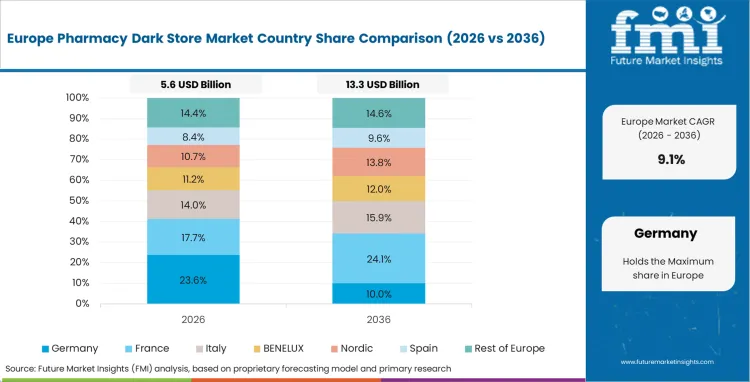
Stringent labor laws are shifting operators from gig-courier models to full employment for logistics fleets, fundamentally changing the financial viability of each delivery. Local health systems are building their dark store networks to ensure complete control over patient data. Pharmacy managers are prioritizing deep integration with national healthcare databases for effortless prescription transfers. Furthermore, FMI is observing a rapid deployment of automated dispensing cabinets to streamline the pharmacist's verification process.
- United Kingdom: National health policies require strict adherence to protocols for digital pharmacy operations. Fleet managers use electric vehicles exclusively to meet tough urban emission standards while keeping delivery times under an hour. The UK achieves an 11.3% Compound Annual Growth Rate (CAGR), driven by centralized prescription processing, which eliminates unnecessary verification steps. Integrating with national health records makes patient registration seamless, significantly lowering the rate of abandoned prescriptions. Facility managers are securing secondary industrial sites to improve delivery routing in heavily congested city areas.
- Germany: Germany is witnessing a 10.8% CAGR, supported by a strong network of independent pharmacies that function as small-scale fulfillment centers. Strict data protection laws compel platforms to create highly secure, closed-loop fulfillment systems. Operations directors are heavily focused on programs that promote patient adherence to chronic medication, securing predictable, recurring revenue. Procurement officers navigate complex pricing regulations by using advanced inventory management software to maintain dynamic and stable stock levels.
Asia Pacific Pharmacy Dark Store Market Analysis
The convergence of extreme urban congestion and high smartphone penetration is significantly accelerating the adoption of digital healthcare. Pharmacy operations directors are completely bypassing the expensive process of establishing physical retail locations. Variable costs remain remarkably low compared to Western markets due to a heavy reliance on independent gig couriers. According to FMI's projection, platforms are aggressively acquiring local neighborhood pharmacies and converting these physical sites into digital-first dark stores. Advanced route optimization software is being implemented to efficiently manage chaotic traffic patterns.
- China: Hyper-local startups are skipping traditional retail entirely, instead building dark stores exclusively for digital orders across tier-one cities. Supply chain directors are capturing unprecedented margins by utilizing mature digital payment ecosystems. The country is expanding at a 14.2% CAGR and holds a dominant 42.0% regional share, driven by the seamless integration of national telehealth portals and hyper-local delivery fleets. Operations are scaling massively through aggressive venture capital funding focused on monopolizing specific urban delivery zones. Furthermore, state-backed infrastructure initiatives are streamlining logistics, allowing for the rapid deployment of specialized autonomous transit vehicles in densely populated residential districts.
Latin America Pharmacy Dark Store Market Analysis
Shifting consumer demographics and rising chronic disease prevalence drive immediate demand for reliable medication delivery systems. E-commerce penetration accelerates rapidly, familiarizing populations with rapid fulfillment concepts. Facility managers overcome challenging urban topographies utilizing specialized two-wheeler transit fleets. FMI analysts note significant investment targeting temperature-controlled logistics infrastructure.
- Brazil: Massive urban centers present unique logistical challenges requiring highly adaptive routing algorithms. Fleet managers constantly re-route couriers avoiding severe traffic bottlenecks across sprawling metropolitan areas. The nation exhibits a 13.6% CAGR, capturing a 45.0% regional share fueled by aggressive digital health platform expansion into underserved neighborhoods. Supply chain directors secure specialized thermal packs logistics ensuring biological medication integrity during extended transit times. Consolidating neighborhood delivery zones enables platforms to achieve positive unit economics despite challenging infrastructure constraints.
Middle East & Africa Pharmacy Dark Store Market Analysis
Smart-city programs and integrated digital health records create seamless environments for automated fulfillment processes. Procurement staff utilize world-class logistics networks specifically designed for managing extreme temperatures. Government regulations aggressively enforce paperless prescribing, directly feeding into digital fulfillment channels. FMI notes the swift incorporation of autonomous transportation systems within recently developed urban areas. Significant regional investment is driving the accelerated deployment of advanced telepharmacy service capabilities.
- GCC Countries: State-backed digital health ecosystems mandate the use of electronic prescriptions, which are instantly routed to quick-commerce platforms. Healthcare administration has fully digitized, completely eliminating paper-based inefficiencies. The region is experiencing a 15.1% Compound Annual Growth Rate (CAGR), securing a 65.0% regional market share, fueled by massive government funding into automated healthcare infrastructure. Providers who integrate directly into national health applications are capturing substantial initial market share. Operations directors are employing advanced cold-chain technology to ensure absolute compliance and perfectly protect high-value biological shipments during extremely hot summer temperatures.
Competitive Aligners for Market Players
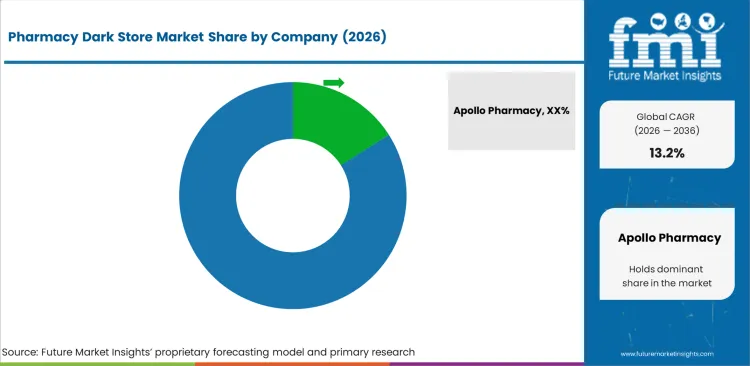
Network density determines competitive survival, completely superseding software interface quality. Logistics directors at PharmEasy and Amazon Pharmacy understand sub-hour guarantees require overlapping dark store coverage. Attempting national expansion before securing regional density results in missed delivery windows and permanent customer churn. Establishing local dominance proves vastly more profitable than shallow national presence. Utilizing advanced sidewalk robot services provides critical edge capabilities.
Incumbents like Tata 1mg possess massive localized historical prescribing data. Data science officers predict regional medication demand with incredible accuracy, positioning inventory days before acute illness outbreaks hit specific neighborhoods. Challengers relying purely on fast couriers face continuous stockouts lacking predictive inventory capabilities. Accessing reliable small parcel networks remains vital.
Regional health systems actively resist monolithic pharmacy platforms by building proprietary dark store networks. Operations officers internalize fulfillment, maintaining complete control over patient data and medication adherence metrics. Hospitals deploying customized automation systems retain high-margin specialty prescriptions entirely in-house.
Key Players in Pharmacy Dark Store Market
- Apollo Pharmacy
- Tata 1mg
- PharmEasy
- Capsule
- NowRx
- Alto Pharmacy
- Amazon Pharmacy
Scope of the Report
| Metric | Value |
|---|---|
| Quantitative Units | USD 23.89 Billion to USD 82.5 Billion, at a CAGR of 13.2% |
| Market Definition | Hyper-local healthcare delivery infrastructure built for sub-hour fulfillment of medicinal products requiring specialized logistics and cold-chain compliance. |
| Segmentation | By Model, By Product, By Delivery Type, By End User, By Technology |
| Regions Covered | North America, Europe, Asia Pacific, Latin America, Middle East & Africa |
| Countries Covered | United States, Canada, Germany, United Kingdom, France, Italy, Spain, China, Japan, South Korea, Taiwan, Singapore, Brazil, Mexico, Argentina, GCC Countries, South Africa, Israel, Rest of Middle East & Africa |
| Key Companies Profiled | Apollo Pharmacy, Tata 1mg, PharmEasy, Capsule, NowRx, Alto Pharmacy, Amazon Pharmacy |
| Forecast Period | 2026 to 2036 |
| Approach | Top-down penetration analysis validated against independent gig-economy courier healthcare transit data. |
Source: Future Market Insights (FMI) analysis, based on proprietary forecasting model and primary research
Pharmacy Dark Store Market Analysis by Segments
Model
- Dedicated Dark Stores
- Hybrid Stores
- Micro Fulfillment
Product
- Prescription Drugs
- OTC Drugs
- Wellness Products
- Medical Devices
Delivery Type
- On-demand Delivery
- Scheduled Delivery
- Subscription Delivery
End User
- Urban Consumers
- Hospitals
- Clinics
- Elderly Care
Technology
- Inventory Systems
- AI Analytics
- Robotics
- IoT Tracking
Region
- North America
- United States
- Canada
- Europe
- Germany
- United Kingdom
- France
- Italy
- Spain
- Asia Pacific
- China
- Japan
- South Korea
- Taiwan
- Singapore
- Latin America
- Brazil
- Mexico
- Argentina
- Middle East & Africa
- GCC Countries
- South Africa
- Israel
- Rest of Middle East & Africa
Bibliography
- Ansari, S., Chowhan, S. S., & Sengupta, S. (2025, November). Online pharmacy adoption and consumer perception: A systematic review of existing literature. Cureus.
- Singh, K. P., & Kumar, P. (2024, December). Factors influencing e-pharmacy adoption in India: A study of user experiences. Results in Control and Optimization.
- Satheesh, G., Masibo, S., Tiruttani, S. K., et al. (2025, February). Compliance of e-pharmacies with regulatory requirements and best practices. PLOS Global Public Health.
- PharmacyPro. (2025, June). Government plans stricter regulation for rapid online pharmacy deliveries in India.
- Mitra, A. (2025, October). Navigating the future of e-pharmacies: Balancing accessibility and regulation in India. TLH Law Insights.
This bibliography is provided for reader reference. The full FMI report contains the complete reference list with primary source documentation.
This Report Addresses
- Predicts exact demand curves for dedicated dark stores navigating strict zoning regulations.
- Analyzes biometric signature requirements constraining chronic prescription fulfillment speeds.
- Evaluates algorithmic routing investments necessary for profitable on-demand delivery models.
- Examines multi-family residential density requirements for viable sub-hour fulfillment operations.
- Assesses multi-node inventory balancing software reducing critical peak-season stockouts.
- Compares hyper-local startup margins in China against legacy retail retrofits in North America.
- Identifies predictive stocking advantages held by established data-rich incumbents.
- Explores cold-chain packaging constraints capping high-value biological transit capacity.
Frequently Asked Questions
What condition drives the 13.2% CAGR?
Patients increasingly abandon maintenance prescriptions when forced into physical retail channels following digital consultations. Platforms capturing this lost revenue justify massive dark store infrastructure investments.
Why do Dedicated Dark Stores hold 62.0% share?
Removing physical retail displays halves real estate requirements while tripling picker speed. Facility managers achieve positive unit economics only through complete industrialization.
How does identity verification impact sub-hour guarantees?
Controlled substances require strict chain of custody. Digital signature tools prevent diversion but add minutes to each drop-off, severely capping overall route density.
What causes hybrid models to fail?
Attempting digital fulfillment within active retail environments splits labor focus. Staff prioritizing physical walk-ins consistently miss strict courier dispatch windows.
Why does China grow faster than the United States?
Extreme urban density and cheap independent courier networks allow hyper-local platforms to bypass expensive real estate acquisition entirely.
How do platforms handle temperature-sensitive biologicals?
Procurement teams deploy validated active-cooling transit containers. This limits capacity specifically to couriers trained handling specialized medical transport equipment.
What triggers profitability for on-demand delivery?
Routing algorithms eventually cross critical density thresholds where couriers handle multiple drop-offs sequentially without returning to the central distribution node.
Why do suburban expansion efforts falter?
Distance destroys sub-hour guarantees while simultaneously burning venture capital on subsidized courier mileage. Effective networks require strict geographic boundaries.
How do independent platforms compete against retail giants?
Incumbents struggle retrofitting legacy aisles into efficient pick-paths. Startups utilizing purpose-built micro-warehouses achieve significantly lower fulfillment costs per unit.
How does predictive stocking alter competitive dynamics?
Incumbents leverage massive historical data predicting regional illness outbreaks. They position therapeutics locally days before challengers realize demand exists.
Why are hospitals building proprietary networks?
Clinical directors resist surrendering patient adherence data to third-party platforms. Internal dark stores protect high-margin specialty prescriptions effectively.
What limits the adoption of fully autonomous transit?
Current regulatory frameworks restrict drone flights over dense populations, while ePharmacy operators await municipal sidewalk robot clearance.
How do zoning laws impact expansion?
Converting retail frontage into pure fulfillment centers often violates commercial zoning. Real estate directors navigate lengthy variance procedures before launching.
Why is real estate arbitrage essential?
Procuring secondary industrial space slashes fixed overhead compared to prime retail corners. This savings funds complex medication management software development.
How do operators ensure cold-chain integrity?
Technicians deploy specialized storage refrigerators at fulfillment nodes before transferring goods to validated transit coolers.
What role do compounding pharmacies play?
Specialized compounding pharmacies integrate directly into rapid fulfillment networks, delivering customized therapeutics without requiring patient travel.
Preview the report firsthand - request a free sample
Get SampleGet the brochure for pricing and purchase details.
Get PDFTable of Content
- Executive Summary
- Global Market Outlook
- Demand-side Trends
- Supply-side Trends
- Technology Roadmap Analysis
- Analysis and Recommendations
- Market Overview
- Market Coverage / Taxonomy
- Market Definition / Scope / Limitations
- Research Methodology
- Chapter Orientation
- Analytical Lens and Working Hypotheses
- Market Structure, Signals, and Trend Drivers
- Benchmarking and Cross-market Comparability
- Market Sizing, Forecasting, and Opportunity Mapping
- Research Design and Evidence Framework
- Desk Research Programme (Secondary Evidence)
- Company Annual and Sustainability Reports
- Peer-reviewed Journals and Academic Literature
- Corporate Websites, Product Literature, and Technical Notes
- Earnings Decks and Investor Briefings
- Statutory Filings and Regulatory Disclosures
- Technical White Papers and Standards Notes
- Trade Journals, Industry Magazines, and Analyst Briefs
- Conference Proceedings, Webinars, and Seminar Materials
- Government Statistics Portals and Public Data Releases
- Press Releases and Reputable Media Coverage
- Specialist Newsletters and Curated Briefings
- Sector Databases and Reference Repositories
- FMI Internal Proprietary Databases and Historical Market Datasets
- Subscription Datasets and Paid Sources
- Social Channels, Communities, and Digital Listening Inputs
- Additional Desk Sources
- Expert Input and Fieldwork (Primary Evidence)
- Primary Modes
- Qualitative Interviews and Expert Elicitation
- Quantitative Surveys and Structured Data Capture
- Blended Approach
- Why Primary Evidence is Used
- Field Techniques
- Interviews
- Surveys
- Focus Groups
- Observational and In-context Research
- Social and Community Interactions
- Stakeholder Universe Engaged
- C-suite Leaders
- Board Members
- Presidents and Vice Presidents
- R&D and Innovation Heads
- Technical Specialists
- Domain Subject-matter Experts
- Scientists
- Physicians and Other Healthcare Professionals
- Governance, Ethics, and Data Stewardship
- Research Ethics
- Data Integrity and Handling
- Primary Modes
- Tooling, Models, and Reference Databases
- Desk Research Programme (Secondary Evidence)
- Data Engineering and Model Build
- Data Acquisition and Ingestion
- Cleaning, Normalisation, and Verification
- Synthesis, Triangulation, and Analysis
- Quality Assurance and Audit Trail
- Market Background
- Market Dynamics
- Drivers
- Restraints
- Opportunity
- Trends
- Scenario Forecast
- Demand in Optimistic Scenario
- Demand in Likely Scenario
- Demand in Conservative Scenario
- Opportunity Map Analysis
- Product Life Cycle Analysis
- Supply Chain Analysis
- Investment Feasibility Matrix
- Value Chain Analysis
- PESTLE and Porter’s Analysis
- Regulatory Landscape
- Regional Parent Market Outlook
- Production and Consumption Statistics
- Import and Export Statistics
- Market Dynamics
- Global Market Analysis 2021 to 2025 and Forecast, 2026 to 2036
- Historical Market Size Value (USD Million) Analysis, 2021 to 2025
- Current and Future Market Size Value (USD Million) Projections, 2026 to 2036
- Y-o-Y Growth Trend Analysis
- Absolute $ Opportunity Analysis
- Global Market Pricing Analysis 2021 to 2025 and Forecast 2026 to 2036
- Global Market Analysis 2021 to 2025 and Forecast 2026 to 2036, By Model
- Introduction / Key Findings
- Historical Market Size Value (USD Million) Analysis By Model , 2021 to 2025
- Current and Future Market Size Value (USD Million) Analysis and Forecast By Model , 2026 to 2036
- Dedicated Dark Stores
- Hybrid Stores
- Micro Fulfillment
- Dedicated Dark Stores
- Y-o-Y Growth Trend Analysis By Model , 2021 to 2025
- Absolute $ Opportunity Analysis By Model , 2026 to 2036
- Global Market Analysis 2021 to 2025 and Forecast 2026 to 2036, By Product
- Introduction / Key Findings
- Historical Market Size Value (USD Million) Analysis By Product, 2021 to 2025
- Current and Future Market Size Value (USD Million) Analysis and Forecast By Product, 2026 to 2036
- Prescription Drugs
- OTC Drugs
- Wellness Products
- Prescription Drugs
- Y-o-Y Growth Trend Analysis By Product, 2021 to 2025
- Absolute $ Opportunity Analysis By Product, 2026 to 2036
- Global Market Analysis 2021 to 2025 and Forecast 2026 to 2036, By Delivery Type
- Introduction / Key Findings
- Historical Market Size Value (USD Million) Analysis By Delivery Type, 2021 to 2025
- Current and Future Market Size Value (USD Million) Analysis and Forecast By Delivery Type, 2026 to 2036
- On-demand Delivery
- Scheduled Delivery
- Subscription Delivery
- On-demand Delivery
- Y-o-Y Growth Trend Analysis By Delivery Type, 2021 to 2025
- Absolute $ Opportunity Analysis By Delivery Type, 2026 to 2036
- Global Market Analysis 2021 to 2025 and Forecast 2026 to 2036, By End User
- Introduction / Key Findings
- Historical Market Size Value (USD Million) Analysis By End User, 2021 to 2025
- Current and Future Market Size Value (USD Million) Analysis and Forecast By End User, 2026 to 2036
- Urban Consumers
- Hospitals
- Clinics
- Urban Consumers
- Y-o-Y Growth Trend Analysis By End User, 2021 to 2025
- Absolute $ Opportunity Analysis By End User, 2026 to 2036
- Global Market Analysis 2021 to 2025 and Forecast 2026 to 2036, By Technology
- Introduction / Key Findings
- Historical Market Size Value (USD Million) Analysis By Technology, 2021 to 2025
- Current and Future Market Size Value (USD Million) Analysis and Forecast By Technology, 2026 to 2036
- Inventory Systems
- AI Analytics
- Robotics
- Inventory Systems
- Y-o-Y Growth Trend Analysis By Technology, 2021 to 2025
- Absolute $ Opportunity Analysis By Technology, 2026 to 2036
- Global Market Analysis 2021 to 2025 and Forecast 2026 to 2036, By Region
- Introduction
- Historical Market Size Value (USD Million) Analysis By Region, 2021 to 2025
- Current Market Size Value (USD Million) Analysis and Forecast By Region, 2026 to 2036
- North America
- Latin America
- Western Europe
- Eastern Europe
- East Asia
- South Asia and Pacific
- Middle East & Africa
- Market Attractiveness Analysis By Region
- North America Market Analysis 2021 to 2025 and Forecast 2026 to 2036, By Country
- Historical Market Size Value (USD Million) Trend Analysis By Market Taxonomy, 2021 to 2025
- Market Size Value (USD Million) Forecast By Market Taxonomy, 2026 to 2036
- By Country
- USA
- Canada
- Mexico
- By Model
- By Product
- By Delivery Type
- By End User
- By Technology
- By Country
- Market Attractiveness Analysis
- By Country
- By Model
- By Product
- By Delivery Type
- By End User
- By Technology
- Key Takeaways
- Latin America Market Analysis 2021 to 2025 and Forecast 2026 to 2036, By Country
- Historical Market Size Value (USD Million) Trend Analysis By Market Taxonomy, 2021 to 2025
- Market Size Value (USD Million) Forecast By Market Taxonomy, 2026 to 2036
- By Country
- Brazil
- Chile
- Rest of Latin America
- By Model
- By Product
- By Delivery Type
- By End User
- By Technology
- By Country
- Market Attractiveness Analysis
- By Country
- By Model
- By Product
- By Delivery Type
- By End User
- By Technology
- Key Takeaways
- Western Europe Market Analysis 2021 to 2025 and Forecast 2026 to 2036, By Country
- Historical Market Size Value (USD Million) Trend Analysis By Market Taxonomy, 2021 to 2025
- Market Size Value (USD Million) Forecast By Market Taxonomy, 2026 to 2036
- By Country
- Germany
- UK
- Italy
- Spain
- France
- Nordic
- BENELUX
- Rest of Western Europe
- By Model
- By Product
- By Delivery Type
- By End User
- By Technology
- By Country
- Market Attractiveness Analysis
- By Country
- By Model
- By Product
- By Delivery Type
- By End User
- By Technology
- Key Takeaways
- Eastern Europe Market Analysis 2021 to 2025 and Forecast 2026 to 2036, By Country
- Historical Market Size Value (USD Million) Trend Analysis By Market Taxonomy, 2021 to 2025
- Market Size Value (USD Million) Forecast By Market Taxonomy, 2026 to 2036
- By Country
- Russia
- Poland
- Hungary
- Balkan & Baltic
- Rest of Eastern Europe
- By Model
- By Product
- By Delivery Type
- By End User
- By Technology
- By Country
- Market Attractiveness Analysis
- By Country
- By Model
- By Product
- By Delivery Type
- By End User
- By Technology
- Key Takeaways
- East Asia Market Analysis 2021 to 2025 and Forecast 2026 to 2036, By Country
- Historical Market Size Value (USD Million) Trend Analysis By Market Taxonomy, 2021 to 2025
- Market Size Value (USD Million) Forecast By Market Taxonomy, 2026 to 2036
- By Country
- China
- Japan
- South Korea
- By Model
- By Product
- By Delivery Type
- By End User
- By Technology
- By Country
- Market Attractiveness Analysis
- By Country
- By Model
- By Product
- By Delivery Type
- By End User
- By Technology
- Key Takeaways
- South Asia and Pacific Market Analysis 2021 to 2025 and Forecast 2026 to 2036, By Country
- Historical Market Size Value (USD Million) Trend Analysis By Market Taxonomy, 2021 to 2025
- Market Size Value (USD Million) Forecast By Market Taxonomy, 2026 to 2036
- By Country
- India
- ASEAN
- Australia & New Zealand
- Rest of South Asia and Pacific
- By Model
- By Product
- By Delivery Type
- By End User
- By Technology
- By Country
- Market Attractiveness Analysis
- By Country
- By Model
- By Product
- By Delivery Type
- By End User
- By Technology
- Key Takeaways
- Middle East & Africa Market Analysis 2021 to 2025 and Forecast 2026 to 2036, By Country
- Historical Market Size Value (USD Million) Trend Analysis By Market Taxonomy, 2021 to 2025
- Market Size Value (USD Million) Forecast By Market Taxonomy, 2026 to 2036
- By Country
- Kingdom of Saudi Arabia
- Other GCC Countries
- Turkiye
- South Africa
- Other African Union
- Rest of Middle East & Africa
- By Model
- By Product
- By Delivery Type
- By End User
- By Technology
- By Country
- Market Attractiveness Analysis
- By Country
- By Model
- By Product
- By Delivery Type
- By End User
- By Technology
- Key Takeaways
- Key Countries Market Analysis
- USA
- Pricing Analysis
- Market Share Analysis, 2025
- By Model
- By Product
- By Delivery Type
- By End User
- By Technology
- Canada
- Pricing Analysis
- Market Share Analysis, 2025
- By Model
- By Product
- By Delivery Type
- By End User
- By Technology
- Mexico
- Pricing Analysis
- Market Share Analysis, 2025
- By Model
- By Product
- By Delivery Type
- By End User
- By Technology
- Brazil
- Pricing Analysis
- Market Share Analysis, 2025
- By Model
- By Product
- By Delivery Type
- By End User
- By Technology
- Chile
- Pricing Analysis
- Market Share Analysis, 2025
- By Model
- By Product
- By Delivery Type
- By End User
- By Technology
- Germany
- Pricing Analysis
- Market Share Analysis, 2025
- By Model
- By Product
- By Delivery Type
- By End User
- By Technology
- UK
- Pricing Analysis
- Market Share Analysis, 2025
- By Model
- By Product
- By Delivery Type
- By End User
- By Technology
- Italy
- Pricing Analysis
- Market Share Analysis, 2025
- By Model
- By Product
- By Delivery Type
- By End User
- By Technology
- Spain
- Pricing Analysis
- Market Share Analysis, 2025
- By Model
- By Product
- By Delivery Type
- By End User
- By Technology
- France
- Pricing Analysis
- Market Share Analysis, 2025
- By Model
- By Product
- By Delivery Type
- By End User
- By Technology
- India
- Pricing Analysis
- Market Share Analysis, 2025
- By Model
- By Product
- By Delivery Type
- By End User
- By Technology
- ASEAN
- Pricing Analysis
- Market Share Analysis, 2025
- By Model
- By Product
- By Delivery Type
- By End User
- By Technology
- Australia & New Zealand
- Pricing Analysis
- Market Share Analysis, 2025
- By Model
- By Product
- By Delivery Type
- By End User
- By Technology
- China
- Pricing Analysis
- Market Share Analysis, 2025
- By Model
- By Product
- By Delivery Type
- By End User
- By Technology
- Japan
- Pricing Analysis
- Market Share Analysis, 2025
- By Model
- By Product
- By Delivery Type
- By End User
- By Technology
- South Korea
- Pricing Analysis
- Market Share Analysis, 2025
- By Model
- By Product
- By Delivery Type
- By End User
- By Technology
- Russia
- Pricing Analysis
- Market Share Analysis, 2025
- By Model
- By Product
- By Delivery Type
- By End User
- By Technology
- Poland
- Pricing Analysis
- Market Share Analysis, 2025
- By Model
- By Product
- By Delivery Type
- By End User
- By Technology
- Hungary
- Pricing Analysis
- Market Share Analysis, 2025
- By Model
- By Product
- By Delivery Type
- By End User
- By Technology
- Kingdom of Saudi Arabia
- Pricing Analysis
- Market Share Analysis, 2025
- By Model
- By Product
- By Delivery Type
- By End User
- By Technology
- Turkiye
- Pricing Analysis
- Market Share Analysis, 2025
- By Model
- By Product
- By Delivery Type
- By End User
- By Technology
- South Africa
- Pricing Analysis
- Market Share Analysis, 2025
- By Model
- By Product
- By Delivery Type
- By End User
- By Technology
- USA
- Market Structure Analysis
- Competition Dashboard
- Competition Benchmarking
- Market Share Analysis of Top Players
- By Regional
- By Model
- By Product
- By Delivery Type
- By End User
- By Technology
- Competition Analysis
- Competition Deep Dive
- Apollo Pharmacy
- Overview
- Product Portfolio
- Profitability by Market Segments (Product/Age /Sales Channel/Region)
- Sales Footprint
- Strategy Overview
- Marketing Strategy
- Product Strategy
- Channel Strategy
- Tata 1mg
- PharmEasy
- Capsule
- NowRx
- Alto Pharmacy
- Amazon Pharmacy
- Apollo Pharmacy
- Competition Deep Dive
- Assumptions & Acronyms Used


