

- Industry Size (2026)
- USD 1.7 Bn
- Forecast (2036)
- USD 5.7 Bn
- CAGR (2026 to 2036)
- 13.0%
Task-Level Labor Planning and Workforce Orchestration for Fulfillment Market Size, Market Forecast and Outlook By FMI
The task-level labor planning and workforce orchestration for fulfillment market was valued at USD 1.5 billion in 2025. Industry valuation is poised to reach USD 1.7 billion in 2026 at a CAGR of 13.0% during the forecast period. Industry valuation is anticipated to reach USD 5.7 billion by 2036, driven by a decisive industry-wide shift away from static headcount planning toward real-time, execution-led labor optimization.
Operations directors facing acute picker shortages cannot wait for weekly schedule adjustments. Delaying dynamic shift allocation forces peak-season volume into overtime constraints, eroding gross margins across e-commerce channels. Moving past legacy warehouse robotics architecture requires algorithmic alignment between available associate hours and incoming order waves, making fulfillment labor planning software a critical procurement priority.
Summary of Task-Level Labor Planning and Workforce Orchestration for Fulfillment Market
- Task-Level Labor Planning and Workforce Orchestration for Fulfillment Market Definition
- Software platforms aligning associate shift schedules with real-time order execution requirements. These systems optimize human movement across distribution centers by adjusting task assignments dynamically.
- Demand Drivers in the Market
- Unpredictable e-commerce spikes force site leaders to utilize warehouse task management software to reassign pickers intra-day.
- Rising base wages compel operations managers to extract higher throughput per scheduled hour.
- Turnover rates push human resources directors toward performance-based incentive models.
- Key Segments Analyzed in the FMI Report
- Labor planning is expected to hold 31.0% share in 2026, driven by labor forecasting in fulfillment centers requirements.
- Cloud is set to capture 64.0% share in 2026, reflecting multi-site visibility demands.
- E-commerce is projected to lead fulfillment modes as order velocity mandates dynamic routing.
- Large enterprises is anticipated to maintain 57.0% share in 2026 through broad network deployment.
- Productivity is estimated to command 29.0% share in 2026 as piece-pick metrics dominate KPI tracking.
- India: 15.0% compound growth, driven by policy initiatives intersecting online retail volume.
- Analyst Opinion at FMI
- Rahul Pandita, Principal Analyst, Technology, at FMI, points out, "Warehouse directors assume deploying algorithmic scheduling immediately solves floor congestion. What standard analytics dashboards miss entirely is how experienced pickers actively game dynamic task assignment warehouse rules to optimize personal incentive payouts rather than facility throughput. Tying associate compensation to algorithmic routing without calibrating standard time allowances across varying inventory zones creates massive behavioral distortion as observed by my team. Until shift planners reconcile mathematical path optimization with actual human pacing constraints, software investments simply digitize existing friction."
- Strategic Implications / Executive Takeaways
- Facility managers facing holiday peaks must transition from daily rosters to wave-based peak season labor planning fulfillment models.
- Software procurement teams gain negotiation leverage by demanding pre-built integration with existing robotic control systems.
- Operations directors delaying cloud migration risk losing multi-site benchmarking capabilities.
- Methodology
- Primary Research: Procurement directors, distribution center general managers, fulfillment operations leads
- Desk Research: Software integration manuals, vendor update logs, supply chain digitization case studies, patent filings
- Market-Sizing and Forecasting: Paid enterprise software seat licenses across tier-one distribution networks
- Data Validation and Update Cycle: Vendor quarterly earnings reports mapping recurring SaaS revenue streams
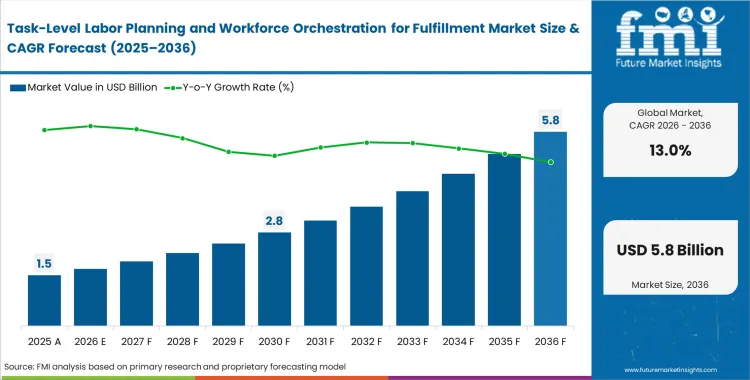
Key Takeaways
| Metric | Details |
|---|---|
| Industry Size (2026) | USD 1.7 billion |
| Industry Value (2036) | USD 5.7 billion |
| CAGR (2026 to 2036) | 13.0% |
Source: Future Market Insights (FMI) analysis, based on proprietary forecasting model and primary research
Once fulfillment supervisors mandate minute-by-minute activity tracking, associate utilization improves. Connecting shift schedules directly to localized picking zones transforms idle transit time into active line-item completion alongside modernized inventory management software frameworks. Measuring standard operating performance triggers immediate baseline adjustments across all active sites, defining the true workforce orchestration market forecast fulfillment trajectory.
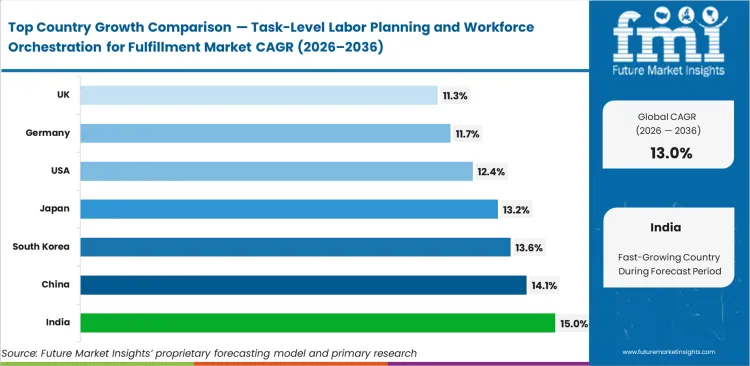
India leads at 15.0% CAGR through 2036, followed closely by China at 14.1% as both regions combine high-throughput online retail with intense pressure to digitize legacy execution layers. South Korea advances at 13.6% while Japan tracks at 13.2% following recent logistics overtime rule changes. The United States maintains 12.4% compound growth based on an expansive installed base. Germany scales at 11.7%, and the United Kingdom grows at 11.3% inside mature software estates. Variations across these regions stem from differing reliance on manual piece-picking versus automated storage retrieval systems.
Task-Level Labor Planning and Workforce Orchestration for Fulfillment Market Definition
Task-Level Labor Planning and Workforce Orchestration for Fulfillment Market encompasses software systems connecting human capital deployment directly with physical distribution tasks. Platforms match associate availability against incoming order waves using algorithmic scheduling. Solutions bridge human resources scheduling and floor-level execution metrics to optimize picker routing, creating a comprehensive warehouse workforce orchestration platform.
Task-Level Labor Planning and Workforce Orchestration for Fulfillment Market Inclusions
Scope incorporates cloud applications managing shift allocation, incentive tracking, and real-time performance analytics. Integrations mapping floor associates to retail warehouse management functions fall within coverage boundaries. Task assignment modules evaluating employee proximity to inventory zones belong here natively, representing the core of any functional warehouse labor optimization system.
Task-Level Labor Planning and Workforce Orchestration for Fulfillment Market Exclusions
General human resources payroll systems tracking overall attendance sit outside this evaluation. Hardware terminals and barcode scanners belong to adjacent categories. Basic enterprise resource planning modules lacking intra-day task reallocation algorithms face exclusion because they cannot shift worker focus during active fulfillment waves.
Task-Level Labor Planning and Workforce Orchestration for Fulfillment Market Research Methodology
- Primary Research: Procurement directors, distribution center general managers, fulfillment operations leads
- Desk Research: Software integration manuals, vendor update logs, supply chain digitization case studies, patent filings
- Market-Sizing and Forecasting: Paid enterprise software seat licenses across tier-one distribution networks
- Data Validation and Update Cycle: Vendor quarterly earnings reports mapping recurring SaaS revenue streams
Segmental Analysis
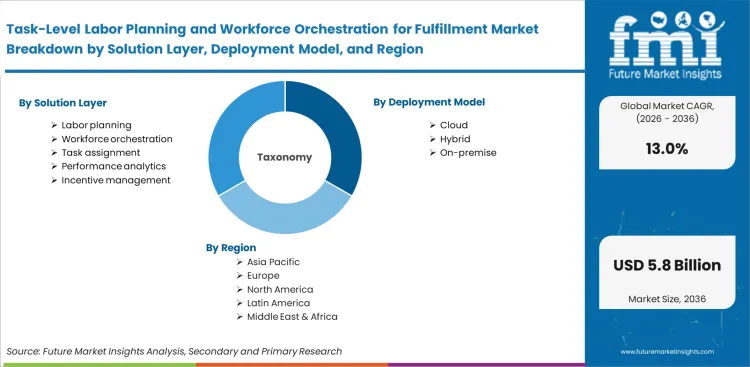
Task-Level Labor Planning and Workforce Orchestration for Fulfillment Market Analysis by Solution Layer
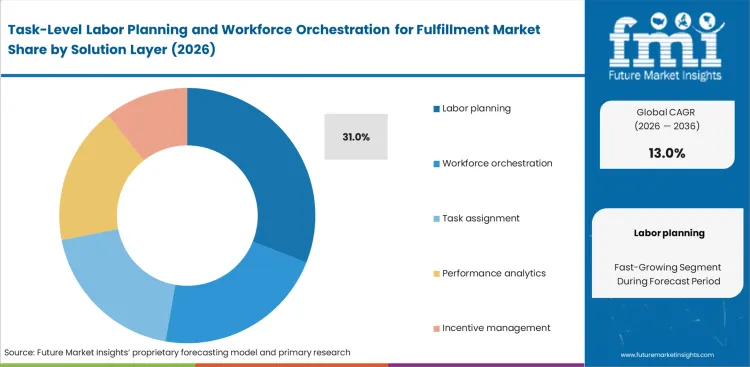
Forecasting baseline headcount anchors every modern distribution network before active floor management can begin. Labor planning holds an estimated 31.0% share in 2026 as facility managers prioritize schedule accuracy over real-time adjustments. Procurement teams mandate these foundational modules because attempting dynamic routing without a stabilized shift roster causes immediate operational failure. Choosing workforce management software at this layer requires aligning historical order volume with anticipated associate availability. What basic deployment figures miss is how heavily site leaders modify algorithmically generated schedules manually just prior to shift commencement. Delaying investment in baseline forecasting tools forces supervisors into reactive overtime approvals during unexpected volume spikes. FMI observes that integrating planning modules directly with enterprise resource systems minimizes administrative overhead.
- Baseline prediction: Algorithms analyze historical shipping volume against seasonal variation. Site managers gain accurate headcount requirements weeks ahead of planned execution.
- Shift coverage: Allocating specific associate skills across designated zones prevents local bottlenecks. Operations directors avoid placing untrained staff in high-velocity picking aisles.
- Roster flexibility: Adjusting planned schedules against real-time call-outs maintains critical path momentum. Shift supervisors must redistribute tasks manually if software lacks automatic recalibration.
Task-Level Labor Planning and Workforce Orchestration for Fulfillment Market Analysis by Deployment Model
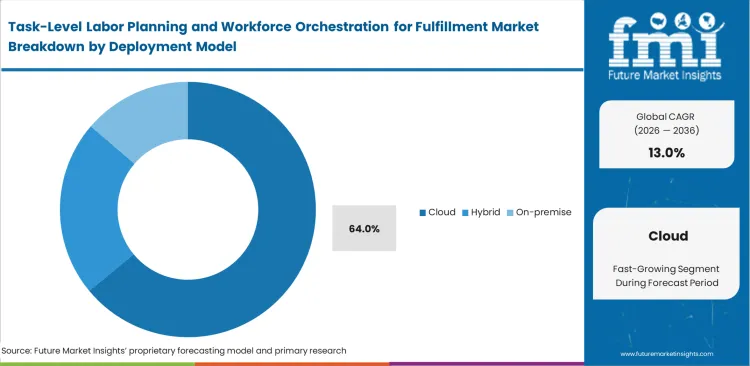
Consolidating multi-site execution data requires centralized architecture that legacy server racks cannot support. Cloud deployment commands 64.0% share in 2026 because regional operations directors need comparative visibility across entire fulfillment networks simultaneously. Securing local hardware restricts benchmarking capabilities and isolates valuable productivity metrics. IT directors select off-premise hosting to ensure continuous algorithm updates without requiring physical site visits, constantly evaluating warehouse labor optimization software pricing against potential uptime gains. According to FMI's estimates, subscription models hide the reality that cloud platforms frequently suffer latency issues during peak picking waves if local facility internet bandwidth fluctuates. Sticking with on-premise installations limits future integration with advanced intralogistics automation solutions.
- Network visibility: Centralizing data lakes allows regional managers to compare picker efficiency across identical workflows. Operations directors spot underperforming sites instantly.
- Update continuity: Pushing algorithm enhancements from central servers guarantees uniform software versions globally. IT administrators avoid patching individual facility servers manually.
- Integration speed: Connecting cloud platforms with third-party carrier APIs accelerates outbound processing. Delaying cloud adoption forces manual data entry during carrier handoffs.
Task-Level Labor Planning and Workforce Orchestration for Fulfillment Market Analysis by Fulfillment mode
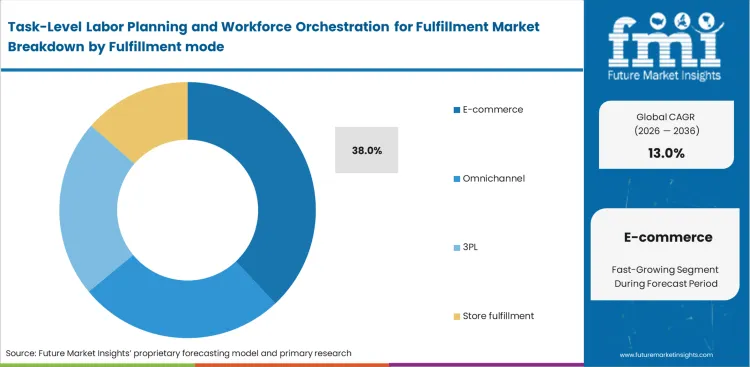
Direct-to-consumer order velocity breaks traditional pallet-based allocation methodologies entirely. E-commerce holds 38.0% share in 2026 as outbound fulfillment managers wrestle with single-unit piece-picking complexities. High-frequency small-parcel operations require constantly recalculating associate paths to minimise empty travel time. Implementing micro fulfillment logic at scale demands software capable of grouping disparate orders into efficient walking routes. Based on FMI's assessment, optimising pure online retail masks a deeper tension: associates optimised for single-unit velocity actively struggle when reassigned to bulk replenishment tasks. Failing to deploy mode-specific routing algorithms reduces picking speed significantly during seasonal volume surges.
- Wave grouping: Compiling multiple single-item orders into one logical travel path cuts transit time. Pickers avoid walking identical aisles multiple times per shift.
- Priority injection: Inserting expedited orders into active picking streams prevents delivery SLA violations. Floor supervisors must override standard sequencing to accommodate overnight shipping requests.
- Exception handling: Managing damaged inventory during active routes requires immediate digital documentation. Associates lose minutes per incident without mobile reporting capability.
Task-Level Labor Planning and Workforce Orchestration for Fulfillment Market Analysis by Warehouse Scale
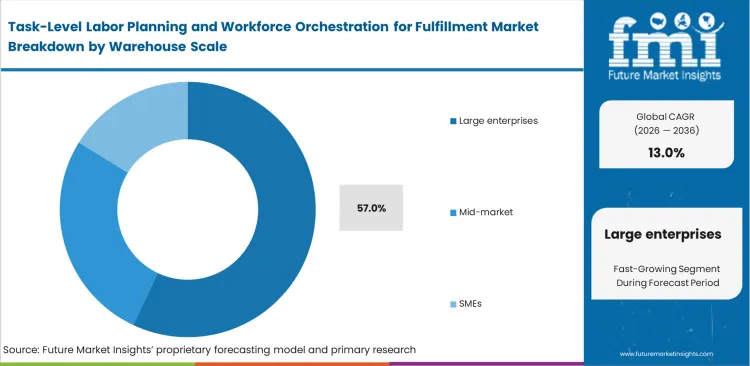
Managing thousands of associates across millions of square feet exceeds human spreadsheet capacity. Large enterprises secure 57.0% share in 2026 by deploying algorithmic coordination across vast physical footprints. Supply chain vice presidents mandate enterprise-grade solutions to standardize labor practices spanning disparate geographies, seeking out the best warehouse labor planning software to unify their operations. Coordinating massive warehouse design and layout geometries requires software that understands exact walking distances between bins. FMI's analysis indicates enterprise share figures obscure a critical friction point: massive implementations frequently take years to calibrate because local site managers resist standardizing unique regional workflows. Mid-market operators attempting to scale without these coordination layers face exponential cost increases per shipped unit.
- Standardized measurement: Establishing uniform time allowances for specific movements creates baseline accountability. Regional directors compare shift efficiency using identical mathematical standards.
- Cross-training deployment: Tracking associate certifications digitally allows supervisors to move staff across specialized zones safely. Untrained workers face access restrictions at hazardous material bins.
- Labor sharing: Moving associates between adjacent buildings during localized volume spikes maximizes utilization. Operations managers avoid paying idle time while neighboring sites approve overtime.
Task-Level Labor Planning and Workforce Orchestration for Fulfillment Market Analysis by Buyer Objective
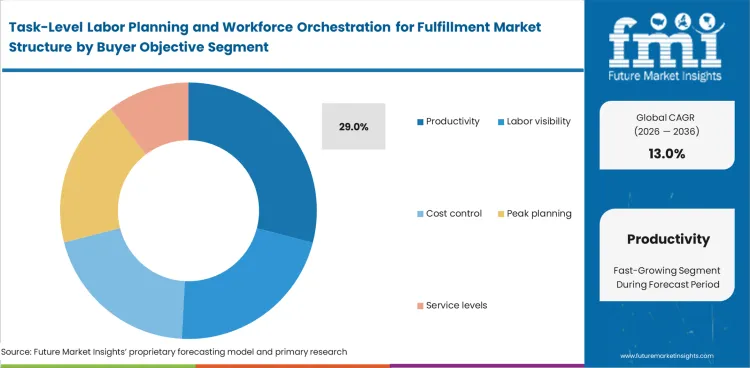
Extracting maximum throughput from every scheduled hour defines modern distribution profitability. Measuring actual execution against these engineered standards isolates underperforming shifts quickly, justifying the workforce orchestration ROI warehouse investment. Productivity objectives capture 29.0% share in 2026 as facility managers focus entirely on units-per-hour metrics. Industrial engineering teams deploy time-study data to build algorithmic baseline expectations. Ignoring quality-control variables while deploying any labor management system forces inbound customer service teams to handle massive return volumes.
- Speed tracking: Monitoring item scans per minute against engineered standards highlights individual performance gaps. Shift supervisors identify associates needing immediate retraining.
- Path optimization: Calculating shortest-distance routes between assigned bins reduces physical fatigue. Pickers complete more tasks per hour when software eliminates backtracking.
- Fatigue calibration: Adjusting expected speed metrics during late-shift hours prevents associate burnout. Unrealistic algorithmic demands create high turnover rates among warehouse staff.
Task-Level Labor Planning and Workforce Orchestration for Fulfillment Market Drivers, Restraints, and Opportunities
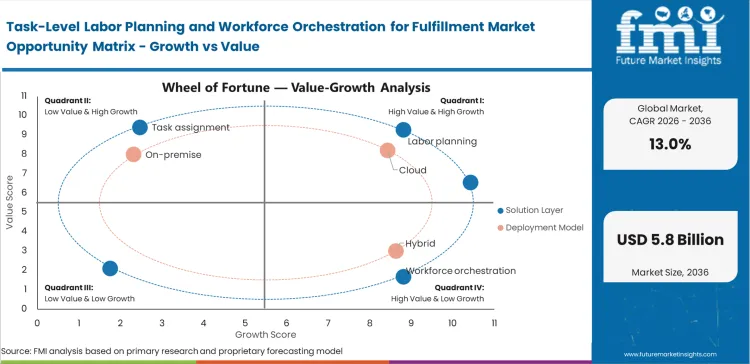
Surging consumer expectations for overnight delivery compel fulfillment directors to squeeze wasted minutes out of every associate shift. Traditional daily rosters collapse under intraday volume fluctuations. Delaying algorithmic task reassignment means site managers cannot react when inbound carrier schedules shift unexpectedly. Operations teams actively deploying dynamic workforce orchestration can pivot associate focus from inbound receiving to outbound picking in seconds, providing a direct warehouse labor shortages software response. Implementing dark store fulfillment models requires a digital layer translating incoming digital demand directly into physical human movement across aisles.
Organizational resistance from floor associates actively stalls software adoption even when procurement teams approve enterprise-wide rollouts. Experienced pickers accustomed to self-selecting familiar zones rebel against algorithmic path mandates. This behavioral friction persists because human operators inherently distrust black-box time allowances that fail to account for specific physical impediments like blocked aisles. Implementing a partial rollout creates bifurcated facilities where some shifts follow software guidance while others revert to manual supervisor direction alongside disconnected freight management software modules, complicating true warehouse labor planning integration with WMS.
Opportunities in Task-Level Labor Planning and Workforce Orchestration for Fulfillment Market
- Gamification integration: Embedding game-mechanics into handheld terminals boosts associate engagement. Supervisors trade punitive tracking for competitive achievement boards.
- Robotic coordination: Syncing human walking paths with autonomous mobile robots eliminates congestion. Floor managers avoid collisions while maximizing mechanical assets using AI in warehouse labor orchestration.
- Temporary labor scaling: Connecting scheduling modules directly to external staffing agency APIs fills empty roster spots instantly. Human resources directors bypass manual phone calls during sudden volume spikes.
Regional Analysis
According to the regional assessment, the Task‑Level Labor Planning and Workforce Orchestration market spans more than 40 countries, grouped across North America, Latin America, Europe, East Asia, South Asia & Pacific, and the Middle East & Africa.
.webp "Top Country Growth Comparison Task Level Labor Planning And Workforce Orchestration For Fulfillment Market Cagr (2026 2036)")
| Country | CAGR (2026 to 2036) |
|---|---|
| India | 15.0% |
| China | 14.1% |
| South Korea | 13.6% |
| Japan | 13.2% |
| United States | 12.4% |
| Germany | 11.7% |
| United Kingdom | 11.3% |
Source: Future Market Insights (FMI) analysis, based on proprietary forecasting model and primary research
North America Task-Level Labor Planning and Workforce Orchestration for Fulfillment Market Analysis
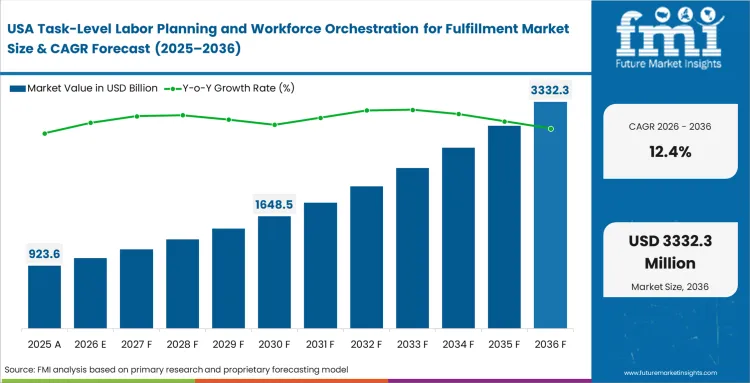
Broad installed bases define operations across North American distribution networks. Facility managers handle steady but predictable labor constraints by upgrading legacy execution platforms. Supply chain leaders prioritize extracting marginal gains from existing physical footprints rather than greenfield expansion, actively shaping the North America warehouse labor planning market. FMI notes that aggressive unionization efforts across this region actively force software vendors to adjust tracking algorithms to comply with stringent new workplace surveillance regulations.
- United States: Expansive physical distribution networks require sophisticated coordination algorithms to align varied shift schedules seamlessly. Operations directors focus intensely on integrating temporary seasonal labor during unexpected volume spikes. Due to tier-one retailers modernizing older software estates, the task-level labor planning and workforce orchestration for fulfillment market in the United States registers a 12.4% CAGR over the forecast period. These upgrades enable massive sites to survive holiday peaks without tripling baseline headcount.
Europe Task-Level Labor Planning and Workforce Orchestration for Fulfillment Market Analysis
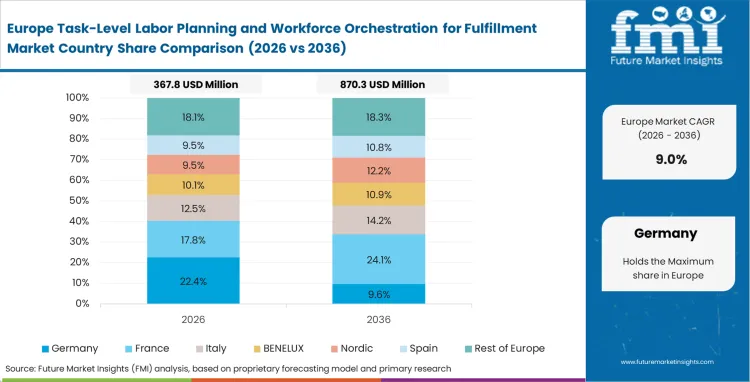
Cooler labor backdrops across European markets intersect with highly mature software environments. Distribution managers prioritize ergonomic task assignment over raw speed optimization due to strict occupational health directives. Procurement teams evaluate platforms based on compliance tracking capabilities rather than just algorithmic routing efficiency, defining the Europe fulfillment workforce orchestration market. As per FMI's projection, heavy reliance on third-party logistics providers complicates regional software deployments, as operators must integrate disparate client systems into singular workforce management views.
- Germany: Balancing strict data privacy mandates regarding individual performance monitoring, the task-level labor planning and workforce orchestration for fulfillment market in Germany expands at an 11.7% CAGR from 2026 to 2036. Mature enterprise architecture in the country demands deep integration capabilities that seamlessly bridge legacy mechanical automation with modern associate tracking. Operators achieving this dual compliance unlock massive operational cost savings through highly localized, ergonomic shift optimization.
- United Kingdom: Expanding minimum wage constraints push facility directors aggressively toward algorithmic efficiency tools rather than simply expanding the daily roster. Shift supervisors rely heavily on specialized routing software to eliminate idle transit time across active zones. Navigating these compounding economic pressures, the task-level labor planning and workforce orchestration for fulfillment market in the United Kingdom tracks at an 11.3% CAGR through 2036, successfully insulating operating margins against escalating overhead.
Asia Pacific Task-Level Labor Planning and Workforce Orchestration for Fulfillment Market Analysis
Rising online retail volume combines with tightening labor pools to reshape Asian fulfillment dynamics. Operations leads sprint to digitize manual execution layers that previously relied on limitless cheap labor. State-sponsored logistics modernization initiatives accelerate software procurement across massive new distribution hubs.
- India: Policy-led logistics modernization pushes massive infrastructural upgrades across domestic distribution networks, prompting supply chain directors to leapfrog legacy systems directly to mobile-first cloud platforms. Connecting vast newly constructed warehouse facilities to digitized associate pools secures a vital competitive advantage against multinational entrants, driving the task-level labor planning and workforce orchestration for fulfillment market in India to lead global adoption at a 15.0% CAGR through 2036.
- China: Hyper-competitive e-commerce sectors demand extreme order processing velocity, forcing operators to discard static daily scheduling entirely. As a result of the relentless pressures, the task-level labor planning and workforce orchestration for fulfillment market in China advances at a 14.1% CAGR over the forecast period. Facility managers actively integrate human routing directly with advanced automated storage systems, mastering single-day delivery mandates through flawless intraday task reallocation across sprawling sites.
- South Korea: The task-level labor planning and workforce orchestration for fulfillment market in South Korea scales at a 13.6% CAGR from 2026 to 2036, as operators digitize remaining manual processes to unlock critical margin improvements. Dense urban delivery networks require highly optimized localized picking sequences where physical space remains severely constrained. Shift planners deploy sophisticated batching algorithms to maximize execution output within these tight real estate footprints without adding headcount.
- Japan: Recent logistics overtime regulations force an immediate reevaluation of associate productivity targets. Shift supervisors can no longer rely on unlimited extended hours to clear unexpected inbound backlogs. Adapting to these strict new labor caps, the task-level labor planning and workforce orchestration for fulfillment market in Japan grows at a 13.2% CAGR through 2036. Sites mastering this algorithmic transition secure crucial delivery contracts while slower competitors falter.
FMI's report includes extensive coverage of additional global markets navigating similar warehouse execution constraints. Integrating trade management software insights further contextualizes cross-border fulfillment demands.
Competitive Aligners for Market Players
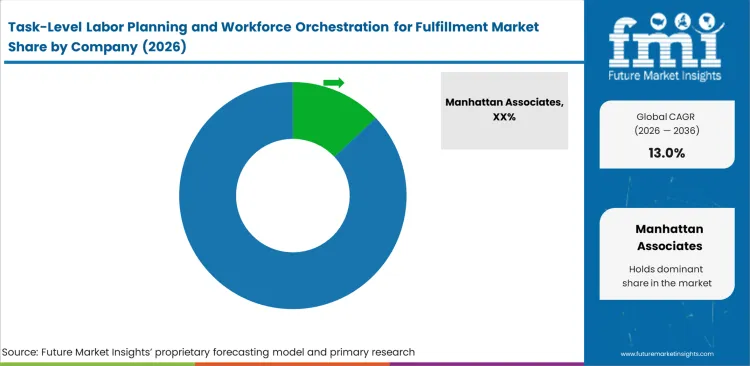
Software competition centers heavily on bridging predictive planning with real-time floor execution. Manhattan Associates relies on deep legacy ties into global supply chain data ecosystems, while Blue Yonder pushes aggressive machine learning integrations. Facility managers evaluating Manhattan vs Blue Yonder labor management scenarios measure these platforms not on algorithmic sophistication alone, but on how quickly associate-facing mobile applications can be deployed without extensive training. Warehouse labor planning software vendors face intense pressure to prove specific time-to-value metrics during pilot programs before enterprise procurement committees approve full network rollouts.
Software giants possess extensive libraries of engineered time standards that challengers struggle to replicate. SAP and Körber utilize massive installed customer bases to refine their routing algorithms using real-world telemetry data. This historical execution data acts as a moat, allowing established players to calibrate task assignments accurately across diverse physical environments. New market entrants pushing standalone warehouse picking ai systems must demonstrate superior integration APIs to break into established technology stacks.
Large distribution networks actively resist vendor lock-in by decoupling their hardware procurement from software licensing agreements. Supply chain executives demand open architectures that allow smooth integration with emerging robotic fleets or alternative analytics engines. Contract logistics providers actively seek out the best fulfillment labor software for 3PL to manage varying client workflows simultaneously. As fulfillment operations shift toward highly automated hybrid models through 2036, competition pivots from pure human task routing to orchestrating complex interactions between human associates and autonomous industrial automation equipment via dedicated 3PL workforce orchestration software.
Key Players in Task-Level Labor Planning and Workforce Orchestration for Fulfillment Market
- Manhattan Associates
- Blue Yonder
- Körber
- Infor
- SAP
- Made4net
- IFS Softeon
Scope of the Report
| Metric | Value |
|---|---|
| Quantitative Units | USD 1.7 billion to USD 5.7 billion, at a CAGR of 13.0% |
| Market Definition | Software platforms aligning associate shift schedules with real-time order execution requirements to optimize physical distribution tasks. |
| Segmentation | Solution layer, Deployment model, Fulfillment mode, Warehouse scale, Buyer objective, User type, and Region |
| Regions Covered | North America, Latin America, Europe, East Asia, South Asia & Pacific, Middle East & Africa |
| Countries Covered | United States, Germany, United Kingdom, Japan, China, India, South Korea, among others |
| Key Companies Profiled | Manhattan Associates, Blue Yonder, Körber, Infor, SAP, Made4net, IFS Softeon |
| Forecast Period | 2026 to 2036 |
| Approach | Top-down supply-side analysis cross-validated with bottom-up buyer procurement modeling and software seat license tracking |
Source: Future Market Insights (FMI) analysis, based on proprietary forecasting model and primary research
Task-Level Labor Planning and Workforce Orchestration for Fulfillment Market Analysis by Segments
Solution layer
- Labor planning
- Workforce orchestration
- Task assignment
- Performance analytics
- Incentive management
Deployment model
- Cloud
- Hybrid
- On-premise
Fulfillment mode
- E-commerce
- Omnichannel
- 3PL
- Store fulfillment
Warehouse scale
- Large enterprises
- Mid-market
- SMEs
Buyer objective
- Productivity
- Labor visibility
- Cost control
- Peak planning
- Service levels
User type
- Operations managers
- Supervisors
- Planners
- Associates
Region:
- North America
- United States
- Canada
- Europe
- Germany
- United Kingdom
- France
- Italy
- Spain
- Asia Pacific
- China
- Japan
- South Korea
- Taiwan
- Singapore
- Latin America
- Brazil
- Mexico
- Argentina
- Middle East & Africa
- GCC Countries
- South Africa
Bibliography
- Federal Reserve Bank of St. Louis. (2026). All Employees, Warehousing and Storage [CES4349300001]. FRED.
- MHI. (2025, March). New MHI and Deloitte report focuses on orchestrating end-to-end digital supply chain solutions. MHI.
- USA Bureau of Labor Statistics. (2026, March). Warehousing and Storage: NAICS 493. BLS.
- USA International Trade Administration. (2025, January). Japan Material Handling. Trade.gov.
- Press Information Bureau, Government of India. (2025, November). Supercharging India’s Logistics. PIB.
- Deutscher Industrie- und Handelskammertag. (2025, December). DIHK presents Skilled Labour Report 2025/2026. DIHK.
- Office for National Statistics. (2025, December). Labour market overview, UK: December 2025. ONS.
This bibliography is provided for reader reference. The full FMI report contains the complete reference list with primary source documentation.
This Report Addresses
- Shift forecasting tools connecting baseline headcount projections directly to fulfillment velocity targets
- Algorithmic models translating varying e-commerce spikes into immediate floor-level routing assignments
- Integration requirements linking legacy automated storage retrievals with active picker availability
- Performance dashboards adjusting expected standard times based on exact inventory zone geometry
- Cloud transition pathways resolving multi-site visibility gaps for regional operations directors
- Real-time gamification applications managing associate retention through transparent incentive tracking
- Hardware decoupling strategies preventing vendor lock-in across expanding robotic fleets
- Regulatory compliance modules tracking occupational health directives regarding continuous associate monitoring
Frequently Asked Questions
What is task-level labor planning in fulfillment?
FMI notes valuation crossed USD 1.5 billion in 2025. Rising wage pressures force logistics operators to adopt algorithmic solutions quickly that match associate availability against incoming order waves using precise scheduling algorithms.
how big is the fulfillment labor orchestration market?
Forecasts project revenue hitting USD 5.7 billion by 2036. Deployment across massive new distribution centers is the reason for this expansion as companies digitize manual workforce allocation.
What is the warehouse labor planning CAGR?
Growth maintains a 13.0% compound annual rate through 2036. Transitioning from static rosters to dynamic algorithms fuels this momentum globally.
explain the task-level labor planning market in fulfillment?
Forecasting baseline headcount dictates all subsequent scheduling activities. Facility managers require accurate shift staffing before implementing real-time task adjustments to optimize picker routing.
which vendors offer workforce orchestration for warehouses?
Manhattan Associates, Blue Yonder, Körber, Infor, and SAP represent the primary technology providers. Facility managers evaluate these fulfillment workforce orchestration vendors based on integration capabilities and engineered time standard libraries.
what is the difference between WMS and labor orchestration?
High-frequency single-unit picking breaks manual spreadsheet planning entirely. Small-parcel velocity requires constantly recalculating associate paths to minimize transit time, moving beyond simple inventory tracking into active human movement direction.
best software for task assignment in fulfillment centers?
Coordinating thousands of associates across vast square footage demands enterprise-grade standards. Massive deployments force buyers to evaluate platforms offering deep application programming interfaces for seamless workflow adjustments.
Why do productivity objectives drive procurement?
Extracting maximum throughput per scheduled hour secures distribution profitability. Industrial engineers focus intensely on tracking physical item scans per minute to justify software investments.
What difference places India ahead of China in growth?
India combines massive policy-led infrastructure upgrades with initial digitalization efforts. Chinese operators already utilize highly mature execution platforms, dampening relative compound growth over the next decade.
How do operations managers utilize real-time analytics?
Site leaders spot underperforming aisles immediately during active shifts. Reassigning staff mid-wave prevents isolated bottlenecks from delaying outbound carrier departures.
What prevents universal adoption across smaller warehouses?
Mid-market operators resist standardizing unique local workflows to match software parameters. Algorithmic friction increases when manual override requests multiply daily across uncalibrated systems.
How do tight labor pools affect software feature development?
Vendors adapt interfaces specifically for zero-training onboarding processes. High turnover rates compel intuitive screen flows that guide temporary associates flawlessly through complex picking zones.
Why do specific geographic regulations alter software configuration?
European directives dictate stringent occupational health compliance tracking. Shift planners must balance routing efficiency against mandated rest periods, driving adoption of specialized scheduling logic.
What advantage do incumbent software vendors hold?
Massive historical execution telemetry allows incumbents to calibrate standard time allowances accurately. Challengers lack real-world data covering diverse physical facility constraints.
How does robotic coordination change task assignment?
Syncing human paths with autonomous material handlers eliminates aisle congestion. Floor supervisors avoid physical collisions while maximizing mechanical asset utilization across shared floor space.
Why do buyers decouple hardware from software licensing?
Supply chain executives demand open architectures preventing restrictive vendor lock-in. Flexibility allows operators to introduce competing analytics engines without replacing handheld scanners.
How does gamification impact associate performance?
Translating punitive tracking into competitive achievement boards reduces floor friction. Real-time incentive visibility actively motivates pickers during demanding holiday peaks.
What consequence awaits operators delaying dynamic shift allocation?
Relying on daily rosters forces sudden volume spikes into expensive overtime. Untracked manual coordination rapidly erodes gross margins across direct-to-consumer channels.
How do facility managers handle exception events digitally?
Mobile reporting capabilities allow associates to document damaged inventory instantly. Eliminating physical paperwork reduces wasted transit minutes per resolution incident.
Why does single-unit optimization mask deeper operational tensions?
Pickers perfectly optimized for single-item velocity struggle adapting to bulk pallet replenishment. Mode-specific routing algorithms must transition smoothly between varying physical tasks.
What hidden friction exists within algorithmic speed tracking?
Unrealistic pace demands drive massive associate turnover rates. Chasing pure productivity targets routinely cannibalizes accuracy, generating expensive inbound return processing.
How does dynamic scheduling integrate with third-party labor pools?
Connecting software directly to staffing agency interfaces fills immediate roster gaps. Human resources directors bypass manual coordination when unexpected order waves hit facilities.
Preview the report firsthand - request a free sample
Get SampleGet the brochure for pricing and purchase details.
Get PDFTable of Content
- Executive Summary
- Global Market Outlook
- Demand-side Trends
- Supply-side Trends
- Technology Roadmap Analysis
- Analysis and Recommendations
- Market Overview
- Market Coverage / Taxonomy
- Market Definition / Scope / Limitations
- Research Methodology
- Chapter Orientation
- Analytical Lens and Working Hypotheses
- Market Structure, Signals, and Trend Drivers
- Benchmarking and Cross-market Comparability
- Market Sizing, Forecasting, and Opportunity Mapping
- Research Design and Evidence Framework
- Desk Research Programme (Secondary Evidence)
- Company Annual and Sustainability Reports
- Peer-reviewed Journals and Academic Literature
- Corporate Websites, Product Literature, and Technical Notes
- Earnings Decks and Investor Briefings
- Statutory Filings and Regulatory Disclosures
- Technical White Papers and Standards Notes
- Trade Journals, Industry Magazines, and Analyst Briefs
- Conference Proceedings, Webinars, and Seminar Materials
- Government Statistics Portals and Public Data Releases
- Press Releases and Reputable Media Coverage
- Specialist Newsletters and Curated Briefings
- Sector Databases and Reference Repositories
- FMI Internal Proprietary Databases and Historical Market Datasets
- Subscription Datasets and Paid Sources
- Social Channels, Communities, and Digital Listening Inputs
- Additional Desk Sources
- Expert Input and Fieldwork (Primary Evidence)
- Primary Modes
- Qualitative Interviews and Expert Elicitation
- Quantitative Surveys and Structured Data Capture
- Blended Approach
- Why Primary Evidence is Used
- Field Techniques
- Interviews
- Surveys
- Focus Groups
- Observational and In-context Research
- Social and Community Interactions
- Stakeholder Universe Engaged
- C-suite Leaders
- Board Members
- Presidents and Vice Presidents
- R&D and Innovation Heads
- Technical Specialists
- Domain Subject-matter Experts
- Scientists
- Physicians and Other Healthcare Professionals
- Governance, Ethics, and Data Stewardship
- Research Ethics
- Data Integrity and Handling
- Primary Modes
- Tooling, Models, and Reference Databases
- Desk Research Programme (Secondary Evidence)
- Data Engineering and Model Build
- Data Acquisition and Ingestion
- Cleaning, Normalisation, and Verification
- Synthesis, Triangulation, and Analysis
- Quality Assurance and Audit Trail
- Market Background
- Market Dynamics
- Drivers
- Restraints
- Opportunity
- Trends
- Scenario Forecast
- Demand in Optimistic Scenario
- Demand in Likely Scenario
- Demand in Conservative Scenario
- Opportunity Map Analysis
- Product Life Cycle Analysis
- Supply Chain Analysis
- Investment Feasibility Matrix
- Value Chain Analysis
- PESTLE and Porter’s Analysis
- Regulatory Landscape
- Regional Parent Market Outlook
- Production and Consumption Statistics
- Import and Export Statistics
- Market Dynamics
- Global Market Analysis 2021 to 2025 and Forecast, 2026 to 2036
- Historical Market Size Value (USD Million) Analysis, 2021 to 2025
- Current and Future Market Size Value (USD Million) Projections, 2026 to 2036
- Y-o-Y Growth Trend Analysis
- Absolute $ Opportunity Analysis
- Global Market Pricing Analysis 2021 to 2025 and Forecast 2026 to 2036
- Global Market Analysis 2021 to 2025 and Forecast 2026 to 2036, By Solution Layer
- Introduction / Key Findings
- Historical Market Size Value (USD Million) Analysis By Solution Layer , 2021 to 2025
- Current and Future Market Size Value (USD Million) Analysis and Forecast By Solution Layer , 2026 to 2036
- Labor planning
- Workforce orchestration
- Task assignment
- Performance analytics
- Incentive management
- Labor planning
- Y-o-Y Growth Trend Analysis By Solution Layer , 2021 to 2025
- Absolute $ Opportunity Analysis By Solution Layer , 2026 to 2036
- Global Market Analysis 2021 to 2025 and Forecast 2026 to 2036, By Deployment Model
- Introduction / Key Findings
- Historical Market Size Value (USD Million) Analysis By Deployment Model, 2021 to 2025
- Current and Future Market Size Value (USD Million) Analysis and Forecast By Deployment Model, 2026 to 2036
- Cloud
- Hybrid
- On-premise
- Cloud
- Y-o-Y Growth Trend Analysis By Deployment Model, 2021 to 2025
- Absolute $ Opportunity Analysis By Deployment Model, 2026 to 2036
- Global Market Analysis 2021 to 2025 and Forecast 2026 to 2036, By Fulfillment mode
- Introduction / Key Findings
- Historical Market Size Value (USD Million) Analysis By Fulfillment mode, 2021 to 2025
- Current and Future Market Size Value (USD Million) Analysis and Forecast By Fulfillment mode, 2026 to 2036
- E-commerce
- Omnichannel
- 3PL
- Store fulfillment
- E-commerce
- Y-o-Y Growth Trend Analysis By Fulfillment mode, 2021 to 2025
- Absolute $ Opportunity Analysis By Fulfillment mode, 2026 to 2036
- Global Market Analysis 2021 to 2025 and Forecast 2026 to 2036, By Warehouse Scale
- Introduction / Key Findings
- Historical Market Size Value (USD Million) Analysis By Warehouse Scale, 2021 to 2025
- Current and Future Market Size Value (USD Million) Analysis and Forecast By Warehouse Scale, 2026 to 2036
- Large enterprises
- Mid-market
- SMEs
- Large enterprises
- Y-o-Y Growth Trend Analysis By Warehouse Scale, 2021 to 2025
- Absolute $ Opportunity Analysis By Warehouse Scale, 2026 to 2036
- Global Market Analysis 2021 to 2025 and Forecast 2026 to 2036, By Buyer Objective
- Introduction / Key Findings
- Historical Market Size Value (USD Million) Analysis By Buyer Objective, 2021 to 2025
- Current and Future Market Size Value (USD Million) Analysis and Forecast By Buyer Objective, 2026 to 2036
- Productivity
- Labor visibility
- Cost control
- Peak planning
- Service levels
- Productivity
- Y-o-Y Growth Trend Analysis By Buyer Objective, 2021 to 2025
- Absolute $ Opportunity Analysis By Buyer Objective, 2026 to 2036
- Global Market Analysis 2021 to 2025 and Forecast 2026 to 2036, By Region
- Introduction
- Historical Market Size Value (USD Million) Analysis By Region, 2021 to 2025
- Current Market Size Value (USD Million) Analysis and Forecast By Region, 2026 to 2036
- North America
- Latin America
- Western Europe
- Eastern Europe
- East Asia
- South Asia and Pacific
- Middle East & Africa
- Market Attractiveness Analysis By Region
- North America Market Analysis 2021 to 2025 and Forecast 2026 to 2036, By Country
- Historical Market Size Value (USD Million) Trend Analysis By Market Taxonomy, 2021 to 2025
- Market Size Value (USD Million) Forecast By Market Taxonomy, 2026 to 2036
- By Country
- USA
- Canada
- Mexico
- By Solution Layer
- By Deployment Model
- By Fulfillment mode
- By Warehouse Scale
- By Buyer Objective
- By Country
- Market Attractiveness Analysis
- By Country
- By Solution Layer
- By Deployment Model
- By Fulfillment mode
- By Warehouse Scale
- By Buyer Objective
- Key Takeaways
- Latin America Market Analysis 2021 to 2025 and Forecast 2026 to 2036, By Country
- Historical Market Size Value (USD Million) Trend Analysis By Market Taxonomy, 2021 to 2025
- Market Size Value (USD Million) Forecast By Market Taxonomy, 2026 to 2036
- By Country
- Brazil
- Chile
- Rest of Latin America
- By Solution Layer
- By Deployment Model
- By Fulfillment mode
- By Warehouse Scale
- By Buyer Objective
- By Country
- Market Attractiveness Analysis
- By Country
- By Solution Layer
- By Deployment Model
- By Fulfillment mode
- By Warehouse Scale
- By Buyer Objective
- Key Takeaways
- Western Europe Market Analysis 2021 to 2025 and Forecast 2026 to 2036, By Country
- Historical Market Size Value (USD Million) Trend Analysis By Market Taxonomy, 2021 to 2025
- Market Size Value (USD Million) Forecast By Market Taxonomy, 2026 to 2036
- By Country
- Germany
- UK
- Italy
- Spain
- France
- Nordic
- BENELUX
- Rest of Western Europe
- By Solution Layer
- By Deployment Model
- By Fulfillment mode
- By Warehouse Scale
- By Buyer Objective
- By Country
- Market Attractiveness Analysis
- By Country
- By Solution Layer
- By Deployment Model
- By Fulfillment mode
- By Warehouse Scale
- By Buyer Objective
- Key Takeaways
- Eastern Europe Market Analysis 2021 to 2025 and Forecast 2026 to 2036, By Country
- Historical Market Size Value (USD Million) Trend Analysis By Market Taxonomy, 2021 to 2025
- Market Size Value (USD Million) Forecast By Market Taxonomy, 2026 to 2036
- By Country
- Russia
- Poland
- Hungary
- Balkan & Baltic
- Rest of Eastern Europe
- By Solution Layer
- By Deployment Model
- By Fulfillment mode
- By Warehouse Scale
- By Buyer Objective
- By Country
- Market Attractiveness Analysis
- By Country
- By Solution Layer
- By Deployment Model
- By Fulfillment mode
- By Warehouse Scale
- By Buyer Objective
- Key Takeaways
- East Asia Market Analysis 2021 to 2025 and Forecast 2026 to 2036, By Country
- Historical Market Size Value (USD Million) Trend Analysis By Market Taxonomy, 2021 to 2025
- Market Size Value (USD Million) Forecast By Market Taxonomy, 2026 to 2036
- By Country
- China
- Japan
- South Korea
- By Solution Layer
- By Deployment Model
- By Fulfillment mode
- By Warehouse Scale
- By Buyer Objective
- By Country
- Market Attractiveness Analysis
- By Country
- By Solution Layer
- By Deployment Model
- By Fulfillment mode
- By Warehouse Scale
- By Buyer Objective
- Key Takeaways
- South Asia and Pacific Market Analysis 2021 to 2025 and Forecast 2026 to 2036, By Country
- Historical Market Size Value (USD Million) Trend Analysis By Market Taxonomy, 2021 to 2025
- Market Size Value (USD Million) Forecast By Market Taxonomy, 2026 to 2036
- By Country
- India
- ASEAN
- Australia & New Zealand
- Rest of South Asia and Pacific
- By Solution Layer
- By Deployment Model
- By Fulfillment mode
- By Warehouse Scale
- By Buyer Objective
- By Country
- Market Attractiveness Analysis
- By Country
- By Solution Layer
- By Deployment Model
- By Fulfillment mode
- By Warehouse Scale
- By Buyer Objective
- Key Takeaways
- Middle East & Africa Market Analysis 2021 to 2025 and Forecast 2026 to 2036, By Country
- Historical Market Size Value (USD Million) Trend Analysis By Market Taxonomy, 2021 to 2025
- Market Size Value (USD Million) Forecast By Market Taxonomy, 2026 to 2036
- By Country
- Kingdom of Saudi Arabia
- Other GCC Countries
- Turkiye
- South Africa
- Other African Union
- Rest of Middle East & Africa
- By Solution Layer
- By Deployment Model
- By Fulfillment mode
- By Warehouse Scale
- By Buyer Objective
- By Country
- Market Attractiveness Analysis
- By Country
- By Solution Layer
- By Deployment Model
- By Fulfillment mode
- By Warehouse Scale
- By Buyer Objective
- Key Takeaways
- Key Countries Market Analysis
- USA
- Pricing Analysis
- Market Share Analysis, 2025
- By Solution Layer
- By Deployment Model
- By Fulfillment mode
- By Warehouse Scale
- By Buyer Objective
- Canada
- Pricing Analysis
- Market Share Analysis, 2025
- By Solution Layer
- By Deployment Model
- By Fulfillment mode
- By Warehouse Scale
- By Buyer Objective
- Mexico
- Pricing Analysis
- Market Share Analysis, 2025
- By Solution Layer
- By Deployment Model
- By Fulfillment mode
- By Warehouse Scale
- By Buyer Objective
- Brazil
- Pricing Analysis
- Market Share Analysis, 2025
- By Solution Layer
- By Deployment Model
- By Fulfillment mode
- By Warehouse Scale
- By Buyer Objective
- Chile
- Pricing Analysis
- Market Share Analysis, 2025
- By Solution Layer
- By Deployment Model
- By Fulfillment mode
- By Warehouse Scale
- By Buyer Objective
- Germany
- Pricing Analysis
- Market Share Analysis, 2025
- By Solution Layer
- By Deployment Model
- By Fulfillment mode
- By Warehouse Scale
- By Buyer Objective
- UK
- Pricing Analysis
- Market Share Analysis, 2025
- By Solution Layer
- By Deployment Model
- By Fulfillment mode
- By Warehouse Scale
- By Buyer Objective
- Italy
- Pricing Analysis
- Market Share Analysis, 2025
- By Solution Layer
- By Deployment Model
- By Fulfillment mode
- By Warehouse Scale
- By Buyer Objective
- Spain
- Pricing Analysis
- Market Share Analysis, 2025
- By Solution Layer
- By Deployment Model
- By Fulfillment mode
- By Warehouse Scale
- By Buyer Objective
- France
- Pricing Analysis
- Market Share Analysis, 2025
- By Solution Layer
- By Deployment Model
- By Fulfillment mode
- By Warehouse Scale
- By Buyer Objective
- India
- Pricing Analysis
- Market Share Analysis, 2025
- By Solution Layer
- By Deployment Model
- By Fulfillment mode
- By Warehouse Scale
- By Buyer Objective
- ASEAN
- Pricing Analysis
- Market Share Analysis, 2025
- By Solution Layer
- By Deployment Model
- By Fulfillment mode
- By Warehouse Scale
- By Buyer Objective
- Australia & New Zealand
- Pricing Analysis
- Market Share Analysis, 2025
- By Solution Layer
- By Deployment Model
- By Fulfillment mode
- By Warehouse Scale
- By Buyer Objective
- China
- Pricing Analysis
- Market Share Analysis, 2025
- By Solution Layer
- By Deployment Model
- By Fulfillment mode
- By Warehouse Scale
- By Buyer Objective
- Japan
- Pricing Analysis
- Market Share Analysis, 2025
- By Solution Layer
- By Deployment Model
- By Fulfillment mode
- By Warehouse Scale
- By Buyer Objective
- South Korea
- Pricing Analysis
- Market Share Analysis, 2025
- By Solution Layer
- By Deployment Model
- By Fulfillment mode
- By Warehouse Scale
- By Buyer Objective
- Russia
- Pricing Analysis
- Market Share Analysis, 2025
- By Solution Layer
- By Deployment Model
- By Fulfillment mode
- By Warehouse Scale
- By Buyer Objective
- Poland
- Pricing Analysis
- Market Share Analysis, 2025
- By Solution Layer
- By Deployment Model
- By Fulfillment mode
- By Warehouse Scale
- By Buyer Objective
- Hungary
- Pricing Analysis
- Market Share Analysis, 2025
- By Solution Layer
- By Deployment Model
- By Fulfillment mode
- By Warehouse Scale
- By Buyer Objective
- Kingdom of Saudi Arabia
- Pricing Analysis
- Market Share Analysis, 2025
- By Solution Layer
- By Deployment Model
- By Fulfillment mode
- By Warehouse Scale
- By Buyer Objective
- Turkiye
- Pricing Analysis
- Market Share Analysis, 2025
- By Solution Layer
- By Deployment Model
- By Fulfillment mode
- By Warehouse Scale
- By Buyer Objective
- South Africa
- Pricing Analysis
- Market Share Analysis, 2025
- By Solution Layer
- By Deployment Model
- By Fulfillment mode
- By Warehouse Scale
- By Buyer Objective
- USA
- Market Structure Analysis
- Competition Dashboard
- Competition Benchmarking
- Market Share Analysis of Top Players
- By Regional
- By Solution Layer
- By Deployment Model
- By Fulfillment mode
- By Warehouse Scale
- By Buyer Objective
- Competition Analysis
- Competition Deep Dive
- Manhattan Associates
- Overview
- Product Portfolio
- Profitability by Market Segments (Product/Age /Sales Channel/Region)
- Sales Footprint
- Strategy Overview
- Marketing Strategy
- Product Strategy
- Channel Strategy
- Blue Yonder
- Körber
- Infor
- SAP
- Made4net
- IFS Softeon
- Manhattan Associates
- Competition Deep Dive
- Assumptions & Acronyms Used


