

- Industry Size (2025)
- USD 1.8 Bn
- Forecast (2035)
- USD 2.3 Bn
- CAGR (2025 to 2035)
- 2.7%
Laboratory Centrifuge & Accessories Market Size and Share Forecast Outlook 2025 to 2035
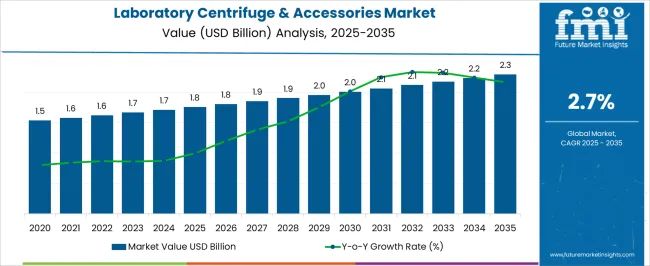
The Laboratory Centrifuge & Accessories Market is estimated to be valued at USD 1.8 billion in 2025 and is projected to reach USD 2.3 billion by 2035, registering a compound annual growth rate (CAGR) of 2.7% over the forecast period.
Quick Stats for Laboratory Centrifuge & Accessories Market
- Laboratory Centrifuge & Accessories Market Value (2025): USD 1.8 billion
- Laboratory Centrifuge & Accessories Market Forecast Value (2035): USD 2.3 billion
- Laboratory Centrifuge & Accessories Market Forecast CAGR: 2.7%
- Leading Segment in Laboratory Centrifuge & Accessories Market in 2025: Equipment (40.0%)
- Key Growth Regions in Laboratory Centrifuge & Accessories Market: North America, Asia-Pacific, Europe
- Top Key Players in Laboratory Centrifuge & Accessories Market: Thermo Fisher Scientific Inc., Eppendorf AG, Beckman Coulter (Danaher), Kubota Corporation, Danaher Corporation, Siemens Healthineers, VWR International, Labcon North America
Laboratory Centrifuge & Accessories Market Key Takeaways
| Metric | Value |
|---|---|
| Laboratory Centrifuge & Accessories Market Estimated Value in (2025 E) | USD 1.8 billion |
| Laboratory Centrifuge & Accessories Market Forecast Value in (2035 F) | USD 2.3 billion |
| Forecast CAGR (2025 to 2035) | 2.7% |
Why is the Laboratory Centrifuge & Accessories Market Growing?
The Laboratory Centrifuge and Accessories market is experiencing consistent growth due to the expanding need for high-precision sample separation and analysis across research and industrial laboratories. In 2025, the market is being shaped by advancements in laboratory automation, integration of digital control systems, and demand for multifunctional and energy-efficient equipment. The current market scenario reflects increased adoption in life sciences, biotechnology, clinical diagnostics, and pharmaceutical research where accuracy, reliability, and speed are critical.
Growth is being driven by rising investments in research and development, expansion of academic and private research facilities, and increasing focus on precision and reproducibility in experiments. In addition, regulatory emphasis on quality assurance and standardized testing procedures has further fueled demand.
The future outlook is favorable, as laboratories continue to upgrade legacy systems to software-enabled, high-throughput centrifuges and accessories that enhance workflow efficiency The growing requirement for sample handling across genomics, proteomics, and microbiology research is expected to sustain the demand for advanced centrifuge technologies over the next decade.
Segmental Analysis
The laboratory centrifuge & accessories market is segmented by product type, application, end use, and geographic regions. By product type, laboratory centrifuge & accessories market is divided into Equipment, Accessories, Rotor, Plate, and Tube. In terms of application, laboratory centrifuge & accessories market is classified into Microbiology, Proteomics, Blood Component Separation, and Genomics. Based on end use, laboratory centrifuge & accessories market is segmented into Research & Development Institutes, Pharmaceutical Industries, Hospitals & Diagnostic Centres, and Others. Regionally, the laboratory centrifuge & accessories industry is classified into North America, Latin America, Western Europe, Eastern Europe, Balkan & Baltic Countries, Russia & Belarus, Central Asia, East Asia, South Asia & Pacific, and the Middle East & Africa.
Insights into the Equipment Segment
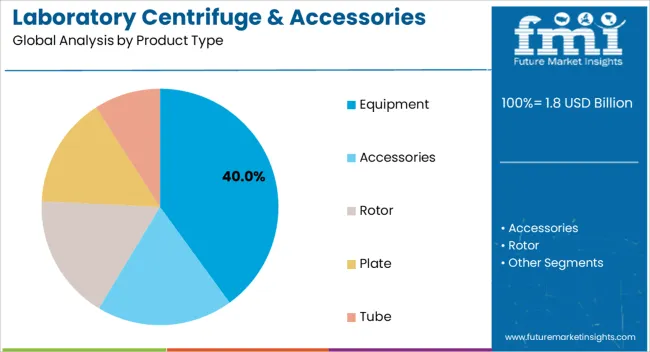
The Equipment product type is expected to hold 40.00% of the Laboratory Centrifuge and Accessories market revenue in 2025, establishing it as the leading product type segment. This leadership has been driven by the critical role that centrifuge equipment plays in sample separation and laboratory workflow efficiency. Adoption has been accelerated by the demand for advanced systems capable of high-speed operation, precise temperature control, and programmable centrifugation protocols.
Laboratories increasingly prefer equipment that can be integrated with digital monitoring and automated accessories, allowing reproducible results and reduced manual intervention. Furthermore, the trend toward high-throughput research and industrial applications has further reinforced growth in the equipment segment.
The ability to accommodate various rotor types and accessory kits, along with flexible software-driven operational parameters, has made these systems a preferred choice Continued investment in research laboratories and modernization of existing facilities is expected to support the segment’s leadership, as laboratories seek scalable and adaptable centrifuge solutions to meet evolving experimental requirements.
Insights into the Microbiology Segment
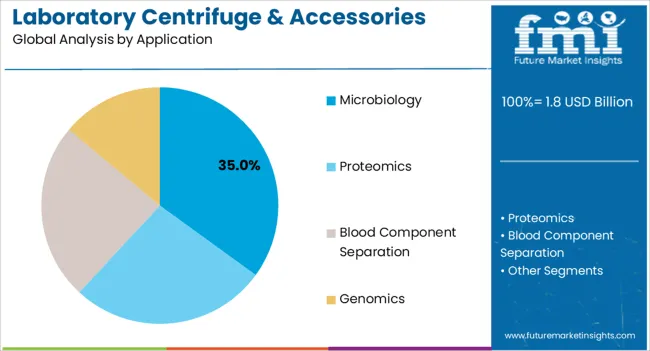
The Microbiology application segment is projected to capture 35.00% of the total market revenue in 2025, making it the dominant application area. Growth in this segment is being attributed to the increasing reliance on centrifugation in microbial analysis, including sample preparation, cell culture separation, and pathogen detection. Laboratories in research, clinical diagnostics, and industrial microbiology are adopting high-performance centrifuges that enable precise separation of microbial cultures from liquids and other substrates.
The efficiency and accuracy offered by software-enabled centrifuge systems allow researchers to achieve consistent results while handling sensitive biological samples. Rising global investments in infectious disease research, microbiome studies, and laboratory automation have further contributed to the segment’s growth.
In addition, regulatory standards for microbial testing and the requirement for reproducible laboratory processes have reinforced the adoption of advanced centrifuge systems The segment is expected to maintain a strong growth trajectory as microbiology continues to play a critical role in healthcare, pharmaceutical development, and food safety research.
Insights into the Research & Development Institutes Segment
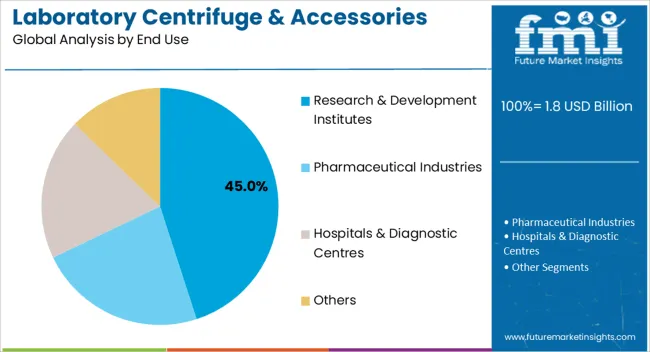
The Research and Development Institutes end-use segment is anticipated to account for 45.00% of the Laboratory Centrifuge and Accessories market revenue in 2025, making it the largest end-use segment. The segment’s growth is being driven by increasing investments in scientific research, innovation, and laboratory infrastructure across both academic and private institutions.
The demand for high-precision, reliable, and software-enabled centrifuge systems is high, as these institutes require accurate sample separation for experiments in biotechnology, pharmaceuticals, and life sciences. The ability to integrate centrifuges with automated workflows and digital monitoring systems has enhanced operational efficiency, enabling researchers to conduct complex studies with reproducibility and minimal error.
Furthermore, research institutions are increasingly adopting energy-efficient and multifunctional systems to optimize laboratory space and reduce operational costs The growing focus on advanced research areas such as genomics, proteomics, and microbiology, along with funding for innovation, is expected to sustain the leadership of this segment in the market over the coming decade.
Market Overview
Laboratory Centrifuge & Accessories Market Overview
Increasing research & development expenditure along with the technological advancement in the analytical instruments are generating the demand for laboratory centrifuge & accessories. The adoption of laboratory centrifuge & accessories is increasing in hospitals and diagnostics centres for the treatment of diseases at the molecular level in order to better understand the nature of the disease.
Moreover, with the emergence of automation in laboratories, the demand for advanced laboratory centrifuge & accessories is increasing to overcome the challenges of conventional laboratory centrifuge & accessories in terms of volume and speed.
Laboratory centrifuge is an equipment which is driven by motor and spins liquid samples at high speed to separate substances of different densities. Laboratory centrifuge & accessories are essential equipment in most of the laboratories to meet the application needs for clinical & blood banking, drug discovery, proteomics, and for molecular biology.
The increasing demand for laboratory centrifuge & accessories to meet the specific demand for component separation process is propelling the growth of laboratory centrifuge & accessories market. Furthermore, the advancements in various sectors such as diagnostics, microbiology, and forensics research is supporting the demand for laboratory centrifuge & accessories market.
Analysis of Laboratory Centrifuge & Accessories Market By Key Countries
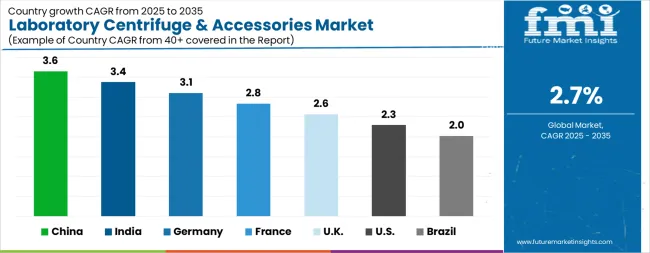
| Country | CAGR |
|---|---|
| China | 3.6% |
| India | 3.4% |
| Germany | 3.1% |
| France | 2.8% |
| UK | 2.6% |
| USA | 2.3% |
| Brazil | 2.0% |
Country-wise Analysis
The Laboratory Centrifuge & Accessories Market is expected to register a CAGR of 2.7% during the forecast period, exhibiting varied country level momentum. China leads with the highest CAGR of 3.6%, followed by India at 3.4%. Developed markets such as Germany, France, and the UK continue to expand steadily, while the USA is likely to grow at consistent rates. Brazil posts the lowest CAGR at 2.0%, yet still underscores a broadly positive trajectory for the global Laboratory Centrifuge & Accessories Market. In 2024, Germany held a dominant revenue in the Western Europe market and is expected to grow with a CAGR of 3.1%. The USA Laboratory Centrifuge & Accessories Market is estimated to be valued at USD 628.7 million in 2025 and is anticipated to reach a valuation of USD 788.8 million by 2035. Sales are projected to rise at a CAGR of 2.3% over the forecast period between 2025 and 2035. While Japan and South Korea markets are estimated to be valued at USD 90.4 million and USD 44.0 million respectively in 2025.
Key Players in the Laboratory Centrifuge & Accessories Market
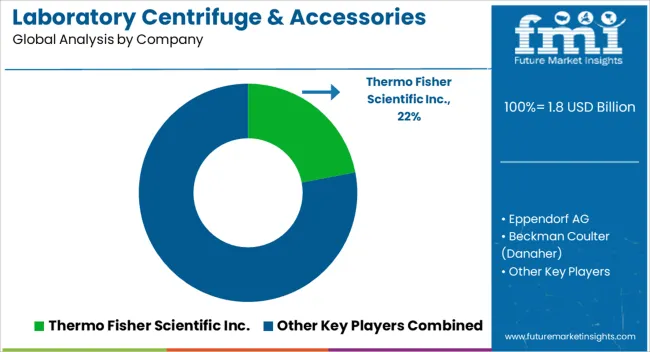
- Thermo Fisher Scientific Inc.
- Eppendorf AG
- Beckman Coulter (Danaher)
- Kubota Corporation
- Danaher Corporation
- Siemens Healthineers
- VWR International
- Labcon North America
Scope of the Report
| Item | Value |
|---|---|
| Quantitative Units | USD 1.8 Billion |
| Product Type | Equipment, Accessories, Rotor, Plate, and Tube |
| Application | Microbiology, Proteomics, Blood Component Separation, and Genomics |
| End Use | Research & Development Institutes, Pharmaceutical Industries, Hospitals & Diagnostic Centres, and Others |
| Regions Covered | North America, Europe, Asia-Pacific, Latin America, Middle East & Africa |
| Country Covered | United States, Canada, Germany, France, United Kingdom, China, Japan, India, Brazil, South Africa |
| Key Companies Profiled | Thermo Fisher Scientific Inc., Eppendorf AG, Beckman Coulter (Danaher), Kubota Corporation, Danaher Corporation, Siemens Healthineers, VWR International, and Labcon North America |
Laboratory Centrifuge & Accessories Market by Segments
Product Type:
- Equipment
- Accessories
- Rotor
- Plate
- Tube
Application:
- Microbiology
- Proteomics
- Blood Component Separation
- Genomics
End Use:
- Research & Development Institutes
- Pharmaceutical Industries
- Hospitals & Diagnostic Centres
- Others
Region:
- North America
- USA
- Canada
- Mexico
- Latin America
- Brazil
- Chile
- Rest of Latin America
- Western Europe
- Germany
- UK
- Italy
- Spain
- France
- Nordic
- BENELUX
- Rest of Western Europe
- Eastern Europe
- Russia
- Poland
- Hungary
- Balkan & Baltic
- Rest of Eastern Europe
- East Asia
- China
- Japan
- South Korea
- South Asia and Pacific
- India
- ASEAN
- Australia & New Zealand
- Rest of South Asia and Pacific
- Middle East & Africa
- Kingdom of Saudi Arabia
- Other GCC Countries
- Turkiye
- South Africa
- Other African Union
- Rest of Middle East & Africa
Frequently Asked Questions
How big is the laboratory centrifuge & accessories market in 2025?
The global laboratory centrifuge & accessories market is estimated to be valued at USD 1.8 billion in 2025.
What will be the size of laboratory centrifuge & accessories market in 2035?
The market size for the laboratory centrifuge & accessories market is projected to reach USD 2.3 billion by 2035.
How much will be the laboratory centrifuge & accessories market growth between 2025 and 2035?
The laboratory centrifuge & accessories market is expected to grow at a 2.7% CAGR between 2025 and 2035.
What are the key product types in the laboratory centrifuge & accessories market?
The key product types in laboratory centrifuge & accessories market are equipment, accessories, rotor, plate and tube.
Which application segment to contribute significant share in the laboratory centrifuge & accessories market in 2025?
In terms of application, microbiology segment to command 35.0% share in the laboratory centrifuge & accessories market in 2025.
Preview the report firsthand - request a free sample
Get SampleGet the brochure for pricing and purchase details.
Get PDFTable of Content
- Executive Summary
- Global Market Outlook
- Demand-side Trends
- Supply-side Trends
- Technology Roadmap Analysis
- Analysis and Recommendations
- Market Overview
- Market Coverage / Taxonomy
- Market Definition / Scope / Limitations
- Market Background
- Market Dynamics
- Drivers
- Restraints
- Opportunity
- Trends
- Scenario Forecast
- Demand in Optimistic Scenario
- Demand in Likely Scenario
- Demand in Conservative Scenario
- Opportunity Map Analysis
- Product Life Cycle Analysis
- Supply Chain Analysis
- Investment Feasibility Matrix
- Value Chain Analysis
- PESTLE and Porter’s Analysis
- Regulatory Landscape
- Regional Parent Market Outlook
- Production and Consumption Statistics
- Import and Export Statistics
- Market Dynamics
- Global Market Analysis 2020 to 2024 and Forecast, 2025 to 2035
- Historical Market Size Value (USD Million) Analysis, 2020 to 2024
- Current and Future Market Size Value (USD Million) Projections, 2025 to 2035
- Y-o-Y Growth Trend Analysis
- Absolute $ Opportunity Analysis
- Global Market Pricing Analysis 2020 to 2024 and Forecast 2025 to 2035
- Global Market Analysis 2020 to 2024 and Forecast 2025 to 2035, By Product Type
- Introduction / Key Findings
- Historical Market Size Value (USD Million) Analysis By Product Type , 2020 to 2024
- Current and Future Market Size Value (USD Million) Analysis and Forecast By Product Type , 2025 to 2035
- Equipment
- Accessories
- Rotor
- Plate
- Tube
- Y-o-Y Growth Trend Analysis By Product Type , 2020 to 2024
- Absolute $ Opportunity Analysis By Product Type , 2025 to 2035
- Global Market Analysis 2020 to 2024 and Forecast 2025 to 2035, By Application
- Introduction / Key Findings
- Historical Market Size Value (USD Million) Analysis By Application, 2020 to 2024
- Current and Future Market Size Value (USD Million) Analysis and Forecast By Application, 2025 to 2035
- Microbiology
- Proteomics
- Blood Component Separation
- Genomics
- Y-o-Y Growth Trend Analysis By Application, 2020 to 2024
- Absolute $ Opportunity Analysis By Application, 2025 to 2035
- Global Market Analysis 2020 to 2024 and Forecast 2025 to 2035, By End Use
- Introduction / Key Findings
- Historical Market Size Value (USD Million) Analysis By End Use, 2020 to 2024
- Current and Future Market Size Value (USD Million) Analysis and Forecast By End Use, 2025 to 2035
- Research & Development Institutes
- Pharmaceutical Industries
- Hospitals & Diagnostic Centres
- Others
- Y-o-Y Growth Trend Analysis By End Use, 2020 to 2024
- Absolute $ Opportunity Analysis By End Use, 2025 to 2035
- Global Market Analysis 2020 to 2024 and Forecast 2025 to 2035, By Region
- Introduction
- Historical Market Size Value (USD Million) Analysis By Region, 2020 to 2024
- Current Market Size Value (USD Million) Analysis and Forecast By Region, 2025 to 2035
- North America
- Latin America
- Western Europe
- Eastern Europe
- East Asia
- South Asia and Pacific
- Middle East & Africa
- Market Attractiveness Analysis By Region
- North America Market Analysis 2020 to 2024 and Forecast 2025 to 2035, By Country
- Historical Market Size Value (USD Million) Trend Analysis By Market Taxonomy, 2020 to 2024
- Market Size Value (USD Million) Forecast By Market Taxonomy, 2025 to 2035
- By Country
- U.S.
- Canada
- Mexico
- By Product Type
- By Application
- By End Use
- By Country
- Market Attractiveness Analysis
- By Country
- By Product Type
- By Application
- By End Use
- Key Takeaways
- Latin America Market Analysis 2020 to 2024 and Forecast 2025 to 2035, By Country
- Historical Market Size Value (USD Million) Trend Analysis By Market Taxonomy, 2020 to 2024
- Market Size Value (USD Million) Forecast By Market Taxonomy, 2025 to 2035
- By Country
- Brazil
- Chile
- Rest of Latin America
- By Product Type
- By Application
- By End Use
- By Country
- Market Attractiveness Analysis
- By Country
- By Product Type
- By Application
- By End Use
- Key Takeaways
- Western Europe Market Analysis 2020 to 2024 and Forecast 2025 to 2035, By Country
- Historical Market Size Value (USD Million) Trend Analysis By Market Taxonomy, 2020 to 2024
- Market Size Value (USD Million) Forecast By Market Taxonomy, 2025 to 2035
- By Country
- Germany
- U.K.
- Italy
- Spain
- France
- Nordic
- BENELUX
- Rest of Western Europe
- By Product Type
- By Application
- By End Use
- By Country
- Market Attractiveness Analysis
- By Country
- By Product Type
- By Application
- By End Use
- Key Takeaways
- Eastern Europe Market Analysis 2020 to 2024 and Forecast 2025 to 2035, By Country
- Historical Market Size Value (USD Million) Trend Analysis By Market Taxonomy, 2020 to 2024
- Market Size Value (USD Million) Forecast By Market Taxonomy, 2025 to 2035
- By Country
- Russia
- Poland
- Hungary
- Balkan & Baltic
- Rest of Eastern Europe
- By Product Type
- By Application
- By End Use
- By Country
- Market Attractiveness Analysis
- By Country
- By Product Type
- By Application
- By End Use
- Key Takeaways
- East Asia Market Analysis 2020 to 2024 and Forecast 2025 to 2035, By Country
- Historical Market Size Value (USD Million) Trend Analysis By Market Taxonomy, 2020 to 2024
- Market Size Value (USD Million) Forecast By Market Taxonomy, 2025 to 2035
- By Country
- China
- Japan
- South Korea
- By Product Type
- By Application
- By End Use
- By Country
- Market Attractiveness Analysis
- By Country
- By Product Type
- By Application
- By End Use
- Key Takeaways
- South Asia and Pacific Market Analysis 2020 to 2024 and Forecast 2025 to 2035, By Country
- Historical Market Size Value (USD Million) Trend Analysis By Market Taxonomy, 2020 to 2024
- Market Size Value (USD Million) Forecast By Market Taxonomy, 2025 to 2035
- By Country
- India
- ASEAN
- Australia & New Zealand
- Rest of South Asia and Pacific
- By Product Type
- By Application
- By End Use
- By Country
- Market Attractiveness Analysis
- By Country
- By Product Type
- By Application
- By End Use
- Key Takeaways
- Middle East & Africa Market Analysis 2020 to 2024 and Forecast 2025 to 2035, By Country
- Historical Market Size Value (USD Million) Trend Analysis By Market Taxonomy, 2020 to 2024
- Market Size Value (USD Million) Forecast By Market Taxonomy, 2025 to 2035
- By Country
- Kingdom of Saudi Arabia
- Other GCC Countries
- Turkiye
- South Africa
- Other African Union
- Rest of Middle East & Africa
- By Product Type
- By Application
- By End Use
- By Country
- Market Attractiveness Analysis
- By Country
- By Product Type
- By Application
- By End Use
- Key Takeaways
- Key Countries Market Analysis
- U.S.
- Pricing Analysis
- Market Share Analysis, 2024
- By Product Type
- By Application
- By End Use
- Canada
- Pricing Analysis
- Market Share Analysis, 2024
- By Product Type
- By Application
- By End Use
- Mexico
- Pricing Analysis
- Market Share Analysis, 2024
- By Product Type
- By Application
- By End Use
- Brazil
- Pricing Analysis
- Market Share Analysis, 2024
- By Product Type
- By Application
- By End Use
- Chile
- Pricing Analysis
- Market Share Analysis, 2024
- By Product Type
- By Application
- By End Use
- Germany
- Pricing Analysis
- Market Share Analysis, 2024
- By Product Type
- By Application
- By End Use
- U.K.
- Pricing Analysis
- Market Share Analysis, 2024
- By Product Type
- By Application
- By End Use
- Italy
- Pricing Analysis
- Market Share Analysis, 2024
- By Product Type
- By Application
- By End Use
- Spain
- Pricing Analysis
- Market Share Analysis, 2024
- By Product Type
- By Application
- By End Use
- France
- Pricing Analysis
- Market Share Analysis, 2024
- By Product Type
- By Application
- By End Use
- India
- Pricing Analysis
- Market Share Analysis, 2024
- By Product Type
- By Application
- By End Use
- ASEAN
- Pricing Analysis
- Market Share Analysis, 2024
- By Product Type
- By Application
- By End Use
- Australia & New Zealand
- Pricing Analysis
- Market Share Analysis, 2024
- By Product Type
- By Application
- By End Use
- China
- Pricing Analysis
- Market Share Analysis, 2024
- By Product Type
- By Application
- By End Use
- Japan
- Pricing Analysis
- Market Share Analysis, 2024
- By Product Type
- By Application
- By End Use
- South Korea
- Pricing Analysis
- Market Share Analysis, 2024
- By Product Type
- By Application
- By End Use
- Russia
- Pricing Analysis
- Market Share Analysis, 2024
- By Product Type
- By Application
- By End Use
- Poland
- Pricing Analysis
- Market Share Analysis, 2024
- By Product Type
- By Application
- By End Use
- Hungary
- Pricing Analysis
- Market Share Analysis, 2024
- By Product Type
- By Application
- By End Use
- Kingdom of Saudi Arabia
- Pricing Analysis
- Market Share Analysis, 2024
- By Product Type
- By Application
- By End Use
- Turkiye
- Pricing Analysis
- Market Share Analysis, 2024
- By Product Type
- By Application
- By End Use
- South Africa
- Pricing Analysis
- Market Share Analysis, 2024
- By Product Type
- By Application
- By End Use
- U.S.
- Market Structure Analysis
- Competition Dashboard
- Competition Benchmarking
- Market Share Analysis of Top Players
- By Regional
- By Product Type
- By Application
- By End Use
- Competition Analysis
- Competition Deep Dive
- Thermo Fisher Scientific Inc.
- Overview
- Product Portfolio
- Profitability by Market Segments (Product/Age /Sales Channel/Region)
- Sales Footprint
- Strategy Overview
- Marketing Strategy
- Product Strategy
- Channel Strategy
- Eppendorf AG
- Beckman Coulter (Danaher)
- Kubota Corporation
- Danaher Corporation
- Siemens Healthineers
- VWR International
- Labcon North America
- Thermo Fisher Scientific Inc.
- Competition Deep Dive
- Assumptions & Acronyms Used
- Research Methodology


