

- Industry Size (2026)
- USD 50.3 Bn
- Forecast (2036)
- USD 75.2 Bn
- CAGR (2026 to 2036)
- 4.0%
Freight Rail Infrastructure Market Forecast and Outlook 2026 to 2036
The freight rail infrastructure market is likely to be valued at USD 50.3 billion in 2026 and is expected to reach USD 75.2 billion by 2036, reflecting a CAGR of 4.0%. Spending in this segment is governed by corridor capacity, axle load targets, and network resilience rather than by traffic volumes alone. Track renewal, signaling, yards, bridges, and terminals are planned as interdependent systems, where a single bottleneck can negate gains elsewhere. Investment therefore concentrates on high density routes, port connectors, and resource corridors that anchor national logistics flows. Regions with long haul bulk commodities and intermodal growth programs account for a disproportionate share of capital allocation.
Program design and delivery constraints shape outcomes more than unit cost comparisons. Projects are bundled to minimize service disruption, align possessions, and sequence civil works with rolling stock and signaling upgrades. Once standards for rail weight, sleeper type, and control systems are set, substitution becomes limited due to certification and interoperability requirements. Operators and public authorities prioritize lifecycle cost, maintainability, and access to possessions windows over headline build cost. The market grows through staged corridor upgrades, capacity releases, and asset life extension, not through uniform expansion across entire networks or short cycle discretionary spending.
Quick Stats for Freight Rail Infrastructure Market
- Freight Rail Infrastructure Market Value (2026): USD 50.3 billion
- Freight Rail Infrastructure Market Forecast Value (2036): USD 75.2 billion
- Freight Rail Infrastructure Market Forecast CAGR 2026 to 2036: 4.0%
- Leading Component in Freight Rail Infrastructure Market: Track and rail network
- Leading End-Use Application in Freight Rail Infrastructure Market: Bulk commodity transport
- Key Growth Regions in Freight Rail Infrastructure Market: Asia Pacific, Europe, North America
- Top Players in Freight Rail Infrastructure Market: China Railway Construction Corporation (CRCC), Vinci SA, Siemens Mobility, Alstom, Progress Rail (Cummins), CRRC Corporation, Bombardier Transportation (part of Alstom)
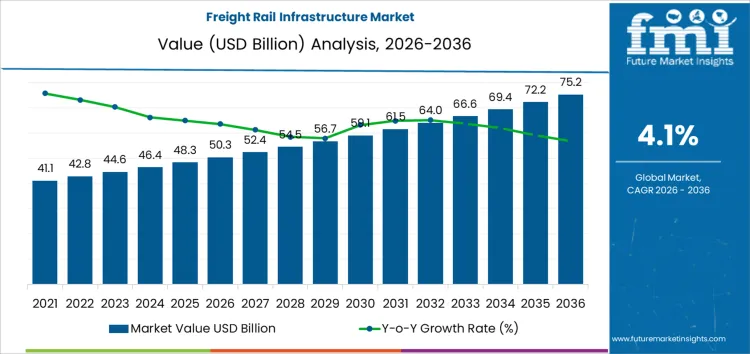
What is the Growth Forecast for the Freight Rail Infrastructure Market through 2036?
The freight rail infrastructure segment is shaped mainly by how intensely networks are used, the aging of critical assets, and the need to manage capacity along high-traffic corridors rather than expanding routes into new geographies. In the early phase, spending is largely concentrated on maintaining core track, signaling systems, bridges, and yard infrastructure that supports dense freight movement. As traffic intensity rises and networks face wear-related constraints, investment priorities shift toward strengthening heavily loaded routes, improving axle-load tolerance, and eliminating speed restrictions caused by deferred maintenance. Focus increasingly moves toward stabilizing throughput, improving reliability, and ensuring consistent transit times across existing mainlines and intermodal corridors.
Over the long term, growth is driven by capacity optimization within existing networks instead of building new lines. Rail operators invest in siding extensions, yard modernization, bridge rehabilitation, and advanced signaling upgrades to raise practical corridor capacity while minimizing disruption. Procurement and capital allocation also increasingly emphasize bottleneck removal, resilience improvements, and climate-related hardening of infrastructure to reduce operational risk. As engineering requirements become more complex, the segment experiences higher project intensity per kilometer, including heavier structures and more advanced traffic management systems. Overall investment decisions remain guided by long asset life cycles, network reliability targets, and corridor-level performance economics rather than short-term freight cycle fluctuations.
Freight Rail Infrastructure Market Key Takeaways
| Metric | Value |
|---|---|
| Market Value (2026) | USD 50.3 billion |
| Forecast Value (2036) | USD 75.2 billion |
| Forecast CAGR 2026 to 2036 | 4.0% |
How Is the Freight Rail Infrastructure Market Supporting Efficient Goods Movement?
Freight rail infrastructure is increasingly developed to enable reliable, high-capacity transport of bulk goods, containers, and industrial materials across regional and international networks. Historically, rail systems were constrained by aging tracks, limited signaling technology, and inadequate loading facilities, resulting in delays, congestion, and operational inefficiencies. Modern freight rail infrastructure integrates advanced track engineering, automated signaling, high-capacity terminals, and intermodal connectivity to support faster transit, higher axle loads, and seamless cargo handling.
Rail operators, logistics companies, and government authorities prioritize network reliability, maintenance efficiency, and interoperability with multimodal transport systems. Early investment focused on main freight corridors and industrial hubs, while current expansion spans regional connections, port access lines, and cross-border networks, driven by demand for timely deliveries, reduced road congestion, and scalable cargo capacity. Track durability, terminal efficiency, and signaling technology influence project planning.
Maximizing cargo throughput, minimizing transit delays, and ensuring operational safety are shaping market strategies. Compared with conventional rail networks, upgraded freight infrastructure enables higher-speed operations, improved load handling, and real-time monitoring of freight movement. Cost structures depend on track construction quality, signaling systems, and terminal automation, concentrating opportunities among contractors and suppliers capable of delivering durable, integrated solutions. Rail operators adopt these investments to enhance cargo reliability, optimize network utilization, and reduce maintenance costs. Over the coming decade, freight rail infrastructure is expected to support increased logistic efficiency, improved supply chain responsiveness, and scalable transport solutions for industrial and commercial sectors.
What Factors Are Shaping Segment-Wise Demand for Freight Rail Infrastructure in 2026?
The Freight Rail Infrastructure Market in 2026 is structured primarily by long-term capital planning cycles, asset life-extension strategies, and network capacity constraints rather than by short-term freight volume fluctuations. By component, demand in the Freight Rail Infrastructure Market is distributed across track and rail networks, rail bridges and tunnels, signaling and communication systems, and freight terminals and yards. By end-use application, demand in the Freight Rail Infrastructure Market is concentrated in bulk commodity transport, intermodal freight, automotive logistics, and containerized goods.
These segments reflect differences in axle load requirements, service reliability expectations, and tolerance for network disruption. In most rail systems, infrastructure investment decisions are not discretionary upgrades but multi-decade commitments tied to regulatory approvals, public funding frameworks, and concession agreements. As a result, procurement and project sequencing are driven by asset condition, safety compliance, and corridor-level capacity bottlenecks rather than by individual customer demand patterns.
How Do Asset Life Cycles and Network Bottlenecks Shape Component-Level Investment in the Freight Rail Infrastructure Market?
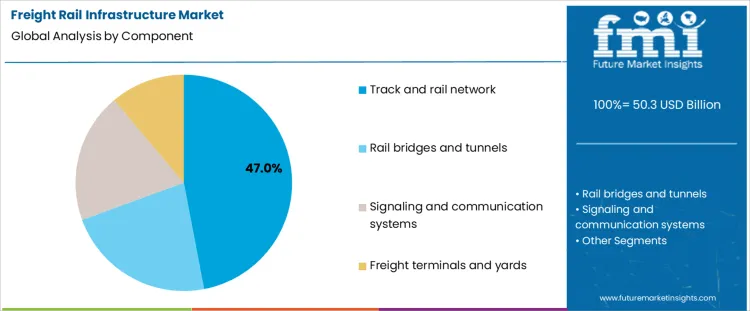
Track and rail networks account for approximately 47% of demand in the Freight Rail Infrastructure Market because they represent the most extensive and continuously stressed asset class within any rail system. Track structure, ballast, sleepers, and rail profiles are subject to cumulative fatigue from axle loads, vibration, and environmental exposure. Even when traffic volumes are stable, renewal and reinforcement programs are required to maintain permissible speeds and load limits.
Rail bridges and tunnels consume large capital budgets on a per-project basis, but their intervention cycles are longer and more episodic. Signaling and communication systems are upgraded primarily in response to safety regulations, interoperability requirements, and capacity optimization initiatives rather than physical wear. Freight terminals and yards are expanded or reconfigured when traffic patterns change or when intermodal strategies are revised. The structure of the Freight Rail Infrastructure Market is therefore driven by a combination of continuous renewal in track assets and episodic, high-value interventions in nodes and control systems, rather than by uniform investment across all components.
Why Does Bulk Commodity Transport Represent the Largest End Use Application in the Freight Rail Infrastructure Market?

Bulk commodity transport accounts for approximately 44% of demand in the Freight Rail Infrastructure Market because heavy bulk flows impose the highest cumulative stress on track, structures, and loading facilities. Coal, ore, agricultural products, and similar commodities move in high tonnage volumes over long distances, often using dedicated corridors and heavy axle load rolling stock. This operating model accelerates wear on rails, sleepers, bridges, and turnouts, creating continuous demand for reinforcement, renewal, and capacity management.
Intermodal and containerized traffic place greater emphasis on terminal efficiency and scheduling reliability, but they typically operate at lower axle loads and more dispersed volumes. Automotive logistics requires high reliability and time sensitivity but involves fewer corridors and more specialized flows. Bulk transport, by contrast, combines scale, repetition, and mechanical stress. This combination makes it the dominant driver of baseline infrastructure spending and explains why bulk commodity transport remains the largest application segment in the Freight Rail Infrastructure Market.
How Are the Key Dynamics Reshaping the Freight Rail Infrastructure Market?
How Are the Key Dynamics Reshaping the Freight Rail Infrastructure Market? The Freight Rail Infrastructure Market does not move to the rhythm of quarterly budgets or short planning cycles. Track, bridges, yards, and signaling live on multi-decade timelines, while demand, cargo mixes, and operating models keep shifting underneath them. Some networks are stretched by heavier axle loads and longer trains. Others are constrained by aging geometry and urban bottlenecks. At the same time, logistics customers are less patient with variability. This puts the Freight Rail Infrastructure Market in a constant negotiation between what already exists and what operations now require. Progress comes from rethinking corridors and nodes, not from incremental asset swaps.
Why the Freight Rail Infrastructure Market Is Capacity-Geometry Driven?
In rail, capacity is not only about how many trains run. It is about curves, gradients, siding length, yard throat layouts, and how fast conflicts can be resolved. A single short siding or flat junction can limit an entire corridor. The Freight Rail Infrastructure Market grows when operators realize that adding locomotives or crews does nothing if geometry stays the same. Projects then focus on passing loops, double tracking, grade separation, and yard reconfiguration. These investments are targeted and location specific. Demand follows where network shape constrains flow, not where traffic volumes look impressive in aggregate statistics.
Why the Freight Rail Infrastructure Market Is Politically Timed?
Few sectors depend so heavily on public process. Permits, land access, community negotiation, and funding approvals often take longer than construction itself. The Freight Rail Infrastructure Market therefore advances in pulses aligned with policy windows, stimulus programs, or regulatory settlements. Years of planning can sit idle, then move quickly once alignment appears. This makes the market look cyclical even when underlying need is constant. Operators do not build when it is optimal. They build when it is possible. The gating factor is rarely engineering. It is permission, funding structure, and political attention.
Why the Freight Rail Infrastructure Market Follows Network Strategy, Not Assets?
Track is not upgraded because it is old. It is upgraded because a corridor’s role has changed. A line that once served bulk commodities may become an intermodal artery. A yard that once sorted cars may become a bottleneck in a precision-scheduled network. The Freight Rail Infrastructure Market therefore follows decisions about how the network should work, not simple asset condition surveys. When strategies shift, investment cascades through terminals, mainlines, and connections. This turns infrastructure spending into a consequence of operating philosophy, not a reaction to wear alone.
What is the Demand for Freight Rail Infrastructure by Country?
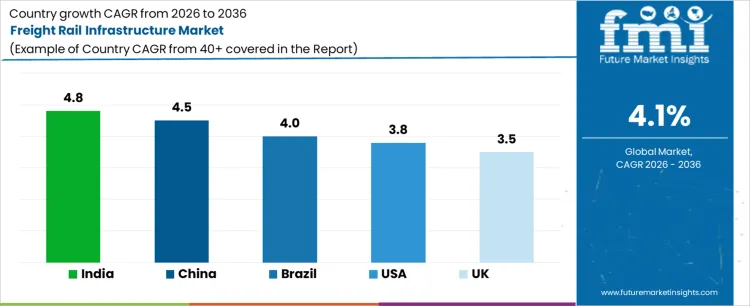
| Country | CAGR (%) |
|---|---|
| USA | 3.8% |
| UK | 3.5% |
| China | 4.5% |
| India | 4.8% |
| Brazil | 4.0% |
Demand for freight rail infrastructure is rising as logistics, transportation, and industrial sectors adopt rail networks to enhance cargo movement, reduce transit times, and improve supply chain efficiency. India leads with a 4.8% CAGR, driven by investments in rail expansion, growing freight volumes, and government infrastructure programs. China follows at 4.5%, supported by large-scale rail projects and increasing industrial transport demand. Brazil records 4.0% growth, shaped by modernization of rail networks and adoption for bulk transportation. The USA grows at 3.8%, influenced by replacement and upgrades in freight corridors. The UK shows 3.5% CAGR, reflecting steady adoption of rail infrastructure for industrial and commercial freight movement.
How do corridor programs and asset renewal shape spend in the United States?
Network capacity planning across major corridors keeps freight rail infrastructure investment in United States on a 3.8% CAGR path. Capital allocation favors siding extensions, yard reconfiguration, bridge renewal, and signaling upgrades that remove bottlenecks. Class I operators and public agencies control program sequencing. Project packaging through long term frameworks shapes contractor access. Material supply and construction windows influence delivery schedules. Intermodal growth and bulk commodity flows guide corridor prioritization. Life extension of track and structures absorbs a large share of budgets. Technology upgrades support train length and reliability targets. Funding release timing follows multi-year plans rather than annual traffic swings. Commercial success depends on positioning inside corridor programs and renewal portfolios rather than pursuit of isolated spot projects.
Why do reliability and capacity constraints guide programs in the United Kingdom?
Network performance targets and asset condition management keep freight rail infrastructure work in United Kingdom expanding at a 3.5% CAGR. Spending concentrates on junction remodeling, passing loops, structure renewal, and route clearance projects. Program control sits with infrastructure owners and national planning bodies. Access windows and service continuity requirements shape construction phasing. Contractor selection follows framework participation and proven delivery records. Intermodal traffic growth and port connectivity influence route priorities. Digital signaling and control upgrades support capacity utilization goals. Funding approvals follow multi-year control periods. Commercial visibility depends on inclusion inside route programs and renewal schedules rather than bidding on short duration standalone works.
What investment structure drives scale in China?
National logistics corridor plans and network expansion targets keep China on a 4.5% growth track for freight rail infrastructure development. Volume centers on double tracking, electrification, yard expansion, and heavy haul route upgrades. Central planning bodies define project sequencing and funding release. State owned contractors execute large bundled packages. Material production scale supports rapid buildout. Intermodal hubs and resource corridors receive priority. Asset standardization supports fast deployment. Order timing follows multi-year plans rather than local traffic cycles. Margin structure reflects scale execution and schedule performance. Commercial success depends on access to national programs and corridor packages rather than pursuit of small regional upgrades.
Why does network buildout dominate spending in India?
Capacity addition and decongestion programs keep India on a 4.8% CAGR path for freight rail infrastructure investment. Dedicated freight corridors, yard expansion, and terminal connectivity projects drive most capital deployment. Program control sits with central rail authorities and project agencies. Land acquisition and approval milestones shape delivery schedules. Contractor access depends on qualification and package scale. Track doubling, signaling upgrades, and bridge works absorb large shares of budgets. Intermodal growth and industrial corridors guide prioritization. Funding follows multi-year commitments. Commercial success depends on participation in corridor scale programs and long duration packages rather than pursuit of isolated station or yard works.
How do export logistics and network reliability shape Brazil programs?
Commodity export flows and network resilience targets keep Brazil on a 4% CAGR track for freight rail infrastructure spending. Investment focuses on track rehabilitation, axle load upgrades, yard improvements, and port access links. Concession holders and public agencies define program scope. Construction phasing aligns with traffic continuity needs. Contractor selection favors framework presence and heavy civil capability. Funding release follows concession plans and public approvals. Intermodal terminals and mining corridors receive priority. Asset renewal absorbs a significant share of budgets. Commercial position depends on placement inside concession programs and corridor upgrades rather than winning short term isolated civil works packages.
How Are Major Players Shaping the Global Freight Rail Infrastructure Market?
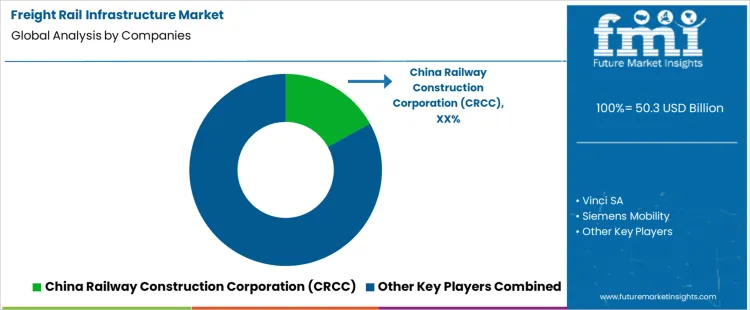
China Railway Construction Corporation (CRCC) executes large scale freight rail projects with emphasis on rapid track laying, ballastless systems, and integrated civil works in high growth corridors. Vinci SA delivers engineered rail infrastructure solutions with a focus on complex bridging, tunneling, and track alignment in Europe and Africa, supported by multidisciplinary construction capabilities. Siemens Mobility supplies signaling, automation, and electrification systems that improve capacity and reliability on freight corridors, enabling tighter headways and safer operations. Alstom provides rail infrastructure products including ETCS compatible signaling and modular track systems that support interoperability across networks. Progress Rail (a Cummins company) contributes heavy haul track components, maintenance of way equipment, and lifecycle support services that enhance uptime for freight operations. CRRC Corporation manufactures rolling stock and offers integrated rail solutions that align track design with vehicle dynamics for freight efficiency. Bombardier Transportation, now part of Alstom, brought expertise in rail systems integration that continues to influence turnkey freight infrastructure delivery.
Providers differentiate through technical depth, system integration, and support networks that address lifecycle performance and regulatory compliance. CRCC’s scale and project execution experience suit megaproject delivery in emerging markets where freight capacity expansion is urgent. Vinci’s multidisciplinary approach supports complex urban and intermodal freight terminal construction. Siemens Mobility’s emphasis on digital signaling and energy efficient electrification positions it for capacity and reliability improvements. Alstom leverages legacy signaling and infrastructure products to support harmonized freight corridors. Progress Rail focuses on serviceability and modular maintenance solutions that reduce downtime. CRRC aligns rolling stock and infrastructure design to optimize freight throughput. Competitive positioning also reflects regional presence and ability to meet local content and safety standards, with suppliers adapting engineering practices to varied regulatory environments. Demand continues where trade growth, logistics optimization, and modal shift policies drive investment in resilient, high capacity freight rail infrastructure.
Key Players in the Freight Rail Infrastructure Market
- China Railway Construction Corporation (CRCC)
- Vinci SA
- Siemens Mobility
- Alstom
- Progress Rail (Cummins)
- CRRC Corporation
- Bombardier Transportation (now part of Alstom)
Scope of the Report
| Items | Values |
|---|---|
| Quantitative Units (2026) | USD billion |
| Component | Track and rail network, Rail bridges and tunnels, Signaling and communication systems, Freight terminals and yards |
| End-Use Application | Bulk commodity transport, Intermodal freight, Automotive logistics, Containerized goods |
| Region | Asia Pacific, Europe, North America, Latin America, Middle East & Africa |
| Countries Covered | China, Japan, South Korea, India, Australia & New Zealand, ASEAN, Germany, United Kingdom, France, Italy, Spain, Nordic, BENELUX, United States, Canada, Mexico, Brazil, Chile, Saudi Arabia, Turkey, South Africa, and other regional markets |
| Key Companies Profiled | China Railway Construction Corporation (CRCC), Vinci SA, Siemens Mobility, Alstom, Progress Rail (Cummins), CRRC Corporation, Bombardier Transportation (now part of Alstom) |
| Additional Attributes | Dollar sales by component and application; demand driven by corridor capacity, asset aging, and axle-load targets; growth led by bottleneck removal, siding extensions, and yard reconfiguration; purchasing shaped by lifecycle cost, possession windows, interoperability standards, and network-level reliability rather than traffic volume alone. |
Freight Rail Infrastructure Market Segmentation
Component:
- Track and rail network
- Rail bridges and tunnels
- Signaling and communication systems
- Freight terminals and yards
End-Use Application:
- Bulk commodity transport
- Intermodal freight
- Automotive logistics
- Containerized goods
Region:
- Asia Pacific
- China
- Japan
- South Korea
- India
- Australia & New Zealand
- ASEAN
- Rest of Asia Pacific
- Europe
- Germany
- United Kingdom
- France
- Italy
- Spain
- Nordic
- BENELUX
- Rest of Europe
- North America
- United States
- Canada
- Mexico
- Latin America
- Brazil
- Chile
- Rest of Latin America
- Middle East & Africa
- Kingdom of Saudi Arabia
- Other GCC Countries
- Turkey
- South Africa
- Other African Union
- Rest of Middle East & Africa
Bibliography
- Federal Railroad Administration. (2024). FY 2024 corridor identification and development project pipeline report. U.S. Department of Transportation.
- European Union. (2024). Trans-European Transport Network (TEN-T) freight corridors: Annual implementation report. Publications Office of the European Union.
- Organisation for Economic Co-operation and Development. (2024). Rail transport performance and sustainability: OECD transport statistics and indicators 2024. OECD Publishing.
Frequently Asked Questions
How big is the freight rail infrastructure market in 2026?
The global freight rail infrastructure market is estimated to be valued at USD 50.3 billion in 2026.
What will be the size of freight rail infrastructure market in 2036?
The market size for the freight rail infrastructure market is projected to reach USD 75.2 billion by 2036.
How much will be the freight rail infrastructure market growth between 2026 and 2036?
The freight rail infrastructure market is expected to grow at a 4.1% CAGR between 2026 and 2036.
What are the key product types in the freight rail infrastructure market?
The key product types in freight rail infrastructure market are track and rail network , rail bridges and tunnels, signaling and communication systems and freight terminals and yards.
Which end‑use application segment to contribute significant share in the freight rail infrastructure market in 2026?
In terms of end‑use application, bulk commodity transport segment to command 44.0% share in the freight rail infrastructure market in 2026.
Preview the report firsthand - request a free sample
Get SampleGet the brochure for pricing and purchase details.
Get PDFTable of Content
- Executive Summary
- Global Market Outlook
- Demand-side Trends
- Supply-side Trends
- Technology Roadmap Analysis
- Analysis and Recommendations
- Market Overview
- Market Coverage / Taxonomy
- Market Definition / Scope / Limitations
- Market Background
- Market Dynamics
- Drivers
- Restraints
- Opportunity
- Trends
- Scenario Forecast
- Demand in Optimistic Scenario
- Demand in Likely Scenario
- Demand in Conservative Scenario
- Opportunity Map Analysis
- Product Life Cycle Analysis
- Supply Chain Analysis
- Investment Feasibility Matrix
- Value Chain Analysis
- PESTLE and Porter’s Analysis
- Regulatory Landscape
- Regional Parent Market Outlook
- Production and Consumption Statistics
- Import and Export Statistics
- Market Dynamics
- Global Market Analysis 2021 to 2025 and Forecast, 2026 to 2036
- Historical Market Size Value (USD Million) Analysis, 2021 to 2025
- Current and Future Market Size Value (USD Million) Projections, 2026 to 2036
- Y-o-Y Growth Trend Analysis
- Absolute $ Opportunity Analysis
- Global Market Pricing Analysis 2021 to 2025 and Forecast 2026 to 2036
- Global Market Analysis 2021 to 2025 and Forecast 2026 to 2036, By Component
- Introduction / Key Findings
- Historical Market Size Value (USD Million) Analysis By Component , 2021 to 2025
- Current and Future Market Size Value (USD Million) Analysis and Forecast By Component , 2026 to 2036
- Track and rail network
- Rail bridges and tunnels
- Signaling and communication systems
- Freight terminals and yards
- Track and rail network
- Y-o-Y Growth Trend Analysis By Component , 2021 to 2025
- Absolute $ Opportunity Analysis By Component , 2026 to 2036
- Global Market Analysis 2021 to 2025 and Forecast 2026 to 2036, By End‑Use Application
- Introduction / Key Findings
- Historical Market Size Value (USD Million) Analysis By End‑Use Application, 2021 to 2025
- Current and Future Market Size Value (USD Million) Analysis and Forecast By End‑Use Application, 2026 to 2036
- Bulk commodity transport
- Intermodal freight
- Automotive logistics
- Containerized goods
- Bulk commodity transport
- Y-o-Y Growth Trend Analysis By End‑Use Application, 2021 to 2025
- Absolute $ Opportunity Analysis By End‑Use Application, 2026 to 2036
- Global Market Analysis 2021 to 2025 and Forecast 2026 to 2036, By Region
- Introduction
- Historical Market Size Value (USD Million) Analysis By Region, 2021 to 2025
- Current Market Size Value (USD Million) Analysis and Forecast By Region, 2026 to 2036
- North America
- Latin America
- Western Europe
- Eastern Europe
- East Asia
- South Asia and Pacific
- Middle East & Africa
- Market Attractiveness Analysis By Region
- North America Market Analysis 2021 to 2025 and Forecast 2026 to 2036, By Country
- Historical Market Size Value (USD Million) Trend Analysis By Market Taxonomy, 2021 to 2025
- Market Size Value (USD Million) Forecast By Market Taxonomy, 2026 to 2036
- By Country
- USA
- Canada
- Mexico
- By Component
- By End‑Use Application
- By Country
- Market Attractiveness Analysis
- By Country
- By Component
- By End‑Use Application
- Key Takeaways
- Latin America Market Analysis 2021 to 2025 and Forecast 2026 to 2036, By Country
- Historical Market Size Value (USD Million) Trend Analysis By Market Taxonomy, 2021 to 2025
- Market Size Value (USD Million) Forecast By Market Taxonomy, 2026 to 2036
- By Country
- Brazil
- Chile
- Rest of Latin America
- By Component
- By End‑Use Application
- By Country
- Market Attractiveness Analysis
- By Country
- By Component
- By End‑Use Application
- Key Takeaways
- Western Europe Market Analysis 2021 to 2025 and Forecast 2026 to 2036, By Country
- Historical Market Size Value (USD Million) Trend Analysis By Market Taxonomy, 2021 to 2025
- Market Size Value (USD Million) Forecast By Market Taxonomy, 2026 to 2036
- By Country
- Germany
- UK
- Italy
- Spain
- France
- Nordic
- BENELUX
- Rest of Western Europe
- By Component
- By End‑Use Application
- By Country
- Market Attractiveness Analysis
- By Country
- By Component
- By End‑Use Application
- Key Takeaways
- Eastern Europe Market Analysis 2021 to 2025 and Forecast 2026 to 2036, By Country
- Historical Market Size Value (USD Million) Trend Analysis By Market Taxonomy, 2021 to 2025
- Market Size Value (USD Million) Forecast By Market Taxonomy, 2026 to 2036
- By Country
- Russia
- Poland
- Hungary
- Balkan & Baltic
- Rest of Eastern Europe
- By Component
- By End‑Use Application
- By Country
- Market Attractiveness Analysis
- By Country
- By Component
- By End‑Use Application
- Key Takeaways
- East Asia Market Analysis 2021 to 2025 and Forecast 2026 to 2036, By Country
- Historical Market Size Value (USD Million) Trend Analysis By Market Taxonomy, 2021 to 2025
- Market Size Value (USD Million) Forecast By Market Taxonomy, 2026 to 2036
- By Country
- China
- Japan
- South Korea
- By Component
- By End‑Use Application
- By Country
- Market Attractiveness Analysis
- By Country
- By Component
- By End‑Use Application
- Key Takeaways
- South Asia and Pacific Market Analysis 2021 to 2025 and Forecast 2026 to 2036, By Country
- Historical Market Size Value (USD Million) Trend Analysis By Market Taxonomy, 2021 to 2025
- Market Size Value (USD Million) Forecast By Market Taxonomy, 2026 to 2036
- By Country
- India
- ASEAN
- Australia & New Zealand
- Rest of South Asia and Pacific
- By Component
- By End‑Use Application
- By Country
- Market Attractiveness Analysis
- By Country
- By Component
- By End‑Use Application
- Key Takeaways
- Middle East & Africa Market Analysis 2021 to 2025 and Forecast 2026 to 2036, By Country
- Historical Market Size Value (USD Million) Trend Analysis By Market Taxonomy, 2021 to 2025
- Market Size Value (USD Million) Forecast By Market Taxonomy, 2026 to 2036
- By Country
- Kingdom of Saudi Arabia
- Other GCC Countries
- Turkiye
- South Africa
- Other African Union
- Rest of Middle East & Africa
- By Component
- By End‑Use Application
- By Country
- Market Attractiveness Analysis
- By Country
- By Component
- By End‑Use Application
- Key Takeaways
- Key Countries Market Analysis
- USA
- Pricing Analysis
- Market Share Analysis, 2025
- By Component
- By End‑Use Application
- Canada
- Pricing Analysis
- Market Share Analysis, 2025
- By Component
- By End‑Use Application
- Mexico
- Pricing Analysis
- Market Share Analysis, 2025
- By Component
- By End‑Use Application
- Brazil
- Pricing Analysis
- Market Share Analysis, 2025
- By Component
- By End‑Use Application
- Chile
- Pricing Analysis
- Market Share Analysis, 2025
- By Component
- By End‑Use Application
- Germany
- Pricing Analysis
- Market Share Analysis, 2025
- By Component
- By End‑Use Application
- UK
- Pricing Analysis
- Market Share Analysis, 2025
- By Component
- By End‑Use Application
- Italy
- Pricing Analysis
- Market Share Analysis, 2025
- By Component
- By End‑Use Application
- Spain
- Pricing Analysis
- Market Share Analysis, 2025
- By Component
- By End‑Use Application
- France
- Pricing Analysis
- Market Share Analysis, 2025
- By Component
- By End‑Use Application
- India
- Pricing Analysis
- Market Share Analysis, 2025
- By Component
- By End‑Use Application
- ASEAN
- Pricing Analysis
- Market Share Analysis, 2025
- By Component
- By End‑Use Application
- Australia & New Zealand
- Pricing Analysis
- Market Share Analysis, 2025
- By Component
- By End‑Use Application
- China
- Pricing Analysis
- Market Share Analysis, 2025
- By Component
- By End‑Use Application
- Japan
- Pricing Analysis
- Market Share Analysis, 2025
- By Component
- By End‑Use Application
- South Korea
- Pricing Analysis
- Market Share Analysis, 2025
- By Component
- By End‑Use Application
- Russia
- Pricing Analysis
- Market Share Analysis, 2025
- By Component
- By End‑Use Application
- Poland
- Pricing Analysis
- Market Share Analysis, 2025
- By Component
- By End‑Use Application
- Hungary
- Pricing Analysis
- Market Share Analysis, 2025
- By Component
- By End‑Use Application
- Kingdom of Saudi Arabia
- Pricing Analysis
- Market Share Analysis, 2025
- By Component
- By End‑Use Application
- Turkiye
- Pricing Analysis
- Market Share Analysis, 2025
- By Component
- By End‑Use Application
- South Africa
- Pricing Analysis
- Market Share Analysis, 2025
- By Component
- By End‑Use Application
- USA
- Market Structure Analysis
- Competition Dashboard
- Competition Benchmarking
- Market Share Analysis of Top Players
- By Regional
- By Component
- By End‑Use Application
- Competition Analysis
- Competition Deep Dive
- China Railway Construction Corporation (CRCC)
- Overview
- Product Portfolio
- Profitability by Market Segments (Product/Age /Sales Channel/Region)
- Sales Footprint
- Strategy Overview
- Marketing Strategy
- Product Strategy
- Channel Strategy
- Vinci SA
- Siemens Mobility
- Alstom
- Progress Rail (Cummins)
- CRRC Corporation
- Bombardier Transportation (now part of Alstom)
- China Railway Construction Corporation (CRCC)
- Competition Deep Dive
- Assumptions & Acronyms Used
- Research Methodology


