

- Industry Size (2026)
- USD 0.94 Bn
- Forecast (2036)
- USD 2.48 Bn
- CAGR (2026 to 2036)
- 10.2%
Rail and Intermodal Decarbonization Strategy Consulting Market Size, Market Forecast and Outlook By FMI
The rail and intermodal decarbonization strategy consulting market was valued at USD 0.85 billion in 2025. Sales are poised to surpass USD 0.94 billion in 2026 at a CAGR of 10.2% during forecast timelines. Continued investment is expected to lift the market’s total value to USD 2.48 billion by 2036, as the end of voluntary emission targets compels operators to undertake rigorous capital planning for trackside asset upgrades.
Infrastructure planners are under significant pressure to translate broad corporate sustainability objectives into detailed, site‑specific engineering plans. Failure means stranding assets when grid connections prove insufficient for projected megawatt traction loads. Engineering chiefs evaluating rail freight transitions recognize an uncomfortable truth: upgrading substations requires more lead time than acquiring battery-electric locomotives. This timeline mismatch pushes rail decarbonization advisory services away from theoretical pathway modelling toward urgent grid-interconnection advocacy and practical rail net zero roadmap development.
Summary of Rail and Intermodal Decarbonization Strategy Consulting Market
- Rail and Intermodal Decarbonization Strategy Consulting Market Definition
- Rail and Intermodal Decarbonization Strategy Consulting provides technical engineering and financial advisory services enabling transit networks to achieve mandated emission reductions. Engagements bridge theoretical climate goals with site-specific grid connection realities and rolling stock procurement constraints.
- Demand Drivers in Market
- Stringent Scope 3 reporting directives force major consumer goods shippers to demand verified carbon-per-ton-mile data from regional operators.
- Imminent phase-outs of diesel locomotives compel rolling stock leasing companies to commission urgent alternative propulsion feasibility studies.
- Multilateral climate grant mechanisms require infrastructure managers to submit investment-grade decarbonization blueprints prior to fund disbursement.
- Key Segments Analyzed in FMI Report
- Net-zero strategy is poised to hold 29.0% share in 2026, as operators require overarching blueprints to secure public financing.
- Infrastructure managers is estimated to record 31.0% share in 2026, due to mandates to upgrade legacy trackside power systems.
- Electrification is projected to capture 27.0% share in 2026, remaining the only commercially viable pathway for heavy-haul continuous operation.
- Program advisory is anticipated to garner 34.0% share in 2026, because public agencies lack internal engineering headcount.
- Rail corridors is expected to account for 30.0% share in 2026, representing the highest capital intensity for trackside retrofits.
- India: 12.4% compound growth, propelled by aggressive integration of high-speed passenger lines with legacy freight modernization.
- Analyst Opinion at FMI
- Nikhil Kaitwade, Principal Analyst, Process Automation, at FMI, points out, "Standard rail logistics metrics measure track miles electrified, entirely missing what actually bottlenecks decarbonization: terminal-level grid connections. Procurement directors focus heavily on acquiring battery or hydrogen locomotives. They assume power will simply be available at freight yards. Upgrading a local substation to handle multi-megawatt simultaneous charging takes three times longer than building new rolling stock. Consulting firms are pivoting away from simple fleet replacement modelling toward complex local grid capacity advocacy. Planners failing to recognize this measurement gap end up with modern zero-emission trains parked at terminals lacking sufficient electrical infrastructure to charge them."
- Strategic Implications / Executive Takeaways
- Infrastructure directors must prioritize grid interconnection studies years ahead of actual locomotive procurement to avoid stranded fleet assets.
- Advisory firm partners face immediate needs for electrical engineers capable of mapping high-voltage traction systems against local utility constraints.
- Terminal operations managers risk losing major shipping contracts unless they provide verifiable carbon-reduction workflows integrated into regional planning.
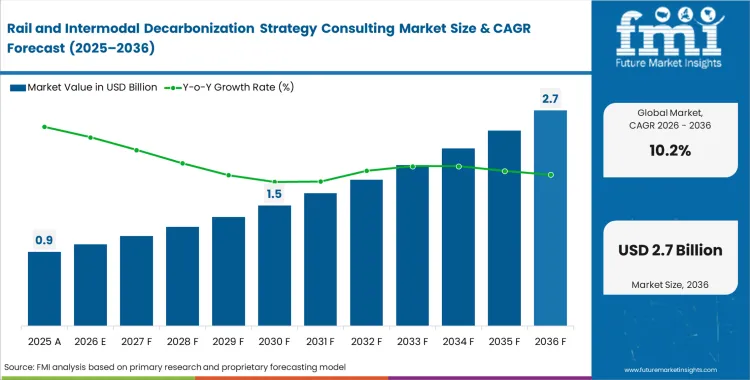
Key Takeaways
| Metric | Details |
|---|---|
| Industry Size (2026) | USD 0.94 billion |
| Industry Value (2036) | USD 2.48 billion |
| CAGR (2026-2036) | 10.2% |
Source: Future Market Insights (FMI) analysis, based on proprietary forecasting model and primary research
National regulators mandating Scope 3 emissions reporting trigger accelerated advisory spending. Shippers immediately force asset owners into providing granular carbon footprints per ton-mile. Conducting a verified rail carbon baseline assessment shifts from an optional marketing exercise to a strict procurement prerequisite.
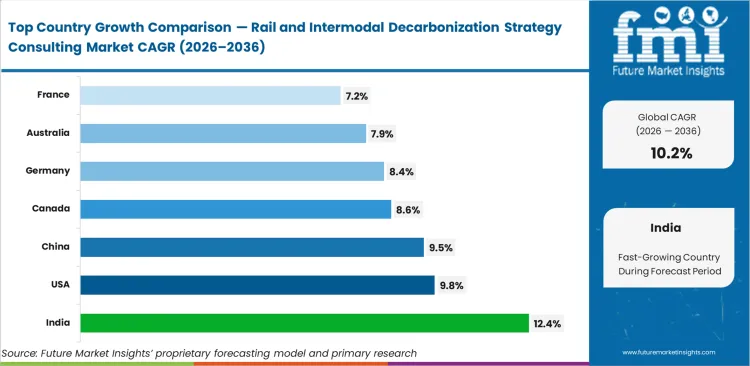
India is set to expand at 12.4%, while the United States is anticipated to post 9.8%. China is projected to record 9.5%, closely followed by Canada, which is estimated to track at 8.6%. Germany is poised to garner 8.4%, Australia is likely to register 7.9%, and France is expected to follow at 7.2%. This divergence in growth rates reflects the stark operational contrast between emerging markets building massive, renewable-integrated heavy-haul corridors from scratch and mature economies struggling to retrofit zero-emission charging infrastructure into heavily congested, legacy transit networks.
Rail and Intermodal Decarbonization Strategy Consulting Market Definition
The intermodal decarbonization consulting sector encompasses specialized technical advisory services directing energy transitions across transit networks. Engagements involve grid capacity modeling, carbon footprint baselining, rolling stock procurement planning, and infrastructure retrofitting blueprints. Analysts map precise emission reductions against capital expenditure requirements for mixed-use transit corridors. Output delivers bankable engineering documentation required for securing multilateral climate transition funding.
Rail and Intermodal Decarbonization Strategy Consulting Market Inclusions
The scope covers consulting revenues derived from feasibility studies assessing alternative propulsion technologies. Trackside charging infrastructure assessments fall within boundaries. Designing a comprehensive intermodal terminal decarbonization plan aiming at carbon reduction qualifies for inclusion. Advisory contracts optimizing freight rail infrastructure for modal shift absorption belong in scope. Scope also captures policy compliance auditing associated with mandatory emission reporting directives.
Rail and Intermodal Decarbonization Strategy Consulting Market Exclusions
Hardware sales involving physical locomotives sit entirely outside scope because they represent capital equipment rather than advisory services. Construction execution contracts covering physical track installation remain excluded. Routine signaling software upgrades lacking explicit decarbonization objectives fall outside boundaries. Standalone corporate PR campaigns promoting sustainability goals do not qualify as technical rail freight decarbonization consulting.
Rail and Intermodal Decarbonization Strategy Consulting Market Research Methodology
- Primary Research: Technical directors at national infrastructure agencies and sustainability heads at major intermodal terminal operators.
- Desk Research: Multilateral lender climate grant approval registries, national transit infrastructure funding bills, and regional grid expansion dockets.
- Market-Sizing and Forecasting: Baseline advisory revenue models anchored on volume of approved rail electrification corridor projects globally.
- Data Validation and Update Cycle: Top-down cross-validation against engineering firm backlog disclosures regarding green transit advisory contracts.
Segmental Analysis
Rail and Intermodal Decarbonization Strategy Consulting Market Analysis by Service Type
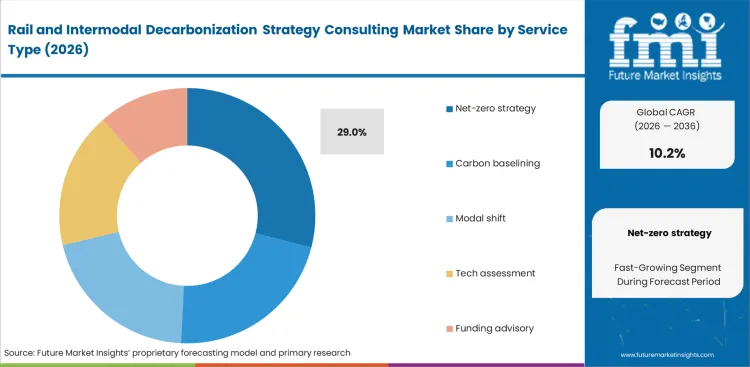
Investment‑grade capital planning requirements place the Net‑zero strategy holding around a 29.0% share in 2026. Chief financial officers require comprehensive blueprints detailing the exact capital expenditures required before authorizing physical construction. FMI analysts note that securing multilateral climate transition funding explicitly demands these overarching engineering frameworks. Translating high-level corporate emissions targets into site-specific rail freight digital transformation initiatives forces networks into extended advisory engagements. Baseline mapping alone proves insufficient for securing board approval on a billion-dollar rail electrification business case. What public filings often obscure is that net-zero strategy deliverables function primarily as risk-transfer mechanisms, allowing infrastructure directors to shift liability for technology selection onto external engineering authorities. Operators delaying comprehensive strategy formulation face immediate exclusion from competitive public grant funding cycles.
- Initial funding justification: Multilateral lenders require comprehensive capital expenditure modeling before authorizing climate transition grants. Chief financial officers secure essential capital by submitting these verified engineering blueprints.
- Technology pathway validation: Consulting teams evaluate local grid capacity constraints against projected traction loads. Engineering directors avoid procuring rolling stock incompatible with regional power infrastructure realities.
- Continuous compliance auditing: Regulators demand verifiable progress markers attached to awarded public funds. Program managers maintain grant compliance through ongoing milestone verification.
Rail and Intermodal Decarbonization Strategy Consulting Market Analysis by Client Type
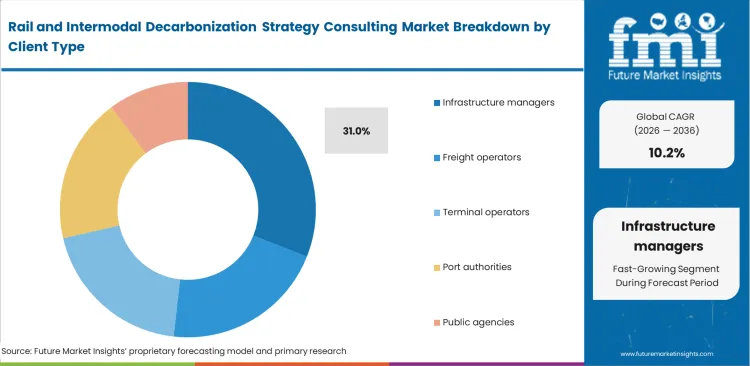
Infrastructure managers currently determines severe split incentives regarding fleet upgrades versus trackside modernization. Recording a 31.0% share in 2026, these entities must fund charging infrastructure for locomotives they do not directly own. Freight operators pushing aggressive sustainability targets force track owners into accelerated railway system power upgrades. Upgrading high-voltage traction networks involves coordinating complex shutdowns across mixed-use corridors. Planners executing these transitions bear all physical construction risk while shippers capture resulting carbon reduction credits. Industry generalists assume equipment owners determine decarbonization timelines, but the true pace of projects hinges on local infrastructure agencies securing utility interconnections. Asset managers failing to synchronize trackside upgrades with operator fleet deliveries create massive logistical bottlenecks across entire regional networks.
- Capital allocation friction: Infrastructure owners absorb high trackside electrification costs while operators capture resulting efficiency savings. Procurement heads navigate this split incentive through complex usage-fee negotiations.
- Hidden grid constraints: High-speed charging requirements for new locomotives exceed legacy terminal substation capacities. Facility managers discover these limits only after initiating site-specific engineering reviews.
- Lifecycle cost divergence: Upgraded traction networks require entirely different maintenance schedules than legacy diesel systems. Operations directors must completely retrain trackside crews to maintain safety standards.
Rail and Intermodal Decarbonization Strategy Consulting Market Analysis by Decarbonization Pathway
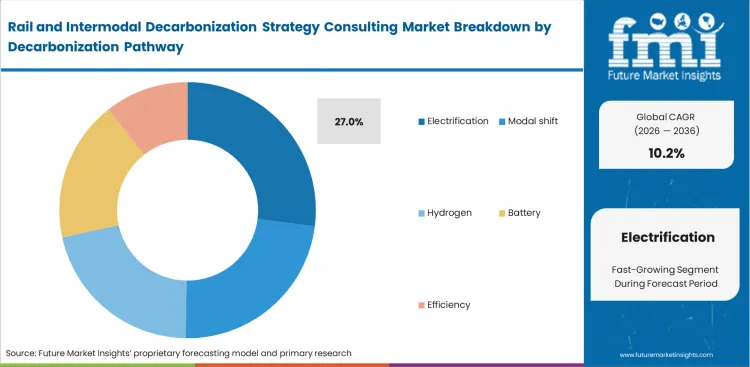
Hydrogen propulsion prototypes generate headlines, yet Electrification captures 27.0% share in 2026, due to proven heavy-haul reliability. Fleet directors managing dense freight corridors recognize battery limitations regarding continuous pulling power across steep gradients. Smart railways require continuous overhead catenary systems for maximum tonnage applications. Installing these high-voltage lines involves severe signaling interference challenges requiring specialized electrical engineering advisory. Procurement evaluations assessing electrification vs hydrogen rail consulting heavily favor electrification because it eliminates complex onboard fuel storage variables inherent to hydrogen. Practitioners know battery-electric solutions dominate low-speed shunting yard applications, but main-line freight relies on continuous external power feeds. Networks attempting partial hybrid implementations without rigorous power modeling suffer immediate scheduling degradation under peak loads.
- Catenary interference mitigation: High-voltage overhead lines cause severe electromagnetic interference with legacy signaling equipment. Electrical engineers must redesign communication protocols to maintain corridor safety margins.
- Gradient performance limitations: Battery solutions suffer rapid depletion under maximum tonnage loads on steep inclines. Route planners restrict battery deployments strictly to flat terminal-switching operations.
- Standardized interoperability requirements: Cross-border transit demands standardized overhead voltage configurations. Network directors qualify track upgrades based on strict adherence to international electrical protocols.
Rail and Intermodal Decarbonization Strategy Consulting Market Analysis by Engagement Model
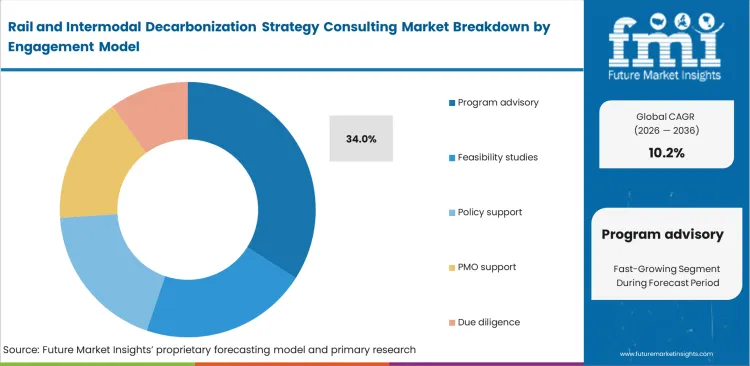
Massive concurrent workstreams dictate Program advisory dominance at 34.0% share in 2026. Public transport authorities lack internal headcount necessary to manage simultaneous grid upgrades, rolling stock procurement, and terminal modernization. In FMI's view, assigning external teams to function as shadow project management offices accelerates railroad transition execution. These advisory teams handle complex utility interconnection negotiations alongside signaling vendor management. Fragmented feasibility studies lose value without centralized coordination translating findings into integrated construction schedules. True program advisory value stems from managing technical interfaces between competing contractors rather than producing standalone reports. Authorities attempting piecemeal contracting without overarching program management inevitably experience severe timeline overruns due to mismatched equipment deliveries.
- Engineering bandwidth constraints: Public agencies lack specialized high-voltage engineering personnel on permanent staff. Project directors import specialized talent pools through comprehensive advisory contracts.
- Utility interconnection delays: Securing megawatts of new power for terminal charging requires navigating complex regional utility queues. Program managers accelerate approvals by managing local regulatory filings directly.
- Multi-vendor synchronization: Integrating new signaling software with upgraded traction power involves coordinating disparate contractor timelines. Shadow PMO teams prevent costly construction delays through rigorous interface management.
Rail and Intermodal Decarbonization Strategy Consulting Market Analysis by Asset focus
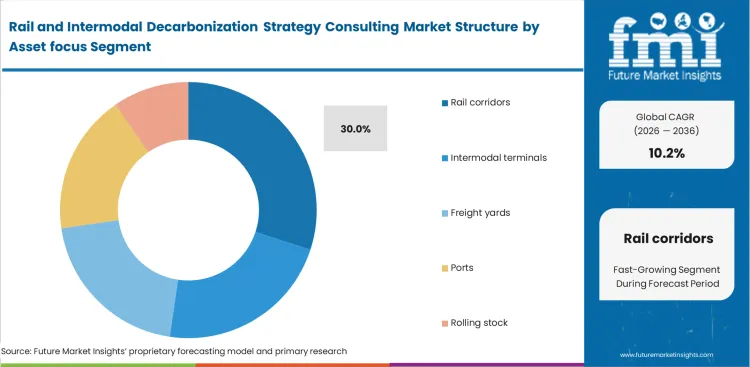
Trackside infrastructure complexity pushes Rail corridors to garner around 30.0% share in 2026. Upgrading active main lines involves coordinating construction windows between scheduled passenger and freight transits. According to FMI's estimates, installing new traction substations along active routes represents highest engineering difficulty. Terminal operators evaluating green logistics expansions face lesser hurdles because yard environments offer controlled testing conditions. Main-line corridor work forces engineers to account for varying legacy bridge clearances and tunnel ventilation restrictions. While public attention focuses on zero-emission locomotives, practitioners understand that physical clearance restrictions dictate actual technology selection for any specific route. Route planners miscalculating bridge modification costs during initial strategy phases routinely bankrupt subsequent construction budgets.
- Clearance restriction failures: Overhead catenary systems require specific vertical clearances beneath legacy bridges. Engineering teams must conduct comprehensive surveys before approving electrification pathways.
- Ventilation hazard retention: Hydrogen-powered rolling stock introduces new combustion risks inside enclosed tunnels. Safety directors mandate extensive airflow modeling before permitting hybrid operations underground.
- Sequential upgrade mandates: Fully electrifying specific routes requires continuous trackside power availability without gaps. Planning officers must sequence construction zones perfectly to maintain uninterrupted corridor operations.
Rail and Intermodal Decarbonization Strategy Consulting Market Drivers, Restraints, and Opportunities
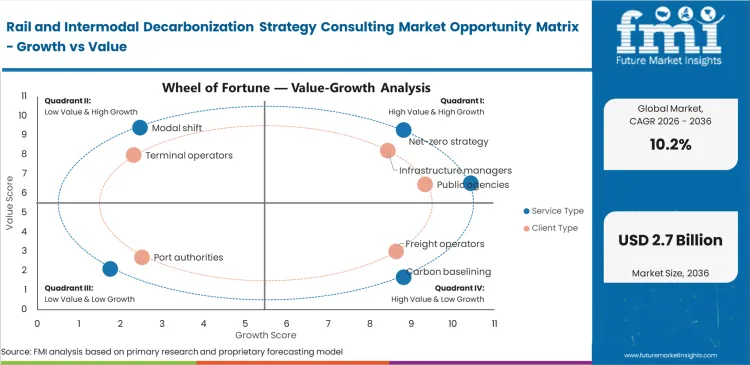
Imminent enforcement of strict Scope 3 emission reporting mandates forces major shippers to demand verifiable carbon footprints from regional transit operators. This regulatory pressure compels freight transport management directors into urgent action. Delaying baseline assessments risks immediate loss of highly lucrative contracts, as consumer goods giants refuse to absorb unaccounted supply chain emissions. Operators suddenly realize internal teams lack capabilities for mapping precise ton-mile carbon intensities. Consulting firms provide immediate credibility required for passing external procurement audits. Urgency accelerates further because operators cannot initiate physical asset upgrades until precise baseline metrics satisfy multinational client reporting standards.
Severe misalignment between asset lifecycles fundamentally slows comprehensive rail freight decarbonization. Track infrastructure depreciates over fifty-year horizons, while operators lease rolling stock on seven-year cycles. This temporal friction prevents synchronized investment. Infrastructure owners hesitate to install specific charging architecture without guaranteed long-term usage commitments from fleet operators. Conversely, operators refuse long-term fleet upgrades without guaranteed trackside power availability. Consulting frameworks attempting to bridge this gap struggle against deeply entrenched capital allocation structures. Intermediate hybrid solutions emerge but add maintenance complexity.
Opportunities in Rail and Intermodal Decarbonization Strategy Consulting Market
- Terminal microgrid integration: Designing self-contained renewable energy grids at intermodal facilities. Facility managers seeking intermodal terminal carbon advisory services gain independence from unstable regional power utilities.
- Cross-border signaling harmonization: Engineering unified communication protocols across international jurisdictions. Route planners utilizing a sophisticated rail modal shift strategy avoid costly locomotive changeovers at national borders.
- Dynamic emission pricing: Structuring variable usage fees based on real-time carbon intensity. Commercial directors utilizing transport management system platforms capture premium rates for verified zero-emission transit windows.
Regional Analysis
based on the regional analysis, the Rail and Intermodal Decarbonization Strategy Consulting Market is segmented into North America, Europe, Asia Pacific, and Latin America across 40 plus countries.
.webp "Top Country Growth Comparison Rail And Intermodal Decarbonization Strategy Consulting Market Cagr (2026 2036)")
| Country | CAGR (2026 to 2036) |
|---|---|
| India | 12.4% |
| United States | 9.8% |
| China | 9.5% |
| Canada | 8.6% |
| Germany | 8.4% |
| Australia | 7.9% |
| France | 7.2% |
Source: Future Market Insights (FMI) analysis, based on proprietary forecasting model and primary research
Asia Pacific Rail and Intermodal Decarbonization Strategy Consulting Market Analysis
The fundamental tension across this geography lies between aggressive track expansion and the stark limitations of regional power grids. Heavy-haul operators are laying thousands of kilometers of new track, but connecting those lines to renewable energy sources requires navigating fragmented utility jurisdictions. According to FMI's estimates, advisory demand concentrates heavily on designing localized microgrids rather than relying on national power infrastructure. Grid congestion frequently forces rail operators to act as independent energy developers. This forces engineering firms to shift their modeling away from basic rolling stock procurement toward complex, multi-decade power purchase agreements. The actual friction slowing adoption is not a lack of available zero-emission locomotives, but the severe shortage of trackside grid connections capable of handling megawatt-level charging spikes.
- India: Dedicated Freight Corridors shifting from diesel to overhead electric run into severe green electron sourcing bottlenecks. Procurement heads at logistics firms must secure independent solar power purchase agreements alongside their track access negotiations. FMI estimates the Rail and Intermodal Decarbonization Strategy Consulting Market in India to expand at an annual growth rate of 12.4%. Relying on the state-level coal-heavy grid negates the carbon reduction targets demanded by multinational shippers. Advisory firms must untangle regional transmission tariffs to make direct renewable integration financially viable for terminal operators. Clearing the complex power-purchasing bottleneck allows these rail operators to bypass state-level grid delays entirely and guarantee truly zero-emission transit for their export clients.
- China: While the high-speed passenger network operates on electric traction, the massive heavy-haul coal and mineral lines still rely heavily on legacy diesel power. State planning commissions now force regional logistics bureaus to evaluate dual-fuel and battery-electric heavy locomotives for these specific industrial corridors. The China sector is forecast to register a CAGR of 9.5% as provincial authorities scramble to meet strict national carbon-peaking deadlines. Consultants must model the exact payload penalties associated with battery weight against the financial incentives of carbon credits. Regional logistics hubs that secure early battery-train allocations immediately undercut neighboring provinces on carbon-taxed export routes.
- Australia: The vast, unpopulated distances between inland mining sites and coastal export terminals make traditional overhead catenary electrification economically impossible. Mining giants require specialized engineering consulting to draft tenders for heavy-haul battery-electric locomotives and the isolated megawatt charging stations needed to support them. Over the forecast period, the industry in Australia is set for a CAGR of 7.9%. Standard battery chemistries degrade rapidly under severe desert temperatures, forcing advisors to model complex thermal management systems into their operational blueprints. Engineering firms that solve the thermal degradation issues for remote fast-charging networks secure exclusive, multi-year advisory contracts with tier-1 resource extractors.
FMI's report includes South Korea and the wider ASEAN block. Standardizing cross-border electrical frequencies and charging protocols remains the primary barrier to unified regional logistics corridors.
North America Rail and Intermodal Decarbonization Strategy Consulting Market Analysis
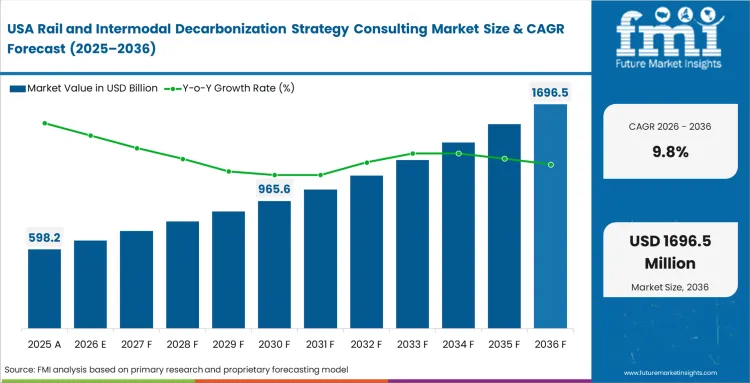
The transition away from fossil fuels here operates entirely under the constraints of Precision Scheduled Railroading and strict operating ratios. Unlike geographies where state mandates force capital expenditure, privately owned freight networks demand immediate commercial justification for any deviation from legacy diesel-electric platforms. Based on FMI's assessment, consulting teams spend the majority of their billable hours modeling the operational friction of transitional fuels rather than designing full network electrification. Stringing overhead catenary across transcontinental distances remains economically unviable for freight. Consequently, the advisory focus shifts toward integrating battery-tender cars and drop-in renewable diesel blends without disrupting carefully calibrated yard dwell times. The structural reality requires advisors to prove that zero-emission initiatives will not degrade network velocity or inflate long-term maintenance liabilities.
- United States: Class I railroads operate massive, captive diesel-electric fleets and heavily resist stranding these capital-intensive assets before their forty-year lifespans expire. Chief Sustainability Officers hire specialized consultants to model the exact operational impacts of drop-in biofuel blends rather than committing to full fleet replacement. Demand for decarbonization advisory in the United States is estimated to expand at a CAGR of 9.8%. Network planners must understand precisely how biodiesel formulations affect engine maintenance schedules in colder northern corridors. The 9.8% growth rate reflects the intense analytical modeling required to prove ROI on transitional fuels, rather than a sudden rush to string overhead wires across the Midwest.
- Canada: Severe sub-zero temperatures drastically impact battery degradation curves and hydrogen fuel cell performance across northern freight routes. Route planners cannot rely on manufacturer specifications designed for temperate climates, requiring independent engineering firms to validate winter thermal efficiency. The Canadian space is forecast to observe a CAGR of 8.6%. Consultants are currently building localized testing frameworks to ensure zero-emission locomotives do not strand critical agricultural exports during peak winter shipping months. They must map emergency rescue protocols for battery-electric trains that lose charge in remote mountain passes. The market here is shifting rapidly from theoretical zero-emission corporate targets to harsh-environment engineering validation and physical operational testing.
FMI's report includes Mexico. The nearshoring of manufacturing demands that cross-border interchange facilities standardize their emission reporting and locomotive interchange protocols.
Europe Rail and Intermodal Decarbonization Strategy Consulting Market Analysis
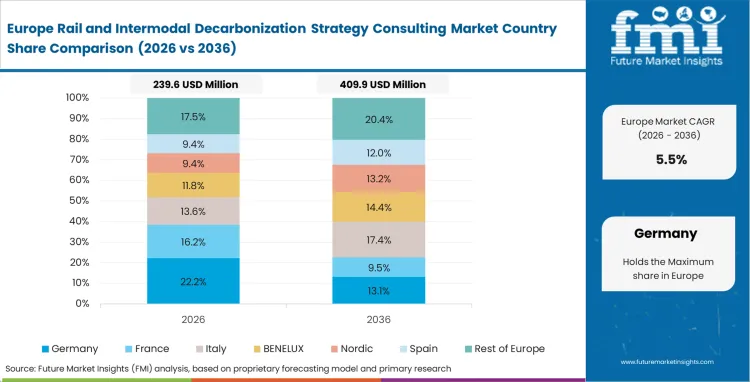
With passenger networks already heavily electrified, the strategic focus across this continent shifts toward the difficult margins of freight logistics. Intermodal terminal operators face intense regulatory pressure to eliminate diesel shunters and synchronize inland rail movements with zero-emission maritime arrivals. Most complex advisory work now happens at these multimodal intersections rather than along main line corridors. Port authorities and terminal managers require highly specific capacity mapping to ensure local grids can handle simultaneous vessel shore-power demands and heavy-haul locomotive charging. Connecting legacy trackside infrastructure to fluctuating wind and solar generation forces consulting teams to deploy advanced predictive algorithms. Procurement directors for major industrial shippers essentially mandate this transition, refusing to award long-term logistics contracts to operators who cannot provide verifiable, carbon-neutral transit documentation.
- Germany: Integrating fluctuating North Sea wind power directly into legacy traction networks dominates the engineering agenda for track owners. System operators must balance intermittent renewable supply against highly predictable heavy-haul transit schedules without destabilizing the national grid. The Germany industry is expected to demonstrate a CAGR of 8.4%. Specialized advisory firms construct dynamic emission pricing models that allow rail operators to monetize their verifiable green transit windows with major industrial clients. They must untangle complex regulatory subsidies to fund the localized battery storage required to smooth grid demand spikes. Terminal operators clinging to legacy diesel shunters face immediate exclusion from major industrial chemical and auto-manufacturing logistics contracts.
- France: State-owned transport networks are moving aggressively from high-level fleet assessments directly into hard infrastructure execution. Engineering directors must translate broad environmental mandates into highly specific traction substation upgrades across the national network. France's sector is poised to expand at a 7.2% annual rate. This operational reality requires specialized high-voltage electrical advisory teams rather than generalist sustainability planners to map out the physical integration points. Consultants must negotiate complex right-of-way permissions to install trackside renewable generation assets adjacent to protected agricultural lands. Advisory teams that successfully translate high-level environmental mandates into site-specific electrical blueprints secure multi-year implementation funding from national infrastructure banks.
FMI's report includes Italy and Spain. Deep technical understanding of high-gradient electrical loads dictates exactly which advisory firms win contracts for modernizing steep Alpine and Pyrenees crossings.
Competitive Aligners for Market Players
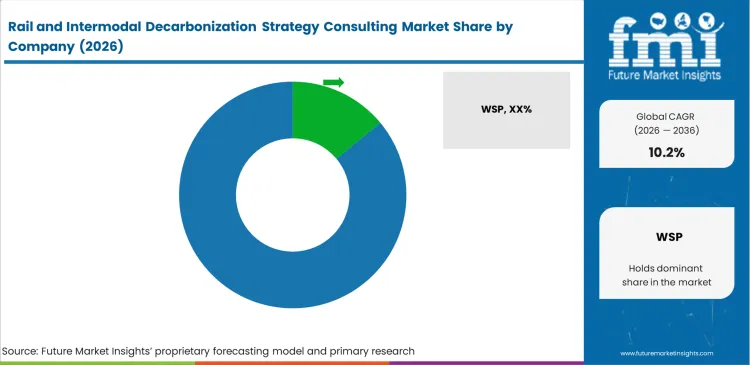
Requirement for massive multi-disciplinary engineering capabilities heavily concentrates top-tier advisory contracts among global infrastructure firms. Pure-play sustainability boutiques lack necessary electrical engineering depth required for designing high-voltage traction substations. Major rail decarbonization consulting firms like WSP and AECOM secure dominant market share by bundling theoretical carbon modeling directly with trackside design services. Infrastructure directors award contracts based strictly on demonstrated ability to produce bankable construction blueprints, ignoring firms offering only high-level strategic guidance. Implementing multimodal shipment visibility software alongside physical track upgrades defines comprehensive service delivery. Firms lacking deep benches of certified rail engineers cannot pass initial technical qualification rounds for national-level transition projects.
Incumbents command pricing power through possession of proprietary grid-capacity modelling tools and extensive historical safety qualification databases. Translating climate goals into physical terminal management system upgrades requires navigating arcane regional railway safety standards. Established freight rail carbon strategy consultants already employ former national transit authority regulators, granting them unparalleled insight into local approval workflows. Challengers attempting entry face prohibitive barriers replicating these specific safety-certification knowledge bases. Simply understanding battery chemistry proves useless without knowing exactly how local signaling inspectors evaluate electromagnetic interference risks.
Large transit authorities counter advisory consolidation by aggressively unbundling strategic phases from detailed design workstreams. Procurement heads structure master service agreements requiring specialized subcontractors for distinct automated container terminal integration tasks. This deliberate fragmentation ensures clients do not simply hire rail sustainability consultant monopolies to dictate entire national transition architectures. As physical construction phases accelerate toward 2036, the best rail sustainability consulting firms will leverage technical execution capacity to completely eclipse theoretical pathway modeling in competitive evaluations.
Key Players in Rail and Intermodal Decarbonization Strategy Consulting Market
- WSP
- AECOM
- Ricardo
- Arup
- SYSTRA
- Mott MacDonald
- Hatch
Scope of the Report
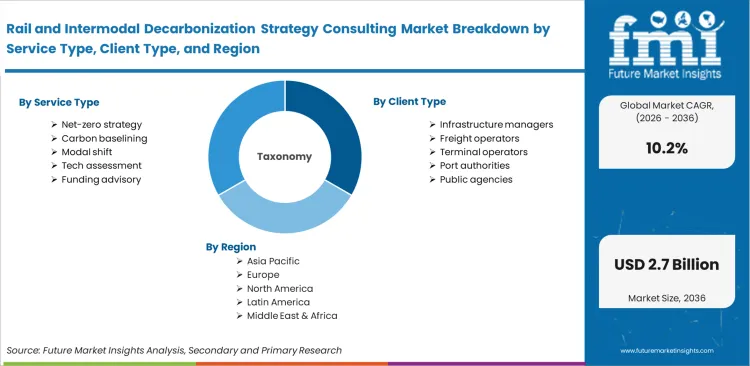
| Metric | Value |
|---|---|
| Quantitative Units | USD 0.94 billion to USD 2.48 billion, at a CAGR of 10.2% |
| Market Definition | Rail and Intermodal Decarbonization Strategy Consulting provides technical engineering and financial advisory services enabling transit networks to achieve mandated emission reductions through grid modeling and trackside retrofits. |
| Segmentation | Service type, Client type, Decarbonization pathway, Engagement model, Asset focus |
| Regions Covered | North America, Latin America, Europe, East Asia, South Asia & Pacific, Middle East & Africa |
| Countries Covered | India, the United States, China, Canada, Germany, Australia, and France. |
| Key Companies Profiled | WSP, AECOM, Ricardo, Arup, SYSTRA, Mott MacDonald, Hatch |
| Forecast Period | 2026 to 2036 |
| Approach | Baseline advisory revenue models anchored on volume of approved rail electrification corridor projects globally. |
Source: Future Market Insights (FMI) analysis, based on proprietary forecasting model and primary research
Rail and Intermodal Decarbonization Strategy Consulting Market Analysis by Segments
Service type
- Net-zero strategy
- Carbon baselining
- Modal shift
- Tech assessment
- Funding advisory
Client type
- Infrastructure managers
- Freight operators
- Terminal operators
- Port authorities
- Public agencies
Decarbonization pathway
- Electrification
- Modal shift
- Hydrogen
- Battery
- Efficiency
Engagement model
- Program advisory
- Feasibility studies
- Policy support
- PMO support
- Due diligence
Asset focus
- Rail corridors
- Intermodal terminals
- Freight yards
- Ports
- Rolling stock
Region
- North America
- United States
- Canada
- Europe
- Germany
- United Kingdom
- France
- Italy
- Spain
- Asia Pacific
- China
- Japan
- South Korea
- Taiwan
- Singapore
- Latin America
- Brazil
- Mexico
- Argentina
- Middle East & Africa
- GCC Countries
- South Africa
Bibliography
- Community of European Railway and Infrastructure Companies. (2024). On track for Europe 2024-2029 manifesto.
- European Climate, Infrastructure and Environment Executive Agency. (2024, September 24). 2024 CEF Transport calls for proposals.
- European Statistical Office. (2024, November). Key figures on European transport: 2024 edition.
- International Transport Forum. (2024, April 12). Rail Sustainability Index.
- Jüngst, M., & Ciesla, M. (2025, November). Outlook on the decarbonization of non-electrified rail lines in Poland. Energies, 18(22), 5900.
- Karaś, A. (2024, October). The role of intermodal transport in the decarbonization of seaports. European Research Studies Journal, 27(2), 1014-1021.
- Najafpour Navaei, T., Kaewunruen, S., & Sussman, J. M. (2024, June). Carbon footprinting of railway infrastructure: A standardized life cycle management framework. Structure and Infrastructure Engineering.
- USA Department of Energy. (2024, December). An action plan for rail energy and emissions innovation.
This bibliography is provided for reader reference. The full FMI report contains the complete reference list with primary source documentation.
This Report Addresses
- Trackside electrification capital expenditure modelling required for multilateral climate grant approvals.
- High-voltage grid connection assessments dictating site-specific intermodal terminal decarbonization timelines.
- Scope 3 emission baselining frameworks aligning transit operators with strict consumer goods shipper mandates.
- Signaling interference mitigation strategies necessary for integrating continuous catenary power architectures.
- Lifecycle maintenance cost divergence between legacy diesel infrastructure and emerging zero-emission technologies.
- Split incentive resolution strategies bridging track owner depreciation cycles with operator rolling stock leases.
- European modernization programs driving high-speed rail integration with legacy intermodal freight corridors.
- Safety certification workflows managing tunnel ventilation risks associated with novel hydrogen propulsion deployments.
Frequently Asked Questions
What services do rail sustainability consultants provide?
Rail sustainability consultants deliver highly technical grid capacity modelling, carbon baselining, rolling stock procurement planning, and infrastructure retrofitting blueprints. They bridge theoretical corporate climate goals with actionable site-specific engineering realities.
How much does rail decarbonization consulting cost?
Engagement costs scale drastically depending on scope. Foundational baselining studies require moderate investment, while comprehensive corridor-level electrification designs integrated with rail decarbonization RFP support demand multi-million-dollar engineering budgets.
Which service type captures highest advisory demand?
Net-zero strategy leads with 29.0% share. Securing public infrastructure grants requires comprehensive capital expenditure blueprints before initiating construction.
Why do infrastructure managers dominate client portfolios?
Infrastructure managers capture 31.0% share because trackside power upgrades represent highest capital intensity. Operators depend entirely on these agencies to provide terminal grid connections.
What specific technical barrier slows battery train deployment?
Upgrading local terminal substations takes significantly longer than acquiring battery locomotives. Facility managers face delays in clearing regional utility interconnection queues.
How does Scope 3 reporting affect advisory spending?
Major shippers require precise carbon-per-ton-mile tracking from logistics providers. Baseline accounting shifts from corporate marketing into mandatory procurement qualification.
Why does Spain lead European growth metrics?
Spain achieves 11.4% expansion by integrating new passenger high-speed lines with legacy freight modernization. Public authorities maximize tight EU funding windows.
How do track clearance restrictions impact strategy?
Installing overhead catenary requires specific vertical clearances beneath legacy bridges. Engineering teams must conduct comprehensive surveys before approving electrical pathways.
Why is Poland expanding faster than Western Europe?
Poland posts 11.2% compound growth by converting massive legacy coal-transit networks for modern intermodal cargo. Initial baseline studies unlock substantial EU infrastructure modernization funds.
What role do shadow PMOs play in execution?
Public agencies lack specialized high-voltage engineering staff. External program advisory teams manage complex contractor interfaces and utility negotiations directly.
How do operators manage rolling stock split incentives?
Track owners absorb electrification costs while operators capture fuel efficiency savings. Consultants design complex usage-fee frameworks to balance this capital friction.
What creates electromagnetic interference during upgrades?
High-voltage traction power disrupts legacy trackside signaling communication. Electrical engineers must completely redesign communication protocols alongside power installation.
Why does hydrogen propulsion remain a minority pathway?
Hydrogen solutions require entirely new fuel storage architectures. Electrification provides proven continuous heavy-haul power without complex onboard combustible gas management.
How do gradient limitations affect battery viability?
Maximum tonnage loads rapidly deplete battery reserves on steep inclines. Route planners restrict battery deployments primarily to flat terminal switching operations.
What makes terminal automation highly relevant?
Optimizing yard workflows reduces idling emissions without requiring new locomotive procurement. Operations directors rely on intermodal rail sustainability consulting to achieve immediate carbon reductions.
Why do pure-play sustainability firms struggle capturing share?
Designing trackside electrification requires deep engineering capabilities. Specialized boutiques lack certified personnel necessary for drafting bankable high-voltage traction blueprints.
How do national authorities prevent advisory consolidation?
Procurement heads actively unbundle strategic master planning from detailed design tasks. This deliberate fragmentation ensures competitive bidding across specialized execution phases.
What specific safety risks require tunnel advisory?
Alternative propulsion introduces novel combustion variables inside enclosed environments. Safety directors mandate extensive airflow and emergency extraction modeling before authorization.
How do port operations influence inland rail strategy?
Coastal authorities must synchronize maritime emission reductions with rail connections. Advisory teams map cargo flows to ensure unified decarbonization across entire logistics chains.
Why do cross-border routes require specialized consulting?
International transit demands standardized electrical voltages and communication protocols. Engineering unified systems prevents costly locomotive changeovers at national boundaries.
What drives demand for dynamic emission pricing?
Commercial directors use software platforms to track real-time transit carbon intensity. Operators charge premium rates for guaranteed zero-emission shipping windows.
How does grid capacity modelling prevent stranded assets?
Procuring modern locomotives fails if terminals lack sufficient electrical charging capacity. Engineers map utility constraints to ensure equipment matches physical infrastructure realities.
What defines success for carbon baselining studies?
Successful baselines translate raw fuel consumption into actionable engineering retrofit schedules. Mere carbon accounting proves useless without direct links to capital expenditure planning.
How do consulting firms secure initial market entry?
Challengers must recruit former transit authority regulators to manage complex local safety approvals. Understanding arcane certification workflows proves more valuable than pure technology expertise.
Preview the report firsthand - request a free sample
Get SampleGet the brochure for pricing and purchase details.
Get PDFTable of Content
- Executive Summary
- Global Market Outlook
- Demand-side Trends
- Supply-side Trends
- Technology Roadmap Analysis
- Analysis and Recommendations
- Market Overview
- Market Coverage / Taxonomy
- Market Definition / Scope / Limitations
- Research Methodology
- Chapter Orientation
- Analytical Lens and Working Hypotheses
- Market Structure, Signals, and Trend Drivers
- Benchmarking and Cross-market Comparability
- Market Sizing, Forecasting, and Opportunity Mapping
- Research Design and Evidence Framework
- Desk Research Programme (Secondary Evidence)
- Company Annual and Sustainability Reports
- Peer-reviewed Journals and Academic Literature
- Corporate Websites, Product Literature, and Technical Notes
- Earnings Decks and Investor Briefings
- Statutory Filings and Regulatory Disclosures
- Technical White Papers and Standards Notes
- Trade Journals, Industry Magazines, and Analyst Briefs
- Conference Proceedings, Webinars, and Seminar Materials
- Government Statistics Portals and Public Data Releases
- Press Releases and Reputable Media Coverage
- Specialist Newsletters and Curated Briefings
- Sector Databases and Reference Repositories
- FMI Internal Proprietary Databases and Historical Market Datasets
- Subscription Datasets and Paid Sources
- Social Channels, Communities, and Digital Listening Inputs
- Additional Desk Sources
- Expert Input and Fieldwork (Primary Evidence)
- Primary Modes
- Qualitative Interviews and Expert Elicitation
- Quantitative Surveys and Structured Data Capture
- Blended Approach
- Why Primary Evidence is Used
- Field Techniques
- Interviews
- Surveys
- Focus Groups
- Observational and In-context Research
- Social and Community Interactions
- Stakeholder Universe Engaged
- C-suite Leaders
- Board Members
- Presidents and Vice Presidents
- R&D and Innovation Heads
- Technical Specialists
- Domain Subject-matter Experts
- Scientists
- Physicians and Other Healthcare Professionals
- Governance, Ethics, and Data Stewardship
- Research Ethics
- Data Integrity and Handling
- Primary Modes
- Tooling, Models, and Reference Databases
- Desk Research Programme (Secondary Evidence)
- Data Engineering and Model Build
- Data Acquisition and Ingestion
- Cleaning, Normalisation, and Verification
- Synthesis, Triangulation, and Analysis
- Quality Assurance and Audit Trail
- Market Background
- Market Dynamics
- Drivers
- Restraints
- Opportunity
- Trends
- Scenario Forecast
- Demand in Optimistic Scenario
- Demand in Likely Scenario
- Demand in Conservative Scenario
- Opportunity Map Analysis
- Product Life Cycle Analysis
- Supply Chain Analysis
- Investment Feasibility Matrix
- Value Chain Analysis
- PESTLE and Porter’s Analysis
- Regulatory Landscape
- Regional Parent Market Outlook
- Production and Consumption Statistics
- Import and Export Statistics
- Market Dynamics
- Global Market Analysis 2021 to 2025 and Forecast, 2026 to 2036
- Historical Market Size Value (USD Million) Analysis, 2021 to 2025
- Current and Future Market Size Value (USD Million) Projections, 2026 to 2036
- Y-o-Y Growth Trend Analysis
- Absolute $ Opportunity Analysis
- Global Market Pricing Analysis 2021 to 2025 and Forecast 2026 to 2036
- Global Market Analysis 2021 to 2025 and Forecast 2026 to 2036, By Service Type
- Introduction / Key Findings
- Historical Market Size Value (USD Million) Analysis By Service Type , 2021 to 2025
- Current and Future Market Size Value (USD Million) Analysis and Forecast By Service Type , 2026 to 2036
- Net-zero strategy
- Carbon baselining
- Modal shift
- Tech assessment
- Funding advisory
- Net-zero strategy
- Y-o-Y Growth Trend Analysis By Service Type , 2021 to 2025
- Absolute $ Opportunity Analysis By Service Type , 2026 to 2036
- Global Market Analysis 2021 to 2025 and Forecast 2026 to 2036, By Client Type
- Introduction / Key Findings
- Historical Market Size Value (USD Million) Analysis By Client Type, 2021 to 2025
- Current and Future Market Size Value (USD Million) Analysis and Forecast By Client Type, 2026 to 2036
- Infrastructure managers
- Freight operators
- Terminal operators
- Port authorities
- Public agencies
- Infrastructure managers
- Y-o-Y Growth Trend Analysis By Client Type, 2021 to 2025
- Absolute $ Opportunity Analysis By Client Type, 2026 to 2036
- Global Market Analysis 2021 to 2025 and Forecast 2026 to 2036, By Decarbonization Pathway
- Introduction / Key Findings
- Historical Market Size Value (USD Million) Analysis By Decarbonization Pathway, 2021 to 2025
- Current and Future Market Size Value (USD Million) Analysis and Forecast By Decarbonization Pathway, 2026 to 2036
- Electrification
- Modal shift
- Hydrogen
- Battery
- Efficiency
- Electrification
- Y-o-Y Growth Trend Analysis By Decarbonization Pathway, 2021 to 2025
- Absolute $ Opportunity Analysis By Decarbonization Pathway, 2026 to 2036
- Global Market Analysis 2021 to 2025 and Forecast 2026 to 2036, By Engagement Model
- Introduction / Key Findings
- Historical Market Size Value (USD Million) Analysis By Engagement Model, 2021 to 2025
- Current and Future Market Size Value (USD Million) Analysis and Forecast By Engagement Model, 2026 to 2036
- Program advisory
- Feasibility studies
- Policy support
- PMO support
- Due diligence
- Program advisory
- Y-o-Y Growth Trend Analysis By Engagement Model, 2021 to 2025
- Absolute $ Opportunity Analysis By Engagement Model, 2026 to 2036
- Global Market Analysis 2021 to 2025 and Forecast 2026 to 2036, By Asset focus
- Introduction / Key Findings
- Historical Market Size Value (USD Million) Analysis By Asset focus, 2021 to 2025
- Current and Future Market Size Value (USD Million) Analysis and Forecast By Asset focus, 2026 to 2036
- Rail corridors
- Intermodal terminals
- Freight yards
- Ports
- Rolling stock
- Rail corridors
- Y-o-Y Growth Trend Analysis By Asset focus, 2021 to 2025
- Absolute $ Opportunity Analysis By Asset focus, 2026 to 2036
- Global Market Analysis 2021 to 2025 and Forecast 2026 to 2036, By Region
- Introduction
- Historical Market Size Value (USD Million) Analysis By Region, 2021 to 2025
- Current Market Size Value (USD Million) Analysis and Forecast By Region, 2026 to 2036
- North America
- Latin America
- Western Europe
- Eastern Europe
- East Asia
- South Asia and Pacific
- Middle East & Africa
- Market Attractiveness Analysis By Region
- North America Market Analysis 2021 to 2025 and Forecast 2026 to 2036, By Country
- Historical Market Size Value (USD Million) Trend Analysis By Market Taxonomy, 2021 to 2025
- Market Size Value (USD Million) Forecast By Market Taxonomy, 2026 to 2036
- By Country
- USA
- Canada
- Mexico
- By Service Type
- By Client Type
- By Decarbonization Pathway
- By Engagement Model
- By Asset focus
- By Country
- Market Attractiveness Analysis
- By Country
- By Service Type
- By Client Type
- By Decarbonization Pathway
- By Engagement Model
- By Asset focus
- Key Takeaways
- Latin America Market Analysis 2021 to 2025 and Forecast 2026 to 2036, By Country
- Historical Market Size Value (USD Million) Trend Analysis By Market Taxonomy, 2021 to 2025
- Market Size Value (USD Million) Forecast By Market Taxonomy, 2026 to 2036
- By Country
- Brazil
- Chile
- Rest of Latin America
- By Service Type
- By Client Type
- By Decarbonization Pathway
- By Engagement Model
- By Asset focus
- By Country
- Market Attractiveness Analysis
- By Country
- By Service Type
- By Client Type
- By Decarbonization Pathway
- By Engagement Model
- By Asset focus
- Key Takeaways
- Western Europe Market Analysis 2021 to 2025 and Forecast 2026 to 2036, By Country
- Historical Market Size Value (USD Million) Trend Analysis By Market Taxonomy, 2021 to 2025
- Market Size Value (USD Million) Forecast By Market Taxonomy, 2026 to 2036
- By Country
- Germany
- UK
- Italy
- Spain
- France
- Nordic
- BENELUX
- Rest of Western Europe
- By Service Type
- By Client Type
- By Decarbonization Pathway
- By Engagement Model
- By Asset focus
- By Country
- Market Attractiveness Analysis
- By Country
- By Service Type
- By Client Type
- By Decarbonization Pathway
- By Engagement Model
- By Asset focus
- Key Takeaways
- Eastern Europe Market Analysis 2021 to 2025 and Forecast 2026 to 2036, By Country
- Historical Market Size Value (USD Million) Trend Analysis By Market Taxonomy, 2021 to 2025
- Market Size Value (USD Million) Forecast By Market Taxonomy, 2026 to 2036
- By Country
- Russia
- Poland
- Hungary
- Balkan & Baltic
- Rest of Eastern Europe
- By Service Type
- By Client Type
- By Decarbonization Pathway
- By Engagement Model
- By Asset focus
- By Country
- Market Attractiveness Analysis
- By Country
- By Service Type
- By Client Type
- By Decarbonization Pathway
- By Engagement Model
- By Asset focus
- Key Takeaways
- East Asia Market Analysis 2021 to 2025 and Forecast 2026 to 2036, By Country
- Historical Market Size Value (USD Million) Trend Analysis By Market Taxonomy, 2021 to 2025
- Market Size Value (USD Million) Forecast By Market Taxonomy, 2026 to 2036
- By Country
- China
- Japan
- South Korea
- By Service Type
- By Client Type
- By Decarbonization Pathway
- By Engagement Model
- By Asset focus
- By Country
- Market Attractiveness Analysis
- By Country
- By Service Type
- By Client Type
- By Decarbonization Pathway
- By Engagement Model
- By Asset focus
- Key Takeaways
- South Asia and Pacific Market Analysis 2021 to 2025 and Forecast 2026 to 2036, By Country
- Historical Market Size Value (USD Million) Trend Analysis By Market Taxonomy, 2021 to 2025
- Market Size Value (USD Million) Forecast By Market Taxonomy, 2026 to 2036
- By Country
- India
- ASEAN
- Australia & New Zealand
- Rest of South Asia and Pacific
- By Service Type
- By Client Type
- By Decarbonization Pathway
- By Engagement Model
- By Asset focus
- By Country
- Market Attractiveness Analysis
- By Country
- By Service Type
- By Client Type
- By Decarbonization Pathway
- By Engagement Model
- By Asset focus
- Key Takeaways
- Middle East & Africa Market Analysis 2021 to 2025 and Forecast 2026 to 2036, By Country
- Historical Market Size Value (USD Million) Trend Analysis By Market Taxonomy, 2021 to 2025
- Market Size Value (USD Million) Forecast By Market Taxonomy, 2026 to 2036
- By Country
- Kingdom of Saudi Arabia
- Other GCC Countries
- Turkiye
- South Africa
- Other African Union
- Rest of Middle East & Africa
- By Service Type
- By Client Type
- By Decarbonization Pathway
- By Engagement Model
- By Asset focus
- By Country
- Market Attractiveness Analysis
- By Country
- By Service Type
- By Client Type
- By Decarbonization Pathway
- By Engagement Model
- By Asset focus
- Key Takeaways
- Key Countries Market Analysis
- USA
- Pricing Analysis
- Market Share Analysis, 2025
- By Service Type
- By Client Type
- By Decarbonization Pathway
- By Engagement Model
- By Asset focus
- Canada
- Pricing Analysis
- Market Share Analysis, 2025
- By Service Type
- By Client Type
- By Decarbonization Pathway
- By Engagement Model
- By Asset focus
- Mexico
- Pricing Analysis
- Market Share Analysis, 2025
- By Service Type
- By Client Type
- By Decarbonization Pathway
- By Engagement Model
- By Asset focus
- Brazil
- Pricing Analysis
- Market Share Analysis, 2025
- By Service Type
- By Client Type
- By Decarbonization Pathway
- By Engagement Model
- By Asset focus
- Chile
- Pricing Analysis
- Market Share Analysis, 2025
- By Service Type
- By Client Type
- By Decarbonization Pathway
- By Engagement Model
- By Asset focus
- Germany
- Pricing Analysis
- Market Share Analysis, 2025
- By Service Type
- By Client Type
- By Decarbonization Pathway
- By Engagement Model
- By Asset focus
- UK
- Pricing Analysis
- Market Share Analysis, 2025
- By Service Type
- By Client Type
- By Decarbonization Pathway
- By Engagement Model
- By Asset focus
- Italy
- Pricing Analysis
- Market Share Analysis, 2025
- By Service Type
- By Client Type
- By Decarbonization Pathway
- By Engagement Model
- By Asset focus
- Spain
- Pricing Analysis
- Market Share Analysis, 2025
- By Service Type
- By Client Type
- By Decarbonization Pathway
- By Engagement Model
- By Asset focus
- France
- Pricing Analysis
- Market Share Analysis, 2025
- By Service Type
- By Client Type
- By Decarbonization Pathway
- By Engagement Model
- By Asset focus
- India
- Pricing Analysis
- Market Share Analysis, 2025
- By Service Type
- By Client Type
- By Decarbonization Pathway
- By Engagement Model
- By Asset focus
- ASEAN
- Pricing Analysis
- Market Share Analysis, 2025
- By Service Type
- By Client Type
- By Decarbonization Pathway
- By Engagement Model
- By Asset focus
- Australia & New Zealand
- Pricing Analysis
- Market Share Analysis, 2025
- By Service Type
- By Client Type
- By Decarbonization Pathway
- By Engagement Model
- By Asset focus
- China
- Pricing Analysis
- Market Share Analysis, 2025
- By Service Type
- By Client Type
- By Decarbonization Pathway
- By Engagement Model
- By Asset focus
- Japan
- Pricing Analysis
- Market Share Analysis, 2025
- By Service Type
- By Client Type
- By Decarbonization Pathway
- By Engagement Model
- By Asset focus
- South Korea
- Pricing Analysis
- Market Share Analysis, 2025
- By Service Type
- By Client Type
- By Decarbonization Pathway
- By Engagement Model
- By Asset focus
- Russia
- Pricing Analysis
- Market Share Analysis, 2025
- By Service Type
- By Client Type
- By Decarbonization Pathway
- By Engagement Model
- By Asset focus
- Poland
- Pricing Analysis
- Market Share Analysis, 2025
- By Service Type
- By Client Type
- By Decarbonization Pathway
- By Engagement Model
- By Asset focus
- Hungary
- Pricing Analysis
- Market Share Analysis, 2025
- By Service Type
- By Client Type
- By Decarbonization Pathway
- By Engagement Model
- By Asset focus
- Kingdom of Saudi Arabia
- Pricing Analysis
- Market Share Analysis, 2025
- By Service Type
- By Client Type
- By Decarbonization Pathway
- By Engagement Model
- By Asset focus
- Turkiye
- Pricing Analysis
- Market Share Analysis, 2025
- By Service Type
- By Client Type
- By Decarbonization Pathway
- By Engagement Model
- By Asset focus
- South Africa
- Pricing Analysis
- Market Share Analysis, 2025
- By Service Type
- By Client Type
- By Decarbonization Pathway
- By Engagement Model
- By Asset focus
- USA
- Market Structure Analysis
- Competition Dashboard
- Competition Benchmarking
- Market Share Analysis of Top Players
- By Regional
- By Service Type
- By Client Type
- By Decarbonization Pathway
- By Engagement Model
- By Asset focus
- Competition Analysis
- Competition Deep Dive
- WSP
- Overview
- Product Portfolio
- Profitability by Market Segments (Product/Age /Sales Channel/Region)
- Sales Footprint
- Strategy Overview
- Marketing Strategy
- Product Strategy
- Channel Strategy
- AECOM
- Ricardo
- Arup
- SYSTRA
- Mott MacDonald
- Hatch
- WSP
- Competition Deep Dive
- Assumptions & Acronyms Used


