

- Industry Size (2026)
- USD 1.3 Bn
- Forecast (2036)
- USD 2.2 Bn
- CAGR (2026 to 2036)
- 10.1%
Intermodal Corridor Performance Monitoring Dashboards Market Size, Market Forecast and Outlook By FMI
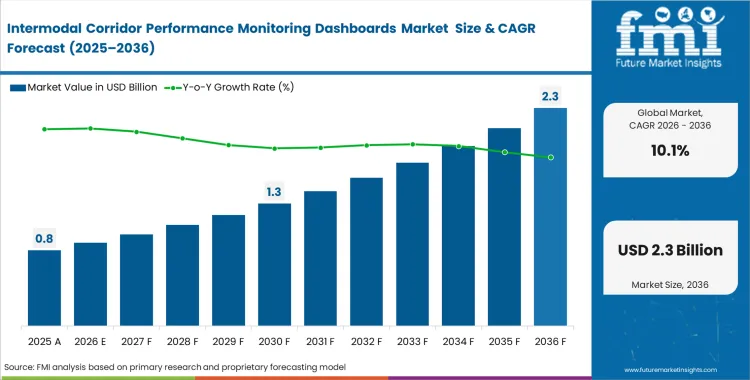
The intermodal corridor performance monitoring dashboards market was valued at USD 0.7 billion in 2025. Sector is poised to cross USD 0.8 billion in 2026 at a CAGR of 10.10% during the forecast period. Industry outlook propels overall opportunity to USD 2.2 billion through 2036 as shippers enforce strict financial penalties on late handoffs at interchange nodes.
Procurement leaders at major 3PLs are facing rising SLA penalties when delivery windows are missed, especially across rail-to-road transfers where coordination is tighter, and delays are harder to absorb. Relying on retroactive reporting tools leaves these operators blind during active transit anomalies. Securing multimodal shipment visibility platforms shifts their capability from disputing past invoices to dynamically rerouting cargo before bottlenecks materialize. Delaying this upgrade pushes operators into sustained margin pressure, as inefficiencies begin to translate directly into financial losses. FMI’s assessment suggests that this near-term cost exposure is driving faster adoption of intermodal corridor dashboards, with buyers prioritizing immediate operational control over broader efficiency improvements.
Summary of intermodal corridor performance monitoring dashboards market
- Market Snapshot
- The intermodal corridor performance monitoring dashboards market is valued at USD 0.7 billion in 2025 and is projected to reach USD 2.2 billion by 2036.
- The industry is expected to grow at a 10.1% CAGR from 2026 to 2036, creating an incremental opportunity of USD 1.3 billion.
- The market remains a specialized logistics and rail-operations software category where competitiveness depends on real-time KPI visibility, cross-mode event normalization, and decision support for corridor bottlenecks.
- Structural demand is supported by the fact that official freight systems already publish corridor-level activity, cost, time, and rail intermodal transit metrics, proving that dashboard-led monitoring is not theoretical but operational.
- Demand and Growth Drivers
- Demand is rising because operators and public agencies increasingly need a single corridor view across terminals, rail legs, ports, and inland handoffs instead of fragmented milestone feeds.
- Rail and corridor digitization is strengthening adoption because live platforms such as Wabtec RailConnect, project44 rail visibility, and Hitachi Rail control and asset platforms already turn movement data into dashboards, alerts, and operational planning views. (
- Public corridor programs also support growth, with Australia publishing freight performance dashboards, the EU maintaining a multi-corridor rail freight structure, and UNECE expanding corridor observatory data layers.
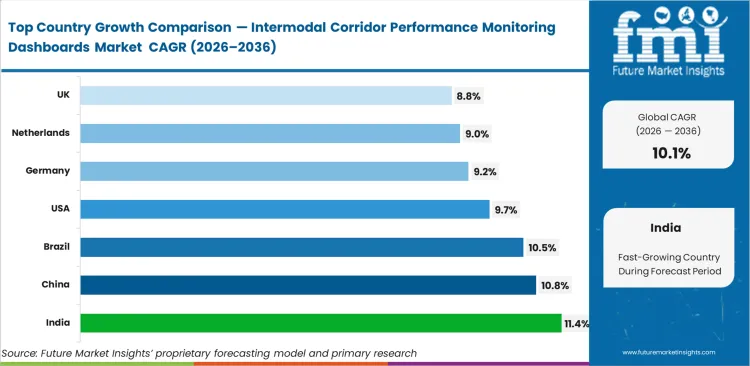
- India leads at 11.4% CAGR, followed by China at 10.8%, Brazil at 10.5%, the United States at 9.7%, Germany at 9.2%, the Netherlands at 9.0%, and the United Kingdom at 8.8%.
- Growth is moderated by long enterprise integration cycles, the need to normalize multi-source event data, and slower budget approvals in public rail and corridor authorities than in private logistics software categories.
- Product and Segment View
- The market covers dashboard software, analytics engines, integration layers, and services built to monitor corridor transit times, capacity, dwell, reliability, and exception performance across rail-linked intermodal flows.
- These platforms are used across corridor control towers, intermodal terminals, rail freight operations, public freight observatories, and shipper-facing logistics visibility functions.
- The Component segment is projected to have a 68.0% share, led by software since the core value lies in dashboarding, KPI calculation, event correlation, and visualization as opposed to a one-off deployment work.
- Cloud dominates the Deployment segment has an estimated 71.0 share, which represents the buyer inclinations towards multi-party data sharing and access by remote locations of geographically spread stakeholders of the corridor.
- The Monitoring Layer segment is headed by transit time, which is expected to take a 31.0% share since corridor users should have visibility of ETA, delay, dwell, and handoff before they can more effectively plan the wider network.
- The Buyer Type segment is dominated by rail operators and is expected to hold a 29.0% share. The railroads and rail corridor managers are the most immediate owners of the line performance, dispatch coordination, and service reliability performance.
- At the head of the Use Case segment is Network planning, which has an expected share of 27.0% to record due to the increasing desire of buyers to go beyond passive reporting to slot, path, asset, and capacity planning support.
- The scope includes corridor KPI dashboards, event-alerting software, benchmarking views, and operational planning modules, but excludes standalone telematics hardware, generic ERP suites, and single-mode fleet tools without dedicated corridor performance analytics.
- Geography and Competitive Outlook
- India, China, and Brazil are the fastest-growing national markets, while the United States remains a stable, high-value demand base because enterprise freight technology spending and rail visibility adoption are already established there.
- Competition is moderately fragmented and is being shaped by rail-specific analytics, multimodal visibility expansion, and broader transport execution suites rather than by a single dominant pure-play vendor.
- Wabtec, project44, SAP, Oracle, Hitachi Rail, Siemens Mobility, and Trimble are among the key participants, spanning rail-native analytics, multimodal shipment visibility, and transport orchestration software.
- Wabtec holds an estimated 12.4% share, indicating leadership but not concentration; the market remains open to rail incumbents, logistics software vendors, and visibility-network platforms.
Port authorities trigger a crucial operational shift when they expose terminal operating data directly to inland rail APIs. Connecting these data streams transforms discrete freight rail infrastructure nodes into a continuous routing surface. Terminal congestion signals instantly recalibrate dispatch schedules hundreds of miles upstream. Adopting specific freight corridor monitoring software standardizes this vital communication layer.
India is expected to hold at 11.4% as dedicated freight corridors demand high-density traffic management through 2036, while China is estimated at 10.8% on the back of export-driven rail logistics modernization. Brazil anticipated to expands at 10.5% through raw material supply chain digitization. United States operators expected to account for 9.7% gains by linking enterprise visibility layers with legacy track systems. Germany is anticipated to capture at 9.2%, the Netherlands 9.0%, and the United Kingdom is estimated at 8.8% focus investments on optimizing existing high-traffic networks during the forecast period. Diverging growth rates reflect a structural split between greenfield capacity scaling and brownfield performance extraction.
Segmental Analysis
Intermodal Corridor Performance Monitoring Dashboards Market Analysis by Component
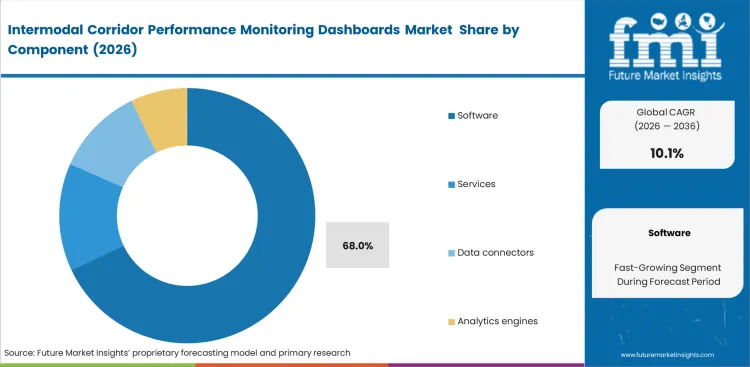
Software is expected to hold 68.0% market share in 2026 as logistics operators refuse to shoulder the internal maintenance burden of custom-built diagnostic tools. Supply chain directors specify scalable applications to access continuous algorithm updates and ensure compatibility with existing enterprise stacks. Procurement teams actively embed freight management software into their evaluation cycles to avoid fragmented IT environments. This dominant software conceals a severe operational vulnerability. Sophisticated analytics fail entirely without reliable sensor inputs feeding the data ingestion layer. Network managers who underinvest in baseline data cleansing protocols inevitably trigger cascading false alerts that destroy dispatcher trust. Evaluating these underlying ingestion capabilities remains the actual test when deciding how to choose corridor dashboard software.
- Implementation lifecycle: System integrators deploy standardized modules directly into existing IT infrastructure. Technology directors achieve operational readiness weeks faster than they could with proprietary builds.
- Maintenance economics: Subscription models convert volatile capital expenditures into predictable operating expenses. Chief financial officers lock in stable technology budgets while guaranteeing continuous security patching.
- Scalability threshold: Processing engines must absorb extreme telemetry volume during peak shipping seasons. Dispatch teams lose situational awareness instantly if interface performance degrades under network stress.
Intermodal Corridor Performance Monitoring Dashboards Market Analysis by Deployment
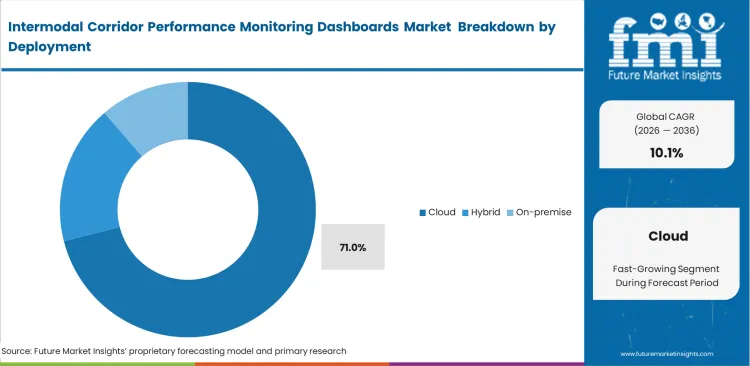
Managing intermodal transfers across vast geographies requires computing power that local rail yard servers cannot physically support. Operations managers rely on distributed processing to run complex predictive simulations and coordinate disparate logistics partners through shared APIs. Integrating freight forwarding software via managed architectures standardizes communication across the entire supply chain. Localized hardware limitations leave the cloud segment poised to garner 71.0% share in 2026. Heavy reliance on cloud connectivity introduces severe latency risks in rural rail corridors where cellular networks frequently drop. Buyers attempting to identify the best software for freight corridor KPI monitoring must test offline caching protocols to prevent complete visibility blackouts during transit gaps.
- Capital allocation: Purchasing teams strip server hardware costs out of initial project budgets. Organizations redirect these funds into advanced analytics licenses and dispatcher training programs.
- Hidden expenditures: Heavy congestion events trigger unpredictable API call volumes that inflate monthly subscription fees. Financial controllers struggle to forecast operating costs when data transmission behavior spikes.
- Lifecycle comparison: Managed platforms push automatic updates continuously. IT departments avoid the expensive, multi-year version migration projects that historically paralyzed control tower operations.
Intermodal Corridor Performance Monitoring Dashboards Market Analysis by Monitoring Layer
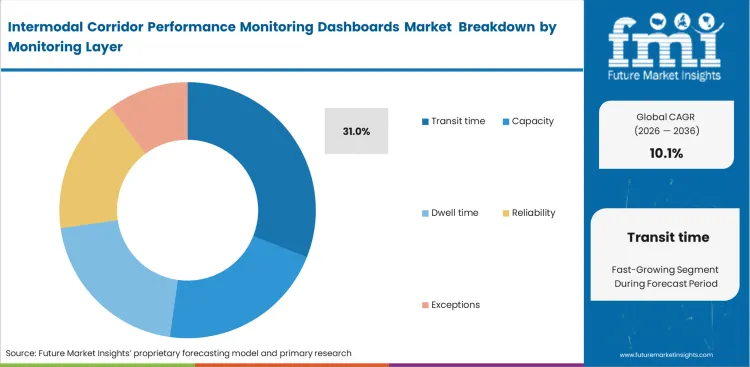
Terminal managers assign crane operators and staging lanes based almost entirely on inbound train schedules. Anticipating these arrival windows drives downstream labor scheduling and equipment allocation. Given its operational importance, transit time tracking is anticipated to hold 31.0% share in 2026. Feeding precise ETA data into a broader transport management system allows planners to automate rebooking the moment a train falls behind. Focusing only on line-haul speed can create problems if planners ignore static transfer periods. Most delays actually occur during dwell time at interchange nodes, not during active transit. Tracking performance closely shows how rushing freight into a congested terminal just worsens local yard delays.
- Congestion prevention: Dispatchers spot yard bottlenecks before inbound trains arrive. Rerouting incoming freight to alternative facilities keeps local gridlock from affecting regional schedules.
- Residual vulnerability: Unpredictable customs inspections disrupt algorithmic transit planning. Terminal planners keep physical buffer capacities available specifically to absorb these regulatory delays.
- Value realization: Contract managers use immutable dashboard data to prove carrier fault. Organizations can enforce automated penalty billing against partners who repeatedly miss transit SLAs.
Intermodal Corridor Performance Monitoring Dashboards Market Analysis by Buyer Type
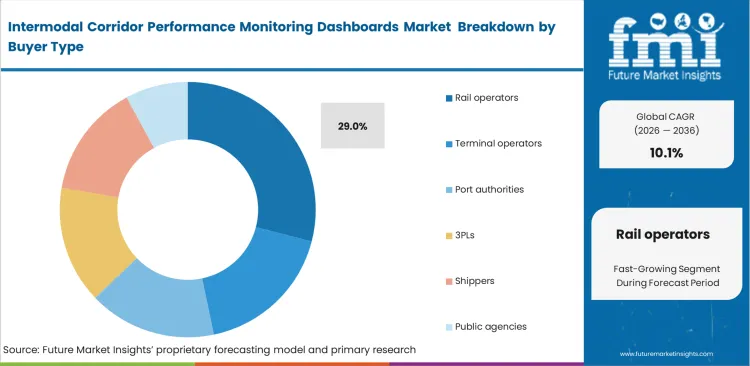
Asset owners need to fit additional train slots into physically limited track networks. Capacity planners use telemetry to monitor locomotive health and track conditions, maximizing the return on expensive infrastructure. Rail operators are expected to account for 29.0% share in 2026. Expanding freight transport management capabilities lets these carriers offer premium, visibility-backed services to high-value shippers. Historically, asset owners treated this data as a proprietary advantage rather than a shared operational resource. Carriers that keep their API architectures closed often lose business to agile 3PLs that aggregate data through third-party platforms. Purchasing teams evaluate rail corridor performance platform suppliers largely based on these different data-sharing approaches.
- Monolistic advantages: Major carriers tightly control access to their own track sensor data. Third-party logistics providers operate at a disadvantage until they establish direct integration partnerships with these carriers.
- API constraints: Legacy rail mainframes limit how often external systems can query data. Platform developers build workarounds to pull near-real-time updates without overloading carrier databases.
- Future landscape: Regulatory bodies are planning to mandate data sharing across national rail networks. Independent software vendors are building the translation layers necessary to handle this standardized telemetry flow.
Intermodal Corridor Performance Monitoring Dashboards Market Analysis by Use Case
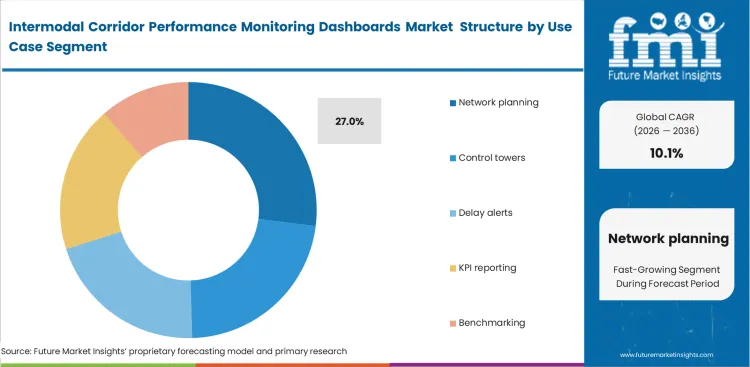
Logistics directors use computational modeling to balance fleet distribution across broad regions. Planners are moving away from reactive dispatching and instead simulating historical transit data to locate chronic bottlenecks. Integrating freight management systems directly into these planning modules allows companies to calculate carbon emissions for each route accurately. Supported by this shift toward proactive modeling, the network planning segment is estimated to capture 27.0% share in 2026. Planning models do occasionally struggle during live execution because algorithms assume optimal terminal performance. Operations teams relying completely on theoretical models face difficulties when bad weather alters baseline transit times. Understanding the functional boundaries of corridor dashboard software vs TMS helps planners use these tools correctly during actual disruptions.
- Early adopters: Global port operators synchronize ship arrivals with outbound rail capacity using advanced planning modules. Terminal directors reduce yard congestion by timing container transfers more accurately.
- Secondary integration: Regional rail carriers connect smaller planning tools into major hub operations. Local dispatchers gain a clear view of inbound traffic flows that were previously difficult to track.
- Laggard conversion: Major shippers now require API connectivity for all contract bids. Sales directors at brokerage firms view planning capabilities as a basic requirement for winning enterprise accounts.
Intermodal Corridor Performance Monitoring Dashboards Market Drivers, Restraints, and Opportunities
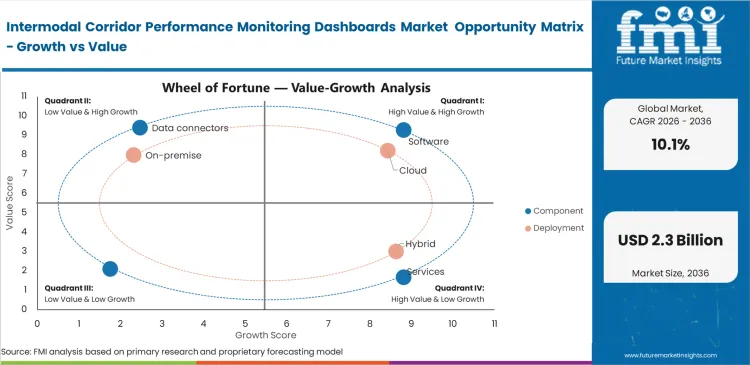
SLA enforcement mechanisms impose massive financial risks on 3PL procurement directors attempting to manage intermodal transfers manually. Operating without live telemetry forces logistics providers to absorb steep penalties when trains miss critical port loading windows. Organizations face immediate margin destruction if they cannot prove carrier fault during a delayed handoff. Implementing rail freight digital transformation platforms shifts accountability back to the underperforming carrier. Planners often ask what data sources feed freight corridor dashboards to ensure they have bulletproof evidence against penalty claims.
Fragmented data standards across legacy carrier systems prevent true end-to-end network visibility. IT directors spend months building custom API bridges because regional rail operators use proprietary, decades-old mainframe architectures. This technical friction delays platform rollout and artificially limits dashboard accuracy during critical cross-border transits. While middleware providers attempt to normalize these varying protocols, their translation engines frequently drop critical rail freight operations metadata. Evaluating diverse intermodal corridor dashboard vendors reveals massive disparities in how effectively they handle these legacy formats.
Opportunities in the Intermodal Corridor Performance Monitoring Dashboards Market
- Emissions tracking: Sustainability directors require precise carbon calculations per intermodal journey to satisfy expanding regulatory reporting mandates.
- Cold chain monitoring: Pharmaceutical shippers need continuous temperature telemetry integrated directly with location data to guarantee product efficacy upon arrival.
- Cross-enterprise collaboration: Establishing neutral supplier collaboration hubs allows competing carriers to share congestion data, reducing overall network friction without compromising competitive pricing.
Regional Analysis
.webp "Top Country Growth Comparison Intermodal Corridor Performance Monitoring Dashboards Market Cagr (2026 2036)")
Based on regional analysis, Intermodal Corridor Performance Monitoring Dashboards Market is segmented into Asia Pacific, Latin America, North America, and Europe across 40 plus countries.
| Country | CAGR (2026 to 2036) |
|---|---|
| India | 11.4% |
| China | 10.8% |
| Brazil | 10.5% |
| United States | 9.7% |
| Germany | 9.2% |
| Netherlands | 9.0% |
| United Kingdom | 8.8% |
Source: Future Market Insights (FMI) analysis, based on a proprietary forecasting model and primary research
Asia Pacific Intermodal Corridor Performance Monitoring Dashboards Market Analysis
Heavy public infrastructure commissioning dictates how freight moves across Asian geographies. Network planners cannot rely on legacy dispatch methods when managing entirely new, high-density routes. Incorporating port-to-door container journey orchestration platforms allows port authorities to push unmatched export volumes inland without collapsing terminal yards.
- India: The recent commissioning of dedicated freight corridors forces a complete overhaul of how local rail planners manage train density. Extreme operational intensity along these routes leaves zero margin for manual dispatch errors. Securing preferential transit slots from national regulators now requires algorithmic proof of reliability. Driven by this urgent need for operational precision, the India market for corridor performance dashboards is anticipated to expand at an 11.4% CAGR through 2036. This aggressive software sourcing establishes a much higher technical baseline for domestic rail logistics.
- China: Port directors struggle to synchronize heavy maritime volumes with available inland rail capacity without causing massive yard backups. Resolving this coastal bottleneck is anticipated to garner a 10.8% CAGR by 2036 across China during the forecast period. Export-driven logistics modernization requires deep digitalization across sprawling transport networks to keep these maritime nodes clear. The resulting digital infrastructure creates a tracking standard that neighboring trade economies must match to remain competitive.
FMI report includes detailed analysis of how massive capital allocation toward greenfield rail corridors completely separates Asian procurement behavior from Western markets. Beyond Asia, Saudi Arabia is emerging as a high‑growth market, driven by Vision 2030 investments in freight rail networks, logistics hubs, and economic corridors designed to diversify trade flows and industrial capacity.
Latin America Intermodal Corridor Performance Monitoring Dashboards Market Analysis
Commodity export cycles continue to shape investment priorities for inland transport technologies in these markets. Rail operators moving large volumes from agricultural and mining regions require more specialized monitoring systems to reduce the risk of spoilage and cargo theft over extended transit distances. The implementation of the connected logistics model is also helping operators manage persistent infrastructure constraints, particularly at congested port gateways. FMI’s estimates suggest that vendors are increasingly directing their product development toward security and environmental monitoring capabilities, rather than focusing solely on speed optimization.
- Brazil: Demand for corridor monitoring software in Brazil is forecast to rise at a 10.5% CAGR through 2036 as raw material shippers aggressively digitize their supply chains. Moving bulk agricultural shipments across vast internal distances creates chronic yard gridlock at major export terminals. Logistics managers now rely on continuous telemetry to reroute trains dynamically before they hit congested zones. This proactive tracking prevents large-scale spoilage at coastal choke points and fundamentally restructures regional export economics.
FMI report includes an assessment of why the commercial reality across Latin American rail networks remains tied almost exclusively to raw material extraction and agricultural cycles. Mexico is increasingly standing out as an exception, supported by nearshoring‑driven manufacturing growth, cross‑border freight demand, and rising private investment in intermodal rail connectivity.
North America Intermodal Corridor Performance Monitoring Dashboards Market Analysis
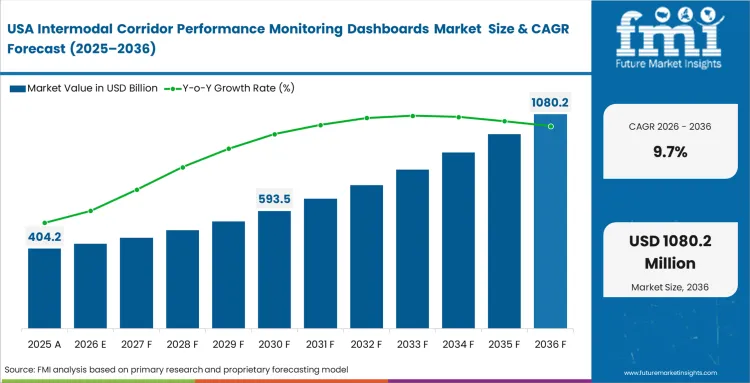
Consolidated rail networks present distinct technical challenges for third-party software integration. Large Class I carriers retain control over extensive proprietary data sets, requiring 3PLs to navigate complex access agreements before deploying enterprise-level dashboards. In response, supply chain leaders are increasingly using big data in logistics capabilities to work around some of these limitations through predictive modeling. Growing competition among major retail shippers is driving demand for neutral, third-party visibility platforms that operate independently of carrier-controlled systems.
- United States: Supply chain directors at major retail brands are building sophisticated control towers specifically to penalize late carrier handoffs. Merging this enterprise visibility layer with legacy rail tracking systems shifts negotiating power away from asset-owning carriers back to high-volume shippers. The United States corridor dashboard sales are expected to increase at a 9.7% CAGR over the assessment period. Integrating these complex datasets allows procurement teams to locate exact freight positions within historically closed carrier networks.
FMI report includes an evaluation of how dashboard procurement across North America essentially functions as a structural battle over data ownership. Canada is witnessing growing momentum, as freight rail operators, ports, and public agencies increase investments in digital corridor visibility to support cross‑border trade, energy exports, and intermodal efficiency.
Europe Intermodal Corridor Performance Monitoring Dashboards Market Analysis
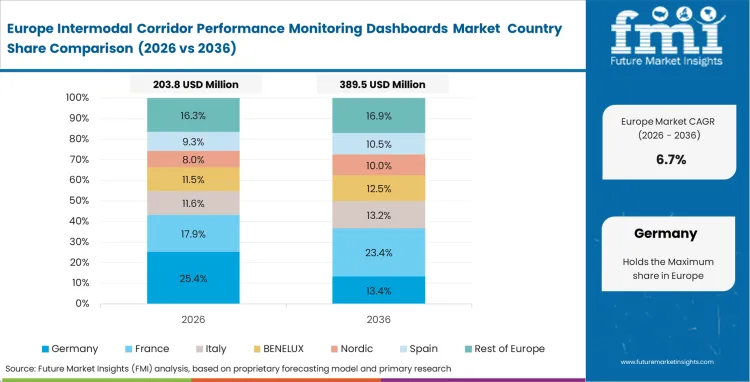
Cross-border standardization efforts are shaping software architecture requirements across the region. Logistics operators often have to work across multiple national rail systems within a single journey, each with its own protocols, which makes robust data translation capabilities essential. The adoption of digital logistics working model is also helping companies align internal reporting with increasingly strict transnational emissions regulations. Most of the value in this market is coming from brownfield optimization, as expanding physical rail infrastructure remains constrained by both geography and political considerations.
- Germany: Operating highly congested mixed-use networks requires precise analytics to safely squeeze narrow freight windows into passenger train timetables. Dispatchers prioritize absolute reliability over top speed because a single delayed freight train disrupts national commuter schedules. Network managers are fundamentally altering their routing paradigms to handle this structural congestion. This operational shift is expected to capture 9.2% CAGR for the German intermodal corridor dashboard market by 2036. The investment focus remains entirely on extracting maximum capacity from existing track rather than laying new rail.
- Netherlands: Seamless inland rail connectivity dictates the success of port-centric logistics strategies at major Dutch gateways. As terminal operators clear docks rapidly by integrating marine traffic data directly with rail dispatch systems, dashboard demand across the Netherlands is estimated to advance at a 9.0% CAGR through 2036. This direct synchronization physically accelerates asset velocity across the entire national corridor. Operations teams essentially treat the inland rail network as a direct extension of the maritime terminal.
- United Kingdom: The United Kingdom is anticipated to record an 8.8% CAGR in the intermodal performance dashboard sector during the forecast period as freight planners battle frequent disruptions from aging infrastructure. Modernizing these existing rail-freight structures relies entirely on extracting better performance data rather than laying new physical track. Data-driven maintenance scheduling reduces unexpected track closures and provides reliable transit windows for intermodal operators. Fleet managers use these predictive alerts to navigate around temporary blockages without absorbing massive delay fines.
FMI report includes strategic context on how European rail dynamics force software vendors to solve for extreme regulatory fragmentation rather than pure geographic distance. Poland is increasingly emerging as a growth market, supported by strong EU‑backed rail infrastructure funding, freight corridor modernization, and rising transit volumes linking Eastern and Western Europe.
Competitive Aligners for Market Players
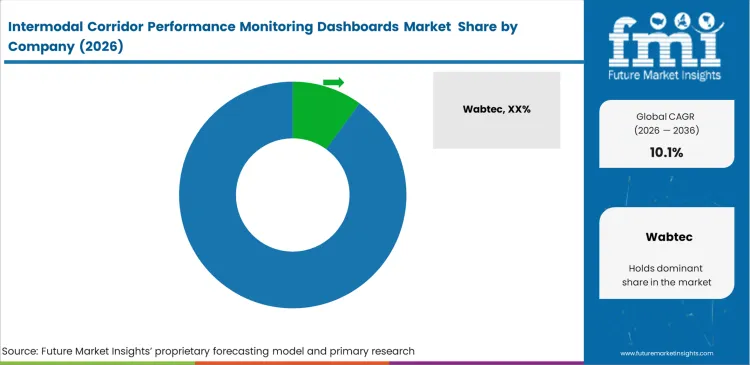
Wabtec, SAP, and Siemens Mobility set the baseline for technical standards, supported by their extensive installed base across global rail networks. These renowned players use long-standing relationships with Class I railroads to embed new railway telematics dashboards within broader, multi-year maintenance agreements. Procurement teams at large rail operators tend to favor these established vendors, as their software integrates more seamlessly with existing locomotive control systems.
New entrants are gaining ground by focusing on stronger cross-modal data translation. Their platforms are designed to work across legacy rail silos, supported by extensive API libraries that connect with a wide range of global carriers. This approach allows companies to scale quickly without being tied to a single network. Competing effectively at this level requires consistently high uptime and precise data normalization across fragmented digital railway architecture, an area where larger incumbents often take longer to adapt.
Global shippers are actively avoiding overdependence on any one vendor by insisting on open API frameworks during procurement. Many are deliberately splitting contracts, using specialized providers for functions such as predictive ETA modeling, while continuing to rely on established vendors for core track-level telemetry. Specifically choosing freight corridor analytics software vendors, high-volume shippers are also pushing back against fragmented communication standards and driving greater technical alignment across their networks.
Key Players in Intermodal Corridor Performance Monitoring Dashboards Market
- Wabtec
- project44
- SAP
- Oracle
- Hitachi Rail
- Siemens Mobility
- Trimble
Scope of the Report
| Metric | Value |
|---|---|
| Quantitative Units | USD 0.85 Billion to USD 2.22 Billion, at a CAGR of 10.10% |
| Market Definition | Dashboards aggregate multi-carrier telemetry into a unified interface for operational dispatchers. Planners use these tools to anticipate interchange delays and reroute freight dynamically. |
| Segmentation | Component, Deployment, Monitoring Layer, Buyer Type, Use Case, and Region |
| Regions Covered | North America, Latin America, Europe, Asia Pacific, Middle East and Africa |
| Countries Covered | United States, Canada, Brazil, Mexico, Germany, United Kingdom, France, Spain, Italy, China, Japan, India, South Korea, Australia, GCC, South Africa |
| Key Companies Profiled | Wabtec, project44, SAP, Oracle, Hitachi Rail, Siemens Mobility, Trimble |
| Forecast Period | 2026 to 2036 |
| Approach | Paid software subscriptions for freight control towers anchored baseline valuation models. |
Source: Future Market Insights (FMI) analysis, based on proprietary forecasting model and primary research
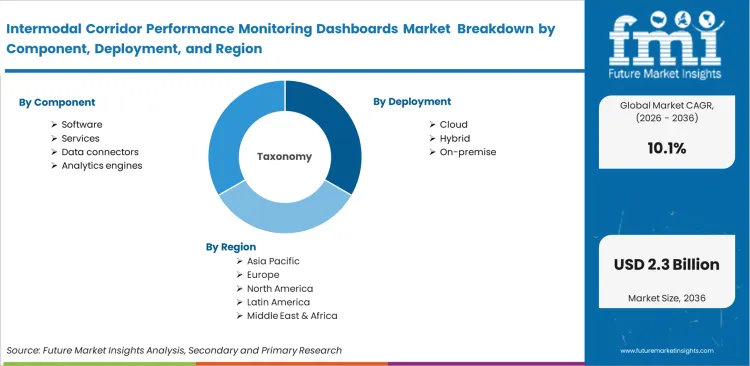
Intermodal Corridor Performance Monitoring Dashboards Market Analysis by Segments
Component
- Software
- Services
- Data connectors
- Analytics engines
Deployment
- Cloud
- Hybrid
- On-premise
Monitoring Layer
- Transit time
- Capacity
- Dwell time
- Reliability
- Exceptions
Buyer Type
- Rail operators
- Terminal operators
- Port authorities
- 3PLs
- Shippers
- Public agencies
Use Case
- Network planning
- Control towers
- Delay alerts
- KPI reporting
- Benchmarking
Region
- North America
- United States
- Canada
- Latin America
- Brazil
- Mexico
- Europe
- Germany
- United Kingdom
- France
- Spain
- Italy
- Asia Pacific
- China
- Japan
- India
- South Korea
- Australia
- Middle East and Africa
- GCC
- South Africa
Bibliography
- Bureau of Infrastructure and Transport Research Economics. (2025). Freight statistics. Australian Government.
- Federal Ministry Republic of Austria. (2025). EU rail freight corridors.
- Office of Rail and Road. (2024, September 19). Freight rail usage and performance, April to June 2024.
- Press Information Bureau, Ministry of Railways. (2026, January 14). Railways sets new record in freight movement. Government of India.
- UIC & UIRR. (2024, November). 2024 report on combined transport in Europe.
- United Nations Economic Commission for Europe. (2025). International transport infrastructure observatory.
- Wang, Z., Chren, S., Stopka, O., & Kampf, R. (2024). Exploring the impact of a railway corridor on intermodal freight transport in the context of railway revitalization. Journal of Advanced Transportation, 2024, Article 4420668.
- Federal Railroad Administration. (2025). Freight rail performance metrics. U.S. Department of Transportation.
This bibliography is provided for reader reference. The full FMI report contains the complete reference list with primary source documentation.
This Report Addresses
- SLA fine mitigation via predictive delay modeling algorithms.
- API integration challenges between port terminal systems and inland rail networks.
- Subscription cost structures versus local hardware deployment economics.
- Mismatched data latency impacts on ETA calculation accuracy.
- Customs inspection disruptions shaping terminal dwell time parameters.
- Asset utilization strategies for major Class I rail operators.
- Greenfield capacity scaling specific to Asian dedicated freight corridors.
- Carbon calculation integration into cross-mode freight planning engines.
Frequently Asked Questions
What is the Intermodal Corridor Performance Monitoring Dashboards Market valuation in 2026?
Revenue reaches USD 0.85 billion in 2026. This figure highlights rapid adoption by 3PLs seeking financial protection against strict SLA penalties enforced at critical interchange nodes.
What is the growth rate for this market?
Demand expands at a 10.10% CAGR from 2026 to 2036. Sustained investment reflects a fundamental shift from reactive troubleshooting to continuous, predictive capacity modeling across global transport networks.
How large will the sector be by 2036?
Overall opportunity crosses USD 2.22 billion by 2036. Regulatory requirements for carbon tracking per route combine with pure efficiency drives to enforce universal software adoption among top-tier shippers.
Why does the Software segment lead the market?
Software holds 68.0% share because logistics providers prioritize scalable SaaS capabilities over managing internal data architecture. Standardized interfaces integrate rapidly with existing procurement stacks.
What drives Cloud deployment adoption?
Cloud architectures capture 71.0% share by enabling multi-regional access without physical server installations at every rail yard. Distributed computing handles complex predictive simulations that overwhelm local hardware.
Why is Transit Time the primary monitoring layer?
Transit time accounts for 31.0% share because predicting arrival sequences directly dictates downstream labor scheduling. Terminal managers allocate crane operators based entirely on these inbound ETA feeds.
How do Rail Operators utilize these dashboards?
Holding 29.0% share, asset-owning carriers use telemetry to squeeze additional train slots into constrained track networks. Precision tracking maximizes asset utilization without requiring expensive physical track expansion.
Why is Network Planning a leading use case?
Network planning commands 27.0% share as logistics directors shift focus from daily dispatching to long-term contract calibration. Simulating historical transit data identifies chronic bottlenecks before executing annual carrier agreements.
How does India's growth compare to China's trajectory?
India leads at 11.4% driven by newly commissioned dedicated freight corridors requiring high-density traffic management. China tracks at 10.8% through export-driven terminal synchronization rather than pure greenfield track expansion.
What operational risk does exclusive cloud reliance create?
Total cloud dependency obscures severe latency risks in rural rail corridors. Planners face complete visibility blackouts when trains traverse remote topographies lacking consistent cellular connectivity.
How do terminal planners mitigate customs delays?
Unpredictable regulatory inspections disrupt algorithmic transit optimization. Planners must maintain physical buffer capacities within yards to absorb these localized hold-ups regardless of software sophistication.
Why do shippers mandate open API architecture during bids?
Logistics directors split contracts to avoid vendor lock-in. They utilize specialized startups for precise ETA modeling while relying on legacy hardware vendors exclusively for foundational track-level telemetry.
What role does emissions tracking play in software procurement?
Sustainability mandates force logistics managers to monitor specific carbon profiles per transit corridor. Dashboards incorporating precise emissions calculations win enterprise contracts over tools offering pure speed optimization.
How do European network managers alter routing paradigms?
Operating highly congested mixed-use networks, German and British dispatchers prioritize absolute reliability over top speed. Analytics squeeze narrow freight windows into passenger timetables safely.
What happens to operators who delay software upgrades?
Failing to implement live tracking leaves 3PLs incapable of dynamically rerouting cargo during disruptions. These operators absorb structural margin erosion through consecutive, unavoidable late-delivery fines.
How do dashboards alter carrier contract negotiations?
Procurement teams implement automated penalty billing for carriers missing transit SLAs. Historical performance data provides immutable proof of fault, recovering substantial costs during annual reconciliations.
What defines the 2036 structural end state for this technology?
Dashboards will transition from read-only monitoring interfaces into automated execution layers. Systems will independently rebook delayed intermodal freight across alternative carriers without requiring human dispatcher authorization.
Preview the report firsthand - request a free sample
Get SampleGet the brochure for pricing and purchase details.
Get PDFTable of Content
- Executive Summary
- Global Market Outlook
- Demand-side Trends
- Supply-side Trends
- Technology Roadmap Analysis
- Analysis and Recommendations
- Market Overview
- Market Coverage / Taxonomy
- Market Definition / Scope / Limitations
- Research Methodology
- Chapter Orientation
- Analytical Lens and Working Hypotheses
- Market Structure, Signals, and Trend Drivers
- Benchmarking and Cross-market Comparability
- Market Sizing, Forecasting, and Opportunity Mapping
- Research Design and Evidence Framework
- Desk Research Programme (Secondary Evidence)
- Company Annual and Sustainability Reports
- Peer-reviewed Journals and Academic Literature
- Corporate Websites, Product Literature, and Technical Notes
- Earnings Decks and Investor Briefings
- Statutory Filings and Regulatory Disclosures
- Technical White Papers and Standards Notes
- Trade Journals, Industry Magazines, and Analyst Briefs
- Conference Proceedings, Webinars, and Seminar Materials
- Government Statistics Portals and Public Data Releases
- Press Releases and Reputable Media Coverage
- Specialist Newsletters and Curated Briefings
- Sector Databases and Reference Repositories
- FMI Internal Proprietary Databases and Historical Market Datasets
- Subscription Datasets and Paid Sources
- Social Channels, Communities, and Digital Listening Inputs
- Additional Desk Sources
- Expert Input and Fieldwork (Primary Evidence)
- Primary Modes
- Qualitative Interviews and Expert Elicitation
- Quantitative Surveys and Structured Data Capture
- Blended Approach
- Why Primary Evidence is Used
- Field Techniques
- Interviews
- Surveys
- Focus Groups
- Observational and In-context Research
- Social and Community Interactions
- Stakeholder Universe Engaged
- C-suite Leaders
- Board Members
- Presidents and Vice Presidents
- R&D and Innovation Heads
- Technical Specialists
- Domain Subject-matter Experts
- Scientists
- Physicians and Other Healthcare Professionals
- Governance, Ethics, and Data Stewardship
- Research Ethics
- Data Integrity and Handling
- Primary Modes
- Tooling, Models, and Reference Databases
- Desk Research Programme (Secondary Evidence)
- Data Engineering and Model Build
- Data Acquisition and Ingestion
- Cleaning, Normalisation, and Verification
- Synthesis, Triangulation, and Analysis
- Quality Assurance and Audit Trail
- Market Background
- Market Dynamics
- Drivers
- Restraints
- Opportunity
- Trends
- Scenario Forecast
- Demand in Optimistic Scenario
- Demand in Likely Scenario
- Demand in Conservative Scenario
- Opportunity Map Analysis
- Product Life Cycle Analysis
- Supply Chain Analysis
- Investment Feasibility Matrix
- Value Chain Analysis
- PESTLE and Porter’s Analysis
- Regulatory Landscape
- Regional Parent Market Outlook
- Production and Consumption Statistics
- Import and Export Statistics
- Market Dynamics
- Global Market Analysis 2021 to 2025 and Forecast, 2026 to 2036
- Historical Market Size Value (USD Million) Analysis, 2021 to 2025
- Current and Future Market Size Value (USD Million) Projections, 2026 to 2036
- Y-o-Y Growth Trend Analysis
- Absolute $ Opportunity Analysis
- Global Market Pricing Analysis 2021 to 2025 and Forecast 2026 to 2036
- Global Market Analysis 2021 to 2025 and Forecast 2026 to 2036, By Component
- Introduction / Key Findings
- Historical Market Size Value (USD Million) Analysis By Component , 2021 to 2025
- Current and Future Market Size Value (USD Million) Analysis and Forecast By Component , 2026 to 2036
- Software
- Services
- Data connectors
- Analytics engines
- Software
- Y-o-Y Growth Trend Analysis By Component , 2021 to 2025
- Absolute $ Opportunity Analysis By Component , 2026 to 2036
- Global Market Analysis 2021 to 2025 and Forecast 2026 to 2036, By Deployment
- Introduction / Key Findings
- Historical Market Size Value (USD Million) Analysis By Deployment, 2021 to 2025
- Current and Future Market Size Value (USD Million) Analysis and Forecast By Deployment, 2026 to 2036
- Cloud
- Hybrid
- On-premise
- Cloud
- Y-o-Y Growth Trend Analysis By Deployment, 2021 to 2025
- Absolute $ Opportunity Analysis By Deployment, 2026 to 2036
- Global Market Analysis 2021 to 2025 and Forecast 2026 to 2036, By Monitoring Layer
- Introduction / Key Findings
- Historical Market Size Value (USD Million) Analysis By Monitoring Layer, 2021 to 2025
- Current and Future Market Size Value (USD Million) Analysis and Forecast By Monitoring Layer, 2026 to 2036
- Transit time
- Capacity
- Dwell time
- Reliability
- Exceptions
- Transit time
- Y-o-Y Growth Trend Analysis By Monitoring Layer, 2021 to 2025
- Absolute $ Opportunity Analysis By Monitoring Layer, 2026 to 2036
- Global Market Analysis 2021 to 2025 and Forecast 2026 to 2036, By Buyer Type
- Introduction / Key Findings
- Historical Market Size Value (USD Million) Analysis By Buyer Type, 2021 to 2025
- Current and Future Market Size Value (USD Million) Analysis and Forecast By Buyer Type, 2026 to 2036
- Rail operators
- Terminal operators
- Port authorities
- 3PLs
- Shippers
- Public agencies
- Rail operators
- Y-o-Y Growth Trend Analysis By Buyer Type, 2021 to 2025
- Absolute $ Opportunity Analysis By Buyer Type, 2026 to 2036
- Global Market Analysis 2021 to 2025 and Forecast 2026 to 2036, By Use Case
- Introduction / Key Findings
- Historical Market Size Value (USD Million) Analysis By Use Case, 2021 to 2025
- Current and Future Market Size Value (USD Million) Analysis and Forecast By Use Case, 2026 to 2036
- Network planning
- Control towers
- Delay alerts
- KPI reporting
- Benchmarking
- Network planning
- Y-o-Y Growth Trend Analysis By Use Case, 2021 to 2025
- Absolute $ Opportunity Analysis By Use Case, 2026 to 2036
- Global Market Analysis 2021 to 2025 and Forecast 2026 to 2036, By Region
- Introduction
- Historical Market Size Value (USD Million) Analysis By Region, 2021 to 2025
- Current Market Size Value (USD Million) Analysis and Forecast By Region, 2026 to 2036
- North America
- Latin America
- Western Europe
- Eastern Europe
- East Asia
- South Asia and Pacific
- Middle East & Africa
- Market Attractiveness Analysis By Region
- North America Market Analysis 2021 to 2025 and Forecast 2026 to 2036, By Country
- Historical Market Size Value (USD Million) Trend Analysis By Market Taxonomy, 2021 to 2025
- Market Size Value (USD Million) Forecast By Market Taxonomy, 2026 to 2036
- By Country
- USA
- Canada
- Mexico
- By Component
- By Deployment
- By Monitoring Layer
- By Buyer Type
- By Use Case
- By Country
- Market Attractiveness Analysis
- By Country
- By Component
- By Deployment
- By Monitoring Layer
- By Buyer Type
- By Use Case
- Key Takeaways
- Latin America Market Analysis 2021 to 2025 and Forecast 2026 to 2036, By Country
- Historical Market Size Value (USD Million) Trend Analysis By Market Taxonomy, 2021 to 2025
- Market Size Value (USD Million) Forecast By Market Taxonomy, 2026 to 2036
- By Country
- Brazil
- Chile
- Rest of Latin America
- By Component
- By Deployment
- By Monitoring Layer
- By Buyer Type
- By Use Case
- By Country
- Market Attractiveness Analysis
- By Country
- By Component
- By Deployment
- By Monitoring Layer
- By Buyer Type
- By Use Case
- Key Takeaways
- Western Europe Market Analysis 2021 to 2025 and Forecast 2026 to 2036, By Country
- Historical Market Size Value (USD Million) Trend Analysis By Market Taxonomy, 2021 to 2025
- Market Size Value (USD Million) Forecast By Market Taxonomy, 2026 to 2036
- By Country
- Germany
- UK
- Italy
- Spain
- France
- Nordic
- BENELUX
- Rest of Western Europe
- By Component
- By Deployment
- By Monitoring Layer
- By Buyer Type
- By Use Case
- By Country
- Market Attractiveness Analysis
- By Country
- By Component
- By Deployment
- By Monitoring Layer
- By Buyer Type
- By Use Case
- Key Takeaways
- Eastern Europe Market Analysis 2021 to 2025 and Forecast 2026 to 2036, By Country
- Historical Market Size Value (USD Million) Trend Analysis By Market Taxonomy, 2021 to 2025
- Market Size Value (USD Million) Forecast By Market Taxonomy, 2026 to 2036
- By Country
- Russia
- Poland
- Hungary
- Balkan & Baltic
- Rest of Eastern Europe
- By Component
- By Deployment
- By Monitoring Layer
- By Buyer Type
- By Use Case
- By Country
- Market Attractiveness Analysis
- By Country
- By Component
- By Deployment
- By Monitoring Layer
- By Buyer Type
- By Use Case
- Key Takeaways
- East Asia Market Analysis 2021 to 2025 and Forecast 2026 to 2036, By Country
- Historical Market Size Value (USD Million) Trend Analysis By Market Taxonomy, 2021 to 2025
- Market Size Value (USD Million) Forecast By Market Taxonomy, 2026 to 2036
- By Country
- China
- Japan
- South Korea
- By Component
- By Deployment
- By Monitoring Layer
- By Buyer Type
- By Use Case
- By Country
- Market Attractiveness Analysis
- By Country
- By Component
- By Deployment
- By Monitoring Layer
- By Buyer Type
- By Use Case
- Key Takeaways
- South Asia and Pacific Market Analysis 2021 to 2025 and Forecast 2026 to 2036, By Country
- Historical Market Size Value (USD Million) Trend Analysis By Market Taxonomy, 2021 to 2025
- Market Size Value (USD Million) Forecast By Market Taxonomy, 2026 to 2036
- By Country
- India
- ASEAN
- Australia & New Zealand
- Rest of South Asia and Pacific
- By Component
- By Deployment
- By Monitoring Layer
- By Buyer Type
- By Use Case
- By Country
- Market Attractiveness Analysis
- By Country
- By Component
- By Deployment
- By Monitoring Layer
- By Buyer Type
- By Use Case
- Key Takeaways
- Middle East & Africa Market Analysis 2021 to 2025 and Forecast 2026 to 2036, By Country
- Historical Market Size Value (USD Million) Trend Analysis By Market Taxonomy, 2021 to 2025
- Market Size Value (USD Million) Forecast By Market Taxonomy, 2026 to 2036
- By Country
- Kingdom of Saudi Arabia
- Other GCC Countries
- Turkiye
- South Africa
- Other African Union
- Rest of Middle East & Africa
- By Component
- By Deployment
- By Monitoring Layer
- By Buyer Type
- By Use Case
- By Country
- Market Attractiveness Analysis
- By Country
- By Component
- By Deployment
- By Monitoring Layer
- By Buyer Type
- By Use Case
- Key Takeaways
- Key Countries Market Analysis
- USA
- Pricing Analysis
- Market Share Analysis, 2025
- By Component
- By Deployment
- By Monitoring Layer
- By Buyer Type
- By Use Case
- Canada
- Pricing Analysis
- Market Share Analysis, 2025
- By Component
- By Deployment
- By Monitoring Layer
- By Buyer Type
- By Use Case
- Mexico
- Pricing Analysis
- Market Share Analysis, 2025
- By Component
- By Deployment
- By Monitoring Layer
- By Buyer Type
- By Use Case
- Brazil
- Pricing Analysis
- Market Share Analysis, 2025
- By Component
- By Deployment
- By Monitoring Layer
- By Buyer Type
- By Use Case
- Chile
- Pricing Analysis
- Market Share Analysis, 2025
- By Component
- By Deployment
- By Monitoring Layer
- By Buyer Type
- By Use Case
- Germany
- Pricing Analysis
- Market Share Analysis, 2025
- By Component
- By Deployment
- By Monitoring Layer
- By Buyer Type
- By Use Case
- UK
- Pricing Analysis
- Market Share Analysis, 2025
- By Component
- By Deployment
- By Monitoring Layer
- By Buyer Type
- By Use Case
- Italy
- Pricing Analysis
- Market Share Analysis, 2025
- By Component
- By Deployment
- By Monitoring Layer
- By Buyer Type
- By Use Case
- Spain
- Pricing Analysis
- Market Share Analysis, 2025
- By Component
- By Deployment
- By Monitoring Layer
- By Buyer Type
- By Use Case
- France
- Pricing Analysis
- Market Share Analysis, 2025
- By Component
- By Deployment
- By Monitoring Layer
- By Buyer Type
- By Use Case
- India
- Pricing Analysis
- Market Share Analysis, 2025
- By Component
- By Deployment
- By Monitoring Layer
- By Buyer Type
- By Use Case
- ASEAN
- Pricing Analysis
- Market Share Analysis, 2025
- By Component
- By Deployment
- By Monitoring Layer
- By Buyer Type
- By Use Case
- Australia & New Zealand
- Pricing Analysis
- Market Share Analysis, 2025
- By Component
- By Deployment
- By Monitoring Layer
- By Buyer Type
- By Use Case
- China
- Pricing Analysis
- Market Share Analysis, 2025
- By Component
- By Deployment
- By Monitoring Layer
- By Buyer Type
- By Use Case
- Japan
- Pricing Analysis
- Market Share Analysis, 2025
- By Component
- By Deployment
- By Monitoring Layer
- By Buyer Type
- By Use Case
- South Korea
- Pricing Analysis
- Market Share Analysis, 2025
- By Component
- By Deployment
- By Monitoring Layer
- By Buyer Type
- By Use Case
- Russia
- Pricing Analysis
- Market Share Analysis, 2025
- By Component
- By Deployment
- By Monitoring Layer
- By Buyer Type
- By Use Case
- Poland
- Pricing Analysis
- Market Share Analysis, 2025
- By Component
- By Deployment
- By Monitoring Layer
- By Buyer Type
- By Use Case
- Hungary
- Pricing Analysis
- Market Share Analysis, 2025
- By Component
- By Deployment
- By Monitoring Layer
- By Buyer Type
- By Use Case
- Kingdom of Saudi Arabia
- Pricing Analysis
- Market Share Analysis, 2025
- By Component
- By Deployment
- By Monitoring Layer
- By Buyer Type
- By Use Case
- Turkiye
- Pricing Analysis
- Market Share Analysis, 2025
- By Component
- By Deployment
- By Monitoring Layer
- By Buyer Type
- By Use Case
- South Africa
- Pricing Analysis
- Market Share Analysis, 2025
- By Component
- By Deployment
- By Monitoring Layer
- By Buyer Type
- By Use Case
- USA
- Market Structure Analysis
- Competition Dashboard
- Competition Benchmarking
- Market Share Analysis of Top Players
- By Regional
- By Component
- By Deployment
- By Monitoring Layer
- By Buyer Type
- By Use Case
- Competition Analysis
- Competition Deep Dive
- Wabtec
- Overview
- Product Portfolio
- Profitability by Market Segments (Product/Age /Sales Channel/Region)
- Sales Footprint
- Strategy Overview
- Marketing Strategy
- Product Strategy
- Channel Strategy
- project44
- SAP
- Oracle
- Hitachi Rail
- Siemens Mobility
- Trimble
- Wabtec
- Competition Deep Dive
- Assumptions & Acronyms Used


