

- Industry Size (2026)
- USD 3.6 Bn
- Forecast (2036)
- USD 12.0 Bn
- CAGR (2026 to 2036)
- 12.80%
Supplier Collaboration and Inbound Logistics Control Tower Market Size, Market Forecast and Outlook By FMI
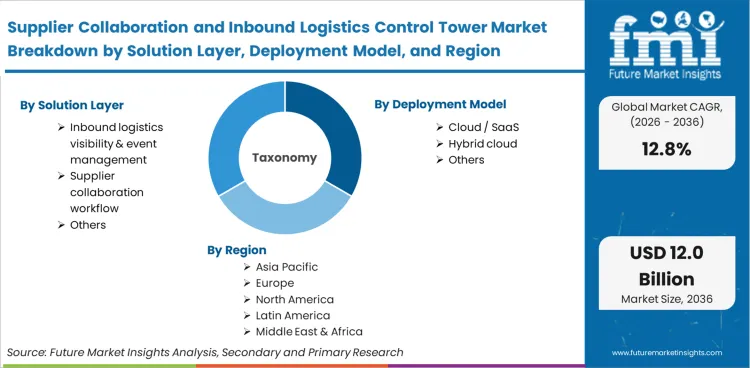
The supplier collaboration and inbound logistics control tower market size was valued at USD 3.2 billion in 2025. Demand is poised to surpass USD 3.6 billion in 2026 at a CAGR of 12.80% during the forecast period. Continuous investment propels cumulative revenue to USD 12.0 billion through 2036 as manufacturing directors mandate unified data architectures to coordinate multi-tier component tracking and dock scheduling simultaneously.
Procurement directors at automotive Tier-1s face a chronic 14-week lead time on critical components. This forces them to qualify secondary suppliers and monitor shipments at the individual container level. The operational consequence of blind inbound freight is a production line stoppage. Facilities cannot absorb the working capital penalty of holding buffer stock for every sub-assembly. They also cannot rely on manual email updates from tier-two vendors to calculate accurate supply chain visibility software requirements. What limits earlier iterations of inbound tracking is the inability to translate an unexpected port delay into an actionable factory floor scheduling change without human intervention. This capability gap drives immediate investment in predictive architecture and localized logistics 4.0 nodes, shaping current supplier collaboration and inbound logistics control tower market trends.
Summary of Supplier Collaboration and Inbound Logistics Control Tower Market
- Supplier Collaboration and Inbound Logistics Control Tower Market Definition
- Supplier Collaboration and Inbound Logistics Control Tower platforms synthesize vendor data and carrier tracking into an actionable inbound scheduling mechanism. The software aligns external supplier movement with internal factory readiness.
- Demand Drivers in the Market
- Component shortages force procurement directors to track individual part shipments using real-time supplier shipment tracking software.
- Port congestion requires logistics managers to recalculate factory arrival times constantly, driving the need for better inbound shipment visibility.
- Working capital constraints compel finance officers to demand strict just-in-time inventory execution.
- Key Segments Analyzed in the FMI Report
- Solution Layer: Inbound logistics visibility & event management is expected to account for 34.0% share in 2026, driven by the immediate operational need to pinpoint delayed freight.
- Deployment Model: Cloud / SaaS is set to lead by Deployment Model through 2036 due to superior API integration capabilities with external carriers.
- Enterprise Size: Large enterprises are projected to hold 66.0% share in 2026, scaling complex multi-tier vendor networks globally.
- End User Sector: Manufacturing & industrial is estimated to lead by End-use Sector with 29.0% share in 2026, coordinating raw material intake with production schedules.
- Buying Objective: Resilience / disruption response is anticipated to lead by Buying Objective with 31.0% share in 2026, mitigating supply chain shocks.
- India: 15.2% compound growth, localized manufacturing initiatives require digitized vendor coordination.
- Analyst Opinion at FMI
- Ronak Shah, Principal Analyst, Consumer Product, at FMI notes that "Purchasing departments assume implementing a centralized dashboard solves inbound visibility. In reality, the dashboard is entirely useless unless tier-two and tier-three suppliers comply with digital shipping notices. The primary constraint is the commercial leverage required to force a mid-market vendor in another country to integrate their systems with your tracking API. Organizations that mandate API compliance in their procurement contracts achieve return on investment in months. Organizations treating visibility merely as an IT project spend years chasing manual updates."
- Strategic Implications / Executive Takeaways
- Supply chain vice presidents must embed digital tracking requirements into all future vendor contracts to secure data feeds, especially when evaluating supplier collaboration software pricing.
- Logistics directors avoid dock congestion penalties by automating yard appointments based on predictive arrival data.
- Procurement officers gain negotiation leverage by capturing objective supplier delivery performance metrics historically.
- Methodology
- Primary Research: Direct interviews with enterprise supply chain architects and procurement directors
- Desk Research: Analysis of major software implementation reports and logistics technology earnings
- Market-Sizing and Forecasting: Baseline established via active SaaS seat licenses and enterprise contracts
- Data Validation and Update Cycle: Correlated against independent system integrator deployment volumes
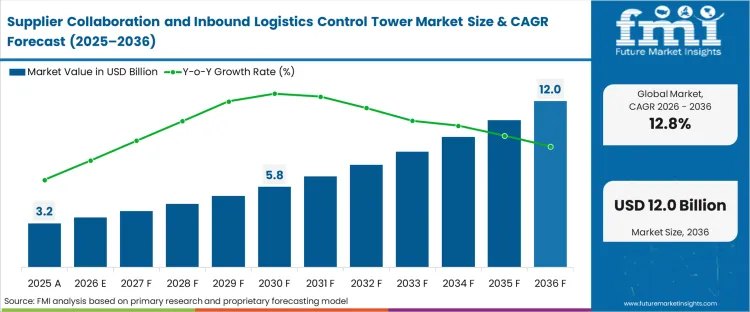
Supplier Collaboration and Inbound Logistics Control Tower Market Key Takeaways
| Metric | Details |
|---|---|
| Industry Size (2026) | USD 3.6 billion |
| Industry Value (2036) | USD 12.0 billion |
| CAGR (2026-2036) | 12.80% |
Source: Future Market Insights (FMI) analysis, based on proprietary forecasting model and primary research
Once an enterprise connects its supplier portal directly to warehouse appointment scheduling, the barrier to just-in-time execution collapses. The trigger occurs when receiving managers refuse to accept advanced shipping notices that lack real-time geolocation validation. Operations teams subsequently eliminate manual gate-check processes and automate yard resource allocation based on predictive arrival algorithms rather than scheduled delivery windows.
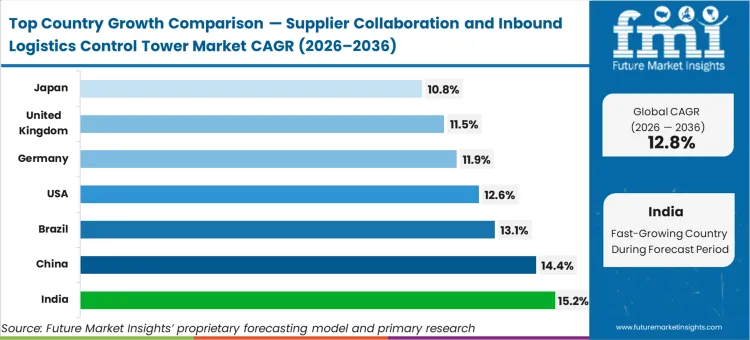
India leads geographic growth at 15.2% as heavy industry conglomerates digitize fragmented supplier bases. China tracks closely at 14.4% driven by export compliance requirements and complex vendor networks. Brazil advances at 13.1% due to infrastructure bottlenecks forcing strict inbound coordination. The North America supplier collaboration and inbound logistics control tower market expands at 12.6% while organizations upgrade legacy ERP connections to active procurement software. Germany progresses at 11.9% on the back of strict automotive supply mandates. The United Kingdom follows at 11.5% and Japan at 10.8%. The operational divergence across these geographies centers entirely on whether adoption is compelled by manufacturing complexity or by port congestion.
Supplier Collaboration and Inbound Logistics Control Tower Market Definition
Supplier Collaboration and Inbound Logistics Control Tower software functions as a centralized data synchronization layer that connects external supplier shipment activities with internal receiving and production schedules. The architecture processes real-time geolocation feeds, advanced shipping notices, and vendor performance metrics to predict arrival times and allocate warehouse resources. It replaces fragmented communication channels with a single verifiable record of inbound freight status, forming the core of the supplier collaboration software market.
Supplier Collaboration and Inbound Logistics Control Tower Market Inclusions
The architecture relies on vendor portals and predictive ETA calculation engines. It incorporates dock scheduling modules to manage receiving flows alongside exception management workflows. Implementations require application programming interfaces that connect third-party carrier data directly to internal inventory systems. Active collaborative transport network modules fall within scope when they explicitly manage inbound supplier freight rather than outbound customer deliveries. This defines the operational boundary for the inbound logistics control tower market.
Supplier Collaboration and Inbound Logistics Control Tower Market Exclusions
Outbound freight forwarding software and last-mile delivery tracking platforms fall outside the functional boundary of this segment. Systems designed solely for internal warehouse management without external supplier integration are omitted. General enterprise resource planning upgrades that lack dedicated predictive tracking capabilities for inbound vendor shipments are functionally excluded from this calculation.
Supplier Collaboration and Inbound Logistics Control Tower Market Research Methodology
- Primary Research: Supply chain vice presidents, procurement directors, and inbound logistics managers
- Desk Research: Vendor API documentation, public contract awards, enterprise software implementation case studies
- Market-Sizing and Forecasting: Paid software-as-a-service subscriptions and enterprise deployment licensing revenues
- Data Validation and Update Cycle: Cross-referenced quarterly software vendor earnings and verified system integrator partnership volumes
Segmental Analysis
Supplier Collaboration and Inbound Logistics Control Tower Market Analysis by Solution Layer
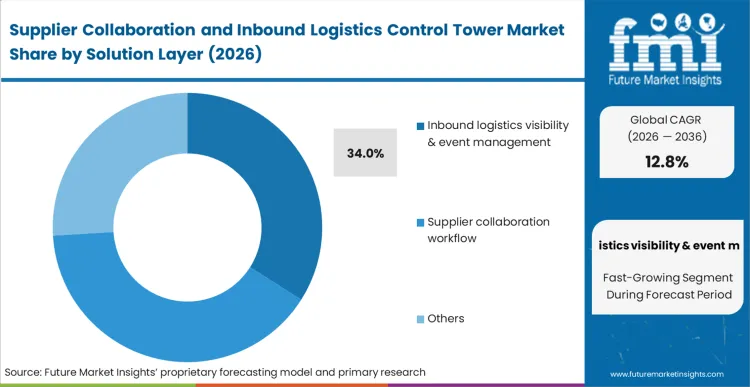
Visibility engines expose exactly where a container sits. This removes the ambiguity that factory planners historically padded with buffer inventory. Inbound logistics visibility & event management drives the 34.0% position this segment holds in 2026. FMI observes that supply chain managers prioritize this layer to stop production delays before they occur. The operational reality shifts completely when a delayed vessel automatically updates the material requirement planning system without a human analyst manually entering the new date. What control towers rarely publicize is that visibility algorithms degrade sharply when tracking multi-modal shipments that transfer from ocean freight to rail. True visibility requires a unified data standard across competing carrier networks. Procurement directors evaluating supply chain visibility software vs control tower software realize platforms with limited pre-built carrier integrations demand massive custom development costs to achieve basic tracking functionality.
- Data normalization: Ingesting raw carrier feeds into a standardized format enables accurate arrival predictions. Supply chain analysts avoid manual spreadsheet reconciliation.
- Exception triggering: Automated alerts isolate shipments trending late against the production schedule. Logistics planners focus strictly on distressed freight.
- Workflow automation: Systematically re-routing delayed components ensures critical manufacturing lines remain active. Operations directors avoid complete facility shutdowns.
Supplier Collaboration and Inbound Logistics Control Tower Market Analysis by Deployment Model
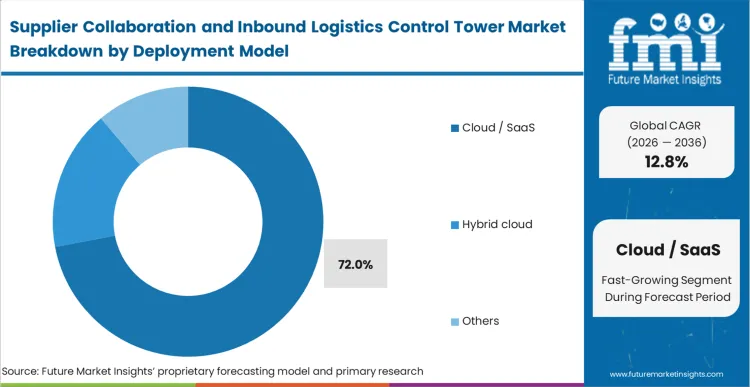
Legacy on-premise installations lack the architectural flexibility to consume thousands of concurrent API feeds from external transport providers. Cloud / SaaS accounts for 72.0% share in 2026 because the model inherently supports multi-tenant data sharing across the vendor ecosystem. Supply chain IT directors recognize that installing tracking software behind a corporate firewall severely restricts supply chain management collaboration with overseas suppliers. Cloud deployment fundamentally changes the vendor onboarding process from a six-month IT project to a simple credential provisioning exercise. Based on FMI's assessment, large enterprises now view vendor-managed cloud infrastructure as superior to internal security protocols for external data exchange. Organizations delaying cloud migration permanently cap their tracking capabilities to tier-one suppliers only, significantly increasing their ultimate inbound logistics control tower implementation cost.
- API elasticity: Cloud infrastructure scales computing power to process peak seasonal tracking volume. IT architects avoid provisioning idle local servers.
- Supplier onboarding: Browser-based portal access allows minor vendors to submit shipping notices instantly. Procurement managers secure compliance from small partners.
- Version consistency: Centralized updates push new carrier connections to all users simultaneously. System administrators bypass complex local patching cycles.
Supplier Collaboration and Inbound Logistics Control Tower Market Analysis by Enterprise Size
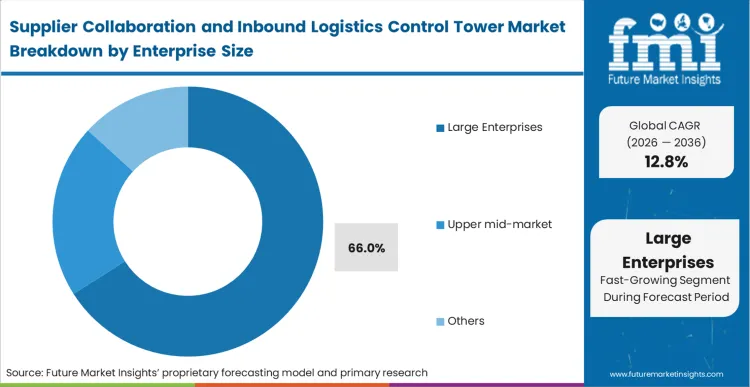
Complex multinational operations require software capable of mapping thousands of individual stock keeping units across dozens of global facilities. Large enterprises hold 66.0% share in 2026, utilizing sophisticated algorithms to balance inbound flow against factory capacity. Vice presidents of supply chain implement these systems to standardize procurement execution across disparate regional divisions. The deployment links supplier contract management directly to operational performance. According to FMI's estimates, a successful large-scale deployment re-allocates dock doors without human input. Mid-market companies that issue an rfq for supplier collaboration control tower platform templates designed for massive enterprises often end up with bloated systems that their lean teams cannot actively manage.
- Multi-site balancing: Routing inbound freight to alternate facilities prevents regional inventory imbalances. Regional logistics directors optimize total network capacity.
- Customized modeling: Configuring specific exception rules matches the software to unique manufacturing constraints. Supply chain architects align technology with physical realities.
- Compliance enforcement: Mandating platform usage across the entire supplier base normalizes data intake. Chief procurement officers extract standardized performance metrics.
Supplier Collaboration and Inbound Logistics Control Tower Market Analysis by End-use Sector
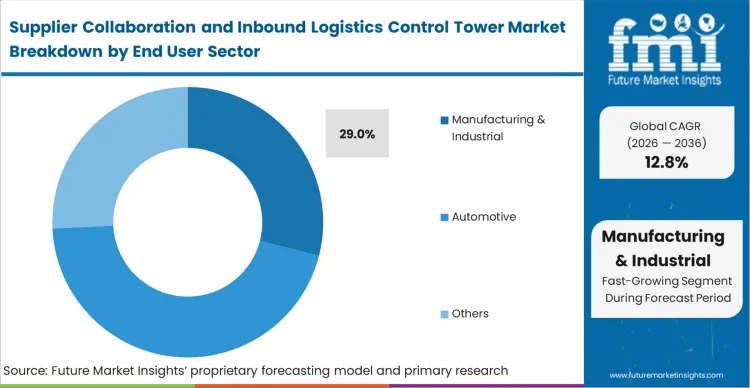
Just-in-time assembly lines require absolute certainty regarding component arrival to prevent devastating idle time costs. Manufacturing supplier collaboration software dominates the sector with 29.0% share in 2026 as plant managers replace estimated arrival dates with precise geographic coordinates. Implementing active logistics visibility software shifts factory scheduling from a reactive adjustment process to a proactive optimization exercise. FMI analysts note that while automotive manufacturers led initial adoption, heavy industrial equipment producers now drive the most complex implementations due to oversized freight requirements. The hidden operational cost emerges when manufacturers try to force generic retail tracking software to manage complex industrial bill-of-materials shipments. Selecting the wrong industry template forces production planners back to manual tracking for critical sub-assemblies.
- Assembly sequencing: Aligning inbound component arrival with specific production runs eliminates staging area congestion. Production managers maximize floor space utilization.
- Quality routing: Directing specialized components straight to inspection bays accelerates the receiving process. Quality control directors minimize intake bottlenecks.
- Line-stoppage prevention: Identifying delayed parts days in advance allows planners to substitute production runs. Plant directors maintain facility output metrics.
Supplier Collaboration and Inbound Logistics Control Tower Market Analysis by Buying Objective
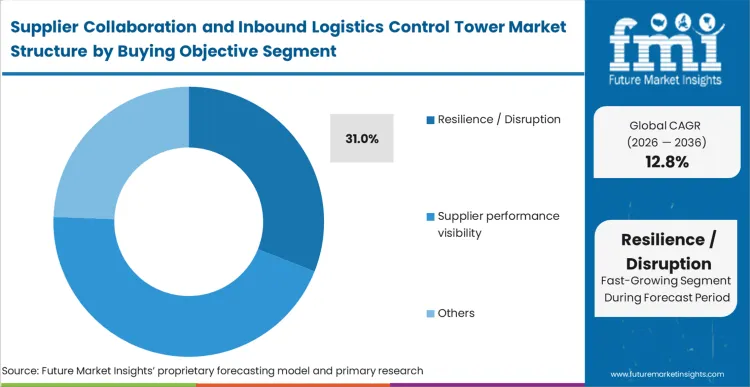
The pandemic proved that reactive supply chain management destroys shareholder value during systemic shocks. Resilience / disruption response drives 31.0% share in 2026, compelling chief supply chain officers to invest heavily in predictive visibility and supplier risk visibility software. The operational focus shifts from reducing freight costs to ensuring material availability under volatile conditions. FMI's analysis indicates that resilience initiatives frequently stall because executives procure visualization tools without securing the underlying carrier data feeds needed to populate them. A dashboard showing a transport management system map is meaningless if the data is 48 hours old. Organizations that prioritize software features over data network access fail to achieve the agility necessary to reroute freight during a crisis.
- Alternate sourcing: Identifying primary supplier delays instantly triggers secondary vendor orders automatically. Procurement directors secure materials before competitors react.
- Port diversion: Rerouting vessels away from congested terminals salvages critical delivery timelines. Logistics managers bypass geographic bottlenecks proactively.
- Impact quantification: Calculating the exact financial cost of a delayed shipment prioritizes expediting budgets correctly. Finance directors allocate emergency air freight spend efficiently.
Supplier Collaboration and Inbound Logistics Control Tower Market Drivers, Restraints, and Opportunities
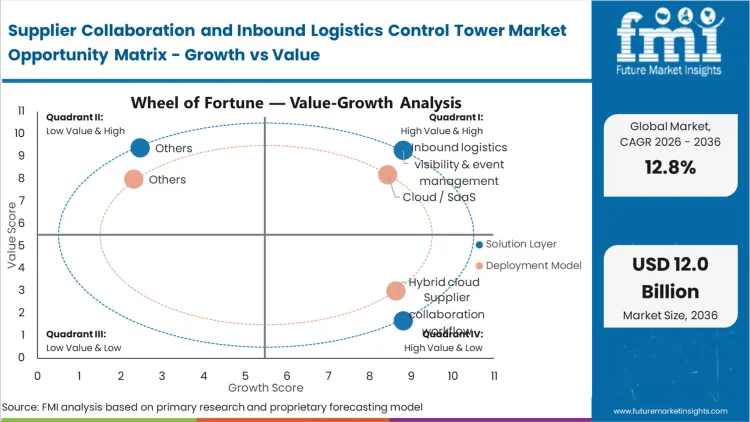
Prolonged transit times and unpredictable carrier schedules force procurement directors to abandon static planning spreadsheets. Organizations cannot calculate production capacities when inbound material delivery dates fluctuate by weeks. The commercial consequence of maintaining a reactive posture is lost sales due to out-of-stock conditions and exorbitant emergency freight transport management expediting fees. This environment accelerates the demand for a supplier collaboration platform for inbound logistics because supply chain executives must replace vendor promises with objective geographic data.
Data silos between legacy internal systems and modern external carrier networks present a severe integration barrier. Warehouse management systems built two decades ago lack the API architecture required to consume high-frequency geolocation updates. Supply chain IT directors struggle to justify the massive middleware investment necessary to bridge this gap, stalling deployments of the best supplier collaboration software. Cloud-based integration hubs offer a partial solution, but customizing data maps for thousands of specific supplier formats remains highly labor-intensive.
Opportunities in the Supplier Collaboration and Inbound Logistics Control Tower Market
- Scope-3 emissions tracking: Capturing carbon footprint data from inbound carriers satisfies emerging regulatory mandates. Sustainability directors avoid compliance penalties.
- Machine learning ETAs: Training algorithms on historical port delays generates highly accurate arrival predictions. Logistics planners optimize dock scheduling efficiency.
- Automated claims processing: Utilizing objective location data to prove carrier delays streamlines penalty enforcement. Finance officers recover lost freight management software value instantly.
Regional Analysis
Based on regional analysis the supplier collaboration and inbound logistics control tower market is segmented into India, China, Brazil, United States, Germany, United Kingdom, and Japan across 40 plus countries.
.webp "Top Country Growth Comparison Supplier Collaboration And Inbound Logistics Control Tower Market Cagr (2026 2036)")
| Country | CAGR (2026 to 2036) |
|---|---|
| India | 15.2% |
| China | 14.4% |
| Brazil | 13.1% |
| United States | 12.6% |
| Germany | 11.9% |
| United Kingdom | 11.5% |
| Japan | 10.8% |
Source: Future Market Insights (FMI) analysis, based on proprietary forecasting model and primary research
Asia Pacific Supplier Collaboration and Inbound Logistics Control Tower Market Analysis
Regional supply chain directors implement control towers to bridge the gap between fragmented regional carriers and centralized manufacturing hubs. FMI observes that the focus here rests strictly on raw material intake rather than finished goods distribution. Heavy industry conglomerates across the region face extreme domestic infrastructure variations that make standard transit time calculations impossible. The operational reality shifts completely when a factory can accurately predict the arrival of components despite multiple inter-state transport handoffs.
- India: The growing at a 15.2% CAGR through 2036, the Indian market relies heavily on industrial conglomerates attempting to bridge fragmented regional carriers with centralized manufacturing hubs. Supply chain directors facing extreme infrastructure variations implement control towers to replace unpredictable transit times with live geolocation tracking. This modernization effort establishes a verifiable data layer across complex multi-state transport handoffs. Facilities that successfully mandate API connectivity achieve stable production scheduling. They gain a distinct operational advantage over competitors relying on manual freight updates.
- China: The massive coastal assembly operations in China require exact synchronization of thousands of tier-two suppliers feeding into tightly scheduled export hubs. Procurement officers mandate active first mile logistics delivery software integration to enforce strict digital shipping records before components ever reach the dock. This aggressive compliance strategy drives a 14.4% CAGR for inbound visibility platforms across the nation. Enterprises utilizing these predictive ETA engines eliminate severe receiving bottlenecks. The operational result is absolute dominance in global export speed.
- Japan: Japan’s strict quality control standards across the automotive and electronics sectors dictate that plant managers maintain absolute visibility over specialized component flows. Logistics directors utilize predictive ETA integration to optimize tight receiving schedules within highly space-constrained urban facilities. Organizations drastically reduce staging area congestion by ingesting raw carrier feeds into standardized formats for automated exception triggering. The resulting optimization of physical warehouse capacity supports a 10.8% growth trajectory through the forecast period.
FMI's report includes South Korea and ASEAN nations. Organizations across these additional territories increasingly mandate API connectivity to synchronize cross-border material movements with their primary assembly hubs.
Americas Supplier Collaboration and Inbound Logistics Control Tower Market Analysis
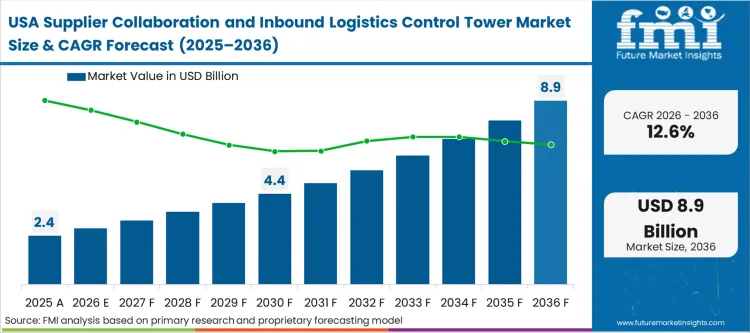
The software deployment focuses heavily on predictive ETA integration with automated yard management systems. Port congestion and severe domestic driver shortages compel North American and Latin American logistics directors to optimize every available receiving dock hour. Based on FMI's assessment, organizations extract the highest value from the analytics layer by utilizing historical carrier performance data to renegotiate annual freight contracts.
- United States: The advancing at a 12.6% pace, the United States market addresses severe labor shortages at receiving docks that require absolute precision in appointment scheduling. Logistics directors deploy delivery management software to connect predictive arrival modules directly with automated yard management systems. This integration aligns warehouse labor precisely with actual vessel arrivals. Organizations lacking these predictive analytics capabilities face escalating detention and demurrage penalties during periods of acute port congestion.
- Brazil: The infrastructure bottlenecks surrounding major agricultural and industrial hubs force in Brazil strict inbound coordination for heavy manufacturing producers. Supply chain architects align tracking technology directly with physical yard realities, propelling the market forward at a 13.1% compound annual rate. Plant managers replace estimated arrival dates with verified geographic coordinates to prevent devastating idle time costs on the assembly line. Facilities unable to secure real-time visibility from their regional carrier networks suffer massive working capital penalties by holding excessive buffer stock.
FMI's report includes Canada and Mexico. Cross-border manufacturing operations in these adjacent zones utilize centralized dashboards to consolidate tracking across fragmented regional carrier networks.
Europe Supplier Collaboration and Inbound Logistics Control Tower Market Analysis
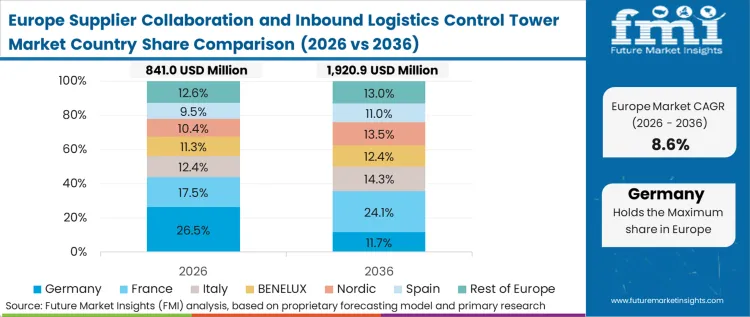
Sustainability tracking and carbon accounting mandates now dictate how procurement officers evaluate inbound freight platforms. High labor costs across the continent drive aggressive automation of the physical receiving process. FMI's analysis indicates that supply chain vice presidents prioritize systems capable of mapping carbon footprint data alongside standard geographic coordinates.
- Germany: The strict automotive supply mandates in Germany demand that Tier-1 manufacturers synchronize component intake precisely with active assembly line sequencing. Production managers maximize floor space utilization by directing specialized components straight to inspection bays based on verified location feeds. These precision requirements eliminate excess buffer stock entirely. This structural shift toward automated receiving coordination drives adoption forward at 11.9% annually. Suppliers unable to connect to these unified networks lose priority vendor status.
- United Kingdom: The complex customs documentation requirements at major ports of UK continuously delay inbound material flows for retail and industrial producers. Quality control directors minimize these intake bottlenecks by ingesting raw carrier feeds into a standardized format, a transition supporting an 11.5% growth rate through 2036. Retailers secure materials before competitors react by automating exception triggers the moment a container flags a customs hold. Organizations failing to capture these objective supplier delivery metrics struggle to execute alternate sourcing strategies during sudden supply shocks.
FMI's report includes France and Italy. Regional logistics directors in these nations optimize total network capacity by routing inbound freight to alternate facilities when primary ports experience localized congestion.
Competitive Aligners for Market Players
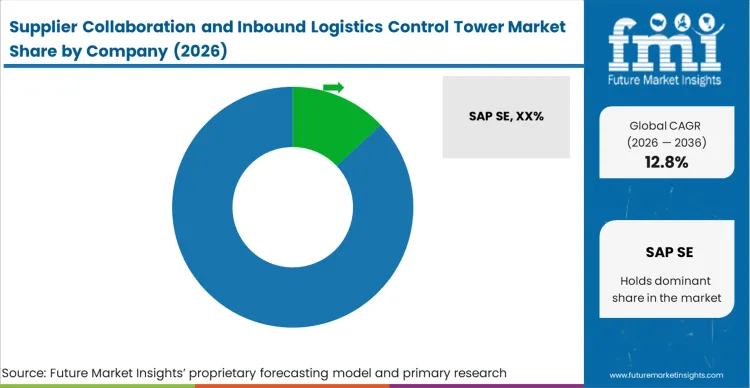
The gap between large software providers and smaller logistics applications often comes down to carrier network depth. SAP SE and Oracle Corporation hold strong positions largely because so many suppliers already operate within their enterprise systems. Smaller providers usually need to build custom API connections for each new client, which makes scaling harder and more expensive. In many cases, supply chain teams choose a platform based on how much of their existing vendor base is already connected. Even when buyers compare SAP, Oracle, Kinaxis, and Infor for supplier collaboration, network overlap usually matters more than interface design.
Established logistics platforms also benefit from years of historical transit data across major trade lanes. That gives them a real edge in ETA accuracy and delay prediction. Newer competitors may have solid products, but they cannot build that data depth quickly. Until their networks mature, they often have to rely on less accurate timing estimates. Larger incumbents use their historical data to train predictive models that can flag likely delays earlier, and that capability is becoming a core part of their value.
At the same time, large enterprise buyers try to avoid becoming too dependent on one platform. Many build secondary integration layers that separate the core ERP from visibility or control tower tools. This makes it easier to switch providers when better data feeds or stronger lane coverage become available. Over time, competition is likely to depend less on software features alone and more on the strength and exclusivity of the underlying data network. Buyers are also paying closer attention to the difference between logistics control tower and TMS roles so they can avoid overlap in system design.
Key Players in Supplier Collaboration and Inbound Logistics Control Tower Market
- SAP SE
- Oracle Corporation
- WiseTech Global (e2open)
- Kinaxis Inc.
- The Descartes Systems Group Inc.
- Infor
- Blue Yonder
Scope of the Report
| Metric | Value |
|---|---|
| Quantitative Units | USD 3.6 billion to USD 12.0 billion, at a CAGR of 12.80% |
| Market Definition | Supplier Collaboration and Inbound Logistics Control Tower platforms synthesize vendor data and carrier tracking into an actionable inbound scheduling mechanism. The software aligns external supplier movement with internal factory readiness. |
| Segmentation | By Solution Layer, Deployment Model, Enterprise Size, End-use Sector, Buying Objective, and Region |
| Regions Covered | North America, Latin America, Europe, Asia Pacific, Middle East and Africa |
| Countries Covered | India, China, Brazil, United States, Germany, United Kingdom, Japan |
| Key Companies Profiled | SAP SE, Oracle Corporation, WiseTech Global (e2open), Kinaxis Inc., The Descartes Systems Group Inc., Infor, Blue Yonder |
| Forecast Period | 2026 to 2036 |
| Approach | Baseline established via active SaaS seat licenses and enterprise contracts |
Source: Future Market Insights (FMI) analysis, based on proprietary forecasting model and primary research
Supplier Collaboration and Inbound Logistics Control Tower Market Analysis by Segments
Solution Layer:
- Inbound logistics visibility & event management
- Supplier collaboration workflow
- Control tower analytics & exception management
- Dock / appointment / ASN orchestration
- Integration & network services
Deployment Model:
- Cloud / SaaS
- Hybrid cloud
- On-premise
Enterprise Size:
- Large enterprises
- Upper mid-market
- Small and medium enterprises
End-use Sector:
- Manufacturing & industrial
- Consumer goods & retail
- Automotive
- Life sciences / healthcare
- High-tech / electronics
- Logistics service providers
Buying Objective:
- Resilience / disruption response
- Supplier performance visibility
- Inbound ETA accuracy
- Inventory and working-capital reduction
- Compliance / traceability coordination
Region:
- North America
- Latin America
- Europe
- Asia Pacific
- Middle East and Africa
Bibliography
- World Trade Organization. (2025). Global Trade Outlook and Statistics.
- National Institute of Standards and Technology. (2024, September). Supply chain traceability: Manufacturing meta-framework (Initial public draft) (NIST IR 8536 IPD).
- Arvis, J.-F., Ulybina, D., & Wiederer, C. (2024, May). From survey to big data: The new Logistics Performance Index (Policy Research Working Paper 10772). World Bank.
- Organization for Economic Co-operation and Development. (2024). OECD digital economy outlook 2024 (Volume 1).
- Modica, T., Tappia, E., Colicchia, C., & Melacini, M. (2024). Integrating arrival time estimation in truck scheduling: An explorative study in grocery retailing. Production & Manufacturing Research.
This bibliography is provided for reader reference. The full FMI report contains the complete reference list with primary source documentation.
This Report Addresses
- Procurement directors securing multi-tier vendor compliance
- Supply chain IT architects integrating legacy warehouse systems
- Logistics managers automating predictive dock appointment scheduling
- Manufacturing vice presidents preventing assembly line stockouts
- Finance officers quantifying objective carrier delay penalties
- Sustainability directors tracking inbound freight emission metrics
- Regional planners balancing multi-site material allocations
- Operations teams transitioning from reactive to proactive monitoring
Frequently Asked Questions
What is a supplier collaboration and inbound logistics control tower?
It is a centralized platform that synthesizes vendor data and carrier tracking into an actionable inbound scheduling mechanism, aligning external supplier movement with internal factory readiness.
What is the supplier collaboration and inbound logistics control tower market forecast?
The valuation reaches USD 3.6 billion in 2026 and expands to USD 12.0 billion by 2036. This growth represents a fundamental pivot away from manual tracking toward automated, predictive inbound scheduling.
How does an inbound logistics control tower work?
The architecture processes real-time geolocation feeds, advanced shipping notices, and vendor performance metrics to predict exact arrival times. This allows operations teams to allocate warehouse resources based on predictive algorithms rather than scheduled delivery windows.
Which companies offer supplier collaboration and inbound logistics control tower software?
Key providers dominating this space include SAP SE, Oracle Corporation, WiseTech Global (e2open), Kinaxis Inc., The Descartes Systems Group Inc., Infor, and Blue Yonder.
What is the difference between supplier collaboration software vs SRM?
Supplier Relationship Management (SRM) focuses on long-term vendor evaluation, contract negotiation, and strategic sourcing. Control tower collaboration focuses on real-time execution, tracking individual component shipments, and coordinating daily inbound freight movement.
Why does Inbound logistics visibility & event management lead the solution layer?
Supply chain managers prioritize this module because exposing exact container locations eliminates the ambiguity that historically required expensive buffer inventory.
What operational limitation slows cloud deployment?
Data silos between legacy warehouse systems and modern APIs restrict data flow. IT directors struggle to justify middleware investments required to bridge these architectures.
How does India compare to China functionally?
India grows at 15.2% as manufacturers digitize fragmented domestic networks, while China at 14.4% focuses strictly on synchronizing massive export-oriented supplier ecosystems.
What specific metric validates a successful control tower deployment?
The percentage of dock appointments rescheduled automatically without human intervention determines true return on investment for logistics directors.
Why do mid-market companies struggle with large enterprise solutions?
Selecting bloated enterprise templates forces lean supply chain teams into unmanageable data maintenance, causing them to revert to manual spreadsheet tracking.
What role does predictive ETA play in resilience?
Identifying delayed vessels instantly allows procurement officers to execute alternate sourcing before competitors react, ensuring factory material availability.
How do incumbents maintain their competitive position?
Established software providers leverage vast historical transit datasets to train superior machine learning models, creating a performance gap challengers cannot bridge.
What forces procurement to mandate API integration?
Purchasing departments recognize that control tower dashboards remain useless without accurate carrier feeds, making data integration a primary vendor contract requirement.
Why is outbound freight excluded from this analysis?
Managing finished goods distribution requires entirely different routing algorithms and customer integration workflows than inbound raw material coordination.
How do port diversions impact operations?
Rerouting delayed vessels proactively salvages critical manufacturing timelines, allowing logistics planners to bypass geographic bottlenecks entirely.
What foundational change occurs by 2036?
Competition pivots entirely from software feature comparisons to carrier network data exclusivity, determining which providers hold true market leverage.
Why does manufacturing dominate end-use adoption?
Just-in-time assembly lines require absolute component arrival certainty. Plant managers deploy these tools to prevent devastating idle time costs.
What hidden cost emerges during integration?
Creating custom data maps for thousands of non-standard supplier formats consumes massive IT budgets, stalling overall visibility initiatives.
How do large enterprises avoid vendor lock-in?
Chief information officers maintain secondary integration layers, decoupling core enterprise resource planning systems from specific visibility applications.
What triggers automated exception management?
Receiving managers rely on the system to isolate distressed freight automatically, ensuring analysts focus strictly on actionable delays rather than healthy shipments.
Why do compliance mandates drive growth in China?
Massive coastal factories enforce digital shipping records strictly to eliminate receiving bottlenecks associated with multi-tier supplier deliveries.
How does automated claims processing benefit finance?
Utilizing objective geolocation data to prove carrier delays streamlines penalty enforcement, allowing organizations to recover lost value instantly.
What drives the shift to cloud infrastructure?
Browser-based access allows minor tier-two vendors to submit shipping notices easily, solving the primary supplier onboarding constraint.
Why do automotive Tier-1s face chronic pressures?
Extended component lead times force these suppliers to monitor shipments at the individual container level to prevent critical assembly line stoppages.
How does USA adoption differ functionally?
North American deployments focus heavily on optimizing dock scheduling to counteract severe domestic receiving labor and driver shortages.
What dictates ultimate platform selection?
Supply chain architects evaluate vendors based strictly on the percentage of their existing supplier base already connected to the platform's network.
Preview the report firsthand - request a free sample
Get SampleGet the brochure for pricing and purchase details.
Get PDFTable of Content
- Executive Summary
- Global Market Outlook
- Demand-side Trends
- Supply-side Trends
- Technology Roadmap Analysis
- Analysis and Recommendations
- Market Overview
- Market Coverage / Taxonomy
- Market Definition / Scope / Limitations
- Research Methodology
- Chapter Orientation
- Analytical Lens and Working Hypotheses
- Market Structure, Signals, and Trend Drivers
- Benchmarking and Cross-market Comparability
- Market Sizing, Forecasting, and Opportunity Mapping
- Research Design and Evidence Framework
- Desk Research Programme (Secondary Evidence)
- Company Annual and Sustainability Reports
- Peer-reviewed Journals and Academic Literature
- Corporate Websites, Product Literature, and Technical Notes
- Earnings Decks and Investor Briefings
- Statutory Filings and Regulatory Disclosures
- Technical White Papers and Standards Notes
- Trade Journals, Industry Magazines, and Analyst Briefs
- Conference Proceedings, Webinars, and Seminar Materials
- Government Statistics Portals and Public Data Releases
- Press Releases and Reputable Media Coverage
- Specialist Newsletters and Curated Briefings
- Sector Databases and Reference Repositories
- FMI Internal Proprietary Databases and Historical Market Datasets
- Subscription Datasets and Paid Sources
- Social Channels, Communities, and Digital Listening Inputs
- Additional Desk Sources
- Expert Input and Fieldwork (Primary Evidence)
- Primary Modes
- Qualitative Interviews and Expert Elicitation
- Quantitative Surveys and Structured Data Capture
- Blended Approach
- Why Primary Evidence is Used
- Field Techniques
- Interviews
- Surveys
- Focus Groups
- Observational and In-context Research
- Social and Community Interactions
- Stakeholder Universe Engaged
- C-suite Leaders
- Board Members
- Presidents and Vice Presidents
- R&D and Innovation Heads
- Technical Specialists
- Domain Subject-matter Experts
- Scientists
- Physicians and Other Healthcare Professionals
- Governance, Ethics, and Data Stewardship
- Research Ethics
- Data Integrity and Handling
- Primary Modes
- Tooling, Models, and Reference Databases
- Desk Research Programme (Secondary Evidence)
- Data Engineering and Model Build
- Data Acquisition and Ingestion
- Cleaning, Normalisation, and Verification
- Synthesis, Triangulation, and Analysis
- Quality Assurance and Audit Trail
- Market Background
- Market Dynamics
- Drivers
- Restraints
- Opportunity
- Trends
- Scenario Forecast
- Demand in Optimistic Scenario
- Demand in Likely Scenario
- Demand in Conservative Scenario
- Opportunity Map Analysis
- Product Life Cycle Analysis
- Supply Chain Analysis
- Investment Feasibility Matrix
- Value Chain Analysis
- PESTLE and Porter’s Analysis
- Regulatory Landscape
- Regional Parent Market Outlook
- Production and Consumption Statistics
- Import and Export Statistics
- Market Dynamics
- Global Market Analysis 2021 to 2025 and Forecast, 2026 to 2036
- Historical Market Size Value (USD Million) Analysis, 2021 to 2025
- Current and Future Market Size Value (USD Million) Projections, 2026 to 2036
- Y-o-Y Growth Trend Analysis
- Absolute $ Opportunity Analysis
- Global Market Pricing Analysis 2021 to 2025 and Forecast 2026 to 2036
- Global Market Analysis 2021 to 2025 and Forecast 2026 to 2036, By Solution Layer
- Introduction / Key Findings
- Historical Market Size Value (USD Million) Analysis By Solution Layer , 2021 to 2025
- Current and Future Market Size Value (USD Million) Analysis and Forecast By Solution Layer , 2026 to 2036
- Inbound logistics visibility & event management
- Supplier collaboration workflow
- Others
- Inbound logistics visibility & event management
- Y-o-Y Growth Trend Analysis By Solution Layer , 2021 to 2025
- Absolute $ Opportunity Analysis By Solution Layer , 2026 to 2036
- Global Market Analysis 2021 to 2025 and Forecast 2026 to 2036, By Deployment Model
- Introduction / Key Findings
- Historical Market Size Value (USD Million) Analysis By Deployment Model, 2021 to 2025
- Current and Future Market Size Value (USD Million) Analysis and Forecast By Deployment Model, 2026 to 2036
- Cloud / SaaS
- Hybrid cloud
- Others
- Cloud / SaaS
- Y-o-Y Growth Trend Analysis By Deployment Model, 2021 to 2025
- Absolute $ Opportunity Analysis By Deployment Model, 2026 to 2036
- Global Market Analysis 2021 to 2025 and Forecast 2026 to 2036, By Enterprise Size
- Introduction / Key Findings
- Historical Market Size Value (USD Million) Analysis By Enterprise Size, 2021 to 2025
- Current and Future Market Size Value (USD Million) Analysis and Forecast By Enterprise Size, 2026 to 2036
- Large Enterprises
- Upper mid-market
- Others
- Large Enterprises
- Y-o-Y Growth Trend Analysis By Enterprise Size, 2021 to 2025
- Absolute $ Opportunity Analysis By Enterprise Size, 2026 to 2036
- Global Market Analysis 2021 to 2025 and Forecast 2026 to 2036, By End User Sector
- Introduction / Key Findings
- Historical Market Size Value (USD Million) Analysis By End User Sector, 2021 to 2025
- Current and Future Market Size Value (USD Million) Analysis and Forecast By End User Sector, 2026 to 2036
- Manufacturing & Industrial
- Automotive
- Others
- Manufacturing & Industrial
- Y-o-Y Growth Trend Analysis By End User Sector, 2021 to 2025
- Absolute $ Opportunity Analysis By End User Sector, 2026 to 2036
- Global Market Analysis 2021 to 2025 and Forecast 2026 to 2036, By Buying Objective
- Introduction / Key Findings
- Historical Market Size Value (USD Million) Analysis By Buying Objective, 2021 to 2025
- Current and Future Market Size Value (USD Million) Analysis and Forecast By Buying Objective, 2026 to 2036
- Resilience / Disruption
- Supplier performance visibility
- Others
- Resilience / Disruption
- Y-o-Y Growth Trend Analysis By Buying Objective, 2021 to 2025
- Absolute $ Opportunity Analysis By Buying Objective, 2026 to 2036
- Global Market Analysis 2021 to 2025 and Forecast 2026 to 2036, By Region
- Introduction
- Historical Market Size Value (USD Million) Analysis By Region, 2021 to 2025
- Current Market Size Value (USD Million) Analysis and Forecast By Region, 2026 to 2036
- North America
- Latin America
- Western Europe
- Eastern Europe
- East Asia
- South Asia and Pacific
- Middle East & Africa
- Market Attractiveness Analysis By Region
- North America Market Analysis 2021 to 2025 and Forecast 2026 to 2036, By Country
- Historical Market Size Value (USD Million) Trend Analysis By Market Taxonomy, 2021 to 2025
- Market Size Value (USD Million) Forecast By Market Taxonomy, 2026 to 2036
- By Country
- USA
- Canada
- Mexico
- By Solution Layer
- By Deployment Model
- By Enterprise Size
- By End User Sector
- By Buying Objective
- By Country
- Market Attractiveness Analysis
- By Country
- By Solution Layer
- By Deployment Model
- By Enterprise Size
- By End User Sector
- By Buying Objective
- Key Takeaways
- Latin America Market Analysis 2021 to 2025 and Forecast 2026 to 2036, By Country
- Historical Market Size Value (USD Million) Trend Analysis By Market Taxonomy, 2021 to 2025
- Market Size Value (USD Million) Forecast By Market Taxonomy, 2026 to 2036
- By Country
- Brazil
- Chile
- Rest of Latin America
- By Solution Layer
- By Deployment Model
- By Enterprise Size
- By End User Sector
- By Buying Objective
- By Country
- Market Attractiveness Analysis
- By Country
- By Solution Layer
- By Deployment Model
- By Enterprise Size
- By End User Sector
- By Buying Objective
- Key Takeaways
- Western Europe Market Analysis 2021 to 2025 and Forecast 2026 to 2036, By Country
- Historical Market Size Value (USD Million) Trend Analysis By Market Taxonomy, 2021 to 2025
- Market Size Value (USD Million) Forecast By Market Taxonomy, 2026 to 2036
- By Country
- Germany
- UK
- Italy
- Spain
- France
- Nordic
- BENELUX
- Rest of Western Europe
- By Solution Layer
- By Deployment Model
- By Enterprise Size
- By End User Sector
- By Buying Objective
- By Country
- Market Attractiveness Analysis
- By Country
- By Solution Layer
- By Deployment Model
- By Enterprise Size
- By End User Sector
- By Buying Objective
- Key Takeaways
- Eastern Europe Market Analysis 2021 to 2025 and Forecast 2026 to 2036, By Country
- Historical Market Size Value (USD Million) Trend Analysis By Market Taxonomy, 2021 to 2025
- Market Size Value (USD Million) Forecast By Market Taxonomy, 2026 to 2036
- By Country
- Russia
- Poland
- Hungary
- Balkan & Baltic
- Rest of Eastern Europe
- By Solution Layer
- By Deployment Model
- By Enterprise Size
- By End User Sector
- By Buying Objective
- By Country
- Market Attractiveness Analysis
- By Country
- By Solution Layer
- By Deployment Model
- By Enterprise Size
- By End User Sector
- By Buying Objective
- Key Takeaways
- East Asia Market Analysis 2021 to 2025 and Forecast 2026 to 2036, By Country
- Historical Market Size Value (USD Million) Trend Analysis By Market Taxonomy, 2021 to 2025
- Market Size Value (USD Million) Forecast By Market Taxonomy, 2026 to 2036
- By Country
- China
- Japan
- South Korea
- By Solution Layer
- By Deployment Model
- By Enterprise Size
- By End User Sector
- By Buying Objective
- By Country
- Market Attractiveness Analysis
- By Country
- By Solution Layer
- By Deployment Model
- By Enterprise Size
- By End User Sector
- By Buying Objective
- Key Takeaways
- South Asia and Pacific Market Analysis 2021 to 2025 and Forecast 2026 to 2036, By Country
- Historical Market Size Value (USD Million) Trend Analysis By Market Taxonomy, 2021 to 2025
- Market Size Value (USD Million) Forecast By Market Taxonomy, 2026 to 2036
- By Country
- India
- ASEAN
- Australia & New Zealand
- Rest of South Asia and Pacific
- By Solution Layer
- By Deployment Model
- By Enterprise Size
- By End User Sector
- By Buying Objective
- By Country
- Market Attractiveness Analysis
- By Country
- By Solution Layer
- By Deployment Model
- By Enterprise Size
- By End User Sector
- By Buying Objective
- Key Takeaways
- Middle East & Africa Market Analysis 2021 to 2025 and Forecast 2026 to 2036, By Country
- Historical Market Size Value (USD Million) Trend Analysis By Market Taxonomy, 2021 to 2025
- Market Size Value (USD Million) Forecast By Market Taxonomy, 2026 to 2036
- By Country
- Kingdom of Saudi Arabia
- Other GCC Countries
- Turkiye
- South Africa
- Other African Union
- Rest of Middle East & Africa
- By Solution Layer
- By Deployment Model
- By Enterprise Size
- By End User Sector
- By Buying Objective
- By Country
- Market Attractiveness Analysis
- By Country
- By Solution Layer
- By Deployment Model
- By Enterprise Size
- By End User Sector
- By Buying Objective
- Key Takeaways
- Key Countries Market Analysis
- USA
- Pricing Analysis
- Market Share Analysis, 2025
- By Solution Layer
- By Deployment Model
- By Enterprise Size
- By End User Sector
- By Buying Objective
- Canada
- Pricing Analysis
- Market Share Analysis, 2025
- By Solution Layer
- By Deployment Model
- By Enterprise Size
- By End User Sector
- By Buying Objective
- Mexico
- Pricing Analysis
- Market Share Analysis, 2025
- By Solution Layer
- By Deployment Model
- By Enterprise Size
- By End User Sector
- By Buying Objective
- Brazil
- Pricing Analysis
- Market Share Analysis, 2025
- By Solution Layer
- By Deployment Model
- By Enterprise Size
- By End User Sector
- By Buying Objective
- Chile
- Pricing Analysis
- Market Share Analysis, 2025
- By Solution Layer
- By Deployment Model
- By Enterprise Size
- By End User Sector
- By Buying Objective
- Germany
- Pricing Analysis
- Market Share Analysis, 2025
- By Solution Layer
- By Deployment Model
- By Enterprise Size
- By End User Sector
- By Buying Objective
- UK
- Pricing Analysis
- Market Share Analysis, 2025
- By Solution Layer
- By Deployment Model
- By Enterprise Size
- By End User Sector
- By Buying Objective
- Italy
- Pricing Analysis
- Market Share Analysis, 2025
- By Solution Layer
- By Deployment Model
- By Enterprise Size
- By End User Sector
- By Buying Objective
- Spain
- Pricing Analysis
- Market Share Analysis, 2025
- By Solution Layer
- By Deployment Model
- By Enterprise Size
- By End User Sector
- By Buying Objective
- France
- Pricing Analysis
- Market Share Analysis, 2025
- By Solution Layer
- By Deployment Model
- By Enterprise Size
- By End User Sector
- By Buying Objective
- India
- Pricing Analysis
- Market Share Analysis, 2025
- By Solution Layer
- By Deployment Model
- By Enterprise Size
- By End User Sector
- By Buying Objective
- ASEAN
- Pricing Analysis
- Market Share Analysis, 2025
- By Solution Layer
- By Deployment Model
- By Enterprise Size
- By End User Sector
- By Buying Objective
- Australia & New Zealand
- Pricing Analysis
- Market Share Analysis, 2025
- By Solution Layer
- By Deployment Model
- By Enterprise Size
- By End User Sector
- By Buying Objective
- China
- Pricing Analysis
- Market Share Analysis, 2025
- By Solution Layer
- By Deployment Model
- By Enterprise Size
- By End User Sector
- By Buying Objective
- Japan
- Pricing Analysis
- Market Share Analysis, 2025
- By Solution Layer
- By Deployment Model
- By Enterprise Size
- By End User Sector
- By Buying Objective
- South Korea
- Pricing Analysis
- Market Share Analysis, 2025
- By Solution Layer
- By Deployment Model
- By Enterprise Size
- By End User Sector
- By Buying Objective
- Russia
- Pricing Analysis
- Market Share Analysis, 2025
- By Solution Layer
- By Deployment Model
- By Enterprise Size
- By End User Sector
- By Buying Objective
- Poland
- Pricing Analysis
- Market Share Analysis, 2025
- By Solution Layer
- By Deployment Model
- By Enterprise Size
- By End User Sector
- By Buying Objective
- Hungary
- Pricing Analysis
- Market Share Analysis, 2025
- By Solution Layer
- By Deployment Model
- By Enterprise Size
- By End User Sector
- By Buying Objective
- Kingdom of Saudi Arabia
- Pricing Analysis
- Market Share Analysis, 2025
- By Solution Layer
- By Deployment Model
- By Enterprise Size
- By End User Sector
- By Buying Objective
- Turkiye
- Pricing Analysis
- Market Share Analysis, 2025
- By Solution Layer
- By Deployment Model
- By Enterprise Size
- By End User Sector
- By Buying Objective
- South Africa
- Pricing Analysis
- Market Share Analysis, 2025
- By Solution Layer
- By Deployment Model
- By Enterprise Size
- By End User Sector
- By Buying Objective
- USA
- Market Structure Analysis
- Competition Dashboard
- Competition Benchmarking
- Market Share Analysis of Top Players
- By Regional
- By Solution Layer
- By Deployment Model
- By Enterprise Size
- By End User Sector
- By Buying Objective
- Competition Analysis
- Competition Deep Dive
- SAP SE
- Overview
- Product Portfolio
- Profitability by Market Segments (Product/Age /Sales Channel/Region)
- Sales Footprint
- Strategy Overview
- Marketing Strategy
- Product Strategy
- Channel Strategy
- Oracle Corporation
- WiseTech Global (e2open)
- Kinaxis Inc.
- The Descartes Systems Group Inc.
- Infor
- SAP SE
- Competition Deep Dive
- Assumptions & Acronyms Used


