

- Industry Size (2026)
- USD 2.48 Bn
- Forecast (2036)
- USD 8.28 Bn
- CAGR (2026 to 2036)
- 12.80%
Supplier Quality Management Applications Market size, market forecast and outlook by FMI
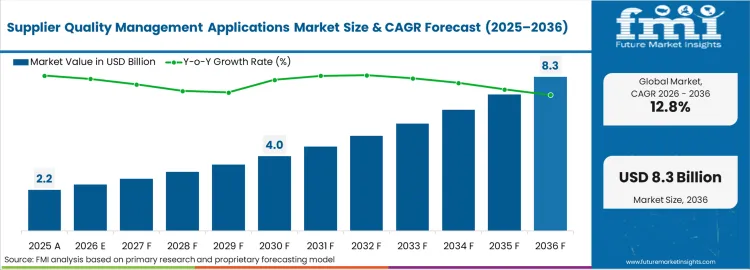
The supplier quality management applications market was valued at USD 2.20 billion in 2025, projected to reach USD 2.48 billion in 2026, and is forecast to expand to USD 8.28 billion by 2036 at a 12.80% CAGR. Based on Future Market Insights analysis, the market is set to add an incremental opportunity worth USD 5.79 billion over the forecast period. As per FMI, the procurement landscape for supplier quality management applications is being reshaped by evolving specification requirements, regional capacity investments, and shifting end-use demand patterns across established and emerging buyer segments.
Summary of Supplier Quality Management Applications Market
- Supplier Quality Management Applications Market definition
- Supplier quality management applications are enterprise software platforms that enable organizations to monitor, assess, and improve supplier performance through automated audit scheduling, corrective action tracking, non-conformance management, incoming inspection workflows, and supplier scorecard analytics across manufacturing and regulated industry supply chains.
- Demand drivers in the market
- FDA 21 CFR Part 820 and EU MDR compliance obligations in medical device and pharmaceutical manufacturing compel organizations to implement auditable supplier quality management systems that maintain inspection-ready documentation across their entire supplier network.
- Automotive OEMs enforcing IATF 16949 supplier quality requirements are mandating digital corrective action management platforms that provide real-time visibility into supplier non-conformance resolution timelines and root cause investigation completeness.
- Manufacturing organizations managing multi-tier supply chains are deploying supplier scorecard analytics to identify quality deterioration trends before defective material enters production lines, reducing scrap rates and warranty cost exposure.
- Key segments analyzed in the FMI report
- Supplier Audit & Compliance Software solution: 35.0% share in 2026, reflecting established procurement specifications and supply chain infrastructure favoring this variant.
- Manufacturing industry: 40.0% share in 2026, driven by end-use requirements in the primary application channels.
- USA: 22.00% compound growth, supported by domestic investment and rising consumption.
- Analyst opinion at FMI
- Sudip saha, Principal Consultant for Technology observe that The supplier quality management applications market is consolidating around platforms that integrate audit management, corrective action tracking, and supplier performance analytics into unified workflows rather than disconnected point solutions. FMI analysts observe that the vendors capturing the largest share of new deployments are those embedded within broader quality management system ecosystems, because procurement directors will not maintain separate platforms for supplier quality when their enterprise QMS vendor offers native supplier management modules. The risk for best-of-breed SQM startups is integration fatigue: buyers prefer fewer vendor relationships, and platform breadth increasingly outweighs feature depth in procurement evaluations.
- Strategic implications / executive takeaways
- Quality directors in regulated industries must evaluate supplier quality management platforms based on pre-built compliance template libraries for FDA, EU MDR, and IATF 16949 requirements rather than generic workflow configurability alone.
- IT procurement teams should prioritize platforms with native integration into existing enterprise QMS and ERP environments to avoid the data synchronization complexity that undermines adoption rates in disconnected point-solution deployments.
- Mid-market manufacturers should target cloud-native SQM platforms with templated implementation playbooks that deliver production-ready deployments within 90 days to capture compliance improvements before next regulatory audit cycles.
Supplier Quality Management Applications Market key takeaways
| Metric | Details |
|---|---|
| Industry Size (2026) | USD 2.48 billion |
| Industry Value (2036) | USD 8.28 billion |
| CAGR (2026 to 2036) | 12.80% |
Source: Future Market Insights, 2026
Three forces are expanding the supplier quality management applications market beyond its traditional manufacturing base. First, regulatory complexity is increasing across healthcare, food, and aerospace sectors, and manual quality management processes cannot scale to meet the documentation and traceability requirements imposed by updated FDA, EU, and aviation authority inspection frameworks. Second, supply chain risk events have elevated supplier quality visibility from a quality department function to a board-level risk management priority, unlocking budget authorization for enterprise-wide platform deployments that previously stalled at departmental pilot stages.
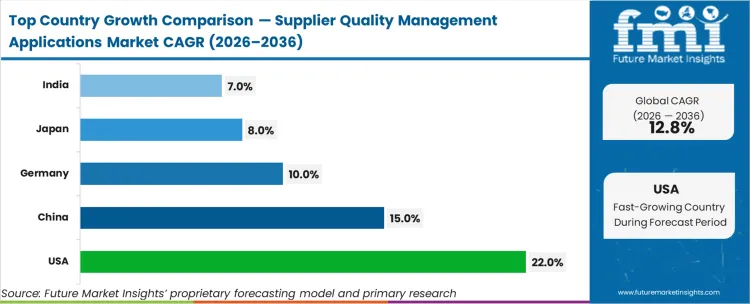
Third, cloud deployment is compressing implementation timelines and reducing total cost of ownership, enabling mid-market manufacturers to adopt supplier quality platforms that were previously viable only for Fortune 500 procurement organizations. Across tracked geographies, USA sets the pace at 22.00% CAGR. China follows at 15.00%. Germany follows at 10.00%. Japan follows at 8.00%. India follows at 7.00%.
Supplier Quality Management Applications Market definition
Supplier quality management applications represent the software category governing the systematic evaluation and continuous improvement of supplier-delivered material, component, and service quality. These platforms digitize supplier audit trails, corrective and preventive action workflows, and quality event investigation processes to maintain compliance with industry-specific regulatory frameworks.
Supplier Quality Management Applications Market inclusions
Market scope includes all commercially traded supplier quality management software segmented by solution (supplier audit and compliance software, corrective action management, supplier performance analytics, incoming inspection management) and industry (manufacturing, healthcare, automotive, aerospace, food and beverage). Revenue sizing spans the 2026 to 2036 forecast period.
Supplier Quality Management Applications Market exclusions
The scope excludes general enterprise resource planning quality modules without dedicated supplier management functionality, standalone document control systems, and customer-facing quality assurance platforms. Laboratory information management systems are outside the boundary unless integrated with supplier quality workflows.
Supplier Quality Management Applications Market research methodology
- Primary research: FMI analysts conducted interviews with procurement directors, engineering leads, and supply chain managers across key supplier quality management applications organizations to map decision gates and sourcing specifications.
- Desk research: Data collection phases aggregated regulatory filings, trade association publications, standards body documentation, and company annual reports to establish verifiable baseline parameters.
- Market sizing and forecasting: Baseline values derive from a bottom-up aggregation of supplier quality management applications transaction volumes, applying region-specific adoption curves and pricing indices to project forward demand through 2036.
- Data validation and update cycle: Projections are tested against publicly reported procurement volumes, trade flow statistics, and company financial disclosures on a quarterly refresh schedule.
Key Industry Highlights
Supply Chain Complexity Drives Demand for Streamlined Solutions
Supply chains have become increasingly complex, with extending networks of suppliers, cross-border sourcing, and changing requirements to comply. The organization today relies on scores of suppliers across geographies, each having varied quality standards, risk profiles, and regulatory obligations-all difficult to manage manually that may result in inefficiencies, risks of product recalls, or compliance violations. Varieties of SQM applications include tools for centralizing data on supplier performance appraisal and quality conformance. Real-time analytics, enterprise system integrations, among other attributes, better place companies to address any issue proactively and therefore assure efficiency and dependability within the supply chains.
Stringent Regulatory Standards Drive Adoption of Supplier Quality Management Tools in High-Compliance Industries
SQM applications help companies in the strict regulatory standard industries to meet these requirements by automating compliance checks, maintaining audit trails and ensuring suppliers adhere to standards. By using these tools companies can ensure their suppliers meet quality standards and avoid penalties. With changes in regulations, SQM applications allow for easy updates so companies can stay compliant and competitive in the global market.
Resistance to Change and Lack of Awareness About Advanced Supplier Quality Management Tools
Companies in traditional industries often use manual or legacy systems to manage supplier quality. Moving to digital SQM applications requires a cultural change, which can face resistance from employees used to the old ways.
There is also lack of awareness about the advanced capabilities of modern SQM tools especially in emerging markets. This expands with lack of training and support during the adoption phase. Vendors need to focus on user education, change management and provide intuitive and user friendly interfaces to ensure smooth adoption and long-term usage.
2021 to 2025 Global Supplier Quality Management Applications Sales Outlook Compared to Demand Forecasts from 2026 to 2036
The industry showcased a CAGR of 9.7% during the period between 2021 and 2025. The industry reached a value of USD 12,811.8 million in 2025 from USD 8,839.9 million in 2021.
From 2021 to 2025, the pandemic cause the global supply chain complexities. This increased demand for robust systems of supplier quality and risk management. High-compliance industries like healthcare, automotive, and food manufacturing increasingly adopted SQM tools.
On the other hand, the market is estimated to grow at a CAGR of 10.5% during the forecasted period between 2026 and 2036. The market is expected to grow swiftly as it has a potential to reach a value of USD 38,081.4 million in 2036 from USD 14,061.6 million in 2026.
Between 2026 and 2036, the SQM Applications market is projected to experience significant growth as AI, ML and predictive analytics advance. These will give real-time insights, automated decision making and proactive quality management to supplier quality systems. Industries will start to use AI driven SQM tools to predict potential disruptions and take corrective action before they happen, reducing risks even further.
Market Concentration
Tier 1 players in the Supplier Quality Management (SQM) Applications market are multi national companies offering end to end solutions with features like AI driven analytics, real time monitoring and integration with ERP and PLM systems.
These companies like SAP SE, Oracle Corporation and IBM have a global presence, deep pockets and robust customer support. Their solutions cater to large enterprises in high compliance industries like healthcare, automotive and aerospace and provide sophisticated tools for supplier audits, risk assessment and regulatory compliance. They hold around 35-40% market share.
Tier 2 companies are generally regional or niche players serving certain industries or markets. They include companies like Intelex Technologies, AssurX, and Sparta Systems. For mid-sized enterprises, or for those industries that have moderate needs for compliance, their solutions remain competitive, balancing functionality and cost.
Generally, their offering will have the common set of features-supplier evaluation, CAPA management, and compliance tracking-but lack many of the advanced capabilities in Tier 1 solutions. Consequently, this will constitute in a way approximately 15-20% considering market size capture regarding Tier 2.
Tier 3 players are local vendors who serve small and medium enterprises (SMEs) with limited budgets and simpler supplier management needs. They offer cloud based or modular solutions with basic functionalities like document control, simple supplier assessments and corrective action tracking at an affordable price. Startups and regional software providers who cater to local markets would be around 25-30% of the total market size.
Country-wise Insights
The section highlights the CAGRs of countries experiencing growth in the supplier quality management applications market, along with the latest advancements contributing to overall market development. Based on current estimates USA, India and China are expected to see steady growth during the forecast period.
.webp "Top Country Growth Comparison Supplier Quality Management Applications Market Cagr (2026 2036)")
| Countries | CAGR |
|---|---|
| India | 13.9% |
| China | 12.8% |
| Germany | 11.4% |
| KSA | 12.3% |
| United States | 12.1% |
Source: FMI analysis based on primary research and proprietary forecasting model
Growing SME Adoption and Digital Transformation Initiatives in India
India’s SQM Applications market is growing fast due to the country’s growing manufacturing sector and government initiatives like “Make in India” and “Digital India”. These initiatives encourage local manufacturers to adopt digital solutions to meet global quality standards and enhance export competitiveness. Also, the surge in SMEs across industries like automotive, healthcare and pharma is creating huge demand for cost effective and scalable SQM tools. For example, investments in India’s manufacturing sector was over USD 31 billion in 2023, that’s a big focus on modernising supply chains and supplier quality management. This will happen.
USA Grows with High-Compliance Industries and Advanced Technology Integration
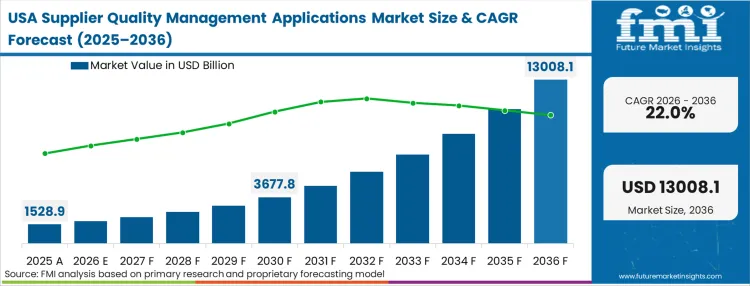
The United States market leads the SQM Applications market because of its strong industrial base, especially in high-compliance industries such as aerospace, healthcare, and automotive. Regulatory bodies like the FDA and ISO drive stringent quality standards, hence forcing companies to invest in advanced SQM tools.
Besides, high adoption rates of technologies such as AI, blockchain, and IoT enhance real-time supplier quality monitoring and risk mitigation. In 2022 alone, investments in AI and IoT technologies in the USA surpassed USD 55 billion, much of which is diverted to supply chain and quality management applications. The technological edge thus provided continues to act as a propellant for the market.
Expanding Manufacturing Base and Focus on Export Quality in China
The main drivers for the SQM Applications market include rapid industrialization and the status of China as the world's largest manufacturing hub. With the country's transformation from a low-cost producer to a high-quality manufacturing leader, there is greater adoption of SQM tools to meet international quality and compliance standards. Initiatives like "Made in China 2026" encourage smart manufacturing and improvement in the quality of suppliers.
In 2023, FDI in China's manufacturing sector crossed over USD 160 billion, underlining a strong focus on improving operational efficiency and supply chain transparency that will further accelerate demand for SQM applications.
Category-wise Insights
The section provides detailed insights into key segments of the supplier quality management applications market. This section analyzes the growth and market share in the Supplier Quality Management Applications Market among key segments.
Cloud-based Segment is Expected to Grow Rapidly for the Forecasting Period
Cloud platforms offer the possibility of real-time data access that enables the enhancement of supplier performance monitoring and compliance management. Major vendors like SAP and Sparta Systems are increasing their SQM cloud offerings to cater to increased regulatory requirements and disruption within the supply chains.
Additionally, SMEs prefer cloud-based solutions due to their low upfront costs and ease of deployment. The increase in remote work and global supply chains further accelerates the adoption of the cloud in supplier quality management.
| Segment | CAGR |
|---|---|
| Cloud-based (Deployment) | 13.4% |
Software Segment Leads the Supplier Quality Management Applications Market in terms of Share
Software leads the domination in the segmentation of the Supplier Quality Management Applications market because of its capability for scalable, automated, real-time management and analysis of performance, compliance, and risk of suppliers.
Increased cloud-based platform adoption facilitates organizations' reducing infrastructure costs by increasing access to advanced analytics, AI, and machine learning. Such tools help streamline supplier assessments, enhance decision-making, and ensure regulatory compliance across industries. In addition to that, the solutions are highly customizable, catering to specific business needs, and integrated seamlessly with enterprise-wide systems like ERP and CRM.
With digital transformation accelerating worldwide, the demand for robust supplier quality management software also shows upward trends.
| Segment | Value Share |
|---|---|
| Software (Solution) | 64.5% |
Competition Outlook
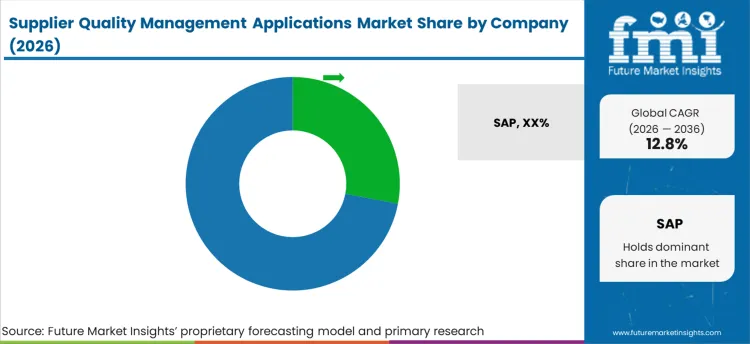
The Supplier Quality Management Applications market is highly competitive, driven by innovation and technological advancements. Key players focus on offering comprehensive solutions with features like AI-driven analytics, real-time monitoring, and seamless integration with enterprise systems.
Cloud-based platforms dominate due to their scalability and cost-effectiveness, with vendors catering to diverse industries such as manufacturing, healthcare, and automotive. Market competition is fueled by the increasing demand for customizable and industry-specific solutions. Companies prioritize user-friendly interfaces, robust support services, and compliance management capabilities to differentiate themselves.
Emerging players target niche markets and SMEs, while established ones expand their global footprint through strategic partnerships.
Scope of the report
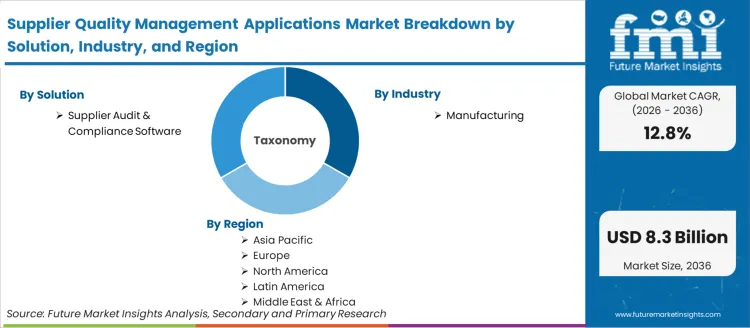
| Metric | Value |
|---|---|
| Quantitative Units | USD 2.48 billion to USD 8.28 billion, at a CAGR of 12.80% |
| Market Definition | Supplier quality management applications are enterprise software platforms that enable organizations to monitor, assess, and improve supplier performance through automated audit scheduling, corrective action tracking, non-conformance management, incoming inspection workflows, and supplier scorecard analytics across manufacturing and regulated industry supply chains. |
| Segmentation | Solution (Supplier Audit & Compliance Software), Industry (Manufacturing) |
| Regions Covered | North America, Latin America, Europe, East Asia, South Asia, Oceania, Middle East and Africa |
| Countries Covered | India, China, USA, Canada, UK, Germany, Japan, and 40 plus countries |
| Key Companies Profiled | SAP, Oracle, IBM, Siemens, Dassault Systèmes, ETQ, Sparta Systems, MasterControl, Arena Solutions, AssurX |
| Forecast Period | 2026 to 2036 |
| Approach | Forecasting models apply a hybrid bottom-up and top-down methodology starting with verified supplier quality management applications transaction data and projecting adoption velocity across defined segments and regions. |
Supplier Quality Management Applications Market Segmentation
By Solution:
In terms of solution, the segment is divided into software and services.
By Deployment:
In terms of deployment, the segment is segregated into Cloud-based and On-premises.
By End User Industry:
In terms of end use, the segment is segregated into Automotive, Aerospace & Defense, Electronics & Semiconductors, Healthcare, Food & Beverage and Others.
By Region:
A regional analysis has been carried out in key countries of North America, Latin America, East Asia, South Asia & Pacific, Western Europe, Eastern Europe and Middle East and Africa (MEA).
Bibliography
- 1. International Organization for Standardization. (2024). ISO 9001:2015 Quality Management Systems: Requirements. ISO.
- 2. United States Food and Drug Administration. (2024). 21 CFR Part 820: Quality System Regulation for Medical Devices. USA FDA.
- 3. International Automotive Task Force. (2024). IATF 16949: Quality Management System Requirements for Automotive Production. IATF.
- 4. European Commission. (2024). Medical Device Regulation (EU) 2017/745: Supplier Control Requirements. EC.
- 5. Organisation for Economic Co-operation and Development. (2024). OECD Guidelines for Quality Infrastructure. OECD.
- 6. SAE International. (2024). AS9100D: Quality Management Systems for Aviation, Space, and Defense. SAE.
This bibliography is provided for reader reference. The full FMI report contains the complete reference list with primary research documentation.
Frequently Asked Questions
How large is the demand for Supplier Quality Management Applications in the global market in 2026?
Demand for supplier quality management applications in the global market is estimated to be valued at USD 2.48 billion in 2026.
What will be the market size of Supplier Quality Management Applications by 2036?
Market size for supplier quality management applications is projected to reach USD 8.28 billion by 2036.
What is the expected demand growth for Supplier Quality Management Applications between 2026 and 2036?
Demand for supplier quality management applications is expected to grow at a CAGR of 12.80% between 2026 and 2036.
Which Solution is poised to lead global sales by 2026?
Supplier Audit & Compliance Software accounts for 35.0% in 2026, reflecting established procurement specifications across primary buyer channels.
How is Manufacturing driving Supplier Quality Management Applications adoption in 2026?
Manufacturing represents 40.0% of segment demand as end-use requirements favor this category.
What is driving demand in USA?
USA registers a 22.00% CAGR through 2036, propelled by domestic investment and rising end-use consumption.
What does Supplier Quality Management Applications Market definition mean in this report?
Supplier quality management applications are enterprise software platforms that enable organizations to monitor, assess, and improve supplier performance through automated audit scheduling, corrective action tracking, non-conformance management, incoming inspection workflows, and supplier scorecard analytics across manufacturing and regulated industry supply chains.
How does FMI build and validate the Supplier Quality Management Applications forecast?
Forecasting models apply a hybrid bottom-up methodology starting with verified transaction data, cross-validated against publicly reported procurement volumes and company financial disclosures on a quarterly refresh schedule.
Preview the report firsthand - request a free sample
Get SampleGet the brochure for pricing and purchase details.
Get PDFTable of Content
- Executive Summary
- Global Market Outlook
- Demand-side Trends
- Supply-side Trends
- Technology Roadmap Analysis
- Analysis and Recommendations
- Market Overview
- Market Coverage / Taxonomy
- Market Definition / Scope / Limitations
- Research Methodology
- Chapter Orientation
- Analytical Lens and Working Hypotheses
- Market Structure, Signals, and Trend Drivers
- Benchmarking and Cross-market Comparability
- Market Sizing, Forecasting, and Opportunity Mapping
- Research Design and Evidence Framework
- Desk Research Programme (Secondary Evidence)
- Company Annual and Sustainability Reports
- Peer-reviewed Journals and Academic Literature
- Corporate Websites, Product Literature, and Technical Notes
- Earnings Decks and Investor Briefings
- Statutory Filings and Regulatory Disclosures
- Technical White Papers and Standards Notes
- Trade Journals, Industry Magazines, and Analyst Briefs
- Conference Proceedings, Webinars, and Seminar Materials
- Government Statistics Portals and Public Data Releases
- Press Releases and Reputable Media Coverage
- Specialist Newsletters and Curated Briefings
- Sector Databases and Reference Repositories
- FMI Internal Proprietary Databases and Historical Market Datasets
- Subscription Datasets and Paid Sources
- Social Channels, Communities, and Digital Listening Inputs
- Additional Desk Sources
- Expert Input and Fieldwork (Primary Evidence)
- Primary Modes
- Qualitative Interviews and Expert Elicitation
- Quantitative Surveys and Structured Data Capture
- Blended Approach
- Why Primary Evidence is Used
- Field Techniques
- Interviews
- Surveys
- Focus Groups
- Observational and In-context Research
- Social and Community Interactions
- Stakeholder Universe Engaged
- C-suite Leaders
- Board Members
- Presidents and Vice Presidents
- R&D and Innovation Heads
- Technical Specialists
- Domain Subject-matter Experts
- Scientists
- Physicians and Other Healthcare Professionals
- Governance, Ethics, and Data Stewardship
- Research Ethics
- Data Integrity and Handling
- Primary Modes
- Tooling, Models, and Reference Databases
- Desk Research Programme (Secondary Evidence)
- Data Engineering and Model Build
- Data Acquisition and Ingestion
- Cleaning, Normalisation, and Verification
- Synthesis, Triangulation, and Analysis
- Quality Assurance and Audit Trail
- Market Background
- Market Dynamics
- Drivers
- Restraints
- Opportunity
- Trends
- Scenario Forecast
- Demand in Optimistic Scenario
- Demand in Likely Scenario
- Demand in Conservative Scenario
- Opportunity Map Analysis
- Product Life Cycle Analysis
- Supply Chain Analysis
- Investment Feasibility Matrix
- Value Chain Analysis
- PESTLE and Porter’s Analysis
- Regulatory Landscape
- Regional Parent Market Outlook
- Production and Consumption Statistics
- Import and Export Statistics
- Market Dynamics
- Global Market Analysis 2021 to 2025 and Forecast, 2026 to 2036
- Historical Market Size Value (USD Million) Analysis, 2021 to 2025
- Current and Future Market Size Value (USD Million) Projections, 2026 to 2036
- Y-o-Y Growth Trend Analysis
- Absolute $ Opportunity Analysis
- Global Market Pricing Analysis 2021 to 2025 and Forecast 2026 to 2036
- Global Market Analysis 2021 to 2025 and Forecast 2026 to 2036, By Solution
- Introduction / Key Findings
- Historical Market Size Value (USD Million) Analysis By Solution , 2021 to 2025
- Current and Future Market Size Value (USD Million) Analysis and Forecast By Solution , 2026 to 2036
- Supplier Audit & Compliance Software
- Supplier Audit & Compliance Software
- Y-o-Y Growth Trend Analysis By Solution , 2021 to 2025
- Absolute $ Opportunity Analysis By Solution , 2026 to 2036
- Global Market Analysis 2021 to 2025 and Forecast 2026 to 2036, By Industry
- Introduction / Key Findings
- Historical Market Size Value (USD Million) Analysis By Industry, 2021 to 2025
- Current and Future Market Size Value (USD Million) Analysis and Forecast By Industry, 2026 to 2036
- Manufacturing
- Manufacturing
- Y-o-Y Growth Trend Analysis By Industry, 2021 to 2025
- Absolute $ Opportunity Analysis By Industry, 2026 to 2036
- Global Market Analysis 2021 to 2025 and Forecast 2026 to 2036, By Region
- Introduction
- Historical Market Size Value (USD Million) Analysis By Region, 2021 to 2025
- Current Market Size Value (USD Million) Analysis and Forecast By Region, 2026 to 2036
- North America
- Latin America
- Western Europe
- Eastern Europe
- East Asia
- South Asia and Pacific
- Middle East & Africa
- Market Attractiveness Analysis By Region
- North America Market Analysis 2021 to 2025 and Forecast 2026 to 2036, By Country
- Historical Market Size Value (USD Million) Trend Analysis By Market Taxonomy, 2021 to 2025
- Market Size Value (USD Million) Forecast By Market Taxonomy, 2026 to 2036
- By Country
- USA
- Canada
- Mexico
- By Solution
- By Industry
- By Country
- Market Attractiveness Analysis
- By Country
- By Solution
- By Industry
- Key Takeaways
- Latin America Market Analysis 2021 to 2025 and Forecast 2026 to 2036, By Country
- Historical Market Size Value (USD Million) Trend Analysis By Market Taxonomy, 2021 to 2025
- Market Size Value (USD Million) Forecast By Market Taxonomy, 2026 to 2036
- By Country
- Brazil
- Chile
- Rest of Latin America
- By Solution
- By Industry
- By Country
- Market Attractiveness Analysis
- By Country
- By Solution
- By Industry
- Key Takeaways
- Western Europe Market Analysis 2021 to 2025 and Forecast 2026 to 2036, By Country
- Historical Market Size Value (USD Million) Trend Analysis By Market Taxonomy, 2021 to 2025
- Market Size Value (USD Million) Forecast By Market Taxonomy, 2026 to 2036
- By Country
- Germany
- UK
- Italy
- Spain
- France
- Nordic
- BENELUX
- Rest of Western Europe
- By Solution
- By Industry
- By Country
- Market Attractiveness Analysis
- By Country
- By Solution
- By Industry
- Key Takeaways
- Eastern Europe Market Analysis 2021 to 2025 and Forecast 2026 to 2036, By Country
- Historical Market Size Value (USD Million) Trend Analysis By Market Taxonomy, 2021 to 2025
- Market Size Value (USD Million) Forecast By Market Taxonomy, 2026 to 2036
- By Country
- Russia
- Poland
- Hungary
- Balkan & Baltic
- Rest of Eastern Europe
- By Solution
- By Industry
- By Country
- Market Attractiveness Analysis
- By Country
- By Solution
- By Industry
- Key Takeaways
- East Asia Market Analysis 2021 to 2025 and Forecast 2026 to 2036, By Country
- Historical Market Size Value (USD Million) Trend Analysis By Market Taxonomy, 2021 to 2025
- Market Size Value (USD Million) Forecast By Market Taxonomy, 2026 to 2036
- By Country
- China
- Japan
- South Korea
- By Solution
- By Industry
- By Country
- Market Attractiveness Analysis
- By Country
- By Solution
- By Industry
- Key Takeaways
- South Asia and Pacific Market Analysis 2021 to 2025 and Forecast 2026 to 2036, By Country
- Historical Market Size Value (USD Million) Trend Analysis By Market Taxonomy, 2021 to 2025
- Market Size Value (USD Million) Forecast By Market Taxonomy, 2026 to 2036
- By Country
- India
- ASEAN
- Australia & New Zealand
- Rest of South Asia and Pacific
- By Solution
- By Industry
- By Country
- Market Attractiveness Analysis
- By Country
- By Solution
- By Industry
- Key Takeaways
- Middle East & Africa Market Analysis 2021 to 2025 and Forecast 2026 to 2036, By Country
- Historical Market Size Value (USD Million) Trend Analysis By Market Taxonomy, 2021 to 2025
- Market Size Value (USD Million) Forecast By Market Taxonomy, 2026 to 2036
- By Country
- Kingdom of Saudi Arabia
- Other GCC Countries
- Turkiye
- South Africa
- Other African Union
- Rest of Middle East & Africa
- By Solution
- By Industry
- By Country
- Market Attractiveness Analysis
- By Country
- By Solution
- By Industry
- Key Takeaways
- Key Countries Market Analysis
- USA
- Pricing Analysis
- Market Share Analysis, 2025
- By Solution
- By Industry
- Canada
- Pricing Analysis
- Market Share Analysis, 2025
- By Solution
- By Industry
- Mexico
- Pricing Analysis
- Market Share Analysis, 2025
- By Solution
- By Industry
- Brazil
- Pricing Analysis
- Market Share Analysis, 2025
- By Solution
- By Industry
- Chile
- Pricing Analysis
- Market Share Analysis, 2025
- By Solution
- By Industry
- Germany
- Pricing Analysis
- Market Share Analysis, 2025
- By Solution
- By Industry
- UK
- Pricing Analysis
- Market Share Analysis, 2025
- By Solution
- By Industry
- Italy
- Pricing Analysis
- Market Share Analysis, 2025
- By Solution
- By Industry
- Spain
- Pricing Analysis
- Market Share Analysis, 2025
- By Solution
- By Industry
- France
- Pricing Analysis
- Market Share Analysis, 2025
- By Solution
- By Industry
- India
- Pricing Analysis
- Market Share Analysis, 2025
- By Solution
- By Industry
- ASEAN
- Pricing Analysis
- Market Share Analysis, 2025
- By Solution
- By Industry
- Australia & New Zealand
- Pricing Analysis
- Market Share Analysis, 2025
- By Solution
- By Industry
- China
- Pricing Analysis
- Market Share Analysis, 2025
- By Solution
- By Industry
- Japan
- Pricing Analysis
- Market Share Analysis, 2025
- By Solution
- By Industry
- South Korea
- Pricing Analysis
- Market Share Analysis, 2025
- By Solution
- By Industry
- Russia
- Pricing Analysis
- Market Share Analysis, 2025
- By Solution
- By Industry
- Poland
- Pricing Analysis
- Market Share Analysis, 2025
- By Solution
- By Industry
- Hungary
- Pricing Analysis
- Market Share Analysis, 2025
- By Solution
- By Industry
- Kingdom of Saudi Arabia
- Pricing Analysis
- Market Share Analysis, 2025
- By Solution
- By Industry
- Turkiye
- Pricing Analysis
- Market Share Analysis, 2025
- By Solution
- By Industry
- South Africa
- Pricing Analysis
- Market Share Analysis, 2025
- By Solution
- By Industry
- USA
- Market Structure Analysis
- Competition Dashboard
- Competition Benchmarking
- Market Share Analysis of Top Players
- By Regional
- By Solution
- By Industry
- Competition Analysis
- Competition Deep Dive
- SAP
- Overview
- Product Portfolio
- Profitability by Market Segments (Product/Age /Sales Channel/Region)
- Sales Footprint
- Strategy Overview
- Marketing Strategy
- Product Strategy
- Channel Strategy
- Oracle
- IBM
- Siemens
- Dassault Systèmes
- ETQ
- Sparta Systems
- MasterControl
- Arena Solutions
- AssurX
- IQMS
- SAP
- Competition Deep Dive
- Assumptions & Acronyms Used


