

- Industry Size (2026)
- USD 0.7 Bn
- Forecast (2036)
- USD 1.1 Bn
- CAGR (2026 to 2036)
- 4.6%
High-Performance Descaling and Deliming Chemicals for HoReCa Equipment Market Size, Market Forecast and Outlook By FMI
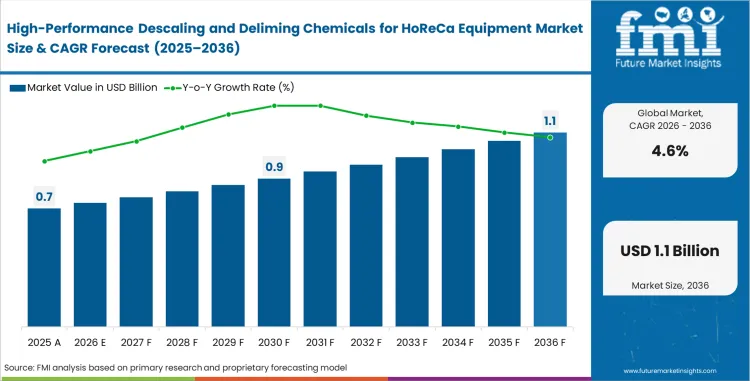
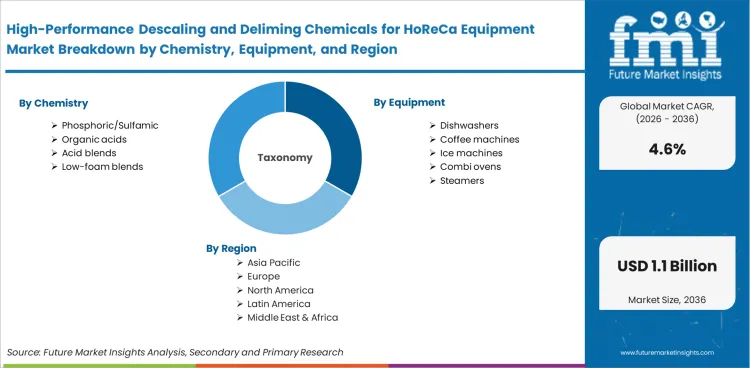
The high-performance descaling and deliming chemicals for HoReCa equipment market was valued at USD 0.6 billion in 2025. Sales are expected to cross USD 0.7 billion in 2026 at a CAGR of 4.6% during the forecast period. The market is projected to reach USD 1.1 billion by 2036 as commercial kitchens place greater emphasis on preventive scale removal to protect equipment uptime and cleaning consistency.
Summary of High-Performance Descaling and Deliming Chemicals for HoReCa Equipment Market
- The market is forecast to reach USD 1.1 billion by 2036.
- The market is expected to grow at a CAGR of 4.6% from 2026 to 2036.
- The market was estimated at USD 0.6 billion in 2025.
- The forecast period represents an incremental opportunity of USD 0.4 billion.
- Demand is driven by the need for regular maintenance of commercial kitchen equipment such as dishwashers, coffee machines, and steam systems to prevent mineral scale buildup.
- Phosphoric and sulfamic acid-based formulations are projected to lead the chemistry segment with a 38% share due to strong descaling efficiency.
- Liquid formats dominate with a 62% share, supported by ease of handling and faster dilution in commercial settings.
- Dishwashers are expected to account for 31% of the equipment segment due to their widespread use in HoReCa operations.
- Restaurants contribute 44% of end-user demand, driven by high wash-cycle frequency and recurring chemical consumption.
- India, Saudi Arabia, UAE, and China are the fastest-growing markets, while the United States remains a stable, high-value market.
Key Takeaways, Market Size, and Forecast
- High-Performance Descaling and Deliming Chemicals for HoReCa Equipment Market is projected to grow from USD 0.7 billion in 2026 to USD 1.1 billion by 2036, at a CAGR of 4.6%.
- The high-performance descaling and deliming chemicals for HoReCa equipment market was valued at USD 0.6 billion in 2025.
- By 2036, the High-Performance Descaling and Deliming Chemicals for HoReCa Equipment Market is expected to be worth USD 1.1 billion.
- From 2026 to 2036, the market is projected to expand at a CAGR of 4.6%.
- The market is projected to create an incremental opportunity of USD 0.4 billion between 2026 and 2036.
- In 2026, Phosphoric/Sulfamic is expected to account for 38.0% of the chemistry segment.
- India (6.2%) and Saudi Arabia (6.0%) are two of the fastest growing markets.
Commercial foodservice operators increasingly treat scale control as a maintenance priority because mineral buildup can reduce heating efficiency, weaken wash performance, and shorten equipment life. The cost of routine chemical treatment is usually lower than the disruption caused by boiler downtime, dishmachine underperformance, or emergency service calls during peak operating hours. This is pushing buyers toward scheduled deliming cycles rather than waiting for visible performance decline. Bulk purchasing of high-performance descaling and deliming chemicals is becoming more common across high-throughput sites where uninterrupted kitchen flow depends on stable operation of heated and water-fed equipment. Product choice is also becoming more technical, as some older acidic chemistries do not always perform well with sensor-based dosing lines and can create avoidable maintenance issues in newer systems.
The move toward automated dosing is reinforcing this shift. Once kitchens install closed-loop dispensing systems in dishwashing and warewashing operations, manual powder mixing becomes less practical and less consistent. Operators then favor liquid descaling formulations that support repeatable dosing, better system compatibility, and more controlled removal of scale deposits across continuous-use equipment.
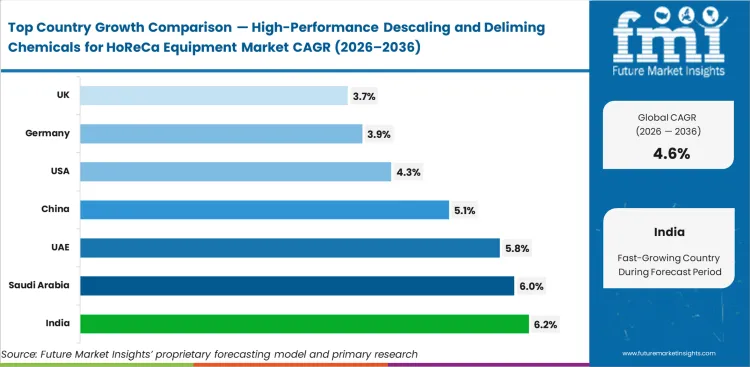
India is projected to witness a CAGR of 6.2% in the market through 2036, supported by expanding foodservice chains and persistent hard-water exposure across many operating environments. Saudi Arabia is expected to expand at a CAGR of 6.0%, driven by new hotel capacity and rising demand for centralized warewashing protection. The UAE is likely to record 5.8% CAGR during the forecast period, backed by similar hospitality infrastructure expansion and intensive equipment-use patterns. China is anticipated to grow at a CAGR of 5.1%, supported by the ongoing modernization of institutional and commercial kitchen assets. The United States market is expected to register 4.3%, reflecting established replacement and maintenance cycles across large coffee and foodservice networks. Germany is set to post 3.9%, while the United Kingdom is projected at 3.7%, with both markets shaped more by disciplined servicing of installed equipment than by rapid new-site additions. Market differences across regions continue to reflect the gap between countries managing severe source-water scaling conditions and those focused on maintaining mature equipment fleets efficiently.
Segmental Analysis
High-Performance Descaling and Deliming Chemicals for HoReCa Equipment Market Analysis by Chemistry
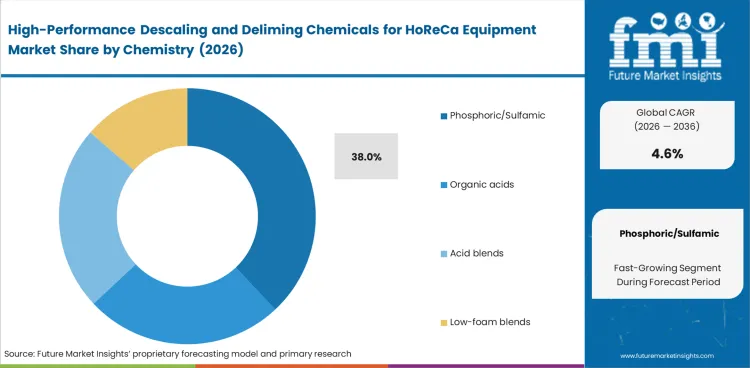
Chemical reaction speed shapes product choice across busy hospitality kitchens where equipment cannot stay offline for long. FMI’s assessment indicates phosphoric and sulfamic formulations are expected to account for 38.0% share in 2026 because they remove dense mineral buildup fast enough to fit between service cycles. Kitchen teams comparing acid systems often avoid slower organic alternatives when soak time interferes with multi-shift operations. Formulators developing scale removal blends also need to balance mineral dissolution strength with worker-safety limits and component compatibility. Another practical issue is that milder acids can be less effective when scale is mixed with grease, which may lead to repeat dosing and weaken any apparent unit-cost advantage. Operators using sulfamic-based deliming programs generally maintain cleaner heating coils and reduce the efficiency loss associated with internal scale accumulation.
- Speed constraints: Phosphoric chemistries remove scale quickly between meal periods. Kitchen teams use them to restore equipment without the long soak windows required by weaker alternatives.
- Contamination resistance: Stronger acid systems can break down calcium deposits and grease residue in the same cleaning cycle. That reduces manual pre-cleaning steps in heavily used equipment.
- Corrosion balancing: High acid strength needs proper inhibitor design inside blended formulations. Poorly balanced chemistry can damage brass fittings and other vulnerable internal parts over time.
High-Performance Descaling and Deliming Chemicals for HoReCa Equipment Market Analysis by Equipment
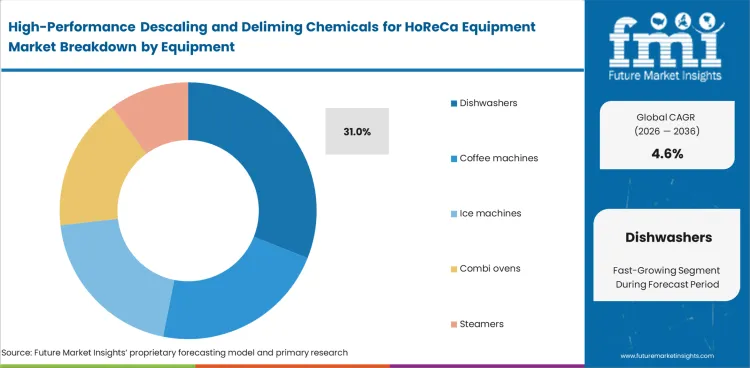
Commercial dishwashing systems consume high water volumes and run frequent wash cycles, so they create steady demand for descaling chemistry. That operating profile keeps this category central to chemical usage across foodservice back-of-house environments. Dishwashing machinery is projected to secure 31.0% share in 2026, supported by the need to protect spray paths, heating elements, and sanitation consistency. Maintenance teams also depend on descaling treatments to prevent nozzle blockage and support consistent warewashing output under hard-water conditions. Coffee and beverage equipment follows a different buying logic because chemistry there must meet tighter food-contact and residue expectations. Operators that postpone descaling in steam-heavy systems such as combi ovens often face avoidable component wear and higher maintenance costs.
- Nozzle protection: Automated warewashing systems rely on small spray openings for proper water distribution. Regular descaling helps keep those apertures clear and preserves wash performance.
- Margin disparity: Coffee equipment requires stricter food-safety and residue-control standards. Buyers often accept higher per-liter pricing for those specialized formulations.
- Generator vulnerability: Combi ovens generate steam under constant thermal stress. Internal scaling can disrupt steam performance and raise the likelihood of costly mechanical failure.
High-Performance Descaling and Deliming Chemicals for HoReCa Equipment Market Analysis by Form
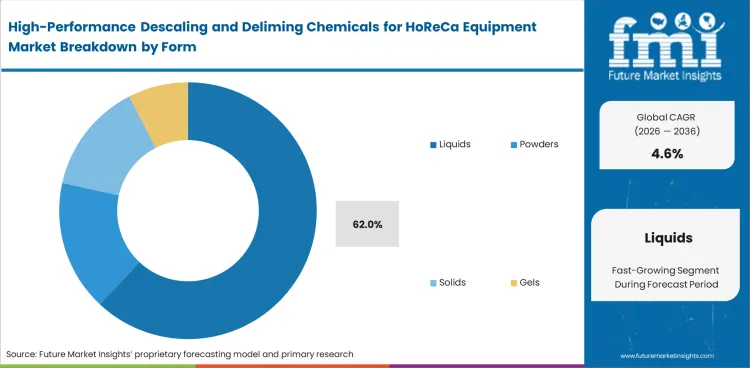
Modern dispensing systems increasingly favor liquid chemistries because they move through automated feed lines with less dosing inconsistency. Operations teams also prefer faster integration with machine-mounted pumps, especially where manual handling needs to stay low. FMI analysts note that low-foam blends are commonly specified in these liquid systems because excess foaming can interfere with controlled circulation and sensor performance. Liquid solutions are anticipated to account for 62.0% share in 2026 for these reasons. Powders remain useful in manual soak applications, but they are less suitable where exact feed control matters more than bulk economics. Some operators also find that compact solids can dissolve unevenly inside narrow extraction paths, creating blockage issues in systems that depend on smooth chemical flow.
- Pump integration: Liquid formats move smoothly through narrow dosing tubes and connected dispensing hardware. That reduces manual handling and supports more stable automated delivery.
- Dissolution consistency: Solid descalers do not always dissolve evenly under variable water conditions. Inconsistent breakup can clog feed lines and interrupt equipment cleaning cycles.
- Storage density: Liquid products take more floor space and raise shipping weight. Many operators still accept that trade-off because fluid reliability remains stronger in automated systems.
High-Performance Descaling and Deliming Chemicals for HoReCa Equipment Market Analysis by Application
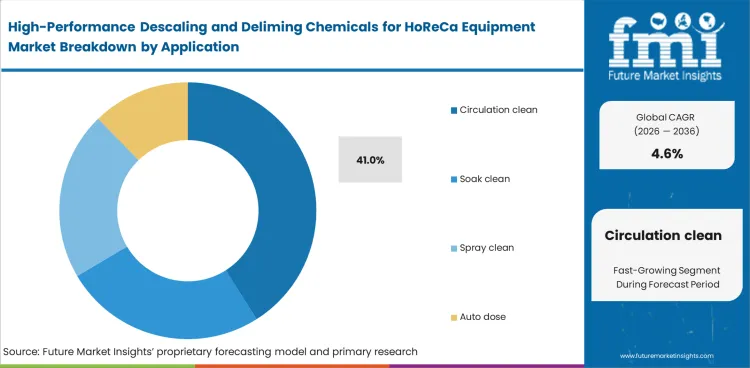
Hospitality operators are under pressure to reduce manual cleaning labor while keeping internal equipment surfaces free from scale and residue. Circulation methods fit that requirement because they move active chemistry through hidden lines, boilers, and internal channels without full disassembly. FMI’s assessment indicates these systems are widely paired with degreasing solutions where mineral buildup and food residue need to be addressed together. Circulation cleaning is set to represent 41.0% share in 2026 because it gives deeper reach than spray or surface-level treatment. Soak cleaning still has value for removable parts, but it cannot match the internal coverage needed for enclosed machine zones. Sites that rely too heavily on spray-based cleaning may leave inaccessible passages untreated, which can contribute to equipment inefficiency and inconsistent cleaning outcomes.
- Labor substitution: Internal circulation reduces the need for manual scrubbing by staff. Teams can run deeper cleaning cycles with limited direct intervention.
- Geometry penetration: Boiler lines and internal passages are difficult to access using hand tools alone. Pump-driven circulation carries chemistry into those hidden zones more effectively.
- Monitoring gap: Automated cleaning can create complacency when staff stop checking reservoir levels and alarm functions. That gap often allows scale buildup to return unnoticed.
High-Performance Descaling and Deliming Chemicals for HoReCa Equipment Market Analysis by End User
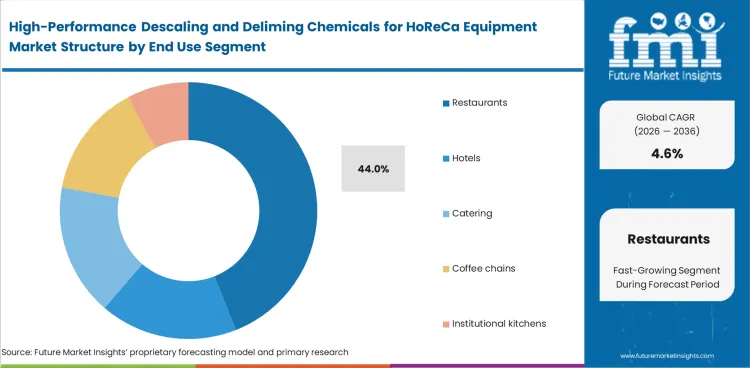
Restaurant outlets create the broadest demand base in this market because their equipment count is high and buying decisions are spread across many independent and chain-operated locations. FMI observes that some larger hospitality groups also prefer industrial and institutional cleaning chemicals that can support kitchen, laundry, and facility maintenance under a shared sourcing framework. Restaurants are forecast to command 44.0% share in 2026 due to their density, frequent equipment use, and recurring need for descaling support. Buying behavior still varies by operator type, with independents often purchasing in smaller lots while institutional kitchens negotiate at broader contract level. Seasonal catering businesses add another layer of complexity because their equipment use is uneven and does not align well with fixed replenishment cycles. Global restaurant brands also face limits on standardization when local water hardness forces regional teams to use stronger chemistry than head office originally specified.
- Density economics: Urban restaurant networks generate steady chemical demand through large outlet counts. Distributors often benefit by serving these buyers in smaller, repeated order volumes.
- Seasonal mismatch: Catering businesses run equipment intensely during peak event periods and lightly outside them. Fixed replenishment schedules often fail to match that demand pattern.
- Standardization failure: Large foodservice brands often try to apply one descaling program across all sites. Local teams still adjust those rules when regional water conditions require stronger treatment.
High-Performance Descaling and Deliming Chemicals for HoReCa Equipment Market Drivers, Restraints, and Opportunities
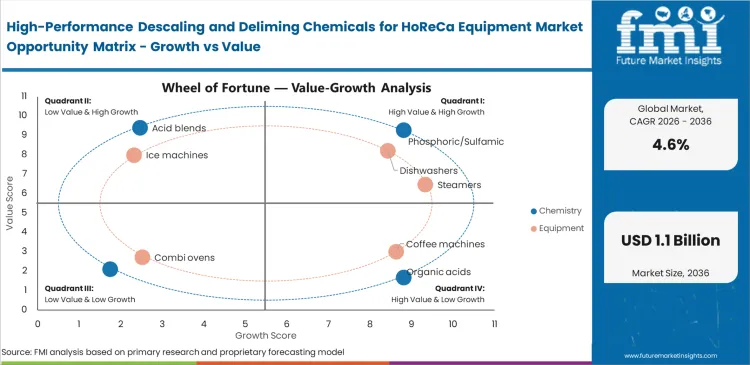
The risk of boiler failure in high-value combi ovens is encouraging facility managers to adopt stricter preventive chemical schedules. Delaying routine deliming procedures during peak operating periods can increase the risk of machine downtime, disrupt foodservice output, and raise compliance concerns. Operations teams no longer treat acidic treatments as optional maintenance inputs in high-use sites; they increasingly view them as part of routine equipment protection. Mineral buildup in continuous-use systems can impair internal steam flow and heating efficiency, pushing purchase teams to weigh chemical efficacy more carefully against unit-cost savings.
High staff turnover across hospitality operations creates practical handling concerns, making safety-conscious operators more cautious about storing highly concentrated acids. Buyers remain aware that improper handling or unsafe mixing practices can raise operator risk in busy kitchen environments. Some facilities managers respond to these concerns by shifting toward milder organic acid blends even when cleaning speed is lower. This trade-off can limit adoption of higher-performance chemical tiers in environments where labor turnover and training gaps remain significant.
Opportunities in the High-Performance Descaling and Deliming Chemicals for HoReCa Equipment Market
- Smart-pump synchronization: Chemical suppliers securing cartridge compatibility with major commercial dishwasher manufacturers can raise switching barriers for third-party refill suppliers through equipment compatibility requirements.
- Eco-certified high-performance blends: Formulators developing a biodegradable delimer for foodservice equipment that meets stricter European environmental requirements can improve qualification prospects with multinational hotel and foodservice groups.
- Contractual service bundling: Distributors packaging cleaning liquids with scheduled technician visits can strengthen long-term client retention while reducing dependence on staff-level chemical handling.
Regional Analysis
Based on regional analysis, High-Performance Descaling and Deliming Chemicals for HoReCa Equipment Market is segmented into Asia Pacific, Middle East, North America, and Europe across 40 plus countries.
.webp "Top Country Growth Comparison High Performance Descaling And Deliming Chemicals For Horeca Equipment Market Cagr (2026 2036)")
| Country | CAGR (2026 to 2036) |
|---|---|
| India | 6.2% |
| Saudi Arabia | 6.0% |
| UAE | 5.8% |
| China | 5.1% |
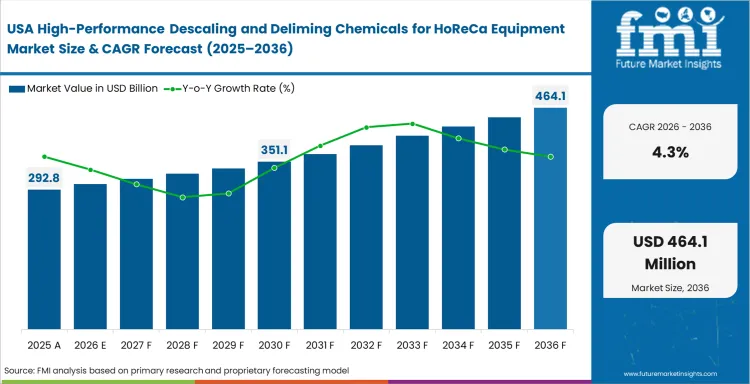
| United States | 4.3% |
| Germany | 3.9% |
| United Kingdom | 3.7% |
Source: Future Market Insights (FMI) analysis, based on proprietary forecasting model and primary research
Asia Pacific High-Performance Descaling and Deliming Chemicals for HoReCa Equipment Market Analysis
Organized foodservice chains are adding sites across major Asian cities, while hard-water conditions remain a persistent operating issue in many municipal systems. Imported combi ovens, steam equipment, and warewashing units often face faster scale buildup where water treatment is uneven. Cleaning cycles become more frequent in these settings, which lifts descaler and delimer usage beyond routine preventive maintenance. India remains especially price-sensitive, giving local suppliers room to compete with lower-cost formulations designed for regional water conditions.
- India: Expansion in tier-two cities is raising the installed base of combi ovens and steam-enabled kitchen systems in hard-water locations. Kitchen teams use sulfamic-acid-based products regularly to limit steam-line blockage and avoid expensive parts replacement. Demand for high-performance descaling and deliming chemicals in India is estimated to rise at a 6.2% CAGR from 2026 to 2036. Local producers are improving their position with heavy-duty formulations that handle mineral stress more effectively than lighter imported products.
- China: Large factory canteens and university kitchens are moving toward more standardized maintenance programs, which supports steady use of bulk cleaning chemicals. Many operators prefer closed-loop liquid dispensing systems to improve dosing control and reduce manual contact during handling. Demand for high-performance descaling and deliming chemicals in China is forecast to expand at a 5.1% CAGR from 2026 to 2036. Suppliers that secure institutional contracts can build scale quickly through regional distribution tied to these large foodservice networks.
Middle East High-Performance Descaling and Deliming Chemicals for HoReCa Equipment Market Analysis
Hotel construction across the Arabian Peninsula continues to support chemical demand linked to commercial kitchen maintenance. Desalinated water changes the mineral profile, though high-temperature boilers and steam equipment still require site-specific deliming programs in many properties. Hospitality buyers place strong emphasis on supply continuity before peak travel periods, especially where catering operations run at high utilization. In this market, dependable delivery often matters more than small savings on chemical cost.
- Saudi Arabia: Religious tourism continues to support large hospitality kitchens and centralized warewashing operations that run for long hours. Automated liquid delivery systems are widely preferred where operators want fewer interruptions during peak meal periods. Demand for high-performance descaling and deliming chemicals in Saudi Arabia is projected to grow at a 6.0% CAGR by 2036. Suppliers with local blending capacity can shorten lead times and reduce exposure to import-related delays.
- UAE: Luxury resorts and premium hotels often need formulations that protect equipment performance while maintaining the appearance of visible metal surfaces such as espresso machines and buffet hardware. Buyers in these settings are more open to premium, non-fuming descalers suited to guest-facing environments. Demand for high-performance descaling and deliming chemicals in the UAE is expected to increase at a 5.8% CAGR through 2036. Approval within premium hospitality accounts can strengthen supplier credibility in nearby commercial segments.
North America High-Performance Descaling and Deliming Chemicals for HoReCa Equipment Market Analysis
Large coffee chains and fast-casual operators continue to standardize chemical programs across broad outlet networks in North America. Headquarters teams often approve a single liquid descaler format for use across franchised locations to reduce variation in local buying and maintenance practice. These centralized decisions can shape equipment compatibility, especially where dosing systems are calibrated to approved products. National service contracts remain an important route to volume in this market.
- United States: Branded coffee operators typically follow fixed maintenance schedules for espresso boilers and hot-water systems, even when visible scale is limited. Franchisees stay close to these programs to protect warranty terms and maintain beverage consistency, which supports the United States commercial dishwasher descaler industry. Demand for high-performance descaling and deliming chemicals in the United States is set to expand at a 4.3% CAGR from 2026 to 2036. Routine purchases dominate volume, though emergency buying still appears when automated deliveries fail or seasonal store traffic rises.
Europe High-Performance Descaling and Deliming Chemicals for HoReCa Equipment Market Analysis
Environmental compliance and wastewater handling rules are shaping formulation choices across parts of Europe’s hospitality sector. Buyers in more tightly regulated markets show greater interest in lower-impact chemistries where discharge requirements are stricter. Producers working with lactic- and citric-based blends often face higher input costs while still needing to preserve cleaning speed close to that of traditional delimers. Product performance remains important, though formulation acceptability is becoming a larger part of supplier selection.
- Germany: Workplace safety standards encourage tighter control over concentrated corrosive liquids used in commercial kitchens. Many operators prefer sealed cartridge systems that connect directly with warewashing equipment and limit direct handling by staff. Demand for high-performance descaling and deliming chemicals in Germany is estimated to record a 3.9% CAGR through 2036. Equipment makers can reinforce customer lock-in by using cartridge formats that restrict compatibility with third-party refill products.
- United Kingdom: Independent pubs and mid-sized hotel chains continue to manage rising utility bills while keeping up with essential maintenance on heating and washing equipment. Scale buildup reduces heat-transfer efficiency, so regular chemical treatment remains necessary to support performance and control energy use. Demand for high-performance descaling and deliming chemicals in the United Kingdom is forecast to advance at a 3.7% CAGR from 2026 to 2036. Sites with disciplined descaling routines are better placed to contain operating costs over time.
FMI’s report also covers detailed market assessments for Japan, South Korea, Brazil, and South Africa. Super-concentrated fluids remain relevant for remote hospitality locations where lower shipping weight can improve distribution efficiency without reducing cleaning performance.
Competitive Aligners for Market Players
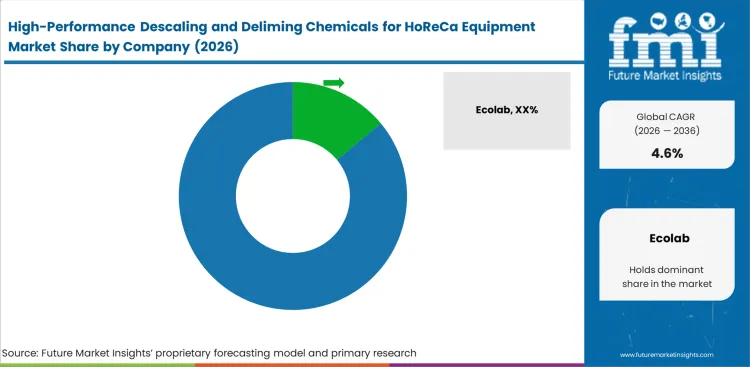
Chemical supply competition differs between multinational suppliers offering integrated dispensing hardware and regional blenders competing on formulation strength, service responsiveness, and pricing. Global leaders increasingly pair chemical supply with automated warewashing equipment and long-term replenishment agreements tied to service expectations or machine-warranty requirements. Regional operators evaluating commercial dishwasher descaler suppliers can face switching barriers where equipment is optimized for approved fluids and compatibility concerns remain high.
Incumbent chemical providers hold advantages through accumulated safety certifications, established documentation systems, and long-standing relationships with large institutional buyers. Formulating effective acids is only one part of market participation; suppliers must also dissolve calcium efficiently, protect internal copper fittings, pass food-safe standards, and remain aligned with wastewater expectations. Challengers attempting to enter adjacent deliming and heavy-duty maintenance spaces often find that established suppliers are better positioned on liability support, technical documentation, and qualification requirements than smaller blenders.
Large institutional buyers continue to push back against supplier consolidation by preferring dispensing equipment that can accept multiple approved chemical inputs. Facilities directors at large campuses may write tenders that discourage vendor lock-in and preserve flexibility in future chemical sourcing. When determining how to choose a commercial dishwasher delimer supplier, the tension between proprietary equipment-linked distribution models and buyer demand for purchasing freedom continues to shape regional contract negotiations.
Key Players in High-Performance Descaling and Deliming Chemicals for HoReCa Equipment Market
- Ecolab
- Solenis (Diversey)
- Dr. Weigert
- Evans Vanodine
- Christeyns
- Werner & Mertz Professional
Scope of the Report
| Metric | Value |
|---|---|
| Quantitative Units | USD 0.7 billion to USD 1.1 billion, at a CAGR of 4.6% |
| Market Definition | Highly calibrated acidic solutions deployed across hospitality sectors to dissolve hardened mineral deposits from water-heating kitchen equipment without degrading food-safe metal surfaces. |
| Segmentation | Chemistry, Equipment, Form, Application, End user, and Region |
| Regions Covered | North America, Latin America, Europe, Asia Pacific, Middle East and Africa |
| Countries Covered | United States, Germany, United Kingdom, China, India, Saudi Arabia, UAE |
| Key Companies Profiled | Ecolab, Solenis (Diversey), Dr. Weigert, Evans Vanodine, Christeyns, Werner & Mertz Professional |
| Forecast Period | 2026 to 2036 |
| Approach | Commercial kitchen installation counts tracked against average municipal water hardness provided volume anchors for regional consumption modeling. |
Source: Future Market Insights (FMI) analysis, based on proprietary forecasting model and primary research
High-Performance Descaling and Deliming Chemicals for HoReCa Equipment Market Analysis by Segments
Chemistry:
- Phosphoric/Sulfamic
- Organic acids
- Acid blends
- Low-foam blends
Equipment:
- Dishwashers
- Coffee machines
- Ice machines
- Combi ovens
- Steamers
Form:
- Liquids
- Powders
- Solids
- Gels
Application:
- Circulation clean
- Soak clean
- Spray clean
- Auto dose
End user:
- Restaurants
- Hotels
- Catering
- Coffee chains
- Institutional kitchens
Region:
- North America
- United States
- Canada
- Europe
- Germany
- United Kingdom
- France
- Italy
- Spain
- Asia Pacific
- China
- Japan
- South Korea
- Taiwan
- Singapore
- Latin America
- Brazil
- Mexico
- Argentina
- Middle East & Africa
- GCC Countries
- South Africa
Bibliography
- Deyab, M. A., & Mohsen, Q. (2024). An eco-friendly corrosion inhibitor for steel used in desalination systems during acid cleaning: Irish ivy extract. Scientific Reports, 14, 30505.
- El-Nahas, S., Khodari, M., Hamam, A. A., Gad El Rab, A. N., & Toghan, A. (2024). Descaling of evaporator tubes in sugarcane factories using molasses as a green and effective technology. Sugar Tech, 26(4), 1157-1170.
- European Parliament. (2024). European Parliament legislative resolution of 27 February 2024 on the proposal for a regulation of the European Parliament and of the Council on detergents and surfactants, amending Regulation (EU) 2019/1020 and repealing Regulation (EC) No 648/2004 (COM(2023)0217 - C9-0154/2023 - 2023/0124(COD)). European Parliament.
- Food Safety and Standards Authority of India. (2024). Notice for operationalization of Food Safety and Standards (Licensing and Registration of Food Business) Amendment Regulations, 2021. FSSAI.
- Food Standards Agency. (2024). Avoiding cross-contamination in your food business. Food Standards Agency.
This bibliography is provided for reader reference. The full FMI report contains the complete reference list with primary source documentation.
This Report Addresses
- Facilities managers balancing chemical sourcing costs against severe heating element failure risks in continuous-use combi ovens.
- Acquisition directors shifting from generic bulk powders to highly calibrated liquid formulations protecting sensitive automated dosing pumps.
- Regional variation regarding water hardness forcing multi-unit restaurant operators bypassing national chemical contracts favoring aggressive localized acid blends.
- Equipment manufacturers integrating proprietary chemical cartridge architectures effectively locking out third-party generic fluid providers.
- Safety-conscious hospital administrators replacing fast-acting phosphoric acid with slower organic alternatives preventing worker toxicity exposure during mixing.
- Corporate coffee chains enforcing strict thirty-day descaling intervals globally maintaining espresso machine warranties and beverage consistency.
- Sustainability officers navigating complex European wastewater discharge regulations substituting traditional industrial delimers with eco-certified lactic acids.
- Asian fast-food franchises deploying massive volumes involving concentrated sulfamic cleaners combating severe untreated municipal water calcification on imported European hardware.
Frequently Asked Questions
What is the size of the High-Performance Descaling and Deliming Chemicals for HoReCa Equipment Market?
Chemical revenue reached USD 0.6 billion globally in 2025. This baseline reflects massive volume regarding acidic fluids required maintaining baseline heating efficiency across millions involving active commercial kitchen installations.
What is the forecast CAGR for HoReCa equipment descaling chemicals?
Global consumption expands at 4.6% compound rate between 2026 and 2036. This relatively steady metric obscures extreme regional spikes caused by localized hospitality construction booms intersecting severely hard municipal water conditions.
Which equipment categories consume the most descaling chemicals?
Dishwashers dominate bulk fluid consumption due to continuous warewashing cycles requiring heavy calcification removal. Conversely, espresso hardware requires lower bulk volume but commands premium pricing due to strict food-safe certification requirements.
Why do commercial dishwashers and ice machines need deliming?
Constant water heating inside dishwashers deposits calcium on spray nozzles, blinding water distribution and destroying sanitation efficacy. Ice machines require the ice machine descaler market solutions preventing mineral buildup insulating evaporator plates, which ruins freezing efficiency completely.
Which chemistry types dominate this market?
Phosphoric and sulfamic acid blends hold commanding positions because they strip heavy calcification rapidly. Executive chefs require fast-acting chemistry ensuring equipment returns online swiftly between high-volume meal services.
Who are the leading suppliers in commercial dishwasher descalers?
Multinational leaders including Ecolab, Solenis (Diversey), and Dr. Weigert dominate top-tier supply. These giants bundle proprietary chemical formulations directly with leased automated dispensing hardware, creating high barriers against smaller regional blenders.
Which countries are growing fastest?
India leads global expansion at 6.2%, followed closely by Saudi Arabia at 6.0%. These territories feature exploding organized foodservice sectors intersecting directly with heavily mineralized, untreated municipal water supplies requiring aggressive chemical intervention.
How does hard water affect HoReCa equipment maintenance demand?
High calcium and magnesium concentrations in source water crystallize rapidly on internal heating coils. This calcification acts as thermal insulation, forcing equipment drawing significantly more electricity reaching required temperatures before causing mechanical failure.
What is the difference between warewashing detergent and delimer?
Detergents remove organic food waste and grease using high-alkaline profiles. Delimers utilize low-pH acidic chemistry specifically dissolving inorganic mineral scale. Evaluating commercial dishwasher rinse aid vs descaler functions reveals rinse aids lower water surface tension preventing spotting, while descalers actively destroy hardened calcium.
What purchase criteria matter most when choosing a supplier?
Facilities directors prioritize chemical compatibility with existing automated dispensing hardware above raw unit pricing. Selecting the wrong viscosity or acid profile frequently damages proprietary internal peristaltic pumps, causing systemic kitchen downtime.
What is driving growth in HoReCa equipment descaling chemicals?
Boiler failures inside high-value combi ovens compel regional facility managers enforcing rigid preventative chemical schedules. Operators recognize routine deliming procedures act as critical mechanical insurance policies against massive emergency repair costs.
Why is circulation cleaning the leading application method?
Mechanized fluid dynamics push active acid through convoluted internal boiler geometries completely inaccessible utilizing manual scrubbing tools. Kitchen supervisors utilize this method guaranteeing deep sanitation without disassembling heavy equipment.
What specific friction slows adoption concerning highly concentrated descalers?
High staff turnover creates dangerous cross-contamination risks when untrained workers accidentally mix aggressive acidic delimers with standard chlorine bleach. Facility managers frequently downgrade toward less effective chemicals simply avoiding toxic gas exposure incidents.
How do equipment manufacturers leverage chemical sales?
Global hardware providers engineer proprietary dosing cartridges physically rejecting generic third-party fluid refills. This architecture effectively transforms one-time equipment leases into decade-long chemical replenishment monopolies.
Why do corporate standardization efforts frequently fail locally?
Massive coffee chains attempt enforcing single-supplier chemical contracts globally. Local store managers quietly break mandates when approved organic delimers prove too weak handling extreme localized municipal water calcification.
What forces the transition toward organic acid formulations in Europe?
Stringent wastewater discharge laws increasingly penalize hospitality venues flushing heavily concentrated industrial acids into municipal treatment plants. Consistency directors absorb higher chemical sourcing costs maintaining compliance through rapid-biodegrading citric and lactic blends.
How do independent restaurants purchase deliming chemicals?
Urban eateries lack storage space housing massive bulk chemical drums. Specialized regional distributors capture significant margin repackaging industrial-strength acids into manageable single-use retail configurations tailored for small independent operators.
Why do catering companies struggle with automated chemical subscriptions?
Event-driven hospitality features extreme seasonal peaks and deep unutilized valleys. Operations directors actively cancel automated monthly liquid shipments oversupplying inventory during quiet months and failing covering busy periods.
What hidden cost complicates basic chemical purchase evaluations?
Acquisiton teams measure acidic fluid costs per liter, ignoring massive electricity spikes caused by mildly scaled heating elements. Actual financial penalties utilizing cheap, ineffective delimers surface on utility bills months before mechanical breakdowns occur.
Preview the report firsthand - request a free sample
Get SampleGet the brochure for pricing and purchase details.
Get PDFTable of Content
- Executive Summary
- Global Market Outlook
- Demand-side Trends
- Supply-side Trends
- Technology Roadmap Analysis
- Analysis and Recommendations
- Market Overview
- Market Coverage / Taxonomy
- Market Definition / Scope / Limitations
- Research Methodology
- Chapter Orientation
- Analytical Lens and Working Hypotheses
- Market Structure, Signals, and Trend Drivers
- Benchmarking and Cross-market Comparability
- Market Sizing, Forecasting, and Opportunity Mapping
- Research Design and Evidence Framework
- Desk Research Programme (Secondary Evidence)
- Company Annual and Sustainability Reports
- Peer-reviewed Journals and Academic Literature
- Corporate Websites, Product Literature, and Technical Notes
- Earnings Decks and Investor Briefings
- Statutory Filings and Regulatory Disclosures
- Technical White Papers and Standards Notes
- Trade Journals, Industry Magazines, and Analyst Briefs
- Conference Proceedings, Webinars, and Seminar Materials
- Government Statistics Portals and Public Data Releases
- Press Releases and Reputable Media Coverage
- Specialist Newsletters and Curated Briefings
- Sector Databases and Reference Repositories
- FMI Internal Proprietary Databases and Historical Market Datasets
- Subscription Datasets and Paid Sources
- Social Channels, Communities, and Digital Listening Inputs
- Additional Desk Sources
- Expert Input and Fieldwork (Primary Evidence)
- Primary Modes
- Qualitative Interviews and Expert Elicitation
- Quantitative Surveys and Structured Data Capture
- Blended Approach
- Why Primary Evidence is Used
- Field Techniques
- Interviews
- Surveys
- Focus Groups
- Observational and In-context Research
- Social and Community Interactions
- Stakeholder Universe Engaged
- C-suite Leaders
- Board Members
- Presidents and Vice Presidents
- R&D and Innovation Heads
- Technical Specialists
- Domain Subject-matter Experts
- Scientists
- Physicians and Other Healthcare Professionals
- Governance, Ethics, and Data Stewardship
- Research Ethics
- Data Integrity and Handling
- Primary Modes
- Tooling, Models, and Reference Databases
- Desk Research Programme (Secondary Evidence)
- Data Engineering and Model Build
- Data Acquisition and Ingestion
- Cleaning, Normalisation, and Verification
- Synthesis, Triangulation, and Analysis
- Quality Assurance and Audit Trail
- Market Background
- Market Dynamics
- Drivers
- Restraints
- Opportunity
- Trends
- Scenario Forecast
- Demand in Optimistic Scenario
- Demand in Likely Scenario
- Demand in Conservative Scenario
- Opportunity Map Analysis
- Product Life Cycle Analysis
- Supply Chain Analysis
- Investment Feasibility Matrix
- Value Chain Analysis
- PESTLE and Porter’s Analysis
- Regulatory Landscape
- Regional Parent Market Outlook
- Production and Consumption Statistics
- Import and Export Statistics
- Market Dynamics
- Global Market Analysis 2021 to 2025 and Forecast, 2026 to 2036
- Historical Market Size Value (USD Million) Analysis, 2021 to 2025
- Current and Future Market Size Value (USD Million) Projections, 2026 to 2036
- Y-o-Y Growth Trend Analysis
- Absolute $ Opportunity Analysis
- Global Market Pricing Analysis 2021 to 2025 and Forecast 2026 to 2036
- Global Market Analysis 2021 to 2025 and Forecast 2026 to 2036, By Chemistry
- Introduction / Key Findings
- Historical Market Size Value (USD Million) Analysis By Chemistry , 2021 to 2025
- Current and Future Market Size Value (USD Million) Analysis and Forecast By Chemistry , 2026 to 2036
- Phosphoric/Sulfamic
- Organic acids
- Acid blends
- Low-foam blends
- Phosphoric/Sulfamic
- Y-o-Y Growth Trend Analysis By Chemistry , 2021 to 2025
- Absolute $ Opportunity Analysis By Chemistry , 2026 to 2036
- Global Market Analysis 2021 to 2025 and Forecast 2026 to 2036, By Equipment
- Introduction / Key Findings
- Historical Market Size Value (USD Million) Analysis By Equipment, 2021 to 2025
- Current and Future Market Size Value (USD Million) Analysis and Forecast By Equipment, 2026 to 2036
- Dishwashers
- Coffee machines
- Ice machines
- Combi ovens
- Steamers
- Dishwashers
- Y-o-Y Growth Trend Analysis By Equipment, 2021 to 2025
- Absolute $ Opportunity Analysis By Equipment, 2026 to 2036
- Global Market Analysis 2021 to 2025 and Forecast 2026 to 2036, By Form
- Introduction / Key Findings
- Historical Market Size Value (USD Million) Analysis By Form, 2021 to 2025
- Current and Future Market Size Value (USD Million) Analysis and Forecast By Form, 2026 to 2036
- Liquids
- Powders
- Solids
- Gels
- Liquids
- Y-o-Y Growth Trend Analysis By Form, 2021 to 2025
- Absolute $ Opportunity Analysis By Form, 2026 to 2036
- Global Market Analysis 2021 to 2025 and Forecast 2026 to 2036, By Application
- Introduction / Key Findings
- Historical Market Size Value (USD Million) Analysis By Application, 2021 to 2025
- Current and Future Market Size Value (USD Million) Analysis and Forecast By Application, 2026 to 2036
- Circulation clean
- Soak clean
- Spray clean
- Auto dose
- Circulation clean
- Y-o-Y Growth Trend Analysis By Application, 2021 to 2025
- Absolute $ Opportunity Analysis By Application, 2026 to 2036
- Global Market Analysis 2021 to 2025 and Forecast 2026 to 2036, By End Use
- Introduction / Key Findings
- Historical Market Size Value (USD Million) Analysis By End Use, 2021 to 2025
- Current and Future Market Size Value (USD Million) Analysis and Forecast By End Use, 2026 to 2036
- Restaurants
- Hotels
- Catering
- Coffee chains
- Institutional kitchens
- Restaurants
- Y-o-Y Growth Trend Analysis By End Use, 2021 to 2025
- Absolute $ Opportunity Analysis By End Use, 2026 to 2036
- Global Market Analysis 2021 to 2025 and Forecast 2026 to 2036, By Region
- Introduction
- Historical Market Size Value (USD Million) Analysis By Region, 2021 to 2025
- Current Market Size Value (USD Million) Analysis and Forecast By Region, 2026 to 2036
- North America
- Latin America
- Western Europe
- Eastern Europe
- East Asia
- South Asia and Pacific
- Middle East & Africa
- Market Attractiveness Analysis By Region
- North America Market Analysis 2021 to 2025 and Forecast 2026 to 2036, By Country
- Historical Market Size Value (USD Million) Trend Analysis By Market Taxonomy, 2021 to 2025
- Market Size Value (USD Million) Forecast By Market Taxonomy, 2026 to 2036
- By Country
- USA
- Canada
- Mexico
- By Chemistry
- By Equipment
- By Form
- By Application
- By End Use
- By Country
- Market Attractiveness Analysis
- By Country
- By Chemistry
- By Equipment
- By Form
- By Application
- By End Use
- Key Takeaways
- Latin America Market Analysis 2021 to 2025 and Forecast 2026 to 2036, By Country
- Historical Market Size Value (USD Million) Trend Analysis By Market Taxonomy, 2021 to 2025
- Market Size Value (USD Million) Forecast By Market Taxonomy, 2026 to 2036
- By Country
- Brazil
- Chile
- Rest of Latin America
- By Chemistry
- By Equipment
- By Form
- By Application
- By End Use
- By Country
- Market Attractiveness Analysis
- By Country
- By Chemistry
- By Equipment
- By Form
- By Application
- By End Use
- Key Takeaways
- Western Europe Market Analysis 2021 to 2025 and Forecast 2026 to 2036, By Country
- Historical Market Size Value (USD Million) Trend Analysis By Market Taxonomy, 2021 to 2025
- Market Size Value (USD Million) Forecast By Market Taxonomy, 2026 to 2036
- By Country
- Germany
- UK
- Italy
- Spain
- France
- Nordic
- BENELUX
- Rest of Western Europe
- By Chemistry
- By Equipment
- By Form
- By Application
- By End Use
- By Country
- Market Attractiveness Analysis
- By Country
- By Chemistry
- By Equipment
- By Form
- By Application
- By End Use
- Key Takeaways
- Eastern Europe Market Analysis 2021 to 2025 and Forecast 2026 to 2036, By Country
- Historical Market Size Value (USD Million) Trend Analysis By Market Taxonomy, 2021 to 2025
- Market Size Value (USD Million) Forecast By Market Taxonomy, 2026 to 2036
- By Country
- Russia
- Poland
- Hungary
- Balkan & Baltic
- Rest of Eastern Europe
- By Chemistry
- By Equipment
- By Form
- By Application
- By End Use
- By Country
- Market Attractiveness Analysis
- By Country
- By Chemistry
- By Equipment
- By Form
- By Application
- By End Use
- Key Takeaways
- East Asia Market Analysis 2021 to 2025 and Forecast 2026 to 2036, By Country
- Historical Market Size Value (USD Million) Trend Analysis By Market Taxonomy, 2021 to 2025
- Market Size Value (USD Million) Forecast By Market Taxonomy, 2026 to 2036
- By Country
- China
- Japan
- South Korea
- By Chemistry
- By Equipment
- By Form
- By Application
- By End Use
- By Country
- Market Attractiveness Analysis
- By Country
- By Chemistry
- By Equipment
- By Form
- By Application
- By End Use
- Key Takeaways
- South Asia and Pacific Market Analysis 2021 to 2025 and Forecast 2026 to 2036, By Country
- Historical Market Size Value (USD Million) Trend Analysis By Market Taxonomy, 2021 to 2025
- Market Size Value (USD Million) Forecast By Market Taxonomy, 2026 to 2036
- By Country
- India
- ASEAN
- Australia & New Zealand
- Rest of South Asia and Pacific
- By Chemistry
- By Equipment
- By Form
- By Application
- By End Use
- By Country
- Market Attractiveness Analysis
- By Country
- By Chemistry
- By Equipment
- By Form
- By Application
- By End Use
- Key Takeaways
- Middle East & Africa Market Analysis 2021 to 2025 and Forecast 2026 to 2036, By Country
- Historical Market Size Value (USD Million) Trend Analysis By Market Taxonomy, 2021 to 2025
- Market Size Value (USD Million) Forecast By Market Taxonomy, 2026 to 2036
- By Country
- Kingdom of Saudi Arabia
- Other GCC Countries
- Turkiye
- South Africa
- Other African Union
- Rest of Middle East & Africa
- By Chemistry
- By Equipment
- By Form
- By Application
- By End Use
- By Country
- Market Attractiveness Analysis
- By Country
- By Chemistry
- By Equipment
- By Form
- By Application
- By End Use
- Key Takeaways
- Key Countries Market Analysis
- USA
- Pricing Analysis
- Market Share Analysis, 2025
- By Chemistry
- By Equipment
- By Form
- By Application
- By End Use
- Canada
- Pricing Analysis
- Market Share Analysis, 2025
- By Chemistry
- By Equipment
- By Form
- By Application
- By End Use
- Mexico
- Pricing Analysis
- Market Share Analysis, 2025
- By Chemistry
- By Equipment
- By Form
- By Application
- By End Use
- Brazil
- Pricing Analysis
- Market Share Analysis, 2025
- By Chemistry
- By Equipment
- By Form
- By Application
- By End Use
- Chile
- Pricing Analysis
- Market Share Analysis, 2025
- By Chemistry
- By Equipment
- By Form
- By Application
- By End Use
- Germany
- Pricing Analysis
- Market Share Analysis, 2025
- By Chemistry
- By Equipment
- By Form
- By Application
- By End Use
- UK
- Pricing Analysis
- Market Share Analysis, 2025
- By Chemistry
- By Equipment
- By Form
- By Application
- By End Use
- Italy
- Pricing Analysis
- Market Share Analysis, 2025
- By Chemistry
- By Equipment
- By Form
- By Application
- By End Use
- Spain
- Pricing Analysis
- Market Share Analysis, 2025
- By Chemistry
- By Equipment
- By Form
- By Application
- By End Use
- France
- Pricing Analysis
- Market Share Analysis, 2025
- By Chemistry
- By Equipment
- By Form
- By Application
- By End Use
- India
- Pricing Analysis
- Market Share Analysis, 2025
- By Chemistry
- By Equipment
- By Form
- By Application
- By End Use
- ASEAN
- Pricing Analysis
- Market Share Analysis, 2025
- By Chemistry
- By Equipment
- By Form
- By Application
- By End Use
- Australia & New Zealand
- Pricing Analysis
- Market Share Analysis, 2025
- By Chemistry
- By Equipment
- By Form
- By Application
- By End Use
- China
- Pricing Analysis
- Market Share Analysis, 2025
- By Chemistry
- By Equipment
- By Form
- By Application
- By End Use
- Japan
- Pricing Analysis
- Market Share Analysis, 2025
- By Chemistry
- By Equipment
- By Form
- By Application
- By End Use
- South Korea
- Pricing Analysis
- Market Share Analysis, 2025
- By Chemistry
- By Equipment
- By Form
- By Application
- By End Use
- Russia
- Pricing Analysis
- Market Share Analysis, 2025
- By Chemistry
- By Equipment
- By Form
- By Application
- By End Use
- Poland
- Pricing Analysis
- Market Share Analysis, 2025
- By Chemistry
- By Equipment
- By Form
- By Application
- By End Use
- Hungary
- Pricing Analysis
- Market Share Analysis, 2025
- By Chemistry
- By Equipment
- By Form
- By Application
- By End Use
- Kingdom of Saudi Arabia
- Pricing Analysis
- Market Share Analysis, 2025
- By Chemistry
- By Equipment
- By Form
- By Application
- By End Use
- Turkiye
- Pricing Analysis
- Market Share Analysis, 2025
- By Chemistry
- By Equipment
- By Form
- By Application
- By End Use
- South Africa
- Pricing Analysis
- Market Share Analysis, 2025
- By Chemistry
- By Equipment
- By Form
- By Application
- By End Use
- USA
- Market Structure Analysis
- Competition Dashboard
- Competition Benchmarking
- Market Share Analysis of Top Players
- By Regional
- By Chemistry
- By Equipment
- By Form
- By Application
- By End Use
- Competition Analysis
- Competition Deep Dive
- Ecolab
- Overview
- Product Portfolio
- Profitability by Market Segments (Product/Age /Sales Channel/Region)
- Sales Footprint
- Strategy Overview
- Marketing Strategy
- Product Strategy
- Channel Strategy
- Solenis (Diversey)
- Dr. Weigert
- Evans Vanodine
- Christeyns
- Werner & Mertz Professional
- Ecolab
- Competition Deep Dive
- Assumptions & Acronyms Used


