

- Industry Size (2026)
- USD 92.0 Bn
- Forecast (2036)
- USD 155.0 Bn
- CAGR (2026 to 2036)
- 5.4%
Contractual Cleaning Services Market Forecast and Outlook 2026 to 2036
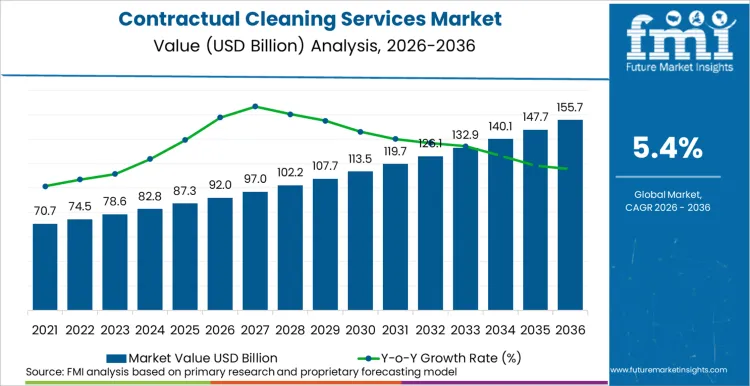
The global contractual cleaning services sector is on track to achieve a valuation of USD 155.0 billion by 2036, expanding from USD 92.0 billion in 2026 at a CAGR of 5.4%. As per Future Market Insights, expansion is structurally underpinned by the permanent elevation of hygiene standards following the pandemic, the growing complexity of specialized cleaning requirements in technology manufacturing and healthcare facilities, and the deployment of AI-powered platforms that optimize cleaning schedules based on real-time occupancy data.
The International Sanitary Supply Association (ISSA) confirmed in its 2024 industry report that the global cleaning industry workforce exceeds 4 million contracted workers, with labor costs accounting for 65 to 75% of total contract value. This labor intensity compels cleaning service providers to invest in robotic cleaning, AI scheduling, and autonomous floor care to improve margins and address chronic worker shortages. Simultaneously, the regulatory landscape is expanding the scope of mandated professional cleaning, with India's Ministry of Housing and Urban Affairs issuing a model contracting framework for outsourcing mechanized sewer and septic tank cleaning to private operators in June 2025.
Scott Salmirs, CEO of ABM Industries, stated in the company's fiscal 2025 earnings that ABM's strategy focuses on 'investing in high-growth, specialized verticals including semiconductor, data center, and advanced manufacturing facility services.' This confirms that major cleaning service companies are pivoting from commodity janitorial contracts to high-margin technical cleaning where specialized training, contamination control, and regulatory compliance create entry barriers. FMI opines that this vertical specialization trend will bifurcate the market into a commodity segment characterized by price competition and labor substitution, and a premium segment where technical expertise and compliance capabilities command sustained margin premiums.
The competitive landscape in 2025 and 2026 has been reshaped by technology deployment and strategic acquisitions. ABM Industries announced the acquisition of WGNSTAR for approximately USD 275 million in December 2025, expanding into semiconductor and high-technology facility managed services, with closing in February 2026. JLL launched JLL Serve in June 2024, an AI-powered facilities management application that integrates occupancy sensor data to dynamically schedule cleaning and maintenance tasks. ISS A/S continued its global 'OneISS' strategy through 2025, consolidating cleaning, catering, and facility management into integrated service contracts. India's Ministry of Housing and Urban Affairs issued the model contracting framework for mechanized cleaning outsourcing in June 2025. As per FMI, this combination of technology-driven service optimization, vertical market specialization, and emerging market regulatory formalization confirms that the contractual cleaning services industry is undergoing a structural transformation from manual labor deployment to technology-augmented outcome delivery.
Key Takeaways
- The contractual cleaning services market is controlled by a fragmented structure where ISS A/S, ABM Industries, Sodexo, CBRE Group, and JLL command the largest share of multinational facility cleaning contracts, while thousands of regional and local operators serve the SME and residential segments. FMI analysts observe that the top five companies collectively hold less than 15% of the global market, indicating substantial consolidation potential, particularly as technology investment requirements create scale advantages.
- Pricing asymmetry in the contractual cleaning services market is extreme between commodity janitorial contracts (USD 0.50 to 2.00 per square foot per month) and specialized technical cleaning for semiconductor fabs, cleanrooms, and data centers (USD 10 to 30 per square foot per month). As per FMI, ABM's USD 275 million acquisition of WGNSTAR is a direct response to this margin differential, positioning the company in the high-value technical cleaning segment where customer switching costs are substantially higher.
- Sourcing fragility is concentrated in labor availability. The cleaning industry faces chronic worker shortages across developed markets, with vacancy rates exceeding 15% in the United States and Western Europe. Robotic floor care (autonomous scrubbers, vacuum robots) addresses a portion of this constraint for large-format spaces but cannot yet replicate the dexterity required for restroom cleaning, high-touch surface sanitization, and specialized technical cleaning. FMI is of the opinion that labor scarcity is the primary structural force driving both technology adoption and wage inflation in the cleaning services sector.
- Brand and compliance risks center on worker safety, immigration compliance, and environmental standards. Cleaning service providers with large immigrant workforces face regulatory scrutiny in the United States and Europe. India's model contracting framework for mechanized cleaning formalization addresses both worker safety and service quality standardization in emerging markets.
- Geographic leverage is concentrated in North America and Europe, which account for the highest outsourced cleaning penetration rates. Asia Pacific is the fastest-growing region driven by formalization of cleaning outsourcing in India, China, and Southeast Asia. The Middle East is a significant market due to large-scale facility management contracts in commercial and hospitality sectors.
- The executive reframing for contractual cleaning services is that this market is transitioning from a labor procurement function to a technology-enabled facility performance service. FMI analysts emphasize that facility management executives must evaluate cleaning contracts on outcome metrics (cleanliness scores, contamination rates, occupancy-adjusted efficiency) rather than labor hours deployed.
Summary of Contractual Cleaning Services Market
What Is Growth Outlook for Contractual Cleaning Services Market as per Future Market Insights Projection?
Future Market Insights projects the contractual cleaning services market to expand at a CAGR of 5.4% from 2026 to 2036, increasing from USD 92.0 Billion in 2026 to USD 155.0 Billion by 2036.
FMI Research Approach: FMI proprietary forecasting model based on commercial real estate growth, outsourced cleaning penetration rates, and specialized cleaning vertical expansion.
How Do FMI Analysts Perceive Contractual Cleaning Services Market to Evolve?
FMI analysts perceive the market evolving toward AI-driven dynamic scheduling, robotic cleaning integration, and vertical specialization in high-margin technical cleaning for semiconductor, data center, and healthcare facilities.
FMI Research Approach: ABM Industries WGNSTAR acquisition filings and JLL Serve AI platform deployment data.
Which Country Holds Largest Share in Global Contractual Cleaning Services Market?
The United States holds a significant share of the global contractual cleaning services market by value which is supported by the highest outsourced cleaning penetration rate and the largest commercial real estate footprint.
FMI Research Approach: FMI country-level revenue modeling by commercial floor space and outsourced cleaning contract penetration.
How Large Will Contractual Cleaning Services Market Be by 2036?
The global contractual cleaning services market is projected to reach USD 155.0 Billion by 2036.
FMI Research Approach: FMI long-term revenue forecast derived from commercial real estate growth projections and cleaning outsourcing penetration rate modeling.
What Is Definition of Contractual Cleaning Services Market?
The contractual cleaning services market includes revenue from professional cleaning services provided under contract to commercial, institutional, industrial, and residential clients, covering janitorial, specialized, and technical cleaning delivered by third-party service providers.
FMI Research Approach: FMI market taxonomy and inclusion-exclusion framework.
What Are Globally Unique Trends Shaping Contractual Cleaning Services Market?
Globally unique trends include the pivot to semiconductor and data center technical cleaning (ABM-WGNSTAR), AI-powered occupancy-based scheduling (JLL Serve), and emerging market regulatory formalization of mechanized cleaning outsourcing (India model contracting framework).
FMI Research Approach: ABM Industries fiscal 2025 earnings disclosures and India Ministry of Housing and Urban Affairs regulatory publications.
Contractual Cleaning Services Market Key Takeaways
| Metric | Details |
|---|---|
| Industry Size (2026) | USD 92.0 Billion |
| Industry Value (2036) | USD 155.0 Billion |
| CAGR (2026 to 2036) | 5.4% |
Source: Future Market Insights (FMI) analysis, based on proprietary forecasting model and primary research
Regional Market Trends and Adoption Outlook for Contractual Cleaning Services
North America
North America is the largest market for contractual cleaning services, due to strong regulatory frameworks, high level of awareness of hygiene standards and significant demand from corporate and institutional clients-this trend is also reflected on the latest report directly mentioned above and indicates the continuing importance of contractual cleaning services in that region.
Countries across North America, particularly the United States and Canada, are at the forefront of this trend, having embraced special types of cleaning services such as green cleaning, electrostatic disinfection, and robotic cleaning solutions.
Growing post-pandemic cleaning protocols demand, regulation on workplace sanitation, and outsourcing of cleaning services by enterprises are supporting the growth of the market. And the trend of subscription-based cleaning service models and digital booking platforms also contribute to the growth of the industry.
Europe
Europe’s market is shaped by the growing demand for sustainable cleaning solutions, favorable government initiatives promoting workplace hygiene, and innovations in automated cleaning technologies. Germany, France, and the UK, and some of the leading countries that are working on developing high-efficiency cleaning solutions for commercial buildings, public institutions, and healthcare facilities.
The increasing focus on environmentally friendly cleaning chemicals, smart cleaning robotics, and research for antimicrobial surface coatings is also supporting market adoption. Apart from that, the increasing use of industrial deep cleaning, hospitality sanitation, and facility management outsourcing services is providing further potential for cleaning service providers.
Asia-Pacific
Contractual cleaning services market in Asia Pacific is expected to grow at the highest CAGR during the forecast period due to faster urbanization, increasing number of commercial real estate projects, and rising concern about health and hygiene. Commercial cleaning infrastructure is witnessing significant investments from China, India, and Japan, which is further complemented by a growing trend towards outsourcing facility maintenance services and smart cleaning solutions.
Rapidly growing demand for hygiene-centric services in shopping malls, offices, hotels, and hospitals, as well as changing government regulations regarding sanitation practices will progressively drive regional market expansion.
Moreover, a growing awareness regarding disinfection services, integration of facility management in disinfection services, and robotic cleaning basics based on artificial intelligence are also contributing to increasing penetration of the market. Domestic cleaning service providers and partnerships with global facility management companies are also injecting the market growth.
Latin America
The Latin American market is steadily growing on the back of rising awareness about sanitation standards, increasing demand for professional cleaning services and the growing trend of outsourcing in the corporate and the industrial sectors. Countries driving growth in the market like Brazil and Mexico are channeling focus towards increasing accessibility to industrial-grade contractual cleaning services to various industry verticals including but not limited to hospitality, healthcare, and manufacturing.
Sustainable cleaning chemicals, economical service models, and promotional campaigns for hygiene maintenance are also the factors contributing to the market growth. Moreover, the implementation of government sanitation programs, a surge in investments for cleaning of industrial facilities, and fetal cleaning driven demand for residential cleaning services is improving access to the service across the region.
Middle East & Africa
After the European & Americas regions, the Middle East & Africa is the slowest-growing market for Contractual cleaning services owing to the less sustainability and geographical areas for cleaning drive and even for maintenance of cleaning service contracts, but it is gradually emerging as a part of the growing plans for local infrastructure, bands for cleaning services in tourism, and for commercial real estate property management.
By OCTOBER 2023 responsblade.org The UAE and Saudi Arabia are at the forefront in optimizing service availability and technology in this space. Technological advancements in facility management, increase in demand for deep cleaning especially in luxury hotels and commercial buildings, and growing partnerships between international and local cleaning service providers are other factors fuelling growth of this market.
Moreover, favorable government policies regarding workplace hygiene, innovations in automated and robotic cleaning systems, and demand for disinfection solutions driven by consumers are supporting long-term industry expansion. Increasing adoption of hygiene awareness campaigns and growing presence of professional cleaning service providers in the region are also driving the market growth.
The market for Contractual cleaning services is expected to grow at a steady pace over the coming years, given the continuous developments in cleaning technologies, sustainable chemical formulation and automation-driven sanitation systems. In the quest for efficiency, market appeal, and long-term customer retention, companies are driving innovation in AI-powered cleaning robots, eco-friendly disinfectants, and digital booking platforms.
Furthermore, a growing consumer awareness of workplace cleanliness, the incorporation of digitalisation into service management and the move towards fixed-price facility maintenance are shaping what the future of the industry looks like.
Globally, the need for optimizing operational efficiency and providing top-notch contractual cleaning services have become achievable with the integration of AI-powered cleaning analytics, IoT-enabled hygiene monitoring, and Green cleaning certification programs.
Challenges and Opportunities
Challenge
Rising Labor Costs and Workforce Shortages
Rising labor costs and an ongoing shortage of skilled cleaning personnel present challenges for the Contractual cleaning services market. Tighter minimum wage legislation, employee benefits, and labor law compliance have increased the operational costs of cleaning service providers.
High turnover and a lack of retention of experienced staff are also prevalent issues, creating workforce management problems. Thereby, the companies should make an effort to conduct employee training programs, provide competitive pay scales, and implement automated and robotic cleaning solutions to limit the costs associated with manual labor.
Stringent Hygiene and Environmental Regulations
Government agencies and more industry regulators are tightening hygiene, sanitation and environmental requirements for cleaning service providers. Regulatory standards [such as Occupational Safety and Health Administration (OSHA) standards, Environmental Protection Agency (EPA) guidelines, and COVID-19 sanitation measures] have added complications to operations.
Moreover, it involves the adoption of eco-friendly cleaning practices that necessitate the use of biodegradable cleaning agents and an investment in green cleaning technologies driven by increased demand for sustainable waste management practices. To comply with regulations and ensure client confidence, organizations need to implement sustainable practices, obtain industry quality assurance certifications, and implement quality management processes.
Opportunity
Growing Demand for Specialized Cleaning Services
Specialized cleaning services are in increasing demand due to the need for better sanitation and disinfection services within healthcare, hospitality, commercial and industrial sectors. Deep cleaning, antimicrobial surface solutions, and cleaner air appliances are seeing a boom in demand as consumers increase hygiene awareness from the pandemic.
Also, as companies and other establishments are now focusing on long-term cleaning services to remain hygienic-based and maintain compliance. Organizations providing customized cleaning services, innovative sanitation technologies, and industry-specific knowledge will harness this increasing demand and grow their market share.
Advancements in Automation and Smart Cleaning Technologies
Automated, AI and IoT-enabled Cleaning Solutions are Revolutionizing the Contractual Cleaning Services Market Robotic vacuum cleaners, UV-disinfection robots, and AI-powered quality control systems are improving efficiencies, lowering costs, and reducing human error.
Smart propulsion systems have also contributed to improved efficiency. In the evolving landscape of cleaning services, the companies that will survive and thrive are the ones that are investing in robotic cleaning technology, IoT-based monitoring, and AI-driven service customization.
Shifts in the Contractual Cleaning Services Market from 2021 to 2025 and Future Trends 2026 to 2036
Contractual cleaning services market Trends: Market Dynamics and Future Outlook (2026 to 2036) Between 2020 and 2024, the Contractual cleaning services market experienced significant shifts due to the increased demand for sanitation stemming from the impact of the COVID-19 pandemic.
Businesses turned their focus to regular deep cleaning, managing air quality, and ensuring compliance with hygiene, which led to a notable uptick in demand for cleaning contracts from specialists. Yet labor shortages, cost pressures and regulatory compliance posed operational challenges. In response, companies implemented green cleaning solutions, enhanced workforce training, and used digital management tools to optimize service delivery.
In fact, between 2026 to 2036, we can expect to see the market being propelled by even more advanced automation, service optimization through AI, and sustainable cleaning practices. The introduction of fleets of robotic cleaners, real-time tracking of cleanliness, and nanotechnology-based coatings for surfaces will set new industry norms.
Furthermore, cleaning using eco-friendly products, smart facility management, and contract sanitation services would lead to the market development. Only the few who embrace technology, sustainability, and service innovation will be the leaders in the next generation of contractual cleaning services.
Market Shifts: A Comparative Analysis (2021 to 2025 vs. 2026 to 2036)
| Market Shift | 2021 to 2025 Trends |
|---|---|
| Regulatory Landscape | Stricter COVID-19 sanitation mandates and workplace hygiene requirements |
| Technological Advancements | Growth in electrostatic spraying, UV-disinfection, and fogging technology |
| Industry Adoption | Increased demand for disinfection in healthcare and commercial spaces |
| Supply Chain and Sourcing | Dependence on chemical-based cleaning products and manual labor |
| Market Competition | Dominance of traditional cleaning service providers |
| Market Growth Drivers | Demand for deep cleaning and antimicrobial treatments |
| Sustainability and Energy Efficiency | Initial focus on reducing chemical waste and energy consumption |
| Integration of Smart Monitoring | Limited use of IoT-enabled cleanliness tracking |
| Advancements in Cleaning Innovation | Adoption of green-certified cleaning solutions and high-efficiency tools |
| Market Shift | 2026 to 2036 Projections |
|---|---|
| Regulatory Landscape | Expansion of global eco-cleaning standards, AI-driven compliance monitoring, and carbon-neutral service solutions |
| Technological Advancements | Expansion of autonomous cleaning robots, AI-powered quality assurance, and real-time cleanliness tracking |
| Industry Adoption | Widespread integration of smart cleaning systems, data-driven facility maintenance, and predictive cleaning analytics |
| Supply Chain and Sourcing | Shift toward biodegradable cleaning agents, AI-managed inventory control, and automation-driven cleaning solutions |
| Market Competition | Rise of tech-driven cleaning startups, robotic cleaning firms, and on-demand service platforms |
| Market Growth Drivers | Expansion of subscription-based cleaning services, smart facility management, and eco-friendly cleaning contracts |
| Sustainability and Energy Efficiency | Large-scale implementation of water-saving cleaning systems, sustainable packaging, and net-zero cleaning services |
| Integration of Smart Monitoring | AI-powered real-time hygiene monitoring, predictive maintenance, and data-driven sanitation management |
| Advancements in Cleaning Innovation | Introduction of self-cleaning surfaces, nanotechnology-based coatings, and autonomous deep-cleaning solutions |
Country-wise Outlook- Contractual cleaning services market
United States
The United States holds the largest market share of the Contractual cleaning services market owing to the growing demand for commercial cleaning solutions, increased hygiene awareness, and the rising adoption of green cleaning technologies. While the significant growth of service providers and the rise of automated cleaning equipment will boost the market.
The demand for environment-friendly and chemical-free cleaning solutions by consumers and the development of robotic cleaning systems, antimicrobial coatings, and smart cleaning devices further flex the market growth. There’s also the increased efficiency with AI-powered scheduling, IoT-enabled cleaning devices and data-oriented maintenance programs.
The report pointed out that introducing specialized cleaning services for healthcare, hospitality, corporate, etc., are also amongst the key trends contributing to the business growth. The growing adoption of outsourced cleaning services in retail, transportation, manufacturing, and other industries is further propelling market growth in the USA
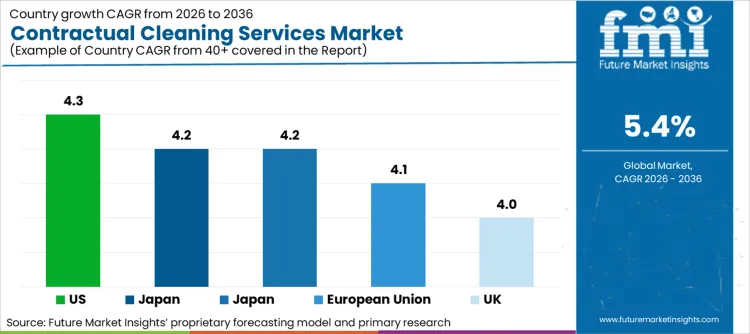
| Country | CAGR (2026 to 2036) |
|---|---|
| USA | 4.3% |
United Kingdom
Key Reasons to Purchase this Report: The gratifyingly Low Land Price Alienation of Commercial Cleaning Services in the UK. The UK represents a significant market for contractual cleaning services in view of the greatly restricted cleaning prerequisites, rising interest for expert facility management and an ascent in the spotlight on economical cleaning arrangements. Growing trend of outsourcing cleaning services in corporate and industrial sectors is also a major contributing factor for its demand.
Increasing market growth is also attributed to government rules to support sanitation in workplaces along with increasing uptake of green cleaning chemicals and energy-efficient cleaning equipment. Furthermore, advancements in UV-based disinfection technologies, touch-free sanitation and electrostatic spraying are starting to catch on.
Businesses are also investing in workforce training and digital reservation platforms to generate demand and strengthen customer service efficiency. In the United Kingdom, a growing consumer preference for specialized cleaning solutions for high-risk environments, including hospitals and laboratories, additionally propels the market growth. Moreover, businesses and households are opting for flexible cleaning contracts and on-demand services.
| Country | CAGR (2026 to 2036) |
|---|---|
| UK | 4.0% |
European Union
The European Contractual cleaning services market is mainly concentrated in Germany, France and Italy, which benefit from strong regulations on workplace hygiene, increasing the adoption of facility management services, and growing awareness of eco-friendly cleaning practices.
EU regulations aimed at chemical reduction in cleaning and investment in automated cleaning technology and sustainable waste management are contributing to market growth at a high pace. Moreover, the adoption of smart cleaning solutions, AI-powered quality control, and biodegradable cleaning agents to enhance service efficiency.
Growing need for hygiene-sensitive cleaning services for industries like healthcare, food processing, and hospitality is additionally contributing to the increasing market growth. Additional improvements in the quality of cleaning services throughout the EU are also being driven by the deployment of robotic cleaning technology and the introduction of AI-driven cleanliness monitoring systems.
In addition, government initiatives for green building upkeep and eco-friendly facility maintenance are hastening the transition to green cleaning services.
| Country | CAGR (2026 to 2036) |
|---|---|
| European Union (EU) | 4.1% |
Japan
Contribution in the market: Japan’s Contractual cleaning services market is thriving with the particular attention being paid towards hygiene, as demand for automated cleaning solutions and adaptability of hygiene protocols in commercial spaces is growing. Market growth is being driven by the increasing demand for highly efficient cleaning technologies in high-traffic urban environments.
The country’s focus on robotic cleaning, combined with the application of AI-powered cleaning-monitoring have ignited innovation. Furthermore, stringent government regulations for disinfection standards and growing demand for contactless cleaning services are stimulating companies to design novel solutions.
The increase of a necessity for specialized cleaning services in elderly care services, public transportation, and high rise office buildings is also driving market growth in urban areas within Japan. What’s more, the country’s commitment to UV-C disinfection robots and advanced smart cleaning tech is transforming the future of facility cleanliness.
| Country | CAGR (2026 to 2036) |
|---|---|
| Japan | 4.2% |
South Korea
Contract cleaning market in South Korea is also gaining popularity owing to an increasing hygiene consciousness, higher demand for professional cleaning solutions, and government-supported sanitation programs in public settings.
Market growth is further propelled by stringent workplace hygiene regulations and rising adoption of eco-friendly cleaning products and automated cleaning solutions. Moreover, the country is working on increasing the quality of services through smart cleaning devices, AI-powered scheduling, and IoT-based sanitation tracking to improve competitiveness. Increasing need for specialized cleaning across hospitals, airports, and residential complexes shall also boost market adoption.
Companies are investing in high-tech cleaning innovations: autonomous robotic vacuums, touchless restroom sanitation, sustainable cleaning agents. Further, an increase in smart city infrastructure and digitalization in facility management across South Korea facilitates the growth of advanced contractual cleaning services in the nation.
| Country | CAGR (2026 to 2036) |
|---|---|
| South Korea | 4.2% |
Segmentation Outlook- Contractual cleaning services market
Exterior and Interior Cleaning Services Drive Market Growth
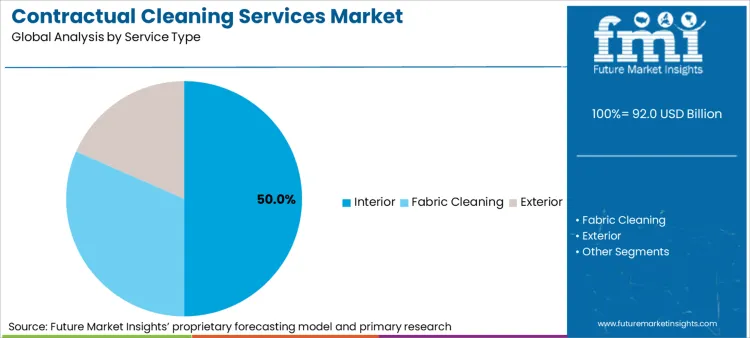
Cleaning the exteriors of commercial and residential premises are integral to preserving their appearance, safety and well-being. A well-maintained and inviting environment is only possible with the help of services like cleaning of parking lots, street cleaning, window washing, and others. Commercial businesses and municipalities use high-pressure washing systems, automated street sweepers, and green detergents to maintain outdoor cleanliness and compliance with sanitation regulations.
The increasing adoption of eco-friendly cleaning solutions and smart waste management systems has also accelerated the demand for professional exterior cleaning solutions. Furthermore, its growing urbanization leading to high footfalls in public areas has increased the demand for commercial vertical solutions, for sidewalks as well as building facades, which have significant growth.
Interior cleaning services are a key part of contractual cleaning and ensure that the indoor parts stay bacteria-free and hygienic and ensure a good environment. Floor and corridor cleaning, lobby maintenance, and deep-cleaning protocols for high-traffic areas are critical for sectors like healthcare, hospitality and corporate offices.
Advancements in interior cleaning operations have been in robotic vacuuming, antimicrobial surface treatments and touchless disinfection systems. The demand for sustainable and allergen-free cleaning products for residential and educational settings is also on the rise. Contractual interior cleaning services are growing to meet these changing consumer demands as businesses and households recognize the high importance of having clean indoor air quality and green cleaning solutions.
Commercial and Industrial Sectors Drive Market Demand
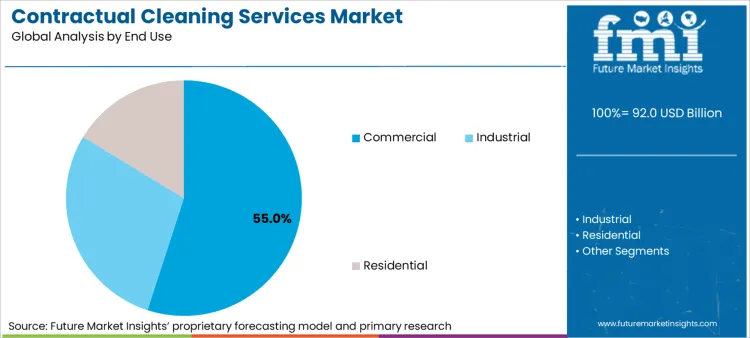
There are many uses for contracts cleaning services which is why the commercial sector accounts for the largest portion of the industry with the use of the service covering all industries from schools and colleges to hotels, health and retail and corporate office. Businesses care about cleanliness because they have to be compliant with health regulations, for customer experience and employee health.
With growing hygiene concerns and stricter sanitation standards, there is increasing demand for customized cleaning contracts, 24/7 janitorial services and specialized disinfection protocols. Furthermore, the rise of smart cleaning devices, automatic scheduling software, and sensor-based monitoring systems have enabled companies to optimize their commercial cleaning processes.
What is Professional Cleaning Services in Industrial Sector? Deep-cleansing solutions, hazardous waste removal, and high-pressure washing systems are necessary for factories, warehouses, and manufacturing plants to provide a contaminant-free environment.
Industrial grade cleaning robots, antimicrobial coatings and chemical free sanitation solutions played an important role in improving workplace hygiene and reduce environmental impact. In fact, pharmaceuticals, food processing, and automotive manufacturing verticals require high compliance with cleaning standards which is ultimately leading to increased demand for contract-based industrial sanitation services.
Competitive Outlook
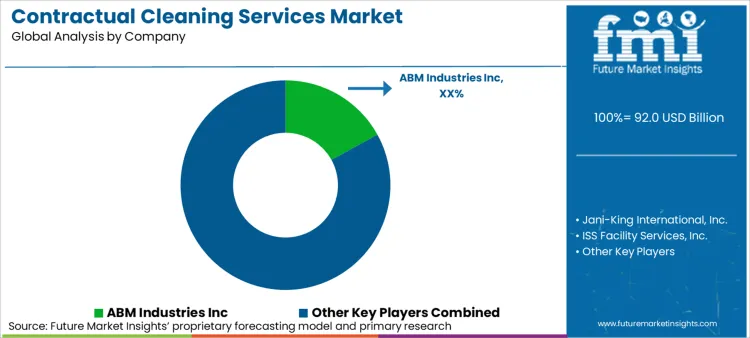
Growing demand for hygiene, sanitation, and facility management services across residential, commercial, and industrial sectors are expected to drive the contractual cleaning services market. As cleaning firms aim to stand out from the competition, they are making a large effort towards eco friendly cleaning solutions, automation, cleaning services outsourcing and many more. Some important trends are robotic cleaning systems, green cleaning products, and integrated facility management solutions.
Recent Developments:
- In December 2026, ABM Industries announced a definitive agreement to acquire WGNSTAR for approximately USD 275 million, expanding into semiconductor and high-technology facility managed workforce solutions, with closing completed in February 2026.
- In June 2024, JLL launched JLL Serve, an AI-powered facilities management application that integrates occupancy sensor data to dynamically schedule cleaning and maintenance tasks across commercial properties.
- In June 2026, India's Ministry of Housing and Urban Affairs issued a model contracting framework for outsourcing mechanized sewer and septic tank cleaning to private operators with strict safety benchmarks.
Market Share Analysis by Company
| Company Name | Estimated Market Share (%) |
|---|---|
| ABM Industries Inc. | 17-21% |
| ISS A/S | 13-17% |
| Sodexo | 10-14% |
| Jani-King International | 7-11% |
| Mitie Group plc | 5-9% |
| Other Companies (combined) | 35-45% |
Key Company Offerings and Activities
| Company Name | Key Offerings/Activities |
|---|---|
| ABM Industries Inc. | Leading provider of janitorial and integrated facility cleaning services for commercial and industrial clients. |
| ISS A/S | Specializes in smart cleaning solutions with a focus on sustainability and automation. |
| Sodexo | Develops hygiene and sanitation services for healthcare, corporate, and educational institutions. |
| Jani-King International | Offers franchise-based commercial cleaning services with customized solutions for various industries. |
| Mitie Group plc | Focuses on eco-friendly and technology-driven cleaning services for businesses and public institutions. |
Key Company Insights
ABM Industries Inc. (17-21%)
ABM commands the Contractual cleaning services space with a portfolio of janitorial and facility management services for large enterprises.
ISS A/S (13-17%)
With a focus on sustainability, ISS A/S offers smart cleaning solutions, including AI and IoT-enabled solutions to optimize facility maintenance.
Sodexo (10-14%)
Sodexo’s hygiene and sanitation services are second to none, especially for healthcare and education clients as well as corporate customers.
Jani-King International (7-11%)
Jani-King follows a franchise-based business model that provides specialized commercial cleaning services for various industries.
Mitie Group plc (5-9%)
Mitie focuses on sustainable, automated cleaning technologies for corporate offices, public institutions and industrial facilities.
Other Key Players (35-45% Combined)
Some emerging customers include mega-players but also global and regional service providers that generate some innovations in contractual cleaning (automation, green cleaning, deep cleaning etc.). Key players include:
- ServiceMaster Clean (Providing advanced janitorial and specialty cleaning solutions for businesses.)
- Stanley Steemer International (Specializing in deep cleaning services for residential and commercial properties.)
- Anago Cleaning Systems (Offering franchise-based commercial cleaning services with customized programs.)
- Vanguard Cleaning Systems (Providing green cleaning solutions and facility maintenance services.)
- CleanNet USA (Focusing on sustainable and technology-enhanced contract cleaning services.)
Market Definition
The contractual cleaning services market represents revenue generated from professional cleaning services provided under contract to commercial, institutional, industrial, and residential clients by third-party service providers. The market measures the value of janitorial cleaning, specialized cleaning (windows, carpets, post-construction), technical cleaning (cleanrooms, semiconductor fabs, data centers), and integrated facility cleaning contracts.
Inclusions cover commercial office and retail janitorial services, healthcare facility cleaning and sanitization, industrial and manufacturing facility cleaning, semiconductor fab and cleanroom contamination control services, data center cleaning, hospitality housekeeping contracts, and residential contracted cleaning services. AI-powered scheduling platforms and robotic cleaning systems deployed as part of cleaning contracts are also included.
Exclusions include self-performed in-house cleaning by facility owners, cleaning product and equipment manufacturing revenue, pest control services, waste management and disposal services not bundled with cleaning contracts, and one-time project cleaning not under recurring contract. Laundry and linen services are outside the scope.
Scope of Report
| Items | Values |
|---|---|
| Quantitative Units (2026) | USD 92.0 Billion |
| Product Type | Commercial Janitorial, Healthcare Cleaning, Industrial and Manufacturing Cleaning, Technical Cleaning (Semiconductor, Data Center), Hospitality Housekeeping |
| Material Type | Manual Cleaning Services, Robotic-Augmented Cleaning, AI-Scheduled Dynamic Cleaning, Specialized Contamination Control |
| End-Use / Channel | Direct Enterprise Contracts, Integrated Facility Management (IFM), Government and Public Sector Tenders, Real Estate Management Companies |
| Regions Covered | North America, Europe, Asia Pacific, Latin America, Middle East and Africa |
| Countries Covered | USA, UK, Germany, France, India, China, Japan, UAE, Australia, and 40+ countries |
| Key Companies Profiled | ISS A/S, ABM Industries, Sodexo, CBRE Group, JLL, Cushman & Wakefield, Mitie Group, Atalian |
| Additional Attributes | Revenue analysis by service vertical and contract type, AI scheduling platform adoption tracking, robotic cleaning deployment rates, labor availability and wage inflation monitoring, and specialized cleaning margin analysis |
Contractual Cleaning Services Market by Segments
By Product Type:
- Commercial Office and Retail Janitorial
- Healthcare Facility Cleaning
- Industrial and Manufacturing Cleaning
- Technical Cleaning (Semiconductor, Cleanroom, Data Center)
- Hospitality Housekeeping
- Residential Contracted Cleaning
By Material Type:
- Manual Cleaning Services
- Robotic-Augmented Cleaning
- AI-Scheduled Dynamic Cleaning
- Specialized Contamination Control
- Integrated Facility Management (IFM)
By Region:
- North America
- Europe
- East Asia
- South Asia
- Latin America
- Middle East and Africa
Bibliography
- ABM Industries Inc. (2025, December). WGNSTAR acquisition announcement. ABM Investor Relations.
- JLL. (2024, June). JLL Serve AI-powered facilities management platform launch. JLL Newsroom.
- Ministry of Housing and Urban Affairs, Government of India. (2025, June). Model contracting framework for mechanized cleaning outsourcing. MoHUA.
- ISS A/S. (2025, March). Annual Report 2024 and OneISS strategy update. ISS Investor Relations.
Frequently Asked Questions
What is the current global market size for Contractual Cleaning Services?
The global market is valued at USD 92.0 Billion in 2026, driven by elevated hygiene standards, technical cleaning vertical expansion, and AI-powered service optimization.
What is the projected Compound Annual Growth Rate (CAGR) for the market over the next 10 years?
The market is projected to grow at a CAGR of 5.4% from 2026 to 2036.
Which regions are experiencing the fastest expansion?
Asia Pacific leads growth driven by cleaning outsourcing formalization in India and China, followed by North America where technical cleaning for semiconductor and data center facilities drives value growth.
What are the primary market drivers?
Post-pandemic hygiene standard elevation, specialized technical cleaning demand from semiconductor and data center sectors, and AI-powered scheduling optimization are the primary drivers.
Who are the leading suppliers in the industry?
ISS A/S, ABM Industries, Sodexo, and JLL are key players, differentiating through integrated facility management, AI-powered scheduling, and high-margin technical cleaning vertical specialization.
Preview the report firsthand - request a free sample
Get SampleGet the brochure for pricing and purchase details.
Get PDFTable of Content
- Executive Summary
- Global Market Outlook
- Demand-side Trends
- Supply-side Trends
- Technology Roadmap Analysis
- Analysis and Recommendations
- Market Overview
- Market Coverage / Taxonomy
- Market Definition / Scope / Limitations
- Research Methodology
- Chapter Orientation
- Analytical Lens and Working Hypotheses
- Market Structure, Signals, and Trend Drivers
- Benchmarking and Cross-market Comparability
- Market Sizing, Forecasting, and Opportunity Mapping
- Research Design and Evidence Framework
- Desk Research Programme (Secondary Evidence)
- Company Annual and Sustainability Reports
- Peer-reviewed Journals and Academic Literature
- Corporate Websites, Product Literature, and Technical Notes
- Earnings Decks and Investor Briefings
- Statutory Filings and Regulatory Disclosures
- Technical White Papers and Standards Notes
- Trade Journals, Industry Magazines, and Analyst Briefs
- Conference Proceedings, Webinars, and Seminar Materials
- Government Statistics Portals and Public Data Releases
- Press Releases and Reputable Media Coverage
- Specialist Newsletters and Curated Briefings
- Sector Databases and Reference Repositories
- FMI Internal Proprietary Databases and Historical Market Datasets
- Subscription Datasets and Paid Sources
- Social Channels, Communities, and Digital Listening Inputs
- Additional Desk Sources
- Expert Input and Fieldwork (Primary Evidence)
- Primary Modes
- Qualitative Interviews and Expert Elicitation
- Quantitative Surveys and Structured Data Capture
- Blended Approach
- Why Primary Evidence is Used
- Field Techniques
- Interviews
- Surveys
- Focus Groups
- Observational and In-context Research
- Social and Community Interactions
- Stakeholder Universe Engaged
- C-suite Leaders
- Board Members
- Presidents and Vice Presidents
- R&D and Innovation Heads
- Technical Specialists
- Domain Subject-matter Experts
- Scientists
- Physicians and Other Healthcare Professionals
- Governance, Ethics, and Data Stewardship
- Research Ethics
- Data Integrity and Handling
- Primary Modes
- Tooling, Models, and Reference Databases
- Desk Research Programme (Secondary Evidence)
- Data Engineering and Model Build
- Data Acquisition and Ingestion
- Cleaning, Normalisation, and Verification
- Synthesis, Triangulation, and Analysis
- Quality Assurance and Audit Trail
- Market Background
- Market Dynamics
- Drivers
- Restraints
- Opportunity
- Trends
- Scenario Forecast
- Demand in Optimistic Scenario
- Demand in Likely Scenario
- Demand in Conservative Scenario
- Opportunity Map Analysis
- Product Life Cycle Analysis
- Supply Chain Analysis
- Investment Feasibility Matrix
- Value Chain Analysis
- PESTLE and Porter’s Analysis
- Regulatory Landscape
- Regional Parent Market Outlook
- Production and Consumption Statistics
- Import and Export Statistics
- Market Dynamics
- Global Market Analysis 2021 to 2025 and Forecast, 2026 to 2036
- Historical Market Size Value (USD Million) Analysis, 2021 to 2025
- Current and Future Market Size Value (USD Million) Projections, 2026 to 2036
- Y-o-Y Growth Trend Analysis
- Absolute $ Opportunity Analysis
- Global Market Pricing Analysis 2021 to 2025 and Forecast 2026 to 2036
- Global Market Analysis 2021 to 2025 and Forecast 2026 to 2036, By Service Type
- Introduction / Key Findings
- Historical Market Size Value (USD Million) Analysis By Service Type , 2021 to 2025
- Current and Future Market Size Value (USD Million) Analysis and Forecast By Service Type , 2026 to 2036
- Interior
- Fabric Cleaning
- Exterior
- Interior
- Y-o-Y Growth Trend Analysis By Service Type , 2021 to 2025
- Absolute $ Opportunity Analysis By Service Type , 2026 to 2036
- Global Market Analysis 2021 to 2025 and Forecast 2026 to 2036, By End Use
- Introduction / Key Findings
- Historical Market Size Value (USD Million) Analysis By End Use, 2021 to 2025
- Current and Future Market Size Value (USD Million) Analysis and Forecast By End Use, 2026 to 2036
- Commercial
- Industrial
- Residential
- Commercial
- Y-o-Y Growth Trend Analysis By End Use, 2021 to 2025
- Absolute $ Opportunity Analysis By End Use, 2026 to 2036
- Global Market Analysis 2021 to 2025 and Forecast 2026 to 2036, By Region
- Introduction
- Historical Market Size Value (USD Million) Analysis By Region, 2021 to 2025
- Current Market Size Value (USD Million) Analysis and Forecast By Region, 2026 to 2036
- North America
- Latin America
- Western Europe
- Eastern Europe
- East Asia
- South Asia and Pacific
- Middle East & Africa
- Market Attractiveness Analysis By Region
- North America Market Analysis 2021 to 2025 and Forecast 2026 to 2036, By Country
- Historical Market Size Value (USD Million) Trend Analysis By Market Taxonomy, 2021 to 2025
- Market Size Value (USD Million) Forecast By Market Taxonomy, 2026 to 2036
- By Country
- USA
- Canada
- Mexico
- By Service Type
- By End Use
- By Country
- Market Attractiveness Analysis
- By Country
- By Service Type
- By End Use
- Key Takeaways
- Latin America Market Analysis 2021 to 2025 and Forecast 2026 to 2036, By Country
- Historical Market Size Value (USD Million) Trend Analysis By Market Taxonomy, 2021 to 2025
- Market Size Value (USD Million) Forecast By Market Taxonomy, 2026 to 2036
- By Country
- Brazil
- Chile
- Rest of Latin America
- By Service Type
- By End Use
- By Country
- Market Attractiveness Analysis
- By Country
- By Service Type
- By End Use
- Key Takeaways
- Western Europe Market Analysis 2021 to 2025 and Forecast 2026 to 2036, By Country
- Historical Market Size Value (USD Million) Trend Analysis By Market Taxonomy, 2021 to 2025
- Market Size Value (USD Million) Forecast By Market Taxonomy, 2026 to 2036
- By Country
- Germany
- UK
- Italy
- Spain
- France
- Nordic
- BENELUX
- Rest of Western Europe
- By Service Type
- By End Use
- By Country
- Market Attractiveness Analysis
- By Country
- By Service Type
- By End Use
- Key Takeaways
- Eastern Europe Market Analysis 2021 to 2025 and Forecast 2026 to 2036, By Country
- Historical Market Size Value (USD Million) Trend Analysis By Market Taxonomy, 2021 to 2025
- Market Size Value (USD Million) Forecast By Market Taxonomy, 2026 to 2036
- By Country
- Russia
- Poland
- Hungary
- Balkan & Baltic
- Rest of Eastern Europe
- By Service Type
- By End Use
- By Country
- Market Attractiveness Analysis
- By Country
- By Service Type
- By End Use
- Key Takeaways
- East Asia Market Analysis 2021 to 2025 and Forecast 2026 to 2036, By Country
- Historical Market Size Value (USD Million) Trend Analysis By Market Taxonomy, 2021 to 2025
- Market Size Value (USD Million) Forecast By Market Taxonomy, 2026 to 2036
- By Country
- China
- Japan
- South Korea
- By Service Type
- By End Use
- By Country
- Market Attractiveness Analysis
- By Country
- By Service Type
- By End Use
- Key Takeaways
- South Asia and Pacific Market Analysis 2021 to 2025 and Forecast 2026 to 2036, By Country
- Historical Market Size Value (USD Million) Trend Analysis By Market Taxonomy, 2021 to 2025
- Market Size Value (USD Million) Forecast By Market Taxonomy, 2026 to 2036
- By Country
- India
- ASEAN
- Australia & New Zealand
- Rest of South Asia and Pacific
- By Service Type
- By End Use
- By Country
- Market Attractiveness Analysis
- By Country
- By Service Type
- By End Use
- Key Takeaways
- Middle East & Africa Market Analysis 2021 to 2025 and Forecast 2026 to 2036, By Country
- Historical Market Size Value (USD Million) Trend Analysis By Market Taxonomy, 2021 to 2025
- Market Size Value (USD Million) Forecast By Market Taxonomy, 2026 to 2036
- By Country
- Kingdom of Saudi Arabia
- Other GCC Countries
- Turkiye
- South Africa
- Other African Union
- Rest of Middle East & Africa
- By Service Type
- By End Use
- By Country
- Market Attractiveness Analysis
- By Country
- By Service Type
- By End Use
- Key Takeaways
- Key Countries Market Analysis
- USA
- Pricing Analysis
- Market Share Analysis, 2025
- By Service Type
- By End Use
- Canada
- Pricing Analysis
- Market Share Analysis, 2025
- By Service Type
- By End Use
- Mexico
- Pricing Analysis
- Market Share Analysis, 2025
- By Service Type
- By End Use
- Brazil
- Pricing Analysis
- Market Share Analysis, 2025
- By Service Type
- By End Use
- Chile
- Pricing Analysis
- Market Share Analysis, 2025
- By Service Type
- By End Use
- Germany
- Pricing Analysis
- Market Share Analysis, 2025
- By Service Type
- By End Use
- UK
- Pricing Analysis
- Market Share Analysis, 2025
- By Service Type
- By End Use
- Italy
- Pricing Analysis
- Market Share Analysis, 2025
- By Service Type
- By End Use
- Spain
- Pricing Analysis
- Market Share Analysis, 2025
- By Service Type
- By End Use
- France
- Pricing Analysis
- Market Share Analysis, 2025
- By Service Type
- By End Use
- India
- Pricing Analysis
- Market Share Analysis, 2025
- By Service Type
- By End Use
- ASEAN
- Pricing Analysis
- Market Share Analysis, 2025
- By Service Type
- By End Use
- Australia & New Zealand
- Pricing Analysis
- Market Share Analysis, 2025
- By Service Type
- By End Use
- China
- Pricing Analysis
- Market Share Analysis, 2025
- By Service Type
- By End Use
- Japan
- Pricing Analysis
- Market Share Analysis, 2025
- By Service Type
- By End Use
- South Korea
- Pricing Analysis
- Market Share Analysis, 2025
- By Service Type
- By End Use
- Russia
- Pricing Analysis
- Market Share Analysis, 2025
- By Service Type
- By End Use
- Poland
- Pricing Analysis
- Market Share Analysis, 2025
- By Service Type
- By End Use
- Hungary
- Pricing Analysis
- Market Share Analysis, 2025
- By Service Type
- By End Use
- Kingdom of Saudi Arabia
- Pricing Analysis
- Market Share Analysis, 2025
- By Service Type
- By End Use
- Turkiye
- Pricing Analysis
- Market Share Analysis, 2025
- By Service Type
- By End Use
- South Africa
- Pricing Analysis
- Market Share Analysis, 2025
- By Service Type
- By End Use
- USA
- Market Structure Analysis
- Competition Dashboard
- Competition Benchmarking
- Market Share Analysis of Top Players
- By Regional
- By Service Type
- By End Use
- Competition Analysis
- Competition Deep Dive
- ABM Industries Inc
- Overview
- Product Portfolio
- Profitability by Market Segments (Product/Age /Sales Channel/Region)
- Sales Footprint
- Strategy Overview
- Marketing Strategy
- Product Strategy
- Channel Strategy
- Jani-King International, Inc.
- ISS Facility Services, Inc.
- Mitie Group Plc.
- Pritchard Industries Inc.
- Vanguard Cleaning Systems, Inc.
- Stanley Steemer International, Inc.
- ABM Industries Inc
- Competition Deep Dive
- Assumptions & Acronyms Used


