

- Market Size (2026)
- USD 1.6 Bn
- Forecast (2036)
- USD 3.2 Bn
- CAGR (2026 to 2036)
- 7.1%
Self-cleaning Bottle Market Size, Market Forecast and Outlook By FMI
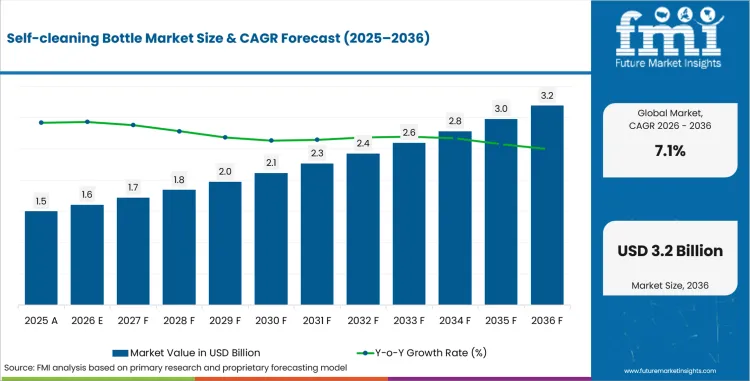
The self-cleaning bottle market was valued at USD 1.5 billion in 2025. The market is set to reach USD 1.6 billion by 2026-end and grow at a CAGR of 7.1% between 2026-2036 to reach USD 3.2 billion by 2036. UV C Light Bottles will dominate with a 36.0% share, while Stainless Steel will lead with a 48.0% share.
Key Takeaways, Market Size, and Forecast
- The Self-cleaning Bottle market was valued at USD 1.50 billion in 2025.
- By 2036, the Self-cleaning Bottle Market is expected to be worth USD 3.19 billion.
- From 2026 to 2036, the market is projected to expand at a CAGR of 7.1%.
- The market is projected to create an incremental opportunity of USD 1.58 billion between 2026 and 2036.
- In 2026, UV C Light Bottles is expected to account for 36.0% of the Product, driven by growing consumer awareness of water bottle hygiene concerns and the convenience of UV-C light sterilization technology that eliminates bacteria without chemical cleaning agents.
- China (7.8%) and India (7.5%) are two of the fastest growing markets in the world.
Summary of the Self-cleaning Bottle Market
- Demand and Growth Drivers
- Growing consumer awareness that reusable water bottles accumulate bacteria, mold, and biofilm that regular hand washing does not fully eliminate is creating demand for self-cleaning technology that automates sterilization.
- UV-C light sterilization technology advancement has enabled compact, battery-powered purification systems that fit inside standard water bottle caps, making self-cleaning functionality practical for everyday hydration products.
- Health-conscious consumer culture and the growth of reusable bottle adoption as an environmental alternative to single-use plastic are creating a receptive market for premium bottles that address the hygiene compromise of reusable container use.
- Product and Segment View
- UV-C light bottles account for 36.0% of the product segment, supported by consumer preference for chemical-free sterilization technology that eliminates bacteria and viruses through ultraviolet light exposure inside the bottle.
- By material, stainless steel holds 48.0% share, reflecting consumer preference for durable, insulated construction that maintains beverage temperature while supporting the integration of UV-C sterilization components.
- Personal hydration leads the application segment at 44.0%, confirming that daily water consumption is the primary use case for self-cleaning bottles ahead of outdoor recreation and travel applications.
- Geography and Competitive Outlook
- China is projected to grow at 7.8% through 2036, supported by the scale of consumer electronics and personal health device adoption, domestic manufacturing capability, and growing consumer awareness of reusable bottle hygiene concerns.
- India follows at 7.5%, reflecting rising health consciousness, growing reusable bottle adoption, and expanding online distribution for premium personal hydration products.
- Companies that combine UV-C sterilization technology reliability, material quality, brand positioning in health-conscious consumer segments, and distribution across online and specialty retail channels are positioned to gain traction during the forecast period.
- Analyst Opinion
- The self-cleaning bottle market sits at the intersection of reusable container sustainability and personal hygiene consciousness. The fundamental consumer insight is that reusable bottles, while environmentally preferable to single-use plastic, accumulate bacteria and biofilm that hand washing does not fully address, creating a hygiene compromise that UV-C technology resolves. Companies that can deliver reliable sterilization performance in a form factor that matches conventional water bottle dimensions and weight are overcoming the primary adoption barriers of size, battery life, and price premium. The competitive advantage belongs to brands that can communicate the hygiene problem compellingly while delivering technology that works consistently.
- The Self-cleaning Bottle Market is moving from a supply driven model toward a demand responsive structure where end user requirements shape product development.
- Adoption is increasing due to evolving consumer expectations and expanding distribution channel accessibility across online and retail formats.
- Growth reflects the structural shift toward higher specification products and more informed purchasing behavior driven by online research and reviews.
- Demand is further supported by changing lifestyle preferences and growing awareness of product quality and performance differences across brands.
Self-cleaning Bottle Market Definition
The self-cleaning bottle market covers reusable water bottles with integrated sterilization technology designed to eliminate bacteria, viruses, and biofilm from the bottle interior. Products include UV-C light bottles, ozone sterilization bottles, and advanced filtration bottles in stainless steel, glass, and BPA-free plastic materials.
Self-cleaning Bottle Market Inclusions
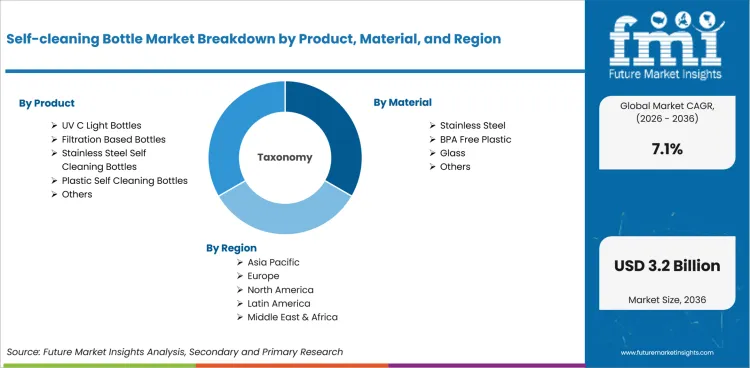
Market scope encompasses all commercially traded products categorized by Product (UV C Light Bottles, Filtration Based Bottles, Stainless Steel Self Cleaning Bottles, Plastic Self Cleaning Bottles, Others); Material (Stainless Steel, BPA Free Plastic, Glass, Others); Distribution Channel (E Commerce Platforms, Company Websites, Specialty Stores, Supermarkets and Hypermarkets, Departmental Stores); Application (Personal Hydration, Travel and Outdoor, Corporate and Institutional); Capacity (500 ml to 750 ml, Below 500 ml, Above 750 ml). Revenue estimates cover the forecast period from 2026 to 2036.
Self-cleaning Bottle Market Exclusions
The scope does not include standard reusable water bottles without integrated cleaning technology, UV-C sterilization wands sold separately, water filtration pitchers, or industrial water purification equipment.
Self-cleaning Bottle Market Research Methodology
- Primary Research: FMI analysts conducted interviews with personal hydration brand managers, UV-C technology engineers, specialty retail buyers, and food-grade stainless steel and component suppliers across key markets to validate demand patterns, pricing structures, and procurement dynamics.
- Desk Research: Research combined data from personal hydration market databases, UV-C sterilization efficacy studies, and consumer health product retail analytics, with cross referencing against publicly available industry databases and regulatory filings.
- Market Sizing and Forecasting: Market sizing uses a hybrid bottom up and top down approach, aggregating demand across product, material, distribution channel, application, capacity with regional adoption curves.
- Data Validation: Data was validated quarterly against production statistics, trade data, and manufacturer disclosures to maintain forecast accuracy.
Why is the Self-cleaning Bottle Market Growing?
- Growing consumer awareness that reusable water bottles accumulate bacteria and biofilm that regular hand washing does not fully eliminate is creating demand for self-cleaning technology that automates the sterilization process.
- UV-C light technology advancement has enabled compact, battery-powered purification systems that fit inside standard water bottle designs, making self-cleaning functionality practical for everyday portable hydration products.
- China leads growth at 7.8%, supported by the scale of consumer electronics and personal health device adoption, domestic manufacturing capability, and growing consumer awareness of reusable bottle hygiene concerns.
The self-cleaning bottle market is expanding as health-conscious consumers recognize that reusable water bottles, while environmentally superior to single-use plastic, present hygiene challenges that conventional washing does not fully resolve. Studies indicate that reusable bottles can harbor bacteria at levels comparable to kitchen sinks and toilet seats when not properly sterilized, creating a consumer problem that UV-C and ozone technology can address.
UV-C light bottles lead the product segment at 36.0% share, using ultraviolet light to destroy bacterial DNA and RNA without chemical agents. Stainless steel holds 48.0% of material share, providing durability and insulation alongside UV-C component integration. E-commerce leads distribution at 39.0%. The 500 to 750 ml capacity range holds 41.0% share, aligning with standard daily hydration volumes.
CrazyCap holds an estimated 20.0% market share through its bottle cap UV-C sterilization system that converts existing bottles into self-cleaning containers. UVBrite, Philips, HydraCoach, Brita, and Noerden compete across integrated bottle systems and retrofit cap solutions.
Market Segmentation Analysis
- UV C Light Bottles accounts for 36.0% of the Product segment, supported by established procurement patterns and application requirements.
- Stainless Steel holds 48.0% of the Material segment, reflecting concentrated demand in core use cases.
The Self-cleaning Bottle market is segmented by product, material, distribution channel, application, capacity. Demand patterns reflect the concentration of procurement in established application areas and the growing diversification of end use requirements.
Insights into the Product Segment
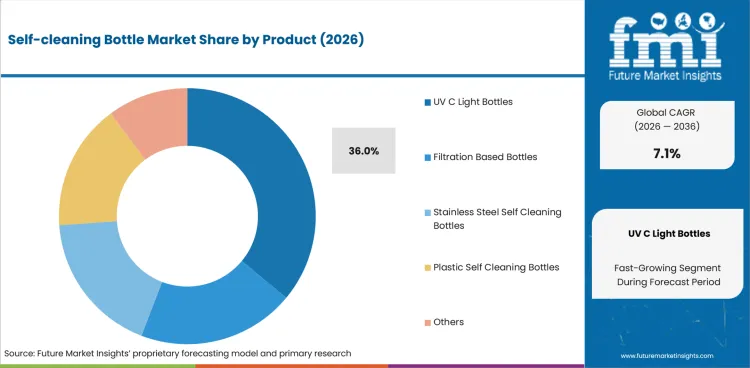
UV-C light bottles account for 36.0% of the product segment, supported by consumer preference for chemical-free sterilization technology that eliminates bacteria and viruses through ultraviolet light exposure inside the bottle.
Insights into the Material Segment
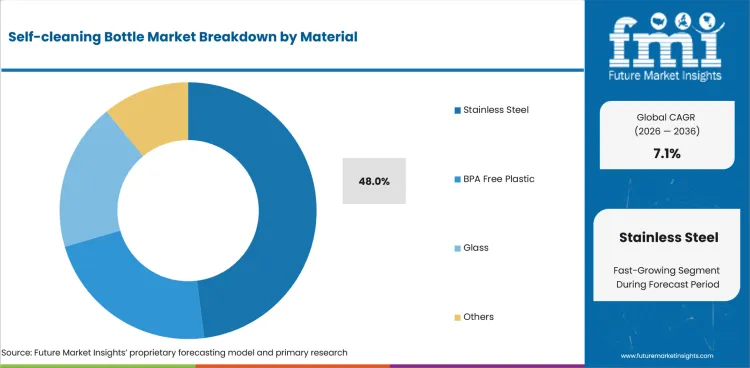
By material, stainless steel holds 48.0% share, reflecting consumer preference for durable, insulated construction that maintains beverage temperature while supporting the integration of UV-C sterilization components.
Self-cleaning Bottle Market Drivers, Restraints, and Opportunities
- CrazyCap holds an estimated 20.0% market share through its UV-C bottle cap technology that converts standard water bottles into self-cleaning containers through cap replacement.
- UVBrite, Philips, HydraCoach, Brita, and Noerden compete across integrated self-cleaning bottle systems and retrofit sterilization cap solutions.
- The competitive landscape is fragmented with opportunities for brands that combine reliable UV-C sterilization technology with premium bottle design and effective consumer education about reusable bottle hygiene.
The Self-cleaning Bottle market is shaped by demand drivers, supply constraints, and emerging opportunities. Growth is supported by expanding application requirements, while cost pressures and competitive dynamics influence adoption rates.
Primary Demand Drivers
Growing consumer awareness that reusable water bottles accumulate bacteria, mold, and biofilm that regular hand washing does not fully eliminate is creating demand for self-cleaning technology that automates sterilization.
Supply and Cost Dynamics
UV-C light sterilization technology advancement has enabled compact, battery-powered purification systems that fit inside standard water bottle caps, making self-cleaning functionality practical for everyday hydration products.
Emerging Growth Opportunities
Health-conscious consumer culture and the growth of reusable bottle adoption as an environmental alternative to single-use plastic are creating a receptive market for premium bottles that address the hygiene compromise of reusable container use.
Analysis of Self-cleaning Bottle Market By Key Countries
.webp "Top Country Growth Comparison Self Cleaning Bottle Market Cagr (2026 2036)")
| Country | CAGR |
|---|---|
| China | 7.8% |
| India | 7.5% |
| USA | 7.1% |
| Germany | 6.9% |
| UK | 6.7% |
| Japan | 6.4% |
| South Korea | 6.2% |
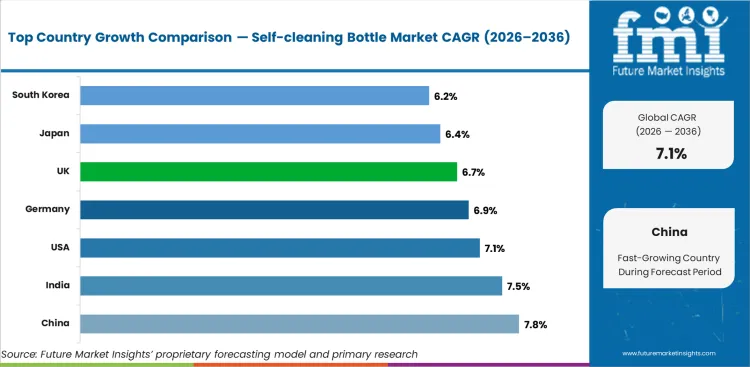
- China at 7.8%: supported by local market conditions and sector investment.
- India at 7.5%: supported by local market conditions and sector investment.
- USA at 7.1%: supported by local market conditions and sector investment.
- Germany at 6.9%: supported by local market conditions and sector investment.
The global self-cleaning bottle market is expected to grow at a rate of 7.1% per year from 2026 to 2036. The study covers more than 30 countries, and the main markets are listed below.
Demand Outlook for Self-cleaning Bottle Market in China
China is projected to grow at 7.8% through 2036. The scale of consumer health device adoption, domestic manufacturing capability for UV-C components and stainless steel bottles, and growing consumer awareness of reusable bottle hygiene through online health content create the largest growth opportunity globally.
- Consumer health device adoption culture and domestic manufacturing capability for UV-C components create the largest addressable market for self-cleaning bottle technology globally.
- Online retail platforms provide efficient distribution and consumer education channels for self-cleaning bottles, enabling rapid product awareness building through review and health content marketing.
- Domestic manufacturing scale supports competitive pricing that can accelerate mass market adoption of self-cleaning technology beyond early adopter health-conscious consumer segments.
Future Outlook for Self-cleaning Bottle Market in India
India is projected to grow at 7.5% through 2036. Rising health consciousness among urban professionals, growing reusable bottle adoption as an alternative to single-use plastic, and expanding online distribution for premium personal hydration products sustain demand growth from an emerging but substantial consumer base.
- Rising health consciousness among urban professionals and growing reusable bottle adoption as an alternative to single-use plastic create demand for premium hydration products with hygiene features.
- Price sensitivity in the Indian market favors affordable self-cleaning solutions, creating opportunities for brands that can deliver UV-C sterilization at accessible price points.
- Online distribution through Amazon India and health product platforms provides the primary channel for self-cleaning bottle brand building and consumer education in the Indian market.
Opportunity Analysis of Self-cleaning Bottle Market in the United States
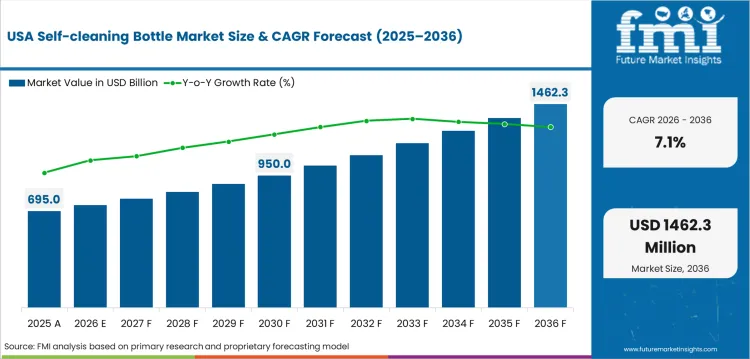
The United States is projected to grow at 7.1% through 2036. Health-conscious consumer culture, strong reusable bottle adoption, and the influence of wellness content creators on product awareness sustain demand for self-cleaning bottles through direct-to-consumer and Amazon distribution channels.
- Health-conscious consumer culture and strong reusable bottle adoption create a receptive market for self-cleaning technology that addresses the hygiene compromise of reusable container use.
- Wellness content creators and health influencer marketing drive consumer awareness of reusable bottle hygiene concerns and self-cleaning bottle solutions through social media and podcast channels.
- Direct-to-consumer distribution through brand websites and Amazon enables self-cleaning bottle brands to reach consumers with educational messaging about UV-C sterilization benefits.
In-depth Analysis of Self-cleaning Bottle Market in Germany
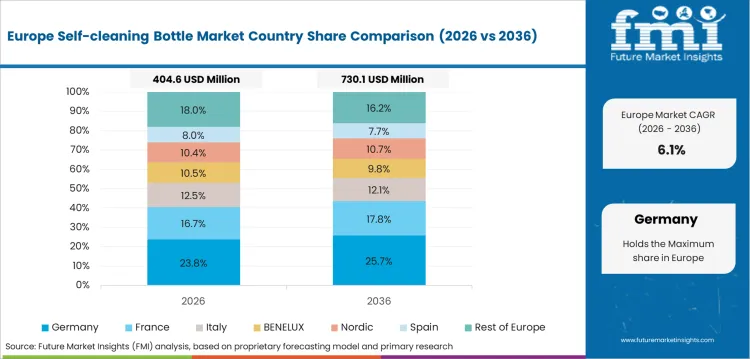
Germany is projected to grow at 6.9% through 2036. Consumer preference for well-engineered health and wellness products and the strength of environmental awareness supporting reusable bottle adoption sustain demand for self-cleaning technology that addresses hygiene concerns.
- Consumer preference for well-engineered health and wellness products creates demand for self-cleaning bottles with documented sterilization efficacy and durable construction quality.
- Environmental awareness supporting reusable bottle adoption provides a receptive consumer base for self-cleaning technology that enhances the hygiene profile of sustainable hydration products.
- Quality expectations and product testing culture sustain demand for self-cleaning bottles from brands that can demonstrate reliable UV-C sterilization performance through independent validation.
Sales Analysis of Self-cleaning Bottle Market in UK
The United Kingdom is projected to grow at 6.7% through 2036. Health and wellness consumer culture, growing reusable bottle adoption, and online retail accessibility for premium hydration products sustain demand for self-cleaning bottle technology.
- Health and wellness culture combined with growing reusable bottle adoption sustain demand for self-cleaning technology that addresses hygiene concerns associated with repeated bottle use.
- Online retail and direct-to-consumer channels provide distribution infrastructure for self-cleaning bottle brands targeting health-conscious UK consumers through digital marketing.
- Environmental consciousness in the UK market supports the dual positioning of self-cleaning bottles as both hygiene solutions and sustainable alternatives to single-use plastic hydration options.
Growth Assessment of Self-cleaning Bottle Market in Japan
Japan is projected to grow at 6.4% through 2036, supported by expanding market requirements and investment in the sector.
- Growth at 6.4% reflects expanding local market requirements, supported by growing consumer awareness and distribution development.
- Procurement is supported by sector investment and policy frameworks that create structured demand for quality products.
- End user demand is concentrated in core application areas with growing consumer preference for premium options.
Market Review of Self-cleaning Bottle Market in South Korea
South Korea is projected to grow at 6.2% through 2036, supported by expanding market requirements and investment in the sector.
- Growth at 6.2% reflects expanding local market requirements, supported by growing consumer awareness and distribution development.
- Procurement is supported by sector investment and policy frameworks that create structured demand for quality products.
- End user demand is concentrated in core application areas with growing consumer preference for premium options.
Competitive Landscape and Strategic Positioning
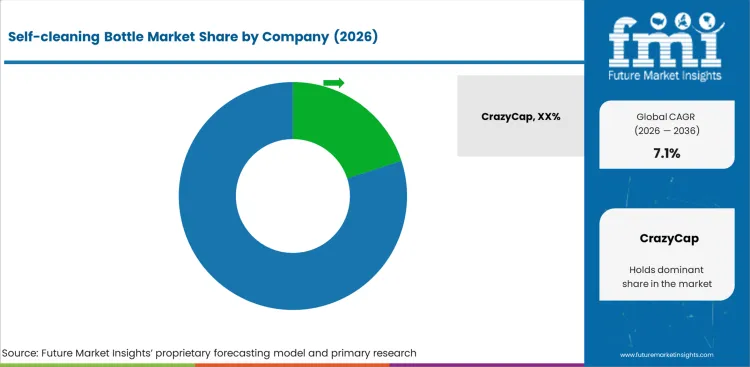
- CrazyCap holds an estimated 20.0% market share through its UV-C bottle cap technology that converts standard water bottles into self-cleaning containers through cap replacement.
- UVBrite, Philips, HydraCoach, Brita, and Noerden compete across integrated self-cleaning bottle systems and retrofit sterilization cap solutions.
- The competitive landscape is fragmented with opportunities for brands that combine reliable UV-C sterilization technology with premium bottle design and effective consumer education about reusable bottle hygiene.
CrazyCap holds an estimated 20.0% market share through its cap-based UV-C sterilization approach that enables consumers to upgrade existing bottles rather than purchasing entirely new containers.
UVBrite offers integrated UV-C bottle designs with dedicated sterilization cycles. Philips brings brand credibility from its broader health technology portfolio. Brita leverages its filtration brand recognition. Noerden combines smart features with sterilization in its bottle designs.
The competitive landscape is early-stage with limited brand awareness among mainstream consumers, creating growth opportunities for companies that can invest in consumer education about reusable bottle hygiene risks and UV-C sterilization benefits.
Key Companies in the Self-cleaning Bottle Market
Key global companies leading the self-cleaning bottle market include:
- CrazyCap, UVBrite, Philips, HydraCoach, Brita hold established positions through product portfolios, brand recognition, and distribution relationships.
- LARQ, Lifestraw, Grayl are specialized players focusing on differentiation and niche positioning.
- ReLive, Mahaton represent emerging participants with growth potential.
Competitive Benchmarking: Self-cleaning Bottle Market
| Company | UV-C Technology | Bottle Design | Brand Awareness | Distribution |
|---|---|---|---|---|
| CrazyCap | Strong | Moderate | Moderate | Online |
| UVBrite | Strong | Strong | Low | Online |
| Philips | Strong | Strong | Strong | Multi-Channel |
| Brita | Moderate | Strong | Strong | Mass Retail |
| Noerden | Moderate | Strong | Low | Online |
Source: Future Market Insights competitive analysis, 2026.
Key Developments in Self-cleaning Bottle Market
- In 2025, CrazyCap launched an updated UV-C sterilization cap with faster purification cycle time and a companion mobile application that tracks sterilization frequency and bottle hydration reminders.
- In 2025, Philips expanded its self-cleaning bottle portfolio with an insulated stainless steel model featuring integrated UV-C sterilization and temperature display.
Key Players in the Self-cleaning Bottle Market
Major Global Players
- CrazyCap
- UVBrite
- Philips
- HydraCoach
- Brita
- Noerden
- Quartz Bottle
Emerging Players/Startups
- LARQ
- Lifestraw
- Grayl
- ReLive
- Mahaton
Report Scope and Coverage
| Parameter | Details |
|---|---|
| Quantitative Units | USD 1.61 Billion to USD 3.19 Billion, at a CAGR of 7.1% |
| Market Definition | The self-cleaning bottle market covers reusable water bottles with integrated sterilization technology designed to eliminate bacteria, viruses, and biofilm from the bottle interior. |
| Regions Covered | North America, Latin America, Europe, East Asia, South Asia and Pacific, Middle East and Africa |
| Countries Covered | China, India, USA, Germany, UK, Japan, South Korea, 30 plus countries |
| Key Companies Profiled | CrazyCap, UVBrite, Philips, HydraCoach, Brita, Noerden, Quartz Bottle, LARQ |
| Forecast Period | 2026 to 2036 |
| Approach | Hybrid bottom up and top down methodology starting with verified transaction data, projecting adoption velocity across segments and regions. |
Market Segmentation Analysis
Self-cleaning Bottle Market Segmented by Product:
- UV C Light Bottles
- Portable UV C Bottles
- Smart UV C Bottles
- Filtration Based Bottles
- Carbon Filter Bottles
- Multi Stage Filtration Bottles
- Stainless Steel Self Cleaning Bottles
- Vacuum Insulated Bottles
- Temperature Retention Bottles
- Plastic Self Cleaning Bottles
- Lightweight Plastic Bottles
- Sports Use Bottles
- Others
- Collapsible Bottles
- Hybrid Cleaning Bottles
Self-cleaning Bottle Market Segmented by Material:
- Stainless Steel
- Food Grade Stainless Steel
- Double Wall Stainless Steel
- BPA Free Plastic
- Tritan Plastic
- Recyclable Plastic
- Glass
- Borosilicate Glass
- Tempered Glass
- Others
- Silicone Components
- Composite Materials
Self-cleaning Bottle Market Segmented by Distribution Channel:
- E Commerce Platforms
- Marketplace Platforms
- Direct Online Retail
- Company Websites
- Brand Owned Stores
- Subscription Based Sales
- Specialty Stores
- Outdoor Equipment Stores
- Lifestyle Retail Stores
- Supermarkets and Hypermarkets
- Large Retail Chains
- Mass Merchandisers
- Departmental Stores
- Urban Department Stores
- Premium Retail Stores
Self-cleaning Bottle Market Segmented by Application:
- Personal Hydration
- Daily Use
- Fitness Use
- Travel and Outdoor
- Camping
- Hiking
- Corporate and Institutional
- Office Use
- Educational Institutions
Self-cleaning Bottle Market Segmented by Capacity:
- 500 ml to 750 ml
- Standard Daily Use Bottles
- Fitness Bottles
- Below 500 ml
- Kids Bottles
- Compact Travel Bottles
- Above 750 ml
- Outdoor Bottles
- Long Duration Bottles
Self-cleaning Bottle Market by Region:
- North America
- USA
- Canada
- Mexico
- Latin America
- Brazil
- Chile
- Rest of Latin America
- Western Europe
- Germany
- UK
- Italy
- Spain
- France
- Nordic
- BENELUX
- Rest of Western Europe
- Eastern Europe
- Russia
- Poland
- Hungary
- Balkan & Baltic
- Rest of Eastern Europe
- East Asia
- China
- Japan
- South Korea
- South Asia and Pacific
- India
- ASEAN
- Australia & New Zealand
- Rest of South Asia and Pacific
- Middle East & Africa
- Kingdom of Saudi Arabia
- Other GCC Countries
- Turkiye
- South Africa
- Other African Union
- Rest of Middle East & Africa
Research Sources and Bibliography
- 1. World Health Organization. (2024). WHO Guidelines on Water Quality and Portable Purification. WHO.
- 2. USA Environmental Protection Agency. (2024). EPA Ultraviolet Disinfection Guidance. EPA.
- 3. National Sanitation Foundation. (2025). NSF Water Treatment Device Standards. NSF.
- 4. International Electrotechnical Commission. (2024). IEC UV-C Safety Standards for Consumer Devices. IEC.
- 5. Centers for Disease Control and Prevention. (2025). CDC Water Disinfection Methods Review. CDC.
This bibliography is provided for reader reference. The full Future Market Insights report contains the complete reference list with publication dates, URLs, and supporting data for all cited works.
This Report Answers
- Estimating the size of the market and revenue from 2026 to 2036.
- Segmentation by product, material, distribution channel, application, capacity.
- Insights about more than 30 markets in the region.
- Analysis of trends shaping the market.
- Assessment of the competitive landscape.
- Finding investment opportunities across key application areas.
- Supply chain and procurement pattern tracking.
- Delivery of data in PDF and Excel formats.
Frequently Asked Questions
How big is the self-cleaning bottle market in 2026?
The global self-cleaning bottle market is estimated to be valued at USD 1.6 billion in 2026.
What will be the size of self-cleaning bottle market in 2036?
The market size for the self-cleaning bottle market is projected to reach USD 3.2 billion by 2036.
How much will be the self-cleaning bottle market growth between 2026 and 2036?
The self-cleaning bottle market is expected to grow at a 7.1% CAGR between 2026 and 2036.
What are the key product types in the self-cleaning bottle market?
The key product types in self-cleaning bottle market are uv c light bottles, portable uv c bottles, smart uv c bottles, filtration based bottles, carbon filter bottles, multi stage filtration bottles, stainless steel self cleaning bottles, vacuum insulated bottles, temperature retention bottles, plastic self cleaning bottles, lightweight plastic bottles, sports use bottles, others, collapsible bottles and hybrid cleaning bottles.
Which material segment is expected to contribute significant share in the self-cleaning bottle market in 2026?
In terms of material, stainless steel segment is expected to command 48.0% share in the self-cleaning bottle market in 2026.
Preview the report firsthand - request a free sample
Get SampleGet the brochure for pricing and purchase details.
Get PDFTable of Content
- Executive Summary
- Global Market Outlook
- Demand-side Trends
- Supply-side Trends
- Technology Roadmap Analysis
- Analysis and Recommendations
- Market Overview
- Market Coverage / Taxonomy
- Market Definition / Scope / Limitations
- Research Methodology
- Chapter Orientation
- Analytical Lens and Working Hypotheses
- Market Structure, Signals, and Trend Drivers
- Benchmarking and Cross-market Comparability
- Market Sizing, Forecasting, and Opportunity Mapping
- Research Design and Evidence Framework
- Desk Research Programme (Secondary Evidence)
- Company Annual and Sustainability Reports
- Peer-reviewed Journals and Academic Literature
- Corporate Websites, Product Literature, and Technical Notes
- Earnings Decks and Investor Briefings
- Statutory Filings and Regulatory Disclosures
- Technical White Papers and Standards Notes
- Trade Journals, Industry Magazines, and Analyst Briefs
- Conference Proceedings, Webinars, and Seminar Materials
- Government Statistics Portals and Public Data Releases
- Press Releases and Reputable Media Coverage
- Specialist Newsletters and Curated Briefings
- Sector Databases and Reference Repositories
- FMI Internal Proprietary Databases and Historical Market Datasets
- Subscription Datasets and Paid Sources
- Social Channels, Communities, and Digital Listening Inputs
- Additional Desk Sources
- Expert Input and Fieldwork (Primary Evidence)
- Primary Modes
- Qualitative Interviews and Expert Elicitation
- Quantitative Surveys and Structured Data Capture
- Blended Approach
- Why Primary Evidence is Used
- Field Techniques
- Interviews
- Surveys
- Focus Groups
- Observational and In-context Research
- Social and Community Interactions
- Stakeholder Universe Engaged
- C-suite Leaders
- Board Members
- Presidents and Vice Presidents
- R&D and Innovation Heads
- Technical Specialists
- Domain Subject-matter Experts
- Scientists
- Physicians and Other Healthcare Professionals
- Governance, Ethics, and Data Stewardship
- Research Ethics
- Data Integrity and Handling
- Primary Modes
- Tooling, Models, and Reference Databases
- Desk Research Programme (Secondary Evidence)
- Data Engineering and Model Build
- Data Acquisition and Ingestion
- Cleaning, Normalisation, and Verification
- Synthesis, Triangulation, and Analysis
- Quality Assurance and Audit Trail
- Market Background
- Market Dynamics
- Drivers
- Restraints
- Opportunity
- Trends
- Scenario Forecast
- Demand in Optimistic Scenario
- Demand in Likely Scenario
- Demand in Conservative Scenario
- Opportunity Map Analysis
- Product Life Cycle Analysis
- Supply Chain Analysis
- Investment Feasibility Matrix
- Value Chain Analysis
- PESTLE and Porter’s Analysis
- Regulatory Landscape
- Regional Parent Market Outlook
- Production and Consumption Statistics
- Import and Export Statistics
- Market Dynamics
- Global Market Analysis 2021 to 2025 and Forecast, 2026 to 2036
- Historical Market Size Value (USD billion) Analysis, 2021 to 2025
- Current and Future Market Size Value (USD billion) Projections, 2026 to 2036
- Y-o-Y Growth Trend Analysis
- Absolute $ Opportunity Analysis
- Global Market Pricing Analysis 2021 to 2025 and Forecast 2026 to 2036
- Global Market Analysis 2021 to 2025 and Forecast 2026 to 2036, By Product
- Introduction / Key Findings
- Historical Market Size Value (USD billion) Analysis By Product , 2021 to 2025
- Current and Future Market Size Value (USD billion) Analysis and Forecast By Product , 2026 to 2036
- UV C Light Bottles
- Portable UV C Bottles
- Smart UV C Bottles
- Filtration Based Bottles
- Carbon Filter Bottles
- Multi Stage Filtration Bottles
- Stainless Steel Self Cleaning Bottles
- Vacuum Insulated Bottles
- Temperature Retention Bottles
- Plastic Self Cleaning Bottles
- UV C Light Bottles
- Y-o-Y Growth Trend Analysis By Product , 2021 to 2025
- Absolute $ Opportunity Analysis By Product , 2026 to 2036
- Global Market Analysis 2021 to 2025 and Forecast 2026 to 2036, By Material
- Introduction / Key Findings
- Historical Market Size Value (USD billion) Analysis By Material, 2021 to 2025
- Current and Future Market Size Value (USD billion) Analysis and Forecast By Material, 2026 to 2036
- Stainless Steel
- Food Grade Stainless Steel
- Double Wall Stainless Steel
- BPA Free Plastic
- Tritan Plastic
- Recyclable Plastic
- Glass
- Borosilicate Glass
- Tempered Glass
- Others
- Stainless Steel
- Y-o-Y Growth Trend Analysis By Material, 2021 to 2025
- Absolute $ Opportunity Analysis By Material, 2026 to 2036
- Global Market Analysis 2021 to 2025 and Forecast 2026 to 2036, By Distribution Channel
- Introduction / Key Findings
- Historical Market Size Value (USD billion) Analysis By Distribution Channel, 2021 to 2025
- Current and Future Market Size Value (USD billion) Analysis and Forecast By Distribution Channel, 2026 to 2036
- E Commerce Platforms
- Marketplace Platforms
- Direct Online Retail
- Company Websites
- Brand Owned Stores
- Subscription Based Sales
- Specialty Stores
- Outdoor Equipment Stores
- Lifestyle Retail Stores
- Supermarkets and Hypermarkets
- E Commerce Platforms
- Y-o-Y Growth Trend Analysis By Distribution Channel, 2021 to 2025
- Absolute $ Opportunity Analysis By Distribution Channel, 2026 to 2036
- Global Market Analysis 2021 to 2025 and Forecast 2026 to 2036, By Application
- Introduction / Key Findings
- Historical Market Size Value (USD billion) Analysis By Application, 2021 to 2025
- Current and Future Market Size Value (USD billion) Analysis and Forecast By Application, 2026 to 2036
- Personal Hydration
- Daily Use
- Fitness Use
- Travel and Outdoor
- Camping
- Hiking
- Corporate and Institutional
- Office Use
- Educational Institutions
- Personal Hydration
- Y-o-Y Growth Trend Analysis By Application, 2021 to 2025
- Absolute $ Opportunity Analysis By Application, 2026 to 2036
- Global Market Analysis 2021 to 2025 and Forecast 2026 to 2036, By Capacity
- Introduction / Key Findings
- Historical Market Size Value (USD billion) Analysis By Capacity, 2021 to 2025
- Current and Future Market Size Value (USD billion) Analysis and Forecast By Capacity, 2026 to 2036
- 500 ml to 750 ml
- Standard Daily Use Bottles
- Fitness Bottles
- Below 500 ml
- Kids Bottles
- Compact Travel Bottles
- Above 750 ml
- Outdoor Bottles
- Long Duration Bottles
- 500 ml to 750 ml
- Y-o-Y Growth Trend Analysis By Capacity, 2021 to 2025
- Absolute $ Opportunity Analysis By Capacity, 2026 to 2036
- Global Market Analysis 2021 to 2025 and Forecast 2026 to 2036, By Region
- Introduction
- Historical Market Size Value (USD billion) Analysis By Region, 2021 to 2025
- Current Market Size Value (USD billion) Analysis and Forecast By Region, 2026 to 2036
- North America
- Latin America
- Western Europe
- Eastern Europe
- East Asia
- South Asia and Pacific
- Middle East & Africa
- Market Attractiveness Analysis By Region
- North America Market Analysis 2021 to 2025 and Forecast 2026 to 2036, By Country
- Historical Market Size Value (USD billion) Trend Analysis By Market Taxonomy, 2021 to 2025
- Market Size Value (USD billion) Forecast By Market Taxonomy, 2026 to 2036
- By Country
- USA
- Canada
- Mexico
- By Product
- By Material
- By Distribution Channel
- By Application
- By Capacity
- By Country
- Market Attractiveness Analysis
- By Country
- By Product
- By Material
- By Distribution Channel
- By Application
- By Capacity
- Key Takeaways
- Latin America Market Analysis 2021 to 2025 and Forecast 2026 to 2036, By Country
- Historical Market Size Value (USD billion) Trend Analysis By Market Taxonomy, 2021 to 2025
- Market Size Value (USD billion) Forecast By Market Taxonomy, 2026 to 2036
- By Country
- Brazil
- Chile
- Rest of Latin America
- By Product
- By Material
- By Distribution Channel
- By Application
- By Capacity
- By Country
- Market Attractiveness Analysis
- By Country
- By Product
- By Material
- By Distribution Channel
- By Application
- By Capacity
- Key Takeaways
- Western Europe Market Analysis 2021 to 2025 and Forecast 2026 to 2036, By Country
- Historical Market Size Value (USD billion) Trend Analysis By Market Taxonomy, 2021 to 2025
- Market Size Value (USD billion) Forecast By Market Taxonomy, 2026 to 2036
- By Country
- Germany
- UK
- Italy
- Spain
- France
- Nordic
- BENELUX
- Rest of Western Europe
- By Product
- By Material
- By Distribution Channel
- By Application
- By Capacity
- By Country
- Market Attractiveness Analysis
- By Country
- By Product
- By Material
- By Distribution Channel
- By Application
- By Capacity
- Key Takeaways
- Eastern Europe Market Analysis 2021 to 2025 and Forecast 2026 to 2036, By Country
- Historical Market Size Value (USD billion) Trend Analysis By Market Taxonomy, 2021 to 2025
- Market Size Value (USD billion) Forecast By Market Taxonomy, 2026 to 2036
- By Country
- Russia
- Poland
- Hungary
- Balkan & Baltic
- Rest of Eastern Europe
- By Product
- By Material
- By Distribution Channel
- By Application
- By Capacity
- By Country
- Market Attractiveness Analysis
- By Country
- By Product
- By Material
- By Distribution Channel
- By Application
- By Capacity
- Key Takeaways
- East Asia Market Analysis 2021 to 2025 and Forecast 2026 to 2036, By Country
- Historical Market Size Value (USD billion) Trend Analysis By Market Taxonomy, 2021 to 2025
- Market Size Value (USD billion) Forecast By Market Taxonomy, 2026 to 2036
- By Country
- China
- Japan
- South Korea
- By Product
- By Material
- By Distribution Channel
- By Application
- By Capacity
- By Country
- Market Attractiveness Analysis
- By Country
- By Product
- By Material
- By Distribution Channel
- By Application
- By Capacity
- Key Takeaways
- South Asia and Pacific Market Analysis 2021 to 2025 and Forecast 2026 to 2036, By Country
- Historical Market Size Value (USD billion) Trend Analysis By Market Taxonomy, 2021 to 2025
- Market Size Value (USD billion) Forecast By Market Taxonomy, 2026 to 2036
- By Country
- India
- ASEAN
- Australia & New Zealand
- Rest of South Asia and Pacific
- By Product
- By Material
- By Distribution Channel
- By Application
- By Capacity
- By Country
- Market Attractiveness Analysis
- By Country
- By Product
- By Material
- By Distribution Channel
- By Application
- By Capacity
- Key Takeaways
- Middle East & Africa Market Analysis 2021 to 2025 and Forecast 2026 to 2036, By Country
- Historical Market Size Value (USD billion) Trend Analysis By Market Taxonomy, 2021 to 2025
- Market Size Value (USD billion) Forecast By Market Taxonomy, 2026 to 2036
- By Country
- Kingdom of Saudi Arabia
- Other GCC Countries
- Turkiye
- South Africa
- Other African Union
- Rest of Middle East & Africa
- By Product
- By Material
- By Distribution Channel
- By Application
- By Capacity
- By Country
- Market Attractiveness Analysis
- By Country
- By Product
- By Material
- By Distribution Channel
- By Application
- By Capacity
- Key Takeaways
- Key Countries Market Analysis
- USA
- Pricing Analysis
- Market Share Analysis, 2025
- By Product
- By Material
- By Distribution Channel
- By Application
- By Capacity
- Canada
- Pricing Analysis
- Market Share Analysis, 2025
- By Product
- By Material
- By Distribution Channel
- By Application
- By Capacity
- Mexico
- Pricing Analysis
- Market Share Analysis, 2025
- By Product
- By Material
- By Distribution Channel
- By Application
- By Capacity
- Brazil
- Pricing Analysis
- Market Share Analysis, 2025
- By Product
- By Material
- By Distribution Channel
- By Application
- By Capacity
- Chile
- Pricing Analysis
- Market Share Analysis, 2025
- By Product
- By Material
- By Distribution Channel
- By Application
- By Capacity
- Germany
- Pricing Analysis
- Market Share Analysis, 2025
- By Product
- By Material
- By Distribution Channel
- By Application
- By Capacity
- UK
- Pricing Analysis
- Market Share Analysis, 2025
- By Product
- By Material
- By Distribution Channel
- By Application
- By Capacity
- Italy
- Pricing Analysis
- Market Share Analysis, 2025
- By Product
- By Material
- By Distribution Channel
- By Application
- By Capacity
- Spain
- Pricing Analysis
- Market Share Analysis, 2025
- By Product
- By Material
- By Distribution Channel
- By Application
- By Capacity
- France
- Pricing Analysis
- Market Share Analysis, 2025
- By Product
- By Material
- By Distribution Channel
- By Application
- By Capacity
- India
- Pricing Analysis
- Market Share Analysis, 2025
- By Product
- By Material
- By Distribution Channel
- By Application
- By Capacity
- ASEAN
- Pricing Analysis
- Market Share Analysis, 2025
- By Product
- By Material
- By Distribution Channel
- By Application
- By Capacity
- Australia & New Zealand
- Pricing Analysis
- Market Share Analysis, 2025
- By Product
- By Material
- By Distribution Channel
- By Application
- By Capacity
- China
- Pricing Analysis
- Market Share Analysis, 2025
- By Product
- By Material
- By Distribution Channel
- By Application
- By Capacity
- Japan
- Pricing Analysis
- Market Share Analysis, 2025
- By Product
- By Material
- By Distribution Channel
- By Application
- By Capacity
- South Korea
- Pricing Analysis
- Market Share Analysis, 2025
- By Product
- By Material
- By Distribution Channel
- By Application
- By Capacity
- Russia
- Pricing Analysis
- Market Share Analysis, 2025
- By Product
- By Material
- By Distribution Channel
- By Application
- By Capacity
- Poland
- Pricing Analysis
- Market Share Analysis, 2025
- By Product
- By Material
- By Distribution Channel
- By Application
- By Capacity
- Hungary
- Pricing Analysis
- Market Share Analysis, 2025
- By Product
- By Material
- By Distribution Channel
- By Application
- By Capacity
- Kingdom of Saudi Arabia
- Pricing Analysis
- Market Share Analysis, 2025
- By Product
- By Material
- By Distribution Channel
- By Application
- By Capacity
- Turkiye
- Pricing Analysis
- Market Share Analysis, 2025
- By Product
- By Material
- By Distribution Channel
- By Application
- By Capacity
- South Africa
- Pricing Analysis
- Market Share Analysis, 2025
- By Product
- By Material
- By Distribution Channel
- By Application
- By Capacity
- USA
- Market Structure Analysis
- Competition Dashboard
- Competition Benchmarking
- Market Share Analysis of Top Players
- By Regional
- By Product
- By Material
- By Distribution Channel
- By Application
- By Capacity
- Competition Analysis
- Competition Deep Dive
- CrazyCap
- Overview
- Product Portfolio
- Profitability by Market Segments (Product/Age /Sales Channel/Region)
- Sales Footprint
- Strategy Overview
- Marketing Strategy
- Product Strategy
- Channel Strategy
- UVBrite
- Philips
- HydraCoach
- Brita
- Noerden
- Quartz Bottle
- LARQ
- CrazyCap
- Competition Deep Dive
- Assumptions & Acronyms Used


