

- Market Size (2026)
- USD 2.2 Bn
- Forecast (2036)
- USD 5.5 Bn
- CAGR (2026 to 2036)
- 9.6%
How big is Self Sanitizing Plastics Market in 2026?
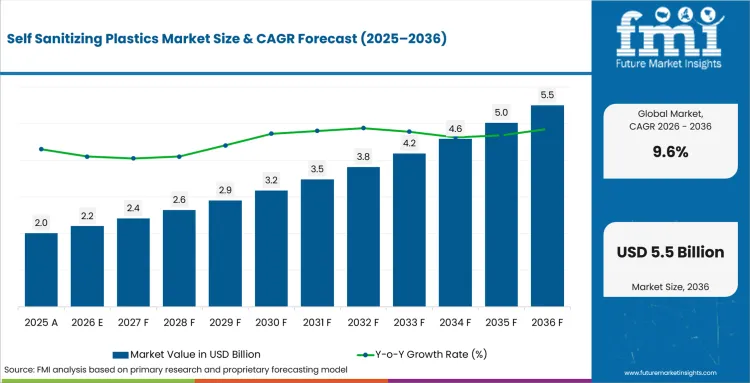
USD 2.2 billion in 2026 and USD 5.5 billion by 2036 at a 9.6% CAGR.
Demand for self sanitizing plastics is projected to expand at 9.6% CAGR between 2026 and 2036, increasing valuation from USD 2.2 billion in 2026 to USD 5.5 billion by 2036. Manufacturers need a common measurement method to compare antimicrobial additives across finished parts and production batches. ISO reconfirmed ISO 22196 in June 2026 for measuring antibacterial activity on treated plastics and other non-porous surfaces. The standard provides compounders with a stable laboratory basis for evaluating molded and extruded commercial components. Commercial value depends on repeatable evidence from the finished article rather than the additive concentrate alone. Material teams must connect laboratory activity with cleaning durability and mechanical performance across the intended service life. Claim language requires a separate regulatory review against the product’s intended commercial purpose and sales geography.
Healthcare equipment and public fixtures follow different purchase routes through distinct cleaning cycles and regulatory claim risks. Medical manufacturers require material compatibility and change control ahead of incorporating medical packaging components into validated workflows. Public-space projects place greater weight on abrasion resistance and clear product-protection language across visible touchpoints. The regulatory boundary shapes product design and promotional language across distributor materials and customer-facing communication. EPA’s March 2000 policy limits the treated-articles exemption to claims that protect the article itself and excludes implied public-health claims against human pathogens. A formulation can meet its material test yet require another registration route if promotion exceeds that boundary. Manufacturers need claim review alongside abrasion testing and migration assessment ahead of tooling or launch commitments.
Key Takeaways of Self Sanitizing Plastics Market
- Demand for self sanitizing plastics is driven by treated plastic parts that retain measurable activity through molding and repeated cleaning.
- Antimicrobial polyethylene is projected to account for 29.0% of product type in 2026 driven by familiar conversion routes.
- Healthcare and medical devices are estimated to hold 34.0% by application in 2026 due to formal material controls.
- The healthcare industry is forecast to represent 37.0% share in 2026 owing to recurring equipment qualification.
- Public-health claim exposure and activity loss during abrasion can delay adoption across consumer and healthcare products. Migration concerns and formulation costs extend qualification work across materials teams and commercial launch schedules.
- The competitive set includes Microban International and Avient Corporation alongside SANITIZED AG and BioCote Ltd. Parx Materials and Milliken & Company compete beside Tosaf Group and Sciessent LLC across focused or broader platforms. Selection depends on polymer coverage and final-part testing across regional claim support and application service requirements.
Analyst Perspective
“Self sanitizing plastics earn repeat specifications through finished-part evidence that survives molding and routine cleaning across normal service conditions. Material protection must remain measurable throughout normal wear under claims that never imply infection prevention or reduced disease transmission. Producers combining polymer engineering with regional claim guidance can shorten qualification and transfer approved formulations between plants without repeating every test. Commercial advantage comes from reliable performance throughout the component’s expected service life and established maintenance routine.”
- Nikhil Kaitwade, Principal Analyst, Future Market Insights
How is the Self Sanitizing Plastics Market segmented?
The Self Sanitizing Plastics Market is assessed by Product Type, Application, End User, Distribution Channel, Additive Type, and Region. Each category separates a distinct material choice or purchasing route within the defined market boundary.
Based on product type industry is driven by polyethylene, polypropylene, PVC, engineering plastics, and high-performance plastics by the base resin carrying the active additive. Application groups healthcare devices, packaging, consumer goods, building components, and automotive parts by the finished product receiving treatment. End user identifies the organization that specifies the treated material or incorporates it into commercial production. Distribution channel follows direct agreements, industrial distribution, specialty material supply, online orders, and retail routes. Additive type distinguishes silver, copper, zinc, organic, and other active technologies through their chemistry and processing behavior. Region reflects sales geography and the regulatory route applied to each finished treated article during commercial supply. The taxonomy excludes plastic additives used solely for processing, color, or appearance without an antimicrobial or related surface-protection function.
How does antimicrobial polyethylene shape purchasing within the product type category?
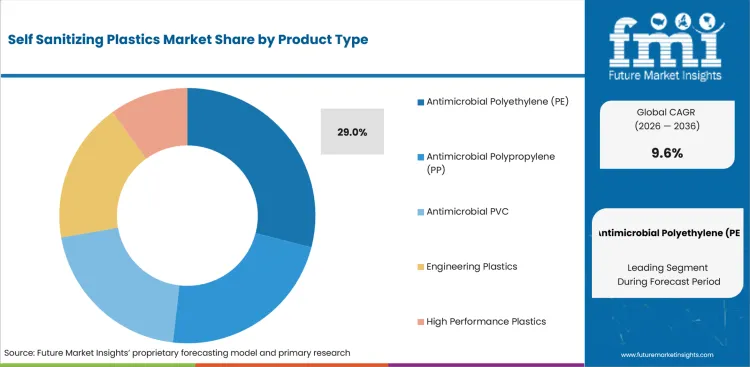
Antimicrobial polyethylene gives compounders a familiar base for films and molded components that need protection from odor or material deterioration. Established extrusion and injection-molding routes let manufacturers test additive performance without qualifying another base-resin platform. The material supports high-volume components across packaging and durable goods through familiar production controls already used at commercial scale. Final approval depends on finished-part activity and appearance alongside mechanical performance across recurring production runs and related plastic compounding programs.
- By product type, antimicrobial polyethylene is forecast to represent 29.0% in 2026 driven by familiar extrusion and molding routes for films and durable components. Compounders can conduct early trials on established polyethylene grades without creating another dedicated base-resin platform for production. The position depends on consistent activity and processing performance across repeated commercial batches and separate manufacturing sites.
- Packaging and component manufacturers use antimicrobial polyethylene for high-volume programs requiring flexible geometry and manageable material cost. BioCote stated in October 2025 that its K 2025 plastics program covered polyethylene and integration through molding or extrusion. The same production routes allow controlled masterbatch trials without permanent equipment changes across early formulation qualification programs. Adoption weakens if additive loading changes clarity or produces uneven surface activity across repeated production batches.
What supports healthcare and medical devices within the application category?
Medical plastics enter controlled device workflows that require documented material-change review across routine manufacturing and quality systems. Respiratory components provide a direct commercial example of antimicrobial polymer integration within regulated patient-care equipment and established production controls. BioCote documented its Eakin Healthcare partnership in April 2025 for breathing-circuit tubing containing silver ions dispersed throughout the polymer. The application places material protection inside a disposable respiratory device rather than on a removable coating. Device teams must confirm biocompatibility and process stability across sterile packaging or reusable equipment through finished-component evidence.
- The healthcare and medical devices segment is likely to capture 34.0% share in 2026 attributable to formal material-change controls across patient-care equipment. Device manufacturers must qualify antimicrobial formulations through established change procedures ahead of extending a specification across product families. The segment retains its position through recurring replacement needs and documented compatibility with cleaning protocols.
- Medical device producers increasingly purchase integrated antimicrobial materials for components that require traceable resin qualification and finished-part records. Hospital equipment teams favor formulations that preserve surface integrity throughout repeated disinfection cycles and routine clinical handling. Reference parts can support transfers across manufacturing sites without implying clinical protection for patients or healthcare staff. Adoption slows if product claims exceed the intended material function or trigger another regulatory pathway.
Why does healthcare industry hold the largest end user share?
Hospitals manage high-touch equipment through cleaning and disinfection programs that treated materials must support rather than replace. Antimicrobial plastics can protect equipment housings and furniture surfaces from odor or material deterioration during repeated handling. Hospital specifications therefore depend on cleaning compatibility and activity that remains measurable across the intended service life. Equipment manufacturers must document both conditions during expansion of one formulation across related product categories and production sites.
- The end user category is forecast to be led by healthcare industry at 37.0% share in 2026 due to recurring equipment replacement and documented cleaning requirements. Hospital groups can standardize treated-component requirements across furniture and equipment that share comparable cleaning protocols and material-performance expectations. The segment maintains its position through documented compatibility and defensible product claims rather than broad infection-prevention language.
- Hospital equipment manufacturers favor antimicrobial materials that preserve cleanability across durable surfaces and antimicrobial packaging components. Germany’s Robert Koch Institute stated in March 2025 that cleaning and disinfection remain basic and extended hygiene measures in medical facilities. The guidance places treated materials inside an established hygiene program with defined cleaning and disinfection responsibilities for healthcare operators. Adoption expands through specifications that define acceptable activity and appearance throughout repeated commercial cleaning cycles.
How does direct sales influence the distribution channel category?
Direct engagement during additive selection requires coordinated dosing and claim review across technical and regulatory functions. Direct sales can shorten clarification cycles for masterbatch systems by linking additive specialists with compounders and finished-product manufacturers. Avient described in February 2025 how its team evaluated clear and opaque resin routes for a toothbrush manufacturer. The company developed one universal carrier for several resin families and reported a 30% annual additive cost reduction. The case demonstrates why direct technical access can reduce formulation rework across commercial qualification and recurring production.
- Direct sales is projected to hold 39.0% share in 2026 owing to application-specific formulation support during customer qualification. Direct contracts give technical teams access to dosing guidance and claim review for each resin system. The route remains attractive for customized additives requiring coordinated tests between compounders and finished-product manufacturers ahead of recurring production.
- Original equipment manufacturers increasingly purchase through direct channels to align additive loading with molding conditions and permitted claims. Distributors remain useful for standard formulations that require local inventory and dependable routine technical support. Direct adoption grows during trials that involve several documented approval steps across technical and commercial teams. The channel loses share for small repeat orders that fit established masterbatch specifications without dedicated engineering.
What supports silver-based additives within the additive type category?
Silver-based additives combine broad polymer compatibility with established masterbatch routes across commodity and engineering resins. BioCote explained in February 2025 that manufacturers can integrate silver additives into polymers during production for healthcare and consumer applications. Controlled dosing must preserve appearance and mechanical performance throughout processing and the intended product life. Integration during manufacturing removes a separate coating step and supports durable material protection across normal product use. Formulators must confirm migration limits and color stability across every intended finished component using specialty polymers.
- Silver-based additives are set to lead the additive type category with 41.0% share in 2026 due to established carrier systems across several polymer families. Compounders can compare carrier systems without changing the active chemistry during controlled formulation trials across several resin families. The position rests on processing stability and documented finished-part activity rather than the headline additive price alone.
- Polymer producers favor silver systems for long-life components that require stable processing and limited visible change. Established masterbatch routes reduce formulation uncertainty during molding and extrusion trials across commercial production sites. Adoption expands in products that need durable material protection throughout repeated cleaning and routine service conditions. Alternative chemistries gain attention if migration limits or discoloration delay regulatory review and customer approval decisions.
What are the drivers, restraints, and opportunities in the Self Sanitizing Plastics Market?
Demand for self sanitizing plastics is supported by measurable product protection on high-touch parts, restrained by claim exposure and performance loss during repeated use, and strengthened by application-specific formulations that preserve material compatibility.
- Driver: Manufacturers need built-in protection against microbial odor and staining that cause premature deterioration on frequently handled plastic components.
- Restraint: Public-health claim exposure and activity loss during repeated cleaning can delay approvals across consumer and healthcare products.
- Opportunity: Metal-free and application-specific formulations can reach products that require stable appearance together with durable activity and clear claim boundaries.
Manufacturers specify built-in antimicrobial protection for plastic parts exposed to microbial odor and staining during routine use. The additive must enter molding or extrusion without changing product appearance or any essential material function. Microban reported in February 2026 that its PLASTINDIA program demonstrated antimicrobial technologies integrated directly during plastics manufacturing. The integrated production route retains protection within the component and avoids a separate coating operation during manufacturing. Related antimicrobial bottle closures require the same control over additive dosage and finished-part performance through commercial production.
Regulatory claim exposure materially restrains treated products promoted beyond the permitted protection of the article itself. EPA explained in May 2026 that unsupported self-sanitizing claims can weaken hygiene practices and trigger enforcement against unlawful products. A claim error can force label revision or product withdrawal even if laboratory material tests meet the intended product-protection standard. Commercial plans therefore need separate budgets for efficacy testing and regulatory review across each intended sales region. Consumer-facing products carry greater risk through promotional wording displayed directly on packaging and retail pages.
Metal-free chemistries provide a practical route for plastic products that face color or formulation limits with traditional metallic additives. The treatment must remain stable during processing and ultraviolet exposure without weakening the base polymer. Microban reported in April 2025 that its Ascera technology received a Silver Edison Award and integrates into polymers and coatings. Commercial fit improves in applications that require stable appearance or durable material protection during routine use. Finished-part testing must confirm color and processing stability together with retained activity under intended service conditions.
Which country CAGRs are profiled in the Self Sanitizing Plastics Market?
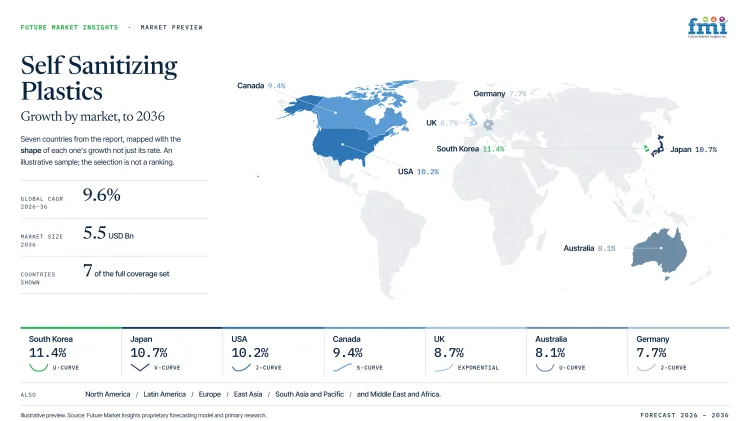
| Country | CAGR |
|---|---|
| South Korea | 11.4% |
| Japan | 10.7% |
| USA | 10.2% |
| Canada | 9.4% |
| UK | 8.7% |
| Australia | 8.1% |
| Germany | 7.7% |
How do country-level CAGRs compare in theSelf Sanitizing Plastics Market?
The country forecasts show a clear progression across the self sanitizing plastics market, with growth rates declining gradually from one market to the next. South Korea, Japan and the USA create an upper group where demand is supported by strong adoption of antimicrobial materials across healthcare, consumer goods and high-touch applications. Canada follows within a relatively short distance of this group and acts as a transition between the higher-growth and lower-growth markets. The UK, Australia and Germany form a closely aligned lower band, with only 1.0 percentage point separating the three countries. This pattern reflects differences in healthcare infection-control initiatives, advanced materials innovation and the pace at which antimicrobial plastic technologies are being incorporated into commercial products.
- South Korea benefits from a strong advanced materials sector and growing use of antimicrobial plastics in healthcare equipment, electronics and public-use environments where hygiene performance is a key consideration.
- Japan's outlook is supported by long-standing emphasis on cleanliness, product safety and high-performance material technologies, encouraging wider integration of self sanitizing plastic formulations.
- The USA reflects sustained demand from healthcare providers, consumer product manufacturers and building materials suppliers seeking surfaces with continuous antimicrobial functionality.
- Canada continues to support market expansion through increasing adoption of infection-control materials across healthcare facilities, institutional settings and consumer applications.
- The UK benefits from growing interest in antimicrobial materials that can complement hygiene management practices across healthcare, transportation and public infrastructure environments.
- Australia's market development is influenced by rising use of specialty plastics in medical and commercial applications where durability and sanitation performance remain important purchasing criteria.
- Germany maintains steady momentum through its strong manufacturing base and continued incorporation of functional additive technologies into engineered plastic products.
Similar CAGRs do not necessarily translate into identical commercialization opportunities. Differences in regulatory requirements, additive approval standards, healthcare procurement practices and end-use industry adoption can significantly influence demand for self sanitizing plastics. As a result, suppliers may encounter distinct product qualification and market entry conditions despite broadly comparable growth trends. The full report provides country-level CAGR analysis across North America, Latin America, Europe, East Asia, South Asia, Oceania and the Middle East and Africa.
Country-wise Analysis
- South Korea uses a national antibacterial test method for treated plastics and other non-porous product surfaces. The Korean Agency for Technology and Standards recorded KS M ISO 22196 with a December 2024 revision entry for antibacterial activity measurement. South Korea’s self sanitizing plastics outlook is anticipated to advance at 11.4% CAGR over the assessment period, supported by a shared domestic test basis. Local laboratories can apply the method during resin trials and finished-product review across separate manufacturing sites. The common framework helps producers compare activity without changing the evidence language between development and customer approval. Korean-language documentation and detailed claim review requirements create material entry friction for overseas producers serving local manufacturing accounts. A local laboratory or compounder can connect formulation trials with commercial qualification across national accounts.
- Japanese manufacturers use JIS Z 2801 to compare antibacterial activity across plastics and other non-textile surfaces. By 2036, Japan’s self sanitizing plastics market is projected to grow at 10.7% CAGR supported by an established national qualification method. Local technical teams use the shared method during formulation transfer and commercial quality review with molders. The Japanese Standards Association lists JIS Z 2801:2010 as active and records its latest confirmation in October 2022. Detailed records help manufacturers preserve activity and appearance across separate plants without repeating every early test. Low tolerance for unplanned resin changes creates material friction during overseas formulation transfers and customer qualification programs. Commercial expansion depends on documentation that connects cleaning durability with the approved process window for each finished component.
- United States market access depends on the federal distinction between product protection and public-health pesticidal claims for treated plastic articles. EPA updated its antimicrobial registration manual in June 2026 and retained separate requirements for public-health and non-public-health claims. The guidance gives manufacturers a defined route for products using registered active ingredients to protect the article itself. Adoption of self sanitizing plastics in the USA is estimated to expand at 10.2% CAGR through 2036, shaped by that clear claim boundary. Regulatory advisers and testing laboratories provide a direct enabler through application-specific efficacy records and permitted labeling. Unsupported disease language remains a material friction through its effect on registration decisions and federal enforcement exposure. National campaigns require completed legal review ahead of promotional language reaching distributors or consumer-facing sales channels.
- Canadian manufacturers must use antimicrobial preservatives registered or otherwise authorized for the intended treated-article application. In Canada, self sanitizing plastics demand is predicted to advance at 9.4% CAGR through 2036, enabled by a clear preservative route and bilingual claim requirements. Domestic regulatory expertise can coordinate active ingredients with application evidence and national label language during qualification. Health Canada stated in December 2025 that treated-article claims must remain consistent with the authorized antimicrobial label. The rule gives compounders a practical basis for healthcare and consumer plastic applications across national distribution. Broad geography creates service friction through higher technical-support costs across remote manufacturing and distribution locations outside major centers. Commercial plans should assign bilingual claim review and distributor training during national inventory expansion and channel development.
- Great Britain requires treated articles to use permitted active substances and carry prescribed labeling for biocidal claims. HSE’s April 2026 guidance requires approved active substances and specified labels for products placed on the Great Britain market. Self sanitizing plastics demand in the UK is forecast to rise at 8.7% CAGR over the forecast period, influenced by separate routes across Great Britain and Northern Ireland. HSE guidance also confirms that Northern Ireland remains subject to the EU Biocidal Products Regulation during commercial supply. Clear documentation enables distributors to explain product protection without overstating the permitted function across customer-facing sales materials. The split route creates material friction for companies distributing treated articles across both jurisdictions and separate regulatory systems. Local entry depends on current substance records and claim support alongside dependable formulation service and distributor training.
- Australia classifies antimicrobial articles through their intended purpose and the claims used during commercial supply. Self sanitizing plastics sales in Australia are forecast to expand at 8.1% CAGR by 2036, linked to claim-specific regulatory treatment for antimicrobial products. General product-protection wording can leave ordinary surface-modifying articles outside the therapeutic route during commercial supply. TGA guidance updated in November 2024 states that antiviral claims can require entry in the Australian Register of Therapeutic Goods. Local sponsors and regulatory advisers provide a direct launch enabler through product classification and claim review. Disease-related wording creates material friction through stronger evidence obligations and tighter advertising controls across consumer-facing product launches. Overseas producers need completed local claim review ahead of scaling products across national retail and distributor networks.
- German customers expect treated-plastic documentation to align with European biocidal rules and established cleaning procedures. Regulation (EU) No 528/2012 requires permitted active substances and sets labeling duties for treated articles carrying biocidal claims. Local application laboratories can connect polymer processing with final-part activity and documented cleaning compatibility across customer programs. Germany self sanitizing plastics sector is projected to record 7.7% CAGR during the assessment period, underpinned by European rules and established application support. That local service network enables specification work across industrial and healthcare components through coordinated testing and formulation assistance. Detailed technical review remains a friction through the need to align active-substance status with each maintenance protocol. Commercial production expands more reliably through local support that resolves both requirements during customer qualification and manufacturing transfer.
Who are the notable companies in the Self Sanitizing Plastics Market?
The Self Sanitizing Plastics competitive set includes Microban International, Avient Corporation, SANITIZED AG, BioCote Ltd., Parx Materials, Milliken & Company, Tosaf Group, and Sciessent LLC.
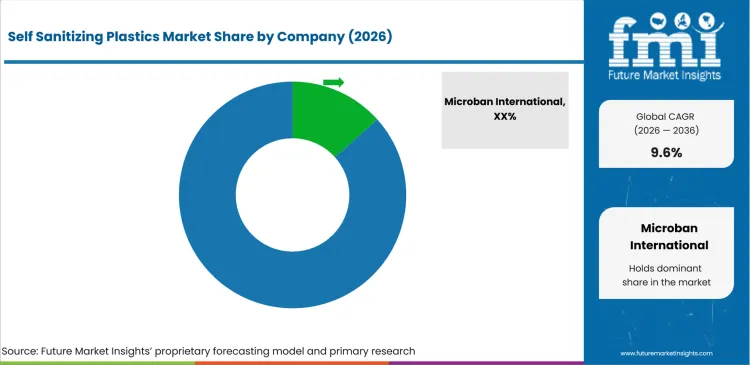
The competitive landscape remains fragmented between global additive platforms and smaller antimicrobial specialists serving defined application niches. Large groups compete through chemistry breadth and polymer application support across several resin families and production regions. Focused companies compete through proprietary technologies and detailed testing support for selected finished-product requirements across narrow application niches. New entrants can gain access through a well-defined claim boundary and credible data from finished plastic components. Corporate scale does not secure a specification on its own; each formulation must pass the customer’s processing and regulatory review. Competitive advantage therefore rests on polymer compatibility and local technical support backed by evidence across different plastic materials and production sites.
- Microban International and Avient Corporation compete through broad additive portfolios and polymer application engineering across several resin families. Their international service networks support formulation transfers between production sites and separate customer qualification programs. Commercial strength depends on responsive technical support and documented finished-part performance rather than portfolio size alone.
- SANITIZED AG and BioCote Limited combine polymer integration with testing and regional claim support across regulated applications. Their position suits manufacturers requiring one technical partner across several product categories and regional claim pathways. Each company must connect laboratory activity with processing stability and permitted communication for the finished article.
- Parx Materials and Sciessent LLC offer focused technology platforms for selected treated-surface and material-protection requirements. Milliken & Company and Tosaf Group add established chemical or masterbatch infrastructure across broader manufacturing networks. Each route requires application-specific evidence and responsive formulation support ahead of recurring commercial component production.
Competitive Benchmarking: Self Sanitizing Plastics Market
| Company | Antimicrobial Portfolio Depth | Polymer Application Support | Regulatory and Testing Support | Geographic Reach |
|---|---|---|---|---|
| Microban International | High | High | High | Global |
| Avient Corporation | Medium | High | Medium | Global |
| SANITIZED AG | High | High | High | Global |
| BioCote Ltd. | High | High | High | Global |
| Parx Materials | Low | Medium | Medium | Europe and selected exports |
| Milliken & Company | Medium | Medium | Medium | Global |
| Tosaf Group | Medium | High | Medium | Global |
| Sciessent LLC | Medium | Medium | Medium | Global |
Scoring basis: Antimicrobial portfolio depth is rated high for several verified chemistry families across multiple polymer formats and applications. Medium describes a narrower commercial range that covers fewer chemistry families or defined application groups. Low identifies one verified exact-market technology with limited breadth and never substitutes for missing evidence. Polymer application support is rated high for documented work across several resins and production routes. Medium covers defined polymer families with documented support across fewer manufacturing processes or resin categories. Low reflects basic integration guidance for a narrow material set with verified commercial availability and technical documentation. Regulatory and testing support is rated high for documented claim guidance and recognized testing resources across several regions. Medium indicates strong testing or regulatory support across a limited number of application areas or sales regions. Low requires verified assistance within a narrow exact-market scope and cannot represent information that remains unavailable.
Key Developments in the Self Sanitizing Plastics Market
- In July 2025, BOMImed introduced antimicrobial Micro Protect breathing circuits through a partnership with BioCote Ltd. The technology is integrated into the circuit material rather than applied as a removable surface treatment. The launch extends built-in antimicrobial protection into a respiratory device manufactured for Canadian hospitals and clinics.
- In February 2025, Avient Corporation launched Cesa™ WithStand™ SX low-haze antimicrobial additives for clear polycarbonate and acrylic applications. The formulation preserves visual clarity in finished parts that include recycled resin across transparent component applications. The launch broadens the addressable range for transparent components across commercial extrusion and molding production processes. Manufacturers must confirm appearance and antimicrobial activity on the final part ahead of transferring the formulation across product lines.
- In January 2026, Microban International reported adding 11 testing capabilities during 2025 across its customer-support laboratories. The additions included methods for polymer staining and anti-biofilm activity on plastics and non-porous surfaces. The expansion gives manufacturers broader technical support during formulation qualification and detailed finished-part performance review.
- In December 2025, SANITIZED AG announced renewed International Antimicrobial Council accreditation for its microbiological laboratory. The accreditation confirms access to internationally recognized testing methods across formulation projects and customer development programs. The renewal strengthens the company’s support during material qualification and claim review for treated plastic components.
Self Sanitizing Plastics Market - Report Scope
| Coverage field | Report scope |
|---|---|
| Market breakdown | Product Type, Application, End User, Distribution Channel, Additive Type, and Region. |
| Market Definition | Polymers and plastic components containing integrated antimicrobial or other active technologies intended to reduce microbial survival or material deterioration on treated surfaces. |
| Regions Covered | North America, Latin America, Europe, East Asia, South Asia and Pacific, and Middle East and Africa. |
| Countries Covered | South Korea, Japan, USA, Canada, UK, Australia, and Germany. |
| Key Companies Profiled | Microban International, Avient Corporation, SANITIZED AG, BioCote Ltd., Parx Materials, Milliken & Company, Tosaf Group, and Sciessent LLC |
| Forecast Period | 2026 to 2036. |
| Approach | Hybrid bottom-up and top-down market sizing supported by primary interviews and official desk research. |
Self Sanitizing Plastics Market - Research Methodology
| Method | Approach |
|---|---|
| Primary Research | FMI analysts gathered input from manufacturers, service providers, technology developers, distributors, end users, procurement teams, and subject-matter experts. Interviews examined purchasing decisions, product or service evaluation, adoption barriers, approval requirements, pricing considerations, and expectations for technical or commercial support. Respondents were also asked what evidence is required before a trial, pilot, or initial order develops into regular purchasing. |
| Desk Research | Desk research covered government statistics, regulatory publications, trade data, industry associations, technical literature, standards, company filings, product information, and official corporate announcements. Sources were reviewed for relevance, publication date, geographic coverage, and consistency with the defined market scope. Claims relating to performance, applications, approvals, capacity, investment, and commercial activity were retained only when supported by credible public evidence. |
| Market Sizing and Forecasting | The market model combined the baseline value with historical performance, segment structure, pricing and volume indicators, adoption levels, company participation, and country-level demand conditions. Forecast assumptions considered economic activity, investment trends, regulatory developments, technology adoption, purchasing cycles, supply availability, and barriers to wider market use. Segment and regional estimates were reconciled before the final market total was calculated. |
| Data Validation | Estimates were checked against multiple independent indicators, including public data, company activity, trade patterns, industry developments, and findings from primary interviews. Validation also tested whether products, services, applications, and company revenues fell within the defined market boundaries. Adjacent categories, unsupported claims, overlapping revenues, and activities without direct market relevance were excluded to reduce double counting and maintain consistency across segments and countries. |
Self Sanitizing Plastics Market by Segments
Self Sanitizing Plastics Market segmented by Product Type:
- Antimicrobial Polyethylene (PE)
- HDPE Antimicrobial Plastic
- LDPE Antimicrobial Plastic
- Antimicrobial Polypropylene (PP)
- Homopolymer PP
- Copolymer PP
- Antimicrobial PVC
- Rigid PVC
- Flexible PVC
- Engineering Plastics
- ABS
- Polycarbonate
- High Performance Plastics
- PEEK
- Polyamide
Self Sanitizing Plastics Market segmented by Application:
- Healthcare & Medical Devices
- Medical Equipment
- Hospital Furniture
- Packaging
- Food Packaging
- Pharmaceutical Packaging
- Consumer Goods
- Household Products
- Personal Care Products
- Building & Construction
- Interior Surfaces
- Public Infrastructure
- Automotive
- Interior Components
- Public Transport Components
Self Sanitizing Plastics Market segmented by End User:
- Healthcare Industry
- Hospitals
- Medical Device Manufacturers
- Packaging Industry
- Food Packaging Companies
- Pharmaceutical Packaging Companies
- Consumer Goods Manufacturers
- Household Product Manufacturers
- Electronics Manufacturers
- Construction Industry
- Commercial Buildings
- Residential Buildings
- Automotive Industry
- OEMs
- Aftermarket Suppliers
Self Sanitizing Plastics Market segmented by Distribution Channel:
- Direct Sales
- OEM Supply Agreements
- Bulk Industrial Orders
- Industrial Distributors
- Authorized Distributors
- Regional Distributors
- Specialty Material Suppliers
- Polymer Compound Suppliers
- Additive Suppliers
- Online Sales
- Manufacturer Websites
- B2B E-commerce Platforms
- Retail Sales
- Industrial Retailers
- Specialty Stores
Self Sanitizing Plastics Market segmented by Additive Type:
- Silver-Based Additives
- Silver Ion Technology
- Silver Zeolite
- Copper-Based Additives
- Copper Ion Additives
- Copper Oxide Additives
- Zinc-Based Additives
- Zinc Pyrithione
- Zinc Oxide
- Organic Antimicrobial Additives
- Quaternary Ammonium Compounds
- Organosilane Additives
- Other Antimicrobial Technologies
- Photocatalytic Additives
- Nanocomposite Additives
Self Sanitizing Plastics Market by Region:
- North America
- USA
- Canada
- Latin America
- Brazil
- Mexico
- Argentina
- Other Latin America
- Western Europe
- Germany
- France
- UK
- Italy
- Spain
- BENELUX
- Nordics
- Other Western Europe
- Eastern Europe
- Poland
- Romania
- Hungary
- Other Eastern Europe
- East Asia
- China
- Japan
- South Korea
- South Asia and Pacific
- India
- ASEAN
- Australia and New Zealand
- Other South Asia and Pacific
- Middle East and Africa
- GCC Countries
- South Africa
- Israel
- Türkiye
- Other Middle East and Africa
Research Sources and Bibliography
- International Organization for Standardization. (2011, August; confirmed 2026, June 15).
- U.S. Environmental Protection Agency. (2000, March 6).
- U.S. Environmental Protection Agency. (2026, June 10).
- Health and Safety Executive. (2026, April 14).
- Health and Safety Executive. (2025, November 28).
- European Parliament and Council of the European Union. (2012, May 22; consolidated 2026, June 15)
- Therapeutic Goods Administration. (2021, August 1; updated 2024, November 4).
- Robert Koch Institute. (2025, March 25).
- BioCote Ltd. (2025, October 2).
- BioCote Ltd. (2025, April 9).
- Avient Corporation. (2025, February 5).
- Mullane, H. (2025, February 7).
- Microban International. (2026, February 24).
- Microban International. (2025, April 8)
- Avient Corporation. (2025, February 3)
- BioCote Ltd. (2025, July 20).
- Microban International. (2026, January 16).
- SANITIZED AG. (2025, December 1).
- Parx Materials N.V. (n.d.).
- Tosaf. (2023, July 26).
- Sciessent LLC. (n.d.).
This bibliography is provided for reader reference and is not exhaustive. The full report contains the complete reference list and detailed citations
This Report Answers
- How large is the Self Sanitizing Plastics Market in 2026 and 2036?
- Which operating conditions support investment in self-sanitizing plastic components?
- Why do antimicrobial polyethylene and silver-based additives hold notable shares?
- How do healthcare applications shape qualification and purchasing requirements?
- Which claim and durability issues limit market expansion?
- How do country growth rates differ across the seven profiled markets?
- Which companies provide exact-market antimicrobial polymer capabilities?
- What capability thresholds support the competitive benchmarking ratings?
- Which recent company developments are improving product integration, testing, and qualification support?
- What evidence should executives require before expanding a material specification?
Frequently Asked Questions
How big is the Self Sanitizing Plastics Market in 2026?
The self sanitizing plastics market is valued at USD 2.2 billion in 2026 and is forecast to reach USD 5.5 billion by 2036. Growth is supported by manufacturers specifying built-in antimicrobial protection for high-touch plastic components that must retain measurable activity through molding, repeated cleaning, and routine service across healthcare and consumer applications.
What is the CAGR of the Self Sanitizing Plastics Market from 2026 to 2036?
The self sanitizing plastics market grows at a CAGR of 9.6% between 2026 and 2036, supported by demand for treated plastic parts that protect against microbial odor and material deterioration across healthcare equipment, consumer goods, and public-space fixtures requiring durable antimicrobial performance throughout their intended service life.
Which product type leads the Self Sanitizing Plastics Market?
Antimicrobial polyethylene accounts for 29.0% of the self sanitizing plastics market by product type in 2026, driven by familiar extrusion and injection-molding routes that let compounders test additive performance across high-volume films and durable components without qualifying a separate base-resin platform for commercial production.
How much will the Self Sanitizing Plastics Market add between 2026 and 2036?
The self sanitizing plastics market is set to add USD 3.3 billion between 2026 and 2036, growing from USD 2.2 billion to USD 5.5 billion as integrated antimicrobial formulations enter recurring specifications across healthcare equipment, packaging, consumer goods, and building components through established masterbatch and compounding production routes.
Who are the leading companies in the Self Sanitizing Plastics Market?
Eight companies lead the self sanitizing plastics market, including Microban International, Avient Corporation, SANITIZED AG, BioCote Ltd., Parx Materials, Milliken & Company, Tosaf Group, and Sciessent LLC, competing through antimicrobial portfolio depth, polymer application engineering, and regional regulatory and testing support across treated plastic component programs worldwide.
Preview the report firsthand - request a free sample
Get SampleGet the brochure for pricing and purchase details.
Get PDFTable of Content
- Key Takeaways
- Market Size and CAGR
- Top Growth Driver
- Fastest Growing Segment
- Leading Region
- Key Companies
- Emerging Opportunities
- Executive Summary
- Global Market Outlook
- Demand-side Trends
- Supply-side Trends
- Technology Roadmap Analysis
- Analysis and Recommendations
- Analyst Perspective (What is happening? Why now? What should investors know?)
- Key Questions Answered
- How large is the market?
- What is the CAGR?
- What are key trends?
- Which region dominates?
- Who are the leaders?
- Market Overview
- Market Coverage / Taxonomy
- Market Definition / Scope / Limitations
- Research Methodology
- Chapter Orientation
- Analytical Lens and Working Hypotheses
- Market Structure, Signals, and Trend Drivers
- Benchmarking and Cross-market Comparability
- Market Sizing, Forecasting, and Opportunity Mapping
- Research Design and Evidence Framework
- Desk Research Programme (Secondary Evidence)
- Expert Input and Fieldwork (Primary Evidence)
- Tooling, Models, and Reference Databases
- Data Engineering and Model Build
- Quality Assurance and Audit Trail
- Market Background
- Market Dynamics (Drivers, Restraints, Opportunity, Trends)
- Scenario Forecast (Optimistic, Likely, Conservative)
- Impact Analysis
- AI Impact
- Sustainability Impact
- Regulatory Impact
- Technology Impact
- Consumer / Buyer Analysis
- Purchase Drivers
- Adoption Barriers
- Buyer Journey
- Opportunity Map Analysis
- Product Life Cycle Analysis
- Supply Chain Analysis
- Investment Feasibility Matrix
- Value Chain Analysis
- PESTLE and Porter's Analysis
- Regulatory Landscape
- Regional Parent Market Outlook
- Production and Consumption Statistics
- Import and Export Statistics
- Global Market Analysis and Forecast, 2021 to 2036
- Historical Market Size Value (USD Billion) Analysis, 2021 to 2025
- Current and Future Market Size Value (USD Billion) Projections, 2026 to 2036
- Y-o-Y Growth Trend Analysis
- Absolute $ Opportunity Analysis
- Global Market Pricing Analysis, 2021 to 2036
- Global Market Analysis and Forecast, By Product, 2021 to 2036
- Introduction / Key Findings
- Historical Market Size Value (USD Billion) Analysis By Product, 2021 to 2025
- Current and Future Market Size Value (USD Billion) Analysis and Forecast By Product, 2026 to 2036
- Antimicrobial Additives
- Silver-Based Additives
- Copper-Based Additives
- Antimicrobial Coatings and Surface Treatments
- Antimicrobial Polymer Coatings
- Antimicrobial Surface Treatments
- Inherently Antimicrobial Plastics
- Inherently Antimicrobial Polymer Grades
- Antimicrobial Polymer Blends
- Photocatalytic Plastics
- Titanium Dioxide-Based Plastics
- Photocatalytic Polymer Composites
- Other Self-Sanitizing Plastics
- Organic Antimicrobial Plastics
- Hybrid Antimicrobial Plastics
- Antimicrobial Additives
- Y-o-Y Growth Trend Analysis By Product, 2021 to 2025
- Absolute $ Opportunity Analysis By Product, 2026 to 2036
- Global Market Analysis and Forecast, By Polymer Type, 2021 to 2036
- Introduction / Key Findings
- Historical Market Size Value (USD Billion) Analysis By Polymer Type, 2021 to 2025
- Current and Future Market Size Value (USD Billion) Analysis and Forecast By Polymer Type, 2026 to 2036
- Polyethylene (PE)
- High-Density Polyethylene
- Low-Density Polyethylene
- Polypropylene (PP)
- Homopolymer Polypropylene
- Copolymer Polypropylene
- Polyvinyl Chloride (PVC)
- Rigid PVC
- Flexible PVC
- Acrylonitrile Butadiene Styrene (ABS)
- General-Purpose ABS
- High-Impact ABS
- Polycarbonate (PC)
- Standard Polycarbonate
- Flame-Retardant Polycarbonate
- Engineering Plastics
- Polyamide
- Polyoxymethylene
- Polyethylene (PE)
- Y-o-Y Growth Trend Analysis By Polymer Type, 2021 to 2025
- Absolute $ Opportunity Analysis By Polymer Type, 2026 to 2036
- Global Market Analysis and Forecast, By Application, 2021 to 2036
- Introduction / Key Findings
- Historical Market Size Value (USD Billion) Analysis By Application, 2021 to 2025
- Current and Future Market Size Value (USD Billion) Analysis and Forecast By Application, 2026 to 2036
- Healthcare
- Medical Devices
- Hospital Equipment and Surfaces
- Food and Beverage Packaging
- Fresh Food Packaging
- Beverage Packaging
- Consumer Goods
- Household Products
- Electronics and Personal Devices
- Building and Construction
- Door Handles and Hardware
- Interior Surfaces and Fixtures
- Automotive
- Interior Components
- High-Touch Vehicle Surfaces
- Public Infrastructure
- Public Transit Components
- Public Furniture and High-Touch Fixtures
- Healthcare
- Y-o-Y Growth Trend Analysis By Application, 2021 to 2025
- Absolute $ Opportunity Analysis By Application, 2026 to 2036
- Global Market Analysis and Forecast, By End User, 2021 to 2036
- Introduction / Key Findings
- Historical Market Size Value (USD Billion) Analysis By End User, 2021 to 2025
- Current and Future Market Size Value (USD Billion) Analysis and Forecast By End User, 2026 to 2036
- Healthcare and Medical Institutions
- Hospitals and Clinics
- Long-Term Care Facilities
- Food and Beverage Manufacturers
- Food Processing Companies
- Beverage Producers
- Consumer Goods Manufacturers
- Household Product Manufacturers
- Electronics Manufacturers
- Automotive Manufacturers
- Passenger Vehicle Manufacturers
- Commercial Vehicle Manufacturers
- Building and Construction Companies
- Commercial Building Developers
- Residential Construction Companies
- Public and Institutional Organizations
- Government Facilities
- Public Transportation Authorities
- Healthcare and Medical Institutions
- Y-o-Y Growth Trend Analysis By End User, 2021 to 2025
- Absolute $ Opportunity Analysis By End User, 2026 to 2036
- Global Market Analysis and Forecast, By Distribution Channel, 2021 to 2036
- Introduction / Key Findings
- Historical Market Size Value (USD Billion) Analysis By Distribution Channel, 2021 to 2025
- Current and Future Market Size Value (USD Billion) Analysis and Forecast By Distribution Channel, 2026 to 2036
- Direct Sales
- Direct Manufacturer Sales
- Key Account Contracts
- Distributors and Specialty Chemical Suppliers
- Regional Chemical Distributors
- Specialty Polymer Distributors
- Polymer Compounders and Masterbatch Suppliers
- Antimicrobial Masterbatch Suppliers
- Custom Polymer Compounders
- OEM and Industrial Supply Contracts
- Automotive OEM Contracts
- Medical Device Supply Contracts
- Online and Digital B2B Channels
- Industrial E-Commerce Platforms
- Direct Digital Procurement
- Direct Sales
- Y-o-Y Growth Trend Analysis By Distribution Channel, 2021 to 2025
- Absolute $ Opportunity Analysis By Distribution Channel, 2026 to 2036
- Global Market Analysis and Forecast, By Technology
- Introduction / Key Findings
- Historical Market Size Value (USD Billion) Analysis By Technology, 2021 to 2025
- Current and Future Market Size Value (USD Billion) Analysis and Forecast By Technology, 2026 to 2036
- Silver-Based Antimicrobial Technology
- Silver Ion Technology
- Silver Nanoparticle Technology
- Copper-Based Antimicrobial Technology
- Copper Ion Technology
- Copper Oxide Technology
- Organic Antimicrobial Technology
- Quaternary Ammonium Compounds
- Organic Biocidal Additives
- Zinc-Based Antimicrobial Technology
- Zinc Oxide Technology
- Zinc Ion Technology
- Photocatalytic Technology
- Titanium Dioxide Photocatalysis
- Light-Activated Antimicrobial Systems
- Hybrid and Multi-Mechanism Technology
- Silver-Copper Hybrid Systems
- Multi-Additive Antimicrobial Systems
- Silver-Based Antimicrobial Technology
- Y-o-Y Growth Trend Analysis By Technology, 2021 to 2025
- Absolute $ Opportunity Analysis By Technology, 2026 to 2036
- Global Market Analysis and Forecast, By Region, 2021 to 2036
- Introduction
- Historical Market Size Value (USD Billion) Analysis By Region, 2021 to 2025
- Current Market Size Value (USD Billion) Analysis and Forecast By Region, 2026 to 2036
- North America
- Latin America
- Western Europe
- Eastern Europe
- East Asia
- South Asia and Pacific
- Middle East & Africa
- Market Attractiveness Analysis By Region
- North America Market Analysis and Forecast, By Country, 2021 to 2036
- Historical Market Size Value (USD Billion) Trend Analysis By Market Taxonomy, 2021 to 2025
- Market Size Value (USD Billion) Forecast By Market Taxonomy, 2026 to 2036
- By Country
- USA
- Canada
- By Product
- By Polymer Type
- By Application
- By End User
- By Distribution Channel
- By Technology
- By Country
- Market Attractiveness Analysis
- By Country
- By Product
- By Polymer Type
- By Application
- By End User
- By Distribution Channel
- By Technology
- Key Takeaways
- Latin America Market Analysis and Forecast, By Country
- Historical Market Size Value (USD Billion) Trend Analysis By Market Taxonomy, 2021 to 2025
- Market Size Value (USD Billion) Forecast By Market Taxonomy, 2026 to 2036
- By Country
- Brazil
- Mexico
- Chile
- Rest of Latin America
- By Product
- By Polymer Type
- By Application
- By End User
- By Distribution Channel
- By Technology
- By Country
- Market Attractiveness Analysis
- By Country
- By Product
- By Polymer Type
- By Application
- By End User
- By Distribution Channel
- By Technology
- Key Takeaways
- Western Europe Market Analysis and Forecast, By Country
- Historical Market Size Value (USD Billion) Trend Analysis By Market Taxonomy, 2021 to 2025
- Market Size Value (USD Billion) Forecast By Market Taxonomy, 2026 to 2036
- By Country
- Germany
- UK
- Italy
- Spain
- France
- Nordic
- BENELUX
- Rest of Western Europe
- By Product
- By Polymer Type
- By Application
- By End User
- By Distribution Channel
- By Technology
- By Country
- Market Attractiveness Analysis
- By Country
- By Product
- By Polymer Type
- By Application
- By End User
- By Distribution Channel
- By Technology
- Key Takeaways
- Eastern Europe Market Analysis and Forecast, By Country
- Historical Market Size Value (USD Billion) Trend Analysis By Market Taxonomy, 2021 to 2025
- Market Size Value (USD Billion) Forecast By Market Taxonomy, 2026 to 2036
- By Country
- Russia
- Poland
- Hungary
- Balkan & Baltic
- Rest of Eastern Europe
- By Product
- By Polymer Type
- By Application
- By End User
- By Distribution Channel
- By Technology
- By Country
- Market Attractiveness Analysis
- By Country
- By Product
- By Polymer Type
- By Application
- By End User
- By Distribution Channel
- By Technology
- Key Takeaways
- East Asia Market Analysis and Forecast, By Country
- Historical Market Size Value (USD Billion) Trend Analysis By Market Taxonomy, 2021 to 2025
- Market Size Value (USD Billion) Forecast By Market Taxonomy, 2026 to 2036
- By Country
- China
- Japan
- South Korea
- By Product
- By Polymer Type
- By Application
- By End User
- By Distribution Channel
- By Technology
- By Country
- Market Attractiveness Analysis
- By Country
- By Product
- By Polymer Type
- By Application
- By End User
- By Distribution Channel
- By Technology
- Key Takeaways
- South Asia and Pacific Market Analysis and Forecast, By Country
- Historical Market Size Value (USD Billion) Trend Analysis By Market Taxonomy, 2021 to 2025
- Market Size Value (USD Billion) Forecast By Market Taxonomy, 2026 to 2036
- By Country
- India
- ASEAN
- Australia & New Zealand
- Rest of South Asia and Pacific
- By Product
- By Polymer Type
- By Application
- By End User
- By Distribution Channel
- By Technology
- By Country
- Market Attractiveness Analysis
- By Country
- By Product
- By Polymer Type
- By Application
- By End User
- By Distribution Channel
- By Technology
- Key Takeaways
- Middle East & Africa Market Analysis and Forecast, By Country
- Historical Market Size Value (USD Billion) Trend Analysis By Market Taxonomy, 2021 to 2025
- Market Size Value (USD Billion) Forecast By Market Taxonomy, 2026 to 2036
- By Country
- Kingdom of Saudi Arabia
- Other GCC Countries
- Türkiye
- South Africa
- Other African Union
- Rest of Middle East & Africa
- By Product
- By Polymer Type
- By Application
- By End User
- By Distribution Channel
- By Technology
- By Country
- Market Attractiveness Analysis
- By Country
- By Product
- By Polymer Type
- By Application
- By End User
- By Distribution Channel
- By Technology
- Key Takeaways
- Key Countries Market Analysis
- USA
- Pricing Analysis
- Market Share Analysis, 2025
- By Product
- By Polymer Type
- By Application
- By End User
- By Distribution Channel
- By Technology
- Canada
- Pricing Analysis
- Market Share Analysis, 2025
- By Product
- By Polymer Type
- By Application
- By End User
- By Distribution Channel
- By Technology
- Mexico
- Pricing Analysis
- Market Share Analysis, 2025
- By Product
- By Polymer Type
- By Application
- By End User
- By Distribution Channel
- By Technology
- Brazil
- Pricing Analysis
- Market Share Analysis, 2025
- By Product
- By Polymer Type
- By Application
- By End User
- By Distribution Channel
- By Technology
- Chile
- Pricing Analysis
- Market Share Analysis, 2025
- By Product
- By Polymer Type
- By Application
- By End User
- By Distribution Channel
- By Technology
- Germany
- Pricing Analysis
- Market Share Analysis, 2025
- By Product
- By Polymer Type
- By Application
- By End User
- By Distribution Channel
- By Technology
- UK
- Pricing Analysis
- Market Share Analysis, 2025
- By Product
- By Polymer Type
- By Application
- By End User
- By Distribution Channel
- By Technology
- Italy
- Pricing Analysis
- Market Share Analysis, 2025
- By Product
- By Polymer Type
- By Application
- By End User
- By Distribution Channel
- By Technology
- Spain
- Pricing Analysis
- Market Share Analysis, 2025
- By Product
- By Polymer Type
- By Application
- By End User
- By Distribution Channel
- By Technology
- France
- Pricing Analysis
- Market Share Analysis, 2025
- By Product
- By Polymer Type
- By Application
- By End User
- By Distribution Channel
- By Technology
- India
- Pricing Analysis
- Market Share Analysis, 2025
- By Product
- By Polymer Type
- By Application
- By End User
- By Distribution Channel
- By Technology
- ASEAN
- Pricing Analysis
- Market Share Analysis, 2025
- By Product
- By Polymer Type
- By Application
- By End User
- By Distribution Channel
- By Technology
- Australia & New Zealand
- Pricing Analysis
- Market Share Analysis, 2025
- By Product
- By Polymer Type
- By Application
- By End User
- By Distribution Channel
- By Technology
- China
- Pricing Analysis
- Market Share Analysis, 2025
- By Product
- By Polymer Type
- By Application
- By End User
- By Distribution Channel
- By Technology
- Japan
- Pricing Analysis
- Market Share Analysis, 2025
- By Product
- By Polymer Type
- By Application
- By End User
- By Distribution Channel
- By Technology
- South Korea
- Pricing Analysis
- Market Share Analysis, 2025
- By Product
- By Polymer Type
- By Application
- By End User
- By Distribution Channel
- By Technology
- Russia
- Pricing Analysis
- Market Share Analysis, 2025
- By Product
- By Polymer Type
- By Application
- By End User
- By Distribution Channel
- By Technology
- Poland
- Pricing Analysis
- Market Share Analysis, 2025
- By Product
- By Polymer Type
- By Application
- By End User
- By Distribution Channel
- By Technology
- Hungary
- Pricing Analysis
- Market Share Analysis, 2025
- By Product
- By Polymer Type
- By Application
- By End User
- By Distribution Channel
- By Technology
- Kingdom of Saudi Arabia
- Pricing Analysis
- Market Share Analysis, 2025
- By Product
- By Polymer Type
- By Application
- By End User
- By Distribution Channel
- By Technology
- Türkiye
- Pricing Analysis
- Market Share Analysis, 2025
- By Product
- By Polymer Type
- By Application
- By End User
- By Distribution Channel
- By Technology
- South Africa
- Pricing Analysis
- Market Share Analysis, 2025
- By Product
- By Polymer Type
- By Application
- By End User
- By Distribution Channel
- By Technology
- USA
- Market Structure Analysis
- Competition Dashboard
- Competition Benchmarking
- Market Share Analysis of Top Players
- By Regional
- By Product
- By Polymer Type
- By Application
- By End User
- By Distribution Channel
- By Technology
- Emerging Startups
- Innovation Benchmarking
- Competition Analysis
- Competition Deep Dive
- Microban International, Ltd.
- Overview
- Product Portfolio
- Profitability by Market Segments
- Sales Footprint
- Strategy Overview
- Marketing Strategy
- Product Strategy
- Channel Strategy
- BASF SE
- DuPont de Nemours, Inc.
- BioCote Limited
- Milliken & Company
- Polygiene Group AB
- Avient Corporation
- Clariant AG
- SABIC
- Parx Materials N.V.
- Microban International, Ltd.
- Case Studies
- Success Stories
- Recent Developments
- Competition Deep Dive
- Assumptions & Acronyms Used


