

- Industry Size (2026)
- USD 981.0 Mn
- Forecast (2036)
- USD 2445.0 Mn
- CAGR (2026 to 2036)
- 9.6%
Antimicrobial Bottle Closures Market Forecast and Outlook 2026 to 2036
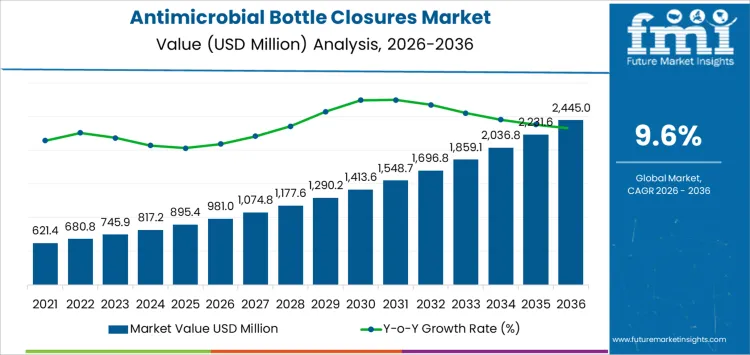
In 2026, the antimicrobial bottle closures market is valued at USD 981 million and is projected to reach USD 2,445 million by 2036, expanding at a CAGR of 9.6%. The first structural breakpoint emerges around the 2029-2030 period, when market value moves beyond USD 1.29 billion. Up to this point, growth is driven primarily by adoption in personal care, pharmaceutical, and healthcare packaging, where antimicrobial screw caps and pumps are integrated into premium product lines. This phase reflects controlled uptake, limited SKU expansion, and selective use of silver-based surface coatings rather than full portfolio conversion.
A second and more pronounced breakpoint appears after 2032, when the market crosses approximately USD 1.86 billion and growth accelerates into higher absolute annual additions. Beyond this threshold, antimicrobial closures transition from differentiated features to baseline specifications across food, beverage, and household cleaner packaging. Embedded biocide masterbatch technologies and coated PP formats scale more rapidly, supported by standardized manufacturing and repeat procurement. This breakpoint marks a shift from adoption-led growth to volume-led expansion, where demand is reinforced by broader packaging normalization rather than incremental application testing.
Quick Stats of the Antimicrobial Bottle Closures Market:
- Antimicrobial Bottle Closures Market Value (2026): USD 981.0 million
- Antimicrobial Bottle Closures Market Forecast Value (2036): USD 2,445.0 million
- Antimicrobial Bottle Closures Market Forecast CAGR (2026 to 2036): 9.6%
- Leading End Use: Personal Care & Pharma (38%)
- Key Growth Regions: India, China, USA, Brazil, Germany, Japan
- Top Players: AptarGroup, Berry Global, Amcor, UFlex, Klabin, Takemoto
What is the Growth Forecast for the Antimicrobial Bottle Closures Market through 2036?
From 2026 to 2031, the antimicrobial bottle closures market rises from USD 981 million to around USD 1,416 million, representing the early growth curve characterized by controlled acceleration. Demand in this phase is driven by selective adoption in bottled beverages, pharmaceuticals, and personal care products where contamination risk mitigation carries immediate value. Growth remains disciplined, as brand owners evaluate antimicrobial efficacy, regulatory acceptability, and cost trade-offs. Uptake is concentrated in premium and regulated segments, with annual gains increasing gradually as closures are integrated into targeted product lines rather than entire portfolios.
Between 2031 and 2036, the market expands from approximately USD 1,416 million to USD 2,445 million, illustrating the late growth curve, where scale rather than validation defines momentum. Adoption broadens across mass-market beverages, dairy alternatives, and household liquids as antimicrobial functionality shifts from differentiation to expectation. Annual value additions grow sharply as closures are standardized across high-volume SKUs, supported by repeat procurement and larger production runs. While early growth depended on cautious qualification, late-stage expansion reflects embedded demand, higher unit penetration, and structural inclusion within mainstream packaging specifications across global bottling operations.
Antimicrobial Bottle Closures Market Key Takeaways
| Metric | Value |
|---|---|
| Market Value (2026) | USD 981.0 million |
| Forecast Value (2036) | USD 2,445.0 million |
| Forecast CAGR (2026–2036) | 9.6% |
How Are Hygiene Control and Packaging Safety Needs Driving the Antimicrobial Bottle Closures Market from 2026 to 2036?
Antimicrobial bottle closures gained adoption as beverage, pharmaceutical, and personal care producers addressed contamination risks at closure contact points. Bottled water, functional drinks, liquid medicines, and hygiene products used treated caps to limit microbial growth during storage and repeated handling. Historical demand reflected heightened focus on product safety, especially in applications with frequent consumer contact after opening. Closure manufacturers integrated antimicrobial additives into resins without altering torque, seal integrity, or compatibility with existing filling lines. Buyers prioritised closures that maintained standard performance while adding passive hygiene protection. Adoption aligned with quality assurance requirements and brand risk management rather than visible consumer features.
From 2026 to 2036 demand is expected to expand with broader use in refillable packaging, on-the-go beverages, and medical liquid products. Increased reuse and longer in-use periods raise attention to microbial control at closure surfaces. Growth aligns with expansion of touchpoint hygiene measures and stricter packaging safety specifications. Manufacturers refine additive dispersion and long-term efficacy within closure materials. Buyers assess regulatory acceptance, additive stability, and compatibility with recycling streams. Demand depends on adoption of reuse systems, shelf-life extension goals, and continued emphasis on packaging components as critical control points in product safety management.
What Is the Demand for the Antimicrobial Bottle Closures Market by End Use and Packaging Format from 2026 to 2036?
From 2026 to 2036, the antimicrobial bottle closures market expands as hygiene assurance becomes embedded within primary packaging design. Personal care and pharma account for 38% of end-use demand as liquid medicines, topical formulations, and daily-use personal care products require contamination control at the point of dispensing. Screw caps and pumps represent 50% of packaging format share because they combine frequent handling with direct product contact. Demand reflects increasing use of antimicrobial additives within closures to limit microbial transfer during repeated consumer use rather than relying solely on preservative systems inside the formulation.
Why do personal care and pharma account for 38% of demand in the antimicrobial bottle closures market by end use from 2026 to 2036?
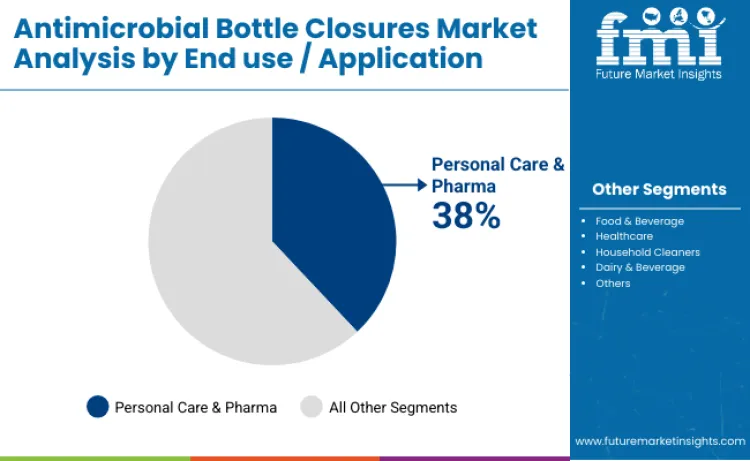
Personal care and pharma account for 38% of demand because these products involve repeated hand contact with closures over extended usage periods. Consumption intensity remains high for lotions, liquid soaps, syrups, antiseptics, and topical drugs where closures act as a primary contact surface. Usage stays consistent as antimicrobial closures reduce surface contamination risk between uses. Procurement decisions prioritize regulatory acceptance, additive stability, and compatibility with sensitive formulations. Buyers favor closures that maintain antimicrobial efficacy without altering product interaction or user experience. Price sensitivity remains moderate since closures contribute directly to perceived safety and brand trust. Specification control focuses on additive dispersion, durability across wash cycles, and long-term performance. Demand remains steady through 2036 as hygiene-focused packaging becomes standard across regulated and consumer health categories.Personal care brands continue integrating antimicrobial closures into premium and mass offerings. Pharma packaging adopts these closures to support handling safety in outpatient and home-care settings. Usage patterns remain predictable due to recurring refill and repurchase cycles.
Why do screw caps and pumps represent 50% of demand in the antimicrobial bottle closures market by packaging format from 2026 to 2036?
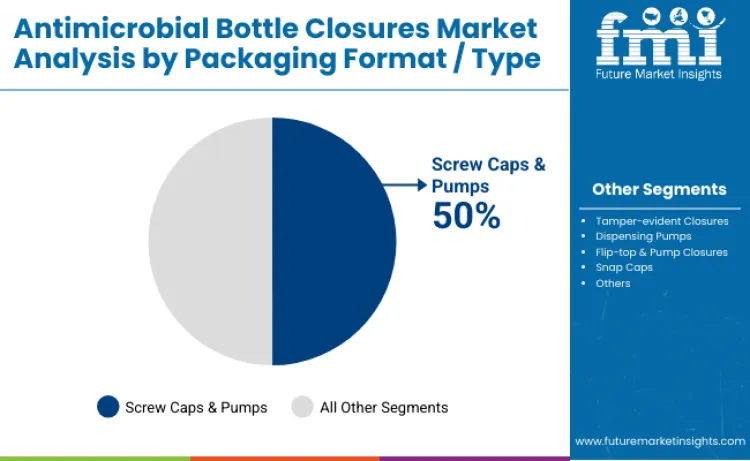
Screw caps and pumps represent 50% of demand because they experience the highest frequency of direct user contact. Consumption is strong across personal care, pharma, household cleaners, and food supplements where closures are touched multiple times daily. Usage remains steady as pumps and screw caps provide controlled dispensing while serving as a contamination interface. Procurement favors designs that integrate antimicrobial additives without affecting torque performance, sealing integrity, or pump actuation. Buyers prioritize closures that maintain mechanical reliability across repeated use. Price sensitivity stays moderate since pumps and caps already command higher unit value. Specification control emphasizes additive longevity, abrasion resistance, and compatibility with recycled resins. Demand remains firm through 2036 as antimicrobial functionality becomes an expected attribute in high-contact closure formats.
Pumps continue gaining preference due to measured dosing and reduced product exposure. Screw caps retain dominance in regulated packaging due to sealing reliability. Together, these formats anchor antimicrobial closure adoption across multiple end-use sectors.
What are the Key Dynamics of the Antimicrobial Bottle Closures Market?
How Are Antimicrobial Bottle Closures Being Integrated Into Packaging and Dispensing Systems?
Use appears in packaging formats where closure contact surfaces face repeated handling or prolonged exposure to moisture. Beverage producers apply antimicrobial closures on bottled water and functional drinks distributed through gyms and clinics. Personal care brands use them on refillable soap and lotion bottles to manage hygiene during repeated use. Pharmaceutical packagers select closures for liquid medicines stored after opening. Household cleaning products incorporate them in trigger and flip top formats used across shared spaces. These applications reflect packaging design choices shaped by handling frequency, storage duration, and contact exposure rather than container aesthetics.
What Packaging and Use Conditions Encourage Adoption of Antimicrobial Bottle Closures?
Selection aligns with environments where closures act as primary touchpoints. Refillable packaging systems favor antimicrobial materials to support extended product life after opening. Institutional buyers specify closures for products used by multiple users, such as in hospitals or gyms. Brands distributing through vending or self-service channels value added protection at the closure interface. Moist environments, including bathrooms and kitchens, increase interest in treated caps. These conditions support use where surface hygiene, repeated contact, and post opening handling influence packaging specifications.
Which Considerations Shape Limits on Wider Use of Antimicrobial Bottle Closures?
Material compatibility affects effectiveness across different polymers and additives. Cost sensitivity influences adoption in high volume, low margin packaging categories. Regulatory review varies by market when antimicrobial agents are incorporated into food contact components. Some manufacturers question long term performance once closures are worn or scratched. Recycling streams may restrict certain additive formulations. Tooling changes are sometimes required to accommodate treated resins. These considerations result in selective use where functional benefit aligns with compliance, cost structure, and manufacturing readiness.
What is the Demand for Antimicrobial Bottle Closures by Country?
| Country | CAGR (%) |
|---|---|
| USA | 8.9% |
| Germany | 6.8% |
| China | 10.5% |
| India | 11.8% |
| Brazil | 7.5% |
| Japan | 5.0% |
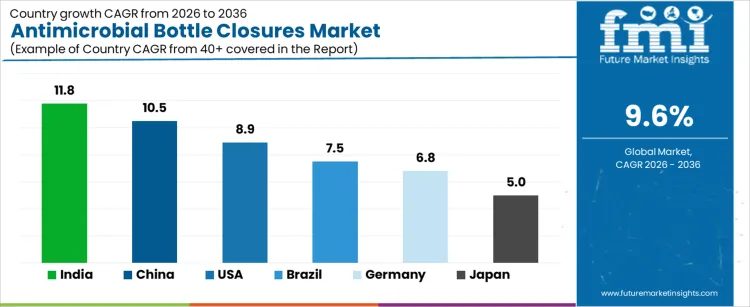
The demand for antimicrobial bottle closures shows differentiated growth across countries, shaped by beverage consumption, hygiene standards, and packaging performance requirements. India leads with an 11.8% CAGR, supported by rising bottled water and functional beverage consumption and greater focus on contamination control. China follows at 10.5%, driven by large scale beverage production and adoption of value added closures across dairy and liquid food segments. The USA grows at 8.9%, reflecting use in bottled water, nutraceuticals, and healthcare related liquids. Brazil records 7.5%, supported by expanding beverage packaging volumes. Germany posts 6.8%, shaped by regulated packaging standards, while Japan grows at 5.0%, reflecting mature consumption patterns and stable closure demand.
How Is Beverage Safety Enhancement Driving Demand in the United States?
In the United States, revenue from the Antimicrobial Bottle Closures Market is expanding at a CAGR of 8.9% through 2035, driven by heightened focus on beverage safety, shelf life control, and contamination prevention. Beverage producers are adopting antimicrobial closures to reduce microbial exposure during storage and distribution. Demand is concentrated in bottled water, functional beverages, dairy drinks, and ready to drink products sold through large retail networks. Domestic closure manufacturers are supplying antimicrobial treated caps compatible with existing bottling lines. Stable beverage consumption, strict quality control practices, and recurring packaging replacement cycles are sustaining consistent procurement across major beverage producers nationwide.
- Beverage manufacturers are adopting antimicrobial closures to reduce contamination risks during filling, transport, and storage
- Bottled water and functional drinks represent the largest application segments due to high safety sensitivity
- Compatibility with existing bottling equipment supports adoption without operational disruption
- Recurring cap replacement cycles sustain predictable procurement volumes
How Do Quality Standards Shape Market Expansion in Germany?
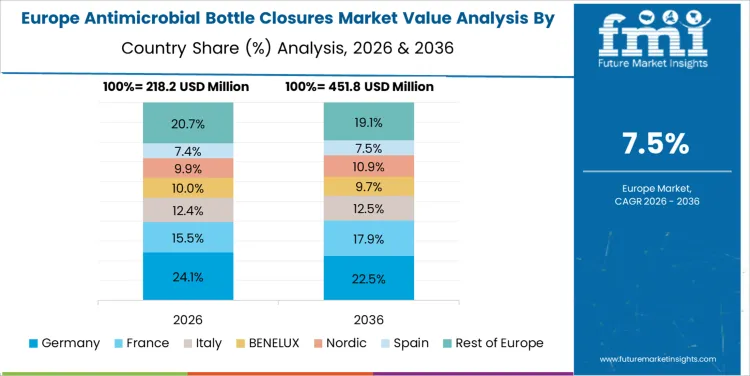
Germany continues to record steady growth in the Antimicrobial Bottle Closures Market at a CAGR of 6.8% through 2035, supported by strong packaging quality standards and regulated beverage production practices. Producers are integrating antimicrobial closures to maintain hygiene and product integrity across bottled beverages. Demand remains focused on mineral water, dairy based drinks, and pharmaceutical liquids. Technical expertise in polymer processing supports precise antimicrobial integration and consistent closure performance. Stable beverage output and compliance driven procurement practices are sustaining measured adoption across domestic bottling operations nationwide.
- Packaging quality standards encourage use of hygienic closure solutions
- Mineral water and dairy beverages remain primary demand drivers
- Polymer processing expertise supports reliable antimicrobial performance
- Compliance focused procurement sustains steady adoption levels
How Is Bottled Beverage Growth Accelerating Adoption in China?
In China, revenue from the Antimicrobial Bottle Closures Market is growing at a CAGR of 10.5% through 2035, driven by rapid expansion of bottled beverage consumption and food safety oversight. Beverage producers are adopting antimicrobial closures to reduce spoilage risks and improve consumer confidence. Demand is strong across bottled water, juices, and functional beverages distributed through modern retail channels. Domestic manufacturers are scaling antimicrobial closure production using integrated material supply chains. High output volumes and structured procurement practices are sustaining rapid adoption across major beverage production hubs nationwide.
- Rising bottled beverage consumption is increasing demand for hygienic closures
- Food safety oversight supports adoption of antimicrobial packaging components
- Domestic manufacturing expansion improves closure availability at scale
- Modern retail distribution sustains high volume procurement
How Is Organized Beverage Manufacturing Supporting Growth in India?
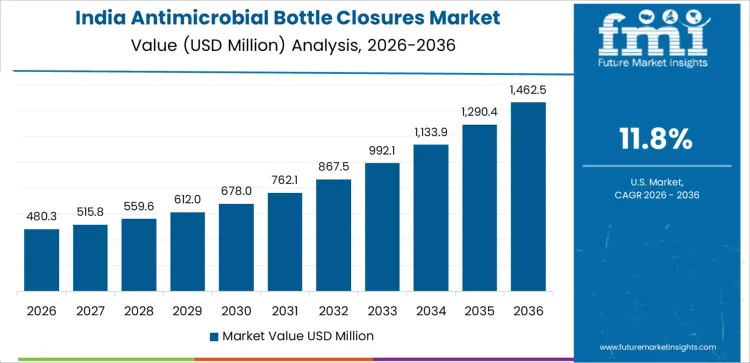
India is witnessing strong expansion in the Antimicrobial Bottle Closures Market at a CAGR of 11.8% through 2035, supported by growth in organized beverage manufacturing and packaged drink consumption. Producers are adopting antimicrobial closures to improve shelf life and hygiene in bottled water, juices, and dairy beverages. Demand is rising across urban markets and institutional supply channels. Domestic closure suppliers are offering cost aligned antimicrobial solutions suited to high volume bottling. Expanding distribution networks and increasing quality awareness are sustaining robust procurement across beverage manufacturers nationwide.
- Organized beverage manufacturing is increasing demand for hygienic closures
- Bottled water and juice segments drive early adoption
- Domestic suppliers improve affordability for high volume producers
- Distribution expansion sustains demand growth
How Are Consumer Beverage Preferences Supporting Adoption in Brazil?
Brazil is seeing steady growth in the Antimicrobial Bottle Closures Market at a CAGR of 7.5% through 2035, supported by rising consumption of packaged beverages and improved hygiene awareness. Beverage companies are using antimicrobial closures to protect product quality during regional transport and storage. Demand is concentrated in bottled water, soft drinks, and dairy beverages. Imports supply some specialized antimicrobial materials, while local manufacturers expand closure production capacity. Growth in organized retail and beverage distribution is sustaining recurring procurement across bottling operations nationwide.
- Packaged beverage consumption supports antimicrobial closure usage
- Hygiene focused packaging improves product protection
- Imports complement local supply for specialized materials
- Retail distribution growth sustains procurement activity
How Does Mature Beverage Consumption Influence Market Stability in Japan?
Japan is maintaining measured growth in the Antimicrobial Bottle Closures Market at a CAGR of 5% through 2035, supported by mature beverage consumption and strict hygiene expectations. Beverage producers apply antimicrobial closures selectively to maintain quality consistency and reduce contamination risks. Demand remains focused on bottled water, functional drinks, and pharmaceutical liquids. Domestic closure suppliers emphasize precision manufacturing and consistent antimicrobial performance. Stable consumption patterns and replacement driven purchasing are sustaining predictable procurement across established beverage bottling operations nationwide.
- Mature beverage markets support selective antimicrobial closure adoption
- Quality consistency requirements drive material selection
- Domestic suppliers ensure precise and reliable closure performance
- Replacement driven purchasing sustains procurement continuity
What Is Driving the Demand for Antimicrobial Bottle Closures and Which Packaging Suppliers Shape Market Uptake?
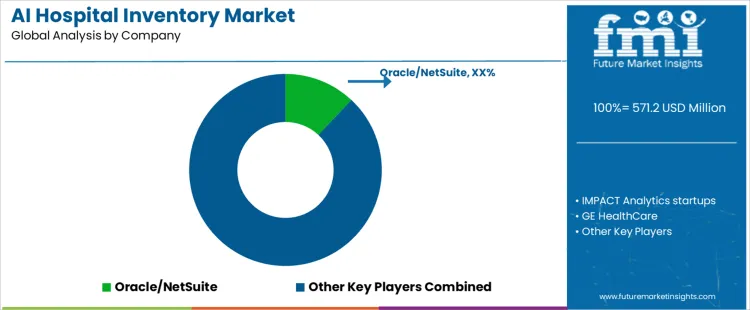
Antimicrobial bottle closures are gaining attention as beverage, personal care, and healthcare brands address contamination risk at high touch contact points. Closures are increasingly designed to limit microbial growth on external surfaces during repeated handling across retail and consumer use. AptarGroup supports adoption through dispensing closures that integrate antimicrobial additives into resin formulations. Berry Global contributes through mass production closures used in beverages, household products, and personal care. Amcor supports packaged goods brands through closure systems aligned with hygiene focused packaging strategies. Takemoto contributes precision molded pumps and caps used in skincare and cosmetic products where cleanliness perception matters. These suppliers align closure design with existing bottle systems and filling lines.
Material choice is guided by antimicrobial efficacy, durability of the additive through product life, and compliance with food and cosmetic contact regulations. UFlex supports cost sensitive segments through antimicrobial enabled caps used in regional food and personal care packaging. Klabin participates indirectly through fiber based packaging systems where antimicrobial closures complement hygienic pack design. Brand owners focus on maintaining tactile quality and dispensing performance while communicating hygiene benefits clearly. Usage spans bottled water, juices, liquid soaps, lotions, and medical solutions. Demand visibility tracks heightened hygiene awareness, growth in refillable packaging systems, and continued emphasis on touch point safety across consumer and institutional products.
Key Players in the Antimicrobial Bottle Closures Market
- AptarGroup
- Berry Global
- Amcor
- UFlex
- Klabin
- Takemoto
Scope of the Report
| Items | Values |
|---|---|
| Quantitative Units (2026) | USD million |
| End Use Application | Personal Care and Pharma; Food and Beverage; Healthcare; Household Cleaners; Dairy and Beverage; Other Applications |
| Packaging Format Type | Screw Caps and Pumps; Tamper-evident Closures; Dispensing Pumps; Flip-top and Pump Closures; Snap Caps; Other Formats |
| Material | PP with Antimicrobial Additive; HDPE with Coating; Bio-based Polymers with Additives; Recycled PP with Coating; Multi-layer PP; Other Materials |
| Technology | Surface Coating Ag-based; Antimicrobial Coating; Embedded Biocide Masterbatch; Antimicrobial Laser Treatment; Surface Functionalization; Other Technologies |
| Regions Covered | Asia Pacific; Europe; North America; Latin America; Middle East & Africa |
| Countries Covered | China; Japan; South Korea; India; Australia & New Zealand; ASEAN; Germany; United Kingdom; France; Italy; Spain; Nordic; BENELUX; United States; Canada; Mexico; Brazil; Chile; Kingdom of Saudi Arabia; Turkey; South Africa; plus additional countries across Asia Pacific, Europe, Latin America, and Middle East & Africa |
| Key Companies Profiled | AptarGroup; Berry Global; Amcor; UFlex; Klabin; Takemoto |
| Additional Attributes | Dollar by sales across end use applications and closure formats; adoption of antimicrobial additives in high contact bottle closures; role of screw caps and pumps as primary hygiene control touchpoints; integration of antimicrobial masterbatch and surface coating technologies in closure manufacturing; compatibility of treated closures with existing bottling and filling lines; regulatory considerations for food, beverage, and personal care contact materials; durability of antimicrobial performance under repeated handling and moisture exposure; influence of refillable packaging and repeated use on antimicrobial closure demand |
Antimicrobial Bottle Closures Market Segmentation
End use / Application
- Personal Care & Pharma
- Food & Beverage
- Healthcare
- Household Cleaners
- Dairy & Beverage
- Others
Packaging Format / Type
- Screw Caps & Pumps
- Tamper-evident Closures
- Dispensing Pumps
- Flip-top & Pump Closures
- Snap Caps
- Others
Material
- PP with Antimicrobial Additive
- HDPE + Coating
- Bio-based Polymers + Additives
- Recycled PP + Coating
- Multi-layer PP
- Others
Technology
- Surface Coating (Ag-based)
- Antimicrobial Coating
- Embedded Biocide Masterbatch
- Antimicrobial Laser Treatment
- Surface Functionalization
- Others
Region
- Asia Pacific
- China
- Japan
- South Korea
- India
- Australia & New Zealand
- ASEAN
- Rest of Asia Pacific
- Europe
- Germany
- United Kingdom
- France
- Italy
- Spain
- Nordic
- BENELUX
- Rest of Europe
- North America
- United States
- Canada
- Mexico
- Latin America
- Brazil
- Chile
- Rest of Latin America
- Middle East & Africa
- Kingdom of Saudi Arabia
- Other GCC Countries
- Turkey
- South Africa
- Other African Union
- Rest of Middle East & Africa
Frequently Asked Questions
How big is the antimicrobial bottle closures market in 2026?
The global antimicrobial bottle closures market is estimated to be valued at USD 981.0 million in 2026.
What will be the size of antimicrobial bottle closures market in 2036?
The market size for the antimicrobial bottle closures market is projected to reach USD 2,445.0 million by 2036.
How much will be the antimicrobial bottle closures market growth between 2026 and 2036?
The antimicrobial bottle closures market is expected to grow at a 9.6% CAGR between 2026 and 2036.
What are the key product types in the antimicrobial bottle closures market?
The key product types in antimicrobial bottle closures market are personal care & pharma, food & beverage, healthcare, household cleaners, dairy & beverage and others.
Which packaging format / type segment to contribute significant share in the antimicrobial bottle closures market in 2026?
In terms of packaging format / type, screw caps & pumps segment to command 50.0% share in the antimicrobial bottle closures market in 2026.
Preview the report firsthand - request a free sample
Get SampleGet the brochure for pricing and purchase details.
Get PDFTable of Content
- Executive Summary
- Global Market Outlook
- Demand-side Trends
- Supply-side Trends
- Technology Roadmap Analysis
- Analysis and Recommendations
- Market Overview
- Market Coverage / Taxonomy
- Market Definition / Scope / Limitations
- Market Background
- Market Dynamics
- Drivers
- Restraints
- Opportunity
- Trends
- Scenario Forecast
- Demand in Optimistic Scenario
- Demand in Likely Scenario
- Demand in Conservative Scenario
- Opportunity Map Analysis
- Product Life Cycle Analysis
- Supply Chain Analysis
- Investment Feasibility Matrix
- Value Chain Analysis
- PESTLE and Porter’s Analysis
- Regulatory Landscape
- Regional Parent Market Outlook
- Production and Consumption Statistics
- Import and Export Statistics
- Market Dynamics
- Global Market Analysis 2021 to 2025 and Forecast, 2026 to 2036
- Historical Market Size Value (USD Million) Analysis, 2021 to 2025
- Current and Future Market Size Value (USD Million) Projections, 2026 to 2036
- Y-o-Y Growth Trend Analysis
- Absolute $ Opportunity Analysis
- Global Market Pricing Analysis 2021 to 2025 and Forecast 2026 to 2036
- Global Market Analysis 2021 to 2025 and Forecast 2026 to 2036, By End-use / Application
- Introduction / Key Findings
- Historical Market Size Value (USD Million) Analysis By End-use / Application , 2021 to 2025
- Current and Future Market Size Value (USD Million) Analysis and Forecast By End-use / Application , 2026 to 2036
- Personal Care & Pharma
- Food & Beverage
- Healthcare
- Household Cleaners
- Dairy & Beverage
- Others
- Y-o-Y Growth Trend Analysis By End-use / Application , 2021 to 2025
- Absolute $ Opportunity Analysis By End-use / Application , 2026 to 2036
- Global Market Analysis 2021 to 2025 and Forecast 2026 to 2036, By Packaging Format / Type
- Introduction / Key Findings
- Historical Market Size Value (USD Million) Analysis By Packaging Format / Type, 2021 to 2025
- Current and Future Market Size Value (USD Million) Analysis and Forecast By Packaging Format / Type, 2026 to 2036
- Screw Caps & Pumps
- Tamper-evident Closures
- Dispensing Pumps
- Flip-top & Pump Closures
- Snap Caps
- Others
- Y-o-Y Growth Trend Analysis By Packaging Format / Type, 2021 to 2025
- Absolute $ Opportunity Analysis By Packaging Format / Type, 2026 to 2036
- Global Market Analysis 2021 to 2025 and Forecast 2026 to 2036, By Material
- Introduction / Key Findings
- Historical Market Size Value (USD Million) Analysis By Material, 2021 to 2025
- Current and Future Market Size Value (USD Million) Analysis and Forecast By Material, 2026 to 2036
- PP with Antimicrobial Additive
- HDPE + Coating
- Bio-based Polymers + Additives
- Recycled PP + Coating
- Multi-layer PP
- Others
- Y-o-Y Growth Trend Analysis By Material, 2021 to 2025
- Absolute $ Opportunity Analysis By Material, 2026 to 2036
- Global Market Analysis 2021 to 2025 and Forecast 2026 to 2036, By Technology
- Introduction / Key Findings
- Historical Market Size Value (USD Million) Analysis By Technology, 2021 to 2025
- Current and Future Market Size Value (USD Million) Analysis and Forecast By Technology, 2026 to 2036
- Surface Coating (Ag-based)
- Antimicrobial Coating
- Embedded Biocide Masterbatch
- Antimicrobial Laser Treatment
- Surface Functionalization
- Others
- Y-o-Y Growth Trend Analysis By Technology, 2021 to 2025
- Absolute $ Opportunity Analysis By Technology, 2026 to 2036
- Global Market Analysis 2021 to 2025 and Forecast 2026 to 2036, By Region
- Introduction
- Historical Market Size Value (USD Million) Analysis By Region, 2021 to 2025
- Current Market Size Value (USD Million) Analysis and Forecast By Region, 2026 to 2036
- North America
- Latin America
- Western Europe
- Eastern Europe
- East Asia
- South Asia and Pacific
- Middle East & Africa
- Market Attractiveness Analysis By Region
- North America Market Analysis 2021 to 2025 and Forecast 2026 to 2036, By Country
- Historical Market Size Value (USD Million) Trend Analysis By Market Taxonomy, 2021 to 2025
- Market Size Value (USD Million) Forecast By Market Taxonomy, 2026 to 2036
- By Country
- USA
- Canada
- Mexico
- By End-use / Application
- By Packaging Format / Type
- By Material
- By Technology
- By Country
- Market Attractiveness Analysis
- By Country
- By End-use / Application
- By Packaging Format / Type
- By Material
- By Technology
- Key Takeaways
- Latin America Market Analysis 2021 to 2025 and Forecast 2026 to 2036, By Country
- Historical Market Size Value (USD Million) Trend Analysis By Market Taxonomy, 2021 to 2025
- Market Size Value (USD Million) Forecast By Market Taxonomy, 2026 to 2036
- By Country
- Brazil
- Chile
- Rest of Latin America
- By End-use / Application
- By Packaging Format / Type
- By Material
- By Technology
- By Country
- Market Attractiveness Analysis
- By Country
- By End-use / Application
- By Packaging Format / Type
- By Material
- By Technology
- Key Takeaways
- Western Europe Market Analysis 2021 to 2025 and Forecast 2026 to 2036, By Country
- Historical Market Size Value (USD Million) Trend Analysis By Market Taxonomy, 2021 to 2025
- Market Size Value (USD Million) Forecast By Market Taxonomy, 2026 to 2036
- By Country
- Germany
- UK
- Italy
- Spain
- France
- Nordic
- BENELUX
- Rest of Western Europe
- By End-use / Application
- By Packaging Format / Type
- By Material
- By Technology
- By Country
- Market Attractiveness Analysis
- By Country
- By End-use / Application
- By Packaging Format / Type
- By Material
- By Technology
- Key Takeaways
- Eastern Europe Market Analysis 2021 to 2025 and Forecast 2026 to 2036, By Country
- Historical Market Size Value (USD Million) Trend Analysis By Market Taxonomy, 2021 to 2025
- Market Size Value (USD Million) Forecast By Market Taxonomy, 2026 to 2036
- By Country
- Russia
- Poland
- Hungary
- Balkan & Baltic
- Rest of Eastern Europe
- By End-use / Application
- By Packaging Format / Type
- By Material
- By Technology
- By Country
- Market Attractiveness Analysis
- By Country
- By End-use / Application
- By Packaging Format / Type
- By Material
- By Technology
- Key Takeaways
- East Asia Market Analysis 2021 to 2025 and Forecast 2026 to 2036, By Country
- Historical Market Size Value (USD Million) Trend Analysis By Market Taxonomy, 2021 to 2025
- Market Size Value (USD Million) Forecast By Market Taxonomy, 2026 to 2036
- By Country
- China
- Japan
- South Korea
- By End-use / Application
- By Packaging Format / Type
- By Material
- By Technology
- By Country
- Market Attractiveness Analysis
- By Country
- By End-use / Application
- By Packaging Format / Type
- By Material
- By Technology
- Key Takeaways
- South Asia and Pacific Market Analysis 2021 to 2025 and Forecast 2026 to 2036, By Country
- Historical Market Size Value (USD Million) Trend Analysis By Market Taxonomy, 2021 to 2025
- Market Size Value (USD Million) Forecast By Market Taxonomy, 2026 to 2036
- By Country
- India
- ASEAN
- Australia & New Zealand
- Rest of South Asia and Pacific
- By End-use / Application
- By Packaging Format / Type
- By Material
- By Technology
- By Country
- Market Attractiveness Analysis
- By Country
- By End-use / Application
- By Packaging Format / Type
- By Material
- By Technology
- Key Takeaways
- Middle East & Africa Market Analysis 2021 to 2025 and Forecast 2026 to 2036, By Country
- Historical Market Size Value (USD Million) Trend Analysis By Market Taxonomy, 2021 to 2025
- Market Size Value (USD Million) Forecast By Market Taxonomy, 2026 to 2036
- By Country
- Kingdom of Saudi Arabia
- Other GCC Countries
- Turkiye
- South Africa
- Other African Union
- Rest of Middle East & Africa
- By End-use / Application
- By Packaging Format / Type
- By Material
- By Technology
- By Country
- Market Attractiveness Analysis
- By Country
- By End-use / Application
- By Packaging Format / Type
- By Material
- By Technology
- Key Takeaways
- Key Countries Market Analysis
- USA
- Pricing Analysis
- Market Share Analysis, 2025
- By End-use / Application
- By Packaging Format / Type
- By Material
- By Technology
- Canada
- Pricing Analysis
- Market Share Analysis, 2025
- By End-use / Application
- By Packaging Format / Type
- By Material
- By Technology
- Mexico
- Pricing Analysis
- Market Share Analysis, 2025
- By End-use / Application
- By Packaging Format / Type
- By Material
- By Technology
- Brazil
- Pricing Analysis
- Market Share Analysis, 2025
- By End-use / Application
- By Packaging Format / Type
- By Material
- By Technology
- Chile
- Pricing Analysis
- Market Share Analysis, 2025
- By End-use / Application
- By Packaging Format / Type
- By Material
- By Technology
- Germany
- Pricing Analysis
- Market Share Analysis, 2025
- By End-use / Application
- By Packaging Format / Type
- By Material
- By Technology
- UK
- Pricing Analysis
- Market Share Analysis, 2025
- By End-use / Application
- By Packaging Format / Type
- By Material
- By Technology
- Italy
- Pricing Analysis
- Market Share Analysis, 2025
- By End-use / Application
- By Packaging Format / Type
- By Material
- By Technology
- Spain
- Pricing Analysis
- Market Share Analysis, 2025
- By End-use / Application
- By Packaging Format / Type
- By Material
- By Technology
- France
- Pricing Analysis
- Market Share Analysis, 2025
- By End-use / Application
- By Packaging Format / Type
- By Material
- By Technology
- India
- Pricing Analysis
- Market Share Analysis, 2025
- By End-use / Application
- By Packaging Format / Type
- By Material
- By Technology
- ASEAN
- Pricing Analysis
- Market Share Analysis, 2025
- By End-use / Application
- By Packaging Format / Type
- By Material
- By Technology
- Australia & New Zealand
- Pricing Analysis
- Market Share Analysis, 2025
- By End-use / Application
- By Packaging Format / Type
- By Material
- By Technology
- China
- Pricing Analysis
- Market Share Analysis, 2025
- By End-use / Application
- By Packaging Format / Type
- By Material
- By Technology
- Japan
- Pricing Analysis
- Market Share Analysis, 2025
- By End-use / Application
- By Packaging Format / Type
- By Material
- By Technology
- South Korea
- Pricing Analysis
- Market Share Analysis, 2025
- By End-use / Application
- By Packaging Format / Type
- By Material
- By Technology
- Russia
- Pricing Analysis
- Market Share Analysis, 2025
- By End-use / Application
- By Packaging Format / Type
- By Material
- By Technology
- Poland
- Pricing Analysis
- Market Share Analysis, 2025
- By End-use / Application
- By Packaging Format / Type
- By Material
- By Technology
- Hungary
- Pricing Analysis
- Market Share Analysis, 2025
- By End-use / Application
- By Packaging Format / Type
- By Material
- By Technology
- Kingdom of Saudi Arabia
- Pricing Analysis
- Market Share Analysis, 2025
- By End-use / Application
- By Packaging Format / Type
- By Material
- By Technology
- Turkiye
- Pricing Analysis
- Market Share Analysis, 2025
- By End-use / Application
- By Packaging Format / Type
- By Material
- By Technology
- South Africa
- Pricing Analysis
- Market Share Analysis, 2025
- By End-use / Application
- By Packaging Format / Type
- By Material
- By Technology
- USA
- Market Structure Analysis
- Competition Dashboard
- Competition Benchmarking
- Market Share Analysis of Top Players
- By Regional
- By End-use / Application
- By Packaging Format / Type
- By Material
- By Technology
- Competition Analysis
- Competition Deep Dive
- AptarGroup
- Overview
- Product Portfolio
- Profitability by Market Segments (Product/Age /Sales Channel/Region)
- Sales Footprint
- Strategy Overview
- Marketing Strategy
- Product Strategy
- Channel Strategy
- Berry Global
- Amcor
- UFlex
- Klabin
- Takemoto
- AptarGroup
- Competition Deep Dive
- Assumptions & Acronyms Used
- Research Methodology


