

- Industry Size (2026)
- USD 1.4 Bn
- Forecast (2036)
- USD 2.8 Bn
- CAGR (2026 to 2036)
- 7.2%
Chlorine-Free Sanitizing Chemicals Market Forecast and Outlook 2026 to 2036
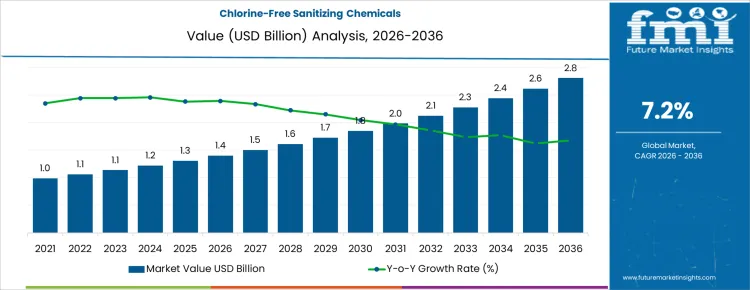
The chlorine-free sanitizing chemicals market is expected to grow from USD 1.4 billion in 2026 to USD 2.8 billion by 2036, reflecting a CAGR of 7.2%. Initial growth is led by the hospitality, healthcare, and foodservice sectors, with a shift toward safer, low-residue sanitizers to meet stricter hygiene and regulatory standards. Between 2028 and 2032, adoption accelerates in emerging regions and high-traffic facilities, supported by awareness campaigns and increasing demand for chlorine-free formulations.
From 2032 onward, market expansion is increasingly driven by innovations in concentrated and multi-use sanitizer systems, combined with compatibility for automated cleaning equipment. Growth momentum is maintained as suppliers enhance product efficacy, odor control, and surface safety, addressing environmental and occupational health concerns. Saturation in established markets encourages providers to target niche applications, ensuring steady long-term value accumulation.
Quick Stats of the Chlorine-Free Sanitizing Chemicals Market
- Chlorine-Free Sanitizing Chemicals Market Value (2026): USD 1.4 billion
- Chlorine-Free Sanitizing Chemicals Market Forecast Value (2036): USD 2.8 billion
- Chlorine-Free Sanitizing Chemicals Market Forecast CAGR (2026 to 2036): 7.2%
- Leading Active Chemistry in the Market: Quaternary Ammonium (QAC) Blends (40%)
- Key Growth Regions in the Market: China, Brazil, USA, UK, Germany
- Top Players in the Market: Ecolab, Solenis (Diversey), Reckitt, Procter & Gamble, SC Johnson Professional, CloroxPro, 3M, GOJO Industries, Lanxess, Christeyns
What is the Growth Forecast for the Chlorine-Free Sanitizing Chemicals Market through 2036?
From 2026 to 2031, the chlorine-free sanitizing chemicals market grows from USD 1.4 billion to approximately USD 1.7 billion, representing the early adoption phase. Growth during this period is driven by commercial kitchens, food processing facilities, healthcare, and institutional hygiene programs seeking effective sanitization without chlorine-related residues. Annual value additions increase from USD 0.1 billion to USD 0.18 billion, with adoption concentrated in North America and Europe, where regulatory pressure, environmental compliance, and worker safety standards encourage transition to chlorine-free solutions. Uptake is incremental, focused on high-value facilities implementing pilot programs and multi-site trials.
Between 2031 and 2036, the market expands from roughly USD 1.7 billion to USD 2.8 billion, illustrating the late adoption curve characterized by broader commercialization and normalized use across multiple sectors. Annual increments widen to USD 0.2-0.25 billion, supported by multi-site rollouts, repeat procurement, and integration into standard hygiene protocols. Growth is reinforced by portfolio-wide adoption in foodservice, healthcare, and industrial cleaning, with early expansion relying on selective adoption and pilot programs, while later growth is driven by structural deployment and global penetration.
Chlorine Free Sanitizing Chemicals Market Key Takeaways
| Metric | Value |
|---|---|
| Market Value (2026) | USD 1.4 billion |
| Forecast Value (2036) | USD 2.8 billion |
| Forecast CAGR (2026 to 2036) | 7.2% |
Why Are Chlorine Free Sanitizing Chemicals Gaining Ground Across Professional Cleaning Environments?
Early use of chlorine free sanitizing chemicals followed practical constraints rather than broad policy shifts. Chlorine based products were effective but created recurring issues in daily operations. Strong odours affected worker comfort, corrosion damaged stainless steel and equipment seals, and accidental overuse caused surface discoloration.
In foodservice, healthcare, and childcare settings, these drawbacks disrupted routine sanitation. Operators adopted non chlorine options to maintain hygiene without degrading surfaces or triggering complaints. Historical demand was situational, driven by material compatibility, indoor air concerns, and incident management rather than formal replacement of chlorine across all sanitation programs.
Future demand reflects tighter control over exposure, residues, and documented cleaning outcomes. Sanitizing programs are now audited against defined performance and safety criteria, not just microbial kill claims. Chlorine free chemistries are selected for predictable behaviour, lower vapour release, and compatibility with mixed material environments. Procurement decisions increasingly specify allowable disinfectant classes to align with worker safety policies and surface warranties. Growth will follow institutional standardisation of sanitation protocols rather than ad hoc substitution.
What Factors Are Affecting the Demand for Chlorine Free Sanitizing Chemicals Market in Terms of Active Chemistry and Product Format?
Demand for chlorine free sanitizing chemicals is segmented by active chemistry and product format across foodservice, healthcare, institutional, and commercial hygiene programs. Quaternary ammonium compound blends account for about 40% of total demand, making them the leading active chemistry. Hydrogen peroxide based systems, peracetic acid formulations, and alcohol or other chlorine free actives represent additional chemistries without disclosed share splits. These actives differ in kill spectrum, surface compatibility, and residue behavior. Product format segmentation reflects application control and usage environment. Liquid concentrates account for about 34% of demand, followed by ready to use sprays, pre saturated wipes, foam or aerosol formats, and dosing cartridges.
What Drives Demand by Active Chemistry in the Chlorine Free Sanitizing Chemicals Market?
Quaternary ammonium blends lead demand with a 40% share due to broad antimicrobial effectiveness and residual activity on treated surfaces. These systems are widely specified for routine sanitation where chlorine odor and corrosion are undesirable. Hydrogen peroxide based sanitizers are adopted where rapid decomposition and low residue are required. Peracetic acid systems are used in applications demanding high efficacy against resistant organisms. Alcohol based and other chlorine free actives support fast drying and spot sanitization. Active chemistry selection reflects balance between efficacy, material compatibility, and user exposure rather than maximum biocidal strength. Demand therefore aligns with standardized sanitation programs and regulatory acceptance.
Active chemistry demand remains stable because sanitation protocols are tightly controlled. QAC systems are embedded in recurring cleaning schedules. Peroxide and PAA products are applied where process or regulatory needs justify their use. Alcohol based systems remain limited to defined use cases. These patterns restrict rapid chemistry substitution. Active chemistry segmentation highlights reliance on proven disinfectant performance. Demand therefore follows compliance driven hygiene practices rather than short term shifts in product preference.
How Does Product Format Shape Demand for Chlorine Free Sanitizing Chemicals Market?
Liquid concentrates account for about 34% of total demand, making them the leading product format. Their dominance reflects cost efficiency, flexible dilution, and compatibility with dispensing systems. Ready to use sprays are applied where speed and convenience are prioritized. Pre saturated wipes support controlled application and cross contamination reduction. Foam and aerosol formats improve surface contact time on vertical areas. Dosing cartridges are used where automated delivery and exposure control are required. Product format selection depends on labor workflow, safety protocols, and surface coverage needs. Demand follows application discipline rather than chemistry potency alone.
Concentrated formats maintain leadership due to bulk usage in institutional settings. RTU products remain common for light duty tasks. Wipes and foams serve targeted sanitation needs. Cartridge systems scale where consistency is enforced. Operators avoid frequent format changes to maintain training and compliance. This stabilizes demand by format. Product format segmentation therefore reinforces concentration in liquid concentrate based sanitation systems.
How Are Chlorine Free Sanitizing Chemicals Being Applied Across Foodservice and Healthcare Environments?
Use appears in settings where microbial control is essential but chlorine-based products may cause corrosion, odor, or chemical residue concerns. Restaurants, commercial kitchens, and food processing facilities adopt chlorine-free sanitizers for surfaces, utensils, and equipment to maintain hygiene without affecting taste or smell. Hospitals and laboratories use them on high-touch surfaces and instruments to reduce pathogen transfer while minimizing staff and patient exposure to harsh chemicals. These applications reflect operational and safety priorities rather than aesthetic purposes, with adoption driven by efficacy, material compatibility, and regulatory compliance.
What Operational and Material Conditions Support Adoption of Chlorine Free Sanitizing Chemicals?
Selection aligns with surfaces and equipment sensitive to oxidation or chemical degradation. Formulations are optimized for broad-spectrum antimicrobial activity while remaining safe for repeated use. Cleaning teams rely on products compatible with automated dosing systems, spray applications, and wipe-based protocols. Health and safety personnel prioritize chemicals that comply with local sanitation regulations and reduce worker irritation. These conditions emerge from operational efficiency, surface protection, and user safety priorities in structured foodservice and healthcare workflows.
Which Practical Considerations Limit Wider Use of Chlorine Free Sanitizing Chemicals?
Effectiveness can vary depending on contact time, surface type, and organic load, requiring strict application protocols. Cost per liter may be higher than traditional chlorine-based sanitizers. Shelf life and storage stability may require careful handling. Regulatory approvals and validated efficacy testing influence adoption in sensitive industries. These factors result in selective deployment where material compatibility, human safety, and microbial control justify incremental cost and operational oversight.
What is the Demand for Chlorine Free Sanitizing Chemicals by Country?
| Country | CAGR (%) |
|---|---|
| USA | 7.1% |
| Germany | 6.6% |
| China | 8.7% |
| UK | 6.7% |
| Brazil | 8.4% |
The demand for chlorine free sanitizing chemicals varies across countries, driven by hygiene standards, foodservice growth, and regulatory compliance for safer cleaning products. China leads with an 8.7% CAGR, supported by expanding food processing, hospitality sectors, and increasing adoption of eco-friendly sanitizers. Brazil follows at 8.4%, driven by commercial cleaning expansion and industrial hygiene practices. The USA grows at 7.1%, reflecting steady adoption in healthcare, foodservice, and institutional cleaning. Germany records 6.6%, shaped by regulated cleaning standards and mature hygiene markets. The UK posts 6.7%, supported by consistent demand in commercial, healthcare, and foodservice sectors.
How Is Chlorine-Free Sanitization Driving Growth in the United States?
In the United States, revenue from the Chlorine-Free Sanitizing Chemicals Market is expanding at a CAGR of 7.1% through 2035, driven by adoption of chemical formulations that provide effective microbial control without using chlorine-based compounds. Manufacturers are integrating chlorine-free sanitizers in foodservice, healthcare, and industrial cleaning applications to reduce corrosion, odor, and harmful byproducts. Demand is concentrated in restaurants, hospitals, schools, and industrial facilities. Domestic suppliers provide high-performance sanitizing chemicals compatible with surfaces, equipment, and automated cleaning systems. Hygiene standards, regulatory compliance, and recurring sanitation schedules are sustaining predictable procurement nationwide.
- Restaurants, hospitals, schools, and industrial facilities drive adoption of chlorine-free sanitizers
- Chemicals provide effective microbial control without chlorine
- Domestic suppliers provide surface- and equipment-compatible high-performance formulations
- Recurring sanitation schedules sustain predictable procurement
How Are Hygiene and Safety Standards Supporting Growth in Germany?
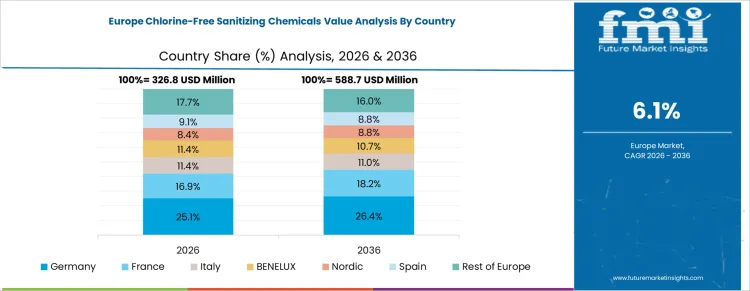
Germany continues to record steady growth in the Chlorine-Free Sanitizing Chemicals Market at a CAGR of 6.6% through 2035, supported by stringent hygiene and safety regulations. Manufacturers are adopting chlorine-free sanitizers in commercial kitchens, hospitals, and industrial facilities to maintain cleanliness while minimizing corrosion and chemical residues. Demand is concentrated in foodservice, healthcare, and institutional sectors. Domestic suppliers provide high-quality chemical formulations compatible with surfaces, equipment, and cleaning systems. Compliance with hygiene standards and recurring sanitation cycles are sustaining measured adoption nationwide.
- Commercial kitchens, hospitals, and industrial facilities anchor demand
- Sanitizers maintain hygiene while reducing corrosion and residues
- Domestic suppliers provide high-quality, surface- and equipment-compatible chemicals
- Recurring sanitation cycles sustain steady procurement
How Is Foodservice and Industrial Expansion Accelerating Adoption in China?
In China, revenue from the Chlorine-Free Sanitizing Chemicals Market is growing at a CAGR of 8.7% through 2035, driven by rapid growth of foodservice operations, industrial kitchens, and healthcare facilities. Manufacturers are integrating chlorine-free sanitizers to control microbial contamination effectively without chlorine-related drawbacks. Demand is strong across restaurants, hospitals, hotels, and industrial kitchens. Domestic suppliers are scaling production of high-performance, surface-compatible sanitizing chemicals suitable for manual and automated cleaning systems. Expanding facilities and structured cleaning programs are sustaining rapid adoption nationwide.
- Restaurants, hospitals, hotels, and industrial kitchens drive sanitizer adoption
- Chemicals control microbial contamination without chlorine
- Domestic suppliers scale production of surface- and equipment-compatible formulations
- Structured cleaning programs sustain consistent adoption
How Is Commercial Hygiene Driving Growth in the United Kingdom?
In the United Kingdom, revenue from the Chlorine-Free Sanitizing Chemicals Market is expanding at a CAGR of 6.7% through 2035, supported by hygiene regulations and increasing foodservice, healthcare, and institutional facility operations. Manufacturers are adopting chlorine-free sanitizers to ensure microbial control, reduce chemical residues, and minimize corrosion in kitchens, hospitals, and industrial facilities. Demand is concentrated in restaurants, healthcare, schools, and commercial buildings. Domestic suppliers provide high-quality, surface-compatible chemical formulations for manual and automated systems. Recurring cleaning schedules, regulatory compliance, and hygiene monitoring are sustaining predictable procurement nationwide.
- Restaurants, hospitals, schools, and commercial facilities anchor demand
- Sanitizers ensure microbial control while reducing chemical residues
- Domestic suppliers provide surface- and equipment-compatible high-quality formulations
- Recurring cleaning schedules sustain predictable procurement
How Is Foodservice and Industrial Facility Expansion Supporting Adoption in Brazil?
Brazil is seeing strong growth in the Chlorine-Free Sanitizing Chemicals Market at a CAGR of 8.4% through 2035, supported by increasing adoption in foodservice, healthcare, and industrial cleaning applications. Manufacturers are integrating chlorine-free sanitizers to provide effective microbial control without chlorine, ensuring safety and surface integrity. Demand is concentrated in restaurants, hospitals, hotels, and industrial facilities. Domestic suppliers are expanding production of high-performance, surface-compatible sanitizing chemicals suitable for manual and automated cleaning processes. Growth in facilities, hygiene compliance, and recurring sanitation cycles are sustaining robust procurement nationwide.
- Restaurants, hospitals, hotels, and industrial facilities drive sanitizer adoption
- Chemicals provide microbial control without chlorine
- Domestic suppliers expand high-performance, surface-compatible formulations
- Recurring sanitation cycles sustain robust procurement
Which Companies Compete In The Chlorine Free Sanitizing Chemicals Market Based On Regulatory Acceptance And Use Environment?
Chlorine free sanitizing chemicals are selected where material compatibility, odor control, and occupational exposure limits constrain the use of traditional chlorine based agents. In foodservice, healthcare, and institutional settings, products must deliver broad spectrum sanitation while remaining suitable for frequent application. Ecolab and Solenis, through the Diversey portfolio, influence adoption by integrating non chlorine sanitizers into hygiene programs aligned with audit and compliance requirements. Reckitt, Procter and Gamble, and SC Johnson Professional supply formulations designed for routine surface sanitation in commercial environments with high contact frequency. Product choice reflects efficacy across contact times, surface safety, and stability in diluted form rather than formulation strength alone.
Competitive positioning varies by application context and service model. Christeyns maintains a strong role in professional kitchens and healthcare facilities, particularly in Europe, where non chlorine chemistries are favored for equipment and surface preservation. Lanxess contributes through biocidal active ingredients supplied into sanitizer formulations rather than finished products. GOJO Industries participates through hand and surface hygiene systems used in controlled environments. CloroxPro and 3M operate selectively where chlorine free sanitation is part of broader cleaning and maintenance programs. Local distributors and hygiene consultants influence outcomes by aligning products with site specific risk profiles. Market dynamics are shaped by regulatory approval, training requirements, and operational consistency rather than brand breadth or chemical intensity.
Key Players in the Chlorine Free Sanitizing Chemicals Market
- Ecolab
- Solenis (Diversey)
- Reckitt
- Procter & Gamble
- SC Johnson Professional
- CloroxPro
- 3M
- GOJO Industries
- Lanxess
- Christeyns
Scope of the Report
| Items | Values |
|---|---|
| Quantitative Units (2026) | USD million |
| Active Chemistry | Quaternary Ammonium (QAC) Blends; Hydrogen Peroxide-Based; Peracetic Acid (PAA) Systems; Alcohol & Other Chlorine-Free Actives |
| Product Format | Liquid Concentrates; Ready-to-Use Sprays; Pre-Saturated Wipes; Foam / Aerosol Applications; Dosing Cartridges & Others |
| Application Area | Hard Non-Porous Surfaces; Food-Contact Surfaces; High-Touch Public Areas; Restrooms & Other Use-Cases |
| Go-to-Market Model | Distributors; Direct Institutional Contracts; Jan-San Service Providers; Online / Small Accounts |
| Region | Asia Pacific; Europe; North America; Latin America; Middle East & Africa |
| Countries Covered | China; Japan; South Korea; India; Australia & New Zealand; ASEAN; Rest of Asia Pacific; Germany; United Kingdom; France; Italy; Spain; Nordic; BENELUX; Rest of Europe; United States; Canada; Mexico; Brazil; Chile; Rest of Latin America; Kingdom of Saudi Arabia; Other GCC Countries; Turkey; South Africa; Other African Union; Rest of Middle East & Africa |
| Key Companies Profiled | Ecolab; Solenis (Diversey); Reckitt; Procter & Gamble; SC Johnson Professional; CloroxPro; 3M; GOJO Industries; Lanxess; Christeyns |
| Additional Attributes | Dollar by sales across active chemistries and product formats; QAC blends dominate due to broad efficacy and residual action; Liquid concentrates lead for cost efficiency and automated dispensing compatibility; RTU sprays, wipes, and foam/aerosol formats support targeted or high-touch applications; Adoption driven by hygiene compliance, surface safety, and regulatory requirements; Early growth concentrated in healthcare, foodservice, and institutional facilities; Later expansion supported by multi-use systems, automated cleaning compatibility, and emerging regional demand; Procurement influenced by distributors, institutional contracts, and jan-san service programs; Competitive positioning guided by regulatory acceptance, material compatibility, and operational reliability rather than brand visibility. |
Chlorine Free Sanitizing Chemicals Market Segmentation
By Active Chemistry:
- Quaternary Ammonium (QAC) Blends
- Hydrogen Peroxide-Based
- Peracetic Acid (PAA) Systems
- Alcohol & Other Chlorine-Free Actives
By Product Format:
- Liquid Concentrates
- Ready-to-Use Sprays
- Pre-Saturated Wipes
- Foam / Aerosol Applications
- Dosing Cartridges & Others
By Application Area:
- Hard Non-Porous Surfaces
- Food-Contact Surfaces
- High-Touch Public Areas
- Restrooms & Other Use-Cases
By Go-to-Market Model:
- Distributors
- Direct Institutional Contracts
- Jan-San Service Providers
- Online / Small Accounts
By Region:
- Asia Pacific
- China
- Japan
- South Korea
- India
- Australia & New Zealand
- ASEAN
- Rest of Asia Pacific
- Europe
- Germany
- United Kingdom
- France
- Italy
- Spain
- Nordic
- BENELUX
- Rest of Europe
- North America
- United States
- Canada
- Mexico
- Latin America
- Brazil
- Chile
- Rest of Latin America
- Middle East & Africa
- Kingdom of Saudi Arabia
- Other GCC Countries
- Turkey
- South Africa
- Other African Union
- Rest of Middle East & Africa
Frequently Asked Questions
How big is the chlorine-free sanitizing chemicals in 2026?
The global chlorine-free sanitizing chemicals is estimated to be valued at USD 1.4 billion in 2026.
What will be the size of chlorine-free sanitizing chemicals in 2036?
The market size for the chlorine-free sanitizing chemicals is projected to reach USD 2.8 billion by 2036.
How much will be the chlorine-free sanitizing chemicals growth between 2026 and 2036?
The chlorine-free sanitizing chemicals is expected to grow at a 7.2% CAGR between 2026 and 2036.
What are the key product types in the chlorine-free sanitizing chemicals?
The key product types in chlorine-free sanitizing chemicals are quaternary ammonium (qac) blends, hydrogen peroxide-based, peracetic acid (paa) systems and alcohol & other chlorine-free actives.
Which product format segment to contribute significant share in the chlorine-free sanitizing chemicals in 2026?
In terms of product format, liquid concentrates segment to command 34.0% share in the chlorine-free sanitizing chemicals in 2026.
Preview the report firsthand - request a free sample
Get SampleGet the brochure for pricing and purchase details.
Get PDFTable of Content
- Executive Summary
- Global Market Outlook
- Demand-side Trends
- Supply-side Trends
- Technology Roadmap Analysis
- Analysis and Recommendations
- Market Overview
- Market Coverage / Taxonomy
- Market Definition / Scope / Limitations
- Market Background
- Market Dynamics
- Drivers
- Restraints
- Opportunity
- Trends
- Scenario Forecast
- Demand in Optimistic Scenario
- Demand in Likely Scenario
- Demand in Conservative Scenario
- Opportunity Map Analysis
- Product Life Cycle Analysis
- Supply Chain Analysis
- Investment Feasibility Matrix
- Value Chain Analysis
- PESTLE and Porter’s Analysis
- Regulatory Landscape
- Regional Parent Market Outlook
- Production and Consumption Statistics
- Import and Export Statistics
- Market Dynamics
- Global Market Analysis 2021 to 2025 and Forecast, 2026 to 2036
- Historical Market Size Value (USD Million) Analysis, 2021 to 2025
- Current and Future Market Size Value (USD Million) Projections, 2026 to 2036
- Y-o-Y Growth Trend Analysis
- Absolute $ Opportunity Analysis
- Global Market Pricing Analysis 2021 to 2025 and Forecast 2026 to 2036
- Global Market Analysis 2021 to 2025 and Forecast 2026 to 2036, By Active Chemistry
- Introduction / Key Findings
- Historical Market Size Value (USD Million) Analysis By Active Chemistry , 2021 to 2025
- Current and Future Market Size Value (USD Million) Analysis and Forecast By Active Chemistry , 2026 to 2036
- Quaternary Ammonium (QAC) Blends
- Hydrogen Peroxide-Based
- Peracetic Acid (PAA) Systems
- Alcohol & Other Chlorine-Free Actives
- Y-o-Y Growth Trend Analysis By Active Chemistry , 2021 to 2025
- Absolute $ Opportunity Analysis By Active Chemistry , 2026 to 2036
- Global Market Analysis 2021 to 2025 and Forecast 2026 to 2036, By Product Format
- Introduction / Key Findings
- Historical Market Size Value (USD Million) Analysis By Product Format, 2021 to 2025
- Current and Future Market Size Value (USD Million) Analysis and Forecast By Product Format, 2026 to 2036
- Liquid Concentrates
- Ready-to-Use Sprays
- Pre-Saturated Wipes
- Foam / Aerosol Applications
- Dosing Cartridges & Others
- Y-o-Y Growth Trend Analysis By Product Format, 2021 to 2025
- Absolute $ Opportunity Analysis By Product Format, 2026 to 2036
- Global Market Analysis 2021 to 2025 and Forecast 2026 to 2036, By Application Area
- Introduction / Key Findings
- Historical Market Size Value (USD Million) Analysis By Application Area, 2021 to 2025
- Current and Future Market Size Value (USD Million) Analysis and Forecast By Application Area, 2026 to 2036
- Hard Non-Porous Surfaces
- Food-Contact Surfaces
- High-Touch Public Areas
- Restrooms & Other Use-Cases
- Y-o-Y Growth Trend Analysis By Application Area, 2021 to 2025
- Absolute $ Opportunity Analysis By Application Area, 2026 to 2036
- Global Market Analysis 2021 to 2025 and Forecast 2026 to 2036, By Go-to-Market Model
- Introduction / Key Findings
- Historical Market Size Value (USD Million) Analysis By Go-to-Market Model, 2021 to 2025
- Current and Future Market Size Value (USD Million) Analysis and Forecast By Go-to-Market Model, 2026 to 2036
- Distributors
- Direct Institutional Contracts
- Jan-San Service Providers
- Online / Small Accounts
- Y-o-Y Growth Trend Analysis By Go-to-Market Model, 2021 to 2025
- Absolute $ Opportunity Analysis By Go-to-Market Model, 2026 to 2036
- Global Market Analysis 2021 to 2025 and Forecast 2026 to 2036, By Region
- Introduction
- Historical Market Size Value (USD Million) Analysis By Region, 2021 to 2025
- Current Market Size Value (USD Million) Analysis and Forecast By Region, 2026 to 2036
- North America
- Latin America
- Western Europe
- Eastern Europe
- East Asia
- South Asia and Pacific
- Middle East & Africa
- Market Attractiveness Analysis By Region
- North America Market Analysis 2021 to 2025 and Forecast 2026 to 2036, By Country
- Historical Market Size Value (USD Million) Trend Analysis By Market Taxonomy, 2021 to 2025
- Market Size Value (USD Million) Forecast By Market Taxonomy, 2026 to 2036
- By Country
- USA
- Canada
- Mexico
- By Active Chemistry
- By Product Format
- By Application Area
- By Go-to-Market Model
- By Country
- Market Attractiveness Analysis
- By Country
- By Active Chemistry
- By Product Format
- By Application Area
- By Go-to-Market Model
- Key Takeaways
- Latin America Market Analysis 2021 to 2025 and Forecast 2026 to 2036, By Country
- Historical Market Size Value (USD Million) Trend Analysis By Market Taxonomy, 2021 to 2025
- Market Size Value (USD Million) Forecast By Market Taxonomy, 2026 to 2036
- By Country
- Brazil
- Chile
- Rest of Latin America
- By Active Chemistry
- By Product Format
- By Application Area
- By Go-to-Market Model
- By Country
- Market Attractiveness Analysis
- By Country
- By Active Chemistry
- By Product Format
- By Application Area
- By Go-to-Market Model
- Key Takeaways
- Western Europe Market Analysis 2021 to 2025 and Forecast 2026 to 2036, By Country
- Historical Market Size Value (USD Million) Trend Analysis By Market Taxonomy, 2021 to 2025
- Market Size Value (USD Million) Forecast By Market Taxonomy, 2026 to 2036
- By Country
- Germany
- UK
- Italy
- Spain
- France
- Nordic
- BENELUX
- Rest of Western Europe
- By Active Chemistry
- By Product Format
- By Application Area
- By Go-to-Market Model
- By Country
- Market Attractiveness Analysis
- By Country
- By Active Chemistry
- By Product Format
- By Application Area
- By Go-to-Market Model
- Key Takeaways
- Eastern Europe Market Analysis 2021 to 2025 and Forecast 2026 to 2036, By Country
- Historical Market Size Value (USD Million) Trend Analysis By Market Taxonomy, 2021 to 2025
- Market Size Value (USD Million) Forecast By Market Taxonomy, 2026 to 2036
- By Country
- Russia
- Poland
- Hungary
- Balkan & Baltic
- Rest of Eastern Europe
- By Active Chemistry
- By Product Format
- By Application Area
- By Go-to-Market Model
- By Country
- Market Attractiveness Analysis
- By Country
- By Active Chemistry
- By Product Format
- By Application Area
- By Go-to-Market Model
- Key Takeaways
- East Asia Market Analysis 2021 to 2025 and Forecast 2026 to 2036, By Country
- Historical Market Size Value (USD Million) Trend Analysis By Market Taxonomy, 2021 to 2025
- Market Size Value (USD Million) Forecast By Market Taxonomy, 2026 to 2036
- By Country
- China
- Japan
- South Korea
- By Active Chemistry
- By Product Format
- By Application Area
- By Go-to-Market Model
- By Country
- Market Attractiveness Analysis
- By Country
- By Active Chemistry
- By Product Format
- By Application Area
- By Go-to-Market Model
- Key Takeaways
- South Asia and Pacific Market Analysis 2021 to 2025 and Forecast 2026 to 2036, By Country
- Historical Market Size Value (USD Million) Trend Analysis By Market Taxonomy, 2021 to 2025
- Market Size Value (USD Million) Forecast By Market Taxonomy, 2026 to 2036
- By Country
- India
- ASEAN
- Australia & New Zealand
- Rest of South Asia and Pacific
- By Active Chemistry
- By Product Format
- By Application Area
- By Go-to-Market Model
- By Country
- Market Attractiveness Analysis
- By Country
- By Active Chemistry
- By Product Format
- By Application Area
- By Go-to-Market Model
- Key Takeaways
- Middle East & Africa Market Analysis 2021 to 2025 and Forecast 2026 to 2036, By Country
- Historical Market Size Value (USD Million) Trend Analysis By Market Taxonomy, 2021 to 2025
- Market Size Value (USD Million) Forecast By Market Taxonomy, 2026 to 2036
- By Country
- Kingdom of Saudi Arabia
- Other GCC Countries
- Turkiye
- South Africa
- Other African Union
- Rest of Middle East & Africa
- By Active Chemistry
- By Product Format
- By Application Area
- By Go-to-Market Model
- By Country
- Market Attractiveness Analysis
- By Country
- By Active Chemistry
- By Product Format
- By Application Area
- By Go-to-Market Model
- Key Takeaways
- Key Countries Market Analysis
- USA
- Pricing Analysis
- Market Share Analysis, 2025
- By Active Chemistry
- By Product Format
- By Application Area
- By Go-to-Market Model
- Canada
- Pricing Analysis
- Market Share Analysis, 2025
- By Active Chemistry
- By Product Format
- By Application Area
- By Go-to-Market Model
- Mexico
- Pricing Analysis
- Market Share Analysis, 2025
- By Active Chemistry
- By Product Format
- By Application Area
- By Go-to-Market Model
- Brazil
- Pricing Analysis
- Market Share Analysis, 2025
- By Active Chemistry
- By Product Format
- By Application Area
- By Go-to-Market Model
- Chile
- Pricing Analysis
- Market Share Analysis, 2025
- By Active Chemistry
- By Product Format
- By Application Area
- By Go-to-Market Model
- Germany
- Pricing Analysis
- Market Share Analysis, 2025
- By Active Chemistry
- By Product Format
- By Application Area
- By Go-to-Market Model
- UK
- Pricing Analysis
- Market Share Analysis, 2025
- By Active Chemistry
- By Product Format
- By Application Area
- By Go-to-Market Model
- Italy
- Pricing Analysis
- Market Share Analysis, 2025
- By Active Chemistry
- By Product Format
- By Application Area
- By Go-to-Market Model
- Spain
- Pricing Analysis
- Market Share Analysis, 2025
- By Active Chemistry
- By Product Format
- By Application Area
- By Go-to-Market Model
- France
- Pricing Analysis
- Market Share Analysis, 2025
- By Active Chemistry
- By Product Format
- By Application Area
- By Go-to-Market Model
- India
- Pricing Analysis
- Market Share Analysis, 2025
- By Active Chemistry
- By Product Format
- By Application Area
- By Go-to-Market Model
- ASEAN
- Pricing Analysis
- Market Share Analysis, 2025
- By Active Chemistry
- By Product Format
- By Application Area
- By Go-to-Market Model
- Australia & New Zealand
- Pricing Analysis
- Market Share Analysis, 2025
- By Active Chemistry
- By Product Format
- By Application Area
- By Go-to-Market Model
- China
- Pricing Analysis
- Market Share Analysis, 2025
- By Active Chemistry
- By Product Format
- By Application Area
- By Go-to-Market Model
- Japan
- Pricing Analysis
- Market Share Analysis, 2025
- By Active Chemistry
- By Product Format
- By Application Area
- By Go-to-Market Model
- South Korea
- Pricing Analysis
- Market Share Analysis, 2025
- By Active Chemistry
- By Product Format
- By Application Area
- By Go-to-Market Model
- Russia
- Pricing Analysis
- Market Share Analysis, 2025
- By Active Chemistry
- By Product Format
- By Application Area
- By Go-to-Market Model
- Poland
- Pricing Analysis
- Market Share Analysis, 2025
- By Active Chemistry
- By Product Format
- By Application Area
- By Go-to-Market Model
- Hungary
- Pricing Analysis
- Market Share Analysis, 2025
- By Active Chemistry
- By Product Format
- By Application Area
- By Go-to-Market Model
- Kingdom of Saudi Arabia
- Pricing Analysis
- Market Share Analysis, 2025
- By Active Chemistry
- By Product Format
- By Application Area
- By Go-to-Market Model
- Turkiye
- Pricing Analysis
- Market Share Analysis, 2025
- By Active Chemistry
- By Product Format
- By Application Area
- By Go-to-Market Model
- South Africa
- Pricing Analysis
- Market Share Analysis, 2025
- By Active Chemistry
- By Product Format
- By Application Area
- By Go-to-Market Model
- USA
- Market Structure Analysis
- Competition Dashboard
- Competition Benchmarking
- Market Share Analysis of Top Players
- By Regional
- By Active Chemistry
- By Product Format
- By Application Area
- By Go-to-Market Model
- Competition Analysis
- Competition Deep Dive
- Ecolab
- Overview
- Product Portfolio
- Profitability by Market Segments (Product/Age /Sales Channel/Region)
- Sales Footprint
- Strategy Overview
- Marketing Strategy
- Product Strategy
- Channel Strategy
- Solenis (Diversey)
- Reckitt
- Procter & Gamble
- SC Johnson Professional
- CloroxPro
- 3M
- GOJO Industries
- Lanxess
- Christeyns
- Ecolab
- Competition Deep Dive
- Assumptions & Acronyms Used
- Research Methodology


